INVESTIGATING THE EFFECTS OF THE GUT-ASSOCIATED MICROBIAL COMMUNITY ON THE GROWTH OF THE EASTERN SPRUCE BUDWORM
THESIS
PRESENTED
AS PARTIAL REQUIREMENT
OF THE MASTERS OF BIO LOG Y
BY
MELBERT SCHWARZ
UNIVERSITÉ DU QUÉBEC À MONTRÉAL Service des bibliothèques
Avertissement
La diffusion de ce mémoire se fait dans le respect des droits de son auteur, qui a signé le formulaire Autorisation de reproduire et de diffuser un travail de recherche de cycles supérieurs (SDU-522 - Rév.01-2006). Cette autorisation stipule que «conformément à l'article 11 du Règlement no 8 des études de cycles supérieurs, [l'auteur] concède à l'Université du Québec à Montréal une licence non exclusive d'utilisation et de publication de la totalité ou d'une partie importante de [son] travail de recherche pour des fins pédagogiques et non commerciales. Plus précisément, [l'auteur] autorise l'Université du Québec à Montréal à reproduire, diffuser, prêter, distribuer ou vendre des copies de [son] travail de recherche à des fins non commerciales sur quelque support que ce soit, y compris l'Internet. Cette licence et cette autorisation n'entraînent pas une renonciation de [la] part [de l'auteur] à [ses] droits moraux ni à [ses] droits de propriété intellectuelle. Sauf entente contraire, [l'auteur] conserve la liberté de diffuser et de commercialiser ou non ce travail dont [il] possède un exemplaire.»
EFFETS DE LA COMMUNAUTÉ MICROBIENNE INTESTINALE DE LA TORDEUSE DES BOURGEONS DE L'ÉPINETTE SUR LA CROISSANCE DE
L'HÔTE
MÉMOIRE
PRÉSENTÉ
COMME EXIGENCE PARTIELLE
DE LA MAÎTRISE EN BIOLOGIE
PAR
MELBERT SCHWARZ
ACKNOWLEDGEMENTS
1 would like to acknowledge first and foremost Steven Kembel and Daniel Kneeshaw, my director and co-director, not only for their guidance and instruction but for their support throughout the course of my degree. 1 would also like to thank each member of the Kembel and Kneeshaw labs respectively for both welcoming me to Quebec and for their help and support during my stay.
TABLE OF CONTENTS ... iii
LIST OF FIGURES ... v
LIST OF TABLES ... vii
ABSTRACT ... viii
Résumé ... ix
INTRODUCTION ... 1
CHAPTERI INVESTIGATING THE EFFECTS OF THE GUT-ASSOCIATED MICROBIAL COMMUNITY ON THE GROWTH OF THE EASTERN SPRUCE BUDWORM. 10 1.1 Introduction ... 10
1.2 Materials and Methods ... 13
1.2.1 Insect rearing ... 13
1.2.2 Health assessment: measuring Im·val growth and survi val ... 14
1.2.3 Sam pie col_lection ... 14
1.2.4 DNA extraction and processing ... 15
1.2.5 Ampli con sequencing ... 17
1.2.6 Growth and survi val analysis ... 18
1.2.7 Community analysis ... l8 1.3 Results ... 20
1.3 .1 Effects of di et and an ti biotics on larval survival ... 20
1.3 .2 Effects of di et and an ti biotics on larval growth rate ... 21
1.3.4 Effects of antibiotic treatment on microbial communities ... 23
1.3.5 Does spruce budworm have a resident microbiome? ... 24
lV
1.4 Discussion ... 28
1.4.1 Influence of the gut micro bi al community on larval growth and survival.. 28
1.4.2 ls the spruce budworm gut micro biome resident or transient? ... 30
1.4.3 Study limitations ... : ... 32
1.5 Conclusion ... 33
Figure
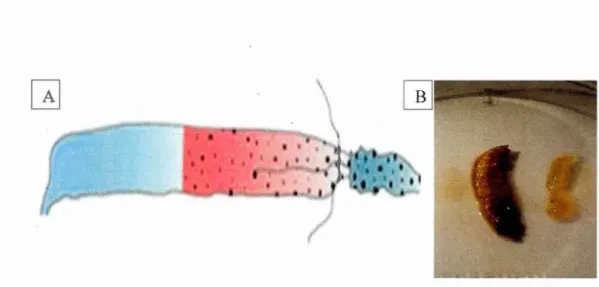
1.1 A) Schematic of a lepidopteran larval gut adapted from Engel and Moran (20 13 ). From le ft to right the image shows the hindgut, the midgut, and the foregut. B) Sixth instar larvae with its gut removed (left) and the
Page
disected gut ( right) ... ~... 3 5
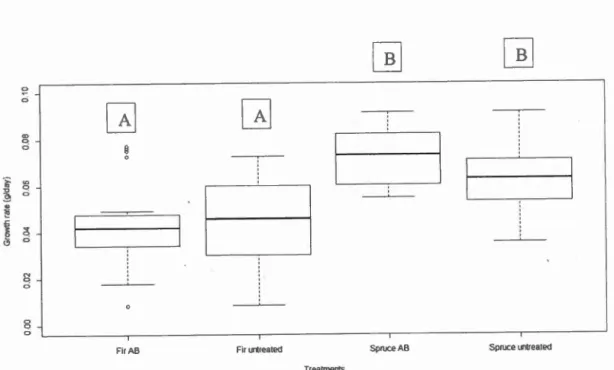
1.2 Growth rate (± S.E) of spruce budworm larvae among different diets and treatments.. .. ... .... ... .. . ... . .. ... ... . ... . .. .. . . . .. .. .. .. . . .. .. . .. .. ... ... .. .. . . .. .. . . .. . .. .. . ... . · 36
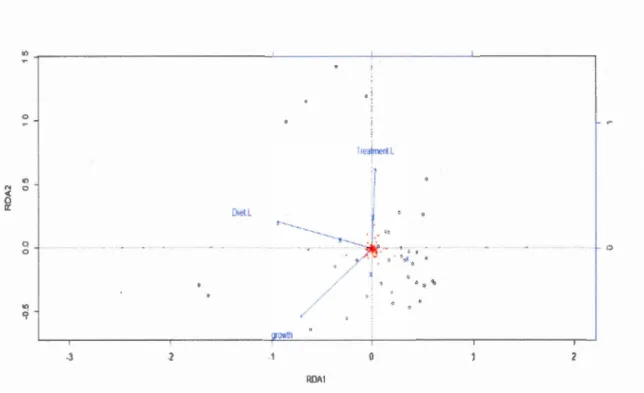
1.3 RDA biplots of spruce budworm larval gut-associated microbial communities ... 37
1.4 Mean Shannon diversity of microbial communities associated with diets, guts, and frass among treatments... 38
1.5 NMDS biplots showing the community structure of diet-associated microbial communities ... 39
1.6 NMDS bi plots showing the community structure of spruce budworm gut-associated microbial communities... 40
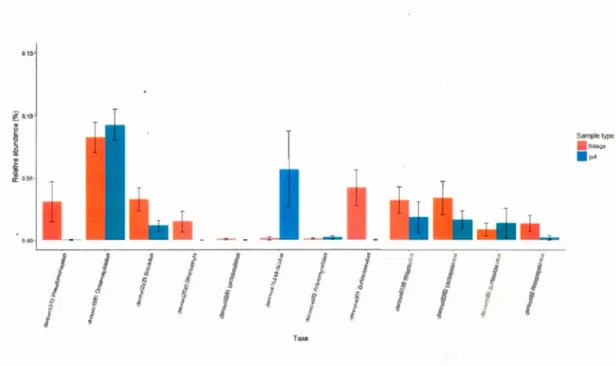
1. 7 Mean relative abundance of OTUs identified as being differentially
abundant between foliage- and gut-associated communities ... 41
l.S 1 RDA bi plots offoliage-associated microbial communities ... 45
I.S2 NMDS biplots showing the community structure of spruce budworm frass-associated microbial communities ... 46
l.S3 Relative abundance (± SE) of OTUs that were determined as
differentially abundant OTUs with ANCOM analysis of sample type
within treatment groups i.e a comparison of guts and frass associated vi
with larvae that fed on antibiotic treated spruce needles ... 47
l.S4 Relative abundance (± SE) of OTUs that were determined as
differentially abundant OTUs with ANCOM analysis of sample type
among treatment groups i.e a comparison of all guts and all frass samples. The relative abundances in this figure represent the relative
abundance ofthese taxa within each treatment group... 48
l.S5 Relative abundance (± SE) of OTUs that were determined as
differentially abundant OTUs with ANCOM analysis of all frass samples and all gut samples. .. ... . .. .. . .. . . .... .. ... ... ... ... .... ... . ... ... ... .. . ... .. . . .. . .. .. . . .. .. . . ... 49
l.S6 Relative abundance (± SE) of OTUs that were determined as
differentially abundant OTUs with ANCOM analysis of all fir-associated sam pies and all spruce-associated samples. ... 50
l.S7 Relative abundance (± SE) of OTUs that were determined as
differentially abundant OTUs with ANCOM analysis of all samples
treated with antibiotics and all untreated samples. ... 51
Table
1.1 Estimates of the influence time, antibiotic treatment, and diet on the weight of spruce budworm larvae exposed to different diet and antibiotic
Page
treatments.... ... . .. . . . .. ... . . ... ... . .. ... ... . . .... .. ... ... . . . .. . .. .. . .. . .. ... . ... . .. .. .. .. .. ... . . .. .. . . . .... 42
1.2 Pairwise comparisons of growth rate estimates for spruce budworm larvae within treatment groups as determined by a mixed effect mode!... 43 1.3 Growth rates of larvae feeding on Spruce and Fir needles with and
without antibiotics.. ... 44
l.S 1 Number of sam pies collected for sequencing analysis across ali sam pies and time points... 53
l.S2 Ali statistical tests used in this study along with the hypotheses tested, variables, and data used ... ,... 54
l.S3 List of significantly differentially abundant OTUs identified by ANCOM analysis. ... ... 55
ABSTRACT
Microbial communities have been shown to play an important role for host health in mammals, especially humans. It is thought that microbes could play an equally important role in other animais such as insects. A growing body of evidence seems to support this, however most of the research effort in understanding host-microbe interactions in insects has been focused on a few weil studied groups such as bees and termites. The effects of host-associated microbial communities in Lepidoptera remains relatively unstudied. We studied the effects of the gut-associated microbial comrnunity in the eastern spruce budworm, Choristoneura jitmiferana, an economically important forest pest in eastern Canada by studying the effects of an antibiotic treatment and diet on larval C. .fumiferana growth. Studying host-microbe interactions in
c.
.fumiferana not only provides us with answers to fundamental questions in lepidopteran biol ogy, but has applications in terms of forest management practices. We hypothesized that antibiotic treatments would disturb or remove the resident C. .fumiferana microbiome, resulting in decreased growth and survival. We show that the antibiotic treatment was sufficient to cause shifts in the microbial communities associated with balsam fir and black spruce foliage as weil as in the guts of C. .fumiferana larvae under laboratory conditions. Contrary to our expectations, we found that the observed antibiotic treatment did not significantly alter larval growth. We did find, however, that under laboratory conditions C. .fumiferana larvae perforrried better when feeding. on black spruce foliage compared to balsam fir which is widely understood to be the preferred food of C. .fumiferana due to phenology. We show that although most bacteria originating on foliage appear to be transient through the gut, sorne bacteria may thrive better in the C. .fumiferana gut. Therefore the C. fumiferana gut is only colonized by rare environmentally derived bacteria that are able to persist through the weak selective pressures exerted by the physiochemical properties found in the gut. Finally, our results suggest that C. fumiferana, and perhaps other lepidopteran species, are not nutritionally dependent on a resident microbial community.Keywords : Spruce budworm, microbiome, host-microbe interactions, lepidoptera
-Les communautés microbiennes jouent un rôle important pour la santé de leurs hôtes
chez les mammifères, en particulier pour les humains. Les microorganismes
pourraient jouer un rôle important pour les autres animaux, dont les insectes. Plusieurs études ont montré l'importance du microbiome pour les insectes, mais la majorité des recherches sur les interactions entre les insectes et la vie microbie1me s'est focalisée sur certains groupes taxonomiques, dont les abeilles et les termites. Les
effets des communautés microbiennes sur leurs hôtes chez les lépidoptères sont
cependant encore mal compris. Dans le cadre de notre projet, nous avons étudié les
effets du microbiote associés à l'intestin de la tordeuse des bourgeons de l'épinette
(Choristoneura fumiferana), un insecte ravageur important au Canada. Nous avons
quantifié en laboratoire les effets des traitements antibiotiques et les différentes diètes sur la croissance et la santé des larves de C. fumeriferana. Notre hypothèse était que
le traitement antibiotique modifierait le microbiome de la tordeuse et ainsi
diminuerait la croissance et la survie de la tordeuse des bourgeons de l'épinette. Nos résultats ont montré que les traitements antibiotiques n'avaient pas modifié la
croissance des larves. La croissance des larves de C. jùmeriferana était augmentée
lorsque leur diète était composée d'épinette noire par rapport à lorsqu'elle était composée de sapin baumier, malgré le fait que le sapin baumier est supposé être la diète préférée de C. fumeriferana en raison de sa phénologie. Finalement, nous avons montré que la majorité des bactéries dans l'intestin de la tordeuse sont des bactéries transitoires originaires des feuilles, mais il y a également certains taxons bactériens avec une bonne performance dans l'intestin de la tordeuse. Le rôle fonctionnel de ces bactéries reste inconnu.
Mots clés : la tordeuse des bourgeons de l'épinette, microbiome, interactions hôtes-microorganismes, lépidoptères
INTRODUCTiON
The eastern spruce budworm, Choristoneura fumiferana, is an economically important forest pest native to eastern Canada. Spruce budworm primarily feeds on balsam fir, Abies balsamea, and white and black spruce, Picea spp. Although C. fumiferana is polyphagous, they prefer to feed on balsam fir due to synchronized phenology between larval emergence and fir's budburst. Normally the impact of endemie spruce budworm populations on the boreal forest is insignificant, however every 30-40 years C. fumiferana undergoes a massive population outbreak which results in millions of hectares of defoliation (Boulanger and Arseneault, 2004; Sainte-Marie et al., 2015; Burton et al., 2015).
Because outbreaks can last for approximately 10 years, the amount of defoliation over such an extensive period causes massive growth reduction and tree mortality in ba1sam fir dominated, spruce dominated, or mixed stands.· For example, during the last spruce budworm outbreak, between 1975 and 1992, an estimated 52 million ha of forest were defoliated and during the peak of that out break (1977 -1981) it was estimated that 44 million m3 of timber was !ost annually. (Sainte-Marie et al., 2015; Burton et al., 20 15)
What makes C. fumiferana so devastating during these population out breaks is that C. fomiferana primarily feeds on recently emerged foliage. During the earl y stages of its !ife cycle C. fumiferana creates a silk hibernacu1um in the new-year buds of balsam fir or spruce trees and after a 6-8 month period of diapause, spruce budworm larvae feed on recently emerged current year foliage. Over a period of 4-6 weeks larvae continue to increase in size and go through 4 more instars with the later instars
consuming the most foliar biomass. Larvae prefer to feed on current year growth because it is more nutritious but if the population size is high enough larvae will also eat older needles.
The Spruce budworm is a member of the order Lepidoptera (moths and butterflies) which is one of the largest insect orders and contains numerous, mostly herbivorous, economically important species including a number of agricultural pests, such as the gypsy moth Lymantria dispar dispar, the tobacco hornworm Manduca sexta, and the diamondback mo th Plutella xylostella (Broderick et al., 2004; Brinkmann et al., 2008; Lin et al., 20 15). Like most lepidopteran pests, spruce budworm is most damaging during its larval stages or instars.
Adult spruce budworm mate and lay their eggs in mid-late summer. When first instar (LI) larvae hatch, they quickly locate an overwintering site where they, molt into the second instar (L2), build a silk hibernacula, and go into a state of diapause for approximately
6
months. After diapause they begin feeding on the newly emerged buds and over a period of 4-6 weeks will undergo four more instars with L6 larvae being the most voracious feeders. L6 larvae will pupate in late June to mid-July depending on the temperature and geographicallocation.Generally, there are two approaches to reducing damage caused by spruce budworm: silvicultural (forest management) strategies aimed at reducing overall forest vulnerability (Sainte-Marie et al., 2015; Burton et al., 2015) and the use of biological pesticides such as Bacillus thuringensis ssp kurstaki (Btk), a soi! microbe, at specifie points in the budworm !ife cycle to protect foliage by locally reducing spruce budworm numbers (Fournier et al., 2010). Although Btk toxin causes mortality on its own in the tobacco hornworm (Manduca sexta) it has been shown that mortality increased when the toxin was combined with the bacterium Enterococcus faecalis. The interaction between Btk toxin and E. .faecalis is an example of how interspecific
3
interactions between the resident microbiota, a pathogenic invader, and the host can have drastic effects on host fitness. Btk toxins allow E. faecalis to move from the gut
where it is benign into the hemoceol through openings in the gut lining where it
becomes toxic (Graf, 2011; Mason et al., 2011 ). The re is still a debate about the exact
mechanism of induced mortality, however, one recent study using RNA inhibition to
silence the 102 SI gene (a gene involved in immunosuppression) in Spodoptera
littoralis larvae provides further evidence to suggest that septicemia is an important
factor in Bt induced mmtality (Caccia et al., 20 16).
Despite being one of the most studied forest pests in Canada (Régnière and Nealis,
2007), collectively our knowledge of spruce budworm's associations with bacteria is
limited. Microbial ass~mblages are weil studied in humans and other mamrnals and it
is generally understood that microbes, especially those associated with the gut, are
critical to the growth and deveJopment oftheir host. Our knowledge of gut associated
microbial communities in insects is not nearly as expansive however. To date, only
one study has been published surveying the gut-associated microbial community in
spruce budworm (Landry et al., 2015).
Because our understanding of spruce budworm microbial associations is still limited, my goal in this study was to better understand the role, if any, that gut bacterial
assemblages play in maintaining spruce budworm growth. Studying bacterial
associations with spruce budworm can provide valuable insights into what influences
spruce budworm biology and ultimately fitness. From this new information we can
potentially develop new, microbial based, control options for spruce budworm
outbreaks. In addition, this study will provide additional insights into
lepidopteran-microbe interactions in general. Because many lepidopteran species are considered to
Much of the research investigating host-microbe interactions in insects is focused on economically important species like pollinators, insect pests, vectors of human disease and sorne mode! species such as termites. Due to the vast diversity, both in terms of physiology and morphology, within insects it is difficult to draw general conclusions about the importance of insect microbiota for their hosts. Many factors influence insect-associated microbial community function and structure including diet, gut morphology, physiochemical properties of the gut, host-specificity to microbes through co-evolution, host life stage, and host environment (Engel and Moran, 2013; Colman et al., 2012). In a recent study, Colman et al. performed a meta-analysis of 81 bacterial communities across 62 insect species representing multiple orders and 9 feeding types (herbivorous, xylophagous, etc .... ) from independent studies ail using 16S rRNA gene clone libraries and found that both diet and host taxonomy play a role in shaping the insect gut community. However, diet and host taxonomy alone cannot explain ail of the variability among insect bacterial communities. Colman and colleagues also suggest that, with a few exceptions, most insects do not maintain communities that are taxonomically distinct from the environment (Colman et al., 2012).
Although insect gut microbial communities are typically taxonomically similar to the environment, the overall function, or gene expression, of the community could be drastically different (Franzosa et al., 2014 ). The environmental con di ti ons experienced by a group of bacteria on the surface of a leaf would be different from the environmental conditions experienced in the spruce budworm gut. Assuming the spruce budworm acquires its gut microbiota directly from the environment, through feeding, the gut microbial community would be taxonomically similar to or a subset of the microbial community associated with the foliage the spruce budworm is feeding on (Ham mer et al., 20 17). Although the gut-associated community may be taxonomically similar to the diet-associated community, bacterial taxa being exposed to very different environmental conditions would likely express different genes in
5
arder to stay competitive thus changing the overall functional profile of the
community.
One can draw on previous studies to hypothesize what functions gut microbial
communities may provide to different hasts. Gut microbiota have been previously shawn to aid in the digestion of hard to process compounds. For example, bacteria in
honey bee guts have been shawn to aid in the degradation of the pectin found in
pollen (Engel et al., 2012) and bacteria have been shawn to aid a number of
xylophagous insects in the degradation of cellulose (Engel and Moran, 20 13). In addition to microbially mediated digestion of food, gut microbes aid sorne
herbivorous insects in processing secondary compounds which would otherwise be
taxie (Hammer and Bowers, 20 15). Spruce budworm must digest conifer needles
which are high in lignin and terpenes and thus symbiosis with bacteria could be
beneficiai. Another common function that microbes may provide is providing their
host with protection against pathogens either by buffering the host's immune response
(Kwong et al., 2017; Emery et al., 2017; De Souza et al., 2013) or by out-competing
invading pathogens or parasites (Koch and Schmid-Hempel, 2011).
The midgut microbial community among Lepidoptera has been shawn to be very
simple, law species richness, in terms of community composition. For example a study on Gypsy math larvae reported a community consisting of just 7 phylotypes (Broderick et al., 2004). A more recent study of gypsy math associated microbes (Masan and Raffa, 2014) reported an average of 52 operational taxonomie units (OTU) in the midgut, however most of those OTU's represented Jess than 1.0 % of
the relative community structure. The increase in diversity shawn in that study is
likely because the sequencing technology used (Masan and Raffa, 20 14) was more
advanced than that of Broderick et al. (2004). Using 16S rRNA gene amplicon sequencing the cabbage white butterfly was reported to harbor only 6-15 species of
community to be studied is that of the European corn borer, where metagenomics sequencing revealed a community consisting of 240 genera (Bel da et al., 2011 ). Many of the genera, however, were considered rare (making up Jess than 1% of the community). These results reveal, when one considers differences in methodology and advances in sequencing technology, relatively simple communities comprised of a few dominant environmentally derived taxa and a number of rare taxa. Although one must be cautious when making generalizations about midgut communities of lepidopterans, there are sorne trends evident in the literature. Sorne common phyla in lepidopteran microbial communities include Firmicutes, Proteobacteria, and Bacteroidetes, ali corn mon gut microbes in animais (Bel da et al., 2011; Tang et al., 2012; Broderick et al., 2004; Xiang et al., 2006).
Landry et al. (2015) is the first study of spruce budworm microbial communities using next generation sequencing. The study found a simple community dominated by Proteobacteria, with Pseudomonas being the most abundant genus within Proteobacteria. Other groups that were present in spruce budworm midguts include Actiniobacteria, Firmicutes, and Bacteroidetes. Interestingly Landry et al. (20 15) found higher diversity within midguts of spruce budworm that were reared on artificial diet containing 0.56% of the antibiotic Aueromycin. A possible explanation for this could be that although the antibiotics did not eliminate the gut community it could have reduced the abundance of the more dominant taxa easing corn petition th us allowing rarer taxa to increase in abundance. Regardless of the mechanism causing increased diversity in communities of larvae reared on artificial diet containing antibiotics, the differences were driven by an increased presence of Bacteroidetes, the vast majority (97%) of which in artificial diet fed individuals belonged to the family Chitinophagacaea. The principal finding of this study is that diet does appear to significantly affect gut microbial community structure in spruce budworm. The fact that diet is a main determining factor in spruce budworm gut community assembly
7
because it suggests that one could alter the spruce budworrn microbiome by altering
the microbial community associated with the host diet.
Bel da et al., 2011, one of the on! y studies th us far to examine function of the microbial community in Lepidoptera, reported significant differences in the·
taxonomie abundances between field caught and lab-reared larvae, a finding which
has been shown in other studies (Xiang et al., 2006). Although microbial
communities were taxonomically different between !ab and field populations of the
European corn borer, metabolic profiles were similar between the two populations
(Bel da et al., 2011 ).
The overall functi.on of the European corn borer (and possibly other lepidopteran
species), as described by Belda et al. (2011), was heavily invested in the breakdown
of food with 1 0-11% of the genes detected being associated with ami no ac id transport
and metabolism and 8-9% being associated specifically with carbohydrate
metabolism. Sixteen to twenty percent of genes were linked to general or unknown functions. One interesting difference in function between the field caught and lab reared populations was that the field metagenome had 1.3% of its genes associated with cell motility white no genes of that nature were detected in the lab metagenome
(Belda et al., 2011).
The . importance of microbial communities for insects is not universal. Despite
evidence to suggest that microbes perform important functions within the guts oftheir
. insect hosts, there is evidence to support the opposite. For example one study showed
that antibiotic treatment of cows was sufficient to alter the microbial communities in
cow dung and in the guts of dung beetles feeding on that dung, but that there was no
observable effect on the health of the dung beetle i.e survival or growth (Hammer et al., 2016).
A survey of 124 taxonomically diverse lepidopteran species representing 15 families
revealed that the lepidopteran gut microbiome is not distinct from the microbial
communities on the food they consume (Hammer et al., 20 17). Most Jepidopteran
species are herbivorous, however many Lycaenid butterflies are carnivorous. A
survey of Lycaenid butterflies provides further evidence suggesting that regardless of
dietary needs (herbivorous or carnivorous) the gut microbial community of
lepidopteran larvae are ali food-derived transient microbes (Whitaker et al., 20 16).
This suggests that lepidopteran larvae may not draw any inherent benefit from their
gut microbiota. The conclusion that Jepidopteran microbes are only transient
microbes presented in these two papers is based only on taxonomie identification of
microbes. To fully elucidate the question of whether or not lepidopteran Iarvae
maintain a distinct microbiome would require functional profiling of microbial
communities.
One possible explanation for why gut-microbial communities in Lepidoptera appear
to be transient is the morphology and physiochemical properties of the larval
lepidopteran gut. While many insect guts employ a more complicated morphology
with specialized structures, the larval lepidopteran gut is relatively simple
morphologically in that it is a simple tube (Engel and Moran, 2013). Additionally,
unlike most guts (insect or otherwise) the larval lepidopteran gut is an alkaline
environment with the typical pH ranging from 8-12 compared with most other insect
which have a gut pH ranging from 4-7 (Broderick et al., 2004; Tang et al., 20 12; Engel and Moran, 2013; Belda et al., 2011).
Another challenge to microbes trying to colonize the gut is that many lepidopteran
species go through multiple larval instars meaning that part of the midgut, the
peritrophic matrix, is shed multiple times during the lifecycle when the larvae
undergo ecdysis (Engel and Moran, 2013). The shedding of the peritrophic matrix and
9
nutrient extraction would be taking place makes it very difficult for microbes to
successfully colonize the gut. It is likely that the physiochemical conditions in the
lepidopteran midgut are an important factor in selecting the gut microbiota.
Conclusions about the relative importance of gut microbiota in Lepidoptera remain
incomplete. The main argument suggesting that the Iepidopteran Iarval gut is
inhabited by only transient microbes is based on observations suggesting that the
membership of the gut microbiome is largely food derived. Even though the
membership of the gut community mirrors the membership of the microbial
community associated with the food it is possible that the relative abundances of
different taxa will change as they are consumed and passed through the gut.
Considering the harsh conditions of the lepidopteran larval gut (high pH, disturbances
via shedding of the peritrpophic matrix) it is not unreasonable to consider the larval
lepidopteran gut as an environmental filter which would preferentially select a
resident microbial comrnunity able to colonize the gut under those conditions. If a group of microbes, derived from foliage, increases in relative abundance in the gut compared to the foliage it could be assumed that those microbes are metabolically
active in the gut and could be considered a resident microbiome. Sequencing of the
metatranscriptome, the collective RNA of the microbial community showing gene
expression, will be needed to confirm this.
I chose to investigate the gut microbial community of Choristoneura fumiferana to
better understand host-microbe interactions in an organism capable of defoliating
huge areas, particularly during outbreaks, of spruce and fir trees. The principal
objectives of this study were to determine if Choristoneura fumiferana selects for a resident microbial community that is shared among. In this memoire 1 used an experiment designed to eliminate the gut-associated microbiome of spruce budworm
larvae with antibiotics and track larval growth to test the hypothesis that spruce
growth and survival. Considering that the efficacy of the Bacillus thuringensis toxin
on lepidopteran larvae is partially tied to the presence of commensal gut bacteria,
gaining a better understanding of spruce budworm-microbe interactions could infom1
CHAPTER 1
INVESTIGATING THE EFFECTS OF THE GUT-ASSOCIATED MICROBIAL
COMMUNITY ON THE GROWTH OF THE EASTERN SPRUCE BUDWORM
1.1 Introduction
The eastern spruce budworm ( Choristoneura fumiferana) is a forest pest native to the
north eastern United States and Canada that undergoes epidemie population outbreaks
every 30-40 years. During these population outbreaks, lasting for approximately 10
years, millions of hectares of balsam fir (Abies balsamea) and spruce (Picea spp.) trees are defoliated and ki lied (Boulanger and Arseneault, 2004; Royama et al., 2005;
Sainte-Marie et al., 2015; Burton et al., 2015). Consequently spruce budworm is an economically important defoliator in coniferous forests (Fournier et al., 201 0) and has significant effects on forest productivity (MacLean, 1984).
Following the introduction of next generation sequencing technology the ease with
which microbial communities can be studied has increased dramatically. This has led to an increased body of literature investigating host-microbe interactions (Kuczynski
et al., 20 Il; Le page et al., 20 13). lt is largely accepted that microbes, particularly those associated with the gut, are critical for human health where they interact with
the immune system, aid in host nutrient acquisition through metabolic pathways, and
in sorne cases the disruption of the normal microbiota have been linked to diseases
such as obesity (Tilg and Kaser, 20 Il; Turnbaugh et al., 2006, 2009) and neurological disorders (Lepage et al., 2013; Tremlett et al., 2017). The general assumption regarding host-microbe interactions is that they, in sorne way, have a positive
interaction to their host rather than a negative one. While a large propo1tion of this research focuses on hurnans and other mammals, there are growing number of studies
investigating the microbial communities of insects (Engel and Moran, 2013; Douglas,
2009; Colman et al., 2012).
One of the most important functions of the insect gut microbiome is its potential to aid in digestion by breaking down compounds the host cannot (Feldhaar, 2011 ). The collective set of microbial genomes associated with a host, the microbiome, has a
much greater functional diversity than the eukaryotic host genome (Lapierre and
Gogarten, 2009). Thus the microbiome can act as an extension of the host gut. For example, gut microbial communities can have the capacity to metabolize sorne compounds that the host cannot. This is particularly important when considering spruce budworm because it feeds on conifer needles which are tough to digest and contain defensive compounds such as terpenes.
Drawing generalizations about the extent to which insect microbiota are important to
their host is difficult due in large part to the morphological, physiological, and
behavioral variation within insects. Different physiology, !ife histories, feeding
strategies, and levels of social interaction (of which there are many within insects) can ali influence how microbes interact with their host (Engel and Moran, 2013). There is evidence to support the assumption that microbial symbiosis is important in a number of insects as weil (Engel and Moran, 2013; Kwong et al., 2017; De Souza
et al., 2013; Koch and Schmid-Hem pel, 2011; Prado et al., 201 0; Rosengaus et al.,
2011; Emery et al., 20 17b; Engel et al., 20 12). The re is a wide body of evidence showing that termites, which depend on specialized bacteria to allow them to digest cellulose, and various species of bees benefit greatly from their associated microbiota.
Bee-associated microbes have been shown to contribute to immune function as weil
to aid in nutrition through mediating the digestion of cellulose (Engel et al., 2012; Kwong et al., 2017)
12
The lepidopteran microbiome has been described as a very simple microbial
community compared to other insects (Broderick et al., 2004; Masan and Raffa,
2014; Xiang et al., 2006; Tang et al., 2012; Brinkmann et al., 2008; Belda et al.,
2011; Robinson et al., 2010; Landry et al., 2015). One.reason that lepidopteran gut
microbial communities tend to be simpler than other insects is that the lepidopteran larval gut is a simple tube without any specialized structure for microbial cultivation
as is seen in termite guts (Engel and Moran, 2013). Another unique aspect of the lepidopteran 1arval gut is that unlike most insect midguts which are acidic and range
in pH between 4-7, lepidopteran midguts are highly alkaline ranging from pH 8-12
(Broderick et al., 2004; Tang et al., 2012; Engel and Moran, 2013; Belda et al., 2011).
The highly alkaline gut environment found in lepidopteran larvae would likely be a
significant barrier to microbes trying to colonize the gut and would thus provide
selective pressures allowing for.
We hypothesized that the eastern spruce budworm has a resident gut microbiome that must be maintained to facilitate larval growth and survival. Thus, we further
hypothesized that the disturbance of microbial communities with antibiotics will
negatively influence spruce budworm larval growth and survival. We also
hypothesized that the use of antibiotics will both reduce diversity of the microbial
communities associated with diet, guts, and frass, and would significantly alter the
composition of the spruce budworm gut microbial community in a way that would
negatively influence larval growth and survival. The objectives ofthis study were (!) to determine if the eastern spruce budworm has a resident gut microbiome that is distinct from the microbial assemblages associated with foliage as weil as to (2)
determine if the gut microbiota associated with spruce budworm larvae, resident or
otherwise, influence larval growth rates and survival. We also sought to quantify the
effects that antibiotics would have on gut microbial diversity and community
different diets and antibiotic treatments m order to measure larval growth and
survival in each treatment.
1.2 Materials and Methods
1.2.1 lnsect rearing
We acquired approximately 1,000 spruce budworm second instar larvae that had
completed diapause from the lnsect Production Services at th~ Great Lakes Forestry
Centre, (Sault Ste. Marie, ON, Canada). Larvae were packaged between a .sheet of
para film and a sheet of chee se cio th and stored at 4
oc
prior to the start of theex periment. Sections of the parafilm containing approximately 30-40 larvae were eut
using scissors sterilized for 5 seconds with 70% ethanol and placed on cups of
synthetic diet containing antibiotics in autoclaved magenta boxes. Larvae were
allowed to emerge from their hibernacula and feed on the common diet for one week.
The purpose of rea ring larvae on a common di et for the first week was twofold: to
ensure larvae were large enough to successfully eat foliage, and so that ali larvae
started to feed on the same food to control for variation in the starting microbiota
among second instar larvae. Throughout the experiment larvae were maintained at
24°C at 60% relative humidity under a 16h:8h light:dark cycle. (NRCAN, 2016).
After 1 week of feeding on the common di et, 200 larvae were randomly selected and
split equally among 5 treatments (n=40): artificial diet with antibiotics, black spruce
(Picea mariana) foliage treated with antibiotics, untreated spruce foliage, balsam fir (Abies balsamea) foliage treated with antibiotics, and untreated balsam fir foliage.
Each replicate consisted of an individual larva in an autoclaved magenta box. Spruce
foliage was collected from saplings housed in the greenhouse at the Université du
Québec à Montréal and stored at -20°C for approximately 4 weeks. Fir foliage was
14
4 weeks. In both cases we took care to use only foliage that had fresh growth. Foliage
was kept fresh by placing the eut stem in a 2ml microcentrifuge tube filled with
sterile water, or 50 11g/ml streptomycin for antibiotic treatments, and sealed with
parafilm. For antibiotic treatments, a 1500 ppm solution of methyl paraben and a 50
11g/ml solution of streptomycin were each sprayed on the foliage every other day.
Untreated foliage were not manipulated other than placing the eut stem in a
microcentrifuge tube containing sterile water.
1.2.2 Health assessment: measuring larval growth and survival
Larval health was assessed every other day by measuring larval weight and calculating growth rates. Overall survival was calculated as weil. We chose larval
weight as a proxy for health because it is often used as a measure of fitness in pupae
and therefore can also be used as a representation for overall health (Hammer et al.,
2017). We removed each larva from its magenta box using a fine paintbrush, placed it on a sterile weigh boat, and recorded the mass. Re-application of antibiotics on foliage occurred at this time via spray bottle. Ali work was done in an ethanol sterilized fume hood. The paintbrush used to manipulate the larvae was sterilized for
5 seconds with 70% ethanol between each replicate. Larvae that were dead at the time
of weighing were discarded and any growth data collected prior to mortality was not
used in the subsequent analysis, as a result we only present data associated with
larvae that survived through the entire experiment in this study.
1.2.3 Sample collection
We collected sixth-instar larvae just prior to pupation, placed them in microcentrifuge
tubes, and left them at room temperature for 4 hours before freezing at -80°C. This
was to allow for any remaining food to pass through their guts, providing us with a
more accurate approximation of the true gut microbiota as opposed to microbes
extracted from surviving individuals using forceps and scissors sterilized with 70%
ethanol by cutting the posterior and anterior ends of the individual off to separate the
midgut from the hindgut and foregut; remaining midgut was extracted from the larva
using the forceps (Fig 1). Extracted guts were placed directly in MoBio PowerSoil
bead beating tubes (Qiagen) and stored at -20°C until nucleic acid extraction.
We sampled frass and foliage samples twice during the experiment, once 7 days after
exposure to treatments and again after 14 days when larvae were also collected (Table
S 1 ). Foliage was collected by taking 5 needles with ethanol sterilized forceps, placed
in microcentrifuge tubes, and immediately frozen at -80°C. Frass was collected from
the bottom of the magenta box, placed in microcentrifuge tubes, and immediately
frozen at -80°C. Samples were then assessed for microbial community diversity and
composition following DNA sequencing.
We sampled frass and foliage communities along with the gut microbiota. Using these
three communities to determine how the relative abundance of microbes changes
from the source (foliage) through an environmental filter (gut) and by comparing gut
communities with frass communities (or foliage communities) makes it possible to
determine which taxa are able to persist in the gut versus which taxa simply pass
through the larval gut.
1.2.4 DNA extraction and processing
We extracted DNA from the midguts of ali surviving larvae (n=96). In addition 10
random individuals were selected randomly from each of the 5 treatment groups to
extract DNA from foliage or synthetic di et (n= 10 1) and frass (n=99), both collected at
each of the two time points. Ali genomic DNA from guts, foliage, and frass was
extracted using the MoBio PowerSoil DNA extraction kit (Qiagen). We used a
slightly altered protocol in order to increase DNA yields. Guts were homogenized by
16
centrifuged at room temperature for 1 mm at 1 O,OOOg. The supernatant was
transferred to a sterile 2 ml microcentrifuge tube and sonicated with the Bioruptor
UCD-200 sonicator (Diagenode) for 1 min on the low setting (160W at 20kHz) for 5
min. After sonication the DNA extraction proceeded as per the manufacturer's
instructions.
Foliage and synthetic diet samples were placed in thick walled 2 ml tubes with three
2.3mm diameter stainless steel beads (BioSpec Products, Bartlesville, OK, USA) and
250 Jll of the PowerSoil bead tube buffer. Diets were homogenized using a MiniBead
Beadbeater-16 (BioSpec Products, Bartlesville.) for 1.5 minutes. The remaining
buffer from the bead beating tube was added to the resulting homogenate, sonicated
at the high setting (320W at 20kHz) for 2 minutes and re-introduced to the bead
beating tubes. Frass samples were sonicated for 2 minutes at the high setting (320W
at 20kHz) for 2 minutes with 250 Jll of the bead beating buffer. Following sonication,
samples were transferred back to the bead beating tubes. For diet and frass samples,
after sonication the DNA extraction was performed following the manufacturer's
instructions.
Following DNA extractions all samples were cleaned using the Zymo OneStep-96
PCR inhibitor removal kit. Polymerase chain reaction (PCR) was used to amplify the
16S rRNA gene from the extracted DNA. We used the chloroplast excluding primers
(799F and 1115R) (Chel_ius and Triplett, 2001) to target the V5-V6 region of the 16S
rRNA gene. Each primer also contained 1 of 20 unique bar codes and an Illumina
adaptor to allow sequences to bind to the flow cell of the MiSeq sequencer. PCR was
performed using 25 Jll reactions prepared with 1 Jll genomic DNA diluted 1:10 in
molecular-grade water, 5 )ll 5x HF buffer (Thermo Scientific), 0.5 )li dNTP's (1 0 )lM each), 0.5 Jll forward and reverse primer (1 0 )lM each), 0.75 Jll DMSO, 0.25Jll
Phusion HotStart II polymerase (Thermo Scientific ), and 16.5 Jll molecular-grade
cycles of: 15s at 98°C, 30s at 64°C, 30s at
n
o
e
,
and a final elongation step atn
o
e
for 10 minutes. Ampli cons were cieaned and norma1ized to 0.55 ng/j..d using the
lnvitrogen Seque1Prep normalization plate kit. After normalization, equal volumes of
amplicon DNA per sample were pooled and sequenced.
1.2.5 Amplicon sequencing
16S rRNA gene amp1icons were sequenced using the Illumina MiSeq platform using
V3 chemistry. After sequencing, we first trimmed Illumina adapters from our
sequences using the program BBduk version 35.76 (https://
sourceforge.net/projects/bbmap) and created paired end sequences using PEAR
version 0.9.5 (Zhang et al., 2014). The resulting paired end sequences were
demultiplexed and passed through a quality control workflow using QIIME version
1.9.1 (Caporaso et al., 2010) where chimeric sequences, sequences with more than
two errors in the primer sequence, and sequences with an average quality score 1ower
than 25 were removed. In total 3,568,621 sequences were obtained across ali samples
after the initial quality control steps and the removal of chimeric sequences.
Sequences passing quality control parameters were binned into 8,593 operational
taxonomie units (OTU) based on a 97% sequence similarity usmg the uclust
algorithm. OTUs were used in our study because they are· standard method of
identifying bacterial species (My sara et al., 20 17).The most abundant sequence for
each OTU was used as a representative sequence that was taxonomically identified to
the lowest possible leve), i.e species, using a BLAST search of the Greengenes 16S
gene database (DeSantis et al., 2006). In addition an alignment of each OTUs
representative sequence was used to create a phylogeny using the FastTree 2 software
(Priee et al., 201 0). Following quality control, we analyzed community composition,
structure, and the effects of gut communities on spruce budworm growth and survival
,
--
-
--
--
--
--
---
---
----
--
---
---181.2.6 Growth and survival analysis
The effects of antibiotic treatment and diet (spruce or fir) on spruce budworm growth and survival were tested using two separate models. A mixed-effects mode! implemented with the R package nlme (Pinheiro et al., 20 17) was used to test for differences in larval growth. Larval weights were log transformed and used as the response variable in the model. Time, antibiotic treatment, diet, and their interactions were used as fixed effects, where time as a fixed effect is an estimate of growth rate, and time nested within individual larvae was used as the random effect for the model. By defining our mode] this way we ensured that growth was treated as a repeated measure, meaning that initial differences between larvae are accounted for in the mode! because the mode! measures the growth rate of each larva. Differences in larval survival were tested using a separate logistic regression with survival as a binary response variable and antibiotic treatment, diet, and their interaction as main effects.
1.2.7 Community analysis
We tested for differences in comrnunity composition and diversity both among and within sample types (foliage, guts, frass). When we made comparisons among sample types, data were analyzed as a single dataset so we could ensure that each sample type had equal sampling depth for comparisons. When comparing treatments within sample types we analyzed separate datasets for each sample type that were rarefied separately. Sample types were rarefied separately to ensure the maximum number of sequences could be used in our analysis, allowing for more statistical power when testing within sample type differences.
Prior to our analysis we removed extremely rare OTUs ( < 10 sequences) and sam pies that had fewer than 500 total sequences. A total of 1,020 OTUs remained after removing rare OTUs. When ali sample types were analyzed together samples were
rarefied to 1,000 sequences. When analyzed separately, gut samples were rarefied to
2,500 sequences per sample while di et and frass samples were rarefied to 1,000
sequences each. We calculated Shannon diversity based on relative abundances of
rarefied sam pies for each data set as a measure of diversity.
Community structure was explored using non-metric multidimensional scaling
(NMDS) using two complementary distance measures; unweighted UniFrac, and
weighted UniFrac (Lozupone and Knight, 2005). We chose to use these two distance
measures in tandem because they each provide slightly different information about
community composition. Weighted and unweighted UniFrac are both phylogenetic
distances where weighted Uni Frac is weighted by abundance. U nweighted Uni Frac
distance reveals how communities differ in terms of membership whereas weighted
Uni Frac shows how the relative abundance of microbes change in the community. By
using these two distance measures we are able to use both phylogenetic relatedness
and abundance to make inferences. Permutational multivariate ANOVA
(PERMANOVA) with 10,000 permutations was used to test for differences in
community structure among diets and between antibiotic treatments using the
unweighted UniFrac and weighted UniFrac distance measures. PERMANOVA was
implemented using the R package Vegan (Oksanen et al., 20 17).
Gut communities were further analyzed to look for correlations between growth rate
(calculated from log-transformed weights as the slope of a simple linear mode! for
each larva) and gut community structure using redundancy analysis (RDA) with
growth rate, diet, and treatment as environmental variables. Individual growth rates
were used for redundancy analysis rather than the estimate derived from the mixed
effects mode! in order to incorporate the communities of each sample separately
rather than a single average community. lndividual growth rates calculated in this
manner were comparable to the estimate derived from the mixed effects mode!.
20
correlations between plant-associated microbial communities and larval growth. In
addition to using redundancy analysis to examine how growth rate and gut
community structure are related, the fastest and slowest growing larvae, defined as
the larvae in the upper and lower quartile of growth rates respectively, were selected for each experimental group and we compared their gut community structure.
Finally to test for differences in relative abundance of individual taxa between groups we used a differentiai expression analyses using the R package ANCOM (Mandai et al., 20 15), which tests for differences in mean relative abondances of taxa between
communities. ANCOM utilizes logarithrnic transformations, so the method does not perform well with large numbers of zero counts (Weiss et al., 2017). To correct for this prior to analysis, we added a pseudocount of 1 to each value (this is done
automatically by the ANCOM package). Because we used relative abundance data,
adding 1 to samples with unequal sampling depth would produce unreliable results.
We addressed this problem by rarefying sam pies to 1000 sequences prior to the
addition of a pseudocount. With ANCOM, differentially abundant OTUs were
identified using the Kruskal- Wallis test with the Jess stringent multiple testing
correction option provided by ANCOM and an alpha of 0.05. We chose to use this method for calculating differentially abundant OTUs because it has been shown to perform better than other methods (Weiss et al., 20 17). A table of ail statistical tests used in this study can be found in the supplementary materials (Table S2)
1.3 Results
1.3.1 Effects of diet and antibiotics on larval survival
There was no significant effect of diet (logistic regression; z= -0.897, p=0.3695) on
larval survival rates, however antibiotic treatment tended to favour survival (logistic regression; z= -1.810, p=0.0702) (Fig S 1 ). Because the synthetic di et was designed to
be optimal for spruce budworm growth and survival a second logistic regression was
performed only on larvae that fed on foliage and we found that there was no longer a
trend of antibiotic treatment on larval survival (logistic regression; z=O.I1 0, p=0.913)
The trend of antibiotic treatment favouring surviva1 seems to be driven by the difference between larvae feeding on spruce (30%) that was not treated with antibiotics and larvae that fed on synthetic diet (60%) which contained antibiotics.
Overall, larvae feeding on artificial diet, which contained antibiotics, had a survival rate of 60%. Larvae feeding on spruce that was not treated with antibiotics had 30%
survival. Larvae feeding on spruce and fir treated with antibiotics both had 50% survival and larvae feeding fir without antibiotics had 52.5% survival.
1.3.2 Effects of diet and antibiotics on larval growth rate
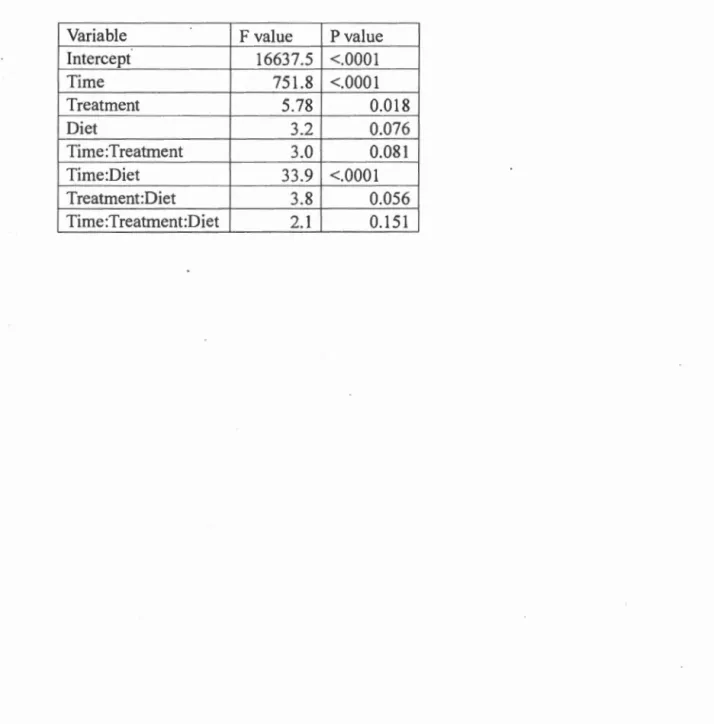
The weight of spruce budworm Iarvae was significantly affected by antibiotic
treatment and ti me (Table 1 ). In the mode!, the estima tes of ti me as a main effect
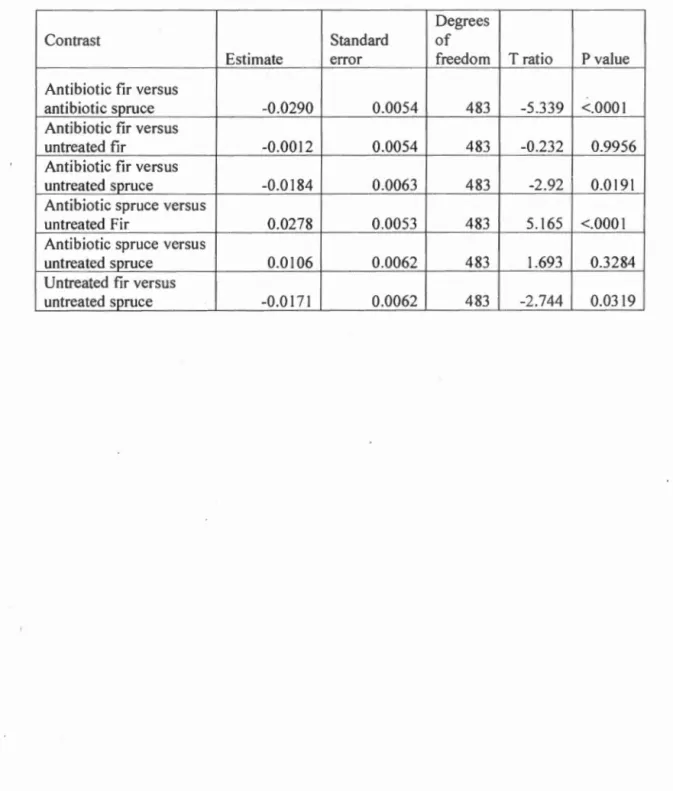
represents growth rate. Pairwise comparisons of the 1east squares means for the time
effect show differences in growth rate between individuals feeding on fir and spruce (Table-2)(Table 3)(Fig 2). Comparisons show that individuals feeding on fir treated
with antibiotics grew Jess than those feeding on antibiotic treated spruce ( -0.020 ±
0.005(mean ± SE); p<O.OOOI), and larvae feeding on untreated fir grew Jess than
those feeding on untreated spruce ( -0.017 ± .006; p=0.032). Comparisons between larvae feeding on antibiotic treated and untreated foliage of the same type (i.e fir or spruce) were not significant however.
The overall differences in growth rate observed between spruce budworm larvae in different experimental groups were due to antibiotic treatment, however this result
.must be interpreted carefully because it appears to be largely driven by an interaction between diet and antibiotic treatment rather than a consistent effect of antibiotics on growth rate. The only pairwise comparisons that were not found to be significant
22
spruce with untreated spruce. Therefore, differences in growth rate observed among different groups of Jarvae are due to differences in diet more so than any disturbance in the microbial community caused by antibiotic treatment.
Redundancy analysis (RDA) of the gut-associated microbial community of spruce budworm larvae feeding on foliage with larval growth rate and the effects of diet and antibiotic treatment as explanatory variables, 9.8% of the variance in spruce budworm gut microbial community structure could be explained. Individually, growth rate explained 4.0 % of the variance, diet explained 4.8 % of the variance, and antibiotic treatment explained 2.3% of the variance (Fig 3B).
To determine if the plant-associated communities of the foliage were correlated with larval growth, a separate RDA was performed comparing foliage-associated communities with larval growth rates using communities isolated from foliage collected at the first time point. A Procrustes analysis of NMDS ordinations revealed that the community structure of foliage did not significantly differ between collection times (Procrustes; sum of squares = 0.88, p=0.57). Growth rate, tree species, and antibiotic treatment explained 18.7 % of the variance in foliage-associated communities (treatment: 8.86%, diet: 5.55%, growth rate: 3.75 %) (Fig S2)
1.3.3 Differences in the gut community of fast and slow growing larvae
We compared the gut-associated communities of the fastest and slowest growing larvae (upper and lower quartile of growth rates) in each treatment group as an additional way to determine if gut community structure impacts spruce budwom1 Jarval growth. Gut communities of Jarvae feeding on antibiotic treated fir were not significantly different between fast and slow growers (PERMANOVA; F=l.89, R2 -=0.32, p=O.l 0). Gut communities of larvae feeding on untreated fir foliage were not significantly different among fast and slow growers (PERMANOVA; F=0.74,
R2=0.15, p=0.86). Out communities of larvae feeding on antibiotic treated spruce
foliage did not differ between fast and slow growing individuals (PERMANOVA;
F=1.07, R2=0.26, p=0.2). Out communities of larvae feeding on untreated spruce
foliage did not differ significantly between fast and slow growing individuals
(PERMANOVA; F=2.17, R2=0.35, p=0.10). Recalculating the aforementioned
ordinations with weighted UniFrac did not change the overall results.
1.3 .4 Effects of antibiotic treatment on microbial communities
Antibiotic treatment (ANOVA; F=5.834 p=0.019) significantly affected the microbial
diversity (Shannon diversity of OTU relative abundances) of the diets (Fig 4A).
Foliage that had been treated with antibiotics ( 1.8 ± 0.12) had slightly lower diversity
than untreated foliage (2.20 ± 0.12) however the difference was not significant
according to post hoc tests (TukeyHSD; p = 0.051 ). Shannon diversity in the guts of
spruce budworm larvae differed significantly between antibiotic treatments (ANOVA;
F=20.5, p<O.OO 1 )(Fig 4B). Larvae feeding on synthetic di et that contained antibiotics,
had significantly lower microbial diversity in their guts (0.52 ± 0.13) than larvae
feeding on foliage treated with antibiotics (1.52 ± 0.13) or untreated foliage (1.47 ±
0.13) (TukeyHSD; p<0.001)(Fig 4B). The Shannon diversity of microbial
communities sampled from spruce budworm frass did not differ among any of the
treatments (Fig 4C).
The composition of diet-associated microbial communities (fir foliage, spruce foliage,
and synthetic diet) was affected by antibiotic treatment (PERMANOVA; F=1.43,
R2=0.022, p=0.0027) regardless of the ecological distance measure used (Fig 5).
However, when just foliage samples were compared antibiotic treatment only had an
effect on foliage-associated community composition when UniFrac distances were
weighted by relative abundance (Fig 5D-C). Unlike diet communities, in
gut-associated communities, antibiotic treatment only affected comrnunity structure when
synthetic diet fed larvae were excluded and the comparisons were made with
-24
weighted UniFrac distances (PERMANOVA; F=2.40, R2= 0.060, p=0.025)(Fig 6). There was no effect of antibiotic treatment on microbial community composition associated with the frass of larvae from any treatment group.
Antibiotic treatment had a significant effect on the communities associated with the diets fed to a subset of larvae from each treatment. Spruce budworm gut-associated communities, however, were only affected by antibiotic treatment when distance measures were weighted by the relative abundance of OTUs. In addition, because the microbial diversity of spruce budworm gut-microbial communities was the same between larvae fed on treated and untreated foliage, this suggests that antibiotic treatment affected the relative abundance of OTUs in gut communities but not membership.
1.3.5 Does spruce budworm have a resident microbiome?
To test if spruce budworm has resident gut microbiota, we compared the associated microbial communities among diets (foliage and artificial diet), guts, and spruce budworm frass, both at a community-wide scale and at the scale of individual OTUs. Microbial diversity was significantly different among sample types (ANOVA; F=23.68, p<0.001). Unsurprisingly, a post-hoc test (Tukey's honestly significant difference test; TukeyHSD) revealed that microbial diversity was lower in guts ( 1.16
± 0.09 (mean ± SE)) than in foliage samples (1.74 ± 0.1) (TukeyHSD; p<O.OOl). Interestingly microbial diversity was also lower in guts than in frass samples (1.76 ±
0.06) (TukeyHSD; p<O.OO 1 ). There was no significant difference in microbial diversity between frass and foliage communities (TukeyHSD; p=0.986).
The microbial communities of diets (including artificial diet), guts, and frass were significantly different from each other based on analysis of square root transformed weighted UniFrac distances, based on the phylogenetic relatedness of OTUs among the communities weighted by their relative abundances (PERMANOVA; F=4.50,
-R2=0.034, p<O.OOI). Because these communities are different, we analyzed the effects of each sam pie type separately using both unweighted and weighted Uni Frac.
Overall diet-associated communities were different among diet types (PERMANOVA; F=l.66, R2= 0.052, p<O.OO!)(Fig 5) The largest difference among diet-associated communities in terms of composition was between foliage communities and the communities in the synthetic diet (Fig 5). Differences between spruce- and fir-associated communities were also evident m our data (PERMANOVA; F=l.27, R2=0.0255, p=0.031).
Gut-associated communities follow a similar trend but are Jess pronounced than differences observed in the foliage- and synthetic diet-associated communities. In most of the comparisons of diet-associated communities, diet type (tree species or artificial diet) was identified as being a significant factor driving community structure between foliage and artificial diet. Gut community composition on the other hand was only affected by diet type when larvae that fed on synthetic diet were included in the analysis (PERMANOVA; F=l2.97, R2=0.31, p<O.OOI) (Fig 6). There was no difference in gut-associated community composition between spruce and fir foliage fed larvae (Fig 6). This result indicates that antibiotics affect the relative abundances of gut microbiota in the spruce budworm gut, but difference between host foliage does not. Across ali gut samples the most 5 most abundant OTUs were identified as: Enterococcus sp. (39.7 % relative abundance), Shewanella sp. (13.6%), Shewanella sp. (8.8%), a member of the family Halomonadaceae (7.4%), and Halomonas sp. (7.4%).
Frass-associated microbial communities in general were more similar among different diet types and treatments than either the guts or diet samples. Frass communities differed significantly among diets. However when synthetic diet was removed from the mode!, to analyze just individuals who had been fed foliage, none of the
26
treatments significantly affected community structure m frass (Fig. S3). Weighted
UniFrac with synthetic diet included in the analysis showed that diet had a significant effect on microbial community structure (PERMANOVA; F=2.052, R2=0.0493
p=0.0031) (Fig.S2), but when only frass of individuals feeding on foliage was no
detectable difference in community structure between them. Finally based on
unweighted UniFrac distances, a purely phylogenetic distance measure, there was no
difference among any of the treatments in frass (Fig S3).
Generally, our results show that the type of diet (spruce foliage, fir foliage, or synthetic diet) and antibiotic treatment had a significant effect on the communities associated with the ·diets fed to a subset of larvae from each treatment. When we analyzed the gut-associated bacterial communities we were stiJl able to detect effects on commuriity structure attributed to diet type but that difference was driven entirely by the difference in community structure between synthetic diet and fresh foliage. When the guts of larvae that were fed synthetic diet were removed from the analysis, the only difference that we detected between communities was due to antibiotic
treatment when weighted UniFrac was used as the distance measure. Because the
only difference that we observed in community structure was calculated with a metric weighted by abundance, this suggests that antibiotic treatment applied to the different diets bad sorne effect on spruce budworm microbiota relative abundances but not on overall community membership.
1.3.6 Are gut-associated bacteria more abundant in foliage or the gut?
We compared the relative abundances of individual OTUs between foliage, guts, and frass samples to identify OTUs that were differentially abundant between samples
using ANCOM (Table SI). ldentifying differentially abundant OTUs was done to
further determine if the spruce budworm gut has a resident microbiome. Among ali
diets and treatments, ANCOM detected 9 differentially abundant OTUs between gut
more abundant in foliage-associated communities (Fig 7). We also detected three differentially abundant OTUs between gut and frass communities two of which were
more abundant in frass wh ile the third, denovo41 54: Mollicutes, was more abundant
in guts.
The re was one differentially abundant OTU ( denovo80 18: Halomonas sp.) between the gut (relative abundance in gut: 0.0003 ± 0.0001) and fo1iage communities (relative abundance in foliage 0.0 ± 0.0) of larvae feeding on antibiotic treated fir,
however Halomonas sp. accounts for less than 1% of the gut associated bacteria in larvae feeding on antibiotic treated fir. Comparisons of gut and fir communities from
the untreated fir group yielded two differentially abundant OTU s ( denovo5 188:
Methylocystaceae and denovo92: A cetobacteraceae ). Bath denovo5 188
Methylocystaceae and denovo92 Acetobacteraceae were more abundant in diet
(0.0704 ± 0.031 and 0.026 ± 0.011 respective1y) than in guts (0.0 ± 0.0 and 0.0 ± 0.0).
Within the group of larvae being fed spruce foliage, 3 differentially abundant OTUs
were detected between gut and foliage communities from the antibiotic group (denovo2429: Staphylococcus sp., denovo4501: Burkholderiaceae, and denovo5458
Enterococcus sp.). 3 OTUs were found to be differentially abundant in the untreated
group ( denovo2287: Erwinia sp., denovo 1313: Pseudo manas sp., and denovo699
Oxalobacteraceae). Ali of the OTUs identified as being differentially abundant
between gut and foliage communities were more abundant in foliage than in guts.
Two differentially abundant OTUs were detected between frass and gut communities
in the antibiotic fir group and one differentially abundant OTU was detected between
frass and gut communities in the untreated fir group. One of the OTUs detected in the
antibiotic fir group (denovo8018: Halomonas sp.) and the OTU detected in the fir (denovo3500: Shewanella sp.) were both more abundant in guts than in frass. Within