HAL Id: sic_00826944
https://archivesic.ccsd.cnrs.fr/sic_00826944
Submitted on 28 May 2013
HAL is a multi-disciplinary open access
archive for the deposit and dissemination of
sci-entific research documents, whether they are
pub-lished or not. The documents may come from
teaching and research institutions in France or
abroad, or from public or private research centers.
L’archive ouverte pluridisciplinaire HAL, est
destinée au dépôt et à la diffusion de documents
scientifiques de niveau recherche, publiés ou non,
émanant des établissements d’enseignement et de
recherche français ou étrangers, des laboratoires
publics ou privés.
Treating bibliometric indicators with caution: their
dependence on the source database
Luc Quoniam, Hervé Rostaing, Eric Boutin, Henri Dou
To cite this version:
Luc Quoniam, Hervé Rostaing, Eric Boutin, Henri Dou. Treating bibliometric indicators with caution:
their dependence on the source database. Research Evaluation, Oxford University Press (OUP), 1995,
5 (3), pp.177 - 181. �10.1093/rev/5.3.177�. �sic_00826944�
.
.
* -Research E1,r7lrroh011. volume 5 . number 3. Decemher 1995, pages 177-181. Beech Tree Publ~sh~ng. 10 Watlord Close. Gu~ldlord. Surrey GUI 2EP, England
Database comparisons
Treating bibliometric indicators with caution:
their dependence on the source database
L
Quoniam,
H
Rostaing, E Boutin,
H
Dou
No~vrrrlrrys, with conzputer-supported rrnrrlysis
of rlrrtrrbnses, constructing biblionretric or
scientonteiric inrlicrrtors nrny be consirlered
errsy. Theprobleni is nzore to serify the nccurrrcy
of tire globnl anrrlysis, including the sany~ling
of drrtrr. The global coherence of
rm
analysis
depends on tlte nrlequrrcy of rrll the steps. Using
on-line drrtnbrrses, nn experinlent ~vrrs
rlesigned
to denwnstrrrte this. Keeping the sang protocol
for dnta collec.tion, the srrnte inrlicrrtors rrre user1
oser the ~lrrrious
smzples.
he
resultsfronr three
sepnrnfe rlrrtrrbrrses are profounrlly rZi&ferent.
I,
Quoninm. I l l<ostaing and I I Dou are at CRRM I:acr~llC StJc;rbme. 1 3 3 9 7 M a r s e i l l e . CE1)F.X 2 0 . Fraticc. E-mail: crrti~.~crrm.univ-111rs.ti; E Boutin is at Cctitrc dc rcchcrclic 1-EI'ONT. BP 133. F-83957.l.a Gardc C E D I X , France.
'Ilic authors tvould like to ~ h a ~ i k both Dialog Information Scrticcs (3460 IIillvictv At.. PO 130s 10010, Pale Allo, CA 94303. USA) arid INIS'I'
(3
allCc du pare d c brabois. 54514 Vandocuvrc-lcs-Nnticy, C E I X X . I'rancc) for tlicir valuablc liclp.S
CIENTIFIC PRODUCTION and collaborative
a b i l i t ~ l - ~
are used as indicators ofthe activity of
a laboratory even though they are quantitative
not qualitative
indicator^.^
We have tested the accu-
racy of these indicators through various on-line bib-
liographic databases. Since we were dealing with
researchers' work in detail, we looked only at ourown
laboratory, according to the code of practice for
information
broker^.^
Data collection
Among our laboratory activities are bibliometry,
scientometry and informetry. We used these three
words, well recognised and defined n o ~ a d a y s , ~
as
kej~vords
with the Dialog Dialindes to get the data-
bases with the best coverage in this area. Our purpose
was not to build the best data collection in each
database, but more to show the individual perception
of each database, using keywords recognised by the
scientists of the area. gives the main responses.
Cost considerations led us to use as much informa-
tion as possible from CD-ROM to constitute our
internal database. Lisa was collected from CD-ROM
for 1994, and Pascal for 1987-94. Because there are
so many duplicates bctsveen Sc~Search, Social
SciScarch and Currcnt Contents Search, the latter
database ivas not considcrcd. An internal database
\\.as doivnloadcd fro111 D~alog from the othcr tsvo
ivithout duplicates.
Thcrc is somc variability beh\.cen the CD-ROM
vcrsions and thc original databascs. so the intcmal
databascs do not havc esactly t l ~ c
same number of
rcfcrcnccs as sh0it.n
in
Tablc
1 .
For esample, Pascal
Trentitrg bibliometric itidicorors \vitlr cntrriori
Table 1. Data collection strategy with Dialog Dialindex
- -
Nurnber Base collection i n 0111995 61 Lisa(Library&infoSci) 1 44 Pascal
202 Information Science Abs 7 Social SciSearch 440 Current Contents Search 434 SciSearch
Bibliornetry Scientometry Informetry 1 , 2 o r 3
does not exist in CD-ROM before 1987. The
producers of the three internal databascs are different
(English for Lisa, French for Pascal, and American
for SciSearch). Two of these databases are multidis-
ciplinary (SciSearch and Pascal), and one thematic
(Lisa). The number of bibliographic notices collected
is reported in Table 2.
Ana1
ysis
From these databases, we perfornied severa1 analyses
for interna1 purposes. We no\\- present a few of ílicni.
Instead of building a common database without du-
plicates, we kept the databases separate to denion-
strate the particularity of each one. Each has its on-n
indesation practice, sources and point of view. Ap-
plying the same treatment over each separate database
\vil1 outline the specificities.
Fields constitution nnd indesntion prnctice
Outlining the databases' specificih could seeni obvi-
ous but is very important. SciSearch is the only data-
base including author's citations, but it has a iveak
keyword indes (2401803 references) which is better
in both Pascal and Lisa. SciSearch is also tlie oiily
database which gives a description of tlie activity of
the journal. Pascal is the only database that provides
the country of publicatioii. Our nest analysis enipha-
sises one specificity
-the data collection practices.
Sources nnd nbstrncting prnctice
To outline this point we dctermincd tlie groups of
co-auíliors. Wc have devised softwarc wliich builds
groups (for esaniplc aiiíliors' groups) using a propa-
gation algonthm.' It is not bascd on a classic
clustcrinç techiliquc, but thc natural structurc of
Table 2. Nurnber o f bibliographic notices i n internal data- bases Interna1 database - Nurnber o f bibliographic notices SciSearch + Social SciSearch 01 195 Dialog 803 Pascal from 1987-1994 CD-ROM 1191 Lisa from 1994 CD-ROM 2229
co-a~thonng,~
using only the co-presence of items in
references. This means that the algonthm determines
all the co-authors ofan author. Then it determines the
co-authors who work with the original co-authors,
and continues until there are no new co-authors in the
group.
Then, the algontliiii builds a new database, linking
for each group, the affiliations, keywords and papers
used by this group in the whole of the studied data-
base. When one group is finished, other groups are
built up until the last author enters a group or is
recognised as an individual author.
This algonthm may be applied over any field in the
studied database. We chose authors' groups, but we
could build keyvord groups. The fields linked to the
group may also be chosen depending on the purpose
of the analysis. The algorithm works very well with
authors, because the relations between them are finite.
Other researchers have published a similar algonthm,
but without the linked fields to each built g r ~ u p . ~ J O
The thresholds used for this analysis are explained
in Table
3. The Table 4 represents our laboratory in
the SciSearch database with those thresholds.
With these paraineters, our laboratory, through
SciSearch, is perceived as small (three persons), with-
out collaborations and publishing few (a maximum of
three articles) iii journals in information science and
library science.
With esactly ílie s a n e panmeters, we analysed the
Lisa databases. First, it is iiiiportant to note that it is
inipossible to estract affiliations from of the Lisa
CD-ROM. The author field is also not homogeneous.
A bibliometric treatrnent of this field requires manual
control of the databasc. Table
5
shoivs the output of
the treatinent.
The perception of our laboratory begins to change.
It appears to have four authors that still publish few
(a niaxiniuni of eight papcrs in the last sis years). The
initial specificity of our laboratory appears
(clicni istc).
Table 3. Analysis pararneters
Author minimum frequency: 2 Co-authors minimum frequency: 1 Relations with other fields minimum frequency: 2 Other fields in SciSearch: affiliation, publication year, çource, journal subject category, author keywords, keywords plus. Other fields in Pascal: affiliation. publication year, çource, English descriptors.
Giher fields in Lisa: çource, publication year, keywords
Table 4. Our laboratory group i n the SciSearch database Authors
Dou H (3): Quoniarn L (2); Hassanaly P (2)
Co-author's relations
Dou H [hassanaly p (2), quoniarn 1 (2)]
Hassanaly P [dou h (2), quoniarn l(2))
Quoniarn L [dou h (2), hassanaly p (2)]
Affiliations
Dou H [rnarseille; france (3)]
Hassanaly P [rnarseille; france (2)]
Quoniarn L [rnarseille; france (2)]
Journal subject category
Dou H [information science & library science (2)]
Note: Nurnbers in parenthesis are frequencies
With esactly the same parameters we analysed the
Pascal database. Table 6 sho\vs the result.
The initial specificity of our laborato- appears
(chernistry), but also a rather good defínition of our
activity in information science: automated process-
ing, classification, code, data analysis, data
processing, decision niaking, downloading, graphics,
information layout, information processing, on line
processing, patent document, relational analysis,
research indicator, research program, scientific re-
search, scientific technical information, sohvare,
statistical analysis, technological awareness, tool,
user interface. Our publications in French joumals
appear too (Cahiers de lu doczrmentntion).
Our working group is now made up of 18 authors
which publish normally (a mauimum of 20 publica-
tions over a seven-year period). Collaborations ap-
pear with the IBM CEMAP Center of Paris (Huot and
Bedecarras), with the IRIT in Toulouse (Dousset,
Dkaki, K o u s s o ~ b e ) ~
n-ith the CEDOCAR (CEntre de
DOcumentation des ARrnées) (Paoli, Dionne,
Hilaire, Longevialle) and the CNRS
URA
1409
G.O.A.E. (Kister).
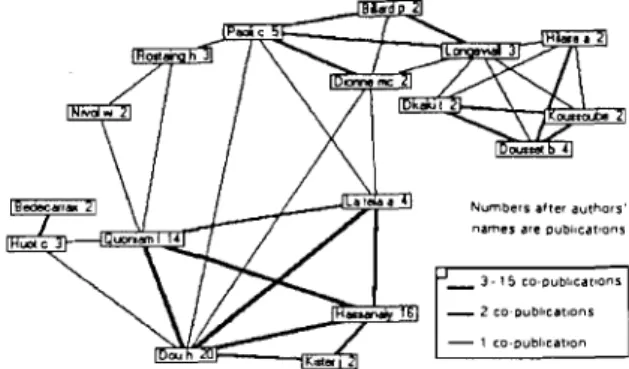
The graph of our t e m is shown in Figure 1. The
thickness of links is a fmction of the number of
co-publications between authors. Keeping in mind
just the thick links, the structure of collabontion
appcars. There are thick links between members with
tiie same affiliation. thin links bchveeii nicnibers with
Using the same parameters the three
databases were analysed for one
French laboratory: results varied
from only showing three authors and
no collaborations, through four
authors with no collaborations, to
18
authors who publish normally
Trentirig biblionre~ic indicnlors willt cautiott
Table 5. Our laboratory group i n the Lisa database Authors
Dou (8); Hassanaly (7); Quoniarn (6); La Tela (2)
Co-author's relations
Dou [hassanaly (7) Ia tela (2), quoniarn (6)]
Hassanaly [dou (7)j
Hassanaly [Ia tela (2)]
Hassanaly [quoniam (5)]
La Tela [dou (2)]
La Tela [hassanaly (2)]
La Tela [quoniarn (I)]
Quoniarn [dou (6), hassanaly (5), Ia tela (I)]
Sources Dou [ çcientornetrics (3)] Hassanaly [ scientornetrics (2)] Quoniarn [çcientometriw (3)] Publication year Dou [ 1989 (2), 1988 (2)] Hassanaly [I 989 (2), 1988 (2)] Quoniarn [I989 (2)] Keywords
Dou [ chernistry (2), bibliornetrics (6), library matenals (6), stock
(611
Hassanaly [chernistry (2), bibliornetrics (6), library rnaterials (6),
stock (6)]
Quoniarn [bibliometrics (5), library rnaterials (5), stock (5)]
Note: Nurnbers in parenthesis are frequencies
different affiliations. This graph was generated
automatically using an algoritiim created in our
1aboratory.l
Discussion
Depending on the indicators, macro- or micro-leve1
bibli~metry'?.'~
and the application comtry, the
choice of database may be more important than the
choice of indicator. An indicator may be considered
efficient when it does not change the perception ofthe
reality. What liappeils if the reality of the database is
wrong?
We showed that an Amencan multidisciplinq
database and an English specific database niay
Numbeis atter authors'
namei are o u b i i ~ a f i o n s
Trec~litig biblion~etric itrdicc~lors wilh coirliotr
Table 6 . Our working group i n the Pascal database Authors
Dou H (20); Hassanaly P (16); Quoniam L (14); Paoli C (5); La Tela A (7); Dousset B (4); Rostaing H (3); Longevialle C (3); Huot C (3); Nivol W(2); Kousçoube S (2); Kister J (2); Hilaire A (2); Dkaki T (2); Dionne Mc (2); Billard P (2); Bedecarrax C (2)
Co-authors relations Bedecarrax C [huot c (2)j;
Billard P [dionne rnc ( I ) , longevialle c (2), paoli c (2)];
Dionne MC [billard p (1 ), dou h (1), Ia tela a (I), longevialle c (1), paoli c (2)]; Dkaki t [dousset b (2), hilaire a (I), koussoube s (2), longevialle c (I)];
Dou H [dionne mc (1). hassanaly p (15), huot c (I), kisterj (2), Ia tela a (7), paoli c (I), quoniarn 1 (10)); Dousset B [dkaki t (2), hilaire a (2), kousçoube s (2). iongevialle c (1));
Hassanaly P [dou h (1 5). kister j (2), Ia tela a (6), quoniarn I@)]; Hilaire A [dkaki t (I), dousset b (2), kousçoube s (I), longevialle c (I)]; Huot C [bedecarrax c (2), dou h (I), quoniarn I (1));
ffister J [dou h (2), hassanaly p (2));
Kousçoube S [dkaki t (2), dousset b (2), hilaire a (I), longevialle c (I)]; La Tela A [dionne rnc ( I ) , dou h (7), hassanaly p (6), paoli c ( I ) , quoniam 1 (2)];
Longevialle C [billard p (2), dionne rnc (I), dkaki t (I), dousset b (I), hilaire a (I), koussoube s (I), paoli c (2)]; Nivol W [quoniarn I (I), rostaing h (I)];
Paoli C [billard p (2), dionne rnc (2), dou h (I), Ia tela a (I), longevialle c (2), rostaing h (1)); Quoniarn L [dou h (IO), hassanaly p (8), huot c (I), Ia tela a (2), nivol w (I), rostaing h (I)]; Rostaing H [nivol w ( I ) , paoli c (I), quoniam I (I)]
Affiliations
Bedecarrax C [paris, fra (2)); Billard P [paris, fra (2)]; Dkaki T [toulouse, fra (2)]; Dou H [rnarseille. fra (18)l; Dousset B [toulouse, fra (4)); Hassanaly P [rnarseille. fra (14)l; Hilaire A [toulouse, fra (2)]; Huot C [paris, fra (3)]; Kister J [rnarseille, fra (2)j; Koussoube S [toulouse, fra (2)j; La Tela A [marseille, fra (7)]; Longevialle C [paris, fra (2)]; Nivol W [rnarseille, fra (2)]; Paoli C [rnarseille. fra (2). paris, fra (3)]; Quoniam L [rnarseille, fra (1 I)]; Rostaing H [rnarseille, fra (3)]
Sources
Dou H [Cahiers de Ia documentation(2), Scientornetrics (3)]; Quoniam L [Cahiers de Ia documentation (2), Scientornetrics (3)] Publication date
Dkaki T [I991 (2)]; Dou H [ 1990 (2). 1992 (4), 1991 (4), 1987 (4), 1989 (4)); Dousset B [I991 (2)]; Hassanaly P [ 1991 (2), 1990 (2), 1987 (4), 1989 (S)]; Koussoube S [I991 (2)); La Tela A 11990 (2), 1987 (2)]; Paoli C [I991 (2)]; Quoniarn L [ 1992 (2), 1990 (2), 1991 (4), 1989 (S)]; Rostaing H [I993 (2)]
Keywords
Bedecarrax C [bibliometrics (2), bibliornettic analysis (2), database (2), application (2). data processing (2), data analysis (2), patenf document (2). relational analysis (2)];
Billard P [bibliometric analysis (2), database (2)];
Dionne MC [bibliornetric analysis (2), dafabase (2). bibliographic data (2)];
Dkaki T [bibliometrics (2), graphics (2), information layout (2), data processing (2), information processing (2)];
DOU H [classification (2), decision making (2), tool (2), research program (2), rnethod (2), firm strategy (21, case study (2), research indicator (2), information processing (2), coword analysis (2), frequency (2), information science (2), patent document (2), methodology (2), congress (2). published document (2), evaluation (2), code (3). bibliographic data (3). scientific technical inforrnation (3), data analysis (3), on line processing (3), data processing (4), statistical analysis (4), europe (4), france (4), bibiiometry (5). bibliometrics (6), downloading (6), scientific research (6), scientornetrics (€9, chemistry (10). bibliometric analysis (10). database (1 2));
Dousset B [bibliometrics (2), inforrnation layout (2), data analysis (2), bibliometric analysis (2), çotlware (2), user interface (2), graphics (3), data processing (3). information processing (3));
Hassanaly P [decision making (2), tool (2), research program (2), scientific technical information (2), research indicator (2), information processing (2), coword analysis (2), frequency (2), code (2), information science (2), patent document (2), methodology (2), congress (2), automated processing (2). data processing (3), data analysis (3), europe (3), france (3), on line processing (3), statistical analysis (4), downloading (4). scientific research (5), bibliometry (5), scientometrics (6), chemistry (8), database (9), bibliometric analysis (1 O)]; Hilaire A [data processing (2));
Huot C [bibliometric analysis (2), database (2), application (2). data processing (2), data analysis (2), patent document (2), relational analysis (2), bibliometrics (3)];
Mster J [scientific research (2). tool (2), research prograrn (2)];
Koussoube S [bibliometrics (2), graphics (2), information layout (2), data processing (2), information processing (2)];
La Tela A [chernistry (2). xientometrics
(3),
data processing ( 2 ) , statistical analysis (2), bibliometry (2), scientific research (2), biblio- metric analysis (3), database (7). downloading (4)];Longevialle C [data analysis (2), bibliometric analysis (2), database (2)]:
(continue4
Table 6 (continue4
Nivol W [bibliometrics (2). bibliometric analysis (2), method (2)];
Paoli C [bibliographic data (2), database (3). bibliometric analysis (4)];
Quoniam L [informetrics (2), dassification (2). code (2), bibliographic data (2), information processing (2), example (2), scientific literature
(2), data analysis (2), patent document (2), methodology (2), wngress (2), published document (2), automated processing (2),
evaluation (2), bibliometry (3), statistical analysis (3), on line processing (3), downloading (4), data processing (4), europe (4), france
(4), scientific research (4), bibliometrics (5), scientometrics (5), database (7), chemistry (a), bibliometric analysis (10)l;
Rostaing H [bibliometrics (2), scientific literature (2). bibliometric analysis (2), technological awareness (2), information processing (2)]
Note: Numbers in parenthesis are frequencies
grossly underestimate the activity of a French
laboratory. Anyone might imagine that the French
multidisciplinary database would overestimate the
activity of this laboratory. We are not convinced of
this, because the Pascal database seems exhaustive in
information science, and other bibliometrics teanls
(which do not publish in French) are also underesti-
mated in the American and English database in com-
parison with the French database.
On the other hand, it is feasible that otherteams are
overestimated in both American and English data-
bases. Yet most teams maintain the same
importante
from one database to the other. A consideration of
both estimations (under and over) is the minimum for
an 'objective' evaluation. This is why 1t.e keep sepa-
rate databases from various producers to emphasise
the contrast behveen databases. Then it is possible to
try to explain their different points of view.
For location considerations, and to minimise ti~e
political problems of evaluating researcher~,~
we just
used the sample of our own working group. The
bibliometrician, who uses on-line databases, has no
influence over the data collection of the producer or
the server of the database. Nor can helshe control the
accuracy of indexation. The most control is over the
misspelling of author names or affiliations. An accu-
rate estimate of the validity of the database must be
perfonned before building bibliometric indicators.
An analysis involving severa1 databases is very ofien
the best solution.
References
1. W Glanzel and M Wnterhager, 'Intemational collaboration of three east European wuntries with Germany in the sciences",
Scientometncs, 25(2), 1992, page 21 9-227.
2. H Kretschmer, "Coauthorship networks of invisible wlleges and institutionalized communities", Scientometncs, 30(1). 1994, page 363-369.
3. H P F Peters and A F J Van Raan, 'Structunng sdentific activities by co-author analysis: an exercise on a university faculty level", ScientomeMcs, 20(1), 1991, page 235-255. 4. L Liming and L Lihua, 'Scientific publication activities of 32
countries: Zipf-Pareto distribution". Scientometncs, 26(2), 1993, page 263-273.
5. EIIA, EUSIDIC, EIRENE, "Code of practice for information brokers", Information S e ~ ' c e s 8 Use, 14, 1994, pages
115-121.
6. L Egghe, "Bridging the gap: conceptual discussions on infor- metrics", Suentometncs, 30(1), May 1994, page 35. 7. H Haon, C Paoli and H Rostaing, 'Perception d'un programme
de R.&D:
A
travers I'analyse bibliombtrique des banques de donnbes d'origine Japonnaises", Ade du colloque 1.D.T.-93.22-24/06/1993, pages 63-70.
8. E L Logan and W M Shaw Jr, "A bibliometric analysis of wllaboration in a medical specialty", Scientometncs, 20(3), 1991, pages 41 7-426.
9. M Bordons, M A Zulueta, A Cabrero and S Barrigon,'ldentify- ing research teams with bibliometrics tools". Proceedings of the Fiffh Biennial Conference of the Intemational Society for Scientometncs and Infometrics (Learned information, Chi- cago USA, June 1995, pages 83-92.
10. M Abd-El-Kader, J F Miquel and J C Dore, 'Mbthode d'analyse des thhmes et rbseaux de Ia coopération scientifique nationale et internationale sur les cbramiques dans les bases SCI". Colloque les systhmes d'infonnabon Blaborée, June 1995, Ile Rousse France.
1 1 . E Boutin, L Quoniam, H Rostaing and H Dou, 'A new approach to display real co-authorship and w-topicship through net- work mapping", Proceedings of the Fifth Biennial Conference o f the Internafiona1 Society for Scientometrics a n d Informetncs (Leamed infomation, Chicago USA, June 1995) page 676.
12. H Grupp, "On the supplementary functions of science and technology indicators: the case of West German telecommu- nications R 8 D", Scientometncs, 19(5-6), 1990, page
447-472.
13. J F Miquel and Y Okubo, 'Structure of international wllab- oration in science. II: Comparisons of profiles in countries using a link indicator". Scientometncs, 29(2), 1994, page
271-297.
Volume 5 Number 3 December 1995
Research
Evaluation
Special issue on S&T indicators: Part
II
Guest editor Anthony
F J van Raan
Editorial: Introduction to a special issue on the Fourth International
Conference on Science and Technology Indicators
Treating bibliometric indicators with caution: their dependence on the
source database
L Quoniam, H Rostain;,
E Boutin: H Dou
Linkage between agency-supported research and patented industrial
technology
Francis Narin, Kirnberly S Hamilton and Domiilic Olivastro
O n the importance of regional'innovation fiows in the European Union:
,some methodological issues in the Italian case
Simona Iammarino,
M
Rosaria Prisco and Alberto Silvani
Measuring innovation in services
Rinaldo Evangelista and Giorçio Sirilli
Basic indicators for describing the stock of human resources in science
and technology (HRST)
Wemer Grüne~vald,
George Paterson and Daniela Scliackis
Evaluation of national biomedical research outputs through
journal-based esteem measures
Grant Le\vison
Roles of bibliometrics in scientific communication
Hans
E
Roosendml
Book
reviews on the challenge of scientometrics~ regional i ~ o v a t i o n ,
and
evolutionan economics
Indes to volunie 5, 1995
Article summaries, author affiliations:
back cover
ISSN:
0958-2029
Volume 5 Number 3 December 1995
Pages 173-248 ISSN 0958-2029
Research
Evaluation
Special issue on S&T indicators: Part
II
Treating bibiiometric indicatom with Nowadays, with computer-supported analysis of databases, constructing bibliometric or scientomevic raution: their dependente on the source indicaton may be considered easy. The problem is more to verify thc accuracy of the global anal>.sis, database including tlie sanipling ofdata The global coherence of an analysis depends on the adequacy ofall the sreps.
L Quoniani. H Rostaing, E Boutin, H Dou Using on-line databases, an experiment was designed to demonstrate this. Keeping the same protocol for (CRRM FacultC St Jérôrne, France) data collection, the same indicaton are uscd over the various samples. The results from three separate Pages 177-181 databases are profoundly different.
Linkage between agency-supported CHI Research's early work on thc citation linkage between patented technology in the USA, and the research and patented industrial underlying research science base using 1987188 US patents has been niassively expanded to include cituions technology from 1993193 US patents, and an analysis of the cited US papen and the agencies supporting them. Thcre Frmcis Narin, Kimberly S Hamilton and is a very strong within-country component to the linkage: inventors in the US system cite their own c o u n q ' s Dominic Olivastro (CHI Research, USA) papen approximately three times as often as would be expected, when adjusted for the size of the country's Pages 183-1 87 science. The linkagc is strongest in the highly scientific areas of technology, and is quite subject specific. Over the six yean separating the studies, there has been a remarkable thrce-fold increase in linkage. A large fraction of these papen cited in pateiits originate in tlie US univenity s y s t m , and are supported by C'S research support agencies.
O n the iniportance of regional innovation Using an Italian questiomaire not specifically designed to study geographic phenomena, the potential and flows in the European Ii'nion: some limitations of the regionalisation of innovation inforniation is analysed. Thcre were diff~culties involved in nietliodologicai issues in the Italian rase introducing the territorial diiiiension iiito the existiiig questionnaire and proposals are made for incremend
Siiiiona Iaiiimarino.
M
Rosaria Prisco and amendmeiits to the survey niethcd for collccting and presenting tlic data, aimed at capturing the regional Alberto Silvani (Isrds-Ciir, Italy) interdependeiicies. lliese include a request for the location of the niain source of infomation, the broad Pages 189-206 geograpliic area froni whicli tcchnology has bcen acquired or transferred, and the sector and region oforiginof the imovation.
Aleasuring innovation in semices Sonie of the problematic issues in the iiieasurement of innovation i11 the s m i c e sector are discussed, in
Riiialdo Evaiigelista aiid Giorgio Sirilli particular the applicability of the definitions and niethodologies set out in the OECD Oslo Manual on íhe (National Research Council of Italy) statistical measurenieiit of technological innovation, which was used in the recent European Community Pagcs 207-2 15 Iniiovation Survcy of the manufacturing scctor. The results of a pilot survcy in Italy and other s w e > s are compared and some suggestions made for the design of a questiomaire for the service sector. It ir suggcsted that the Oslo Manual franiework can be used to collect innovation data in the service s e a o r with some changes in the definition of innovation and in the list of ekpnditure i t m s . The economic impa of technological and orgaiiisational imovation, though considered a cmcial issuc, is still not amenable to statistical measureiiient.
Basic indicatom for describing the stock Science and technology indicaton have been used since the 1960s. yet it is only within the last few yeam of hunian r e s w r c e s in science and that more pressing policy needs for wider-ranging meaures of Iiuinan resources in science and teclmology technology (HRST) (HRST) began to emerge. Tlie measure of stocks of HRST, and the development of indicaton which make Wemer Grùnewald (Eurostac Luxenibourg). international comparisons possible, will be a major step fonvard. The objective of this p a p a is to pr-nt George Patenon and Daniela Scliackis the concepts of HRST and some indications for the measurement of basic HRST populations. (Consultuits to Eurostat)
Pages 2 17-224
Evaiuation of national bioniedical A study was carried out to determine tlic volume and esteeiii of scicntific publications in 16 subfielb of research outputs t h r w g h journal-based clinical medicine m d bioniedical research for the UK and I I other OECD nations for 1988-93 as pan of esteern measures the UK Govemment.s Technology Foresight Rogramrne. The sublields were defined by means of se% of Graiit Le\risoii (Wellconie T m s ~ CK) specialist jounials and, for multi-disciplinary and general journals, keywords in the titlcs of the papen. Pages 225-235 estcem of tlie papen w a based on subjective views of scientific administrative s d o f the relativc vai= of
papsn iii different classes of joumal. The weighted sum of íhe nuniben of p a p n from each countn. as a
pcrcentage of the world total was conipared with the percentage based on the sirnple s u m to give a 'jo-A esteeiii factor'. This provides a niore judgernent-based and tiniely asscssment of research quality íhm
coiiuiioiily used indicaton based directly on nuniben of citations.
Roles of biblionietrics in scientific Iii view of clisiges i11 scieiitific comiiiuiiication towards an electroiiic enviroiuneiit. tliis paper skctcher the conununicatio,n development of bibliornetric tools for use in a scientific publishing environnient. n i e main a r a of Hans E Roosendaal (Else\.ier Scieiicc. Tlie applicitioii are: quality coiitrol of individual prcducts; niarkct analysis: strategic analysis for long-lcrni Setlicrlands) plamiiig; yid prcduct developiiieiit. Each of these rcquires differeiit indicaton a i d tools, which are c r i i i i d l ~ Páges 237-241 discussed. Ths influente of thc tlpe ofjournal and scientific discipliiie on íhe usefulness and intqreutioll
ofthe impact f x t o r is addressed briefly, and requirements for indicaton wc discussed against the backgound of possible. future chmges in the scientific communication process. This Icads to spxulation on the role of biblionistrics, md how to organisc i6 in an electronic comniunication enbironment.