HAL Id: hal-00004147
https://hal.archives-ouvertes.fr/hal-00004147
Submitted on 3 Feb 2005
HAL is a multi-disciplinary open access
archive for the deposit and dissemination of
sci-entific research documents, whether they are
pub-lished or not. The documents may come from
teaching and research institutions in France or
abroad, or from public or private research centers.
L’archive ouverte pluridisciplinaire HAL, est
destinée au dépôt et à la diffusion de documents
scientifiques de niveau recherche, publiés ou non,
émanant des établissements d’enseignement et de
recherche français ou étrangers, des laboratoires
publics ou privés.
Leading interactions in the β-SrV _6O_15 compound
Marie-Liesse Doublet, Marie-Bernadette Lepetit
To cite this version:
Marie-Liesse Doublet, Marie-Bernadette Lepetit. Leading interactions in the β-SrV _6O_15
com-pound. Physical Review B: Condensed Matter and Materials Physics (1998-2015), American Physical
Society, 2005, 71, pp.075119. �hal-00004147�
ccsd-00004147, version 1 - 3 Feb 2005
Marie-Liesse Doublet1 and Marie-Bernadette Lepetit2
1
Laboratoire de Structure et Dynamique des Syst`emes Mol´eculaires et Solides, LSDSMS / UMR 5636, Universit´e Montpellier 2,
Place Eug`ene Bataillon, F-34095 Montpellier Cedex 5, FRANCE 2
Laboratoire de Physique Quantique, IRSAMC / UMR 5626, Universit´e Paul Sabatier, 118 route de Narbonne, F-31062 Toulouse Cedex 4, FRANCE∗
(Dated: February 3, 2005)
The present study shows that the electronic structure of the β-AV6O15 family of compounds (A = Sr, Ca, N a...) is based on weakly interacting two-leg ladders, in contrast with the zig-zag chain model one could expect from their crystal structure. Spin dimer analysis, based on extended H¨uckel tight-binding calculations, was performed to determine the structure of the dominant transfer and magnetic interactions in the room temperature β-SrV6O15 phase. Two different two-legs ladders, associated with different charge/spin orders are proposed to describe these one-dimensional β-type systems. The antiferromagnetic ladders are packed in an ’IPN’ geometry and coupled to each other through weak antiferromagnetic interactions. This arrangement of the dominant interactions explains the otherwise surprising similarities of the optical conductivity and Raman spectra for the one-dimensional β-type phases and the two-dimensional α-type ones such as the well-known α′-NaV2O5 system.
I. INTRODUCTION
Vanadium oxides are known since the fifties but they have attracted a lot of attention in the recent years be-cause of their exotic behavior. Their remarkable prop-erties are due to the interplay between charge, spin and lattice degrees of freedom. One of the most famous exam-ple is the α′-NaV2O5phase that undergoes a spin-Peierls
transition1coupled to a spin ordering. This double
tran-sition has raised a large controversy in the last five years before its nature and origin could be elucidated, and be-fore the apparent experimental contradictions could be lifted. Indeed, the ordering associated with the transi-tion was supposed to be a charge ordering of the vana-dium unpaired electron, located on each rung of this
two-legs ladder system2. While vanadium NMR3and neutron
diffraction4 experiments exhibited a large charge
order-ing at the transition, optical conductivity5 and resonant
X-ray diffraction6 did not show much charge ordering.
The controversy was lifted when ab-initio calculations7
showed that i) the bridging oxygens of the ladder rungs have an open-shell character, ii) there are three and not one magnetic electron per ladder rung and thus spin and charge densities are not compelled to be equal, iii) the system presents a large spin ordering (seen by spin sen-sitive experiments) associated with a very weak charge ordering (as observed in charge sensitive experiments).
Recently, superconductivity has been discovered in an-other family of vanadium bronzes, renewing the inter-est in low-dimensional vanadium oxides. The different
phases of the β-AV6O15 (A = Li, Na, Ag, Ca, Sr, Cu)
family, also referred to as β-A0.33V2O5, exhibit an
one-dimensional (1D) metallic behavior at room temperature and undergo a metal to insulator phase transition at TMI8, associated with a charge ordering. Systems with
monovalent cations (A+) show a long-range magnetic
or-der at T < TMI9. In systems with divalent cations (A2+),
no sign of long-range magnetic order is observed down to
2K and a spin gap appears in SrV6O1510. The β-type
phases present crystal structures with a 1D arrangement along the b direction — unlike the layered character of the α-type phases. They show six crystallographically in-dependent vanadium atoms two-by-two distributed over
different cationic sites : two V1 atoms that form
zig-zag double chains composed of edge-sharing V O5
square-based pyramids, two V2 atoms that form two-leg ladders
composed of V2bO5 square-based pyramid sharing a
cor-ner with V2aO6 distorted octahedron, and two V3 atoms
that form zig-zag edge-sharing double chains, similar to the V1’s, at first sights.
Some remarks should be done at this point.
First, in the β-type systems, phases with remarkable similitude of their structural arrangements, whether they are doped by mono- or divalent cations, exhibit very dif-ferent magnetic properties. Ueda et al10 suggested that
the differences in the magnetic properties are due to the different nature of the electronically dominant subsys-tem. The electronically dominant subsystem would be the zig-zag chains in the β-A+V
6O15 and ladders in
β-A2+V
6O15 compounds.
Second, the α and β compounds have very different struc-tural arrangements — the former is 2D while the latter is 1D — however their spectroscopic properties such as
Ra-man11 and optical conductivity spectra12 show
remark-able similitudes.
A simple formal charge analysis gives
A+V6(5−1/6)+O2−15 for monovalent cations and A2+V(5−1/3)+
6 O2−15 for divalent cations. It comes a
filling of either one or two 3d electrons for 6 vanadium atoms. This (low) filling, as well as the strongly localized character of the first row transition metal 3d orbitals, justify the use of a t − J model on the vanadium sites to describe the low energy physics of such vanadates.
2 The present paper thus aims at elucidating the
struc-ture of the dominant electronic interactions in the β-type compounds within the hypothesis of a t − J model. For this purpose, spin dimer analysis was performed using extended-H¨uckel tight-binding (EHTB) electronic struc-ture calculations. Since β-AV6O15unit cells consist in (at
least) four formula units, i.e. 88 atoms, this approach of-fers a pertinent alternative to prohibitive ab initio calcu-lations. Furthermore, the EHTB method has been shown to provide reliable and expedient means to study the rel-ative strengths of both hopping and spin exchange inter-actions in a wide variety of transition metal oxides13.
Be-cause strongly interacting spin exchange paths of a mag-netic solid are determined either by the overlap between its magnetic orbitals for non-bridged interactions, or by the overlap between its magnetic orbitals and the bridg-ing ligand orbitals for bridged interactions, a qualitative picture of both the dominant magnetic interactions and their nature (antiferromagnetic versus ferromagnetic) is reachable using EHTB, provided the knowledge of the crystal structure. In the present work, calculations have been performed using the crystallographic data reported for the β-SrV6O15 compound14.
II. STRUCTURE OF THE DOMINANT
INTERACTIONS
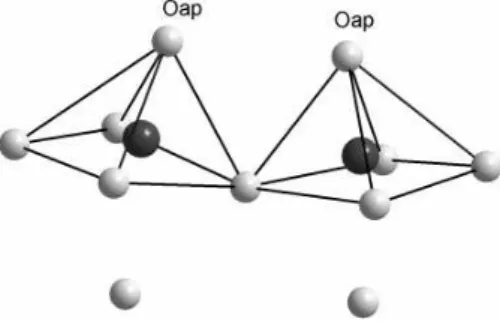
In the β-type compounds, five of the six vanadium atoms are surrounded by five nearest-neighbor (NN) oxy-gen atoms forming a distorted squared pyramid (V1a, V1b,
V2b, V3a and V3b). A sixth oxygen neighbor is found at
a larger distance in the position issued from a highly distorted V O6 octahedron (see figure 1). For the sixth
vanadium atom V2a, a less marked pyramidal structure
is observed, with two short, two medium and two long V − O bonds. Each pyramid may actually be seen as a
FIG. 1: Local environment of vanadium atoms in the β-AV6O15 phases. Vanadium and oxygen atoms correspond to dark and light gray spheres, respectively.
vanadyl V ≡ Oapcation lying above a distorted square of
O2−anions. Indeed, the V –Oapdistance is much smaller
(∼ 1.6˚A) than the V –O distances involving either the
oxygens contained in the pyramid basal plane (∼ 1.9˚A–
2.0˚A), or the sixth oxygen (∼ 2.3˚A). Let us note that the V ≡ Oap cations are not rigorously perpendicular to the
basal plane of the pyramids. The existence of an apical oxygen is crucial in these systems since the short V –Oap
distance allows a strong delocalization to occur between these two atoms and a multiple vanadium–oxygen cova-lent bond to take place. This phenomenon has already been observed in the α′-NaV2O5 compound, in which a
triple covalent/dative bond exists between the vanadium and its apical oxygen. This bond is only weakly
polar-ized15 with an oxygen charge of about −0.5. The
exper-imental signature of such a strong multiple bond in the Raman spectra is a sharp peak at relatively high energy, corresponding to the bond stretching mode. This peak occurs at 969cm−1for the α′-NaV
2O516, at 932cm−1and
1002cm−1 for the CaV
2O5 and MgV2O517 respectively.
In the β-CaV6O1511, it is seen at 978cm−1, 952cm−1and
877cm−1for the V3, V1and V2vanadyl bonds. Note that
the softening of the apical bond stretching mode for the V2 atoms is due to a less marked pyramidal character of
its oxygen first neighbors.
Two consequences arise from the occurrence of such
a V –Oap multiple bond. First the formal charge of the
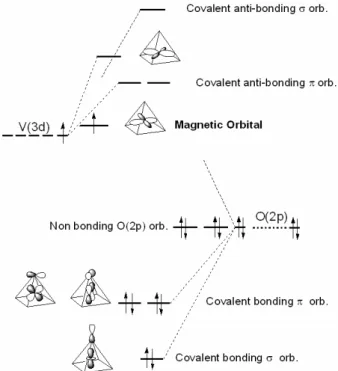
vanadium atom is much smaller than what is usually as-sumed. It should be accounted as 5 − η − q instead of 5 − η where η is the number of magnetic 3d electrons per vanadium atom and q is the number of vanadium electrons participating to the vanadyl bond. Second and much more important, the vanadyl bond acts as a local quantification axis for the vanadium atom. As a con-sequence, the nature of the 3d magnetic orbital can be deduced from the vanadyl bond orientation : it is the dxy
orbital, when local axes are chosen so that z is collinear to the vanadyl bond and x and y point toward the basal plane first oxygen neighbors (see figure 2). Indeed, while the dz2, dxz and dyz vanadium orbitals form one σ and
two π covalent/dative bonds with the apical oxygen, the dxy and dx2−y2 orbitals are split in agreement with the
crystal field. The dx2−y2orbital is more destabilized than
the dxyone due to its σ–type overlap with the basal plane
oxygen atoms which is larger than the π–type overlap of the dxy orbital. Note that the structural difference
ob-served for the V2a local environment induces a lowering
of one of the two anti-bonding π-orbitals close to the magnetic orbital energy and therefore a slightly different orientation of the V2a magnetic orbital.
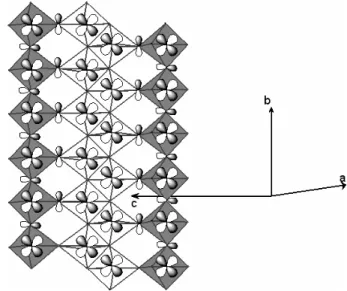
Focusing now on the orientation of the vanadium mag-netic orbitals in the crystal structure, it becomes very simple to build the structure of the magnetic orbitals once each vanadyl bond is located. Figure 3 reports this structure for the β-SrV6O15system. The existence of two
sets of vanadium atoms can be clearly seen : on one hand the V1and V3centers for which the magnetic orbitals are
roughly in the (c, b) plane and on the other hand the V2
centers for which the magnetic orbitals are nearly orthog-onal to the previous ones, in the approximate (a + c, b) plane.
Let us now analyze separately each type of crystallo-graphic chain or ladder. Figure 4 reports the relative position of the magnetic orbitals for the V2 ladder.
FIG. 2: Qualitative orbital interaction between the vanadium 3d orbitals and the p orbitals of the pyramid oxygens. The apical oxygen lies on the z axis, while the four oxygens of the pyramid basal plane lie on the x and y axes.
FIG. 3: Structural arrangement of the vanadium magnetic orbitals as derived both from the vanadyl bond orientation on each vanadium atom and from extended H¨uckel calculations. The crystal structure is represented within the (a, c) plane. The gray circles represent the counter ions, the V2 pyramids are hatched, the V3 are represented in white and the V1 in gray.
Let us note that vanadyl bonds are nearly orthogo-nal to the figure, pointing alternatively above and below the figure plane. The bridging-oxygen pxorbitals, along
the ladder legs, and py orbitals along the ladder rungs
strongly overlap with the neighboring V2 magnetic
or-bitals. They will thus mediate both transfer and mag-netic interactions. This qualitative description is
con-FIG. 4: Vanadium magnetic orbitals of a V2 ladder and p orbitals of the bridging oxygen atoms mediating the interac-tions between the former. Note that orbital signs do not have any meaning here. The local x, y and z axes are defined as such : the z axis is in the V2b vanadyl bond direction, the x axis is in the ladder rungs direction and the y axis along the bcrystallographic direction.
firmed by spin dimer EHTB calculations since the largest
spin exchange paths (i.e. the largest effective
trans-fer integrals) occur between the V2 magnetic centers, as
stacked in the two-leg ladder shown in figure 4. Due to significant local distortions of the V2-centered
pyra-mids, transfer integrals are larger along the ladder rungs (∼ 0.31 eV ) than along the ladder legs (0.17 eV and 0.21 eV ). Nevertheless, both effective integrals are large enough to expect antiferromagnetic interactions between
the V2 atoms. Indeed, the effective transfer mediated
through the appropriate p orbital of the bridging oxy-gen, can be expressed as
t = ±t
2 pd
∆1
(1) and thus the bridged super-exchange mechanism comes as J = −4 t 4 pd (∆1)2Ud − 8 t 4 pd (∆1)2∆2 (2) = −4t 2 Ud − 8 t2 ∆2 (3) with ∆1= δ − Up+ Ud− Vpd and ∆2 = 2δ − Up+
2Ud− 4Vpd . δ is the orbital energy difference between
the vanadium magnetic orbital and the bridging oxygen porbital, tpd is the transfer integral between them, Up
and Udare the on-site Coulomb repulsions and Vpdis the
4 Figure 5 reports the relative position of the magnetic
orbital for the V1 zig-zag chains. One sees immediately
FIG. 5: Magnetic orbitals of the V1 zig-zag chains and p or-bitals of the bridging oxygen atoms involved in the media-tion of the V1 magnetic orbitals interaction. Note that the orbitals represented here are atomic orbitals and that the rel-ative phases between them do not have any meaning. Local x, y and z axes are defined as such : z is in the vanadyl bonds direction, y is along the b crystallographic direction and x is orthogonal to the formers.
that the hopping between the magnetic orbitals of two
nearest neighbors (NN) V1 atoms is not bridged by any
oxygen orbital that could mediate the interaction, and
is thus restricted to its direct contribution. This
di-rect contribution is itself expected to be very small, due
to both the large distance between adjacent V1 atoms
(∼ 3.3˚A) and the δ character of the overlap. EHTB calcu-lations confirm these remarks since the transfer integral
between NN V1 magnetic orbitals is found to be
negli-gible. As far as the magnetic exchange is concerned, no super-exchange mechanism can take place between the
NN V1 atoms, for the same reasons. Therefore, the
ef-fective magnetic interaction is reduced to the direct ex-change between the two vanadium atoms. It can thus be predicted to be very weak and ferromagnetic. One can
clearly consider that the NN V1 atoms do not interact.
Let us now examine the coupling between second
neigh-bor V1 atoms. One sees on figure 5 that the associated
pyramids share a corner in the b direction and that the px orbital of the bridging oxygen presents a large
over-lap with the vanadium magnetic orbitals. It can thus mediate efficiently the interaction between second neigh-bor V1atoms. EHTB calculations yield effective transfer
integrals of 0.17 eV and 0.15 eV . Through-bridge super-exchange mechanism should take place and the effective
exchange between second neighbor V1atoms can thus be
expected to by reasonably large and antiferromagnetic. Figure 6 reports the relative position of the magnetic
orbitals of both the V1 and V3 chains. The magnetic
FIG. 6: Magnetic orbitals of the V1and V3chains along the b direction and p orbitals of the bridging oxygen atoms. Note that the orbitals represented here are atomic orbitals and that the relative phases between them do not have any meaning. Pyramids associated with the V1and V3atoms are represented in gray and white, respectively. Local x, y and z axes are defined as such : z is in the vanadyl bonds direction which is orthogonal to the figure plane, y is along the b crystallographic direction and x is orthogonal to the formers.
orbitals of the V3 zig-zag chains are similar to the
mag-netic orbitals of the V1 atoms since the apical axes of
both sets of atoms are along the same direction. The
V3 pyramids share an edge and the interaction between
the V3 magnetic orbitals is bridged by two oxygen atoms
with nearly 90◦V
3–O–V3angles. It is well known that in
such 90◦arrangements, the contribution of the
bridging-oxygen p orbitals is destructive and that the interactions between the vanadium magnetic orbitals are restricted to the direct transfer and exchange integrals. These inter-actions are thus weak due to the large distance between
two NN vanadium atoms (∼ 3.0˚A). Indeed, EHTB
calcu-lations yield effective transfers between nearest neighbor
V3 atoms of the order of ≃ 0.05 eV (see Appendix for
the exact values of the four crystallographically different V3–V3transfer integrals). As far as the effective exchange
is concerned, one can expect it to be both weak (of the order of a few tenth of meV or smaller) and ferromag-netic — the direct exchange is always ferromagferromag-netic in
nature. Let us now examine the second neighbor V3–
V3 interactions. The associated pyramids share a corner
along the b direction and the px orbital of the oxygen
atom (not shown on figure 6) can efficiently mediate the interactions between two vanadium atoms. EHTB calcu-lations yield transfer integrals of 0.14eV . Through-bridge super-exchange mechanism takes place via the oxygens px
orbitals and the effective exchange between second neigh-bors V3atoms should thus be reasonably large (hundreds
It is clear from figure 6 that there is another type of large vanadium–vanadium interactions that is not con-sidered in the literature, that is the V1–V3 interaction.
Indeed, the NN V1 and V3 magnetic orbitals are bridged
by a py oxygen orbital that mediates the interactions
between them. EHTB calculations confirm the present remarks with an evaluation of the transfer integral of
0.20 eV and 0.23 eV . Of course this py oxygen orbital
will mediate a super-exchange mechanism so that the magnetic interaction can be expected to be large and antiferromagnetic.
Summarizing the above results, one sees that the struc-ture of the dominant interactions, both transfer and mag-netic, does not follow the crystallographic zig-zag chains structure. Actually, the dominant interactions are ar-ranged in two types of two-leg ladders, namely the V2–V2
ladders and the V1–V3 ladders which are
crystallograph-ically orthogonal to each other. The average filling of these ladders is of one electron for 3 sites in systems doped with divalent cations and of one electron for 6 sites in systems doped with monovalent cations. All magnetic interactions within these ladders show an antiferromag-netic character.
Let us now analyze the interactions between these lad-ders. The coupling between two V1–V3 ladders could go
either through V1–V1NN interactions which we have seen
to be totally negligible, both in terms of electron transfer and magnetic interactions, or through the V3–V3 NN
in-teractions. The latter are somewhat larger than the NN V1–V1interactions but still quite weak and ferromagnetic
in character.
Are there other types of inter-ladder interactions? Going back to figure 3, one sees that the V1, V2and V3pyramids
share a corner.
Let us note the local axes in the following manner : y
for the b direction, x and z in such a way that the V1
and V3 magnetic orbitals are dxy and the V2 magnetic
orbitals are dzy in nature.
The py orbitals of the V1–V2–V3 bridging oxygen
me-diates the V1–V3 interaction. One should notice that
de-spite the nearly 90◦ V
1–O–V2 and V3–O–V2 angles, the
oxygen py orbital can efficiently mediate the transfer
in-teraction between i) the V1and V2magnetic orbitals and
ii) the V3and V2magnetic orbitals. This is due to the fact
that, unlike the classical case, the Vn magnetic orbitals
are orthogonal to the (V1,O,V2) and (V3,O,V2) planes.
Indeed, EHTB calculations yield V1–V2and V3–V2
trans-fer integrals of the order of 70 meV and 25 meV . As far as the magnetic exchange is concerned, the pyorbital
is able to mediate super-exchange mechanism. Thus the effective exchange between the V1–V3 and V2–V2 ladders
i) goes though the local V1–V2 and V3–V2 interactions,
ii) can be expected to be weak but much larger than the exchange between two V1–V3 ladders and iii) is
antiferro-magnetic in character.
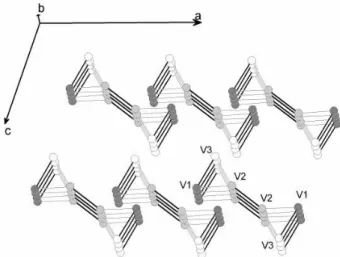
In conclusion one can see the β-AV6O15 compounds
as composed of two types of orthogonal two-legs ladders packed in an ’IPN’ geometry (see figure 7) and coupled
through antiferromagnetic exchange interactions.
FIG. 7: Structure of the dominant interactions in the β-AV6O15 compounds. Strong intra-ladder interactions are in dark gray, while inter-ladder interaction are pictured in light gray.
III. ON SITE ENERGIES
In the β-AV6O15compounds, the ladder rungs are built
on two crystallographically different vanadium atoms. This is obviously the case for the V1–V3 ladders and
of-ten for the V2–V2ladders. For instance, even in the high
temperature phase, the Sr and Ca compounds present a dimerization along the b direction so that the V2–V2
lad-der rungs are composed of V2a and V2b
crystallographi-cally different atoms. These crystallographic differences, which are system and phase specific, are due to different chemical parameters such as the size of the An+cation,
its location (in the β or β′ sites), or the electronic
insta-bilities toward spin-Peierls type of distortion. The conse-quence of these characteristics is that the energies of the two vanadium magnetic orbitals in one ladder rung are different. EHTB calculations show that these energy dif-ferences are not negligible, even in the high temperature phases, since they can reach values as large as 0.18 eV on the V2–V2ladders. Surprisingly the V1–V3ladders are
much more symmetric with an orbital energy difference between the V1and V3magnetic orbitals of 0.05 eV only.
The first consequence is that there should be a charge/spin order, even in the high temperature phases. The second one is that the average fillings, η13 and η22,
of the two types of ladders have no reason to be equal and that a charge transfer degree of freedom between the two ladders should be taken into account.
6
IV. THE LOW TEMPERATURE PHASE
Similar EHTB calculations as those detailed in the pre-ceding sections were done on the low temperature phase (LTPh). Structural data at 90K were taken from ref-erence14. In the low temperature phase the unit cell is
tripled along the ladder axis b. Sellier et al attributed this 3×b super-cell to small displacements of the V2atoms
within the V2 ladders rungs.
As expected, the results in the LTPh exhibit on-site orbital energies and transfer integral modulations com-pared to the high temperature phase (HTPh), however the main conclusions remain unchanged. Indeed, as in the HTPh, the dominant interactions are arranged in tiferromagnetic ladders, and these ladders are then an-tiferromagnetically coupled according to an IPN geome-try. The main difference between the two phases is that while in the HTPh the transfer between IPNs is always very small, in the LTPh some of the V3–V3 transfers are
of the same order of magnitude as the intra-IPN ones. Another point to be noticed is that the variation range of the on-site orbital energies along the ladders is larger in the LTPh than in the HTPh. These differences can thus be expected to induce a greater electron localization in the ladder direction (in agreement with the observed metal to insulator transition) and a somewhat lesser 1D character in the LTPh.
V. DISCUSSION AND CONCLUSION
One of the troubling properties of the β-AV6O15
com-pounds is that, while their crystallographic structure is very different from that of the α′-NaV
2O5 system, they
present very similar features, both in the optical con-ductivity and Raman spectra. The present study par-tially explains these similarities. Indeed, the electronic structures of the two compounds are based on simi-lar units, despite their a-priori different crystallographic structures. They show (i) square-pyramid environment of the vanadium atoms with magnetic orbitals orthogonal to a very short vanadyl bond, and (ii) dominant interac-tions of the magnetic centers arranged in two-leg ladders with antiferromagnetic interactions.
The vanadyl multiple bond is responsible for the
ex-istence of a sharp peak around 1000 cm−1 in the
Ra-man spectra of both β and α compounds. Other fea-tures related to the existence of the pyramidal entities are present in the Raman spectra of both type of compounds such as the bending mode between two pyramids around 440 cm−1. Finally, one retrieves in both compounds the
broad feature in the 550 cm−1 to 700 cm−1 range that
was attributed in the α′-NaV
2O5to the electron-phonon
coupling19responsible for the spin-Peierls transition.
The optical conductivity spectra for both the
β-AV6O15 and the α′-NaV2O5 compounds also present
strong similitudes, such as the famous 1 eV peak. This peak was attributed in the α′-NaV2O5system to the first
doublet-doublet excitation energy on the ladder rung. It is also present in the β-type compounds, which are lad-der systems, as well. In the SrV6O15, this peak is double
(0.85 eV and 1.2 eV12). In the assumption that this peak
can also be attributed to the first doublet-doublet excita-tion energy of the ladder rungs, the doubling would be in total agreement with the electronic structure proposed in this work, namely two-leg ladders of two different types. The occurrence of this peak in the β-type compounds raises several more general questions on 1D vanadium oxides.
• The first one is whether the existence of this 1 eV feature is the signature of a ladder arrangement of the dominant interactions in the vanadium oxides. • It has been shown in the α′-NaV
2O5compound that
the ladder rung should not be seen as supporting one electron delocalized on the two vanadium mag-netic orbitals, but rather three magmag-netic electrons, since the bridging oxygen shows a strong open-shell character and the local wave-function is multicon-figurationnal7,15.
The second question is thus whether this magnetic character of the rung bridging oxygen is a general feature of the vanadium oxides with a two-leg lad-ders electronic structure.
• The third question is whether the 1 eV peak is the signature of this magnetic character of the rung oxygens. One of us is actually running ab-initio cal-culations in order to check these questions in the β compounds. The preliminary results confirm these hypotheses.
Finally let us remember that the sodium phase of the β-AV6O15family presents a super-conducing phase. Put
into perspective with the present results yielding a ladder structure for the dominant interactions, one can wonder whether this compound could be a realization of the pre-dicted superconductivity in doped ladder systems20.
Acknowledgments : the authors thank the
follow-ing research groups for helpful discussions, namely E.
Janod, Cl. Sellier, and co-workers from the Institut
des mat´eriaux Jean Rouxel, V. Ta Phuoc from the
Lab-oratoire d’´electrodynamique des mat´eriaux avanc´es, Y. Fagot-Revurat and co-workers from the Laboratoire de
Physique des Mat´eriaux. We also thank the Groupement
de Recherche 2069 of the CNRS,Oxydes `a propri´et´es re-marquables, for having made this collaboration possible.
V1–V3 ladder Rungs Legs Atoms t ∆ε Atoms t ∆ε V1b–V3b −0.203 0.050 V1a–V1b −0.173 0.00 V1a–V3a −0.237 0.113 V1a–V1b+b −0.145 0.00 V3a–V3b −0.148 −0.038 V3a–V3b+b −0.140 −0.040 V2–V2 ladder Rungs Legs Atoms t ∆ε Atoms t ∆ε V2a–V2b −0.313 −0.184 V2a–V2b −0.147 −0.173 V2a–V2b+b −0.135 0.215 Inter-ladder Intra-IPN Atoms t ∆ε Atoms t ∆ε
V2a–V1a 0.070 0.135 V2a–V3a −0.024 −0.022
V2b–V1b 0.094 −0.046 V2b–V3b 0.054 0.093
Inter-ladder Inter-IPN
Atoms t ∆ε Atoms t ∆ε
V3a–V3a′ 0.023 0.002 V3a–V3b′ −0.053 −0.038 V3b–V3b′ −0.059 0.006 V3b–V3a−b −0.053 −0.038 TABLE I: EHTB values of the hopping and vanadium mag-netic orbital energies (eV).
∗ On leave to : Laboratoire CRISMAT / UMR 6508, 6 boule-vard Marchal Juin, F-14050 Caen Cedex 4, FRANCE 1
M. Isobe and Y. Ueda, J. Phys. Soc. Jnp. 65, 1178 (1996). 2 M. K¨oppen, D. Pankert, R. Hauptmann, M. Lang, M. Wei-den, C. Geibel, and F. Steglich,Phys. Rev. B 57, 8466 (1998).
3 T. Ohama, H. Yasuoka, M. Isobe and Y. Ueda, Phys. Rev. B 59, 3299 (1999).
4
B. Grenier, O. Cepas, L. P. Regnault, J. E. Lorenzo, T. Ziman, J. P. Boucher, A. Hiess, T. Chatterji, J, Jegoudez and A. Revcolevschi, Phys. Rev. Letters 86, 5966 (2001). 5
C. Presura, D. van der Marel, A. Damascelli and R.K. Kremer, Phys. Rev. B 61, 15762 (2000).
6
Y. Joly, S. Grenier and J.E. Lorenzo, Phys. Rev. B 68, 144412 (2003).
7
N. Suaud and M.-B. Lepetit, Phys. Rev. Letters 88, 056405 (2002).
8
H. Yamada and Y. Ueda, J. Phys. soc. Jpn. 68, 2735 (1999).
9 H. Yamada and Y. Ueda, Physica B 284, 1651 (2000). 10
Y. Ueda, H. Yamada, M. Isobe, T. Yamauchi, J. Alloys Compounds 317-318, 109 (2001).
11 Z. V. Popovic et al, J. Phys. Condens. Matter 15, L139 (2003).
12 V. Ta Phuoc, private communication. 13
J. Ren ; W. Liang and M.-H. Whangbo Crystal and Elec-tronic Structure Analysis Using CAESAR (1998) ; M.-H. Whangbo, H.-J. Koo and D. Dai, J. Solid State Chem. 176, 417 (2003).
14
Cl. Sellier, Fl. Boucher, E. Janod, Solid state sci. 5, 591 (2003).
15
N. Suaud and M.-B. Lepetit, Phys. Rev. B 62 402 (2000). 16
Z. V. Popovi´c, M. J. Konstantinovi´c, R. Gaji´c, V. N. Popov, M. Isobe, Y. Ueda and V. V. Moshchalkov, Phys. Rev. B 65, 184303 (2002).
17
J. Spitaler, E.Ya. Sherman, C. Ambrosch-Draxl, H.-G. Ev-ertz, cond-mat/0401458.
18
P. H. M. van Loosdrecht, C. N. Presura, M. Popinciuc, D. van der Marel, G. Maris, T. T. M. Palstra, P. J. M. van Bentum, H. Yamada, T. Yamauchi, Y. Ueda, J. supercond. 15, 587 (2002).
19
W. S. Bacsa, R. Lewandowska, A. Zwick, and P. Millet, Phys. Rev. B 61, R14885 (2000).
20 E. Dagotto, J. Riera and D. Scalapino, Phys. Rev. B 45, 5744 (1992); M.Sigrist, T. M. Rice and F. C. Zhang, Phys. Rev. B 49, 12058 (1994); H. Tsunetsugu, M. Troyer and T. M. Rice, Phys. Rev. B 49, 16078 (1994).