HAL Id: tel-00009496
https://tel.archives-ouvertes.fr/tel-00009496
Submitted on 15 Jun 2005
HAL is a multi-disciplinary open access
archive for the deposit and dissemination of sci-entific research documents, whether they are pub-lished or not. The documents may come from teaching and research institutions in France or abroad, or from public or private research centers.
L’archive ouverte pluridisciplinaire HAL, est destinée au dépôt et à la diffusion de documents scientifiques de niveau recherche, publiés ou non, émanant des établissements d’enseignement et de recherche français ou étrangers, des laboratoires publics ou privés.
Solange Lemai
To cite this version:
Solange Lemai. IXTET-EXEC: planning, plan repair and execution control with time and resource management. Automatique / Robotique. Institut National Polytechnique de Toulouse - INPT, 2004. Français. �tel-00009496�
en vue de l’obtention du
Doctorat de l’Institut National Polytechnique de Toulouse Ecole Doctorale Informatique et T´el´ecommunications
Sp´ecialit´e : RCFR
parSolange LEMAI-CHENEVIER
IXTET-EXEC : planification, r´eparation de plan et contrˆole
d’ex´ecution avec gestion du temps et des ressources
I
X
TET-
E
X
E
C: planning, plan repair and execution
control with time and resource management
Soutenue le 21 juin 2004, devant le Jury compos´e de :
Raja Chatila Pr´esident
F´elix Ingrand Directeur de th`ese Malik Ghallab Co-directeur de th`ese Fran¸cois Charpillet Rapporteurs
Maria Fox
Nicola Muscettola
Marie-Claire Charmeau Invit´es Henri Farreny
Remercier ceux qui m’ont donn´e l’occasion de faire cette th`ese dans d’aussi bonnes conditions.
Remercier ceux qui m’ont permis de progresser, d’apprendre, d’avoir des id´ees, d’approfondir, . . .
Remercier tous ceux qui ont contribu´e `a faire de ce bout de vie des ann´ees sympathiques.
1.2 Planifier... 10
1.2.1 ...pour un domaine li´e `a une application “r´eelle” 10
1.2.2 ...pour une ex´ecution dans un environnement dynamique 13 1.2.3 Conclusion 15
1.3 Int´egrer des m´ecanismes de planification dans un syst`eme autonome complexe 15 1.3.1 Architecture 15
1.3.2 “Planification r´eactive” : un ex´ecutif dot´e de capacit´es de d´elib´eration 18 1.3.3 “Planification par lots” : planification → ex´ecution → replanification 20 1.3.4 “Planification continue” : planification et ex´ecution entrelac´ees 20 1.3.5 Planification `a tous les niveaux d’abstraction 24
1.3.6 Conclusion 27 1.4 Notre approche 27 1.5 Exemple de mission 30
2 Le planificateur IXTET 39
2.1 Une repr´esentation fonctionnelle `a base de chroniques 40 2.1.1 Variables d’´etat 40
2.1.2 “Timeline” 42 2.1.3 Ressources 42
2.1.4 Repr´esentation des actions 44 2.1.5 Probl`eme de planification 45
2.1.6 Discussion concernant l’ex´ecution du plan 46 2.2 Les gestionnaires de contraintes sous-jacents 49
2.2.1 Le r´eseau temporel 49 2.2.2 Le r´eseau atemporel 51 2.2.3 Les contraintes mixtes 53
2.2.4 Discussion concernant l’ex´ecution du plan 55
2.3 Planification non lin´eaire causale avec des variables partiellement instanci´ees 57 2.3.1 Recherche dans l’espace des plans partiels 57
2.3.2 Une ´etape de planification dans IXTET 62
2.3.3 Analyse des d´efauts 64 2.3.4 Contrˆole de la recherche 73
2.3.5 Discussion concernant l’ex´ecution du plan 83 2.4 Extension de la gestion des ressources 84
2.4.1 Conflit de ressource 84 2.4.2 D´etection des conflits 86 2.4.3 R´esolvantes 89
3 IXTET-EXEC : int´egrer planification et ex´ecution de plans temporels 99 3.1 L’ex´ecutif temporel 100
3.1.1 Vue d’ensemble 100
3.1.2 Interactions avec le syst`eme contrˆol´e 101 3.1.3 Ex´ecution du r´eseau temporel 102
3.1.4 Situations non nominales et strat´egies d’adaptation du plan 104 3.2 D´efinition d’un plan ex´ecutable 105
3.2.1 Un plan partiel partiellement ex´ecut´e jusqu’`a l’instant t 105 3.2.2 Niveau d’une ressource allou´ee r `a l’instant t dans le plan Pt 106
3.2.3 Ex´ecutabilit´e 108
3.3 Cycle “Perception/R´eparation du plan/Action” 109 3.4 Perception 112
3.4.1 Int´egration des messages 112
3.4.2 Rupture de liens causaux suppl´ementaires 120 3.5 R´eparation du plan 123
3.6 Action 126
3.7 Replanification compl`ete 128 3.8 Discussion 131
3.8.1 R´eparation de plan ou replanification? 131 3.8.2 Contrˆolabilit´e temporelle 131
4 Int´egration dans l’architecture LAAS 139 4.1 L’architecture LAAS 141
4.1.1 Le niveau fonctionnel 141
4.1.2 Le niveau de contrˆole des requˆetes 143 4.1.3 Le niveau d´ecisionnel 143
4.2 Les mod`eles 146
4.2.1 Le mod`ele IXTET-EXEC 146
4.2.2 Le mod`ele OpenPRS 147 4.3 R´esultats 150
5 Exemple illustratif 161 5.1 Domaine 162
5.2 R´eparation et ex´ecution de plan entrelac´ees ou replanification? 162 5.3 Ressources 168
1 Algorithmes pour le calcul des cliques maximales 181
2 Tests sur Dala 183
2.1 Le mod`ele IXTET-EXEC 183 2.2 Trace pour le “Run3” 190
1.1 Problematic . . . 9
1.2 Planning. . . 10
1.2.1 . . . for a real-world domain . . . 10
1.2.2 . . . for execution in a dynamic environment . . . 13
1.2.3 Conclusion . . . 15
1.3 Embedding planning in a complex autonomous system . . . 15
1.3.1 Architecture . . . 15
1.3.2 Executive enhanced with deliberative capabilities or “reactive plan-ning” . . . 18
1.3.3 Planning → execution → replanning or “batch planning” . . . 20
1.3.4 Interleaved planning and execution or “continuous planning” . . . . 20
1.3.5 Planning at any level of abstraction . . . 24
1.3.6 Conclusion . . . 27
1.4 Our approach . . . 27
1.5 Mission example . . . 30
2 The IXTET planning system 39 2.1 A time-oriented functional representation . . . 40
2.1.1 State variables . . . 40
2.1.2 Timelines . . . 42
2.1.3 Resources . . . 42
2.1.4 Representation of actions . . . 44
2.1.5 Planning problem . . . 45
2.1.6 Discussion with respect to plan execution . . . 46
2.2 The underlying CSP managers . . . 49
2.2.1 Time Map . . . 49
2.2.2 Variable Map . . . 51
2.2.3 Mixed constraints . . . 53
2.2.4 Discussion with respect to plan execution . . . 55
2.3 Partial Order Causal Link Planning with unbound variables . . . 57
2.3.1 Search in the plan space . . . 57
2.3.2 IXTET planning process . . . 62
2.3.3 Analysis module . . . 64
2.3.4 Search Control module . . . 73
2.3.5 Discussion with respect to plan execution . . . 83
2.4 Resource management extension . . . 84
2.4.1 Resource conflict . . . 84
2.4.2 Conflict detection . . . 86
2.4.3 Resolvers . . . 89
3 IXTET-EXEC: Interleaving temporal planning and plan execution 99
3.1 Temporal executive . . . 100
3.1.1 Overview . . . 100
3.1.2 Interactions with the controlled system . . . 101
3.1.3 Temporal network execution . . . 102
3.1.4 Non nominal situations and strategies of plan adaptation . . . 104
3.2 An executable plan . . . 105
3.2.1 A partial plan partially executed up to time t . . . 105
3.2.2 Level of an allocated resource r at time t in the partial plan Pt . . . 106
3.2.3 Executability . . . 108
3.3 “Sensing/Plan Repair/Action” cycle . . . 109
3.4 Sensing . . . 112
3.4.1 Message integration . . . 112
3.4.2 Deletion of additional causal links . . . 120
3.5 Plan repair . . . 123
3.6 Action . . . 126
3.7 Complete replanning . . . 128
3.8 Discussion . . . 131
3.8.1 Plan repair vs replanning . . . 131
3.8.2 Temporal controllability . . . 131
4 Integration in the LAAS Architecture 139 4.1 The LAAS architecture . . . 141
4.1.1 Functional level . . . 141
4.1.2 Requests control level . . . 143
4.1.3 Decisional level . . . 143 4.2 Models . . . 146 4.2.1 IXTET-EXEC model . . . 146 4.2.2 OpenPRS model . . . 147 4.3 Runs . . . 150 5 Illustrative example 161 5.1 Domain . . . 162
5.2 Plan repair interleaved with plan execution vs replanning . . . 162
5.3 Resources . . . 168
1 Algorithms for maximal cliques computation 181 2 Tests on Dala 183 2.1 IXTET-EXEC model . . . 183
2.2 IXTET-EXEC trace of Run 3 . . . 190
manque de r´eactivit´e, de d´elais de communication avec le sol, de probl`emes de visibilit´e, il n’est plus souhaitable de les t´el´eop´erer enti`erement du sol mais plutˆot de les contrˆoler au niveau buts et tˆaches. Augmenter l’autonomie d´ecisionnelle des syt`emes spatiaux soul`eve de nouveaux probl`emes tels que la planification des activit´es pour accomplir un but, le contrˆole de l’ex´ecution du plan, et la surveillance et le diagnostic de l’´etat du syst`eme.
Nous nous int´eressons plus particuli`erement `a la planification d’une mission et au contrˆole de son ex´ecution dans le cadre d’une application avec des contraintes temporelles (rendez-vous avec des fenˆetres temporelles de visibilit´e, etc.) et la gestion de ressources limit´ees (´energie, carburant, etc.).
Cette th`ese propose un cadre g´en´eral pour combiner la planification d´elib´erative, le contrˆole d’ex´ecution d’un plan et l’adaptation r´eactive d’un plan en exploitant la flexi-bilit´e temporelle et le parall´elisme des plans produits par un planificateur non lin´eaire causal (POCL) bas´e sur des techniques de satisfaction de contraintes, notamment la repr´esentation des contraintes temporelles sous la forme d’un STN (Simple Temporal Net-work ). Cette approche a ´et´e mise en oeuvre dans le syst`eme IXTET-EXEC qui se compose d’un ex´ecutif temporel et d’un composant de planification qui est bas´e sur les principes et algorithmes du planificateur IXTET, modifi´es pour prendre en compte la progression du
temps et la dur´ee de la planification.
Un premier plan complet est produit puis d´eroul´e par l’ex´ecutif temporel selon un cycle “Perception/R´eparation de plan/Action”: int´egrer les messages externes, r´eparer le plan si n´ecessaire, d´ecider des actions `a ex´ecuter `a l’instant courant.
Deux m´ecanismes d’adaptation de plan ont ´et´e mis en place pour r´eagir aux ´ev´enements en cours d’ex´ecution (´echec d’une action, d´epassement de d´elai, chˆute du niveau d’une ressource, nouveau but). Si le plan est encore temporellement flexible, il est partiellement invalid´e en fonction du type d’´ev´enement et une r´eparation est tent´ee pour restaurer les propri´et´es perdues tout en poursuivant l’ex´ecution en parall`ele de la partie valide du plan. Dans d’autres cas, il faut interrompre l’ex´ecution, abandonner le plan en cours et effectuer une replanification compl`ete `a partir de la situation courante, des buts restants et de leurs contraintes temporelles.
Le syst`eme IXTET-EXEC a ´et´e int´egr´e dans le niveau d´ecisionnel de l’architecture LAAS, en interaction avec l’ex´ecutif proc´edural OpenPRS, pour contrˆoler un robot mobile au-tonome avec une mission d’exploration.
Le premier chapitre positionne notre approche par rapport aux syst`emes existants. Le deuxi`eme chapitre pr´esente le planificateur IXTET et les modifications apport´ees pour am´eliorer son expressivit´e et permettre la repr´esentation de domaines plus r´ealistes
(util-isation de quantit´es de ressources variables, d´ependant de la dur´ee d’une action). Le troisi`eme chapitre d´etaille le syst`eme IXTET-EXEC: les interactions de l’ex´ecutif temporel
avec le syst`eme contrˆol´e, les phases du cycle d’ex´ecution, les conditions formelles pour l’ex´ecution et la r´eparation simultan´ees d’un plan et les strat´egies d’adaptation de plan. Le quatri`eme chapitre pr´esente l’int´egration dans l’architecture LAAS et les tests effectu´es sur une plateforme robotique. Le dernier chapitre pr´esente et analyse des tests suppl´ementaires r´ealis´es en simulation.
Ces travaux ont ´et´e r´ealis´es dans le cadre d’une collaboration avec EADS-Astrium et le CNES.
lays with the ground or restricted visibility windows, these systems can not efficiently be completely teleoperated from the ground. Improving their autonomy requires decisional capabilities such as: on-board planning of the activities necessary to achieve the mission goals, control of the execution of these activities, diagnostic and monitoring of the state of the system.
Our work focused on the processes of planning a mission and controlling its execution in the context of applications requiring the enforcement of temporal constraints (visibility windows, etc.) and the management of limited resources (energy, propellant, etc.).
This thesis proposes a general framework to combine deliberative planning, execution control and reactive adaptation of a plan, that takes advantage of the temporal flexibility and parallelism of the plans produced by a POCL planning system based on CSP managers (particularly, the temporal constraints are handled through an STN). This approach has been implemented in the IXTET-EXEC system. It is composed of two processes: a temporal
executive and a planning system. The latter one relies on the principles and algorithms of the IXTET planner, modified to take into account the execution context.
A complete plan is produced by IXTET and then sequenced by the executive according to a “Sense/Plan Repair/Act” cycle: integrate the external messages, repair the plan if necessary, decide when to launch or stop the actions. Two mechanisms of plan adaptation are provided to react to some of the events that may occur during the plan execution (action failure, temporal failure, drop of a resource level, new goal). If there is some temporal flexibility left in the plan, it is partially invalidated according to the type of event and a plan repair process is launched to try to restore the failed properties of the plan, while executing valid actions in parallel. Otherwise, the execution is interrupted and a new plan is produced from the current situation, the remaining goals and their temporal constraints.
IXTET-EXEC has been integrated in the decisional level of the LAAS architecture, in interaction with the procedural executive OpenPRS, in order to control an autonomous mobile robot with an exploration mission.
The first chapter compares our approach with other existing systems. Chapter 2 describes the underlying IXTET planning system. We focus especially on its interesting features in a context of plan execution (representation of time and resource, flexibility, plan space search), and present the extension that we made to provide a more realistic and flexible management of resources. Chapter 3 gives a detailed description of the IX
TET-EXEC framework and formally addresses the issue raised by the interleaving of plan repair
and execution processes on the same plan. Chapter 4 presents the integration of IX TET-EXEC in the LAAS architecture and the experiments carried out on a robotic platform.
Finally, chapter 5 presents additional examples and results obtained by simulation.
Les travaux de cette th`ese portent sur les interactions entre la planification d’une mission et le contrˆole de l’ex´ecution des plans dans le but d’augmenter l’autonomie d´ecisionnelle de syst`emes spatiaux tels que les satellites ou les rovers. Ce type d’application impose de respecter des contraintes temporelles et de g´erer des ressources limit´ees. Dans ce chapitre nous consid´erons comment ce type de probl`eme a pu ˆetre trait´e. Nous nous concentrons sur deux aspects :
1. Quelles sont les techniques de planification les mieux adapt´ees dans ce contexte? 2. Comment doivent interagir les processus de planification et d’ex´ecution des plans?
Planifier. . .
. . . pour un domaine li´e `a une application “r´eelle” Prendre en compte le temps
Nous rappelons bri`evement les formalismes d´evelopp´es pour repr´esenter et raisonner sur le temps : alg`ebre des instants, alg`ebre des intervalles, r´eseau de contraintes temporelles (TCSP). Nous ´evoquons l’impact sur la repr´esentation des op´erateurs de planification. Deux cat´egories se distinguent : les approches bas´ees sur une repr´esentation par ´etats et les approches bas´ees sur des chroniques.
Planifier & ordonnancer
Diff´erents types de ressources doivent ˆetre pris en compte. Ils se caract´erisent par la ca-pacit´e de la ressource (unaire, multiple) et l’usage qui en est fait (consommation, emprunt, etc.). La gestion de ces ressources implique des m´ecanismes d’ordonnancement (ordre des actions, allocation des ressources). Dans les planificateurs r´ecents, ces m´ecanismes sont int´egr´es dans le processus de planification.
. . . pour une ex´ecution dans un environnement dynamique
Un planificateur pour un syst`eme autonome doit prendre en compte une certaine forme d’incertitude qui vient `a la fois d’une connaissance approximative de l’´etat du monde au moment de l’ex´ecution des actions, et des effets non d´eterministes des actions. Plusieurs techniques de planification ont ´et´e propos´ees pour g´erer une partie de cette incertitude :
• les planificateurs “conformant” produisent des plans qui r´ealisent les buts quelles que soient les circonstances,
• les planificateurs conditionnels produisent des plans contenant des actions de per-ception et des branches s´epar´ees qui seront ex´ecut´ees en fonction des r´esultats de chaque perception.
Cependant, l’´enum´eration compl`ete de tous les contextes d’ex´ecution possibles est com-pliqu´ee par l’introduction d’actions avec dur´ees et effets quantitatifs. Des m´ecanismes de r´evision de plans pendant l’ex´ecution demeurent n´ecessaires. Les plans v´erifiant cer-taines caract´eristiques (une flexibilit´e sur les instants d’ex´ecution des actions et sur leurs param`etres) seront plus robustes `a l’ex´ecution.
Notre approche utilise le planificateur IXTET pour les raisons suivantes :
1. Il permet de g´erer le temps et les ressources (repr´esentation `a base de chroniques). 2. Il est bas´e sur une planification non lin´eaire causale (POCL) combin´ee avec des
techniques de satisfaction de contraintes, produisant ainsi des plans partiellement ordonn´ees et partiellement instanci´es.
3. La recherche dans l’espace des plans partiels peut ˆetre adapt´ee pour effectuer de la r´eparation de plan.
Int´
egrer des m´
ecanismes de planification dans un syst`
eme
au-tonome complexe
Architecture
La conception d’un syst`eme autonome repose sur une architecture logicielle. Nous rap-pelons certaines des architectures classiques qui int`egrent des capacit´es de planification. En r´esum´e, deux niveaux peuvent ˆetre distingu´es : un niveau d´ecisionnel qui g´en`ere les plans d’actions accomplissant les buts de la mission et ex´ecute ces plans; et un niveau fonctionnel qui est responsable de l’ex´ecution des actions. Le niveau d´ecisionnel contient deux composants principaux :
• un planificateur qui fournit des m´ecanismes de d´elib´eration pour la gestion de mission `
a long terme avec des ressources limit´ees mais qui est souvent coˆuteux, • un ex´ecutif plus r´eactif pour le contrˆole de l’ex´ecution des plans.
Dans les sections suivantes, nous d´eveloppons certaines des strat´egies propos´ees dans la litt´erature pour faire interagir d´elib´eration et r´eaction.
“Planification r´eactive” : un ex´ecutif dot´e de capacit´es de d´elib´eration
L’ex´ecutif est le composant principal. Il contient une librairie de sous-plans pr´ecompil´es. Le planificateur est utilis´e comme une ressource par l’ex´ecutif pour l’aider `a faire des
choix, pour anticiper en simulant une s´equence de sous-plans ou pour g´en´erer un nouveau sous-plan correspondant `a la situation courante.
“Planification par lots” : planification → ex´ecution → replanification
La planification et l’ex´ecution forment deux processus distincts. A partir de la description d’un ´etat initial, d’un ensemble de buts et d’un mod`ele, le planificateur g´en`ere un plan sur l’horizon de la mission. Ce plan est ensuite pass´e `a l’ex´ecutif qui le s´equence et contrˆole son ex´ecution. En cas d’´echec non r´eparable par l’ex´ecutif, le planificateur g´en`ere un nouveau plan `a partir de la situation courante. Le processus de planification est complet mais peut prendre un certain temps, pendant lequel le syst`eme reste passif.
“Planification continue” : planification et ex´ecution entrelac´ees
Les processus de planification et d’ex´ecution sont entrelac´es de fa¸con continue. Le proces-sus de planification reste actif pour adapter le plan lorsque de nouveaux buts sont ajout´es ou pour r´esoudre des conflits apr`es une mise `a jour de l’´etat du syst`eme. En outre, les actions qui sont ex´ecutables sont lanc´ees mˆeme si le plan n’a pas encore ´et´e compl`etement ´elabor´e.
Planification `a tous les niveaux d’abstraction
A l’oppos´e des approches pr´ec´edentes qui cantonnent l’utilisation de planificateurs pour l’´elaboration de plans d’actions et l’optimisation de l’utilisation des ressources sur un horizon `a long terme, un nouvelle approche propose d’utiliser la planification comme m´ecanisme de raisonnement `a tous les niveaux d’abstraction (planification de mission, ex´ecution r´eactive, . . . ).
Finalement, peu d’approches tiennent compte explicitement du temps. Les applica-tions qui nous concernent (acapplica-tions avec des dur´ees, rendez-vous temporels) n´ecessitent l’introduction d’un ex´ecutif temporel qui d´ecide des dates de lancement et d’arrˆet des ac-tions, surveille la dur´ee des actions et les rendez-vous et r´eagit a diff´erents types d’´echecs temporels. Prendre en compte le temps au moment de l’ex´ecution est d´elicat (le pro-cessus d’ex´ecution lui-mˆeme prend du temps), surtout si l’ex´ecution est combin´ee avec l’adaptation du plan. L’ex´ecutif doit alors contrˆoler la dur´ee du processus de planifica-tion. Une notion de cycle d’ex´ecution apparaˆıt : mettre `a jour l’´etat du syst`eme et int´egrer les messages, planifier si n´ecessaire, ex´ecuter les actions `a temps.
Notre approche
IXTET-EXEC est constitu´e de deux composants qui interagissent sur le mˆeme plan : un
planificateur et un ex´ecutif temporel. IXTET-EXEC fournit deux m´ecanismes pour r´eagir aux ´ev´enements survenant pendant l’ex´ecution du plan (´echecs ou nouveaux buts) : (1) une r´eparation du plan en parall`ele de l’ex´ecution de ses parties valides, (2) un arrˆet de l’ex´ecution du plan et une replanification compl`ete. Ces deux m´ecanismes sont bas´es sur la mˆeme technique de planification non lin´eaire (IXTET), modifi´ee pour prendre en compte
le contexte d’ex´ecution.
IXTET-EXEC a ´et´e int´egr´e dans le niveau d´ecisionnel de l’architecture LAAS, en
inter-action avec un ex´ecutif proc´edural.
Context and State of the art
1.1
Problematic
Space systems such as spacecraft, satellites or rovers become more and more complex: they embed various and numerous sensors, effectors and processing functions. Such systems usually execute a sequence of commands elaborated and monitored by experts from a ground station (SOJOURNER), or by mixed initiative planning systems (MAPGEN for MER [Ai-Chang 03]). Due to a lack of reactivity, long communication delays with the ground or restricted visibility windows, these systems cannot efficiently be completely teleoperated from the ground. Improving their autonomy requires to supply decisional capabilities on-board, allowing the ground to teleoperate at a goal level. These decisional capabilities include the choice of activities to perform in order to achieve the goals, the control of the execution of these activities and the diagnostic and monitoring of the state of the system. In 1999, such an autonomous system, called Remote Agent, has been tested in flight by NASA on-board the DeepSpace1 spacecraft [Muscettola 98]. Embarking decisional capabilities is also an active domain of research in “earth” robotics systems such as UAV, Personal Assistant Robots, etc.
Space applications however have stringent requirements. These remote systems have limited resources. For example, the energy is often provided by solar panels and batteries during “shadowed” activities. Thus the system needs to forecast charge and decharge cycles and manage the battery level. Some systems also use propellant (in spacecraft or satellites to perform maneuvers). Such reservoir resource is finite, and the lifetime of the system heavily relies on a careful management of this resource. These systems often embark a payload to make scientific experiments (e.g. cameras). Generally, the memory storage on-board is limited too, and the system needs to download regularly its data to the ground. All these resources and activities need to be properly managed to maximize the mission objectives.
Another main characteristic of space domain is the importance of time. Almost all data are denoted by temporal windows: the visibility windows of ground stations, or, for a satellite, its position on its orbit and the areas it flies over.
system receives a set of goals from the ground, or establishes new goals “on the fly” (after image analysis for instance) and has a model of its skills: what actions it can perform, what are the conditions to execute them, what are their effects, and how do they interfere. It should decide (or “plan”) its course of actions in order to achieve the goals. The system must also be able to execute this plan of actions. A space system is complex and the planning model is often abstract and imperfect. Actions may have non-deterministic effects not accounted for by the model. A space system is also subject to harsh environmental conditions and may evolve in an unknown and dynamic environment (rover). Therefore, it has to monitor the execution of the plan and react to events.
Our work aimed to provide mechanisms to improve the overall robustness of the de-cisional processes to complete the mission of the system. In the following sections, we discuss how this problem has been tackled so far. We will focus on two main issues:
• What kind of planning techniques is best suited, both in the context of a “real-world” domain, with time and resource requirements, and in the context of plan execution in a dynamic environment?
• How should the planning and execution control processes be linked?
We do not attempt to present an exhaustive list of existing temporal planning tech-niques and plan execution strategies. Instead, we try to highlight the main difficulties linked to the application requirements and the main characteristics of some approaches, in order to justify the orientation and choices of our own approach.
1.2
Planning. . .
1.2.1 . . . for a real-world domain Reasoning about time
Classical planning represents actions as instantaneous transitions between states, and goals are not constrained in time. More realistic applications however involve actions with different durations and goals with deadlines.
To introduce temporal reasoning into classical planning, one needs a specific repre-sentation of time. Two main formalisms have been developed: the timepoint algebra [Vilain 86] and the interval algebra [Allen 84]. The first one reasons about instants and qualitative binary constraints between instants (based on the following relation symbols: {<, >, =}). The second one reasons about intervals and qualitative binary constraints between intervals (using 13 primitive relations1). Several subsets of these algebra have been studied and consistency checking algorithms have been proposed.
1These primitive relations are: {b, m, o, s, d, f } standing respectively for before, meet, overlap, start,
during, finish; {b0, m0, o0, s0, d0, f0} standing for after, is-met-by, is-overlapped-by, is-started-by, includes, is-finished-by ; and {e} standing for equal.
The type of applications that we are concerned with also requires to express quantita-tive numerical constraints. The framework proposed in [Dechter 89] and called Temporal Constraint Satisfaction Problem (TCSP) allows the specification of quantitative unary and binary constraints on a set of timepoints: (a1 ≤ ti ≤ b1) ∨ . . . ∨ (an ≤ ti ≤ bn) and
(a1≤ tj−ti≤ b1)∨. . .∨(an≤ tj−ti≤ bn) with a1, b1, . . . , an, bn∈ <. The general problem
takes into account disjunctions of constraints on the distance between two timepoints. A simplified version of the problem, called Simple Temporal Problem and represented as a Simple Temporal Network (STN) is commonly used by temporal planners to reason about temporal variables and constraints [Laborie 95b, Rabideau 99, Frank 03]. The nodes in an STN represent timepoints and the arcs represent duration constraints between two timepoints. Arcs are labeled with a single numeric interval. Efficient algorithms exist to add constraints and check the network consistency.
Furthermore, the handling of time impacts the representation of planning operators. In a STRIPS formulation [Fikes 71], actions and their associated preconditions and effects are instantaneous. An extended version (e.g. used in the DEVISER planner [Vere 83]) assumes that preconditions have to be true at the start and remain verified throughout the action, whereas effects are undefined during the action and become true at the end. The PDDL2.1 Level3 language [Fox 02b], used during the AIPS’02 planning competition [Fox 02a], improves the expressiveness by allowing the specification of local preconditions and effects on start and end timepoints of a durative action, as well as invariant conditions to maintain throughout the action. PDDL2.1 also supplies the use of numeric variables which value can be accessed and updated instantaneously. These improvements allow the expression of resource usage and a weaker mutex relation2.
These languages share a common representation of an action as a transition between two global states. Intermediate timepoints inside the action cannot be specified, and joint effects of actions cannot be addressed. This type of representation has been widely used with various planning techniques. Examples include TLplan [Bacchus 01] and TALplan [Doherty 01] in state-space planning, TGP [Smith 99] and SAPA [Do 01] in planning graph approaches, O-Plan[Currie 91] and SHOP2 [Nau 01] in HTN planning and [Coddington 02] in plan space planning.
In another approach, called “time-oriented” as opposed to the previous “state-oriented” one, the world is described as a set of state variables which are functions of time. A time-line, associated with each state variable, describes the history of changes and persistences of the state variable’s value over the planning horizon. A plan is made of the set of time-lines. Several planners are based on this time-oriented approach. We will introduce two variants:
• A timeline in the Europa planner [Frank 03] and its predecessor HSTS [Muscettola 94] consists in a sequence of token intervals representing either a state (persistence) or an activity (change of state). Domain constraints define for each token the set of 2
Two actions can be concurrent if there is no interactions between the timepoints of an action and the timepoints (if simultaneous) or the invariants of the other action.
(:durative-action MOVE
:parameters (?init-pos ?final-pos) :duration (?duration 10)
:condition (at start (at ?init-pos)) :effect (and (at start (not (at ?init-pos))) (at end (at ?final-pos))))
(Define-Compatibility ((S-V Position) (MOVE(?init-pos ?final-pos))) :duration_bounds [8 10] :compatibility_spec (AND
(met-by (S-V Position (AT(?init-pos)))) (meets (S-V Position (AT(?final-pos)))))) PDDL2.1 Level3
AT(?init-pos)MOVE(?init-pos,?final-pos)AT(?final-pos) S-V Position
t-start t-end
EUROPA
t-start t-end
(at ?init-pos)
(at ?init-pos) (at ?final-pos)
IxTeT t-start t-end SV- AT() moving ?init-pos ?final-pos task MOVE(?init-pos,?final-pos)(t-start,t-end){ event(AT():(?init-pos,moving),t-start) hold(AT():moving,(t-start,t-end)) event(AT():(moving,?final-pos),t-end) (t-end - t-start) in [8,10]}
Figure 1.1: Example of various representations for a durative action
configurations in which its insertion in the plan is valid.
• A timeline in IXTET [Laborie 95b] is a sequence of temporal assertions that can represent either an instantaneous change of values or the persistence of a value over an interval. In the IXTET formalism, an action describes the partial evolution of a subset of state variables over the action’s duration interval.
Figure 1.1 illustrates and compares the description of an action in the state-oriented approach and in the two variants of the time-oriented approach. We assume in this example that the action move(?init-pos,?final-pos) only affects the position of the robot (the other characteristics of the world remain unchanged). Note that the action duration in this example is expressed as a numerical value or interval. However, in the three cases, more elaborate relations can be expressed between the duration and the effects of the action (e.g. the duration can be computed according to the distance between the two locations and the speed of the robot). The time-oriented representation allows the expression of intermediate timepoints and more complex synchronization mechanisms between actions. The time-oriented approach and its use in temporal planning are thoroughly discussed in [Ghallab 04].
Planning & Scheduling
Achievement of goals requires the execution of actions (“what” needs to be done), the selection of agent and resources that execute them (“how” the actions should be done) and the determination of time of occurrence and action ordering (“when” the actions should be done). Classically, planning deals with the determination of “what” to do and “when”according to causal constraints, whereas scheduling refers to the determination of “when” to schedule precisely the actions and “how” to allocate the resources. Autonomous spacecraft or robot applications involve both planning and scheduling problems: the sys-tem may choose actions in order to achieve a new goal, while assigning limited resources to actions.
Different types of resource and resource usage need to be considered. Reusable re-sources are “borrowed” by an action and released when it finishes. Such a resource can have a multiple capacity (e.g. power) and concurrent actions requiring this resource are allowed providing that their cumulative usage does not exceed the resource capacity. Moreover, a unary reusable resource, such as a camera, imposes a total order between actions requiring it. Consumable resources can be consumed and possibly produced by an action. A reservoir resource (e.g. fuel tank) is a consumable resource which has a maximum capacity and may have an initial level. Planning with actions requiring reservoir resources imposes to check for each resource that the level profile over the plan horizon never exceeds the capacity or becomes negative.
In [Smith 00], the authors describe several scheduling and classical planning techniques and discuss how these planning techniques have been (not so easily) extended to handle time and/or metric resources. Recent planners take into account the action scheduling and resource allocation problems while planning. Some planners embed Operation Research techniques such as linear programming (Zeno [Penberthy 94]) or integer programming [Vossen 99] to manage metric quantities.
A promising framework to handle such problems seems to be the use of a time-oriented approach combined with the use of underlying constraint networks and constraint satisfac-tion techniques (an STN for instance allows continuous time handling). Examples of such planners include HSTS, Europa and IxTeT. Useful algorithms for propagating resource constraints in a CSP-based, integrated planning and scheduling framework can be found in [Laborie 01].
1.2.2 . . . for execution in a dynamic environment
An autonomous agent such as a robot or a spacecraft is a complex system and evolves in a dynamic and unpredictable environment. The planning process of choosing which actions to do in order to achieve a goal has to deal with uncertainty. This uncertainty comes both from an incomplete and incorrect knowledge of the state at execution time, and from the non-deterministic effects of the actions. Several planning methods have been developed to
handle part of this indeterminacy.
Conformant planners (CGP [Smith 98], CMBP [Cimatti 00], C-PLAN [Ferraris 00]) produce plans that achieve the goals in all possible circumstances. Such a plan contains only actions that are applicable and lead to the goal whatever the current state is. Consider for instance a “painter” robot. Initially, there are two objects (O1, O2) and several cans
of paint, with everything of unknown color. The goal is to have both objects painted in the same color. A conformant plan would consist in picking up one can and painting both objects using this can. Being quite restrictive, conformant planning is often practically inapplicable.
Conditional (or contingent) planners (SGP [Weld 98], MBP [Bertoli 01], GPT [Bonet 00], Shaper [Gu´er´e 01]) produce plans with sensing actions. After each sensing action, the plan contains separate branches corresponding to the different plan continuations, according to the different possible results of the state observation. The painter robot for instance will first sense the color of both objects. If they are the same color, the goal is achieved. If not, the robot senses the colors of the cans. If one can has the same color as one object, then it paints the other object with that can. If not, it chooses one can and paints both objects. Contingent planning can be computationally too expensive to be performed on-board a spacecraft or robot within the limited computational resources (memory, processor speed and time to react) typically available to control these systems.
In a more complex domain involving for instance durative actions and quantitative effects (resource usage), the set of all possible situations is too large to be enumerated. In such a context, the agent needs to monitor the execution and revise the plan when necessary. Thus, in [Washington 99], a contingent plan is uplinked to a planetary rover, as well as alternate plans used during execution to perform failure recovery. We will introduce in section 1.3 other existing strategies for plan adaptation during execution.
Nevertheless a certain amount of plan revisions can be avoided depending on the plan-ning techniques used to generate plans. Plans with the following properties are especially worthwhile in an execution context:
• order-constrained plans – Some metric temporal planners ([Do 01], [Bacchus 01], [Smith 99], [Edelkamp 01]) produce position-constrained plans which specify the exact start time for each action. Some others ([Penberthy 94], [Muscettola 94], [Laborie 95b]) produce order-constrained plans which only specify precedence con-straints between actions. Such plans provide a better execution flexibility and an improved makespan. Indeed, an order-constrained plan corresponds to a set of position-constrained plans, each being suitable for execution. In [Do 03], the au-thors propose a post-processing method to generate an order-constrained plan from a position-constrained temporal plan.
• plans with unbound variables – The parameters of the actions remain flexible and the plan only specifies separation constraints between variables. Similar to the temporal flexibility in order-constrained plans, the parameters of the actions can be
further constrained during execution. If the painter robot has two brushes, and one object to paint, the action paint(O1,?b) with brush ?b in {B1,B2} remains executable
even if one brush mysteriously disappears. If the robot has two objects to paint, an order-constrained plan with unbound variables contains two actions paint(O1,?b1)
and paint(O2,?b2), linked by the constraint ?b1 6=?b2, that can be concurrently
exe-cuted.
1.2.3 Conclusion
We opted for the planning/scheduling system IXTET for the following reasons:
1. It represents and reasons about continuous time and metric resources. It is based on a “time-oriented” approach, with a description of the domain through state variables. Ordering constraints, numeric temporal constraints and resource metric constraints are managed using constraint networks and constraint satisfaction techniques. 2. It is based on a Partial Order Causal Link (POCL) planning process combined with
CSP-techniques, thus producing order-constrained plans with unbound variables and providing execution flexibility.
3. Search in the partial plan space can be adapted to perform plan repair. Since plans possibly contain parallel actions that are executed concurrently, interleaved plan repair and execution can be envisioned.
Chapter 2 describes in more details the IXTET planning system and the modifications we made to make it more suitable for plan execution.
1.3
Embedding planning in a complex autonomous system
1.3.1 Architecture
The definition of a software architecture contributes towards designing, developing and de-ploying complex autonomous systems. An architecture describes the different components (from basic built-in action and perception functions to reasoning capabilities) and how they interact to perform the task of the system. Among the various approaches proposed for autonomous mobile robots and spacecraft, we will focus on architectures embedding planning capacities.
First approaches were based on a simple “Sense/Plan/Act” open-loop: sense the world, translate the data into a world model, generate a plan to achieve a goal based on this model and execute the plan (cf. Figure 1.2(a)). Shakey [Fikes 72] was the first robot to integrate perception, planning and execution. The PLANEX system on-board Shakey used the STRIPS planner to generate plans and triangle tables to monitor the execution. These tables allowed basic failure recovery: if an action fails and its preconditions are still valid,
(b) (a) Deliberate Layer Control Layer Executive Layer System System Acting Sensing Planning World Modeling
Figure 1.2: (a) The “Sense/Plan/Act” open-loop, (b) The three-layered architecture
the action is launched again, otherwise a new plan is generated. This open-loop plan execution proved to be inadequate in dynamic environments.
More recent works rely on an approach, called P-SA in [Kortenkamp 98], in which the system “plans based on initial conditions and common knowledge (P) and then executes this plan using sense-act (SA) behaviors, replanning only when the reactive behaviors run out of routine solutions”.
Many of these architectures rely on three layers. E. Gat highlights in [Kortenkamp 98] the equivalence between the 3T ([Bonasso 97]) and ATLANTIS ([Gat 92]) architectures: the three layers consist of three components which are a reactive feedback control sys-tem, a reactive plan execution system and a time-consuming deliberative system (cf. Fig-ure 1.2(b)). MIR MI MR Planner/Scheduler Goals Remote Agent Executive System Software
Figure 1.3: Remote Agent architecture
The architecture deployed for the Remote Agent experiment [Muscettola 98] on-board the DeepSpace1 probe in 1999 could be de-scribed as a three-layered architecture with three main components (cf. Figure 1.3). A plan-ner/scheduler based on the HSTS planning sys-tem [Muscettola 94] is responsible for back-to-back mission planning and replanning. An ex-ecutive based on ESL [Gat 97] refines the ac-tions in the plan and eventually tries alterna-tive methods to recover from a failure. Finally a diagnostic system, called MIR (Mode Iden-tification and Recovery) and based on the Liv-ingstone technology [Williams 96] estimates the state of the system from the sensor data and can suggest recovery actions to the executive.
The LAAS architecture [Alami 98] is also decomposed into three layers, with several components: a functional level contains a set of modules encoding the basic functionalities, a decisional level is responsible for both plan generation and plan execution, and the in-between execution control level has a fault protection role and filters the commands sent to the functional level. Our temporal planning/execution system IXTET-EXEC has been
integrated in the decisional level. This integration is detailed in chapter 4.
A “two-layer” architecture is being developed at Jet Propulsion Laboratory, called CLARAty (Coupled Layer Architecture for Robotic Autonomy) (see [Volpe 00]). The func-tional layer embeds communicating objects encoding basic funcfunc-tionalities. Each object has the possibility to predict its resource consumption and provide this information to the de-cisional level as requested. The dede-cisional level contains two interacting components: a planner/scheduler (based on a declarative model) and an executive (based on a procedu-ral model). In the long-term, the authors plan to have a common plan database based on a representation language combining procedural and declarative structures. Mean-while, the CASPER [Chien 00] and CLEaR [Estlin 01] systems are presented as instances of this decisional layer. CASPER associates the planning system ASPEN [Rabideau 99] with a simple executive and CLEaR associates CASPER with an executive based on TDL [Simmons 98].
As seen in the previous examples, the number, role and components of layers in an architecture vary. Generally speaking, we can consider two main levels. A decisional level is in charge of generating a plan of actions to achieve mission goals, and executing the plan in a robust way. A functional level is in charge of executing the actions of the plan. It is interfaced with the hardware. The execution of an action may require diverse processing functions and control loops. This level also interprets and merges sensor data to provide the above level with the system state. Indeed the decisional level needs a knowledge of the global state of the system, whereas functional processes reason on subsets of this state.
Managing long-term missions with limited resources requires deliberation mechanisms which are often computationally expensive, whereas evolving in a dynamic environment requires a reactive behavior. Thus the decisional level is broken down into two main components: a planner and an executive. The planner, based on a declarative model, the system state and a set of goals, produces plans which execution should achieve the goals. The executive is in charge of executing and monitoring plans (predefined and/or automatically generated). It has a time-bounded reaction to events (such as using pre-compiled error handlers in response to execution failures).
We are interested in the key problem of defining how the two components should interact to balance deliberation and reaction. Various strategies have been applied so far. In section 1.3.2 we discuss approaches based on a strong executive and little planning. Section 1.3.3 presents an example of batch-oriented planning and its limitations. In section 1.3.4 we discuss some of the mechanisms proposed to interleave planning and execution in a continuous way. Finally section 1.3.5 describes recent and innovative work on the use of
temporal planning techniques at various levels of the architecture.
1.3.2 Executive enhanced with deliberative capabilities or “reactive planning” The executive is the main component and is given a set of pre-compiled subplans. The planner serves as a resource for the executive to help it make choice, to anticipate by simulating a sequence of subplans or to generate a new subplan corresponding to the current situation.
Examples of “simple” executives include RAP, ESL and TDL. The Reactive Action Package system [Firby 94] has been designed for the reactive execution of the tasks of a symbolic plan. For each task, the RAP system selects a refinement method in a set of predefined methods according to the situation. Concurrent task execution is allowed and synchronized with events (reports from the functional level). In case of failure, a new method is selected, and so on, until the task is completed.
The Execution Support Language [Gat 97] provides constructs to encode execution knowledge in autonomous agents, including features such as: contingency handling, task management, goal achievement and logical database management. Contingency handling in ESL is similar to RAP. Multiple outcomes of an action are categorized as success or failure. The system responds immediately to failures by applying recovery procedures.
The Task Description Language [Simmons 98] also provides support for task decompo-sition, synchronization, execution monitoring and exception handling. A task is executed following a task tree generated dynamically according to the current perception data. Ex-ception handlers are associated with nodes in the tree and specific “reasons”. In case of failure, an exception handler that matches the failure reason is looked for and invoked. It can eventually fail in recovering the error, and the search for a matching exception handler continues up the tree.
These systems fail if they face a situation for which no explicit method or procedure is provided. The following approaches propose to extend an executive with deliberative capabilities.
In PROPEL [Levinson 95], the executive relies on predefined programs for routine situations, and uses predictive search to evaluate choices and generate procedures in un-expected situations. Propel embeds two main components: an executive and a planner. Both use the same procedural search engine. Being reactive, the executive does not per-form backtracking through the search tree, whereas the planner can backtrack on previous choice points. This planning ability is used with two aims: (1) anticipation and (2) un-expected failure handling. (1) The planner is extended to simulate sensing and effecting and produce a plan corresponding to a set of choice selection rules associated with a top-level procedure. These rules guide the executive in the choice points encountered during the procedure execution. (2) When the executive is frozen by an unexpected failure, the planner performs backtrack through the search tree originally generated by the executive
and provides new selection rules, used by the executive to handle the situation.
Similar functions have been implemented in Propice-Plan [Despouys 99]. A procedural executive (OpenPRS3) is endowed with plan synthesis and anticipation planning. The executive requests plan synthesis when encountering a new goal for which no procedure is available. Planning amounts to selecting and combining existing procedures to achieve the goal from the current situation. During the executive’s idle time, future choices are simulated. This anticipation process advises the executive in the selection of the best option and forecasts problems.
Another approach worth mentioning is the use of transformational planning by an executive. XFRM [Beetz 94] for instance has been developed and tested on indoor robot applications. The robot’s executive is provided with a library of plans specified in the procedural language RPL. There is at least one default plan for each goal sent to the executive. XFRM also has a taxonomy of failure models. The default procedure is executed if the executive has no time left to reason. Otherwise, transformational planning diagnoses “bugs” in the default plan (future possible plan failures) and tries to improve it. Planning is thus a search in the space of complete and executable plans. A search step is divided into three phases: projection of execution scenarios, diagnosis of projected plan failures and plan revision via a set of transformational rules. These revisions are not guaranteed to improve the plan or even eliminate the bug, but potentially make it more robust.
Still, the systems presented above do not perform a projection of the state far in the future. This look-ahead is yet necessary to manage the level of a limited resource (such as power or memory space) during the entire mission. It is then desirable to have a long-term plan that predicts the evolution of the resource over the mission horizon.
In [Washington 99], the authors propose an architecture for a planetary rover without on-board planner. Instead, a library of plans (which actions consist in low-level commands) is uploaded to the on-board executive. This library contains a long-term plan with contin-gent branches and a set of alternate plans. The executive sequences the plan and selects a branch in the plan according to a utility function. During execution, a resource manager regularly compares a resource actual usage and predicted usage to the resource availability profile and detects current conflicts or potential future conflicts. Similarly, a model-based estimator regularly updates the state knowledge of the executive. In case of failure and in addition to the contingent branches, the executive can use alternate plans to adapt locally the plan and recover, or to switch to an overall backup plan. If no alternate plan is applicable, the planner on the ground is still needed.
Moreover, procedural executive such as TDL, ESL or PRS [Georgeff 89] do not handle quantitative temporal constraints and scheduling problems. A new approach, presented in [Kim 01], proposes a language RMPL (Reactive Model-based Programming Language) along with a mixed planning/execution system called Kirk. RMPL aims at combining
3
This executive is integrated in the LAAS architecture and frequently used on-board indoor and outdoor robots. It is described in chapter 4.
in a unified representation the flexibility of reactive execution languages and the forward looking scheduling ability of temporal planners. RMPL programs are compiled by Kirk into Temporal Plan Networks (TPNs). A TPN is a Simple Temporal Network [Dechter 89] augmented with symbolic constraints and decision nodes. The arcs are labeled with the classical temporal constraints and new symbolic constraints: condition assertions or re-quirements. Specific decision nodes encode multiple strategies and contingencies (choices are made by the planner). The online planning algorithm searches for unconditional, tem-porally consistent paths in the TPN, thus producing an order-constrained temporal plan. This plan is then executed following the plan runner strategy used on-board the Remote Agent [Tsamardinos 98]. This approach does not yet provide resource management, nei-ther replanning or exception handling although RPML allows the expression of exception handlers. This extension would require more expensive conditional planning algorithms.
Finally, these “smart” executives are useful to provide reactive behaviors but an on-board planning process may still be required to handle unpredicted events, or to manage resource constraints and temporal constraints (such as deadlines) over the mission horizon.
1.3.3 Planning → execution → replanning or “batch planning”
In this framework, planning and plan execution are two separate and successive processes. Given an initial state, a set of goals and a model, the planner generates a plan ranging over the mission horizon. This plan is then passed to the executive which sequences it and monitors its execution. If a failure occurs and cannot be recovered by the executive, the planner is requested to replan, i.e. generate a new plan from the current situation and the updated set of goals. The replanning process is generally complete (if a solution exists, it will find it) but may take a lot of time. And in the meantime, the system has to stay in a standby mode.
The Remote Agent [Muscettola 98] was also performing back to back planning. Time is broken into a set of planning horizons. The current plan contains a planning action near the end of its horizon. The executive achieves this action by transmitting the request to the planner, along with an estimation of the resource constraints and of the initial state of the following plan (corresponding to the future state at the end of the current plan). However, it is difficult to anticipate the maximum time needed by most planning systems to come up with a plan, and hence to foresee the duration of this planning action. The “future initial state” may also deviate from the predicted one (therefore, this state is required to correspond to a standby one).
1.3.4 Interleaved planning and execution or “continuous planning”
Continuous planning implies that planning and plan execution processes are seamlessly interleaved. The planning process remains active to adapt the plan when new goals are added or to resolve conflicts appearing after a state update. Besides, actions that are
ready to be executed are committed to execution even if the plan is not yet completely generated.
Planning, execution and monitoring have even been integrated in the same process in the IPEM framework (Integrated Planning Execution and Monitoring ) [Ambros-Ingerson 88]. IPEM is based on a hierarchical partial-order planning technique. Using this technique, a solution plan is found by fixing all flaws in a partial plan. Flaws are classically: unsup-ported preconditions of actions, conflicts between actions or unexpanded actions. Each flaw is associated with a specific fix or plan transformation. IPEM extends this set of {IF <flaw> THEN <fix>} rules to handle execution and monitoring:
• Execution is pursued thanks to two new rules: (1) {Unexecuted Action/Execute} and (2) {Timed-Out Action/Excise action}. (1) An action is executed if its preconditions are supported and if it is not in conflict with a “live” action (the plan is order-constrained thus allowing concurrent execution). (2) The action is completed and removed from the plan.
• Monitoring is done by detecting redundant actions (their effects are already present in the current state description) and unsupported protections. The plan is then fixed by removing actions or asserting new protections.
The search in the partial plan space is guided by a flaw ordering heuristic. It is important to note that the use of these new “execution flaws” leads to non-backtrackable executed fixes, thus compromising the completeness of the search process.
The SPEEDY system [Basti´e 96] presents similar features. The main differences rely in the use of a linear planning technique to help in determining the executable actions, coupled with a triangle table used to eventually execute actions in parallel.
The ROGUE system [Haigh 98] makes up the decisional level on board Xavier the robot. It is composed of a task planner (PRODIGY4.0), an execution processing module that monitors the environment for exogenous events, and a learning module. PRODIGY [Stone 96] is a domain-independent nonlinear state-space planner that uses means-ends analysis and backward chaining to reason about multiple goals and multiple alternative operators to achieve the goals. It has been extended to handle asynchronous goal requests and interleave planning and plan execution. Replanning proceeds if there exist not satisfied top-level goals or if execution monitoring reveals a failure situation. Each time the planner generates an executable plan step, the action is executed and monitored. In case of failure, the state knowledge is updated and the next plan step is generated. An interesting feature of the ROGUE system is its ability to learn from real execution to improve planning. Robot’s execution traces are analyzed to identify situations in which the planner’s behavior needs to change. Situation-dependent rules are created and used by the planner to select between alternatives.
SIPE (System for Interactive Planning and Execution monitoring) [Wilkins 88] is a hierarchical non-linear planning system allowing some resource reasoning and replanning. Planning and execution are interleaved by partitioning the set of goals: the user specifies which goals can be delayed. An original plan is elaborated for the non-delayed goals.
Figure 1.4: The CPEF architecture, from [Myers 99]
Its execution is started in parallel with a background planning process for the delayed goals. The original plan is executed until either an unexpected event occurs or the goals whose planning has been delayed are reached. The “background” plan is then retrieved (eventually after waiting for the planning process to finish) and updated with information on already executed actions. In case of unexpected situation, SIPE also offers a replanning ability, which corresponds in fact to a plan repair: “transform the plan, retaining as much of the old plan as is reasonable, into one that will still accomplish the original goal from the current situation”. The unexpected situation is translated into a list of problems in the plan. A set of domain-independent replanning actions is then used to modify the plan (by inserting new goals). This new planning problem is finally solved by the standard planner.
SIPE has been integrated into a Continuous Planning and Execution Framework (CPEF) [Myers 99] to update plans in a timely fashion in response to new information and require-ments. CPEF proposes a distributed multi-agent architecture (cf. Figure 1.4) in which plan generation, execution, monitoring and dynamic plan repair are fluidly integrated. The SIPE-2 planner provides plan generation and adaptation capabilities. Users can in-fluence the planning process through the Advisable Planner (AP). Plan execution and monitoring are performed by the procedural system PRS [Georgeff 89]. The always active plan manager monitors the environment and directs the overall plan generation, monitor-ing and execution processes. CPEF supports indirect execution, i.e. supervises activities execution by agents outside the system. The plan execution tracking is limited by the fact that reports on outcome of actions are taken into account in precedence order on actions. Finally, an interesting feature of CPEF is the specification of failure models and various monitors (as event-response rules). Failure models include unattributable failures and aggregate failures. Failure monitors encode appropriate responses to failures. Knowledge monitors test for the availability of information needed for decision making, and Assump-tion monitors test for situaAssump-tion changes that violate plan assumpAssump-tions. This architecture has been tested by simulating realistic air-campaigns but has not been interfaced with a
Figure 1.5: The CASPER architecture, from [Chien 00]
“functional level” of an autonomous agent.
IPEM and SPEEDY are purely classical planning systems and time is not represented explicitly in SIPE (time is managed as a “consumable resource”). CASPER [Chien 00] extends an IPEM-like approach to metric time and resources. In the CASPER system (Continuous Activity Scheduling Planning Execution and Replanning), the ASPEN plan-ner [Rabideau 99] is provided with a set of goals, a plan, the current state and projections of the state in the future according to the plan. This plan is extended incrementally and regularly updated to respond to feedback. The planner receives and propagates updates: state updates (corresponding to changes to the state variables), activity updates (notifi-cations of activity start and end times) and resource updates (actual resource usages and availabilities). Potential future conflicts are incrementally resolved by performing itera-tive repair techniques with a most-commitment strategy (all parameters are instantiated). This strategy simplifies the projections, especially the estimation of the resource level profiles, but reduces the plan flexibility.
Some issues relevant to interleaved temporal plan execution and repair are raised in [Chien 00], namely: “When to replan? What to execute during planning time? How much time should the planner be given to replan? How to ensure the planner does not change activities that are already in execution?”
The CASPER approach attempts to minimize the amount of time for replanning. Replanning is done when the projection of the current state according to the current plan reveals future flaws. During replanning, and depending on the domain application, nothing is executed (rover application) or a portion of the old plan is executed (spacecraft application). In that case, a commitment window, corresponding to the replanning time interval forbids the modification of committed activities by the replanning process, as well as the execution of non committed activities by the executive. Note however that
CASPER cannot handle conflicts which appear within the commitment window.
Figure 1.5 summarizes the CASPER basic mechanisms. The synchronization pro-cess sequences the tasks performed by the planner: planning, goal update, state update, executed plan update and commitment status of activities update. CASPER has been in-tegrated in the Rocky7 rover architecture for scientific goals planning and has been tested on-board the EO1 satellite as part of the ST6 technology demonstration.
Interleaved scheduling and execution processes have also been used to improve the management of the operations in ground control centers. The approach proposed in the TIMELINE software [Grandjean 04] and implemented by EADS-Astrium in the INTEL-SAT control center, integrates operations scheduling (including resource allocations such as antennas . . . ), execution monitoring and re-scheduling (required by a task or constraint modification induced by the user interface or by the execution process). TIMELINE re-lies on a multi-threaded software architecture. A schedule management thread generates, when required, “scheduling jobs” which are handled by a scheduling thread. These jobs are ranked according to an emergency priority and processed one by one. Their results are applied to the current schedule. As for the CASPER system, a commitment win-dow (corresponding to an upper-bound of the scheduling possible duration) forbids the modification of the operations occuring during this time interval. The scheduling process relies on classical constraint propagation algorithms. Reactivity is improved by dedicated algorithms and by limiting “scheduling jobs” to re-optimize only a portion of the global schedule.
Many systems, confronted with “real” applications and requiring reactivity, supply in-terleaving mechanisms between planning and plan execution processes. Various techniques have been applied so far, but very few really take into account timing problems, such as actions with durations and goals with deadlines, and their effects on both processes.
1.3.5 Planning at any level of abstraction
Opposed to the approaches presented in the previous sections, where planners are mainly used to schedule high-level actions and optimize resource usage over a long-term mission horizon, a new architectural concept, called IDEA (Intelligent Distributed Execution Ar-chitecture), is currently under development at NASA Ames Research Center. The IDEA approach [Muscettola 02] proposes to use planning as the core reasoning engine at each level of abstraction: mission planning as well as reactive execution. The basic concept be-hind IDEA is that any control system can be designed as a plan database and a planning mechanism to select the next action to execute in response to new goals and new sensory inputs.
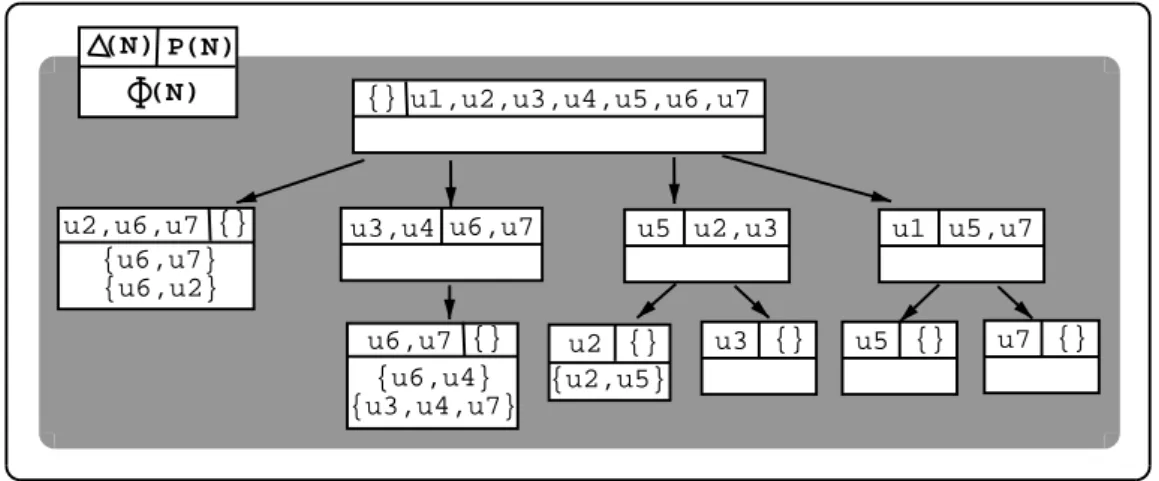
IDEA defines a unified virtual machine. Complex autonomous systems can be designed as networks of IDEA agents interacting through a uniform, declarative communication protocol. The IDEA “virtual machine” consists of four main components (cf. Figure 1.6).
Plan Runner
..
.
Controlling SystemGoal Execution Feedback
Controlling System Goal Execution Feedback Controlled System Controlled System Plan Service Layer Search Engine Search Control Plan Database Model Reactive Planner Goal Register Plan Runner Plan Runner
..
.
Controlling SystemGoal Execution Feedback
Controlling System Controlling System Goal Execution Feedback Controlled System Goal Execution Feedback Controlled System Controlled System Plan Service Layer Plan Service Layer Search Engine Search Engine Search Control Plan Database Model Reactive Planner Goal Register
Figure 1.6: Structure of an IDEA agent, from [Dias 03]
A plan database represents the actions currently executed as well as the actions planned for the future. A plan runner is in charge of closing the loop by integrating execution feedback and reading the next actions to execute in the plan. The plan service layer provides the communication infrastructure for actions, goals and sensor data exchanges with other controlled or controlling agents and/or hardware drivers. Finally, a reactive planner is activated by the plan runner each time a new information is received or an action deadline expires.
The plan database is composed of a set of parallel timelines. Each timeline corresponds to a specific state variable (representing a dynamic property of the system), and describes the sequence of (past and future) actions and states linked to this state variable. Both actions and states are represented by the same structure, called token. A token corresponds to a time interval during which a procedure has to be executed. This procedure may have a set of input values and a vector of return status parameters. It is sent to other agents or drivers for execution. A procedure is completed when the return status is bound to a specific value or when the token deadline has elapsed.
Each timeline should contain one active token at current time. Thus, when a procedure returns or must be terminated, the reactive planner uses subgoaling search and constraint satisfaction techniques to guarantee that the next tokens are consistent with respect to the constraints in the agent’s model. Reactive performance is obtained by limiting the horizon over which planning operates (e.g. make decisions only for the next step).
Each agent is given an execution latency that corresponds to the duration allowed for the “sense/plan/act” cycle to complete. This latency permits a quantification of the agent’s responsiveness (the maximal duration between an event and its response is always
![Figure 1.6: Structure of an IDEA agent, from [Dias 03]](https://thumb-eu.123doks.com/thumbv2/123doknet/2353042.36699/34.892.211.707.187.514/figure-structure-idea-agent-dias.webp)