HAL Id: tel-00483086
https://tel.archives-ouvertes.fr/tel-00483086
Submitted on 12 May 2010
HAL is a multi-disciplinary open access archive for the deposit and dissemination of sci-entific research documents, whether they are
pub-L’archive ouverte pluridisciplinaire HAL, est destinée au dépôt et à la diffusion de documents scientifiques de niveau recherche, publiés ou non,
Managing reindeer lichen during forest regeneration
procedures: Linking Sami herders’ knowledge and
forestry
Samuel Roturier
To cite this version:
Samuel Roturier. Managing reindeer lichen during forest regeneration procedures: Linking Sami herders’ knowledge and forestry. Social Anthropology and ethnology. Museum national d’histoire naturelle - MNHN PARIS, 2009. English. �tel-00483086�
Managing Reindeer Lichen during Forest
Regeneration Procedures: Linking Sámi
Herders’ Knowledge and Forestry
Samuel Roturier
Faculty of Forest SciencesDepartment of Forest Ecology and Management Umeå
Department of Ethnobiology and Eco-anthropology Paris
Doctoral Thesis
Swedish University of Agricultural Sciences
&
French National Museum of Natural History
Umeå 2009
Acta Universitatis Agriculturae Sueciae
2009:84
Cover: Illustration by C. & S. Roturier
ISSN 1652-6880
ISBN 978-91-576-7431-9 © 2009 Samuel Roturier, Umeå Tryck: Arkitektkopia, 2009
Managing Reindeer Lichen during Forest Regeneration Procedures: Linking Sámi Herders’ Knowledge and Forestry
Abstract
In northern Sweden, conventional forest regeneration procedures applied in modern commercial forestry can disturb terricolous lichen (Cladina spp.) pastures. This has become a source of conflicts with Sámi reindeer herders. The overall aim of this thesis was to investigate forest regeneration strategies that may minimise the disturbance to, and promote the regeneration of, reindeer lichen pastures. The Sámi herders’ practices and knowledge related to the lichen resources were also analysed.
Effects of gentle soil preparation methods on the re-establishment of lichen cover, reindeer grazing and establishment of Pinus sylvestris planted seedlings were studied in a field experiment. Using the HuMinMix-technique to mix the lichen mat with humus and mineral soil (humix-substrate), was found to promote lichen mat recovery more effectively than conventional scarification. Seedling establishment was highest for mounding and tracks with mineral soil. Rates of seedlings mechanically damaged, possibly caused by reindeer trampling in winter, indicates that planting on densely grazed areas should be avoided to minimize sources of conflict and to prefer either direct seeding or natural regeneration instead. According to a survey, complete re-establishment of the lichen mat after soil preparation was estimated to take about one decade on humix-substrate, compared to probably more than five decades following conventional harrowing.
Possibilities for artificial dispersal of reindeer lichen, e.g. in areas disturbed by conventional soil preparation, were also studied. The substrate was identified as a key factor for lichen establishment. In this regard, mineral soil was identified as a poor substrate for reindeer lichen immobilization, while milled organic materials, such as moss, were suitable substrates for lichen immobilization and growth. All dispersal methods tested resulted in lichen establishment, but transplanted lichen cushions were heavily depleted by reindeer grazing, while fragmented lichen thalli were much less affected.
A study based on ethnolinguistics demonstrated that whereas the Western use of the word ‘pasture’ is often associated with a specific plant community, Sámi herders’ understanding of the word (guohtun in Sámi) also incorporates the effect of snow on grazing. Sámi herders use their knowledge of the effects of forest trees and other vegetation on snow conditions, to strategically plan reindeer grazing during winter. Sámi herders’ knowledge of winter pastures should therefore be integrated with information on the effects of forest regeneration procedures on stand development to develop strategies that meet the needs of both commercial forestry and the reindeer herders.
Keywords: Artificial dispersal, Cladina, Guohtun, HuMinMix, Soil scarification,
Reindeer pastures
Author’s address: Samuel Roturier, Department of Forest Ecology and Management,
Swedish University of Agricultural Sciences, SE-922 91 Vindeln and Department of Ethnobiology and Eco-anthropology, French National Museum of Natural History, FR-75 005 Paris.
La gestion des pâtures de lichen au cours de la régénération forestière: Associer les savoirs locaux des éleveurs de rennes Sami et la sylviculture
Résumé
En Suède boréale, les techniques de régénération forestière utilisées par la foresterie moderne, notamment les préparations de sols précédant la plantation, endommagent les pâtures de lichen terricoles (Cladina spp.), et sont devenues une source de conflit entre forestiers et éleveurs de rennes Sami. L’objet de cette thèse est d’étudier des stratégies de régénération forestière pouvant réduire les perturbations et promouvoir le ré-établissement du lichen des rennes. Les savoirs et les pratiques des éleveurs Sami sur la ressource en lichen sont également analysés.
Les effets de préparations de sol moins perturbatrices sur le ré-établissement du tapis de lichen, le pâturage des rennes et l’établissement de plants de Pinus sylvestris furent étudiés. L’utilisation de l’HuMinMix, technique mélangeant le couvert de lichen avec la couche d’humus et le sol minéral, est favorable à la régénération du tapis de lichen par comparaison aux préparations de sols conventionnelles. Cependant, l’établissement des jeunes pins est supérieur suivant une préparation exposant seulement le sol minéral. L’occurrence de dégâts mécaniques, possiblement causés par le piétinement des rennes, est un argument pour éviter la plantation dans les parcelles fortement fréquentées par les rennes, au profit de la régénération naturelle ou de l’ensemencement afin d’éviter les conflits avec les propriétaires forestiers. La régénération complète du tapis de lichen suivant la préparation de sol HuMinMix est estimée à une dizaine d’année comparé à plus de cinquante ans suivant les techniques conventionnelles.
Les possibilités de dispersion artificielle du lichen, par exemple dans des parcelles fortement endommagées par les préparations de sol, sont également étudiées. La nature du substrat s’avère être un facteur clé pour l’établissement du lichen dispersé. Le sol minéral se révèle être un substrat ne permettant pas l’immobilisation des fragments de lichen, alors que les substrats organiques sont favorables à l’établissement et à la croissance du lichen. Au cours du suivi de 17 parcelles en régénération, toutes les espèces du genre Cladina furent observées colonisant naturellement les sols scarifiés. Néanmois la présence d’espèces de lichen pionnières semble favoriser l’établissement des lichens du genre Cladina. Toutes les méthodes de dispersion testées résultèrent en un établissement effectif du lichen. Néanmoins l’établissement suivant la transplantation de thalles lichéniques entiers, non-fragmentés, fût sévèrement réduit par le pâturage des rennes, alors que l’établissement à partir de thalles fragmentés le fût beaucoup moins.
Une étude ethnolinguistique permit également de démontrer que, contrairement à son usage dans la culture occidentale où le mot ‘pâture’ est associé à une communauté végétale spécifique, l’usage par les éleveurs Sami du même mot (guohtun en Sami) inclut l’effet de la neige sur les pâtures de lichen et leur pâturage par les rennes. Les éleveurs de rennes Samis utilisent leurs savoirs sur l’influence de la végétation forestière sur les conditions de neige, et donc les conditions de pâturage, pour élaborer des stratégies de pâturage au cours de l’hiver. C’est pourquoi il est nécessaire d’intégrer le savoir des éleveurs Sami sur les pâturages hivernaux en tenant compte des conséquences de la régénération forestière sur le développement et la structure du peuplement, afin d’améliorer la compréhension des effets de la production forestière sur le pâturage hivernal des rennes, et pour développer des stratégies qui satisfassent les gestionnaires forestiers et les éleveurs de rennes.
Mots clés: Cladina, Dispersion artificielle, Guohtun, HuMinMix, Pâturage des rennes,
Skötsel av renlav integrerat med skogsföryngringsåtgärder vid
skogsbruk
Sammanfattning
Skogsresursen i norra Sverige används ofta samtidigt av både rennäring och skogsbruk. Det moderna skogsbruket kan medföra störningar i tillgången på renlavar (Cladina spp.) för renbete under skogsföryngringsfasen, vilket utgör en källa för konflikter mellan rennäring och skogsbruk. Övergripande mål med denna avhandling var att undersöka skogsföryngrings-strategier som kan minimera störningar och stimulera reproduktion av renlavsbeten. Syftet var att (i) kvantifiera effekter av markberedning, bl. a. avseende HuMinMix-tekniken (Figur 3), på återetablering av renlav, renens betesmönster och etablering av tallplantor (Pinus sylvestris), (ii) undersöka möjligheter till artificiell spridning av renlav, och (iii) analysera hur traditionell kunskap hos renskötande samer används vid val av betesmarker under vintern.
Effekter av skonsam markbehandling på återetablering av renlav, renens betesmönster och etablering av tallplantor studerades i ett fältförsök utlagt på en lavrik tallhed (Studie I). I försöket jämfördes tre varianter av markberedning (humix-spår, högläggning och mineraljordspår, inklusive en kontroll utan markberedning) av olika intensitet, dvs. med olika nivåer av störd markyta. Med en finfördelad blandning av lav-/humustäcke och mineraljord (humix-substrat), erhölls snabbare återetablering av renlav jämfört med konventionell markberedning (Figur 4). Studie V, avseende återetablering av renlav för humix-spår och konventionell harvning, visade att tiden till fullständig återetablering av renlav kan uppskattas till ca ett decennium för ett humix-substrat, jämfört med troligtvis minst fem decennier för konventionell harvning (Figur 6).
I Studie I visade sig plantetableringen vara generellt låg, speciellt för kontrollen, men dock högre för högläggning och mineraljordspår jämfört med humix-spår (Figur 8). Förekomsten av mekaniskt skadade plantor, förmodligen orsakat av renens betesgräv under vintern, indikerar att plantering ska undvikas i områden som är speciellt viktiga för renens vinterbete. Istället bör sådd eller naturlig föryngring väljas, som kan ge etablering av ett stort antal stammar till låg kostnad, vilket medför mindre känslighet för att en andel plantor skadas av betesgräv. Därmed minimeras även risken för konflikter. En spillningsinventering i Studie 1 visade på en trend med färre spillningshögar där mer av mineraljorden exponerats och fler spillningshögar där lavtäcket var intakt (Figur 7).
Möjligheter till artificiell spridning av renlav studerades i två fältförsök. I Studie II spreds lavfragment (1- och 3-cm) på fyra olika marksubstrat (mineraljord samt sönderdelad mossa, bärrisvegetation och bark). Marksubstratet identifierades som en nyckelfaktor för lavfragmentens etablering, särskilt för immobilisering av fragmenten. Mineraljord förefaller olämplig medan sönderdelat organiskt material (t ex mossa) erbjuder bra miljö för att lavfragment både ska fästa (Figur 5) och växa (Figur 9), jfr humix-substratet ovan. Något fler marklavarter (andra än renlavar) verkar etablera sig i humix-spår jämfört med harvning (Studie V, Figur 10). I studie IV undersöktes två spridningssätt, spridning av lavbålar resp. lavfragment. Både spridningssätten
resulterade i lavetablering och tillväxt liknande naturligt etablerad renlav. Spridning av fragment var dock effektivare än spridning av intakta lavbålar eftersom bålarna betades hårt av ren. Spridning av fragmenterad renlav bör alltså vara en möjlighet för restaurering, t ex när onödigt radikal markberedning använts.
I Studie III presenteras resultat från en analys (utförd genom deltagarobservation, intervjuer av renskötare och etnolingvistisk analys) av hur renskötande samer använder sin traditionella kunskap för att välja vinterbetesmarker i Jokkmokksområdet. Samiska ordet guohtun (bete) har en vidare betydelse än det svenska ordet bete. Medan det svenska ordet ofta är associerat med en specifik art som betas, t ex en marklav, är det samiska ordet även förknippat med snöns effekt på möjligheterna till bete. Renskötarna använder sin kunskap om trädens och annan vegetations inverkan på snöbetingelserna som underlag för strategisk planering av vinterbetet. Därför föreslås i avhandlingen ett schematiskt underlag för diskussion om markanvändning som baseras både på metoder som kan minska skogskötselns negativa inverkan på renlavsbetet och renskötarnas kunskap om beståndsegenskapers och snöns inverkan på renens vinterbete (Figur 11).
Contents
List of Publications 11
1
Introduction 13
2
Background 15
2.1
Forest management in reindeer grazing land 15 2.1.1
History of forests use for logging in northern Sweden 15 2.1.2
Effects of forest management on reindeer lichen pastures 15 2.1.3. Effects of soil preparation on seedling establishment and
lichen cover 18
2.2
Sámi reindeer herders: the other users of the boreal forest 19 2.2.1
Reindeer herding in Sweden today 19 2.2.2
Contribution of indigenous knowledge to resource
management 22
2.3
Restoring reindeer lichen: how and why? 24 2.3.1
Lichen recovery after disturbances 24 2.3.2
Elements of lichen biology 25
3
Objectives 27
4
Material & Methods 29
4.1
Study areas 29
4.2
Lichen cover measurements 29
4.3
Ethnographic fieldwork 31
5
Results & Discussion 33
5.1
Gentle forest soil preparation and ground lichen re-establishment 33 5.1.1
Effects of gentle scarification on ground lichen 33 5.1.2
Effects of gentle scarification on reindeer grazing 37 5.1.3
Seedling establishment on mixed substrates 39 5.2
Scope for artificially dispersing reindeer lichen and restoring
disturbed areas 40
5.2.1
Determinant factors for reindeer lichen establishment 40 5.2.2
Practical and economic issues 45 5.3
Sámi reindeer herding: a knowledge rooted in language and culture 47 5.3.1
Guohtun, a holistic definition of pastures 47 5.3.2
Grazing in winter: the science of the snow 48 5.3.3
Snow changes and herders’ use of pastures 49 5.3.4
Strategies for grazing in a managed forest landscape 51
5.4
Managing reindeer lichen: towards social and ecological
engineering 53
6
Conclusions 57
6.1
Major findings 57
6.2
Needs for further research 58
Acknowledgements 61
List of Publications
This PhD thesis is based on the following five studies, which will be referred to by their respective Roman numerals.
I Roturier, S., Bergsten, U. (2006). Influence of soil scarification on reindeer foraging and damage to planted Pinus sylvestris seedlings.
Scandinavian Journal of Forest Research 21(3), 209-220.
II Roturier, S., Bäcklund, S., Sundén, M., Bergsten, U. (2007). Influence of ground substrate on establishment of reindeer lichen after artificial dispersal. Silva Fennica 41(2), 269-280.
III Roturier, S., Roué, M. (2009). Of forest, snow and lichen: Sámi reindeer herders’ knowledge of winter pastures in northern Sweden.
Forest Ecology and Management 258(9), 1960-1967.
IV Roturier, S., Bergsten, U. (2009). Establishment of Cladonia stellaris after artificial dispersal in an unfenced forest in northern Sweden.
Rangifer 29(1), 39-49.
V Roturier, S., Sundén, M., Bergsten, U. Re-establishment rate of reindeer lichen species following conventional harrowing and HuMinMix soil preparation in Pinus-lichen clear-cut stands: a survey in northern Sweden. Manuscript.
Papers I, II, III and IV are reproduced with the kind permission of the publishers.
1. Introduction
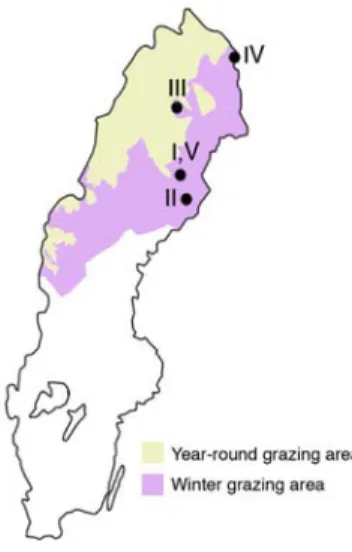
Reindeer husbandry and forestry are by far the most geographically extensive uses of the boreal forests in Fennoscandia, as illustrated by the map showing the reindeer herding areas (47% of which are forested) in northern Sweden in Figure 1. In the last five centuries, semi-domesticated reindeer (Rangifer
tarandus tarandus L.) herding by Sámi people has required access to pastures in
the boreal forest, since reindeer rely on grazing the understorey vegetation, especially terricolous mat-forming lichen (Cladina1 spp.), during wintertime. In addition, for about 100 years, private landowners and forest companies have managed the forest for timber and fibre production in ways, from tree regeneration to final felling, that heavily affect reindeer lichen pastures, particularly during forest regeneration. This dual-use situation has led to frequent conflicts between these two activities, especially in the last 50-60 years (Widmark, 2008). This thesis is intended to provide knowledge to foresters about possible measures to interactively manage reindeer lichen pastures and forest exploitation, taking into account Sámi reindeer herders’ knowledge.
1Lichen nomenclature follows Moberg and Holmåsen (2000); see Material & Methods (4.2) for brief
discussion about the nomenclature of reindeer lichens.
Figure 1. Reindeer herding area in Sweden. Forest land for wood production represents about
47% of the reindeer herding area (Norrbotten, Västerbotten, Jämtland). Roman letters refer to Paper numbers indicating the location of the studies presented in the thesis.
There are numerous sources of conflicts and divergence of interests between forestry and reindeer herding, but ground lichen can be readily identified as pivotal element in this respect for several reasons: ground lichen is the main resource for reindeer during winter, wintertime is the period when access to grazing resources is most critical, and forestry measures impair lichen pastures over both short and/or long-term scales. Hence, most research on reindeer winter grazing has crystallised around issues related to ground lichen.
As a major component of the understorey vegetation in boreal ecosystems, reindeer lichen has been considered in numerous publications by forest ecologists and plant scientists in recent decades. Since it is also the main pasture resource of a large herbivore (reindeer), lichen has also interested zoologists during this time. In addition, since lichen pastures are resources for reindeer herded by indigenous people, with its own culture, practices, language and worldview, reindeer lichens have dimensions that are highly relevant to the social sciences. Recurrent court cases associated with reindeer winter grazing show that the issue has also strong legal aspects, and is highly politically charged (Hahn, 2000). Further, there is unlikely to be any major resolution of the associated problems without the development of clearer institutional frameworks (Sandström et al., 2006).
Forest ecosystems are currently managed in boreal Sweden in ways that are intended to optimise wood production and conserve biodiversity, based on increasing knowledge of forest ecology and management, and experience gained from almost a century of modern forestry. Adapting forest management to reindeer herding should be technically possible, if the only challenges associated with meeting the socio-political requirements were purely related to forest ecology and management. However, knowledge of the effects of forestry on aspects of reindeer herding, such as use of pastures and herding patterns, remain poorly understood or simplistic, as widely acknowledged, e.g. in the Swedish Forestry Act (§21 and §31). Indeed, integrating the management of reindeer pastures with forest management requires knowledge and skills that extend beyond those of natural sciences. But neither social nor natural sciences can meet such challenges alone. Therefore, in order to improve knowledge on forest management adapted to reindeer herding and understand the issue in its whole complexity, it must be tackled by an interdisciplinary approach. Thus, this thesis addresses the issues involved in adapting forest regeneration to meet the needs of both forests (optimising forest growth) and Sámi reindeer herding (optimising lichen resources and access) using methodologies rooted in environmental anthropology as well as forest ecology and management.
2. Background
2.1. Forest management in reindeer grazing land
2.1.1. History of forests use for logging in northern Sweden
The present use of the boreal forest for commercial forestry has developed via a series of historical changes. Human impact on the forest remained of low intensity until the 19th century, following the establishment of settlements, the beginning of industrialization and the introduction of commercial forestry (Tirén, 1937). During the 19th century the two northern counties of Sweden (Västerbotten and Norrbotten) were reached by the timber frontier that moved across the country targeting the largest Scots pine (Pinus sylvestris L.) trees (Östlund, 1993). During the first half of the 20th century, selective logging (or high-grading) was still the principal logging system, and together with fire prevention, forest exploitation provided a sparser forest which was more suitable for the growth of terricolous lichens, and thus for reindeer herding (Berg et al., 2008). Changes occurred progressively during this period towards more intensive and productive forest management (Östlund & Roturier, in press). The use of forestland for producing wood presented a dramatic shift in the middle of the 20th century with the introduction of mechanization and rationalized practices. During the second half of the 20th century, clear-cutting, soil scarification and fertilisation became dominant practices (Östlund
et al., 1997; Berg et al., 2008). As a result of this high-yielding strategy forestry
is an important contributor to the economy of the lightly populated northern counties of the country.
2.1.2. Effects of forest management on reindeer lichen pastures
Terricolous mat-forming lichen, together with epiphytic species (Alectoria spp. and Bryoria spp.), represent 50-80% of the reindeer’s winter diet (Bergerud & Nolan, 1970; Kojola et al., 1995; Heggberget et al., 2002; Storeheier et al., 2003; Jaakkola et al., 2006), and thus are of critical importance for reindeer herding. During winter reindeer have to dig through the snow to feed on lichen. Temperatures are generally milder, and the snow conditions more suitable for digging reindeer in coniferous forests than in bare mountain areas. Therefore,
Pinus-lichen stands (also called pine-heaths) in the winter grazing area (Fig.
1) constitute the principal pastures for reindeer during winter. Pinus-lichen forests are dominated by Scots pine, which accounts for the largest part of the standing volume, and the ground vegetation is dominated by lichens, feather mosses (Hylocomium splendens Hedw. and Pleurozium schreberi Bridd.) and ericaceous dwarf shrubs. In two types of vegetation, designated lichen-rich and lichen-dominated types, the lichen cover amounts to ≥25 to < 50% or ≥50%, respectively, according to Hägglund and Lundmark (1982), and these types jointly account for about 13% of the forest land in Sweden (data from 1999; Sandström et al., 2006).
Forest management is mainly based on clear-cutting and artificial regeneration. Pinus-lichen forests are generally considered to have low productivity, and thus are harvested after longer periods (100-120 years) than more productive forests (SKSFS 1993:2). However, prior to regeneration, the first step in a rotation in most (87%) forest stands is soil preparation by scarification (Swedish Forest Agency, 2007). For Pinus-lichen stands established on dry and mesic soils the most common practice is to scarify by harrowing before planting and/or natural regeneration (Karlsson et al., 2009). However, in some cases mounding may be preferred to more severe harrowing. The regeneration strategies applied generally depend on the degree of moisture of the soil and thickness of the humus layer. On dry soils, with thin humus layers, natural regeneration without soil scarification may be chosen since Scots pine seeds readily germinate on lichen mats (cf. Steijlen et al., 1995). However, this strategy is only usually recommended for areas where the temperature sum is higher than 1 000°C, otherwise there are substantial risks that it will not result in sufficiently high stem densities (Karlsson et al., 2009). In the reindeer husbandry area of northern Sweden, this corresponds only to a narrow belt of land along the coast.
Most current forestry practices applied to Pinus-lichen stands have negative effects on reindeer winter pastures since they decrease the biomass of lichen forage. Measures that have a direct effect on lichen abundance include: conventional scarification methods like harrowing, which partly destroy the vegetation cover; and leaving logging residues in clear-cut areas, which affects lichen growth and access to it (Eriksson, 1976a; Helle et al., 1990; Webb, 1998).
By changing abiotic conditions, notably light and moisture levels, other practices may also favour vascular plants at the expense of ground reindeer lichen. Both fertilisation and clear-cutting on sites with high nitrogen supplies, promote the growth of dwarf shrubs or pioneer species such as Deschampsia
flexuosa (L.) (e.g. Hannerz & Hånell, 1997; Kellner & Mårshagen, 1991;
Vaccinum myrtillus (L.) and feather mosses are adversely affected by the higher
irradiance that follows clear-cutting, consequently decreasing the competition for Cladina lichens (Kardell, 1980; Bråkenhielm & Persson, 1980). There will also be between-Cladina species differences in such responses, for instance Webb (1998) observed a decline in C. stellaris cover after logging, but an increase in cover of other ground lichen species, possibly due to an increased access to light.
Recent production practices, such as the planting of densely ramified Pinus
contorta (Dougl.), since the 1960s, and high stem density, often due to owners
neglecting pre-commercial thinning, also favour mosses at the expense of ground lichen (Kardell & Eriksson, 1992; Berg et al., 2008). Another effect of high stem density related to reindeer herding is that it is very difficult to drive snowmobiles through stands with high stem density and consequently almost impossible to gather animals in dense forests.
Before the end of the 19th century, when forest fires were prevented to maximise wood production (Tirén, 1937), coniferous forest burnt at a mean interval of 80 years in northern Sweden (Zackrisson, 1977), an extremely high frequency compared with today. This change has led to a decrease in Pinus-lichen stands at the landscape level, and it may be the most important effect of forestry on lichen cover at the landscape level (Zackrisson, 1977; Berg et
al., 2008). On mesic sites, this favours litter accumulation and late successional
species at the expense of reindeer lichen (Ebeling, 1978). Thus although the absence of fire is beneficial for reindeer lichen in the short term at stand level, in the long term ground lichen benefits from frequent forest fires relative to vascular plants (Zackrisson, 1977; Ebeling, 1978; Foster, 1985; Hörnberg et al., 1999; Berg et al., 2008).
Finally, since reindeer have to dig through the snow to reach the lichen, snow density and snow depth are key factors that influence reindeer grazing (Eriksson, 1976b; Pruitt, 1979; Collins & Smith, 1991; Kumpula & Colpaert, 2007; Helle & Kojola, 2008). The effects of forest management on the degree and extent of snow cover are therefore of great importance to Sámi herders, but they have not been thoroughly studied because of the complexities of the interactive factors involved.
It should also be noted that the shift from the longer natural cycles that predominate in old growth forests to a clear-cutting system with shorter rotation cycles has also reduced the amount of arboreal lichens, which are mostly confined to old-growth forests (Holien, 1996; Jaakkola et al., 2006). Today approximately 72% of the forest land in Sweden is occupied by stands younger than 100 years (Swedish Forest Agency, 2007). The poor dispersal
potential of epiphytic lichen in general, and the fragmented habitats due to the absence of old-growth forests, has isolated arboreal lichen populations and prevented their development (Dettki & Esseen, 1998). In addition to causing concerns regarding biodiversity (Hörnberg et al., 1998), this causes problems for reindeer herding (Jaakkola et al., 2006), since epiphytic lichens provide useful alternative sources of forage. This has increased the grazing pressure on ground lichen.
2.1.3. Effects of soil preparation on seedling establishment and lichen cover
For forest owners, the aim of soil preparation is to facilitate forest regeneration by improving soil and microclimate conditions for seeds and seedlings. It is commonly used to improve survival rates and early growth of forest plantations and natural regenerations (Karlsson et al., 2009). Conventional practices involve soil scarification, in which the organic layer is either removed, leaving the mineral soil surface exposed (harrowing) or inverted (mounding).
When the organic layer is removed and mineral soil is exposed germinating seeds have direct access to the mineral soil, which improves the establishment of seedlings (Winsa & Bergsten, 1994; Wennström et al., 1999; Hille & den Ouden, 2004), partly because they are less dependent on the highly variable moisture regime of the humus layer (Oleskog & Sahlén, 2000), as illustrated by sharp drops in mortality when seedlings have established their roots in mineral soil (Nilsson et al., 2002). In addition, removing the vegetation layer increases the availability of suitable microsites for seeds, and reduces the competition young seedlings face for water and nutrients. It also decreases the allelopathic effects of dwarf shrubs (e.g. Empetrum nigrum L.), which can inhibit the germination of Scots pine (Zackrisson & Nilsson, 1992).
In a naturally grown forest, wildfire is a primary determinant of the composition and biomass of understory vegetation, and hence a major driver of forest community and ecosystem properties. To a certain degree, disturbing the humus layer by scarification can mimic some effects of fire, by removing the understorey, increasing rates of mineralization (Johansson, 1994) and consequently increasing rates of nitrogen uptake by conifer seedlings (Nilsson & Örlander, 1999). Moreover, mounding increases the thickness of the fertile zone by inverting the humus layer. Soil structure is also improved by associated increases in soil porosity, which, e.g., promoting gas exchange (de Chantal et
al., 2004).
Low soil temperature may inhibit root growth as well as water uptake, and thus affect seedlings’ water absorption and nutrient uptake rates (Mellander et
is to remove the insulating effect of the vegetation layer, thereby increasing solar radiation and raising soil temperatures in the root zone. The increases in solar radiation, together with the reflectance and conductivity of mineral soil, may also increase the temperature of the air surrounding the above-ground parts of the seedlings. This can enhance their rates of photosynthesis and keep them warmer than they would otherwise be during cold summer nights (Lundmark et al., 1978; Kubin & Kemppainen, 1994). Increased temperatures in seedlings’ surroundings may also reduce the risks of fungal diseases and damage by insects such as Hylobius abietis (L.) (Örlander & Nilsson, 1999). However, scarification may also have negative effects on seedlings, notably it may increase their transpiration and, consequently, water requirements.
Scarification also has profound effects on reindeer grazing, since it can affect as much as 35-55% of the vegetation cover grazed by reindeer when applied in lichen-rich stands (Eriksson & Raunistola, 1990). It reduces a substantial proportion of the forage biomass, and may also have indirect effects since herders report that reindeer generally avoid grazing in scarified stands because they are repelled by the smell of exposed mineral soil. Thus, during the consultations that forest companies are obliged to hold with reindeer herders prior to clear-cutting according to Forest Stewardship Council regulations (FSC, 1998), soil preparation is one of the main focus of negotiations and sources of conflicts (see also Sandström & Widmark, 2007). For these reasons, scarification techniques with as little impact as possible on vegetation cover should be selected, especially since harsh scarification may give no better results than mild treatments. For instance, Mattsson (2002) showed that (on sites with intermediate fertility at least), 20 years after mounding and harrowing, which resulted in disturbance to 35 and 54% of the soil area, respectively, stem volume yields were similar.
2.2. Sámi reindeer herders: the other users of the boreal forest
2.2.1. Reindeer herding in Sweden today
The Sámi herding society in Sweden has been organized in 1886 in 51 reindeer
herding communities in the three northernmost counties. Today, a reindeer
herding community is commonly defined as a geographic entity delimiting the grazing areas and an economic organization representing its members’ interests (Gustavsson, 1989; Sametinget, 2008). In addition, a herding community also refers to a community in the more commonly used sense,
i.e. the herders and their families, who share the land and collaborate during
many essential activities. Since reindeer husbandry is an exclusive right of the Sámi people, all members of a herding community are Sámi. There are about
4 500 reindeer owners in Sweden and about 250 000 reindeer (Sametinget, 2008). Reindeer herding communities are differentiated between mountain and forest2 communities. The principal difference is that summer pastures of
the former are located in the mountains and those of the latter are located in the inland forests. Hence, migration distances are longer for mountain herding communities, but winter pastures, which are the main foci of this thesis, are invariably located in the forestland at lower altitudes for both mountain and forest herding communities.
At the beginning of the 20th century, there were major changes in reindeer herding in northern Sweden, with a transition towards the reindeer being gathered in larger herds solely for slaughtering. These changes had multiple causes, including the spread of the extensive herding practiced by Karesuando Sámi, who were relocated to various places throughout northern Sweden after the border closure with Norway in 1919. In addition, modernization and motorization of herding tasks during the second half of the 20th century eased some of the herders’ work and lifestyle. Finally, the rationalization encouraged by Scandinavian states also contributed to the switch to the current form of reindeer herding (Beach, 1981; Bjørklund, 1990; Müller-Wille et al., 2006).
Reindeer herding is based on an annual cycle that can be outlined as follows. From calving in May until the end of the growing season, the herds graze freely and their diet consists of protein-rich deciduous shrubs, herbs and grasses, allowing them to build reserves for winter, during which they rely mostly on energy-rich lichen (e.g. Eilersten et al., 2001; Heggberget et
al., 2002). At the turn of June-July, reindeer herds are gathered by foot and
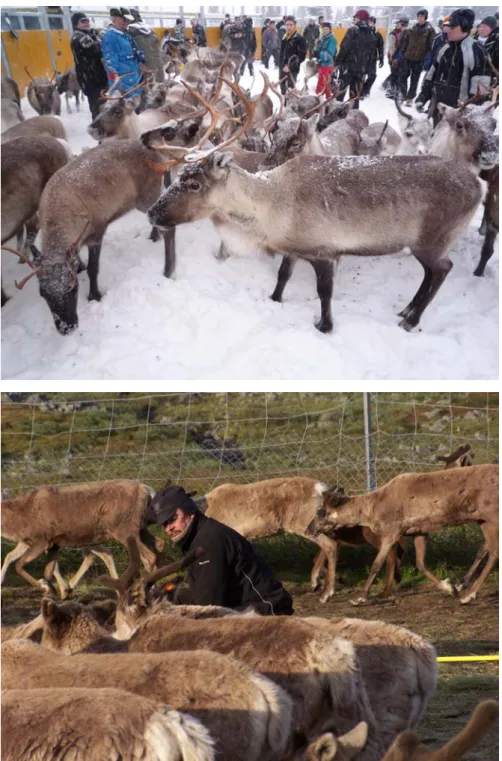
motorized vehicles, including helicopters, for earmarking the yearlings (Fig. 2), after which they are released for free grazing until the slaughter of the males. Males are slaughtered in autumn, before the rut, to obtain meat for both private consumption and sale. After the rut, in November-December, the first herds are gathered by herders of the whole community to be sorted and separated into smaller herds belonging to specific families, or groups of families, called winter-groups or siida (Fig. 2). At that time of the year, herders stop working for the whole community, and concentrate their labour on reindeer belonging to their respective winter-groups. Depending on the location of winter-groups’ territory and weather conditions, reindeer herds either migrate by foot or are taken in vehicles to their winter territory. Due to the extensive form of summer grazing, with extremely loose guarding, it is very rare that all reindeer belonging to a herding community are gathered together. For the same reason, reindeer belonging to adjacent communities often mix and herders also have to participate in neighbours’ separations to
2 Concession communities can be regarded as “forest” communities with respect to their land use strategies,
Figure 2. (Top) Reindeer separation: after identifying the owner of the reindeer by their
earmarks, reindeer belonging to the winter-group are gathered in an adjacent coral before the migration to the winter grazing land. (Bottom) Earmarking of yearlings in July. Photos: S. Roturier.
collect their own reindeer and transport them to their winter land. New herds of reindeer can thus be gathered and moved to winter land until the end of January. Adverse climatic conditions, especially for mountain communities, which are frequently confronted with bad weather, can reduce the efficiency of the gathering and some reindeer commonly spend the winter in the mountain area. Winter separations are also the time when herders can sell yearlings to slaughterers. Wintertime is a period of intense guarding to avoid reindeer scattering. This is especially true when a crust of ice covers the snow cover and reindeer scatter to find epiphytic lichen. Thereafter the spring migration takes place and reindeer herds are then released in the community’s common pasture, when they are heading toward calving land.
Winter is often considered to be the bottleneck for reindeer survival and reindeer herding in general, since the quantity and quality of winter ranges strongly influence the body weight, calf production and mortality of reindeer (Skogland, 1986; Kojola et al., 1995; Kumpula et al., 1998). As well as trying to ensure the survival of the reindeer, herders have to prevent them scattering beyond their grazing area at that time. As explained above, winter grazing for each winter-group takes place in a particular area. Thus, the grazing territory of each winter-group is limited in space and surrounded by the territories of other groups. Keeping reindeer within their respective winter-group’s territories avoids the need for extra labour to collect the scattered reindeer, and helps to maintain good relations between neighbouring groups. In addition, maintaining control of the herd, which is mostly composed of pregnant female during winter, is also the only way to ensure that the yearlings will be earmarked next summer.
After the winter separation, our task is to control our reindeer. To make sure that our reindeer spend the winter as well as possible, and that they give birth to nice and healthy calves in May. (P.-J. Parffa, March 2008)
This is an important factor to consider when studying reindeer herding in winter, since reindeer continuously move when grazing (see also III).
2.2.2. Contribution of indigenous knowledge to resource management
As often mentioned, there is no universally accepted definition of traditional ecological knowledge (Berkes, 1999) and the understanding of the term, as widely used since its official emergence in Article 8(j) of the Convention of Biological Diversity (CBD, 1992), may even be misleading when studying such knowledge (see Nakashima & Roué, 2002). Thus, in this thesis when referring to current knowledge of Sámi herders about forest grazing areas, the term of indigenous ecological knowledge is preferred and understood as:
(…) the complex arrays of knowledge, know-how, practices and representations that guide human societies in their innumerable interactions with the natural milieu: agriculture and animal husbandry; hunting, fishing and gathering; struggles against disease and injury; naming and explaining natural phenomena; and strategies for coping with changing environments. (Nakashima & Roué, 2002)
In his seminal work on The Savage Mind, Lévi-Strauss (1962) reflected on the distinctive nature and process of what he called the science of the concrete,
i.e. the results of the accumulation of individuals’ and societies’ interactions,
observations and efforts to comprehend and organize their surrounding environment.
Reindeer herding concerns as much the material environment as the spiritual environment, since both are undoubtedly combined in indigenous knowledge. Centuries of acculturation of Sámi people have made this dimension less obvious to outsiders, but dismissing it would be an error (cf. Oskal, 1999; Ruotsala, 2004), since it remains a cornerstone of the worldview that Sámi societies have of their environment. Authors commonly agree that indigenous knowledge has a number of distinctive features, among which the following are of particular interest in the context of this thesis: (i) indigenous knowledge has an holistic approach; (ii) it has a strong empirical knowledge component; (iii) it is cumulative and open to change; (iv) it has a management practice component; hence (v) it is always embedded in a specific socio-cultural context (Berkes, 1999; Posey, 1999).
Language often embodies such knowledge, frequently in unwritten forms. Naming and classifying things enable people to “understand and make more
intelligible the relationships between beings” (author’s translation from Durkheim
& Mauss, 1901-1902). For that reason the study of indigenous knowledge is deeply rooted in ethnoscience, or new ethnography, which can be defined as the study of a culture’s system of classification and taxonomy to describe its surrounding environment. Key objectives of this discipline are to understand indigenous people’s view from within and obtain insights into the very nature of indigenous knowledge (cf. Nakashima & Roué, 2002). Current interest in indigenous knowledge regarding resource management is motivated by both ethical concerns and desires to increase the effectiveness of management measures (e.g. Fernandez-Gimenez, 2000; Hunn et al., 2003; Foale, 2006). In that sense, understanding Sámi reindeer herders’ knowledge is highly relevant to attempts to improve the management of both reindeer lichen pastures and boreal forests.
2.3. Restoring reindeer lichen: how and why?
2.3.1. Lichen recovery after disturbances
The “National goals for the forestry sector” guidelines recommend that forest managers should pay particular attention to reindeer herding, especially regarding soil preparation in Pinus-lichen forest (Swedish Forest Agency, 2005). However, in order to progress beyond good intentions to concrete action in this respect, one should acknowledge the complexities involved in meeting such a goal. Ideally, reindeer lichen should be managed during regeneration procedures in ways that satisfy both the needs of forest managers, as stipulated by the Swedish Forestry Act for production purposes (SKSFS 1993:2), and the needs of Sámi reindeer herders, which are not solely determined by profit (Riseth, 2006). The latter cannot be identified without a thorough understanding of herders’ worldviews regarding winter pastures.
It is technically challenging to prepare soils for tree regeneration while affecting reindeer lichen supply as little as possible. These dual objectives conflict, to some degree (as shown above), and meeting them requires both knowledge about the potential rates of reindeer lichen re-establishment, and measures that may promote it. Valuable insights regarding measures that could be applied can be obtained from knowledge of lichen re-establishment following natural and anthropogenic disturbances, such as the well-documented information that is available on post-fire succession. Fires may consume virtually all of the ground cover and important changes in vegetation composition occur during the following 100 years, i.e. it takes at least a century for lichen cover to peak again (Kershaw, 1977; Morneau & Payette, 1989). The succession stages have been thoroughly described (Maikawa & Kershaw, 1976; Ahti & Oksanen, 1990). In boreal regions, the first colonizers of bare soils are fast-growing crustose lichens and some bryophyte species, as well as some vascular plants that can peak at this time. Then cup lichens (Cladonia spp.) become abundant and the first fruticose lichens may also appear. Later, fruticose lichens, and usually reindeer lichens (Cladina rangiferina L., C. arbuscula Wallr.) become dominant. Cladina stellaris (Opiz) is usually the last to establish. In the absence of grazing, reindeer lichen mats can attain their maximum thickness (ca. 13 cm) and maximum biomass after 125 years (Morneau & Payette, 1989). It is noteworthy that Sámi people knew about the succession of different lichen florae. Nissen (1921, p. 243) noted that Sámi herders in Norway in the early 20th century seemed to recognize different stages corresponding to the dominance of different lichen species or groups of species.
In contrast to fire, soil preparation (like over-grazing and trampling) does not remove all of the lichen ground cover. Instead, it initiates a new succession
on exposed ground, beginning with settlements of crustose lichens or other pioneer species (Helle & Aspi, 1983; Boudreau & Payette, 2004a). This differs from post-fire succession because species from different successional stages are already present following the disturbance and, according to Boudreau and Payette (2004a), C. stellaris may directly recolonize via the spread of fragmented thalli. After nearly complete removal of lichen cover by over-grazing, in the absence of further grazing, at least 20 years are needed for the lichen cover to fully recover (Henry & Gunn, 1991). Conventional scarification can have more prolonged consequences (Sundén, 2003).
On the other hand, the total absence of disturbance can have adverse effects for lichen cover, including the following. On more mesic sites, canopy closure leads to the establishment of feather mosses that can compete with terricolous lichen (Foster, 1985; Sulyma & Coxson, 2001). Gaare (1997) also hypothesized that by grazing reindeer may decrease the thickness of the lichen mat that would otherwise promote the establishment of vascular plants, and thus maintain lichen dominance.
2.3.2. Elements of lichen biology
Lichens are symbiotic organisms, composed of a fungal partner (mycobiont) and photosynthetic partners (photobionts) that may be cyanobacteria and/or green algae. However, all of the most common mat-forming lichens in boreal forests – including Cladina spp. – are associated with algae from the genus
Trebouxia (Ahmadjian, 1993).
Lichenized ascomycetes can reproduce either asexually or sexually. A general characteristic of reindeer lichens (Cladina spp.) is that they mainly propagate through the dispersal of fragmented thalli (Honegger, 1996). The extreme brittleness of the thalli at water contents below 25% (Bayfield et al., 1981) facilitates dispersal, which is mediated by wind and animals (Bailey, 1976; Heinken, 1999).
Lichens are poikilohydric organisms that lack water-transport organs and depend on passive physical processes of water uptake and loss (Blum, 1973). Thus, their moisture status varies to a large extent with surrounding atmospheric conditions, and both their metabolism and growth are periodically inactive when conditions are dry, and activated when they are hydrated by precipitation, dew or atmospheric water (Péch, 1991; Hyvärinen & Crittenden, 1998; Sundberg et al., 1999; Palmqvist & Sundberg, 2000; Jonsson et al. 2008).
Nevertheless, despite being subject to passive regulation, desiccation and rehydration rates of lichen thalli vary between species. The morphological structure and the growing habits of the lichen play an important role in these processes (Larson & Kershaw, 1976; Gauslaa & Solhaug, 1998). As reindeer lichens are all fruticose species, i.e. species with highly ramified morphology, they have a high surface area exposed to the air relative to their volume. For that reason reindeer lichen are more sensitive to desiccation than foliose lichen species, for instance (Larson & Kershaw, 1976). On the other hand, their mat-forming growth habit is often considered to help reduce evaporation, potentially prolonging their growing period (Kershaw & Rouse, 1971; Larson & Kershaw, 1976; Helle et al., 1983; Jonsson et al., 2008). However, this has been recently challenged by Gaio-Oliveira et al. (2006) who found that the wet active time of C. stellaris was not affected by either the density or the thickness of the mat. Nevertheless, isolated thallus fragments, especially smaller ones, may desiccate more rapidly than dense mats or larger fragments (Kershaw & Field, 1975; Gauslaa & Solhaug, 1998; Kytöviita & Crittenden, 2002).
In reindeer lichen most of the photobionts are concentrated in the apical part of the thalli (Nash et al., 1980). Several experiments have shown that the relative growth rate of the apical parts is higher than that of the lower basal parts, which are constituted of fungal, sometimes senescent, tissues (Kärenlampi, 1971; Kytöviita & Crittenden, 2002; Gaio Oliveira et al. 2006). Recent studies have shown that the combined effects of hydration periods and the irradiance intercepted by lichen during these wet periods (Iwet) are key determinants of thallus growth that explain much of the variation observed between species and habitats (Palmqvist & Sundberg, 2000; Gaio Oliveira et
al., 2006). Consequently, microclimatic conditions at lichen establishment sites
strongly influence rates of lichen growth.
Atmospheric deposits are believed to be the main sources of nutrients for
Cladina lichens (Ellis et al., 2004), although Crittenden (1991) also suggested
that reindeer lichen may recycle nutrients from their decaying basal areas to their upper parts. The optimal growth temperature for reindeer lichens is known to be between 15-25°C, but in summer the temperature at the surface of lichen mats can reach 35-40°C without affecting their vitality (Tegler & Kershaw, 1980; Coxson & Wilson, 2004). Since lichens are dependent on wet active periods their growth rates vary between seasons and years. On an annual basis biomass increments up to 17-26% have been measured (Crittenden et
al., 1994; den Herder et al., 2003), which is substantially higher than those
reported by Kumpula et al. (2002) for an intensively grazed mat (ca. 7%). The elongation rate of reindeer lichen has been measured, and found to be
ca. 4 mm y-1, in several studies (Scotter, 1963; Helle et al., 1983; Boudreau & Payette, 2004b).
3. Objectives
The overall aim of the studies underlying this thesis was to acquire knowledge regarding possible measures to decrease the disturbance and negative consequences caused by soil preparation during forest regeneration procedures on reindeer winter pastures, and to promote integration of lichen management with the regeneration of forest trees. The work focused on reindeer lichen (Cladina spp.) pastures and their use by Sámi herders. The first overall hypothesis tested was that since reindeer lichen naturally disperse by thalli fragmentation, it should be possible to accelerate the recovery of lichen mats after disturbance by artificial dispersal and/or by creating suitable establishment conditions during soil preparation. The second overall hypothesis examined was that since reindeer herders belong to the Sámi community, herders’ indigenous knowledge of forest winter pastures should provide valuable insights regarding the management of reindeer lichen pastures. A more detailed understanding of Sámi herders’ knowledge and means to restore lichen grounds is necessary to integrate reindeer lichen management, as a resource for reindeer herding, with forestry practices, patterns and paradigms. Therefore, the approach presented in this thesis, and applied in the underlying studies, is of interdisciplinary nature, involving forest ecology and management as well as social and cultural anthropology. More specifically, the objectives were to:
(i) Evaluate the effects of scarification treatments that disturb the soil less than conventional scarification (I, V) using recently developed equipment that can create various types of planting substrates, with varying intensity, on both the re-establishment of lichen mats in disturbed areas and the regeneration of Pinus sylvestris seedlings (considering also interactive effects of reindeer);
(ii) Test the scope for artificially dispersing reindeer lichen (Cladina spp.) (II, IV, V) in pine forests by assessing the ability of lichen thalli, dispersed by several methods, to restore areas disturbed by forest soil preparation;
(iii) Improve the understanding, through participant observations and interviews, of Sámi reindeer herders’ ecological knowledge with regard to lichen-rich pastures and their use of managed forests during winter time (III).
4. Material & Methods
4.1. Study areas
The studies this thesis is based upon were carried out at places actively used for both forestry and reindeer herding in winter (Fig. 1), in typical boreal forest areas in the middle-north boreal zone of Sweden (Ahti et al., 1968). All of the studies were located in productive, young to middle-aged, Scots pine forests. The field layer of the ground vegetation at each site was dominated by dwarf shrubs, mainly Vaccinum vitis-idaea (L.), Calluna vulgaris (L.), Empetrum nigrum and some V. myrtillus, while the bottom layer was dominated by terricolous lichen (Cladina spp. and Cladonia spp.) and feather mosses. More specifically, studies presented in Papers I, II and V were carried out on dry sites supporting a lichen cover >25% of the bottom layer; the experiment described in Paper IV was established on a mesic site supporting a moss vegetation type with spots of reindeer lichen; and the study reported in Paper III concentrated on the winter grazing areas of reindeer herding communities around Jokkmokk, extending along the valley of River Lule where Pinus-lichen stands are frequent. The study sites are more precisely described in the cited papers.
The monthly mean temperature in the study region ranges between –15 °C in January and +19 °C in June, with mean annual precipitation ranging between 500-700 mm. The average numbers of days with snow, and snow depth, generally vary along a gradient from the coast of the Gulf of Bothnia inland, 150 days with a mean maximal depth of 70 cm near the coast, to up to 225 days with a mean maximal depth of 90 cm close to the mountain areas (data from 1961-1990; SMHI, 2008).
4.2. Lichen cover measurements
Reindeer lichen cover was one of the main variables measured in the experiments (I, II, IV and V). According to the nomenclature proposed by Moberg and Holmåsen (2000), reindeer lichen is the general term for species belonging to the genus Cladina. Recent phylogenic studies have argued that
there is no reason to distinguish the genus Cladina from the genus Cladonia, to which its members were previously assigned (Stenroos et al., 2002; Santesson
et al., 2004). In the papers underlying this thesis, the nomenclature follows
Moberg and Holmåsen (2000), except in Paper IV for editorial reasons. To be consistent throughout the thesis this distinction has thus been kept.
Lichen cover measurements were performed following different methods depending on the experiments. Where surveys of ground vegetation cover were carried out, a 50 cm x 50 cm frame, divided into 25 squares, was used to estimate the cover of terricolous lichens, in conjunction with both visual estimation (I) and point intercept methods (V). The height of lichen thalli was measured using a graduated rod (∅ 1 mm) lowered vertically to the ground without penetrating into the litter and humus layer (I, V).
Where permanent quadrats (1 m x 1 m) were established to monitor the lichen cover over time (II, IV), measurements were made by photo inventory (Dietz & Steinlein, 1996; Vanha-Majamaa et al., 2000). For this purpose, photographs of quadrats were taken, from vertically overhead, using a tripod-mounted camera. The photographs were then automatically processed using image analysis software. In these analyses the following precautions were routinely taken in the field to minimise errors due to the nature and colour of reindeer lichen and reduce the time required to obtain high-quality data. Debris of similar colour to the reindeer lichen was cleared from the ground surface, and photographs were taken when the ground vegetation was dry to avoid moisture (e.g. raindrops or dew) reflecting the light and being confounded with the white colour of lichen. In addition, each series of photographs was taken when air moisture conditions were as similar as possible. Lichen was photographed when moist, where possible, since colour nuances of dry lichen are less easy to distinguish. Finally, photographs were consistently taken on overcast days since direct sunlight could have masked the contrast between reindeer lichen and the vegetation, and above all created shadows in the lichen mat that would have decreased the apparent lichen cover. For these analyses WinCAM™ (Regent Instr., 2007) was used, which enables features in images to be analysed according to colour and to group colours. It should be noted that this program provides attractive possibilities for extending previous studies. For instance, it could be used to complement lichen biomass data presented in Moen et al. (2007) by non-destructive methods. Biomass measurements were used to compare different methods of estimating reindeer lichen cover, including visual estimation, presence/absence and point intercepts. Comparing results obtained using these methods with estimates of cover obtained by image analysis would be very useful for large-scale inventories of reindeer lichen biomass in grazing areas.
4.3. Ethnographic fieldwork
The ethnographic fieldwork included about six months of participant observation spent, between July 2007 and July 2009, in the area of Jokkmokk (chosen because of its importance as a centre for reindeer herding communities and Sámi cultural institutions). Jokkmokk is known as a pioneering area with respect to initiating dialogue between foresters and reindeer herders (Gustavsson, 1989).
Repeated stays gave possibilities to assist (and experience to some degree) different phases of herders’ work such as gathering reindeer, separations in winter, keeping reindeer in winter, checking the grazing conditions, marking yearlings and slaughtering male reindeer, as well as visiting winter grazing areas with herders during the snow-free season.
In addition to the participant observations, the fieldwork included semi-directed interviews with Sámi reindeer herders. Twenty-four herders belonging to the herding communities of Báste, Jåhkågasska, Sirges, Sörkaitum, Tuorpon and Udtja were interviewed, often with the help of field maps to support the discussions. Although most of the Sámi herders use the Sámi language as their mother tongue, the interviews were performed in Swedish, in which they are all fluent, except for Sámi words and expressions that are culturally specific.
The interviews were recorded and most of them were transcribed. This approach prevents the loss or neglect of data that initially seems to be uninformative, but later, during the progress of the fieldwork, may become highly relevant for the analysis, or raise new hypotheses. The topics discussed during the interviews were largely related to the nature and use of winter pastures, including ground lichen, herding management approaches, forestry techniques and Sámi relationships with forest companies. Forest managers from the four forestry companies based in Jokkmokk and representatives from the National Forest Agency were also interviewed on various occasions during this period.
5. Results & discussion
5.1. Gentle forest soil preparation and ground lichen
re-establishment
5.1.1. Effects of gentle scarification on ground lichen
The overall objective of mechanized scarification is to increase seedling establishment after clear-cutting by improving soil and microclimatic conditions. It involves removal of the ground vegetation and exposure of humus or mineral soil in which seeds or seedlings can germinate and establish more easily. Ground lichen cover is destroyed by this process, to a degree that depends on the extent of the scarification (see section 2.1.3). There is a need, therefore, to identify soil preparation techniques, and the optimal intensities to apply them, in order to ensure both satisfactory forest regeneration and satisfactory lichen cover re-establishment.
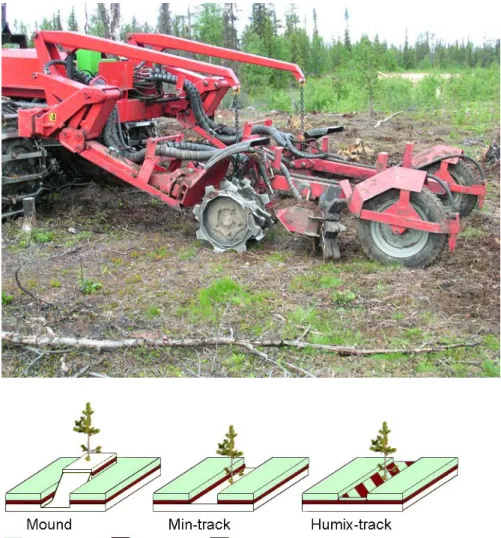
In 2000, a field experiment was established in a Pinus-lichen stand, on dry soil, to evaluate the effects of gentle scarification techniques on ground lichen cover and seedling establishment (Paper I). Three different scarification techniques creating different substrates were tested using recently developed equipment, a flexible HuMinMix scarification apparatus. The scarification techniques were each applied at various intensities of soil disturbance, resulting in six treatments, including Mounding (14 and 21% of soil disturbed by intermittent mounds); Min-track (28% of soil disturbed by 0.3 m-wide tracks exposing mineral soil); Humix-track (14 and 28% of soil disturbed by 0.3 m-wide tracks consisting of mixed lichen cover, humus material and mineral soil, called humix), and controls (no treatment) (Fig. 3). Scarification was followed by planting 1-year-old pine seedlings at a density corresponding to 2 000 plants ha-1. The scarification treatments applied in this experiment differed from conventional treatments in: the low intensity of initial soil disturbance (from 14 to 28% of ground cover); the nature of the Humix-track substrate, which does not expose exclusively mineral soil, but leaves a mixture of different materials, including reindeer lichen, on the surface; and in the fact that a single machine was used to apply all the treatments.
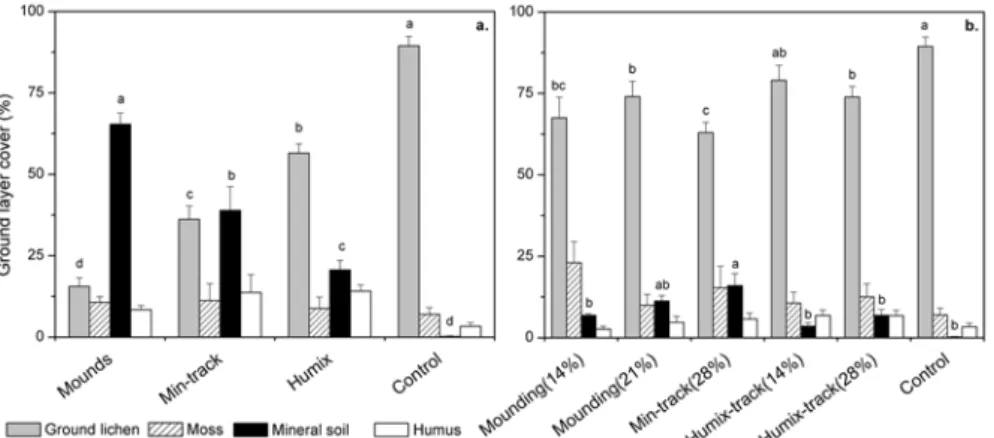
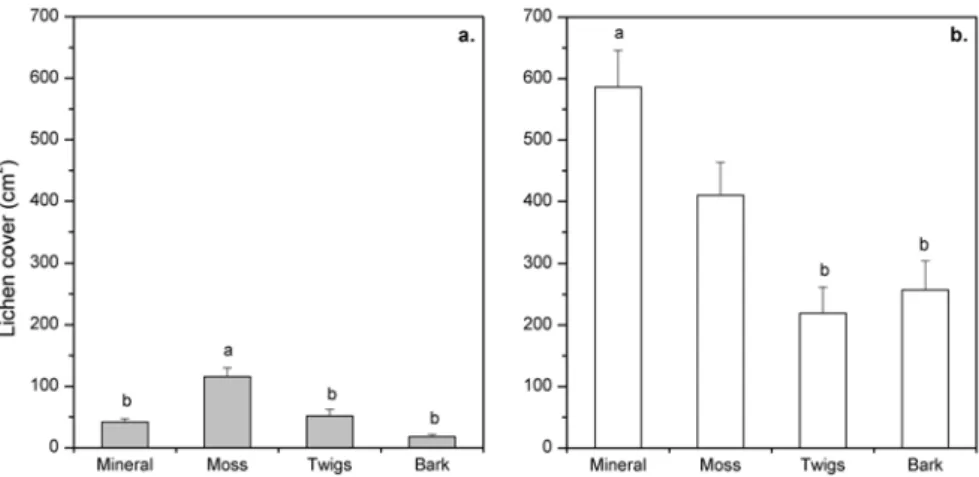
Five years after soil preparation, the ground cover in the areas disturbed by scarification was surveyed to obtain information on the effects of the scarification techniques (Fig. 4a). In control plots there was ca. 90% cover of ground lichen (Cladina and Cladonia) and no exposed mineral soil. By contrast, in plots where the Mounding treatment had been applied 15% of the ground cover was covered by lichen and 65% by mineral soil, due to the creation of the mounds. The ground cover in plots disturbed by the Min-track and Humix-Min-track treatments presented intermediate values, with a significantly larger cover of ground lichen and a lower cover of mineral soil following Humix-track treatment (56% and 36%, respectively) than Min-track
Figure 3. Different substrates created by the HuMinMix scarification apparatus in Studies I and
treatment (36% and 39%, respectively). The differences between scarification techniques can be explained by the presence/absence of fragmented lichen in disturbed areas, the substrate and the micro-topography created.
Clearly by mixing the lichen mat with the upper layer of the soil, Humix-track scarification promoted lichen re-establishment in disturbed areas; since fragmentation is the main dispersal form for Cladina species (Honegger, 1996), the lichen mat began to regenerate immediately after this form of disturbance as observed in surveys one and two years after Humix-track scarification in Study V. Heinken (1999) reported that fragmented thalli spread rapidly by wind, within a radius of 20 cm, within only 15 days. Thus, areas disturbed by Min-track and Mounding were also probably settled by lichen fragments to some degree. However, the establishment of the lichen fragments was enhanced following the Humix-track scarification, presumably because it also created a more suitable substrate.
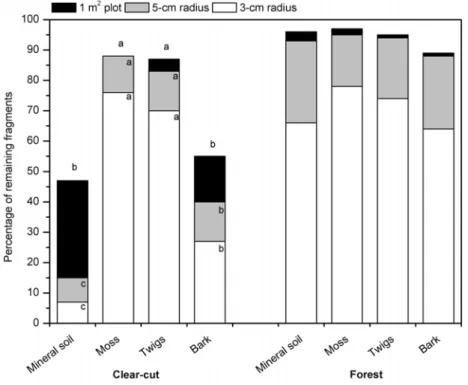
The results presented in Paper II highlighted the importance of the substrate for lichen displacement, since the displacement rate of lichen fragments was higher on sandy mineral soil than on coarser substrates. This was particularly obvious in an environment exposed to wind (Clear-cut) compared to a more closed one (Forest) (Fig. 5). Further, the results showed that lichen establishment was poorer on mineral soil, firstly because it provides an unstable substrate for lichen, and secondly because of its poor water-holding capacity. Other substrates, such as moss, probably created a micro-climate that could have prolonged the wet active period of thalli (e.g. Kershaw & Rouse, 1971; Jonsson et al., 2008). In this respect, the micro-topography created by
Figure 4. Mean ground layer coverage five years after soil preparation (a) in areas where the
soil was disturbed by different scarification techniques resulting in the indicated substrates, and (b) weighted plot-level averages of cover observed following different techniques and different intensities of initial soil disturbance. Different letters indicate significant between-treatment differences (Tukey’s test: p ≤0.05). Error bars =SE.
the Min-track and Humix-track treatments most likely contributed to a favourable micro-climate, by protecting lichen from too rapid desiccation by wind. In contrast, Mounding did not favour lichen establishment because it resulted in the creation of hollows about 0.3 m deep adjacent to mounds on which only mineral soil was exposed. If they fell in hollows, fragments could be periodically flooded and somewhat covered by mineral soil due to micro-erosion. But falling on mounds resulted in exposure to higher solar radiation and wind.
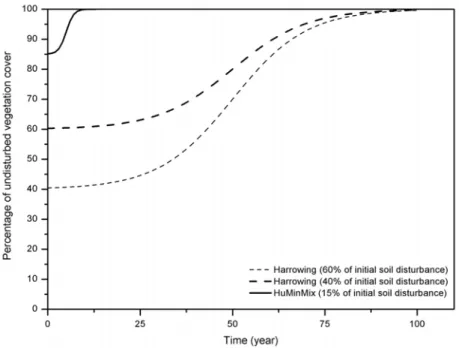
Results from study V corroborated the finding that re-establishment of reindeer lichen was faster in the areas scarified by Humix-track than in areas where techniques that only exposed mineral soil were applied (such as Mounding, Min-track or harrowing). According to regressions between the rates of biomass and cover re-establishment and time (V), the total recovery of the lichen mat was estimated to take about one decade after Humix-track scarification compared to probably more than five decades after harrowing exposing mineral soil (Fig. 6; V).
Figure 5. Immobilisation capacity of different substrates measured by the mean percentage of
fragments remaining within 3-cm and 5-cm radii from their establishment points, and within 1 m2-plots, on indicated substrates and sites one year after establishment. Different letters within columns indicate significant between-substrate differences (Tukey’s test: p ≤0.05).
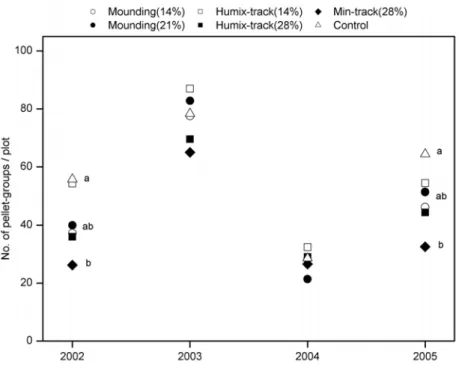
5.1.2. Effects of gentle scarification on reindeer grazing
Paper I also presented data from a yearly inventory of reindeer droppings following each of the scarification treatments (Fig. 7). The numbers of pellet-groups recorded in experimental plots indicated that the scarification treatments had significant, but irregular, effects on the density of pellet-groups in the plots. These results can be related to the ground vegetation cover at plot scale, measured in 2005 (Fig. 4b). Significant differences between treated and control plots were detected in 2002 and 2005, when control plots (0% mineral soil exposed) were the most frequently visited by reindeer, and plots scarified by the Min-track treatment (16% mineral soil exposed) the least frequently visited. In the same years, the numbers of reindeer droppings recorded in Humix-track and Mounding plots did not significantly differ, in spite of the differences in intensities of soil disturbance and substrates created. The results suggest that high soil disturbance intensity, combined with exposure of mineral soil, affects reindeer behaviour. Exposed mineral soil has often been hypothesized by reindeer herders to deter reindeer grazing, and the results from Study I tend to support this hypothesis. However, it is difficult to tell from these data whether the decrease in reindeer lichen cover or the increase in mineral soil cover, or both, affected reindeer behaviour, and thus potentially reindeer grazing. On the other hand, the effects of snow conditions should
Figure 6. Theoretical re-establishment rate of reindeer lichen over time at stand level depending
on the scarification technique and the initial soil disturbance. The HuMinMix-technique is assumed to create a humix-substrate.