To cite this document:
Brau, Guillaume and Navet, Nicolas and Hugues, Jérôme
Refinement of AADL models using early-stage analysis methods. (2013) In: The 4th
Analytic Virtual Integration of Cyber-Physical Systems Workshop, 03 December 2013 -
03 December 2013 (Vancouver, Canada).
O
pen
A
rchive
T
oulouse
A
rchive
O
uverte (
OATAO
)
OATAO is an open access repository that collects the work of Toulouse researchers and
makes it freely available over the web where possible.
This is an author-deposited version published in:
http://oatao.univ-toulouse.fr/
Eprints ID: 10291
Any correspondence concerning this service should be sent to the repository
administrator:
[email protected]
Refinement of AADL models using early-stage analysis methods
Guillaume Brau
1Jérôme Hugues
2Nicolas Navet
11
University of Luxembourg, Laboratory of Advanced Software Systems, 6 rue Richard Coudenhove-Kalergi, L-1359 Luxembourg, Luxembourg
{guillaume.brau, nicolas.navet}@uni.lu 2
Université de Toulouse – ISAE, 10 avenue E. Belin, 31055 Toulouse, France [email protected]
Abstract
Model-Driven Engineering (MDE) is a relevant approach to support the engineering of distributed embedded systems with performance and dependability constraints. MDE in-volves models definitions and transformations to cover most of the system life-cycle: design, implementation and Verification & Validation activities towards system quali-fication. Still, few works evaluate the early integration of performance evaluation based on architectural models. In this paper, we investigate the early-stage use of analysis in AADL modeling. Precisely, we exemplify on an avionics case study how to dimension the data flows for an appli-cation distributed over an AFDX network. Based on the insight from this study, we suggest a simple framework and associated techniques to efficiently support analysis activities in the early-stage design phases.
Keywords AADL, ARINC653, AFDX, analysis combi-nation, WCTT evaluation, Network Calculus.
For more details and experimental results, an extended version of this paper is available as a technical report [1].
1.
Introduction
Context of the paper. Distributed Real-time Embedded (DRE) systems are present in safety-critical domains such as transportation, telecommunications, health services, military or space. These systems have to meet both the functionaland non-functional requirements. Hence, DRE systems encompass specific technologies to realize the re-quired service with the expected performance metrics (e.g. time, security or safety) through dedicated networks, pro-cessors or real-time operating systems. In addition, the en-gineering process has to address efficiently system model-ing and evaluation of all metrics.
Definition of the problem. Many experiments indicate that the distance between the activities steps in a classical V-cycle is detrimental and usually slows down the devel-opment process [2]. In practice, a significant part of errors is injected at early-stage of the engineering process, while being detected during later integration phases. As a conse-quence, regressions and rework activities have an important weight on the overall project costs.
We believe that this problem can be lifted considering models with sufficient power of expression to guide the conception phases (e.g. using interface or behavioral mod-els on which one can both reason and iterate) and support-ing early-stage analysis. This “integrate, then build” ap-proach, also known as virtual integration is promising to support the design of complex systems.
Contributions and objectives. In this paper, we use the Architecture Analysis & Design Language (AADL) [3] as the pivot to capture the system architecture and derive its performances. AADL is an Architecture Description Lan-guage (ADL) suitable to describe systems, capturing the functional and non-functional concerns together with the operational platform. As the AADL provides modeling el-ements with a precise syntax and well-defined semantics, it is possible to :1) perform analysis and 2) derive imple-mentations thanks to code generation [4].
The focus of this paper is twofold. First, taking a specific example coming from the avionics, we show how to accu-rately seize important parameters in the AADL model. As the system that is modeled includes technologies not sup-ported within the core language, we build on and extend the work in [5] in order to include in the AADL model the networking elements and capture the overall DRE system.
Secondly, based on lessons learned during the modeling experience, we propose to jointly use AADL models and analysis methods so as to gradually refine and verify the model. We investigate and examplify this strategy on the avionics case study. Taking as example the network com-munications and the expressed timing constraints, we show that using complementary analysis methods allows to de-duce missing parameters while maintaining the consistency of the model (i.e. chosen parameters guarantee that non-functional constraints are met).
The paper is organized as follows: we first introduce the avionics case study and give elements to model it with AADL (Section 2). In Section 3, we underline relationships between modeling concerns, and, using analysis, we ex-plain how to solve those dependencies for some important communication parameters. Finally, in Section 4, we draw conclusions from this case study and discuss future work.
2.
Modeling avionics systems with AADL
In this section we describe how to jointly capture with AADL the functional description of an avionics system, its temporal constraints and the target execution platform. 2.1 The Flight Management SystemThe avionics system to model, coming from Lauer et al. [6], is part of an aircraft’s Flight Management System (FMS). It interacts with the crew and provides static and dynamic information about the flight plan (i.e. the predefined path between departure and arrival points) : current location, remaining distance and estimated arrival time.
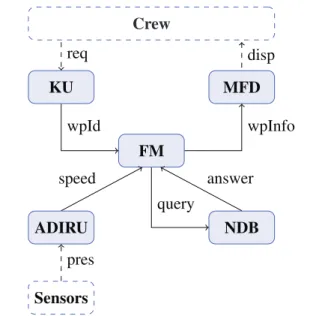
Functional description. The system is made up of five main functions as depicted in Figure 1. The Keyboard and cursor control Unit (KU)reads data inputted by the pilot (or copilot) through the keyboards while the Multi Func-tional Display (MFD)refreshes the displays consecutively. From the KU function, crew requests are forwarded to the Flight Manager (FM) function which computes the re-sponse about the flight plan and returns it to the MFD. For this, it requests static data to the Navigation Data Base (NDB)function and also relies on dynamic data from the Air Data Inertial Reference Unit (ADIRU), computed based on sensors measurements.
Temporal constraints. In the avionics context, the sys-tem has to conserve a predictable behavior. Several sys- tempo-ral constraints may be expressed upon different "locations". Typically, temporal constraints concern : 1) response times which are the delays needed to carry out the functions, 2) traversal times refering to communication delays between functions and 3) latencies along functional chains that en-compass a succession of response times and traversal times. Execution and communication platform. The functions are executed in an Integrated Modular Avionics (IMA) en-vironment. In particular, this execution and communication platform supports two standards, used in the case study, that defines the use of the shared hardware and software resources in a deterministic way.
The ARINC653 [7] standard defines management of the functions hosted by a same hardware/software platform (re-ferred as an execution module in the following). In this en-vironment, each function is located in a different partition with a strict access to processing and memory resources.
The ARINC664 [8] standard defines a determinis-tic communication network called Avionics Full Duplex-Switched Ethernet (AFDX). AFDX implements the core concept of Virtual Link (VL) which is an unidirectional logical connection from one sender to one or several re-ceiver(s). Each VL has a limited bandwidth according to
Crew
KU
MFD
FM
ADIRU
NDB
Sensors
req
disp
wpInfo
wpId
query
answer
speed
pres
Figure 1. The Flight Management System functional ar-chitecture depicts the functions and the data exchanged as well as the interactions with the actors.
its Bandwidth Allocation Gap (BAG in the following) – the minimum time elapsed between two frames sending – and a maximal allowed packet size (smaxin the remainder).
2.2 Modeling the FMS in AADL
The Architecture Analysis & Design Language (AADL) [9] is an international standard by the Society of Automotive Engineers (SAE), defining the basics of an architecture de-scription language dedicated to the design of DRE sys-tems. AADL is component-centric and allows to specify both software and hardware parts of a system. See [3] for a complete presentation of AADL.
The full model of the FMS uses AADLv2 core speci-fications and the ARINC653 Annex. The model is made up of AADL components that describe the ARINC653 ex-ecution modules hosting the avionics functions and the AFDX network that supports the data exchanges. The full AADLv2 textual model – that spans over 770 SLOCs – is part of the AADLib project and is available at http: //www.openaadl.org.
The model follows the initial specifications and AADL guidelines for ARINC653 systems : a module is a distinct system(containing a global memory and a processor) that hosts partitions (each is a process) bound to separate memorysegments and virtual processors (repre-senting spatial and temporal partitioning). thread com-ponents contained in partitions realize the avionics func-tions. Thanks to annex guidelines, we can model precisely the ARINC653 components and associated parameters.
AADL does not provide specific guidelines for mod-eling AFDX networks. The AADL concept of virtual busdefines a connection supported in a bus. We use this concept to define AFDX virtual links. Switches are repre-sented by device components bound to the virtual links. A dedicated property set has been defined to model param-eters attached to virtual links, end systems and switches.
3.
Analysis as part of the design process
We discussed how AADL allows to capture both the FMS functional and non-functional aspects as well as the IMA platform description. From this model, we may now con-sider further analysis of the full architecture. The current design could be used to validate a given architecture. Yet, the most challenging part is actually guiding the designer in finding a suitable definition of the architecture parameters in order to respect the constraints expressed in the model. 3.1 Discussion : there are dependencies betweenmodeling concerns
Figure 2 summarizes the three traits caught in the archi-tecture model : the functions to realize, the hardware and software platform hosting the functions and the constraints to comply with. It implies that the architecture model com-ponents and the attached properties have to integrate and solve the dependencies between these views.
Figure 2. The architecture model captures jointly the sys-tem functional, non-functional and platform concerns and has to integrate the dependencies between these aspects.
For instance, let us consider the design of virtual links in AFDX networks. The virtual links characterization (plat-form view) depends on :
•the data flows needed to realize the functions
(func-tional view) and their features, e.g the number (n) of messages sent by a function and their size (m),
•the constraints expressed onto the data flows
(non-functional view), e.g a communication between two specific tasks can be subject to timing constraints (noted LCin the sequel).
Moreover, finding a suitable design for the virtual links in AFDX networks can be a difficult problem because of the interferences between VLs definitions. For further informa-tion, the issue is addressed in a more comprehensive setting in [10].
Proposed approach. We believe it is possible to deal with the dependencies between the modeling concerns by ex-ecuting relevant analysis methods onto the model under construction. In the sequel, we show how to define pro-gressively the VLs parameters taking into account infor-mation in the model such as the constraints expressed upon the communications. From an evaluation perspective, it im-plies :1) isolating model input parameters that can be com-bined to2) propose a feasible solution which is 3) later as-sessed. Some parameters are mandatory, while others can be assumed. This is discussed in the following paragraphs.
3.2 Example : integration of the Bandwidth Allocation Gap (BAG) parameter into an incomplete AADL model
Let us consider a partially completed AADL model. This initial model contains basic information : the functions hosted in the modules and their properties as well as the data exchanges between them. We also know the con-straints of the system expressed onto the communications.
At this stage, dimensioning the BAG, which has a direct impact on the respect of timing constraints and the network load, may be a difficult task because the design space can be huge. Indeed, as this parameter ought to respect the formula BAG= 2k [ms] with k integer in range 0 to 7 (see [8]), if we take as assumption that one VL is dedicated to one data flow, then there are solbag = 8f conceivable solutions, with f the number of flows.
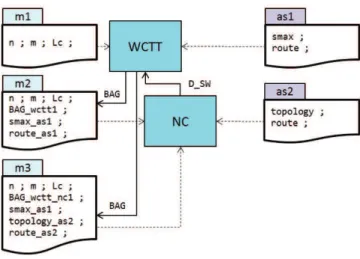
To overcome this problem and complete the model, we execute the process pictured on Figure 3. We propose to:
1. use a pivotal Worst-Case Traversal Time evaluation (WCTT in the following) in order to identify the set of suitable BAGs,
2. use a complementary analysis method, relying on Net-work Calculus (NC in the following), to improve the results of the main WCTT evaluation.
WCTT evaluation. The Worst-Case Traversal Time anal-ysis aims to assess the delay experienced by each data flow in the AFDX network. Without too much details, the WCTT evaluation gives the formula of an upper-bounded delay (Dwctt
T ) suffered by a frame as a function of sev-eral parameters. Hence, it is possible to compare the delay against the expressed constraint (Dwctt
T ≤Lc) and to cal-culate the suitable set of BAGs [1]. The WCTT evaluation gives a set of suitable BAGs for each VL (BAGwctt
vli ). Of
course, the accuracy of the BAGs sets depends on the pre-cision of the model and of the assumptions. In addition, at the first stage, there is no NC feedback, i.e. Dsw_vli= 0.
Figure 3. The BAG refinement process includes AADL models (blue-headed shapes), analysis methods (portrayed by green rectangles) and assumptions models (purple-headed shapes).
NC analysis. Network Calculus (NC) is an algebra for computing accurately the end-to-end delay of a data flow in the AFDX network. In the scope of this paper, this anal-ysis is performed using RTaW-Pegase, which is a commer-cial product implementing a state-of-the-art network calcu-lus AFDX timing analysis [11]. In our case, the NC anal-ysis computes complementary information (Dncsw_vli) and
allows to refine results of the main WCTT evaluation. Model refinement. We can see through the modeling and analysis flow (figure 3) that, as long as the required anal-ysis inputs are present, the model is enhanced. The model refinements are done in line with : 1) the model evolution (m1, m2, m3), 2) the analysis methods outputs (BAGwctt and Dncsw) and 3) the feasible assumptions (as1, as2).
The first execution of the pivotal analysis method takes as input the data of the incomplete model (m1) and the de-duced assumptions (as1). The first coarse-grained WCTT evaluation reduces the space of BAGs solutions for the VLs (BAGwctt1
vli ) attached to the data flows in order to verify the
latency constraints (Lm1
C_vli).
Thanks to the first WCTT computation, the initial model (m1) is enriched with a crucial missing parameter : the BAG (m2). We are then able to perform the complementary NC analysis that aims to evaluate the upper delay suffered in the switches for each VL (Dnc1
sw_vli). To execute the
com-plementary analysis, the assumption model (as2) contains additional information about the network topology and the VLs routes. The NC computed latency is passed as a re-finement parameter to the WCTT method so as to precise the BAGs sets. Taking into account the calculated Dnc1
sw_vli
reduces the set of eligible BAGs (BAGwctt_nc1
vli ) : solutions
that do not meet the initial Lm1
C_vliconstraints are discarded.
At the third iteration, the model (m3) contains the re-fined BAGs (BAGwctt_nc1
vli ). It is then necessary to
cal-culate the delay suffered in the switches for each VL (Dnc2
sw_vli) and refine the BAGs sets (BAG
wctt_nc2
vli ). In our
example, a new combined execution of WCTT and NC shows that a fixed-point is reached : the model m3cannot be refined anymore against the Bandwidth Allocation Gap if the input parameters and assumptions stay stable.
4.
Conclusions and perspectives
Our first contribution (Section 2) dealt with the architec-tural description of an avionics system with AADL, com-bining the functional, non-functional and platform con-cerns. We extended existing patterns dedicated to AR-INC653 systems to also model AFDX networks.
We then addressed (Section 3) the definition and evalu-ation of the AADL model components and their properties. We showed that dealing with the architecture description amounts to solve the dependencies between the AADL model concerns. Starting from an incomplete AADL model, we implemented a process combining two analysis meth-ods to evaluate and refine the Bandwidth Allocation Gap parameter. This process combines early and in-depth anal-ysis to help the designer to narrow the design space.
We believe it is necessary to formalize the use of anal-ysis methods along with modeling languages in order to
tackle the early system architecture definition and evalua-tion. In a previous work, we defined REAL [12] – Require-ment EnforceRequire-ment and Analysis Language. It allows one to define a set of predicates, and check whether a system sat-isfies them. We plan to extend REAL to define a library of predicates for tools. Such predicates would 1) define condi-tions under which a given analysis becomes feasible and 2) detect and exploit relationships between analysis methods. This would guide the designer to trigger relevant analysis as early as possible in the design flow.
The definition of those predicates, in the context of the FMS, is currently under implementation.
References
[1] G. Brau, J. Hugues, and N. Navet. Refinement of AADL models using early-stage analysis methods. Technical Re-port TR-LASSY-13-06, LASSY, University of Luxembourg, 2013. Available at http://orbilu.uni.lu/. [2] D. Redman, D. Ward, J. Chilenski, and G. Pollari. Virtual
Integration for Improved System Design. In Proceedings of The First Analytic Virtual Integration of Cyber-Physical Systems Workshop, San Diego, California, USA, Nov. 2010. [3] P. H. Feiler and D. P. Gluch. Model-Based Engineering with AADL: An Introduction to the SAE Architecture Analysis & Design Language. Addison-Wesley Professional, 1st edition, 2012.
[4] G. Lasnier, B. Zalila, L. Pautet, and J. Hugues. Ocarina : An Environment for AADL Models Analysis and Automatic Code Generation for High Integrity Applications. In Pro-ceedings of the 14th Ada-Europe International Conference, Brest, France, June 8-12 2009.
[5] J. Delange, L. Pautet, A. Plantec, M. Kerboeuf, F. Singhoff, and F. Kordon. Validate, simulate, and implement AR-INC653 systems using the AADL. In SIGAda annual international conference on Ada and related technologies, SIGAda ’09, pages 31–44, New York, NY, USA, 2009. [6] M. Lauer. Une méthode globale pour la vérification
d’exigences temps réel - Application à l’Avionique Mod-ulaire Intégrée. Thèse de doctorat, Institut National Poly-technique de Toulouse, Toulouse, France, juin 2012. [7] Aeronautical Radio Incorporated. ARINC Report 653P0
Avionics Application Software Standard Interface, Part 0, Overview of ARINC 653.
[8] Aeronautical Radio Incorporated. ARINC Report 664P7-1 Aircraft Data Network, Part 7, Avionics Full-Duplex Switched Ethernet Network.
[9] SAE/AS2-C. Architecture Analysis & Design Language V2 (AS5506A), January 2009.
[10] A. Al Sheikh, O. Brun, M. Chéramy, and P.-E. Hladik. Optimal design of virtual links in AFDX networks. Real-Time Systems, 49(3):308–336, 2013.
[11] M. Boyer, J. Migge, and M. Fumey. PEGASE - A Robust and Efficient Tool for Worst-Case Network Traversal Time Evaluation on AFDX. In SAE AeroTech Congress & Exhibition, Toulouse, France, October 18-21 2011. [12] O. Gilles and J. Hugues. Expressing and enforcing
user-defined constraints of AADL models. In Proceedings of the 5th UML& AADL Workshop, Oxford, UK, 2010.