Mécanisme de salissage et de nettoyage
en surface de matériaux polymères
Par
Xing Chen
Mémoire présenté au department de chimie en vue de l‘obtention
du grade de maître ès science (M.Sc)
FACULTÉ DES SCIENCES
UNIVERSITÉ DE SHERBROOKE
juin 03, 2016
le jury a accepté le mémoire de monsieur Xing Chen dans sa version finale
Membres du jury
Professeur Carmel Jolicoeur Directeur de recherche Département de chimie
Professeur Michel Huneault Évaluateur externe Département génie chimique
Faculté de génie
Professeur Armand Soldera Président-rapporteur Département de chimie
i
SUMMARY
The development of industrial polymers provides more choices to the design of flooring materials. Rubbers, PVC and linoeleum are the most used polymers in the flooring industry. This project stems from the problem of cleanability (ease of cleaning) of the surface of rubber tile flooring which is known as a soft, sticky and rough surface.
In the introduction, the current situation of research on the polymer flooring industry, especially the study on the cleaning problem will be introduced. The relevant theory and general information on polymers, polymer composites and surface science will be introduced in CHAPTER 1. In CHAPTER 2 different approaches, protocols and equipment to evaluate cleanability will be presented.
The initial experiments and results (CHAPTER 3) will involve various fundamental concepts on surface wettability, roughness and hardness, as these properties can all influence the surface soiling and cleanability. In single-polymer systems, dozens of polymer materials with a hydrophobic or hydrophilic surface were investigated to observe their soiling and cleaning properties. The effect of roughness was also studied by surface printing method which is used to control the surface topography. Likewise, the influence of surface hardness on cleanability was also investigated with different polymer materials. From the above results and observations, a surface soiling/ cleaning model is proposed in attempt to simplify the ―rules‖ which determine the surface cleanability. Finally, peroxide crosslinking was investigated as a matrix modification method to improve the surface cleanability.
ii
polymer blends, in attempt to optimize the performance of single-polymer materials. In this chapter, the surface cleaning model and its relevant rules are examined by the wettability, roughness and hardness tests discussed in CHAPTER 3. The influence of immiscibility on cleaning performance will be discussed in polymer blends from the point of view of thermodynamics (DSC) and morphology (SEM). In order to improve the compatibility in polymer blends, peroxide crosslinking was performed in EPDM/ (E-ran-MAA(Zn)-ran-BuMA) blends. The dosage of curing (cross-linking) agent and curing time were investigated to observe the influence of these experimental conditions on cleanability. Finally, a blend compatibilizer was designed to improve the compatibility of the EPDM/ (E-ran-MAA(Zn)-ran-BuMA)/HSR blends. The compatibilizer prepared by partial pre-crosslinking of EPDM (Nordel) and E-ran-MAA(Zn)-ran-BuMA (Surlyn) was incorporated in polymer composites and its influence on cleanability was studied and explained on the basis of changes in morphology of the blend polymer matrix..
Key words: polymer, cleanability, wettability, roughness, hardness, blends, crosslinking,
iii
SOMMAIRE
Le développement de l‘industrie des polymères fourni de plus en plus de choix pour la formulation de matériaux pour les couvre-planchers. Les caoutchoucs, le PVC et le linoleum sont les polymères habituellement utilisés dans l‘industrie des couvre-planchers. Ce projet répond à un problème de facilité de nettoyage des couvre-planchers de caoutchouc qui sont reconnus pour être mous, collants et ayant une surface rugueuse.
L‘INTRODUCTION couvrira l‘état actuel de la recherche sur les couvre-planchers, surtout en regard au problème de la «nettoyabilité». La théorie pertinente et les informations générales sur les polymères, les composites polymériques et la science des surfaces seront introduites au CHAPITRE 1. Ensuite, le CHAPITRE 2 couvrira la méthode utilisée pour déterminer la nettoyabilité, l‘évaluation des résultats ainsi que l‘équipement utilise.
Le CHAPITRE 3, discutera des premières expériences sur l‘effet de la mouillabilité, la rugosité et la dureté sur la facilité de nettoyage des polymères purs. Plusieurs polymères ayant des surfaces plus ou moins hydrophobes seront investigués afin d‘observer leur effet sur la nettoyabilité. L‘effet de la rugosité sur la nettoyabilité sera investigué en imprimant une rugosité définie lors du moulage des échantillons; l‘influence de la dureté sera également étudiée. Ensuite, un modèle de salissage/nettoyage sera établi à partir de nos résultats et observations afin de rationaliser les facteurs, ou « règles », qui détrminent la facilité de nettoyage des surfaces. Finalement, la réticulation au peroxyde sera étudiée comme une méthode de modification des polymères dans le but d‘améliorer leur nettoyabilité; un mécanisme découlant des résultats de ces études sera présenté.
iv
Le CHAPITRE 4 étendra cette recherche aux mélanges de polymères; ces derniers servent habituellement à optimiser la performance des polymères purs. Dans ce chapitre, les mêmes tests discutés dans le CHAPITRE 3 seront utilisés pour vérifier le modèle de nettoyabilité établi ci-haut. De plus, l‘influence de la non-miscibilité des mélanges de polymères sera discutée du point de vue de la thermodynamique (DSC) et de la morphologie (MEB). L‘utilisation de la réticulation par peroxyde sera étudié dans les mélanges EPDM/ (E-ran-MAA(Zn)-ran-BuMA) afin d‘améliorer la compatibilité de ces polymères. Les effets du dosage en agent de réticulation et du temps de cuisson seront également examinés. Finalement, un compatibilisant pré-réticulé a été développé pour les mélanges ternaires EPDM/ (E-ran-MAA(Zn)-ran-BuMA)/ HSR; son effet sur la nettoyabilité et sur la morphologie du mélange sera exposé.
Mots clés: polymère, nettoyabilité, mouillabilité, rugosité, dureté, mélanges, réticulation,
v
ACKNOWLEDGEMENTS
First and foremost, I would like to show my deepest gratitude to my supervisor, Professor Carmel Jolicoeur, a respectable, responsible and resourceful scholar, who has provided me with valuable guidance in every stage of the preparation of this mémoire. His keen and vigorous academic observation enlightens me not only in this mémoire but also in my future studies.
I shall extend my thanks to Professor Michel Huneault of Chemical Engineering Department and Dr. Jean-Claude Mercier, R&D vice president of American Biltrite Canada. They provided me tremendous help on experiment and equipment, and helped me enrich and broaden my knowledge on polymer science. In addition, I would also like to express my gratitude to Professor Yue Zhao for his support on characterization instruments.
My sincere appreciation also goes to all the members in the research group: Jeff Sharman, Thi Cong To, Alexandre Proulx, Stéphane Fitzback, Stephan Freiberg, Mauricio Gonzalez, Shant Shahbikian, Juan Xuan and all of the trainees.
Finally, I would like to express my thanks to Conseil de Recherche en Sciences Naturelles et Génie (CRSNG), NanoQuébec (Prima-Québec) and American Biltrite for their financial support, and my sincere appreciation to the members of the jury: Professors Armand Soldera, Michel Huneault and Carmel Jolicoeur.
vi
TABLE OF CONTENTS
SUMMARY ... i SOMMAIRE ... iii ACKNOWLEDGEMENTS ... v TABLE OF CONTENTS ... vi LIST OF TABLES ... xiLIST OF FIGURES ... xii
INTRODUCTION ... 1
CHAPTER 1. THEORY ... 6
1.1. Polymers and polymer crosslinking ... 6
1.1.1. Polymer materials and polymerization ... 6
1.1.2. Polymer structure and classification of polymer materials ... 8
1.1.3. Vulcanization in sulfur and non-sulfur system ... 9
1.1.4. Mechanism of peroxide vulcanization ... 11
1.2. Polymer composite ... 12
1.2.1. Composite materials ... 12
1.2.2. Polymer composite ... 13
1.2.3. Introduction of components in polymer composite ... 13
1.3. Polymer blends and miscibility ... 15
vii
1.3.2. Miscibility ... 17
1.3.3. Compatibilisation and compatibilizers ... 18
1.4. Surface wettability ... 19
1.4.1. Surface water contact angle ... 20
1.4.2. Surface water contact angle (WCA) on rough surfaces ... 20
1.4.3. Lotus effect and superhydrophobic self-cleaning effect ... 22
1.4.4. Limitation and inspiration from superhydrophobic self-cleaning model. ... 24
1.5. Surface topography ... 25
1.5.1. Surface roughness and its evaluation ... 25
1.5.2. Analysis for selection of parameters ... 27
CHAPTER 2. EXPERIMENTAL ... 29
2.1. Polymer materials and products used in the project ... 29
2.1.1. Polymer ... 29
2.1.2. Chemical product ... 33
2.2. Sample preparation and related equipment ... 33
2.2.1. HAAKE Rheomix Lab mixer and mixing process ... 34
2.2.2. Grinder ... 36
2.2.3. Hydraulic press ... 36
2.3. Procedure for the cleanability test ... 38
2.3.1. Preparation of samples for the cleanability test ... 38
viii
2.3.3. Evaluation of cleanability ... 39
2.4. Characterisation ... 41
2.4.1. Test of surface water contact angle ... 41
2.4.2. Test of surface topography ... 43
2.4.3. Surface hardness ... 44
2.4.4. Differential scanning calorimetry (DSC) ... 45
2.4.5. Scanning electron microscope (SEM) ... 48
CHAPTER 3. CLEANABILITY IN SINGLE POLYMER SYSTEMS - ESTABLISHING A SURFACE CLEANING MODEL ... 50
3.1. Sample preparation and experiment ... 51
3.2. Influence of surface wettability ... 52
3.3. Influence of surface roughness ... 55
3.4. Combined effect of surface wettability and roughness ... 57
3.5. Hardness ... 59
3.6. A surface soiling and cleaning model ... 60
3.6.1. Soiling process ... 61
3.6.2. Cleaning on hard surfaces ... 61
3.6.3. Cleaning a soft surface ... 63
3.7. The influence of polymer crosslinking on cleanability ... 64
3.7.1. Sample preparation and experiment ... 65
ix
3.8. Conclusion ... 68
CHAPTER 4. STUDY ON THE INFLUENCE OF POLYMER IMMISCIBILITY ON CLEANING PERFORMANCE IN POLYMER BLENDS AND THE COMPATIBILITY MODIFICATION ON EPDM/ E-MAA (ZN)-BUMA/HSR BLENDS. ... 70
4.1. Research of multiple surface factors in polymer blends system. ... 71
4.1.1. Polymer blends design, preparation and testing ... 71
4.1.2. Results and analysis ... 72
4.2. The influence of miscibility on cleanability in polymer blends. ... 75
4.2.1. Influence of polymer immiscibility on cleanability ... 76
4.2.2. Thermal analysis and study on morphology ... 77
4.3. Effect of crosslinking on polymer compatibility and cleanability in Nordel (EPDM) / Surlyn (E-ran-MAA(Zn)-ran-BuMA) blends ... 80
4.3.1. Sample preparation and experiment ... 80
4.3.2. The influence of curing agent dosage ... 81
4.3.3. The influence of curing time ... 82
4.3.4. Study on morphology ... 83
4.4. Study of compatibilizer modification on compatibility and cleanability in Nordel/Surlyn /HSR blend system ... 84
4.4.1. Preparation of pre-crosslinked compatibilizer (PC) ... 84
4.4.2. Study of cleanability with the presence of pre-crosslinked compatibilizer ... 86
4.4.3. Study on morphology of 3-polymer blend ... 87
x
CONCLUSION ... 90 REFERENCES ... 93
xi
LIST OF TABLES
Table 1. Characteristics of different surface roughness measurement techniques
(R.Kuisma et al.). ... 26
Table 2. Structure and abbreviation of the more significant materials of this study. ... 31
Table 3. Cleaning agents with different surface tension. ... 33
Table 4. List and information of the powders used as soil agent ... 38
Table 5. Color intensity code for soiling and cleaning evaluation ... 41
Table 6. List of some typical polymers and their thermal properties ... 52
Table 7. Cleanability test of roughness controlled surface ... 56
Table 8. Materials used in this section ... 65
Table 9. Hardness before and after curing of selected polymers ... 66
Table 10. List of component polymers used in polymer blends ... 72
xii
LIST OF FIGURES
Figure 1. Structure of polyethylene ... 7
Figure 2. Reaction of radical polymerization ... 7
Figure 3. Condensation polymerization ... 8
Figure 4. Main types of architecture of polymer chain ... 8
Figure 5. Natural rubber after vulcanization with elemental sulfur (circled in red) ... 10
Figure 6. Plywood composite ... 13
Figure 7. Varying of the polymer blends type along with different ratio of components. 17 Figure 8. A-B block polymer works as a compatibilizer to improve interfacial adhesion ... 18
Figure 9. Normal polymer blend (a); polymer blend modified by compatibilizer (b) ... 19
Figure 10. Static contact angle of liquid droplet on smooth solid surface ... 20
Figure 11. Static contact angle of water droplet on rough surface: (a) Wenzel‘s model. (b) Cassie‘s model ... 21
Figure 12. Lotus effect (left) and a microscopic SEM image of a lotus leaf (right) ... 23
Figure 13. Slip of a water droplet from an inclined hydrophobic surface (left) and an inclined superhydrophobic surface (right) ... 23
Figure 14. Small soil particles can‘t be removed by water on superhydrophobic surfaces ... 24
Figure 15. Designed surface with controlled roughness (by R. Kuisma et al.) ... 27
Figure 16. Cleanability variation with the different surface roughness parameters (R.Kuisma et al.) ... 28
Figure 17. Two surfaces with same Ra (Sa) but different structure ... 28
xiii
Figure 19. HAAKE™ Rheomix Lab Mixers ... 34
Figure 20. The mixing chamber of HAAKE Rheomix Lab Mixers (left); typical Torque-Temperature graph obtained from mixing process (right) ... 35
Figure 21. Allen-Bradley grinder ... 36
Figure 22. Hydraulic press machine ... 36
Figure 23. Mold for compression molding (left); filling of the mold with sample particles (right) ... 37
Figure 24. Soiling test (left) and finished sample (right) ... 39
Figure 25. Reference 5-level color intensity codes ... 40
Figure 26. First Ten Armstrong (FTA200) contact angle analyzer ... 41
Figure 27. Image of the hemisphere droplet for contact angle test ... 42
Figure 28. Non-contact profilometer (3D optical microscope) Bruker Contour GT ... 43
Figure 29. Shore A durometer ... 44
Figure 30. Shore hardness measurement (left); Type A and type D indenter (right) ... 45
Figure 31. DSC experimental setup ... 46
Figure 32. Typical DSC curve ... 47
Figure 33. Structure of scanning electron microscope ... 48
Figure 34. Cleanability of hard polymers classified by CA (Left) and the corresponding data (right) ... 53
Figure 35. Cleanability of soft polymers classified by CA ... 54
Figure 36. Cleanability of polymers having different roughness... 55
Figure 37. The SEM of Fe2O3 particles (a); The HSR sample cleaned with 3 types of detergent (b) ... 58
Figure 38. Surface cleaned by different clean agents ... 59
Figure 39. Cleanability of polymer with different hardness ... 60
xiv
Figure 41. Dry cleaning (left) and wet cleaning (right) ... 62
Figure 42. Cleaning with the use of a detergent ... 63
Figure 43. Cleaning a soft surface ... 63
Figure 44. Crosslinking in rubber fabrication ... 64
Figure 45. Effect of crosslinking on the cleanability of typical polymers: (a) Nordel (EPDM); (b) Engage (E/O); (c) Nucrel (E/MAA); (d) LDPE ... 67
Figure 46. Comparison of cleanability before & after crosslinking on Hard (left) and soft (right) polymers ... 67
Figure 47. Cleanability of polymer blends classified by CA ... 73
Figure 48. Cleanability of polymer blends with different surface roughness ... 74
Figure 49. Cleanability of polymer blends with different hardness ... 75
Figure 50. Cleanability of polymer blends in function of the weight fraction: (a) LDPE-Levapren, (b) PMMA-Engage, (c) Bynel-Engage, (d) Celcon-SBR ... 77
Figure 51. DSC diagram of the different Bynel-Engage blends (cooling curve). ... 78
Figure 52. SEM images of Bynel/Engage (75/25) (left) and Surlyn/Engage (75/25) (right) ... 79
Figure 53. Cleanability of Nordel/ Surlyn blend cured with different dosage of peroxide ... 81
Figure 54. Cleanability of Nordel/ Surlyn blend cured with different curing times ... 82
Figure 55. SEM image of Nordel/ Surlyn blends with (a) 0phr, (b) 2.5phr, (c) 5phr, (d) 12.5phr of peroxide curing agent ... 83
Figure 56. (a) Crosslinked polymer network; (b) pre-crosslinked compatibilizer ... 85
Figure 57. Cleanability of Nordel/Surlyn/HSR blends modified by pre-crosslinked compatibilizer (PC) (3P: without PC, 3P+1: with PC#1, 3P+2: with PC#2) ... 86
Figure 58. SEM of (a) Nordel/Surlyn/HSR blend; (b) with PC; (c) with 0.2phr peroxide ... 87
1
INTRODUCTION
In the modern world, polymers are one of the most used construction and decoration materials in many public and home buildings. Pipes, window profiles and cable insulation made using polymers have been widely used since the end of last century (1).
At the beginning of 21th century, the emergence concern for environmental protection required people to use more environment friendly materials to replace the traditional ones, such as wood and marble material. Furthermore, the rapid growth of the number of high-rise buildings also has the requirement of employing lighter and more durable materials. That is why polymer materials have been of widespread interest in the construction field. The characteristics of polymeric materials include: light weight, corrosion resistance, comfort, superior insulation, and excellent physical properties (2). Until now, benefiting from the rapid development of production technology, polymers are also widely used as building flooring, surface coating and water proofing materials.
The first attempts to make polymer floor tiles (thermoplastic and rubber floor) date back as early as the 13th century, but with little to no success. Modern «vinyl» (thermoplastic) floor tiles and sheet flooring of those products sold since the early 1980s are composed of colored polyvinyl chloride (PVC) chips formed into solid sheets of varying thicknesses by heat and pressure (3).
Rubber flooring cannot be manufactured by normal heat and pressure process. It wasn't until the 1830s when inventors Charles Goodyear and Nathaniel Hayward learned how to combine
2
gum plastic, sulfur and latex to create the rubber we know and use today. This process (named "vulcanization") produces a material more durable and more resilient than its rubber ancestors. Despite technological advances with rubber in the early 19th century, it wasn't until the 1950‘s that rubber was used as a flooring material.
Rubber flooring was once made from the milky sap of the rubber tree, but most rubber flooring is now producing from synthetic elastomers. It is hard wearing, colorful, resilient, low density, flexible and durable, and has excellent resistant to burns and dents; in advanced materials, built-in self-releasing wax allows some rubber tile flooring to self-heal most scratches and abrasions. Synthetic rubber flooring thus offered a most valuable alternative, to other resilient polymer floor coverings like PVC, linoeleum, etc. Firstly, rubber tile flooring is generally considered a "low-impact," environmentally friendly building material. Virgin rubber is sustainable as it is derived from trees, and the manufacture of synthetic rubber also has a low impact on the environment. Secondly, rubber flooring contain less free chemical products, such as plasticizers, and most rubber tiles flooring has good water and chemical resistance, a benefit resulting from its vulcanization (crosslinking) (4).
However, because of the nature of rubber materials, rubber flooring is also easily soiled or stained from exposure to dust, or other common soiling mixtures. This phenomenon is found more frequently and more significantly in flexible flooring materials which aim at providing user comfort and noise reduction. . The resistance to soiling and staining and the ease of cleaning (these properties will be collectively called cleanability in this mémoire) are quite important to the durability of flooring materials. A flooring material with superior cleanability will provide various benefits, namely, lasting aearance, easier and less frequent servicing, and extended service life.
3
Several investigations have been made on the flooring surface soiling and cleaning problem. In the past 50 years, various factors were shown to affect the surface cleanability. For instance, in the mid-1960s, it was found using SEM discovered that the surface of lotus leaf, which appears to be macroscopically smooth, exhibits microscopic roughness on different length scales (5, 6). From then on, the relationship between the surface cleanability and other surface properties, such as surface topography and surface tension (energy) have gradually been revealed in lab experiments (7, 8). Especially, the combined effect of surface tension and surface topography was extensively studied and the results used in the manufacturing of self-cleaning surface coating.
However, the preparation of artificial self-cleaning surfaces which are based on superhydrophilic and superhydrophobic phenomenon are difficult to apply to the manufacture of commercial rubber flooring because of their cost (9). There are only a few papers related to the research of cleanability on normal polymer surfaces by using modern instrument characterizations (Risto Kuisma et al.) and study the theory of surface soiling (E.F. Cuddihy et al.) (10, 11).
The lack of comprehensive investigations and data base greatly increases the difficulty of research on the surface cleanability of polymer composites for use in flooring application. Therefore, it seemed most appropriate to fill the gap of research on polymer surface cleanability. In order to achieve this goal, our research group included three types of expertises: the academic researchers in chemistry (Laboratory of Pr. Carmel Jolicoeur), academic researchers in polymer engineering (Laboratory of Pr. Michel Huneault) and researchers in industrial processing (American Biltrite Canada). Our research work is mainly based on the common polymer materials which are wildly applied in flooring production, in
4
order to establish relevant theoretical concepts and find optimization methods that can be applied in the industrial production.
In the industry, rubber flooring is generally based on polymer composites which include a single-polymer or a polymer blend matrix, mineral fillers and chemical additives. Polymer materials are the main component of polymer composites; they offer the flooring tiles their physical and chemical properties such as flexibility, elasticity and resistance to chemical degradation. Different polymer matrix compositions, even by simply changing the ratio of polymers in a blend, can greatly affect the surface properties. For instance, the surface wettability was shown to be greatly affected by changing the ratio of polymers in blends (12). Mineral fillers (such as CaCO3, talc, quartz, etc.) are another important component in
polymer flooring composites which are used to provide material hardness and resistance to indentation, as well as to reduce the cost of the end products. Mineral fillers usually have a hydrophilic surface which is not easily wetted by molten polymer; this could lead to surface in homogeneity and, as a result, it may influence the surface cleaning property (13).
Moreover, inspired by a great deal of research on the lotus-effect (superhydrophobic self-cleaning), the tremendous influence of surface wettability and surface topography on cleanability are confirmed by several researchers (14). Furthermore, compared with the study of surface cleanability on metal and ceramic materials, scientists found that a surface that is more compact (dense) and harder will have a better cleanability (15). Therefore, other physical or chemical methods which can increase the surface density and hardness, such as vulcanization (or polymer crosslinking), should be investigated.
In this mémoire, we will firstly introduce the basic concepts of surface wettability, surface topography, polymer blends and vulcanization (or polymer crosslinking) in CHAPTER 1.
5
Then the experimental methods, the evaluation of cleanability and the equipment used will be introduced in CHAPTER 2. In CHAPTER 3, we will discuss the influence of different factors in single-polymer system and try to construct a surface soiling and cleaning model. In CHAPTER 4, the soiling-cleaning model will be verified in polymer blends. And then, we will discuss the effect of crosslinking and compatibilizer modification in specific polymer blends. Finally, the main observations and trends in different factors and the effects of polymer matrix modification will be summarized in the CONCLUSION.
6
CHAPTER 1. THEORY
In order to appreciate the selection of experimental materials, the formulation approaches and the discussion to the results in following chapters, it is important to first understand some related concepts. This project on surface cleanability addresses surface chemistry, surface topography, polymer miscibility and various material properties; the topic is thus inherently highly complex. Therefore, we will first introduce some basic concepts of polymers, composites, polymer miscibility, surface wettability, topography and polymer crosslinking. We will simultaneously introduce some basic laws which affect the surface cleanability found in the past few decades.
1.1. Polymers and polymer crosslinking
In this section, the basic concept of polymer materials and polymerization will be introduced. The different structures of polymer chains and the definition of thermoplastic and rubber will also be introduced. In addition, some basic knowledge of vulcanization which plays an important role in the rubber molding process will be presented to help the comprehension of CHAPTER 3.
1.1.1. Polymer materials and polymerization
Polymers are molecules that consist of a long, repeating chain of smaller units called monomers which are connected to each other by covalent bonds. They have the highest molecular weight among any molecules, and may consist of billions of atoms. They are the largest and most diverse class of known molecules and even include plastics (16). Figure 1 shows an example of polyethylene.
7
Figure 1. Structure of polyethylene
The synthesis of a polymer is called polymerization. Polymers and their polymerization processes are so diverse that a variety of different systems exist to classify them. One major reaction named polymerisation by chain reaction which is an ultra-fast reaction by adding successive monomers on a chain carrying an active end (free radical). Synonyms: radical polymerization (Figure 2), addition polymerization
Figure 2. Reaction of radical polymerization
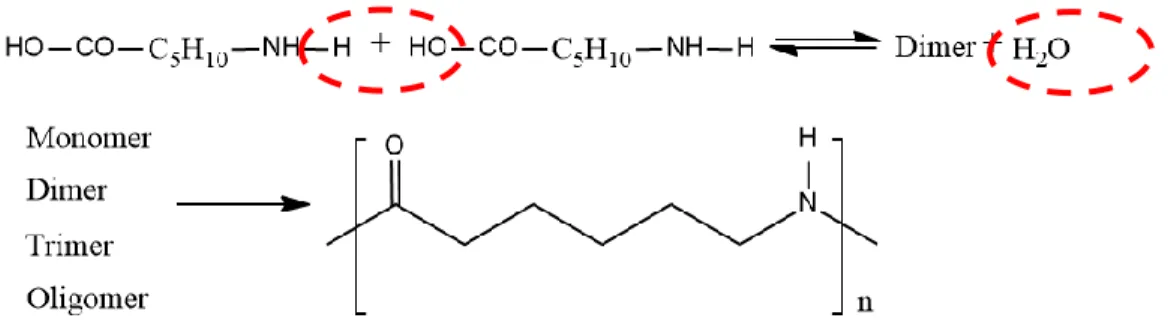
Another major type of polymerization process is named step polymerisation which occurs by independent steps. In this type of polymerization simultaneous reactions may occur between monomers, dimers, and oligomers. There are two main reactions: condensation (Figure 3) and ring-opening reaction (17).
8 Figure 3. Condensation polymerization
1.1.2. Polymer structure and classification of polymer materials
Depending on the monomer type and the conditions of polymerization, the architecture of polymer chains can vary dramatically. Figure 4 shows the main types of architecture of polymer chains which can be found in commercial polymer materials:linear, branched and crosslinked (3D).
Figure 4. Main types of architecture of polymer chain
Thermoplastics are generally polymers with a linear or branched chain architecture. Many of the most commonly used polymer materials, for instance, polyethylene (PE), polypropylene (PP), polystyrene (PS) and polyvinyl chloride (PVC) belong to the category of thermoplastics.
Thermoplastic materials are wildly used in thermoforming processes such as injection molding, blow molding and compression molding (18, 19). The reason is that the thermoplastic‘s mechanical
9
properties change considerably on both sides of its transition temperature, either its glass transition temperature (Tg) or melting temperature (Tm).
Another type of polymer are elastomers, such as rubber, that can form 3D network structures. Compared to vulcanized (crosslinked) rubber, uncured rubber has similar thermal properties as thermoplastics, but has relatively few uses due to its low physical properties (20). It is used for cements; for adhesive, insulating, and friction tapes; and for crepe rubber used in insulating blankets and footwear. Vulcanized rubber, on the other hand, has numerous applications. Resistance to abrasion makes softer kinds of rubber valuable for the outer soleof vehicle tires, flooring material and conveyor belts.
Because of the irreversibility of the vulcanization reaction, the industrial production of rubber flooring tiles are always molded under heating at first, and then vulcanized, in order to permanently fix the shape of the pressed material. The cured rubber materials no longer have the same thermo-property as thermoplastic, they are able to maintain their form under heating because the 3D structure prevents movement between polymer chains.
1.1.3. Vulcanization in sulfur and non-sulfur system
Vulcanization is a chemical process for converting natural rubber or related polymers into more durable materials via the addition of sulfur or other equivalent curing or accelerators. These additives modify the polymer by forming cross-links (bridges) between individual polymer chains (21, 22).
Uncured natural rubber is sticky, deforms easily when warm, and is brittle when cold. In this state, it is a poor material for applications where a high level of elasticity is required. The reason for inelastic
10
deformation of un-vulcanized rubber can be found in its chemical structure — rubber is composed of long polymer chains. These chains can move independently relative to each other, which lets the material change shape. Crosslinking introduced by vulcanization prevents the polymer chains from moving independently. As a result, when stress is applied the vulcanized rubber deforms, but upon release of the stress it reverts to its original shape.
In contrast with thermoplastic processes which are reversible, vulcanization of elastomers, or the curing of other thermosetting polymers, is generally irreversible. The cross-linking is usually achieved by the addition of sulfur, but other chemicals can perform the same function, including peroxides, metallic oxides, acetoxysilane, etc. Therefore, in the rubber industry, the "cure", "vulcanization" and "cross-linking" are synonymous, and curing system is divided into non-sulfur vulcanization system and sulfur curing system (23). In Figure 5, we schematically represent two strands (blue and green) of natural rubber after vulcanization with elemental sulfur.
Figure 5. Natural rubber after vulcanization with elemental sulfur (circled in red)
A variety of methods exist for vulcanization. For example, an economically important method (for example, vulcanization of tires) uses high pressure and temperature after the curing agent has been added to the rubber. A typical vulcanization temperature for a passenger tire is 10 minutes at 170 °C. This process employs the technique known as compression molding, where the rubber article is
11 intended to adopt the shape of the mold.
The traditional curing system using sulfur opens the unsaturated carbon-carbon double bond to allow the formation of intermolecular cross-linking between raw rubber molecules. Thereby the properties of rubber are greatly improved, for instance high strength, high flexibility, high wear and corrosion resistance and other excellent properties. However, with the increasing variety of synthetic rubber, in addition to the mass production of general-purpose synthetic rubber varieties (unsaturated rubber), there have been created some saturated rubbers such as ethylene propylene rubber (EPR), ethylene-propylene-diene-monomer rubber (EPDM), acrylic rubber (ACM), chlorohydrin rubber and the silicone rubber, etc. (24). Because their main chains do not contain carbon-carbon double bonds that can be vulcanized with sulfur vulcanization system, these polymers can only be crosslinked with a peroxide, a metal oxide or other similar agents.
Peroxide curing systems can be divided into three categories according to the type of crosslinking agent: inorganic peroxides, organosilicon peroxides and organic peroxides. The organic peroxide is the most common among them, primarily for crosslinking saturated rubbers; unsaturated rubbers can also be cured by using peroxide (25). Compared to sulfur curing, peroxide curing forms C-C bonds which have a higher bond energy. It provides better chemical stability, excellent resistance to aging and a very low permanent deformation. In addition, non-sulfur vulcanized rubber has no reversion degradation problems.
1.1.4. Mechanism of peroxide vulcanization
Peroxides are easy to decompose under heating and generate free radicals, which act as an initiator and results in a cross-linking reaction between molecular chains. The reaction process can be summarized
12 as the following steps:
(1.1)
(1.2)
(1.3)
Peroxide can also react with C=C by breaking the carbon-carbon double bond and the reaction mechanism is similar to sulfur curing but replaces S-S bond with a C-C bond (26). Therefore, peroxide could be applied in both of the saturated and unsaturated rubber materials.
1.2. Polymer composite
This section involves the basic conception of composite material, the composition of polymer composite. Different components of polymer composites such as mineral fillers and chemical additives will be introduced in this section.
1.2.1. Composite materials
Composite materials for construction, engineering, and other similar applications are formed by combining two or more materials in such a way that the constituents are still distinguishable and not fully blended (Figure 6). The different materials are combined judiciously to achieve a system with
13
more useful structural or functional properties non-attainable by any of the constituents alone (27).
Figure 6. Plywood composite 1.2.2. Polymer composite
Many commercially produced composites use a polymer matrix material (often called a resin solution). There are several broad categories, each with numerous variations. The most common are known as polyester, vinyl ester, polyamide, polyethylene, polypropylene, PVC, and others. The reinforcement materials are often common ground minerals but also fibres and nano-materials.
Generally, polymer composite, especially polymer composite construction materials, including pipe, window profiles and flooring material have similar compositions. The components can be roughly divided into three categories: polymer matrix, reinforcement (mineral filler and fibre, etc.) and chemical additives (additive and curing agent).
1.2.3. Introduction of components in polymer composite
Polymer matrix: the properties of different polymer matrix will determine the application to which it
is appropriate. The chief advantages of polymers as a matrix are low cost, easy-processability, good chemical resistance, and low specific gravity (28). On the other hand, low strength, low modulus, and low operating temperatures limit their use (29). Various polymers used for composites are
14
thermoplastic polymers, thermosetting polymers, elastomers, and their blends.
Fibre reinforcement: glass, carbon, Kevlar, boron, and natural source fibres are being used as
reinforcing materials in fibre-reinforced plastics, which have been widely accepted as materials for structural and non-structural applications (30).Fibre reinforced polymer (FRP) allows the alignment of the fibres of thermoplastics to suit specific design programs. Specifying the orientation of reinforcing fibres can increase the strength and resistance to deformation of the polymer matrix. For instance, glass fibre reinforced polymers are strongest and most resistive to deforming forces when the polymers fibres are parallel to the force being exerted.
Mineral fillers: fillers are particles added to materials (plastics, polymer composite material and
concrete) to lower the consumption of more expensive binder material or to enhance some properties of the composite material. The common mineral fillers used in polymer composite are calcium carbonate, dolomite, talc, quartz and clay (31).
Among the most important fillers, calcium carbonate holds the largest market volume and is mainly used in the plastics sector. Calcium carbonate is the least expensive and the largest mineral filler used in thermoplastic as well as in thermoset compounds and rubber materials. Calcium carbonate can be incorporated at a very high level of more than 70% by weight (32). While polyolefin and other non-polar polymer compounds use plain calcium carbonate, they usually require surface modified calcium carbonate. The reason is that, in the mixing process the hydrophobic liquid phase (polymer phase) does not readily wet the CaCO3 surface, and as a result, the filler phase will spontaneously
separate from the mixture. The common method used to resolve this problem is to treat the filler particles‘ surface by functionalized polymer such as a maleicanhydride polymer which acts as a particle-matrix coupling agent.
15
Chemical additives: a chemical additive is a compound used to modify the properties of polymer
resins. Examples include plasticizers, UV stabilizers, antioxidant and flame-retardants. In some certain polymer systems for example: rubber and elastomer manufacturing, the curing agent can also play the role of chemical additive in order to modifier some properties (33, 34).
Introduction of some common additives:
Plasticizer: additives that increase the plasticity or fluidity of a material. It is generally agreed that plasticizers work by embedding themselves between the chains of polymers, spacing them apart (increasing the "free volume"), and thus significantly lowering the glass transition temperature of the polymer and making it softer (35).
Antioxidant: Substance that, when added in small quantities to resin, prevents oxidation and degradation while maintaining the resin‘s properties.
Curing Agent: A catalytic or reactive agent that, when added to a resin, causes vulcanization (crosslinking). It also called hardener.
UV Stabilizer: Chemical compound which improves resistance to degradation from ultraviolet radiation (36).
1.3. Polymer blends and miscibility
Most of the polymer matrix used in polymer composite materials are usually composed of mixes of different polymers: polymer blends. In this section, we will introduce the general concept of polymer blends, its advantages and a frequently observed problem of immiscibility. Some methods used to improve polymer compatibility will also be presented, especially the chemical method by using a compatibilizer (37).
16 1.3.1. Polymer blends
During the 1940s, '50s and '60s, the commercial development of new monomers for production of the new polymers seemed endless. In this period, it was discovered that the development of the new techniques for the modification of the already existing polymers, would be economically viable. A new polymer modification process, based on the simple mechanical mixture of two polymers first appeared when Thomas Hancock made a mixture of natural rubber with Gutta-percha. This process generated a new polymer class called «Polymer Blend».
Polymer blends are a class of materials analogous to metal alloys, in which at least two polymers are blended together to create a new material with different physical properties (38). Polymer blends can be broadly divided into three categories:
Immiscible polymer blends: This is by far the most populous group. If the blend is made of two polymers, two glass transition temperatures will be observed.
Compatible polymer blends: Immiscible polymer blend that exhibits macroscopically uniform physical properties. The macroscopically uniform properties are usually caused by sufficiently strong interactions between the component polymers.
Miscible polymer blends: Polymer blend that is a single-phase structure. In this case, one glass transition temperature will be observed (homogeneous down to molecular level). In thermodynamic terms a miscible blend is one associated with a negative value of the free energy of mixing:
(1.4) And a positive value of the second derivative with respect to concentration:
17
(where ΔGm is the free energy of mixing, ΔHm is the heat of mixing and ϕ is the volume
fraction of the matrix polymer)
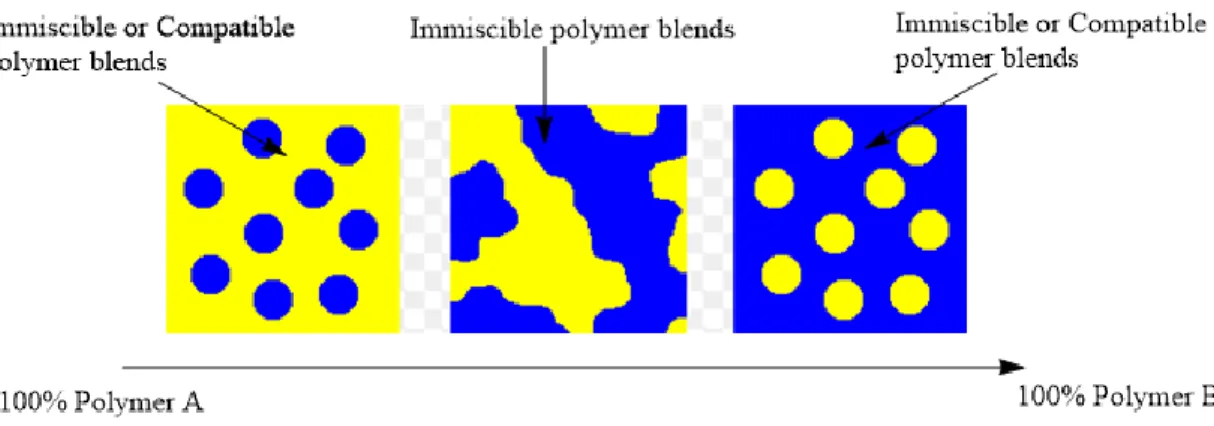
Figure 7. Varying of the polymer blends type along with different ratio of components.
As shown in Figure 7, the change of components ratio can result in a different types of polymer blends. In addition various other factors will affect the polymer blends‘ status such as the component‘s polarity, viscosity, Tg & Tm (affect hardness and viscosity), the degree of crystallinity and external processing conditions. The complex balance of these various factors leads to the observation that most of the polymers are immiscible (or thermodynamically immiscible) (39).
1.3.2. Miscibility
Miscibility is a thermodynamic concept, its thermodynamic definition is clear. It is pertinent to the liquid or glassy state, such as polymer blends can be considered to be a solution (40). However, there is a significant amount of discussion as to methods of detecting miscibility and the size of heterogeneity in the phase dispersion of miscible blends. In polymer blends, immiscibility is a rule while miscibility is a rare and precarious state, determined by a large range of variables: molecular parameters, polymer chain type, concentration, pressure, temperature, etc. In this case, considerable research is committed to find modification methods which can improve the miscibility of polymer
18 blends, called compatibilisation.
1.3.3. Compatibilisation and compatibilizers
Compatibilisation is a process of modification of the interfacial properties in immiscible polymer blends, which result in: 1) reduction of the interfacial tension between different polymer phases or domains; 2) stabilisation of the desired morphology against the processing stress and 3) improved interaction between the phases in the solid state. In other words, compatibilisation results in the formation of a polymer alloy which has a well dispersed, stable appearance (41).
Compatibilisation can be accomplished by physical or chemical means. In the former case the desired level of dispersion is generated by physical means, then physically stabilised (e.g. by quenching, irradiation crosslinking or co-crystallisation). However, in this mémoire we will focus on the chemical compatibilisation process, where the morphology not only depends on the level of mechanical mixing, but to a great extent, it is controlled by the crosslinking process and use of a compatibilizer (42).
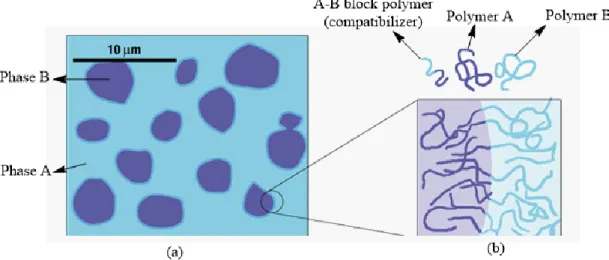
Figure 8. A-B block polymer works as a compatibilizer to improve interfacial adhesion
Compatibilizers in polymer blends are used to promote interfacial adhesion between pairs of polymers that are otherwise immiscible. They are usually block copolymers, each of the blocks being compatible
19
with one of the phases. These molecules tend to concentrate at the interfaces and stabilize them thus allowing finer dispersion of mutually incompatible pairs. As shown in Figure 8(a), A-B polymer blend is immiscible in the micro-scale. In Figure 8 (b), as an A-B block-polymer compatibilizer which is compatible with both of the phases is used to improve the interaction between phase A and B. Therefore, the polymer blend becomes more stable and the dimension of the dispersion domain (phase B) becomes smaller (Figure 9).
Figure 9. Normal polymer blend (a); polymer blend modified by compatibilizer (b)
1.4. Surface wettability
In everyday life, people usually apply some liquids such as water, alcohol or solvents to help in the cleaning process. The reason is that some liquids have higher affinityto the inorganic particles (water, alcohol, etc.) or to organic (petrol, etc.) soil particles, than to the solid surface; the strong liquid-particle interaction thus helps to remove the particles away from the surface,. Therefore, the role of surface wettability in surface cleaning process should be important and should be examined thouroughly. In this section, we introduce the external manifestations of surface wettability which is named surface water contact angle (WCA) and its application in the development of self-cleaning surfaces.
20 1.4.1. Surface water contact angle
Wettability of solid surfaces has been studied for a very long time. The first fundamental equation that quantified the static contact angle of a liquid droplet on a flat surface was proposed by Young in 1805.
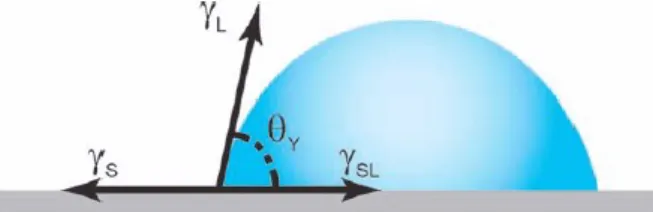
Figure 10. Static contact angle of liquid droplet on smooth solid surface
In Figure 1, the droplets form a three-phase contact line where solid-liquid, solid-vapor, and liquid-vapor interfaces meet. Forces created by the surface tensions at each interface are pulling the droplet along the solid plane and define its shape.
Young‘s equation: (1.6)
According to the Young‘s equation (1.6), the cosine of the WCA in the equilibrium state (θY) is
directly proportional to the difference of the interfacial forces per unit length of solid– vapor (γSV) and
solid–liquid interfaces (γSL), and inversely proportional to the interfacial force of the liquid–vapor (γLV)
interface (43). When the contact angle for liquid is higher than 20 degrees, it can be assumed that γSV γS and γLV γL (44). The static WCA of a smooth surface produced from the material with the
lowest surface tension (energy) can reach only 119° (45). 1.4.2. Surface water contact angle (WCA) on rough surfaces
Through investigation of the water resistance of textile surfaces, Wenzel found that the roughness of a surface can significantly change the static WCA on such a surface.Wenzel‘s assumption is also called
21
homogeneous wetting as shown in Figure 11 (a). Based on this assumption, the author derived an equation that relates surface roughness (r) and Young‘s contact angle (
θ
Y) to the actual WCA on arough surface (
θ
W) (46).Wenzel‘s model: (1.7)
The roughness factor (r) is the ratio of the water–solid contact area to the area of geometrical projection of water–solid interface. As a result, we always have (r)>1 and for hydrophobic surfaces there is
θ
w >θ
Y > 90°, on the contrary for hydrophilic surfaces, there isθ
w <θ
Y < 90°.Figure 11. Static contact angle of water droplet on rough surface: (a) Wenzel‘s model. (b) Cassie‘s model
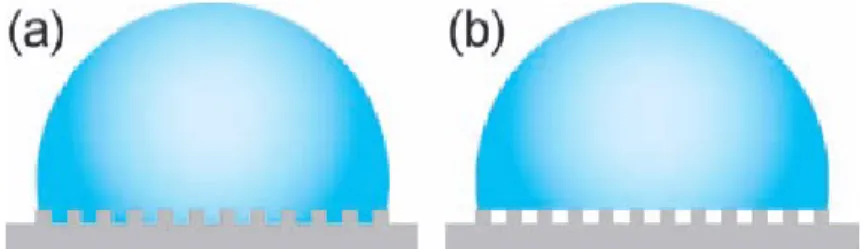
On the other hand, Cassie and Baxter proposed another model to explain the effect of roughness on droplet behavior on a surface. In contrast to Wenzel, they assumed heterogeneous wetting when air is entrapped by water in surface cavities as shown in Figure 11 (b). In such a case, the contact area between water and the solid is minimized, and the area between water and air is maximized, thus forcing water to form spherical droplets. In addition, roughness of wet areas also influences the contact angle, and in general, Cassie‘s equation can be described as follows:
22
Where (f) is the ratio of the solid–liquid contact area to the area of geometrical projection of water droplet. It is necessary to note that the wetting regime that yields the lowest contact angle is the more stable one from a thermodynamic point of view, since the Gibbs energy turns out to be a monotonically increasing function of the contact angle. In Cassie‘s model, when f decreases due to an increase in roughness (more air is trapped), the WCA increases. Wenzel‘s and Cassie‘s models give a fundamental explanation of how a static WCA can be increased with the help of surface roughness.
For further reflection, Cassie‘s model could be regarded as a phase transition in the surface system of Wenzel‘s model. Generally speaking, in Wenzel‘s model the WCA will increase proportionately with increasing roughness (47). However, when the surface micro-structure reaches a certain shape (certain rougness) (48), e.g. the distance between the peak (on surface) or diameter of holes is small enough, then the water is no longer able to enter into the valleys. Then the system immediately translates into Cassie‘s model and leads to a change of the WCA.
1.4.3. Lotus effect and superhydrophobic self-cleaning effect
Lotus leaves are one of the most famous examples of naturally occurring superhydrophobic surfaces. The microstructure of a lotus leaf obtained by Barthlott and Neihuis are shown in Figure 12 (right). The WCA of a lotus leaf is 161° with WCA hysteresis of 2°. As a result, water droplets roll off the leaf while collecting the contaminants; this is dubbed as the ‗‗lotus effect‘‘ as shown in Figure 12 (left).
23
Figure 12. Lotus effect (left) and a microscopic SEM image of a lotus leaf (right)
Generally, ―easy to roll‖ property of the water droplet could be interpreted as a minimisation of the solid-liquid interface due to a reduced interaction between them. For a drop of water rolling off a lotus leaf, the droplet behaves as an elastic ball, rather than as a fluid (Figure 13).
Figure 13. Slip of a water droplet from an inclined hydrophobic surface (left) and an inclined superhydrophobic surface (right)
In case of a normal hydrophobic surface, because of the nonslip boundary condition, the water drop falls across the dirt particles and the dirt particles are mainly displaced to the sides of the droplet and re-deposited behind the droplet. Especially hydrophobic particles tend to remain on such surfaces (Figure 13, left). In the case of water repellent rough surfaces, the solid-water interface is minimized. Water forms a spherical droplet, and collects the particles from the surface (Figure 13, right). The lotus leaf therefore always exhibits a very low degree of contamination: this is clearly self-cleaning (49).
24
1.4.4. Limitation and inspiration from superhydrophobic self-cleaning model.
The superhydrophobicity is determined by the surface micro-surface structure. Generally, this kind of self-cleaning structure is difficult to prepare but easy to destroy. In the world, there are many kinds of self-cleaning coating for commercial purposes, but most of them have some shortcomings such as poor wear resistance, short life and they are generally expensive.
Thus some limitations of superhydrophobic self-cleaning technology are summarized as flows:
Self-cleaning surfaces are more suitable for collision-free use (surface structure is easy to wear under frequent collision), that is why those self-cleaning coatings can often be applied to glass or painted surfaces.
Self-cleaning surfaces are too expensive to be applied on large area (e.g. floor surface). The most common silicone resin or fluorocarbon based coating do not come cheap.
Artificial superhydrophobic structure can‘t be applied to a soft surface. The deformation of a soft surface will lead to the destruction of the micro-structure. The soil particle‘s size must be bigger than the smallest gap in the surface structure.
In Cassie‘s model, if the soil particles of small size can enter the gaps in the surface structure, than they could not be removed by water (Figure 14).
25
The discussion above illustrates the difficulty and complexity in the application of self-cleaning technology in our daily life. Normal material surfaces, which are neither superhydrophilic nor superhydrophobic, can be considered as a complex system which may include both Wenzel and Cassie‘s model. For this reason, once we discuss the influence of wettability on cleanability, we have to consider simultaneously the effect of surface topography.
1.5. Surface topography
As mentioned above, surface topography may play an important role in the surface wettability and the surface cleaning property. In this section, the basic concept of surface topography and surface roughness will be introduced, and some commonly used characterization methods will also be presented to guide further insight. Some important parameters which are used to evaluate surface roughness will be introduced, and their influence to surface cleaning will be summarized from the literature.
1.5.1. Surface roughness and its evaluation
Surface topography includes roughness (nano- and micro-), waviness (macroroughness), lay and flaws. The symbol Ra (or Sa) is used both for nano- and microroughness and for waviness (or
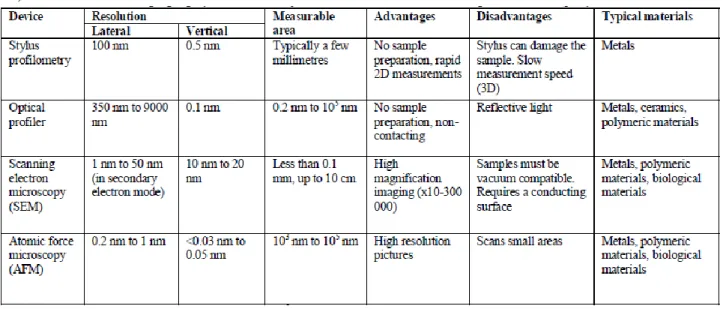
macroroughness). This is usually determined by the production method used. On the other hand, there are unintentional irregularities that do not occur in any consistent pattern and include scratches, dents, cracks etc. (50). Several techniques have been developed to quantify the topography of surfaces such as atomic force microscopy (AFM), scanning electron microscopy (SEM) and contact- or noncontact-profilometry (Table 1).
26
Table 1. Characteristics of different surface roughness measurement techniques (by R.Kuisma et al.).
The most important factor in the analysis of surface topography is the evaluation of surface roughness. Various surface roughness parameters can be generated from a surface profile to represent its geometrical characteristics. The most commonly used surface roughness parameters are defined below.
Ra (or Sa) is the arithmetical average of surface heights (peaks), also known as the centre line average
of surface heights (yi), and can be calculated as
(1.9)
Rq (or Sq) is defined as the root mean square of surface heights, i.e.
(1.10)
Rku is a measure of the spikiness of the statistical distribution.
27 1.5.2. Analysis for selection of parameters
For the purpose of industrial applications, SEM and AFM instrument were rarely used to evaluate surface roughness. For SEM method, the interpretation of the images is not necessarily straightforward and does not readily yield quantitative data about the height or depth of surface features. AFM is relatively high resolution but is difficult to use to evaluate large surface area. As a result, profilometry, especially optical profilometry, becomes the more commonly used method. Several parameters can be determined by measuring surface profile such as Ra, Rq etc. Before they are applied in further investigation, they need to be evaluated as to their influence on surface cleanability.
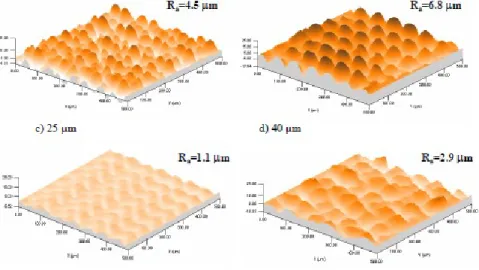
R. Kuisma et al. have used a profilometer to investigate the surface cleanability on flooring material. They chose ten light-coloured commercial plastic floor coverings and some prepared materials with a designed surface topography (Figure 15). These materials were soiled with different types of soils, such as particle, oil soil, blood soil, etc., for each of which specific soiling methods were used.
Figure 15. Designed surface with controlled roughness (by R. Kuisma et al.)
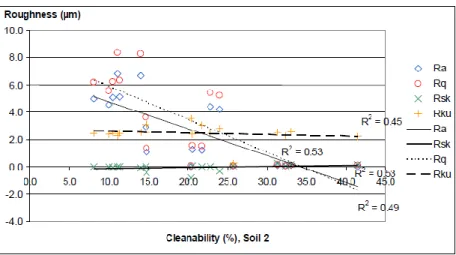
The results are shown in Figure 16. The cleanability increases with a decrease of parameter Ra and Rq. A lower value of Ra and Rq shows that the surface is less rough, meaning there should be less small
28
surface defects such as small cracks and gaps that may contain hard to remove soil. Therefore, it can be said that the smoother the surface, the easier it is to clean. But we can‘t observe such a tendency from the variation of Rsk and Rku parameters. As shown in Figure 16 with the thick solid line and the
dashed line, even though the materials‘ Rsk and Rku parameters are unchanging, its cleanability
changed a lot. Therefore, the further research in this mémoire will focus on the Ra parameter.
Figure 16. Cleanability variation with the different surface roughness parameters (R.Kuisma et al.)
However, there are also some limitations in using roughness parameters to evaluate the surface cleanability. As mentioned above, the definition of Ra (or Sa) is the arithmetical average of surface
heights (peaks, valleys). As a result, the following two surfaces (Figure 17) have same Ra, but
obviously the cleanability can be expected to be different. However, to date, there isn‘t a better method to evaluate the surface roughness and the vast majority of surfaces can still be adequately characterized by profile measurement.
29
CHAPTER 2. EXPERIMENTAL
In this chapter, the materials and chemical products used in the project will be introduced. The main functions of the equipment and characterization instruments use will be described; sample preparation and experiment procedure will also be presented. In addition, the method used to evaluate the surface cleanability, simplified by our group, will be described in detail in this chapter.
2.1. Polymer materials and products used in the project
All the polymer composite samples used in our project are prepared either in the university laboratories, or in the industrial laboratory. The samples may be composed of the polymer matrix, different fillers and various chemical additives such as the curing agent. The concentration of each component in the composite will be expressed in phr (per hundred resin), which means the weight of product / 100g of total polymer in the mixture.
2.1.1. Polymer
In order to find some general relations between polymer chemistry and polymer surface properties, 43 polymers/co-polymers in the family of thermoplastic (TP), elastomer (E) and thermoplastic-elastomer (TPE) were chosen to do the soiling-cleaning test. All the following materials are used in CHAPTER 3 to investigate the influence of different factors on surface cleanability in single-polymer systems (the number in the parentheses represents the number of different polymers tested in this category):
PE (4), PP, PS, PMMA (2), PLA (3), P(E/O) (4), P(P/E), EPDM (3), P(E/MeA) (2), P(E/VAc) (2), P(E/VOH)), NBR, SBR, HSBR, SEBS, ABS, P(E/MAA), P(E/MAA/BuA), i-(E/MAA) (3), i-(E/MAA/BuMA), PTE. POM, PA (2), PPS, PBT, TPU, LDPE+Scilicon Rubber.
30
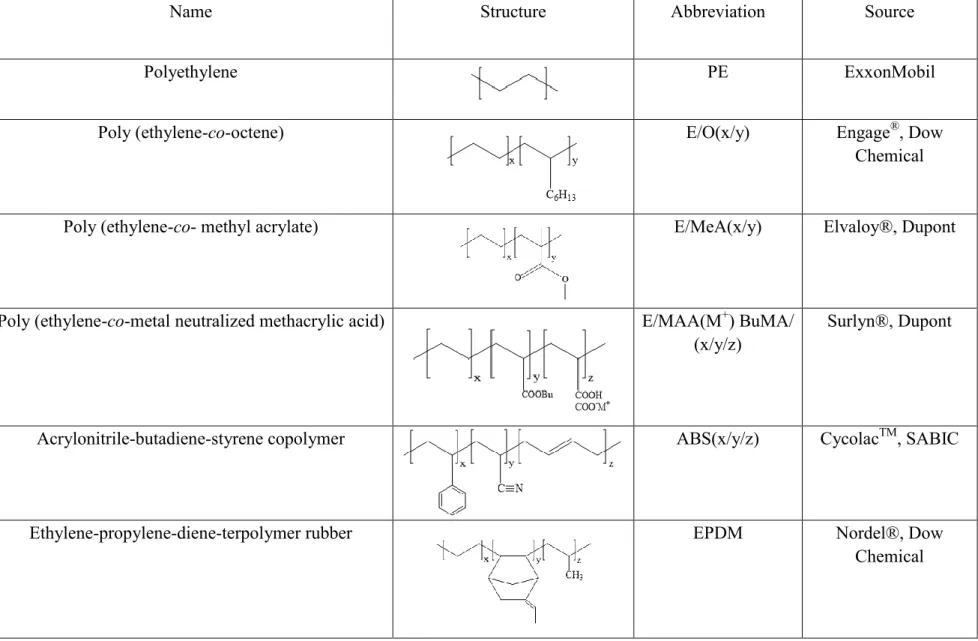
Selected materials were used in CHAPTER 4 to manufacture polymer blends based on the results obtained in CHAPTER 3 (Table 2).
31
Table 2. Structure and abbreviation of the more significant materials of this study.
Name Structure Abbreviation Source
Polyethylene PE ExxonMobil
Poly (ethylene-co-octene) E/O(x/y) Engage®, Dow
Chemical
Poly (ethylene-co- methyl acrylate) E/MeA(x/y) Elvaloy®, Dupont
Poly (ethylene-co-metal neutralized methacrylic acid) E/MAA(M+) BuMA/ (x/y/z)
Surlyn®, Dupont
Acrylonitrile-butadiene-styrene copolymer ABS(x/y/z) CycolacTM, SABIC
Ethylene-propylene-diene-terpolymer rubber EPDM Nordel®, Dow
32
Name Structure Abbreviation Source
Styrene Butadiene Rubber SBR Buna®, Dow
Chemical
Poly (ethylene-co- vinyl acetate) E/Vac
(x/y)
Levapren®, ARLANXEO
33 2.1.2. Chemical product
Chemical products used in this project include two types. One is the curing agent tert-butyl peroxybenzoate, produced by Akzonobel; its structure is illustrated in Figure 18.
Figure 18. The structure of organic peroxide curing agent
Another type of chemical product is the liquid cleaning agent, such as deionized water, ethanol and ethylene glycol. These products have different surface tension. The purpose of using such a group of liquids as cleaning agent is to investigate the influence of wettability on surface cleanability. Their surface tension is shown in Table 3.
Table 3. Cleaning agents with different surface tension.
Producer Name Surface tesion (mN/m)
n.a Water 72.7
Anachemia Ethylene glycol 48.4
GreenField Ethanol 22.3
2.2. Sample preparation and related equipment
All the samples discussed in the following sections were prepared in the laboratories of Pr. Carmel Jolicoeur and Pr. Michel Huneault, or at American Biltrite Canada in Sherbrooke. The samples consist of single-polymers, polymer blends and crosslinked (cured) polymeric materials. In the preparation
34
process, a mixer (HAAKE) is used to mix polymer blends and composite materials, and a hydraulic press is used for compression molding.
2.2.1. HAAKE Rheomix Lab mixer and mixing process
HAAKE Rheomix Lab Mixers (Figure 19) is a torque rheometer used to test highly viscous substances such as polymers, elastomers and composites. This mixer is controlled using the HAAKE PolyLab OS System. All of the blended samples were prepared in this mixer giving ~50 ml samples.
Figure 19. HAAKE™ Rheomix Lab Mixers
As shown in Figure 20, a typical mixing test is run at a constant speed (shear rate) and the material's response is recorded as torque. The temperature of the mixing chamber is temperature-controlled but due to melting and to the frictional heat in the mixing chambe, the sample‘s temperature changes over time. This ―Rheogram‖ (torque, melt temperature vs. time at constant speed) is characteristic for different materials or blends and can often be used to verify the quality of the material.
35
Figure 20. The mixing chamber of HAAKE Rheomix Lab Mixers (left); typical Torque-Temperature graph obtained from mixing process (right)
Operation method
1. Turn on the HAAKE Rheomix Lab Mixer
2. Turn on the HAAKE PolyLab OS System in the computer; the software will connect to the mixer automatically.
3. Set the initial temperature of mixer. Usually it should be above the melting temperature of each of the polymer components. In most cases, the initial temperature was set to 160℃. 4. Create a new test file and click ―calibration‖ button to return the torque detector to zero.
5. Pour the materials (polymer, fillers, curing agent, etc.) into the chamber and start the test, close the chamber when the feeding is finished.
6. Wait until the torque data stabilises. As shown in Figure20 (right), torque is almost stable after the dashed line. The total test time is usually 6minutes.
7. Stop the equipment and remove the mixed sample as soon as possible, if not, when the temperature decreases to below its Tm, the polymer hardens quickly.
36 2.2.2. Grinder
The polymer blend or composite produced in the HAAKE mixer is a solid block that is hard to use. To enable further processing and testing, the polymer block is broken into small granular particles with a size around 3mm diameter with an Allen-Bradley grinder (Figure 21).
Figure 21. Allen-Bradley grinder 2.2.3. Hydraulic press
Figure 22. Hydraulic press machine
37
Figure 23 shows the mold which is used to prepare the polymer or composite sample strips. It is made from stainless steel and its external dimension is 18cm*18cm; internal dimension is 1.5cm*15cm for each cavity.
Figure 23. Mold for compression molding (left); filling of the mold with sample particles (right) Operation protocol
Turn on the hydraulic press. 1. Set the temperature to 180℃.
2. Preheat the mold during the heating process. 3. Fill the mold with polymer granules.
4. Put the filled mold into the hydraulic press and set the timer going
5. At 4 minutes, increase the pressure gradually within 1 minute until it reaches 5000 lbs 6. At 5 minutes, turn the pressure valve to release the pressure.
7. At 5 min. 30 sec, gradually increase the pressure to 10,000 lbs within 1min. 8. At 6 min 30 sec, release the pressure again.
9. From7 minutes to 8 minutes, gradually increase the pressure again to 10,000 lbs. 10. Keep the pressure for 2 mins
38 on the cooling water, wait until 17 minutes.
12. After 17 minutes, release the pressure and take out the mold. 13. Remove the sample from the mold and wash.
2.3. Procedure for the cleanability test
This experiment is performed on the sample strips as prepared by the mixing and pressing process described above. Various soiling agent formulations have been found in literature, but no systematic data was available for general polymer systems. In order to simplify the soiling/cleaning system under further study, the research team finally chose two kinds of particle soil agents to represent inorganic and organic soil (Table 4), they are Red-Iron Oxide (RIO) and Carbon black (CB).
Table 4. List and information of the powders used as soil agent
Particles Chemical name Type Cat# Size Code Red Iron Oxide Fe2O3 Inorganic
Hydrophilic
Red 403 80~200nm RIO
Carbon black C Organic Hydrophobic
Black raven 1020
~100nm CB
2.3.1. Preparation of samples for the cleanability test The reference and samples were prepared as follows:
1. Clean the surface with ethanol and then with water. 2. Dry in the oven at 60℃ for 1h.
39 2.3.2. Protocol for evaluation of soiling and cleaning Soling:
1. Covering one end of the sample with tape to preserve the original appearance. 2. Dip the applicator (felt tip pencil eraser) in the soiling agent.
3. Rub the surface with light pressure in a circular motion for 50 seconds. 4. Leave to react for 30min
Dry cleaning
1. Take a glass slide to cover and protect the two-thirds of the sample surface.
2. On the unprotected side of the sample strip, scrub the surface gently with a circular motion with rough paper until no more soiling agent is removed.
Wet cleaning
1. On the opposite end of the sample from Dry cleaning, perform wet cleaning. 2. Clean similarly as dry, using a water water-saturated paper.
3. The middle of the sample strip is untouched and designated as "soiled" (Figure 24).
Figure 24. Soiling test (left) and finished sample (right)
2.3.3. Evaluation of cleanability
Several attempts were reported in the literature to evaluate the extent of soiling and surface cleanability, usually through visual assessment, or using a colorimeter. The use of a colorimeter for
Original Wet cleaned
Soiled Dry cleaned