To cite this document:
Sarwar, Golam and Boreli, Roksana and Lochin, Emmanuel
and Mifdaoui, Ahlem and Smith, Guillaume Mitigating Receiver’s Buffer Blocking by
Delay Aware Packet Scheduling in Multipath Data Transfer. (In Press: 2013) In: The
3rd International Workshop on Protocols and Applications with Multi-Homing
Support (PAMS 2013), 27 Mar 2013, Barcelona, Spain.
OATAO is an open access repository that collects the work of Toulouse researchers and
makes it freely available over the web where possible.
This is an author-deposited version published in:
http://oatao.univ-toulouse.fr/
Eprints ID: 8610
Any correspondence concerning this service should be sent to the repository
administrator:
[email protected]
Mitigating Receiver’s Buffer Blocking by Delay
Aware Packet Scheduling in Multipath Data Transfer
Golam Sarwar
†,⋆,∗,⋄, Roksana Boreli
‡,⋆,∗⋆
National ICT Australia Ltd, Australia
∗ University of NSW, Kensington, Australia
Emmanuel Lochin
⋄,⊳, Ahlem Mifdaoui
⋄,⊲, Guillaume Smith
†,⋆,∞,⋄⋄Université de Toulouse; ISAE, LAAS-CNRS, France
⊳
[email protected], ⊲[email protected],
Abstract—Reliable in-order multi-path data transfer under asymmetric heterogeneous network conditions has known prob-lems related to receiver’s buffer blocking, caused by out of order packet arrival. Consequently, the aggregate capacity from multiple paths, which theoretically should be available to and achievable by the multi-path transport protocol, is practically severely underutilized. Several mitigation techniques have been proposed to address this issue mostly by using various packet re-transmission schemes, load-balancing and bandwidth-estimation based mechanisms. In comparison to the existing reactive tech-niques for buffer block mitigation, we propose a novel and yet simpler to implement, delay aware packet scheduling scheme for multipath data transfer over asymmetric network paths, that proactively minimizes the blocking inside receiver’s buffer. Our initial simulation results show that, in comparison to the default round robin packet scheduler, by using our proposed delay aware packet scheduling scheme, we can significantly improve the overall performance of a multi-path transport protocols while notably minimizing the receiver’s buffer usage. Therefore, our proposal is particularly beneficial for multi-homed hand-held mobile devices with limited buffering capacity, which, due to their multi-homing and heterogeneous wireless network features (i.e. availability of 3G and Wi-Fi) are also one of the most common use cases for multi-path transport.
Index Terms—Multipath Transport Protocol; Receiver’s Buffer Blocking; CMT-SCTP; Receiver’s Window Blocking
I. INTRODUCTION ANDMOTIVATION
With the increased popularity of hand-held devices equipped with multiple heterogeneous radio interfaces and multi-homing capable data-centres connected to the Internet with several network access links, contemporary networking is demonstrably moving towards multi-homed and multi-path oriented communication. Yet the majority of data transfer today is still performed using traditional TCP, which neither supports multi-homing nor can provide multi-path data transfer. To address these deficiencies, a multi-path and multi-homing capable version of TCP has been proposed recently and is
actively being contributed to in IETF [2]. Stream Control
Transport Protocol (SCTP) [1] was originally designed to
fulfil the limitations of traditional TCP with features such as inherent multi-homing, multi-streaming, reliable, unreliable and partial reliable data delivery and elimination of TCP’s head-of-line blocking problem. Although SCTP provides in-built multi-homing, secondary paths are still only meant to provide fail-over redundancy and load-balancing. Therefore an
extension to the existing SCTP standard, Concurrent Multipath
Transfer SCTP (CMT-SCTP) [3], has been proposed to enable
simultaneous usage of multiple available paths, aggregating dispersed available capacity.
Receiver’s buffer blocking is a known problem for both
MP-TCP [6] and CMT-SCTP [9] when operating under various
asymmetric network scenarios, since out of order incom-ing packets may occupy the entire receiver’s buffer eventu-ally stalling the whole transmission flow. Before transmit-ting newer data packets, both MP-TCP and CMT-SCTP’s congestion control mechanism will check if the receiver’s buffer has enough space by following the result given by
min(CW N Di, RW N D) where CW N Diis the data sender’s
congestion window for each path and RW N D is receiver’s
congestion window for the whole connection which essentially indicates the available space in the receiver’s buffer. Therefore, although the potential of aggregating capacity in concurrent multipath data transfer might seem a straightforward way to use all the available resources, out of order packet arrival leading to receiver’s buffer block together with the conservative nature of congestion control may significantly degrade the expected overall performance of multipath data transmission
protocols [4], [5]. Since the original proposal of CMT-SCTP,
several retransmission-policy based mitigation techniques for
receiver’s buffer blocking have been put forward [9], [10], [12].
The fundamental idea behind buffer-block mitigation by re-transmission is to provide the receiver with in order packets as fast as possible, based on different policies exploiting inherent metrics such as congestion window size, slow-start threshold, estimated path loss and round trip time (RTT), or hybrid policies using a combination of them. On the other hand, present state of deployable MP-TCP still depends on increasing the buffer size estimated from the combined bandwidth delay
product using the highest RTTRT Tmax of the available paths
and concludes that the buffer size should be adaptable based
on the type of end-point devices [6]. If communicating devices
can afford to provide bigger buffers, they may achieve higher throughput. Otherwise they will receive limited throughput for the case of constrained buffer size.
Considering the current state of the art buffer management and packet scheduling in multipath transport protocols, our contributions include:
• The proposal for a novel packet scheduling technique that exploits the awareness of per-path delay with respect to the combined overall capacity of the paths, to mitigate receiver’s buffer blocking.
• A related technique to estimate the forward delay for
delay aware scheduling.
• Evaluation (via simulation) of the performance of the
pro-posed scheduling mechanism as compared to the standard round robin scheduling used in current multi-path trans-port protocols. Sensitivity analysis of the performance to the imperfect delay estimation.
We note that although we refer to the specific details of the CMT-SCTP protocol when evaluating the performance improvement resulting from the use of our proposed scheduling mechanism, our proposal is equally applicable to other multi-path transport protocols like e.g. MP-TCP.
The organization of the rest of the paper is as follows: in
Section II we propose and explain our delay-aware packet
scheduling in contrast to CMT-SCTP’s default round-robin packet scheduling. We additionally present a proposal for a delay estimation mechanism and the required modifications to
CMT-SCTP. In Section III we present an evaluation of the
proposed packet scheduling technique and compare it with CMT-SCTP’s sender congestion window round robin packet scheduler. We also present the impact of a varying delay estimation error to the performance of our proposal. Finally
in SectionIVwe draw conclusion and propose future work.
II. DELAYAWAREPACKETSCHEDULING FORMULTI-PATH
DATATRANSFER
In this section, we first introduce the round robin scheduling currently utilized in the CMT-SCTP transport protocol and the associated performance issues. We then present our proposal for delay based packet scheduling, followed by the description of a mechanism used to estimate the delay on specific paths. A. Round Robin Scheduling
In CMT-SCTP’s original round robin packet scheduling mechanism, data sender attempts to send packets on multiple paths, based on the congestion window of each path. A sepa-rate congestion window is kept for each individual path. The scheduler observes the usable partition of sender’s congestion window, subtracting the on-the-flight unacknowledged packets from current congestion window size for each path, in a
so called "blind" round robin manner using the Equation 1
where Cwndi and U nacknowledgedi represents the sender
side congestion window size and amount of unacknowledged
packets for any pathPi. The resulting amount of packets from
Equation1, which is assumed to be safe to prevent the overflow
of the receiver’s buffer, is transmitted over the particular path during multipath transmission. Each path gets the opportunity
to transmit packets based on the output of Equation 1 in a
round robin manner. Once the receiver’s buffer is full with out
of order packets i.e. withRwnd = 0, the missing packets are
retransmitted, even though they might actually be in flight over the longer delay paths. The retransmission based mitigation
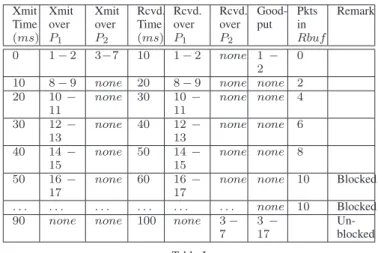
Xmit Time (ms) Xmit over P1 Xmit over P2 Rcvd. Time (ms) Rcvd. over P1 Rcvd. over P2 Good-put Pkts in Rbuf Remark 0 1 − 2 3−7 10 1 − 2 none 1 − 2 0
10 8 − 9 none 20 8 − 9 none none 2
20 10 − 11 none 30 10 − 11 none none 4 30 12 − 13 none 40 12 − 13 none none 6 40 14 − 15 none 50 14 − 15 none none 8 50 16 − 17 none 60 16 − 17
none none 10 Blocked
. . . none 10 Blocked
90 none none 100 none 3 −
7 3 − 17 Un-blocked Table I
TRADITIONALROUND-ROBINPACKETSCHEDULING
techniques perform their role in these cases by determining the best path to retransmit the missing packet(s) based on various path characteristics criteria which will lead to unblocking of
the receiver’s buffer [9], [10], [12].
min(Cwndi− U nacknowledgedi, Rwnd) (1)
An illustration of buffer block in round robin packet
scheduling in presented in TableIwhere the multi-path
trans-port protocol is using two paths: P1 and P2, with RT T1 =
20ms and RT T2= 200ms respectively. The bandwidth of the
paths are considered B1 = 1.6M bit/s and B2= 400Kbit/s
respectively. The above parameters closely represent a multi-path scenario, where a mobile device e.g. smartphone which has two (heterogeneous) interfaces, 3G and Wi-Fi and is downloading content from a data-centre.
Therefore, considering symmetric forward and reverse delay
on both paths, with an average packet size ofS = 1000Bytes,
P1 will emit Bi.RT T8.S i = (1.6).1000.10008.1000 × 100010 = 2P ackets
at every 10ms. Similarly, P2 will emit 400.10008.1000 × 1000100 =
5P ackets at every 100ms until the receiver’s buffer is full. For the sake of illustration, we assume that the receiver’s buffer
size is 10packets in TableI.
As can be seen in TableI, receiver buffer is blocked during
50ms − 100ms clearly due to the way packet sequences are selected by the scheduler. To further establish our argument on
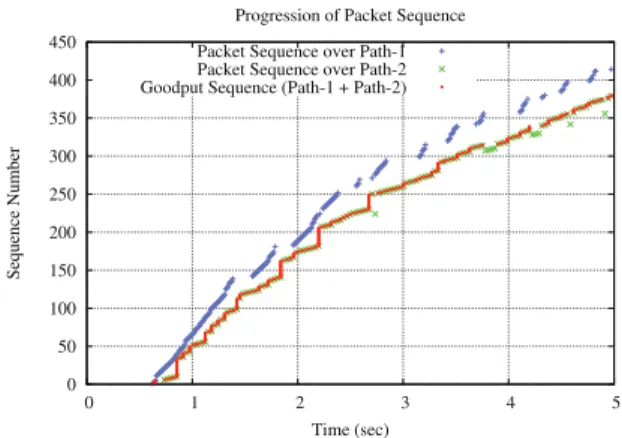
the problem, we present the NS-2 [14] simulation results for
CMT-SCTP with round-robin scheduling in Figures 1 and2.
The parameters chosen for this simulation were the same as
in TableI.
Figure1presents the packet sequence progression in time1
As can be seen, although we receive packets over bothP ath1
and P ath2, the application-received packets are controlled
by the worse bandwidth-delay path, due to the buffer-and-release nature introduced as a consequence of round-robin
scheduling. Figure 2depicts the throughput evolution in time
(throughput is averaged over 1 second intervals), for each path
0 50 100 150 200 250 300 350 400 450 0 1 2 3 4 5 Sequence Number Time (sec) Progression of Packet Sequence Packet Sequence over Path-1 Packet Sequence over Path-2 Goodput Sequence (Path-1 + Path-2)
Figure 1. Impact of receiver’s buffer blocking on application received packets
0 200 400 600 800 1000 1200 1400 0 10 20 30 40 50 60 Kbits/sec Time (sec)
Throughput over Path-1 Throughput over Path-2 Overall Goodput
Figure 2. Impact of receiver’s buffer blocking on the overall aggregated
goodput
and aggregated, i.e. presented to the application. Similarly, the reduced performance of the multi-path transport protocol can evidently be observed from the figure, as the transport protocol utilizes only a part of the available total capacity.
We should note that it is possible to get around buffer blocking by providing a large enough buffer. For the given
scenario in Table I, we will at least need a buffer with size
equal to the combined delay product with respect to the highest
RT T of the corresponding paths, as shown in Equation2, to
avoid blocking. Rbufmin= X i∈{P1,P2,...Pn} Bi× max j∈{P1,P2,...Pn} (RT Tj) (2)
From Equation 2, a given receiver’s buffer size of 50KB
would have sufficed for the illustrated scenario in Table I.
But this would not be a scalable and optimum solution as
Rbufmin easily becomes more demanding if we consider a
slightly different scenario of two paths with 10M bit/s and
1M bit/s bandwidth and 20ms and 200ms RTT respectively,
where the required minimum buffer size would be275KB to
avoid blocking. The required minimum buffer size will be even higher if we consider lossy scenarios where lost or delayed packets will frequently need to be retransmitted. Therefore, to
avoid these existing problems with round-robin scheduling, we
propose delay-aware scheduling in Section II-B.
B. Delay Aware Scheduling
To mitigate the problems associated with the path unaware round-robin packet scheduling, in this section we propose a delay aware packet scheduling which carefully selects packet sequences to be transmitted over each path. The main idea behind delay aware packet scheduling is not to transmit mono-tonically increasing packet sequences in a multipath transfer, but to carefully choose and then emit packets based on the delay of the associated paths to receive packets in order.
First, we define Pi ∈ {P1, P2, . . . Pn} as the set of
the paths associated in a multipath transmission and Di ∈
{D1, D2, . . . Dn} are the respective forward delays of the
paths. We assume that the set of the paths is sorted in ascending order based on their forward delays. The packet emission
capacity of eachPi is given by Ci∈ {C1, C2, . . . Cn} which
could be estimated from instantaneous congestion window of each path.
Then we obtain the ideal number of packets Ki that
can be transmitted on the path Pi within lcm2(Di ∈
{D1, D2, . . . Dn}) time using Equation3. In an ideal scenario,
the time duration lcm(Di ∈ {D1, D2, . . . Dn}) ensures that
having started at time instant 0, the scheduler will be back to
the same state after lcm(Di ∈ {D1, D2, . . . Dn}) amount of
time.
Ki= lcm (Dj∈ {D1, D2, ..., Dn}) ×
Ci
Di
(3)
Thus the ideal number of packets N sent on all the paths
during the time lcm (Dj∈ {D1, D2, ..., Dn}) is given by
Equation4. N = X i∈{1,2,...,n} lcm (Dj∈ {D1, D2, ..., Dn}) × Ci Di (4)
Our goal now is to transmit this N packets in such
an order over the available paths that they would occupy the least amount of space in the receiver’s buffer. To
in-fer in order packet reception, we create the vector Oi ∈
{O1, O2, ..., OP
i∈{1,2,...,n}lcm(Di)Di } that contains the ideal
or-der of the paths in which the transmitted packets should be
received. Calculation ofOi is shown in Algorithm1.
In order to prove our hypothesis, we considering a deter-ministic scenario where the delays of the paths do not change
during the transmission of theseN packets.
Using Algorithm1, we can derive the vectorO of expected
reception order of N packets denoting the paths over which
they will continue to be transmitted during the nextlcm(Di∈
{D1, D2, ..., Dn}) duration of time as shown in (5). Now, from
each path Pi with corresponding path capacity Ci and using
the order in the vectorO, we generate another vector SEQPi
Algorithm 1 Expected Order of Data Reception in Delay Aware Scheduling j ← 0 t ← 1 whilet ≤ lcm(Di∈ {D1, D2, ..., Dn}) do for each Pi∈ {P1, P2, ..., Pn} do ift ≡ 0 (mod Di) then O[j] ← Pi j ← j + 1 end if end for t ← t + 1 end while
for each pathPiwhich describes the packet sequence numbers
that can be transmitted at every attempt of the scheduler to emit
over the particular path. The method to derive SEQPi from
O is shown in Algorithm2.
Algorithm 2 Deriving Packet Sequence Numbers to Transmit Per Path Using Expected Reception Order
Smax← 0
for each Pi∈ {P1, P 2, ..., Pn} do
SEQPi← IntializeV ector()
end for
for each Pi∈ {O1, O2, ..., OP
i∈{1,2,...,n}lcm(Di)Di } do
SEQPi← Append (SEQPi, [Smax+ 1, Smax+ Ci])
Smax← Smax+ Ci
end for
Then we can easily schedule the next sequence of packets
using Algorithm3.
Reception T ime Over P1 Over P2
T10ms O(1) = P1 − T20ms O(2) = P1 − T30ms O(3) = P1 − T40ms O(4) = P1 − T50ms O(5) = P1 − T60ms O(6) = P1 − T70ms O(7) = P1 − T80ms O(8) = P1 − T90ms O(9) = P1 − T100ms O(10) = P1 O(11) = P2 (5)
With the same multipath scenario and path parameters
used in Table I, we present another illustration of packet
transmission using the delay aware scheduling in Table II.
First we derive N = 25 for this scenario using Equation
4. Algorithm 1 and 2 yield that packets [1 . . . 20] should be
transmitted over P1 while packets [21 . . . 25] should go over
P2. As can be seen in Table II, since the packets sequences
are carefully selected based on per path delay and emitted over the appropriate paths, the receiver’s buffer is never blocked in
Algorithm 3 Transmission Based on Pre-calculated Sequence t ← 0 whilet < lcm(Di∈ {D1, D2, ..., Dn}) do for eachPi∈ {P1, P2, ..., Pn} do ift ≡ 0 (mod Di) then T ransmit(Pi, SEQPi[ t Di]) end if end for t ← t + 1 end while Xmit Time (ms) Xmit over P1 Xmit over P2 Rcvd. Time (ms) Rcvd. over P1 Rcvd. over P2 Good-put Pkts in Rbuf 0 1 − 2 21 − 25 10 1 − 2 none 1−2 0 10 3 − 4 none 20 3 − 4 none 3−4 0 20 5 − 6 none 30 5 − 6 none 5−6 0 30 7 − 8 none 40 7 − 8 none 7−8 0 . . . . 90 19 − 20 none 100 19 − 20 21 − 25 19 − 25 0 Table II
DELAYAWAREPACKETSCHEDULING
this non-oscillating deterministic scenario. In fact the buffer is always empty due to the proper in order arrival of the packets. C. Estimating Forward Delay for Delay Aware Scheduling
In order to accurately estimate forward delay in CMT-SCTP, we propose a timestamp based method similar to the mechanism used for the RTT estimation in Datagram
Con-gestion Control Protocol (DCCP) [15]. Although CMT-SCTP
maintains its own estimation of RTT, in our previous work we have shown that RTT estimation in CMT-SCTP is severely
degraded in presence of asymmetric transmission paths [5].
An accurate RTT estimation can easily be made without making significant modifications in the CMT-SCTP protocol. Our proposal to estimate RTT correctly includes adding some additional fields in the SCTP packet header namely
sender-timestamp (Ts) for data packets and receiver-timestamp (Tr)
and time-elapsed (Te) for SACK packets. An illustration of
how the delay calculation may be performed using these
timestamp fields is shown in Figure3.
As shown in Figure 3, data packet pi is sent with
sender-timestampTs1. It is received by the receiver and acknowledged
at timeTr. If it takesTeamount of time for the receiver before
sending the selective acknowledgement for data packetpi, we
can estimate the forward delayDf wd as shown in Equation6
after having received theSACKpi.
Df wd= Tr− Te− Ts1 (6)
In the following section, we evaluate the improvements resulting from our proposal, by comparison with the baseline performance of the multipath protocol using round robin scheduling.
Ts1 Datapi
Sackpi Te
Ts2
Tr
Figure 3. Timestamp based forward delay estimation
Figure 4. Simulation topology
III. EXPERIMENTALEVALUATION
To check the validity of our proposal from Section II, we
have implemented both the round-robin scheduling and delay-aware scheduling for multipath data transfer in GNU’s Matlab
equivalent Octave tool [13]. The round robin scheduling
im-plementation was also cross-checked with simulation results
from NS-2 [14].
The network topology used during the simulations was as
shown in Figure4. The path parameters are as per the example
presented in Table I, with path P1 having RT T1 = 20ms
and B1 = 1.6M bit/s; path P2 with RT T2 = 200ms and
B2= 400Kbit/s.
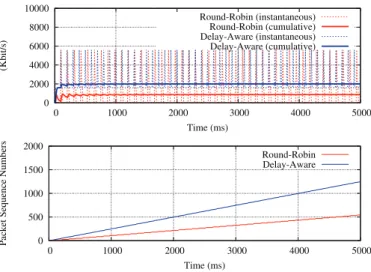
In Figure 5, we present a snapshot of the simulation
0 2000 4000 6000 8000 10000 0 1000 2000 3000 4000 5000
Overall Application Goodput
(Kbit/s) Time (ms) Round-Robin (instantaneous) Round-Robin (cumulative) Delay-Aware (instantaneous) Delay-Aware (cumulative) 0 500 1000 1500 2000 0 1000 2000 3000 4000 5000
Cumulative Application Receiverd
Packet Sequence Numbers
Time (ms)
Round-Robin Delay-Aware
Figure 5. Comparison of round-robin and delay-aware scheduling
0 1 2 3 4 5 0 1000 2000 3000 4000 5000 Buffer Occupancy (Packets) Time (ms) Round-Robin Delay-Aware 0 2 4 6 8 10 12 14 0 500 1000 1500 2000 2500 3000 3500 4000 4500 5000
Unacknowledged on the Flight
Packets
Time (ms)
Round-Robin Delay-Aware
Figure 6. Comparison of receiver’s buffer occupancy and unacknowldeged
on the flight packets for round-robin and delay-aware scheduling
performed with the same parameters presented in Table Iand
II. We show cumulative packet sequence numbers received
by the application and the application goodput resulting from aggregated data transfer on both paths. As can be seen, the performance of delay-aware scheduling is clearly much better than the round-robin scheduling both in terms of overall good-put and minimization of jitter experienced by the application.
In Figure 6, we present a comparison of the receiver’s
buffer usage and unacknowledged data packets on the flight. As can be observed, the delay aware scheduling clearly results in lower occupancy of the receiver’s buffer, while also emitting more data packets which eventually leads to higher application goodput.
A. Impact of Incorrect Delay Estimation on Delay Aware Scheduling
We now present practical considerations related to the performance of our proposed scheme. The results presented
in Figures5 and6 assume perfect estimation of the delay on
both paths. We now present results for the case where there is
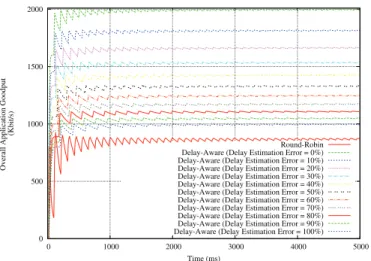
0 500 1000 1500 2000 0 1000 2000 3000 4000 5000
Overall Application Goodput
(Kbit/s)
Time (ms)
Round-Robin Delay-Aware (Delay Estimation Error = 0%) Delay-Aware (Delay Estimation Error = 10%) Delay-Aware (Delay Estimation Error = 20%) Delay-Aware (Delay Estimation Error = 30%) Delay-Aware (Delay Estimation Error = 40%) Delay-Aware (Delay Estimation Error = 50%) Delay-Aware (Delay Estimation Error = 60%) Delay-Aware (Delay Estimation Error = 70%) Delay-Aware (Delay Estimation Error = 80%) Delay-Aware (Delay Estimation Error = 90%) Delay-Aware (Delay Estimation Error = 100%)
Figure 7. Impact of Incorrect Delay Estimation on Delay Aware Scheduling:
Comparison of the overall application goodput
0 200 400 600 800 1000 1200 0 1000 2000 3000 4000 5000
Cumulative Application Receiverd
Packet Sequence Numbers
Time (ms) Round-Robin Delay-Aware (Delay Estimation Error = 0%) Delay-Aware (Delay Estimation Error = 10%) Delay-Aware (Delay Estimation Error = 20%) Delay-Aware (Delay Estimation Error = 30%) Delay-Aware (Delay Estimation Error = 40%) Delay-Aware (Delay Estimation Error = 50%) Delay-Aware (Delay Estimation Error = 60%) Delay-Aware (Delay Estimation Error = 70%) Delay-Aware (Delay Estimation Error = 80%) Delay-Aware (Delay Estimation Error = 90%) Delay-Aware (Delay Estimation Error = 100%)
Figure 8. Impact of Incorrect Delay Estimation on Delay Aware Scheduling: Comparison
Figure7shows the goodput available to the application from
the total data transfer on both paths. Baseline results are shown for the round-robin scheduling (bottom curve), the delay aware scheduling where there is no error in the delay estimation on both paths (top curve), and for the error in the delay over-estimation ranging from 10% to 100%. It can be observed that there is a solid gain by the delay aware scheduling mechanism, even for the case when there is a 100% error (twice the original delay) in the delay estimation.
Figure8 presents the cumulative packet sequence numbers
received by the application, for the first 5 seconds of the data transfer. Again, the bottom curve represents the result for the round-robin scheduling, and the top curve the delay aware scheduling where there is no error in the delay estimation on both paths. The middle curves represent results for the error in the delay estimation which is varied between 10% and 100%. Similarly to the application goodput results, it can be seen that a considerable error in estimating the delay on both path cannn be tolerated by the delay aware scheduling mechanism, while
still providing an improvement compared to the round robin scheduling.
We note that the results for the occupancy of the receiver’s buffer are omitted for the case of imperfect delay estimation, as they would show a similar trend as the comparison shown in
Figures7and8, i.e. that even a considerable error in the delay
estimation by the transport protocol, used in the delay aware scheduling, still results in a solid improvement compared to the round robin schduling mechanism.
IV. CONCLUSION ANDFUTUREWORK
Our current evaluation indicates that the delay-aware scheduling has significant potential for providing performance improvement over the traditional round-robin scheduling in asymmetric multipath scenarios. As future work, we plan to implement our proposal first in NS-2 and later in FreeBSD’s CMT-SCTP stack to evaluate the performance gain in realistic network conditions and address the related practical issues.
V. ACKNOWLEDGMENT
This research work has been supported by funding from National ICT Australia (NICTA). NICTA is a research orga-nization funded by Australian Government research initiatives through Australian Research Council (ARC).
REFERENCES
[1] R. Stewart, Ed., RFC 4960 - Stream Control Transmission Protocol, 2007.
[2] IETF MPTCP Working Group, http://datatracker.ietf.org/wg/mptcp/
charter/
[3] Iyengar et al, Concurrent Multipath Transfer Using SCTP Multihoming Over Independent End-to-End Paths, IEEE/ACM Transactions on Net-working, 2006.
[4] Adhari, H., Dreibholz, T., Becke, M., Rathgeb, E., and M. Tuexen, Evaluation of Concurrent Multipath Transfer over Dissimilar Paths, IEEE AINA PAMS, 2011.
[5] Golam Sarwar, Roksana Boreli, Emmanuel Lochin and Ahlem Mifdaour, Performance Evaluation of Multipath Transport Protocol in Heterogeneous Network Environments, IEEE International Symposium on Communica-tions and Information Technologies (ISCIT), 2012.
[6] Costin Raiciu, Christoph Paasch, Sebastien Barre, Alan Ford, Michio Honda, Fabien Duchene, Olivier Bonaventure and Mark Handley, How Hard Can It Be? Designing and Implementing a Deployable Multipath TCP, USENIX NSDI, 2012.
[7] Lin Cuia, Xin Cuib, Jingji Jina, Seok J. Kohc, Woo J. Lee, Countermea-sures to Impacts of Bandwidth and Receiving Buffer on CMT Schemes, Procedia Engineering, Volume 15, 2011, Pages 3723-3727, ISSN 1877-7058.
[8] Janardhan R. Iyengar, Paul D. Amer, Randall Stewart, Performance Im-plications of a Bounded Receive Buffer In Concurrent Multipath Transfer, Computer Communications 30(4), 2007.
[9] Janardhan R. Iyengar, Paul D. Amer, Randall Stewart, Retransmission Policies For concurrent Multipath Transfer Using sctp Multihoming, ICON 2004.
[10] Jiemin Liu, Hongxing Zou, Jingxin Dou, Yuan Gao, Rethinking Retrans-mission Policy In Concurrent Multipath Transfer, International Conference on Intelligent Information Hiding and Multimedia Signal Processing, 2008.
[11] C. Casetti and W. Gaiotto, Westwood SCTP: load balancing over multipaths using bandwidth-aware source scheduling, IEEE VTC Fall, 2004.
[12] Yuansong Qiao, Enda Fallon, John Murphy, Liam Murphy, Austin Hanley, Path Selection of SCTP Fast Retransmission in Multi-homed Wireless Environments, MWCN/PWC 2008.
[13] GNU Octave, http://www.gnu.org/software/octave/
[14] The Network Simulator - NS-2, http://www.isi.edu/nsnam/ns/ [15] E. Kohler, M. Handley, S. Floyd, Datagram Congestion Control Protocol