Interventions pédagogiques pour diminuer le niveau d’appréhension en entrevues en formation technique au Cégep
Pedagogical Interventions to Overcome Communication Apprehension in Employment Interviews among Career Students
par
Paule Gaudet
Essai présenté à la Faculté d’éducation En vue de l’obtention du grade de
Maître en éducation (M. Éd.) Maîtrise en enseignement au collégial
Décembre 2009 ©Paule Gaudet, 2009
Faculté d’éducation
Maîtrise en enseignement au collégial
Interventions pédagogiques pour diminuer le niveau d’appréhension en entrevues en formation technique au Cégep
Pedagogical Interventions to Overcome Communication Apprehension in Employment Interviews among Career Students
par
Paule Gaudet
a été évalué par un jury composé des personnes suivantes:
Yvon Geoffroy Directeur de l’essai
Career programs in the Cegep system base their training on various learning activities, which are followed by a practicum. The objective is to achieve a certain number of competencies, deemed necessary by the Ministry of Education, for entry-level occupations in to the workforce. The Graphic Communications program offered at Champlain College Saint-Lambert is a three-year career program that leads to employment in the field of graphics. Many students have part-time jobs during their schooling period but most of those jobs do not relate to their field of study. Several graduates stated they were unable to persuade employers to hire them for an externship or stage at the end of their program. While jobs are important for their general skills, since they are not directly related to the field, these jobs may not have given the students a suitable model for the conduct of an employment interview. Practice interviews may be one of many successful training methods to lower communication apprehension (CA) levels. CA is defined as “an individual's level of fear or anxiety associated with either real or anticipated communication with another person or persons.”
This paper examines the literature on CA and employment interviews and evaluates whether pedagogical interventions, including monitored phone calls to employers and practice-videotaped interviews, allow students to feel more confident about interviewing for a future job. A qualitative tool was used to gather scientific measurements of the participants’ levels of CA both at the beginning and at the end of the Career Planning course. Open-ended reflective journals gathered quantitative data on the impact specific instructional strategies had on the participants.
The pedagogical interventions that were examined and tested were as follows: preparation of scripts, monitored phone calls, videotaped practice interviews, and in-class access to professional assistance. Results indicate that all
activities. Overall, participants who responded to the reflective journal questions felt positive about the contribution of this preparatory career course to their CA levels. The results of the quantitative tool were consistent with previous research and the analysis of the reflective journals gave additional support to the usefulness of the interventions on students’ confidence levels.
Recommendations for improvements to the curriculum include the need for students to be taught formally about metacognition and how to monitor it. Students need to be exposed to videotaped interviews more often. They should be better prepared for unexpected interview questions, and they should experience formal rehearsals with one of their instructors before the actual practice interview. Some of these recommendations have already been successfully implemented in the program’s curriculum.
Le but de ce travail était de vérifier si certaines activités pédagogiques sont efficaces pour faire baisser le niveau d’anxiété lié à la communication orale lors de leurs entrevues d’embauche. L’objectif des programmes techniques au Québec est de fournir aux étudiants un certain nombre de compétences définies par le ministère de l’Éducation, des Loisirs et du Sport afin que ces derniers puissent fournir des services de techniciens spécialisés aux entreprises. Le programme nommé Office Systems Technology (412) du collège Champlain de Saint-Lambert, a choisi la voie de la spécialisation en microédition et hypermédia en 1999 et a changé son nom pour Graphic Communications en 2005. Les programmes techniques au Cégep incluent un stage en milieu de travail à la fin d’un programme de trois ans et par le fait même, une entrevue pour obtenir un stage en entreprise.
La compétence visée par cette étude est l’intégration au marché du travail et le cheminement professionnel des étudiants. Lors d’enquêtes informelles, plusieurs étudiants du programme ont fait part de leurs difficultés à trouver un stage en fin d’études. Certains auteurs suggèrent que ces étudiants n’ont pas de modèles appropriés lors de la tenue d’une entrevue d’emploi. Ils proposent de diminuer le niveau d’anxiété lié à la communication orale lors d’entrevues d’embauche en offrant des pratiques d’entrevue aux étudiants.
Cette recherche a examiné la littérature au sujet de l’anxiété de communication, plus précisément lors d’entrevues. Elle avait pour mandat d’évaluer si les activités pédagogiques d’un cours de préparation à la carrière ont été efficaces pour faire baisser les taux d’anxiété en communication orale lors d’entrevues. En plus, une conseillère à l’emploi fut invitée à plusieurs reprises afin de fournir un support professionnel en classe, étant donné que les étudiants ne prennent pas nécessairement le temps de consulter des professionnels en raison de leurs activités personnelles trop nombreuses.
Le type d’enseignement évalué est considéré comme stratégique, étant donné qu’il agit au niveau cognitif et métacognitif de l’étudiant. Le cours de préparation à l’emploi débute par la vérification des acquis antérieurs des étudiants et il tient compte de leur motivation scolaire et professionnelle. De plus, il est axé sur la construction du savoir en proposant des activités de plus en plus complexes, débutant par la rédaction de textes à utiliser lors d’appels aux employeurs, en passant par la préparation et la pratique d’appels et se terminant par des entrevues d’emploi qui serviront de modèle à perfectionner par chaque étudiant. Ces entrevues se font avec des employeurs qui ont déjà embauché des étudiants du programme de Graphic Communications au collège Champlain de Saint-Lambert et sont enregistrées sur bande vidéo afin de permettre une visualisation ultérieure et cohérente avec les objectifs visés.
d’appréhension en communication des étudiants au début et à la fin du cours de préparation à l’emploi. Cet outil est la fusion de deux outils, le Personal Report
of Communication Apprehension ou PRCA-24, qui fut développé par McCroskey
(1984), en tandem avec celui de Wongprasert & Ayres (2000), qui lui met l’accent sur les entrevues d’emploi. Les réponses à cet outil combiné sont évaluées sur une échelle Likert de cinq points. L’outil qualitatif est une série de questions auxquelles les étudiants ont répondu quatre fois lors de la session. Les réponses à ces questions ont été analysées et les commentaires des étudiants évalués. Il découle de cette analyse que les niveaux d’anxiété des étudiants qui ont participé (14) étaient définitivement à la baisse en fin de cours.
La pratique téléphonique structurée, dans un laboratoire avec les téléphones, a été très révélatrice pour les étudiants. Ils ont appris comment utiliser un script comme piste de départ pour un appel et qu’il était possible de contourner certains obstacles de façon professionnelle. Ensuite, lors d’une visite d’une compagnie de graphisme, ils ont pu observer divers modèles d’emploi. Ils ont eu la possibilité de poser des questions sur le fonctionnement et les besoins de l’entreprise. Ceci facilita la rédaction de leur curriculum vitae en leur permettant de mieux décrire leurs acquis en fonction d’emplois recherchés. Par la suite, ils se sont préparés pour une pratique d’entrevue, filmée. Les interviewers avaient déjà travaillé avec le collège et avaient déjà embauché certains étudiants de ce programme, donc ils connaissaient leur potentiel. Une liste de questions possibles fut suggérée mais il n’en restait pas moins que les interviewers pouvaient les modifier, ceci étant représentatif du marché de l’emploi. Même si le collège fournit un enseignement en anglais, un des intervieweurs donna ses entrevues en français. Trois étudiants se sont portés volontaires, mais deux ont constaté qu’ils auraient dû pratiquer leur script en français avant l’entrevue pour mieux diminuer leur niveau d’anxiété. Finalement, les étudiants durent visionner leur segment d’entrevue : ceci leur a permis de voir si leur attitude non-verbale concordait avec ce qu’ils ressentaient en entrevue et d’emmener les correctifs appropriés. Les taux d’anxiété furent vérifiés une deuxième fois en fin de session et les résultats ont démontré une baisse des taux d’appréhension.
Les résultats de cette étude concordent donc avec ceux trouvés dans la littérature et donnent de bonnes pistes pour l’amélioration de ce cours de préparation à la carrière. L’auteur recommande d’enseigner la métacognition de façon formelle et ainsi de faciliter la prise de conscience des apprentissages que les étudiants effectuent. De plus, les étudiants devraient être filmés en studio au moins une fois par année pour diminuer le facteur de stress causé par les caméras et finalement ils pourraient certainement bénéficier de pratiques formelles d’entrevue avec un instructeur avant l’entrevue filmée. L’augmentation des pratiques a déjà été mise en œuvre dans le programme et des résultats positifs se sont ensuivis.
TABLE OF CONTENTS
LIST OF TABLES ... 9
LIST OF FIGURES ... 9
INTRODUCTION... 11
CHAPTER ONE: STATEMENT OF THE PROBLEM... 12
1. THE SCHOLARSHIP OF TEACHING... 16
CHAPTER 2: LITERATURE REVIEW ... 17
2. COMMUNICATION APPREHENSION... 17 2.1. Cultural background... 18 2.2. Academic achievement ... 18 2.3. Social desirability... 19 2.4. Student success ... 19 2.5. Motivation... 20 2.6. Strategies: Dangers ... 21
2.7. Strategies: Performance Visualization... 21
3. THEORETICAL FRAMEWORK... 22
CHAPTER 3: METHODOLOGY ... 25
1. SAMPLE... 25
2. ETHICS COMMITTEE... 26
3. INSTRUMENTS OF DATA COLLECTION... 27
3.1. PRCA/EI ... 27
3.2. Journals ... 28
4. CURRICULUM -INSTRUCTIONAL STRATEGIES... 29
4.1. Self-Assessment... 30
4.2. Informational Interview ... 30
4.3. The Videotaped Interview... 33
CHAPTER 4: PRESENTATION OF FINDINGS ... 36
1. QUANTITATIVE DATA – PRCA/EI ... 36
2.1. Self-perception – levels of CA at the beginning of the course ... 41
2.2. Informational interview – Phone Calls ... 49
2.3. Practice interviews ... 51
2.4. Stage request – Phone Calls... 53
2.5. Self perception – Levels of CA at the end of the course ... 54
CHAPTER 5: DISCUSSION ... 58
CHAPTER 6: CONCLUSION ... 66
BIBLIOGRAPHICAL REFERENCES ... 69
APPENDIX A -EXPLANATORY STATEMENT... 71
APPENDIX B - INFORMED CONSENT FORM... 73
APPENDIX C - APPROVALTO CONDUCT RESEARCH... 75
APPENDIX D - PRCA24 ... 77
APPENDIX E - PRCA/EI... 81
APPENDIX F - JOURNAL QUESTIONS... 83
LIST OF TABLES
TABLE 1: Timeline, Career Preparation Fall 2007 ... 29 TABLE 2: PRCA/EI Results... 37
LIST OF FIGURES
FIGURE 1: Comparison of Pre and Post Means... 38
FIGURE 2: Group Discussion Sub-scale... 38
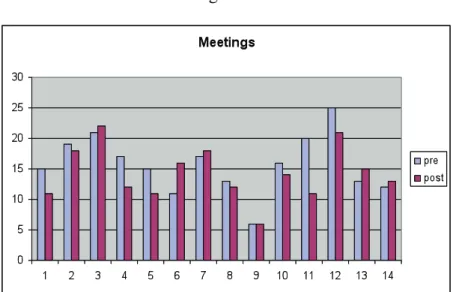
FIGURE 3: Meetings Sub-scale... 39
FIGURE 4: Interpersonal Sub-scale... 39
FIGURE 5: Public Speaking Sub-scale... 40
INTRODUCTION
The Graphic Communications program offered at Champlain College Saint-Lambert is a three-year career program that leads to employment in the field of graphics. Several past graduates stated they were unable to persuade employers to hire them for a stage or non-paid period of training. Although many students have part-time jobs during their schooling period, most of those jobs do not relate to their field of study and the interviews they have experienced may not have given them a suitable interview model. Wongprasert & Ayres (2000, p 13) suggest that the students “lack an appropriate model for the conduct of an employment interview.” The authors consider that practice interviews may be one of many successful training methods to lower communication apprehension (CA) levels.
This paper examines the literature on CA and employment interviews and evaluates whether a pedagogical intervention composed of specific instructional strategies, including monitored phone calls to employers and practice-videotaped interviews, reduces levels of CA, allowing students to feel more confident about interviewing for a future job. Recommendations for improvements of the curriculum, as well as further studies, are presented in the conclusion.
CHAPTER ONE
STATEMENT OF THE PROBLEM
The curriculum for career programs in the CEGEP (Collège d’enseignement général et professionnel) system in Québec is based on various learning activities followed by practice, with the goal of achieving competencies deemed necessary by the Ministère de l’Éducation du Loisir et du Sport (MELS) for entry level jobs in the workforce. These competencies are based on the knowledge and expertise associated with given occupations. In addition to the acquisition of competencies, students in technical programs in the CEGEP system must complete externships or stages to graduate. These stages can vary in structure and length and serve as a form of apprenticeship or on-the-job training.
At Champlain Saint-Lambert, the 412 Office Systems Technology program was officially revised by MELS (then the MEQ or Ministry of Education of Québec) in 1999. At the time, the colleges that were offering the 412 program felt it was not reflective of the realities of the workforce (Evaluation Report, May 2009, p. 6). With the advent of digital printing, desktop publishing does not rely on traditional file preparation anymore and competencies like changing typewriter ribbon no longer apply. Therefore, the 412 department’s faculty, together with members of the college’s administration and with the help of an Advisory Board composed of industry leaders and education professionals, made the program more in sync with the needs of a rapidly changing industry. Consequently, new technologies and Web instruction was added to the program in 1999.
In response to students, graduates, and externship employer’s feedback, the three-year career program underwent another major reassessment in 2005. Also at this time, the name changed to Graphic Communications. This change was considered an important marketing strategy to improve the perception of
both potential students and employers and ensure the survival of this program, as there had been low enrolment a few years in a row.
The Graphic Communications program offered at Champlain College Saint-Lambert leads to employment in the field of graphics. This program focuses on print design, web site interface design, and multimedia presentation design. Graduates of this program work in technology related jobs such as production artists, desktop publishers, and print technicians. Some graduates also continue their studies in university programs leading to careers in advertizing, communications, and graphic design. The courses in Graphic Communications are sequenced over three years and integrate theoretical with practical knowledge. They begin with basic technical skills and evolve into the acquisition of more complex, in-depth abilities in the third year. The sequencing and content of these courses are constantly being reviewed by the teachers of the program and reassessments are done every year according to student and employer feedback in order to ensure the acquisition of the competencies provided by the MELS. In the last year of this three-year program, students focus on career preparation skills such as running a graphic communication business and applying for employment in the industry. They also prepare for an externship or stage.
In the Graphic Communications program at Champlain Saint-Lambert, the stage is now established at eight weeks in length at the end of the three-year program. Usually, students are expected to find their own stages and in order to better prepare them, a Career Planning course is offered in the fifth semester. This course is 75 hours in length, which translates into 5 hours a week over 15 weeks. The course description, as presented in the Champlain Saint-Lambert Academic Calendar, is as follows:
This course provides students with the necessary job and career management tools they need to reach their full career potential. Self-assessment exercises, company research, networking, job
search strategies, letters of application, resumes, videotaped professional interviews, and follow-up techniques will ensure students have the knowledge, the skills, and the strengths to begin their professional career. ( Champlain St-Lambert (Collège), Calendar 2007, p. 104)
In order to be accepted in a stage, interviews are necessary, a requirement which often creates high levels of CA (McCroskey, 1976) in students. McCroskey defines CA as “an individual's level of fear or anxiety associated with either real or anticipated communication with another person or persons” (p. 39). The problem is not within the classroom where students know and trust their teachers and peers, but outside the classroom where they have to “sell” their skills to strangers who have no emotional connection to them.
Since 1999, the graduates of this program are followed closely and it was found that some graduates have had difficulties in finding employment after graduation. When polled informally, by email, for the reasons of such difficulties, several mentioned they feared rejection because they thought they did not have the necessary skills while others responded they simply could not obtain interviews for positions in their field. They reported that they called very few companies and when they did call, they were often told by the receptionist that no jobs were available. In one case, a student, who graduated with honours from the program, was still working, a full year later, as a sales clerk for the retail outlet she had worked for prior to graduation (Evaluation Report, May 2009, p. 16). Communication apprehension seems to be a major factor preventing these graduates from actively seeking interviews.
This project examines whether a pedagogical intervention composed of specific instructional strategies, including monitored phone calls to employers and practice-videotaped interviews, would reduce levels of CA, allowing students to feel more confident about interviewing for a future job.
Typically, these students are from 19 to 22 years of age and have just spent at least fourteen or more years of their life in school. Although several have part-time jobs during their schooling period, most of those jobs do not relate to their field of study and the interviews they have experienced may not have given them an appropriate interview model. Students are strongly encouraged to find placement on their own to further strengthen their skill set but, if necessary, the teacher in charge of externship will place the students who cannot find a stage by themselves. The department has a bank of potential companies that have accepted such students in the past. The negative side of such placement is that these students, not having successfully found placement on their own, experience difficulties in finding employment upon graduation. These difficulties often have repercussions on the student’s self-esteem as they then doubt their ability to find work in their chosen field. The department has observed that some of these students will continue working in unrelated jobs in which they have acquired experience during their school years because high levels of CA undermine their confidence.
Wongprasert & Ayres (2000, p 13) suggest that the students “lack an appropriate model for the conduct of an employment interview.” The authors consider that practice interviews may be one of many successful training methods to lower CA levels.
In order to provide such a framework for employment interviews, the fifth semester Career Planning course was taught in a modular format, as each section of the course builds upon the last one; this is also known as curricular scaffolding. Students were given time to prepare and rehearse making phone calls and having practice interviews. This educational approach was meant to provide a model such as the one suggested by Wongprasert & Ayres (2000) and to facilitate the transfer of the student’s skills to the specialized industry requirements (Driscoll, 2000).
1. THE SCHOLARSHIP OF TEACHING
This research fits within the context of the scholarship of teaching and learning at the college level since the content matter was not the only important factor in this project. Instructional strategies took into consideration the cognitive and affective processes and aptitudes of the learner (Wittrock, 1978). These strategies were monitored, documented, and reflected upon by both the researcher and the students, and their feedback was analysed and used to understand the impact these instructional approaches had on the students’ levels of CA. The Graphic Communications Department is committed to providing a pedagogical approach to learning and teaching by revising, every year, the sequencing of the courses, and the materials presented in each course as improvement of the curriculum enhances the chances of promoting student success. Conclusions from this research will provide useful information to all career programs that include a stage at the end of their career program, and it will allow future reassessments of the Graphic Communications curriculum to be evidence-based.
This inquiry of a specific pedagogical approach within a framework of scientific research in education is part of the scholarship of teaching. This research project examines if participants who are exposed to classroom interventions in the Career Preparation course will, at the end of the semester, have lower levels of communication apprehension about employment interviews compared to their levels at the beginning of the semester. Furthermore, results of this study will be made public, allowing for peer review of these pedagogical and instructional strategies.
The following chapter will summarize previous findings in the literature on CA and other factors such as student success and employment interviews.
CHAPTER 2 LITERATURE REVIEW
The review of the literature on communication apprehension is pertinent to an understanding of the problem, its various dimensions, its variables and their operationalization and, to an analysis of the problem. It also casts light on possible causes and on methods to measure and overcome CA. Major databases, such as ERIC, EBSCO Host, Inforoute (MELS) and the Centre de Documentation collégiale where Parea documents are available, were consulted for literature on CA and for instructional strategies to counter CA in employment interview situations. The scholarly journals, articles and reports consulted and retained are summarized in this chapter.
CA is considered a causal factor in student success and specifically in employment interviews (Wongprasert & Ayres, 2000). Extensive educational research has been done over the last half century showing relationships between communication apprehension and other factors. The factors that were examined in this study were personality traits (McCroskey, 1983), academic performance (Butler, Prior & Marti, 2004), cultural variance (Pryor, Butler & Boehringer, 2005), social desirability (Chen, 1993), student success (Everett, 1999; Webb 2006) and coping mechanisms (Kuo, Hagie and Miller, 2004), among others.
2. COMMUNICATION APPREHENSION
Students with high CA levels do poorly in employment interviews because of their fear of communicating (Ayres & Crosby, 1995 as cited in Buxton, 1997). They search for employment that requires less communication (Daly & al., 1979, as cited in Wongprasert & Ayres, 2000) and are less likely to obtain the jobs they seek. They focus on negative thoughts (Ayres & al., 1998, as cited in Buxton, 1997) and since they believe they have less chance of success,
they spend less time preparing for interviews (Daly & al. 1979, as cited in Wongprasert & al, 2000).
2.1. Cultural background
Students who were participants in this study are from different cultural backgrounds, cultural factors must be considered as well. Pryor, Butler & Boehringer (2005) compared communication apprehension levels between American and Japanese participants. An instrument called the Personal Report of Communication Apprehension (PRCA-24), a leading self-report tool to measure CA created by McCroskey (1982), was translated into Japanese and administered to 200 undergraduates at three Japanese universities. The English version of the PRCA-24 was administered to 122 undergraduates at a large university in Florida. The results showed significantly higher levels of CA in the Japanese sample and were discussed with reference to cultural implications. Numerous characteristics seem to be common to specific cultural groups. For example, the Japanese tend to value group harmony over individual assertiveness.
2.2. Academic achievement
Some students afflicted with CA often seek the highest possible academic achievement. Butler, Prior & Marti (2004) studied whether there was a difference in CA levels between honours and non-honours students. The authors studied whether communication apprehension would correlate with high academic achievement. The PRCA-24 was used on a sample of 134 students from both achievement categories enrolled in public speaking courses. These authors confirmed that honours students have a significantly higher level of CA than the non-honours ones.
2.3. Social desirability
Social desirability, a tendency to be perceived by others in a better light, is also a factor that influences CA (Chen, 1993, p. 435). Chen found that when social desirability is considered an independent variable as a personality trait or “an indicator of a characteristic reaction pattern of an individual in certain situations” (p.433), rather than an interfering variable that should be controlled (Crowne and Marlowe, 1964, as cited in Chen, 1993), individuals who scored high in the social desirability scale showed more apprehension and were more reluctant to communicate. In cases where students experience high levels of CA, they may choose not to apply for jobs where they might not be perceived well by employers.
2.4. Student success
Many career programs accept a significant number of students who have a high school average below the median, and a number of these programs, including the Graphic Communications program at Champlain, have no specific math requirement. In order to promote student retention, colleges encourage teachers to develop strategies to improve overall student retention. Everett, (1999) studied the relationships between communication apprehension and student success with community college students. To measure student success Everett used grade point averages (GPA), class completion, and persistence to enrol in the subsequent semester. McCroskey’s Personal Report of Communication Apprehension (PRCA-24) was administered to a sample of 171 students. Other variables included age and gender. Everett did not find noteworthy relationships between communication apprehension and any of the academic (GPA) and demographic variables. This was unanticipated because the author expected that, since in previous studies students with high CA had experienced poor academic performance, they would also be more likely to drop
classes. A possible explanation might be that previous research was done on university students and students from community colleges might have different expectations. Everett did find that the completion ratio (number of hours completed by a student divided by the numbers of hours attempted), GPA and age were major influences on student success but recommended more research to be done on communication apprehension specifically, considering the different approaches to student success by each institution.
2.5. Motivation
The degree of student motivation is often measured by the decisions students make about how many hours to work outside of school and whether or not to use the support services offered by their institution. The current trend is that students are employed while studying. Roy et al. (2003) have found that the number of CEGEP students who have part time work while studying has increased from 20% in the 1970’ to 60% at the beginning of this century. This may lead them to make decisions about the amount of energy and effort they put into their studies and how they resolve academic and personal problems. Students often decide not to use the services offered on campus, such as tutors, guidance in finding employment or student counselling, because they feel their time is better-spent working or following personal interests. Kuo, Hagie and Miller (2004) examined how students enrolled in an urban research university in the western United States defined their study skills, and how they coped with the study and life challenges they faced. Their research was directed at giving insight to develop more effective ways to support student success in the future and to show that students do not use the resources available to them in academic settings on their own time. They encourage colleges to look at other ways to enhance student success by modifying problem-solving approaches for today’s emerging adult.
Webb (2006) reported that the use of a Student Success Skills program, developed in a southern United States University, can be tied to improved student outcomes. This classroom intervention program is based on the principle that certain core skills, including self-confidence, can be learned. The techniques outlined are directed at improving academic and social outcomes. They include a variety of “tell-show-do” activities, goal setting, repetition, and positive feedback that increase levels of self-assurance in a safe and supportive classroom environment. This implementation was carried out by counsellors, showing positive results and advocating a continuation in the use of research-supported programs.
This research brings professional counsellors into the classroom to assess if, in so doing, levels of CA are lowered.
2.6. Strategies: Dangers
Buxton (1997) looked at ways to overcome CA in a public speaking environment and cautions that not all strategies are useful. He suggests that insisting that a student speak in front of an audience is not only ineffective to overcome CA, but that it can be detrimental to individuals with high levels of CA. Other forms of behaviourism have used systematic desensitization (McCroskey, 1972 as cited in Buxton), which involves relaxation techniques, visualization (Ayres & Hopf, 1985; 1993, as cited in Buxton) and speech preparation techniques (Ayres, 1996, as cited in Buxton). A combination of these preparation strategies provided outcomes that influenced student success by lowering levels of CA and increased student retention.
2.7. Strategies: Performance Visualization
Wongprasert & Ayres (2000) studied the effect of performance visualization on levels of CA in students in a mid-size western university in the
United States. Performance visualization contained three components: education, which explained the exercise and the reasons for it, visualization that proposed listening to a script and then modelling of the visualization. The sample consisted of 93 students ranging from 17 to 30 years of age. Several instruments were used to measure the levels of communication apprehension in employment interviews, the levels of positive or negative thoughts in mock interviews, and the levels of trust and attraction. The authors found that individuals with high CA levels have negative thoughts about their success in interviews, and they lack trust in self-disclosure. These attitudes, combined with low attraction levels, would not promote adequate performance in an interview situation. Even though no statistical significance was found, the authors raise the possibility that experience in previous job interviews would reduce levels of CA. In support of this, they suggest that individuals become skilful and competent through rehearsals and recommend the use of interpersonal interaction factors as opposed to viewing a static video for visualization purposes. They conclude by reiterating that practice in formal interviews may yield positive results.
The objective of this research was to assess whether instructional strategies based on cognitive psychology (Tardif, 1997) will better prepare students and thus allow them to lower their levels of communication apprehension while interviewing for an externship.
3. THEORETICAL FRAMEWORK
The pedagogical interventions that were included in the Career Preparation course were based on a cognitive paradigm. Educational cognitive psychology adopts the standpoint that knowledge is constructed (Mayer, 1991; Tardif, 1997; Wittrock, 1978.) Tardif (1997) believes students already have an acquired knowledge base they draw from. Furthermore, Richardson (2003) stresses there are five characteristics of a constructivist approach to pedagogy: it
must be student centered, and it must allow students to explore their existing knowledge in groups to develop a deeper understanding of the topic. For Richardson the acquisition of knowledge related to a student’s field of study is sometimes planned but it can also be spontaneous. Situations where students can accept or refute such knowledge must be provided and lastly students must be made aware of their learning process. Providing instructional strategies that encompass these five points encourages students to achieve a meta awareness or metacognition. The learning activities in the Career Preparation course are planned to create scaffolding for the students so they can build, practice and reflect on their own knowledge about employment interviewing on their own and in groups. The way students process new information is considered and specific instructional strategies are used to enhance this acquisition of knowledge and to enable a conscious transfer of such knowledge to unknown situations (Driscoll, 2000) such as employment interviews. The instructional strategies are based on affective, cognitive, and metacognitive factors and are very explicit and repetitive for optimal development of students’ knowledge. Several approaches are used and students are made aware of the metacognitive connections that could potentially take place. Tardif (1997) insists that the learner is responsible for taking an active role in his learning, and that can only take place in an explicit environment.
Certain conditions must be met to provoke conscious reuse or transfer of acquired knowledge (Tardif, 1997, p. 278) from one context to another. When a student is able to consciously evaluate different strategies that can be used to achieve success and assess their outcome, then metacognition is achieved (Slavin, 1994). In order for new learning to become deeper, the teacher is accountable as a facilitator. The teacher is responsible to create an environment conducive to assist and stimulate knowledge acquisition while promoting active learning. It is also essential that the teacher constantly check that students are drawing correct conclusions in order to provide immediate corrective measures should the wrong
conclusions be drawn; planning and coordinating learning activities to efficiently meet the objectives are key. Original and new solutions must be sought; otherwise, no new learning will take place, and old solutions will be reapplied. Lastly, efforts must be made to make evaluations coherent with desired outcomes.
The next chapter develops in detail the methodology guiding the data collection and analysis of the results as well as the instructional strategies used in classroom interventions.
CHAPTER 3 METHODOLOGY
The previous review of the literature shows that interviews are a significant cause of communication apprehension in students and, therefore, closely related to student success. A proposal for this research was submitted to the Ethics Committee of Champlain St-Lambert CEGEP. The committee was concerned about the dual role of the teacher/researcher and how their concerns were addressed is explained more fully in this chapter. It is important to note this research is rooted in classroom intervention; therefore, the methodology described in this chapter also covers particular instructional strategies. This chapter will also describe the sample and methods used in this research. Two different methods were used to collect data for this research: the PRCA/EI survey as a quantitative method to monitor CA levels, and reflective journal entries as a qualitative method to monitor the effects of chosen instructional strategies. The combination of both approaches provides different ways to operationalize and measure the effects of CA on the participants. The quantitative approach is statistically reliable and allows for accuracy of results while avoiding personal bias, while the qualitative approach provides for more in-depth feedback specifically exploring the attitudes and experiences of the participants. The size of the sample and the open-ended questions in the reflective journals make it challenging to make systematic comparisons in both approaches, but this combination was meant to overcome weaknesses of both methods.
1. SAMPLE
A saturation sample was used: the whole third year cohort was solicited in Fall 2007. The sample consisted of 14 students, 7 females, and 7 males. Their ages ranged from 19 to 23 years. Only two of these students had never had a job interview. All others had been exposed to at least one interview for a summer or
part-time job. The participants were given the Explanatory Statement (Appendix A), signed consent forms (Appendix B) and were assured that their names and other personal information would be kept confidential and not used in the research report. No marks were attached to any of the activities regarding the research (filling the questionnaire and answering the journals) and time was given in class to fill out forms and journals. Participants were able to withdraw any time during the research process without any consequences.
2. ETHICS COMMITTEE
The initial research proposal was submitted to Champlain’s Ethics Committee in May 2007. The committee was concerned about the dual role of the teacher/researcher and requested more information about the planned curriculum. Additional detailed information on the curriculum was provided to address these concerns and, to further protect the students, a change was made in the collection of the qualitative data. The reflective journals would be sent to a third, unrelated party for removal of all personal information instead of going directly to the researcher; they would be coded, cross-referenced with the quantitative data, and kept by this third party, until marks were submitted. The committee was reassured that all efforts were made to protect student confidentiality and freedom of choice in their participation in this research. The committee also requested a few changes be made in the consent form.
Approval for this research was granted in August 2007 (Appendix C). An explanatory statement (Appendix A) was given to each participant and an informed consent form (Appendix B) was signed by all participants.
3. INSTRUMENTS OF DATA COLLECTION
3.1. PRCA/EI
This research aimed to measure the students’ levels of communication apprehension (CA) at the beginning (week 1) and at the end of the course (week 16). The Personal Report of Communication Apprehension (PRCA-24) created by McCroskey (1982) (Appendix D) in tandem with the Personal Report of Communication Apprehension in Employment Interviews (PRCA/EI) as found in Wongprasert & Ayres (2000) was used in this study (Appendix E).
The PRCA-24 is based on four perspectives: public speaking, speaking in small groups, speaking in meetings and speaking in dyads. Each perspective is represented by six items. These are representative of the most common communication situations (McCroskey, Richmond, 1980). This instrument (PRCA-24) provides results on a 5 point Likert scale on which students state the degree to which the statement applies to their personal situation (strongly agree, agree, neutral, disagree and strongly disagree) and yields a total score ranging from 24 to 120, as well as subscales in each context. A score of 80 or more represents high CA. There is substantial evidence to support the reliability and validity of the instrument and internal consistency is estimated at .94 (McCroskey, 1996, as cited in Nimocks, Mittie, Bromley, Parsons, Enright & Gates, 2001).
Wongprasert & Ayres (2000) developed the PRCA/EI by adding five questions that were integrated as a fifth subscale in the PRCA questionnaire used to measure student’s levels of CA and were processed separately but in the same scoring schemes as the PRCA-24 (Appendix D). This fifth sub-scale was on the levels of CA in Employment Interviews.
3.2. Journals
Qualitative data was collected via a series of reflective journals (Appendix F), throughout the semester, to verify the impact of this course on the student’s levels of CA. The intent of these journals was to monitor the effects of the planned strategies on the students’ levels of CA and contained open-ended questions. The journals were filled out in electronic format and emailed to an unrelated member of the college’s staff to remove all personal information and to be cross-referenced with the quantitative data, and results were given to the researcher the following semester, to comply with the Ethics committee’s request.
Journal 1 was requested immediately after obtaining the score of the PRCA questionnaire, asking the respondents how they perceived the questionnaire and whether they thought the results obtained were a fair representation of how they see themselves. Three other journals were requested immediately after specific classroom activities; journal 2 followed the supervised telephone calls to request an informational interview with a large company, journal 3 followed the practice-videotaped job interview describing how they felt physically and psychologically during their practice interview and journal 4 followed the phone calls to request an externship interview. Finally, journal 5 was requested at the end of the semester to ask how the students perceived the impact of the class activities on their levels of CA.
4. CURRICULUM -INSTRUCTIONAL STRATEGIES
The following table summarizes the Career Planning course curriculum:
Table 1
Timeline, Career Preparation Fall 2007
Week Topic Class work / Assignment PRCA/EI - Journals
1 Introduction
Self Assessment and promotion
Assignment 1 – Self-Assessment
PRCA/EI (pre)
2 – 3 Marketing strategies and
techniques
Assignment 2 – Industry Information Interview (assigned now but to be done after Assignment 3)
Journal 1: After receiving their PRCA/EI results
4 – 5 Interview techniques
(preparation of scripts and practice)
Guest speaker from HR company in the industry
Assignment 3 – Telephone interviews (in call centre) (meeting objections on the phone)
Journal 2: After the telephone interview for an information meeting request
6 – 7 Resumes and References
Career Correspondence and
Applications
Assignment 4 – Resume and Identity Kit
Assignment 5 – Cover letters
8 – 10 Before, during and after
the interview
Assignment 6 – Stage interview preparation Phone calls for stage interviews
11 Preparation for the
practice videotaped interviews
Assignment 7 – Videotaped interviews
Journal 3: After their videotaped interview
12 – 13 After the offer Assignment 8 – Thank you
letters
Journal 4: After the telephone call for a stage request
13 – 14 What to Do and Know
Career Success Skills
Assignment 9 – Job Search Plan (due on last day of class)
PRCA / EI (post)
15 – 16 Presentation of Job Search
Plan
Journal 5: After finding stage placement and receiving the results of the second PRCA/EI
4.1. Self-Assessment
Students wrote a self-assessment of their acquired abilities, skills, work values and life preferences using questionnaires and checklists; this allowed them to create an inventory of their personality traits and transferable skills and verbalize their perceived strengths and weaknesses. During a group discussion (Richardson, 2003) in class, parallels were made to show how a skill learned in a different context could be used in the professional field and emphasis was put on lateral transfer of skills. This exercise in metacognition (being aware of one’s learning process) was explained to the students in order to facilitate future transfer of knowledge (Driscoll, 2000, Slavin, 1994, Tardif, 1997). During the group discussion each was asked to present their perceived strongest skill; then, another participant was to volunteer what he believed this participant’s best skill was. It was interesting and valuable to see how others’ perception differed from a student’s self-perception.
4.2. Informational Interview
Students then studied personal marketing strategies and telephone techniques in the employment world. Research techniques were reviewed and lists of industry leaders were made using both traditional print directories and the Web. The students were encouraged to search for large companies that usually require several years of experience when they hire. An informational interview provides the students the chance to gather information and to make contacts, and since companies are receptive to giving out information, students were encouraged to get a glimpse of what a real work environment looks like. This strategy also provides practice in the development of interpersonal skills (Webb, 2006). The lists of companies were then sorted by the students’ preferences and they each produced three lists (A, B, and C). This step helped them prioritize the
environments they felt suited them best. These lists became the basis for the phone calls students had to make in the weeks to come.
Students learned telephone techniques, specifically how to make a cold call and how to meet objections. Scripts were written and rehearsed until students were fluent and comfortable for the telephone call to request an informational interview.
A campus professional counsellor was invited to the classroom to help with the preparation of phone calls. This step was devised to counter the possibility of the students not seeking professional help on their own time as advocated by Kuo, Hagie and Miller (2004) and to introduce them to the benefits of such help. The counsellor actually visited the class several times and helped with the writing of the script and role-playing with the students, giving plausible answers to individual student’s requests for an interview.
Previous study of the literature demonstrated that a variety of activities like “tell-show-do”, goal setting, repetition and positive feedback will increase levels of self-assurance in a safe and supportive classroom environment (Webb, 2006, Wongprasert & Ayres, 2000). A special lab (Call Centre), where each station was set up with a phone and a personal computer, was used to make a first round of calls to industry leaders in the Graphic Communications field in order to obtain an information interview. The students were connected to the Internet and they were able to research the company they were calling prior to each call. They used the ABC lists of potential companies they had created by researching current magazines and the Web as a starting point. As students obtained interviews, their names went on the board. This technique was requested by the students as a form of stimulation or encouragement.
Journal 2 was requested of them at this point to discuss their levels of anxiety during this exercise and to verify the impact of this strategy.
The following class was used for students to prepare possible questions to use during the interviews; the interviews happened the following week. This informational interview allowed for a first practice in calling the companies they had chosen and in semi-structured interviewing. In this case, the student was leading the interview as opposed to being interviewed. They each learned about different companies and about potential positions. As a result of these interviews, they saw firsthand what the work environment looks like and they experienced how the atmosphere feels. At this point, they were also able to get advice and information on the skills and aptitudes required in positions in this company.
Results from this informational interview were then reported to the class. At this point, the students had a better idea of what they would be facing in a real interview. This interview also allowed the students to get a glimpse of what a typical job in their chosen field looked like. This experience helped them use the data they had come up with in their self-assessment and identify the transferable skills they had acquired so far, in order to better “sell” their specific skills set later.
During the next couple of weeks, resumes and other pertinent correspondence such as “cover” and “thank you” letters were created; samples were provided to further use the “tell-show-do” strategy advocated by Webb (2006). The students wrote letters to carefully pre-selected interviewers from the industry to request a practice interview for an externship. These interviewers were also potential employers in the field of Graphic Communications that have provided stages to some of this department’s students in the past. At this point, the counsellor came back to the class to help students refine their requests and use adequate language. Once again, this strategy was used to reinforce the
validity of professional external advice since students have been shown not to seek such help (Kuo, Hagie and Miller, 2004). The letters and resumes were then sent to their assigned interviewers.
4.3. The Videotaped Interview
Employment interviews were covered in theory. Interview questions were proposed to both employers and students (Appendix G). Responses to these questions were practiced with role-playing in class and on a voluntary basis outside of class. Practice interviews with the pre-selected industry interviewers were scheduled.
Three interviewers were solicited and each assigned four to five students. These interviewers, all professionals in the Graphic Communications field, had all volunteered in previous years to conduct such interviews. They were all familiar with the type of students they were to interview and hiring was one of their responsibilities in their jobs. They all had experience with the videotaped interview format. These interviews were videotaped as unobtrusively as possible in a TV studio on campus and lasted about ten minutes each. The interviewers gave an additional five minute feedback session to each student immediately after the interview. This feedback session was also taped. It is important to note these students had also experienced videotaped interviews in their first semester of the program, and so this was their second time in the TV studio.
The third journal entry was requested of the students, immediately after the interview, to gather data on their state of mind during this interview.
The students then had access to the tapes, in a private viewing room in the library, to review their videotaped interview to further visualize and analyse their performance. A comprehensive written analysis was requested as part of the curriculum. This activity counted for marks and therefore the objectivity of the
content of this activity is questionable and has not been included in this research. Interview follow-up techniques were covered. Thank you letters were written, corrected, and sent to the interviewers. Emphasis was put on the feedback received during the practice interview as another reinforcement exercise in metacognition.
In the next step, the students were asked to contact potential employers to request a stage. The original ABC lists and telephone scripts were reviewed and adapted for this step. More practice and role-playing was done. Then, students were asked to make the calls to actually request an externship or stage. These calls were made on the students’ own time since the special lab (Call Centre), equipped with phones and personal computers was unavailable, and in any case the call center was inappropriate as they often had to wait for responses to messages they left and they could not receive calls in this lab. Their letters and résumés were then reviewed and corrected according to the feedback they had received previously from their interviewer.
The fourth journal was asked of the participants to describe their levels of apprehension as the phone calls were made.
As a final assignment, the students were to produce a job search plan, summarising the whole process undergone in this course. The PRCA/EI was administered on the last day of class, and then the fifth and final journal was requested to comment on the participant’s levels of CA at the end of the semester.
It was entirely possible the levels of CA would lower just by the nature of the Career Preparation course. However, the fifth scale and the reflective journals students were asked to write was designed to show whether the levels of CA would diminish more in the interview’s category. The ultimate objective was for these students to find placement at the end of March in an eight-week stage.
By participating in this study, participants should show lower levels of CA by the end of the semester, and, they should have less difficulty in eventually interviewing for a more permanent job by the end of May.
The research data was collected during the 2007/2008 academic year. The quantitative and qualitative data was comprised of the results of the PRCA/EI and the reflective journals. The results obtained through the use of these methods are described in the following chapter.
CHAPTER 4
PRESENTATION OF FINDINGS
The methodology described in the previous chapter resulted in two major categories of findings; this chapter will describe the quantitative and qualitative results obtained in this study.
1. QUANTITATIVE DATA – PRCA/EI
The PRCA/EI was used to measure the student’s levels of communication apprehension (CA) at the beginning (week 1) and at the end of the course (week 16). The PRCA/EI is based on five perspectives: public speaking, speaking in small groups, speaking in meetings, speaking in dyads and speaking in employment interviews. Each perspective is represented by six items, except for the employment interview subscale, which was represented by five items. This instrument (PRCA/EI) provides results on a 5 point Likert scale on which students state the degree to which the statement applies to their personal situation (strongly agree, agree, neutral, disagree and strongly disagree) and yields a total score ranging from 26 to 142, as well as subscales in each context. In this study, scores from the sample selected ranged from a low 36 to a high 106 (see Table 2). All the data from this instrument was analysed using Microsoft Excel; since the measures were done on the same individuals and there were pre and post measures, paired samples t-tests were chosen.
Repeated measures t-tests were carried out on the results of the PRCA/EI to determine whether significant shifts had occurred between the pre and post intervention subscale scores. T-tests were run on the scores for each sub-category and on the PRCA-24 and the PRCA/EI. For the two combined scores (PRCA-24 and the PRCA/EI), the difference was statistically significant (p<0.05)
However this statistical significance was not achieved in most of the sub-categories. Table 2 PRCA/EI results Means Pre- Intervention (week 1) Post- Intervention (week 16) T-test value (p) Group Discussion 13.43 12.57 0.11 Meetings 15.71 14.29 0.08 Interpersonal 13.36 12.79 0.26 Public Speaking 19.00 17.57 0.03 Interview 10.93 9.93 0.12 PRCA 24 61.5 57.2 0.01 PRCA /EI 72.43 67.14 0.01
Examination of the means in the previous table shows that for all categories, there is a reduction in scores in the post intervention, but in several subcategories, it was not sufficient to achieve statistical significance.
The bar chart shown below demonstrates the consistently lower means in the sub-categories of the scale.
Figure 1
Comparison of Pre and Post Means
If we look at the questions separately, we find there are specific areas where levels of CA were definitely altered.
Figure 2
Group Discussion sub-scale
In the Group Discussion subcategory four participants scored higher in the post-intervention test, one stayed the same and nine scored lower.
Figure 3 Meetings sub-scale
In the Meetings subscale, five participants scored higher CA levels in the post-test while nine scored lower or stayed the same.
Figure 4
Interpersonal sub-scale
In the Interpersonal subcategory, five students scored higher in the post-test while the others scored lower or stayed the same.
Figure 5
Public Speaking sub-scale
In the Public speaking category, two participants scored higher in the post-test, two scored the same and the remaining ten scored lower.
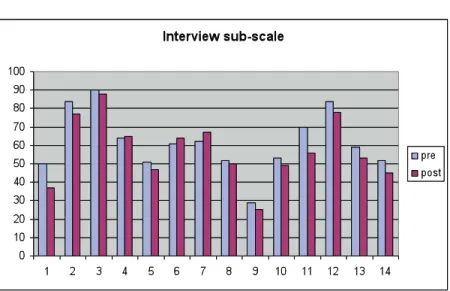
Figure 6 Interview sub-scale
For the last subscale, the Interview, three scored higher in the post-test and eleven scored lower.
2. QUALITATIVE DATA –JOURNALS
The open-ended journals describe the student’s feedback about their perceived levels of CA and about the effectiveness of major instructional strategies in this course in more detail. The questions asked covered the preparation for phone calls as well as their state of mind during and after the calls. The questions also covered the practice interviews and their preparation levels for this interview and finally, they covered the overall effectiveness of the instructional strategies during the whole course. Thirteen participants answered journal 1, 7 participants answered journal 2, 9 participants answered journal 3, none answered journal 4 and 9 participants answered journal 5.
Please note that all the journal entries were submitted electronically and are reported verbatim.
2.1. Self-perception – levels of CA at the beginning of the course Journal 1 was requested on week 2 and asked:
You have obtained your score from the questionnaire PRCAEI. About the questionnaire: how did you perceive the
questionnaire?
About the results: Are the results an accurate or inaccurate representation of the way you perceive yourself?
How would you describe your communication apprehension levels?
With your friends? With strangers? With your boss?
Do you have any comments?
This journal was about comparing their perceived levels of CA to the results of the questionnaire (PRCA/EI); thirteen participants responded. Most participants (10) perceived the results of the PRCA as being accurate in
describing their perceived levels of CA; two found the results very accurate and one did not answer.
Student 1 scored average on the PRCA/EI and responded:
It felt like a self-evaluation on my self-personality and my level of anxiety. I find it closely accurate to how I feel about my own anxiety. They’re some moments when I can feel the pressure of anxiety rising like in moments of speeches but other moments such as in group discussion I’m more at ease of expressing my self. My level of communication skills with other is pretty good and I always say what I have to say except for the moments when I’m being pressured to communicate well such as speeches.
Student 2 scored average on the PRCA/EI and responded: “The questionnaire had tested me well. The results were accurate enough for me to understand where I am and that I need to work harder. I am in an average level and in order to obtain a higher level, I must fix and learn from my mistakes.”
Student 3 scored average on the PRCA/EI and responded: “Id say it is accurate. I don’t have a problem with communicating with other people. As long as I am in my comfort zone, then I will do just fine.”
Student 4 scored high on the PRCA/EI and responded:
I think it is pretty accurate because I do not like to speak in front of a lot of people. I know this and have been able to change a few things that will help me feel less stressed but even though I feel a little bit more comfortable, I still do not like it. I would say they (results of CA level) are high because I hate speaking in front of a large group of people, when it is people I know it is not as bad but when I am talking to a group of strangers I do not feel comfortable. I am very comfortable in one on one
conversations with anyone but 3 and more I become shy or uncomfortable and will talk as little as possible.
Student 5 scored average on the PRCA/EI and responded:
Yes, I believe that I am a relatively comfortable person when it comes to communicating. Certain situations do make me feel more nervous than others, but generally I do not lose sleep over meeting up with someone the next day whether it be my boss, a teacher, a friend or a future potential employer. I am not a normally stressed out individual in the first place which I think helps with feeling at ease with many situations. The only situations, in which I can picture myself being uneasy in, are around strangers and in important situations. During leisure activities I am less shy but the worst scenario I can picture would be meeting with an important businessperson stranger who needed to discuss something serious and negative with me! Student 6 scored average on the PRCA/EI and responded:
Well in my opinion, I think the result support to be a bit lower. Well speaking and communicating with people (languages) isn’t a big issue but for personal preference being a shy person is hard to have more communications if needed. Most of the time, I don’t really know how to starts. Most of the situation depends on the environments and moods.
Student 7 scored average on the PRCA/EI and responded:
I think they're pretty accurate. I tend to consider myself to be a bit shy, although my communication apprehension levels pretty much depends on to whom I'm talking to. I'm perfectly
comfortable with people I know, and am alright with giving a speach to crowd, but as soon as I have to talk one-on-one with a stranger, I feel really nervous, especially when it's on the phone. Even telling someone "hello, can I speak to so-and-so" on the phone stresses me out a lot.
Student 8 scored high on the PRCA/EI and responded: “Yes, I belive they are accurate because I am very stressed out by communicating professionally with known superiors, and the test results mirror this.”
Student 9 scored average on the PRCA/EI and responded: “The results are fairly accurate. I was rated as average.”
Student 10 scored average on the PRCA/EI and responded:
I would say it is slightly accurate but higher then I expected. I do not have a problem talking to people nor confronting them, but as long as the conversation is in my own language, and also depending to whom I am talking. I try to remain calm and relaxed when I talk to people. I do not feel pressured to answer questions or ask question. If I feel something I say it, although, if I am talking to someone who is not my first language, then I become shyer. I know that I do not judge people but not everyone is like that. I had a bad experience one time speaking in French so I very rarely do it.
Student 11 scored low on the PRCA/EI and responded:
I found the results to be quite accurate. I wasn’t entirely sure what to expect. For the most part, I know that I am not a very anxious person by nature; however, I do get quite nervous when dealing with job-related situations, such as interviews or work meetings, or at least before such situations actually come to pass—once I am in such a situation, I tend to relax. That being said, I expected to be somewhere in the middle, maybe leaning towards the less-anxious side, and my results reflect that quite accurately.
Student 12 scored average on the PRCA/EI and responded: “I find the results of the survey are fairly accurate. I dont get anxious when speaking to others, but like alot of people, i get nervous when i have to speak infront of a large crowd. I hear myself talking, and i get my words all jumbled sometimes.”
Student 13 scored low on the PRCA/EI and responded:
I find that the results were an accurate representation of how I perceive myself. The results showed that I had low
comfortable while speaking. I do perceive myself with having an easiness to speak to others, especially my surrounding.
All of them felt comfortable communicating with their friends (12 very low CA, 1 average) mainly because they can say what they think without fear of repercussions: “No problem at all expressing my self with friends because we understand each other in a deeper level with slang’s and expressions. And the fear of saying something wrong or with a bad pronunciation is inexistent”; and, they are not afraid of being misunderstood: “I am myself when I am with friends. I let it all out and say what is on my mind. We always understand each other because we always say what we think of each other or others”; “Communicating with friends (known) is almost free to speak out anything that we interested. Most of the time, I was trying not to be left out of the conversations”; “I am very open with my friend and speak my mind. I am not shy and say what I want to.”
They are aware that friends allow them to be themselves as this student states:
With my fiends I hardly have any anxiety at all. I think that it’s because I know them and I know that they are aware of how I am and my way speaking and acting, therefore I am not afraid to speak up like I always do. I can be somewhat loud at time and some of the things I say can be offensive but the people that know me are aware of that so when I speak it doesn’t cross my mind that I might have been a little offensive or loud.
“My communication apprehension levels with my friends are very good. I am able to understand and communicated with comfort and ease with them. They are also ok with my communications.” Some of the participants are absolutely at ease communicating with friends: “With my friends, I feel no stress at all. In fact, I sometimes talk too much”; “I have no problems communicating with them no matter where or when”; “I dont feel any anxiety when i am only talking with my friends. I feel comfortable and at ease”.