Reverse Logistics in Food Industries:
A Case Study in Malaysia
Noor Irdiana Binti Ngadiman
#1, Mehdi Moeinaddini
2, Jamilahtun Binti Ghazali
#3,
Nuur Fathin Binti Roslan
#4#
Department of Industrial Logistics
1,3,4Universiti Kuala Lumpur, Malaysian Institute of Industrial Technology
1
[email protected]
3[email protected]
4[email protected]
Department of Urban Planning, Universiti Teknologi Malaysia
2[email protected]
2Abstract— This paper is demonstrated the reverse logistics in the food and beverage industries in Malaysia. Reverse logistics defined as the return, exchange, refurbishment, remarketing and disposition of products. The customer returns the products because of several reasons such as end of life, expired, product damage, products recall, poor quality and non halal products. The successful implementing reverse logistics industries can be a benchmark to the other food and beverage industries. This study is based on quantitative data collected by distributing the questionnaire to hypermarkets and one beverage company as a benchmark. The descriptive analysis shows that the significant factors those make reverse logistics success are based on the framework dimensions on: Why- Returning (the return reasons by the end user or customer), Why- Receiving (driving forces for implementing reverse logistics activities), What (the type of products and the product’s characteristics), How (the recovery processes and recovery option), and Who (the actors involved and their roles). The aims of this study, thereby is to investigate the challenges that faced with application of reverse logistics at the organization are influenced by the internal and external barriers. The contribution of the study is to highlight the present scenario of reverse logistics practices to academicians and industries.
Keywords: Reverse Logistics, Food and Beverage
Industries, Challenges, Returning
1. Introduction
In Malaysia, there is a growing level of industrialization and consumption, which has resulted in the increasing generation of solid waste.
International Journal of Supply Chain Management IJSCM,
ISSN: 2050-7399 (Online), 2051-3771 (Print)Copyright © ExcelingTech Pub, UK (http://excelingtech.co.uk/)
The amount of solid waste generated in Malaysia increased from 16,200 tonnes per day in 2001 to 19,100 tonnes in 2005. According to the environmental report of Coca Cola Company, in year 2004 they do produce 1.72 liters of waste water and 11.67 grams solid waste per 1 litter of drink production. Wastewater is the primary area of concern in the food and beverage industry [2]. Solid wastes from the food and beverage industries include both organic and packaging waste. Solid waste management is one of the most important issues for local authorities, where much money and effort are spent in the collection and disposal of solid waste. The traditional approach in Malaysia and many developing countries towards end of life products is to landfill or incinerate them with considerable cost and damage to the environment [4].
Ref [5] refer that, the population of Malaysia reached 30.4 million in 2015 and the real GDP growth rate of Malaysia was 7.3% in the year 2010. The annual disposable income grew by 44.6% from 2005 to 2010 and consumers spend US$25 billion on food and beverage in 2010. The Malaysia food retail industry is in split format with grocery stores (56%), convenience stores (1%), supermarkets, and hypermarkets (43%). Food and beverage industry become one of the fastest growing industries in Malaysia as a result of globalization that increasing expendable income and demands from population mix [7]. With the Malaysia’s current goals to green its industries with launch of green initiatives, reverse logistics is one of the imperative strategies to close the gap. Currently, firms in Malaysia feel the pressure to introduce reverse logistics into their operations. One of the new challenges faced by Malaysian firms that want to go global is the requirement to comply with legislations or directive, introduced by foreign countries that can ensure the effective disposal of manufactured products and waste [8].
Reverse logistics can be explained as the movement of product or materials, in the opposite direction of the supply chain for the purpose of creating or recapturing value, or for proper disposal [10] [11] .However, although reverse logistics are widely practiced and studies in many industries such as electric and electronic, garments, manufacturing and others, but the information on reverse logistics in Malaysia’s food and beverage retail industry is limited. The limited number of studies conducted on recent developments in the Malaysia’s food and beverage industry and reverse logistics indicates a major gap in sustainability logistics studies. Thus, it is important for Malaysian manufacturers to realize the importance of reverse logistics and to implement it into their operations. Empirical studies investigating the existence of green supply chain initiative are limited, particularly those which focus on reverse logistics efforts, especially in food and beverage industries [8].
2. Literature Review
Reverse logistics is defined as the movement of products or materials occurring in the opposite direction of the supply chain for the purpose of creating or recapturing value, or for proper disposal. It includes processing returned merchandise due to damage, seasonal inventory, restock, and salvage recalls, and excess inventory, as well as packaging and shipping materials received from the end user or reseller [8]. Reverse logistics process and activities start with the end user or purchaser’s decision when a purchaser feels the product that their bought or have already reached the end of its life and needs to dispose of the materials, especially for food products that quick damaged or outdated products [9]. Rejected items may be returned to the vendor, resold as it is, reconditioned to discount store or to be broker, or donated for charity. Sometimes, when the company I donating the rejected items for charity the company whereby can earn some tax deduction. If the items are totally being not used anymore, it may end up in a landfill or recycled. In addition, according to Malaysia Income Tax Act 1967 under Section 34 (6) (g), firms may earn tax reductions by donating the cash income resulting from the reverse logistics activities to approved institutions. Such deductions are restricted to 10 percent of the aggregate income of the company [8].
2.1 Drivers of Reverse Logistics
Reverse logistics must be properly managed. Estee Lauder has after a very successful reverse logistics project, created a USD 250 million product line from its returned goods flow. Usually, a product may be returned by a customer for several reasons: it is defective, it is not as advertised, it is in the wrong size or perhaps because the customer had changed his or her mind and had decided that the product is no longer needed after all. Generally, reverse flow starts with the final customer and
ends with the producer that is completely the opposite of the traditional flow of logistics activities [8].
Reverse logistics has become significant because organizations are under increasing pressure from many stakeholder groups, including shareholders, customers, employees, suppliers, reverse supply chain partners, government agencies, non-profit organizations and the public environment owning to environmental issues, legislation and consumer expectations [3]. In the different research, regarding the drivers of the reverse logistics activities, three main factors can be classified as the drivers companies to implement reverse logistics which are economics, legislation and corporate citizenship [1].
The driving force of reverse logistics which is economics, legislation and corporate citizenship (social factors) all contribute to an organization’s decision to adopt reverse logistics activities as part of their supply chain management process [6].
2.1.1. Economics
Ref [1] refers that processing returned or used products provide substantial gains to the companies. In some cases, reusing the products can be a cheap raw material source and sometimes when the production of new products is much more expensive than recovering then reverse logistics is considered as an option. Reverse logistics activities can bring direct economic benefits such as reducing of raw materials usage, adding value through recovery and reselling valuable product returns. While indirectly economic gains such as improving customer relationships or supplier’s relation, market protection and image building [12].
2.1.2 Legislation
The legislation drivers refer to any jurisdiction indicating that a company should recover its products or take them back. Since the strict legislations examples in Turkey about the environmental issues express the extended producer responsibility, companies are entitled to recover their products or accept them back [1]. However, in different research [9], has mentioned that legislation refers to the customer’s right example in UK customers can return the order product within 90 days and environmental legislation example are recovery quotas and take back responsibility.
2.1.3 Corporate Citizenship
Corporate citizenship refers to the set of values or principles that an organization holds to be responsible with reverse logistics activities. The motivations behind the implication of reverse logistics activities laid on both being legally obliged and trying to establish an image the
consumers desires as an environmentally responsible organization. Better customer service such as increasing the level of customer awareness for returning and refunding options, guaranteeing better services would affect the company’s image positively and provide potential benefits [1]. Corporate citizenship concerns a set of values or principles that impels a company or an organization to become responsibly engaged with reverse logistics [10].
2.2 Challenges of Implementation of Reverse Logistics
Irrespective of the benefits and opportunities, reverse logistics application is clouded by hurdles. The uncertainty in return forecasting, complete value recovery from return products and complexity in management of returns network are some of the major challenges identified to reverse logistics adoption [11] [12].
Firms in Malaysia currently feel the pressure to introduce reverse logistics into their operations. One of the challenges faced by the Malaysian firms that want to go global is the requirement to comply with legislations or directives introduced by foreign countries that can ensure the effective disposal of manufacture products and waste. One of the examples in Europe, there is a regulation with the objectives to reduce the amount of waste dumped in landfills [9]. All manufacturers, wholesalers, and retailers have to comply with the Waste Electrical and Electronic Equipment (WEEE) Directive 2007. Therefore, under the terms of the regulations, manufacturers had to join a WEEE compliance scheme and have full financial responsibility for recycling household equipment. Due to this, their ability to manage the reverse logistics process efficiently will definitely become a critical factor, especially for manufacturers and retailers currently doing business.
In different research, although reverse logistics deal with product returns, it presents one of the biggest operational challenges in the world of manufacturing since the activities involved are many and tends to be so varied [9]. Some of these challenges include the problems of collecting returns, sorting the returned products, return abuse, customers having lost confidence in returns, credit approval and repair activities, lengthy processing cycle times of returns and issues relating to the environmental sustainability. So it is important to perform reverse logistics efficiently and effectively to obtain maximum benefits of its opportunities.
3 Research Methodology
The analysis of this research is based on primary data. There have two sets of questionnaire is related to reverse
logistics practices implementing at hypermarkets. The respondents need to give a scale and rank the most efficient food and beverage industries are fast collecting the return goods at the hypermarkets. The second set of questionnaire is directly to the food and beverage industries. The demographic background of the company can represent the nature work at the manufacturer. This research is only focusing on hypermarket in Johor Bahru because approximately 88% of Malaysian grocery retails sales take place in the modern retail segment while the rest is through traditional retailers. Based on this formula, S= X2 NP(1-P) / d2 (N-1)+ X2 P(1-P), in this research, 5% of margin of error can be tolerated and using 95% of confidence level. Therefore, 24 of sample sizes is the minimum recommended size for this survey.
4 Results and Analysis
4.0.1Figures
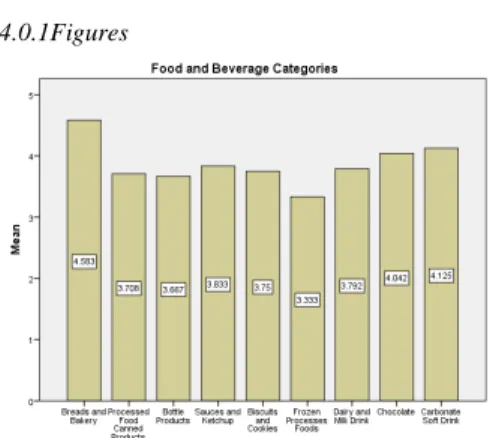
Figure 1.0 Food and Beverage Categories
Figure 2.0 Reasons for customer to returns
This statistical results for mean for each food and beverage industries that efficient implementing reverse logistics practices. The measurer can be how fast the mentioned industries fast collecting the return goods at the hypermarkets. The breads and bakery industries have the highest mean which is 4.58 and also be the highest mean in food categories. The carbonate soft drink industries are stated the highest mean which is 4.13 for
beverage industries. The lowest mean is 3.33 from frozen and processes foods. Besides that, the figure 2.0 shows the statistical result, 41.67% of reasons for customers to return back the carbonate soft drink to hypermarket are because of end of life (expired) reasons. Food and beverage is a short grocery lifetime, therefore it is important to hypermarket, supermarket or convenient shop to do sorting using FIFO (first in first out) method. Besides that, 29.17% stated the return of products are because of expired and damage issues. For examples, Coca Cola Sdn Bhd has agreed that one of the reasons of beverage product has been returned to the manufacturer because of damage in transit.
5 Discussion
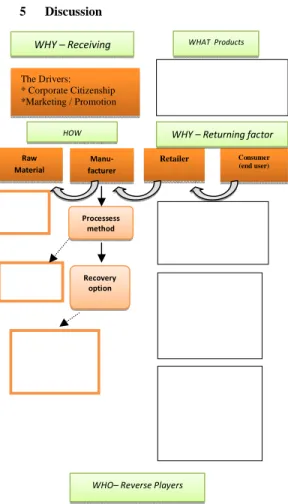
Figure 3.0: Diagram of Reverse Logistics Processes
Develop from Beverage Industries’ perspective
Branding is an important element in business purpose. A good services and well branding will help customers to royal with one brand only. Therefore, the drivers that make Coca Cola Refreshment (M) Sdn Bhd to receive the return products from customer or retailers are because of corporate citizenship and marketing promotion
purpose. Usually, manufacturers keep doing innovation on products, when the company is launching a new product, they need to clear up the old stock due to shelf life issue. Generally, food and beverage products have different life span, for example an item of trendy clothing will have a very short life span, while other products may have a very long life span. In this variable, the life span of soft drink product and how life span of product effects on reverse logistics activities is influencing customers to return back the damage goods.
Coca Cola Refreshment (M) Sdn Bhd prioritizes the corporate citizenship. The businesses are socially responsible for meeting legal, ethical and economic responsibilities. The reasons of Coca Cola Refreshment (M) Sdn Bhd are prioritize corporate citizenship with customer to collect back all the products at their shop or hypermarket due to shop is terminated, closed or transfer to a new place.
6. Conclusion
The successful by implementing reverse logistics at foods and beverage industries are influenced by several factors. At the early stage, the organizations must introduce and give awareness to the employees. From that, employees can understand the level of maturity of reverse logistics practices. Besides that, with the clear picture of implementation reverse logistics practices, the organizations must provide the guideline as standard procedure to be followed and fulfil by their employees and customers. In addition, the agreement and regulations by government also influence the success of reverse logistics practices.
In the nutshell, internal and external barriers must be slowly overcome and eliminate it. The successful of reverse logistics in foods and beverage industries not only give benefits to the organization in terms of costs or profits but mainly benefits to environmental impacts.
Consumer (end user)
*Landfill for Disposal *Reselll with lower price for certain products *Sorting *Inspection Retailer Manu- facturer Raw Material Reasons for hypermarket’s customer return: *End of life *Damage products Product Characteristics Return from: Supermarket,
grocery market, restaurant, convenient store, traditional store
Reasons for retailer return to beverage company:
*End of life (expired) *Pricing issues *Quality issues *Damage in transit
Reasons for retailer reject/return: *Duplicate order *Cancel order *Insufficient stock *Wrong order *DO issues *PO issues Processess method Recovery option Recycle the canned The Drivers: * Corporate Citizenship *Marketing / Promotion
WHY – Returning factor
WHY – Receiving
HOW
WHO– Reverse Players
Acknowledgments
The authors would like to express her gratitude and dedicate million thanks to all hypermarkets in Johor Bahru for the volunteer involvement and also to the beverage industries Coca Cola Refreshment in Malaysia for the supportive contribution.
References
[1] Akdogan M. Sukru and Coskun Aysen. 2012. Drivers of Reverse Logistics Activities: An Empirical Investigation.
8th International Strategic Management Conference.
[2] Alam A.S.M.M., Hossain K.M., Hossain. B , and Haque, M.J. 2007. A Study on Industrial Waste Effluents and their Management at Selected Food and Beverage Industries of Bangladesh. Journal Applied Sciences
Environmental Management. Vol. 11. No. 4 pp 5-9.
[3] Badenhorst Amanda. 2013. A Best Practice Framework in Reverse Logistics. MSc Dissertation. University of South Africa.
[4] Eltayeb, Tarig Khidir and Suhaiza Hanim Mohamad Zailani. 2011. Drivers on the Reverse Logistics: Evidence from Malaysia Certified Companies.
International Journal Logistics Systems and
Management. Vol.10, No.4. pp. 375-397.
[5] Hickford A.J. and Cherrett,2007. Green Logistics.
Transportation Group University of Southampton.
[6] Market Analysis Report. 2012. Modern Grocery Retailing in Major ASEAN Markets (Indonesia, Thailand, Malaysia, Singapore and the Philippines). International Markets Bureau. Agriculture and Agri Food Canada.
[7] Market Watch, “The Malaysian Food Industry”, German Chamber of Commerce abroad (DE international),pp.1-17,2015.
Availableat:http://www.malaysia.ahk.de/fileadmin/ahk_ malaysia/Market_reports/The_Malaysian_Food_Industry .pdf [Accessed October 20, 2015].
[8] Nik Abdullah Nik Ab Halim and Yaakub Sabariah. 2015. The Pressure for Reverse Logistics Adoption among Manufacturers in Malaysia. Asian Journal of Business Accounting 8(1). Pp 151-177.
[9] Reddy Dhananjaya. 2013. A Study on Reverse Logistics.
Msc Thesis Work in Product and Process Development Production and Logistics. Malardalens Hogskola,
Sweden
[10]Somuyiwa Adebamboo and Adebayo Iyabot. 2014. Empirical Study of the Effect of Reverse Logistics Objectives on Economics Performance of Food and Beverage Companies in Nigeria. International Review of
Management and Business Research. Vol. 3 No 3. pp
1484- 1493.
[11]Vijayan Growi, Nitty Hirawaty Kamarulzaman, Zainal Abidin Mohamed and Amin Mahir Abdullah. 2014. An Insight into Adaption of Reverse Logistics by Food Retailers in Klang Valley Malaysia. Conference Paper.
[12]Vijayan Growi, Nitty Hirawaty Kamarulzaman, Zainal Abidin Mohamed and Amin Mahir Abdullah. 2014. Sustainability in Food Retail Industry through Reverse Logistics. International Journal of Supply Chain