HAL Id: tel-01166538
https://tel.archives-ouvertes.fr/tel-01166538v2
Submitted on 23 Jun 2015HAL is a multi-disciplinary open access
archive for the deposit and dissemination of sci-entific research documents, whether they are pub-lished or not. The documents may come from teaching and research institutions in France or abroad, or from public or private research centers.
L’archive ouverte pluridisciplinaire HAL, est destinée au dépôt et à la diffusion de documents scientifiques de niveau recherche, publiés ou non, émanant des établissements d’enseignement et de recherche français ou étrangers, des laboratoires publics ou privés.
users satisfaction
Inès Fakhfakh
To cite this version:
Inès Fakhfakh. Semantic based cloud broker architecture optimizing users satisfaction. Other [cs.OH]. Institut National des Télécommunications, 2015. English. �NNT : 2015TELE0008�. �tel-01166538v2�
THESE DE DOCTORAT CONJOINT TELECOM SUDPARIS et L’UNIVERSITE PIERRE ET MARIE CURIE
Thèse n° 2015TELE0008 Spécialité : Informatique et Réseaux
Ecole doctorale : Informatique, Télécommunications et Electronique de Paris
Présentée par
Inès FAKHFAKH
Pour obtenir le grade de DOCTEUR DE TELECOM SUDPARIS
UNE ARCHITECTURE DE CLOUD BROKER BASEE SUR LA SEMANTIQUE POUR
L'OPTIMISATION DE LA SATISFACTION DES UTILISATEURS
Soutenue le 07/05/2015
devant le jury composé de :
Mme. Lynda MOKDAD, Professeur à la Faculté des Sciences et Technologie, Université Paris 12, Val de Marne –
Rapporteur
M. Yacine GHAMRI DOUDANE, Professeur à l’Université de La Rochelle – Rapporteur Mme Véronique VEQUE, Professeur à l’Université Paris-Sud – Examinateur
M. Pierre SENS, Professeur à l’Université Paris 6 – Examinateur
Mme. Amel BOUZEGHOUB, Professeur à Télécom SudParis – Examinateur M. Djamal ZEGHLACHE, Professeur à Télécom SudParis – Directeur de thèse
Acknowledgements
I am very grateful to my reading committee members: Prof. Lynda MOK-DAD and Prof.Yacine GHAMRI DOUDANE for accepting to judge this work. Thank you for your time, your interest, and your helpful comments. I would also like to thank the two other members of my oral defense com-mittee Prof. Véronique VEQUE and Prof. Pierre SENS for their time and insightful questions.
I owe my deepest gratitude to Prof. Amel BOUZEGHOUB for all her con-tributions of time, ideas, and guidance, especially in the semantic part of this thesis.
My special thanks go to Prof. Djamal ZEGHLACHE for offering me the opportunity to work on this thesis at Telecom Suparis Institute and for all the advice he provided to the work on this thesis.
I would like to thank my colleagues and friends, not only for being supportive during the work on this thesis but also for the fun times we spent together. Last but not the least, I would like to thank my family for supporting me throughout my life.
Cloud computing is a dynamic new technology that has huge potentials in enterprises and markets. Its resources configuration changes significantly depending on various internal modifications such as fail of some components or external environment changes. The dynamicity and the increasing com-plexity of cloud architectures involve several management challenges. In this work, we are interested in the service level agreement (SLA) management. Actually, there is no standard to express cloud SLA, so, providers describe their SLAs in different manner and different languages, which leaves the user puzzled about the choice of its cloud provider.
To overcome these problems, we introduce a cloud broker architecture man-aging the service level agreements between providers and consumers. It aims to assist users in establishing and negotiating SLA contracts and to help them in finding the best provider that satisfies their service level ex-pectations. Our broker SLA contracts are formalized as OWL ontologies as they allow to hide the heterogeneity in the distributed cloud environment and enable interoperability between cloud actors. Besides, by combining our ontology with our proposed inference rules, we contribute to detect vi-olations in the SLA contract assuring thereby the sustainability of the user satisfaction. Based on the requirements specified in the SLA contract, our cloud broker assists users in selecting the right provider using a multi at-tribute utility theory method. This method is based on utility functions representing the user satisfaction degree. To obtain accurate results, we have modelled both functional and non functional attributes utilities. We have used personalized utilities for each criterion under negotiation so that our cloud broker satisfies the best consumer requirements from functional and non functional point of view.
Résumé
Le cloud computing est un nouveau modèle économique hébergeant les ap-plications de la technologie de l’information. Il répond aux besoins exponen-tiellement croissants en ressources physiques et logicielles. Il permet d’appro-visionner ces ressources et de les partager sous forme de ressources virtuelles à travers le réseau internet. Le passage au cloud devient un enjeux impor-tant des entreprises pour des raisons essentiellement économiques. En effet, le cloud fournit des services à la demande ce qui permet aux utilisateurs d’allouer les ressources virtuelles nécessaire pour leurs processus métier. Ils n’ont plus donc besoin d’installer des infrastructures couteuses et d’assurer leurs mis à jours ce qui permet de réduire les coûts de l’exploitation et de l’entretien. En outre, le cloud assure la flexibilité, la scalabilité, la fiabilité et la haute disponibilité.
Aujourd’hui il existe plusieurs fournisseurs de service cloud public, privé et hybride.
Étant donné la diversité des fournisseurs et des services du cloud, l’utili-sateur doit être capable de sélectionner celui qui répond au mieux à ses besoins. Ce choix n’est pas évident car l’utilisateur doit être en mesure de trouver le meilleurs compromis entre plusieurs paramètres de qualité de ser-vice proposés par les différents fournisseurs de serser-vices. Il doit aussi prendre en compte la dynamicité de l’infrastructure du cloud. En outre, l’hétérogé-néité syntaxique et sémantique entre les fournisseurs du cloud rends ce choix encore plus difficile. Cette hétérogénéité se manifeste en :
• différentes terminologies exprimant le même concept : par exemple, la capacité de traitement d’une machine virtuelle peut être appelé CPU, capacité, capacité de traitement . . . ;
de composer sa requête à partir de ces instances alors que d’autres exigent que l’utilisateur fixe les caractéristiques techniques des res-sources à allouer tel que sa capacité, sa mémoire son espace disque . . .
• Différentes façons d’exprimer la qualité de service : dans certains cas deux métriques différentes peuvent avoir la même appellation. Par exemple, le mot "delay" peut faire référence à la latence d’un système comme il peut exprimer le pourcentage des paquets perdu lors de la transmission d’un service.
Afin de définir l’accord et la nomenclature utilisée entre le fournisseur et le consommateur de service, on crée des contrats SLA (Service Level Agree-ments). Le contrat SLA est un contrat formel entre les fournisseurs et les consommateurs du cloud assurant la qualité de services négociée. Les contrats SLA actuellement établis sont basés sur les modèles proposées par les fournisseurs de service. A cause de la diversité des terminologies et des langages, la création et la négociation de contrat SLA avec plusieurs four-nisseurs devient une tâche assez difficile pour l’utilisateur. Ce dernier doit s’adapter à chaque fois avec les terminologies et les langages de description du SLA de chaque fournisseur ce qui rends la comparaisons des différents offres une tache assez compliquée. Par conséquent, l’utilisateur peut facile-ment se tromper dans son choix final du meilleur fournisseur. En outre, une fois le contrat SLA établit, les fournisseurs du cloud ne proposent aucune garantie de performance. En fait, c’est à l’utilisateur de détecter les viola-tions dans le contrat SLA et de s’assurer que les pénalités imposées dans le contrat en cas de violation soient exécutées.
L’objectif de cette thèse est de :
1. Assurer l’interopérabilité : prendre en compte la sémantique de la qua-lité de service dans le processus de négociation de contrat SLA ;
2. Garantir une satisfaction optimale : trouver le meilleur compromis qui répond au besoin de l’utilisateur ;
3. Garantir le respect de la satisfaction client dans le temps : fournir à l’utilisateur des moyens lui permettant de surveiller le respect de ses exigences.
Afin d’atteindre ces objectifs, nous allons :
1. Définir une ontologie spécifique au cloud décrivant le contrat SLA 2. Proposer une méthode multi-critère qui permet de sélectionner le
four-nisseur qui répond au mieux à la requête de l’utilisateur
3. Proposer une politique qui permet de détecter les violations dans le contrat SLA en s’appuyant sur des règles et de l’inférence
Ces différentes contributions sont structurés dans une architecture globale appelée "Cloud Broker Architecture". L’objectif de cette architecture est d’aider les utilisateurs à trouver des services cloud répondant au mieux à leur requête. Pour ceci, le broker utilise une méthode multicritère qui permet de trouver le meilleur offre en prenant en compte plusieurs critères de choix. Dans cette architecture, le contrat SLA est exprimé à l’aide d’une ontologie assurant l’interopérabilité entre les différents acteurs du cloud. Ce contrat est géré à l’aide de politiques, exprimé sous forme de règles permettant de détecter les violations du contrat.
La structure de cette thèse est la suivante.
Le premier chapitre présente l’état de l’art en introduisant le concept de cloud computing, ses caractéristiques, ses modèles de service, ses modèles de déploiement et de ses principaux défis de gestion. Il introduit aussi quelques outils de gestion sémantiques comme l’ontologie et les règles et présente des travaux qui ont utilisés les ontologies pour la découverte de services. Dans ce chapitre, nous présentons aussi des travaux qui ont proposé des métho-dologies pour la sélection de services. Finalement, nous définissons la notion de "cloud broker" et nous présentons quelques travaux qui ont proposé des architectures de broker. Dans le chapitre 2, nous introduisons l’architecture
contrat SLA et nous expliquons les avantages de l’utilisation des règles de gestion. Dans ce travail, nous avons utilisé une méthode multi-critère pour sélectionner le meilleur fournisseur de service que nous expliquons dans le chapitre 3. Ce chapitre introduit aussi les fonctions d’utilités que nous avons utilisé pour calculer le degré de satisfaction des utilisateurs. Finalement, le chapitre 4 explique l’avantage de l’utilisation des annotations sémantique dans la découverte de services et nous évaluons les fonctions d’utilités que nous avons proposé.
Dans la suite de ce résumé, nous présentons le travail réalisé dans les trois chapitres suivants le chapitre état de l’art :
Une Architecture de Broker pour la Négociation de Contrats SLA Afin de remédier aux problématiques mentionnées ci dessus, nous avons pro-posé une architecture de Broker cloud. Ce broker joue le rôle d’intermédiaire entre les fournisseurs et les consommateurs du cloud. C’est une interface de gestion unique permettant de traiter les différentes requêtes des utilisateurs, établir des contrats SLA entre les clients et les fournisseurs de service et d’assurer le respect des contrats établit. Cette architecture est illustrée par la figure 1.
Les différents modules de cette architecture sont :
• Broker Manager : c’est le module principale du broker qui assure l’or-chestration des différentes opérations. Il englobe un module "Request Parser" qui fournit au utilisateurs du broker un modèle de requête à remplir puis parse la requête de l’utilisateur en ontologie. Il est aussi muni d’un module "QoS Parser" qui interagit avec les fournisseurs de services en leurs envoyant la requête de l’utilisateur et en recevant les QoS qu’ils peuvent fournir.
• SLA Contract Ontology : décrit la structure du contrat SLA établit entre les utilisateurs et les fournisseurs du cloud.
Figure 1: Architecture de Cloud Broker
-• Reasoner module : ce module assure la vérification de la cohérence de la requête de l’utilisateur et la détection des violations dans le contrat SLA.
• Consistency Checking Policies module : contient des règles utilisées pour vérifier la cohérence des requêtes.
• Violation Detection Policies module : contient des règles utilisées pour détecter les violations dans le contrat SLA et pour déterminer les pé-nalités à imposer au fournisseur de service en cas de violation.
• Decision Making Module : ce module est chargé de trouver le four-nisseur qui propose le meilleur offre pour la requête de l’utilisateur. Il évalue les performances de chaque fournisseur en utilisant une méthode multi-critère.
• Providers knowledge Base : il s’agit d’une base de donnée énumérant les différents fournisseurs du cloud. Elle contient des informations sur ces fournisseurs comme leur méthode de réplication, leur stratégie de récupération et la localisation géographique de leurs données stockés. • Monitoring module : afin de détecter les violations dans le contrat SLA,
nous avons prévu un module de monitoring qui permet de mesurer les valeurs de la qualité de service en temps réel. Si ces valeurs n’honore
Cette architecture assure trois fonctions :
1. Établir un contrat SLA cohérent : les utilisateurs du broker ne sont pas forcément des personnes expérimentées dans le domaine du cloud capables de formuler des demandes cohérentes. Ainsi, nous avons prévu de vérifier la cohérence sémantique de la requête de l’utilisateur avant d’entamer le processus de sélection du meilleur offre pour cette re-quête. Pour ce faire, le module "broker manager" parse la requête sous forme d’ontologie puis demande au module "reasoner" de vérifier sa consistance. Ce module vérifie si les règles exprimés dans le module "Consistency Checking Policies" sont respectées par la requête. Dans le cas contraire, le broker alerte l’utilisateur pour qu’il reformule sa demande. Les règles stockées dans le module "Consistency Checking Policies" sont prédéfinit par le gestionnaire du broker en adéquation avec les concepts de l’ontologie utilisée pour exprimer le contrat SLA. 2. Sélectionnez le meilleur fournisseur pour la requête de l’utilisateur et établir le contrat SLA : Le principal objectif du broker est de trouver le meilleur offre du fournisseur de service qui correspond à la demande de l’utilisateur et établir un contrat SLA entre le consommateur et le fournisseur sélectionné. Ce processus passe par plusieurs étapes :
• le broker sélectionne les fournisseur de service susceptible de ré-pondre à la requête de l’utilisateur en éliminant les fournisseurs qui ne peuvent pas répondre aux contraintes dures de l’utilisateur comme le type de réplication demandé et la localisation géogra-phique des données stockées.
• en se basant sur les performances des fournisseurs de services consta-tées en exécutant d’anciennes requêtes, le broker prédit les perfor-mances de chaque fournisseur de service sélectionné pour la nou-velle requête. Ensuite, il compare la qualité de service fourni par les différents fournisseurs et sélectionne celui qui répond au mieux à la requête de l’utilisateur.
• le broker contacte le fournisseur de service sélectionné et établit le contrat SLA entre avec le consommateur.
3. Détecter les violations dans le contrat SLA : après avoir établit le contrat SLA entre le consommateur et le fournisseur de service, le bro-ker assure que les termes de ce contrat soient respectées. En effet, il vérifie régulièrement que la qualité de service assurée par le fournisseur en temps réel satisfait le consommateur. Pour ce faire, il fait encore une fois appel au raisonneur qui compare les valeur des paramètre QoS au seuils fixés par le contrat SLA. En cas de violation, il s’assure que des pénalités soient imposées au fournisseur de service. Les pénalités sont déterminées au préalable par le gestionnaire du broker sous forme de règles et stockées dans le module "Violation Detection Policies".
Afin d’assurer ces différentes fonctionnalités, nous décrivons sémantique-ment le contrat SLA entre l’utilisateur et le fournisseur du cloud sous forme d’ontologie. Nous proposons une ontologie générique pour décrire un contrat SLA dans le domaine du cloud. Ce contrat est établit entre un utilisateur qui doit spécifier sa requête, ses contraintes et les critères de qualité de service dont il a besoin, et un fournisseur de service qui spécifie les valeurs de QoS qu’il s’engage à fournir pour cette requête. La durée de ce contrat est déter-minée par l’attribut "Duration". La structure de l’ontologie représentant le contrat SLA est illustrée par la figure 2.
Cette ontologie générique est spécifiée pour la couche infrastructure du cloud. En effet, la requête de l’utilisateur de la couche infrastructure doit être formulé sous forme de demande de ressources virtuelles. La formulation de la requête que nous avons proposé est conforme au standard OCCI ce qui permet d’assurer l’interopérabilité entre les différents acteurs du cloud et facilite de faire la correspondance entre notre ontologie et les autres for-malismes utilisés par les fournisseurs du cloud. De plus, nous définissons dans cette ontologie les contraintes et les critères de la qualité de service qui intéressent un utilisateur de la couche infrastructure du cloud comme illustré par le figure 3.
L’utilisateur de la couche IaaS du cloud peut donc s’adresser à notre bro-ker afin de chercher un fournisseur de services cloud en utilisant le modèle proposée par notre ontologie. Ainsi, il évite de confronter les différents four-nisseurs du cloud qui utilisent des terminologies différentes. Toutefois, le broker doit communiquer avec plusieurs fournisseur de service cloud afin de négocier avec eux les contrats SLA. Ces fournisseurs utilisent différents langages de description du contrat SLA. Afin de permettre au broker de communiquer avec les fournisseurs de service, nous proposons de faire un "mapping" entre les langages de description du contrat SLA utilisé par ces fournisseur et notre ontologie. Vu que le langage WS-Agreement est un stan-dard largement utilisé, nous proposons une méthode permettant de faire la correspondance entre notre ontologie et ce langage. L’objectif de la spéci-fication du WS-Agreement est de définir un langage générique permettant de créer tout type d’accord quelque soit le domaine d’application, et il a été utilisé dans le domaine du cloud. La structure du WS-Agreement est illustrée par la figure 4. Elle est composée de :
• son nom
• le contexte décrivant les deux parties de l’accord et sa date d’expiration • les termes de ce contrat comprenant la description du service et les ga-ranties que le fournisseur s’engage à assurer pour ce service. Le service
Figure 3: Notre Ontologie représentant le contrat SLA pour la couche infrastructure du cloud
-est définit par un ensemble de propriétés qui correspondent au critères à négocier. Les garanties intègrent à la fois les indicateurs de perfor-mances que les fournisseur devra assurer et les pénalités à imposer au fournisseur en cas de violation. Dans le cadre de notre ontologie, le ser-vice négocié corresponds à la requête à satisfaire, et les propriétés de cette requêtes sont les paramètres "SLO " de notre ontologie. Les va-leurs numériques de ces paramètres représentent les performances que le fournisseur est en mesure de garantir, et les pénalités sont introduite dans les règles d’inférence qui permettent de détecter les violations. • les contraintes à respecter lors de l’établissement du contrat SLA qui
décrivent les valeurs acceptables pour chaque critère négocié. Ces va-leurs sont directement intégré dans l’ontologie lors de la définition de chaque paramètre.
Nous montrons par ce "mapping" que l’ontologie proposée associé au règles d’inférence contient tous les éléments d’un WS-Agreement. L’ontologie intro-duit le contexte, la description de service et les critères négocié comme illus-tré par la figure 5. Les règles d’inférence définissent les pénalités à imposer en cas de violation. Notre système est encore plus riche qu’un WS-Agreement puisque il garde la trace des préférences des utilisateurs et introduit une méthode qui permet de détecter les violations du contrat.
Figure 5: Le mapping entre notre ontologie et le language WSAgreement
-La Sélection du meilleur fournisseur de service cloud en se basant sur une méthode multi-critère Le cloud computing est un nouveau paradigme qui a attiré plusieurs clients cherchant à profiter de la haute dis-ponibilité des ressources du cloud et de minimiser le coût d’exploitation des services. Ces clients ont différents secteurs d’activité, par conséquent ils ont des besoins et des attentes différentes des service offert par les fournisseurs du cloud. Ils ont donc besoin de comparer soigneusement les services offert par les différents fournisseurs et de trouver le meilleur compromis qui ré-ponds à leur demande. Dans ce travail, nous avons proposé une architecture de broker qui a pour objectif d’aider les utilisateur à choisir leur fournisseur. Il utilise une méthode multi-critère qui choisit le meilleur fournisseur en se basant sur les critères définit par l’utilisateur et sur ces préférences. Cette méthode est appelé MAUT (Multi-Attribute Utility Theory). Cette méthode considère chaque critère comme une fonction d’utilité à intégrer dans une super-fonction d’utilité. Il existe trois formes différentes pour appliquer la méthode MAUT : multi-linéaire, additive et multiplicative. Selon Keeney et Raiffa (1), les formes additive et multiplicatives sont plus appropriés que la forme mutli-linéaire si on considère plus que quatre critères. De plus, la forme additive est adoptée lorsque l’interaction entre les attributs n’est pas importante. Dans le contexte du cloud, plusieurs paramètres présentant une forte interaction sont mis en jeu dans le choix du meilleur service. En se
ba-fournisseur cloud. Cet algorithme est présenté ci dessous :
La requête de l’utilisateur est représentée par le vecteur R : R = [r1, r2, · · · , rn]
n : nombre de parametres dans la requete
(1)
L’ensemble des fournisseurs de services capables de répondre à cette requête est représenté par le vecteur P :
P = [p1, p2, · · · , pm]
m : nombre de f ournisseurs de services
(2)
Les critères négocié sont représentés par le vecteur C : C = [c1, c2, · · · , ck]
k : nombrede criteres
(3)
Le degré d’importance de chaque critère pour l’utilisateur est spécifié sous forme de poids. Les poids relatives aux critères négociés sont représentés par un vecteur W.
W = [w1, w2, · · · , wk] (4)
L’utilité de chaque fournisseur est calculée par l’équation suivante :
∀i ∈ [1, m], U (pi) = 1 w[ k Y j=1 (1 + wwjfj(cj)) − 1)] where (1 + w) = k Y j=1 (1 + wwj) (5)
l’utilité globale de chaque fournisseur est calculée à partir des utilités uni-taire des différents critères de la qualité de service et des poids attribués
par l’utilisateur à ces critères. Ainsi, notre broker peut sélectionner le four-nisseur qui propose le meilleur service en se basant sur les préférences des utilisateurs. Ce service est celui qui obtient la meilleur utilité globale U (pi). Le choix du meilleur fournisseur de service est basé essentiellement sur les fonctions d’utilité permettant de représenter le degré de satisfaction client vis à vis à chaque critère de la qualité de service. Plusieurs travaux ont adopté cette méthode pour résoudre des problématique de choix multi-critère. Néan-moins, ils utilisent la même forme de courbe (courbes exponentielles, loga-rithmiques, linéaire, hyperbolique . . .) pour représenter tout les critères de choix. Dans ce travail, nous proposons d’illustrer chaque fonction d’utilité par une courbe spécifique à lui représentant bien le critère de choix. Nous essayons de cerner la plupart des critères qui contribuent dans le choix du meilleurs service et de les classer en critères fonctionnels et critères non fonctionnels. Dans ce chapitre, nous modélisons les fonctions d’utilités de ces différents critères.
Expérimentations et résultats Dans ce travail, nous avons proposé une architecture de broker aidant les utilisateurs à trouver le meilleur fournisseur satisfaisant leur demande, en fonction de leur préférences. Afin d’atteindre cet objectif, le broker assure une meilleure compréhension et une interopé-rabilité entre les différents acteurs du cloud en adoptant les annotations sémantiques. En fait, il utilise l’ontologie et les règles d’inférences pour dé-finir le contrat SLA entre les consommateurs et les fournisseurs de services cloud et pour détecter les éventuelles violations de ce contrat. Afin d’aider les utilisateurs à choisir le meilleur fournisseur de service avec lequel ils peuvent établir des contrats SLA, le broker utilise une méthode multi-critère appe-lée la méthode MAUT qui est basée sur les fonctions d’utilités. Nous avons modélisé les fonctions d’utilité des critère fonctionnels et non fonctionnels négocié dans le contrat SLA. Ces fonctions permettent d’évaluer le degré de satisfaction de l’utilisateur par rapport à chaque critère négocié.
Afin d’évaluer notre solution, nous avons implémenté notre architecture de boker en langage java. Nous avons utilisé le logiciel Protégé et la bibliothèque
Évaluation des annotations sémantiques Afin d’évaluer l’avantage des annotations sémantiques, nous avons réalisée l’expérience illustrée par la figure 6. Cette expérience consiste à trouver le service qui répond à la requête de l’utilisateur parmis trois services proposés par trois fournisseurs utilisant des terminologies différentes. De plus chaque fournisseur utilise une unité différente pour mesurer la capacité du processeur. Par exemple, le pre-mier fournisseur adopte les instances Amazon ECU (1 ECU = 1.0-1.2 GHz) alors que le deuxième fournisseur utilise des processeurs Intel Xeon E5520 qui ont une capacité équivalente à 4.52 GHz.
Figure 6: Le scénario de l’évaluation sémantique
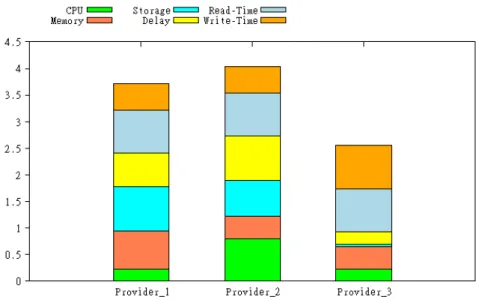
-Dans un premier temps, nous avons effectué une recherche syntaxique qui compare les critères de la requête de l’utilisateur à ceux proposés par les fournisseurs de services. Les résultats sont illustrés par la figure 7. Nous
remarquons que seuls le "CPU" et le "Delay" ont été découvert car on re-trouve ces mêmes termes dans la requête et les propositions des fournisseurs. De plus l’utilité attribué à la capacité du processeur n’est pas fiable car elle ne tient pas en compte les différences entre les unités. On remarque aussi que le terme "Delay" n’a pas la même signification pour l’utilisateur et le fournisseur. Ce qui fait qu’on obtient le résultat suivant : U tility(P 3) > U tility(P 1) > U tility(P 2). Dans un deuxième temps, nous avons introduit les annotations sémantiques qui permettent de découvrir tout les critères et de masquer les hétérogénéité syntaxiques et sémantiques. Dans ce cas, nous obtenons le résultat suivant : U tility(P 2) > U tility(P 1) > U tility(P 3) (fi-gure 8) ce qui prouve que l’absence d’annotations sémantique peut conduire à choisir un fournisseur qui ne peut pas satisfaire la requête de l’utilisateur.
Figure 7: Les résultats de la recherche syntaxique
-Évaluation des fonctions d’utilité fonctionnelles Les fonctions d’uti-lité peuvent avoir plusieurs formes : exponentielle, logarithmique, linéaire, hyperbolique etc. Dans ce travail, nous avons choisi de modéliser chaque critère par une fonction d’utilité propre à lui. Afin d’évaluer notre méthode, nous avons pris l’exemple d’une requête composée de trois critères : temps de réponse, latence et bande passante et de dix offres de fournisseur de
ser-vice qui peuvent répondre à cette requête. Nous avons modélisé les fonctions d’utilité des trois critère négocié avec la forme linéaire, la forme exponen-tielle et les formes que nous avons proposé dans le chapitre précédant. Puis, nous avons calculé l’utilité globale attribuée à chaque fournisseur en utili-sant les différentes formes. Nous remarquons que l’utilité globale attribuée à chaque fournisseur diffère selon la forme utilisée. Ainsi, le choix du meilleur fournisseur diffère selon la méthode utilisée. En utilisant les forme exponen-tielle et linéaire, le choix porte sur un fournisseur qui a une bonne bande passante mais qui ne satisfait pas les attentes de l’utilisateur en terme de temps de réponse. La compensation entre les utilités de ces deux critères entraine un mauvais choix de fournisseur. En utilisant les utilités que nous avons proposés, nous choisissons le fournisseur qui satisfait tout les critères négociés. Ainsi, nous satisfaisons les attentes des utilisateurs.
Évaluation des fonctions d’utilité non fonctionnelles Les critères non fonctionnels sont des critères non mesurable qui ne peuvent pas être directement représentés par des fonctions d’utilité. Par conséquent, des cri-tères non fonctionnels comme la fiabilité et la réputation des fournisseurs ne sont pas pris en compte dans le choix du meilleur fournisseur. Ces critères
sont très important et doivent être inclus dans le processus de prise de déci-sion et dans le choix du fournisseur de services. Afin de prendre en compte des critère non fonctionnels, nous proposons dans ce travail des méthodes pour calculer l’utilité de ces critère. Dans ce paragraphe, nous proposons des exemples numériques qui permettent de calculer les fonctions d’utilité du critère "disaster recovery" représentant le plan de reprise après un si-nistre et du critère "Trust" représentant la réputation d’un fournisseur de service.
Contents
List of Figures v List of Tables ix 1 Introduction 1 1.1 Context . . . 1 1.2 Problem statement . . . 2 1.3 Contributions . . . 3 1.4 Thesis structure . . . 42 State of the art on cloud management frameworks 5
2.1 Cloud Computing Overview . . . 5 2.1.1 Cloud Computing Characteristics . . . 6 2.1.2 Cloud Computing Service Models . . . 7 2.1.3 Cloud Computing Deployment Models . . . 8 2.2 Cloud Computing Management Challenges . . . 10 2.2.1 Data Management . . . 11 2.2.2 Virtual Machine Management . . . 11 2.2.3 Load Balancing . . . 12 2.2.4 Security . . . 12 2.2.5 Service Level Agreement . . . 13 2.3 Service Discovery and Selection . . . 16 2.3.1 Semantic based management tools . . . 16 2.3.1.1 Semantic Web architectures . . . 16 2.3.1.2 Ontology . . . 17 2.3.1.3 Declarative programming . . . 18
2.3.2 Combining ontologies with rules . . . 19 2.3.3 Cloud services discovery ontologies . . . 23 2.3.4 Cloud Service Selection . . . 24 2.4 Cloud Broker architecture . . . 27 2.4.1 Cloud Broker Definition . . . 27 2.4.2 Cloud Broker related work . . . 28 3 Cloud Broker Architecture for negotiating semantic SLA contracts 35 3.1 Problem Statement . . . 36 3.2 CBA: A Cloud Broker Architecture . . . 39 3.3 Management Policies Implementation . . . 47 3.3.1 Consistency Checking Policies . . . 48 3.3.2 Violation Detection Policies . . . 49 3.4 Cloud SLA Contract specification . . . 50 3.4.1 IaaS Cloud SLA Contract specification . . . 52 3.5 Ontology Mapping to WS-Agreement . . . 55 4 Service provider’s selection based on the multi-criteria method 65 4.1 Motivation . . . 65 4.2 Multi-criteria algorithm for service provider’s selection . . . 66 4.2.1 Service selection algorithm . . . 67 4.2.2 Functional QoS Utility functions . . . 70 4.2.2.1 Compute Utility functions . . . 70 4.2.2.2 Network Utility functions . . . 71 4.2.2.3 Storage Utility functions . . . 73 4.2.2.4 Cost Utility function . . . 73 4.2.3 Non Functional QoS Utility functions . . . 75 4.2.3.1 Reliability Utility functions . . . 75 4.2.3.2 Trust Utility function . . . 82
5 Experimentations and results 87
5.1 Validation of semantic annotations contribution . . . 88 5.2 Evaluation of the proposed utility functions . . . 90 5.2.1 Evaluation of functional utility functions . . . 90
CONTENTS
5.2.1.1 Utility functions Configuration . . . 92 5.2.1.2 Results . . . 97 5.2.2 Evaluation of non functional utility functions . . . 99 5.2.2.1 Disaster recovery Example . . . 100 5.2.2.2 Trust example . . . 100 5.3 Conclusion . . . 102
6 Conclusions and Future Work 103
6.1 Conclusions . . . 103 6.2 Future Research Directions . . . 104
List of Figures
1 Architecture de Cloud Broker . . . ix 2 Notre Ontology représentant le contrat SLA . . . xii 3 Notre Ontologie représentant le contrat SLA pour la couche
infrastruc-ture du cloud . . . xiii 4 Structure du langage WS-Agreement . . . xiv 5 Le mapping entre notre ontologie et le language WS-Agreement . . . xv 6 Le scénario de l’évaluation sémantique . . . xviii 7 Les résultats de la recherche syntaxique . . . xix 8 Les résultats de la recherche sémantique . . . xx 1.1 The cloud computing environment . . . 2 2.1 Cloud Computing Service Models . . . 7 2.2 Cloud Computing Deployment Models . . . 9 2.3 Cloud challenges as introduced by Booz and Company . . . 10 2.4 WSLA Services and their interactions (32) . . . 14 2.5 Semantic Web Architectures (35) . . . 17 2.6 High-level approach to translating OWL, SWRL, and RuleML to Prolog
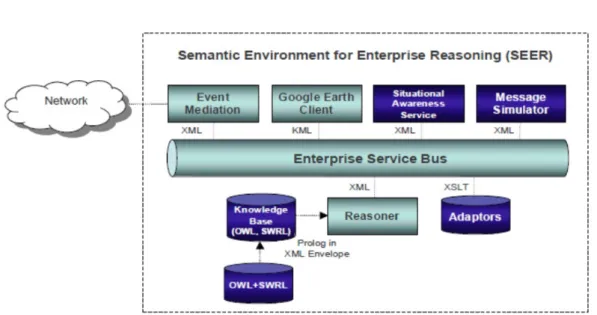
(40) . . . 20 2.7 Architecture of the Semantic Environment for Enterprise Reasoning (SEER)
(40) . . . 21 2.8 Application of OWL+SWRL and OWL-S to describe MIB and PIB (41) 22 2.9 Multi criteria decision making (MCDM) Tree . . . 26 2.10 An SLA based service brokering in intercloud environment (56) . . . 29 3.1 Terminology heterogeneity . . . 36
3.2 Request formulation heterogeneity . . . 37 3.3 Trade-off between QoS parameters . . . 39 3.4 Cloud Broker Architecture . . . 40 3.5 Coherent SLA Establishment . . . 43 3.6 SLA Negotiation Process . . . 45 3.7 SLA Violation Detection Process . . . 46 3.8 Management interface to create policies . . . 48 3.9 Consistency Checking Policies Example . . . 49 3.10 Response Time Violation Detection Policies Example 1 . . . 50 3.11 Response Time Violation Detection Policies Example 2 . . . 50 3.12 Cloud SLA Contract Ontology . . . 52 3.13 IaaS SLA Contract Ontology . . . 54 3.14 SLA interoperability via the broker . . . 56 3.15 Structure of WS-Agreement template . . . 57 3.16 IaaS Request . . . 58 3.17 IAAS SLOs . . . 59 3.18 Penalty example written in WS-Agreement . . . 60 3.19 Penalty example as Rule . . . 61 3.20 Creation constraint example written in WS-Agreement . . . 61 3.21 Creation constraints example created by Protégé . . . 62 3.22 The mapping summary . . . 63 4.1 Response Time utility function . . . 70 4.2 Latency utility function . . . 72 4.3 Bandwidth utility function . . . 72 4.4 Scalability utility function . . . 76 4.5 Peak-Load-provisioning scenario . . . 77 4.6 Under-provisioning scenario . . . 78 4.7 Over-provisioning scenario . . . 78 4.8 OnDemand-provisioning scenario . . . 79 4.9 Dedicated recovery model scenario . . . 81 4.10 Shared recovery model scenario . . . 82 4.11 CertainLogic operator’s definition . . . 84
LIST OF FIGURES
5.1 Semantic evaluation scenario . . . 88 5.2 Syntactic search evaluation . . . 89 5.3 Semantic search evaluation . . . 90 5.4 Response Time Utility functions . . . 94 5.5 Latency Utility functions . . . 96 5.6 Bandwidth Utility functions . . . 98 5.7 Steps to calculate the trust score . . . 102
List of Tables
3.1 Negotiated SLA criteria classification. . . 55 3.2 Mapping Notation. . . 57 4.1 Disaster recovery models. . . 80 5.1 Functional SLA criteria parameters. . . 91 5.2 User request example. . . 91 5.3 Provider’s offers. . . 92 5.4 Provider’s global Utilities. . . 99 5.5 Provider’s classification . . . 99 5.6 Factors involved in the trust score measure. . . 101
1
Introduction
1.1
Context
Cloud Computing is one of the hottest topics in IT as it fundamentally changes the ways institutions and companies are managing their computing needs. Cloud Computing has sprung as a new paradigm, for both enterprises and scientific applications development, managing and delivering services over the internet. So, what is cloud computing? Is it a technology recently invented?
The general idea behind this technology trace its roots back to the 1950s when large-scale mainframes were made available to schools and corporations. Because of the cost of buying and maintaining mainframes, it wasn’t possible to purvey a mainframe to each user. So, multiple users were enabled to access the same mainframe via "dumb terminals". From here emerges the idea of sharing access to the same data storage layer and CPU power from any station. Later, around 1970, emerges the concept of virtual machines (VMs). VM is a tightly isolated software container with an operating system and application inside. It enables different operating systems to run in the same computer at the same time. The VM operating system took the 1950s shared access mainframe to the next level, permitting multiple distinct computing environments to reside on one physical environment.
In the 1990s, telecommunications companies were able to provide users with shared access to the same physical infrastructure. Hence, they started offering virtualized private network connections.
applications via a simple website. Then the idea of delivering applications over the internet was reproduced by multiple providers like Amazon Web Services in 2002 and Elastic Compute cloud (EC2) in 2006.
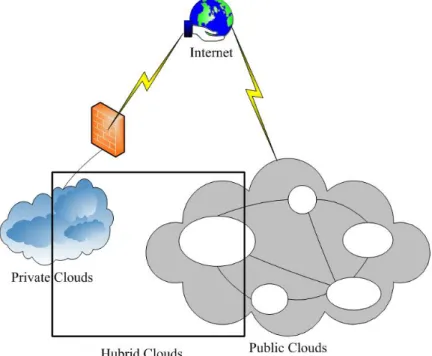
Nowadays, cloud computing is the solution to the problem of how the Internet can help improve business technology. It emerges as a new computing paradigm which provides a large scale service provisioning. It is a framework delivering virtualized infrastructure resources as a service through a public network which is internet. It offers various key advantages such as cost effectiveness, information access from anywhere, quick deployment, almost unlimited Storage, backup and recovery capabilities, and flexibility to scale up and down, and it assures several benefits such as scalability, elasticity, reliability and data management as illustrated by figure 1.1.
Figure 1.1: The cloud computing environment
-Cloud computing proved its usefulness for enterprises and markets which encourage a multitude of providers to offer real business solutions based on the cloud concept. With the rapid proliferation of cloud services, it is now difficult to know which ones are a good fit for a company’s needs.
1.2
Problem statement
The growing popularity and adoption of Cloud computing solutions has attracted many customers from different natures. But face to the diversity and the heterogeneity of cloud service providers, the customers find a difficulty when selecting their best fitting Cloud provider. Indeed, the first problem faced by customers is the heterogeneity problem which consists in the diversity of existing ways for describing services. Actually, each provider establishes the definitions and parameters for its cloud offers. Hence, many
1.3 Contributions
providers may use the same term to define completely different services (hybrid cloud is one example), making it difficult to compare offers (2).
Face to this heterogeneous cloud environment, customers may choose to contact only the providers using the same vocabulary. This could help them in avoiding ambiguity and misunderstanding, but, it ties them to particular providers which don’t offer neces-sary the best solution for them. To avoid to choose unsuitable providers, customers have to work on understanding, analysing and summarising the different provider’s proposal to be able to compare them which is a hard and time consuming task for them.
Moreover, to choose the right cloud provider, customers need also to compare the provider’s quality of service parameters e.g., response time, bandwidth, reputation in the market, reliability . . . . Given the large number and variations of variables involved, it is hard to find a provider that offers good performance for all criteria. Therefore, we have to select the provider that proposes the best trade-off. This could be a difficult task especially involving not only functional criteria but also non functional criteria.
Selecting the right cloud service provider is a difficult process, but it is not the latest difficulty faced by the consumers. Indeed, after negotiating an agreement, cloud service providers don’t offer any performance guaranty and leave the burden of detecting violations to the customers (3). Hence, throughout the execution of the service on the provider’s resources, customers have to wary about the eventual violations of the agreement and impose the necessary penalties to the provider.
1.3
Contributions
To address the issues cited previously, an effective management of the relationship between providers and consumers is required for the delivery of cloud computing. In this work, we propose a third party entity that negotiates the relationships between cloud providers and cloud consumers called cloud broker. Our proposed cloud broker assists users in finding the right cloud provider, establishing a service level agreement and verifying that the provider honours the agreement terms. It aims to ensure:
1. the interoperability between cloud providers and cloud consumers by introducing semantic annotations in the negotiation process;
2. an optimum user satisfaction by finding him the best trade-off between QoS pa-rameters based on his own preferences;
3. the sustainability of user satisfaction by providing him tools to supervise easily the compliance of the provided services with his requirements.
1.4
Thesis structure
Chapter 1 begins by introducing the concept of cloud computing, its characteristics, its service models, its deployment models and its main management challenges. It continues with introducing semantic based management tools and their utilization for network management automation in general which could be an interesting solution for the automation of the cloud management process. Finally, it defines cloud broker concept which is a third-party entity managing the relationship between the cloud actors and negotiating service level agreements in the cloud. In Chapter 2, we present the cloud broker architecture we proposed, its components and its main features. We explained how we used ontologies and rules for managing the SLA contract between providers and consumers, and how semantic annotations could ensure interoperability between the different cloud actors. The use of a multi-attribute utility theory method to find the best cloud provider is presented in Chapter 3. In this chapter, we introduced also our proposed utility functions for calculating the user satisfaction degree. Finally, we evaluate in Chapter 4 the usefulness of the introduction of semantic annotations in discovering more cloud services and in providing more accurate results. We evaluate also the advantages of using the utility functions that we proposed in the best provider selection.
Chapter 2
State of the art on cloud
management frameworks
2.1
Cloud Computing Overview
Cloud computing is the on-demand delivery of computing services over the internet or a company network, or both. cloud services allow individuals and businesses to provision computational, network and storage resources from any device connected to Internet. Provisioned resources are scattered at remote locations all over the world which gives users a wide range of choice. Used technology in cloud computing allows customers to use applications without installation and to access their personal files simply by con-necting at any computer with internet access. Cloud services are also designed to work equally well with Linux, Mac, and Windows platforms. This technology, based on virtu-alization concepts, aims to guaranty high availability, scalability and reliability. In this report, we adopt the definition developed by the U.S. National Institute of Standards and Technology (NIST) (4) : " Cloud computing is a model for enabling convenient, on-demand network access to a shared pool of configurable computing resources (e.g., networks, servers, storage, applications, and services) that can be rapidly provisioned and released with minimal management effort or service provider interaction." The main features of a cloud environment include a reduced cost, an improved efficiency and a rapid deployment of services. Cloud computing can result in reduction in capital and operating expenses. It allows deployed systems to run on the latest platform and it enables changes since it allows people to try new tools. This cloud model promotes
availability, scalability and federation and is composed of five essential characteristics, three service models, and four deployment models.
2.1.1 Cloud Computing Characteristics
Cloud computing is a relatively new business model in the computing world. Under-standing the characteristics of cloud computing will help highlighting its key advantages and understanding its utility. There are myriad variations on the definition of the cloud, but, we will consider the characteristics identified by NIST in their definition. Here, are the five main characteristics that cloud computing offers businesses today.
• On-demand self-service: Computer services such as email, applications, net-work or server service are provisioned automatically without requiring human interaction from a cloud host provider. Typically, consumers are billed with a monthly subscription or a pay-for-what-you-use scenario. Terms of subscriptions and payments will vary with each software provider.
• Broad network access: Cloud capabilities are available over the network and accessed through a simple online access point such as mobile phones, tablets, laptops, and workstations.
• Resource pooling: The providers computing resources are pooled to serve mul-tiple consumers using a multi-tenant model, with different physical and virtual resources dynamically assigned and reassigned according to consumer demand. There is a sense of location independence in that the customer generally has no control or knowledge over the exact location of the provided resources but may be able to specify location at a higher level of abstraction (e.g., country, state, or datacenter). Examples of resources include storage, processing, memory, and network bandwidth.
• Rapid elasticity: Cloud services can be rapidly and elastically provisioned, in some cases automatically, to quickly scale out and rapidly released to quickly scale in. To the consumer, the capabilities available for provisioning often appear to be unlimited and can be purchased in any quantity at any time.
2.1 Cloud Computing Overview
• Measurable service - payment pay-per-use: Going back to the affordable nature of the cloud, you only pay for what you use. Cloud computing resource usage can be measured, controlled, and reported providing transparency for both the provider and consumer of the utilised service. Cloud computing services use a metering capability which enables to control and optimise resource use. This implies that just like air time, electricity or municipality water IT services are charged per usage metrics pay per use. The more you utilise the higher the bill. Just as utility companies sell power to subscribers, and telephone companies sell voice and data services, IT services such as network security management, data center hosting or even departmental billing can now be easily delivered as a contractual service.
2.1.2 Cloud Computing Service Models
There are three basic kinds of cloud service models. Each share similarities but have their own distinct differences as well. These service models are Software-as-a-Service, Platform-as-a-Service and Infrastructure-as-a-Service. It helps to think of these services in layers as depisted by figure 2.1.
Figure 2.1: Cloud Computing Service Models
-Cloud computing services can be categorized into:
• Software-as-a-Service (SaaS): also known as a software on demand. SaaS is a software distribution model in which applications are hosted by a vendor or service provider and made it available to users over the Internet. SaaS offers
already created applications running on a cloud infrastructure. Such applications are exploited is different domains like business domain, financial services, human resources, management etc. This model is the highest level at which cloud can be used by the customers, it eliminates the need to install hardware on the customers local computers and it applies updates without customer intervention. Examples of SaaS providers are: Freshdesk (5), NetSuite(6), Zoho (7), Bloomfire (8) and GHG Corporation (9), among others.
• Platform-as-a-Service (PaaS):provides computing platforms which typically includes operating system, programming language execution environment, database, web server etc. Platform as a Service (PaaS) offers the possibility to exploit clouds in a different manner than using the virtualized infrastructure. It provides a de-velopment platform as a service for developers where applications are developed using a set of programming languages and tools. These services may include de-velopment, integration, testing or resources storage to complete the life-cycle of services. Examples of PaaS providers are: Google App Engine (10), AWS Elastic Beanstalk (11), cloudmapreduce (12) and Force.com (13), among others.
• Infrastructure-as-a-Service (IaaS): IaaS (14) allows managing a large set of computing resources and provides its customers with physical or virtual computing infrastructure, including storage, hardware, servers and networking components. Resources like virtual-machine disk image library, block and file-based storage, firewalls, load balancers, IP addresses, virtual local area networks are rent from IaaS providers, then reconfigured to install IaaS customers applications on them. Scale up is assured by requesting more servers and reconfiguring the load balancer without purchasing more hardware and scale down is possible at any time by reconfiguring the infrastructure. Examples of IaaS providers are: Amazon E2C (15), GoGrid (16), Rackspace (17) and Windows Azure(18), among others.
2.1.3 Cloud Computing Deployment Models
Cloud services can be deployed in different ways, depending on the organizational struc-ture and the provisioning location. Tree deployment models are usually distinguished, namely public, private and hybrid cloud service usage as illustrated in Figure 2.2.
2.1 Cloud Computing Overview
Figure 2.2: Cloud Computing Deployment Models
-• Public cloud refers to a set of computer and network resources characterized by a public availability of service offering and a public network that is used to communicate with the cloud service. Application and data are stored in the providers data center. Windows Azure Platform by Microsoft, AWS by Amazon, AppEngine and Gmail by Google, etc. are all examples of public cloud services. Public clouds are perfect for organizations looking to expand their testing or development environment. However, Customers who possess sensitive data and application normally do not feel comfortable using public cloud due to privacy, policy, and security concerns.
• Private cloud is dedicated to a single organisation provided with great control and privacy. The chief advantage of these systems is that hardware is locally managed, so, hosting organisation retains full control over corporate data, secu-rity guidelines, and system performance. In contrast, private cloud offerings are usually not as large-scale as public cloud offerings resulting in worse economies of scale.
take advantage of the scalability and cost-effectiveness offered by the public cloud computing environment without exposing mission-critical applications and data to the vulnerabilities associated with the public cloud option. The deployment of an hybrid cloud computing system requires two or more clouds (private or public)that remain unique entities but are bound together by standardized or proprietary technology. With the benefits derived from both deployment models, the hybrid model solution has become more popular nowadays.
2.2
Cloud Computing Management Challenges
Cloud computing will play a major role in the future Internet of Services by offering on-demand access to shared resources and services. However, it must address several technology challenges (19, 20) to accomplish its business objectives. In order to better coordinate and accelerate standardisation in the field of cloud computing at the national and the European levels, the Federal Ministry of Economics and Technology has engaged Booz and Company to conduct a study defining cloud computing challenges (21). Nine especially relevant challenges have been identified which cover both the perspectives of providers and users and overarching interests. At a second level, they are subdivided again into 19 further subcategories. Defined cloud challenges are depicted by figure 2.3. A key challenge IaaS providers face when building a cloud infrastructure is
Figure 2.3: Cloud challenges as introduced by Booz and Company
2.2 Cloud Computing Management Challenges
orchestration of resources must be performed in a way to rapidly and dynamically provision resources to applications. In the next section, we discuss the most common management challenges that emerge in the cloud computing domain.
2.2.1 Data Management
Cloud storage is a model of networked online storage where data is placed on multiple virtual servers, generally hosted by third parties; rather than being hosted on dedicated servers. Hosting companies operate large data centers. The data center operators, in the background, virtualize the resources according to the requirements of the customer and expose them as storage pools, which the customers can themselves use to store files or data objects. This way, the resource may be span physically across multiple servers. Clouds have a single point of access for all computing requests so consumers will have access to data from any point, on demand. From the business point of view, Cloud infrastructures aim to provide robustness and availability at any time. Scalable and consistent data management is a challenge that has confronted the database research community for more than two decades (22, 23). Moreover, there are limitations on the size of the objects that can be stored, which can create some complications in the development process. The fine-grain access is another issue since IaaS provides just simple mechanisms like get and put for managing the data, and these operations cannot access just small parts.
2.2.2 Virtual Machine Management
The use of virtualisation technologies enable service providers to optimise the use of resources. Indeed, until recently, operating systems managed the allocation of physical resources, such as CPU time, main memory, disk space and network bandwidth to applications. Virtualisation infrastructures, such as Xen and VMWare. are changing this by introducing a layer of abstraction known as a hypervisor. Dynamic management of virtualized application environments has become an active area of research in the cloud computing paradigm, especially with recent virtualization capabilities that allow live sessions to be moved transparently between servers (24, 25). Cost of resources varies significantly depending on configuration for using them. Hence efficient management of resources is of prime interest to both cloud providers and cloud users. Performances of virtual machines depends also on the resources usage of other virtual machines using
the same physical resources. Thus, the need of a scheduler orchestrating the virtual machine placement within the cloud. The scheduling algorithms are divided into static scheduling and dynamic scheduling. Static approaches are based on the prediction of the process behaviour then they guaranty response times. Dynamic scheduling are more flexible since virtual machines are automatically turned on or off based on demand and threshold policies. The architecture of schedulers could be categorised into centralized approaches and decentralized ones. There are several virtual machines schedulers such as Snooze, Entropy, open Nebula scheduler and Haizea (26).
2.2.3 Load Balancing
Load Balancing (27) is used to distribute workload across one or multiple servers, net-work interfaces, hard drives, or other computing resources. This method is used to optimize resource usage by avoiding overload of any one of the resources, minimize re-sponse times and maximize throughput. Load balancers are typically used within data centers as part of the overall application delivery controllers. They represent a traffic management solution that functions at the DNS layer. They are introduced to overcome some of the significant networking challenges associated with providing fully elastic and scalable self-service capabilities when delivering application services in service provider environments. Load balancing is especially useful for networks where it is difficult to predict the number of requests that will be issued to a server. It can be implemented with dedicated hardware or software, or a combination of both. Using multiple compo-nents with load balancing instead of a single component may increase reliability through redundancy. Typically, load balancing is the main reason for computer server clustering. Load balancing has become a challenging research area for efficient operations in a cloud environment. Diverse static and dynamic algorithms are proposed to resolve the issue of load balancing and task scheduling presenting many advantages and disadvantages.
2.2.4 Security
Cloud computing opens up a new world of opportunities for businesses, but mixed in with these opportunities are numerous security challenges that need to be considered and addressed prior to committing to a cloud computing strategy. Because of the cloud service models employed, cloud computing presents more risks than other IT environments. Security (28, 29) and privacy are still cited by many organisms as the
2.2 Cloud Computing Management Challenges
top inhibitors of cloud services adoption. The cloud, especially public clouds, highlights new and significant security concerns for companies that are accustomed to hosting their data and applications within their own servers. Cloud computing security challenges fall into three broad categories:
• Data Protection: Securing your data both at rest and in transit
• User Authentication: Limiting access to data and monitoring who accesses the data
• Disaster and Data Breach Contingency Planning
2.2.5 Service Level Agreement
Service Level Agreements (SLAs) (30) has been used since 1980s in a variety of fields, so, most of the available definitions are contextual. In the area of cloud computing, SLAs are agreements between a service provider and another party such as a service consumer, a broker agent or a monitoring agent. It is a formal contract used to guaranty that consumer’s service quality expectation can be achieved and it provides a unique combination of business-driven application scenarios and advanced research in the area of service-level agreements for clouds and service-oriented infrastructures. SLAs are offered by IaaS providers to express their commitment to delivery of a certain QoS. An SLA usually include availability and performance guarantees. Additionally, SLA metrics could be classified by different categories which are compute SLAs, Network SLAs and Storage SLAs. metrics must be agreed upon by all parties as well as penalties for violating these expectations. Most IaaS providers focus their SLA terms on availability guarantees, specifying the minimum percentage of time the system will be available during a certain period.
Actually, there is no standard to express cloud SLA. Each provider describes its service level agreements in its own way. Thus, several languages for specifying SLA have been proposed:
The Web Service Level Agreement (WSLA) The Web Service Level Agreement (WSLA) (31) provides a framework for defining and monitoring service level agreement (SLA) for Web services. It could be used also in other domains such as business process
and service management, or the management of networks, systems and applications in general. It consists of a formal and extensible language, designed to specify SLAs in a flexible and individualized way. It is XML-based used by both service providers and consumers. Since SLA specification is determined, the WSLA monitoring services are automatically configured to enforce the SLA. However, The WSLA specifications don’t foresee creation and form of a WSLA template. Though a WSLA document without specified parties may potentially be used as a template, the specifications don’t support ranges of values for obligations. An implementation of the WSLA framework, termed SLA Compliance Monitor, is publicly available as part of the IBM Web Services Toolkit. Figure 2.4 shows a short recap of WSLA.
Figure 2.4: WSLA Services and their interactions (32)
-SLAng SLAng (33) is a language for concrete service-level agreements currently pro-viding support for ASP SLAs. It provides a format for the description of QoS proper-ties using an EMOF metamodel, with embedded OCL constraints and natural-language documentation in English. SLAng defines QoS targets including reliability, timeliness,
2.2 Cloud Computing Management Challenges
availability, data currency, data recovery. The application of these constraints can be varied according to the level of abstraction at which the system is described. SLAng is designed so that all SLAs expressed in the language are monitorable. This makes it extremely precise as well as being understandable. It also includes semantics for admin-istration, which is the process whereby the parties to the SLA agree what penalties are to be paid. It expresses constraints on the accuracy of reports used in administration that are approximately monitorable. However, it is not enough expressive to represent the QoS parameters included in SLA. SLAng defines seven different types of SLA. They regulate the possible agreements between the different types of parties identified in the SLAng model which are Application, Web Service, Component, Container, Storage and Network. Vertical and Horizontal SLAs can be contracted between pairs of them. The Vertical SLAs are:
• Application: between applications/web-services and components. • Hosting: between container and component providers.
• Persistence: between a container provider and an SSP. • Communication: between container and network providers. The Horizontal SLAs are:
• Service: between component and web service providers • Container: between container providers
• Networking: between network providers
WS-Agreement The Web Services Agreement (34) specification constitutes a nor-mative language to formulate Service Level Agreements and a basic protocol to expose service-level descriptions, validate service-level requests, and come to an agreement. This Java framework, proposed by the OGF WS-Agreement standard, defines a tool to create and manage service level agreements in distributed systems. The WS-Agreement specification defines two separate schemata, the agreement schema and the agreement state schema. The agreement schema that defines the WS-Agreement core data types and the agreement state schema that includes the data types for the dynamic agreement
monitoring, namely the agreement states, service term states and guarantee term states. WS-Agreement allows a service provider and a service consumer to decide whether to accept or reject a service offer. Although this approach is sufficient for a number of use cases, others exist with requirements for multi-step negotiation or the adaptation of an existing agreement.
Generally, each provider decide about the SLA language used to communicate with the consumers. Starting from the selected language, he can define an SLA template in which he specifies for example the quality of service parameters. The definition of the QoS parameters may differ from one provider to another i.e., two different providers may refer to different concepts by the same QoS parameter. This can lead to a misun-derstanding between providers and consumers resulting in a bad discovery and selection services regarding the consumer’s requirements.
Next section targets works dealing with service discovery and selection in the cloud.
2.3
Service Discovery and Selection
In order to reduce the heterogeneity between various equivalent services, several works have proposed to use ontologies and semantic annotations. In the following, we will introduce semantic based management tools such as ontologies and declarative pro-gramming and we will present relevant works that used ontologies for cloud service discovery.
2.3.1 Semantic based management tools
2.3.1.1 Semantic Web architectures
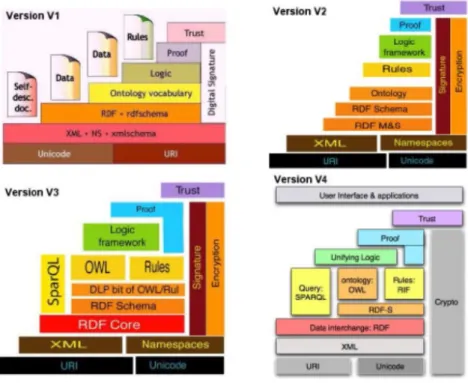
Semantic Web architecture (35) is the next generation in information architecture. Se-mantic Web enables data to be presented in an efficient way to be understood and used by machines without human intervention. The most well-known versions of the layered architecture that exist within literature have been introduced by BernersLee (36). Berners-Lee proposed four versions of Semantic Web architecture as depicted by figure 2.5. The fist one in 2000, the second in 2003 as part of a presentation at the SIIA Summit, the third and fourth versions in 2005 and 2006 respectively. The main difference between those versions consists in the positioning and interaction between
2.3 Service Discovery and Selection
ontology and rules layers. In fact, Semantic technologies represent meaning using on-tologies and provide reasoning through the relationships, rules, logic, and conditions represented in those ontologies.
Figure 2.5: Semantic Web Architectures (35)
-2.3.1.2 Ontology
The use of ontologies (37) has shown its benefits in many domains especially artificial intelligence, knowledge representation and inductive reasoning. Some generic ontologies have been designed to provide a framework for building service level agreements. They contribute essentially to identify concepts in the SLA domain. Moreover, the combina-tion of ontologies with rule-based knowledges (38) is recommended for many interesting semantic web tasks.
Ontology can be defined as a formal, explicit specification of the terms of a shared conceptualization and relations among them. It is not a simple hierarchical structure of items but a logical description of concepts, relations among them and individual in-sertion. It has been introduced for explicating semantics of formal languages used in
knowledge sharing. One of the main advantages of employing ontologies expressed in logic-based formalism such as OWL is being able to check the logical consistency of our model using reasoners. Standard reasoner services are: consistency checking, sub-sumption checking, equivalence checking and instantiation checking. Such mechanisms facilitate automation, especially consistency checking mechanism, avoiding the creation of classes that doesn’t really make sense. Reasoners help also inferring ontologies by deriving further expressions and relations that are not explicitly contained within the ontology.
Web Ontology language (OWL) is a knowledge language constructed over the RDF layer in the semantic web architecture, specified by the W3C consortium. OWL be-came the most used language for ontology description. OWL as a language has three sub languages: OWL-full, OWL-DL and OWL-lite. OWL-Full, as its name indicates, is a full version of OWL language. It allows a maximum expressiveness but may be undecidable and hence difficult to reason over. OWL-DL defines a decidable OWL lan-guage corresponding to the logic description SHOIN(D). OWL-Lite is a simple version of OWL corresponding to the logic description SHIF. It is decidable too. OWL-Lite is only useful for customers requiring a hierarchical classification of concepts supported by some simple constraints. This version of OWL can not be adopted for Service Level agreement specification requiring more expressiveness. OWL-Full can’t be retained too because of its undecidability, while SLA specification is harnessed in automated systems so its ontology needs to be reasoned over. Ultimately, OWL-DL seems to be the best OWL version for SLA description due to its richness and its decidability.
2.3.1.3 Declarative programming
In contrast to conventional imperative programming languages such as Java or C++ specifying a series of instructions to be executed, declarative rule languages based on logic programming (LP) states what computer should do rather than how it should do it (39). It declares a set of rules about what outputs should result from which input. Declarative programming adduces a high level of flexibility. In fact, rule languages develop flexible applications on a high abstraction level. They are seen as self-contained knowledge units that involves some form of reasoning. Rules are classified as three types depending on their purpose: