Eberly: Northwestern University and NBER Rebelo: Northwestern University, NBER and CEPR Vincent: HEC Montréal and CIRPÉE
We thank Nick Bloom for helpful discussions on the estimation algorithm, Damba Lkhagvasuren for providing us Cahier de recherche/Working Paper 09-08
Investment and Value: a Neoclassical Benchmark
Janice Eberly Sergio Rebelo Nicolas Vincent
Abstract:
Do investment models fit firm-level data? – which model fits best? To answer this question we estimate alternative models using Compustat data. We find that both a version of the Hayashi (1982) and a model with decreasing returns to scale in production fit firm-level data very well. Our estimates suggest that there is substantial measurement error in Q. This measurement error implies that the investment-cash-flow regressions that have received so much attention are ineffectual to discriminate among alternative models. In fact, the models that we estimate generate empirically plausible cash-flow and lagged-investment effects even though they were not designed to produce them.
Keywords: Investment, Hayashi, Investment adjustment costs, Tobin’s Q, Regime
switching
1. Introduction
In Hayashi’s (1982) neoclassical model of investment average Q (the value of existing capital divided by its replacement cost) is equal to marginal Q (the value of an additional unit of installed capital). This property famously implies that average Q is a su¢ cient statistic for determining a …rm’s investment decision. This implication has often been empirically rejected. Cash-‡ow and lagged-investment e¤ects are present in virtually every investment-regression speci…cation and data sample.1 These e¤ects suggest that Hayashi’s model is an inadequate description of the behavior of investment at the …rm level.
In this paper we search for an empirically successful model of investment. We …nd that investment regression estimates are very sensitive to the presence of mea-surement error in Q. So, instead of using these regressions as our guide, we use a broad set of empirical moments (means, standard deviations, persistence, and skewness properties of cash ‡ow, Q, and investment) to estimate three candidate models. Our estimates are based on the simulated method of moments imple-mented on …rm-level data for the top quartile of Compustat …rms sorted by the size of the capital stock in the beginning of the sample. These are the …rms that Fazzari, Hubbard, and Petersen (1988) (henceforth FHP) use as their frictionless benchmark because they are unlikely to be a¤ected by …nancial frictions.
Our models are driven by stochastic shocks that can be interpreted as produc-tivity or demand shocks. We assume that these shocks follow a regime-switching process. This model feature is important, because it generates skewness in cash ‡ows, as well as the low correlation between Q and current cash ‡ow observed in the data.
1The lagged-investment e¤ect has attracted less attention than the cash-‡ow e¤ect but it
is empirically much more important. Lagged investment is a much better predictor of current investment than either Q or cash ‡ow.
The …rst model, which we call the “decreasing-returns model,” features de-creasing returns to scale in production, a …xed operating cost, and quadratic capital adjustment costs.2 The conditions for Q to be a su¢ cient statistic for in-vestment choice are not satis…ed in this model because the production function is not homogeneous of degree one. However, in a single-regime version of the model, the decision rule for optimal investment can still be very closely approximated by a log-linear function of Q. The second model, which we call the “Hayashi model,” is a version of Hayashi’s (1982) model with quadratic investment ad-justment costs. The third model, which we call the “CEE model” incorporates adjustment costs that penalize changes in the level of investment, as proposed by Christiano, Eichenbaum, and Evans (2005). This speci…cation has gained cur-rency in the macroeconomics literature because it generates impulse responses to monetary policy shocks that are consistent with those estimated using vector auto-regressions.
Surprisingly, we …nd that both the Hayashi model and the decreasing-returns model …t …rm-level data very well. The CEE model also provides a reasonably good …t, but it generates excess persistence and insu¢ cient skewness in invest-ment. These properties result from the fact that the CEE model penalizes large changes in investment, generating a highly persistent investment series that ex-hibits very few investment spikes.
Our estimates suggest that there is substantial measurement error in Q. This …nding is consistent with the results in Erikson and Whited (2000) who estimate the importance of measurement error in Q using the information contained in the third and higher-order moments of the joint distribution of the regression variables.
2Curvature in the revenue function, which we model as arising from decreasing returns to
scale in production, can also arise from monopoly power. We discuss this equivalent formulation when we develop the model.
This measurement error can arise from any component of Q that is better observed by the …rm than by the researcher, including the market value of debt or the replacement value of the capital stock.3 More controversially, measurement error in Q can also arise from di¤erences between the intrinsic value and the market value of equity, as suggested by Shiller (1989, 2000). Consistent with this view, measures of Q that do not rely on the market value of equity tend to be better predictors of investment than conventional measures of Q. Examples of these alternative Q measures, include estimates based on cash-‡ow forecasts (Gilchrist and Himmelberg (1995)), analyst forecasts of earnings growth (Cumins, Hassett, and Oliner (2006)), and bond prices (Philippon (2008)).
The cash-‡ow e¤ect present in our data is likely to be caused by measurement error and/or model mispeci…cation. We draw this inference because we …nd cash-‡ow e¤ects in our sample, even though it only contains very large …rms that are unlikely to face borrowing constraints.4 To investigate this possibility we run investment regressions on data generated by simulating our three models. All three models generate cash-‡ow and lagged-investment e¤ects. These results suggest that the investment regressions that have received so much empirical attention are ine¤ectual to discriminate between alternative models.
The decreasing-returns model generates e¤ects that are remarkably similar to those we estimate in our data. In this model these e¤ects emerge both from measurement error in Q and from mispeci…cation in the investment regression, since average and marginal Q do not coincide. The optimal level of investment is 3We studied the case in which measurement error arises from the use of book value as the
seed in the perpetual inventory calculation of the capital stock. However, we found that this source of error alone decayed too quickly, owing to depreciation, to have a signi…cant e¤ect on our estimates.
4Several authors suggest that cash-‡ow e¤ects can be generated by deviations from Hayashi’s
(1982) assumptions. For example, Schiantarelli and Georgoutsos (1990), Cooper and Ejarque (2003), Gomes (2001), Alti (2003), and Moyen (2004) study the implications of decreasing returns to scale, while Abel and Eberly (2001, 2005) analyze the e¤ects of growth options.
a function of three state variables: the capital stock, the shock, and the regime. So any additional independent variable that is correlated with the state variables has explanatory power in a regression equation. As a result, cash-‡ow and lagged-investment e¤ects emerge naturally, even though the model is not designed to produce them.
Our analysis di¤ers in this respect from that of Cooper and Ejarque (2003). These authors show that they can parameterize a model without …nancial frictions so that it generates a cash-‡ow e¤ect that is similar to that present in the data. They do so by estimating a model to match the coe¢ cients of Q and cash-‡ow in an investment regression estimated by Gilchrist and Himmelberg (1995) as well as three other moments (the serial correlation of investment rates, the standard deviation of pro…t rates, and the average value of average Q).
Our paper is organized as follows. In Section 2 we present the decreasing-returns model. In Section 3 we discuss our data and estimation procedure. Section 4 presents the results for a version of the decreasing-returns model in which the demand or productivity shock has a single regime. We also discuss the e¤ects of introducing asymmetric investment adjustment costs, investment irreversibility, a variable discount factor, as well as a behavioral bias. In Section 5 we discuss results for the regime-switching version of the model.5 Section 6 considers the Hayashi model. Section 7 contains results for the CEE model. Section 8 concludes.
5Since our estimates are based on …rm-level data, this result does not imply that these
features are not useful to understand investment in less aggregated data (e.g. at the plant level or in smaller …rms).
2. The decreasing-returns model
The …rm’s problem is given by the following Bellman equation, where y0 denotes next period’s value of variable y:
V (K; X; z) = max I [zK X 1 X [I=K ( 1)]2 K I + Z V (K0; X0; z0)F (dz0; z)], K0 = I + (1 )K.
The …rm’s output is given by zK X1 . The variable X denotes the level of exogenous technological progress. This variable grows at a constant rate > 1, X0 = X. The stochastic variable z is governed by the distribution F ( ). This variable represents a shock to productivity or to the price of the …rm’s output. We can interpret the production function as requiring a single production factor, capital. Alternatively, we can think of output as being produced with capital, labor, and other variable factors, with labor and variable factors being adjustable without frictions. In this case zK X1 represents output net of labor and other variable costs. Under this interpretation, which we adopt throughout the paper, the variable z can also represent shocks to the real wage or to the price of other variable factors.
We assume that < 1. We can interpret this property as re‡ecting the presence of decreasing returns to scale in production. Alternatively, we can think of < 1 as resulting from a setting in which the production function exhibits returns to scale but the …rm has monopoly power and faces constant-elasticity demand function.
The function V (K; X; z) represents the value of a …rm with capital stock K, technical progress, X, and total factor productivity, z. We denote the discount
factor by . Capital depreciates at rate . The variable represents a …xed operating cost paid in every period.6
Investment, denoted by I, is subject to quadratic adjustment costs, which are represented by the term [I=K ( 1)]2K. This formulation has the property that adjustment costs are zero when the …rm grows at its steady state growth rate, . The parameter controls the size of the adjustment costs.
We de…ne cash-‡ow (CFt) as:
CFt= zK X1 X [I=K ( 1)]
2 K,
which is net revenue after …xed operating costs and investment costs, so we inter-pret investment adjustment costs as reducing output or revenue.
Investment, average, and marginal Q The optimal level of investment is given by:
1 + 2 [I=K ( 1)] =
Z
V1(K0; X0; z0)F (dz0; z)]. (2.1) Equation (2.1) implies that investment is a function of marginal Q, de…ned as the value of an additional unit of installed capital ( R V1(K0; X0; z0)F (dz0; z)]). This function is linear as a consequence of our assumption that adjustment costs are quadratic.
Average Q is de…ned as the ratio of …rm value to the stock of capital: Q = V (K; X; z)
K . (2.2)
In this model marginal and average Q do not coincide, so investment cannot be written as a linear function of Q. The di¤erence between average and marginal Q 6This cost is …xed with respect to the investment decision, but grows with the technology X,
arises for three reasons: the presence of decreasing returns to production ( < 1), the presence of …xed costs ( ), and timing considerations that result from the discrete-time nature of our model.
To explain these timing considerations consider the case in which = 1 and = 0. Then average Q, de…ned as (2.2) is still di¤erent from marginal Q. In order for marginal and average Q to coincide we must measure Q at the end of the period. We denote end-of-period Q by Q :
Q = V (K
0; X0; z)
K0 ,
Here V (K0; X0; z) is the end-of-period value of the …rm, de…ned as the value of the …rm after it receives its cash ‡ow and incurs investment costs but before it learns z0. It is easy to show that, if = 1 and = 0, marginal and end-of-period average Q coincide:
Q = Z
V1(K0; X0; z0)F (dz0; z)].
Using equation (2.1) we can write investment as a linear function of Q .
The fact that V (K0; X0; z) is computed before the …rm learns z0 makes it di¢ cult to compute empirically. For this reason we use the conventional de…nition of Q, given by equation (2.2), in our analysis, so that it more closely corresponds to empirical measures.
Single versus Regime-Switching Regime We consider two versions of the shock process. In the ‘single-regime model’, z follows a Markov chain where the mean shock is normalized to one and the support is given by:
We assume that the Markov chain for the single-regime model takes the form: = 2 4 p2 2p(1 p) (1 p)2 p(1 p) p2+ (1 p)2 p(1 p) (1 p)2 2p(1 p) p2 3 5 .
The …rst-order serial correlation of the shock implied by this matrix is: = 2p 1 (see Rouwenhorst (1995)).
In the ‘regime-switching model’the support of z is given by: z 2 L L; L; L+ L; H H; H; H + H , where:
L
= 1 , (2.3)
H = 1 + .
The variable governs the distance between the means of the two regimes. Pro-ductivity alternates between two regimes, the low regime ( L L; L; L+ L) and the high regime ( H H; H; H + H). The evolution of z is governed by a Markov chain.
Since we allow for growth in the model, it is useful to rewrite the …rm’s problem in terms of detrended variables, k = K=X, i = I=X, and v(k; z) = V (K; X; z)=X:
V (k; z) = max i;k0 [zk [i=k ( 1)] 2 k i + Z V (k0; z0)F (dz0; z)], k0 = i + (1 )k.
We solve the model using the value-function iteration method (see Appendix 9.3).
3. Estimation
In this section we …rst describe the data used in our estimation and summarize some key data properties using simple regressions. We then describe our estima-tion procedure.
3.1. Data
To estimate the model we use a balanced panel of Compustat …rms with annual data for the period 1981-2003. Using a balanced panel introduces a selection bias towards more stable …rms which are the intended focus of our study. Our sample includes 776 …rms and roughly 14; 000 …rm-year observations. We focus our analysis on the large …rms in our data, de…ned as being those in the top quartile of …rms sorted by size of the capital stock in 1981. In the beginning of the sample, the top quartile of …rms represents 30 percent of aggregate private non-residential investment and 40 percent of corporate non-residential investment. We use data for the four variables present in our model: investment in property, plant, and equipment, the physical capital stock, Q, and cash ‡ow. We exclude from our sample …rms that have made a major acquisition to help ensure that investment measures purchases of new property, plant, and equipment. We estimate the physical capital stock using the perpetual inventory method. We use the book value of capital as the starting value for the capital stock and four-digit industry-speci…c estimates of the depreciation rate. Q is calculated as the market value of equity plus the book value of debt, divided by the capital stock estimate. Cash ‡ow is measured using the Compustat item for Income before extraordinary items + depreciation and amortization + minor adjustments. We describe the data in more detail in Appendix 9.1.
In Table 1 we report summary statistics for the fourth quartile (largest) …rms in our sample, both for the 1981-2003 period and for two sub-periods, 1981-1992
and 1993-2003. Standard errors are indicated in parenthesis. We report the me-dian across …rms of selected time-series moments. An alternative would have been to compute moments for the average across …rms of the variables of interest. However, this procedure would eliminate the idiosyncratic variability associated with individual …rms. The median time-series averages are 1:3 for Q, 0:15 for the investment-capital ratio, and 0:17 for the cash-‡ow-capital ratio. We report the standard deviations for both the logarithms and levels of the main variables. Q is the most volatile variable, closely followed by cash ‡ow/capital and invest-ment/capital. The estimates in Table 1 are similar to those reported in other studies that use Compustat data.
There are important di¤erences across sub-samples. In particular, the mean and standard deviation of Q and cash ‡ow in the second sub-sample are signi…-cantly higher than in the earlier period. All variables exhibit positive skewness, and there is more skewness in the full sample than in each of the two sub-samples. The systematic di¤erences across sub-samples lead us to consider a regime switch-ing model in our estimation strategy. Finally, Q exhibits strong serial correlation, while investment and cash ‡ow exhibit moderate persistence.
In Table 2 we report pooled, time-series-cross-section regressions of the investment-capital ratio on log(Q), log(cash ‡ow/investment-capital) and the lagged investment/investment-capital ratio.7 The coe¢ cient on log(Q) is quantitatively small (0:06), but signi…cant, with modest explanatory power (R2 = 0:29). Including cash ‡ow increases sig-ni…cantly the explanatory power of the regression (R2 = 0:34) and reduces the size (0:03) and signi…cance of the coe¢ cient on Q. Cash ‡ow has a large and 7We use a semi-log speci…cation since, as discussed in Abel and Eberly (2002), the log
speci…cation …ts the data better. The skewness in the independent variables, Q and the cash ‡ow/capital ratio, favors the semi-log speci…cation over a conventional linear regression. When we run linear regressions, the coe¢ cient on Q is small but signi…cant, and the coe¢ cient on cash ‡ow/capital is larger and also statistically signi…cant. These results accord with the investment regression results reported in the literature.
statistically signi…cant e¤ect on the investment-capital ratio. As discussed in the introduction, this cash-‡ow e¤ect is surprising since we use data for the top quartile of Compustat …rms, which a priori are unlikely to face borrowing con-straints. We view this e¤ect as likely stemming from measurement error and/or mispeci…cation, and explore these possibilities in sections 4 and 5. Adding the lagged investment-capital ratio to the regression leads to a large improvement in the goodness of …t (R2 = 0:61). Even though much of the investment literature focuses on the cash-‡ow e¤ect, the lagged-investment e¤ect is far more important from an empirical standpoint.
Figures 1 through 3 provide scatter plots of pooled time-series-cross-section data that are useful to visualize the relation between di¤erent variables. Figure 1 shows a scatter plot of investment versus log(Q). Figure 2 shows a scatter plot of investment and log(cash ‡ow/capital). Figure 3 shows the close correlation between the investment-capital ratio and its lagged value.
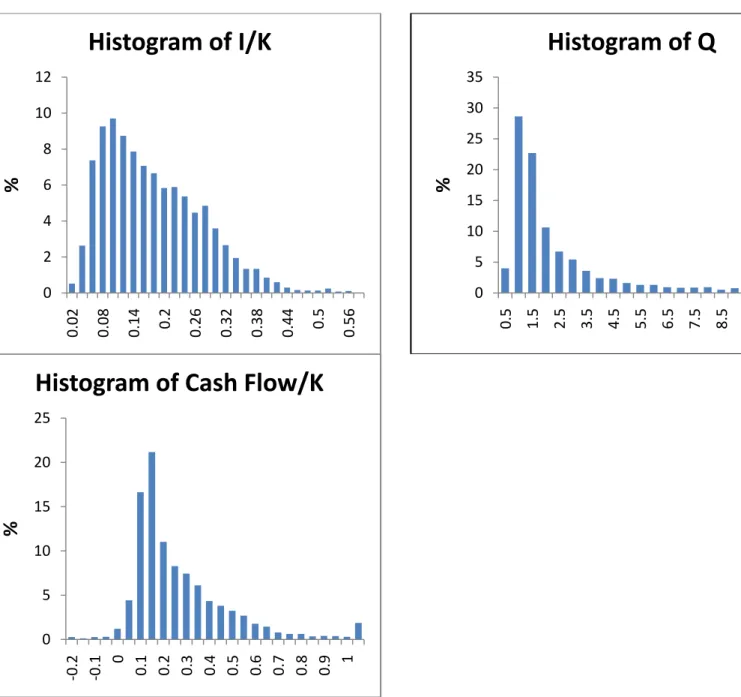
Figure 4 displays the histograms for I=K, average Q, and cash-‡ow/K for the …rms in our sample. Figure 4 depicts three features of the data that are relevant for our analysis. The …rst feature is that only 0.5 percent of the observations for I=K are near zero (less than 0.02). This …nding suggests that that investment irreversibilities do not play an important role in our data, as there is little dis-cernible range of inaction in which investment is zero. We introduce investment irreversibility into our model, in section 4.3, and …nd that the irreversibility con-straint never binds and the …t of the model does not improve. The second feature is that the histogram shows no concentration of large spikes in investment, sug-gesting that …xed costs of investment are not likely to be useful in matching the properties of the investment data for these large …rms. The third feature is that all three variables are skewed. This property suggests that asymmetric adjustment costs to investment may not be needed to match the skewness in investment,
since the underlying cash ‡ows and Q are already skewed. We investigate these possibilities formally in section 4.3, where we further discuss these issues.
3.2. Estimation Procedure
Our solution method does not yield an analytical representation for the population moments implied by the model. For this reason, we estimate the model using the simulated method of moments proposed by Lee and Ingram (1991). We …rst use our data to estimate the vector of moments D, as described in Section 3.1. We focus on the moments that are most directly related to the parameters of the model. The moment vector that we use to estimate the single regime model includes the mean, standard deviation, and serial correlation of cash ‡ow (to identify the shock process), the variance of investment (to identify adjustment costs), and the mean of Q (to identify the …xed cost). We …nd the parameter vector ^ that minimizes the distance between the empirical and simulated moments,
( ^ ) computed for the median …rm,
L( ^ ) = min [ ( ) D]0W [ ( ) D]. (3.1) The weighting matrix W is computed using a block-bootstrap method on our panel dataset (see Appendix 9.6 for a description). This estimation method gives a larger weight to moments that are more precisely estimated in the data
We solve the minimization problem (3.1) using an annealing algorithm. This procedure is used to avoid convergence to a local minimum. Finally, the standard errors of the estimated parameters are computed as
^ = ( 0W ) 1
n ,
where is the matrix of derivatives,
= @ ( ^ ) @ ^ ,
which we compute numerically. The estimation method is discussed in more detail in Appendix 9.6.
4. Results: decreasing-returns model, single regime
We choose the exogenous rate of technical progress to be = 1:03. This growth rate is equal to the real annual growth rate of corporate net cash ‡ows from January 1981 to January 2004. We set = 0:8. This value is consistent with the estimate of the average degree of returns to scale across industries by Burnside (1996). We …x because we cannot separately identify and using the moments of the data that we consider. Both parameters control curvature, so when changes, the value of can be adjusted to restore the …t of the model. We estimate two versions of the model, with and without measurement error in Q. 4.1. Parameter and moment estimates
We report our parameter estimates and standard errors in Table 3. Our estimate of the adjustment cost parameter, , is 0:4148 (with a standard error of 0:0035). This estimate implies that the average investment adjustment cost is 0:8 percent of revenue net of variable costs, zK X1 in the notation of the model. Our estimate for the …xed operating cost, , is 87:07 (with a standard error of 2:23). This estimate implies annual …xed operating costs that are 22 percent of revenue net of variable costs.8 We normalize the average shock z to one. We estimate the spread between shocks to be 0:522. As we discuss below, these values allow the model to match the mean and standard deviation of the cash-‡ow-capital ratio in the data.
8To calibrate this value to revenue, suppose that variable costs, including labor, are a
two-thirds share of expenditure. In this case, the …xed operating cost would be on average .22/3 = 7.3% of revenue.
Table 1 reports summary statistics for a panel of …rms constructed by simu-lating our model. The moments in bold are included in the D vector, so our estimation algorithm seeks to make these moments as close as possible to those estimated from Compustat data. The algorithm matches all of these moments closely. The remaining moments are not “targeted” by the algorithm.
Table 1 shows that the single-regime model matches well the …rst-order serial correlations of sales, cash ‡ow, and investment, although Q is signi…cantly less persistent than in the data. Our main …nding is that the model generates a much lower standard deviation and skewness of Q than those we …nd in the data. The volatility of Q generated by the model is one-fourth of the volatility of Q present in the data (0:157 versus 0:625).
We then estimate the model with measurement error in Q in order to match the standard deviation, …rst-order serial correlation, and skewness of our empir-ical measure of Q. The estimated noise process generates Qnoise
t = Qtexp("t) +0:7486"t, where "t+1 = 0:8761"t+ 0:1369 t+1 and tv N(0; 1). Note that since the estimated measurement error is serially correlated, it cannot be corrected in the investment regressions using instrumental variables.
4.2. Simulated regression results
To evaluate the performance of our model from a di¤erent angle we estimate investment regressions on a panel of …rms constructed by simulating our model. We use as explanatory variables both the state variables, which are only observable in the model, as well as Q, cash ‡ow, and lagged investment. We report our results in Table 2. The …rst column shows that regressing investment on the true state variables of the model (k and the shock, z) using a semi-log speci…cation yields an R2 of 0:95. This speci…cation proves a very good description of how optimal investment depends on the state variables.
We discussed in Section 2 three reasons why average Q is di¤erent from mar-ginal Q: the presence of decreasing returns to production, the presence of …xed costs, and timing issues that result from our discrete-time formulation. Still, we obtain a very good …t (the R2 is 0:95) when we regress investment on log(Q). When Q is measured without error, average Q is an excellent proxy for marginal Q. In this sense, this model is not much di¤erent from the original Hayashi (1982) model.
When we use the noisy version of Q in our investment regressions the R2 falls to 0:08 and the coe¢ cient on Q is 0:037 (compared to 0:466 for the true Q ). When cash ‡ow is added to the regression with noisy Q, the coe¢ cient on Q falls below 0:01, cash ‡ow has a coe¢ cient of 0:079, and the R2 rises to 0:71. When we replace cash ‡ow with the state variable z in the investment regression, we obtain an R2 that is similar to that obtained using cash ‡ow as a dependent variable. Since there are no frictions in the model, cash ‡ow enters signi…cantly in the regression because it is a proxy for the shock, z.
One shortcoming of the single-regime model is that it cannot explain the role of lagged investment in investment regressions. When we include lagged investment in the model-based regressions we obtain a very small coe¢ cient (0:02, compared to 0:63 in the data) and no increase in explanatory power.
In summary, the decreasing-returns model can generate a cash-‡ow e¤ect be-cause when Q is measured with error, cash ‡ow is a proxy for z. However, we also …nd that the model is inconsistent with the importance of lagged investment in investment regressions and with the skewness properties of Q, cash ‡ow, and in-vestment. In Section 5 we show that the performance of the model can be greatly improved by adding a regime-switching component to the Markov chain for z.
4.3. Other model speci…cations
Before turning to regime-switching, we explored several alternative model speci…-cations to identify the features that are important to replicate the key moments of our data. We considered di¤erent speci…cations of the adjustment cost function, a time-varying discount factor, as well as a behavioral bias.
The skewness in investment led us to consider asymmetric adjustment costs, both in the form of asymmetric quadratic adjustment costs and an irreversibility constraint. The asymmetric adjustment costs that we considered take the form:
1(I=K ) 2 K 2(I=K ) 2 K if I=K > ; if I=K < .
This formulation is similar to that considered in Zhang (2005). When 2 > 1, this formulation can match the skewness in investment. It does not, however, generate enough skewness and volatility in Q, and cannot explain the presence of signi…cant lagged-investment e¤ects in empirical regressions.
We studied a version of the model that incorporates irreversibility in invest-ment. This constraint never binds in our model, simulated using the estimated parameter values. This result is not surprising. Other authors, such as Doms and Dunne (1998) show that aggregating data for smaller …rms or for individual plants tends to smooth out non-convexities in investment.9 Hence, non-convex costs that are important for understanding more disaggregated data do not gener-ate realistic dynamics when applied to more aggreggener-ated data, such as our sample of large …rms.
We found that introducing empirically plausible variability in the discount factor had almost no impact on the implications of our model for the moments of 9Cooper and Haltiwanger (2006) use the Longitudinal Research Database to show that the
properties of investment at the plant level are very di¤erent from those at the …rm level. They estimate a model that captures key features of investment at the plant level. Since the plant-level data do not include Q and cash ‡ow, these variables are not part of their analysis.
interest. For this reason, we computed our main results using a constant discount rate.
In order to generate a higher volatility of Q, we introduced a behavioral bias into the model. Speci…cally, we assumed that managers forecast fundamentals us-ing the correct Markov chain but investors forecast future shocks usus-ing a distorted Markov chain with higher persistence (larger diagonal values). This speci…cation generated enough volatility in Q, but failed to replicate the skewness of Q found in the data.
Finally, we re-estimated the model using a more ‡exible speci…cation for the shock distribution that allows for a skewed support. This model can match the skewness of investment in the data, but it requires skewness in cash ‡ow that is four times greater than in the data. Moreover, even when we match the skewness of investment with this approach, there is still no lagged investment e¤ect.
5. Results: decreasing-returns model with regime switching
The regime-switching speci…cation allows for a second regime in the productivity shock z. The average shock is normalized to one. We separately estimate spreads across regimes ( , see equation (2.3)) and within regimes ( L and H). We also estimate the discount factor, the persistence of the shocks, and the switching parameters in the Markov chain. In all our regime-switching speci…cations, we use a moment vector that includes the mean and standard deviation of cash ‡ow in both regimes, the overall standard deviation and serial correlation of cash ‡ow, the mean of Q in both regimes and its overall serial correlation, and the standard deviation and skewness of investment. These moments are reported in bold in Table 1.
5.1. Parameter and moment estimates
We report the estimated model parameters and standard errors in Table 3. Our estimate for the adjustment cost parameter, , is 0:7654 (with a standard error of 0:0643). This estimate is much larger that the one we obtained for the single regime model (0:4148). This di¤erence re‡ects the fact that the support of z is much wider in the regime-switching model. In the absence of adjustment costs, this wider support would generate higher volatility of investment than that of the single regime model. As a result, we need higher adjustment costs in the regime-switching model to match the empirical volatility of investment.
This value of implies that the average investment adjustment cost is 1:3 percent of revenue net of variable costs. The estimated …xed operating cost, , is 102:2 with a standard error of 1:734. These estimates imply that annual …xed operating costs are 25:1 percent of revenue minus variable costs.10
Figure 5 displays the distribution of shocks. The high regime has a higher average productivity, but also a higher standard deviation. It is interesting to note that the support of the two regimes overlap. In fact, the low shock in the high regime is lower than the low shock in the low regime. All of these parameters are precisely estimated. The estimated Markov chain described in Table 4 exhibits strong persistence: the parameter is 0:5972 (recall that our data has annual frequency). We also estimate the probabilities of switching regime from either the middle state or from the state closest to the alternative regime (e.g., transiting from the highest low state to the high regime, or from the lowest high state to the low regime). These probabilities are 3:63 percent and 17:59 percent, respectively. These estimates imply that the (unconditional) probability of a regime switch is 10Calibrating to revenue, and again supposing that variable costs, including labor, are a
two-thirds share of expenditure, this value implies that the …xed operating cost would be on average .251/3 = 8.4% of revenue.
approximately 7 percent per year.
Table 1 reports summary statistics for the panel of …rms simulated using the regime-switching model. The highlighted moments are included in the D vec-tor. The algorithm matches all of these moments quite closely. We estimate the measurement error process to match the standard deviation, persistence, and skewness of Q.11 The results reported in Table 1 show that incorporating regime switching improves the …t of the model, particularly for the higher moments of the data. Compared to the single-regime model, the standard deviation of Q is substantially higher, and the model generates skewness in Q and investment that are much closer to the data. The serial correlation properties are also better than those of the single regime model.
In order to better understand the dynamics of the model, we calculate the elasticity of each moment in the D vector with respect to the parameters of the model. This exercise shows how changes in parameter values a¤ect the model’s performance. We report this elasticity matrix in Table 5. In the …rst row of the table we see that average Q in the …rst (low) regime is heavily in‡uenced by the …xed operating cost, , as well as by the discount factor . The …xed operating cost, , in‡uences the moments of Q and cash ‡ow but in‡uences only the skewness of investment.
Since we keep the average shock, z, constant in the model, the average cash ‡ow for each of the two regimes is largely determined by the spread across regimes. This parameter establishes in turn the mean shocks L and H and a¤ects the average cash ‡ow in each regime. Similarly, the standard deviation of cash ‡ow in each regime has a unit elasticity with respect to the standard deviation of shocks in the regime. The standard deviation of the investment-capital ratio is
11We generate Qnoise
t = Qtexp("t) +1:24"t; where "t+1 = 0:841"t+ 0:104 t+1 and t v
largely determined by the adjustment cost parameter and the volatility of shocks within and across regimes. Finally, the skewness of investment is in‡uenced by the adjustment cost and the …xed operating cost, as well as the parameters governing the distance between the shocks in the two regimes.
Figure 6a and 6b plot the value functions and policy functions for each state in the two regimes as a function of the …rm’s capital stock. The lower bounds of the support of z in the two regimes ( L Land H H) are very similar. However, the value and policy functions evaluated at these two lower bounds take on very di¤erent values. The value of the …rm is higher when the shock is H H rather than when it is L L even though H H < L L. This property re‡ects the fact that, even when the current state is low, the probability of transiting to the highest value of the shock, H + H, is higher when the current state is
H H than when the state is L L.
5.2. Simulated regression results
We now regress investment on its determinants using simulated data. We report our results in Table 2. In the …rst column, we use K, z, and a dummy variable for the regime to explain investment using a semi-log speci…cation. As in the single regime model, this speci…cation provides a good approximation to the policy function for the investment-capital ratio, with a R2 of 0:97.
A regression of investment on Q has a R2 of only 0:48 (compared to 0:95 for the single-regime model) and the Q coe¢ cient is equal to 0:1137. The di¤erence between average and marginal Q is greater in this model, relative to the single-regime model, because the support of z is much wider.
If we use the noisy measure of Q the coe¢ cient on Q falls to 0:0218 and the R2 drops sharply to 0:11. When we control for the regime the R2 rises from 0:11 to 0:27 while the coe¢ cient on Q falls from 0:0218 to 0:011.
When we add cash ‡ow to this regression, the coe¢ cient on Q falls to 0:0155. Cash ‡ow enters signi…cantly with a coe¢ cient of 0:0339 and the R2 rises from 0:11 to 0:21. As in the single regime model, we obtain similar results when we replace cash ‡ow with z. In column (7), cash-‡ow enters signi…cantly in the investment regression because it is a proxy for z.
Finally, including lagged investment in the regression improves the …t con-siderably in both model and data regressions, lowering the coe¢ cients on Q and cash ‡ow. The parameter estimates are very similar in model and data regres-sions. Recall that this similarity is not present in the investment regressions for the single-regime model. In those regressions lagged investment is driven out by cash ‡ow (see Table 2). The last column (column (10)) of the table shows that this result also holds when we use the true measure of average Q, rather than the noisy measure. The misspeci…cation in average Q, relative to marginal Q, admits both a cash-‡ow e¤ect and a lagged investment e¤ect in the regression even when average Q is measured perfectly.
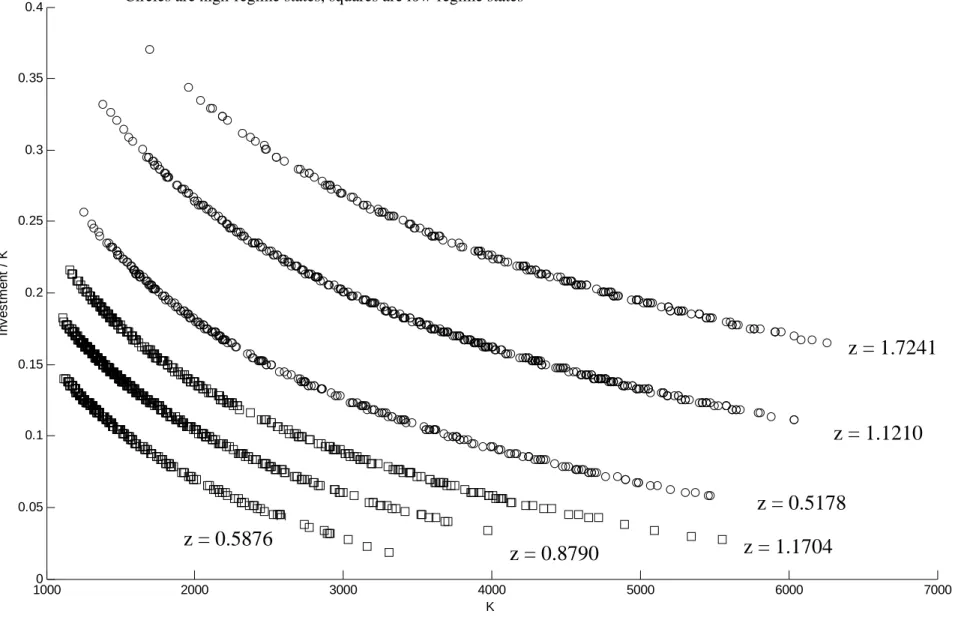
The presence of regime switching improves the ability of the model to …t the moments of the data. It also helps the model match the empirical covariation and partial covariation among investment, cash ‡ow, and Q. These results sug-gest that the presence of regime switching is crucial to understanding investment regressions. In the data and in the simulation, both the true Q and noisy Q have relatively poor explanatory power for investment when there is regime switching (Table 2). Cash ‡ow improves the …t of the regression, but not nearly as dramati-cally as it did in the single regime model, where using cash ‡ow to proxy the shock raised the R2 from 0:04 to 0:70. In the regime switching model, the addition of cash ‡ow only increases the R2 from 0:11 to 0:27. Figure 7 illustrates this prop-erty. It plots the investment rate, i=k, as a function of the capital stock for each value of the shock, z, in the regime switching model. The relation between the
current shock and current investment is non-monotonic. The lowest investment rates occur on the lowest branch of the graph, when the shock is in the low regime and z = 0:5876. Investment rates are substantially higher when the shock is in the high regime and z takes on its lowest value: z = 0:5178. This property results from the fact that the probability of transiting between regimes is low. Within the high regime, even when current z is very low, future prospects are bright because there is a high probability of transiting to a high value of z. In the low regime, even when current z is high, the prospects for the future are relatively bleak and thus investment remains low. The transition dynamics within and across regimes break the monotonic relation between investment and z and between investment and cash ‡ow.
A similar argument explains why the regime-switching model can replicate the lagged-investment e¤ect present in the data. Since regime changes do not occur often, last period’s level of investment is a good indicator of the current regime. In other words, lagged investment acts as a proxy for an aspect of the shock process (the regime) that is not embodied by cash ‡ow. In contrast, in the single-regime model, the close relation between the shock and cash ‡ow makes lagged investment redundant in explaining current investment.
5.3. Introducing …rm heterogeneity
So far our results are based on data simulated for a single …rm which we compare to the median …rm in our sample. To investigate the robustness of our results, since most empirical work addresses a heterogeneous panel of …rms, we now introduce …rm heterogeneity. We allow for the average value of z to be di¤erent across …rms. For every …rm i we choose z so that the steady state stock of capital coincides with the average value of the capital stock of …rm i in the sample (see Appendix 9.7) for details. We generate simulated data for the di¤erent …rms and use the
resulting data panel to run investment regressions with …xed e¤ects. The results are reported in Table 2. The …t of the di¤erent regressions and the magnitude of the cash ‡ow and investment e¤ects are comparable to our previous results.
6. Hayashi’s Model
In this section we study a version of Hayashi’s model by considering a special case of the decreasing-returns model in which returns to scale are constant ( = 1) and the …xed cost of operating is zero ( = 0).
The …rm’s problem is given by the following Bellman equation: V (K; z) = max i;k0 [zK (I=K ) 2 K I (6.1) + Z V (K0; z0)F (dz0; z)], subject to: K0 = I + (1 )K. (6.2)
We consider a regime-switching process and choose the Markov chain and the support of z so that the model matches the empirical volatility of the cash-‡ow-to-capital ratio. The support of z is given by:12
z 2 L L; L; L+ L; H H; H; H + H .
We solve the model taking advantage of the fact that the value function is homo-geneous of degree one (see Appendix 9.4 for details).
One interesting …nding is that if we set = , this model fails to match even the most basic moments of the data, such as the average value of Q and the volatility of I=K. The fact that the model generates in…nite values for V and Q 12The performance of this regime-switching version of Hayashi’s model is much better than
that of a single-regime version. To conserve space we do not report results for the single-regime version.
for many parameter combinations is at the heart of this failure. When the discount factor is high (i.e. the real interest rate is low) the average values of V and Q are often in…nity. The value of the …rm is …nite only when the adjustment cost parameter, , is very high. However, high adjustment costs imply low investment volatility. When the discount factor is low (i.e. the real interest rate is high) it is possible to generate a …nite …rm value with low values of . However, the low discount factor produces very low values for Q.
We avoid this conundrum by analyzing a version of the model in which we estimate . Table 3 reports the parameter estimates and standard errors for the Hayashi model with regime switching. The estimate of the adjustment cost parameter, , is much higher than that obtained for the decreasing-returns model (3:4510 versus 0:7654). In the absence of adjustment costs investment would be …nite in the decreasing-returns model because of the presence of decreasing returns to production. In contrast, without adjustment costs, investment in the Hayashi model would alternate between +1 (when z > 1= 1) and 1 (when z < 1= 1). As a consequence, we need higher adjustment costs in the Hayashi model in order to match the volatility of investment observed in the data. Our parameter estimates imply that adjustment costs represent on average 4:6 percent of revenue net of variable costs.
Table 1 compares the implied data moments from the model to those in the data.13The model matches closely the data moments, including the average level of Qin both regimes, and the overall volatility and skewness of Q. Since investment closely tracks Q in this model, overall investment volatility and skewness also match the data. However, the adjustment cost required to match the data reduces investment volatility within regimes (for example, the volatility of investment is
13We added the average level of I
t=Kt to the moment vector used in the estimaton of the
Hayashi model. In the generalized-Hayashi model the ratio It=Kt is determined by the
0:015in the low regime, compared to 0:05 in the data). The model requires a large change in the average level of It=Kt across regimes (from 0:113 to 0:215 from the low to high regimes) that is not present in the data. Overall, the …t is comparable to that of the decreasing-returns model. In some dimensions the …t is superior (e.g., the dynamics of Q) in the Hayashi model, while in others (e.g., investment dynamics) the decreasing-returns model is a better …t.
6.1. Simulated regression results
Table 2 reports the results of estimating investment regressions on data simulated from the Hayashi model. The only reason why Q is not a su¢ cient statistic for investment is the timing issue that arises in discrete time, which we discuss in Section 2. So, it is not surprising that we …nd that Q is an excellent predictor of investment: the R2 of the regression of investment on log(Q) is 0:97.
The second set of regressions use a version of the model where Q is mea-sured with error. As with our previous model, this measurement error process is estimated so that the resulting Q matches the empirical standard deviation, persistence and skewness of Q.14 In this version of the model Q is no longer a suf-…cient statistic for the choice of investment, and cash-‡ow and lagged-investment e¤ects emerge. However, these e¤ects are much weaker than in the data. Regress-ing investment on noisy Q alone generates an R2 of 0:42; adding only cash ‡ow reduces the coe¢ cient on Q from 0:0633 to 0:0554 with a coe¢ cient on cash ‡ow of 0:0271. Adding lagged investment raises the R2 further to 0:80, with a lagged investment coe¢ cient of 0:7325. In this speci…cation the coe¢ cient on Q is twice as large as it is in the data.
14We generate Qnoise
t = Qtexp("t) +6:998"t; where "t+1 = 0:662"t+ 0:023 t+1 and t v
7. CEE Model
Many recent macroeconomic models incorporate a form of adjustment costs pro-posed by Christiano, Eichenbaum, and Evans (2005). In this formulation, adjust-ment costs depend on changes in the level of investadjust-ment, so lagged investadjust-ment e¤ects are likely to arise naturally in investment regressions. In this section we study the properties of a version of our model that incorporates CEE-style ad-justment costs.
The …rm’s problem, written in terms of detrended variables, is given by: v(k; i 1; z) = max i;k0 zk i + Z V (k0; i; z0)F (dz0; z) , subject to: k0 = i 1 ( i=i 1 )2 + (1 )k. (7.1)
Here i 1 denotes the value of investment in the previous period. The presence of a third state variable in the value function requires us to adopt a di¤erent algorithm to solve the model. We describe this algorithm in the appendix.
There are four reasons why average and marginal Q do not coincide in this model. The …rst three reasons are common to the decreasing-returns model: there are decreasing returns to production, a …xed cost, and the timing issue that arises in discrete time. The fourth reason has to do with the fact that the value function depends, not only on k and z, but also on i 1. If we set = 1 and = 0 in the Hayashi model we obtain a value function that is homogeneous of degree one and so: V (k; z) = V1(k; z)k, implying that V (k; z)=k = V1(k; z). If we set = 1 and = 0in the CEE model the value function is homogeneous in degree one in k and i i.15 This property implies that: v(k; i 1; z) = v1(k; i 1; z)k +v2(k; i 1; z)i 1. So, v(k; i 1; z)=k 6= v1(k; i 1; z).
We estimate that the adjustment cost parameter, , is equal to 0:9829, with a standard error of 0:0567.16 The other parameter estimates, shown in Table 3, are close to those for the decreasing-returns model. Average adjustment costs as a fraction of revenue net of variable costs are 0:8 percent. The …xed cost represents 25:4 percent of revenue net of variable costs.
Table 1 shows that the …t of the model with CEE adjustment costs is gen-erally very good. This …t is comparable to that of the decreasing-returns model with two exceptions. First, the CEE formulation generates too much investment persistence. The …rst-order serial correlation of investment is 0:94 in the model and 0:60 in the data. The high degree of investment persistence generated by the model is not surprising since this speci…cation penalizes changes in the level of investment. Second, the model does not generate enough skewness in investment (0:31 in the model versus 0:42 in the data). This property is a direct consequence of the adjustment cost speci…cation: an increase in reduces both the standard deviation and skewness of investment, and the estimation procedure cannot …nd a set of parameter values which …ts both moments.
Table 2 reports the results of estimating investment regressions on data sim-ulated from the model with CEE adjustment costs.17 This model generates a regression coe¢ cient on Q that is very similar to the data. The cash-‡ow e¤ect is weak and sometimes negative. The model generates a lagged investment e¤ect that is much stronger than that found in the data (0:9269 versus 0:6253). This property re‡ects the fact that lagged investment is a state variable in this model. 16The value of estimated by CEE using macro data and a model with a constant returns
to scale in production is 1:24. CEE estimate 00(1) = 2:48, where 00(1) is the second derivative
of the adjusment cost function evaluated at the steady state. In our case the adjustment cost function is quadractic, so = 00(1)=2.
17We generate Qnoise
t = Qtexp("t) +4:336"t; where "t+1 = 0:740"t+ 0:042 t+1 and t v
8. Conclusions
We estimate three models of investment and examine their implications for the mean, standard deviation, skewness and persistence of investment, cash ‡ow, and Q. While all three models can closely match the key data moments, the decreasing-returns model and the Hayashi model both replicate the salient empirical features of investment, cash ‡ow and value in our sample of large …rms. These models would nonetheless be rejected by tests based on investment regressions. We …nd empirically plausible cash-‡ow and lagged-investment e¤ects in data simulated from these models when we incorporate our estimates of measurement error in the construction of Q. This result illustrates the importance of going beyond investment regressions when assessing investment models.
The estimated regime-switching process for the shocks is an important feature of the model. This process generates skewness in cash ‡ow, Q, and investment, and also implies that Q and cash ‡ow are not informationally redundant for the investment decision. When Q is mismeasured or misspeci…ed (as in the decreasing-returns model), current cash ‡ow does not perfectly predict expected investment opportunities. Instead there is a role for both cash ‡ow and lagged investment to predict current investment, even when controlling for Tobin’s Q. These …ndings show that a neoclassical model with quadratic adjustment costs can match the key data moments of large publicly-traded …rms, while simultaneously generating empirically relevant cash ‡ow and lagged investment e¤ects.
References
[1] Abel, Andrew, and Janice Eberly, “Q Theory Without Adjustment Costs & Cash Flow E¤ects Without Financing Constraints,” working paper, 2001. [2] Abel, Andrew, and Janice Eberly, “Investment and Q With Fixed Costs: An
Empirical Analysis,” working paper, 2002.
[3] Abel, Andrew, and Janice Eberly, “Investment, Valuation, and Growth Op-tions,” working paper, 2005.
[4] Alti, Aydogan “How Sensitive Is Investment to Cash Flow When Financing Is Frictionless?” The Journal of Finance, 58: 707-722, 2003.
[5] Burnside, Craig “Production Function Regression, Returns to Scale and Ex-ternalities,” Journal of Monetary Economics, 37: 177-201, 1996.
[6] Christiano, Lawrence, Martin Eichenbaum, and Charles Evans “Nominal Rigidities and the Dynamic E¤ects of a Shock to Monetary Policy,” Jour-nal of Political Economy, 113: 1–45, 2005.
[7] Cooper, Russell and Joao Ejarque, “Financial Frictions and Investment: A Requiem in Q,” Review of Economic Dynamics, 6: 710-28, 2003.
[8] Cooper, Russell and John Haltiwanger, "On the Nature of Capital Adjust-ment Costs," Review of Economic Studies 73 (3) , 611–633, 2006.
[9] Cummins, Jason G., Kevin A. Hassett, and Stephen D. Oliner “Investment Behavior, Observable Expectations, and Internal Funds,” American Eco-nomic Review, 96: 796-810, 2006.
[10] Doms, Mark and Timothy Dunne, “Capital Adjustment Patterns in Manu-facturing Plants,” Review of Economic Dynamics, 1: 409-429, 1998.
[11] Erickson, T. and Toni Whited, “Measurement Error and the Relationship between Investment and ‘q’,”The Journal of Political Economy, 108: 5. 1027-1057, 2000.
[12] Fazzari, Steven, R. Glenn Hubbard, and Bruce C. Petersen, “Financing Con-straints and Corporate Investment,”Brookings Papers on Economic Activity, 1:141-206, 1988.
[13] Gilchrist, Simon and Charles Himmelberg, “Evidence on the role of cash ‡ow for investment,” Journal of Monetary Economics 36: 541-572, 1995.
[14] Gomes, Joao, “Financing Investment,”The American Economic Review, 91: 1263-1285, 2001.
[15] Hayashi, Fumio, “Tobin’s marginal Q and average Q : A neoclassical inter-pretation,” Econometrica, 50, 215-224, 1982.
[16] Jaimovich, Nir and Sergio Rebelo “Tobin’s Marginal Q and Average Q Re-visited,” mimeo, Northwestern University, 2008.
[17] Jorgenson, Dale and Ralph Landau, Tax Reform and the Cost of Capital: an International Comparison, Washington, DC: Brookings Institution, 1993. [18] King, Mervyn and Don Fullerton, The Taxation of Income from Capital: a
Comparative Study of the United States, the United Kingdom, Sweden, and West Germany; University of Chicago Press, Chicago, 1984.
[19] Lkhagvasuren, Damba “Big Locational Di¤erences in Unemployment Despite High Labor Mobility,” mimeo, Northwestern University, 2006.
[20] Lee, B. and Ingram B. “Simulation estimation of time series models”, Journal of Econometrics, 47, 197-205, 1991.
[21] Moyen, Nathalie “Investment-Cash Flow Sensitivities: Constrained versus Unconstrained Firms,” The Journal of Finance 59: 2061–2092, 2004.
[22] Philippon, Thomas “The bond market’s Q”, Quarterly Journal of Economics, forthcoming, 2008.
[23] Rouwenhorst, K. Geert “Asset Pricing Implications of Equilibrium Business Cycle Models,”in Thomas Cooley, ed. Frontiers of Business Cycle Research, Princeton University Press, 1995.
[24] Salinger, Michael A. and Lawrence Summers, “Tax Reform and Corporate Investment: A Microeconomic Simulation Study,” in Martin S. Feldstein, editor, Behavioral Simulation Methods in Tax Policy Analysis, University of Chicago Press, 1983, 247-287.
[25] Schiantarelli, Fabio, and Dimitri Georgoutsos, “Monopolistic competition and the Q theory of investment, European Economic Review, 34: 1061-1078, 1990.
[26] Shiller, Robert J. Market volatility, Cambridge, MA: MIT Press, 1989. [27] Shiller, Robert J. Irrational exuberance, Princeton: Princeton University
Press, 2000.
9. Appendix
9.1. Data Sources and Calculations
Annual data items from the dataset cstsann in the CRSP/Compustat Merged database, 1981-2003, are …rst listed, followed by the calculations underlying the constructed variables. Sources for non-Compustat items are given in parentheses.
I : expenditures on property, plant, and equipment, data 30
CashF low: income before extraordinary items + depreciation and amor-tization + minor adjustments, calculated as follows (from the Compustat manual):
Income Before Extraordinary Items, 123 + Depreciation and Amortization, 125
+ Extraordinary Items and Discontinued Operations, 124 + Deferred Taxes, 126
+ Equity in Net Loss (Earnings), 106
+ Sale of Property, Plant, and Equipment and Sale of Investments –Loss(Gain), 213
+ Funds from Operations –Other, 217
+ Accounts Receivable –Decrease (Increase), 302 + Inventory –Decrease (Increase), 303
+ Accounts Payable and Accrued Liabilities –Increase (Decrease), 304 + Income Taxes –Accrued –Increase (Decrease), 305
+ Assets and Liabilities –Other (Net Change), 307 = Operating Activities –Net Cash Flow, 308
debt: long-term debt (end of period), data 9
P P E, book value of capital: property, plant, and equipment,
–data 182: PPE - Beginning Balance –check if it is still reported after 1997;
–data 187: PPE - Ending Balance (Schedule V);
–data 184: PPE - Retirements (Schedule V) - not reported after 1997; –data 185: PPE - Other Changes (Schedule V) - not reported after 1997. Pk, price of capital: implicit price de‡ator for nonresidential investment, Economic Report of the President, Table B-3, various years.
u, investment tax credit: obtained by year for 51 asset classes from Dale Jorgenson. These data are aggregated to the two-digit industry level using the BEA historical cost capital ‡ow matrix (asset by industry by year). Speci…cally, the weight of asset type n in industry j in year t is calculated as wn;j;t In;j;t=
P n
In;j;t. The investment tax credit applied to industry j in year t, uj;t, is then constructed as the weighted sum uj;t =
P n
wj;n;tuj;n;t. z, value of depreciation allowances: obtained by year for 51 asset classes from Dale Jorgenson. These data are aggregated to the two-digit industry level using the BEA historical cost capital ‡ow matrix (asset by industry by year). Speci…cally, the weight of asset type n in industry j in year t is calculated as wn;j;t In;j;t=
P n
In;j;t. The value of depreciation allowances in industry j in year t, zj;t, is then constructed as the weighted sum zj;t =
P n
wj;n;tzj;n;t. , corporate tax rate: obtained from King and Fullerton (1984), table 6.4, and Fullerton and Karayannis (in Jorgenson and Landau (1993)), p. 343, updated to 2003 by Dale Jorgenson.
market value of equity: closing stock price times number of common shares outstanding (end of period) plus redemption value of preferred stock (end of period) = prc * shrout/1000 + data56, where,
–prc: closing stock price from msf …le (monthly stock - securities); –shrout: Common shares outstanding from msf …le (monthly stock
-securities);
–data 56: Preferred Stock - Redemption Value.
L, useful life of capital goods: by two-digit industry, the useful life of cap-ital goods is calculated as Lj N1
j
P i2j
P P Ei;t 1+DEP Ri;t 1+Ii;t
DEP Ri;t , where Nj is
the number of …rms, i, in industry j. Using the double-declining balance method, the implied depreciation rate for industry j, j, is 2=Lj.
K, replacement value of capital stock: Using the method of Salinger and Summers (1983) the replacement value of the capital stock is constructed by …rm from its book value using the recursion: Ki;t = Ki;t 1
PK;t
PK;t 1 + Ii;t (1 j),
where the recursion is initialized using the book value of capital.
9.2. Sample Selection
Starting from the dataset cstsann in the CRSP/Compustat Merged database, the following …lters were applied:
If the …rm was involved in a merger or acquisition, then delete (using aftnt35: =’01’as indication of a Merger & Acquisition)
end-of-period capital (data 187) is not missing investment (data 30) is not missing
operating pro…t (data 178) is not missing
incorrect capital accumulation (only for data before 1994, due to data184 and data185 not being reported after 1997)
if disinvestment > end-of-period capital then delete
if operating loss is greater than end-of-period capital then delete
if operating pro…t is greater than 2.5 times end-of-period capital then delete if q is missing or q<0 then delete
if investment (data 30) < 0 then delete if dis-investment (data107) < 0 then delete
9.3. Solution Method, decreasing-returns model
We assume that k can only take nk discrete values. We start with a guess for the value function, V0(k; z) for each pair (k; z). We compute the policy function k0 = h0(k; z)by …nding the value of k0 that maximizes the value of the …rm for each pair (k; z). The new value function, V1(k; z) is given by the following equation with m = 1: Vm(k; z) = max i;k0 [zk f[k 0 (1 )k] =k g2 k [ k0 (1 )k] + Z Vm 1(k0; z0)F (dz0; z)].
We use V1(k; z) to …nd a new policy function k0 = h1(k; z) and a new value function, V2(k; z). We continue to iterate until Vm 1(k; z) and Vm(k; z) converge for every (k; z) pair.
In practice, this method is slow to converge. To speed up the procedure in the context of our SMM estimation, which requires solving the model at every iteration, we instead adopt a hybrid method. We start with a policy function iteration approach: we iterate as above until hm 1(k; z) and hm(k; z) converge for every (k; z) pair. Once this is done, we iterate on the value function, keeping the policy function constant, until convergence. Not having to …nd a new policy function at that stage makes this hybrid procedure signi…cantly faster.
9.4. Solution Method, Hayashi Model
The value function, V (K; z), is homogeneous of degree one in the capital stock. This property follows from the fact that we can write the value function as a sum of functions that are homogeneous of degree one. The homogeneity property allows us to rewrite (6.1) as:
V (1; z) = max i=k [z (I=K )2 I=K (9.1) + (I=K + 1 ) Z V (1; z0)F (dz0; z)],
Using the fact that V1(1; z) = V (1; z), we can write the optimal value of I=K as: I
K =
R
V (1; z0) F (dz0; z) 1
2 + (9.2)
We solve the model using value-function iteration. We start with a guess for the value function, V0(1; z) for each value of z. We use (9.2) to compute the optimal value of I=K associated with each value of z. We then compute the new value function, V1(k; z). This function is given by the following equation with m = 1:
Vm(1; z) = max i=k " z 1 R Vm 1(1; z0) F (dz0; z) 1 2 2 R Vm 1(1; z0) F (dz0; z) 1 2 + + (9.3) R Vm 1(1; z0) F (dz0; z) 1 2 + 1 Z Vm 1(1; z0)F (dz0; z) .
9.5. Solution Method, CEE Model
We obtain numerical solutions to the model with CEE adjustment costs using the following algorithm developed in Lkhagvasuren (2006):
1. De…ne a coarse grid for (k; i 1; z);
2. Choose a guess for v(k; i 1; z) and evaluate it on the coarse grid; 3. Choose a …ne grid for i 1;
4. Generate a …ne grid for k compatible with …ne grid for i 1 using the resource constraint, (7.1);
5. Use bilinear interpolation to evaluate v(k; i 1; z)for every value of z on the …ne grid for i 1 and z;18
6. Find the optimal value of i for every (k; i 1; z) combination; 7. Save the new value of v(k; i 1; z)evaluated on the coarse grid; 8. Save the policy function for i, i(k; i 1; z), evaluated on the …ne grid; 9. Check whether the value function has converged;
10. If the value function has converged then stop; else go to step 5;
To simulate the model we can use a bilinear interpolation of i(k; i 1; z) evalu-ated for every z, for every pair (k; i 1) evaluated on the …ne grid. This interpola-tion procedure avoids k and i 1 having to take values on the real line.
18Bilinear interpolation is an extension of linear interpolation for bivariate functions. Suppose
we know the values of the function f (x; y) evaluated at four points: (x1; y1), (x2; y1), (x1; y2),
and (x2; y2). Then f (x; y) ' (x2f (xx11)(y;y12)y1)(x2 x)(y2 y) +(x2f (xx1)(y2;y12)y1)(x x1)(y2 y) + f (x1;y2)
(x2 x1)(y2 y1)(x2 x)(y y1) +
f (x2;y2)
9.6. Estimation Method
The objective of the simulated method of moments is to …nd the parameter vector ^ that minimizes the distance between empirical ( D) and simulated moments ( ( )):
L( ^ ) = min [ ( ) D]0W [ ( ) D]. (9.4) The weighting matrix, W , is obtained using the variance-covariance matrix of the empirical moments, D:
W = 1
D(1 + 1=k)
, (9.5)
where k = length of simulation=length of sample. We estimate the matrix D using a block-bootstrap method as follows: We form m samples. Each sample consists of data for n …rms drawn with replacement from our data set. For each of the m samples we compute the vector of empirical moments. We use the m observations on the vector of moments to estimate the variance-covariance matrix of the empirical moments, D.
We solve the minimization problem (9.4) using an annealing algorithm. The …rst step consists in choosing initial values for the parameter vector, , admissible ranges for the parameters, as well as the “temperature” and the step size. As we discuss below, the temperature controls the probability that, given the best parameter vector so far, , we accept a parameter vector 0that yields a worse …t (L( 0) > L( )). This procedure is used to avoid convergence to a local minimum. We start with a high temperature value, so that the algorithm explores di¤erent regions of the parameter space.
The second step is to generate a new parameter vector, 0, by adding random shocks to the elements of within their admissible range. Next we solve the model using value-function iteration for the parameter vector 0 and simulate 1940 representative …rms (each with 23 years of data). Since the number of …rms
in our Compustat sample is equal to 194, this implies that k in (9.5) equals 10. The fourth step consists in computing the simulated moments and L( 0). If L( 0) < L( ) we set = 0. If L( 0) > L( ) we set = 0 with probability exp [ (L( 0) L( )) =temperature]. Finally, we reduce the values of temperature and step size before going back to step two. The vector of parameter estimates is the one that generates the lowest value of L. We denote this vector by ^ .
To verify the convergence properties of our estimation procedure, we used a simple robustness check. Starting with a parameter vector ~ , we simulate a panel of …rms and compute the simulated moments, ( ~ ). We then use the SMM pro-cedure described above to …t these moments. Ideally, we would like the parameter estimates ^ to be as close as possible to the true parameter values ~ (the ones that generated the data). Failure to do so may indicate that the estimation pro-cedure is not adequate or that the model parameters are not identi…ed. We …nd that our procedure can recover reasonably well the true parameter values. This is also con…rmed by the fact that we obtain similar parameter estimates across SMM runs with di¤erent starting values.
9.7. Simulation Method, Panel of Firms
We construct a panel of …rms using our estimation results for the decreasing returns version of the model, with regime switching. We proceed as follows:
1. From our Compustat sample, classify …rms into bins based on their average level of capital.
2. Using the expression for the steady state level of capital, back out the average level of the shock z for a …rm/bin.
3. For a given bin, compute the median across …rms of the …rst three time-series moments of Tobin’s Q.
4. For a given bin, solve the …rm’s problem, using the estimated parameters for the decreasing returns model with regime switching.
5. Simulate series for capital, cash ‡ow and investment of length N T .
6. Adjust the …xed cost to match the average of Tobin’s Q for that particular bin (corresponds to the “median” …rm for that bin).
7. Find the noise process to match the standard deviation and skewness of Q for that particular bin. Create the variable Qnoise.
8. Divide the simulated series into N …rms of T years each. 9. Repeat the procedure for each bin.
Decreasing returns model
Full Sample Single regime
1981‐2003 1981‐1992 1993‐2003 All Low High All Low High All Low High
Time‐series average Q 1.298 0.950 1.892 1.316 1.235 0.920 1.550 1.355 0.976 1.748 1.286 0.930 1.657 I/K 0.150 0.146 0.161 0.151 0.152 0.124 0.179 0.163 0.113 0.215 0.153 0.124 0.183 Cash Flow/K 0.169 0.155 0.199 0.172 0.156 0.141 0.172 0.180 0.171 0.190 0.162 0.137 0.189 Time‐series standard deviations Q 0.625 0.256 0.589 0.157 0.397 0.207 0.269 0.475 0.148 0.365 0.433 0.162 0.294 Q + noise 0.625 0.636 0.468 0.613 0.624 0.386 0.566 0.625 0.435 0.594 ln(Q) 0.420 0.280 0.280 I/K 0.055 0.050 0.046 0.055 0.055 0.039 0.056 0.057 0.015 0.033 0.057 0.044 0.054 ln(I/K) 0.370 0.330 0.300 Cash Flow/K 0.078 0.046 0.089 0.079 0.072 0.050 0.086 0.079 0.052 0.098 0.074 0.044 0.087 Skewness Q 0.577 0.160 0.350 0.084 0.278 0.690 0.571 Q + noise 0.577 0.160 0.350 0.577 0.555 0.584 0.575 I/K 0.418 0.320 0.330 0.014 0.479 0.422 0.314 Cash Flow/K 0.245 ‐0.040 0.050 ‐0.063 0.306 0.292 0.545 Serial correlation Q 0.838 0.780 0.660 0.426 0.848 0.856 0.860 Q + noise 0.838 0.780 0.660 0.838 0.842 0.838 0.837 I/K 0.600 0.550 0.540 0.397 0.741 0.877 0.938 Cash Flow/K 0.540 0.500 0.370 0.535 0.515 0.508 0.586 *For each variable, we compute the time series average for each firm in the sample, and report the median across firms.
Regime switching Regime switching Regime switching Subsamples
Table 1: Summary statistics, data and model implications
Decreasing returnsmodel Median across large firms (4th