1
University of Liege 2013/2014
Department of general practice DUMG ULg
FMKM
Family Medicine Knowledge managementTowards a system
of
concepts
in
General Practice /
Family Medicine
Part 1 Towards a
specific indexation
system in GP/FM
2
Document prepared for the first meeting of the members of the board of the thesis of Marc Jamoulle, Family doctor
September 9, 2014 by teleconference Lisbon/Brussels/ Calabria
marc.jamoulledoct.ulg.ac.be
This document is a preliminary draft
Various paragraphs have to be developed further This part expected to be ready end of 2014 Some text are still in French. Translation ongoing
Front page
3
E
XECUTIVES
UMMARYTowards a system of concept on general practice / family medicine
Part 1 Towards a specific indexation system in GP/FM
Status of this document ;
preliminary draft, not for diffusionIntended audience :
Members of the board of the PhD thesis of Marc Jamoulle, department of general practice, Liege University and experts in the field contacted by the authorBackground
:
Thousands of general practitioners/ family doctors are gathering each year in local, national or international congresses. They are exchanging thoughts, researches and methods through thousands of communications in various formats; posters, oral communications, workshops and so on. Although this huge collection of bottom-up knowledge is sometimes available through Internet sites, there is no specific indexation system allowing a real knowledge management of the exposed works. Consequently the information could not be reached, which don’t favor the exchange between researchers. The absence of a common indexation system is also a problem to organize the congresses and the participants have always difficulties to find communications relevant of their interest.The technology of semantic web and Linked data have emerged as a future solution to exchange data distributed in many languages between so many providers, the family physicians, spread around the globe. The considerable development of medical ontologies demonstrates the vitality of this field of discovery.
Aim of the thesis;
To find the best way to identify the main concepts effectively used by practicing GPs by the development of a system of classification embedded in the International classification of Primary Care aiming at retrieval of clinical and non-clinical issues addressed by the authors in their communicationsTo propose a mapped terminology to this classification systems, in other words an ontology of GP/FM, to participle to a linked data based automatic or semi-automatic indexation of knowledge in GP/FM and its implementation in the realm of the semantic web.
Content of the part 1 :
the first steps towards a global classification system in GP/FM are related as well as previous experiences and difficulties with usual coding systems.The new information technology tools for information management are concisely described which permit the understanding of their importance in future research networks of knowledge in G/FM
A comparison of the coding process and results of 6 congress of GP/FM in several countries and 4 languages has been performed to examine the internal reproducibility of the classifying system proposed.
Next steps of the thesis are discussed of which first of them would be the constitution of an International research group.
4
Content
EXECUTIVE SUMMARY ... 3
TOWARDS A SYSTEM OF CONCEPT IN GP/FM/RESEARCH QUESTIONS ... 8
1. INTRODUCTION ... 9
1.1. Accumulated knowledge in GP/FM is not shared effectively or disappears ... 9
1.1.1. Textbooks of Family Medicine... 9
1.1.2. Publications of the GPS during congresses ... 10
2. THE WORLDS OF REFERENCE IN MEDICINE (TO BE DEVELOPED FURTHER) ... 11
3. ETHICAL FOUNDATION OF THE ANALYSIS (TO BE DEVELOPED FURTHER) ... 11
4. NEED FOR A MIXED SYSTEM TO INDEX CLINICAL AND NON-CLINICAL ITEMS ... 12
4.1. GENERAL PRACTICE INDEXATION SYSTEMS ... 12
4.2. MEDICAL SUBJECT HEADING ... 13
4.2.1. MESH; BASIC AND SPECIFICITIES (TO BE DEVELOPED FURTHER) ... 13
4.2.2. PRE-TEST WITH MESH ON METACLINICAL CLASSIFICATION.2007 ... 13
4.3. FAMLI1980–1992 ... 16
4.4. THE WONCA DICTIONARY ... 17
4.5. ICPC GENESIS AND DESCRIPTION (TO BE DEVELOPED FURTHER) ... 17
4.6. CORE CONTENT CLASSIFICATION IN GENERAL PRACTICE (3CGP) ... 18
4.6.1. THE Q-CODES.LAMBERTS 1987 ... 18
4.6.2. FROM Q-CODES TO 3CGP ... 19
5. EVOLUTION OF THE METHOD ... 21
5.1. Spreadsheet and database data on Internet... 22
5.2. 2014 Use of a Computer-assisted qualitative data analysis software ... 22
5.3. Exploring semantic web ... 23
6. COMPARATIVE STUDY OF 6 CONGRESSES IN GP/FM... 26
6.1. WONCA EUROPE CONGRES 2007 ... 26
6.1.1. INTRODUCTION ... 26
6.1.2. METHOD ... 27
6.1.3. RESULTS ... 28
6.2. APMGFCOVILHA 2013ANNUAL CONFERENCE ... 33
6.3. CNGECLERMONT CONGRES 2013 ... 38
6.3.1. INTRODUCTION ... 38
6.3.2. METHODS ... 38
6.3.3. RESULTS ... 41
6.3.3.1. PRELIMINARY RECOMMENDATIONS TO LILLE 2014SCIENTIFIC COMMITTEE ... 41
6.3.3.2. RESULTS;205 ABSTRACTS FROM CLERMONT FERRAND 2013 USING ATLAS.TI ... 43
5
6.4. CONGRÈS SWISSFAMILYDOCS ZURICH 2014 ... 52
6.4.1. INTRODUCTION ... 52
6.4.2. METHODS ... 52
6.4.3. RESULTS ... 52
6.4.3.1. SWISSFAMILYDOCS 2014 THROUGH THE LENS OF THE ICPC ... 52
6.4.3.2. SWISSFAMILYDOCS 2014 THROUGH THE LENS OF 3CGP ... 53
6.4.3.3. SBF2014QO CODES ... 55
6.4.3.4. SWISSFAMILYDOCS ENABLES THE ADDITION OF NEW TERMS TO 3CGP ... 56
6.5. THE BELGIAN CONGRES BRUSSELS 2014 ... 57
6.6. THE CNGELILLE CONGRESS 2014 ... 60
6.7. COMPARISONS BETWEEN SOME CONGRESSES ... 60
7. DISCUSSION ... 63
8. NEXT STEPS ... 65
8.1. CLASSIFICATION FIELD ... 65
8.1.1. LOOKING FOR A CONSENSUS ABOUT 3CGP CONTENT ... 65
8.1.2. BUILDING AND FIELD TESTING 3CGP AND ICPC ... 65
8.2. ONTOLOGICAL FIELD ... 65
8.2.1. BUILDING A REFERENCE TERMINOLOGY MAPPED TO 3CGP ... 65
8.2.2. PREPARING SEMANTIC TOOLS ... 65
9. A MULTIDISCIPLINARY TEAM IS A NECESSITY ... 66
9.1. Members of the board ... 66
9.2. People recently contacted and interested by the project ... 66
1. Terminologie, mapping, semantisation... 66
2. Library and information science (FAMLI) ... 66
3. Computer application ... 66
10. ACKNOWLEDGEMENTS ... 67
11. RÉFÉRENCES ... 68
ANNEX ICODES INTRODUCED SO FAR IN THE CONTENT ANALYSIS SOFTWARE (AUGUST 2014) ... 72
ANNEX IISOME FIGURES ABOUT CODES AND THEIR USE IN ABSTRACTS ANALYSIS ... 75
ANNEX III PERSONAL PUBLICATIONS RELATED TO THE CONTENT OF THIS REPORT ... 80
6 List of the tables
Table 1 Availability of abstracts of some GP/FM congresses with corresponding Congresses URLs ... 10
Table 2 Coding of 39 Medline abstracts ... 14
Table 3 Extract of the 2007 spreadsheet showing the title of the abstracts with corresponding codes ... 28
Table 4 Keywords detected in at least three abstracts with number of abstracts CNGE Clermont 2013 ... 40
Table 5 Code added to 3CGP after Clermont analysis ... 51
List of the figures Figure 1 Medical knowledge layers (source Michel Roland) ... 9
Figure 2 The concept Quaternary Prevention through the Ogden & Richards triangle (see § 4.2) ... 11
Figure 3 Four fields of knowledge in GP/FM (Van Dormael 2001) ... 12
Figure 4 Example of a Medlin abstract to be coded with metaclinical classification (2007) ... 13
Figure 5 Q-CODES Amsterdam (+/- 1987) ... 18
Figure 6 The 8 knowledge domains in GP/FM and one rag-bag (QO Other) ... 19
Figure 7 Opening of 3CGP domain (here QT4 Training) ... 20
Figure 8 Conceptualization of the themes of communications (here Vocational training) following the semantic triangle ... 21
Figure 9 Linked data cloud (see http://lod-cloud.net ) ... 23
Figure 10 The concept « feeling tired » in the Ontology of emotion in RDF (Obofundry) ... 25
Figure 11 Wonca 2007Indexation by ICPC (left) opening of the Chapter A for non-clinical issues (right) . 27 Figure 12 Copy of a power point. 2007 The online database with all the 998 abstract of Paris 2007. Here the query system shows the QD8 related abstracts ... 29
Figure 13 Copy of a power point. 2007 The online database. Query window ... 29
Figure 14 Wonca Paris 2007. Distribution of 3CGP main domains. On 998 abstracts ... 30
Figure 15 Wonca Paris 2007. Distribution of ICPC-2 chapters. On 998 abstracts ... 31
Figure 16 Wonca Paris 2007. Opening of P chapter ... 32
Figure 17 Wonca Paris 2007. Distribution of ICPC-2 process codes. On 998 abstracts ... 32
Figure 18 Wonca Paris 2007. Crossing between 3CGP items. Here the category Migrants and its related discussed problems coded also in 3CGP. ... 33
Figure 19 Main data, APMGF Covilha congress 2013 ... 35
Figure 20 Sympt.&Complaint component (dark) and diagnostic component (grey) ICPC in Covilha ... 36
Figure 21 Covilha . Distribution of ICPC Process codes ... 36
Figure 22 Distribution of 25 P problems on 128 communications in Covilha ... 37
Figure 23 ATLAS.it Sotware – After being scanned, coded themes appear on the right column: 3CGP codes (QS41, QC3, QP31) and one ICPC code (Z01). Here, the theme identified is the offer of family medicine services in vulnerable populations ... 41
Figure 24 CNGE Lille 2014 New online submission form. ... 42
Figure 25 CNGE Lille 2014 online submission form. ICPC grid ... 43
Figure 26 Clermont 2013. ICPC Chapters (A – Z) and Process (-proc). ... 44
Figure 27 Process codes. Coding of 205 abstracts Clermont 2013 ... 44
7
Figure 29 Psychological problems Coding of 205 abstracts Clermont 2013 ... 45
Figure 30 Coding of 205 abstracts Clermont 2013. 7 Chapter W(pregnancy) coded verbatim ... 45
Figure 31 3CGP domains including QD0 for 'Other’ ... 46
Figure 32 Distribution of 3CGP codes. Clermont 2013 ... 47
Figure 33 QR codes distribution (Research and Development) ... 47
Figure 34 QT codes distribution (teaching and training) ... 48
Figure 35 QT62 (online editing) and their verbatim. 205 abstracts Clermont 2013 ... 49
Figure 36 QD distribution ( Doctor's issue) ... 49
Figure 37 Les codes QO dans les 205 résumés CNGE 2013 ... 50
Figure 38 An abstract from Clermont 2013 coded QO21 not understandable abreviation ... 50
Figure 39 SFD Zurich 2014. Chapter (A-Z) and Process (-proc) ICPC-2 ... 52
Figure 40 SFD Zurich 2014. Detail of the 23 codes ICPC-2 ... 53
Figure 41 Two abstract about Cardiovascular risks (ICPC K22) ... 53
Figure 42 SFD Zurich 2014. 3CGP distribution ... 54
Figure 43 SFD 2014 3CGP (QC patient’s categories, QE Ethics , QD doctor’s issues, QP patient’s view) .. 54
Figure 44 SFD 2014. 6 verbatim about complementary medicine and homeopathy ... 55
Figure 45 congrès SFD 2014 ... 55
Figure 46 3CGP domains in the 37 Belgian abstracts ... 57
Figure 47 Distribution of QO in 37 Belgian abstracts ... 58
Figure 48 The study of the Belgian abstracts induces the suggestion of new codes ... 58
Figure 49 15 codes ICPC in the 37 Belgian abstracts ... 59
Figure 50 Distribution of QR in the 37 Belgian abstracts ... 59
Figure 51 Distribution of QT in the 37 Belgian abstracts ... 59
Figure 52 Opening of QS in 37 Belgian abstracts ... 59
Figure 53 Manual coding ... 60
Figure 54 ATLAS.ti 3CGP coding (%): 3 congresses (205 abstracts Fr - 45 Ch - 37 Be) ... 61
Figure 55 Manual coding on ICPC Wonca 2007 versus ... 62
Figure 56 Wonca versus Covilha in % ... 62
Figure 57 Structure of 3CGP; 9 domains ... 75
Figure 58Some 3CGP codes of the QT domain and study of their definitions with sources ... 75
Figure 59QO Others domains opening after abstracts analysis ... 76
Figure 60 Example of quotes linked to QT62 in CNGE Clermont 2013 ... 76
Figure 61 The chapter W Pregnancy of ICPC as found in CNGE Clermont 2013 abstracts ... 77
Figure 62 3CGP QD51 Homeopathy and QD5 Complementary medicine in SwissFamilyDocs abstracts ... 77
Figure 63 use of ICPC K22 in SwissFamilyDocs abstracts ... 78
8
TOWARDS A SYSTEM OF CONCEPT IN GP/FM/RESEARCH QUESTIONS GP field is global,
o includes not only bio-social-psycho-social but also ethical, moral, legal aspects o Share a common ground with specialized doctors but also a specific knowledge Most efforts to formalize and represent medical knowledge to date confined to specialized medicine
o Gave rise to ontologies such as MeSH
GP/FM has developed clinical classifications like ICPC for use in clinical settings and epidemiology of primary care o Similar efforts to formalize, represent GM /FM knowledge has been lacking
o The following considerations are at the core of the proposed work
It is in the interest of family medicine to develop a specific tool for indexing their communications at their congress. The techniques used to date, including the authors key words or the MeSH are not sufficiently adapted to the specificities of family medicine.
An existing classification, ICPC, International Classification of Primary Care, could be satisfactory to index the clinical items addressed in these communications.
It is necessary to develop a complementary tool to ICPC, to index the non-clinical topics addressed by physicians in their communications. This tool is called 3CGP.
A comprehensive tool that combines ICPC and 3CGP can organize a congress of family medicine and allows participants to the congress to choose their program and makes it easier to develop networks of research on these topics
The use of semantic editing tools on the Internet allows the networking of different sites of publications of abstracts by various national and international organizations of family medicine, regardless of language
Thus the aim of this thesis is to find the best way to identify the main concepts effectively used by practicing GPs, propose a mapped terminology to those concepts aiming to participle to an automatic or semi-automatic indexation of knowledge in GP/FM and its implementation in the realm of the semantic web.
The key research questions that we address are :
Are existing ontologies like MesH and ICPC adequate to encode and represent the vast and diverse GP /FM knowledge?
What are the GP/F M concepts and terms (both medical and non-medical) that are not to be found in MeSH, in ICPC ?
Can an ontology for GP /FM be devised based on these terms and concepts and possibly integrating MeSH and other knowledge sources
Can the detection of these medicals and non-medical terms from GP/FM be automated ?
Can the classification of these medicals and non-medical terms into concepts from GP/FM be implemented with semantic web technologies ?
The various steps of the work will be
• Part 1 : to develop the classification 3CGP by using empirical and purposive sampling methods together with collaboration with experts in the domain (Delphi)
• Part 2 : to develop a mapped web based GP/FM ontology by reuse of existing terminologies, by natural language processing techniques and careful verifications
• Part 3 ; to show the operationallity of such an indexing system and its implementation to admit the production of GPs in the world of linked data
9
1.
Introduction
General practice / family medicine knowledge is growing.
Internet based changes. Social networking changes. Information is up to Family medicine what technology is to specialized medicine (to be developed further)
Figure 1 Medical knowledge layers (source Michel Roland)
1.1. Accumulated knowledge in GP/FM is not shared effectively or disappears
Specific knowledge in GP/FM , PBM (Patient Based) or EBM (Evidence based meddecine), can be found in three main sources : the communications of GPs during the congresses, the published papers/gray literature and the books of Family medicine
1.1.1. Textbooks of Family Medicine
The profession of family doctor has a very elaborated definition { Wonca 2011} but its exact content is left to the discretion of each medical school settings. If we review some Textbooks of Family Medicine, we see that the tables of contents are really diverse.
Analysis of the table of contents of some of the most important of them is appealing in this regard. Whatever the arrangement of the chapters, one can see a general division into three main themes; specific process in family medicine, main areas of knowledge and thirdly mastering the specific clinical approaches as the symptoms and diseases usually seen by general practitioners { McWhinney 1997, Taylor 2003, Druais 2009, Kochen 2012, Murtagh 2011, Casado 2012} for quoting only some.
One of those book {Gusso 2012} is more structured since it takes over the grid of the chapters of ICPC as a table of contents of the conditions and symptoms in addition to addressing the procedures and specific knowledge areas.
But this is a view from above (Top-bottom) that does not prejudge the real interests of family physicians in activity hic et nunc.
10
1.1.2. Publications of the GPS during congresses
The work of family physicians shared in congresses are often of high quality. They are most often subject to assessment process before being accepted and represent a significant investment of energy and time. Each GP/FM congress organization publishes the abstracts of their participating members. The summaries of the conference participants are not always available. Despite the fact that a lot of work is available in medical journals, more than half of the researches done by GPS and presented in congress will not more be available easily. Often more than 50% of them are not subject to publication { 55% VanRoyen 2010, 48% Hummers-Pradier 2007, 65% Post 2013}. Abstracts which are not reaching publication are in an analog range in specialized congress {65% Ylmaz 2013, 63% Dahllöf 2008, 65% Nasir 2013 }
Dr. Carl Steylaert has initiated a remarkable effort by editing the abstracts of Wonca Europe conferences since 1995 to date on the Wonca Europe website. There is no indexing system except author’s keywords.
Congress URL Abstracts
available Wonca World
Prague 2013
http://www.globalfamilydoctor.com/ no
Wonca Europe http://www.woncaeurope.org/library/abstracts yes Wonca rural
2014
http://www.cmfc.org.br/sul/index yes
Portugal APMFG http://www.cnmgf.com/pt/conteudo/programa/18-cnmgf/programa-completo/programa-final.html
no
France CNGE http://www.imagilles.com/cnge2013/accueil/index.html yes Switzerland
SwissFamilyDocs
http://fr.swissfamilydocs.ch/2014/programm/abstracts-speakers/index/fc#2014-08-28
yes
Table 1 Availability of abstracts of some GP/FM congresses with corresponding Congresses URLs There have been at least two isolated attempts of organizing conference around ICPC (Wonca Europe 2007 conference and CNGE Conference Lille 2014) (fig 11 and 25).
Thus, considerable efforts of family physicians often disappear. It is regrettable that these efforts are not more valued. With the development of Internet and the social networking, interest groups could gather which share the same concerns. One might think it would be useful to keep the works done, and that conservation would facilitate exchanges and the feeling of belonging to a productive community. A common and consistent indexing system could help to strengthen ties between the various actors of GP/FM. This could represent bottom-up views of the content of GP/FM. MeSH are usually recommended for the indexing of abstracts. We will examine this issue more deeply
11
2. The worlds of reference in medicine (to be developed further)
World of reference of GP/FM are quite different form the world of National Library of Medicine, of IHTSDO SNOMED-CT terminology of from ICD related nomenclatures.
Each corporate organization has its own world of reference, often unconsciously expressed and diffused in a subliminal way
Related publication annexed : Jamoulle M, Vander Stichele RH, Cardillo E, Roumier J, Warnier M. Mapping French terms in a Belgian guideline on heart failure to international classifications and nomenclatures: the devil is in the detail. Inform Prim Care. 2014;(accepted) http://hdl.handle.net/2268/171599
3. Ethical foundation of the analysis (to be developed further)
Figure 2 The concept Quaternary Prevention through the Ogden & Richards triangle (see § 4.2)
• The world of reference of the family doctor is a conscious world based on the human being, his/her environment and the patient doctor relationship developed along the time line.
• About the need to take sides and the non-neutrality of classifications and standards • About the patient-centered medicine and conflicts of interest
• The concept of quaternary prevention becomes central to the methodological analysis in GP/FM
Related publication annexed : Jamoulle M. The four duties of family doctors: quaternary prevention - first, do no harm. Hong Kong Pract. 2014;36(june). http://hdl.handle.net/2268/170670
12
4. Need for a mixed system to index clinical and non-clinical items
4.1.
General practice indexation systems
Management of specific knowledge to the business of general practitioner is a difficult question. The fields of general medicine, family medicine is extremely broad with unclear boundaries.
The clinics or all elements related to the clinical contact with the patient, is central to the practice of family medicine but conditions of the realization of the work represent a different content of information with respect to the clinic. In a first time we have (maybe wrongly) used the term meta-information to describe all non-clinical meta-information related to the core business of a GP. That’s why the reader will find in the text the prefix meta. This name has been replaced, as we shall develop it further, by the acronym 3CGP, standing for core content classification of General Practice and aiming at defining the non-clinical elements of the business of a GP which are often heavily exchanged upon in G/P conferences.
The articulation of the GP/FM discipline to community health is expanding its scope from individual to the community. A nice way to represent such a large and complex fields has been described by Monique Van Dormael, a Belgian medical sociologist {Van Dormael 2001} . By crossing the dimensions of doing and being with that of the individual and the community, it shows both the extent and complexity of the working field.
Figure 3 Four fields of knowledge in GP/FM (Van Dormael 2001)
Although the general training of doctors is usually confined within the how and the individual, i.e. biology and biosciences, there is a thorough consideration of the human being and psychological and psychiatric training of student has been expanding in recent 30 years. But epidemiology, meeting of to do and the collective aspects is still the poor field of basic training. For saying nothing of medical anthropology which is hardly teach. However, there are strong trends and the teaching type Problem based learning {Bestetti 2014} is a leader in this field while medical anthropology has lost recently one of its preeminent researcher [Helman 1981]
13
Yet every family doctor knows intuitively or due to personal training that he works on these four fields, although the available economic resources are mostly concentrated on the first one, biology and biosciences approaches. And each of those theme are discussed when doctors are gathering. A health information system dedicated to describe the fields of interest in GP/FM has to take on board this extensive view.
4.2.
Medical subject heading
4.2.1.
MeSH; basic and specificities (to be developed further)
Basic description of the 25.000 MESH and their difficult use in GP/FM indexing
Including the current move to automatic natural language processing (NLP) based indexation
Including discussion about discrepancies between MeSH and GP/FM like in the following concepts: shared decision making, quaternary prevention, overmedicalisation, overscrening, déprescription, overtreatment etc (ongoing work)
4.2.2.
Pre-test with MeSH on metaclinical classification. 2007
Aim: pre-test, to compare content of Medline abstracts related to GP/FM with the concepts of the
metaclinical classification version 0.2
Methods:Choice of Medline abstracts: one descriptor with several limits to get a little number of
abstracts to analyse
"family practice"[MeSH Terms]
Limits: only items with links to full text, only items with abstracts,
English, published in the last 3 years, Humans, Core clinical journals, Review
Each content of abstract is mapped to the metaclinical classification and correspondences are searched. Codes are numeric or alphanumeric.
Results: 39 abstracts from Medline (full data available on http://docpatient.net/class/meta.html )
14
Example (fig 4); “Treatment and management of chronic conditions” is coded here by QD31 Case management (this term being replaced further by Health issue management in 3CGP). “Adolescence” is coded by QC13 Category of patient adolescent.
Table 2 Coding of 39 Medline abstracts
num n°medline icpc meta meta alpha Remarques
1 17349440 T92 2.2.8 case management QD 2.8 disease management?
2 17210873 no missing outcome of care in cat 2.2?
Not relevant? 3 17087427 K 2.2.2 prevention QD 2.2 4.3.2. Women’s health QC 3.2 4 17002031 T89 2.2.2 prevention QD 2.2 T34 2.2.7. Risk management QD 2.7 2.1.3 Counselling QD 1.3
5 16883928 B78 2.2.8 case management QD 2.8 disease management? 6 16770982 L16, L17 2.2.8 case management QD 2.8 disease management? 7 16595759 D87 2.2.8 case management QD 2.8 not relevant? comparison
7.2. EBM QT 2 GP/Gastro
8 16570737 P24?, P28 2.4. Medico legal issues QD 4
4.4 Ageing QC 4
9 16510055 P79 2.2.8 case management QD 2.8 bad abstract 10 16483865 U04 2.2.8 case management QD 2.8
11 16445273 B90 2.2.2 prevention QD 2.2 2.2.8 case management QD 2.8
12 16388764 P76 1.1.1. Availability of QP 1.1 missing diagnostic process QC ? ethnical subgroup 4 patient's category
13 16370404 U70 2.2.8 case management QD 2.8 4.1 infants and children QC 1
14 16342851 no 1.3.2.2 cultural accessibility QP 3.2.2 missing 4 patient's category QC ? ethnical subgroup 15 16342832 S19 2.2.8 case management QD 2.8 body piercing A29? 35 16300037 L11 2.2.8 case management QD 2.8
36 16300034 U88,U99 2.2.8 case management QD 2.8 37 16050454 A78 2.2.8 case management QD 2.8
38 15939004 N94 2.2.8 case management QD 2.8 CRPS --> unknown syndrome in EU 39 15939000 K77 2.2.8 case management QD 2.8
40 15906748 D 2.2.8 case management QD 2.8
41 15793019 no 4.2 Adolescents QC 2 chronic illness 2.2.8 case management QD 2.8
42 15617297 Y76,,X91 2.2.8 case management QD 2.8 genital warts 43 15617296 A88 2.2.8 case management QD 2.8 hypothermia 44 15617295 W81 2.2.8 case management QD 2.8 preeclampsia 45 15617293 NO1 2.2.8 case management QD 2.8 headaches
15
46 15606064 K77 2.2.8 case management QD 2.8 heart failure 47 15606063 K77 2.2.8 case management QD 2.8 heart failure 48 15606061 X84, X71,X84 2.2.8 case management QD 2.8 genital warts 49 15606059 D19 2.2.2 prevention QD 2.2 oral health 50 15595338 N 2.2.8 case management QD 2.8 neuropathic pain 51 15561920 T89 2.2.8 case management QD 2.8 type 2 diabete 52 15508543 L76 2.2.8 case management QD 2.8 nasal fractures 53 15383439 no 4.2 Adolescents QD 2.8 chronic condition
2.2.8 case management
54 15368728 R96 2.2.8 case management QD 2.8 asthma 55 15291088 B90 2.2.2 prevention QD 2 HIV
8.2 epidemiology QR 2
56 15277128 no 7.5 training QT 5 communication skills 2.1 communication QD 1
57 15274289 F83,T89,T90 2.2.8 case management retinipathie diabetique 58 15145910 K74,K75,K76 2.2.2 prevention QD 2 secondary used for tertiairy
Analysis
The careful reading of those abstracts show a lot of description of diseases or conditions and few specific activities related to family practice. The number of “case management” is wondering 29/39. The term “case management “(replaced further by Health issue management in 3CGP) describes abstracts which are dealing with usual description of disease, here in the context of GP/FM
The descriptors “review” and “family practice” quote 10 abstracts which are not dealing with this kind of disease description. This could indicate that the complexity of themes encountered in GP/FM are poorly identified.
It has to be said that the coding process is addressing the research question of the author or the main question described in the abstract and is not considering the results expressed. Usually the title, the introduction and the methods are enough to get the relevant code, at least if the author has understood the difference between methods and results.
This pre-test raises some suggestions for 3CGP next version:
• outcome of care to be considered in category 2.2 (from second Medline abstract)
• practice management is quoted twice in metaclinical skip
• Suggestion to shift from case management to health issue management in ver 0.3 • Patient’s Categories: ethnic subgroup to be added in metaclinical ver 0.3
16
4.3.
FAMLI 1980 – 1992
The 70s saw the birth of groups and organizations that would determine the future of general practice. The European research workgroup (EGPRW) and the European Academy of Teachers in GP/FM (EURACT) take flight in this decade. Wonca is founded in 1972. Leuwenhorst Group {Leeuwenhorst 1980} would be decisive in this adventure. General practice / family doctor claims its place as a separate discipline. “General practice is a scientific discipline within medicine and has a specific place in a comprehensive health care system” {EGPRW 1982} The field of classifications is also very well studied {Bentsen 1976, Braun 1979} and 1976 saw the first publication of the International classification of health problems in primary care. {JRCGP 1976}
At the same time a significant movement appears in the treatment of the specific literature in GP/FM. FAMLI {Fitzgerald1980}, an index for indexing the literature specific to family medicine system, is edited in Canada. As pointed by D. Fitzgerald: « Family physicians cannot always rely entirely on Index Medicus and Medline to provide the information they require. A number of family medicine journals, including Canadian Family Physician, are not indexed by these major sources.” {Fitzgerald1980a}
This statement is emphasized by Lynn Dunikowski, Director of Library Services of the College of Family Physicians of Canada and second editor of FAMLI who notes : “Because MeSH originally was intended for use with clinical documents, the problem has always been how to adapt it to cover the range of a family physician’s non-clinical activities”(personal communication Aug 2014)
E. Challis, Chairman of the Teachers of Family Medicine, College of Family Physicians of Canada underlines the role of Wonca ; “Dr. Ian R. McWhinney, the chairman of the WONCA Bibliography Committee who was also instrumental in the development of this informative reference”.{Challis1981} D. Fitzgerald gives more precision “Each annual cumulation of FAMLI includes a five-year cumulative list of books written by or for family physicians; this is a comprehensive, rather than a recommended, listing”. Moreover, the FAMLI index is edited under the name of Wonca {WONCA 1980} which shows the importance given to this area by the organization of family doctors at this moment.
The specific GP/FM literature is booming and lists of publications are regularly made available. {Dunikowski1986, Dunikowski1984, Weston1992a, Verhoeven1995}
In September 1992 is edited the last issue of the serie FAMLI {Dunikowsky 1992} in which L. Dunikowsky publishes a set of keywords specific to GP/FM under the title "KeyWords in Family Medicine (A Thesaurus)".
Precisions she brings on the approach deserves mention because she already fully notes some discrepancies between the MeSH and the world of family medicine:
“Some terms commonly used in the field of family medicine do not appear in Medical Subject Headings (MeSH). The thesaurus bas been designed to act as a bridge between these terms and the MeSH headings used in FAMLI. Family medicine terms appear in the thesaurus with the nearest equivalent MeSH term (or terms) used in FAMLI printed in bold-face type. The thesaurus also provides brief explanations of selected MeSH terms, to help in choosing the term that most closely corresponds to a selected topic. Some
17
MeSH terms are listed together with closely related MeSH terms, to suggest ways of broadening a search.” {Dunikowsky1992}
The collection of terms quoted in FAMLI will be studied carefully. We will examine the congruence with the clinical and meta-clinical classification developed to index the abstract of family physicians. (to be developed further)4.4.
The Wonca dictionary
Source for the world of reference of general practice and Family medicine. (To be developed further) “The main purpose of this dictionary is to act as a reference for GPs/FPs throughout the world, so that they can communicate meaningfully about general/family practice now and in the near future. The Dictionary’s ambition is to cover general terms regarding the organization and the work in general/family practice, research, classification, and epidemiology.” {Bentzen 2003}
Publications annexed :
Contributor in Bentzen, N, ed. Wonca Dictionary of General/Family Practice. Wonca International Classification Committee: Copenhagen, 2003. See www.ph3c.org rubric Wonca dictionary
4.5.
ICPC genesis and description (to be developed further)
If one want to manage a clinical information system in family medicine, we have a tool already used extensively in clinical work in GP/FM for almost 25 years {Lamberts & Wood 1987} which has become a de facto standard. Internationally known by its acronym, ICPC is available in nearly 30 languages and available also in French as the CISP (Classification Internationale des Soins Primaires) {Jamoulle 2000}. Treatment of clinical information i.e. reasons for encounter, symptoms and diagnoses and of clinical procedures they perform is doable using ICPC.
ICPC genesis and description (to be developed further) ICPC international de facto standard for clinical data in GP/FM ICPC terminology availability : The Nl Thesaurus / ICPC Plus Publications annexed :
Okkes I, Jamoulle M, Lamberts H, Bentzen N. ICPC-2-E: the electronic version of ICPC-2. Differences from the printed version and the consequences. Fam Pract. 2000;17(2):101–7. Available at: http://www.ncbi.nlm.nih.gov/pubmed/10758069 http://hdl.handle.net/2268/171600
Wonca International Classification Committtee. ICPC-2 – French, desk-copy, translated by Marc Jamoulle & Michel Roland 2000. Available at: http://www.kith.no/upload/2705/ICPC-2-French.pdf
Wonca International Classification Committtee. ICPC-2 – English, desk-copy, (co-author) 2005. Available at: http://www.kith.no/upload/2705/ICPC-2-French.pdf
18
4.6.
Core Content Classification in General Practice (3CGP)
4.6.1.
The Q-codes. Lamberts 1987
At the Department of General Practice, University of Amsterdam, in the 80’, the burden of reading medical journals specific to general practice was devoted to teachers and assistants in the department. Articles relevant to the profession were indexed by ICPC and non-clinical subjects were by Q-Codes. Using the letter Q, available in ICPC, the late Professor Henk Lamberts had opened this new category. This was before the Internet, even before Medline becomes available on CD Rom. To my knowledge this list of Q-Codes has never been published but a copy taken on the tables of the library of the department in 1987 has been preserved. We see in Figure 5 the list of Q-Codes proposed by Professor Lamberts, also linchpin of development of ICPC in the Wonca International Classification Committee, the Wonca working group in classification field.
Figure 5 Q-CODES Amsterdam (+/- 1987) Dep of gen practice. Prof Lamberts
From this list proposed by Professor Lamberts, we have conserved the seminal idea and only 3 domains : Category of patient, Teaching and Research(fig 6). In fact Teaching has been extended to Training and Teaching and more generally to Knowledge management, using the letter T added to Q to build the acronym QT. Development has been added to Research, using the letter R added to Q to build the acronym QR standing for the domain QR Research & Development. Out of the Q-Codes, Q0, Q1, Q3 for Care Process & part of Support task was already included in the Process codes of ICPC.
We have chosen to develop progressively the other categories: QS for Structure of practice, QE for Ethical questions, QH for Hazard, i.e. environmental issues, QD for issues related to the activities of the doctor, QP for the patient’s views and QO for Other has been chosen as main domains. The QO Other was initially chosen as a rag bag but it prove to be interesting also to determine some lack of or imprecise information in the abstracts(fig 37)
19
4.6.2.
From Q-codes to 3CGP
In 2007, the annual conference of Wonca Europe is held in Paris. French colleagues of the CNGE allowed me to have access to abstracts of the conference before it takes place.
The reading of 998 abstracts has permitted to empirically identify major themes presented by participants from many countries and cultures. The clinical one have been easily cached up by ICPC. For the non-clinical items a new tool became necessary. The structure of what might be called an authority list for non-clinical items took shape slowly. An authority list is a controlled list of terms, names, phrases or similar entries relative to a specific domain or scope {Wason ND} As the tool should be combined with the ICPC classification, a hierarchical structure has been chosen. Taking the Q-Codes of Lamberts as a basis, gradually the 8 areas plus a rag bag appeared to be necessary and sufficient to introduce the major concepts encountered in the texts analyzed.
This empirical method of choice based on the experience of the researcher is described in the Sage dictionary of social research method as 'Purposive sampling' {Jupp 206};
“A form of non-probability sampling in which decisions concerning the individuals to be included in the sample are taken by the researcher, based upon a variety of criteria which may include specialist knowledge of the research issue, or capacity and willingness to participate in the research. Some types of research design necessitate researchers taking a decision about the individual participants who would be most likely to contribute appropriate data, both in terms of relevance and depth.”
In our case the "individual to be included" is the concept identified as significant by the researcher specialized in the discipline he observes.
Figure 6 The 8 knowledge domains in GP/FM and one rag-bag (QO Other)
Information about the themes identified can be considered as meta-information. The name chosen for the tool storage was first “meta-classification”. This use of the meta prefix was confusing. The need to show we were at the heart of the business of GP/FM has given rise to a change in naming and meta-classification becomes the Core Content Classification in General Practice / Family Medicine whose acronym is 3CGP.
20
Figure 7 Opening of 3CGP domain (here QT4 Training)
3CGP has a hierarchical structure. The 8 domains denoted each by their first letter are open into categories, open itself into subcategories and if necessary in basic headings. It does not list all the areas of interest of family doctors but those encountered by indexing till now. They can be grouped conceptually according to the logic of the semantic triangle of Ogden and Richard {Richard and Ogden 1923 & 1989}
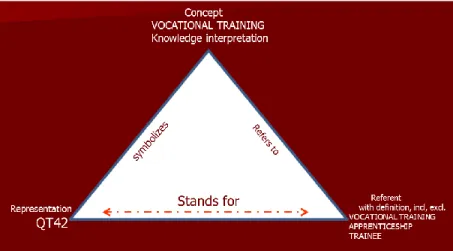
Ogden & Richards have introduced the words Thought of Reference to connect Symbol and Referent in their famous triangle. In the fig 8, QT42 is the symbol of Vocational Training which is presented not only as a term but as a thought of reference referring to a content such as Vocational Training, Apprenticeship, Trainee and their definitions, exclusion, inclusion criteria and so on. We could also give the example of P4, symbolizing Quaternary prevention, referring to a range of concept like overmedicalization, overtreatment, overscreening, deprescription etc.(fig 2)
It is observed that this procedure about the knowledge exhibited by physicians in the field is a bottom-up approach as opposed to the knowledge accumulated in the textbooks we have mentioned above which can be seen as a top-bottom knowledge. In our case, the experts are the general practitioners. They talk about their concerns. In textbooks, experts are interpreters of what they think is reality. Both methods have their value and are probably complementary but to get an intimate knowledge of family medicine, it is interesting to collate what is expressed in the field.
« What are they talking about?»
This is the question that is usually asked by readers of communications. Thus the project goes much beyond keywords or descriptors. The project is to identify the categories of concepts in GP/FM. When themes and major categories are emerging, one must tackle the thorny issue of subcategories and to give them a name. There is the dilemma of any classifier, namely the difficult combination of inclusivity and exclusivity and to find the most adequate term to give a name to the domain or the category.. A section must be exhaustive and contain all the topics concerned with the exclusion of those who do not apply. That's the unresolvable question whether you put the watermelon with fruits or vegetables. It is
21
easy to separate the nails & screws but where does ne may put screws that can be nailed? We have chosen to follow a method similar to the development of ICPC. A classification of usual theme, acting as container for subset. This is well shown in the fig 2. The concept quaternary prevention covers a set of important issues, heavily discussed in congresses as overmedicalisation, overscreening, overtreatment, déprescription etc. In fig 8 the concept vocational training encompass, as stated in the Wonca dictionary, Vocational training, apprenticeship, Trainee etc.
Anyway we tried to resolve these issues with the greatest possible precision, without, in 2007, to have time to look up the definitions, inclusions and exclusions that would probably refine the tool and report use the most fluid insuring also the link with huge nomenclature like MeSH. . This task is at the forefront of work to be undertaken. Computer techniques have recently made great strides, we try to incorporate this approach to knowledge in the movement of distributed data and the Semantic Web.
Figure 8 Conceptualization of the themes of communications (here Vocational training) following the semantic triangle
But the first step is to continue the slow discovery of the universe of GP/FM.
After Wonca 2007 and a 6 years latency period, we have had the chance to assist to the 2013 Portuguese congress of family medicine in Covilha, then to analyze the French CNGE 2013 congress in Clermont, followed by the SwissFamilyDocs congress , Zurich, 2014, the Belgian congress of GP/FM in Brussels 2014 and last one the LILLE CNGE Congress 2014.
We will present here the methods and the results of those analyzes of nearly 1400 communications of our colleagues.
5. Evolution of the method
The methods used have been influenced by the time elapsed since the beginning of the research. While ICPC was born before the blow up of laptop and Internet era, it has proven to be very well adaptable to electronic data base and researchers have worked with Dbase, Excel, Access and SQL for its development and related studies.
22
So the first step in developing 3CGP have been also those traditional methods. Computer content assisted analysis software is a tool used in qualitative research but is also quite performant to identify knowledge in GPS texts. Since this year the analysis of the abstracts have been done with the software Atlas.ti.
In the meantime the huge influence of semantic web technology was growing and ontologies are taking precedence on terminology for managing knowledge in the new era of distributed data. This particular field has been explored in depth and is exposed below. Participation in MERITERM group allowed to enter this area (www.meriterm.org )
5.1. Spreadsheet and database data on Internet
In the first time the development was marked by the use of information management method used in the 80’- 90’. We used a spreadsheet (Excel) and for abstracts Wonca 2007 a SQL database published online with the help computer scientists, thanks to a small grant received from the Wonca International Classification Committee.
At the annual conference of GPs and Portuguese family in Covilha, Portugal in 2013, it seemed interesting to go back to the research and to analyze the abstracts of this meeting. Then, the French National College of Teachers in General Practice (CNGE) hosts an annual conference that brings together GPs teachers and researchers in Lille this year 2014. Professor Berkhout, chairman of the scientific committee, has suggested to use the 3CGP/ICPC indexing system to index the abstracts submitted to the conference CNGE 2014 .The purpose is twofold. First, show the focus of the meeting to all abstracts presented. Second, by indexing before the review process, one could examine the contents of abstracts rejected compared to accepted. This comparison would inform the conference organizers and participants themselves .
It becomes therefore a process of operational research in quality of communications. This approach would complement the usual evaluation methods of quality of summaries. To be aware of the interests of members of CNGE and test the operational capability of ICPC and 3CGP, it was proposed by Prof. Laurent Letrilliard, Lyon, to code summaries of the previous congress held in CNGE Clermont Ferrand in 2013.
5.2. 2014 Use of a Computer-assisted qualitative data analysis software
The analysis of the 205 abstracts of Clermont 2013 was conducted using a Computer-assisted qualitative data analysis software (CAQDAS). Indeed our work could be assimilated to a qualitative research and "content analysis as the use of replicable and valid method for making specific inferences from text to other states or properties of its source" {Krippendorff 1969 quoted by Mairing 2000}
We have a large set of previously gathered codes as ICPC contains just a little bit less than 700 codes, and 3CGP version 0.2 show 153 codes. Coding means “to bring similar data according to themes, concepts, etc.. Generate code from the data level (inductively) or according to existing ideas (deductively) as necessary” {Silver & Lewins 2014 } . This implies we are using more inductive capabilities (linking strings of text to existing codes) than deductive ones (looking for missing concepts in texts and attributing new code).
23
After a review of the available products, and due to its user-friendly interface and its low cost for academic purpose the software ATLAS.ti has been chosen.
The work was completed by the analysis of 45 abstracts of SwissFamilyDocs 2014 and 37 abstracts of the Belgian research congress in general practice in 2014
A reporting structure has been developed to analyze abstracts of CNGE Lille in 2014 just after the submission process and blinded towards the reviewers. Computer-assisted qualitative data analysis software will be used to code the Lille abstracts as soon as they will be available.
One will find on the following pages the analysis of these six Congress followed by a comparison between them and a discussion of the strengths and limitations of the method.
The ICPC classification is available on the website www.ph3c.org in many languages.
The classification 3CGP version 0.2 is available on my personal website website
http://docpatient.net/mj/wonca2007/3CGPFMdeskcopy.pdf . The Version 0.3.1 of 3CGP, current result of the work described above is available in annex.
5.3. Exploring semantic web New tools in information management
Since the seminal proposal of Tim Berners Lee to turn the Internet of documents into an Internet of data {Berners-Lee 2001}, giant steps have been made by numerous researchers. At the same time the power of the laptops has grown exponentially. Gradually the health knowledge management field becomes a multidisciplinary case involving both domain specialists, terminologists, taxonomists computer scientists and computational linguists.
The semantic web, sometimes referred to Web 3.0 {Giustini 2007} and the huge possibility of distributed data have exploded in fields as varied as clinical guidelines{Kumar2004b}, information resources for consumer health{Smith2004}, mappings between medical classification systems{Cardillo 2008a}, Linked data{Bizer 2009}, ICD-11 development {Tudorache 2010b}, adverse events{Ceusters 2011b}, medical education {Blaum 2013}, terminological resources and Natural Language Processing {Neveol 2013}, NLP and ontology {Liu 2011}, biomedical data integration {Smith 2007}, interoperability {Qamar2008}
Semantic web and linked data
The technology of semantic web and Linked data have emerged as a future solution to exchange data distributed between so many providers, the family physicians, spread around the globe. The considerable development of medical ontologies demonstrates the vitality of this field of discovery.
It became increasingly clear that advances in information technology, or ontologies, new languages such RDF { Allemang 2008} or SPARQL {Salvadores 2012}, transforming the Internet
24
into a huge distributed data base, associated with Natural Language processing techniques { Ittoo 2013} would allow strides in information management in general and, it is hoped, in information management of family medicine. The realization of the prediction that information is up to general practice what technology is up to specialized medicine { Van Dormael 2001} may finally be within reach.
This area will be developed later, but the interested reader can find more information on the website of the group is MERITERM www.meriterm.org and will find a training in ontologies (in French) at
http://docpatient.net/onto/formol.html
Ontology, what’s for a name ?
Understanding of computer scientist and computational linguist world of reference is not that easy. When dealing with the term “ontology”, mainly all the fundamental papers in the field are referring to the seminal paper of Gruber in which he gives the following definition “Ontology is a formal specification of a conceptualization” {Gruber 1993} This not enlightening for a practicing doctor. Here, the term Ontology, although coming from the field of philosophy is not referring to the study of being or existence. The term ontology is used in the world of Artificial Intelligence and refers to an huge Internet based collection of interlinked terms describing the whole content of a domain in a dedicated machine readable format.
Indeed the second term to understand is the term formal. Formal could have many perceived meanings and one thinks directly to the form in the sense of shape, to formal in its legal sense as rules or to some kind of standard with specific format. In fact computer scientists are using formal in its mathematical sense i.e. a set of symbols understandable by machines. The problem is that the collection of term has to be read and understood by human beings also. Ontologies are not for human use but for machine use in a sequence; human to machine to machine to human. So one can say that ontologies are an arrangement of written human knowledge ready to be used by machines.
What about conceptualisation?
We remain with two terms to define ; specification and conceptualisation. Conceptualisation has already be addressed in this text in the above triangle of Ogben & Richard. Historically, the concepts, defined as mental representations or written form of an idea, are usually categorised and defined in written dictionary in an onomasiological way (list of words like an index) or semasiological way (list of senses of words like a thesaurus).
Ontologies are the machine based semasiological expression of all the possible occurrences of meanings and links of a word in a defined domain (i.e. all terms of sailing ships or all terms related to EKG) and this whatsoever the language used by humans. This possible multilingualism is due to the fact that the word representing the concept is related not to its lexical representation but to the concept it represents which could be expressed in various linguistic format. Usually the ontologies are in English working language but the specifications allows this miracle of interoperability of language. See for further insight the website www.babelnet.org
25
You says specification?
This introduces the last term of the definition proposed by Gruber “Ontology as a formal specification of a conceptualization” Specification refers to all the information technology tools patiently elaborated by hundreds of computer scientists and computational linguists since the 2000. First of all has been the URI (Unique Resource Identifier), proposed by Tim Berners Lee {Berners Lee 2002}. We know all the URL which is now for us the Internet address of a specific document. The URI is the specific address of a data, i.e. by example that you exist as a person (first data) and that your weight is 80kg (second data
linked to the first). The second most important proposal is RDF (Resource Description Framework) {W3C 1999} and its relatives {W3C 2004} We understand very well HTML, this language which allows us to link a document to another. RDF is the name of that language which allows the link of a data with another data.
There exist much more
specifications and new languages, all derived from the work in Artificial intelligence but with those two you can understand the phenomenon of Linked data {Bizer 2009}
Linked data and Dereferenced data
Examining the cloud of linked data on linkeddata.org you can see that billions of data are now interlinked by RDF and submitted to queries by dedicated robots. Whatsoever the activity, business, cars selling, books selling, civil affairs management or health care they are a lot of sites already managing linked data. The difference with the Internet of document is striking. If you question the linked data web site of the BBC asking information about an artist will not receive a link to a prepared page, but rather it will be created instantly to match the query. The screen you see is prepared at the very second. this is achieved by copying data from the relevant cloud. The computer scientist don’t say copied, the use the strange term dereferencing data.
This allows the retrieval of all the knowledge needed on a subject while the data are not gathered in a database but dereferenced at a glance. The data is reachable through the Internet. Internet is now the database and this is the explanation of the word “distributed data”.
The future of health care information systems The next EHR
Now imagine that the data of your patients are not sent by mail to your electronic medical record anymore but that, with the due authorizations, you are allowed to dereference the data you need in all the hospitals or primary care settings which store information about your patient in the correct format. You will reconstitute in seconds and only for the time needed, the current record of your patient. Health-Data becomes Linked-Data {Dowling 2013}. As stated by Pierce and all “ Semantic Web
Figure 10 The concept « feeling tired » in the Ontology of emotion in RDF (Obofundry)
26
technologies offer the potential to revolutionize management of health care data by increasing interoperability and reusability while reducing the need for redundant data collection and storage”{Pierce 2014}. This is the future of health care information system and of electronic health record (HER). This is behind our door {Fernández-Breis 2013} That’s why scientists are working so hard to develop medical ontologies like Open Biomedical Ontologies consortium (OBO) {Smith 2007}, National Center for Biomedical Ontology { Musen 2011} or Linking Open Drug Data (LODD) for pharmaceutical research {Samwald 2011}
Interlinked publications
In the same way, the abstracts presented by doctors in congress, or the gray literature could be tagged by semantic web specifications, stay in their place into the local database of congress organizers or local organizations and a semantic web robot could traverse these sites, dereferencing the asked information through a common indexation system. One hopes to apply such techniques to indexation system for communications of family doctors, interlink them through the use of dedicated ontology in a semantic web GP/FM universe.
Related publications annexed :
• Roumier J, Jamoulle M, Vander Stichele R, Romary L, Cardillo E, Stichele R Vander. Towards a terminologies support system in Primary Care (Letter to the editor). Inform Prim Care. 2011;19:257–258. http://hdl.handle.net/2268/171544
• Cardillo E, Warnier M, Roumier J, Jamoulle M, Vander Stichele RH. Using ISO and Semantic Web standards for creating a Multilingual Medical Interface Terminology : A use case for Hearth Failure. In: 1Oth International conference on Terminology and Artificial Intelligence, Paris Oct 28-30, 2013.; 2013:1–11. http://hdl.handle.net/2268/171534
6. Comparative study of 6 congresses in GP/FM
6.1.
Wonca Europe congres 2007
6.1.1.
Introduction
As stated above, French colleagues gave me access to abstracts before the congress and I have been able to code all of them (998) and to manage an online database with a query module online before the congress.
It’s worth to mention that the scientific committee lead by Bernard Gay has already chosen ICPC as an indexation tool for the management of the abstracts. One can see in the following figure this opening but also that the question of non-clinical themes of abstracts has been solved by opening the chapter A of ICPC
27
Figure 11 Wonca 2007. Indexation by ICPC (left) and opening of the Chapter A for non-clinical issues (right)
6.1.2.
Method
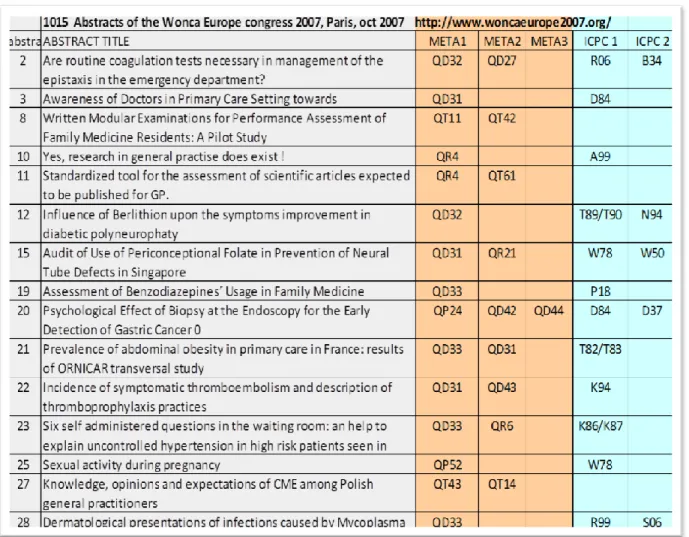
With the help of Niels Bentsen, at this moment Chair of the Wonca International Classification Committee I have been able to found some budget to pay the development of an online database on a dedicated website. I had the access on line to the screen of the reviewers of the submissions to the congress. All 998 abstracts have been introduced one by one by hand in an Excel spreadsheet. I have read carefully all the abstracts, looking for main theme with in mind the distribution of Q-codes of Henk Lamberts described above. Gradually, days after days and weeks after weeks, I have identified more themes dealing with the core job of the family doctors and 3CGP version 0.2 has emerged . All the codes have been reported in the spreadsheet as shown in the following table 3. At this moment I was still using the name “meta-classification”. That’s why in the figure one finds the acronym META as column entries. I have tried to give maximum 3 codes of each classification, ICPC and metaclassification. In the figure, chosen example have max 3 codes META and 2 codes ICPC (ICPC1 and 2).
As an example for people not ICPC minded, the abstract n° 15 in the figure, titled “Audit of use of periconception folate in prevention of neural tube defects in Singapore” is coded with 3CGP codes QD31 which was used for Primary Prevention and QR21 used for field research, while ICPC codes W78 for pregnancy and W50 for treatment during pregnancy.
28
Table 3 Extract of the 2007 spreadsheet showing the title of the abstracts with corresponding codes
6.1.3.
Results
Online database with query module
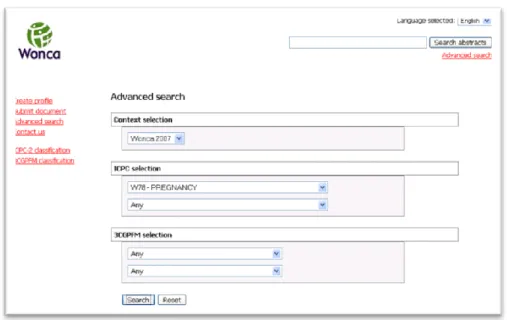
All the data gathered in the spreadsheet have been introduced by the team of computer scientists in an online database as shown in the following figure 12 which is a copy taken form a power point saved from destruction of my computer. Indeed a computer crash has provoked the loss of mainly all data and the web domain was too costly to maintain. So all this experience has disappeared.
A query module allowed the search of specific abstracts by using the indexation tools as retrieval units. One can see in the figure all the abstracts associated with the code QD8 : health provider personal life. Unsurprisingly, the correspondent abstracts dealt with burnout and or work satisfaction.
The system has been presented in a workshop held in the Paris conference. This workshop didn’t attract a lot of people. Critics by some Wonca executives have been disappointing. There general comments was
29
that there was no need for a new indexation system in GP/FM and that the MeSH could fit with the GP/FM publications. No funds was available for an abstract database.
Figure 12 Copy of a power point. 2007 The online database with all the 998 abstract of Paris 2007. Here the query system shows the QD8 related abstracts
Figure 13 Copy of a power point. 2007 The online database. Query window
Meta-clinical (3CGP) content
The analyse of the non-clinical codes of the Paris congress is nevertheless interesting. 1999 non-clinical codes and 970 ICPC-2 codes have been used to code 998 abstracts.
30
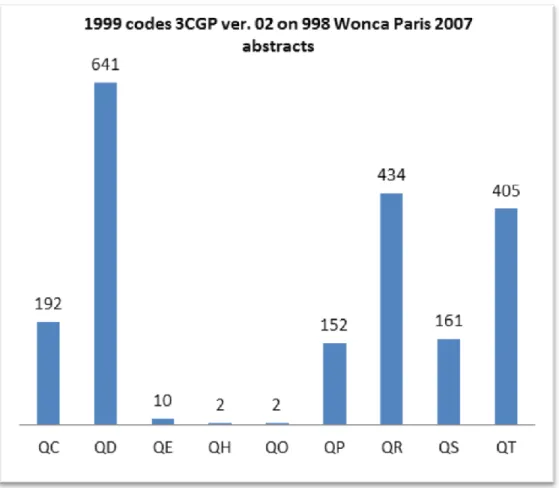
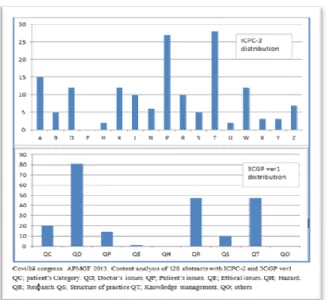
The distribution of the non-clinical codes, let’s use the acronym 3CGP now, shows that the majority of coding is in the QD Doctor’s issue domain (Fig 14). Indeed the main used code into the QD domain was QD31 Health issue management (description of disease and its management) which implies that young participating doctors like to show their ability to describe disease process and management. At this moment the cow milk of drug therapy i.e. Diabetes, Lipid issues and so called Metabolic syndrome was very attractive. This is quite evident in the distribution of the chapters of ICPC-2 with the prevailing chapter T (which, for non ICPC minded readers, contains all those problems)(fig 15)
Wonca is an association of academics and teachers in GP/FM and this appears very well in the 405 codes used for teaching and learning (3CGP QT) and 434 codes Research & development (3CGP QR) (fig 14) It’s appealing that the domain of medical ethics(QE) has attracted only 10 participations while virtually nothing for Hazards (QH) which encompasses the environment issues. Structure of practice (QS) like settings, manpower, organisation of Primary care etc. and Patient’s issue (QP) (like accessibility, acceptability, security etc. was no as attractive as research and teaching.
31
Clinical content through ICPC coding
For people used to see ICPC distribution through bar histograms, the Paris 2007 ICPC distribution is unusual. The distribution here don’t follow what we are used to see in clinical settings when using ICPC to code clinical problems like reason for encounters or diagnosis.
Only the proportion of T (metabolic and endocrine), K (circulatory) are at the same level as in usual daily clinical data. The usual clinical based diagram shows much more item in the R chapter (Respiratory) and certainly not so much in the P chapter (Psychological) and Z one (social problems)
This could raise an interesting research question. Why the GPs don’t point out the P & Z problems in clinical settings and discuss a lot about it during congresses?
Figure 15 Wonca Paris 2007. Distribution of ICPC-2 chapters. On 998 abstracts
Through ICPC-2 indexing, (from a clinical perspective) it is evident that European researchers in GP/FM are confronted with and addressing a large amount of psychosocial problems, mainly depression and addiction (nicotine and alcohol)
32
Figure 16 Wonca Paris 2007. Opening of P chapter
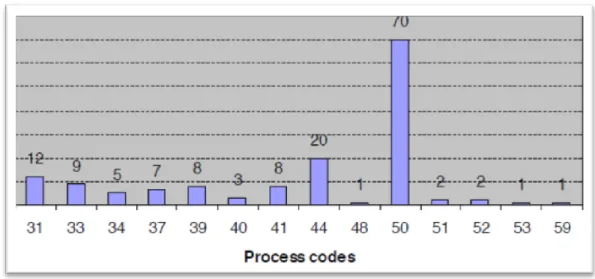
The distribution of process show that GPs like to speak about treatments and mainly about drug therapy (item 50). The second position is for immunisations (item 44) while all the others are really rarely discussed.
Figure 17 Wonca Paris 2007. Distribution of ICPC-2 process codes. On 998 abstracts
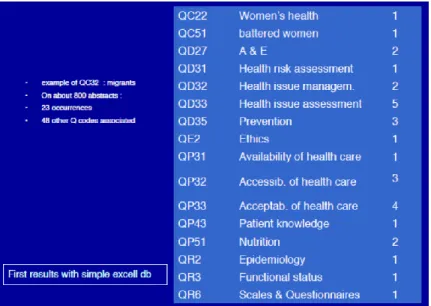
The cross between the various items of 3CGP and ICPC could give interesting pictures as in the following figure 18 which shows the non-clinical problems associated with the patient category Migrants (QC32) The interested readers could have a look at the power point still available on my personal website
33
Figure 18 Wonca Paris 2007. Crossing between 3CGP items . Here the category Migrants and its related discussed problems coded also in 3CGP.
In the above figure, one can see that the migrant issue was discussed in 4 abstracts with acceptability of health care, in two abstracts dealing with nutrition , in 2 dealing with accident and emergency issues (A&E) etc.
This could give an idea of the expected query for an item in an application prepared for a congress if the corresponding indexation systems are used during the submission of the congress. A participant to a congress, interested in the issue Migrant, and introducing this item in the query module, could receive all the related communications. The precise indications like authors & mail, title and content of abstract, place and time could be easily introduced in the system. Naturally, the two classifications ICPC-2 and 3CGP could be crossed.
This kind of tool could favour a quick communication between authors and attendees and will favour also, it’s hoped, the development of social networking between researchers.
Moreover, as we will try to experiment, the RDF tagging (see 5.2 above) of the metadata of abstracts, the abstracts themselves and related indexation could open the door to a semantic web of knowledge between family practitioners by introducing it in the world of semantic web.
6.2.
APMGF Covilha 2013 Annual Conference
Attending the Portuguese Association of General and Family Medicine 2013 Annual Conference (APMGF – Associação Portuguesa de Medicina Geral e Familiar) in Covilha was an opportunity to witness the youth and enthusiasm of attendees, as wells as the great quality of their work. The 128 submitted abstracts were peer-reviewed by the conference’s organizers who expressed desire to include them in their association’s journal.
Down below is a text summary of this work. Codification was done according to the ICPC-2 structure as well as the 3CGP system, validated six years earlier in Paris at the WONCA 2007 conference (ICPC-2 &