Université de Québec
Institut National de la Recherche Scientifique (INRS) Énergie Matériaux Télécommunications (EMT)
Gold Nanoparticles for Catalytic and Potential
Biological Applications
Par
Jianming Zhang
Thèse présentée pour l’obtention du grade de Philosophiæ Doctor (Ph.D.) en Sciences de l’énergie et des matériaux
Jury d’évaluation
Président du jury et Royston Paynterexaminateurs interne INRS-EMT, Université de Québec Examinateurs externe Fabio Cicoira
École Polytechnique de Montréal Zhifeng Ding
University of Western Ontario Directeur de recherche Dongling Ma
INRS-EMT, Université de Québec Codirecteur de recherche Mohamed Chaker
i
Abstract
Gold nanoparticles (AuNPs) have attracted much attention in many applications due to their unique physical and chemical properties, which the bulk material does not possess. Generally, two main approaches can be used for synthesis of AuNPs, namely chemical and physical methods. The chemical reduction method is the most widely used synthesis technique. It involves using various chemical precursors, such as Au salt and a reducing agent. Au ions are reduced to Au atoms followed by the growth of NPs. The laser ablation approach is one of the most used physical synthesis methods, such as pulsed laser ablation in liquid (PLAL), where NPs are synthesized via laser ablation of a solid target placed in a liquid medium without addition of chemicals.
AuNPs based nanomaterials used as catalyst have shown highly active catalytic properties in many reactions, such as selective hydrogenation of organic molecules, carbon monoxide (CO) oxidation, and the water-gas shift reaction. The catalytic activity of AuNPs is strongly dependent on their surface chemistry. Various Au-based nanostructures have been successfully synthesized by chemical methods, however, the surface features of AuNPs prepared by these chemical approaches are not optimal for catalysis, due to the existence of surface stabilizing molecules or tightly adsorbed reaction residues, which exerts a “barrier” effect to catalysis or poisons the catalyst. Therefore, AuNPs with relatively “bare and clean” surfaces are highly desired for catalysis. The unique relatively “bare and clean” surface of AuNPs prepared by PLAL makes them a good candidate for catalysis. However, this potential of applications of PLAL-AuNPs in the field of
ii
catalysis is still not explored. It is therefore of great interest to investigate the catalytic properties of PLAL-AuNPs and the influence of their surface chemistry on catalysis.
AuNPs have also been widely used in the field of biological research. In these applications, small and toxic-chemical-free colloidal AuNPs are highly desired. Nonetheless, the colloidal stability and molecule adsorption ability of the AuNPs are two primary properties for their biological application development, which highly depend on the surface chemistry of AuNPs. Unfortunately, the chemical synthesis of very small AuNPs (less than 10 nm) involves the use of toxic chemicals which renders them unsuitable for biological applications. Another laser technique ─ laser irradiation, which combines chemical reduction and laser methods, is suitable for synthesis of “green” Au colloids with very small sizes. Interestingly, laser irradiation introduces novel surface chemistry to chemically synthesized AuNPs, such as surface oxidation. The effect of the surface chemistry variation introduced by laser treatment on NP colloidal stability and amine molecule-AuNP interaction has not been investigated so far.
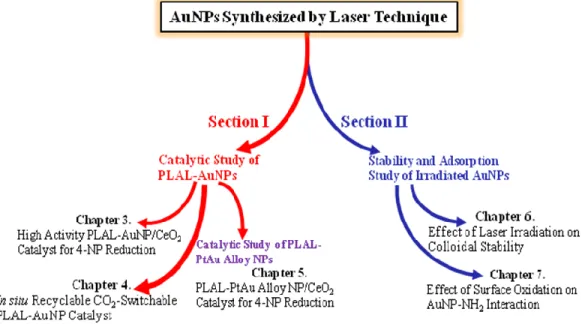
The work performed in this thesis was therefore driven by two main objectives: 1) PLAL and chemical synthesis of Au and PtAu NPs and characterization of their catalytic properties and 2) investigation of the surface modification of chemically synthesized Au NPs by laser irradiation and its influence on Au colloidal stability and amine-AuNP interaction. The results obtained in this work are summarized in two sections as follows.
In the first section, the synthesis and catalytic property of AuNPs prepared using the PLAL technique are investigated. To do so, I prepared a novel nanostructured catalyst, composed of small (~5 nm in diameter) and uniform AuNPs and ceria nanotubes (CeO2 NTs). AuNPs with relatively
“bare and clean” surfaces fabricated by PLAL on a bulk Au target in pure water are efficiently assembled onto the surfaces of CeO2 NTs without performing any surface functionalization of either
iii
component to promote their coupling, thanks to the presence of the –OH groups (that do not block catalysis) on the surfaces of PLAL-AuNPs. The model reaction of reducing nitrophenol to 4-aminophenol catalyzed by our PLAL-AuNP/CeO2-NT catalyst exhibits a remarkably higher reaction
rate than the reaction catalyzed by other supported Au catalysts reported recently by other groups. Meanwhile the study of the effect of surface chemistry on catalysis shows that the catalytic activity of the PLAL-AuNP/CeO2-NT catalyst is much higher in comparison to that of similar
catalysts composed of chemically prepared AuNPs (Chem-AuNPs) and/or commercially available CeO2 powder as support. Its superior catalytic activity is found to be due to the unique, relatively
“bare” surface of the PLAL-AuNPs as well as oxidized Au species induced by the strong interaction between the “barrier-free” surface of PLAL-AuNPs and surface defects (oxygen vacancies) of CeO2
NTs. The important role of the unique surface chemistry of PLAL-AuNPs in catalysis was further demonstrated in the CO oxidation reaction in the gas phase. Our results suggest that the use of PLAL-AuNPs enables easy and efficient attachment of AuNPs onto the surface of the CeO2 NTs
and their unique combination leads to the development of highly efficient catalysts.
In order to overcome the aggregation issue induced by centrifugation when recycling AuNPs during catalysis, and to expand the application of PLAL-AuNPs for catalysis in liquid phases, I further developed a novel in situ recyclable AuNP catalyst for 4-NP reduction using PLAL-AuNPs and CO2-switchable polymers. The surface of PLAL-AuNPs is relatively “bare and clean” and
therefore favours easy surface functionalization. I modified the surfaces of PLAL-AuNPs by coupling a thiol-terminated poly(N,Ndiethylaminoethylmethacrylate) (SH-PDEAEMA) with Au, to form CO2-switchable AuNPs (PDEAEMA-AuNPs). The structure of PDEAEMA polymer was
rationally designed to enable its robust attachment to the NP surface, yet limit the number of polymers that can be anchored onto the NP surface. So the possible, negative “blocking” effect on the catalytic active sites of AuNPs is limited. The dispersion status of PDEAEMA-AuNPs in
iv
aqueous solution can be easily tuned by simply bubbling CO2 or expelling CO2 from solution using
N2 bubbling, inducing novel in situ recyclable AuNPs in liquid. The PDEAEMA-AuNPs were used
as a catalyst in a model catalytic reaction of 4-nitrophenol reduction and compared with the PLAL-AuNPs without polymer functionalization and the Chem-PLAL-AuNPs. Results show that the limited amount of PDEAEMA on the AuNP surface doesn‟t noticeably reduce the catalytic activity. More interestingly, this novel catalyst can be easily separated and re-dispersed in solution by CO2
gas-switching and exhibits better colloidal and catalytic stability during successive reactions than PLAL-AuNPs and similarly sized AuNPs synthesized by the conventional chemical reduction approach (Chem-AuNPs).
In order to further enhance the catalytic activity of PLAL-AuNPs, it is highly interesting to alloy Au with other transition metals, e.g., platinum (Pt) because of the possible synergistic effect of the alloy structure in catalysis. Using a modified PLAL technique, stable PtAu alloy colloids with a wide range of compositions were prepared successfully on novel metal-mixture targets in water, which are made by compression molding a mixture of Pt and Au powders at different ratios. The concentration of Pt in the alloys can be tuned by varying the Pt/Au ratio in the targets, and their composition basically follows that of their corresponding targets. The effect of aqueous solution pH and ablating laser fluence on the formation and structure of alloy NPs was further investigated. It is found that PtAu alloy colloids of identical composition can be achieved over a pH range extending from 4.0 to 11.0 and at fluences varying from 4 to 150 J cm-2 as long as targets of the same composition are used. This finding suggests that alloy formation is essentially insensitive to both factors in certain ranges and the method developed herein for the alloy NP formation is quite robust. Moreover, the surface composition, estimated from electrochemical measurements, is identical to the overall composition of the NPs estimated from Vegard‟s law and X-ray diffraction data, which
v
is a strong indication of the uniform composition on the surface and in the interior of these alloy NPs.
The as-prepared PtAu alloy NPs were assembled onto CeO2 nanotubes (NTs) to form hybrid
nanocatalysts for 4-NP reduction. As demonstrated in the PLAL-AuNP/CeO2 study, the unique
surface features of alloy NPs resulting from PLAL are mainly responsible for their robust adsorption onto the NTs, without any additional surface functionalization to either component. The as-prepared PtAu alloy NPs exhibit exceptional catalytic activity for the reduction of 4-nitrophenol. All PtAu alloy NPs, and in particular the Pt50Au50 sample, outperform the activity of monometallic PLAL-Pt,
AuNPs and their mixture, and even outperform most AuNPs reported. Remarkably, the alloying of Au with Pt enhances the catalytic activity by means of a synergistic effect.
In the second section, chemically pre-synthesized AuNPs were treated using a laser irradiation technique, and then the effect of the surface chemistry variation introduced by laser treatment on the colloidal stability of NPs and amine molecule-AuNP interactions was investigated.
First, monodisperse, AuNPs with diameter ~5 nm were prepared at a relatively high concentration by optimized laser irradiation (without the involvement of any hazardous chemicals) on 20-nm AuNPs synthesized chemically via the “green” Frens method. The citate concentration shows an effect on the final particle size and shape during laser treatment. AuNPs after laser irradiation demonstrate a significant improvement in colloidal stability as compared to similarly sized Chem-AuNPs prepared by a purely chemical approach which involves the use of hazardous NaBH4. The stability has been investigated by adjusting the dielectric constant and ionic
concentration of the colloidal solutions. The observed enhanced colloidal stability is confirmed by a significant increase in the Zeta potential of the Au colloids and could be explained by the oxidation of gold surface under laser irradiation. The enhanced stability is a key property for the use of AuNPs
vi
in many applications and this study reveals the potential of the laser irradiation treatment (free of hazardous chemicals) for the production of highly-stable ultra-small AuNPs.
Then, I investigated the surface chemistry and surface functionality variation introduced by laser irradiation. The effect of the surface chemistry variation of AuNPs on the AuNP-amine (-NH2)
interaction was investigated via conjugating an amine probe ─ 1-methylaminopyrene (MAP) chromophore ─ with three Au colloidal samples of the same particle size yet different surface chemistries. The surfaces of laser-irradiated and ligand-exchanged-irradiated AuNPs are covered with acetonedicarboxylic ligands (due to laser-introduced citrate oxidization) and citrate ligands, respectively, and both surfaces contain oxidized Au species which are essentially lacking for the citrate-capped AuNPs prepared by the pure chemical approach. Both laser irradiated samples show inferior adsorption capacity of MAP as compared with the purely chemically prepared AuNPs. Detailed investigations indicate that MAP molecules mainly complex directly with Au atoms via Au-NH2R bonds, and the oxidation of the AuNP surface strongly influences the ratio of this direct
bonding to the indirect bonding originating from the electrostatic interaction between protonated amine (-NH3+) and negatively charged surface ligands. The impact of the oxidized AuNP surface
associated with the laser treatment is further confirmed by an aging experiment on AuNP-MAP conjugation systems, which straightforwardly verifies that the surface oxidation leads to the decrease in the MAP adsorption on AuNPs.
vii
Acknowledgements
I would like to thank Prof. Dongling Ma and Prof. Mohamed Chaker for giving me the opportunity to study at INRS-EMT, and providing me precious advice and direction throughout my PhD study. They have created a warm and stimulating research environment allowing me explore a complex and fascinating scientific field. Thanks to them for their kindness, patience and support during my PhD path. I learned lots from them. Being able to study under their supervision is one of the most important achievements in my life.
I want to acknowledge the contributions to this work made by Dr. Daria Riabinina. She gave me invaluable help and comments on my research, predoctoral exam and thesis writing. I am grateful to Dr. Guozhu Chen, who collaborated closely with me on many aspects of this research. Thanks to all the group members for their help throughout the work. I am grateful to have been part of such supportive, hardworking, and inspiring groups. Over the course of my research I have been fortunate enough to work with the truly outstanding groups. These people include: Dr. Haiguang Zhao, Ibrahima Ka, Hongyan Liang, Belete Atomsa Gonfa, Maxime Gougis and Dr. Stephano Desigan.
I thank to Prof. Federico Rosei, Prof. Daniel Guay and Ana Tavares at INRS-EMT, Prof. Nianqiang Wu from University of West Virginia and Prof. Yue Zhao from University of Sherbrooke for their important comments during my project research.
viii
I thank Shun Li, Yue Huang, Sébastien Vigne and Maxime Brossard. They always bring me funs and cheer me up.
I thank the departmental and technical staff at INRS-EMT. They are very helpful, particularly Etienne Charette, Georges Lamoureux, Louise Hudon and Christophe Chabanier. I would like to thank Jean-Philippe Masse at Ecole Polytechnique for TEM measurements.
I am eternally grateful to my dearest mother, who has been a constant source of love, encouragement for me. I want to thank to my wife, Meaw-Qian, who loves me deeply and supports me selflessly. I want to say them, I love you. I thank my family and my friends for their continuing love and heartily support.
Finally, I wish to acknowledge the following organizations for their financial support: the Natural Sciences and Engineering Research Council of Canada and Fonds de la recherche sur la nature et les technologies.
ix
Contents
Chapter 1 Introduction 1
1.1 Gold Nanoparticles and their Basic Properties 1
1.2 Synthesis Techniques for AuNPs 3
1.2.1 Chemical Synthesis 3
1.2.2 Physical Synthesis 5
1.3 Application of AuNPs 7
1.3.1 Catalytic Applications 7
1.3.2 Stability and Molecule Adsorption for Potential Bio-application 12
1.4 Thesis Objectives and Organization 15
Chapter 2 Experimental 21
2.1 Materials 21
2.2 Experimental Details Relevant to PLAL Synthesized AuNPs and their Catalytic Study 22
2.2.1 Laser Ablation Setup 22
2.2.2 Preparation of PLAL-AuNPs 23
2.2.3 Preparation of PLAL-PtAu Alloy NPs 23
2.2.4 Synthesis of 5-nm AuNPs by Chemical Reduction (Chem-AuNPs) 24
2.2.5 Preparation of Au Based Nanocatalyst 25
2.2.5.1 Preparation of NP/CeO2-NT Catalyst 25
2.2.5.2 Synthesis of PDEAEMA-AuNP Catalyst 26
2.2.6 Catalytic Activity Measurement 26
2.2.6.1 Catalysis over NP/CeO2-NT Catalyst for 4-NP Reduction 26
2.2.6.2 Catalysis over AuNP/CeO2-NT Catalyst for CO Oxidation 27
2.2.6.3 Catalysis over PDEAEMA-AuNP Catalyst for 4-NP Reduction 27 2.3 Experimental Details Relevant to Laser Irradiated AuNPs and Surface Chemistry Study 28
x
2.3.1 Preparation of Laser Irradiated AuNPs 28
2.3.1.1 Synthesis of “Parent” AuNPs 28
2.3.1.2 Laser Irradiation of “Parent” AuNPs 28
2. 3. 2 Chemically Synthesized 5-nm AuNPs (NaBH4 reduced sample) 29
2. 3. 3 Stability of Laser Irradiated Au colloidal solution 29
2.3.3.1 Ethanol Induced Aggregation 29
2.3.3.2 Salt Induced Aggregation 29
2.3.4 Adsorption Ability of Amine Molecules to AuNPs 30
2.4 Characterization 30
SECTION (I): PLAL Synthesized AuNPs and their Catalytic Study 35
Chapter 3 High Catalytic Activity of PLAL-AuNP/CeO2-NT Hybrid Nanocatalyst 35
3.1 Catalytic Application of AuNPs 35
3.2 Preparation and Structural Characterization of PLAL-AuNP/CeO2-NT Catalyst 36
3.3 Catalytic Activity of PLAL-AuNP/CeO2-NT Catalyst for 4-NP Reduction 40
3.4 Mechanism for Enhanced Catalytic Activity 41
3.4.1 Surface Chemistry of NPs: PLAL vs. Chem-AuNPs 42
3.4.2 Au-Support Interaction: CeO2-NT vs. Commercial Ceria Powder 45
3.5 PLAL-AuNPs/CeO2-NTs towards CO Oxidation 49
3.6 Summary 51
Chapter 4 Novel In Situ Recyclable Gas-Sensitive AuNP Catalyst 52
4.1 Characterization of PDEAEMA-AuNPs 53
4.2 Application of PDEAEMA-AuNPs in Catalysis 57
4.3 Summary 61
Chapter 5 Increase of PLAL-AuNP Catalytic Activity by Forming Pt-Au Alloy 62
5.1 Characterization of PLAL PtAu Alloy NPs 63
5.2 Effect pf pH and Laser Fluence on the Fabrication of PtAu NPs 68
5.2.1 Effect of pH 68
5.2.2 Effect of Fluence 71
xi
5.4 Catalytic Property of PLAL-PtAu Alloy NPs 75
5.4.1 Catalyst preparation 75
5.4.2 Catalytic Measurement 76
5.5 Summary 80
SECTION (II): Surface Modification of AuNPs by Laser Irradiation and its Influence on
Stability and Amine-AuNP Interaction 82
Chapter 6 Modification of Chemically Synthesized AuNPs Using Laser Irradiation: (I)
Effect on Colloidal Stability 82
6.1 Preparation of AuNPs by Laser Irradiation 83
6.1.1 Effect of Citrate Concentration 85
6.2 Stability of Laser Irradiated AuNPs 89
6.2.1 Ethanol Induced Aggregation 90
6.2.2 Salt Induced Aggregation 92
6.3 Zeta Potential of Au Colloids 94
6.4 Correlation of Surface Chemistry with Stability 95
6.5 Summary 97
Chapter 7 Modification of Chemically Synthesized AuNPs Using Laser Irradiation: (II)
Effect on Surface Chemistry and AuNP-NH2 Interaction 98
7.1 Surface Chemistry of AuNP Samples 100
7.2 AuNP-MAP Conjugation 104
7.2.1 Optimizing MAP Concentration for Conjugation with AuNPs 104
7.2.2 Quntifying Adsorption of MAP 105
7.3 Summary 113
Chapter 8 Conclusions and Perspectives 114
8.1 Conclusions 114
8.2 Perspectives 118
Bibliography 121
Appendix 139
xii
B List of Chemical Formula 140
xiii
List of Figures
Figure 1.1 (a) Photographs of aqueous solutions of AuNPs as a function of increasing
dimensions. Corresponding transmission electron microscopy (TEM) images of the particles (i-v) are shown (all scale bars 100 nm) [8]. (b) Schematic illustration of a surface plasmon of a metal sphere showing the displacement of the electron charge cloud relative to the nuclei [4].(c)
UV-Vis spectra of AuNPs of different sizes [17]. 2
Figure 1.2 A typical AuNP prepration route (“Frens” method) by chemical reduction 3
Figure 1.3 Schematic illustration of (a) laser ablation, (b) PLD and (c) PLAL for NPs 6
Figure 1.4 Mechanistic model of the reduction of 4-NP by borohydride in the presence of AuNP
catalyst. 10
Figure 1.5 Schematic illustration of the access of reagent molecules to the surface of AuNPs
prepared by chemical method (a) and physical method (b) during catalysis 11
Figure 1.6 A guide illustrating the arrangement of chapters of this thesis 17
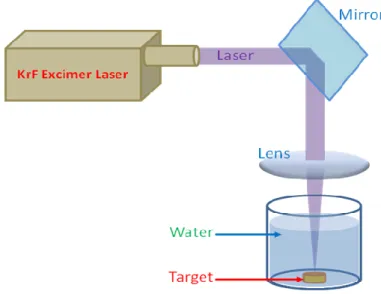
Figure 2.1 Schematic illustration of the PLAL setup for NP colloidal solution preparation 22
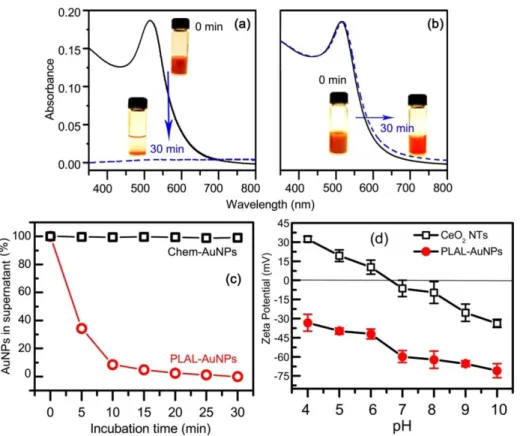
Figure 3.1 UV-Vis spectra of PLAL-AuNPs (a) and Chem-AuNPs (b) solution at 0 min (solid
line) and 30 min (dashed line) after the addition of CeO2 NTs. (c) “Free” AuNPs remaining in
the solution as a function of incubation time. Insets are corresponding photo-images. (d) Zeta
potential of CeO2 NTs and PLAL-AuNPs 38
Figure 3.2 TEM (HR-TEM) images (a-c) and EDS spectrum (d) of PLAL-AuNPs/CeO2-NTs.
Insets are the SAED pattern and the magnified TEM image 39
Figure 3.3 (a) UV-Vis absorption spectra during the catalytic reduction of 4-NP over
PLAL-AuNPs/CeO2-NTs; (b) C/C0 and-ln(C/C0) as a function of reaction time for the reduction of
xiv
Figure 3.4 TEM images of PLAL-AuNPs (a) and Chem-AuNPs (b). Insets show the high
magnification TEM images and histograms of size distribution for each sample; (c) UV-Vis
absorption spectra of PLAL- and Chem-AuNPs 42
Figure 3.5 (a) UV-Vis absorption spectra during the catalytic reduction of 4-NP over
Chem-AuNPs/CeO2-NTs; (b) C/C0 and-ln(C/C0) as a function of reaction time for the reduction of
4-NP over Chem-Au4-NPs/CeO2-NTs. Inset shows the TEM image of the Chem-AuNPs/CeO2-NTs.
Solid lines in (b) are the best-fit polynomials . 44
Figure 3.6 One thousand (103) times of reaction rate constant (103k) against the number of successive reduction reactions catalyzed by PLAL-AuNPs/CeO2-NTs and Chem-AuNPs/CeO2-NTs,
respectively 44
Figure 3.7 C/C0 and ‒ln(C/C0) as a function of reaction time for the reduction of 4-NP over
PLAL-AuNPs/CeO2-powder (a) and Chem-AuNPs/CeO2-powder (b), respectively. Insets show
the corresponding TEM images of nanocatalyst (a) and (b). Solid lines are the best-fit
polynomials 46
Figure 3.8 Nitrogen adsorption/desorption isotherms at -78 Cº of CeO2 NTs 47
Figure 3.9 XPS spectra of Ce 3d5/2 (a) for CeO2 supports and Au 4f (b) of PLAL-AuNPs/CeO2
-NTs (1), PLAL-AuNPs/CeO2-powder (2) and Chem-AuNPs/CeO2-NTs (3) 49
Figure 3.10 XPS spectra of unsupported PLAL-AuNPs (a) and Chem-AuNPs (b) 49
Figure 3.11 Temperature dependence of CO conversion in CO oxidation reaction over
PLAL-AuNPs/CeO2-NTs and Chem-AuNPs/CeO2-NTs 49
Figure 4.1 TEM image of PLAL-AuNPs before (a) and after (b) functionalization with
PDEAEMA, and (c) their corresponding UV-Vis spectra 54
Figure 4.2 (a) Reversible change of transmittance upon four cycles of CO2/N2 bubbling; (b)
Reversible in situ phase separation and re-dispersion of PDEAEMA-AuNPs in water upon CO2/
N2 purging 54
Figure 4.3 TEM images of PDEAEMA-AuNPs before (a) and after CO2 bubbling (b); Insets
show selected area electron diffraction (SAED) patterns; (c) and (d) show corresponding
xv
Figure 4.4 (a) UV-Vis absorption spectra during the first round catalytic reduction of 4-NP over
PDEAEMA-AuNPs; (b-d) C/C0 and -ln(C/C0) as a function of reaction time for the successive
reaction rounds of the 4-NP reduction over PDEAEMA-AuNPs Solid lines in (b-d) are the
best-fit polynomials 58
Figure 4.5 UV-Vis absorption spectra of 4-NP in the presence of N2 bubbled
PDEAEMA-AuNPs and NaBH4 for 60 min 59
Figure 4.6 (a) Plots of ln(kapp) against the reaction cycle in the presence of PDEAEMA-AuNPs,
PLAL-AuNPs and Chem-AuNPs respectively; (b) and (c) are TEM images of PDEAEMA-AuNPs and PLAL-PDEAEMA-AuNPs, respectively, after the third reaction cycle (scale bar is 20 nm) 60
Figure 5.1 (a) XRD patterns of PtAu alloy colloids prepared by PLAL at a fluence of 150.0
J/cm2 and pH of 11.0. The Pt feeding content is (A) 0, (B) 30, (C) 50, (D) 70, and (E) 100 at. %. (b) XRD patterns of Pt50Au50 alloy and 50:50 mixture of pure Pt and Au NPs. The inset presents
a high resolution scan of {220} peaks. (c) Lattice parameter and (d) crystallite size of NPs, estimated from XRD patterns, as a function of [Pt]feeding. Solid lines in (c) and (d) are the best-fit
polynomial and a guide for the eye, respectively 64
Figure 5.2 TEM (a) and HR-TEM (b) images, SAED pattern (c) and EDS spectrum (d) of
Pt50Au50 alloy NPs prepared by PLAL at a fluence of 150.0 J/cm2 and pH of 11.0 65
Figure 5.3 (a) XPS spectrum of Pt50Au50 (fluence=150.0 J/cm2, pH=11.0); (b) XPS core electron
binding energy difference, ΔBE, defined as Au4f7/2-Pt4f7/2, of alloy samples as a function of
[Pt]feeding. Inset shows the high resolution Pt 4f XPS spectrum of (a) fitted by three pairs of
curves. Solid line in (b) shows the linear-fitting 66
Figure 5.4 (a) XRD patterns of Pt50Au50 prepared by PLAL at a fluence of 4.0 J/cm2 in aqueous
solution with different pH values. The pH value increases from 4.0 to 12.0 from bottom to top. (b) Lattice parameter and (c) crystallite size of Pt50Au50 as a function of solution pH. (d) and (e)
show the TEM images of Pt50Au50 prepared by PLAL at pH of 4.0 and 11.0, respectively. Solid
lines in (b) and (c) show a linear-fitting and a guide for the eye, respectively. 69
Figure 5.5 (a) Lattice parameter and (b) crystallite size of Pt30Au70, Pt50Au50 and Pt70Au30
xvi
Figure 5.6 Cyclic Voltammetric responses (50 mV s-1) for PtxAu100-x NPs (fluence=150.0 J/cm2,
pH=11.0) in 0.5 M Ar-saturated H2SO4 solution up to (a) 1.5V and (b) 1.8V vs. RHE 73
Figure 5.7 [135] surface of PtAu alloy NPs, prepared by PLAL at fluence of 150.0 J/cm2 and pH
11.0, with respect to their [135] overall. Solid line shows a linear-fitting 75
Figure 5.8 TEM (a, b) and HR-TEM images (c) of Pt50Au50-NPs/CeO2-NTs 76
Figure 5.9 (a) UV-Vis absorption spectra of the 4-NP reduction reaction over PLAL-Pt50Au50
-NPs/CeO2-NTs; (b-f) C/C0 and -ln(C/C0) as a function of reaction time over hybrid catalysts.
Solid lines in (b-f) are the best-fit polynomials. 77
Figure 5.10 Reaction rate k over PtAu alloy-NPs/CeO2-NTs as a function of NP Pt content.
Dashed lines are the guides for eyes. 78
Figure 6.1 TEM images of AuNPs before (a), and after (b) laser irradiation. Inset shows the high
magnification TEM image of irradiated AuNPs (b); (c) Histograms of NP size distribution for the original 20-nm (a) and irradiated (b) samples. (d) UV-Vis absorption spectra of gold colloids,
before and after laser irradiation 84
Figure 6.2 UV-Vis spectra of gold colloid samples 1-4 with increasing citrate concentration after
55-min irradiation. For comparison a typical UV-Vis spectrum (dashed curve) of the original
gold colloid without laser treatment is also included 86
Figure 6.3 TEM images of samples a-4 with increasing citrate concentration after 55-min laser
irradiation; Circles mark the representative fused particles and single bigger particles,
respectively 88
Figure 6.4 TEM image of NaBH4 reduced 5-nm AuNPs (a). Inset shows the high magnification
TEM image. (b) UV-Vis spectra of laser irradiated AuNPs and Chem-5-nm AuNPs 90
Figure 6.5 (a) UV-Vis spectra of irradiated (red) and NaBH4 reduced (blue) AuNPs at pH 5.6
and pH 6.6. Solid and dashed lines represent the colloids before and after being mixed with ethanol for 4 hrs, respectively; photographs show the color change of the colloidal solutions due to the induced aggregation of AuNPs. (b) TEM images of AuNPs prepared after ethanol-induced aggregation experiments of irradiated (left), and NaBH4 reduced 5-nm (right) samples 92
xvii
Figure 6.6 (a) The absorption spectra of the laser irradiated AuNPs at pH 5.6 for various
quantities of 0.1M NaCl solution; (b) the normalized absorption intensity at a wavelength of 514 nm of the irradiated AuNPs (red square) and NaBH4 reduced 5-nm (blue circle) AuNPs at pH 5.6
as a function of final NaCl concentration in solution mixture 93
Figure 6.7 Zeta potential of the laser-irradiated and NaBH4 reduced 5-nm AuNPs as a function
of pH values of colloidal Au solutions 95
Figure 6.8 High-resolution Au4f XPS spectra of AuNPs before and after 55 minutes of laser
irradiation 95
Figure 6.9 FTIR spectra of the same amount of 5-nm AuNP samples prepared by NaBH4
reduction (blue) and laser irradiation (red) 96
Figure 7.1 TEM images of the AuNPs prepared by laser irradiation before (a) and after (b)
citrate ligand-exchange, and by chemical reduction with NaBH4 (c). Insets show corresponding
high magnification TEM images; (d) Histograms of NP size distribution of all three samples. (e)
UV-Vis absorption spectra of all three Au colloidal samples 99
Figure 7.2 High resolution Au4f XPS spectra of the AuNPs modified by laser irradiation before
(curve 1) and after (curve 2) citrate ligand-exchange, and the AuNPs produced using the NaBH4
reduction method (curve 3) 100
Figure 7.3 FTIR (a) and 1H-NMR (b) spectra of the AuNPs prepared by laser irradiation before (spectrum 1) and after (spectrum 2) ligand-exchange by citrate, and by NaBH4 reduction
(spectrum 3) 101
Figure 7.4 FTIR (a) and 1H-NMR (b) spectra of sodium citrate (spectrum 1) and 1,
3-acetonedicarboxylic acid (spectrum 2) 102
Figure 7.5 UV-Vis spectra for AuNP-MAP conjugation solutions with different MAP
concentrations. The AuNP samples were prepared by laser-irradiation before (a) and after (b) ligand exchange using citrate, and by NaBH4 reduction (c). The spectra were taken 6 hours after
MAP was introduced into the AuNP solutions 104
Figure 7.6 (a) PL spectra of the filtrate solutions after conjugating 800 nM MAP with the
xviii
prepared NPs, at pH=5.5. (b) Adsorption of 500, 800 and 1000 nM of MAP to the three types of
AuNPs at pH=5.5 107
Figure 7.7 Zeta potential of the laser-irradiated AuNPs before and after ligand exchange, and the
NaBH4 reduced AuNPs as a function of pH values of Au colloidal solutions 108
Figure 7.8 TGA data recorded from the as-irradiated AuNPs before and after ligand exchange
with citrate, and the NaBH4 reduced citrate-capped AuNPs 109
Figure 7.9 N1s XPS spectra of MAP conjugated AuNPs prepared by laser irradiation before (1)
and after (2) ligand-exchange with citrate, and by NaBH4 reduction (3) 110
Figure 7.10 PL intensity in filtrates as a function of incubation time for conjugation at pH=5.5
xix
List of Schemes
Scheme 3.1 Schematic diagram of the simple route for the preparation of PLAL-AuNP/CeO2-NT
catalyst and its application in 4-NP reduction and CO oxidation 36
Scheme 4.1 (a) Reactions of the side chains of PDEAEMA on AuNP surface upon CO2 and N2
bubbling. (b) Schematic illustration of catalytic cycles using PDEAEMA-AuNPs as catalyst via
CO2/N2 bubbling 56
Scheme 6.1 Schematic illustration of the setup of laser irradiation of a pre-synthesized AuNP
colloidal solution 82
Scheme 7.1 Surface characteristics of the AuNPs prepared by laser-irradiation before (a) and
xx
List of Tables
Table 1.1 Comparison of two synthesis methods and surface features of AuNPs catalysts 12
Table 3.1 Summary of the reaction rate constant k according to recent studies on the reduction of
4-NP over AuNP based catalyst 41
Table 6.1 The concentrations of sodium citrate introduced after the particle synthesis and
purification, while before laser irradiation 85
Table 6.2 SPR peak characteristics of samples before and after laser irradiation 86
1
Chapter 1
Introduction
1.1 Gold Nanoparticles and their Basic Properties
When the size of a material is reduced to the nanometer scale (generally 1–100 nm) in at least one dimension, it can be defined as a “nanomaterial”, whether it is dispersed in gaseous, liquid or solid media [1, 2]. At nanoscale, the ratio between the surface and volume significantly increases, which leads to important changes in physical and chemical properties of nanomaterials that are very different from their bulk materials [1-3]. Nanomaterials are likely to impact virtually all fields of physical and chemical sciences, biological and health sciences, and other interdisciplinary region of science and engineering [1-8].
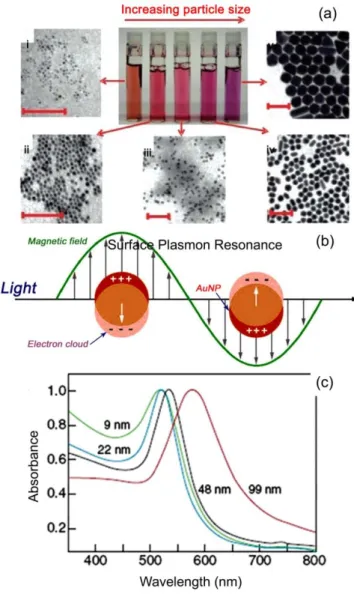
Among various nanomaterials, gold nanoparticles (AuNPs) have attracted considerable attention because of their unique physical and chemical properties and potential technological applications [4-15]. Unlike bulk Au with its familiar yellow color, when the size of Au reaches nanoscale dimensions, its color changes to ruby red or purple (Figure 1.1-a) due to the absorption of the light at certain wavelengths, e.g., 520 nm (green light) [4, 8]. As illustrated in Figure 1.1-b, when light of certain wavelength passes through AuNPs, the NPs are excited, leading to a strong electromagnetic field and an intense absorption attributed to the collective oscillation of excited electrons on the particle surface, known as Surface Plasmon Resonance (SPR) [4, 16]. The presence
2
of SPR also results in strong light scattering. This resonance can be measured and recorded using a UV-Visible (UV-Vis) spectrometer as a strong absorption peak (SPR peak) as shown in Figure 1.1-c.
Figure 1.1 (a) Photographs of aqueous solutions of AuNPs as a function of increasing dimensions. Corresponding transmission electron microscopy (TEM) images of the particles (i-v) are shown (all scale bars are 100 nm) [8]. (b) Schematic illustration of a surface plasmon of a metal sphere showing the displacement of the electron charge cloud relative to the NP [4]. (c) UV-Vis spectra of AuNPs of different sizes [17].
Generally, the resonance frequency is highly dependent on particle size, shape, material, and environment [4]. AuNPs in aqueous solution with a particle size of about 10 nm in diameter show a strong absorption at about 520 nm due to their SPR properties. This absorption peak shows a red
3
shift with an increase in the NP size (Figure 1.1-c) due to the electromagnetic retardation in larger particles, resulting in a color change from ruby-red to purple (Figure 1.1-a) [4, 16]. The NP size can thus be estimated from the position of the SPR peak [18]. This tuneable performance of SPR by varying the size or shape of the NPs leads to particles with tailored optical properties for different applications.
Besides, it is well known that Au has strong affinity with thiol (e.g., R-SH) and amine (e.g., R-NH2) group-bearing molecules or polymers by forming Au-S and Au-N covalent bonds,
respectively [3]. These molecules can thus strongly interact with surface Au atoms to form a stable molecule layer on the AuNP surface. Moreover, appropriately charged ions, molecules or polymers may be able to adsorb on a AuNP surface through electro-static interactions as well [3, 150-158]. The bonding of AuNP with molecules offers a versatile route to modify and functionalize the AuNPs, and brings various possibilities for actual applications.
1.2 Synthesis Techniques for AuNPs
To the best of our knowledge, two main approaches ─ chemical methods and physical methods have been well established for the synthesis of AuNPs [54]. Wet chemical procedures start from the reduction of metal ion precursors to metal atoms, followed by controlled aggregation of atoms into NPs. The physical methods often involve the condensation of vapor-like substances, effective by subdividing bulk materials into NPs.
1.2.1 Chemical Synthesis
4
The synthesis of AuNPs with diameters ranging from a few to several hundreds of nanometers has been developed in aqueous solution as well as in organic solvents. As illustrated in Figure 1.2, generally, in a typical chemical synthesis process, the Au precursor (Au salt), e.g., auric acid (HAuCl4), is dissolved in a solution, and then with rapid stirring a reducing agent, such as citrate or
NaBH4, is added immediately, which causes Au3+ ions to be reduced to neutral Au atoms. The
enrichment of Au atoms in solution leads to their nucleation/precipitation to form sub-nanometer particles. The free Au atoms or sub-nanometer particles will attach to the existing NPs, and therefore, they grow into bigger AuNPs [7, 55, 56].
In principle, smaller NPs easily aggregate during synthesis or storage due to their high surface energy, resulting in a large reduction of their quality and application ability. Besides, colloidal NPs are sensitive to their enviroment, for instance, high ionic concentration in dispersing solution or high temperature can induce an irreversible fierce aggregation [7, 57, 58]. In order to prevent the particles from aggregating and control their nucleation/growth to achieve an ideal size, stabilizing agents (such as ligands or surfactants) that bond to the NP surface are usually added during the AuNP synthesis process [34, 35, 57, 59]. For the typical synthesis process of AuNPs in aqueous solution, the stabilizing agent is usually charged, so that the charged NPs repel each other leading to a stable colloidal solution. For particles that need to be dispersed in organic solvent, frequently surfactants, which can bind strongly to the NP surface and are mainly based on hydrophobic alkane chains, are used to provide a good colloidal stability. Another option to stabilize AuNPs is to use support materials, such as ceria (CeO2), silica (SiO2) and Zinc oxide (ZnO) [5, 7, 34, 35, 57, 59, 60],
to link AuNPs and thus form a hybrid structure to disperse and stabilize the AuNPs. To couple the AuNPs with support, the pre-formed AuNPs are generally surface modified with linker molecules, such as silanes or mercapto alkane acids, during or after the synthesis [5, 7, 60].
5
Other procedures, such as deposition–precipitation (DP) [15, 59, 61-65], impregnation-incipient wetness [66, 67], and in-situ growth methods [39] are widely used to obtain supported AuNPs as well. They are usually composed of two steps [7]: i) mixing an Au salt and a solid support in solution for adsorption; ii) growth of adsorbed Au salt into AuNPs on the support surface by reduction. The DP method was first reported by Haruta‟s group to synthesize supported AuNP nanostructures and has since then become one of the most popularly used methods. In a typical DP process, Au salt (HAuCl4) solution is mixed with a support material, such as metal oxide or carbon,
and Au anions are hydrolyzed by raising the pH of the solution to form insoluble Au(OH)3 which
adsorbs onto the solid support as it precipitates. After the adsorption, the unstable component Au(OH)3 will decompose into neutral Au atoms, followed by their assembly [7, 63]. Finally the
AuNPs form on the support surface by nuclearation and growth. For the impregnation-incipient wetness method, an Au complex adsorbing on a support is subject to a thermal treatment under a reductive atmosphere, and is hence reduced to neutral Au atoms that grow into AuNPs on the support surface. Supported AuNP nanostructures can also be synthesized by the in situ growth method, where typically Au salt solution is mixed with special support materials, and then a redox reaction occurs between the two components simultaneously leading to the formation of AuNPs on the support surface [7, 39].
1.2.2 Physical Synthesis
The pulsed laser ablation technique is an important physical method for NP preparation [68-86]. As shown in Figure 1.3-a, during laser ablation, high energy pulsed laser beam is focused on the surface of a solid target, creating a directional plasma propagating perpendicularly to the target (plasma plume). Small clusters are formed as a result of the condensation of atoms in the decaying plume. Generally, the size of NPs formed in plasma plume varies from several to hundreds of nanometers, depending on experimental parameters, such as laser density, pulse width,
target-6
substrate distance, pressure and the composition of the surrounding gas. Unlike the chemical method, chemical reagents are usually not involved in this approach.
Figure 1.3 Schematic illustration of (a) laser ablation, (b) PLD and (c) PLAL for NPs.
AuNPs prepared by pulsed laser deposition (PLD) in the gas phase are generally collected by a solid substrate (Figure 1.3-b), e.g., a silicon wafer or metal oxide support (such as Fe2O3, SiO2 and
MnO2) [74-76]. Recently, an alternative laser ablation technique, pulsed laser ablation in liquid
phase (PLAL), has attracted much interest [68, 69, 71, 73, 78, 79, 81, 82, 85, 87, 88]. The bulk target is immersed in a liquid environment instead of the gas of PLD, and the focused beam passes through the liquid to hit the target (Figure 1.3-c). The influence of various conditions on NP fabrication, such as laser parameters, solvents, pH values, temperatures and electrolytes [68, 69, 79,
7
81, 88, 90, 91], and the surface chemistry of PLAL-AuNPs has been investigated. If the experimental conditions are appropriately optimized, it is able to yield small, mono-dispersed, stable colloidal NPs in a pure solvent (e.g., water) without intentionally introducing any stabilizing molecules. It has been shown that, in contrast to the plasma plume formed in the classical PLD process involving a gas environment, the plume formed during PLAL has very distinct characteristics [71, 73, 85, 89]: i). the plasma plume expansion is limited by the ambient liquid and
ii). the size and lifetime of the plasma in the liquid are much smaller compared to the PLD in a
gaseous environment. Due to the confinement of ambient liquid, the laser-induced plasma is rapidly driven into a thermodynamic state of high temperature, high pressure, and high density, which are highly favorable for chemical reactions, and the short lifetime of the ablated species favors the formation of metastable substances [73].For example, Luong et al. and Mafune et al. reported that Au atoms on the surface of AuNPs freshly prepared by the laser technique in water are partially oxidized [68, 80, 82], Kondow [69], and Muniz-Miranda et al. [70]also showed that metal PLAL NP prepared in pure water without using any surfactants are stable because small OH- groups from aqueous environment can adsorb on the NP surface to form a negatively charged surface to stabilize the NPs. This unusual surface feature of AuNPs prepared by laser in aqueous solution may lead to interesting impact to NP properties and potential applications.
1.3 Applications of AuNPs
Various applications using AuNPs have been developed based on their unique physical and chemical properties. For example, AuNPs have been designed to serve as good conductors in printing electronic chips [2]. Since the electronic chips or devices become smaller, NPs are acting as important components for the chip design. AuNPs are being used to connect resistors, conductors, and other elements of an electronic chip [2]. The non-toxicity and unique SPR feature of AuNPs have led to wide applications in biological field [4, 8]. The light absorption of AuNPs can produce
8
heat at a local region close to NP surface when excited by light at certain wavelengths. Therefore, when light is applied to a tumor containing AuNPs in a treatment, the particles rapidly heat up so as to kill the tumor cells, which is known as AuNP based photo-therapy [8]. Therapeutic agents can also be conjugated onto the NP surface. The large surface area-to-volume ratio of AuNPs enables their surface to be coated with a large number of molecules, such as therapeutics, targeting agents, and anti-fouling polymers [3, 8]. AuNPs can also be used for molecule detection and analysis [5]. For example, surface enhanced Raman signal of small molecules can be significantly enhanced by exploiting AuNP as substrates to enable the measurement of vibrational energies of chemical bonds [4, 5]. Besides, AuNPs also demonstrate outstanding catalytic activity in a number of chemical reactions which will be discussed detailedly in the following content.
1.3.1 Catalytic Applications
Bulk Au is a well-known chemically inert material and has been considered as a poorly active catalyst in many reactions. However AuNPs demonstrate outstanding catalytic properties for many reactions [5, 7, 9, 12, 13, 19-25]. The discovery of the excellent catalytic properties of AuNPs was reported for the first time by Haruta et al. in 1989, who demonstrated that AuNPs can be very active in the promotion of the oxidation of carbon monoxide (CO) at low temperature [26]. Following this discovery, a variety of aerobic oxidation reactions catalyzed by AuNPs have been reported. For instance, the oxidation of alcohols to aldehydes [22], carboxylic acids [5, 27, 28] or esters [29], the oxidation of aldehydes to esters [30] or acids [31], epoxidations of olefins [32], and the oxidation of amines to amides [33] have been investigated.
Recently, the catalytic application of AuNPs in selective hydrogenation has been widely reported as well [9, 12, 34-46]. In particular, it was shown that with the presence of a AuNP catalyst, substituted anilines and related derivatives can be produced efficiently at low temperature from their nitrogenated compounds, which are generally toxic organic by-products produced undesirably
9
during the industrial manufacturing process of chemicals, such as agrochemicals, dyes and pharmaceuticals [44, 48]. For example, 4-nitrophenol (4-NP), a toxic nitro acromatic chemical, has a delayed interaction with blood and then forms methaemoglobin inducing methemoglobinemia, potentially causing cyanosis, confusion, and unconsciousness to human body. When ingested, it causes abdominal pain and vomiting [49]. On the other hand, 4-aminophenol (4-AP), a hydrogenation product of 4-NP, is a very useful material which can be used as an important intermediate in pharmaceutical synthesis of analgesic and antipyretic drugs[39, 44], as antioxidant in plastics fabrication [44]. More importantly, this reaction is highly constructive for the transferring environmental pollutants into useful chemicals. With AuNPs, unsaturated chemicals can also be selectively hydrogenated. For instance, acetylene and 1, 3-butadiene can be partially hydrogenated into ethylene [48] and butenes [34, 35], respectively. The main advantage of AuNP catalysts is their ability to selectively catalyze the hydrogenation of the C=O group of α,β-unsaturated aldehydes producing allyl-type unsaturated alcohols [19, 48, 50-51].
The reduction of 4-NP to 4-AP on AuNPs with sodium borohydride (BH4-) in aqueous
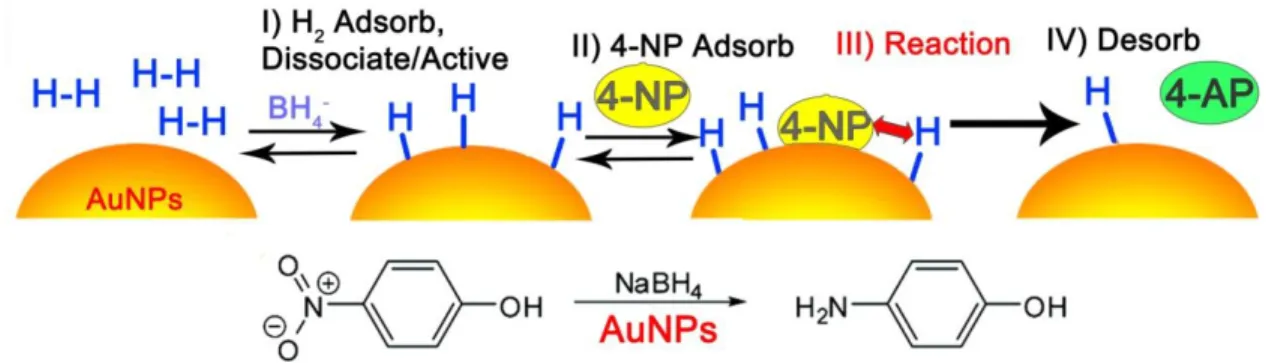
solution has also been rigorously used as a model reaction to examine the catalytic performance of noble metal NPs, especially AuNPs prepared from the reduction of auric acid by wet chemical approaches [20, 38-43, 52, 53].For example, Pal and co-workers report that a decrease in AuNP size leads to the increase of reduction rate [42]. The modification of AuNP surfaces with different functional groups confirmed that the surface structure also largely influences the catalytic properties of AuNPs [38]. The mechanism of the reaction catalyzed by AuNPs has been proposed as follows [44]. Basically, the catalytic reduction can only proceed on the surface of the AuNPs, as illustrated in Figure 1.4. First, BH4- or hydrogen (H2) from the borohydride ions adsorb on the active catalytic
sites of a AuNP, and then is dissociated and activated by forming H-Au bonds. Concomitantly, 4-NP molecules adsorbs onto the Au4-NP surface. Then the hydrogenation reaction takes place between
10
adsorbed 4-NP molecules and surface-hydrogen to form 4-AP; Afterward, 4-AP desorbs from the AuNP surface.
Figure 1.4 Mechanistic model of the reduction of 4-NP by borohydride in the presence of AuNP catalyst.
In the absence of the AuNP catalyst, the reaction does not proceed or only takes place under rigorous conditions. The outstanding catalytic property of AuNP catalysts in 4-NP reduction leads to promising prospects for employing them in industrial applications.
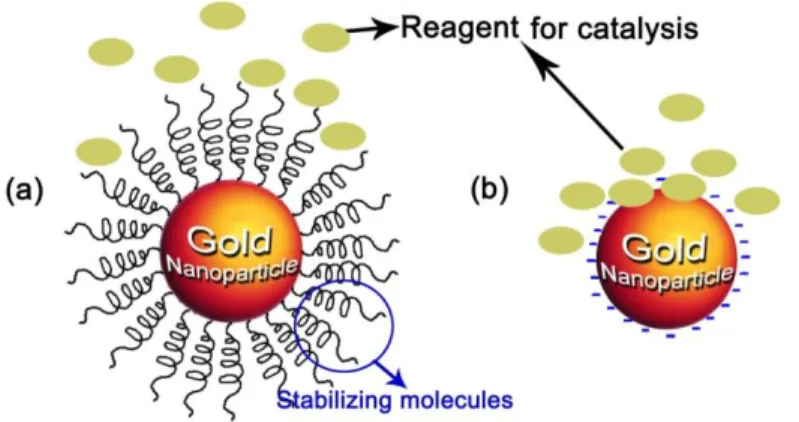
As introduced in 1.2.1, AuNP based nanostuctures has been successfully synthesized by various chemical methods and used as catalysts. Since AuNP catalyzed reactions basically proceed on the surface of the AuNPs, the surface properties of the as-synthesized AuNPs are deemed to influence the catalytic reaction significantly. During the chemical synthesis, using stabilizer or linker molecules leads to successful and reproducible experimental protocols and stable AuNPs in either synthesis or catalysis process; However, it is noted that the presence of these stabilizing molecules on the NP surface can obstruct the access of reactants to the active sites of NPs, namely the “barrier” effect in catalysis, and thus decrease their catalytic activity as illustrated in Figure 1.5-a [58]. The remov1.5-al of these st1.5-abilizing molecules from the surf1.5-ace of AuNPs is still problem1.5-atic. To date, it has mainly been achieved using thermal and oxidative approaches; however, such methods can lead to extensive changes in the size and shape of the NPs, and thus uncontrolled negative effects on catalytic properties [59, 61]. Also the thermal treatment may affect the support structure [58], so this method is not always highly reproducible.
11
Supported small AuNPs can be synthesized by the DP method without using stabilizing molecules, which avoids the “barrier” effect, however, impurities, such as chloride ions (Cl
-) from the HAuCl4 precursor and excessive chemical precursors, remaining in the catalyst must be
completely removed by an exhaustive washing treatment since these substances contaminate Au catalysts [7]. In particular, residual Cl- strongly bond to the AuNP surface can poison the Au catalyst [15, 65]. Generally a thermal treatment below 600 °C is still not efficient enough to remove most Cl [7]. Thermal treatment at higher temperature will accelerate NP aggregation [64] and hence damage the structure of the nanocatalyst.
Figure 1.5 Schematic illustration of the access of reagent molecules to the surface of AuNPs prepared by chemical method (a) and physical method (b) during catalysis.
On the other hand, the purely physical approach of laser ablation offers a better way to produce AuNPs for catalysis, since chemical reagents or ions can be avoided in this approach. It is reported that PLD fabricated AuNPs-support structures exhibit high catalytic efficiency in various gas phase catalytic reactions, such as CO oxidation, and low volatility component (e.g., acetone, toluene) oxidation [74-76]. Although the use of stabilizing chemicals is avoided in the PLD approach, which prevents the contamination of metal NPs, the set-up and operation of the PLD system are rather complicated in practice as well as time-consuming. For example, a bigger chamber commonly needs a long time to reach an ideal vacuum, and after refilling with gas, a good
12
sealability has to been guaranteed. Unlike PLD, the PLAL setup can be an open system without the need for a vacuum or gas refilling. Hence, compared with the PLD technique, PLAL can provide significant improvements in convenience of experimental manipulation. As mentioned previously, the stabilizing molecules on AuNP catalysts prepared by chemical method exert intense “barrier” effects on catalysis, blocking the approach of reagents to AuNP surfaces, reducing the reaction efficiency (Figure 1.5-a). In contrast, as explained in 1.2.2, the surface of a AuNP prepared by PLAL in pure water is only covered by small OH- groups, therefore this relatively “bare and clean” surface is expected to impose much smaller “barrier” effects on catalysis than most stabilizing molecules, leading to an enhanced reaction efficiency (Figure 1.5-b). Interestingly, the -OH capped surface of a PLAL-AuNP is supposed to easily interact with other materials, e.g., a metal oxide rich in hydroxylgroups in aqueous solution, to form NP/metal-oxide hybrid structures to stabilize the NPs during reactions, which are of high relevance to practical applications. Accordingly, it is highly interesting to apply these stable, colloidal PLAL-AuNPs fabricated in pure water with relatively “bare” surfaces in catalytic reactions in the aqueous phase.
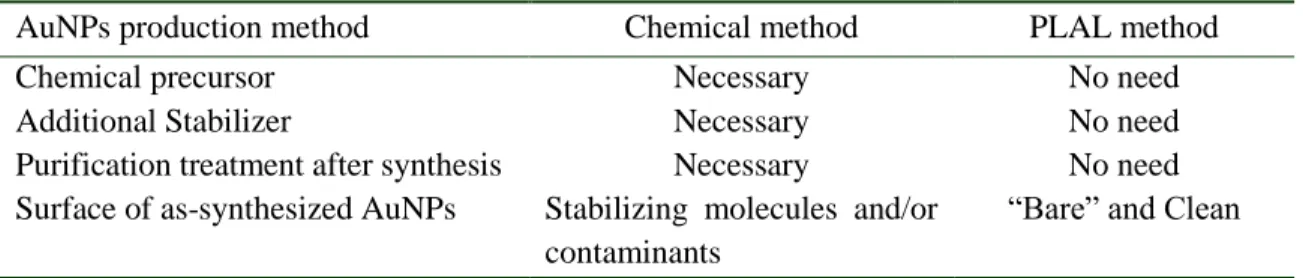
Table 1.1 Comparison of two synthesis methods and surface features of AuNPs.
AuNPs production method Chemical method PLAL method
Chemical precursor Necessary No need
Additional Stabilizer Necessary No need
Purification treatment after synthesis Necessary No need
Surface of as-synthesized AuNPs Stabilizing molecules and/or
contaminants
“Bare” and Clean
According to the above discussion of AuNPs prepared by chemical and physical methods, the main differences between them have been summarized in Table 1.1. It is clear that the physical approach, i.e., the PLAL method, demonstrates more advantages for developing AuNPs for catalytic applications.
13
Au is well known to be a “safe” material, and due to its unique optical/electronic properties, high surface-area-tovolume ratios and diverse possibilities for the surface functionalization of AuNPs using sulfur or amine containing bio-molecules [3, 150-158] for the application in the field of biology, e.g., in drug delivery, cell targeting/imaging, DNA hybridization detection [6, 8, 10, 11, 14, 135, 143-145], etc. For example, biocompatible AuNP carriers have been developed for the application of drug delivery [143, 145]. The AuNPs carry hydrophobic pockets on their surface, which encapsulate drug molecules, and can deliver them into cancer cells [143]. The molecule on the surface is commonly composed of a hydrophobic interior, which can encapsulate drug molecules, and a hydrophilic shell, which has good biocompatibility and binding selectivity with surface functionalities of a targetted cell. After the NP binds with the targetted cell, the entrapped drug payloads can be released into cells by membrane-mediated diffusion to actualize drug delivery [143]. Basically, for certain biological applications, the size of the NP is required to be small enough (less than 10 nm) in order to enable their easy penetration of barriers (for instance, cell membranes), and to enhance their binding capacity with bio-species of interest [10, 11]. Most of these biological applications require the appropriate surface modification of AuNPs with diverse functional molecules in solution. To do so, generally AuNPs are introduced into a buffer solution with various biomolecules or polymers to effect surface functionalization. In this process, a good colloidal stability to avoid the irreversible aggregation of NPs is required, particularly when the salt concentration is high [57]. Therefore, the good colloidal stability of AuNPs is one of the most fundamental requirements [57, 135]. Moreover, the molecule-NP interface directly determines the surface coverage, binding strength and configuration of molecules on the NP surface, all of which could have high relevance to the functionality of these NPs [10, 11]. Au aqueous colloids have been observed to readily bind with amine, thiol and cyanide functional groups [55, 153-155]. Due to the abundance of amine groups in biological and environmental systems and the importance of the
14
AuNP-amine interaction that is the basis of many biomedical applications, various amine functionalities have been investigated, including amino acid and amine-bearing polymers [150, 156-158]. The study of amine-modified colloidal Au has identified two major bonding modes between amine groups and AuNP surfaces. One is the electrostatic interaction between protonated amine (-NH3+) and negatively charged surface ligands, while the other is the direct bonding of Au atoms to
the -NH2 group [150, 156-158]. It is evident that both modes of the AuNP-amine interaction are
highly dependent on AuNP surface chemistry [3].
In order to synthesize suitable AuNPs (< 10 nm) for potential biological applications, as discussed in 1.2.1, generally the chemical reaction needs very strong surfactant molecules, e.g., mercaptoalky acid [34, 35, 57, 59], and/or a strong reducing agent [7], such as NaBH4, and in some
cases this reaction has to be conducted in organic solution [6]. However, such approaches cannot be considered as “green” because of the introduction of hazardous reducing agents, additives and solvents. Moreover, additional complicated surface modification is necessary for the transfer of AuNPs from an organic solution into aqueous media and for their stabilization in aqueous media with a view to biochemical and biomedical applications [55, 56]. Recently, a method of combining physical and chemical process has been developed to synthesize NPs [68, 82, 91, 146, 147]. In this approach, bigger “parent” AuNPs are first synthesized by a conventional chemical approach, and then they are irradiated by a laser beam. Laser irradiation can break these pre-formed, relatively large metal NPs into smaller ones in a hazardous-chemical-free aqueous medium at high concentration without introducing any additional chemicals [146, 147], which are particularly promising for biological research. Compared with a pure chemical approach, laser irradiation offers unique features when considering the biological application of AuNPs.
More importantly, as described in 2.2, lasers can introduce a unique surface chemistry variation to AuNPs, i.e., oxidized surface Au species, which is not easily achieved by conventional
15
chemical method due to the inert nature of Au. Considering that such a surface modification may have an interesting impact on the colloidal stability and molecular adsorption of AuNPs, the laser technique appears to be an excellent tool that offers unexplored possibilities for the investigation of the stability of AuNPs with oxidized surfaces and further their interactions with amine molecules.
1.4 Thesis Objectives and Organization
This thesis is divided into two sections with two corresponding objectives:
The first section is mainly devoted to the study of the synthesis and the development of catalytic applications of AuNPs using the PLAL technique.
To the best of our knowledge, although exhaustive research on the synthesis of AuNPs by the PLAL method has been well reported in literature, the study of their catalytic properties is still lacking. Based on the promising surface features of PLAL-AuNPs, I consider that it is of great interest to use this stable, colloidal nanomaterial prepared by PLAL with a relatively “bare” surface for applications in catalysis and compare its catalytic performance with that of NPs synthesized by chemical method. The comparison of the physical and chemical synthesis of AuNPs is also essential for a deep fundamental understanding of the influence of the surface chemistry of AuNPs on their properties.
Additionally, to improve and expand the application of PLAL-AuNPs in catalysis, another two key challenges also need to be considered. 1) the recovery and reuse of the NPs, especially those of very small sizes, i.e., less than 10 nm, are still challenging. The main difficulties consist in the efficient separation of tiny NPs from products without significant mass loss, their re-dispersion after centrifugation or filtration, and their colloidal stability in the new reaction solution. Currently, centrifugation is widely used for separating NPs and the products of reaction; however, it may lead to the irreversible aggregation of NPs, and thus a considerable reduction of their catalytic activity.
16
Therefore, to achieve optimal catalytic activity, long-term stability and reusability of PLAL-AuNPs, it is desirable to develop a novel, simple yet effective separation technique. 2) the second challenge concerns the increase of the catalytic activity of PLAL-AuNPs. Although it is possible to increase the catalytic activity of AuNPs by reducing the particle size, a meaningful reduction of particle size using the PLAL technique requires the use of strong surfactant additives or ligand molecules. Unfortunately, the use of such additives negates the advantages of surfactant-free synthesis by PLAL. A promising route is to alloy Au with other transition metals, such as platinum (Pt) to form Au based alloy nanostructures which can enhance the catalytic activity of AuNPs by means of synergistic effects. However, such a Au based alloy nanocatalyst has not been developed using PLAL technique.
Therefore, the objective for this section is:
Study the synthesis of the PLAL-AuNP based catalyst and assess its catalytic properties in 4-NP reduction, and understand the effect of surface chemistry on catalysis; Develop a novel, simple yet effective approach offering better recyclability and reuseability to PLAL-AuNPs in catalysis; Secure a new route of alloying Pt into AuNPs based on the PLAL technique to increase the catalytic activity of PLAL-AuNPs.
The second section is mainly focused on the investigatation of the surface modification of chemically synthsized AuNPs by laser irradiation and the study of how this modification influences NP properties. The existing research on the laser irradiation of AuNPs has demonstrated the mechanisms of NP fragmentation and the influence of laser parameters on particle shape and size modification [68, 69, 78, 79, 83, 91, 146]. However, the stability and the interaction with amine molecules of laser irradiated AuNPs have not been well investigated and evaluated. Catalytic properties are not studied in this section. Understanding the influence of surface chemistry on NP
17
properties not only is of great benefit to fundamental research, but also represents a significant contribution to the development of practical applications. Hence, the objective of this section is:
Investigate the influence of laser irradiation on the surface chemistry of chemically synthesized AuNPs, and explore the effect of surface oxidization on Au colloidal stability and amine molecule-AuNP interactions to gain a deeper fundamental understanding of the influence of the surface chemistry of AuNPs on their properties.
The structure of this thesis is therefore illustrated in Figure 1.6 and organized as follows:
Figure 1.6 A guide illustrating the arrangement of chapters of this thesis.
Chapter 1 introduces the background, motivation and main goals of this thesis;
Chapter 2 describes experimental details of the synthesis process for PLAL-AuNPs, chemically
synthesized AuNPs, polymer modified AuNPs, PLAL-PtAu alloy NPs, PLAL-NP hybrid catalysts and catalysis tests. The main characterization techniques of AuNPs and catalysts are also described in this chapter;
18
Chapter 3 details a novel yet simple method to fabricate a PLAL-AuNP/CeO2 nanohybrid catalyst,
which demonstrates higher activity in both 4-NP reduction and CO oxidation than Chem-AuNPs. In order to understand the increased activity of the PLAL-AuNP/CeO2 catalyst, the effect of the
surface chemistry on catalytic activity is studied by designing similar catalysts with different surface characteristics. For the first time, I reported the application of PLAL-AuNPs in catalysis, and the publication related to this chapter is:
[92] Zhang, J., Chen, G., Chaker, M., Rosei, F. and Ma, D. Gold Nanoparticle Decorated Ceria Nanotubes with Significantly High Catalytic Activity for the Reduction of Nitrophenol and Mechanism Study, Applied Catalysis B: Environmental, 132-133: 107-115, 2013.
Chapter 4 presents the new concept of combining CO2-switchable polymers to PLAL-AuNPs to
make a CO2-switchable AuNP catalyst, which demonstrates unique CO2-controllable, efficient in
situ recycling behavior upon bubbling or removing CO2 from a reaction solution. The CO2
-switchable AuNPs show good catalytic activity in 4-NP reduction. The publication related to this chapter is:
[93] J. Zhang, D. Han, H. Zhang, M. Chaker, Y. Zhao and D. Ma, In situ recyclable gold nanoparticles using CO2-switchable polymers for catalytic reduction of 4-nitrophenol,
Chemical Communications, 48: 11510-11512, 2012 (Back Cover).
Chapter 5 introduces the preparation of clean, stable Platinum-Gold (PtAu) alloy colloids with a
wide range of compositions using the PLAL technique. The unique solid targets used for PLAL were made by compression moulding a mixture of Pt and Au powders at different ratios. Various characterization techniques confirm the formation of an alloy structure. Meanwhile, I studied the effect of pH and laser fluence in the preparation of PLAL-PtAu NPs. As prepared PLAL PtAu alloy NP catalyst show significantly increased activity in the 4-NP reduction reaction. Also the alloy-NPs
19
demonstrate good catalytic properties in fuel-cell applications. The publications related to this chapter are:
[71] Zhang, J., Oko, D., Garbarino, S., Imbeault, R., Chaker, M., Tavares, A. C., Guay, D. and Ma, D. Preparation of PtAu Alloy Colloids by Laser Ablation in Solution and their Characterization, Journal of Physical Chemistry C, 116: 13413-13420, 2012.
Zhang, J., Chen, G., Chaker, M. and D. Ma, Synergistic Catalysis of PtAu Alloy Nanoparticle in the Reduction of 4-Nitrophenol, Journal of Physical Chemistry Letters, to be submitted.
SECTION (II): Surface Modification of AuNPs by Laser Irradiation and its Influence on Colloidal Stability and Amine-AuNP Interactions.
Chapter 6 relates the effect of laser irradiation on preformed chemically synthesized AuNPs. The
stability of the AuNPs with and without laser irradiation was investigated. The publication related to this chapter is:
[94] Zhang, J., Riabinina, D., Chaker, M. and Ma, D. Significant Stability Enhancement of Gold Colloids via Nanosecond Laser Irradiation, Advanced Science Letters, 4: 59-64, 2011.
Chapter 7 is devoted to the investigation of AuNP-amine molecule interactions of Chem-AuNPs
with and without laser treatment. The surface chemistry of Chem-AuNPs before and after laser irradiation was thoroughly studied in this chapter. Amine probe molecules were introduced to the AuNP samples to verify the AuNP-amine molecule interaction. This study demonstrates the high dependences of the AuNP-amine interaction on the AuNP surface chemistry modified by laser irradiation. This chapter related publication is:
[72] Zhang, J., Riabinina, D., Chaker, M. and Ma, D. Effect of Surface Oxidation on the Interaction of 1-Methylaminopyrene with Gold Nanoparticles, Langmuir 28: 2858-2865, 2012.
Chapter 8 briefly summarizes most important contributions of this work and discusses the
20
Following the main body of this thesis is an appendix providing a summary of this thesis in French in compliance with INRS policy.