access, permits us to analyze why such strategies were selected.
In this paper, based on the results of my research, I describe the general empirical pattern of lithic economy during the Early Upper Paleolithic in Belgium, based on six study sites. I argue that the observed pattern of variability in assemblage structure is founded primarily on economic concerns, on the need to balance the desire for good quality flint against increasing time and energy expense for obtaining it as flint sources become more distant from a site. Methodology
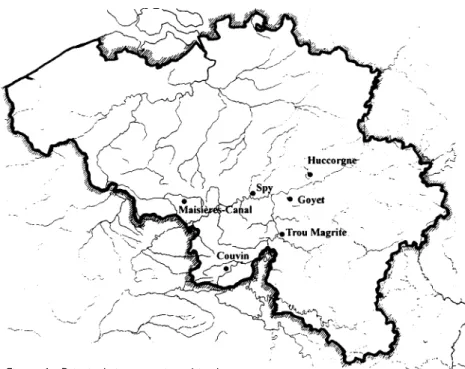
Six sites (Fig. 1), representing the range of variability in access to flint sources according to dis-tance to nearest source(s), have been analyzed with respect to their raw material and assemblage struc-ture. This permits the identification of patterns of differential raw material use which result from the choice of different strategies within a lithic economy for procurement, transport, reduction, and tool pro-duction. Archaeological analysis was first done at the scale of assemblage, examining raw material, technological, and typological variables. Such intra-assemblage analysis identified variability in procurement, reduction, and use of different raw materials. Inter-assemblage comparisons were made in two ways : 1) between strata in stratified sites to observe change through time, where distances to sources remain cons-tant, and 2) between sites with different raw material contexts to observe variability in strategies employed in response to raw material availability.
Temporally, research concentrates on the Early Upper Paleolithic, with three Gravettian sites (Maisières-Canal, Huccorgne, Goyet Level 2), three Aurignacian sites (Trou Magrite, Spy Level 2, Goyet Level 3.0), and one transitional or Late Mousterian site (Trou de lAbîme). Trou Magrite, Goyet, and Spy also have Mousterian assemblages which were compared with Aurignacian assemblages to address possible change through time. In general, however, it was decided that temporal limits would control for technical variability so that economic variability across space could be analyzed.
Introduction
This paper presents preliminary results of dis-sertation research focusing on the effects of raw material context on prehistoric lithic economy during the Early Upper Paleolithic in Belgium.
Raw material context is defined here as the range of available lithic sources at and around a given site. The geographic distribution of flint and other useable raw materials is uneven across the landscape; thus, raw material context is site-specific, varying in distance to sources and in quality of locally available material. Lithic economy is defined as the range of strategies available for the procurement, reduction, and utilization of lithic raw materials, from which were selected technological solutions for human survival. It is therefore a cultural interface of evaluation and com-promise between technological needs and the prehistoric raw material context. Of the range of possible strategies, different ones were appropriate under different conditions. As raw material context varies, different constraints are imposed on the decision-making process of lithic economy. It is important to note that while this definition is a general one, the specific organization of lithic economy varies through time and across space, with the adoption of new strategies and abandonment of others. The key issues for technological needs are 1) to have material available to produce tools and 2) that this material is of suitable quality for both the level of technology (techniques used) and for effective use in expected activities. Purpose of research
Study of the relationship between raw material and assemblage structure addresses the nature and organization of prehistoric lithic economy. Under varying conditions of access to flint, what strategies were employed by prehistoric groups for raw material procurement and transport, reduction, tool produc-tion, and use? On an empirical level, such a study describes the specific strategies employed during a certain time period. On a more theoretical level, examination of the variability in utilization of different strategies across space, in relation to raw material
Variability in Lithic Assemblages across Space :
Differential Responses to Raw Material Context
Three spatial zones for raw material context were defined on the basis of access to flint sources in order to compare lithic strategies across space. In Zone 1, flint sources are local, within 5 km of the site. In Zone 2, flint sources are between 5 and 40 km distant. In Zone 3, the nearest flint sources are at least 40 km distant. Within Zones 2 and 3, local material, if present, is of poorer quality than flint (chert, quartzite, sandstone, limestone).
For each assemblage studied, raw material types were identified on the basis of macroscopic characteristics (grain size, color, kinds of inclusions, cortex, etc.). These types were compared with a database1 of geological samples of flint to make tenta-tive or probable provenience identifications where possible. Material types of unknown provenience were grouped based on general similarity. Assemblages were analyzed to identify the technological and typological structure for each material type. This was done to address the following issues : 1) form under which material was transported, 2) reduction techni-ques utilized, 3) blank preference for tool production, 4) representation of assemblage components (cores, blanks, tools, debris), and 5) preferential use of different materials for different tool types.
If one considers the three main problems faced by a prehistoric group when deciding on site location, these are access to shelter, subsistence resources, and lithic raw material resources. During the Early Upper Paleolithic, shelter in caves appears to have top priority, with the vast majority of sites found in caves along the Meuse River and its tributaries in Middle Belgium. From such residential sites, small parties would have exploited the surrounding territory
to obtain subsistence and raw material resources. Between these two, subsistence resources have a higher priority, particularly because they are not stationary on the landscape and may be only seasonally available (e.g., migrating herds, harvest of various plants). The need for locally available raw material thus has the lowest priority. As a result, the provisioning of a site with lithic material and its utilization take place under constraints imposed by the need to first meet shelter and subsistence requirements. The raw material context is therefore rarely ideal.
In Belgium, the distribution of flint across the landscape is uneven and gives rise to the three zones described above. The two main source regions are the Hainaut Valley in the west (Obourg, Spiennes flint sources) and the Maastricht region in the east (many sources known from Neolithic mines and modern quarries). These regions are part of a continuous band of Cretaceous deposits across Middle Belgium north of the Meuse. There are known flint sources in the intervening plateau region (e.g., Orp), but subsequent geological deposits on the Brabant and Hesbaye Plateaus made access to much of this flint impossible. While flint was therefore available on the plateaus, it was less abundant and less accessible than in the west or east. In northern Belgium, any flint sources would also have suffered from overlying geological deposits. South of the Meuse, flint sources are virtually absent because the geological history of the Ardennes, more ancient
1. A database for flint from Belgium and The Netherlands has been developed from lithic reference collections at Katholieke Universiteit (Leuven and the Bonnefanten Museum (Maastricht). Figure 1 - Principal sites mentioned in the text.
than the Cretaceous, did not include conditions under which flint formation could occur. Other useable, but poorer quality, materials such as chert, quartzite, and limestone, can be found. Based on the distribution of flint, the three zones can be demarcated geographically as follows :
Zone 1 : Hainaut Valley, Maastricht region, Brabant and Hesbaye Plateaus with the qualification discussed;
Zone 2 : region south of the Meuse and Sambre Rivers up to 40 km from flint sources;
Zone 3 : southern Belgium, starting roughly parallel with Dinant.
Site comparison
Comparison of sites in different zones reveals the use of different strategies for different raw materials
in response to the varying raw material context. While treated in more detail in the dissertation itself, only raw material and assemblage structure will be discussed here. Assemblage structure is described by classifying artifacts in five broad categories : cores, chunks, tools, unretouched removals (blanks), and small debris. Cores possess morphology including removals scars and platforms. Chunks lack such characteristics but are likely to be core remnants, particularly in raw material contexts under constraints. Tools are artifacts with formal retouch permitting typological identification. Unretouched removals are flakes and blades which, by their size and form, were potentially suitable for tool production but which were not retouched. Many, of course, may have been used unretouched. Small debris includes flakes and blades < 30 mm, more commonly < 20 mm, produced during core reduction and tool resharpening.
Table 1 summarizes the grouped raw material types used for comparison. It should be noted that there are many known proveniences in the Maastricht region which vary in macroscopic attributes. Hesbaye flint, as used here, is used as a general term for flints likely to have come from the Hesbaye Plateau or the Maastricht region, although exact sources are unknown. Flints characterized by this term are similar in macroscopic attributes. The first five types are from known proveniences or source regions. Proveniences for Types 6-9 are unknown. Types 10-14 have unknown provenience as well but can be found locally at each study site; additionally, they are of relatively poorer quality than flint. Types 15-17 also have unknown provenience and are quite rare.
Zone 1 : Maisières-Canal
Maisières-Canal is an open-air Gravettian site excavated in the 1960s by de Heinzelin and Haesaerts (de Heinzelin 1971, Haesaerts and de Heinzelin 1979, etc.) and consists of the main site (Champ de Fouilles) and an associated workshop (Atelier de Taille de la Berge Nord-Est). Unit M.G., just below the
occupa-Table 1 Grouped raw material types.
tion layer, has been dated to 27965 BP (GrN-5523). The site has been interpreted as a relatively short-term residential site, situated in relation to both subsistence and lithic resources (Haesaerts and de Heinzelin 1979), with substantial reduction activity occurring relative to duration of occupation. Based on the homogeneity of raw material at the site, all of Atelier de Taille and Rows H-K of Champ de Fouilles were analyzed as a representative sample.
The site is located within 5 km of the Craie dObourg, within which is found abundant, very good quality, translucent black flint with rare inclusions. The Spiennes flint source is also nearby, 7 km to the south. The local presence of good quality flint means that there are no constraints placed on lithic economy : material is abundant, easily available, and is suitable for any reduction technique. Time and energy expenses for procurement are minimal. Given such a raw material context, there are no limits to choice of reduction technique, there is no need to maximize the number of blanks produced from a single core, and only the largest or most suitable blanks need to be selected for tool retouch.
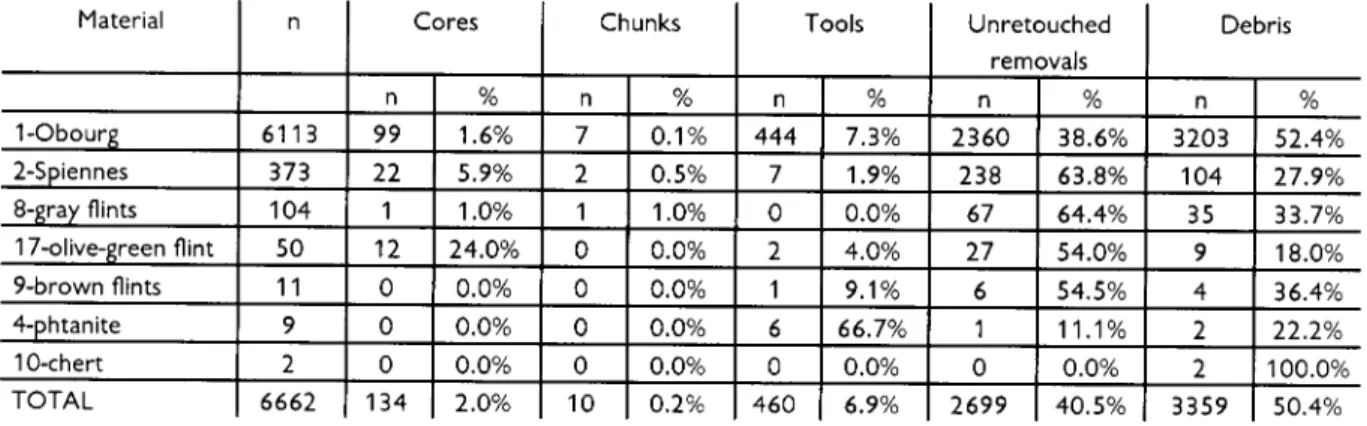
Table 2 summarizes the assemblage structure by raw material, sorted by material rank.
Based on either frequency or weight, the materials utilized at Maisières-Canal can be readily ranked in three tiers (Table 3). Obourg flint, the closest flint source, dominates the assemblage and evidences a high degree of reduction activity. It was obtained locally and transported as unprepared blocks and partially prepared cores, based on the high number of cortical pieces (41.5%). It was used to provision the site and probably also prepared for transport to subsequent sites, considering the degree of reduction activity in relation to the relatively short duration of occupation.
Rank 2 materials, also reduced but to a much lesser degree than Rank 1, were transported as prepared cores. Cortical pieces are less common (4-15%) except for Type 17 (52%), although most of these pieces are only slightly cortical. Interestingly, while the Spiennes source is only a few kilometers more distant than the Obourg source, it was not commonly used and artifacts have a low proportion of cortex, indicating transport of material as prepared cores. Gray flint (Type 8) is likely a variant of Spiennes flint and the unknown olive-green flint (12 cores)
probably has a source within 40 km and was transported from the previous occupation.
Rank 3 materials were transported as only as finished (or exhausted) tools and blanks. There are six tools in phtanite (source approximately 50 km distant, near Ottignies-Mousty), including two Font Robert points, three retouched blades, and a notch. Apart from the notch, these tools reflect more intense shaping activity, and would be more likely to be curated.
The overall picture of the assemblage is one of near exclusive use of local, good quality flint, with transport, minor reduction, and discard of flint from slightly more distant or non-local sources. The very low number of chunks reflects the lack of need to exploit cores to exhaustion. When a core reached a certain size or shape that made it more difficult to reduce, it was discarded in favor of a new block of material. Rank 2 flints would have been discarded and replaced in the lithic economy by the abundant local flint. The presence of rare Rank 3 tools and blanks indicate the use of a strategy of curation of certain tools long after the cores from which they came had been discarded.
Zone 2 : Grottes de Goyet
The Grottes de Goyet are located about 5 km south of the Meuse, at the confluence of the Strud, a small stream, and the Samson River, a tributary of the Meuse. Excavated by many since the mid-19th century, only the 1869 excavations of Édouard Dupont (Du-pont 1872) of Level 3 of the third cave (according to his designation) have been analyzed here.
Locally available materials include chert and quartzite, probably river cobbles, based on waterworn cortex on two chert artifacts, although cortex is generally absent. Potential flint sources on the Hes-baye Plateau could be as near as 5 km, just north of the Meuse, more commonly around 20 km and up to 60 km to the Maastricht region. Flint sources to the west are approximately 70 km distant. Given this distribu-tion of raw material, both quality of material and dis-tance to flint sources exert pressure on the lithic economy and strategies are expected to differ from those observed at Maisières-Canal.
There are many problems with Level 3, mainly due to the nature of excavation techniques. It has been described as a mixed Aurignacian and Mousterian
semblage (Otte 1979). At the Institut des Sciences Naturelles de Belgique, where the collection is conserved, Level 3 is found in drawers labeled troi-sième niveau-Aurignacien and troitroi-sième niveau-Mous-térien. These were analyzed separately (Tables 4 and 6) but, apart from typological differences, the raw material structure is essentially identical. If we accept that Level 3 is a mixed assemblage of Aurignacian and Mousterian, as well as a palimpsest of multiple
occupa-tions of each, we can still make inferences about raw material procurement and transport and variability in raw material utilization when compared to sites in other zones. Certain observations can be made although inferences about lithic economy are less rigorous than those for the other study sites.
For the Aurignacian portion of Level 3, materials can be ranked in three tiers (Table 5), again either by frequency or weight. Hesbaye flint, the
Table 4 Assemblage structure (Grotte de Goyet, third cave, Level 3-Aurignacian).
Table 5 Ranked raw materials (Grotte de Goyet, third cave, Level 3-Aurignacian).
nearest non-local flint source, is clearly dominant. 33% of the artifacts are cortical, with fresh chalk cortex, indicating procurement in primary geological context. These artifacts exhibit a low proportion of cortex in general, although 80 of 381 artifacts have more than 50% cortex. Hesbaye flint thus appears to have been transported as prepared or partially prepared cores. It was the main source of material used to provision the site.
Of the Rank 2 materials, the tan and gray flints may be variants of Hesbaye flint, although exact proveniences are not known. Obourg flint is the most distant. These materials, including 25 cores, were subject to a minor degree of continued reduction at Goyet, and were then replaced by material from the nearest non-local flint source to further provision the site. In contrast to Maisières-Canal, at Goyet there is an increase in pressure on the lithic economy to maximize the exploitation of transported cores because there is an increase in time and energy expenditure to procure flint from non-local sources such as on the Hesbaye Plateau.
For Hesbaye flint, flakes and blades were produced in similar proportions. Among the Rank 2 materials, there appears to be some degree of specialization : blades are more common on tan flints and Obourg flint while flakes are more common than blades on gray flints. With respect to blank production techniques, both flake and blade technology were used, but the degree to which they were used varies between materials.
The diversity of Rank 3 materials, present as a few exhausted cores and curated tools, likely reflects the palimpsest nature of the assemblage. These materials would reflect the transport of material from different regions occupied prior to arrival at Goyet.
In sum, in order to maximize the utilization of good quality flint and to minimize procurement and transport costs for the provisioning of the site, there is an increased intensity of core reduction and tool pro-duction for Rank 2 materials. When these materials are exhausted, the nearest non-local flint source is then exploited. There is also a clear preference for good quality flint, evidenced by the rarity of local, poorer quality chert and quartzite in the assemblage.
The Mousterian portion of Level 3 shows a similar pattern of raw material utilization (Table 7), with Hesbaye flint dominant, followed by tan and gray flints in Rank 2. While reduction techniques varied
(dominance of flake production), the ranking of materials reflects the use of Hesbaye flint to provision the site and increased intensity of reduction of tan and gray flints. Local chert, although of poorer quality, also played a larger role in the lithic economy. There is similar diversity in Rank 3 materials, which were transported only as finished tools or as blanks.
Zone 3 : Trou Magrite
Trou Magrite is a cave site situated on the Lesse River, a tributary of the Meuse. Flint sources are absent locally, with rarely used western sources (Spiennes and Obourg) approximately 70 km distant and sources on the Hesbaye Plateau and in the Maas-tricht region between 40 km and 80 km distant. Black limestone, quartzite and quartz cobbles, and chert are available locally, from the river terrace of the Lesse and on the Condroz Plateau just above the site.
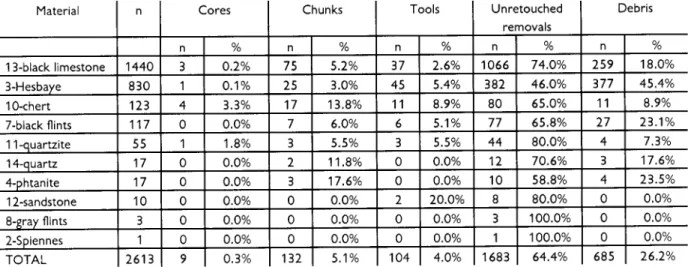
Only the assemblages resulting from the 1991-92 excavations of Otte and Straus (Straus and Otte 1996) have been analyzed. These include two Aurignacian layers (Strata 2 and 3) and two Mousterian layers (Strata 4 and 5). In this paper, only the Aurignacian layers are discussed (Table 8). Tables 9 and 11 summarize the assemblage structure by raw material type for Strata 2 and 3.
In Stratum 3, materials can be ranked in four tiers (Table 10), although Ranks 1 and 2 at Trou Magrite can be combined to be comparable to the other sites studied. The dominant material is local black limestone, which is abundant and readily available although of relatively poorer quality than flint. Trans-port costs are minimal. All stages of the chaîne opéra-toire are represented. The high number of chunks and low number of cores may be due to the difficulty of applying systematic methods of reduction to limestone
Table 7 Ranked raw materials (Grotte de Goyet, third cave, Level 3-Mousterian).
blocks.
The Rank 2 material, Hesbaye flint, comes from the nearest flint source region (minimally 40 km), but this source region is too far to regularly exploit to provision the site after arrival. Material would have been brought to the site as curated material already in use. Cortex is rare and cores reflect increased intensity of blank production to maximize the remaining material since new stock of flint could not be procured. Material came to the site as active cores, blanks, and finished tools. When it was exhausted, it was replaced by black limestone. Here, in contrast to black limestone, the
number of chunks versus cores likely reflects the exhausted nature of Hesbaye flint.
Tools were produced on black limestone and flint in similar counts (37 and 45 tools respectively) although many more unretouched removals are present on black limestone. It is possible that many of these were used unretouched. There is a clear preference for Hesbaye flint for production of Upper Paleolithic tool types; of the 45 tools on Hesbaye flint, 28 are endscrapers and retouched blades. On black limestone, Mousterian types are slightly more common, mostly notches and denticulates (n=19).
Table 9 Assemblage structure (Trou Magrite, Stratum 3).
Table 10 Ranked raw materials (Trou Magrite, Stratum 3).
Rank 3 material includes both local and non-local material which exhibit a much more minor degree of reduction. The non-local material, black flint, lacks cores although there are seven chunks which are pro-bable core fragments. Material would have been transported as nearly exhausted cores, blanks, and finished tools. I would argue that this material was procured prior to the Hesbaye flint, both at previously occupied sites, and represents the last stages of an already dwindling supply. For the local materials, cer-tain suitable chunks or cobbles were found and reduced, with cortex or cobble surface removed before trans-port.
Rank 4 materials are present only in very low percentages and were transported to the site as blanks and finished tools. No reduction occurred. In terms of the history of procurement, such materials would have been procured the earliest, before black flint.
In Stratum 2, materials were ranked in four tiers (Table 12). By count, the dominant material is Hesbaye flint. Hesbaye flint is nearly twice as common as black limestone while the reverse was true in Stratum 3. This is due to the much higher frequency of debris (trimming flakes and shatter) - 1518 for Hesbaye flint and 146 for limestone. Blanks have similar counts although there are more tools on Hesbaye flint than on limestone. There are only three recognizable cores of Hesbaye flint (as opposed to one in Stratum 3), but there are 137 chunks (versus 25 in Stratum 3). More Hesbaye flint was brought to the site during the Stratum 2 occupation than in Stratum 3 (2580 g. vs. 1049 g.). It is unlikely that this increase in quantity reflects logistical trips to obtain flint, but rather the absence of recognizable cores makes it more likely that the material was curated and transported from a previous occupa-tion closer to the Hesbaye Plateau. This could have been in preparation for an occupation of longer duration than that represented in Stratum 3 or it could reflect some sort of change in transport technology which permitted the transport of more material.
The substantial increase in small debris of Hesbaye flint reflects the adoption of a strategy to increase the intensity of tool use by resharpening. This maximizes the utilization of good quality, non-local flint which arrived at the site already close to exhaustion. The distance to the nearest flint sources is too great to continue to exploit for the provisioning of the site; time
and energy expenses are too high.
Black limestone falls to Rank 2 in Stratum 2, roughly reversing percentages by count with Hesbaye flint. However, it is present in similar percentages by weight in both strata. While more Hesbaye flint overall was available than in Stratum 3, it was still limited with no possibility of obtaining fresh flint when it was exhausted. Limestone thus continued to replace flint as a major source of raw material. There are 11 recognizable cores (6 flake, 1 prismatic blade, 1 pyra-midal bladelet, and 3 mixed cores) and 123 chunks as opposed to 3 cores and 75 chunks in Stratum 3. This increase in use of local material supports an interpretation of longer duration of occupation.
Examination of the types of tools produced on Hesbaye flint and black limestone reveals differences in tool production. In Stratum 2, there are 76 tools on Hesbaye flint versus 24 on black limestone. On the flint, endscrapers and retouched blades dominate (n=57) with 19 Mousterian types (notches, denticulates, sidescrapers). On the limestone, Upper Paleolithic and Mousterian types are present in roughly equal proportions (10 endscrapers and retouched blades and 13 notches, denticulates, and sidescrapers). It appears that flint was primarily reserved for Upper Paleolithic types while the poorer quality of limestone limited production to tools requiring less shaping.
Rank 3 materials include black flint, cherts, and quartzites, which are ranked the same as in Stratum 3. They reflect a minor degree of reduction in comparison with limestone and Hesbaye flint. Percentages decrease due to the increase in use of Hesbaye flint but remain similar to those in Stratum 3. One major difference is that black flint includes 13 cores and 17 chunks in Stratum 2 as opposed to no cores and 7 chunks in Stratum 3. Black flint would have been procured some time prior to procurement of Hesbaye flint, as in Stratum 3, but with a shorter length of time between its procurement and arrival at Trou Magrite; while it is still nearly exhausted, there is more of it than there was in Stratum 3, and it is in the form of cores rather than only blanks and tools.
In contrast, local cherts are used less than in Stratum 3. There are no cores and 16 chunks versus four cores and 17 chunks in Stratum 3. Quartzite is used slightly more than in Stratum 3. There are 4 cores and 3 chunks versus 1 core and 3 chunks in
Stratum 3. With more flint imported to the site, local materials other than limestone were more commonly rejected.
Rank 4 materials include the same range of materials as in Stratum 3 - phtanite, quartz, and sandstone. No reduction occurred and material was transported as blanks and finished tools, although there are some chunks in phtanite and quartz. Again, these materials represent the very last stages in the history of the material - cores have been exhausted prior to arrival at Trou Magrite and only blanks and tools remain. Local quartz was probably again rejected as unsuitable. Overall, each material tends to include a wider range of assemblage components than in Stratum 3 (cores where there were no cores) and a greater quantity (more cores, more blanks, more tools). These observations have two implications. First, there could be shorter intervals of travel between sites so that material such as black flint, obtained prior to Hesbaye flint, is less exhausted and still includes cores upon arrival at Trou Magrite. Alternatively, this could reflect an increase in stockpiling so that more material is being transported than in earlier times. Second, the greater quantity of material in mass and count reflects both an increase in the amount of material procured for the site and an increase in reduction activity, indicating a relatively longer duration of occupation than in Stratum 3.
I would argue that the Mousterian-like character of the lithic assemblage in general is due to differential use of non-local and local materials and the lack of good quality raw material. There is a clear differentiation in tool types between local, poor quality, limestone and non-local, good quality, flint. The Mousterianization is actually a technical response to a raw material context lacking good quality material. On the transported, good quality flint, UP types dominate.
Comparison of the two strata
The primary differences between Strata 2 and 3 are 1) a shift in reduction strategies on Hesbaye flint reflecting intensification of resharpening to maximize the use-life of tools, and 2) increase in overall mass of material transported and reduced at the site. In both strata, there is a clear preference for Hesbaye flint for Upper Paleolithic tool types, while black limestone was used to produce primarily notches, denticulates, and sidescrapers as well as some Upper Paleolithic tool types.
Materials in Rank 3 show a similar pattern in both strata : minor degree of reduction of near exhausted non-local black flint and minor use of local, poorer quality materials (chert, quartzite). Additionally, they indicate similar patterns of procurement during two different occupations; the same source of black
flint was exploited prior to arrival at Trou Magrite and prior to procurement of Hesbaye flint. Rank 4 includes the same range of materials which were transported only as finished tools and blanks.
The ranking of materials reflects distance in space and time (recent past of the group occupying Trou Magrite). The oldest materials, the ones which had been transported the longest and furthest, have been completely exploited and all that remains are a few curated tools and blanks which are finally discarded. These are the Rank 4 materials phtanite, sandstone and Spiennes flint. Quartz is also Rank 4, but it reflects an attempt to exploit local material without much success.
The next oldest material is included in Rank 3 (black flint), which would have been procured more recently than the Rank 4 ones but still far enough in the past so that most of the active reduction and use of the material occurred at previous sites. At Trou Magrite, it is almost exhausted, and the last session(s) of core reduction occur and the material is finished. Possibly some retouched tools were curated, to become Rank 4 materials at the next site. Chert and quartzite, also Rank 3, show the same pattern of minor reduction activity, but reflect only a slightly more successful attempt to exploit local materials other than limestone. A few tools (14 chert and 5 quartzite in all) were produced from this reduction.
The most recent material exploited is the Rank 2 material, Hesbaye flint. This material would have been procured during the previous occupation, somewhere closer to the Hesbaye Plateau. It has been actively used and was probably the Rank 1 material at the previous site. At Trou Magrite, the supply is dwindling, and more intense reduction activity occurs, particularly in Stratum 2, to maximize it because there are no flint sources available to replace this source. The Hesbaye sources (and other flint sources) are now too distant to obtain more flint to regularly provision the site. When the Hesbaye flint is exhausted, local black limestone replaces it. Some retouched tools and possibly some cores could have been taken away to become Rank 3 or 4 materials at the next site.
In Stratum 3, the dominant material is the Rank 1 black limestone. Reduction and tool production do not alter dramatically between strata; it is rather changes in strategies relative to Hesbaye flint that make Hesbaye flint dominant in Stratum 2, principally increase in number of tools produced and increase in resharpening. Under other conditions or raw material contexts where flint sources were non-local but not too distant, black limestone might have been rejected. At Trou Magrite, however, the distance to the nearest flint source exerts strong pressure on the lithic economy. Quality has been compromised to benefit from low procurement costs. It is adequate for tasks occurring at the site but not for transport elsewhere.
Discussion
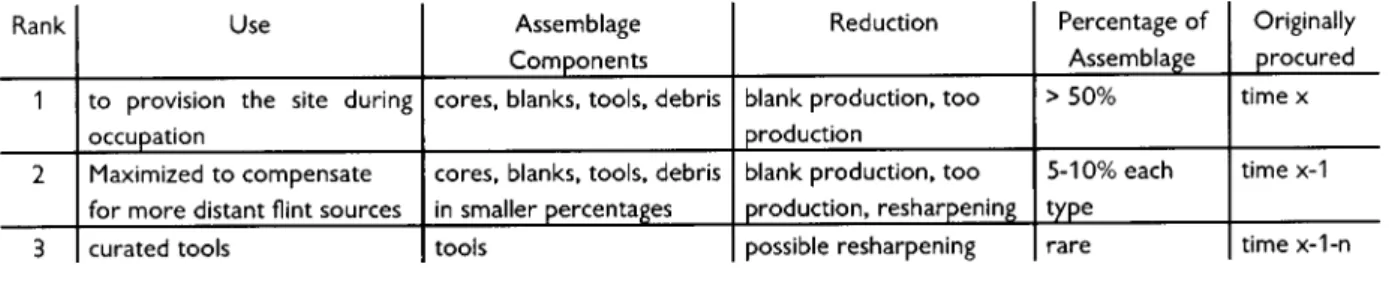
The main pattern observed is one of decreasing inclusivity in assemblage structure as flint sources become more distant. The dominant material (Rank 1) in a site is either local material (Zones 1 and 3) or from the nearest flint source (Zone 2) and is represented by all stages of reduction (cores, blanks, tools, debris), and can include primary reduction (Zone 1). Rank 2 materials include those transported from the previously occupied region and form much smaller percentages of the assemblage. They are transported as prepared cores (or cores in active use) and tools, with evidence of continued reduction in an effort to maximize the material. In Zone 2, such Rank 2 materials are replaced by the nearest non-local flint source (up to 40 km away), which is exploited to provision the site; in Zone 3, they are replaced by poorer quality local materials. Rank 3 materials are represented only by transported tools with no reduction activity occurring at the site except possibly resharpening. They represent the final stage in the sequence or history of the use of a given raw material and originated in the most distant regions from the site.
The ranking of material types by weight and frequency, as well as the assemblage structure, clearly shows this pattern (Table 13). This pattern is the result of the effects of the raw material context on the existing lithic economy and reflects the use of different strategies
for different raw materials. Time x is the time of occupation of the site in question; material is procured during occupation. Time x-1 is the time of occupation of the previous (unknown) site and material procured during this previous occupation was used to provision that site. A portion of the material was then transported to the current site.
This pattern further shows the general adop-tion of a strategy to exploit the nearest flint source(s) to provision a site, in order to minimize the time and energy expense of procurement and transport while obtaining good quality material. It also shows the use of a strategy of transport of flint to another region in the form of active cores and tools, which is probably due more to the fact that they are in active use than deliberate export to provision the next site. By this I mean that there is no real pattern of systematic exploi-tation for future needs; material is collected and used at one site, and an active toolkit (including cores) is transported with the group. Similarly, the curated Rank 3 tools represent tools in long use by the group, discarded when they are finally exhausted. There is no evidence for long-distance transport of material as can be seen during the Magdalenian and no system of exchange or trade as in the Neolithic or as with Teotihuacan in Mesoamerica, where Teotihuacan was the specialized center of obsidian reduction and material was exported to provision villages in the hinterlands.
Acknowledgments
Dissertation research has been funded by the Belgian-American Educational Foundation (1994-95) and the J. William Fulbright Foreign Scholarship Board (1996-97).
Bibliography
DUPONT, É., 1872. Les temps préhistoriques en Belgique, Bruxelles : 105-125.
DE HEINZELIN, J., 1971. Le Gisement Périgordien de Maisières-Canal (1966). Bulletin de la Société royale belge
dAnthropologie et de Préhistoire, 82 : 63-76.
HAESAERTS, P. & DE HEINZELIN, J., 1979. Le site paléolithi-que de Maisières-Canal. Dissertations Archaeologicae Gandenses, vol. XIX, De Tempel, Brugge.
NOIRET, P. et al., 1994. Recherches paléolithiques et méso-lithiques en Belgique, 1993 : le Trou Magrite, Huccorgne et lAbri du Pape. Notae Praehistoricae, 13 : 45-62.
OTTE, M., 1979. Le Paléolithique supérieur ancien en Belgique. Musées Royaux dArt et dHistoire, Monographies dAr-chéologie Nationale, 5, Bruxelles.
STRAUS, L. & OTTE, M., eds, 1996. Le Trou Magrite : Résur-rection dun site classique. ERAUL, 69, Liège.