Essays in Econometrics and Energy Markets
par
David Benatia
Département de sciences économiques
Faculté des arts et sciences
Thèse présentée à la Faculté des études supérieures
en vue de l’obtention du grade de Philosophiæ Doctor (Ph.D.)
en sciences économiques
Mai, 2018
c
Cette thèse intitulée :
Essays in Econometrics and Energy Markets
présentée par :
David Benatia
a été évaluée par un jury composé des personnes suivantes :
Raphaël Godefroy,
président-rapporteur
Marine Carrasco,
directrice de recherche
Étienne Billette de Villemeur, co-directeur de recherche
Pierre-Olivier Pineau,
membre du jury
Steven L. Puller,
examinateur externe
François Perron,
vice-doyen, représentant du doyen de la FAS
Remerciements
AcknowledgmentsJe remercie Marine Carrasco, ma directrice de recherche, pour sa confiance, son soutien, sa gentillesse, ses conseils, sa disponibilité, sa rigueur, et pour tout le temps passé à lire et commenter mon travail. Je suis très heureux d’avoir frappé à sa porte, et d’avoir bénéficié de sa supervision sur des thèmes de recherche qui m’ont passionné durant ces dernières années.
Je remercie aussi Étienne Billette de Villemeur, mon co-directeur de recherche, pour sa bienveillance, ses conseils et nos discussions lors de ses visites à Montréal. Je souhaiterais aussi exprimer ma profonde gratitude à Pierre-Olivier Pineau pour son enthousiasme et sa générosité, à Jean-Pierre Florens pour son soutien, son aide précieuse et sa confiance, et à Raphael Godefroy pour ses conseils et sa disponibilité.
La détermination nécessaire pour achever ce travail, je la dois en grande partie à celles et ceux qui m’ont soutenu et aux rencontres enrichissantes que j’ai faites pendant ces années d’études. Merci d’abord à Nick John-stone, Stefan Ambec et Lukas de m’avoir conseillé et orienté vers Mon-tréal, où j’y ai passé de très belles années. Je voudrais remercier le groupe d’économie environnementale de Montréal, notamment Hassan Benchekroun, Sophie Bernard, Robert Cairns, Gérard Gaudet, Pierre Lasserre, Justin Ler-oux, Martino Pelli, et Charles Séguin. Merci aussi à Derek Olmstead et Mathieu Marcoux pour leurs commentaires précieux. Je voudrais remercier Tuba Tunçel, pour son aide indispensable durant cette année de “job mar-ket”, notamment lors d’un voyage épique jusqu’à Philadelphie à travers la tempête. Je dois aussi exprimer ma reconnaissance à mes collègues et amis: Somouaouga, Jonathan, Samuel, Gabriela, Sébastien, Kokouvi, Ada, Hervé, Louphou, Mohamed, Alex, Dominique et les autres étudiants du CIREQ, sans eux je n’aurais pu tenir la distance. Tout ceci aurait été tellement plus difficile sans mes amis de toujours: Adrian, Benjamin, Fabien, Martine et toute la bande; et ma famille: Maria, Maguy, Claudine, Nathalie, Véronique,
et tous les autres que je ne cite pas. Je voudrais aussi remercier mes par-ents Carole et Marc, et ma soeur Lucille d’avoir toujours cru en moi et de m’avoir soutenu quand j’en avais besoin. Par dessus tout, je serais éternelle-ment reconnaissant envers ma formidable partenaire de vie, Charlotte, venue vivre cette aventure à Montréal avec moi, pour son dynamisme contagieux, sa patience à rude épreuve, et tout le reste.
Pour finir, j’ai été très heureux d’étudier à l’Université de Montréal. Je voudrais exprimer ma gratitude à tous les professeurs et le personnel admin-istratif du département de sciences économiques et du CIREQ. Je n’aurais pu faire de si longues études sans le soutien financier des bourses du département et du CIREQ, les contrats d’enseignement, les contrats d’assistant recherche, le fonds Bernard Landry, la générosité de la Chaire en gestion du secteur de l’énergie de HEC Montréal, l’Association Canadienne d’Économique de l’Énergie, mes parents, et Charlotte.
Je voudrais donc remercier toutes celles et tous ceux qui ont permis, de près ou de loin, de rendre ces années agréables et à ce travail d’aboutir.
Résumé
Cette thèse est organisée en trois chapitres où sont développées des méthodes d’analyse économique et économétrique des marchés de l’énergie.
Le Chapitre 1 propose une étude des incitations à la manipulation de marché générées par des opportunités de revenir sur ses engagements. Un modèle théorique est développé pour analyser le comportement d’un monopole face à une frange compétitive en présence d’une demande incertaine, de contraintes de capacité, et de possibilités de trahir ses engagements. Les entreprises se concurrencent avec des fonctions d’offre étant donnés leurs engagements. Le monopole revient sur ses engagements lorsqu’il retire sa production engagée en observant la réalisation de l’incertitude. Il peut ainsi exacerber son pouvoir de marché, réduire l’incertitude autour de la demande, et accroitre sa probabilité de devenir un offreur pivot. À l’équilibre, les stratégies d’offre dépendent du volume de production engagée et du coût d’opportunité de la retirer stratégiquement. En particulier, le monopole peut trouver profitable d’offrir sa production à des prix plus élevés lorsqu’il sait qu’il pourra revenir sur ses engagements si la demande est élevée. Finale-ment, cette stratégie est présentée comme un comportement de manipulation par perte, et des applications aux marchés de l’électricité sont discutées.
Dans le Chapitre 2, nous développons de nouveaux résultats pour les régressions fonctionnelles où le prédicteur Z(t) et la réponse Y (t) sont des fonctions d’espaces de Hilbert, indexés par le temps ou l’espace. Le modèle peut être compris comme une généralisation de la régression multivariée où le coefficient de régression est maintenant un opérateur inconnu Π. Nous proposons d’estimer l’opérateur Π par régularisation de Tikhonov, ce qui re-vient à appliquer une pénalité sur sa norme L2. Nous dérivons le taux de convergence de l’erreur quadratique moyenne, la distribution asymptotique de l’estimateur, et développons des tests sur Π. Comme les trajectoires ne sont généralement pas complètement observables, nous considérons une
sit-uation où les données deviennent de plus en plus fréquentes (asymptotique de remplissage). Nous traitons aussi le cas où Z est endogène et des vari-ables instrumentales sont utilisées afin d’estimer Π. Une application à la consommation d’électricité complète l’article.
Le Chapitre 3 propose une nouvelle approche pour l’analyse empirique des enchères à unités multiples, dans lesquelles les participants choisissent des fonctions d’offre ou de demande. Cette approche permet d’évaluer le pouvoir de marché des entreprises dans une cadre d’information privée, en évitant d’avoir à modéliser le mécanisme du marché. Elle repose sur des méthodes économétriques qui traitent les fonctions de mise comme des éléments aléa-toires à valeurs fonctionnelles. Notamment, un estimateur fonctionnelle à variable instrumentale est développé. La méthode est appliquée au marché de l’électricité de l’état de New York sur des données micro-économiques de mises et de coûts à l’échelle des entreprises pour 2013-2015. J’estime le pouvoir de marché unilatéral des entreprises et compare les comportements observés aux comportements maximisant les profits sous information privée. Je trouve un faisceau d’indices sérieux de comportement optimal, qui sug-gère que les entreprises sont au courant de leur pouvoir de marché et se comportent en conséquence.
Mots-clés : Régression fonctionnelle, pouvoir de marché, marchés de l’électricité, problème contractuel, engagement, manipulation de marché, enchères empiriques, variables instrumentales, opérateur linéaire, régulari-sation de Tikhonov.
Abstract
This thesis is organized in three chapters which develop economic and econo-metric methods for the analysis of energy markets.
In Chapter 1, we study the incentives for market manipulations created by opportunities to renege on prior commitments. We develop a theoretical framework to analyze the behavior of a monopolist facing a competitive fringe in the presence of demand uncertainty, capacity constraints and reneging op-portunities. The firms are assumed to compete in supply functions taking their commitments as sunk decisions. Reneging occurs when the monopolist withdraws its committed output upon observing the realization of demand. By doing so, it can exacerbate its market power, alleviate demand uncer-tainty, and be more likely to be pivotal. At equilibrium, supply strategies depend on the volume of committed output and the opportunity cost of reneging. In particular, the monopolist may find profitable to offer some of its market output at higher prices in the presence of reneging opportunities. Finally, we present strategic reneging as a loss-based manipulative conduct in a general framework and discuss applications to electricity markets.
In Chapter 2, we develop new estimation results for functional regressions where both the regressor Z(t) and the response Y (t) are functions of Hilbert spaces, indexed by the time or a spatial location. The model can be thought as a generalization of the multivariate regression where the regression coeffi-cient is now an unknown operator Π. We propose to estimate the operator Π by Tikhonov regularization, which amounts to apply a penalty on the L2 norm of Π. We derive the rate of convergence of the mean-square error, the asymptotic distribution of the estimator, and develop tests on Π. As trajec-tories are often not fully observed, we consider the scenario where the data become more and more frequent (infill asymptotics). We also address the case where Z is endogenous and instrumental variables are used to estimate Π. An application to the electricity consumption completes the paper.
Chapter 3 proposes a novel approach for the empirical analysis of multi-unit auctions, to which participants submit supply or demand functions ob-servable by the researcher. The approach allows for the evaluation of firm-level market power in a private information setting, and avoids having to model the market mechanism. It relies on econometric methods that treat the observed bid functions as function-valued random elements. Notably, a functional instrumental variable estimator is developed. The method is ap-plied to the New York electricity market using rich data on firm-level bids and marginal costs for 2013-2015. In this market, daily bids are disclosed three months later in order to limit strategic behaviors. I estimate firm-level market power and compare actual bidding behavior to profit-maximizing behavior under private information. I find consistent evidence of optimal bidding, suggesting that firms are well aware of their own market power and behave accordingly. Therefore, the late disclosure of bids is not sufficient to preclude firms from acting strategically, most likely due to the repeated nature of those auctions.
Keywords : Functional regression, market power, electricity markets, reneging, commitment, market manipulation, empirical auctions, instrumen-tal variables, linear operator, Tikhonov regularization.
Table of contents
Dédicace / Dedication iii
Remerciements / Acknowledgments iv
Résumé vi
Abstract viii
Table des matières / Table of contents xi
Liste des figures / List of figures xiii
Liste des tableaux / List of tables xiv
Introduction 1
1 Strategic reneging in sequential markets under imperfect
com-petition 6 1.1 Introduction . . . 8 1.2 Related literature . . . 12 1.3 The model . . . 15 1.4 Discussion . . . 34 1.5 Conclusion . . . 40
2 Functional linear regression with functional response 41 2.1 Introduction . . . 42
2.2 The model and estimator . . . 44
2.3 Rate of convergence of the MSE . . . 57
2.4 Asymptotic normality for fixed α and tests . . . 60
2.5 Data-driven selection of α . . . 65
2.6 Discrete observations . . . 65
2.7 Case where Z is endogenous . . . 68
2.8 Simulations . . . 71
2.9 Application . . . 80
2.10 Conclusion . . . 92
3 Functional econometrics of multi-unit auctions: an applica-tion to the New York electricity market 93 3.1 Introduction . . . 94
3.2 Related literature . . . 97
3.3 The New York State electricity market . . . 101
3.4 The economic model . . . 108
3.5 Econometric methods . . . 113
3.6 Application to the New York electricity market . . . 136
3.7 Conclusion . . . 168 Conclusion 170 Bibliographie / Bibliography 182 Annexes / Appendices 183 A Chapter 1 . . . 183 B Chapter 2 . . . 195 C Chapter 3 . . . 204
List of figures
1.1 Optimal strategy without reneging and uncertainty . . . 21
1.2 Market regimes as a function of demand . . . 23
1.3 Optimal strategy with reneging and without uncertainty . . . 27
1.4 Optimal strategy under uncertainty without reneging . . . 30
1.5 Market regimes as a function of demand under uncertainty . . 32
1.6 Optimal strategy with reneging and uncertainty . . . 34
2.1 Examples of simulated functions . . . 73
2.2 True kernel vs. regularized kernel . . . 75
2.3 True kernel vs. mean estimate . . . 76
2.4 True kernel vs. mean IV estimate . . . 79
2.5 Electricity consumption (GWh) vs. temperature (C) . . . 83
2.6 Entire data series . . . 84
2.7 Estimation sample . . . 85
2.8 Prediction sample . . . 85
2.9 CV criterion and MSPE . . . 87
2.10 3 hourly OLS estimate and αCV-regularized estimate . . . 88
2.11 αBP-Regularized Kernel Estimate . . . 89
2.12 |ˆui(s)|/Yi(s) and out-of-sample prediction. . . 91
3.1 New York State electricity market zone map . . . 104
3.2 Zonal prices map . . . 105
3.3 Simulated sample under H1 . . . 128
3.4 Astoria Energy . . . 145
3.5 Long Island Power Authority. . . 145
3.6 Long Island Power Authority. . . 146
3.7 Estimated price distribution functions. . . 147
3.8 Estimated β with confidence bands . . . 150
3.9 Estimated parameters (Astoria Energy: May 7th, 2014) . . . . 153
3.10 ˆπ (Astoria Energy: May 7th, 2014) . . . 153
3.11 Estimated parameters (LIPA: August 20th, 2015) . . . 154
3.12 ˆπ (LIPA: August 20th, 2015) . . . 154
3.13 Optimal supply function (Astoria Energy: May 7th, 2014) . . 160
3.14 Optimal supply function (LIPA: August 20th, 2015) . . . 161
3.15 IMSE and natural gas price spread between Henry Hub and Transco 6 NY . . . 165
3.16 Estimated behavioral marginal costs . . . 167
Liste des tableaux
List of tables2.1 Simulation results: Mean-Square Errors over 100 replications . 74
2.2 Non-IV estimator: Mean-Square Errors over 100 replications . 78
2.3 IV estimator: Mean-Square Errors over 100 replications . . . . 79
2.4 Descriptive statistics . . . 83
2.5 Mean Squared Prediction Errors for Summer 2014 . . . 87
3.1 NYISO capacity and demand by zone . . . 104
3.2 Firms with the largest installed capacity . . . 107
3.3 Simulations results . . . 123
3.4 Simulations results . . . 129
3.5 Descriptive statistics of firm-level data . . . 144
3.6 Descriptive statistics of zonal prices (2013-2015) . . . 147
3.7 P-values of the tests of optimal bidding . . . 149
3.8 P-values of AS tests. . . 151
3.9 AISE of ˆπ and rejection rate of H0 : π = 0 . . . 156
3.10 Mean elasticities of residual demand functions . . . 158
3.11 IMSE between observed and optimal supply functions . . . 159
3.12 IME between observed and optimal supply functions . . . 160
3.13 Percent achieved of maximum expected profits . . . 163
C.1 Matching PTIDs to MaskedGenIDs . . . 211
C.2 Matching PTIDs to MaskedGenIDs (continued) . . . 212
C.3 Matching PTIDs to MaskedGenIDs (continued) . . . 213
C.4 Cost parameters by prime mover-fuel . . . 214
C.5 Descriptive statistics of fuel and emission prices . . . 215
Introduction
“The free market may be hu-mans’ most powerful tool. But, like all very powerful tools, it is also a two-edged sword. [...] That means that we need pro-tection against the problems [...] only a real fool would pretend that there are no disadvantages, or take no precautions against them.”
Phishing for phools,
Akerlof and Shiller(2015)
Competition and free markets have long been praised as virtuous by economists. Nevertheless, the virtues of free markets rest on ideal condi-tions which are hardly ever met. In his Nobel Prize lecture, Tirole (2014) observes that “[a]las, competition is rarely perfect, markets fail, and market power must be kept in check”. Market power, the ability of a firm to raise the market price substantially above cost, is a key market failure which has attracted a lot of attention from economists in the past decades, especially in industrial organization.
Market power is not the only cause of a firm’s ability to alter market prices and profit from it. Market manipulations, that is anti-competitive behaviors e.g. through outright fraud or uneconomic trading, provide addi-tional channels to raise market prices significantly above competitive levels. In a well acclaimed book, Nobel Prize laureates Akerlof and Shiller (2015) state that “competitive markets by their very nature spawn deception and trickery, as a result of the same profit motive that give us our prosperity.”
Part of the role of economists hence consists of providing tools to diagnose and address the issues related to market power exertion and misconducts.
Modern economics widely acknowledges the importance of sound regu-lation, market design and adequate economic policies for well-functioning markets. They give rise to significant challenges, not only with regards to the developing industries based on new technologies, but also for the ever-important ones experiencing critical transitions, such as the energy sector.
Energy is key to life and a fundamental driver of socio-economic devel-opment. Our contemporaneous societies have become enormous consumers of energy in its diverse forms, and markets consist of the main mechanisms used to organize the production, transportation and consumption of energy commodities in the economy. Well-functioning energy markets are thus a cornerstone of sustained economic activity and growth.
The large and increasing reliance of energy consumption on electricity generation makes electricity markets critical platforms in our economies. Electricity is perceived as a means to increasing energy supply security and mitigating polluting emissions in the entire economy, notably through the large deployment of renewable power and electric transport.
The electricity industry has experienced a major paradigm shift in the 1990’s, and considerably evolved since then. Electricity sectors evolved from vertically integrated geographic monopolies, either publicly owned or regu-lated as natural monopolies because of the large increasing returns to scale and sunk costs. Many developed countries have introduced comprehensive reform programmes aimed at restructuring their electricity industry through liberalization and privatization. The primary goal of the introduction of com-petition in the generation and retail segments is to achieve improved economic efficiency, while ensuring that an adequate share of the realised long-term social benefits is passed on to consumers through lower energy prices. In general, it has been perceived as welfare-enhancing (Joskow, 2008b).
Yet, significant structural factors render electricity markets prone to the exercise of market power and anti-competitive behavior. The most prevalent factors are the lack of price elasticity of demand and cost-effective storage options, binding network constraints, production capacity constraints, a lim-ited number of suppliers and their repeated interactions not only within a given market but also across regional markets (Benatia and Koźluk, 2016).
In a large electricity market, e.g. that of New York or New England, market participants buy and sell billions of dollars’ worth of electricity and related contracts annually. The potential welfare impacts of market power
in electricity markets are consequently sizeable. It is hence of utmost im-portance to understand the behaviors of participants in electricity markets so as to be able to control the exercise of market power and prevent anti-competitive conducts. It is obviously not a trivial matter.
Liberalized electricity markets consist of large sets of rules, sophisti-cated allocation mechanisms and extremely system-dependent operational constraints such as the transmission network. Electricity market mecha-nisms can typically be understood as procurement auctions held ahead of actual delivery time, to which generators submit supply bids so as to signal their willingness to produce. Given a specific set of market rules, the system operator – i.e. the auctioneer – solves for the cost-minimizing production schedule subject to operational constraints in order to satisfy the demand at every moment of the day, while ensuring the security and reliability of supply. This wholesale market is often the centerpiece of a complex market environment which interlinks various markets for forward contracts, avail-able capacity, transmission contracts, and ancillary services for frequency and voltage regulation.
An important aspect of those auctions is the fact that the strategies are entire functions. Wilson (1979) developed the seminal model of multi-unit auctions to which bidders submit supply or demand functions to signal their willingness to sell or buy different quantities of an homogeneous good. His crucial result is that those auction mechanisms can be manipulated by the bidders. Contrary to second-price sealed bid auctions for single items, multi-unit auctions are not strategy-proof as agents do not reveal their true valuation in equilibrium. This result underlines the importance of keeping market power in check.
The literature focusing on electricity markets is generally based on the supply function equilibrium (SFE) concept of Klemperer and Meyer(1989). A key result of the standard SFE is the ex-post optimality of equilibrium supply function strategies in the presence of additive random shocks as the only source of uncertainty. Green and Newberry (1992) is the first article to adapt this model to electricity markets. The authors use the SFE framework to study the deregulation of the England and Wales electricity industry in the early 1990’s. A large literature has built on those initial contributions.
Nevertheless, the theoretical literature on electricity markets (Schöne,
2009) is often disconnected from empirical research. The existing economic theory of firms’ behaviors in multi-unit auctions, such as the SFE model, is often based on smooth supply schedules, which are functional variables. Yet,
despite the large amount of available data on electricity auctions, existing empirical methods lack a proper framework to account for the functional nature of the observed supply schedules. Dealing with functional variables in an empirical model complicates the analysis as the researcher is forced to address challenging problems related to the curse of dimensionality ( Bell-man, 1961). Functional data analysis (Ramsay and Silverman, 2005) offers a natural framework for the statistical analysis of random functions. It pro-vides a building-block to develop econometric tools for the empirical analysis of strategies in multi-unit auctions, and thereby an opportunity to reconcile empirical research with the theory.
This thesis is organized in three chapters and aims at developing methods for the economic and econometric analyses of firms’ behaviors in restructured electricity markets. The main research objective is two-fold: 1) to provide an understanding of the effects of the market structure and sources of uncer-tainties on the strategies of electricity producers and market outcomes, and; 2) to develop econometric techniques to evaluate market power and potential misconducts.
Chapter 1 develops a micro-economic framework to study the incentives for market manipulations created by opportunities to renege on prior com-mitments in a sequential market under imperfect competition. The analysis focuses on a monopolist competing in supply functions against a competi-tive fringe, taking its commitments as sunk decisions. The model accounts for demand uncertainty, capacity constraints and the ability to strategically renege on prior commitments. Reneging occurs when the monopolist with-draws its commitments upon observing the realization of demand. By doing so, it can exacerbate its market power, alleviate demand uncertainty, and be more likely to become pivotal. Strategic reneging is presented as a loss-based manipulative conduct and applications related to electricity markets are dis-cussed. This type of misconducts is illustrated using examples of market manipulations that occurred in Alberta in 2010-2011. It shows that the reg-ulatory tools for market power mitigation can lead to undesirable incentives for anti-competitive conducts.
Chapter 2 develops new estimation results for functional regressions where both the regressor and response are functions of Hilbert spaces. The model can be thought as a generalization of the multivariate regression where the regression coefficient is now an unknown operator. This chapter proposes an estimator of this operator based on Tikhonov regularization, which amounts to penalize its L2 norm. Theoretical results are derived for both estimation
and inference. The case of an endogenous predictor function is also addressed. The methods are illustrated through a numerical simulation study, and an application to forecasting electricity consumption in Ontario using weather data from 2010-2014.
Chapter 3 proposes a novel approach for the empirical analysis of multi-unit auctions, to which participants submit supply and demand functions observable by the researcher. The approach allows for the evaluation of firm-level market power in a private information setting, and avoids having to model the market mechanism – which can be extremely challenging, espe-cially in electricity markets with location-based prices. It relies on econo-metric methods that treat the observed bid functions as function-valued ran-dom elements. An instrumental variable functional estimator is proposed, and some theoretical results are derived for both estimation and inference. The method is applied to the New York electricity market using rich data on firm-level bids and marginal costs for 2013-2015. In this market, daily bids are disclosed three months later in order to limit strategic behaviors. I estimate firm-level market power and compare actual bidding behavior to profit-maximizing behavior under private information. I find consistent evi-dence of optimal bidding, suggesting that firms are well aware of their own market power and behave accordingly. Therefore, the late disclosure of bids – although useful to limit the strategic information available to firms to some extent – is not sufficient to prevent strategic behaviors, most likely due to the repeated nature of those auctions.
Chapter 1
Strategic reneging in
sequential markets under
imperfect competition
∗
“- A strong night last night as we priced up units, Sun 5 came down early [...]. With the unit coming offline and Poplar Creek pricing up, prices jumped to $400 over
the peak hours. Our portfolio
benefited from a ton of length.” - Great job this first week. Some great value and it’s clear we’re learning a ton.”
Discussion between one of TransAlta’s Asset Optimizer and the Chief Operating Officer on November 20, 2010, the day after the plant outage (MSA,2015).
∗This chapter is co-authored with my co-advisor Étienne Billette de Villemeur
(EQUIPPE, Université de Lille), and Pierre-Olivier Pineau (HEC Montréal). The authors would like to thank Derek Olmstead, and all participants of the Montréal Environment and Resource Economics Workshop, SCSE 2016 in Québec, CIREQ Ph.D. Students 2016 in Montréal, CEA 2016 in Ottawa, and IAEE 2016 in Bergen, for their valuable comments. Benatia gratefully acknowledges financial support from the Canadian Energy Economics Association.
1.1
Introduction
Opportunities to renege on prior commitments can create incentives to ma-nipulate markets. Those incentives are especially relevant to imperfect mar-kets with capacity constraints, such as electricity marmar-kets, because market-clearing prices may at times be very sensitive to unexpected supply or de-mand shocks.
In this paper, we study the incentives for market manipulations created by reneging opportunities in imperfect markets. We develop a theoretical frame-work to analyze the behavior of a monopolist facing a competitive fringe in the presence of demand uncertainty, capacity constraints and opportunities to renege on prior commitments. Firms are assumed to compete in supply functions, taking their commitments as sunk decisions, to satisfy a random and perfectly inelastic demand. Strategic reneging occurs when the mo-nopolist withdraws its committed output upon observing the realization of demand in order to put upward pressure on the market price. The firm’s market portfolio hence benefits from an artificially inflated price at the cost of the foregone profits from reneging.
In virtually all competitive markets, some of the exchanges are settled through forward commitments. Those commitments are generally contracts specifying a given price for a given output volume to be delivered. This contract price is however not directly tied to the market price, and can be used to hedge against its volatility.1 At the time when the market price is
settled, the firm faces its own committed output as competition.
The market duality created by the co-existence of the two prices may give room for market manipulations. A market participant who not only competes in the spot market but also holds commitments has both direct and indirect effects on the market outcomes. While its market strategy has a direct effect through the market mechanism, its commitments affect the net market demand which in turn affects the market outcome. By reneging on its commitments, the firm can increase the net market demand mechanically since –at least some of– the withdrawn output must be replaced in equilib-rium. Reneging hence shifts the residual demand faced by the monopolist in the market. Such conduct can be described as a form of residual demand
1In a sequential market, the forward price is a signal for the expected spot price (Weber
et al.,1981). Differences between the two are usually attributed to risk aversion (McAfee and Vincent,1993), asymmetric shocks (Bernhardt and Scoones,1994) and market power (Ito and Reguant, 2016).
manipulation.
Capacity constraints have an important role in this context. We assume that the committed output is tied to some production capacity through the contract. More specifically, if the monopolist reneges on its commitments the output is not produced and the associated capacity is left idle. That is, the committed output cannot be sold at the market price.
An illustrative case of strategic reneging took place in Alberta’s electricity market in 2010. The Alberta Market Surveillance Administrator (MSA) ac-cused TransAlta Corporation of market manipulations through strategically timed outages – and strategic under-production, or derating – of its coal-fired power plant’s generation unit “Sun 5” in high demand periods. At the same time, the firm offered the output of its gas-fired capacity at “Poplar Creek” at increased prices in the energy market.2 After due investigation, the regulator concluded that “by timing the outages at its coal-fired units subject to [power purchase agreements] based on market conditions, rather than on operational conditions [...], TransAlta unfairly exercised its outage timing discretion [...] for its own advantage and made its own portfolio benefits paramount to the competitive operation of the market” (MSA, 2015). The firm paid CAD 56 millions in settlement following these allegations.3
By withholding its coal-fired capacity from the market under claims of maintenance requirements, TransAlta reneged on its power purchase agree-ment (PPA) with an energy buyer. The PPA specified a price at which the output produced by this capacity must be sold to the other party.4 The
market could not adjust from the unanticipated supply shock caused by the plant coming off-line. An artificially inflated market price was hence the re-sult of the scheme. MSA (2015) reveals that the firm even accounted for the penalties for non-delivery when designing its manipulative strategy.
2In the discussion cited in the epigraph, Sun 5 refers to Sundance coal-fired plant’s fifth generation unit located close to Edmonton whereas Poplar Creek refers to TransAlta’s gas-fired power station near Fort McMurray. The matter of the investigation concerns four outage events involving two plants under PPAs with TransAlta which occurred between November 2010 and February 2011.
3This amount corresponds to USD 40.2 millions using exchange rates from December 2015.
4Coincidentally, the other party was a rival electricity supplier who was allowed to re-sale the energy at market prices. The strategic outage hence prevented the PPA buyers from competing in the market. In Alberta, the purpose of PPAs was initially to address the concentration of capacity held by TransAlta and two other players, which controlled about 90% of total generation capacity (MSA,2015).
Following Carlton and Heyer (2008), this anti-competitive behavior is a form of extensive conduct as it consists to weaken competition to enhance the firm’s profitability. In this case, the firm weakens the competition from its own output sold at forward prices. In contrast, the exercise of unilateral market power absent anti-competitive effects corresponds to an extractive conduct on behalf of the firm. Market power is a determinant of the prof-itability of strategic reneging.
The exercise of market power is often defined as any deliberately designed strategy used by a firm, or a group of firms, to alter market-clearing prices, and to profit from it.5 The profitability of strategic reneging is plausibly larger for firms with market power. The most extreme form of market power arises when a firm’s rivals are capacity constrained and its residual demand is price inelastic. One of the firm’s possible strategy is thus to set the price at its maximum possible level. A firm in such a position is referred to as being pivotal (Genc and Reynolds,2011).6 A firm with a positive probability
to be pivotal may find profitable to renege on its commitments to increase that probability. In this context, reneging weakens competition by forcing competitors to approach their capacity constraints. In our analysis, we study the incentives for market manipulations when the firm may be pivotal.
The scope of strategic reneging extends largely to all sequential markets, beyond this illustrative example in Alberta. A firm may commit to a produc-tion schedule in a forward market, then renege on this commitment under claims of technical failure when the uncertainty around the spot market is resolved. There are plenty of such opportunities in electricity markets. For example, a vertically-integrated firm may at times find profitable to under-forecast its demand so as to create an unexpected demand shock in the spot market.7 Intermittent renewables may be subject to similar concerns. For
instance, consider a market participant who also operates a wind farm under
5Remark that manipulative conducts involving uneconomic trading or outright fraud also aims at altering prices and do not require a large market share to succeed (Ledgerwood and Carpenter,2012).
6In order to mitigate the impacts of even ephemeral pivotal suppliers, electricity market rules typically define a maximum price, or price cap.
7Demand-side participants are generally mandated to disclose their demand forecasts for day-ahead dispatch scheduling and reserve planning. A diversified firm participating on both sides of the market may have incentives to over- or under-forecast its actual demand depending on its net market position so as to affect the following day’s reserve margins and production commitments. In 2006, the New York ISO implemented a procedure to identify chronic under-forecaster and curb such conduct (NYISO,2015, 7-40 p.164).
a feed-in contract paying a fixed price per output unit. The firm may at times be better off to curtail its wind power production to benefit its mar-ket portfolio during periods of high prices. Interestingly, this strategy was considered by TransAlta in Alberta: “We believe there is the opportunity to economic dispatch our wind farms by simply turning off during periods of high wind” (MSA, 2015). This example is discussed further in Section1.4.
This paper contributes to the literature on market manipulations. It is the first paper to study strategic reneging in sequential markets under imper-fect competition. We disentangle the efimper-fects of demand uncertainty, capacity constraints and opportunities for manipulations on equilibrium strategies. Our theoretical framework allows to characterize how the supply strategies and market outcomes are affected by opportunities to renege on prior com-mitments.
Our main finding is that a strategic firm can benefit from reneging on its commitments from two channels. First, the firm can weaken competition from its own output sold at forward prices as well as from its competitors by forcing them to approach their capacity limit. By doing so, the firm ex-tends its market power and increase its profitability through higher prices and possibly higher volume of market sales. Second, the firm can alleviate demand uncertainties and relax the monotonicity constraint on its supply strategy. We find that the profitability of reneging depends on the volume of committed output, its opportunity cost and the firm’s market behavior. An important determinant of this profitability is the market position of the firm. We show that the ability to renege affects supply strategies in equi-librium. Specifically, the firm may increase its expected profits by selling some of its market output at higher prices and renege on its commitments for any realization of demand above a certain threshold. This conduct has potential to increase artificially the market price, the volume of market sales of the firm, and at the extreme, its probability to become pivotal. Under demand uncertainty, there always exists a demand threshold above which a monopolist finds profitable to renege on its commitments in order to become pivotal.
We also find an interesting side result. The presence of a pivotal supplier may render supply function strategies dependent on uncertainties in equilib-rium, unlike predicted by the standard supply function equilibrium (SFE) model of Klemperer and Meyer (1989). This is due to a tradeoff between two competing strategies over a range of demand: acting as a monopolist on the elastic part of the residual demand or as a pivotal supplier on its
inelas-tic part. It makes the monotonicity constraint on supply functions binding, hence the functions are not ex-post optimal anymore.
The paper is organized as follows. Section1.2 presents the related liter-ature. Section 1.3 unravels the model. Section 1.4 discusses reneging as a loss-based manipulative behavior in a general framework, as well as policy implications for intermittent renewables. Section 1.5 concludes.
1.2
Related literature
This section presents the related literature on market power, market manip-ulations and pivotal suppliers. This paper also relates to the literature on sequential markets in the presence of market power (Allaz and Vila, 1993;
Bagnoli, Salant, and Swierzbinski,1989;Coase,1972;Ito and Reguant,2016). However, the forward market is not endogenous in our setting and forward positions are hence considered as exogenous.
Market manipulations and market power
Exercises of market power and manipulative behaviors are strongly interre-lated. We discuss those conducts with a focus on electricity markets. Ex-ercises of market power include economic withholding, physical withholding, and transmission-related strategies.
First, economic withholding consists of supplying a firm’s own potential output at very high prices so that it is not economically available except in extreme price periods. This extractive conduct is argued to allowing pro-ducers to recoup their investment costs and other fixed operation costs as part of the solution to the so-called “missing money problem”, and as such does not necessarily constitute an illegal strategy in electricity markets ( Har-vey and Hogan,2001; Olmstead and Ayres, 2014). For instance, Brown and Olmstead (2017) find that firms exercise substantial market power in high demand hours in Alberta’s electricity market. However, the authors show that in absence of market power exertion, the market profits are generally insufficient to induce adequate investment in new capacity.
Second, physical withholding is also an extractive conduct. It consists in retaining production capacity out of the market so as to reduce the avail-able excess capacity. It is typically associated with strategically timed plant maintenance schedules, as in the well-documented California electricity
cri-sis of summer 2000 (Borenstein et al., 2002; Joskow and Kahn, 2002), and as such is considered a manipulative conduct. Besides strategic plant main-tenance, physical withholding strategies may involve other channels. Schill and Kemfert(2011) use a numerical cournot model calibrated to the German electricity market to show that strategic firms tend to under-utilize pumped storage capabilities. Prüggler et al.(2011) find large potential revenues asso-ciated with under-utilization of storage and demand-response capacities for a dominant generation company. Their investigation is based on Ontario’s electricity market data.
Third, transmission-related strategies can be considered as extensive con-ducts. Those aim at benefiting market portfolio positions from congestion rents in constrained networks. These rents are a consequence of the market segmentation created by congested networks. The simplest strategy involves predatory pricing in a particular network zone with the objective to fore-close competition in another zone so as to benefit from increased locational market power (Hogan, 1997). A textbook example of such conduct occurred in Alberta during 2011. TransAlta Corporation was fined for alleged im-pediments of electricity imports from British Columbia in order to inflate domestic market-clearing prices (MSA, 2012). More involved strategies are also used in nodal markets, where prices differ across transmission nodes depending on overall network congestions.
Manipulative conducts in electricity markets are increasingly related to financial markets. The introduction of virtual bidding in U.S. electricity markets has given birth to more sophisticated forms of market manipula-tions related to transmission networks. They generally aim at artificially amplifying spreads between nodal prices (Birge et al., 2014; FERC, 2012,
2013a,b,c). Virtual bidding is initially motivated by potential reductions of transaction costs through convergence bidding in multi-settlement nodal markets (Jha and Wolak, 2015). However, it also gives room for manipula-tions of derivative contracts based on transmission congesmanipula-tions (Ledgerwood and Pfeifenberger, 2013).
The form of market manipulations considered in this paper is part of a host of possible extensive conducts in electricity markets. As already ex-plained, withholding of physical generation capacity is only one among many possible manipulation tools. Strategic virtual bidding or cross-border trad-ing, withholding of transmission rights (Debia, Benatia, and Pineau, 2018), under-utilization of storage or demand-response capacities are means to al-ter the distribution of market-clearing prices in order to benefit a trading
position. Ledgerwood and Carpenter (2012) present a general framework of market manipulations with examples taken from financial and commodity markets. They emphasize the use of uneconomic trading, i.e. dumping goods to lower a target price, as a manipulation tool which does not require a priori market power for the manipulator.
In Section1.4, we present strategic reneging as a loss-based manipulative scheme within the framework ofLedgerwood and Carpenter(2012). Strategic reneging is a form of capacity withholding in a sequential framework. Recent empirical evidence of such conduct have been presented in the literature. For instance, Fogelberg and Lazarczyk (2014) find evidence of strategic physical withholding disguised as production failures in the Swedish electricity mar-ket, and Bergler et al. (2017) find similar evidence for the German-Austrian market. As regards with the TransAlta case mentioned earlier, the firm’s strategy consisted in restraining production8 from the coal-fired power plant
in order to benefit its market portfolio.
As documented by MSA (2015), it need not be an easy task to fake (or overstate) production limitations for a thermal power plant. It should be easier to do so for intermittent renewable power plants, such as wind farms, which production constraints are inherently tied to the randomness of exogenous weather realizations. Unless the regulator is able to monitor these random production constraints accurately,9 deliberate misforecasting
of wind power consists in a relatively low-profile type of strategic reneging in electricity markets.
Pivotal suppliers
As first noted byGenc and Reynolds(2011), the presence of pivotal suppliers in capacity constrained market models is often neglected. Previous research did not consider how strategic firms may actually anticipate their own ef-fects on their rivals’ constraints in equilibrium. They provide the following definition:
Definition 1 (Pivotal firm). The firm is pivotal in the sense that it can
move the market price to the price cap with positive probability by withholding output at prices below the cap.
8The strategy also involved reducing output (derating the plant capacity) on some instances rather than completely shutting down the production units.
9In the New York electricity market, wind parks are required to submit production forecasts in the day-ahead auction (NYISO,2016, 4-9 p.41).
In other words, a market participant’s ability to exercise “pivotal market power” arises when all its rivals are capacity constrained and it can uni-laterally set the market-clearing price to any desired level, below the price cap. Even though electricity markets are subject to capacity constraints, we have identified only a few articles on the role of pivotal suppliers, beside re-gional market reports. Genc and Reynolds (2011) propose an analysis of the set of symmetric SFE in the presence of pivotal suppliers. They show that as the market’s excess capacity falls, the set of SFE shrinks and the most competitive equilibria vanish. Furthermore, as the demand distribution is increasingly more concentrated around the capacity limit, the probability that the price cap is reached goes to one. A key result of the standard SFE model of Klemperer and Meyer (1989) is the ex-post optimality of equilib-rium supply function strategies in the presence of additive random demand shocks. Bosco et al.(2012, 2013) studies a vertically-integrated pivotal sup-plier in the Italian electricity market. They show evidence that it does not behave as predicted by a standard SFE model because the level of the price cap affects its optimal strategy. On a side note, Wolak (2009) argues that a firm in a pivotal position may not have incentives to actually exercise its market power depending on its forward contract position. The firm will not find profitable to exercise its pivotal position if it is a net buyer in the en-ergy market. Forward contracts are often perceived as useful mechanisms to prevent the exercise of market power.10
1.3
The model
This section presents the general setup, timing, assumptions and the profit maximization problem. We consider four sets of assumptions. First, the benchmark case without uncertainty nor strategic reneging is presented. Sec-ond, the effect of reneging is analyzed with respect to the benchmark. Third, we single out the effect of uncertainty. Finally, we incorporate both ingredi-ents and study how they interact with each other in equilibrium.
10It should be noted that, in practice, electricity system operators enforce rules to mitigate pivotal market power. The Pivotal Supplier Index (PSI) and the Residual Supply Index (RSI) are useful indices used to detect and identify pivotal suppliers for given demand levels. Once a pivotal firm is identified, the market regulator usually imposes mitigation procedures to prevent its from exercising unilateral market power.
1.3.1
The setup
Let us consider a market where firms compete in supply functions to satisfy the demand θ. The level of demand θ is a random variable distributed ac-cording to F (·) with support [θ, θ]. Moreover, the demand is perfectly price inelastic up to an exogenous price cap P , or market reserve price – hence F (·) is independent of the market price p.11
There are two players: a monopolistic firm and a competitive fringe, respectively denoted m and f . Their short-run cost functions are specified as
Cm(qm) = cqm, ∀qm ∈ [0, Km],
for the monopolist, and Cf(qf) =
(
cqf if 0 ≤ qf ≤ ρfKf
cqf +2b(qf − ρfKf)2 if ρfKf ≤ qf ≤ Kf,
for the fringe. Ki denotes firm i’s capacity constraint and qi denotes its
output.12 The cost parameter ρ
f ∈ [0, 1] defines the share of the fringe’s
capacity subject to constant marginal cost Cf0(qf) = c > 0. Production levels
larger than ρfKf and up to the capacity limit are subject to an increasing
marginal cost Cf0(qf) = c + b(qf − ρfKf).
Furthermore, the monopolist may have prior commitments. We assume that it has committed to deliver an output Ke ≥ 0 at a unit profit profit
r ≥ 0 to some buyers, irrespectively of the realized market-clearing price. The monopolist’s total production capacity is hence Ke+ Km.13
Timing and main assumptions
The timing of the game is as follows
1. Each firm i ∈ {m, f } chooses its supply schedule Si(p).
2. The level of demand θ is realized according to F (·).
11This reserve price is often understood as a constraint imposed by the regulator to mitigate market power abuse – which coincides with the buyers’ maximum willingness to pay, often referred to as the value of loss load in electricity markets.
12Alternatively, all the results derived in this paper can be obtained when both firms have ’hockey stick’-shaped marginal cost functions like the fringe does.
13K
3. The monopolist may choose to renege on its commitments by choosing qe ∈ [0, Ke].
4. The realized uniform market-clearing price p is such that the net de-mand θ − qe is satisfied.
5. Payoffs πm and πf are realized.
We consider the following general assumptions.
Assumption 1 (Price cap). The price cap is such that the entire available
capacity can profitably enter production, i.e. ¯P > c + b(1 − ρf)Kf.
Assumption 2 (Competitive Fringe). The fringe reveals its marginal cost
function, hence the monopolist is the only strategic player.
Assumption 3 (Demand). We assume Ke < θ < ρfKf + Ke and θ =
Kf + Km+ Ke, so that the firms are always net sellers in this market. The monopolist’s profit maximization problem
The monopolist faces the residual demand function
D(p) = θ − qe− Sf(p), (1.1)
where θ − qe is net market demand and Sf is its rival’s strategy. Under
As-sumption 2, we have Sf(p) = Cf0−1(p) and the corresponding inverse residual
demand function faced by the monopolist writes
P (qm, θ−qe) = c if qm ≥ θ − qe− ρfKf c + b(θ − qe− ρfKf − qm) if qm ∈ [θ − qe− Kf, θ − qe− ρfKf] ¯ P if qm ≤ θ − qe− Kf (1.2) The monopolist’s expected profit maximization problem is given by
Max {Sm(·),qe(·)} Eθ h pSm(p) − Cm(Sm(p)) + rqe(θ) i s.t. ( qm ≥ 0 ⊥ λm, qm ≤ Km ⊥ λm qe ≥ 0 ⊥ λe, qe≤ Ke ⊥ λe , (1.3)
where Eθ denotes the expectation operator with respect to the random
de-mand θ. The capacity constraints’ shadow costs are denoted λm, λm, λe and
1.3.2
Benchmark: no uncertainty and no reneging
Let us first consider the benchmark case without uncertainty nor strategic use of commitments. Market participants with perfect foresight over de-mand realizations can condition their supply strategies on the realized level of demand instead of the price level.
Assumption 4 (No uncertainty). The level of demand is deterministic and
known by all players.
Assumption 5 (No reneging). The monopolist cannot renege on its
com-mitments, i.e. qe= Ke.
Under the above assumptions, the monopolist’s profit maximization prob-lem in (1.3) simplifies to Max {qm(·)} P (qm(θ), θ − Ke)qm(θ) − Cm(qm(θ)) + rKe s.t. qm(θ) ≥ 0 ⊥ λm, qm(θ) ≤ Km ⊥ λm. (1.4) For low demand levels, i.e. θ ≤ θc:= ρfKf + Ke, the fringe has sufficient
constant marginal cost capacity ρfKf to satisfy the whole net demand θ −Ke
at the competitive price c, implying P0(q
m) = 0. Therefore, the monopolist
can at best make zero profit by engaging in Bertrand competition against the fringe.14 For θ − K
e ∈ [θ − Ke, θc− Ke], there is a continuum of possible
equilibria where the fringe and the monopolist supply θ − Ke at price c. This
corresponds to the competitive strategy qc m.
For higher values of demand, i.e. θ > θc, the fringe’s constant marginal
cost capacity is not sufficient. The strategic player’s best response is to act as a monopolist over the elastic residual demand.15 We denote this residual
monopolist strategy as q?
m. As demand rises, the fringe’s capacity constraint
eventually becomes binding for some level of demand ˜θ such that ˜θ = Ke+
Kf + q?m(˜θ).
As demand increases beyond ˜θ the fringe produces at full capacity qf =
Kf and the monopolist has remaining idle capacity Km−q?m(˜θ) > 0, assuming
Km > (1 − ρf)Kf. The monopolist is hence pivotal and can supply the
inelastic residual demand θ − Ke− Kf − qm?(θ) at the price cap ¯P .
14This case relates to low demand periods in von der Fehr and Harbord (1993) (see Proposition 2. p.534.)
15This situation is similar toKlemperer and Meyer(1989), where market participants behave individually as residual monopolists.
Yet, there is no reason to expect this strategy to necessarily coincide with the best strategy.16 The monopolist could profit from a pivotal position
for lower demand levels, and earn possibly larger profits, by anticipating its own impact on the fringe’s capacity constraint. In effect, choosing to offer a smaller quantity for demand levels below ˜θ would force the fringe to meet its capacity constraint earlier. At the extreme, if the monopolist’s strategy were to withhold its entire capacity, i.e. to produce qm = 0 as long as qf < Kf.
The fringe’s capacity would be exhausted as early as θ ≥ θ
˜ := Kf + Ke, i.e. the minimum level of demand at which the firm can become a pivotal supplier. The strategic player can hence choose to supply only the inelastic residual demand θ − θ
˜at the highest possible price ¯P , as long as Km ≥ θ − θ˜. This is however not necessarily the best strategy for the monopolist either. There are two competing natural strategies for θ ∈ [θ
˜, ˜θ]: either
(a) to act as a residual monopolist by pricing output using the standard inverse elasticity rule;17 or
(b) to benefit from a pivotal position by supplying only the inelastic de-mand at the price cap.
In other words, the firm faces a trade-off between higher output with the residual monopolist strategy q?
m and higher prices with the pivotal
sup-plier strategy qm†. Denote the indirect profit functions in both regimes by πm?(θ) = πm(q?m(θ)) and πm†(θ) = πm(q†m(θ)) respectively. Lemma 1
charac-terizes the monopolist’s best strategy over the demand interval [θ
˜, ˜θ]. No-tably, it establishes existence, uniqueness and other properties of a threshold level of demand θ1 ∈ [θ
˜, ˜θ] which determines the optimal transition from q
? m
to q†m.
Lemma 1 (Optimal Transition to Pivotal Position). Under Assumptions 1 -5, the monopolist’s best strategy over the demand interval [θ
˜, ˜θ] is such that: (a) There exists a unique θ1 ∈ [θ
˜, ˜θ] such that π
?
m(θ1) = πm†(θ1). For θ ∈ [θ
˜, θ1], the firm’s best strategy is to act as a residual monopolist (i.e.
16The equilibria corresponding to this naive strategy are characterized in the appendix. 17In an oligopolistic setting, it could be any equilibrium strategy in a SFE as explained in Genc and Reynolds(2011).
with strategy q?m), whereas it finds more profitable to act as a pivotal supplier (i.e. with strategy qm†) for θ ∈ [θ1, ˜θ].
(b) The larger the price cap, the smaller the demand threshold θ1 above which the pivotal regime prevails in equilibrium.
(c) At the demand threshold θ, the monopolist reduces its output from qm?(θ1) to a strictly smaller quantity qm†(θ1).
Proof. See Appendix.
According to Lemma 1, this optimal transition occurs for the demand level such that the indirect profit functions in both regimes equalize. The price cap is an important determinant of this threshold: a larger cap will induce the firm to exercise its pivotal market power for lower demand levels, and reversely. Interestingly, when θ1 is reached the firm reduces its output from q?m(θ1) to qm†(θ1) and rises the offer price from P (qm?(θ1)) to ¯P . This strategy defines an inverse supply correspondence with respect to quantity as soon as q?
m(θ1) > qm†(θ1). The equilibria are characterized in Proposition
1.
Proposition 1 (Equilibria). Under Assumptions 1-5, all equilibria are such that:
(a) Competitive Regime (θ ∈ [θ, θc]): The fringe produces with the constant
marginal cost capacity and both players make zero market profit. (b) Monopoly Regime (θ ∈ (θc, θ1]): The fringe produces with its increasing
marginal cost capacity and the strategic firm acts as a monopolist on its residual demand.
(c) Pivotal Regime (θ ∈ [θ1, θ]): The fringe is capacity constrained and the strategic firm has a pivotal position as it supplies only the inelastic residual demand at the price cap.
where ˜θ = Ke+ Kf + (1 − ρf)Kf. The corresponding equilibrium strategies
are such that:
S1?(p) = 0 if p ∈ [0, c) qm ∈ [0, Km] if p = c p−c b if p ∈ (c, c + bq ? m(θ1)] Km if p = ¯P
Proof. See Appendix.
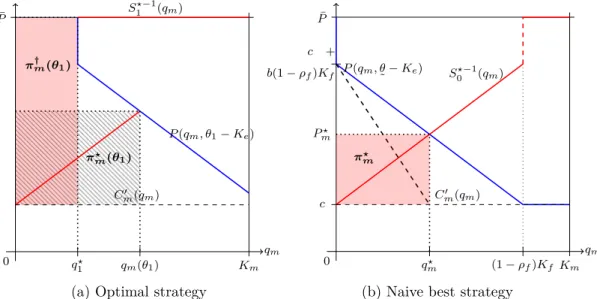
Those results are illustrated in Figure 1.1a. The blue line represents the inverse residual demand function faced by the monopolist at net market demand θ1 − Ke. The red line represents the equilibrium inverse supply
strategy of the monopolist. The red (resp. hatched) area corresponds to the market profits of the strategic player when acting as a pivotal player (resp. residual monopolist). It should be clear from this figure that the ex-post optimal supply function does not satisfy monotonicity in p. For comparison, Figure 1.1b illustrates the naive best strategy, denoted S0−1(·), which corresponds to the situation where the monopolist does not anticipate its effect on the fringe’s capacity constraint.
0 q? 1 qm(θ1) Km qm ¯ P π? m(θ1) π†m(θ1) P (qm, θ1− Ke) S1?−1(qm) C0 m(qm)
(a) Optimal strategy
0 (1 − ρ f)Kf Km qm q? m ¯ P c + b(1 − ρf)Kf c P? m π? m P (qm, θ ˜− Ke) S0?−1(qm) C0 m(qm)
(b) Naive best strategy
Figure 1.1: Optimal strategy without reneging and uncertainty
1.3.3
Reneging on commitments
We now turn to the case where the monopolist has the ability to renege on its commitments upon observing θ. First, we study the determinants of the profitability of this form of extensive conduct. Second, we characterize how optimal supply strategies are affected. Let us substitute Assumption 5 by the following.
Assumption 6 (Reneging on commitments). The monopolist is able to
choose output level qe ∈ [0, Ke] upon observing the realized demand level
θ.
Under Assumption6, the monopolist’s profit function becomes
πm(qm, qe) = P (qm, qe)qm− Cm(qm) + rqe, (1.5)
which total differentiation with respect to qe gives
∂P ∂qe qm+ ∂P ∂qm qm+ P − Cm0 (qm) ! dqm dqe + r, (1.6) where ∂q∂P e = ∂P ∂qm since P (qm, qe) = S −1 f (θ − qe− qm). A marginal reduction of
the committed output to qe < Kecan be done at the cost of the foregone unit
profit rate r. The strategic player’s profit is affected through two channels. M First, it may affect the market-clearing price upwards, since ∂q∂Pe ≤ 0.
The intensive margin corresponds to the increased profit margin of the market output qm sold by the monopolist. It coincides with the first
term in (1.6).
M Second, this output level may also increase since dqm
dqe ≥ 0. In turn,
it may enlarge market profits as the extra output is to be sold at an higher price p − ∂q∂P
mqm. This second-order effect corresponds to the
extensive margin. It is represented by the second term in (1.6).
Following Proposition 1, the monopolist’s best strategy is a function of net market demand θ − qe with qe = Ke. For any value of θ − qe, we are
assured that the best strategy is either to act competitively (qmc), as a residual monopolist (q?
m) or as a pivotal supplier (q
†
m). Solving for the best strategy
amounts as previously to finding the demand thresholds corresponding to the profit-maximizing transitions from one strategy to another. The only difference lies in the firm’s ability to manipulate its residual demand through reneging. Reneging on commitments can serve two purposes:
(a) to increase net market demand within a regime, so as to push either the price or output upwards; or
The feasibility and profitability depend on the level of demand, opportunity cost r, and ultimately the maximum profit margin ¯P − c.
If qe = 0, the monopoly regime would arise as soon as θ ∈ [θc−Ke, θ1−Ke),
and the pivotal regime for θ ≥ θ1 − Ke. We can decompose the demand’s
domain into five intervals for which reneging differs in scope as depicted in Figure 1.2. We briefly discuss the profitability of manipulations in each interval of demand.
θ
θ θc− Ke θc θ1− Ke θ1 θ
Competitive Regime Monopoly Regime Pivotal Regime
Within 1 Shift 1 Within 2 Shift 2 Within 3
Figure 1.2: Market regimes as a function of demand
(Within 1) Within the competitive regime: For θ ∈ [θ, θc− Ke), we have
π(qmc, qe) = rqe. Since this profit function is increasing in qe if r > 0, it is
never profitable to withdraw its commitments within the competitive regime.
(Shift 1) Shift to the monopoly regime: In the absence of manipulations,
the market is competitive for θ ∈ [θc− Ke, θc). However, if qe < Ke, the
monopoly regime prevails for θ ∈ [θc − (Ke − qe), θc]. To remain in the
competitive regime provides zero market profit though a strictly positive profit from the exogenous capacity, πmc(θ, Ke) = rKe, whereas shifting to the
monopoly regime by setting qe < Ke generates π?m(θ, qe) = P (qm?, qe)qm? −
Cm(qm?) + rqe. From (Within 2) below, qe = 0 when reneging is profitable in
the monopoly regime. Therefore, it is profitable to shift from the competitive regime to the monopoly regime if for some θ ∈ [θc−Ke, θc], we have πm?(θ, 0)−
πc
m(θ, Ke) ≥ 0 where the equality holds at θM, and the inequality is strict for
larger demand levels.
(Within 2) Within the monopoly regime: For θ ∈ [θc, θ1− Ke), the
mo-nopolist’s best strategy is q?
demand θ, the firm seeks to maximize its profit as follows max
qe
P (q?m, qe)q?m− Cm(q?m) + rqe s.t. {qe ≥ 0 ⊥ λe, qe≤ Ke ⊥ λe}.
(1.7) From the Envelope Theorem, differentiating with respect to qe gives the
first-order condition ∂P (qm?,qe)
∂qe q
?
m + r = λe − λe. Taking the second-order
derivative yields ∂2P (q?m,qe)
∂q2
e q
?
m ≥ 0 as P (qm, qe) = Sf−1(θ − qm− qe) is a convex
function of qe. The convexity of the objective function leads us to investigate
corner solutions. Therefore, reneging on commitments is profitable within the monopoly regime for any θ ∈ [θc, θ1− Ke) such that πm?(θ, 0) − π?m(θ, Ke) ≥ 0.
The equality holds at the threshold θM, and the inequality is strict for larger
demand levels because this profit difference is increasing in θ.
(Shift 2) Shift to the pivotal regime: For θ ∈ [θ1 − Ke, θ1), the firm has
a choice between setting qe = qe? ∈ [θ − Kf − q?, Ke] and earn the monopoly
profit π?
m(θ, qe?), or setting qe = qe† ∈ [0, θ − Kf − q?] so as to reap the
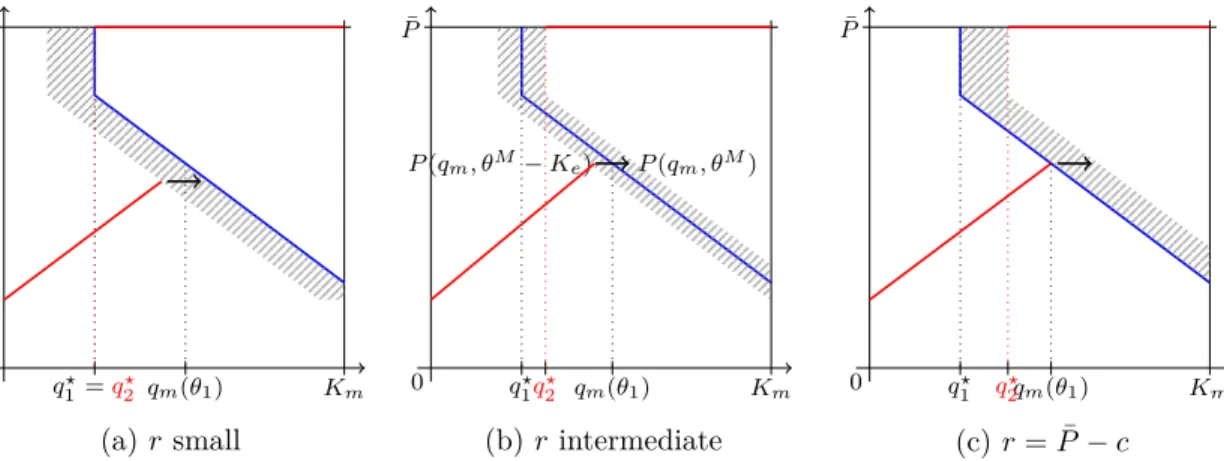
pivotal supplier profit π†m(θ, q†e). Let q?2 = θ2 − Kf − qe denote the smallest
output sold in the market when the pivotal regime is reached. There are two possible cases depending on the value of r. First, if r is such that full reneging is profitable for some θ in both the monopoly regime and the pivotal regime, then q?
e = q
†
e = 0 for all θ ∈ [θ1 − Ke, θ1). The optimal q2? will coincide to q?
1 as it is derived from the equivalent profitability condition: πm†(θ, 0) − π?m(θ, 0) ≥ 0. Second, if r is such that it is profitable to renege within the pivotal regime but not within the monopoly regime, the condition is changed into: πm†(θ, 0) − π?
m(θ, Ke) ≥ 0.
(Within 3) Within the pivotal regime: For θ ≥ θ1, the monopolist’s best
strategy is q†m. Upon observing θ, the firm maximizes its profit as max
qe
¯
P (θ−qe−Kf)−Cm(θ−qe−Kf)+rqe s.t. {qe ≥ 0 ⊥ λe, qe≤ Ke ⊥ λe}.
(1.8) The FOC is − ¯P + Cm0 (θ − qe− Kf) + r = λe− λe which is linear given the
monopolist’s constant marginal costs. The optimal solution corresponds to the corner solution where q?
e(θ) = 0 if and only if r ≤ ¯P − c. The monopolist
will gradually supply the committed output for demand levels above θ − Ke.
In the pivotal regime, any committed output withheld is exactly substituted by an extra market output produced by the monopolist, since all its rivals