A PROCESS TO ADDRESS ELECTRICITY DISTRIBUTION SECTOR
CHALLENGES: THE GREDOR PROJECT APPROACH
Bertrand CORNELUSSE David VANGULICK Mevludin GLAVIC Damien ERNST University of Liège–Belgium ORES–Belgium University of Liège–Belgium University of Liège–Belgium
[email protected] [email protected] [email protected] [email protected]
ABSTRACT
This paper presents a general process set in the
GREDOR (French acronym for “Gestion des Réseaux Electriques de Distribution Ouverts aux Renouvelables”)
project to address the challenges in distribution systems posed by the integration of renewable generation, changing load patterns, and the changes in the electricity market sector. A use case describing interactions among different players that fits the process is also presented. A pseudo-dynamic approach to Global Capacity Announcement as a way to increase penetration of Renewable Energy Sources in a distribution system is elaborated in more details.
INTRODUCTION
The GREDOR project is a four-year collaborative research project funded by the Public Service of Wallonia, Department of Energy and Sustainable Building, of the Belgian Walloon Region. The project started in January of 2013 and involves leading research institutions and major electricity sector players in the region (DSOs, TSO, engineering solution providers, retailers) [1]. The aim of the project is to address investment strategy, operational planning and real-time control from functional, computational, and organizational perspectives.
This paper presents and discusses the general process adopted to address the above-mentioned challenges, i.e. the structure underlying the interactions between the actors. While setting up the process the following is taken into account: the specifics of the Walloon Region [2], the present European regulatory and legislative frameworks [3,4], best practices of similar, finished or under consideration, projects in other regions within Europe [5], and the positions of relevant institutions, at European level but also world-wide if found to be relevant. Most specific for European and Walloon Region regulatory and legislative frameworks is the fact that a Distribution System Operator (DSO) is not allowed to own his generation [2,3,4]. A number of research projects (in Europe) were considered while setting the general process [6]. The projects identified as most relevant include: ADDRESS, FINSENY, HiPerDNO, Meter-ON, THINK, SmartA, GRID4EU, GRID+, and evolvDSO [6]. The most relevant institutions/organizations, providing: reports, regulatory documents, position papers, and research papers, are listed in Table I.
Table I: Most relevant institutions Institution Details Web CEER Council of European
Energy Regulators
www.ceer.eu ACER Agency for
Cooperation of Energy Regulators www.acer.europe.eu CWAPE Commission WAllonne Pour l’Energie www.cwape.be Eurelectric Electricity for Europe www.eurelectric.org EDSO European DSO
for smart grids
www.edspforsmartgrids. eu
EWEA The European Wind
Energy Association www.ewea.org ENTSO-E European Network of
Transmission System Operators for Electricity
www.entsoe.eu
SEDC Smart Energy Demand
Coalition
sedc-coalition.eu IEA International Energy
Agency www.iea.org IEEE Institute of Electrical
and Electronics Engineers
www.ieee.org IET The Institutions of
Engineering and Technology
www.theiet.org NREL National Renewable
Energy Laboratory
www.nrel.org
A use case is presented as an example of activities and interactions across different time horizons defined in the general process. An example of Global Capacity ANnouncement (GCAN) computations is considered for further support of some initial results of the project.
GENERAL PROCESS
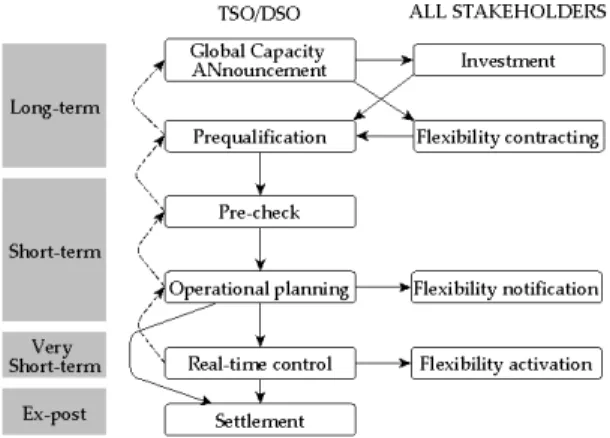
The process is illustrated in Figure 1 and is divided in four time horizons.
The long-term horizon, months to years in advance, is related to the investments or contracts in the system, either from a DSO’s or other stakeholders’ perspectives. This horizon includes two major considerations: GCAN and pre-qualification. GCAN is concerned with the assessment of generation connections and flexibility potential across the system and is aimed at triggering investment of developers for higher penetrations of RES.
Figure 1: General process Adopted in the project The pre-qualification is the procedure in which a DSO asserts the ability of certain stakeholders to provide the service for which they apply for without endangering the system reliability (approve/disapprove specific service). The pre-qualification consists of two types of verifications, first the legal and technical requirements that apply for a specific service, and second the impact on the system conducted by the DSO.
The short-term horizon relates to all the activities necessary to prepare the real-time operation. Taking into account all the options made available by long-term activities, short-term activities aim at determining whether some issues are likely to appear in the system in the short-term. Furthermore, it aims at finding the best techno-economical trade-off either to avoid the issues by taking preventive actions, or to correct them in real-time. This horizon includes two major activities: pre-check and operational planning. These steps will be performed once per day, or several times per day. The pre-check is considered in the project as a statistical estimation of the risk of issues in the system and is executed to evaluate the evolution of the state of the system. Operational planning is a best effort phase searching for the most technically and economically efficient way to solve issues raised by pre-check.
The very short-term (or real-time) horizon encompasses monitoring of the system and, whenever issues appear in the system, taking corrective actions such as activating flexibility services, or acting on control devices. The time horizon ranges from several seconds to at most the smallest time period considered in the short-term. This horizon is concerned with two issues: the system monitoring and state estimation, and control of over- and under-voltages and thermal limits of lines and cables. Ex-post activities are related to the settlement, to verify the activities and establish penalties, based on metered information. In the scope of the GREDOR project, settlement mainly aims at determining the effect of the
activation of flexibility services on the balance of Balancing Responsive Parties (BRPs) and retailers, compensating the actors that could not deliver a service along a pre-qualified contract.
The word “flexibility”, in Figure 1, should be understood as “any kind of flexibility”: generation curtailment, load modulation, etc. Several stakeholders may be associated to each block of the right column of Figure 1. The dashed arrows, in Figure 1, represent the information that flows backwards for adapting each step of the process to the observations made by steps that are closer to real time. To better illustrate the general process details a use case that involves activities over all time horizons shown in Figure 1 is presented below.
Use case: TSO buys and uses flexibility
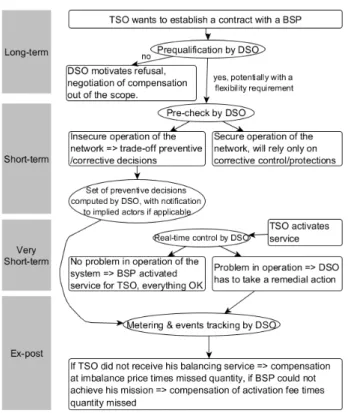
Figure 2 illustrates the interactions that a flexibility contract between a balancing service provider (BSP) and a TSO can trigger.
Pre-qualification. First, the flexibility service is pre- qualified by the DSO. The case of interest here is the one where the pre-qualification leads to the acceptance of the service by DSO. Otherwise the parties involved may negotiate, ask for explanations. In case the service is pre-qualified, the acceptance may be conditioned to a certain level of flexibility itself associated with a certain level of compensation for the reservation and the activation of this flexibility.
Short-term In the considered case, the DSO is not notified of the activation of the flexibility service. The assumption made is that pre-qualification is sufficient to withstand any activation.
The DSO further proceeds with pre-check, i.e. evaluates whether the operation of the network will be secure or insecure in day-ahead, given forecasts of generation and consumption at the MV nodes, and information from qualification. There are two possible outcomes of the pre-check:
1. System is foreseen to be secure. No preventive action is taken,
2. System is foreseen to be insecure. A trade-off between taking preventive actions and relying on corrective control must be made.
Very Short-term In real-time, there are again two cases: 1. The DSO does not experience any issue in the
system. This use case terminates.
2. The DSO experiences issues in the system. He has to take corrective actions to maintain the network in a secure operation mode. Depending on the operation that is performed, it may or not have an impact on contract between the TSO and the BSP, or other Grid Users (GUs).
Figure 2: Use case where TSO buys and uses flexibility from a BSP active in a DSO
Ex-post. In practice the settlement are compound of the following:
1. DSO uses corrective controls that do not affect the contract, e.g. by acting on the configuration of the network, or on its own control devices. In that case, only the cost of these actions must be accounted for (OPEX of the DSO). No particular settlement action is to be taken with respect to other actors.
2. DSO uses corrective controls that directly affect the contract and prevent the BSP to perform the activation request. In that case, for the part of the service activation that was within the pre-qualified bounds, the DSO should compensate for the imbalance caused to the TSO and potentially for the activation fee not captured by the BSP. For the portion that was not firmly allocated at pre-qualification time the DSO should compensate along the rules of the connection contract (i.e., compensation at a regulated price, no compensation, or even a negative compensation). If other actors are impacted we should also account for the value of loss load or generation.
3. DSO uses corrective controls that indirectly affect the contract, e.g. by activating another source of flexibility. In that case the BSP actually performs the activation request from the TSO. Nevertheless, the TSO is impacted, and the DSO should pay the imbalance fee.
To establish the responsibility of the DSO the following is proposed:
1. DSO logs all the flexibility activation he has to perform to operate the network. We can distinguish:
- corrective actions, that necessarily lead to a compensation as described here above, - preventive actions, that can lead to a priori
adjustment of the balance of the TSO, and avoiding the TSO activating services that would be cancelled. Preventive actions could thus lead to smaller costs for the DSO, but with uncertainty on the realization of the event that would have caused trouble in the system.
2. DSO logs evidence of congestions, e.g. opening of protections.
In this interaction model, the DSO does not know that the flexibility contract will be or was activated.
An alternative: it would consist in assuming that the notification of activation from the TSO to the BSP is performed in day-ahead, and that the DSO would be notified of this activation. The DSO could then account for this in his pre-check analysis, and consider preventing or conditioning this activation.
”Force majeure” A usual assumption is that in case of ”force majeure” the DSO does not pay any compensation. In that case, the DSO might modulate or even trip some pre-qualified services. The conditions under which this clause is applicable should of course be carefully detailed to avoid that the DSO makes abusive use of it.
GLOBAL CAPACITY ANNOUNCEMENT
GCAN is a procedure to compute an estimate of the capacity of generation that could be connected in substations, without endangering system reliability, with the aim to trigger the investments in the system. Similarly, GCAN could be used to determine locations and amount of load modulation in system’s substations, however this paper presents the results of GCAN for generation connections. GCAN is specific for DSOs but is applicable to TSOs in a similar fashion. Several other terms are also in use: station capacity, headroom, available capacity of the system, and distribution network capacity [6]. According to [6], “Whereas the technical problems arising from distribution-level connections may be mitigated for individual connections, the anticipated connection volumes imply a potential risk of conflict between connections, in that inappropriately sized or located plant could constrain further development of the network and consequently threaten the achievement of renewable energy targets”. GCAN computations are performed using a system model (a static, i.e. steady state, model is sufficient to this purpose) and adequate tools (power flow is preferred as the tool routinely used
within DSOs). To trigger investments in the network, GCAN results have to be communicated to all the stakeholders of the system. The results of GCAN should be computed at yearly basis and updated whenever new connection is realized on the system.
GCAN: a pseudo-dynamic approach
GCAN computations, considered in the GREDOR project, are based on the following fact and premises:
1. Fact: DSOs in the current European regulatory and legislative frameworks are not allowed to own generation. Consequently, this increases uncertainties in DG connections.
2. Premises:
- GCAN computations should be in line with other DSO’s planning activities (network reinforcement and expansion planning) and political targets (e.g, penetration level of RES at the end of planning horizon), - GCAN computations should be simple, - GCAN should rely on existing, and
routinely used, tools (power flow, planning tool, and OPF if needed).
The GCAN computations are conducted by a DSO with the following interests and commitments:
1. A DSO’s interest: decrease in active power losses,
2. A DSO’s commitments: GCAN computations for network configurations with reduced losses, and deployment of active network management schemes if some connections deem to be infeasible (in a reasonable manner) [7].
The essence of pseudo-dynamic GCAN computations is similar to the approach used for distribution network planning in [8]. It consists of two steps: in the first one the whole planning horizon is considered as one step (generation connections are computed for the end of planning horizon), in the second one connections are computed for each step in the planning horizon with the reference to (taking into account) the values computed in the first step. The values of generation connections are computed with the analytical formula presented below. Analytical formula for active power generation connection
To maintain the simplicity of the overall procedure, pseudo-dynamic GCAN relies on an analytical formula for the generation connection computations. Starting from the exact loss formula (active power losses over all the system) the following analytical expression for active generation connection that minimizes the system losses, is obtained: 𝑃!"= !!!!!!"! !!!.!!!! !!"!!!!!"!! ! !!!!.!!!!!"!!!!!"!! !!!!!!"#!!"!!!!!!!"#!!" (1) where: 𝛼!"= 𝑟!" 𝑉!𝑉!𝑐𝑜𝑠𝜃!" 𝛽!"= 𝑟!" 𝑉!𝑉!𝑠𝑖𝑛𝜃!"
𝑃!(𝑄!) is the active (reactive) power injection in bus 𝑖, 𝑉! is the voltage magnitude in the same bus, 𝜃!" is the
difference of voltage phase angles in buses 𝑖 and 𝑗, 𝑟!" is
the real component of the bus impedance matrix, 𝑛 is the number of buses in the system, 𝑃!= 𝑃!"− 𝑃!", 𝑄!"= 𝑃!"𝑡𝑎𝑛𝜑!" (this relates to different power factor of
generation) . Procedure
The proposed pseudo-dynamic GCAN computations include the following steps:
1. Take load forecasts for the planning horizon, 2. Take results of network reinforcement and
expansion plan for the planning horizon,
3. Compute the network configuration with minimal losses for the first and last step of the planning horizon,
4. Use analytical expressions for maximum active power connection (1) and compute the amounts in all substations included in plausible set, 5. Check feasibility at the end of planning horizon
and correct if needed,
6. Go back to the first year of planning horizon and compute active powers as in (1). Form the vector of differences of active power connections at the final and the first planning horizon. Sort this vector in ascending order. Publish for the first year the connections corresponding to the sorted vector which entries are less than a pre-specified value.
This procedure is repeated at the next planning horizon by shifting it for one planning step (one year, in a rolling horizon manner).
GCAN computations example
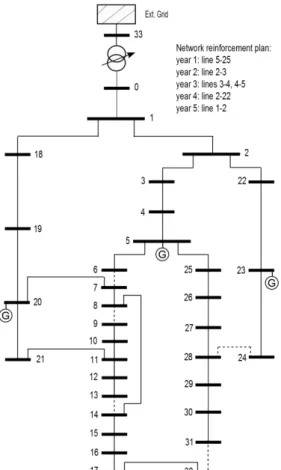
The IEEE 33-bus test system (12.66 kV, balanced conditions) is used for to illustration (Figure 4). The system is initially assumed without generation installed. The base load is 3.715 MW and 2.3 MVar. The peak load is set to be 20% bigger than the base load (uniformly for all loads) while the minimum load is 40% of the peak. The results are shown in Figure 4 and are obtained under the following conditions. A five years planning horizon is considered. A three percent load increase per year is assumed (for all loads). Network reinforcement (expansion is not considered in this example) is determined using pseudo-dynamic approach of [8]. The results are illustrated in Figure 4. The heuristic approach of [9], combined with power flow [10], is used to
determine optimal network configuration (shown in Figure 4). Five substations (buses) are considered for possible generation connections (buses: 5, 17, 21, 23, and 27) with the target of having 50% of total system load covered by DGs at the end of planning horizon (the target is 2.5133 MW).
Figure 4: IEEE 33-bus test system
Among five substations three are chosen for publishing the connection amount in the first year (bus 5 with amount of 0.944 MW, bus 20 with 1.129 MW, and bus 23 with 0.982 MW), as indicated in Figure 4. These values are computed assuming 0.95 (lead) power factor for every generator and correspond to firm generation connection computed for minimum load conditions.
CONCLUSION
Setting a clear general process, that defines activities and interactions among different stakeholders, is a pre-requisite for successful implementation of research project dealing with new challenges in the electricity distribution sector. This paper presents the process set in the context of the GREDOR project. A use case is presented to illustrate the activities and interactions while an example of computations conducted in long-term horizon (GCAN) is included to illustrate some initial results.
ACKNOWLEDGMENT
This research is supported by Public Service of Wallonia, Department of Energy and Sustainable Building, within the framework of the GREDOR project.
REFERENCES
[1] The GREDOR project, 2013, available online: www.gredor.be, University of Liège, Belgium. [2] Parlement Wallon, 2014, Décret du 11 avril 2014
modifiant le décret du 12 avril 2001 relatif á l'organisation du marché régional de l'électricité et modifiant le décret du 19 décembre 2002 relatif á l'organisation du marché régional du gaz, Parlement
Wallon, Namur, Belgium.
[3] European Parliament, 2003, Directive 2003/54/EC of
the European Parliament and of the Council of 26 June 2003 concerning common rules for the internal market in electricity and repealing Directive 96/92/EC, Official Journal of the European Union, L176/33-55, Brussels, Belgium.
[4] European Commission, 2007, Distributed generation
ownership issues, review of current practices, future options and European policy recommendation,
Brussels, Belgium.
[5] European Commission, 2014, Joint Research Centre,
Institute for Energy and Transport (IET), Smart Electricity Systems and Interoperability, available
online: http://ses.jrc.ec.europa.eu, Brussels, Belgium. [6] G. P. Harrison, A. R. Wallace, 2005, “Optimal power flow evaluation of distribution network capacity for the connection of distributed generation,” IEE
Proceedings-Generation, Transmission, Distribution,
vol. 152, 115-122.
[7] Q. Gemine, D. Ernst, B. Cornélusse, 2014, “Active network management for electrical distribution systems: problem formulation and benchmark,”
arXiv Systems and Control (cs.SY)
[8] I. J. Ramirez-Rosado, T. Gonen, 1991, “Pseudodynamic planning for expansion of power distribution systems,” IEEE Trans. on Power
Systems, vol. 6, 245-254.
[9] D. Shirmohammadi, H. W. Hong, 1989, “Reconfiguration of Electric Distribution Networks for Resistive Line Losses Reduction,” IEEE Trans.
on Power Delivery, vol. 4, 1492-1498.
[10] R. D. Zimmerman, C. E. Murillo-Sánchez, R. J. Thomas, 2011, “MATPOWER: Steady-State Operations, Planning and Analysis Tools for Power Systems Research and Education,” IEEE Trans. on