To cite this document: Mignot, Rémi and Hélie, Thomas and Matignon, Denis
State-space representation for digital waveguide networks of lossy flared acoustic
pipes. (2009) In: 12th International conference on Digital Audio Effects,
DAFx’09, 01-04 Sep 2009, Como, Italy.
O
pen
A
rchive
T
oulouse
A
rchive
O
uverte (
OATAO
)
OATAO is an open access repository that collects the work of Toulouse researchers and
makes it freely available over the web where possible.
This is an author-deposited version published in:
http://oatao.univ-toulouse.fr/
Eprints ID: 8977
Any correspondence concerning this service should be sent to the repository
administrator:
[email protected]
STATE-SPACE REPRESENTATIONS FOR DIGITAL WAVEGUIDE NETWORKS OF LOSSY
FLARED ACOUSTIC PIPES
Rémi Mignot
∗ †, Thomas Hélie,
IRCAM & CNRS, UMR 9912
1, pl. Igor Stravinsky,
75004 Paris, France
{mignot,helie} @ ircam.fr
Denis Matignon
ISAE, Applied Mathematics Training Unit,
10, av. E. Belin, B.P. 54032.
F-31055 Toulouse cedex4, France
denis.matignon @ isae.fr
ABSTRACT
This paper deals with digital waveguide modeling of wind instru-ments. It presents the application of state-space representations to the acoustic model of Webster-Lokshin. This acoustic model describes the propagation of longitudinal waves in axisymmetric acoustic pipes with a varying cross-section, visco-thermal losses at the walls, and without assuming planar or spherical waves. More-over, three types of discontinuities of the shape can be taken into account (radius, slope and curvature), which can lead to a good fit of the original shape of pipe. The purpose of this work is to build low-cost digital simulations in the time domain, based on the Webster-Lokshin model. First, decomposing a resonator into independent elementary parts and isolating delay operators lead to a network of input/output systems and delays, of
Kelly-Lochbaum network type. Second, for a systematic assembling of
elements, their state-space representations are derived in discrete time. Then, standard tools of automatic control are used to reduce the complexity of digital simulations in time domain. In order to validate the method, simulations are presented and compared with measurements.
1. INTRODUCTION
Studying physical modeling for sound synthesis allows to simu-late the behavior of musical instruments. Consequently it naturely leads to realistic sounds, especially during attacks and note transi-tions, compared to signal processing approaches. However, digital simulations in time domain require intensive computations from signal processors, and simplifications of the physical model have to be considered to make real-time simulations possible. More-over, because of interactions between elements of an instrument, building a modular synthetizer proves difficult.
With the approach of digital waveguides (cf. eg. [1]), some works have considered 1D acoustic model of axisymmetric pipes based on the Webster horn equation (cf. [2]). Approximating a varying cross-section pipe by some cylinders or cones leads to the Kelly-Lochbaum scattering network (cf. eg. [3, 4]), which allows a low-cost digital simulation in time domain. These mod-els assume planar and spherical waves respectively. For a more realistic behavior of the virtual instrument, in [5] and [6] visco-thermal losses have been taken into account. This model of losses (cf. [7]) involves fractional derivatives, and is more accurate than more standard dampings based on integer order derivatives. In [8],
∗Rémi Mignot is Ph.D. student at Télécom ParisTech/TSI
†This work is supported by the CONSONNES project, ANR-05-BLAN-0097-01
the Kelly-Lochbaum network has been derived for pipes with
con-tinuity of radius and slope (C1-regularity of the shape), using the
Webster-Lokshin acoustic model of lossy flared pipes which does
not assume planar or spherical waves (cf. [9]).
After modeling each piece of pipe separately, it is necessary to put them together in order to build the whole resonator. In [10] and [11], the following modular method is proposed: deriving
state-space representations of every pieces of pipe in discrete time
do-main, interconnection laws allow to calculate the state-space rep-resentation of the whole resonator. This formalism facilitates the modularity of the building of a virtual trombone.
In a recent work [12], a framework (based on the
Webster-Lokshin equation) has been derived and allows to recover all
mod-els mentioned above ([3, 5, 4, 6, 8]). Moreover, it allows to ob-tain a good level of accuracy with a small number of pipes. The novelty of the present work is the use of the formalism of [11], starting from the unifying model of [12]. Thanks to the modular-ity of the method, virtual wind instruments can be built connecting additional models such as: mouth-piece, radiation, tone-hole, lips and reed (which are not studied in this paper). For example, Fig. 1 presents the network of a possible virtual resonator built by con-necting such acoustic elements.
p+ e p− e ps,1 ps,2
Figure 1: Example of an acoustic network modeling a resonator with a mouth-piece, a horn and a tone-hole.
This document is organized as follows. In section 3, a pipe with varying cross-section is separated into some pieces of pipe. Using the Webster-Lokshin model, each piece of pipe is modeled by an input/output network of the Kelly-Lochbaum type. In section 4, a state-space representation is derived for the network of section 2, in continuous time and in discrete time. Section 5 presents stan-dard tools of automatic control which allow to optimize numerical realizations in order to obtain low-cost digital simulations in the time domain. Section 6 presents the digital simulations of virtual trombones and a comparison between computed impedances and the measured impedance of a real trombone. The last section con-cludes this paper and deals with perspectives.
p+ 0 p+ 0 p− 0 p− 0 p− L p− L p+ L p+ L QP Ql a R Qls Rls Qcll Qrcl Qsr Qar s l Rsr Rs r 1+Rs l 1+Rs l 1+Rs r 1+Rs r kl k r 1+kl 1+kr −kl −kr 1−kl 1−kr R −R −R R 1+R 1+R 1−R 1−R rl rrT rr rlT
Figure 2: Separation of the effects of pipe geometry.
2. MODELING A PIECE OF PIPE 2.1. Webster-Lokshin model and traveling waves
The Webster-Lokshin model is a mono-dimensional model which characterizes linear waves propagation in axisymmetric pipes, as-suming the quasi-sphericity of isobars near the inner wall (cf. [9, 13]), and taking into account visco-thermal losses (cf. [7]) at the
wall. The acoustic pressureP and the particle flow U are governed
by the following equations, given in the Laplace domain: " „ s c0 «2 +2ε(ℓ) „ s c0 «3 2 +Υ(ℓ) ! −∂2ℓ # r(ℓ)P (ℓ, s) = 0, (1) ρ0sU (ℓ, s) S(ℓ) + ∂ℓp(ℓ, s) = 0, (2)
wheres ∈ C is the Laplace variable, ℓ is the space variable
mea-suring the arclength of the wall, r(ℓ) is the radius of the pipe,
S(ℓ) = πr(ℓ)2 is the section area,ε(ℓ) = κ
0
p
1−r′(ℓ)2/r(ℓ)
quantifies the visco-thermal losses andΥ(ℓ) = r′′(ℓ)/r(ℓ) is the
curvature. Eq. (1) is called the Webster-Lokshin equation, and (2) is the Euler equation satisfied outside the boundary layer. The
physical constants are the mass densityρ0, the speed of soundc0,
andκ0=√l′v+ (γ − 1)
√
lhwherel′vandlhdenote characteristic
lengths of viscous (l′
v) and thermal (lh) effects.
With the formalism of Digital Waveguides, it is usual to
de-scribe acoustic effects with traveling waves rather thanP and U .
In this work, we define the change of variables by introducing a
virtual reference pipe: a lossless cylinder with (arbitrary) radiusrc.
Its characteristic impedance isZc = ρ0c0/Sc, withSc = πr2c,
for which corresponding planar traveling waves would be defined
by » p+(ℓ, s) p−(ℓ, s) – =1 2 » 1 Zc 1 −Zc – » P (ℓ, s) U (ℓ, s) – . (3)
In the case of lossy varying cross-section pipes, these vari-ables are neither decoupled nor perfectly progressive inside the pipe. Nevertheless, they remain “physically meaningful” at inter-faces of the pipe (cf. [12]), and respect the causality principle. 2.2. Two-port system of a piece of pipe
In this paper, a pipe with varying cross-section is approximated by a concatenation of pieces of pipe with constant parameters. Thus,
a piece of pipe is defined as a finite pipe with lengthL, and with
constant curvature (Υ) and losses (ε) parameters.
The piece of pipe is modeled by a system, the inputs of which
arep+0(s) := p+(ℓ = 0, s) and p−L(s) := p
−(ℓ = L, s) (incoming
waves atℓ = 0 and ℓ = L). Outputs are p+
0(s) and p
−
L(s) (outgoing
waves).
In [12], a detailed analysis gives a framework which represents the system of a piece of pipe. In this framework, delays and effects of geometry of the pipe are isolated from each others. The
geome-trical parameters are the radii at endsr0andrL, the slopes at ends
r′
0andr′L, the curvature and the visco-thermal losses of the piece
of pipe (Υ and ε). The framework is presented in Fig. 2 where
kl= Zl− Zc Zl+ Zc , and kr= Zr− Zc Zr+ Zc , (4) Rls(s) = αl s − αl , with αl= − c0 2 r′ l rl , (5) Rrs(s) = αr s − αr , with αr= + c0 2 r′ r rr , (6) R(s) = s/ c0−Γ(s) s/ c0+Γ(s) , (7) T (s) = e−Γ(s)L= D(s) e−c0sL, (8) with D(s) = e− “ Γ(s)−s c0 ” L , (9) and Γ(s) = s “ s c0 ”2 + 2ε“ s c0 ”3 2 + Υ, (10)
and where √. denotes an analytical continuation of the positive
square root of R+ on a domain compatible with the one-sided
Laplace transform, namely C+0 = {s ∈ C/ℜe(s) > 0} (see
Ref. [14, 15] for more details). The functionΓ is proved to be
analytical in C+0, and such thatℜe(Γ(s)) ≥ 0 if ε ≥ 0.
Brief interpretations of cells of Fig.2 are
• Cells Ql
a andQ r
a, withklandkr(cf. (4)), remind
Kelly-Lochbaum junctions between two lossless cylinders (cf. eg.
[3, 5]) with discontinuities of sections.
• Cells Ql
sandQrs, withRlsandRrs(cf. (5-6)), are similar to
Kelly-Lochbaum junctions between lossless cones (cf. eg.
[4, 6]) with discontinuities of slopes.
• Cells Ql
clandQ r
cl, withR(s), remind Kelly-Lochbaum
junc-tions between lossy pipes with constant curvature of [8].
• T (s) (cf. (8)), of the cell Ql
cl, represents the delay L/ c0
of wave propagation through the piece of pipe, and the
ef-fectD(s) (cf. (9)) due to the visco-thermal losses and the
curvature. In [14]D(s) is proved to be causal and stable.
The framework of Fig. 2 is interesting because the effects of the curvature and losses are isolated from the others (section and slope), and it makes their study easier. Because of the square roots
in the functionΓ (cf. (10)), the study requires special treatments
3. STATE-SPACE REPRESENTATION
For a systematic building of resonators, it is proposed to derive state-space representations for each cell of Fig. 2. These represen-tations allow algebraic manipulations on the system using well-known tools of automatic control (see sec. 4). Introducing the
in-put vectorU (N ×1), the output vector Y (N ×1), and the state
vectorX (J ×1), each cell is rewritten with the following
repre-sentation in continuous time
s X(s) = A X(s) + B U (s),
Y (s) = C X(s) + D U (s). (11)
3.1. Finite-dimensional systems
Because of the square roots in Γ(s), transfer functions such as
R(s) and T (s) (see sec. 2.2) are irrational. These functions have continuous lines of singularities in C, which are named cuts. These cuts join some points (branching points) and the infinity.
IfΥ = 0, the function Γ has one branching point at s = 0. The
cut R− is chosen to preserve the hermitian symmetry. Thereof,
transfer functions have a continuous line of singularities on R−.
The residues theorem shows that these functions are represented by a class of infinite-dimensional systems, called Diffusive
Re-presentations (cf. [16, 17, 15]). For any diffusive representation
H(s) which is analytic on C\R− : H(s) = Z∞ 0 µH(ξ) s + ξ dξ, (12) µH(ξ) = 1 2iπ{H(−ξ+i0 − )−H(−ξ+i0+)}. (13)
For simulation in time domain, eg. in [17], it is proposed to approximate such diffusive representations by finite-dimensional
approximations, given by eH(s) =Pj=Lj=1 µHj
s+ξj, where L is the
number of poles, −ξj ∈ R−is the position of thejth pole and
µH
j is its weight. The poles are placed in R−with a logarithmic
scale, and the weightsµH
j are obtained by a least-square
optimiza-tion in the Fourier domain.
IfΥ > 0, Γ has two more branching points, which are
com-plex conjugate. In this case, diffusive representations are approxi-mated with a finite sum of 1st and 2nd order differential systems:
e H(s) = j=LX j=1 µH j s + ξj + j=MX j=1 wH j s + γj + w H j s + γj ! . (14)
R and D can be approximated with L + 2M = 10 or 15. 3.2. State-space representations in continuous time CellsQl
aandQra These Cells only contain constant coefficients
klandkr. WithQlafor example, the state-space representation is
A = [ ] , B = [ ] , C = [ ] , D = » kl 1−kl 1+kl −kl – . (15) A, B, C are degenerated (empty) matrices, but this convenient notation is used to standardize the procedures in the sequel. CellsQl
sandQrs They contain one first-order transfer function,
the state-space representation ofQl
sis A =ˆ αl˜ , B = ˆ1 1˜ , C =»αlαl – , D =» 01 10 – . (16) CellsQl clandQ r
cl The transfer functionR of the type (12) is
approximated by eR of the type (14). The state-space representation
ofQl
clis given by the following diagonal form
A = diag(ˆξ1, ..., ξL, γ1, ..., γM, γ1, ..., γM ˜ ), C = " µR 1, ..., µRL, wR1, ..., wMR, wR1, ..., wRM µR 1, ..., µRL, wR1, ..., wMR, wR1, ..., wRM # , B = » 1, ... 1 −1, ... −1 –T and D = » 0 1 1 0 – . (17)
CellQp In the central cellT (s) = D(s) e
−L
c0s. The transfer
functionD(s) of type (12) is approximated by eD(s) of type (14)
for which the state-space representation can be written
A = diag(ˆξ1, ..., ξL, γ1, ..., γM, γ1, ..., γM ˜ ), C =ˆµD 1, ... µDL, wD1, ... wMD, wD1, ... wDM ˜ , B =ˆ1, ... 1˜T and D =ˆ0˜. (18)
Pure delay operators are treated differently : fore−τ s
, ifτ =
M Ts withM ∈ N∗andTsis the sampling period, its
discrete-time version isZ−M
and is performed by a circular buffer. IfM
is fractional, interpolation filters are needed (cf. eg. [4, 11]). 3.3. State-space representations in discrete time
Since every state-space representation are written in diagonal form,
the dynamics equation behaves asJ independent first order
equa-tions with polesaj= Aj,j. This leads to
sXj= ajXj+ Vj, for 1 ≤ j ≤ J, (19)
whereVj=PNn=1B(j,n)Un.
Using any standard discretization schemes, J discrete-time
equations of the first order are derived from (19). The
correspond-ing difference equations are1
zXjd= αjXjd+ (zλ(j,1)+ λ(j,0))V
d
j, for 1 ≤ j ≤ J. (20)
WithΛl= diag({λ(j,l)}1≤j≤J)B for l ∈ {0, 1}, and Ad=
diag({αj}1≤j≤J), the matrix version is
zXd = AdXd+ (zΛ1+ Λ0)Ud, (21)
Yd = CXd+ DUd.
(22) Equation (21), is not a standard dynamics equation of
state-space representation, becausexndepends uponunin the time
do-main. To cope with this problem, let’s define the new state vector:
Wd= Xd − Λ1Ud⇒ zWd= AdXd+ Λ0Ud, ⇒ zWd = AdWd+ BdUd, Yd = CdWd+ DdUd, (23) withBd= (AdΛ 1+ Λ0), Cd= C and Dd= (CΛ1+ D).
To simplify notations, vectors and matrices of the
discrete-time systems are renotedU , Y , X, A, B, C and D.
1For example, choosing the triangle approximation (modified first-order hold, cf. [18]), the coefficients of (20) are:
αj= eajTs, λ (j,0)=− 1−αj a2 jTs − 1 aj, and λ(j,1)= 1−αj a2 jTs +αj aj.
4. REALIZABLE NETWORK
To build the network of a whole pipe, two-port systems of pieces of pipe (cf. Fig. 2) are connected together. This section is devoted to obtain a computationally realizable network of the whole system. 4.1. Concatenating systems
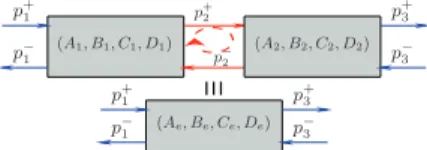
In Fig. 3 (top part), delay-free loops appear at interfaces of two systems which represent some cells of Fig. 2. These instantaneous loops cannot be simulated numerically as such, and it is necessary to remove them. To cope with this problem, it is possible to derive an equivalent two-port as the bottom of Fig. 3 shows.
p+ 1 p+ 1 p− 1 p− 1 p+ 2 p− 2 p+ 3 p+ 3 p− 3 p− 3 (A1, B1, C1, D1) (A2, B2, C2, D2)
(Ae, Be, Ce, De)
Figure 3: Concatenating two two-ports
In [11, p. 31-33], the interconnection laws are performed from
state-space representations. This leads to the matricesAe,Be,Ce
and De of the equivalent two-port. This operation is performed
recursively to remove every instantaneous loop, until the network only contains intertwined two-port systems (without delay) and
cellsQP(with delay operators).
4.2. Minimal realization
At this stage of the building, a well-known result in automatic con-trol allows to reduce the dimensions of the systems, in order to reduce the cost of numerical computation.
For an original state-space representation, the study of its ob-servability allows to know if a change of state exists, which defines observable and non-observable sub-states. From an input/output point of view it is not necessary to simulate the last substates, be-cause they have no influence on the output.
Similarly, the study of reachability allows to separate reachable and unreachable sub-states. With zero initial conditions,
unreacha-ble sub-states remain zero for bounded excitationsU .
Using the canonical Kalman’s form (cf. [19]), the minimal
re-alization is derived by eliminating non-observable or unreachable
sub-states. If they exist, the dimension of this minimal realization is lower than the original.
Remark: the minimal realization can be required for stability reasons in some particular cases (cf. eg. [20]).
4.3. Jordan decomposition
To reduce the calculation cost, it is useful to look for a new change
of state which makes the matrixA sparse.
Considering the minimal realization of a system of the
net-work, if its matrixA is diagonalizable over CJ×J, the modal form
of the system is computed. If this matrix is not diagonalizable, it
always admits a Jordan decomposition over CJ×J.
Then, the appropriate change of variable is done to lead to
the new dynamics matrixA′with the diagonal form or the Jordan
normal form. This matrix contains its complex eigenvalues on its
diagonal, some0 or 1 on its super-diagonal and 0 everywhere else.
4.4. Last reduction
Whereas all systems are real-valued (unandyn ∈ RN), matrices
of the state-space representation are complex-valued. From a nu-merical point of view, computation with complex numbers is more expensive than with real numbers. However using the hermitian symmetry of input/output transfer matrix (H(s) = H(s)), it is possible to reduce the number of sub-states to calculate.
The matrixA is with the Jordan normal form, then its Jordan
blocks are sorted with respect to their eigenvalues:
A′= diag(AR, AC, AC),
withARis a Jordan matrix composed with real eigenvalues,AC is
a Jordan matrix composed with complex eigenvalues with positive
imaginary part, andAC = AC. ThenH(s) is decomposed:
H(s) = HR(s) + HC(s) + HC(s) + D.
The hermitian symmetry of H(s) and identifications prove
thatHR(s) = HR(s) and HC(s) = HC(s). Thus, the contribution
ofHC(s) can be deduced from that of HC(s).
Decomposing matrices with respect to eigenvalues ofA′
,B′= ˆ BR, BC, BC ˜T ,C′=ˆC R, CC, CC ˜ andX′=ˆX R, XC, XC ˜T , the equivalent scheme for simulation is, in time domain:
8 > < > : » xR(n+1) xC(n+1) – = » AR 0 0 A C – » xR(n) xC(n) – + » BR BC – u(n), y(n) = CRxR(n) + 2ℜe “ CCxC(n) ” + Du(n). 5. RESULTS OF SIMULATIONS
From the geometry of a real trombone, two virtual trombones are built numerically. The varying cross-section pipe of the first
vir-tual trombone,M1, is built with 11 pieces of pipe, for a refined
fit with the original shape of pipe. The second model,M2, is a
simplified version with 5 pieces of pipe. Additionally, the mouth-piece and the radiation impedance are modeled, but these models are not detailed here.
From the geometrical parameters ofM1 and M2, the
state-space representations of the networks of simulation are built with the procedures described in sections 3 and 4. These global sys-tems which represent the resonator of a trombone, have one input
and two outputs: the input is the incoming traveling wavep+
e at
the entry of the mouth-piece, and their outputs are the traveling
wavep−
e outgoing from the mouth-piece and the radiated pressure
ps from the horn. Simulating the impulse response of the input
reflexion of the resonator,p−
e/p+e, in time domain, the computed
input impedance,P/U , is deduced in frequency domain from (3).
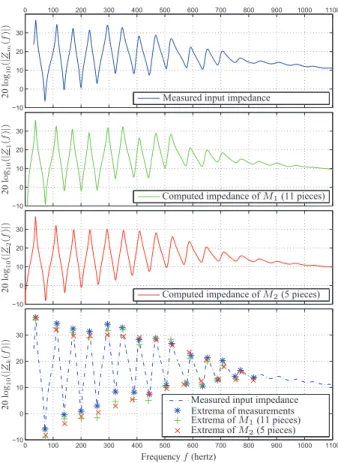
Computed impedances are compared with the measured
impe-dance of the real trombone1in Fig. 4. As we can see, the main
im-provement of the modelM1(with 11 pieces of pipes) compared to
that ofM2(with 5 pieces) is about the spectral envelop. Whereas
the envelop of maxima and minima ofM2 is smooth, that one of
the measurements have some irregularities (see the fifth and the sixth maxima for example). With a best fit of the real shape of
pipe, the envelop ofM1has the same type of irregularities.
How-ever, because of the simplification ofM2, the complexity of the
network of simulation is reduced.
1Measurements was done with the impedance sensor of the Centre de
0 100 200 300 400 500 600 700 800 900 1000 1100 −10 0 10 20 30 −10 0 10 20 30 −10 0 10 20 30 0 100 200 300 400 500 600 700 800 900 1000 1100 −10 0 10 20 30 Frequencyf (hertz) 2 0 lo g10 (| Zm (f )| ) 2 0 lo g10 (| Z1 (f )| ) 2 0 lo g10 (| Z2 (f )| ) 2 0 lo g10 (| Zk (f )| )
Measured input impedance
Computed impedance of M1(11 pieces)
Computed impedance of M2(5 pieces)
Measured input impedance Extrema of measurements Extrema of M1(11 pieces) Extrema of M2(5 pieces)
Figure 4: Comparison between impedances.
6. CONCLUSIONS AND PERSPECTIVES
Using the formalism of state-space representations for digital wave-guide networks leads to a good modularity for the assembling of elements, and an automatic building of the network of simulation. Moreover, standard tools of automatic control are used to reduce the calculation cost.
Considering the refined model of Webster-Lokshin for lossy flared pipes, it has been shown that this formalism can be applied with approximations of the diffusive representations by finite-di-mensional systems. Compared to models based on cylinders or cones, this model requires much fewer pieces of pipes to obtain good geometrical fits and realistic computed impedances.
At present, the global complexity of computation is equivalent to former models mentioned above. But the dimension of approx-imation (cf. sec. 3.1) can be reduced with a different method.
In this paper, only linear resonators with static parameters have been presented. In order to have a complete computer-aided maker of virtual wind instruments, nonlinear or time-varying system must be considered: trombone slide, valves, lips, reed, tone-holes. The modularity of the formalism should make an easy integration pos-sible with only a few differences.
7. ACKNOWLEDGMENT
The authors thank René Caussé, Thomas Hézard and Pierre-Da-mien Dekoninck for their collaboration.
8. REFERENCES
[1] J. O. Smith, Applications of Digital Signal Processing to
Audio and Acoustics, pp. 417–466, Kluwer Academic
Pub-lishers, February 1998.
[2] A. Webster, “Acoustic impedance and the theory of horns and of the phonograph,” Proc. Nat. Acad. Sci. U.S, 1919. [3] J. D. Markel and A. H. Gray, “On autocorrelation equations
as applied to speech analysis,” IEEE Trans. Audio and
Elec-troacoust., vol. AU-21, no. 2, pp. 69–79, April 1973.
[4] V. Välimäki, Discrete-time modeling of acoustic tubes using
fractional delay filters, Ph.D. thesis, Helsinski University of
Technology, 1995.
[5] D. Matignon, Représentations en variables d’état de guides
d’ondes avec dérivation fractionnaire, Ph.D. thesis,
Univer-sité Paris-Sud, 1994.
[6] E. Ducasse, “An alternative to the traveling-wave approach for use in two-port descriptions of acoustic bores,” J. Acoust.
Soc. Am., vol. 112, pp. 3031–3041, 2002.
[7] J.-D. Polack, “Time domain solution of Kirchhoff’s equa-tion for sound propagaequa-tion in viscothermal gases: a diffusion process,” J. Acoustique, vol. 4, pp. 47–67, February 1991. [8] T. Hélie, R. Mignot, and D. Matignon, “Waveguide
mode-ling of lossy flared acoustic pipes: Derivation of a
Kelly-Lochbaum structure for real-time simulations,” in IEEE
WASPAA, Mohonk, USA, 2007, pp. 267–270.
[9] T. Hélie, “Unidimensional models of acoustic propagation in axisymmetric waveguides,” J. Acoust. Soc. Am., 2003. [10] D. Matignon, “Physical modelling of musical instruments:
analysis/synthesis by means of state space representations,” in ISMA95, pp. 496–502.
[11] S. Tassart, Modélisation, simulation et analyse des
instru-ments à vent avec retards fractionnaires, Ph.D. thesis,
Uni-versité Paris VI, Paris, 1999.
[12] R. Mignot, T. Hélie, and D. Matignon, “From the Webster-Lokshin equation to a general framework for simulation of digital waveguides,” Submitted, 2009.
[13] T. Hélie, Modélisation physique des instruments de musique
en systêmes dynamiques et inversion, Ph.D. thesis,
Univer-sité Paris-Sud, Orsay, France, 2002.
[14] T. Hélie and D. Matignon, “Diffusive reprentations for the analysis and simulation of flared acoustic pipes with visco-thermal losses,” Math. Models Meth. Appl. Sci., 2006. [15] D. Matignon, “Stability properties for generalized fractional
differential systems,” ESAIM: Proc, vol. 5, 1998.
[16] O. J. Staffans, “Well-posedness and stabilizability of a vis-coealistic in energy space,” Trans. Amer. Math. Soc., vol. 345, no. 2, pp. 527–575, 1994.
[17] G. Montseny, “Diffusive representation of
pseudo-dif-ferential time-operators,” ESAIM: Proc, vol. 5, 1998. [18] G. F. Franklin, J. D. Powell, and M. L. Workman, Digital
Control of Dynamic Systems, p.151, Addison-Wesley, 1990.
[19] R. Kalman, “Canonical structure of linear dynamical sys-tems,” in Proc. of the Nat. Ac. of Sciences.
[20] R. Mignot, T. Hélie, and D. Matignon, “Stable realization of a delay system modeling a convergent acoustic cone,” in