COMMUNAUTE FRANCAISE DE BELGIQUE ACADEMIE UNIVERSITAIRE WALLONIE-EUROPE UNIVERSITE DE LIEGE – GEMBLOUX AGRO-BIO TECH
Push-Pull strategy to control aphids
in Belgium and China
Qingxuan XU
(Push-Pull strategy in Belgium) (Push-Pull strategy in China)
Promoteur : Prof. Frédéric Francis Co-promoteur : Prof. Julian Chen
COMMUNAUTE FRANCAISE DE BELGIQUE ACADEMIE UNIVERSITAIRE WALLONIE-EUROPE UNIVERSITE DE LIEGE – GEMBLOUX AGRO-BIO TECH
Push-Pull strategy to control aphids
in Belgium and China
Qingxuan XU
Promoteur : Prof. Frédéric Francis Co-promoteur : Prof. Julian Chen
Copyright. Aux termes de la loi belge du 30 juin 1994, sur le droit d'auteur et les droits voisins, seul l'auteur a le droit de reproduire partiellement ou complètement cet ouvrage de quelque façon et forme que ce soit ou d'en autoriser la reproduction partielle ou complète de quelque manière et sous quelque forme que ce soit. Toute photocopie ou reproduction sous autre forme est donc faite en violation de la dite loi et des modifications ultérieures.
Qingxuan Xu (2017). Push-Pull strategy to control aphids in Belgium and China (PhD thesis). Gembloux, Belgium, University of Liege - Gembloux Agro-Bio Tech.
This work was supported by:
Gembloux Agro-Bio Tech, University of Liège
Abstract:
Wheat (Triticum aestivum L.) is one of the most cultivated crops in temperate climates. As its pests are mainly controlled with insecticides which are harmful to the environment and human health, alternative practices such as intercropping have been studied for their potential to promote biological control. Fifty original research papers were obtained from a systematic search of the peer-reviewed literature. Results from a vote-counting analysis indicated that, in the majority of studies, pest abundance was significantly reduced in intercropping systems compared with pure stands. However, the occurrence of their natural enemies as well as predation and parasitism rates were not significantly increased. Nevertheless, other practices could be combined with intercropping to favour natural enemies and enhance pest control. Dispersal of viruses is intimately tied to their vectors. Aphids are known to invest in costly antipredator behavior when perceiving cues of predators. Before presenting the results and the answers to the previous questions, a brief research was conducted in order to have an overview of the intercropping on the spread of aphids, to assess the potential impact of intercropping systems attracting natural enemies on the virus transmission. We studied aphid antipredator behavior in intercropping with wheat-broad bean (Vicia faba L.) as a model. The bird cherry-oat aphid, Rhopalosiphum padi Linnaeus, is an important vector of the barley yellow dwarf virus. The effects of two natural aphid enemies, adult and larvae of the seven-spot ladybeetle, Coccinella septempunctata Linneaus, on R. padi dispersion was studied under laboratory conditions. Results show that in receptor lines (other lines than the source one), two hours after the experiment started, aphids were more abundant in monoculture than intercropping in the presence of ladybeetle adults and larvae and after 24 hours, it was still the case in the presence of predatory larvae. These results might be explained by the non-host plant chemical cues and the physical barrier that was broad-bean plants confusing R. padi when searching for their host plants after being dropped from wheat by predators.
After make sure that the intercropping can reduce the dispersal of aphids in the presence of predators, in fine potentially limiting virus dispersal, especially shortly after aphids colonize plants. Then we try to solve how to increase the number of natural enemies of intercropping in Belgium and China.
Semiochemical substances have been tested to enhance biological control, with inconsistent results. Combining semiochemical and intercropping can be an interesting way to maximize pest control. In Belgium, a two-year setup involving wheat–pea strip intercropping combined with the release of E-β-farnesene (EBF) or methyl salicylate (MeSA) was tested as a push–pull
strategy to simultaneously repell aphids and attract beneficials. Two types of slow-release formulation (i.e., oil and alginate beads) containing EBF or MeSA were deployed with intercropping. The abundance of aphids was significantly decreased, hoverfly larvae and mummified aphids increased on both pea plants and wheat tillers by the release of oil-formulated EBF and MeSA. The proportion parasitism of aphids-parasitism rate was also increased by treating both crops in both years. Releasing EBF through oil rather than alginate beads proved significantly better for attracting natural enemies and reducing aphids. Aphids were negatively correlated with the density of hoverflies (both adults and larvae) and numbers of mummies. We also tested the combining in China and the experiments were set-up: wheat-pea strip intercropping solely, intercropping combined with the release of EBF, and intercropping combined with the release of MeSA, each treatment repeated three times. The total number of aphids throughout the growing season was significantly decreased in treatments with releases of semiochemicals compared to intercropping solely. The effect was stronger with MeSA than with EBF on the control of R. padi, and hoverflies and lacewings were twice more numerous in MeSA.
All the results showed that combining intercropping with the release of EBF or MeSA formulated in oil can significantly reduce aphid density and attract their natural enemies. Therefore, the combination of both strategies could help farmersreduce the use of insecticides.
摘要
小麦(Triticum aestivum L.)是温带气候中栽培的最重要的作物之一。小麦上的害 虫主要是采用化学杀虫剂控制的,对环境安全和人类健康十分有害,因此,作物间作 措施作为了一种有效的生物防治方法,近年来得到了广泛的研究。通过文献进行系统 检索,筛选获得了 50 份与间作相关的研究论文,对论文的研究进行了分类统计以及结 论分析。结果表明,与作物单作相比,作物间作可以减少害虫的发生数量,然而,综 合分析结果表明间作对害虫天敌数量和寄生蜂的寄生率并没有显著增加。因而,有你 要寻找另外一些生物防治方法与作物间作结合,以增加害虫天敌的数量,加强对害虫 的控制作用。 病毒的传播与它们的载体密切相关。众所周知,蚜虫在感知到捕食天敌时,会相 应的产生抗捕食行为如逃逸、坠落等。因此我们首先进行了一项简要的研究,观察在 间作系统中蚜虫抗捕食行为的发生情况,以评估该行为在作物间作系统中对病毒传播 过程的潜在影响。我们研究了蚜虫在小麦-蚕豆(Vicia faba L.)间作系统中的抗捕食行 为。蚜虫选用的是大麦黄矮病毒的重要传播载体-禾谷缢管蚜。在实验室条件下,分别 用 七 星 瓢 虫 (Coccinella septempunctata L.) 成 虫 和 幼 虫 处 理 对 禾 谷 缢 管 蚜 (Rhopalosiphum padi L.)在作物间作系统中扩散的情况进行了研究。结果表明,释放 瓢虫成虫或者幼虫 2 和 24 小时后,间作处理中扩散行上的蚜虫数量明显少于单作处理。 我们认为间作系统中蚜虫由于抗捕食行为从寄主作物上坠落或者逃离后,由于非宿主 植物的化学挥发物的干扰和物理障碍干扰了蚜虫继续就近选择合适的寄主植物,因此 在扩散行上观察到的蚜虫的数量明显减少了。 当确定了间作系统中引入天敌不会因为蚜虫的抗捕食行为造成潜在的病毒扩散后, 下一步我们将在比利时和中国农田中解决提高间作系统中天敌种群数量。 化学信息物释放是一种可以有效吸引天敌的物质,因此,将作物间作和化学信息 物释放结合有可能进一步增强对害虫的生物防控作用。在比利时,我们将蚜虫报警信 息素和水杨酸甲酯释放与小麦-豌豆间作处理联合起来,连续两年测试该“推-拉”系统对 蚜虫及其天敌的影响。同时也试验了两种不同的缓释剂型:挥发油和微囊缓释球。实 验结果表明,与单纯小麦-豌豆间作相比,化学信息物释放和间作联合可以进一步降低 害虫种群数量,同时显著提高天敌种群的发生量和提高蚜虫寄生蜂的寄生率,此外结 果还显示报警信息素挥发油比微囊缓释球缓释处理更有效。我们同时也在中国的河南 进行了化学信息素和间作联合处理:小麦-豌豆间作、小麦-豌豆间作联合报警信息素挥发油释放和小麦-豌豆间作联合水杨酸甲酯挥发油释放 3 个处理,田间调查结果显示, 化学信息素和间作联合处理不仅可以显著的降低蚜虫的发生量,同时有助于天敌种群 数量的提高,结果还显示水杨酸甲酯缓释处理比蚜虫报警信息素缓释处理更有效。综 合两地的实验结果我们可以得出化学信息素和间作联合处理是一种更有效的生防措施, 可以帮助农户减少化学农药的使用。
Acknowledgments
Many people contributed to the achievement of this PhD thesis. All these actors must be acknowledged hereafter:
- My promoter, Prof. Frédéric FRANCIS, Prof. Julian CHEN who gave me the opportunity to study in Belgium, to realise this fascinating and challenging work. Since the beginning of my thesis they trusted in me and gave me opportunities to follow my ideas. Through the many discussions we had together, they helped me to become more self-confident in my scientific decisions.
- The other members of my PhD committee: Prof. Bernard BODSON, Prof. Georges LOGNAY, Prof. Denwen QIU and Prof. François VERHEGGEN. They have to be acknowledged for the precious advices they gave me during the last three years. - Great thanks to Dr. Séverin HATT and Dr. Thomas LOPES, thanks a lot with the
data analysis and many nice advice about writing. Fortunately, we worked together more than two years, especially in China in 2016.
- Mrs Catherine WUILLAUME, Dr. Emilie, Dr. Alabi, and all the technicians from our team for all the ideas shared together and for all the good moments we enjoyed in Belguim, also made me known more details of life in Europe.
- My colleagues from the GSCAAS-ULg Joint PhD Program project: Shuangchao WANG, Jianqing GUO, Lili GAO, Qin Liu and Qi LIU. They must be acknowledged for the many ideas we shared together during last four years. A special thank to take care of me during my illness in Belgium.
- Mrs. Jingrui SUN, Dr. Jia FAN, Dr. Xiaoling TAN and Mrs Yanxia LIU, for all the ideas shared together and for all the good moments we enjoyed together in China. The PhD and master students who contributed directly or directly to my work: Yong ZHANG, Qian LI, Jingxuan SUN, Yi WANG, Shanshan JIANG, Wenxin XUE Zongli HAN, Xin JIANG, and Qian ZHANG.
- My friend Faji LI from Institute Crop Science, Chinese Academy of Agricultural Sciences, who always encourage me when I am frustrated.
- My mother and sisters who always trust in me. They must be acknowledged for all the love they give me in my life.
- My wife Rui Tan and my baby, who are always by my side and help me to find motivation and energy to overtake the problems.
- The financial support of the Cooperation Project between Belgium and China from the Ministry of Science and Technology (MOST) 2014DF32270 which allowed me to conduct my PhD thesis in the best conditions of equipment and gave me the financial opportunities to take part in many interesting international symposia.
Index
Chapter I General introduction ... 19
Chapter II Wheat (Triticum aestivum L.)-based intercropping systems for biological pest control- A review ... 24
Wheat (Triticum aestivum L.)-based intercropping systems for biological pest control ... 25
Abstract ... 26
1. Introduction ... 27
2. Experimental methods ... 28
2.1 A systematic research of the literature ... 28
2.2 Vote-counting method ... 29
2.3 Statistical analyses ... 30
3. Results ... 30
3.1 Countries and evolution through time ... 30
3.2 Plants associated with wheat and types of intercropping ... 31
3.3 Pests and their natural enemies ... 31
3.4 Crop yield ... 32
4. Discussion ... 32
4.1 Effect on pest biological control and implication for yield ... 32
4.2 Adopting intercropping for pest control: constraints and opportunities ... 34
4.3 Needs for further research ... 36
References ... 38
Chapter III Objectives and thesis structure ... 57
Chapter IV Anti-predator behaviour in intercropping system ... 60
Antipredator response of aphids to ladybeetles: effect of intercropping on aphid dispersal ... 62
Abstract ... 63
1 Introduction ... 64
2 Materials and methods ... 65
2.1 Plant material ... 65
2.2 Insects ... 65
2.3 Aphid dispersal ... 65
2.4 Statistical analyses ... 66
3 Results ... 66
3.2 Effect of intercropping vs. monoculture ... 67
4 Discussion ... 67
References ... 70
Chapter V Intercropping combined with semiochemicals release in Belgium and China ... 75
Chapter V.1 Semiochemical combine with wheat-pea intercropping (In Belgium) ... 77
Acknowledgements ... 78
Abstract ... 79
1 Introduction ... 80
2 Materials and methods ... 81
2.1 Field layout ... 81
2.2 Weather conditions ... 82
2.3 E-β-farnesene and methyl salicylate dispensers ... 82
2.4 Sampling of aphids and beneficials ... 82
2.5 Statistical analysis ... 83
3 Results ... 83
3.1 Aphid and natural enemy diversity ... 83
3.2 Observations on plants ... 84
3.3 Trapped aphids and adult predators ... 84
3.4 Aphid-natural enemy regressions ... 84
4 Discussion ... 85
References ... 87
Chapter V.2 Semiochemical combine with wheat-pea intercropping In China ... 98
Abstract ... 100
1 Introduction ... 101
2 Materials and methods ... 102
2.1 Field layout ... 102
2.2 E-β-farnesene and methyl salicylate dispensers ... 103
2.3 Monitoring of aphids and beneficials ... 103
2.4 Statistical analysis ... 104
3 Results ... 104
3.1 Diversity and development trends of aphids and their natural enemies ... 104
3.2 Effects of treatments on aphids and their natural enemies ... 104
4 Discussion ... 105
Chapter VI Gerneral discussions and conclusions ... 115
References ... 120
Chapter VII List of scientific productions ... 123
Publications included in the thesis ... 124
Other publications not related to the subject ... 124
Communications: ... 124
List of figures
Figure 1 Mean (± SE) number of responses reporting a positive effect of wheat-based intercropping on biological control (i.e. decrease in pest and increase in natural enemy populations) on the total number of responses according to the countries where the studies took place. The ratio given in brackets corresponds to the number of
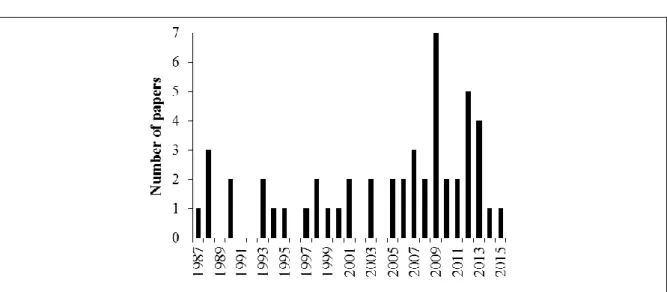
responses/number of papers. Likelihood ratio tests on GLMs. * P <0.05; *** P <0.001.54 Figure 2 Evolution through time of the number of papers published on the effect of
wheat-based intercropping on pests and their natural enemies. ... 54 Figure 3 Ratio of the number of responses reporting a positive effect of wheat-based
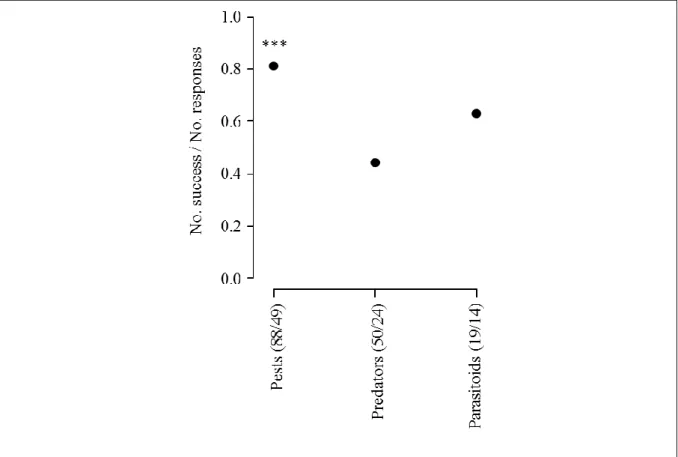
intercropping on biological control (i.e. decrease in pest and increase in natural enemy populations) on the total number of responses. The ratio given in brackets corresponds to the number of responses/number of papers. Exact Bernouilli test. *** P <0.001. ... 55 Figure 4 Mean (± SE) number of responses reporting a positive effect of wheat-based
intercropping on biological control (i.e. decrease in pest and increase in natural enemy populations) on the total number of responses according to the type of wheat-based intercropping. The ratio given in brackets corresponds to the number of
responses/number of papers. Likelihood ratio tests on GLMs. * P <0.05; *** P <0.001.55 Figure 5 Mean (±SE) number of responses reporting a positive effect of wheat-based
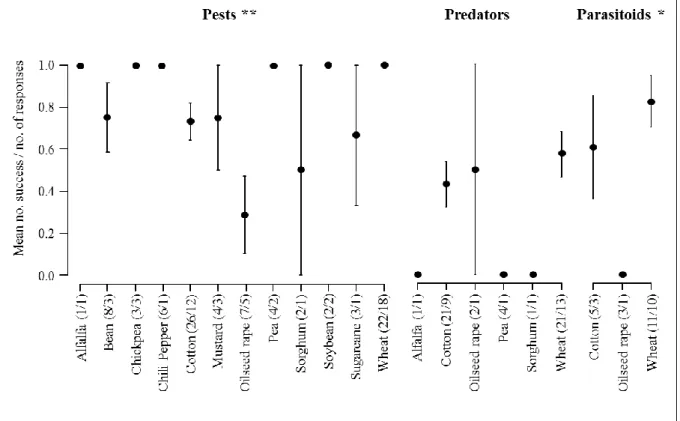
intercropping on biological control (i.e. decrease in pest and increase in natural enemy populations) on the total number of responses according to the crop species that was studied. The ratio given in brackets corresponds to the number of responses/number of papers. Likelihood ratio tests on GLMs. * P <0.05; ** P <0.01. ... 56 Figure 6 Design of boxes for wheat monoculture and wheat-broad bean intercropping (source
line: Ⅰ, receptor lines: Ⅱ, Ⅲ, Ⅳ). Aphids and ladybeetles were introduced in the
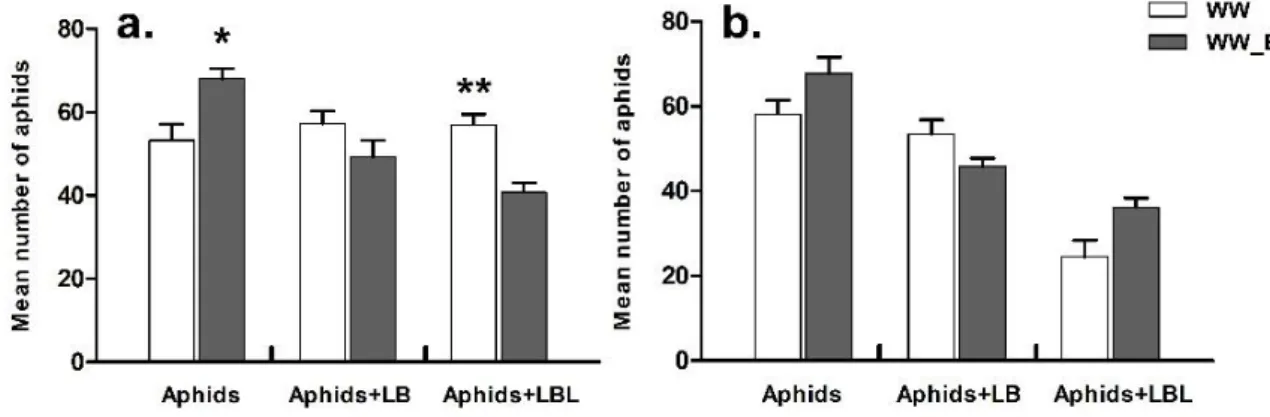
middle of the source line. ... 73 Figure 7 Mean number of aphids (± SE) on all lines (source and receptor lines) found (a) two
hours and (b) 24 hours after the experiment started (LB: ladybeetle adults, LBL:
ladybeetle larvae). (Independent-test, * P<0.05, ** P<0.01). ... 73 Figure 8 Mean number of aphids (± SE) on the source line found (a) two hours and (b) 24
hours after the experiment started (LB: ladybeetle adults, LBL: ladybeetle larvae).
Figure 9 Mean number of aphids (± SE) on the receptor lines found (a) two hours and (b) 24 hours after the experiment started (LB: ladybeetle adults, LBL: ladybeetle larvae).
(Independent-test, * P<0.05, ** P<0.01, *** P<0.001) ... 74 Figure 10 Experimental design (a: wheat–pea intercropping (control), b: wheat–pea
intercropping with EBF release using oil (WP_EBF oil), c: wheat–pea intercropping with EBF release using alginate bead (WP_EBF bead), d: wheat–pea intercropping with MeSA release (WP_MeSA)) ... 95 Figure 11 Mean abundance (and standard error) of a) pea aphids, b) hoverfly larvae and
pupae, c) mummified aphids, and d) parasitism rate, on pea plants in each treatment (control, WP_EBF bead, WP_EBF oil, WP_MeSA) in 2015 and 2016. Letters indicate significant differences based on post-hoc tests of Tukey performed on GLMMs (p < 0.05) ... 96 Figure 12 Mean abundance (and standard error) of a) wheat aphids, b) hoverfly larvae and
pupae, c) mummified aphids, and d) parasitism rate, on wheat tillers in each treatment (control, WP_EBF bead, WP_EBF oil, WP_MeSA) in 2015 and 2016. Letters indicate significant differences based on post-hoc tests of Tukey performed on GLMMs (p < 0.05) ... 96 Figure 13 Mean abundance (and standard error) of a) pea winged aphids, b) wheat winged
aphids, c) ladybeetle adults, d) hoverfly adults, and e) lacewing adults, in yellow pan traps in each treatment (control, WP_EBF bead, WP_EBF oil, WP_MeSA) in 2015 and 2016. Letters indicate significant differences based on post-hoc tests of Tukey performed on GLMMs (p < 0.05) ... 97 Figure 14 Experimental design (wheat-pea intercropping (control), wheat-pea intercropping
with EBF release using oil (EBF), wheat-pea intercropping with MeSA release (MeSA)) ... 111 Figure 15 Mean numbers (and standard error) of aphids and mummies on the pea and wheat
per 40 plants/tillers. a) S.avenae on the wheat, b) R. padi on the wheat, c) Aphis on the pea, d) Mummies on the wheat. ... 112 Figure 16 Mean numbers (and standard error) of natural enemies recorded in different
treatments throughout 2016 growing season. a) Ladybeetles, b) Lacewings, c)
List of tables
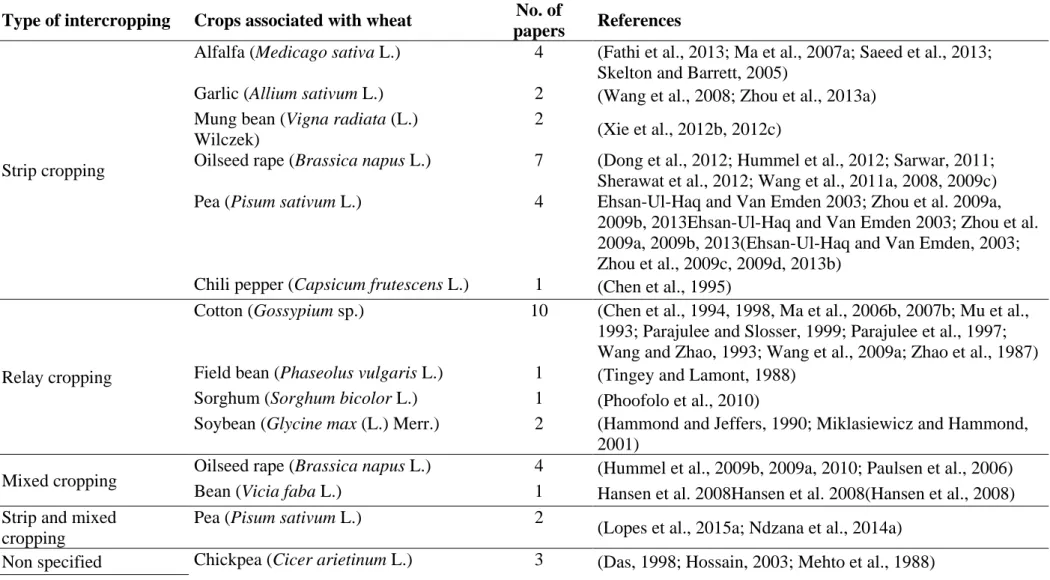
Table 1. Plant species associated to wheat based on the type of intercropping ... 50 Table 2. Effect of wheat-based intercropping on pests and natural enemies according to the
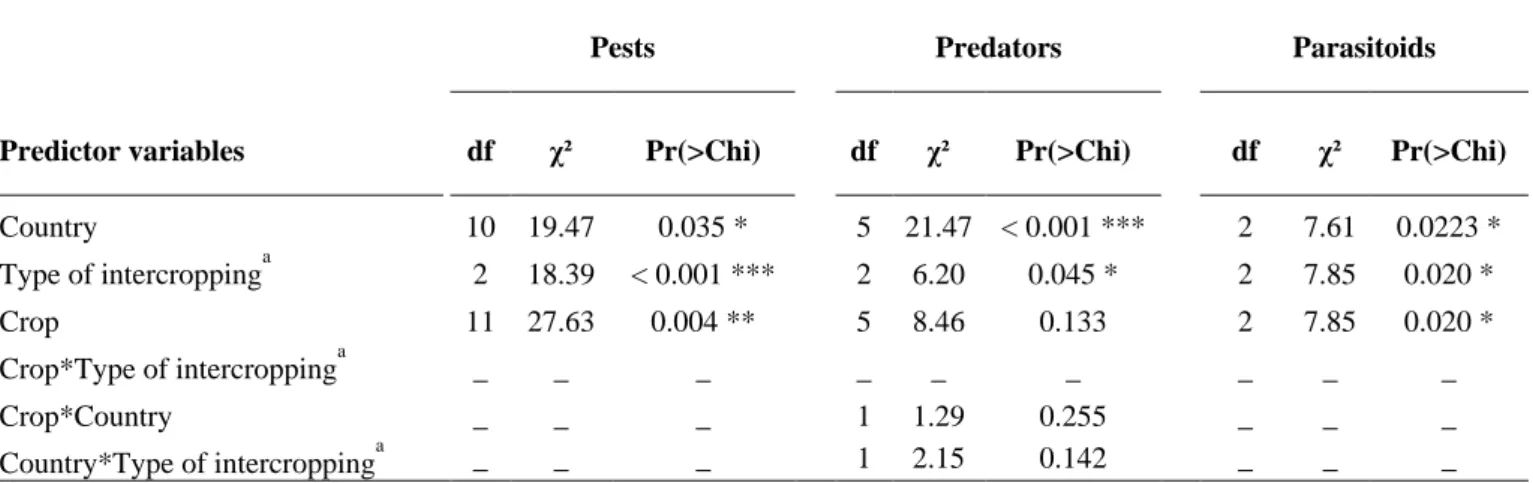
countries where the studies took place, the type of intercropping and the crop of primary interest. Likelihood-ratio tests on GLMs; *P < 0.05; **P < 0.01; ***P < 0.001.
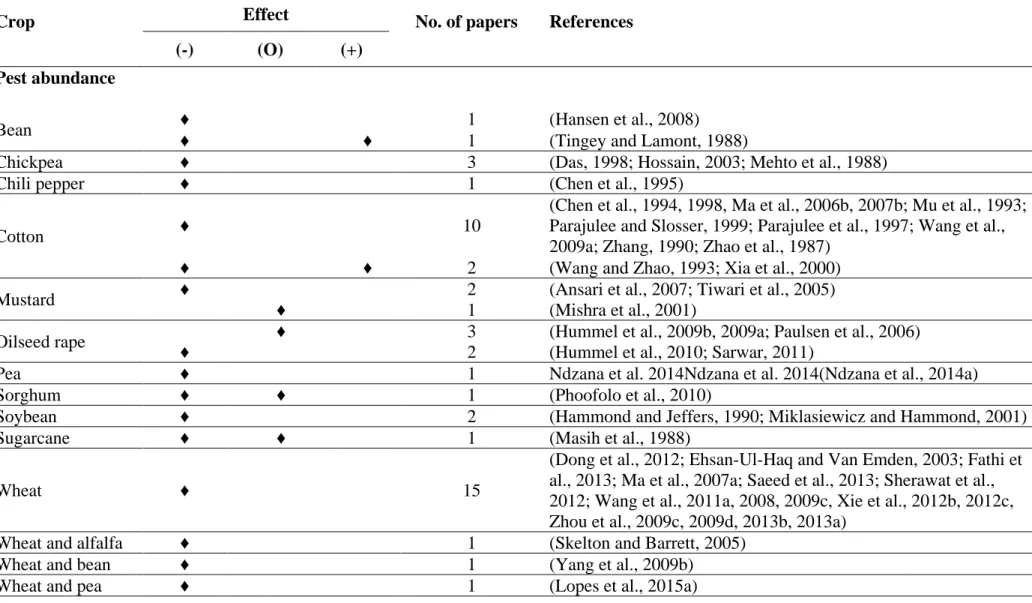
‘-‘ indicates that it was not possible to perform the analysis. ... 51 Table 3 Effect on pests, predators and parasitoids according to the plant species that was
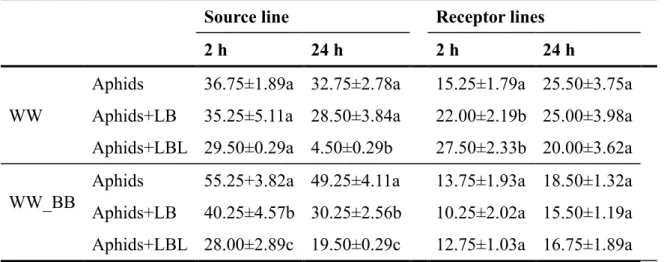
studied in the intercropping ... 52 Table 4 Mean number of aphids (± SE) on plants (source line and receptor lines) found 2h and 24h after the aphid dispersal experiment started (LB: ladybeetle adults, LBL: ladybeetle larvae). Letters indicate significant differences based on post-hoc tests of Duncan
performed on GLM (p<0.05). ... 74 Table 5 Monthly means of meteorological data from Gembloux, Belgium, during the
experimental periods in 2015 and 2016. Temperature was measured using a data logger (EASYLOG USB-2) placed in the experimental field. Rainfall data were taken from a meteorological station set near the experimental farm (Bordia, Gembloux, 50°56’N, 4°71’E) ... 92 Table 6 Diversity and abundance of aphids and their trapped natural enemies ... 92 Table 7 Effect of treatments (control, WP_EBF bead, WP_EBF oil, and WP_MeSA), years
(2015, 2016), and their interaction on the abundance of aphids, mummified aphids, hoverflies (larvae and pupae) and parasitism rate. Degrees of freedom (df), χ2-values, and p-values from likelihood-ratio tests performed on the GLMMs are given, F-values, and p-values from analyses of variance are given. * p < 0.05, ** p < 0.01, *** P < 0.001 ... 92 Table 8 Effect of treatments (control, WP_EBF bead, WP_EBF oil, WP_MeSA) and years
(2015, 2016) on the abundance of winged aphids and related beneficials collected in yellow pan traps. Degrees of freedom (df), χ2-values, and p-values from likelihood-ratio tests performed on the GLMMs are given, * p < 0.05, ** p < 0.01, *** P < 0.001 ... 93 Table 9 Linear regressions between the abundances of aphids, predators (adults and larvae)
and mummies without distinguishing treatments, * p < 0.05, ** p < 0.01, *** P < 0.001 ... 94 Table 10 Diversity of aphids and their trapped natural enemies ... 113
Table 11 Mean number (and standard error) of aphids on the pea and wheat recorded in different treatments throughout 2016 growing season. (Letters indicate significant
differences based on Duncan multiple range test on SAS 9.4 (p < 0.05)) ... 114 Table 12 Mean numbers (and standard error) of natural enemies in the traps in different
treatments throughout 2016 growing season. (Letters indicate significant differences based on Duncan multiple range test on SAS 9.4 (p < 0.05)) ... 114
Wheat (Triticum aestivum L.) is important crops for the people of the world as well as Belgium and China. Aphids are among the most abundant and destructive insect pests of agriculture, particularly in temperate regions, their feeding can directly and indirectly damage the crop and influence yield, and they can vector virus (Rossing, 1991). Among aphid species, Metopolophum dirhodum (Walker), Sitobion avenae (Fabricius) and Rhopalosiphum padi (Linnaeus) attack a range of small grains (Black and Eastop, 2000), causing economic damage and necessitating routine insecticide use.
Pesticides have been widely applied to protect agricultural crops since the 1940s, and since then, their use has increased steadily. As more attention has been paid to sustainable agricultural production that reduce reliance on the pesticide use and associated economic, environmental, and health costs, more studies on integrated pest management focus on ecological function of volatiles released by plants and intercropping with leguminous crop on herbivores and their natural enemies in agroecosystems. Indeed, pesticides were largely reported to induce human diseases and to be harmful for the environment (Witzgall, 2001).
To reduce reliance on this pesticide use and associated economic, environmental, and healthy costs, we tried to promote the application of infochemicals and intercropping as efficient biological control agents by developing alternative strategies for aphid biological control in wheat field. Several methods can be considered to limit aphid populations on cereals, such as semiochemicals (Verheggen et al., 2008), intercropping (Lopes et al., 2015) as efficient biological control agents by developing alternative strategies for aphid biological control in wheat field.
Crop intercropping or mixing as a traditional agricultural technique for preventing crop yield decrease from plant disease and pests infestation in different world geographical areas. Intercropping, defined as a kind of multiple cropping system with two or more crops grown simultaneously in alternate rows in the same area. It was the agronomic practice for the development of sustainable food production systems (Agegnehu et al., 2006; Eskandari & Ghanbari, 2010), plays an important role in controlling pests and protecting beneficial insects relevant to enhancing biodiversity in an agroecosystem. Intercropping of cereals has a 1000-year old tradition in China and it is still widespread in modern Chinese agriculture.
The use of predatory insects, including coccinellids and chrysopids, as biological control agents to suppress pest populations on crops is widely accepted and recognized by the general public. Volatiles produced by hosts and plants, especially herbivore-induced plant volatiles (HIPVs), play an important role in the foraging behavior of parasitoids and may influence their search for hosts (Price et al. 1980). Semiochemicals that recruit predators and parasitoids (parasites
that kill their hosts), or in other ways manage beneficial organisms, can be released by crop or companion plants, thereby providing new approaches to exploiting biological control of pests (Pickett et al., 2014). Some insect species, when attacked by natural enemies, release alarm pheromones, causing avoidance or dispersal behavior in conspecifics (Teerling et al., 1993, Macdonald ert al., 2002). The alarm pheromone for many pest aphids is (E)-β-farnesene . It can be applied to the main crop to repel aphids in the field (Zhou et al., 2016).
Recently it has been observed that use of intercropping and semiochemical, may hold potential to manipulate an agroecosystem in a push-pull or stimulodeterrent diversionary strategy. Push-pull strategies involve the behavioral manipulation of insect pests and their natural enemies via the integration of stimuli that act to make the protected resource unattractive or unsuitable to the pests (push) while luring them toward an attractive source (pull) from where the pests are subsequently removed.
The principles of the push-pull strategyare to maximize control efficacy, efficiency, sustainability, and output, while minimizing negative environmental effects. Each individual component of the strategy is usually not as effective as a broad-spectrum insecticide at reducing pest numbers. Intercropping is one way to increase plant diversity to control aphids (Poggio 2005). In addition to intercropping, semiochemicals are particularly interesting in push-pull strategies (Miller & Cowles, 1990). A large guild of parasitoids and predators in agro-ecosystems are increasingly recognized as important sources of biocontrol for invasive agricultural aphids. Whereas intercropping alone may not enhance pest natural enemies, the use of semiochemicals in monocultures may not be consistently successful and may even negatively influence natural enemies in low pest density situations (Wang et al., 2011). Combining semiochemicals with intercropping may bridge these problems. In the context of aphid natural enemy attraction, wheat-pea strip intercropping combined with the release of E-β-farnesene or methyl salicylate was tested as a push-pull strategy to simultaneously repell aphids and attract beneficials.
References
Agegnehu G, Ghizaw A & Sinebo W (2006) Yield performance and land-use efficiency of barley and faba bean mixed cropping in Ethiopian highlands. European Journal of Agronomy 25: 202-207
Blackman RL, Eastop VF (2000) Aphids on the World’s Crops: An identification and information guide (2ed). Wiley, Chichester, p 476
Eskandari H & Ghanbari A (2010) Effect of different planting pattern of wheat (Triticum aestivum) and bean (Vicia faba) on grain yield, dry matter production and weed Biomass. Notulae Scientia Biologicae 2: 111-115
Jeremy M, Mark K, Geogre E (2012) Combined effects of host-plant resistance and intraguild predation on the soybean aphid parasitoid Binodoxys communis in the field. Biological control 60:16-25
Lopes L, Bodson B, Francis F (2015) Associations of Wheat with Pea Can Reduce Aphid Infestations. Neotrop Entomol 44:286-293
Qi L, QG L, Jennifer SB (2006) Mi-1-Mediated Aphid Resistance Involves Salicylic Acid and Mitogen-Activated Protein Kinase Signaling Cascades. MPMI 19:655-664
Macdonald KM, Hamilton JGC, Jacobson R, Kirk WDJ. 2002. Effects of alarm pheromone on landing and take-off by adult western flower thrips. Entomol. Exp. Appl. 103:279-82 Miller JR, Cowles RS (1990) Stimulo-deterrent diversion: a concept and its possible application
to onion maggot control. Journal of Chemical Ecology 16:3197-3212
Nürnberger T, Nennstiel D, Jabs T, Sacks WR, Hahlbrock K, Scheel D (1994) High affinity binding of a fungal oligopeptide elicitor to parsley plasma membranes triggers multiple defense responses. Cell 78:449-460
Karban, R. & J. R. Carey, 1984. Induced resistance of cotton seedlings to mites. Science 225: 53-54
Karban, R. & I. T. Baldwin (1997) Induced Responses to Herbivory. The University of Chicago Press, Chicago
Opinion in Biotechnology 2014, 26:125-132
Poggio SL (2005) Structure of weed communities occurring in monoculture and intercropping of field pea and barley. Agric Ecosyst Environ 109:48-58
Price PW, Bouton CE, Gross P, McPheron BA, Thompson JN, Weis AE (1980) Interactions among three trophic levels: Influence of plants on interactions between insect herbivores and natural enemies. Annu Rev Ecol Syst 11:41-65
Rossing WAH (1991) Simulation of damage in winter wheat caused by the grain aphid Sitobion avenae. 3. Calculation of damage at various attainable yield levels. Netherlands Journal of Plant Pathology 97: 87-100
Teerling CR, Pierce HD, Borden JH, Gillespie DR. 1993. Identification and bioactivity of alarm pheromone in the western flower thrips, Frankliniella occidentalis. J. Chem. Ecol. 19:681-97
Wang G, Cui LL, Dong J et al (2011) Combining intercropping with semiochemical releases: optimization of alternative control of Sitobion avenae in wheat crops in China. Entomol Exp Appl 140:189-195
Witzgall P. (2001). Pheromones-future techniques for insect control? Pheromones for Insect Control in Orchards and Vineyards IOBC wprs Bulletin 24: 114-122
Wool, D. & D. E. Hales, 1996. Previous infestation affects recolonization of cotton by Aphis gossypii: Induced resistance or plant damage? Phytoparasitica 24:39-48
Verheggen F.J., Arnaud L., Bartram S., Gohy M., Haubruge E. (2008). Aphid and plant volatiles induce oviposition in an aphidophagous Hoverfly. J Chem Ecol 34:301-307
Zhang W, Yang X, Qiu D et al (2011) PeaT1-induced systemic acquired resistance in tobacco follows salicylic acid-dependent pathway. Molecular Biology Reports 38:2549-2556 Zhou, H., Chen, L., Liu, Y., Chen, J., and Francis, F. (2016). Use of slow-release plant
infochemicals to control aphids: a first investigation in a Belgian wheat field. Sci. Rep. 6:1-8
Chapter II Wheat (Triticum aestivum L.)-based
Wheat (Triticum aestivum L.)-based intercropping systems for biological
pest control
Thomas Lopes1, Séverin Hatt1,2,3, Qingxuan Xu1,3, Julian Chen3, Yong Liu4, Frédéric Francis1 1 Functional and Evolutionary Entomology, Gembloux Agro-Bio Tech, University of Liège. Passage des Déportés 2, 5030 Gembloux, Belgium.
2 TERRA-AgricultureIsLife, Gembloux Agro-Bio Tech, University of Liège. Passage des Déportés 2, 5030 Gembloux, Belgium.
3 State Key Laboratory for Biology of Plant Diseases and Insect Pests, Institute of Plant Protection, Chinese Academy of Agricultural Sciences, West Yuanmingyuan Road 2, Beijing 100193, P.R. China.
4 College of Plant Protection, Shandong Agricultural University, 61 Daizong Road, Taian, Shandong 271018, P.R. China.
Acknowledgements: The authors thank Bernard Pochet and Jacques Mignon for their useful advice regarding the search query, the Belgian National Fund for Scientific Research (FNRS) for providing a FRIA (Fund for Research in Industry and Agronomy) PhD fellowship to Thomas Lopes, the CARE AgricultureIsLife of the University of Liege for providing a PhD fellowship to Séverin Hatt, the cooperation project between Belgium and China from MOST (2014DF32270), and the Open fund of SKLBPI for supporting Qingxuan Xu.
Abstract
Wheat (Triticum aestivum L.) is one of the most cultivated crops in temperate climates. As its pests are mainly controlled with insecticides which are harmful to the environment and human health, alternative practices such as intercropping have been studied for their potential to promote biological control. Based on the published literature, this study aimed to review the effect of wheat-based intercropping systems on insect pests and their natural enemies.
Fifty original research papers were obtained from a systematic search of the peer-reviewed literature. Results from a vote-counting analysis indicated that, in the majority of studies, pest abundance was significantly reduced in intercropping systems compared with pure stands. However, the occurrence of their natural enemies as well as predation and parasitism rates were not significantly increased. The country where the studies took place, the type of intercropping, and the crop that was studied in the association had significant effects on these results.
These findings show that intercropping is a viable practice to decrease insecticide use in wheat production systems. Nevertheless, other practices could be combined with intercropping to favour natural enemies and enhance pest control.
Key words: sustainable agriculture, crop diversity, conservation biological control, predators, parasitoids, yield
1. Introduction
Wheat (Triticum aestivum L.) is one of the most important crops worldwide (ranked fifth in terms of production according to FAOSTAT (http://faostat3.fao.org/browse/Q/QC/E)). Therefore, finding alternative methods to improve its sustainable production is a major challenge for today’s agriculture. Conventional farming practices contributed to increase yields during the 20th century, but are today contested for their negative impact on the environment (Gibbons et al., 2015; Krebs et al., 1999) and human health (Baldi et al., 2013). Industrialized monoculture systems, which are highly dependent on the use of external inputs such as agrochemicals (i.e. synthetized fertilizers, chemical pesticides, growth regulators), favoured the simplification of agroecosystems (Kremen et al., 2012; Malézieux, 2012).
In contrast, promoting functional biodiversity, which supports ecological processes, may allow agricultural systems to benefit from various ecosystem services, including nutrient cycling, soil structuration and pest control (Altieri and Rosset, 1996; Zhang et al., 2007b). One of the ‘agrobiodiversity strategies’ to improve the sustainability of wheat production (reviewed by Costanzo and Bàrberi 2014) is to increase plant species diversity at the field scale though intercropping designs (Hauggaard-Nielsen et al., 2001; Malézieux et al., 2009a; Poggio, 2005a). Intercropping is defined as the cultivation of at least two plant species simultaneously in the same field (Andrews and Kassam, 1976; Anil et al., 1998; Ofori and Stern, 1987), but which are not necessarily sown and/or harvested at the same time (Lithourgidis et al., 2011b). Andrews and Kassam (1976) categorised intercropping into four principle types based on the spatial and temporal overlap of plant species: (1) mixed intercropping - two or more crops mixed with no distinct row arrangement; (2) row intercropping - two or more crops grown in separate alternate rows (when plant species are alternated within the same row it is considered as within-row intercropping); (3) strip intercropping - several rows of a crop (strip) alternated with several rows of one or more other crops; (4) relay intercropping - two or more cropsgrown in relay, but with the growth cycles overlapping to some degree. Choosing a type of intercropping may depend on the associated crops and their valuation after harvest, in addition to the knowledge of the famer and the level of mechanisation used.
Intercropping systems tend to produce higher yields compared to monocultures and reduce the impact of agriculture on the environment. Specifically, intercropping may improve soil conservation, fertility and crop quality, while possibly reducing the incidence of weeds, disease and insect pests (Aziz et al., 2015; Bedoussac et al., 2015a; Lithourgidis et al., 2011b). Focusing on pests, as stated in the ‘resource concentration hypothesis’ from Root (1973) specialist
herbivores are more likely to find their host plants when they are concentrated in dense or pure stands. Moreover, according to the ‘enemy hypothesis’ from Root (1973) the suppression of herbivores by their natural enemies (i.e. predators and parasitoids) is expected to be more efficient in diversified crop habitats compared to simplified ones, as they may be more abundant in environments offering a greater diversity of prey/host species and microhabitats to exploit. Although the effect of intercropping on pests and natural enemies have been largely covered in the literature (Andow, 1991; Dassou and Tixier, 2016; Langellotto and Denno, 2004; Letourneau et al., 2011b; Risch, 1983; Tonhasca and Byrne, 1994), most comprehensive reviews are very generalists. As wheat is one of the most important crops worldwide, understanding the potential of wheat-based intercropping systems for biological control may be of crucial importance. More specifically, this study aimed at answering the following questions: (i) Are pests reduced and natural enemies favoured in wheat-based intercropping systems compared to pure stands? (ii) Is there a correlation between biological control and yield in wheat-based intercropping systems? (iii) Where and when were these systems studied? (iv) What are the technical characteristics of wheat-based intercropping systems (i.e. types of intercropping and plant species associated with wheat)? Overall, this study is expected to give valuable information about the potential of intercropping as a tool to reduce insecticide use in wheat production.
2. Experimental methods
2.1 A systematic research of the literature
To locate scientific literature related to the effect of wheat-based intercropping on pests and/or natural enemies, all terms potentially related to intercropping, wheat, pests and natural enemies were listed. These terms were then included in a single query, as follows: (intercrop* OR "crop association" OR "crop combination" OR "combined crop" OR "associated crop" OR "crop mix" OR "mixed crop" OR "mixed cropping" OR “row cropping” OR “relay cropping” OR “strip cropping”) AND (wheat OR "triticum aestivum") AND (pest* OR herbivor* OR "natural enemy" OR predator* OR parasit*). The composed terms were put between quotation marks so that the entire term was considered. For some of them, an asterisk was used to include all words that have a common core. The first step of this research was completed on 26 June 2015 by introducing the query in the search engine from the University of Liège (ULg - Belgium) e-bouquet. The search engine includes several e-journals and databases such as Scopus (Elsevier), AGRIS, CAB Abstracts and ProQuest (for the list of all databases included, see Annex 1).
Thereafter, the search query was adapted to each database, as some of them use a specific query language.
The obtained references were then selected based on the abstracts of the published papers. The abstracts had to meet four criteria to be retained for further analysis. First, they had to be research papers from peer-reviewed journals. Review and meta-analysis papers were not considered, as they are based on other studies. Second, the abstracts had to focus on intercropping. As stated in the Introduction, intercropping was defined as the cultivation of at least two plant species simultaneously in the same field, without necessarily being sown and/or harvested at the same time. Wheat had to be included in the intercropping and associated plant species had to be harvestable and consumable (human consumption, animal feeding, energy production and fibres). Ornamental, grassy or woody species were excluded. Third, insect pests and/or natural enemies (i.e. predators and parasitoids) had to be assessed by the studies and the effect of biological control had to be specified through direct (e.g. predation or parasitism rate) or indirect (e.g. abundance) indicators. Finally, the intercropping had to be compared to a pure stand control treatment. When the abstract was not available, the paper was excluded from the review. When the information contained in the abstract was not sufficiently precise to respond to criteria, the full paper was analysed. The paper was excluded from analyses if it was not obtainable.
Selected papers were then analysed in greater depth to determine the country where the study took place, the plant species associated with wheat, the type of intercropping and the effect of intercropping on yield, insect pests and/or natural enemies. Concerning insects, the effect was considered to be negative, positive or neutral when their populations declined, increased or no significant difference was detected, respectively between treatments. Furthermore, an increase in the predation or parasitism rate was considered to be a positive effect on natural enemies. In fact, both indicators allow determining the top-down impact of predators or parasitoids on their herbivorous prey or hosts. Therefore, we considered that higher predation or parasitism rates mean higher pressure on pests, which is positive for biological control. In the event that a single paper showed positive, negative and neutral effects on different insect populations, crops and intercropping designs (i.e. strip, relay, mixed), all instances were considered, hereafter termed ‘responses’.
2.2 Vote-counting method
The analysis of the selected papers was performed following the vote-counting method, which considers the number of tests supporting a theoretical relationship (i.e. in our case, if pests are reduced and natural enemies favoured in intercropping systems, compared with pure stands).
Despite a wide use of this method for analysing results of numerous different studies (Connell, 1983; Denno et al., 1995; Garratt et al., 2011; Haaland et al., 2011; Root et al., 2003), vote-counting has been criticized and meta-analysis promoted (Letourneau et al., 2011b; Tonhasca and Byrne, 1994). Indeed, vote-counting presents some limits that were reviewed by Combs et al. (2011) However, vote-counting allows the analysis of a large amount of papers for which the precise data are not always available. It is the case for several papers retrieved from the literature search, which still provide valuable findings that are worth to be considered.
2.3 Statistical analyses
In order to perform statistical analyses, a score was given to each response. The score ‘1’ was given when a positive effect on biological control was recorded (i.e. lower abundance of pests, higher abundance of predators or parasitoids, higher parasitism or predation rates, higher yield). The score ‘0’ was given when no effect or a negative effect was recorded. The Exact Bernouilli test (P < 0.05) was used to assess whether the frequency of responses where intercropping had a positive effect on biological control compared to pure stands differed from that expected by chance. Generalized linear models (GLMs) with binomial error (logit-link function) were fitted to assess whether (i) the country where the study took place, (ii) the type of intercropping, and (iii) the crop species that was studied had effects on the responses. These variables as well as every possible interaction were tested using a likelihood-ratio test (P < 0.05). Finally, the Pearson correlation between the effect of intercropping on pests, natural enemies and yield was tested (P < 0.05). The analyses were performed using R software (R Core Team, 2013a).
3. Results
3.1 Countries and evolution through time
Out of 445 papers that were examined, 50 papers met the stated criteria. Thirty-nine of these papers were found using the search engine of the ULg. Eleven additional papers meeting the criteria were found by adapting the query to each database.
Four regions of the world are represented by the 50 studies. Twenty three were carried in China, 12 in Central and Southern Asia (i.e. India, Pakistan, Bangladesh and Iran), and 11 in North America (i.e. United States of America, Canada). Four papers refer to experiments carried in Western Europe (i.e. France, Denmark, Belgium and Germany) (Fig. 1). The oldest paper found was published in 1987 in China (Fig. 2). Since this year, one to two papers were published every year on average throughout the world. However, the number of publications increased from 2009 with 40 % of them published since this date. The first paper published in Europe was in Germany in 2006.
3.2 Plants associated with wheat and types of intercropping
Thirteen plant species were recorded in association with wheat (Table 1). The main species included cotton (Gossypium sp.), oilseed rape (Brassica napus L.) and pea (Pisum sativum L.). Different kinds of intercropping with wheat were implemented depending on the species used (Table 1). Strip cropping is the most common type, representing almost half of the studies, followed by relay cropping. Relay cropping was used when cotton, field bean (Phaseolus vulgaris L.), sorghum (Sorghum bicolor L.) or soybean (Glycine max L. Merr.) were associated with wheat. Mixed cropping was the least reported type. Pea, oilseed rape and faba bean (Vicia faba L.) were found mixed with wheat in this system.
3.3 Pests and their natural enemies
Forty-nine (98 %), twenty-four (48 %) and fourteen (28 %) papers assessed the effect of intercropping systems, compared to pure stands, on pests, predators and parasitoids respectively. Among them, twelve (24 %) considered both predators and parasitoids. Wheat-based intercropping systems significantly decreased pest populations compared to pure stands (P < 0.001), while no significant effects were observed for predators (P = 0.480) and parasitoids (P = 0.359) (Fig. 3).
Responses from pests and natural enemies varied significantly between countries where studies took place (Table 2). All responses obtained for pests in Bangladesh, Belgium, Denmark, France and Iran reported a decrease of their populations, while the opposite was observed in the only study that was carried in Germany. Variable responses were obtained in other countries, especially in the three Canadian studies (Fig. 1). As for natural enemies, the study that was carried in Iran was the only that reported an increase of predator populations or predation rate, while the opposite was observed in Belgium. As for pests, variable responses were observed in other countries. Similar results were obtained for parasitoids. The study from Pakistan was the only one reporting an increase of parasitoids abundance or parasitism rate, while a decrease was obtained in the single study from Canada.
Both pests and natural enemy responses were significantly affected by the type of intercropping (Table 2). Pest populations were always reduced in strip cropping, which also favoured predators and parasitoids more often than relay and mixed cropping. The latter reduced pests in half of the cases and never induced an increase of natural enemy populations, as well as predation and parasitism rates (Fig. 4). Finally, such variability of responses was also observed for pests and parasitoids, but not for predators, when considering the crop species that was studied in the wheat-based intercropping system (Table 2; see Table 3 for details and associated references). Pests were reduced on the majority of crops, but rarely on oilseed rape (Fig. 5).
Variable responses were obtained for other crops, especially sorghum, sugarcane (Saccharum officinarum L.) and mustard (Sinapis albla L.). Predators were not favoured on alfalfa (Medicago sativa L.), pea and sorghum, and a beneficial effect was recorded on cotton and wheat in only half of the cases (Fig. 5). The only study where oilseed rape was considered reported two opposite effects. As for parasitoids, all responses obtained with oilseed rape corresponded to a decrease of populations or parasitism rates, while more than a half of them were beneficial for biological control on cotton and wheat (Fig. 5).
3.4 Crop yield
The effect of intercropping on yield was assessed in only 10 of the 50 papers. Six papers reported significant higher yield in intercropping systems compared to pure stands, while a single one showed the opposite. Two of them reported no significant differences. Additionally, one paper reported significant higher yield in intercropping compared to pure stand in the first year and no significant differences in the following one. No significant correlation was found between pest reduction and yield increase (φ = 0.45, P = 0.145). However, higher yield was positively correlated with an increase of predator populations and predation rate (φ = 0.77, P = 0.024). This positive correlation was even stronger when predator and parasitoid data were analysed together (φ = 0.81, P = 0.002). However, not enough data were available to test such a correlation for parasitoids alone.
4. Discussion
4.1 Effect on pest biological control and implication for yield 4.1.1 Insect pests and natural enemies
Wheat-based intercropping systems almost systematically have a positive effect on pest control. In fact, the number of responses reporting a decrease of their populations was significantly higher than those showing the opposite. This finding is consistent with most studies addressing the effect of plant diversity on herbivores (Andow, 1991; Letourneau et al., 2011b). Most of the mechanisms explaining how plant diversity promotes pest regulation, called associational resistance (Tahvanainen and Root, 1972), were compiled by Poveda et al.(2008) and Barbosa et al. (2009). For example, pest ability to locate host plant odours may be disrupted when they are masked by volatiles from non-host plants (Tahvanainen and Root, 1972). Moreover, host plant odours may be altered when exposed to volatiles from neighbouring insect-infested (Ton et al., 2007) and non-infested (Ninkovic et al., 2013) plants, but also after absorbing certain root exudates from adjacent non-host plants (Finch and Collier, 2000). In some cases, competition between associated plants may alter the quality of host plants, which become less attractive for
pests (Theunissen, 1994). Pests may also be more attracted to associated non-host plant species and remain on these plants without infesting the main crop (Vandermeer, 1989). Alternatively, certain plants have repellent odours (Uvah and Coaker, 1984). Other mechanisms may also affect the visual location of host plants, such as greener and/or taller non-host plants, which may camouflage the host plant (Finch and Collier, 2000) or even lead to its physical obstruction (Perrin and Phillips, 1978).
Furthermore, natural enemies may exercise a top-down control on pests. However, the number of responses reporting a beneficial effect of intercropping on predators and parasitoids was not significantly higher than the one reporting the opposite. This result is not consistent with the ‘enemy hypothesis’ of Root. Several explanations have been put forward by the authors of the analysed papers to explain that. For instance, according to Hummel et al.(2012) who found that canola-wheat intercropping did not increase ground beetle (Coleoptera: Carabidae) populations compared to pure stands, intercropping may have altered microhabitat conditions (i.e. soil moisture, temperature and light penetration through the canopy), making the environment less suitable for some species. The same authors also found that the parasitism rates of the root maggot Delia radicum (L.) puparia decreased with increasing proportions of wheat in a canola-wheat intercropping system. Since Delia spp. caused less damage in intercropping systems compared to pure stands, it was hypothesised that the amount of volatiles emitted by infested canola plants, which attract the adult parasitoid Aleochara bilineata Gyll., were limited by intercropping. A similar hypothesis was proposed by Lopes et al. (2015) to explain why adult ladybeetles and hoverflies were significantly more attracted by pure stands of pea and wheat, respectively, which were significantly more infested by aphids compared to mixed and strip cropping systems. Moreover, some practical aspects may explain that natural enemies were rarely favoured in intercropping systems. In relay-intercropping for instance, whereas this system may allow natural enemies to maintain though time, a lack of temporal overlap between the several crops may cause a dissipation of the natural enemies (Parajulee and Slosser, 1999). Also, the use of insecticides in experiments could have negatively affected natural enemies resulting in no differences between treatments (Chen et al., 1994). Landis et al. (2000) reported that plant diversity should benefit natural enemies partly because it may provide pollen and nectar that are alternative non-host food sources. However, a particular attention must be paid on the crop phenological and physiological characteristics that may affect natural enemies. Despite several flowering crops may produce such food sources (e.g. oilseed rape, alfalfa or faba bean with extra floral nectar), the flower architecture must be adapted to insect mouth parts (Campbell et al., 2012) and the resources must be available when they are needed (Colley and
Luna, 2000). These aspects may explain why simply associating crops do not necessarily favour natural enemies.
4.1.2 Crop yield
There was no significant correlation between pest reduction and yield increase. This result is consistent with Letourneau et al. (2011) who also found that beneficial effects of plant diversity on pest reduction are not systematically translated in higher yield. One reason is that the type of intercropping also influences other agronomic aspects, such as plant density and competition for resources. Yield may particularly be affected in substitutive designs like mixed intercropping, as they imply lower crop densities when compared to pure stands, but also higher competition for water, light and nutriments between associated plants (Letourneau et al., 2011b). However, according to Bedoussac et al. (2015), yield of all associated crops considered together is almost systematically higher compared to the one of each crop grown in pure stands. In our study, not enough data were obtained to fully address this question. However, we might hypothesize that minimizing the competition between intercropped plants can be achieved in relay and strip intercropping, which are also the most efficient for controlling pests and favouring natural enemies. The positive correlation between the beneficial effect of intercropping on natural enemies and higher yield may encourage following this direction. Furthermore, as noted by Letourneau et al.(2011), it would be interesting to determine whether eventual yield losses due to intercropping are compensated by environmental benefits and input cost reduction (in our case insecticides) in future studies.
4.2 Adopting intercropping for pest control: constraints and opportunities
4.2.1 A well-established practice in Asia that is beginning to take hold in Europe
Most studies addressing the effect of wheat-based intercropping on pests and/or natural enemies were carried out in China. Despite the fact that intercropping has been practiced in Chinese agriculture for over 1000 years (Knörzer et al., 2009a), there has been a strong decline in the use of this method on the North China Plain over the last 20 years (Feike et al., 2012). In fact, with the decrease of rural labourers and increase in farmer’s income, farmers have invested in mechanisation, adopting intensive production methods. As noted by Feike et al. (2012), one of the ways to overcome this issue is to replace the traditional labour-intensive row intercropping system by strip intercropping, which can be more easily adapted to mechanisation. Therefore, it is not surprising that many studies carried out in China have focused on this type of intercropping.
In contrast, studies remain rare on intercropping as a tool to biologically control pests in Europe. This may be because this practice needs technical adaptations (see section 4.2.2) to be
implemented, which are not compatible with the conventional agriculture model that has been practiced in Europe for the last 30 years (Malézieux, 2012). In fact, for farmers, developing intercropping systems requires new skills and tools (Malézieux et al., 2009a). In addition, these systems must satisfy the ecological, economic and social constraints on their farms (Malézieux, 2012). However, the growing focus on low-input farming practices in academic environments (Doré et al., 2011; Malézieux, 2012; Wezel et al., 2014) and at the political level (De Schutter, 2010; Guillou et al., 2013) may explain the recent development of research on intercropping in Europe.
4.2.2 Adopting intercropping needs technical adaptations
Management and technical issues are central for developing intercropping systems. Indeed, phenological and spatial constraints of crop species must be taken into account to select viable combinations. Competition for resources (i.e. light, water, nutrient) (Thorsted et al., 2006), as well as allelopathic effects (Khan et al., 2002), may limit whether associations work. Appropriate machines are also needed to sow, harvest and separate grains in mixed cropping (Lithourgidis et al., 2011b). However, the management of strip and relay intercropping systems may be facilitated, as two or more crops may be separately managed. Also, the size of the strips and the ratio between the associated crops can be adapted depending on farmer production objectives and agronomic constraints (i.e. in the selected studies, the width of the strips went from few crop rows to at least 5 m. and the ratio between crops was from 1 to 4). This may explain why the majority of studies focus on these two systems. Among the crops associated in relay, the combination of wheat with cotton is widely practiced in China (Zhang et al., 2007a). As well described by Zhang et al. (2008), “the cotton is sown in April, approximately seven weeks before the harvest date of wheat. Strips are left open in the wheat crop at sowing (October/November) to provide space for the cotton plants during their seedling stage (April, May and June). After the wheat harvest in June, cotton plants can exploit the full space, above-ground as well as below-above-ground.” As for mixed intercropping, wheat was only found associated with pea and oilseed rape. Wheat-pea mixtures are known to provide many benefits. For instance, wheat benefits from the symbiotic nitrogen fixation of peas, allowing to reduce fertilizer inputs (Ghaley et al., 2005; Pelzer et al., 2012). Some experiments have been published on the effects of wheat-pea mixtures, but not necessarily on the aspect of pest control (Ghaley et al., 2005; Lithourgidis et al., 2011c; Pelzer et al., 2012). In comparison, studies on the effects of mixing wheat and oilseed rape seemed to be a rarer combination, at least based on the publication record.
4.2.3 Combining crops of primary importance to favour the adoption of intercropping
Intercropping systems involve cultivating two or more crops in the same place at the same time. However, one crop is often seen as more important than the other crops for economic reasons (Lithourgidis et al., 2011b). This issue may explain why intercropping was studied to mitigate pests and favour natural enemies for just one of the associated crops in most studies. Cotton, sugarcane and soybean are well-known important cash crops that are exported worldwide (FAOSTAT (http://faostat.fao.org/site/342/default.aspx)). A particular crop may also be of special economic and cultural importance in some regions, such as chili pepper (Capsicum frutescens L.) in China (Lu et al., 2011) or the oilseed rape variety Canola in Canada (Raymer, 2002).
Wheat is an essential food crop in northern China and central Asia (Carter and Zhong, 1999; Morgounov et al., 2007), as it is in Europe and North America (FAOSTAT (http://faostat3.fao.org/browse/Q/*/E)). However, wheat is rarely considered as the main crop in intercropping systems in Europe and North America. Because conventional farming practices applied to wheat production already tend to achieve high yields, producing wheat under intercropping systems may not be seen as needed for economic and food security reasons. However, it is necessary for agriculture to shift toward more ecological food production in Western countries. Developing intercropping systems that are beneficial for crops of primary importance may favour such a transition.
4.3 Needs for further research
This study shows that wheat-based intercropping systems allow reducing pest occurrence on crops, while natural enemies are not favoured in such systems when compared to pure stands. However these results varied significantly depending on the countries where the study took place, the type of intercropping and the crops studied. In Europe, more research is needed to better assess the potential of wheat-based intercropping for pest control. Despite some limiting factors, mixed intercropping deserves to be further studied, as it may also provide some benefits. Because predators and parasitoids are not significantly favoured in intercropping systems, these latter could be combined with other practices known to efficiently support natural enemies within fields. For instance, some volatiles known to attract natural enemies can be released in fields. Wang et al. (2011) showed that the abundance of ladybeetles and parasitism rate were higher when methyl salicylate was released in wheat-oilseed rape intercropping fields, compared to each treatment applied separately. Moreover, infrastructures such as woodlots, hedgerows and wildflower strips could be settled in farming areas as they are known to provide habitats sustaining natural enemies that prey on and parasitize pests in adjacent fields (Colignon
et al., 2002; Haaland et al., 2011; Morandin et al., 2014). Among other factors, the regulation of pests by natural enemies depends on their presence in the surrounding landscape (Fahrig et al., 2015). The conservation of natural enemies and their attraction in intercropping fields could be a way to improve the biological control of pests.
References
Altieri, M.A., Rosset, P., 1996. Agroecology and the conversion of large‐scale conventional systems to sustainable management. International Journal of Environmental Studies 50, 165– 185. doi:10.1080/00207239608711055
Andow, D.A., 1991. Vegetational diversity and arthropod population response. Annual Review of Entomology 36, 561–586.
Andrews, D.J., Kassam, A.H., 1976. The importance of multiple cropping in increasing world food supplies, in: Papendick, R.I., Sanchez, P.A., Triplett, G.B. (Eds.), Multiple Cropping, ASA Special Publication. Madison, WI, USA, pp. 1–10.
Anil, L., Park, J., Phipps, R.H., Miller, F.A., 1998. Temperate intercropping of cereals for forage. Grass and Forage Science 53, 301–317.
Ansari, N.A., Mishra, V.A., Madhvi, P., Srivastava, G.P., Tewari, J.P., 2007. Role of intercropping on population build-up of Lipaphis pseudobrassicae (L.) on mustard. Flora and Fauna 13, 41–42.
Aziz, M., Mahmood, A., Asif, M., Ali, A., 2015. Wheat-based intercropping: a review. The Journal of Animal & Plant Sciences 25, 896–907.
Baldi, I., Cordier, S., Coumoul, X., Elbaz, A., Gamet-Payrastre, L., Le Bailly, P., Multigner, L., Rahmani, R., Spinosi, J., Van Maele-Fabry, G., 2013. Pesticides: effets sur la santé. INSERM, Institut national de la santé et de la recherche médicale, Paris.
Barbosa, P.A., Hines, J., Kaplan, I., Martinson, H., Szczepaniec, A., Szendrei, Z., 2009. Associational resistance and associational susceptibility: having right or wrong neighbors. Annual Review of Ecology, Evolution, and Systematics 40, 1–20.
Bedoussac, L., Journet, E.-P., Hauggaard-Nielsen, H., Naudin, C., Corre-Hellou, G., Jensen, E.S., Prieur, L., Justes, E., 2015. Ecological principles underlying the increase of productivity achieved by cereal-grain legume intercrops in organic farming. A review. Agronomy for Sustainable Development 35, 911–935.
Campbell, A.J., Biesmeijer, J.C., Varma, V., Wäckers, F.L., 2012. Realising multiple ecosystem services based on the response of three beneficial insect groups to floral traits and trait diversity.
Basic and Applied Ecology 13, 363–370. doi:10.1016/j.baae.2012.04.003
Carter, C.A., Zhong, F., 1999. Rural wheat consumption in China. American Journal of Agricultural Economics 81, 582–592.
Chen, P.-R., Zhang, Z.-Q., Wang, K., Wang, X.-Y., Xu, W.-L., Gao, Z.-L., 1994. Allothrombium pulvinum Ewing (Acari, Trombidiidae), an important early season natural enemy of Aphis gossypii Glover (Hom., Aphididae) in cotton. Journal of Applied Entomology 117, 113–121. doi:10.1111/j.1439-0418.1994.tb00716.x
Chen, Z.J., Wu, G.J., Zhang, M., 1995. Study on the efficacies of wheat-pepper interplantation to evade aphid damage and alleviate virus disease. Acta Phytophylacica Sinica 22, 343–347. Chen, Z.J., Wu, G.J., Zhang, S.L., 1998. Integrated pest management in cotton field of wheat interplanting with cotton. Acta Agricultural Boreali-Occidentalis Sinica 7, 27–31.
Colignon, P., Gaspar, C., Haubruge, E., Francis, F., 2002. Impact of close habitat on the entomological diversity and abundance in carrot open fields. Mededelingen van de Faculteit Landbouwkundige en Toegepaste Biologische Wetenschappen (Rijksuniversiteit te Gent) 67, 481–486.
Colley, M.R., Luna, J.M., 2000. Relative Attractiveness of Potential Beneficial Insectary Plants to Aphidophagous Hoverflies (Diptera: Syrphidae). Environmental Entomology 29, 1054–1059. doi:10.1603/0046-225X-29.5.1054
Combs, J.G., Ketchen, D.J., Crook, T.R., Roth, P.L., 2011. Assessing cumulative evidence within “macro” research: why meta-analysis should be preferred over vote counting. Journal of Management Studies 48, 178–197.
Connell, J.H., 1983. On the prevalence and relative importance of interspecific competition: evidence from field experiments. The American Naturalist 122, 661–696.
Costanzo, A., Bàrberi, P., 2014. Functional agrobiodiversity and agroecosystem services in sustainable wheat production. Agronomy for Sustainable Development 34, 327–348. doi:10.1007/s13593-013-0178-1
Das, S.B., 1998. Impact of intercropping on Helicoverpa armigera (Hub.): incidence and crop yield of chickpea in West Nimar Valley of Madhya Pradesh. Insect Environ 4, 84–85.
Dassou, A.G., Tixier, P., 2016. Response of pest control by generalist predators to local-scale plant diversity: a meta-analysis. Ecology and Evolution 6, 1143–1153.
De Schutter, O., 2010. Agroecology and the right to food (No. A/HRC/16/49). United Nations - Human Right Council, New York.
Denno, R.F., McClure, M.S., Ott, J.R., 1995. Interspecifific interactions in phytophagous insects: competition reexamined and resurrected. Annual Review of Entomology 40, 297–331. Dong, J., Liu, Y.J., Li, P.L., Lin, F.J., Chen, J.L., Liu, Y., 2012. Ecological effects of wheat-oilseed rape intercropping combined with methyl salicylate release on Sitobion avenae and its main natural enemies. Ying yong sheng tai xue bao= The journal of applied ecology 23, 2843– 2848.
Doré, T., Makowski, D., Malézieux, E., Munier-Jolain, N., Tchamitchian, M., Tittonell, P., 2011. Facing up to the paradigm of ecological intensification in agronomy: Revisiting methods, concepts and knowledge. European Journal of Agronomy 34, 197–210. doi:10.1016/j.eja.2011.02.006
Ehsan-Ul-Haq, Van Emden, H.F., 2003. Effects of intercropping wheat and peas on the growth and development of Metopolophium dirhodum and Aphidius rhopalosiphi (A glasshouse simulation). Pakistan Journal of Zoology 35, 271–275.
Fahrig, L., Girard, J., Duro, D., Pasher, J., Smith, A., Javorek, S., King, D., Freemark Lindsay, K., Mitchell, S., Tischendorf, L., 2015. Farmlands with smaller crop fields have higher within-field biodiversity. Agriculture, Ecosystems & Environment 200, 219–234.
Fathi, S.A.A., Nouri-Ganbalani, G., Belali-Mashkour, E., 2013. Evaluation of two wheat cropping systems for enhancing biological control of the wheat thrips, Haplothrips tritici (Thys.: Phlaeothripidae). Journal of Entomological Society of Iran 33, 49–85.
Feike, T., Doluschitz, R., Chen, Q., Graeff-Hönninger, S., Claupein, W., 2012. How to overcome the slow death of intercropping in the north China plain. Sustainability 4, 2550–2565. Finch, S., Collier, R.H., 2000. Host-plant selection by insects - a theory based on “appropriate/inappropriate landings” by pest insects of cruciferous plants. Entomologia Experimentalis et Applicata 96, 91–102.