Accepted Manuscript
Bio- and hydrochars from rice straw and pig manure: Inter-comparison Yuxue Liu, Shuai Yao, Yuying Wang, Haohao Lu, Satinder Kaur Brar, Shengmao Yang
PII: S0960-8524(17)30384-X
DOI: http://dx.doi.org/10.1016/j.biortech.2017.03.103
Reference: BITE 17807
To appear in: Bioresource Technology Received Date: 28 January 2017
Revised Date: 11 March 2017 Accepted Date: 17 March 2017
Please cite this article as: Liu, Y., Yao, S., Wang, Y., Lu, H., Kaur Brar, S., Yang, S., Bio- and hydrochars from rice straw and pig manure: Inter-comparison, Bioresource Technology (2017), doi: http://dx.doi.org/10.1016/ j.biortech.2017.03.103
This is a PDF file of an unedited manuscript that has been accepted for publication. As a service to our customers we are providing this early version of the manuscript. The manuscript will undergo copyediting, typesetting, and review of the resulting proof before it is published in its final form. Please note that during the production process errors may be discovered which could affect the content, and all legal disclaimers that apply to the journal pertain.
Bio- and hydrochars from rice straw and pig manure: Inter-comparison
1
Yuxue Liua,b, Shuai Yaoc, Yuying Wanga,b, Haohao Lua,b, Satinder Kaur Brard, Shengmao Yang a,b,*
2
a
Institute of Environment, Resource, Soil and Fertilizer, Zhejiang Academy of Agricultural Sciences, 198 Shiqiao Road, Hangzhou 310021, 3
China 4
bEngineering Research Center of Biochar of Zhejiang Province, Hangzhou 310021, China
5
cCollege of Environment, Zhejiang University of Technology, Hangzhou 310014, China
6
d
INRS-ETE, Université du Québec, 490, Rue de la Couronne, Québec G1K 9A9, Canada 7
8
*Corresponding author. E-mail: [email protected]; tel.: +86 571 8641 9218; fax: +86 571 8641 9218.
9
Abstract: Conversion of rice straw (RS) and pig manure (PM) into chars is a promising disposal/recycling option. Herein, pyrolysis and
11
hydrothermal carbonization were used to produce bio- and hydrochars from RS and PM, affording lower biochar (300–700 °C) and hydrochar
12
(180–300 °C) yields at higher temperatures within the specified range. The C contents and C/N ratios of RS chars were higher than those of PM
13
ones, with the opposite trend observed for yield and ash content. C and ash contents increased with increasing temperature, whereas H/C, O/C,
14
and (O+N)/C ratios decreased. The lower H/C ratio of biochars compared to that of hydrochars indicated greater stability of the former. KCl was
15
the main inorganic fraction in RS biochars, whereas quartz was dominant in PM biochars, and albite in PM hydrochars. Thus, RS is more
16
suitable for carbon sequestration, while PM is more suitable for use as a soil amendment substrate.
17
Keywords: biowaste; biochar; hydrochar; pyrolysis; hydrothermal carbonization
18
1 Introduction
20
Rice is a staple food for more than 3.5 billion people worldwide, i.e., for around half of the world population. In 2008, about 620 million tons of
21
rice straw was produced in Asia alone, with this quantity increasing every year. In most places, this waste has no commercial value and is
22
disposed of in various ways. Rice straw contains about 0.6% (w) N, 0.1% P and S (each), 1.5% K, 5% Si, and 40% C (Ponnamperuma, 1984),
23
being a convenient source of plant nutrients due to its on-the-spot availability in amounts varying from 2 to 10 t/ha. Although residue retention is
24
essential for the sustainable soil management of non-rice crops and mixed cropping (rice-upland crops), direct incorporation of rice straw into
25
soil usually causes methane emissions due to its anaerobic breakdown. The alternative (where practiced) burning of rice straw in fields results in
26
airborne emissions hazardous to humans and the ecosystem. Therefore, the development of a proper rice straw treatment method preceding its
27
incorporation into soil is urgently required.
28
Moreover, another important issue concerns waste management in the livestock industry. Livestock production, mainly comprising pig and
29
poultry farming, has developed rapidly in China, especially after the launch of economic reforms (Zheng et al., 2014). The intensive industrial
30
livestock production has resulted in a high density of animals in relatively small areas, with large quantities of manure produced in recent years
31
(Ko et al., 2008). As a result, the nitrogen- and phosphorus-containing manure constituents contaminate soil and water bodies, also resulting in
odor pollution, particularly in and around production buildings, storage areas, and during pig manure spreading (Makara and Kowalski, 2015).
33
Therefore, the need for more environmentally friendly methods for the treatment and utilization of pig manure has become imperative, making
34
the significance of establishing an integrated crop-livestock system hard to overstate.
35
Biochar refers to carbon-rich solid particles produced from biomass by pyrolysis under oxygen-limited conditions at a relatively low temperature
36
(< 700 °C) (Chen et al., 2008; Lehmann, 2007), typically exhibiting a well-developed pore structure, very large surface area, high stability, and
37
exceptional adsorption properties (Kei et al., 2004). The increasing attention enjoyed by biochar in recent years is ascribed to its beneficial use
38
for carbon sequestration, climate change mitigation, soil amendment, and contaminant removal (Chan et al., 2007; Mohan et al., 2014; Tan et al.,
39
2015). Hydrochar refers to the solid products of hydrothermal carbonization, which is a promising alternative waste management strategy for
40
biomass residuals, especially those with high water content (up to 80%) (Catalkopru et al., 2017). In terms of structure, hydrochar is closer to
41
coal than biochar produced by dry pyrolysis (Berge et al., 2013), being potentially suitable for a wide range of applications such as carbon
42
sequestration, adsorbents, container nurseries, fuels, and even soil additives (Guo et al., 2015). Extensive efforts have been directed at the
43
production of energy-rich hydrochars from a wide range of lignocellulosic biomasses, digestate, and manure. Generally, the characteristics of
44
bio- and hydrochars mainly depend on the type of feedstock and pyrolysis/carbonization processes. However, the effects of
pyrolysis/carbonization conditions on the properties of bio-/hydrochars derived from the same biomass are yet to be thoroughly assessed.
46
Therefore, in the present work, rice straw and pig manure were chosen as pyrolysis and hydrothermal carbonization precursors, and the
47
corresponding bio- and hydrochars were produced under a series of thermal conditions. The characteristics of these chars were determined to
48
investigate the differences between the above thermochemical processes at various temperatures, as well as those between rice straw and pig
49
manure. Thus, this study provides a basis for the disposal and utilization of biowaste produced by agriculture and the livestock industry.
50
51
2 Materials and methods
52
2.1 Preparation of bio- and hydrochars
53
Rice straw (RS) and pig manure (PM) were collected as raw biomasses and used to produce bio- and hydrochars utilizing two types of
54
thermochemical processes. RS was collected from Haining City, Zhejiang Province, China, shredded into pieces of less than 5 mm, and air-dried.
55
The compositional analysis of RS yielded the following results: cellulose 38.2 wt%, hemicellulose 20.1 wt%, and lignin 21.4 wt%. PM was
56
collected from Tongxiang City, Zhejiang Province, China, and also air-dried. The dried RS and PM samples were sealed in a plastic container for
57
further use.
Pyrolysis was performed in a programmable tube furnace (Hangzhou Lantian Instrument Co., Ltd., China), whose schematic is shown in Fig. 1.
59
Typically, the prepared biomass was slowly pyrolyzed under anaerobic conditions at a heating rate of 25 °C min−1 and a residence time of 1.5 h.
60
Final temperatures of 300, 500, and 700 °C were used, and the produced biochars were allowed to cool to room temperature after pyrolysis.
61
Hydrothermal carbonization was performed in a 2-L stainless steel pressure reactor, as shown in Fig. 2. The reaction temperature was controlled
62
at 180, 240, and 300 °C by a single-display proportional – integral – derivative (PID) controller. In this temperature range, biomass components
63
become more reactive: hemicellulose is degraded at ~200 °C, cellulose starts to react above 230 °C, and lignin is partially decomposed above
64
260 °C (Funke and Ziegler, 2010). For each run, 50 g of RS or 150 g of PM and 1 L of distilled water were loaded into the reactor, heated to the
65
desired temperature at 3 °C min−1, and held at the final temperature for 1.5 h. During the process, the mixture of water and biomass was
66
continuously stirred by a magnetic stirrer at 150 rpm to ensure uniform heating. After 1.5 h, the reactor was allowed to air-cool, and the gaseous
67
products were released into the atmosphere. The solid and liquid products were separated by gravity filtration using 150-mm qualitative filter
68
circles. The obtained hydrochar samples were air-dried in a ventilated fume cupboard for 48 h.
69
For simplicity, the bio-/hydrochars derived from RS were denoted as RS-P300, RS-P500, RS-P700, RS-H180, RS-H240, and RS-H300, and
70
those derived from PM were denoted as PM-P300, PM-P500, PM-P700, PM-H180, PM-H240, and PM-H300, where the letters P/H stand for
pyrolysis/hydrothermal carbonization, respectively, and the numbers represent the final temperature. All biochars were milled to a homogenous
72
fine powder using a ball mill and dried overnight at 105 °C prior to being analyzed.
73
2.2 Analytical methods
74
Yields of bio- and hydrochars were calculated as fractions of raw material mass, and the char properties, such as pH, were investigated at a
75
solid:water ratio of 1:20 (w/v). The suspension was first shaken and equilibrated for 5 min, and pH measurements were performed in triplicate
76
using a pH meter (Mettler-Toledo, Switzerland). Electric conductivity (EC) was measured by an EC meter. The moisture content of chars was
77
determined from the sample mass loss at 105 °C, whereas ash and volatile matter contents were calculated from the residual weight obtained
78
after heating at 815±1 °C for 2 h and 900±1 °C for 7 min, respectively, in a muffle furnace (National Standard of the People’s Republic of China,
79
GB/T 212-2008). Fixed carbon content was calculated by subtracting the ash and volatile matter content from 100% on a dry basis. C, H, N, and
80
S contents of bio- and hydrochars were determined using an elemental analyzer (Vario EL/micro cube, Elementar, Germany). The oxygen
81
content was calculated by subtracting C, N, H, S, and ash contents from the total char mass. The specific surface area, total pore volume, and
82
mean pore size of biochar were measured with a BET surface area analyzer (ASAP2020, Micromeritics, USA) using N2 adsorption. Inorganic
83
components of chars were identified based on their X-ray diffraction (XRD) patterns obtained using an X-ray diffractometer (D8 Advance,
Bruker, Germany) equipped with a graphite-monochromatized Cu Kα radiation source (λ = 1.541841 Å) and employing a scan rate of 0.01° s−1 in
85
a 2θ range of 10–70°. The surface functional groups of biochars were characterized by Fourier transform infrared (FTIR) spectroscopy (Varian
86
640-IR, USA) in a wavelength range of 400–4000 cm−1 using KBr pellets at room temperature. SigmaPlot 10.0 software was used for drawing
87 figures. 88 89 3 Results 90
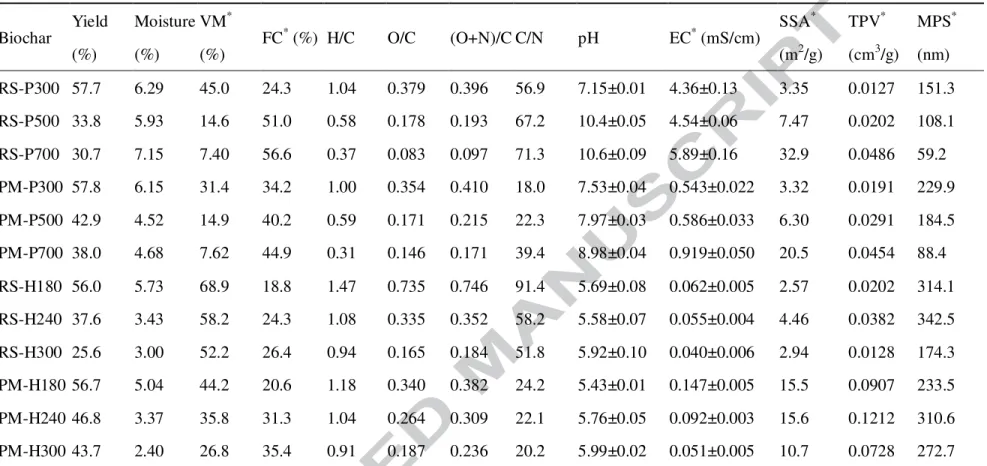
3.1 Basic physical and chemical properties of bio- and hydrochars
91
The yields, atomic ratios, pH, ECs, specific surface areas, total pore volumes, and mean pore sizes of bio- and hydrochars derived from RS and
92
PM at different temperatures are listed in Table 1, whereas their elemental compositions and ash contents are shown in Fig. 3. For each feedstock,
93
higher temperatures resulted in lower bio-/hydrochar yields, which equaled 25.6–57.7% for RS and 38.0–57.8% for PM. At the same
94
temperature, the yields of PM-derived bio-/hydrochars were higher than those of RS-derived chars. The ash contents of RS- and PM-derived bio-
95
and hydrochars increased with increasing temperature, equaling 24.4–42.8% and 6.59–35.4% for chars obtained by pyrolysis and hydrothermal
96
carbonization, respectively. The ash contents of PM-derived bio- and hydrochars were higher than those of RS-derived chars under the same
conditions. The C contents of bio- and hydrochars derived from both RS and PM increased with increasing temperature, whereas their H and O
98
contents, as well as H/C, O/C, and (O + N)/C ratios decreased. For each feedstock, the C/N ratio of biochar increased with increasing
99
temperature, while it decreased for hydrochar. The C contents and C/N ratios of bio-/hydrochars derived from RS (44.1–61.7% and 51.8–91.4,
100
respectively) were much higher than those of PM-derived chars (43.3–46.4% and 18.0–39.4, respectively) at the same temperature. Furthermore,
101
the H/C ratios of hydrochars derived from both RS (0.94–1.47) and PM (0.91–1.18) were higher than those of RS- and PM-derived biochars
102
(0.37–1.04 and 0.31–1.00, respectively).
103
The pH of RS- and PM-derived biochars increased with increasing temperature, equaling 7.15–10.6 for thermal treatment temperatures of
104
300–700 °C (Table 1). A similar tendency was observed for the pH of hydrochars derived from RS and PM (except for RS-H180), which equaled
105
5.43–5.99 at 180–300 °C. The ECs of both RS- and PM-derived biochars increased with increasing temperature, with RS-derived biochar
106
exhibiting much higher values (4.36–5.89 mS cm−1) than PM-derived biochar (0.543–0.919 mS cm−1). Conversely, the ECs of hydrochars
107
decreased with increasing temperature, with PM-derived hydrochar (0.051–0.147 mS cm−1) exhibiting higher values than RS-derived hydrochar
108
(0.040–0.062 mS cm−1).
109
The specific surface areas of most bio- and hydrochars were very low (2.57–32.9 m2 g–1, Table 1). Under pyrolytic conditions, the specific
surface areas and total pore volumes of RS- and PM-derived biochars increased with increasing temperature, whereas their mean pore sizes
111
decreased. The specific surface area of RS-derived biochar (3.35–32.9 m2 g–1) was higher than that of PM-derived biochar (3.32–20.5 m2 g–1),
112
and the mean pore size of RS-derived biochar (59.2–151.3 nm) was lower than that of PM-derived biochar (88.4–229.9 nm). However, the
113
specific surface areas, total pore volumes, and mean pore sizes of RS- and PM-derived hydrochars exhibited an initial increase and a subsequent
114
decline with increasing temperature. The specific surface area and total pore volume of PM-derived hydrochar (10.7–15.6 m2 g–1 and
115
0.0728–0.1212 cm3/g, respectively) were higher than those of RS-derived hydrochar (2.57–4.46 m2 g–1 and 0.0128–0.0382 cm3/g, respectively).
116
3.2 Composition of char ash determined by XRD
117
Typical XRD patterns of bio- and hydrochars are shown in Fig. S1 (Supplementary data). For RS-derived biochars, sylvite (KCl) and quartz
118
(SiO2) were the main crystalline phases detected after pyrolysis at 300 °C, with calcite (CaCO3) also detected at temperatures above 500 °C. For
119
PM-derived biochars, CaCO3 and SiO2 were the major inorganic crystalline phases observed at 300 °C, with magnesium silicate (MgSiO3)
120
detected at 500 °C, and dolomite [CaMg(CO3)2] and albite (NaAlSi3O8) observed at 700 °C. Furthermore, only small amounts of crystalline
121
phases were detected at 180–300 °C for RS-derived hydrochars. In contrast, SiO2 and NaAlSi3O8 were the main inorganic crystalline phases
122
observed at 180–300 °C for PM-derived hydrochars, with CaCO3 observed at 240 °C and [CaMg(CO3)2] detected at 300 °C.
3.3 Surface property analysis by FTIR
124
Functional groups of bio- and hydrochars were analyzed by FTIR spectroscopy, with the obtained spectra presented in Fig. S2 (Supplementary
125
data). For RS-derived biochars, the intensity of peaks at 3397, 2920, 1110, and 789 cm−1 decreased with increasing temperature, and some peaks
126
disappeared at 700 °C. For PM-derived biochars, peaks at 3397, 2920, 2358, 1092, and 769 cm−1 were well preserved at 300 and 500 °C, but lost
127
intensity at 700 °C, whereas peaks at 1591 and 1350 cm−1 exhibited an intensity decrease with increasing temperature. Conversely, for both RS-
128
and PM-derived hydrochars, peaks at 2928, 2360, 1600 and 800 cm−1 became sharper with increasing temperature, and those at 2850 and 1114
129
cm−1 appeared at 300 °C for RS-derived hydrochars.
130
131
4 Discussion
132
4.1 Basic characteristics of bio- and hydrochars
133
During thermochemical processing, the char yield (defined as the mass ratio of dry bio-/hydrochar to that of input dry feedstock) usually
134
decreases with increasing temperature due to the formation of liquid and gaseous by-products (Libra et al., 2011). The reduced yields of RS- and
135
PM-derived bio-/hydrochars with increasing treatment temperature (Table 1) are mainly associated with the removal of cellulosic and
hemicellulosic components (Kambo and Dutta, 2015).
137
The high ash content of individual bio-/hydrochars directly correlates with yield reduction. For both RS and PM, the ash content of biochar was
138
usually higher than that of hydrochar at the same treatment temperature (Fig. 3), in agreement with the results of Dai et al. (2015), who
139
concluded that hydrothermal carbonization can be employed to dissolve and wash out some inorganic components from hydrochar.
140
As reported in numerous previous researches (Chen et al., 2008; Ghanim et al., 2016; Keiluweit et al., 2010; Smith et al., 2016), thermal
141
treatment temperature is the primary factor determining bio-/hydrochar properties. Elevated temperatures favored higher C contents, which
142
increased for all bio-/hydrochars produced from RS and PM (Fig. 3). Conversely, H and O contents markedly decreased with increasing
143
temperature, indicating the occurrence of decarboxylation, decarbonylation, and dehydration during pyrolysis and hydrothermal carbonization of
144
biomass (Ghanim et al., 2016). The H/C atomic ratio was proposed as an index of aromaticity and resistance of bio-/hydrochars to microbial and
145
chemical degradation (Crombie et al., 2013). This ratio significantly decreased with increasing temperature for all chars, suggesting an increase
146
of their aromaticity. The lower H/C ratio of biochar compared to hydrochar indicates the greater stability of the former.
147
The decrease of the polarity index (O + N)/C and the O/C atomic ratio with increasing temperature indicated a reduction of polarity and the
148
number of oxygen-containing functional groups. This agrees with previous reports, suggesting that pyrolysis and hydrothermal carbonization of
biomass result in removal of hydroxyl groups via dehydration, loss of carboxyl and carbonyl groups via decarboxylation, cleavage of ester and
150
ether bonds via hydrolysis, and, for lignocellulose-based biomass, in increased aromatization due to the dehydration of lignin and aromatization
151
of carbohydrates (Funke and Ziegler, 2010; Smith et al., 2016).
152
It should be noted that bio-/hydrochar properties varied greatly with biomass type. The C content of RS-derived bio-/hydrochars was much
153
higher and exhibited a more obvious increase upon pyrolysis than that of PM-derived ones (Fig. 3), indicating that RS is more suitable for
154
carbon sequestration than PM. Similar to the C content, the O content of RS-derived bio-/hydrochars markedly decreased with temperature.
155
Unlike RS, PM is a sort of livestock manure, commonly containing a large number of inorganic elements (e.g., K, Ca). PM contains abundant
156
porcine metabolites, being easily decomposable in comparison to plant biomass. The C/N ratio of RS-derived bio-/hydrochars was much higher
157
than that of PM-derived ones (Table 1), indicating that PM is more suited for use as a soil amendment substrate than RS, since an overly high
158
C/N ratio that goes against decomposition by microbes will result in excessive consumption of available soil nitrogen.
159
4.2 Composition of bio- and hydrochars
160
XRD was used to detect the short-range ordered structures of bio- and hydrochars and the crystalline structures of the present minerals (Wang et
161
al., 2016). The observed strong and sharp peaks indicated the presence of crystalline inorganic phases in bio- and hydrochars derived from RS
and PM. The speciation and abundance of inorganic constituents were determined by thermal treatment temperature and feedstock properties.
163
Under the same conditions, the peaks of RS-derived bio- and hydrochars were less abundant than those of PM-derived chars, indicating the
164
lower ash content of the former and being in agreement with the results presented in Table 1. For example, the weak peaks observed for
165
RS-derived hydrochars demonstrated their low inorganic content, whereas quartz and albite were detected in PM-derived hydrochars. Peaks at
166
28° and 41° confirmed the presence of sylvite in RS-derived biochars, whereas those at 27° were indicative of quartz in PM-derived biochars.
167
In addition, the results showed that a larger amount of crystalline inorganic fractions was formed in both RS and PM at high temperatures during
168
pyrolysis and hydrothermal carbonization. For RS-derived biochars, the peak of calcite at 29° was observed only above 500 °C. In contrast, for
169
PM-derived biochars, peaks at 28°, 31°, 36°, and 43° indicated that MgSiO3 was formed above 500 °C, and albite (22° and 28°) and dolomite
170
(31° and 41°) were formed at 700 °C. For PM-derived hydrochars, the peak at 29° confirmed the formation of calcite during hydrothermal
171
carbonization at 240 °C, and that at 31° was due to the formation of dolomite at 300 °C.
172
Li et al. (2017) found that the type and amount of inorganic crystalline phases in biochar depend on the feedstock and temperature. However,
173
their results demonstrated that KCl formed at relatively low pyrolysis temperature (200–300 °C), while carbonates generally formed above
174
400 °C.
4.3 Surface property of bio- and hydrochars
176
As demonstrated by the FTIR spectra, the band at 3397 cm−1, attributed to the stretching vibrations of hydrogen-bonded hydroxyl groups of
177
water (Droussi et al., 2009), lost intensity with increasing temperature and disappeared at 700 °C for both RS- and PM-derived biochars. For all
178
biochars, peaks at 2920, 2850, and 1458 cm−1 (aliphatic CH
2) (Xiao et al., 2014) gradually disappeared with increasing temperature. The intense
179
bands of aromatic C=C and C=O groups (1591–1601 cm−1) (Chun et al., 2004) were well preserved between 180 and 500 °C, but lost intensity at
180
700 °C in the case of PM-derived biochar. Peaks of aliphatic C–O–C fragments at 1092–1114 cm−1 (Li et al., 2017) disappeared at temperatures
181
above 500 °C for PM-derived biochar, being better preserved for RS-derived biochar. Peaks observed at 3397, 2920, 2850, 1591, 1458, 1355,
182
and 1100 cm−1 indicated that a large number of organic residues (e.g., polymeric –CH2–, fatty acids, lignins, and polysaccharides) were
183
preserved in RS- and PM-derived hydro- and biochars at low temperature (300 °C), whereas some of them disappeared in biochars pyrolyzed at
184
high temperature, e.g., above 500 °C. The changes observed in the range of 1000–1400 cm−1 (C–O) and at 1591 cm−1 (C=O) indicated that
185
oxygen-containing functional groups might have been oxidized during hydrothermal carbonization and pyrolysis.
186
187
5 Conclusions
High temperature resulted in lower bio-/hydrochar yields. C and ash contents increased with increasing temperature, while H/C, O/C, and
189
(O+N)/C ratios decreased. Higher C contents and C/N ratios of RS chars compared to those of PM chars indicate that RS is more suitable for
190
carbon sequestration, whereas PM is suitable for soil amendment. Biochars showed lower H/C ratios than hydrochars due to their greater
191
stability. KCl was the main inorganic fraction in RS biochars, while SiO2 was dominant in PM biochars, and NaAlSi3O8 was detected in PM
192
hydrochars. The number of surface groups in biochars gradually decreased with increasing temperature.
193
194
Acknowledgements
195
This research was financially supported by the International Science & Technology Cooperation Program of China (2014DFE90040), the
196
Science and Technology Project of Zhejiang Province (2015C03004), and the Zhejiang Provincial Natural Science Foundation (LY16D010004
197 and LQ17D020002). 198 199 References 200
[1] Berge, D.N., Kammann, C., Ro, K., Libra, J., 2013. Environmental applications of hydrothermal carbonization technology: biochar
production, carbon sequestration, and waste conversion. In: Titirici, M.M. (Ed.), Sustainable Carbon Materials from Hydrothermal Processes.
202
John Wiley & Sons, Ltd., United Kingdom, p. 297.
203
[2] Catalkopru, A.K., Kantarli, I.C., Yanik, J., 2017. Effects of spent liquor recirculation in hydrothermal carbonization. Bioresour. Technol. 226,
204
89–93.
205
[3] Chan, K.Y., Van Zwieten, L., Meszaros, I., Downie, A., Joseph, S., 2007. Agronomic values of greenwastebiochar as a soil amendment. Aust.
206
J. Soil Res. 45, 629–634.
207
[4] Chen, B., Zhou, D., Zhu, L., 2008. Transitional adsorption and partition of nonpolar and polar aromatic contaminants by biochars of pine
208
needles with different pyrolytic temperatures. Environ. Sci. Technol. 42, 5137–5143.
209
[5] Chun, Y., Sheng, G.Y., Chiou, C.T., Xing, B.S., 2004. Compositions and sorptive properties of crop residue-derived chars. Environ. Sci.
210
Technol. 38, 4649–4655.
211
[6] Crombie, K., Mašek, O., Sohi, S.P., Brownsort, P., Cross, A., 2013. The effect of pyrolysis conditions on biochar stability as determined by
212
three methods. GCB Bioenergy 5, 122–131.
213
[7] Dai, L., Tan, F., Wu, B., He, M., Wang, W., Tang, X., Hu, Q., Zhang, M., 2015. Immobilization of phosphorus in cow manure during
hydrothermal carbonization. J. Environ. Manage. 157, 49–53.
215
[8] Droussi, Z., D’orazio, V., Provenzano, M.R., Hafidi, M., Ouatmane, A., 2009. Study of the biodegradation and transformation of olive-mill
216
residues during composting using FTIR spectroscopy and differential scanning calorimetry. J. Hazard. Mater. 164, 1281–1285.
217
[9] Funke, A., Ziegler, F., 2010. Hydrothermal carbonization of biomass: A summary anddiscussion of chemical mechanisms for process
218
engineering. Biofuels Bioprod. Bior. 4, 160–177.
219
[10] Ghanim, B.M., Pandey, D.S., Kwapinski, W., Leahy, J.J., 2016. Hydrothermal carbonisation of poultry litter: Effects of treatment
220
temperature and residence time on yields and chemical properties of hydrochars. Bioresour. Technol. 216, 373–380.
221
[11] Guo, S., Dong, X., Wu, T., Shi, F., Zhu, C., 2015. Characteristic evolution of hydrochar from hydrothermal carbonization of corn stalk. J.
222
Anal. Appl. Pyrol. 116, 1–9.
223
[12] Kei, M., Toshitatsu, M., Yasuo, H., Nishihara, K., Nakanishi, T., 2004. Removal of nitrate-nitrogen from drinking water using bamboo
224
powder charcoal. Bioresour. Technol. 95, 255–257.
225
[13] Keiluweit, M., Nico, P.S., Johnson, M.G., Kleber, M., 2010. Dynamic molecular structure of plant biomass-derived black carbon (biochar).
226
Environ. Sci. Technol. 44, 1247–1253.
[14] Ko, H.J., Kim, K.Y., Kim, H.T., Kim, C.N., Umeda, M., 2008. Evaluation of maturity parameters and heavy metal contents in composts
228
made from animal manure. Waste Manage. 28, 813–820.
229
[15] Lehmann, J., 2007. A handful of carbon. Nature 447, 143–144.
230
[16] Li, J., Liang, N., Jin, X., Zhou, D., Li, H., Wu, M., Pan, B., 2017. The role of ash content on bisphenol A sorption to biochars derived from
231
different agricultural wastes. Chemosphere 171, 66–73.
232
[17] Libra, J.A., Ro, K.S., Kammann, C., Funke, A., Berge, N.D., Neubauer, Y., Titirici, M.-M., Fühner, C., Bens, O., Kern, J., Emmerich, K.H.,
233
2011. Hydrothermal carbonization of biomass residuals: a comparative review of the chemistry, processes and applications of wet and dry
234
pyrolysis. Biofuels 2, 71–106.
235
[18] Makara, A., Kowalski, Z., 2015. Pig manure treatment and purification by filtration. J. Environ. Manag. 161, 317–324.
236
[19] Mohan, D., Sarswat, A., Ok, Y.S., Pittman, C.U. Jr., 2014. Organic and inorganic contaminants removal from water with biochar, a
237
renewable, low cost and sustainable adsorbent – A critical review. Bioresour. Technol. 160, 191–202.
238
[20] Ponnamperuma, F.N., 1984. Straw as a source of nutrients for wetland rice. Organic matter and rice. Manila (Philippines): International Rice
239
Research Institute, p. 117–136.
[21] Smith, A.M., Singh, S., Ross, A.B., 2016. Fate of inorganic material during hydrothermal carbonisation of biomass: Influence of feedstock
241
on combustion behaviour of hydrochar. Fuel 169, 135–145.
242
[22] Tan, X.F., Liu, Y.G., Zeng, G.M.,Wang, X., Hu, X.J., Gu, Y.L., Yang, Z.Z., 2015. Application of biochar for the removal of pollutants from
243
aqueous solutions. Chemosphere 125, 70–85.
244
[23] Wang, Y., Lu, H., Liu, Y., Yang, S., 2016. Ammonium citrate-modified biochar: An adsorbent for La(III) ionsfrom aqueous solution. Colloid.
245
Surface. A: Physicochem. Eng. Aspects 509, 550–563.
246
[24] Xiao, X., Chen, B., Zhu, L., 2014. Transformation, morphology, and dissolution ofsilicon and carbon in rice straw-derived biochars under
247
different pyrolytic temperatures. Environ. Sci. Technol. 48, 3411–3419.
248
[25] Zheng, C., Bluemling, B., Liu, Y., Mol, A.P.J., Chen, J., 2014. Managing manure from China’s pigs and poultry: The influence of ecological
249
rationality. AMBIO 43, 661–672.
250
Table 1. Basic physical and chemical properties of bio- and hydrochars obtained from RS and PM at different temperatures.
252 Biochar Yield (%) Moisture (%) VM* (%) FC
* (%) H/C O/C (O+N)/C C/N pH EC* (mS/cm) SSA * (m2/g) TPV* (cm3/g) MPS* (nm) RS-P300 57.7 6.29 45.0 24.3 1.04 0.379 0.396 56.9 7.15±0.01 4.36±0.13 3.35 0.0127 151.3 RS-P500 33.8 5.93 14.6 51.0 0.58 0.178 0.193 67.2 10.4±0.05 4.54±0.06 7.47 0.0202 108.1 RS-P700 30.7 7.15 7.40 56.6 0.37 0.083 0.097 71.3 10.6±0.09 5.89±0.16 32.9 0.0486 59.2 PM-P300 57.8 6.15 31.4 34.2 1.00 0.354 0.410 18.0 7.53±0.04 0.543±0.022 3.32 0.0191 229.9 PM-P500 42.9 4.52 14.9 40.2 0.59 0.171 0.215 22.3 7.97±0.03 0.586±0.033 6.30 0.0291 184.5 PM-P700 38.0 4.68 7.62 44.9 0.31 0.146 0.171 39.4 8.98±0.04 0.919±0.050 20.5 0.0454 88.4 RS-H180 56.0 5.73 68.9 18.8 1.47 0.735 0.746 91.4 5.69±0.08 0.062±0.005 2.57 0.0202 314.1 RS-H240 37.6 3.43 58.2 24.3 1.08 0.335 0.352 58.2 5.58±0.07 0.055±0.004 4.46 0.0382 342.5 RS-H300 25.6 3.00 52.2 26.4 0.94 0.165 0.184 51.8 5.92±0.10 0.040±0.006 2.94 0.0128 174.3 PM-H180 56.7 5.04 44.2 20.6 1.18 0.340 0.382 24.2 5.43±0.01 0.147±0.005 15.5 0.0907 233.5 PM-H240 46.8 3.37 35.8 31.3 1.04 0.264 0.309 22.1 5.76±0.05 0.092±0.003 15.6 0.1212 310.6 PM-H300 43.7 2.40 26.8 35.4 0.91 0.187 0.236 20.2 5.99±0.02 0.051±0.005 10.7 0.0728 272.7 * VM, volatile matter; FC, fixed carbon; EC, electric conductivity; SSA, specific surface area; TPV, total pore volume; MPS, mean pore size.
Figure captions
255
Fig. 1. Schematic diagram of pyrolysis setup. 1) Exhaust gas absorber; 2) valve; 3) quartz tube; 4) heating jacket; 5) biomass; 6) filter plug; 7)
256
pressure meter; 8) vacuum pump; 9) temperature controller.
257
Fig. 2. Schematic diagram of hydrothermal carbonization setup. 1) Pressure meter; 2) magnetic stirrer; 3) pressure sensor; 4) temperature sensor;
258
5) magnetic stirrer; 6) heating jacket; 7) power port; 8) protection platform; 9) support base; 10) PID controller.
259
Fig. 3. C, H, N, S, O and ash content of biochars and hydrochars.
261
Fig. 1.
263
Fig. 2.
RS
-P
30
0
RS
-P
50
0
RS
-P
70
0
PM
-P
30
0
PM
-P
50
0
PM
-P
70
0
RS
-H
18
0
RS
-H
24
0
RS
-H
30
0
PM
-H
18
0
PM
-H
24
0
PM
-H
30
0
C
o
n
te
n
t
(%
)
0
20
40
60
80
100
C
H
N
S
O
Ash
265 266 Fig. 3. 267 268Highlights:
269
• Bio- and hydrochars were obtained by thermal treatment of rice straw and pig
270
manure
271
• Higher temperatures resulted in lower bio-/hydrochar yields
272
• Biochars showed lower H/C ratios than hydrochars due to their greater stability
273
• Rice straw is suited for carbon sequestration by pyrolysis/hydrothermal
274
carbonization
275
• Pig manure is suitable for use as a soil amendment substrate
276