O
pen
A
rchive
T
oulouse
A
rchive
O
uverte
(OATAO)
OATAO is an open access repository that collects the work of some Toulouse
researchers and makes it freely available over the web where possible.
This is
an author'sversion published in:
https://oatao.univ-toulouse.fr/23091Official URL :
https://doi.org/10.1007/s00264-018-4082-9
To cite this version :
Any correspondence concerning this service should be sent to the repository administrator:
Laumonerie, Pierre and Tibbo, Meagan E. and Reina, Nicolas and Pham, Thuy Trang and
Bonnevialle, Nicolas and Mansat, Pierre Radial head arthroplasty: a historical
perspective. (2018) International Orthopaedics. 1-9. ISSN 0341-2695
OATAO
Radial head arthroplasty: a historical perspective
Pierre Laumonerie 1
8
•
Meagan E. Tibbo 2 • Nicolas Reina 1 • Thuy Trang Pham 1 • Nicolas Bonnevialle 1 • PierreMansat 1
Abstract
There bas been lively debate regarding the rationale behind the use of radial head arthroplasty (RRA) for more than 80 years. Currently, its primary indication is for treatment of non-reconstructible RH fractures. The first RH implant, released in 1941, was a ferml cap used to prevent heterotopic ossification. Biomechanical studies in the 1980s stimulated a revolution in RRA design by promoting modular implants that replicated the native bony anatomy of the elbow. Subsequent data-driven evolution in design led to the creation of a variety of devices that also accommodated for common ligamentous injuries occurring at the time of RH fracture. Despite significantadvances in ourunderstanding of complex elbow instability, improvements in implant design bave to malœ RRA the gold standard for treatment of non-reconstructible RH fractures. The challenge in the coming years will be to perform high-level clinical studies in order to obtain consensus regarding the most appropriate treatment for comminuted RH fractures.
Keywords Radial head arthroplasty • Mason III fractures • Implant • Biomecbanics • History
Introduction
One third of fractures involving the elbow joint affect the radial head (RH) [1 ]. However, the treatment of Mason III fractures remains controversial [2--4]. Arthroplasty or simple RH resection is an alternative in cases of non-reconstructable RH fractures [2-7].
Patients who undergo excision of non-reconstructable RH fractures develop progressive valgus instability, potential ra
-dial ascent, and secondary ulnocarpal symptoms with alter
-ation of the kinematics about the elbow and forearm creating a self-petpetuating cycle of degenerative change [6-8]. ln an effort to avoid these complications and others, the use of RH replacement bas been popularized in the literature since the beginning of the twentieth century (Fig. 1). Since that time,
the surgical indications as well as the design of RH prostheses (RHP) have continuously evolved in an attempt to resolve the
Level of evidence V: Mechanism based reasoning. 181 Pierre Laumonerie
1 Institut Locomoteur, Hôpital Pierre Paul Riquet, Place du Docteur
Baylac, 31059 Toulouse, France
2
Mayo Clinic, Rochester, MN 55905, USA
primary problems encountered during and subsequent to RH arthroplasty (RRA). Older designs are no longer used due to reports of poor results and numerous complications [9]. Heijink et al. [10] found that the mid-term functional results following RRA performed between 1993 and 2015 were good to exc.ellent in 85% of patients using the Mayo Elbow Performanc•e Score [11]. The long-term results of RRA, how
-ever, are unknown. Complication rates in the recent literature are variable, with reoperation rates ranging from O to 45%
afterRRA [12].
Biomechanical and anatomie research aiming to reduce complications and improve outcomes of RRA bas allowed for the development of many different models of RHP. However, current literature bas yet to discern which design or material is superior to others. Enhanced awareness of the history of RHP would allow for better understanding of the state of the art and would faciliate innovation in prosthesis design.
The aims ofthis study are to summarize (1) the history of RH prosthesis use in traumatology and (2) the clinical and biomechanical data tbat engendered its evolution.
Materials and methods
A literature search was performed using Ovid Medline, Ovid Embase, Scopus and Cochrane Library, and the Medical Subject Headings vocabulary. The search was limited to
English and French language literatures. The following terms were combined withBAND^ and BOR^: Bradial head,^ B arthroplasty,^ B prosthesis,^ B radial head prosthesis,^ and Bradial head arthroplasty.^ Due to the limited historical timeframe that can be searched via these search engines, ref-erences from the existing literature were also searched. Results are discussed as a chronologic review of the relevant literature between January 1920 and Januray 2018 (Fig.1).
Review of the literature
Innovation
Treatment of comminuted RH fractures at the beginning of the twentieth century was limited to conservative measures [13], or resection for cases where open reduction and internal fixa-tion was not possible [14]. In 1924, Speed [14] even stated
that:BIn adults, unless the lesion is only a mere crack, there is no doubt that removal of the head is primarily indicated.^ Heterotopic ossification at the proximal radius was the most commonly reported short-term complication [15] for which soft tissue interposition [16,17] and bone grafting [15] were suggested treatments. In 1941, Speed [18] was the first to describe the use of a ferrule (Vitalium) cap (Fig.2) that could be placed over the radial neck, in order to prevent heterotopic bone formation. The same retrospective study [18] involving three patients also led to the observation that the ferrul caps prevented shortening of the proximal radius while simulta-neously allowing for complete resumption of functional elbow articulation.
In 1951, Essex-Lopresti et al. [19] suggested the use of a RH implant until the forearm had healed and become stable in cases of distal radio-ulnar dislocation associated with RH frac-ture. During the same year, Carr and Howard [20] (1951) demonstrated that a metallic cap increased elbow stability,
Fig. 1 History of radial head arthroplasty: innovation, revolution, evolution
Fig. 2 Different sizes of ferrule caps for the radial head, designed by Speed [30] Speed K [18] Ferrule cap Essex-Lopresti P [19] Swaoson implant INNOVATION Merrey BF & An K.N' [42] Ring D, Jupiter JB [50] MorreyBF [44] : CRFll F~atingRH REVOLUTION KingGJ [38] O'Driscoll SW [58,: 59] A(;UMED Anatom)c RH System EVOLUTION
when compared to RH resection. Similarly, Cherry et al. [21] proposed a second RHP design in 1953, composed of acrylic resin, to prevent proximal translation of the radius and its related consequences; its use was, however, quite limited at that time. Twenty years after Speed’s first caps (1953), Taylor and O’Connor [22] reported that half of patients treated for RH fractures with excision presented with distal radio-ulnar joint (DRUJ) symptoms. Subsequent to this report [22], RHPs became the treatment of choice to avoid distal radio-ulnar joint subluxation related to RH resection. The first long-term results of Vitallium caps were published in 1964 and resulted in sim-ilar clinical outcomes as patients treated with RH resection, in addition to decreased prono-supination among patients receiv-ing caps [23]. As the use of RHPs was becoming more wide-spread, Creyssel and De Morgues [24] changed the material of the ferrule to nylon in order to increase elasticity and lessen stress on the humeral condyle; its use remained however quite rare.
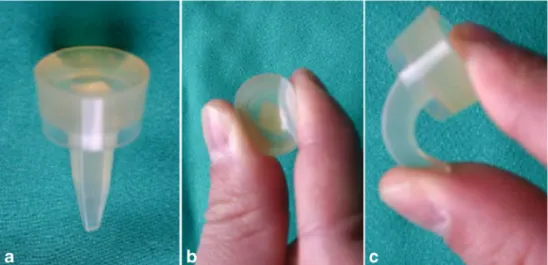
Begining in 1968, Swanson developed silastic implant (the Swanson implant, Dow Corning Corporation, USA) (Fig.3). The implant’s low elastic modulus was intended to allow for easy implantation and provides a smooth surface for radiocapitellar articulation [25]. Swanson et al. [25] initially reported excellent short- to mid-term outcomes and advocated for more widespread use of the device. However, since 1979, criticisms of the prosthesis arose because of silastic’s propen-sity to create wear particles which led to inflammatory arthri-tis, reactive giant cell synovitis [26] and mecanical failure [27]. Silastic was too easily deformed and did not provide sufficient resistance to axial load (Fig.3) [28]. After assessing the long-term outcomes of 17 Swanson implants, Morrey et al. [29] concluded that the indications for silastic RHPs after fracture were extremely limited, and its routine use could not be justified. Given the fact that silastic’s poor reputation had been earned on the basis of limited data with questionable surgical indications and techniques (e.g., no medial collateral ligament repair), Magen et al. [30] suggested that the use of
silastic implants might be still reasonable for stable elbows or those rendered stable by ligament repair.
However, due to the abundance of data demonstrating sub-optimal results with the Swanson implant, more rigid mate-rials (e.g., ceramic, cobalt-chrome, or titanium) have been used manufacture RHA to since the early 1980s.
Revolution
As a result of the inability to restore valgus statibility with a RH implant, there has been increasing interest in elbow bio-mechanics since the 1980s; data resulting from these biome-chanical studies revolutionized the approach to RHA.
In the early to mid-1980s, Morrey [29] and Carn et al. [31] demonstrated that silicone rubber deformed easily under phys-iologic loads and transferred minimal force to the capitellum. During the same period, Harrington and Tountas [32] demon-strated that stiffer implants provided improved resistance to valgus stress compared to softer silicon rubber. Further evi-dence to support the use of stiff materials came from Knight et al. [33] in 1993 when they reported restored normal axial forearm stiffness with the use of vitallium RHPs.
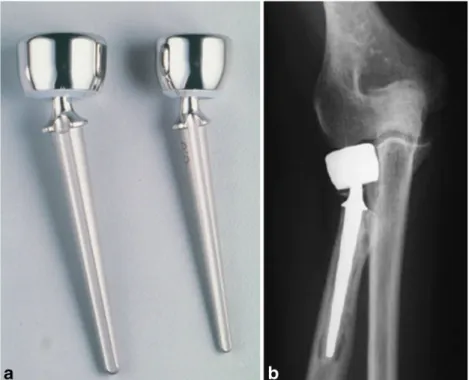
Metallic implants have a high modulus of elasticity, rang-ing from seven to 15 times greater than that of bone. This property confers improved resistance to deformation; howev-er, it also increases the risk of capitellar wear, periprosthetic osteolysis, and stress shielding [33]. In an effort to reduce stress shielding and more closely replicate the anatomy of the proximal radius, modular and bipolar implant systems were designed and promoted (Fig.4). These devices had the added benefit of easing implantation and compensating for potential technical errors. The first bipolar RHP was promoted by Judet et al. in 1988; this early version, made from titanium, was replaced by a cobalt-chrome design in 1994 [34,35]. The Bfloating^ RH prosthesis (Wright Medical, Arlington, TN, USA) had a collared stem with a 15° neck-shaft angle, a float-ing articulation, and concave head to allow for continuous
Fig. 3 a The BSwanson^ silastic prosthesis. b Highly deformable head. c High flexibility stem. Reprinted with permission from Morrey [14]
contact with the convex humeral condyle during elbow range of motion (ROM) (Fig.5). Short-term results of the floating RH prosthesis were also promising (83.3% excellent or good outcomes according MEP score) and the prosthesis was found to restore joint stability [34–36]. However, degenerative changes of the elbow after bipolar RHA were found in approx-imately 50% (n = 8) of patient at short-term follow-up in a multicentre study carried out by Smets et al. [36].
At the beginning of the 2000s, further anatomic studies demonstrated that the relationship between the RH and neck was quite variable [37, 39]. Beredjiklian et al. [37] reported that even the smallest prosthetic stem available would not fit into the intramedullary canal of the radius in 39% (n = 18) of patients. The anatomy of RH was also found not to be circular, but rather consistently elliptical
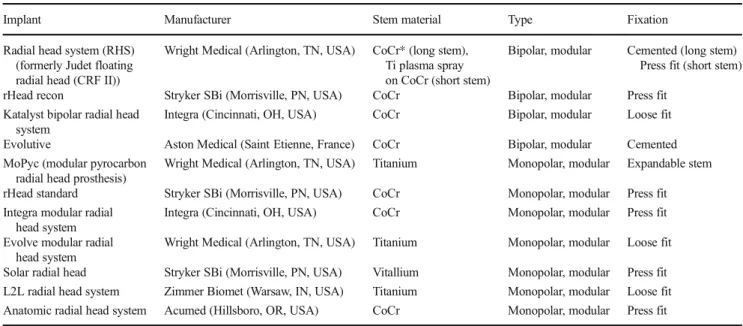
in shape [39]. Biomechanical analyses demonstrated al-tered ulnohumeral kinematics and radiocapitellar stability with the use of nonanatomic prostheses due to their shallower articular surface and the fact that they do not replicate the elliptical shape of the native RH [37–41]. This data created a significant need for more anatomic and modular implant systems which led to diversification of device designs and fixation modes including the follow-ing: anatomic or nonanatomic, monoblock or bipolar pros-theses, with short or long stems anchored via cement, and press fit, loose fit or auto-expanding stem systems (Fig.4, Table 1) [10]. The first prosthesis designed to address the aforementioned requirements was the Anatomic Radial Head System (ACUMED, Hillsboro, Or, USA) which was released in the early 2000s (Fig.6).
Fig. 4 Four examples of modular bipolar (a, c) and monopolar radial head prostheses (b, d): a Evolutive (cemented, Aston Medical, Saint Etienne, France), b MoPyc (auto expanding, Wright Medical, Arlington, TN, USA), c rHead Recon (bipolar, press fit, Stryker Small Bone Innovation, Morrisville, PN, USA), d Evolve (Wright Medical Technology, Arlington, TN, USA)
Fig. 5 Pictured here is the first bipolar radial head prosthesis. The Judet RHP (Wright Medical, Arlington, TN, USA) has a collared stem, a 15° neck shaft angle, and a floating articulation; head and stem sizes are interchangeable
Indications for RHA were also redefined as the under-standing of elbow biomechanics improved. The ligamen-tous contribution to elbow stability has been studied ex-haustively. Morrey et al. [42] confirmed, in 1983, that the medial collateral ligament (MCL) is the primary stabilizer of the elbow. The RH was therefore considered a second-ary restraint to valgus and rotatory instability, significant only if the anterior bundle of the MCL was absent [32, 43]. Less than ten years later, Morrey et al. [44] published data to suggest that simultaneous rupture of the anterior band of the MCL should be a new indication for RHA and the primary contraindication to RH resection. In 1996, Olsen et al. [45] showed that the lateral collateral liga-ment was an equally important stabilizer of the elbow joint during varus and external rotation loads. Three years later, the same group [46] demonstrated that excision of the RH reduces tension in the lateral collateral ligament and induces varus and external rotation laxity. More re-cently, Beignessner et al. [47] (2004) demonstrated that
RHA alone does not adequately restore stability to elbows having a ligamentous injury and recommended concomi-tant ligament repair at the time of RHA. In addition to ligamentous stabilizers, the coronoid also plays a central role in elbow stability by providing an attachment site for the anterior bundle of the medial collateral ligament [42, 48–50]. Biomechanical studies have demonstrated that deficits comprising approximately 50% of the coronoid are grossly unstable, even if the remaining stabilizers, the RH and collateral ligaments are intact or have been restored [48]. O’Driscoll et al. [49] recommended that coronoid fractures must also be addressed, especially when they occur with RH fractures as part of a terrible triad injury.
With the above data in mind, RHA became the treatment of choice for non-reconstructable RH fractures. Recognition of Bcomplex instability^ led to more global surgical treatment, inclunding concomitant repair of ligaments and coronoid frac-tures when present.
Table 1 Design and biomaterial composition of contemporary radial head prostheses
Implant Manufacturer Stem material Type Fixation
Radial head system (RHS) (formerly Judet floating radial head (CRF II))
Wright Medical (Arlington, TN, USA) CoCr* (long stem), Ti plasma spray on CoCr (short stem)
Bipolar, modular Cemented (long stem) Press fit (short stem)
rHead recon Stryker SBi (Morrisville, PN, USA) CoCr Bipolar, modular Press fit
Katalyst bipolar radial head system
Integra (Cincinnati, OH, USA) CoCr Bipolar, modular Loose fit
Evolutive Aston Medical (Saint Etienne, France) CoCr Bipolar, modular Cemented
MoPyc (modular pyrocarbon radial head prosthesis)
Wright Medical (Arlington, TN, USA) Titanium Monopolar, modular Expandable stem
rHead standard Stryker SBi (Morrisville, PN, USA) CoCr Monopolar, modular Press fit
Integra modular radial head system
Integra (Cincinnati, OH, USA) CoCr Monopolar, modular Press fit
Evolve modular radial head system
Wright Medical (Arlington, TN, USA) Titanium Monopolar, modular Loose fit
Solar radial head Stryker SBi (Morrisville, PN, USA) Vitallium Monopolar, modular Press fit
L2L radial head system Zimmer Biomet (Warsaw, IN, USA) Titanium Monopolar, modular Loose fit
Anatomic radial head system Acumed (Hillsboro, OR, USA) CoCr Monopolar, modular Press fit
*CoCr Cobalt chrome
Fig. 6 The Acumed RHP (ACUMED, Hillsboro, Or, USA) is the first anatomic implant designed to replicate native radial head geometry
Evolution
After 2000, multiple RHP designs were available for the treat-ment of similar injuries (Fig.4, Table1); with no significant evidence to support the use of one implant over another [10, 12,51,52]. More recently, a classification system was devised to describe the four main reasons for re-operation after RHA: painful loosening, stiffness, humero-radial conflict, and insta-bility. The study of these primary reasons for failure triggered rapid evolution in the indications for RHA with each individ-ual prosthesis.
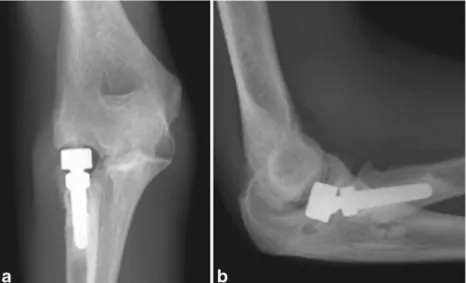
Painful loosening, as defined by O’Driscoll and Herald [53], is the main indication for re-operation after RHA [12, 51–54]. Despite our limited understanding of the biomechan-ics, fixation method seems to play a pivotal role in RHA survivorship [10,52,55]. Press fit implants may be the most prone to painful loosening [10,52,55], especially those pros-theses with shorter stems of sub-maximal diameter (approxi-mately 1 mm less than maximum diameter of the radial neck medullary canal) (Fig. 7) [55–57]. Difficulties in obtaining satisfactory stability when using short-stemmed and/or bipolar implants may also predispose the surgeon to favour stability over implant positioning [12,55].
A recent review of the literature found that radiocapitellar instability was the main reason for re-operation with implant
retention (11.25% of failures) [12]. In 2009, Moon et al. [58] demonstrated that bipolar implants were more prone to radiocapitellar subluxation. O’Driscoll and colleagues [59] showed that a bipolar prosthesis depended more heavily on the integrity of the surrounding soft tissues for restoration of stability than did a monopolar prosthesis. This data would suggest that monopolar prostheses provide significantly great-er radiocapitellar stability when used in the treatment of tgreat-erri- terri-ble triad injuries, than bipolar implants. These findings have been replicated in multiple clinical studies, though without statistically significant evidence, and the monopolar implant is currently the device of choice in cases of associated soft tissue injury [12,58–63].
The long-term outcomes of RHA are largely unknown and concerns about capitellar wear remain (Fig. 8). The use of metal radial heads has been demonstrated to lead to severe capitellar cartilage wear [51]. Biomechanical studies demon-strated that the geometry and design of RHPs influence their contact characteritstics and can contribute significantly to changes in the articular cartilage [58, 59,61]. Sahu et al. [62] showed that anatomic RHP with articular surfaces that match the radius of curvature of the capitellum have increased radiocapitellar contact areas and lower peak pressures com-pared to mono- and bipolar implants. Although comparative clinical studies could not reproduce these results, the use of the
Fig. 7 AP (a) and lateral (b) radiographs depicting loosening of a press fit, short stemmed radial head implant
Fig. 8 AP (a) and lateral (b) radiographs demonstrating capitellar wear caused by an overstuffed bipolar radial head implant
anatomic RH is recommended to avoid long-term cartilage damage; the polarity of the design does not appear to affect this endpoint [12,51,59–63].
Although current studies report satisfactory mid- to long-term outcomes after RHA [10,64], some still advocate for RH resection as an alternative to RHA for isolated, non-reconstructable radial had fractures [3]. Several studies dem-onstrate excellent results of RH excision for isolated RH frac-tures at mid- and long-term follow-up [5]; however, there are also reports of unsatisfactory results with high complication rates [7]. When magnetic resonance imaging (MRI) is per-formed in the setting of RH fracture, studies found even higher incidences of concomitant ligamentous injury than with phys-ical or clinphys-ical examination alone [65,66]. Itamura et al. [65] found a 92% incidence of associated injuries in Mason type II and type III RH fractures; Kaas et al. [66] found that 100% of Mason type III RH fractures had associated injuries. This might suggest that RHA is indicated for all non-reconstructable RH factures whether isolated or not. Radial head resection should be considered only in cases where RHA is contraindicated. Ligamentous injuries are quite com-mon in the setting of non-reconstructible radial head fractures. Given this, we submit that monopolar modular implants with loose fitting stems (Table1) should be used preferentially in this situation due to their improved stability (vs. bipolar im-plants), satifactory restoration of proximal radius anatomy, and low rate of painful loosening.
Future directions
Orthopaedic surgeons have been searching for the ideal RH prosthesis since its initial development for more than 80 years. Meticulous biomechanical studies have stimulated a revolu-tion in the approach to RHA and complex instability of the elbow. In contrast, the clinical and radiographic literature re-garding outcomes of RHA have led to inconsistent conclu-sions and have been largely unable to reproduce in vitro find-ings. We speculate that it may be due to the quasi-exclusively retrospective monocentric nature of the majority of studies and the inherent bias associated with that study design. Furthermore, the small sample size, the lack of a standardized classification system of the reasons for failure, and the plural-ity of methodologies used have prevented reproducible studies of RHA. A recent meta-analysis [12] estimates that 90% of current literature has insufficient follow-up and underesti-mates the rate of failure of RHA. Similar to what is being done in the prospective, randomized, multicentre trialBRAMBO trial^ [67], the challenge in the coming years will be to per-form and publish high level of clinical studies in order to obtain reliable results and provide clear recommendations for surgeons. This will require strict adherence to the quality standards developed for observational studies [68]: clear
definitions of outcomes (1) and the assessment of outcomes (2), an independent assessment of the outcome parameters (3), sufficient follow-up (4), no significant loss to follow-up (5), the identification of important confounders, and prognostic factors (6). A task of this magnitude calls for collective re-sponsibility among authors and journal editors for transparent, comprehensive, and standardized reporting of all outcomes and study characteristics.
To conclude, despite a growing body of outcomes data and improvements in implant design and rationale, prosthetic RH replacement has yet to become the gold standard for treatment of non-reconstructible RH fractures. We suggest that RHA will be considered the treatment of choice for these injuries when a study with a high level of clinical evidence provides more definitive evidence to support its widespread use.
Acknowledgements We would like to thank Dr. BF Morrey for sharing with us the photographs.
Authors’ contribution Conception and design: Laumonerie Acquisition of data: Laumonerie
Analysis and interpretation of data: all authors Critically revising the article: all authors
Reviewed submitted version of manuscript: all authors
Approved the final version of the manuscript on behalf of all authors: Mansat
Administrative/ technical/ material support: Mansat Study supervision: Mansat
Compliance with ethical standards
Conflict of interest The authors declare that they have no conflict of interest.
Ethical approval This article does not contain any studies with human participants or animals performed by any of the authors.
Informed consent Informed consent was not needed for this literature review.
References
1. Kaas L, van Riet RP, Vroemen JPAM, Eygendaal D (2010) The epidemiology of radial head fractures. J Shoulder Elb Surg 19:520 523.https://doi.org/10.1016/j.jse.2009.10.015
2. Chen X, Wang SC, Cao LH et al (2011) Comparison between radial head replacement and open reduction and internal fixation in clin ical treatment of unstable, multi fragmented radial head fractures. Int Orthop 35:1071 1076.https://doi.org/10.1007/s00264 010 1107 4
3. Lópiz Y, González A, García Fernández C, García Coiradas J, Marco F (2016) Comminuted fractures of the radial head: resection or prosthesis? Injury 47(Suppl 3):S29 S34.https://doi.org/10. 1016/S0020 1383(16)30603 9
4. Yu SY, Yan HD, Ruan HJ, Wang W, Fan CY (2015) Comparative study of radial head resection and prosthetic replacement in surgical release of stiff elbows. Int Orthop 39:73 79.https://doi.org/10. 1007/s00264 014 2594 5
5. Faldini C, Nanni M, Leonetti D, Capra P, Bonomo M, Persiani V (2012) Early radial head excision for displaced and comminuted radial head fractures: considerations and concerns at long term fol low up. J Orthop Trauma 26:236 240.https://doi.org/10.1097/ BOT.0b013e318220af4f
6. Ikeda M, Oka Y (2000) Function after early radial head resection for fracture: a retrospective evaluation of 15 patients followed for 3 18 years. Acta Orthop Scand 71:191 194.https://doi.org/10.1080/ 000164700317413184
7. Leppilahti J, Jalovaara P (2000) Early excision of the radial head for fracture. Int Orthop 24:160 162
8. van Riet RP, Morrey BF (2010) Delayed valgus instability and proximal migration of the radius after radial head prosthesis failure. J Shoulder Elb Surg 19:7 10.https://doi.org/10.1016/j.jse.2010.04. 046
9. Celli A, Celli L, Morrey BF (2008) Treatment of elbow lesions: new aspects in diagnosis and surgical techniques. Springer Verlag, Milan
10. Heijink A, Kodde IF, Mulder PG et al (2016) Radial head arthroplasty: a systematic review. JBJS Rev 4:4.https://doi.org/ 10.2106/JBJS.RVW.15.00095
11. Cusick MC, Bonnaig NS, Azar FM et al (2014) Accuracy and reliability of the Mayo Elbow Performance Score. J Hand Surg Am 39:1146 1150.https://doi.org/10.1016/j.jhsa 2014.01.041
12. Laumonerie P, Reina N, Kerezoudis P, Declaux S, Tibbo ME, Bonnevialle N et al (2017) The minimum follow up required for radial head arthroplasty: a meta analysis. Bone Joint J 99 B:1561 1570.https://doi.org/10.1302/0301 620X.99B12.BJJ 2017 0543. R2
13. Cutler C (1926) Fractures of the head and neck of the radius. Ann Surg 8:267 278
14. Speed K (1924) Fracture of the head of the radius. Am J Surg 38: 157 159
15. Sutro CJ (1935) Regrowth of bone at the proximal end of the radius following resection in this region. J Bone Joint Surg 17:867 878 16. Schwartz RP, Young F (1933) Treatment of fractures of the head
and neck of the radius and slipped radial epiphysis in children. Surg Gyn Obst 57:258 266
17. King BB (1939) Resection of the radial head and neck: an end result study of thirteen cases. J Bone Joint Surg 21:839 857 18. Speed K (1941) Ferrule caps for the head of the radius. Surg
Gynecol Obstet 73:845 850
19. Essex Lopresti P (1951) Fractures of the radial head with distal radio ulnar dislocation. J Bone Joint Surg 33 B:244 247 20. Carr CR, Howard JW (1951) Metallic cap replacement of radial
head following fracture. West J Surg Obstet Gynecol 59:539 546 21. Cherry J (1953) Use of acrylic prosthesis in the treatment of fracture
of the head of the radius. J Bone Joint Surg 35 B:70 71
22. Taylor TFK, O’Connor BT (1964) The effect upon the inferior radio ulnar joint of excision of the head of the radius in adults. J Bone Joint Surg 46 B:83 88
23. Baciu C, Brosteanu G, Füllop A, Chicu Isac E (1964) Les fractures de la tête radiale chez l’adulte. Résultats éloignés après résection parcellaire, résection totale et arthroplastie avec endoprothèse en vitallium. Acta Orthop Belg 30:420 437
24. Creyssel J, De Morgues G (1951) Resection de la tete radiale avec endhoprothese en nylon. Lyon Chir 46:508
25. Swanson AB, Jaeger SH, La Rochelle D (1981) Comminuted frac tures of the radial head. J Bone Joint Surg Am 63:1039 1049 26. Worsing RA, Engber WD, Lange TA (1982) Reactive synovitis
from particulate silastic. J Bone Joint Surg Am 64 A:581 585 27. Mayhall WS, Tiley FT, Paluska DJ (1981) Fracture of silastic
radial head prosthesis. Case report. J Bone Joint Surg [Am] 63 A: 459 460
28. Pribyl CR, Kester MA, Cook SD et al (1986) The effect of the radial head and prosthetic radial head replacement on resisting valgus stress at the elbow. Orthopedics 9:723 726
29. Morrey BF, Askew L, Chao EY (1981) Silastic prosthetic replace ment for the radial head. J Bone Joint Surg Am 63:454 458 30. Maghen Y, Leo AJ, Hsu JW, Hausman MR (2011) Is a silastic radial
head still a reasonable option? Clin Orthop Relat Res 469:1061 1070.https://doi.org/10.1007/s11999 010 1672 2
31. Carn RM, Medige J, Curtain D, Koenig A (1986) Silicone rubber replacement of the severely fractured radial head. Clin Orthop Relat Res 209:259 269
32. Harrington IJ, Tountas AA (1981) Replacement of the radial head in the treatment of unstable elbow fractures. Injury 12:405 412 33. Knight DJ, Rymaszewski LA, Amis AA, Miller JH (1993) Primary
replacement of the fractured radial head with a metal prosthesis. J Bone Joint Surg Br 75:572 576
34. Judet T, Massin P, Bayeh PJ (1994) Radial head prosthesis with floating cup in recent and old injuries of the elbow: preliminary results. Rev Chir Orthop Reparatrice Appar Mot 80:123 130 35. Dotzis A, Cochu G, Mabit C, Charissoux JL, Arnaud JP (2006)
Comminuted fractures of the radial head treated by the Judet float ing radial head prosthesis. J Bone Joint Surg Br 88:760 764.https:// doi.org/10.1302/0301 620X.88B6.17415
36. Smets S, Govaers K, Jansen N et al (2000) The floating radial head prosthesis for comminuted radial head fractures: a multicentric study. Acta Orthop Belg 66:353 358
37. Beredjiklian PK, Nalbantoglu U, Potter HG, Hotchkiss RN (1999) Prosthetic radial head components and proximal radial morpholo gy: a mismatch. J Shoulder Elb Surg 8:471 475
38. King GJ, Zarzour ZD, Patterson SD, Johnson JA (2001) An anthro pometric study of the radial head: implications in the design of a prosthesis. J Arthroplast 16:112.https://doi.org/10.1054/arth.2001. 16499
39. van Riet RP, Van Glabbeek F, Neale PG et al (2003) The noncircular shape of the radial head. J Hand Surg 28 A:972 978
40. Van Glabbeek F, Van Riet RP, Baumfeld JA, Neale PG, O’Driscoll SW, Morrey BF et al (2004) Detrimental effects of overstuffing or understuffing with a radial head replacement in the medial collateral ligament deficient elbow. J Bone Joint Surg Am 86 A: 2629 2635
41. Van Riet RP, Van Glabbeek F, Baumfeld JA, Neale PG, Morrey BF, O’Driscoll SW et al (2004) The effect of the orientation of the noncircular radial head on elbow kinematics. Clin Biomech (Bristol, Avon) 19:595 599.https://doi.org/10.1016/j.clinbiomech. 2004.03.002
42. Morrey BF, An KN (1983) Articular and ligamentous contributions to the stability of the elbow joint. Am J Sports Med 11:315 319.
https://doi.org/10.1177/036354658301100506
43. Søjbjerg JO, Ovesen J, Nielsen S (1987) Experimental elbow insta bility after transection of the medial collateral ligament. Clin Orthop Relat Res 218:186 190
44. Morrey BF, Tanaka S, An KN (1991) Valgus stability of the elbow. A definition of primary and secondary constraints. Clin Orthop Relat Res 265:187 195
45. Olsen BS, Vaesel MT, Søjbjerg JO, Helmig P, Sneppen O (1996) Lateral collateral ligament of the elbow joint: anatomy and kine matics. J Shoulder Elb Surg 5:103 112
46. Jensen SL, Olsen BS, Søjbjerg JO (1999) Elbow joint kinematics after excision of the radial head. J Shoulder Elb Surg 8:238 241 47. Beingessner DM, Dunning CE, Gordon KD, Johnson JA, King GJ
(2004) The effect of radial head excision and arthroplasty on elbow kinematics and stability. J Bone Joint Surg Am 86 A:1730 1739 48. Papandrea RF, Morrey BF, O’Driscoll SW (2007) Reconstruction
for persistent instability of the elbow after coronoid fracture dislo cation. J Shoulder Elb Surg 16:68 77.https://doi.org/10.1016/j.jse. 2006.03.011
49. O’Driscoll SW (2000) Classification and evaluation of recurrent instability of the elbow. Clin Orthop Relat Res:34 43
50. Ring D, Jupiter JB (2000) Reconstruction of posttraumatic elbow instability. Clin Orthop Relat Res:44 56
51. van Riet RP, Sanchez Sotelo J, Morrey BF (2010) Failure of metal radial head replacement. J Bone Joint Surg Br 92:661 667.https:// doi.org/10.1302/0301 620X.92B5.23067
52. Laumonerie P, Reina N, Ancelin D, Delclaux S, Tibbo ME, Bonnevialle N et al (2017) Mid term outcomes of 77 modular ra dial head prostheses. Bone Joint J 99 B:1197 1103.https://doi.org/ 10.1302/0301 620X.99B9.BJJ 2016 1043.R2
53. O’Driscoll SW, Herald JA (2012) Forearm pain associated with loose radial head prostheses. J Shoulder Elb Surg 21:92 97.
https://doi.org/10.1016/j.jse.2011.05.008
54. Laumonerie P, Ancelin D, Reina N, Tibbo ME, Kerezoudis P, Delclaux S et al (2017) Causes for early and late surgical re intervention after radial head arthroplasty. Int Orthop 41:1435 1443.https://doi.org/10.1007/s00264 017 3496 0
55. Laumonerie P, Reina N, Gutierrez C, Delclaux S, Tibbo ME, Bonnevialle N et al (2017) Tight fitting radial head prosthesis: does stem size help prevent painful loosening? Int Orthop 42:161 167.
https://doi.org/10.1007/s00264 017 3644 6
56. Moon J G, Berglund LJ, Domire Z, An K N, O’Driscoll SW (2009) Stem diameter and micromotion of press fit radial head prosthesis: a biomechanical study. J Shoulder Elb Surg 18:785 790.https://doi. org/10.1016/j.jse.2009.02.014
57. Shukla DR, Fitzsimmons JS, An K N, O’Driscoll SW (2012) Effect of stem length on prosthetic radial head micromotion. J Shoulder Elb Surg 21:1559 1564
58. Moon JG, Berglund LJ, Zachary D, An KN, O’Driscoll SW (2009) Radiocapitellar joint stability with bipolar versus monopolar radial head prostheses. J Shoulder Elb Surg 18:779 784.https://doi.org/ 10.1016/j.jse.2011.11.025
59. Chanlalit C, Shukla DR, Fitzsimmons JS et al (2011) Radiocapitellar stability: the effect of soft tissue integrity on bipolar versus monopolar radial head prostheses. J Shoulder Elb Surg 20: 219 225.https://doi.org/10.1016/j.jse.2010.10.033
60. Kachooei AR, Baradaran A, Ebrahimzadeh MH, van Dijk CN, Chen N (2018) The rate of radial head prosthesis removal or revi sion: a systematic review and meta analysis. J Hand Surg Am 43: 39 53.https://doi.org/10.1016/j.jhsa.2017.08.031
61. Bachman DR, Thaveepunsan S, Park S, Fitzsimmons JS, An KN, O’Driscoll SW (2015) The effect of prosthetic radial head geometry on the distribution and magnitude of radiocapitellar joint contact pressures. J Hand Surg Am 40:281 288.https://doi.org/10.1016/j. jhsa.2014.11.005
62. Sahu D, Holmes DM, Fitzsimmons JS et al (2014) Influence of radial head prosthetic design on radiocapitellar joint contact me chanics. J Shoulder Elb Surg 23:456 462.https://doi.org/10.1016/ j.jse 2013.11.028
63. Delclaux S, Lebon J, Faraud A et al (2015) Complications of radial head prostheses. . Int Orthop 39:907 13. 15 2689 7https://doi.org/ 10.1007/s00264 015 2689 7
64. Sershon RA, Luchetti TJ, Cohen MS, Wysocki RW (2018) Radial head replacement with a bipolar system: an average 10 year follow up. J Shoulder Elb Surg 2018; 27:e38 e44.https://doi.org/10.1016/ j.jse 2017.09.015
65. Itamura J, Roidis N, Mirzayan R, Vaishnav S, Learch T, Shean C (2005) Radial head fractures: MRI evaluation of associated injuries. J Shoulder Elb Surg 14:421 424.https://doi.org/10.1016/j.jse. 2004.11.003
66. Kaas L, Turkenburg JL, van Riet RP, Vroemen JP, Eygendaal D (2010) Magnetic resonance imaging findings in 46 elbows with a radial head fracture. Acta Orthop 81:373 376.https://doi.org/10. 3109/17453674.2010.483988
67. Bruinsma W, Kodde I, de Muinck Keizer RJ, Kloen P, Lindenhovius AL, Vroemen JP et al (2014) A randomized con trolled trial of nonoperative treatment versus open reduction and internal fixation for stable, displaced, partial articular fractures of the radial head: the RAMBO trial. BMC Musculoskelet Disord 15: 147.https://doi.org/10.1186/1471 2474 15 147
68. Stroup DF, Berlin JA, Morton SC et al (2000) Meta analysis of observational studies in epidemiology: a proposal for reporting. Meta analysis Of Observational Studies in Epidemiology (MOOSE) group. JAMA 283:2008 2012
![Fig. 2 Different sizes of ferrule caps for the radial head, designed by Speed [ 30 ]Speed K [18] Ferrule cap Essex-Lopresti P [19] Swaoson implant INNOVATION Merre y BF & An K](https://thumb-eu.123doks.com/thumbv2/123doknet/3012679.84616/3.892.348.817.683.1063/different-ferrule-designed-ferrule-lopresti-swaoson-implant-innovation.webp)