OATAO is an open access repository that collects the work of Toulouse
researchers and makes it freely available over the web where possible
Any correspondence concerning this service should be sent
to the repository administrator:
[email protected]
This is an author’s version published in: http://oatao.univ-toulouse.fr/19981
To cite this version:
Nguyen, Thi Phuong Khanh
and Beugin, Julie and Berbineau,
Marion and Kassab, Mohamed A new analytical approach to
evaluate the critical-event probability due to wireless
communication errors in train control systems. (2017) IEEE
Transactions on Intelligent Transportation Systems, 18 (6).
1380-1392. ISSN 1524-9050
Official URL: http://doi.org/10.1109/TITS.2016.2604043
A New Analytical Approach to Evaluate the
Critical-Event Probability Due to Wireless
Communication Errors in Train Control Systems
Khanh T. P. Nguyen, Julie Beugin, Marion Berbineau, and Mohamed Kassab
Abstract—Wireless communication links tend to be employed
more and more in safety-critical railway applications. Their safe use in an advanced train control system (TCS) is an issue that is addressed in this paper by characterizing the TCS service inter-ruption due to communication errors. More precisely, occurrence probabilities of single errors are first discussed. Then, we obtain probabilistic analytical expressions of several temporal conditions that lead to a TCS service interruption, here a train emergency braking (the critical event). The accuracy of this analytical ap-proach is proved when the results are compared with those given by a simulation approach with a Petri net model. Additionally, as the use case related to the “trains’ separation” is considered in this paper, an analytical evaluation process is proposed to discuss the tolerated time margins that can be fixed to limit the critical-event occurrence probability due to the wireless communication errors.
Index Terms—Rail transportation communication, rail
trans-portation reliability, probabilistic model, intelligent transporta-tion systems, wireless communicatransporta-tion errors.
I. INTRODUCTION
T
RAIN control systems (TCS) are relying more and more on wireless communication systems (WCS) [1] as they improve train operations, especially by offering continuous communications between embedded and ground installations. Today, the European Train Control System (ETCS) Level 2 used for mainlines and high speed, relies on continuous exchanges via wireless cellular network known as Global System for Mobile Communications Railway (GSM-R). Communication Based Train Control (CBTC) systems used for mass transit lines, rely on wireless local area network (WLAN), IEEE 802.11x standards. In the future, among new wireless technologies, the Long Term Evolution (LTE) technology is considered as one of the promising solutions to satisfy the needManuscript received November 30, 2015; revised May 4, 2016 and July 28, 2016; accepted August 24, 2016. Date of publication September 13, 2016; date of current version May 29, 2017. This work was performed in the framework of the CISIT project (Campus Interdisciplinaire de recherche, d’innovation technologique et de formation à vocation Internationale centré sur la Sécurité et l’Intermodalité des Transports de surface ) and SYSTUF project (SYStème de Télécommunications pour les Transports Urbains du Futur) supported by the French Government under the PIA (programme d’Investissements d’Avenir). The Associate Editor for this paper was S. Siri. (Corresponding author:
Khanh T. P. Nguyen.)
K. T. P. Nguyen is with the ROSAS Department, University of Technology of Troyes, 10010 Troyes, France (e-mail: [email protected]).
J. Beugin and M. Berbineau are with the IFSTTAR-COSYS, University of Lille Nord de France, 59000 Lille, France.
M. Kassab is with the HANA Laboratory, ENSI, University of Manouba, 2010 Manouba, Tunisia.
Color versions of one or more of the figures in this paper are available online at http://ieeexplore.ieee.org.
to develop numerous intelligent and safe train control appli-cations additionally to the TCS one (e.g., DAVS-Driver Assist Video System) [2]. Indeed, its architecture supports multiser-vice traffic and is also much less vulnerable to security threats than other wireless technologies [3]. For TCS, LTE makes possible the convergence of ETCS and CBTC systems in a unique system combining all features [4]. Besides the operation reliability and safety, the passenger comfort is also addressed by employing social network services for rail traffic applications [5]. Therefore, WCS for future railways is required to evolve from voice and signaling services to multiservice of high data rates [6]. This integration has to be realized by maintaining the current safety conditions provided today by existing TCS. This issue is addressed in this article by analyzing the impact of wireless communication errors on the TCS service interruption. In the literature, the close relationship between WCS and TCS is generally approached in three ways. The first way, from the automation engineering domain, considers the impact of the WCS performances on the train traffic flow. It is based on the assumptions that performance parameters of the WCS are known and modeled by stochastic or probabilistic variables. In [7], the authors proposed a cellular automata model to investigate the impact of end-to-end communication delay on railway traffic flow. [8] studied the impact of random packet drops due to the frame error rate (FER) and handovers on the stability and performances of CBTC systems.
Unlike the first way that simplifies the WCS modeling, the second way focuses on the performance of the WCS with their close-to-reality-models in train control applications. In this context, the WCS performance issue takes even greater im-portance and is considered from the telecommunication expert’s point of view while the train control modeling is simplified. Using Colored Petri Nets (CPN), the authors in [9] focused on modeling the WCS of the CBTC system in order to evaluate the transfer delay of messages between the trains and the zone controller (ZC). In [10], using OPNET (Optimized Network Engineering Tool) simulations, the authors proved that QoS (Quality of Service) mechanisms of a deployed LTE network are efficient enough for ensuring simultaneously safety and non-safety applications in ETCS. In [11], the authors also used the OPNET simulator to evaluate the performances offered by the LTE system to safety and non-safety applications in urban guided-transport. In [12], the authors derived the stochastic delay thresholds of high speed train control services over fad-ing channels usfad-ing the analytical analysis based on stochastic network calculus.
On the other hand, numerous studies aimed to proposed an efficient solution to limit the negative impact such as ping-pong effect, handover delay, packet loss on the performance of TCS. The paper [13] presented a handoff algorithm with frequency combination that allows for ensuring the channel quality and optimize handoff time. In order to reduce the handover delay, the multiple-input-multiple output (MIMO) assisted handoff scheme is proposed for CBTC system based WLAN technology [14] and for the one based on LTE technology [15]. The authors in [16] proposed using cooperative relaying for train-train com-munication in order to enhance the train control performance of CBTC systems.
The third way considers the WCS performances from railway operator’s point of view and addresses the question whether the WCS ensures the desired performance level for safety application according to the railway safety standards [17]. In this context, a single communication error can be negligible. Only communication errors that last more than a certain time and that can lead to a critical event(CE) like a collision are in-teresting. Therefore, it is necessary to reduce the WCS model’s complexity of the second way when focusing on the railway safety and operation aspects by neglecting WCS details such as fading channel effects, resource allocation, power control, etc. However, the WCS modeling in this third way is more aided than in the first way by taking into account numerous channel features such as transfer delay, loss connection rate, reconnec-tion procedure, handover occurrence rate, handover execureconnec-tion time, etc. The authors in [18] presented a stochastic Petri net (SPN) model for ETCS real-time communication system in order to investigate the impact of train head-to-head distance on the train stopping probability. The proposed discrete event model corresponds to a simplified model of transmission error and recover behavior of the real-time WCS of the ETCS. In [19], authors used stochastic automation networks to model CBTC systems in order to examine the impact of the time interval between two consecutive trains on the probability to trigger the emergency braking of the train behind. A SPN simulation-based approach for the dependability analysis of an LTE-based WCS in CBTC application is presented in [20]. Nevertheless, the efficiency of these above articles, which are based on modeling and simulations, i.e., the ratio between the result accuracy and the execution time, is an issue. Therefore, an analytical treatment is recommended.
The authors in [21] presented an analytical estimation for evaluating the probability of train emergency stopping due to Global System for Mobile Communications Railway (GSM-R) communication errors in ETCS. The communication delays were analyzed in more details in [22]. However, these two studies are only based on the bit error rate (BER) analysis. This value does not take into account any perturbing effects caused by interferences or cell handovers as presented in [23]. In addition, these studies only consider the occurrence rate of communication errors during a long operating time but do not consider the duration of errors. For a TCS, the duration of communication errors is essential in terms of safety because a CE (an emergency braking for example) can occur when consecutive messages are missed for more than a fixed time interval. In [24], a new analytical analysis that examines the
duration of every principal error types of the WCS, was pro-posed. Based on the previous work, we develop an analytical process in this paper. This allows us to analyze the impact of wireless communication errors on the TCS and then to eval-uate the occurrence probability of the CE in braking control applications. The contribution of this paper is to develop a methodology from the railway operator’s point of view that allows us (1) to analyze and to evaluate communication errors that lead to theCE when no valid position message is received by the train control center (TCC) for more than a certain time, and (2) to calculate the occurrence probability of this CE. This methodology could be applied in general to different communication technologies, such as GSM-R, WLAN, or LTE by considering the corresponding transmission procedure and appropriate parameters.
The paper is structured as follows: in Section II, we will describe the problem statement and formalize the performance parameters of the WCS. The proposed analytical approach that integrates the principal communication errors degrading CBTC services, will be presented in Section III. Then, the case study dedicated to LTE technology, its modeling and the model simulations are summarized in Section IV. An evaluation process based on the analytical approach will be proposed in Section IV-C. The process accuracy will also be proved by comparing its results with those of a simulated PN model in this subsection. Finally, Section V will present the conclusions and the further research works.
II. PROBLEMSTATEMENT ANDMODELFORMULATION
A. Requirements of Train Ground Communication for TCS
Focusing on railway control commands, the expected re-quirements for a WCS are categorized into two groups accord-ing to followaccord-ing applications:
1) High-speed railway applications: In Europe, the require-ments for a WCS linked to ERTMS are defined in numerous documents (e.g., [25]1).
2) Urban guided transport applications: The standard IEEE 1474 provides operational and safety requirements of CBTC and mentions general requirements of perfor-mance data related to a communication system. However, these requirements could not be directly applied for con-struction of communication system. To our knowledge, each transport operator group defines its own needs for a specific project in order to design a corresponding WCS, as was done in Systuf.2
A summary of the requirements of train ground communi-cation for TCS is outside the scope of this paper because in case of (1), the requirements (qualitative and quantitative) are numerous and in case of (2), the requirements are specific to every operator group and in most cases are non-public.
1Note that the requirements defined in this document are not fixed and
will evolve according to technology evolution (this is written on the European Railway Agency website at http://www.era.europa.eu/Core-Activities/ERTMS/ Pages/The-Program-Evolution-of-Railway-Radio.aspx.
B. Problem Statement
Let us consider an urban railway line equipped with an advanced TCS and assume that train 1 runs ahead of train 2. LetTm(s) be the journey time of trains. During a journey, the
position/integrity messages generated by the trains are trans-mitted periodically to the TTC eachTs(s). When receiving the
position message of train 2, the TCC takes into account the po-sition of train 1 and the signaling states of other trains, and then, sends back a movement authority message (MA) to train 2. A message is considered valid at the reception if and only if its transmission time does not exceed a valueTo(obsolescence
deadline for a message). To ensure safety conditions when no valid position message from train 1 is received by TCC within a period ofTb (s), an emergency braking message is sent from
the TCC to train 2. It corresponds to aCE that is relevant for safety and dependability evaluations. In order to evaluate the occurrence probability of this CE due to the communication errors during a train journey, the performance parameters of the LTE communication process between the train and the TCC will be examined in next subsections.
C. Performance Parameters of the Communication Process Between the Train and the TCC
1) Transmission Delay:LetDpbe the transmission delay of
the packet sent by a train or by a TCC in the normal case.Dpis
assumed to follow the exponential distribution with the mean value λp. Although this assumption seems to be too simple
to take into account the up bound values of the packet delay, it is still widely used in communication systems, especially in the queuing theory. In fact, according to [26] (pp. 44–45), the assumption of exponential distribution for network delays is adequate for a number of experimental observations and applications. Then, the probability density function (pdf) ofDp
is given by:
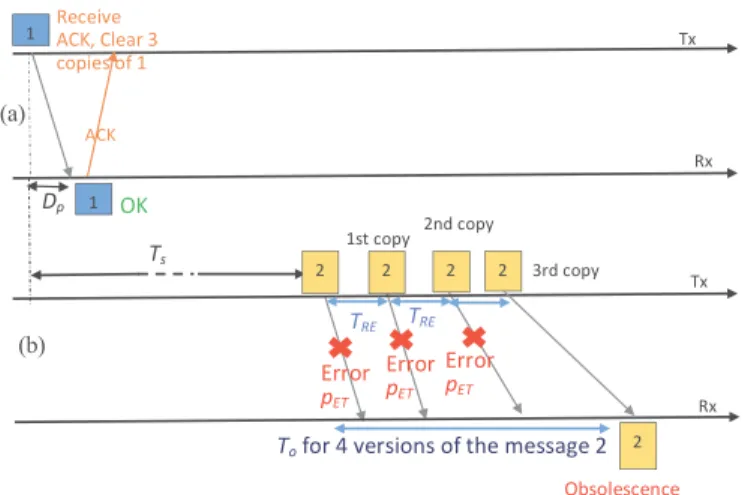
fDp(t) = λpexp(−λpt). (1) 2) Retransmission Mechanism: The goal of this paper is to propose a new methodology that could be applied in multiple different communication technologies. Therefore, we present in this section a general retransmission mechanism. When a message is sent,nrcopies are created. If the transmitter (Tx)
re-ceives ACK sent by the receiver (Rx), these copies are deleted, for example, see Fig. 1.1) when Tx receives ACK from Rx. Next, for the message 2, see Fig. 1.2), after the retransmission time,TRE, if Tx does not yet receive ACK, it send another copy
until all nrcopies are sent. For GSM-R and WILAN,nr= 0
when we do not consider the retransmission mechanism. For LTE, we consider the Sync HARQ with nr= 3. Due to
tem-porarily bad radio signal conditions, the packet loss occurs with rate pET. The obsolescence deadlineTo includes the nr+ 1
versions of a message (1 original version and nrcopies). For
example, see Fig. 1.2), Rx does not receive the original version and two first copies of message 2 due to packet loss errors. Next, the third copy arrives at Rx after the obsolescence deadlineTo
(counted from the first sending time of the message 2), then it
Fig. 1. Examples for the transmission and retransmission mechanisms.
is considered as an obsolescent message and does not valid for train control application.
3) Connection Loss: LetDl be the time to the connection
loss, in other words, the on-time duration of connection, and letDrcbe the reconnection time.Dlis assumed to follow the
exponential distribution, [18]:
fDl(t) = λlexp(−λlt). (2)
The train hardware detects this state after some time-out, Td and tries to establish a new connection with the failed
reconnection probabilitypf. In detail, when the reconnection
duration is greater than b, the re-establishment is considered as false and then another attempt is made, [18]. The recovery time of a successful connection is assumed to follow the uniform distribution of UNIF[a, b]. Thus, for h reconnection withh ∈ {1, 2, . . . , ∞}, the probability density function of the reconnection time is given by:
fDrc(t) = 0 t ≤ a (1 − pf)b−a1 t ∈]a, b] . . . 0 t ∈](h − 1)b, (h − 1)b + a] (1 − pf)p(h−1)f b−a1 t ∈](h − 1)b + a, hb]. (3) If the connection is established at the first attempt, h = 1, then the reconnection time,Drc, belongs to the interval[a, b].
The probability that the connection is successful at the first attempt is 1 −pf. Therefore, the probability density function
of the reconnection time is given byfDrc = 0 for t ≤ a and
fDrc = (1 − pf)/(b − a) for t ∈]a, b]. Next, the probability
that the first attempt of reconnection is failed and the second reconnection is successful(h = 2) is (1 − pf)pf. In this case,
the reconnection time Drc, only belongs to the interval]b +
a, 2b]. Similarly, if the (h − 1)-th attempts are failed and the h-th reconnection is successful, the reconnection time Drconly
belongs to the interval](h − 1)b + a, hb].
4) Handover Performance:Handover processes occur every time the train crosses the limit between the communication areas of two neighboring radio base stations (called eNodeB in an LTE network). When the train is operating normally, the
inter-occurrence time of handovers can be associated with one of the two assumptions that follow:
• either it can be considered as a constant,THo (s). Then,
the distribution of timeDk when handover occurs for the
k-th time is:
FDk(t) = δ{t≥kTHo} (4)
where δ{condition}= 1 when the condition is true and
δ{condition}= 0 when the condition is false.
• or it can be considered as independent and exponentially distributed with the rateλHo[18]. Then, the distribution
of the time Tk when handover occurs for the k-th time
follows the Gamma law: FDk(t) = 1 − k−1 X j=0 (λHot)j j! exp(−λHot). (5) The execution time of handovers is assumed to follow the exponential distribution with the rate λeH, [18]. Let DeH be
the handover delay, then its pdf is:
fDeH(t) = λeHexp(−λeHt). (6)
When the packet is sent during the handover processes, its transmission delay is defined byDeH+ Dp.
III. ANALYSIS OFPRINCIPALTYPES OFCOMMUNICATION
ERRORS IN THETCS
For the advanced TCS, a single communication error (such as losing one packet) can be negligible. The communication error becomes important when a fixed time interval is exceeded. In other words, missing consecutive valid messages at the train or the TCC will lead toCE. Therefore, in this section, we will analyze the principal types of communication errors that can lead to missing consecutive valid messages at the receiver. In general, these errors are classified by the following types:
• Type A—loss ofn consecutive messages in normal con-dition (without a handover process or a connection loss) wheren is the minimum number of invalid messages that can lead to theCE.
• Type B—long execution time of handovers during more thanT1s whereT1is the minimal duration of errors that
can lead to theCE.
• Type C—long timeout of connection during more than T1(s).
• Hybrid type, i.e., the combination between the above types. The higher the combination order between error types is, the lower the occurrence probability of this event is. Then only the combination of order 2 (i.e., combination between 2 error types) is considered in this paper: 1) combination between packet losses and a handover. 2) combination between packet losses and a connection
loss.
3) combination between a handover and a connection loss.
Fig. 2. Time chart of the occurrence of error Type A.
Because of the complexity, the analytical analysis for the hybrid error types is not presented in this section. It will be approxi-mated for a particular case study in Section IV. The value ofn, T1will also be investigated in Section IV-C.
A. Occurrence Probability of Error Type A
In this paragraph, the mathematical formulation of the prob-ability thatn consecutive valid messages cannot arrive at the receiver during normal connection will be derived. As presented in the above section, a message is considered as failed when thenr+ 1 packets of the retransmission mechanism are failed.
In fact, during normal connection period (without connection loss or handover procedure), the packet error at the reception is caused by:
• the packet error rate,pET.
• the packet obsolescence: transmission time is more than the obsolescence deadline,To.
Then, the probability that thei-th packet transmission is incor-rect is given by:
pi= pET + P (Dp≥To−(i − 1)TRE) . (7)
As the errors of packet transmission during normal connection are independent, the probability that a message transmission is failed,pm, is given by:
pm= nr+1
Y
i=1
[pET + P (Dp≥To−(i − 1)TRE)] . (8)
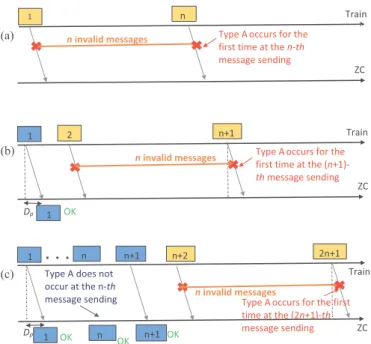
LetQibe the probability that error type A occurs for the first
time at thei-th message sending. It is easy to see that: Qi= 0
fori < n and the probability that error type A occurs at the n-th message sending, Fig. 2(a) is:Qn = pnm.
Then, the probability that error type A occurs for the first time at the (n + h)-th message sending is: Qn+h= (1 −
pm)pnmfor 0< h ≤ n. Indeed, we find that error type A occurs
for the first time at the(n + h)-th message sending (0 < h ≤ n) if the h-th message is valid at the receiver and then, n next consecutive messages are failed, for example,h = 1, Fig. 2(b). Next, considering Fig. 2(c), error type A occurs for the first time at the(2n + 1)-th message sending if:
• the train receives the(n + 1)-th message, then it does not receiven next consecutive messages.
• and error type A does not occur for the first time at the n-th message sending. Q2n+1= (1 − pm)pnm(1 − Qn). Similarly, we have: Q2n+2= (1 − pm)pnm à 1 − n+1 X h=n Qh ! .
In summary, the probability that error type A occurs for the first time at thei-th message sending is given by:
Qi= 0 i < n pn m i = n (1 − pm)pnm n < i ≤ 2n (1 − pm)pnm ³ 1 −Pi−n−1 h=n Qh ´ i ≥ 2n + 1. (9)
Therefore, we obtain the following property:
Property 1: LetNm(t) be the number of train messages that
are sent during[0, t], t > Ts,Nm(t) = int[t/Ts] where int[x] is
the integer part ofx; and let DAbe the occurrence time of error
type A. The probability that error type A occurs during[0, t] can be calculated by: P(DA≤t) = Nm(t) X i=n Qi (10)
whereQiis defined by the (9).
B. Distribution Function of Error Type B
Error type B can only occur during handover process. LetDB
be the first time occurrence of error type B thenDB is always
greater thanT1. It is easy to see that:
P(DB ≤t) = 0 ∀t < T1.
It remains to calculate FB(t) = P(DB≤t) for t ≥ T1. As
the occurrence times of handover are totally independent of the time when the previous handover process finishes, the probability that error type B occurs for the first time during the k-th handover process at t is:
FBk(t) = P (Dk+ T1≤t, DeH1 < T1, . . .
. . . , DeHk−1< T1, DeHk ≥T1
¢
where Dk is the k-th occurrence time of handover process,
defined by (4) or (5);DeHk is the execution time of thek-th
handover, defined by (6). As the occurrence times of handover and their relevant execution times are independent, theFBk(t)
can be rewritten as:
FBk(t) = P(Dk ≤t − T1)(1 − e
−λeHT1)(k−1)e−λeHT1. (11)
Finally, we obtain the following property.
Property 2: The probability that att, t > T1, the handover
execution time is more than a certain time,T1(s), which is the
distribution function of error type B, is given by: FB(t) = ∞ X k=1 P(Dk≤t−T1)(1−e−λeHT1) (k−1) e−λeHT1 (12) where P(Dk ≤t − T1) is calculated by (4) or (5). C. Distribution Function of Error Type C
Recall that:
• Dl1, . . . , Dlk are i.i.d. following (E(λl)), they are the
durations associated to connection losses.
• Doc1, . . . , Dock are the out-time durations of connection
whereDock= Drck+ Td given thatDrck are i.i.d.
fol-lowing(fDrc(t)) and is the time to reconnection and that
Tdis the time to detect the timeout.
(Dlk)k≥1 and (Drck)k≥1 are independent.
LetDCbe the first time occurrence of error type C. Similarly
to case B, we have: P(DC≤t) = 0, ∀t < T1and it remains to
calculate:
FC(t) = P(DC≤t) for t ≥ T1.
IfDockis the first out-time duration which is longer thanT1
then:
DC= (Dl1+Doc1)+ · · · +¡Dlk−1+Dock−1¢ +Dlk+T1. (13)
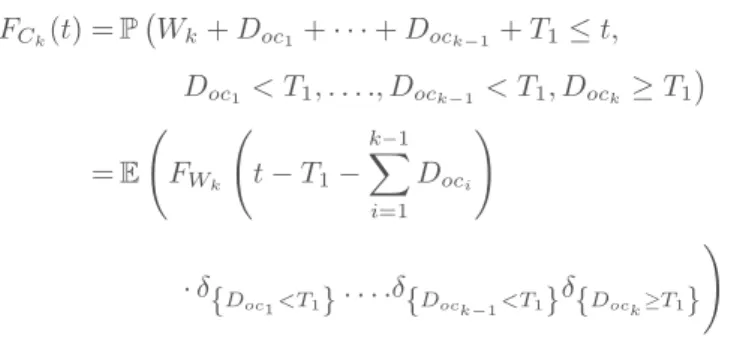
The probability that error type C occurs att is given by: FC(t) = ∞ X k=1 FCk(t) where FCk(t) = P¡DC≤t, Doc1< T1, . . . , Dock−1< T1, Dock≥T1¢ .
Because(Dlk)k≥1 are i.i.d. with exponential distribution
fol-lowingE(λl), the random variable Dl1+ · · · + Dlkis
Gamma-distributed with parameters (k, λl). Furthermore as (Dlk)k≥1
can replace the sum Dl1+ · · · + Dlk by a random variable Wk∼Γ(k, λl). Hence we obtain: FCk(t) = P¡Wk+ Doc1+ · · · + Dock−1+ T1≤t, Doc1 < T1, . . . ., Dock−1 < T1, Dock≥T1 ¢ = E à FWk à t − T1− k−1 X i=1 Doci !
· δ{Doc1<T1} . . . .δ{Dock−1<T1}δ{Dock≥T1}
!
whereFWkis the c.d.f. ofWk.
Property 3: The distribution function of error type C when the time of connection is more than a certain timeT1is written
byP∞ k=1FCk FCk(t) = T1C Z 0 . . . T1C Z 0 FWk(·)dDrc1. . . dDrck−1 · ∞ Z T1C fDrc(uk)duk (14)
wherefDrc(t) is defined in (3), T1C= T1−Td, andFWk(·) =
FWk(t − T1−
Pk−1
i=1Doci), given that:
FWk(t) = 1 − k−1 X j=0 (λlt)j j! exp(−λlt) for t ≥ T1+ (k − 1)Td.
IV. COMPARISONBETWEENANALYTICALAPPROACH AND
SIMULATIONAPPROACH: VALIDATION ON ACASESTUDY
In the previous section, we derive three properties for eval-uating the occurrence probabilities of the principal communi-cation error types. In this section, using these properties, we calculate the occurrence probability of theCE, e.g., “sending
an emergency braking message from TCC to train 2” due to communication errors between the TCC and train 1. This is a probability related to the Tb value mentioned in Section I.
We will firstly describe the case study in Section IV-A. Next, the simulation approach (PN here) will be is briefly in Section IV-B. Finally, the analytical process will be performed (by Matlab) in order to evaluate theCE probability occurrence in Section IV-C. We also compare the results obtained by every step of the analytical process to the ones obtained by the PN simulation to verify their accuracy.
Note that the mathematical formulas in Section IV-C could be evaluated by any numerical computing environment, such as Matlab, R, C++, etc. In this paper, we use Matlab. On the other hand, according to standard IEC 61508-part 6 (page 76), the PN based on Monte Carlo simulation is an efficient method for modeling dynamic system. Therefore, we believe that a comparison with a PN simulation tool (of GRIF platform) is enough to highlight the performance of the proposed approach, which is totally independent of the PN simulation. In fact,
TABLE I
INPUTPARAMETERS FOR THECASESTUDY
Fig. 3. Distribution of eNode-B along the urban railway line.
our analytical approach is not time-consuming. It allows us to avoid the simulation execution time and to obtain results as good as the one of the classic PN simulation. The difference between analytical result(AR) and simulation result (SR) is quantitatively evaluated by the relative error,ǫr:
ǫr=
|AR − SR|
SR . (15)
A. Description of the Case Study
Considering the train’s journey time,Tm= 3600 s (average
journey duration of urban train, [23]). Several values of Ts,
the interval time between two consecutive position message sending of the train, are chosen in the context of CBTC systems (in the SYSTUF project3), T
s∈[0.2, 0.6] s. Note that these
values are very low compared to the value of 5 s mentioned in ETCS requirements. This is due to the continuous monitoring requirements for the Mass Transit system—CBTC, aiming to enforce train speed profiles, headway and dwell times, [4]. As LTE technology is considered as the final answer-piece in the puzzle to the convergence prospect between ETCS and CBTC systems, our case study is dedicated to a simple example of LTE-based TCS, and furthermore the parameter values in both reference sections of ETCS and CBTC can be inherited, given in Table I.
Note that the input parameters are chosen(1)based on [18],(2) based on [9] (mean transfer delay for a message of 500 bytes is about 5 ms),(3) based on [27],(4) based on [28] with the assumption that the target cell is already known,(5) arbitrarily but try to come close to reality.4 In fact, Fig. 3 presents the considered distribution of the eNodeB along the urban railway line. As the distance between two eNodeB is fixed and also the relevant velocity parameters of the train are specified in advance, then the occurrence time of the handover could be considered as constant,THos for a given radio planning.
3http://systuf.ifsttar.fr/index-en.php 4Project SYSTUF.
Fig. 4. PN structure for the ZC operation model.
B. Modeling and Simulation Approach Applied to the Case Study
Petri net (PN) is a graphical and mathematical formalism for modeling discrete event systems with time-dependent behav-iors and is widely employed to model complex systems, [29]. Simulation of PN models is a common technique to perform dependability assessments.
In this paper, we propose to use the PN module of the soft-ware platform GRIF5for evaluating the occurrence probability
of the CE. In detail, SPN with predicates and assertions are used to model the CBTC system based on the LTE technology. Note that in the CBTC system, the TCS is normally called zone controller (ZC). For quantitative evaluation, a high-speed Monte Carlo simulation engine (MOCA-RP) is used.
The CBTC system is modeled with 4 sub-nets describing: 1) handover procedure
2) re-connection procedure
3) transmission and re-transmission procedure 4) Zone controller (ZC) operation.
The sub-nets modeling procedures 1, 2, and 3 are similar to those presented in [20]. Fig. 4 presents the sub-net for modeling the ZC operation: “sending emergency braking message”. In detail, after receiving a valid packet from the train, “Tr12” is triggered and the ZC sends an ACK to the train, i.e., the token in “packet_OK” place (num. 6) is removed and another is created in “ZC_ACK” place (num. 12). The ACK processing of the train is modeled in the “transmission and re-transmission” sub-net described in [20]. Another token simultaneously comes to the “ZC_preaction” place (num. 7). Within the deadlineTo
of the train message, if the ZC receives another copy of this train message, these copies are rejected, i.e., the “rejectdouble” transition is then triggered. When a token is created in place 58, the timer (place 11 that validates the “Tr20” transition for the Tb time counting) is reset. If not, after Tb s, the ZC sends an
emergency braking message to train 2 and the variable “CE” is set to true.
5GRaphical Interface for reliability Forecasting, http://grif-workshop.com/
grif/petri-module/.
Fig. 5. Missing consecutive valid messages for more than Tbs due to
commu-nication error Type A.
C. Formulation of the Analytical Approach and Discussion of the Accuracy of Its Results
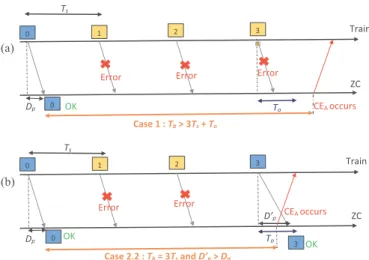
1) Missing Consecutive Valid Messages for More ThanTbs Due to the Communication Error Type A: In the Section III-1, the occurrence probability of error type A (n consecutive valid messages cannot arrive at the receiver during normal connec-tion) was evaluated. Now, in this section we will present the way to evaluate the occurrence probability of theCE caused by error type A(CEA). This way depends on the relationship
betweenTb(maximum accepted duration without valid position
message) andTs(time between two position/integrity messages
generated by the train). In detail, the occurrence probability of CEA will be evaluated in the following two cases (wheren is
an integer such asn = int [Tb/Ts]):
1) Tb> nTs+ To
2) Tb= nTs.
AsTo is very small, it is not necessary to consider the case
nTs< Tb< nTs+ To. This case can be considered as the
caseTb= nTs.
In the first case whenTb> nTs+ To(cf. case 1) in Fig. 5
wheren = 3), the CE occurs when n consecutive messages are invalid. In this case the pdf of theCEAis given by (9).
In the second case whenTb= nTs, theCEAwill occur if:
1) n consecutive messages are invalid (similar to the first case), or
2) only(n − 1) consecutive messages are invalid with the condition that the transmission delay of then-th message, D′
p, is superior to the transmission delay Dp of the
message 0. The message 0 is the last valid message that arrives at the ZC before the missing consecutive mes-sages, (cf. case 2) in Fig. 5 wheren = 3). The probability thatD′ p> Dpis calculated by: P¡D′ p> Dp¢ = ∞ Z 0 ∞ Z y fD′p(x)dx.fDp(y)dy = ∞ Z 0 exp(−2λpy)λpdy = 0.5.
Fig. 6. Occurrence probability of error Type A according to the relationship between Tb and Ts. Note: Simul—Simulation approach; Anal—Analytical
approach. The relative error between two approaches is presented by percentage numbers in the figure.
Then, the probability thatCEA occurs for the first time at the
n-th message sending is given by:
Qn= P¡Dp′ > Dp¢ · P (only (n − 1) invalid messages)
+ P (n invalid messages)
= 0.5pn−1m (1 − pm) + pnm= 0.5¡pn−1m + pnm¢ .
Therefore, from (9), the pdf of theCEA(missing consecutive
valid messages for more thanTbs) can be rewritten as follows:
Qi= 0 i < n 0.5¡pn−1 m + pnm ¢ i = n (1 − pm)0.5¡pn−1m + pnm ¢ n < i ≤ 2n (1 − pm)0.5¡pn−1m + pnm ¢ ׳1 −Pi−n−1 h=n Qh ´ i > 2n. (16)
Fig. 6 compares the results between the analytical approach and the simulation approach of the occurrence probability of the CEA (presented by the vertical axis) during a train
journey whenpET = 0.1, Tb= Ts+ 0.1 (an example for the
caseTb> nTs+ To) orTb= 2Ts(an example for the case
Tb= nTs). We find that the results for both approaches are
almost the same. In fact, theǫr, that is presented by percentage
number according to every value point ofPCEA, is smaller than
1.3% for all cases.
Then, the analytical approach is used to consider how Tb
is chosen in order to limit the impact of error type A on the CE during a train journey. It means that Tb is investigated
such as PCEA(1 h) ≤ 1E − 5. Table II presents the occurrence
probability of theCEAaccording to every value ofTs,pET,Tb.
All probability values are indicated in the second line of each row corresponding to a value of pET. Hereunder are two
examples taken from Table II:
1) forTs= 0.2 and pET = 0.1, the occurrence probability
ofCEAcan be negligible whenTb ≥ 0.7.
2) forTs= 0.2 and pET = 0.4, the occurrence probability
ofCEAcan be negligible whenTb ≥ 1.3.
2) Missing Consecutive Valid Messages for More ThanTbs Due to the Communication Error Type B:Let message 0 be the last valid message that arrives at the ZC before the handover
TABLE II
CHOOSINGTbACCORDING TOTsANDpETINORDER TOLIMIT THEOCCURRENCEPROBABILITY OFCEA
Fig. 7. Illustration of CEBwhen Tb> nTs+To.
occurrence. Similarly to the previous subsection, the occurrence probability of theCE caused by error type B, CEB will be
evaluated in two cases.
For the first case whenTb> nTs+ To(cf. the example in
Fig. 7 withn = 3), the CEBoccurs at thek-th handover when
the execution time of the handover is more than T1 s. T1 is
given by: T1= (n − 1)Ts+ To+ ³ inthDk Ts i + 1´Ts−Dk; whenmod³Dk Ts ´ > 0 (n − 1)Ts+ To; whenmod ³ Dk Ts ´ = 0 (17)
wheren = int [Tb/Ts], Dk is the occurrence time of thek-th
handover,mod(Dk/Ts) is the remainder when we divide Dk
byTs.
Then, from (11), the probability of the CEB occurs for
the first time at the k-th handover when Tb> nTs+ To is
given by:
P(CEBk) = δ(Dk≤t−Tb)(1 − e
−λeHT1)(k−1)e−λeHT1 (18)
whereDk= kTHo when the time intervalTHo between two
handover occurrences is assumed to be constant.
For the second case whenTb= nTs, theCEBoccurs for
the first time at thek-th handover when:
1) the execution time of the handover is more thanT1, given
by (17).
2) or the execution time of the handover is more thanT′ 1=
[T1−T s]+ (where[x]+= max[0, x]) and the
transmis-sion delay of the n-th message, D′
p is superior to the
transmission delay Dp of the message 0. (Fig. 8 when
n = 3).
Then, whenTb= nTs, the probability thatCEBoccurs for
the first time at thek-th handover is given by:
P(CEBk) = δ(Dk≤t−Tb) " 1 − k−1 X i=1 P(CEBi) # · [P(DeH > T1) + 0.5P (T1′ ≤DeH ≤T1)] . (19)
Fig. 8. Illustration of CEBwhen Tb=nTs.
Fig. 9. Occurrence probability of error Type B according to the relationship between Tb and Ts. Note: Simul—Simulation approach; Anal—Analytical
approach. The relative error between two approaches is presented by percentage numbers in the figure.
TABLE III
CHOOSINGTbACCORDING TOTsANDmeHINORDER TOLIMIT THEOCCURRENCEPROBABILITY OFCEB
Fig. 9 compares the results between the analytical approach and the simulation approach of the occurrence probability of theCEB(presented by the vertical axis) during a train journey
whenTb= 2Ts+ 0.1 (an example for the case Tb> nTs+
To) andTb= 3Ts(an example for the caseTb= nTs). We
find that the results of two approaches are almost the same. In fact, theǫr, that is presented by percentage number according to
every value point ofPCEB, is not important. In the worst case,
whenPCEB < 0.005, then ǫr< 5% of PCEB obtained by the
simulation approach.
Then, the analytical approach is applied to evaluate the occurrence probability of rare events in order to consider for which value of Tb, the impact of error Type B during a train
journey can be negligible(PCEB(1 h) ≤ 1E − 5). Hereunder
are two examples taken from Table III that has the same presen-tation principles of Table II:
1) ForTs= 0.2 and meH = 0.05, the occurrence
probabil-ity ofCEBcan be negligible whenTb≥ 1.2s. CEBcan
be negligible whenTb≥ 1.8s.
2) ForTs= 0.2 and meH = 0.096, the occurrence
probabil-ity ofCEBcan be negligible whenTb≥ 2s.
3) Missing Consecutive Valid Messages for More ThanTbs Due to the Communication Error Type C: As the connection
loss rate is 10−4/h [18], the probability that the connection loss
occurs more than 2 times during a train journey is negligible. Therefore,FC(t) can be re-written as:
FC(t) = FW1(t − T1) ∞
Z
T1C
fDrc(u)du (20)
whereT1C= [T1−Td]+;fDrc(u) is given by (3)
FW1(t − T1) = 1 − exp (−λl(t − T1)) .
Similarly to the communication error Type B, the occurrence probability of theCECis calculated in the following two cases:
For the first case whenTb> nTs+ To,CECoccurs if the
connection time-outDocis more thanT1, that is given by (17)
when replacingDkbyDl.
whereDlis the occurrence time of thel-th connection loss.
As(n − 1)Ts+ To≤T1< nTs+ To, from (20), the
occur-rence probability of theCECin this case is:
PCECinf(t) ≤ PCEC(t) < PCECsup(t) PCECinf(t) = FW1(t − Tb) ∞ Z T1Cinf fDrc(u)du PCECsup(t) = FW1(t − Tb) ∞ Z T1Csup fDrc(u)du (21) where T1Csup = [(n − 1)Ts+ To−Td] +, and T 1Cinf = [nTs+ To−Td]+.
For the second case when Tb= nTs, similarly to error
type B, the probability thatCECoccurs during[0, t] is given by:
PCECinf(t) ≤ PCE(t) < PCECsup(t) PCECinf(t) = FW1(t − Tb) ·0.5 P¡T1C′ inf ≤Drc≤T1Cinf ¢ + P (Drc> T1Cinf) ¸ PCECsup(t) = FW1(t − Tb) " 0.5 P³T1Csup′ ≤Drc ≤T1Csup ´ + P¡Drc> T1Csup ¢ # (22) whereT1C′
inf = T1Cinf−TsandT1C′sup= T1Csup−Ts.
Fig. 10 compares the results between the analytical approach and the simulation approach of the occurrence probability of the CECduring a train journey, according toTb∈[1, 6] s. We find
that the simulation results are between the inferior threshold (PECCinf) and superior threshold (PECCsup) of the analytical
approach. Then, hereafter the probability thatCE occurs due to error type C can be approximated by:
PECC(t) =
PECCinf(t) + PECCsup(t)
2 . (23)
The maximal value of PECC(t) during a journey is about
10−4. Hence, the occurrence probability of any hybrid commu-nication error where one error among the two is a connection loss, is always inferior to 10−4. Therefore, the hybrid error where one error among the two is a connection loss can be negligible in further works.
Fig. 10. Occurrence probability of error Type C according to the relationship between Tb and Ts. Note: Simul—Simulation approach; Anal—Analytical
approach.
4) Missing Consecutive Valid Messages for More ThanTbs Due to the Hybrid Error “Error Type A and Error Type B”:
In this section, we examine the cases, in which error Type A occurs before or after the handover process, and this combina-tion leads to missing consecutive valid messages for more than Tb(s). It is called error Type H.
Note that for this hybrid error type, we consider that the du-ration of handover cannot directly lead toCE as this case was presented before. So, error type A is combined with handover processes in order to haveCEH.
Similarly to other error types, the occurrence probability of error Type H is evaluated in two different cases linking Tb
andTs.
For the first case whenTb> nTs+ To,
• The occurrence probability ofCEH, caused by the event
that one message is invalid due to error type A before (or after) thek-th handover, is given by:
PCEH_1(k − th handover) = 2pm
· P¡[T1−Ts]+≤DeH < T1¢ . (24)
wherepmis given by the (8) andT1is given by the (17).
• Similarly, the occurrence probability ofCEH, caused by
the event thati messages are invalid due to error type A before (or after) thek-th handover, is given by:
PCEH_i(·) = 2p i m· P µ[T1−i · Ts]+≤DeH < [T1−(i − 1)Ts]+ 
• Hence, the occurrence probability ofCEHis given by:
PCEH(·) = (n−1) X i=1 PCEH_i(·). (25) We find that PCEH_1(·) PCEH_i(·) =exp (−λeH· (i − 1)Ts) pi−1 m .
When (PCEH_1(·))/(PCEH_i(·)) ≫ 1, the PCEH can be
approximated by the PCEH_1.
For the second case whenTb= nTs,
• The occurrence probability ofCEH, caused by the event
that one message is invalid due to error type A before (or after) thek-th handover, is given by:
PCEH_1(.) = 2pm·µP ¡Dp> Dp′¢ P(T1_s1≤DeH < T1) + P¡Dp≤Dp′¢ P(T1_s2< DeH < T1_s1) ¶ = pm·µP(T1_s1 ≤DeH < T1) + P(T1_s2< DeH < T1_s1) ¶ = pm· P(T1_s2≤DeH < T1) (26)
wherepmis given by (8),T1is given by (17), andT1_si=
[T1−i · Ts]+.
• Similar to the first case, the occurrence probability of CEHcould be approximatively byCEH_1.
5) Analytical Process for Evaluating the Occurrence Proba-bility ofCE During the Mission Time:
Input: Tb, Ts, To, Tm and all parameters characterized the
WCS performance(λl, λp, λeH, pf, a, b, Td, THo, TRE, pET).
Output: Probability thatCE occurs during the mission time (Tm) of the train, PCE(Tm)
Initialisation:i = 1
1: Evaluate the probability PCE1, thatCE occurs for the first
time before the first handover. Evaluate PCEA(t ≤ THo) by
Eq. (9) ifTb> nTs+ To
Eq. (16) ifTb= nTs
Evaluate PCEC(t ≤ THo) by
Eq. (21) & Eq. (23) ifTb> nTs+ To
Eq. (22) & Eq. (23) ifTb= nTs
PCE1 = PCEA(t ≤ THo) + PCEC(t ≤ THo). LOOP Process
2: fori = 2 to int [(Tm−Tb)/THo] do
3: Evaluate the probability ¯PCEthatCE does not occur yet
until thei-th handover. ¯ PCEi= 1 − i−1 X j=0 PCEj 4: Evaluate PCEA((i − 1)THo< t ≤ iTHo) by Eq. (9) ifTb> nTs+ To Eq. (16) ifTb= nTs 5: Evaluate PCEC((i − 1)THo < t ≤ iTHo) by Eq. (21) ifTb> nTs+ To Eq. (22)Tb= nTs 6: Evaluate PCEB((i − 1)THo < t ≤ iTHo) by δ{t≥THo+Tb}P(DeH > T1) if Tb> nTs+ To δ{t≥THo+Tb}[P(DeH > T1) + 0.5 P (T ′ 1≤DeH ≤T1)] if Tb= nTs 7: Evaluate PCEH((i − 1)THo< t ≤ iTHo) by Eq. (24) ifTb> nTs+ To Eq. (26) ifTb= nTs
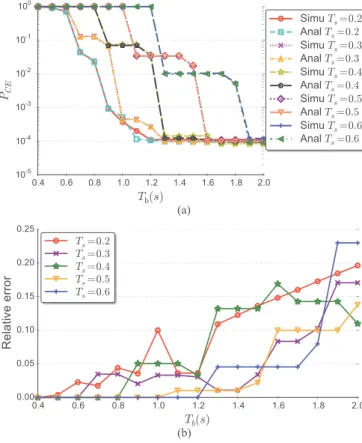
Fig. 11. Comparison between analytical and simulation results of PCE.
Note: Simul—Simulation approach; Anal—Analytical approach. (a) Occur-rence probability of the CE according to Tb. (b) Relative error between
analytical and simulation results.
8: Evaluate the probability PCEi, that CE occurs for the
first time during](i − 1)THo, iTHo].
PCEi= ¯PCEi(PCEA(·) + PCEC(·) + PCEB(·) + PCEH(·))
9: end for
10: Evaluate the probability that CE occurs during the mission timeTm PCE(Tm) = inthTm−Tb THo i X i=1 PCEi 11: return PCE(Tm)
Fig. 11 presents the simulation results and the analytical results for the occurrence probability of theCE during a train journey according to Tb. We find that for the case study, the
analytical approach gives close results compared to the results of the simulation approach [see Fig. 11(a)]. However, for the small value of PCE (PCE ∼= 1E − 4), the relative error is
quite significant 0.2< ǫr< 0.25 [see Fig. 11(b)] because of the
simulation approach’s defect when evaluating the small proba-bilities. In fact, considering only 106scenarios, the simulation approach cannot give the results within 12 h, for example when Ts= 0.3 s and Tb> 1.2 s. Therefore, for small probabilities,
the analytical approach is more powerful. And based on the analytical approach result, we find that whenTbis large enough
compared toTs, the impact of error type A, B, and H can be
negligible. For example when Ts= 0.6 s and Tb= 2 s, the
occurrence probability of the CE strictly depends on error type C: “connection loss”, PCE(= 9.25E − 5) ≃ PCEC(=
9.27E − 5). Moreover, considering Fig. 10, the decreasing ofPCEC is not important according to Tb. Therefore, when
Tb = 2 s, it is not necessary to increase Tb in order to reduce
the occurrence probability ofCE. V. CONCLUSION
In this paper, we proposed a new analytical analysis to evaluate the consequences on safety level of the wireless communication errors in train control application. In detail, three principal error types, which lead to consecutive invalid messages, such as packet error rate, long handover execution time, and connection loss, were analyzed. The new analytical approach was developed to evaluate the occurrence probability ofCE: “missing invalid consecutive messages sent from the
train to the zone controller for more thanTbs”; whereTbis the
waiting time before sending an emergency braking message from the TCC to the train behind. When comparing the new ap-proach with the simulation apap-proach based on a Petri net model, we obtained the same results. Furthermore, the efficiency and the robustness of our analytical approach were highlighted in the cases of small probabilities ofCE when the accuracy of the simulation approach and its execution time cannot meet user requirements due to its approximate statistic calculations. Considering the case study of the LTE-based CBTC system, our approach was applied to identify the appropriate threshold of the waiting time, Tb, in order to limit the occurrence
probabilities of theCE according to every error type.
The analytical results presented in this paper constitute the prerequisite to analyze the RAMS parameters of the WCS in train control application. In order to ensure the desired level of performance for the safety application (CBTC here), according to the V-model of the product life-cycle presented in the EN 50126 standard, a new system (LTE-based communication system in this case) is not only evaluated and tested in the last phases after the complete development but also in the early design phases. Indeed, following the studies of [10], [11] corresponding to every proposed configuration (or architecture) of the LTE-based communication system, the performance parameters of the communication system (such as packet delay, packet error rate, communication loss rate, etc) can be obtained by OPNET simulation. Then, using these parameters as inputs, the analytical approach proposed in this paper can examine whether the studied system is able to guarantee a given level of performance (an acceptable value of the probability of the critical events) or not. Moreover, our analytical approach could be applied in order to identify the appropriate values for communication performance parameters. Therefore, it aims to make recommendations for implementing the appropriate architecture/configuration of the LTE based CBTC system.
On the other hand, as the assumption about exponential distribution of delay packet and of handover execution time is considered as limitation of our model. It should be better to study which distribution is more appropriate to empirical data. Note that the modification of these assumptions does not
significantly affect the proposed approach. Indeed, when con-sidering another distribution for packet delay, such as gamma or logistic distribution [7], we only re-evaluate the probability that the transmission time is more than the obsolescence deadline [in Eq. (7) of the Section III-A]. Finally, a further work could consider distance management between trains to perform the sensitivity analysis of the dependability and the safety parame-ters of the TCS based on WCS.
REFERENCES
[1] B. Ai et al., “Challenges toward wireless communications for high-speed railway,” IEEE Trans. Intell. Transp. Syst., vol. 15, no. 5, pp. 2143–2158, Oct. 2014.
[2] J. Moreno, J. M. Riera, L. D. Haro, and C. Rodriguez, “A survey on future railway radio communications services: Challenges and opportunities,”
IEEE Commun. Mag., vol. 53, no. 10, pp. 62–68, Oct. 2015.
[3] J. Cao, M. Ma, H. Li, Y. Zhang, and Z. Luo, “A survey on security aspects for LTE and LTE-A networks,” IEEE Commun. Surveys Tut., vol. 16, no. 1, pp. 283–302, 1st Quart. 2014.
[4] R. Alvarez and J. Roman, “ETCS L2 and CBTC over LTE—Convergence of the radio layer in advanced train control systems,” presented at the IRSE Technical Meeting, Perth, WA, Australia, Oct. 2013.
[5] B. Ai, X. Cheng, L. Yang, Z. D. Zhong, J. W. Ding, and H. Song, “Social network services for rail traffic applications,” IEEE Intell. Syst., vol. 29, no. 6, pp. 63–69, Nov. 2014.
[6] B. Ai et al., “Future railway services-oriented mobile communications network,” IEEE Commun. Mag., vol. 53, no. 10, pp. 78–85, Oct. 2015. [7] J. Xun, B. Ning, K.-P. Li, and W.-B. Zhang, “The impact of
end-to-end communication delay on railway traffic flow using cellular automata model,” Transp. Res. C, Emerg. Technol., vol. 35, pp. 127–140, 2013. [8] B. Bu, F. Yu, and T. Tang, “Performance improved methods for
communication-based train control systems with random packet drops,”
IEEE Trans. Intell. Transp. Syst., vol. 15, no. 3, pp. 1179–1192, Jun. 2014. [9] T. Xu and T. Tang, “The modeling and analysis of Data Communication System (DCS) in Communication Based Train Control (CBTC) with Colored Petri Nets,” in Proc. 8th ISADS, Mar. 2007, pp. 83–92. [10] A. Sniady, J. Soler, M. Kassab, and M. Berbineau, “Ensuring ETCS data
integrity in LTE,” IEEE Veh. Technol. Mag., vol. 11, pp. 60–70, 2016. [11] A. Khayat, M. Kassab, M. Berbineau, M. A. Abid, and A. Belghith,
“Based communication system for urban guided-transport: A QoS perfor-mance study,” in Communication Technologies for Vehicles, ser. Lecture Notes in Computer Science. Berlin, Germany: Springer-Verlag, 2013, pp. 197–210, doi: 10.1007/978-3-642-37974-1_16.
[12] L. Lei et al., “Stochastic delay analysis for train control services in next-generation high-speed railway communications system,” IEEE Trans.
Intell. Transp. Syst., vol. 17, no. 1, pp. 48–64, Jan. 2016.
[13] L. Xiaojuan and Z. Yanpeng, “A fast handoff algorithm with high reliability and efficiency for CBTC systems,” in Proc. TMEE, 2011, pp. 1461–1464.
[14] L. Zhu, F. R. Yu, B. Ning, and T. Tang, “Handoff performance improve-ments in MIMO-enabled communication-based train control systems,”
IEEE Trans. Intell. Transp. Syst., vol. 13, no. 2, pp. 582–593, Jun. 2012. [15] M. Cheng, X. Fang, and W. Luo, “Beamforming and positioning-assisted
handover scheme for long-term evolution system in high-speed railway,”
IET Commun., vol. 6, no. 15, pp. 2335–2340, Oct. 2012.
[16] L. Zhu, F. R. Yu, B. Ning, and T. Tang, “Communication-Based Train Control (CBTC) systems with cooperative relaying: Design and performance analysis,” IEEE Trans. Veh. Technol., vol. 63, no. 5, pp. 2162–2172, Jun. 2014.
[17] Railway Applications Communication, Signalling and Processing Systems
Safety Related Electronic Systems for Signalling, CENELEC European standard (European Committee for Electrotechnical Standardization), EN 50129, 2003.
[18] A. Zimmermann and G. Hommel, “Towards modeling and evaluation of ETCS real-time communication and operation,” J. Syst. Softw., vol. 77, no. 1, pp. 47–54, 2005.
[19] H. Zhao, T. Xu, and T. Tang, “Towards modeling and evaluation of avail-ability of Communication Based Train Control (CBTC) system,” in Proc.
IEEE ICCTA, Oct. 2009, pp. 860–863.
[20] K. Nguyen, J. Beugin, M. Berbineau, and M. Kassab, “Modelling com-munication based train control system for dependability analysis of the LTE communication network in train control application,” in Proc. EMS, Oct. 2014, pp. 320–325.
[21] T. Babczynski and J. Magott, “Dependability and safety analysis of ETCS communication for ERTMS level 3 using performance statecharts and analytic estimation,” in Proceedings of the Ninth International
Con-ference on Dependability and Complex Systems DepCoS-RELCOMEX, Poland. Cham, Switzerland: Springer International Publishing, 2014, pp. 37–46, doi: 10.1007/978-3-319-07013-1_4.
[22] T. Babczynski and J. Magott, “New analytic estimation for dependability and safety of GSM-R communication in ERTMS level 3,” in Proc. 10th
Symp. FORMS, Braunschweig, Germany, Jan. 2014, pp. 146–155. [23] ETCS/GSM-R Quality of Service Operational Analysis EEIG ERTMS
Users Group, Brussels, Belgium, Oct. 2005.
[24] K. Nguyen, J. Beugin, M. Berbineau, and M. Kassab, “Analytical ap-proach for evaluating LTE communication errors in train control appli-cation,” in Proc. IEEE ICCW, Jun. 2015, pp. 2369–2374.
[25] “Commission decision on the technical specification for interoperability relating to the control-command and signalling subsystem of the trans-European rail system,” Official J. Eur. Union, T. E. Comm., Brussels, Belgium, Under Doc. C (2012) 172, vol. 55, Dec. 2012.
[26] E. Serpedin and Q. M. Chaudhari, Synchronization in Wireless Sensor
Net-works: Parameter Estimation, Performance Benchmarks and Protocols. New York, NY, USA: Cambridge Univ. Press, 2009.
[27] S. Kangude, “Lecture MAC—HARQ & scheduling. EETS 8316, wireless,” SMU Eng., Dallas, TX, USA, 2013.
[28] L. Zhu, F. R. Yu, and B. Ning, “Availability improvement for WLAN-based train-ground communication systems in Communication-Based Train Control (CBTC),” in Proc. IEEE 72nd VTC—Fall, Sep. 2010, pp. 1–5.
[29] T. Murata, “Petri nets: Properties, analysis, and applications,” Proc. IEEE, vol. 77, no. 4, pp. 541–580, Apr. 1989.
Khanh T. P. Nguyen received the B.E.E. degree
from Ho Chi Minh City University of Technology, Ho Chi Minh City, Vietnam, in 2008; the M.Sc.Tech. degree in system optimization and security from University of Technology of Troyes (UTT), Troyes, France, in 2009; and the Ph.D. degree in automation and production engineering from École Centrale de Nantes, Nantes, France, in 2012.
From March 2013 to December 2015, she was a Postdoctoral Researcher with the French Institute of Science and Technology for Transport, Development and Networks (IFSTTAR). She has been part of the European project GaLoROI in the field of global-navigation-satellite-system-based solutions embedded in train control applications and the SySTUF project in the field of long-term-evolution-based wireless communication links used in communications-based train control applications. Since 2016, she has been an Assistant Professor with UTT. Her research interests include system reliability, maintenance opti-mization, stochastic modeling, and safety assessment of railway safety-related systems.
Julie Beugin received the B.Eng. degree from
National School of Engineering in Computer Science, Automation, Mechanics and Electronics (ENSIAME), Valenciennes, France, in 2002; the M.Eng. degree in automation engineering from Uni-versity of Valenciennes, Valenciennes, in 2002; and the Ph.D. degree in automation engineering in 2006. Her Ph.D. dealt with the safety assessment of railway safety-related systems using risk concepts and reliability, availability, maintainability and safety (RAMS) evaluation methods. During these research works, she has been part of European projects in the field of urban guided transportations (UGTMS and MODUrban). Since 2007, she has been a Re-searcher with the French Institute of Science and Technology for Transport, Development and Networks. Her research interest is in dependability and safety evaluation of complex guided transportation systems. Part of her activities addresses RAMS demonstration issues of global-navigation-satellite-system-based solutions embedded in train control applications and were developed through the GaLoROI and the QualiSar European projects and through the Tr@in-MD project. Her recent activities address, in addition, the dependability analysis of long-term-evolution-based wireless communication links used in communications-based train control applications inside the SySTUF project.
Marion Berbineau received the M.Eng. degree in
electronics, automatic and metrology from Polytech Lille, Lille, France, in 1986 and the Ph.D. degree in electronics from University of Lille, Lille, in 1989.
In 1989, she joined the French Institute of Sci-ence and Technology for Transport, Development and Networks as a Researcher in wireless telecom-munications for transports. From 2002 to July 2013, she was the Director of the LEOST Laboratory. She is currently the Research Director and the Deputy Director of the Components and Systems Department that consists of 12 laboratories. She was involved in several national projects (CORRIDOR, MOCAMIMODYN, SYSTUF, and VEGAS) and European projects (MOSTRAIN, LOCOPROL, ESCORT, INTEGRAIL, BOSS, and GALOROI). She is currently involved in the ROLL2RAIL (H2020) project. She previously took part in the Global System for Mo-bile Communications—Railway (GSM-R) development in several European projects (MORANE) and is active as an expert in GSM-R deployment. She is an author and a coauthor of several publications and patents. Her fields of expertise are electromagnetic propagation and modeling, channel characterization and modeling for transport and complex environments particularly in tunnels, signal processing for wireless communication systems in multipath environments, multiple-input–multiple-output systems, and cognitive radio for intelligent transport systems and for railway applications including control command, video surveillance, and passenger information.
Mohamed Kassab received the B.Eng. degree in
computer sciences and the M.Sc. degree in computer networks from National School of Computer Studies, Manouba, Tunisia, in 2003 and 2004, respectively, and the Ph.D. degree in computer sciences from Telecom Bretagne, Brest, France, in 2008.
From 2009 to 2013, he was a Postdoctoral Fellow with the French Institute of Science and Technol-ogy for Transport, Development and Networks. In January 2014, he joined University of Monastir, Monastir, Tunisia, as an Assistant Professor. His re-search interests include wireless network architecture, quality-of-service man-agement and mobility manman-agement in wireless networks, machine-to-machine communication, and software-defined networks. He is particularly interested in the study of these issues in transportation contexts.