- - - -- -- - - ,
UNIVERSITÉ DU QUÉBEC À MONTRÉAL
INTEGRATED SPECIALIZED LEARNING APPLICATION (ISLA) FOR TEACHING ADDITION TO HIGH FUNCTIONING CHILDREN PRESENTING
AUTISM SPECTRUM DISORDER (ASD)
A DISSERTATION SUBMITTED
IN PARTIAL FULFILLMENT OF THE REQUIREMENTS
FOR THE DOCTORA TE OF COGNITIVE INFORMA TICS
BY
A YDÉE LIZA MONDRAGON
Avertissement
La diffusion de cette thèse se fait dans le respect des droits de son auteur, qui a signé le formulaire Autorisation de reproduire et de diffuser un travail de recherche de cycles supérieurs (SDU-522 - Rév.0?-2011 ). Cette autorisation stipule que «conformément à l'article 11 du Règlement no 8 des études de cycles supérieurs, [l'auteur] concède à l'Université du Québec à Montréal une licence non exclusive d'utilisation et de publication de la totalité ou d'une partie importante de [son] travail de recherche pour des fins pédagogiques et non commerciales. Plus précisément, [l'auteur] autorise l'Université du Québec à Montréal à reproduire, diffuser, prêter, distribuer ou vendre des copies de [son] travail de recherche à des fins non commerciales sur quelque support que ce soit, y compris l'Internet. Cette licence et cette autorisation n'entraînent pas une renonciation de [la] part [de l'auteur] à [ses] droits moraux ni à [ses] droits de propriété intellectuelle. Sauf entente contraire, [l'auteur] conserve la liberté de diffuser et de commercialiser ou non ce travail dont [il] possède un exemplaire.>>
UNIVERSITÉ DU QUÉBEC À MONTRÉAL
APPLICATION SPÉCIALISÉE INTÉGRÉE POUR L'APPRENTISSAGE DE L'ADDITION CHEZ LES PERSONNES AYANT DES TROUBLES
ENVAHISSANTS DE DÉVELOPPMENT DE HAUT NIVEAU
THÈSE PRÉSENTÉE
COMME EXIGENCE PARTIELLE
DU DOCTORAT EN INFORMATIQUE COGNITIVE
PAR
A YDÉE UZA MONDRAGON
- - - -- - · - - - - -- - -
--REMERCIEMENTS
Ce projet de recherche me tient à cœur. Il fait partie de ma vie et de la vie de ma famille proche. Depuis ses débuts, beaucoup de personnes ont contribué à sa réalisation. Je veux remercier Alejandro pour son endurance et son soutien inconditionnel. Je dois absolument remercier mes enfants autistes qui sont ma source de motivation et d'admiration. Leurs réussites sont ma source d'inspiration et leurs difficultés sont ma source d'apprentissage. Ils m'ont appris à vivre un jour à la fois.
Le domaine de l'éducation spécialisée pour les personnes autistes est un défi. Je veux remercier mes directeurs de recherche, M. Roger Nkambou et M. Pierre Poirier, de vos encouragements, de votre patience, de m'avoir écoutée et d'avoir soutenu mes idées ainsi que d'avoir façonné mes apprentissages pendant ce long parcours. Merci d'y avoir cru.
Mes remerciements spéciaux vont aux enfants autistes pour leur participation extraordinaire à cette recherche. C'est un honneur et un privilège pour moi de vous avoir rencontrés et d'avoir eu la chance de jouer avec vous le «Chalkboard Game.» Mes remerciements vont aussi aux parents que j'ai eu 1' opportunité de rencontrer en entrevue. Merci d'avoir cru à cette recherche.
Je dois remercier M. Michel Léonard du LICEF de sa disponibilité et de ses commentaires judicieux, ainsi que Mme. Aude Dufresne de l'Université de Montréal d'avoir répondu à mes questions et d'avoir bien voulu m'accorder de son précieux temps de retraite et l'emploi des équipements pour la validation de cette recherche.
Je remercie Dr. Reski Lounnas, Dr. CoiTea, ainsi que Mme. Irene Whist pour leur collaboration à ce projet. J'aimerais aussi remercier, mes professeurs et professionnels en autisme, Dr Sylvie Bernard et Dr. Normand Giroux, pour leurs précieux commentaires.
the li fe of my immediate family. Many people have contributed to its realization. I want to thank Alejandro for his endurance and his unconditional support. I must thank my autistic children who are my source of motivation and admiration. Their success is my source of inspiration; their difficulties are my source of learning. They taught me to live one day at a tirne.
The field of specialized education related to teaching autistic children is challenging. I want to thank my research directors, Mr. Roger Nkambou and Mr. Pierre Poirier for their encouragement, for their patience, for listening and for supporting my ideas. Y ou have shaped my learning during the course of this project. Thank you for having believed in me.
My special thanks go to the autistic children for their extraordinary participation in this research. It has been an honor and privilege for me to have met you and to have had the opportunity to play 'The Chalkboard Game.' with you.
I want to thank the parents who I had the opportunity to meet and interview. Thank you for believing in this research.
I have to thank Mr. Michel Leonard from the LICEF for his availability and his insightful comments, as well as Mrs. Aude Dufresne from the University of Montreal for having responded to my questions and for kindly granting me her precious retirement time and the provision of equipment for the validation of this research.
Thank you to Dr. Lounnas, Dr. Correa, as well as to Mrs. Irene Whist for their precious time and collaboration in this research. I am grateful to my teachers and professionals in autism, Dr. Sylvie Bernard, and Dr. Normand Giroux for their support.
TABLE OF CONTENTS
ACKN"OWLEDGMENTS ... i
REMERCIEMENTS ... i
TABLE OF CONTENTS ... ii
LIST OF FIGlJRES ... üi LIST OF TABLES ... iv ABSTRACT ... v RÉSUMÉ ... v CHAPTERI INTRODUCTION 1.1 Motivation 1.2 V arious components of the Thesis ... 2
1.3 The research question ... 4
CHAPTER IT AUTISM SPECTRUM DISORDER 2.1 The problem 2.2 Autism Spectrum Disorder (ASD) ... 6
2.3 Pervasive Development Disorder (PDD) ... 7
2.4 What is the Autism Spectrum Disorder? ... 7
2.5 Types of autism ... 8
2.5.1 Pervasive Developmental Disorder -Not Otberwise Specified (PDD-NOS) ... 9
2.5.2 Autism ... 9
2.5.3 Asperger's Syndrome ... 10
2.6 What causes autism? ... 11
2.6.1 Genetics ... 11
2.6.2 Environmental factors ... 12 2. 7 The prevalence of autism ... 13
CHAPTERID
METACOGNITION AND LEARNING 3.1 Introduction
3.2 The role ofthe Self-Regulated Learning Theory (SRL) ... 15
3 .2.1 What is Self-Regulated Learning Theory? ... 15
3 .2.2 Cognition ... 16
3 .2.3 Metacognition ... 17
3.2.4 Motivation ... 18
3.3 Strategies enhancing Self-Regulated Learning ... 20
3.3 .1 Curriculum change and in quiry based learning ... 20
3.3.2 Collaborative support ... 21
3.3.3 Strategies and problem-solving ... 22
3.3.4 Mental Models ... 22
3.3.5 Self-efficacy and epistemological beliefs ... 23
3.4 The relationship between emotions and learning ... 24
3 .4.1 Emotions and autism ... 25
3.4.2 Why do autistic individuals lack theory ofmind skills? ... 26
3.5 Conclusion ... 29
CHAPTERIV INTELLIGENT TUTORING SYSTEMS (ITS) AND AFFECTIVE INTELLIGENT TUTORING SYSTEMS (AITS) 4.1 Introduction 4.2 The importance of instructional design in Intelligent Learning Environment ... 30
4.3 What is an Intelligent Learning Environment (ILE)? ... 31
4.4 What is an Intelligent Tutoring System (ITS)? ... 32
4.4.1 Supporting SRL using AITS technology ... 33
4.5 Mfective Intelligent Tutoring System (AITS) ... 36
4.6 Cognitive diagnosis (CD) ... 37
4.6.2 Mechanisms to cognitive diagnosis ... 39
4.7 AITS applications: Cognitive diagnosis and adaptation ... 45
4.7.1 Approaches to emotion recognition ... 46
4.7.2 AITS applications ... 50
4.8 Learning and autism ... 55
4.9 Specialized education ... 58
4. 9.1 Educational strategies in autism ... 59
4.10 Conclusion ... 61
CHAPTERV THE PEDAGOGICAL AGENT OF ISLA 5.1 SECTION I: The lntegrated Specialized Learning Application Architecture 5 .1.1 Introduction 5.1.2 System overview and pedagogical methodology ... 62
5.1.2.1 ISLA architecture ... 62
5.1.2.2 Competency approach to specialized education ... 64
5 .1.3 The instructional design of ISLA ... 66
5.1.3.1 The domain Madel ofiSLA ... 67
5.1.3.2 The accompaniment Madel ofiSLA ... 71
5.1.4 Conclusion ... 74
5.2. SECTION II: The pedagogical Model of ISLA 5.2.1 Introduction ... 75
5.2.2 The learner Model ofiSLA ... 75
5.2.2.1 The cognitive state ... 82
5.2.2.2 The affective state ... 83
5.2.3 The pedagogical agent ofiSLA ... 85
5.2.4 The affect detection cycle ofiSLA ... 86
5.2.5 Conclusion ... :... 90 ii
5.3.1 Introduction ... 91
5.3.2 The conception ofiSLA ... 91
5.3.2.1 The pedagogical design ofiSLA ... 91
5.3.2.2 The learning events network (Global) ... 92
5.3.3 The pedagogical scenario ofiSLA ... 94
5.3.4 The mediatic Model ofiSLA ... 96
5.3.5 The diffusion Model ofiSLA ... 98
5.3.6 The development ofiSLA ... 100
5.3.6.1 The decision tree ofiSLA ... 103 5.3.6.2 General and specifie rules ofiSLA ... 105
5.3.7 Conclusion ... 110
CHAPTER VI IMPLEMENTATION, VALIDATION AND RESULTS 6.1 Introduction 6.2 The methodology ... 111
6.3 The preliminary experiment.. ... 112
6.3 .1 Experiment: Without the use of a pedagogical agent.. ... 113
6.3.1.1 Results and discussions ... 114
6.3.2 Experiment: With the use of a pedagogical agent ... 116
6.3.2.1. Results and discussions ... 117
6.4 The implementation of the Integrated Specialized Learning Application... 119
6.4.1 The mathematical application for the prototype ofiSLA ... 119
6.4.2 Technologies used in ISLA to affect recognition ... 122
6.4.2.1 FaceReader. ... 122
6.4.2.2·0bserver® XT ... 124
6.4.2.3 Tobii TX300 ... 126 6.4.2.4 Team Viewer ... 130
- -- --- - - -- -JI
6.5 The laboratory environment used in ISLA ... 130
6.5.1 The study protocol ... 130
6.5 .2 The intervention protocol.. ... 132
6.6 The prototype ... 133
6.7 The main experiments ... 134
6.7.1 Control experiment group: Without the use of a pedago gical agent Jessie ... 135
6.8 Data analysis: FaceReader and Observer XT ... 137
6.8.1 Results: Group without Jessie ... 137
6.9 Test experiment group: With the use of a pedagogical Agent ... 143
6.9.1 Results: GroupwithJessie ... 144
6.10 Statistical analysis ... 151
6.11 Methods ... 152
6.12 Results ... 153
6.12.1 Comparison of performance scores (N= 12) ... 153
6.12.2 Comparison ofpelformance scores (N=11) ... 155
6.12.3 Comparison of affective states (N=12) ... 156
6.12.4 Comparison of affective states (N=11) ... 160
6.13 Anal y sis of affect detection technologies ... 164
6.13 .1 Comparison of affective states using observations with FaceReader ... 164
6.13.2 Comparison of affective states using observations with Observer XT ... 165
CONCLUSION
7.1 The contributions
7.1.1 Technology contribution ... 169
7.1.2 Cognitive contribution ... 170
7.2 Limitations, !essons learned, and future research ... 172
7.2.1 Limitations ... 172 7 .2.2 Lessons learned ... 172 7.3 Future research ... 174 APPENDTX A ED214 APPENDIX B EDI02 APPENDIX C ED104 APPENDJXD ED106 APPENDIXE The Quiz APPENDJXF
The detailed log for all participants using Face Reader
APPENDIXG
The detailed log for all participants using Observer
APPENDTXH
The Parental assessment questionnaire in mathematics in specialized education (P AQ-SE)
APPENDIX I
Il
APPENDIX J
The parent's consent forms
APPENDIXK
The study protocol with and without Jessie
APPENDIXL
The ethics certificate
APPENDIXM
The statistical analysis
Figure 2.1 2.2 3.1 3.2 3.3 4.1 4.2 4.3 4.4 4.5 4.6 4.7 4.8 4.9 4.10 4.11 4.12 5.1 5.2 5.3 5.4 5.5 5.6 5.7a 5.7b 5.8 Page
Autism and the brain ... 8
Pervasive Developmental Disorder PDD ... 8
Components of self-regulated learning ... 16
Theory of mind ... 27
Empathy ... 28
Architectural of AITS ... 35
Why2-Atlas-Auto Tutor.. ... .42
Emotional sensors ... 46
Physiological deviees used for emotion detection ... .47
A learner wearing Pendant EEG ... .48
ESTEL's Induction system ... .48
Brainwaves Categories ... .49
Wayang Tutor. ... 51
MOCAS ... 53
FearNot! ... 54
Mind Reading:The Interactive Guide to Emotions ... 56
PASS Model. ... 58
The Architecture of ISLA. ... 63
The domain Model of ISLA ... 68
The accompaniment Mo del ofiSLA. ... 72
The leamer Model ofiSLA ... 76
The pedagogical Mode! of ISLA ... 80
ISLA (Error #1) ... 81
Correct answer. ... 85
Incorrect answer. ... 85
Ill
5.9 Affect-Valence integrated ... 87
5.10 Mfect detection cycle in ISLA. ... 88
5.11 The network oflearning events (Global) ... 93
5.12 The learning events network (Detailed-LEN) ... 94
5.13 The pedagogical scenario ofiSLA ... 95
5.14 The Media tic Mo del ofiSLA. ... 97
5.15 The Diffusion Model ofiSLA ... 99
5.16 The development Model ofiSLA. ... .l01 5.17 Model tracing approach ... l03 5.18 The Decision tree ... 104
5.19 The rules model. ... 1 06 5.20 General rules ISLA ... 107
5.21 S pecific rules ISLA. ... 1 08 6.1 ISLA interface ... 119
6.2 Jessie interface ... 120
6.3 Jessie interface ... 121
6.4 The Chalkboard Game interface ... 121
6.5 FaceReader core output. ... 123
6.6 Observer® XT ... 125
6. 7 The Observational Marking Grid in Observer XT in ISLA ... 126
6.8 Participant performing the quiz using Tobii TX300 ... 127
6.9 Eye Calibration using Tobii TX300 ... .128
6.1 Oa Eye Calibration using Tobii TX300 (Accept) ... .128
6.10b Eye Calibration using Tobii TX300 (Recalibrate) ... l29 6.11 Laboratory set-up (ASD participant's side) ... l31 6.12 Laboratory set-up (Researcher team side) ... 132 6.13 Interactive quiz (begum er level) ... 13 7
6.15 6.16 6.17 6.18 6.19 6.20 6.21 6.22 6.23 6.24 6.25 6.26 6.27 6.28 6.29 6.30 6.31 6.32 6.33 6.34 6.35 6.36
Valence profile (FaceReader)-Participant #1.. ... .139
Affective profile (Observer XT)- Participant #4 ... 139
Interactive quiz (question for a beginner level) ... .140
Valence profile (FaceReader)- Participant #4 ... .140
Affective profile (Observer XT) -Participant #5 ... 141
Valence profile (FaceReader)-Participant #5 ... 141
Interactive quiz, (question of advanced level) ... 142
Feedback col or flag, Good answer. ... 145
Feedback color flag, Wrong answer ... .l45 Affective profile (Observer XT)- Participant #8 ... 146
Valence profile (FaceReader)-Participant #8 ... 147
Affective profile (Observer XT)-Participant #1 0 ... 147
Valence profile (FaceReader)-Participant #10 ... 148
Affective profile (Observer XT)-Participant #7 ... .148
Valence profile (FaceReader)-Participant #7 ... .149
Scenario 'How to carry tens' ... .149
Box plots of performance scores with data points (N=12) ... 154
Box plots of performance scores with data points (N=11) ... 155
Box plots of affective states with data points (N=l2) ... 157 Box plots of affective states with data
points (N=ll) ... l61 Differences between groups using FaceReader.. ... l64 Differences between groups using FaceReader ... l66
LV
LIST OF TABLES
Table Page
3.1 Strategies to enhance Self-Regulated Leaming (SRL) ... 21
5.1 The competencies ofiSLA ... 69
5.2 SRL strategies used in ISLA. ... 77
5.3 The learning process of mathematics ... 78
5.4 Error Analysis List. ... 82
5.5 FaceReader emotional expression classification ... 89
6.1 Participants' profile ... 112
6.2 Reward System ... l13 6.3 Error Anal y sis List.. ... .114
6.4 Score criteria baseline ... 114
6.5 Affective profile ASD participant without the use of a pedagogical agent.. ... 115
6.6 EITor analysis list with the use of a pedagogical Agent. ... ll6 6.7 Participants' rewards ... 117
6.8 Affective profile ASD participants with the use of a pedagogical agent ... 117
6.9 Participants' scores ... 118
6.10 Leve! of competency criteria ... l22 6.11 Participants' profile- Group without Jessie ... 136
6.12 Performances scores-Group without Jessie ... 138
6.13 Participants' profùe-Group with Jessie ... 143
6.14 Perf01mances scores-Group with Jessie ... 144
6.15 Scores performance: With and Without Jessie (N=12) ... 154
(N=ll) ... l56 6.17 Affective states: With and Without Jessie (N=l2)
Inter-Quartile Range (IQR) ... 158 6.18 Affective states: With and Without Jessie (N=12)
Test-Statistics ... 159 6.19 Affective states: With and Without Jessie (N=ll)
Inter-Quartile Range (IQR) ... 162 6.20 Affective states: With and Without Jessie (N=ll)
Test-Statistics ... 163 6.21 Affective states using FaceReader:
v
ABSTRACT
Autism spectrurn disorder (ASD) is "A neurological disorder affecting the way the brain processes information and which can affect all aspects of the development of a persan. Autism is four times more common in boys than in girls. The Autistic Spectrum Disorders (ASDs) are characterized by impairments in language and communication, in
social interaction, in imaginative ability and by the presence of repetitive and restricted patterns ofbehavior." (DSM-IV).
This research contributes to the advancement of intelligent tutoring systems by proposing an affective intelligent tutoring system in the field of specialized education in order to overcome the lack of individualized intervention, such as in the field of specialized education for individuals with autism. The affective intelligent tutoring system ISLA is an adaptive application evolving along with the learner's needs. ISLA is unique and its contribution entails the model of accompaniment to help autistic children manage their
emotions by analyzing the learning trace and considering the student' s current performance in order to respond accordingly to it during a mathematical learning situation such as
L'autisme est: 'A neurological disorder affecting the way the brain processes
information and which can affect all aspects of the development of a persan. Autism is
four times more common in boys than in girls. The Autistic Spectrum Disorders (ASDs)
are characterized by impairments in language and communication, in social interaction,
in imaginative ability and by the presence of repetitive and restricted patterns of behavior '. (DSM-IV).
Cette recherche contribue à l'avancement des systèmes tutoriels intelligents affectifs en proposant un système tutoriel intelligent affectif pour sum1onter le manque d'intervention personnalisée dans le domaine de l'éducation spécialisée visant les personnes ayant des troubles envahissants du développement. ISLA est une application adaptative dans le domaine de l'éducation spécialisée qui évolue avec les besoins de l'étudiant. ISLA est unique et sa contribution comporte le modèle d'accompagnement pour aider les enfants autistes à gérer leurs émotions en analysant la trace d'apprentissage de l'étudiant et en permettant de répondre en conséquence afin d'aider l'étudiant autiste à calibrer ses émotions durant une situation d'apprentissage de mathématique telle que l'addition.
CHAPTERI
INTRODUCTION
1.1. Motivation
My motivation and inspiration to pursue this research project cornes from my own
expeliences as a mother ofthree autistic children whom I deeply love and admire. Each of
them has different special needs that have to be addressed. Despite the challenges that they
face in their daily lives, they are continuing to persevere and demonstrate remarkable
courage and progress. My journey along the spectrum of autism started with the diagnosis
of my son at the age of36 months. The signs ofautism became apparent at the age of 18
months. He had no verbal skills, poor eye contact, and severe behavioural difficulties
interfering with his learning. School integration was not an option because of his be havi our
issues. Then my daughter was diagnosed with autism. In contrast to her brother, her
language skills bad been preserved. My oldest son was diagnosed at age 4 with severe dysphasia, but at age 10, he was diagnosed with autism. While science is trying to figure
out what causes autism, parents are left al one on this di ffi cult journey to figure out how to
support and help their children to deal with their challenges on a daily basis. When having
children with leaming disabilities, one has to choose one's own battles. Though it does not
mean denial, my children are a blessing. I believe in their potential and I chose the battle
of educating them. My question was: How do I teach them? My professional background
has been in information technology as an analyst in business process reengineering. I
studied autism to be able to help my children and I hold a "Diplôme d'études supérieures
the age of 5 years old said to me in French: "Je ne comprends pas les mots" (I cannot understand the words). He made a drawing for his teacher and said to her: "J'aimerais avoir le cerveau d'une tortue, ça va trop vite. Je comprends les numéros" (I wish I could have the brain of a turtle, it goes too fast, I understand numbers). My second son, after countless hours of intervention in ABA and speech therapy to teach him French, by age 6, his total French vocabulary was about 15 words. At the age of6 years old, services were terminated at the readaptation center. His prognosis was that he might not be able to speak:. I modeled his behaviour and I reengineered his curriculum by break:ing it down to the smallest learning unit. He started to talk at the age of 8 years old only in English. With the use oftechnology, I developed a simple application through the use of computerized flash cards to teach hi.m English. Though he is not a receptive or an expressive learner, he is visual.
The reason for this research is the hope that education will bring light to their lives and opportunities to overcome the challenges faced by children on the spectrum of autism. Children living wi.th autism spectrum disorders are genuine and unique in their skills and abilities. They deserve to be educated to their full potential. They need to be integrated wi.th respect and dignity into our society, not isolated.
1.2. Varions Components of the Thesis
Individuals wi.th ASD usually display particular communication and social deficits (Diagnostic and Statistical Manual of Mental Disorder, 2000). These characteristics cover a wi.de spectrum, wi.th individual differences in terms of age of onset, levels offunctioning, challenges with social interactions, and particular kinds of symptoms ranging from mild to severe. In the educational system, the lack of one-on- one intervention as it pertains to the domain of specialized education related to autism pose a "complex multi-factor'' problem. Emotions and learning have been broadly recognized as challenging among individuals diagnosed with autism. The socio-cognitive and behavioural problems experienced by individuals with ASD are considered to stem from the difficulty ofunderstanding others' mental states (Baron-Cohen, Leslie et al., 1985; Frith, 1999). The lack of joint attention
- - -
-3
displayed by individuals with ASD is regarded as a necessary 'precursor' to a 'developmental building block' (Tomasello, 1995). Thus generalization of gains is difficult to maintain for children on the spectrum (Green, Charman et al., 2010). Within the domain of intelligent tutoring systems, Azevedo (2009) points out that the companion agent has the potential of providing students of all ages with infom1ation that will help the student to become self-regulated and to consequently become independent learners. Here, we present an affective intelligent tutoring system (ISLA) to overcome the problem of one- on-one intervention with the purpose of helping the ASD leamer to calibrate his/her emotions during mathematicallearning.
This paper is divided· into seven sections. Chapter I covers the introduction. Chapter II explains the Autistic Spectrurn Disorder (ASDs) and different types of autism are described, such as Pervasive Developmental Disorder (PDD-NOS), Autism, and the Asperger's Syndrome (Diagnostic and Statistical Manual ofMental Disorder, 2000). Then, we address the self-regulated learning theory consisting of three main components: cognition, metacognition, and motivation (Schraw, Olafson et al., 2002). In the following chapter, we present intelligent tutoring systems (ITS) and affective intelligent tutoring systems (AITS) literature, focusing on the student madel and learning process. Several techniques and approaches will be presented regarding the study, detection, and induction of emotions using sensors and smart interfaces. Cognitive diagnosis (CD) and adaptation within the frarnework of the affective intelligent tutoring systems (AITS) and specialized education related to autism will also be addressed.
Chapter V is devoted to the specifie architecture of the Integrated Spedalized Learning Application (ISLA) presenting the domain mode! and the model of accompanirnent of ISLA. The learner madel and the pedagogical model, as well as the conception and development of ISLA are presented. Chapter VI deals with the methodology, the prelirninary study, and the implementation of ISLA, and the prototype is also presented. The prototype was validated with a larger group of twelve participants with high functioning autism in which, one controlled group of six students interacted without the pedagogical agent Jessie, while the test group of six participants interacted with the pedagogical agent Jessie. Finally, Chapter VII deals with the conclusion, linlitations, and
contribution of this study in the field of AITS wbich pertains to the domain of specialized education.
1.3. The Research Question
The very question being addressed in this study is:
How do we develop a virtual companion capable of establishing the affective state of an
autistic child in a mathematical situation such as addition so asto respond effective/y to it?
1.3.1 Two important questions are considered:
1) What is the affective state and performance of the ASD student during a learning
situation such as addition without the use of a pedagogical agent such as ISLA?
2) What is the affective state and performance of the ASD student during a learning
- -~-~ ~-- - - -
--5
CHAPTERll
AUTISM SPECTRUM DISORDER
2.1. The problem
As reported in literature, autism is considered to be a 'heterogeneous' condition
because no two children or adults on the spectrum have exactly the same profile
(Diagnostic and Statistical Manual of Mental Disorders, 2000). This is because every child
diagnosed with an autism spectrum disorder is unique. As such, teaching techniques should
be 'individualized' and one-on-one intervention should be tailored to meet each child's
special needs (Seip, 1994). Research carried out in the United States and in Canada
pertaining to the prevalence of autism spectrum disorder (ASD) reveals an increasing trend in the occurrence of autism. For instance, in Canada, the recent estimate (March, 2014) by the Centre for Disease Control (CDC) and Developmental Disabilities Monitoring (ADDM) suggest that 1 in every 68 children is born with an Autism Spectrum Disorder
(ASD). According to Woolf, Arroyo et al., (20 1 0), learning disabilities pose a "complex
mtùti-factor" problem in the educational system, as most educational institutions do not
have the necessary tools to provide extra time for learrring-related tasks or cost-effective
instruction tailored to each individual. In fact, studies suggest that individuals with learning
disabilities (LD) who require extra resources comprise 13% percent of all students in the USA (NCES 2009). The problem stems from the fact that in the educational system, one-on-one intervention is difficult to implement due to budgetary and human const:raints. As
a result, students are not being educated to their full potential. Students with LD develop
and are later under-prepared for science and math careers (Woolf, Arroyo et al., 2010). The outcome is that of a significant negative impact not only on the lives of these students, but on society as a whole.
2.2. Autism Spectrum Disorder(ASD)
The term "autism" originates from the Greek word "autos" for "self." It was introduced around 1911 by Swiss psychiatrist, Dr. Paul Eugen Bleuler to describe a group ofsymptoms of"schizophrenia." For many decades, researchers and professionals believed that "autism" and "schizophrenia" were linked together (Autism and PDD Support Network: History of Autism; Neurodiversity.com: Library of the History of Autism Research; Behaviorism & Psychiatry). In his article, "Autistic Disturbances of Affective Contact" Leo Kanner (1943) fTom Baltimore Johns Hopkins University in the United States, used the term "autism" to explain the introverted behaviour or social problems among severa! children (Wing, 1981). Similarly, Hans Asperger (Asperger & Frith, 1991) published, in Vi enna in 1944, a definition of the "autistic psychopathie." He identified patterns of behaviour and abilities in four boys, similar to those described by Leo Kanner (1943) which included 'a lack of empathy, little ability to form friendships, one-sided conversations, an intense absorption in a special interest as well as clumsy movements' (Attwood, 1997; Autism Society of America). English researcher Loma Wing (1981) took the position of challenging Leo Kanner's model of autism, which he presented in 1943, and described conditions related to Asperger's Syndrome in her article: "Asperger's syndrome: a clinical account. " In 1991, German psychologist Utah Frith pub li shed a scientific translation on the topic of Asperger's (Frith, 1991). His work, along with Loma Wing's research, jointly contributed to the inclusion, in 1993, of "Asperger' s Syndrome" in the International Statistical Classification of Diseases and Related Health Problems (ICD-1 0) and in the Diagnostic and Statistical Manual of Mental Disorders (DSM-IV) in 1994, both of which served as foundation to the modem study of autism.
7
2.3 Pervasive Developmental Disorders (PDD)
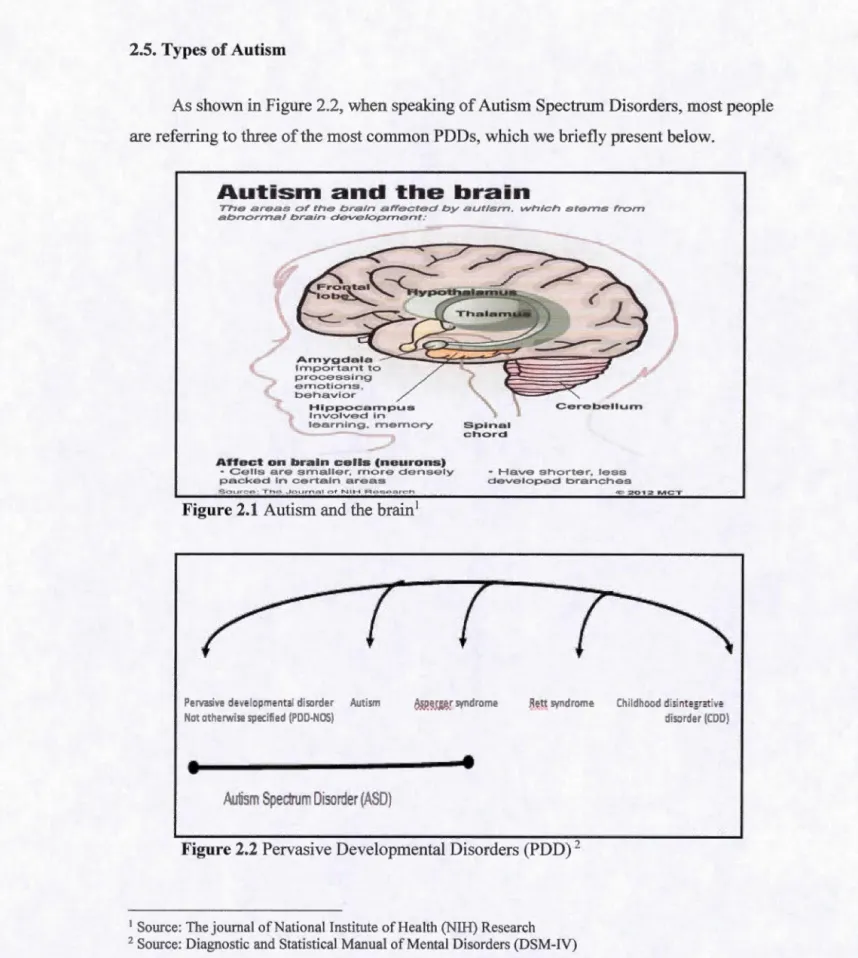
The term "spectmm" refers to a continuum of severity or developmental impairment as it pertains to ASD. It is characterized by delays in socialization and communication (DSM-IV). As illustrated in Figure 2.1, there are, in fact, five Autism Spectrum Œsorders,
described under this diagnostic category of Pervasive Developmental Disorders (PDD),
which appear in the (Diagnostic and Statistical Manual of Mental Disorders 2000). For the purpose of this research project, we will focus on the tlu·ee primary categories of Autism Spectmm Disorder (ASD), namely PDD-NOS, Autism and Asperger Syndrome.
2.4. What is the Autism Spectrum Disorder (ASD)?
In literature, autism is considered a heterogeneous condition because no two children or adults in the spectrum have exactly the same profile. Children and adults with ASDs usually display particular communication and social deficits (DSM-IV, Lord, Cook et al.,
2000). These characteristics caver a wide spectrum, with individual differences in terms of: age of onset, levels of functioning, and challenges with social interactions, and particular kinds of symptoms va:rying from mild to severe. Figure 2.1 shows the areas of the
brain affected by autism. According to tl1e Diagnostic and Statistical Manual of Mental Disorders of the American Psychiatrie Association (DSM 5, as ofMay 2013), autism is: "A
neurological disorder affecting the way the brain processes information which can affect
all aspects of the development of a persan. The Autistic Spectrum Disorders (ASDs) are
characterized by impairments in social interaction, communication, and the presence of
2.5. Types of Autism
As shown in Figure 2.2, when speaking of Autism Spech·um Disorders, most people
are referring to three of the most con1mon PDDs, which we briefly present below.
AutisiD and the brain
The an~as o r the brain affecre d by autlsrn. vvhich .sterns rrom
a b n o r r n s l brain cieveloprnent: A m y g d a l a
~~:~~~~~~~i~~ii~T~
lmpor~ant to processing emotions, behavior H i p p o c a m p u s l n v o l ve d i n l e a r n i n g. m e m o r y S pin a l c h o r c l Affect on braïn cells (neurons).. Cetls are smaller, more densety - Have shorter. less
packed ln certain areas devetoped branches Sou,.-eo· Tho ..Journol o f NIH Rosoo,.ch «D 20"12 M C T Figure 2.1 Autism and the brain 1
P<rv:;i>,, d<~<l pm•nt:l disord'!r 1\ot t erwis= sp~i :d (POO·~. S)
•
ti;m
Autisrr pectrum Di~order (· 0)
p~ ~:;r syndrom: .R:tt ;yndr m~
•
Figure 2.2 Pervasive Developmental Disorders (PDD) 2
1 Source: The journal of National Institute ofHealth (N1H) Research 2 Source: Diagnostic and Statistical Manual of Mental Disorders (DSM-IV)
(hildhood disint:gr:tiv: di;o d: IC )
9
2.5.1. Pervasive Developmental Disorder- Not Otherwise Specified(PDD-NOS)
PDD-NOS is often called atypical autism because the criteria for an autistic disorder are not met due to a late age of onset, atypical "symptomatology", sub- threshold "symptomatology" or because of all three of these (National Dissemination Center for Children with Disabilities, October 2003, Lord, Cook et al., 2000).
Although PDD-NOS is considered in sorne individuals with ASD, to be a "milder" condition than typical autism, this is not al ways the case. Indeed, research has revealed that even though sorne characteristics ofPDD-NOS may be milder than those of ASD, others may be more severe (National Autism Resomces). PDD-NOS is a diagnosis which is given when a patient displays "severe and pervasive impairment" in the development of reciprocal social interaction, verbal and nonverbal communication skills, or when stereotyped behavior, interests and activities are present. However, these criteria are not met for a specifie 'PDD' or for several other disorders (Autisrn Society of America; Council on Children with Disabilities, 2007).
2.5.2. Autism
The second disorder described under the diagnostic category of Pervasive Developmental Disorders (PDD) appearing in the (DSM-IV) is autism. The diagnostic and Statistical Manual of Mental Disorders indicates that generally the symptoms becorne apparent be fore a child reaches the age of 3. In sorne cases, the child shows "normal development" early on and then starts regressing between the ages of 12 and 24 months. Autism affects the way that information is processed in the brain by altering the connection and organization of the nerve cells and their synapses. Many researchers and professionals define it as a "disorder of neural development." Others describe it as "Une autre intelligence" (Mottron and Belleville, 1993), characterized by a qualitative impairment in social interaction, marked by difficulties in the use of multiple nonverbal behaviours such as eye-to-eye gaze, facial expression, body postmes, and gestures for the regulation of
social interaction. Also, qualitative impairments in communication are shown by a delay, or even by a totallack of developrnent with respect to spoken language. In sorne individuals with age- appropriate speech, marked impairment may be present in their lack of ability to initiate and/or sustain a conversation with others, as well as in their stereotyped and repetitive use of language, and in their idiosyncratic language (DSM-IV). Furtherrnore, individuals with autism often show restricted, repetitive, and stereotyped patterns of behaviour, interests and activities, such as encompassing preoccupation with one or more stereotyped and restricted patterns of interest. That is, abnormal either in intensity or in its apparently inflexible focus on adherence to specifie, non-functional routines or rituals, stereotyped and repetitive motor mannerisms such as hand or finger flapping, twisting and/or complex whole- body movements, and a persistent preoccupation with parts of abjects (DSM-IV).
2.5.3. Asperger's Syndrome
The third disorder described under the diagnostic category of Pervasive Developrnental Disorders (PDD), which appears in the (DSM-IV), is Asperger Syndrome (AS). Aspergers's syndrome is named after the Austrian pediatrician Hans Asperger, who, in 1944, studied and described children lacking nonverbal communication skills and who demonstrated limited empathy with their peers and operated with physical clurnsiness (Attwood 1997; Autism Society of America; Fritb 1999). Asperger's Syndrome varies from other autism spectrurn disorders because of the relative preservation of linguistic and cognitive development that individuals with this disorder display. Even though they are not considered criteria for a diagnosis of AS, physical clurnsiness and atypical (peculiar, odd) use oflanguage are often described (McPartland & Klin 2006; Baskin, Sperber et al., 2005). Researchers question wh ether AS is different from high-functioning autism (HF A), mainly because of its prevalence, which is not firmly established (Klin & 1 orres, 2006). In 2012, it was decided that the Asperger's diagnosis would be eliminated in the DSM-5 and replaced by a diagnosis of Autism Spectrurn Disorder on a severity scale (DSM-5 Development,
11
American Psychiatrie Association).
2.6. What causes autism?
Severa! causes of autism have been suggested in literatu.re. Many researchers and professionals point out that autism might be related to different factors such as "genetics" (Freitag, 2007; Folstein & Rosen- Sheidley, 2001; Sykes & Lamb, 2007; Happé & Ronald,
2008; Dufour-Rainfray, Vourch et al., 2011) as weil as childhood "vaccines" (Persico and
Bourgeron, 2006; Fombonne, Zakarian et al., 2006), and "environmental causes" (Bulletin of the World Health Organization, 2008). However, for many researchers, the relationship between "theory of causation" and autism spectrum disorders remains uncertain (American
Medical Association, 2004; US Food and Drug Administration, 2012). The following
section presents sorne ofthese important factors in more detail.
2.6.1. Genetics
The gene tics of autism are "complex" (Freitag, 2007). According to the W orld Health Organization, the term "genetics" describes "the study of heredity and of the mechanisms by which genetic factors are transmitted from one generation to the next. Dysjimctional genes, or gene mutations, can cause ill ness, and can be passed from parents to children. In addition, sorne people have a genetic, or inherited, predisposition to certain diseases,
such as cancer, diabetes, cardiovascular disease, and mental disorders. "
Studies suggest that different "genes" (Sykes & Lamb, 2007) might be associated with
autism spectrum disorders and a number of "candidate genes" have been located (Persico & Bourgeron, 2006). For instance, sorne researchers clairn that autisrn has a strong genetic
background explained by rare "mutations" or by rare combinations of common genetic variants (Lord, et al., 2000; Beaudet, 2007). In fact, the most significant genetic finding related to autism is the recent identification of the gene responsible for Rett's syndrome (Amir et al., 1999). Autism spectrum disorders have also been found in a substantial
minority of patients with full mutations of the Fragile X (FRAXA) gene FMR 1 (Lord, Cook
et al., 2000). Researchers claim that the sibling recurrence risk is approximately 4.5%,
relative to a population incidence and estimated prevalence of approximately 0.1%--0.5%. Studies have demonstrated compelling evidence that autism spectrurn disorders are inherited, having a greater than 50% concordance rate for monozygotic twins relative to a -3% concordance for dizygotic twins (Lord C, et al., 2000). Recent research in molecular
genetics is focusing on the identification of molecular genetic variation using candidate
genes, including a family-based association and linkage finding between the serotonin
transp01ter promoter gene insertion!deletion polymorphism and autism disorders. Other studies related to the genetics of autism reveal that chromosomal disorders may play a role.
Specifically, a maternai duplication of 15qll-q13 is frequently found (0%-- 3%) to be
involved. These fmdings demonstrate that similar genetic anomalies are related to two other developmental disorders associated with mental retardation. Thus, absent maternai
gene expression or "mutation" ofubiquitin binding enzyme 3A (UBE3A) is responsible for
Angelman syndrome and the absence of patemal cbromosomal gene expression leads to Prader-Willi syndrome (Autism Society of America).
2.6.2. Environmental factors
Other hypotheses related to the causes of autism are based on "environmental causes", such as heavy metals, pesticides or childhood vaccines, including the triple
vaccine for measles, murnps, and rubella (MMR) (Kawashima, et al., 2000; Wakefield,
Anthony et al., 2000; World Health Organization, 2006; US Food and Drug Administration,
20 12). Sorne cases of autism have been reported by parents who se children have demonstrated sorne ability to speak and engage in other social and communicative actions prior to the second year of life. Such cases occur in about one fifth of children diagnosed
with an autism spectrwn disorder. Due to the age of onset of the disorder in these cases, it
has been speculated that autism may possibly be linked to vaccinations. The vaccine theory was based on research conducted by (Wakefield, Anthony et al., 2000) which has been highly criticized by the scienti:fic community as being "fraudulent" (Godlee, Smith et al.,
13
2011). As a result, several epidemiological studies were conducted in different countries with comprehensive health registers and have not found convincing scientific evidence to support a link between MMR vaccines and autism (Bulletin of the World Health Organization, 2008).
2.7. The prevalence of autism
In the last decade, research carried out in the United States and Canada concerning the prevalence of autism spectrum disorder (ASD) revealed an increasing trend in the occurrence of autism. According to the Center for Disease Control (CDC), a comparison of the incidence rates for 2008 in the United States suggests an increase in ASD prevalence of approximately 23% compared with the 2006 estin1ates and 78% compared with 2002. Importantly the increase from 2002 to 2008 was observed among Hispanie children, non
-Hispanie black children, and children without co-occurring intellectual disability alike. In Canada the recent estimates (March 2014) by the Centre for Disease Control (CDC) and th.e Developmental Disabilities Monitoring (AD DM) suggest that 1 in every 68 children is born with an Autism Spectrum Disorder (ASD). There are many controversies surrounding ASD among researchers. The lack of scientific evidence regarding the causes of autism is mainly due to the fact that the underlying questions regarding diagnosis have not been answered and because scientific evidence addressing the rise in incidence is lacking. In May 2013, the American Psychiatrie Association (AP A) cornpleted the fifth edition of the Diagnostic and Statistical Manual of Mental Disorders (DSM 5). This new version brings in a new diagnostic category called 'Autism Spectrum Disorder' that takes the place of the previous diagnoses of Autistic Disorder, Asperger's Disorder, and PDD-NOS (Pervasive Developmental Disorder-Not Otherwise Specified). The dramatic increase in ASD prevalence rates has resulted in more attention and overseeing of ASD. In this respect, Health Canada, in 2012 and along with tl1e Autism Society of Canada, has highlighted the necessity ofimplementing such monitoring in terms ofrisk factors, etiology, and effective interventions which are essential to the treatment of autism.
2.8. Conclusion
The preceding sections have covered the Autistic Spectrum Disorders (ASDs)
characterized by impairments in language and communication, social interaction,
imaginative ability, and in repetitive and restricted pattems ofbehavior. Several causes of
autism have been postulated, including "genetics", childhood "vaccines", and
"environmental causes" am.ong other factors. Different types of autism have been
described, such as Pervasive Developmental Disorder (PDD-NOS), autism, and Asperger's
syndrome. These conditions cover a wide spectrum, with many individual differences. The
next part of this chapter will be related to metacognition and learning, for which different theories will be presented. The self-regulated learning theory is intended to enhance the
autistic student's positive behavior in order to facilitate metacognition, motivation, and
15
CHAPTERIII
METACOGNITION AND LEARNING
3.1. Introduction
Researchers explain that metacognition is "complex" requiring an understanding and a control of cognitive processes, that ta.ke into account planning, monitoring and evaluating activities (Jacobs & Paris, 1987). Different frameworks are proposed for the understanding of metacognition. In spi te of this, covering such a large amount of research is beyond the scope of this research proj ect. Therefore, for the purpose of this paper, the next part presents the self-regulated learning theory, showing the essential role that metacognition plays in self-regulation and learning (Baird & White, 1996; Nichols, Tippins et al., 1997). Accordingly, Section 3.3 presents a framework which brings to light different strategies to enhance self- regulation.
3.2. The role ofthe Self-Regulated Learning theory(SRL)
3.2.1. What is Self-Regulated Learning theory(SRL)?
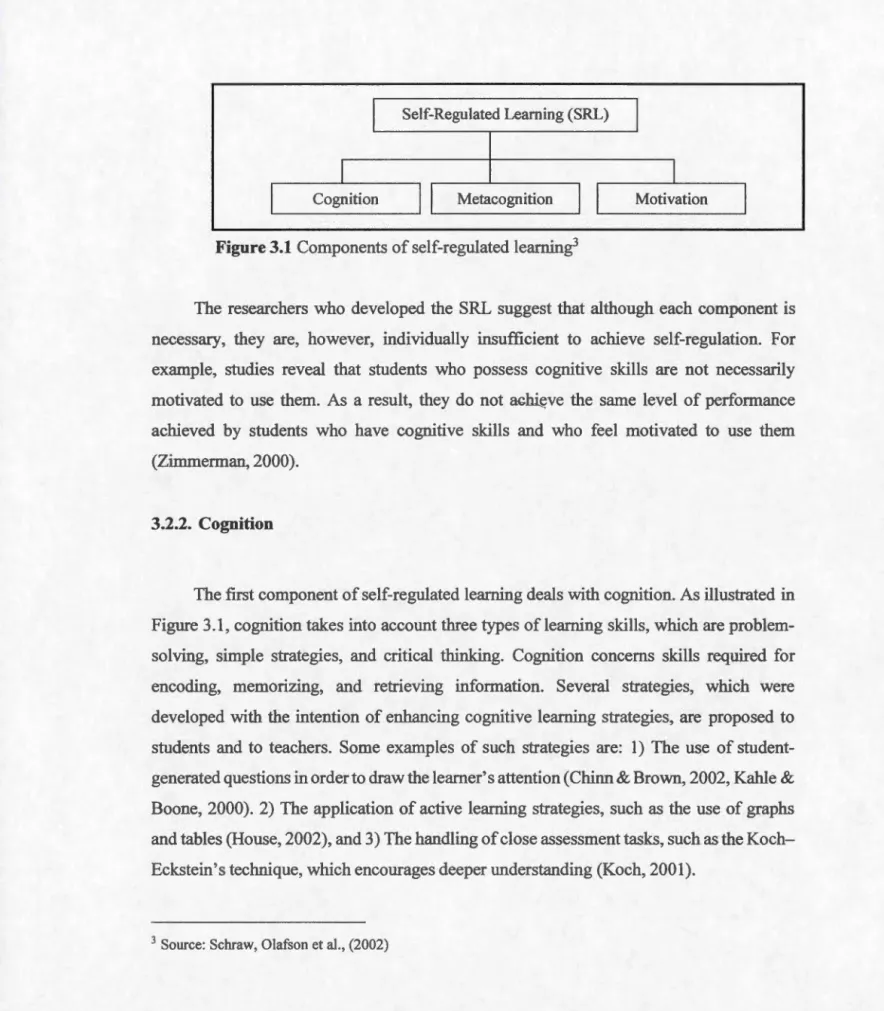
To begin with, self-regulated learning refers to our ability to understand and control om learning environments. As observed in Figure 3.1, the self-regulated learning process consists in three main components: cognition, metacognition, and motivation (Schraw,
1 Self-Regulated Learning (SRL) 1
1 1
1 Cognition Il Metacognition 1 1 Motivation 1
L---~ L---~
Figure 3.1 Components of self-regulated learning3
The researchers who developed the SRL suggest that although each cornponent is necessary, they are, however, individually insuffi.cient to achieve self-regulation. For exarnple, studies reveal that students who possess cognitive skills are not necessarily motivated to use them. As a result, they do not achü::ve the same level of performance achieved by students who have cognitive skills and who feel motivated to use them (Zimmerman, 2000).
3.2.2. Cognition
The first component of self-regulated learning deals with cognition. As illustrated in Figure 3.1, cognition takes into account three types of learning skills, which are problem-solving, simple strategies, and critical thinking. Cognition concerns skills required for encoding, memorizing, and retrieving information. Several strategies, which were
developed with the intention of enb.ancing cognitive learning strategies, are proposed to students and to teachers. Sorne examples of such strategies are: 1) The use of student-generated questions in order to draw the learner' s attention (Chinn & Brown, 2002, Kahle &
Boone, 2000). 2) The application of active learning strategies, such as the use of graphs and tables (House, 2002), and 3) The handling of close assessment tasks, such as the Koch-Eckstein's technique, which encourages deeper understanding (Koch, 2001).
17
Regarding problem-solving strategies, there exists a technique developed by (Rickey &
Stacy, 2000), which is called the predict-observe-explain (POE) technique. Studies reveal that problem-solving can be frnther broken down into smaller individual tasks, which can be teachable and which can improve learning (Peterson & Treagust, 1998). The third cognitive strategy is concerned with critical thinking. This can be enhanced through instruction (Baird & White, 1996) by engaging in se veral skills, su ch as the person' s ability to recognize the source of information, its credibility, reflect upon its relevance to his/her previous knowledge, and fmally draw a conclusion based on his/her critical thinking (Linn, 2000).
3.2.3. Metacognition
With these concepts in mind, the question is: What place and role does metacognition play in learning? Metacognition takes into account the skills that enable learners to understand and monitor their cognitive processes. According to (Hartman & Sternberg,
1992), there are four general ways to increase metacognition in classroom settings. These include promoting general awareness of the importance of metacognition, improving knowledge regarding cognition, irnproving the regulation of cognition, and fostering an environment that promotes metacognitive awareness. These authors claim that there is a significant difference between two important components of metacognition such as cognition knowledge and cognition regulation. Cognition knowledge is related to what individuals k:now about their own cognition or about cognition in general. It consists in three different kinds of metacognitive awareness known as: metacognitive declarative,
metacognitive procedural, and metacognitive conditional knowledge (Brown & Palincsar,
1989; Jacobs & Paris, 1987; Schraw and Moshman, 1995). Metacognitive declarative knowledge is concerned with the knowledge about oneself as a learner and about the different factors that may influence one's performance. Metacognitive procedural knowledge entails knowledge about "how'' to do things, and it plays an important role in learning because students who have a high degree of metacognitive procedural knowledge
tend to carry out the ir tasks more automatically. They are also more likely to use qualitatively different strategies for effective problem-solving (Pressley, Borkwski et al., 1989). Metacognitive conditional knowledge refers to knowing when and why to use metacognitive declarative and metacognitive procedural knowledge (Garner, 1990). It has
strongly been suggested that metacognitive conditional knowledge is the key to learning, as
it helps students allocate their resources selectively and to ad just to the changing situational
demands of each learning activity (Reynolds, 1992). Cognition regulation provides a set of
activities and helps students to be responsible for their own learning. Research reveals
significant improvements in learning when regulatory skills and understanding of how to use these skills are included as part of classroom instruction (Brown & Palincsar 1989). In
this regard, Sternberg (1985) explains that metacognition can be viewed as part of the
concept of developing expertise for school success. He provides a list of expertise characteristics that are important in learning such as time allocation, representation development, strategy selections, difficulty prediction, and monitoring. These characteristics are components of metacognitive functioning and expertise development used among students. Also, abilities are typically seen as precursors to expertise (Chi, Glaser et al., 1988). For instance, it is believed that when employing a testing procedure,
we are tes ting a form of expertise, regardless of the academie achievement or skill in vol ved
in solving a particular math problem.
3.2.4. Motivation
In the realm of education, motivation plays an important rote in learning. One major issue faced by teachers is how to effectively motivate their students. However, we must
first consider the question, What is motivation? Williams, Burden et al., (2001) define motivation as: "A state of cognitive and emotional arousal, which leads to a conscious decision to act and which gives rise to a period of sustained intellectual and/or physical effort in arder to attain a previously set goal (or goals)."
19
a complex task. These authors claim that Intelligent Tutoring Systems (ITS) would take ad van tage ofbeing able to adjusttheir tutoring task not only to the student's "cognitive state"
but also to their "motivational state." They propose that "motivational diagnosis" should be made when trying to assess a student's motivational state, rather than utilizing 'motivational planning' when concemed with planning instruction in arder to motivate the student. ln their study, they obtained many knowledge mies related to the detection of a motivational state of a student by a tutoring system. The motivational criteria set by these researchers contains nine criteria such as control, challenge, independence fantasy, confidence, sensory, interest, cognitive interest, effort, and satisfaction. In addition, motivation consists of self-efficacy and epistemological beliefs affecting the use and development of cognitive and metacognitive skills.
Self-efficacy plays an in1portant role in self-regulated learning because it affects the degree to which students engage in and persevere at challenging tasks. In fact, studies have shawn that, contrary to low efficacy students, those with higher self- efficacy tend to persevere on a task, even when faced with initial failures (Pajares, 1996). As a result, a higher degree of self-efficacy is positively associated with school achievement and self-esteem. Bandura (1997) explains that self-efticacy relates to the degree to which an individual is confident that he/she can perform a specifie task and/or achieve a specifie goal.
Self-efficacy is affected by a number of variables, one being modeling. When learners intentionally acquire a learned behaviour from other individuals, i.e. teachers and students, they are said to madel such behaviour. An example ofmodeling is when a teacher breaks down a difficult task into smaller activities and then has students show their ability in demonstrating each task separately in sequence. Bandura (1997) has highlighted the importance of modeling since it increases the expectations that a new strategy can be acquired and does so by providing a great deal of knowledge about the skill. Another strategy proposed to increase the students' self- efficacy uses teacher and non-expert
(students) peer models. Peer models are usually most effective because they are often similar to the learner (Schunk, 1996). Providing as much informational feedback as possible in arder to increase motivation, performance and self-efficacy has also been recommended, especially for students experiencing difficulty in performing a task.
Epistemological beliefs as shawn in Table 3.1 concern the origin and nature ofknowledge. In this sense, studies have revealed a relationship between epistemological beliefs and scientific problem solving (Neber & Schommer-Aikins, 2002). In the following section severa! strategies leading to self- regulated learning will be presented.
3.3. Strategies enhancing Self-Regulated Learning(SRL)
Table 3.1 presents a framework with different strategies proposed. in literature to enhance self-regulation, thereby improving learning in science education (Schraw, Olafson et al., 2002). These proposed strategies are: (1) Curriculum change and the use of inquiry based. learning, (2) The role of collaborative support, (3) Strategy and problem solving instruction, ( 4) The construction of mental mod.els, (5) The role of personal beliefs, su ch as self-efficacy and epistemological world views, and (6) The use oftechnology to support leaming.
3.3.1. Curriculum change and inquiry-based learning
Inquiry leaming is a course of action in which students are engaged in leaming by the use of a process-oriented approach to pose questions and construct solutions (Gunstone
& Mitchell, 1998). Inquiry teaching plays an important role in learning since it encourages self-regulation in two ways. First, it stimulates the students' active engagement in the learning process by using cognitive learning and metacognitive strategies which monitor their understanding. Second, it acts as an aid to increase their motivation for being successful in science which is achieved by modeling active investigation strategies such as Predict-Observe-Explain (POE) (Keamey, 2002), or question-asking (Chinn & Brown, 2002).
21
Table 3.1
Strategies to enhance Self-ReguJated Learning (SRL)4
Instructional strategies increase cognitive, metacognitive
Strategies Cognitive Metacognitive Motivational
Curriculum change and Promotes critical Improves explicit Provides expert
the use of inquiry based tbinking through planning, monitoring, mode ling.
leaming. experimentation and and evaluation.
reflection.
Co!Laborative support. Models strategies for Models self-retlection. Provides social support
novices. from peers.
Strategies and problem- Provides a variety of Helps students develop [ncreases self-efficacy to
solving strategies conditional knowledge learn.
Mental models. Provides explicit Promotes explicit Promotes radical models to analyze. reflection and evaluation restructuring and
of the proposed models. conceptual change.
Persona] beliefs, self- lncreases Promotes conceptual Promotes modeling
efficacy. engagement and changes and reflection. epistemology
persistence among characteristics of expert
students. scientists.
The use oftechnology filust:rates skills with Helps students test, Provides informational
feedback. Provides evaluate, and revise resources and
models and simulates models. collaborative support.
data.
3.3.2. Collaborative Support
Collaborative support strategies are comprised of tu tors or small collaborative work
groups. On one hand, studies have revealed that peer tutors who are considered to possess comparable levels of ability to those of their students actually enhance the students'
declarative and procedural knowledge, as well as their self-efficacy (Pajares, 1996). On the other band, expert mentors (teachers) can help novice students to build up expertise and metacognitive understanding in a particular domain (Ramaswamy, Harris et al., 2001).
Along these lines, the Thinking Aloud Together (TA T) pro gram is an example of a
cooperative leaming group that was designed to promote metacognition and self-regulation
in a small collaborative group setting (Ho gan, 1999).
3.3.3. Strategies and problem-5olving
Strategy instructions are also important to enhance self-regulation and thus improve
learning. By helping students to focus their attention in a more selective way, strategy
instructions enable students to better integrate information in a broad conceptual model for
problem solving. Linn (2000) has taken the position by presenting three key general goals
leading to success in science education. 1) making thinking visible. 2) helping students
learn from each other, and 3) promoting lifelong scientific leaming. To achieve these goals,
Linn proposes the Knowledge Integration Environment (KIE) framework based on the idea
that learners use support skills that allow them to integrate multiple sources of information
into an unified framework of knowledge. Other scientific researchers have elaborated on this framework resulting in a set of strategies designed to improve content learning (Brooks & Crippen, 2001; Kahle & Boo ne, 2000), as well as metacognitive awareness (Beeth, 1998). For instance, the work of (Baird & White, 1996) presents four components, as part oftheir
Project for Enhancing Effective Learning (PEEL), that emphasize increasing time and
opportunities for learning, teacher guidance and student suppmt.
3.3.4. Mental models
Another important strategy that enhances self-regulation is the use of mental models. According to Ho gan & Thomas (200 1 ), mental mo dels are essential as they help thinking metacognitively about complex systems, main! y because learners often encounter obstacles
reflecting complex phenomena without mental models. As a result, they find it difficult to
examine and self-regulate their own learning. These authors have presented a number of
differences between experts and novices when constructing mental models of a scientific
phenomenon. They propose four components that deal with the model-construction
process: construction, quantification, interpretation and revision models. Both authors
23
within the madel, whereas nov1ces focus more particularly on isolated component variables. The discrepancies between experts and novices might be explained by experience and accessibility to skilled mentors, as well as by modeling epistemology and the experts' or novices' beliefs about the utility and credibility of models (Hogan & Thomas, 2001 ).
3.3.5. Self-efficacy and epistemological belief
As illustrated in Table 3.1, another important strategy for improving self- regulation, which pla ys a significant role for both students and teachers, deals with self- efficacy and epistemological beliefs and aims at encouraging students' and teachers' motivation (Elby & Hammer, 2001; Neber & Schommer-Aikins, 2002). According to Bandura (1997) self-ef:ficacy refers to the degree to which individuals feel capable of accomplishing a particular task or goal. Students with a higher lev el of self-efficacy are more consistent, become more engaged in a difficult task, and wben faced with setbacks, demonstrate greater persistence. Another strategy is modeling, which helps students increase their self-efficacy (Pajares,
1996), as well as their metacognitive skills (Kuhn, 2002). Strategy instruction also irnproves self-efficacy (Pressley, Goodchild et al., 1989), self-regulated learning (Butler &
Winne, 1995), and metacognitive awareness (Schraw & Moshman, 1995). Epistemological beliefs refer to individuals' beliefs about the origin and nature of knowledge (Reiner & Gilbert, 2000). What stands out from the literature is that teachers' epistemological beliefs have an impact in their curricular and pedagogical decisions (Reybold, 2001· Olafson & Schraw; 2002). Teachers who support realistic beliefs are expected to rely on textbooks, and on standardized curriculum, and to use conventional texts, while mirùmizing field experiences, limiting the role of hypothesis testing and thought experiments (Elby & Harnmer, 2001; Neber & Schommer-Aikins, 2000; Beeth, 1998; Reiner & Gilbert, 2000). Teachers who are portrayed as having sophisticated epistemological beliefs are more likely to promote inquiry and argument by using specifie strategies, such as debate, by generating and by critiquing arguments, as weil as by promo ting group-based projects which facilitate
the process of synthesizing ideas (Roth, McRobbie et aL, 1997). Studies have also revealed that expert science teachers may promote sophisticated reasoning and argumentative skills through co-teaching (Roth & Tobin, 2002). As outlined in Table 3.1, a further important strategy that increases self-regulation deals with the use of technology. This important strategywill be presented in Chapter IV, Section4.4.1.
3.4. The relationship between emotions and learning
The relationship between emotions and learning, as it pertains to the domain of specialized education, has been broadly recognized among researchers. The socio -cognitive and behavioral problems experienced by individuals with ASD are considered to stem from the difficulty in understanding others' mental states (Baron-Cohen, Leslie et al., 1985). In fact, the lack of joint attention displayed by individuals with ASD is regarded as a necessary "precursor" to a "developmental building block" (Tomasello, 1995). Studies have revealed that recognizing the possible behaviours that may indicate an autistic child's affective states, such as happiness, boredom, frustration, as weil as cognitive states related to attention, curiosity, and understanding are essential for effective intervention for the child (Picard, 2009). As a result, "generalization" of gains is difficult to maintain for children in the spectrum (Green, Charman et al., 2010). Along these lines, (Rao, Beidel et al., 2008) explain that the "efficacy" of an intervention must be determined by means of more single- case and open trial designs within a specifie learning task (Whalen & Schreibman, 2003). Other researchers consider emotions essential for "adapting to unpredictable environrnents'' (Oatley & Johnson-Laird, 1987). Rolls (2000) points out that emotions might be triggered by different factors involved in "motivation", "communication" or "survival."
Damasio (2008), on the other hand, provides a theory called the "Somatic Marker Hypothesis" (SMH) by which emotional processes are able to guide (or bias) behavior mostly in decision-making. The idea is that "somatic states" play an important role in dealing with emotions. According to the authors, "emotions" are characterized as changes
- - - -- - -
-25
involving body and brain states in response to different physiological stimuli, such as muscle tone, heart rate, endocrine release, posture, and facial expression, among others. As a result, wben a "somatic marker" associated witb a positive outcome is perceived, the person might experience happiness and in this mam1er be motivated to engage in a particular behaviour. By contrast, when a "somatic marker' associated with a negative outcome is perceived, the person might experience sadness which triggers an internai alarm so as to advise the individual to avoid a course of action. Similarly, Chaffar & Frasson (2005) define "emotions" as: "the consequence and display of a feeling." ln this context, emotion is a "visible" or "measurable" consequence of a feeling that is comprised of a set of emotional states which can trigger different reactions (heart rate, transpiration, skin conductivity, muscle tension, and bJood pressure).
To better understand the relationship between emotions and learning, the author
provides several definitions that are important to keep in mind.
A feeling is an interna! perception of a situation (or sensation) which is
compared with previous experiences. Feelings (and ability to feel) differ from one
individual to another as the volume and variety of previous sensations is different.
They need an evaluation of a given situation.
An affect is a stimulation state or instinct able to change or provoke affective situations or experiences; affects are unconscious, without individual control.
Successive affects will create different feelings according to the lime. As a result; it
is a physiological property of the body to generale intensifies of affective situations.
In other words, an individual can affect or be affected.
3.4.1. Emotions and autism
Sorne individuals with learning disabilities (LD) such as Autism Spectrum Disorder
(ASD) have difficulty processing their own and other's emotions. The theory of mind has
been broadly studied in both individuals with and without ASD (Baron-Cohen, 2001). According to these researchers, possessing a theory of mind entails being able to infer a full