To link to this article :
DOI:10.1093/jigpal/jzu043
URL: http://dx.doi.org/10.1093/jigpal/jzu043
To cite this version :
Sakama, Chiaki and Caminada, Martin and
Herzig, Andreas A formal account of dishonesty. (2014) Logic Journal
of the IGPL, vol. 23 (n° 2). pp. 259-294. ISSN 1367-0751
O
pen
A
rchive
T
OULOUSE
A
rchive
O
uverte (
OATAO
)
OATAO is an open access repository that collects the work of Toulouse researchers and
makes it freely available over the web where possible.
This is an author-deposited version published in :
http://oatao.univ-toulouse.fr/
Eprints ID : 15217
A Formal Account of Dishonesty
Chiaki Sakama
Department of Computer and Communication Sciences
Wakayama University, Sakaedani, Wakayama 640-8510, Japan
Email: [email protected]
Martin Caminada
Department of Computing Science
University of Aberdeen, Aberdeen AB24 3UE, United Kingdom
Email: [email protected]
Andreas Herzig
University of Toulouse and CNRS, France
Email: [email protected]
November 2014
Abstract
This paper provides formal accounts of dishonest attitudes of agents. We in-troduce a propositional multi-modal logic that can represent an agent’s belief and
intentionas well as communication between agents. Using the language, we for-mulate different categories of dishonesty. We first provide two different definitions of lies and provide their logical properties. We then consider an incentive behind the act of lying and introduce lying with objectives. We subsequently define
bull-shit, withholding information and half-truths, and analyze their formal properties. We compare different categories of dishonesty in a systematic manner, and exam-ine their connection to deception. We also propose maxims for dishonest commu-nication that agents should ideally try to satisfy.
1
Introduction
Men are able to trust one another, knowing the exact degree of dishonesty they are entitled to expect.
—Stephen Leacock (1869–1944, Canadian Humorist) Dishonesty is a fact of daily life. A behavioral economist Dan Ariely experimen-tally shows that there are various forces which urge people to behave dishonestly [3]. He argues that an average person has “the delicate balance between the contradictory desires to maintain a positive self-image and to benefit from cheating”, and a person rationalizes his/her dishonest behavior using this balancing act. There are a number of words representing dishonest attitudes of humans—bluff, bullshit, cheat, concealing, deceit, dodge, fake, fraud, fudge, and lie, to name a few. These different categories of dishonesty frequently appear in human communication to benefit the self or avoid conflict. According to a study in social psychology [26], 20%–30% of conversation are in fact lies.
In classical speech act theory, on the other hand, a speaker who makes an asser-tion is assumed to obey the sincerity rule that “the speaker commits himself to a belief in the truth of the expressed proposition” [63, p.62]. This basic principle is not ap-plied to human agents who may behave dishonestly in communication. The issue is also pointed out for the FIPA agent communication language: “In Arcol, an agent must make only sincere contributions (assertives that are believed true, requests that it intends should succeed) and may assume that other agents also make only sincere contributions. Consequently, you cannot use Arcol in settings where sincerity cannot be taken for granted—for example, in electronic commerce or, broadly, in negotiation of any kind” [65]. The need for relaxing the sincerity condition in agent tion is also argued for in [51]. As such, formulating dishonesty in agent communica-tion and constructing behavioral rules for dishonest agents are necessary and challeng-ing. Many philosophers have discussed dishonest behaviors of humans in the literature [7, 15, 33, 39, 64, 67, 71], while relatively little study exists for formulating and com-paring different categories of dishonesty. A reason for this is the fact that defining the notion of dishonesty has been the topic of extensive discussion. For instance, Mahon [42] examines twelve different definitions of lying in the literature and argues which one is empirically acceptable. Moreover, when we reason about dishonesty we cannot simply take a subjective view and represent an agent’s beliefs by means of formulas of classical propositional logic. We need modal operators of belief and intention in order to be able to represent at the same time what an agent believes and what the agent in-tends to communicate (which might contradict the agent’s beliefs). Thus, providing a formal account of dishonesty requires one to overcome various difficulties.
The issue of formulating dishonesty is relevant as a research topic not only in phi-losophy, but also in artificial intelligence (AI). In AI the question “Can computers deceive humans?” has been of interest since Turing’s imitation game [72]. The pur-pose of the game is to devise an intelligent computer which behaves like humans in conversation. A computer attempts to convince a judge that it is human through appro-priate, and often deceptive, responses. A recent study shows that lying by computers
affects judges’ misclassification in that computers are considered human [80].1 There
are several reasons why the study of dishonesty is important in AI. (i) First, dishonest behaviors are inherent to human beings, that require intelligence and thinking.2 Some researchers remark this fact: “Lying is related to intelligence . . . lying demands both advanced cognitive development and social skills that honesty simply doesn’t require” [10] and “lying is challenging in terms of cognitive control because an individual must hold two mental states (i.e., their own and that of another) in mind” [13]. Studies on dishonesty can therefore contribute to better understanding human intelligence and take us one step closer to realizing “human-like” AI. (ii) Second, understanding the mechanism of dishonesty opens possibilities to develop computers which select dis-honest behaviors as moral or secretive decisions. Such “artificial liars” are considered effective in a number of situations [16]. For instance, we can imagine a robot for med-ical care which does not inform a patient of the true state of affairs. An intelligent personal assistant might deceive us to influence us to make a right decision. Appli-cations of lying in AI and knowledge engineering are also reported in the literature [8, 17, 27, 66, 78]. (iii) Third, studying dishonest acts in the context of multiagent sys-tems is necessary for designing social agents who behave economically to minimize costs and/or maximize benefits. Lying or deception is in fact one of the strategic in-teractions between self-interested agents, and its effects have been analyzed from the game-theoretic viewpoints [24, 28, 75]. Some studies show potential utilities of dis-honest acts as a strategy in multiagent negotiation [28, 69, 81], formal argumentation [11, 53, 59], and in social interactions [12, 70]. (iv) Fourth, the new field of
compu-tational moralityor machine ethics has emerged in AI for computationally modelling moral decision making [2, 79]. Formal theories for encoding ethical rules and compu-tational logics for realizing compucompu-tational morality have also been studied by several researchers [34, 50]. Clearly, morality and dishonesty are closely related—they are two different sides of the same coin. Studying dishonesty will thus contribute to better understanding morality and designing ethical agents.
The purpose of this paper is to provide a logical account of dishonesty. To represent dishonest attitudes of agents, we need a logic that can distinguish belief of truth and an act of falsehood. Moreover, it is necessary to represent intention of a speaker and to reason about the belief state of a hearer. To this end, we first introduce a proposi-tional multi-modal logic BIC that can represent three modalities: belief, intention and
communication. Using the logic, we first formulate sincere communication between agents, which is later contrasted with dishonest communication. We then proceed to formal accounts of dishonesty where four different categories are considered: lie,
bullshit, withholding information and half-truth. We represent them using the logical language of BIC and prove their semantic properties using its axiomatic system. We compare those categories in a systematic manner and argue their connection to
decep-tion. We also address qualitative and quantitative dishonesty maxims that agents should try to satisfy both for moral and self-interested reasons.
The rest of this paper is organized as follows. Section 2 introduces the logic that is
1Interestingly, an experiment shows that truth-telling by a machine is often taken as a double bluff by a
human judge resulting in misclassification it as human.
2It is well known that non-human animals often deceive other individuals, which is a result of natural
used in this paper and formulates sincere communication. Section 3 provides a logical framework of lies and investigates formal properties. Section 4 formulates bullshit, withholding information, and half-truth. Section 5 proposes postulates and maxims for dishonest agents. Section 6 compares different categories of dishonesties and addresses related works. Section 7 concludes the paper.
2
A Logic for Belief, Intention and Communication
In this section, we first introduce a propositional multi-modal logic BIC which is used in this paper. We then formulate in BIC conditions for sincere communication.2.1
BIC logic
The propositional multi-modal languageL of the logic BIC is built from a finite set of propositional constants P = {p, q, r, . . .} on the logical connectives ¬ and ∧, and on three different types of modal operators,(Ba)a∈A,(Ia)a∈A, and(Cab)a,b∈A, where
A = {a, b, c, . . .} is a finite set of agents.3 Well-formed formulas (or sentences) in
L are defined as follows: (i) If p ∈ P , then p is a sentence. (ii) If ϕ and ψ are sentences, then¬ϕ and ϕ ∧ ψ are sentences. (iii) If ϕ is a sentence and a, b ∈ A, then Baϕ, Iaϕ, and Cabϕ are all sentences. The logical connectives⊤, ⊥, ∨, ⊃ and
≡ are introduced as abbreviations as usual. The set of all sentences in L is denoted byΦ. Throughout the paper, lower case letters a and b represent agents in A and Greek letters δ, λ, σ, ϕ, ψ represent sentences inΦ unless otherwise stated. A sentence Baϕ represents an agent’s internal belief and is read as “an agent a believes ϕ”. A
sentence Iaϕ represents an agent’s intention in action and is read as “a intends ϕ”. A
sentence Cabϕ represents an agent’s intentional communication to another agent and
is read as “a communicates ϕ to b”. By communication, we understand any method by which an agent a informs an agent b of a sentence σ, be it linguistically or not. Nevertheless, we often call “a” a speaker and “b” a hearer in Cabσ, although we do
not restrict communication to speech acts. As a special case, we sometimes consider a situation where a= b. When a communicates a sentence σ to b, we assume that any information that is logically implied by the sentence is implicitly communicated. For instance, if one communicates the sentence p∧q, then one also implicitly communicates p and implicitly communicates q. We also assume that communication is instantaneous such that a hearer recognizes information at the moment when it is dispatched from a speaker. For instance, if a speaker a tells a sentence σ to a hearer b in a conversation, information in σ is conveyed to the hearer at the moment when the speaker utters the sentence.
The semantics of BIC is given by the Kripke semantics for normal modal operators. Formally, a BIC model is a tuple(W, ν, (Ba)a∈A,(Ia)a∈A,(Cab)a,b∈A) where
• W is a set of possible worlds.
• ν : P → 2W is a truth assignment mapping each propositional constant to the
set of worlds in which it is true.
• Ba ⊆ W × W is a serial, transitive and Euclidean binary relation on W . That
is,∀u ∈ W ∃v ∈ W , uBav;∀u, v, w ∈ W , uBav and vBaw imply uBaw; and
∀u, v, w ∈ W , uBav and uBaw imply vBaw.
• Ia ⊆ W × W is a serial relation on W , namely, ∀u ∈ W ∃v ∈ W , uIav.
• Cab⊆ W × W is a serial relation on W , namely, ∀u ∈ W ∃v ∈ W , uCabv.
• Iais transitive and Euclidean overBa. That is,∀u, v, w ∈ W , uBav and vIaw
imply uIaw; and∀u, v, w ∈ W , uBav and uIaw imply vIaw.
• Cabis transitive and Euclidean overBa. That is,∀u, v, w ∈ W , uBav and vCabw
imply uCabw; and∀u, v, w ∈ W , uBav and uCabw imply vCabw.
• Cabis transitive and Euclidean overIa. That is,∀u, v, w ∈ W , uIav and vCabw
imply uCabw; and∀u, v, w ∈ W , uIav and uCabw imply vCabw.
Intuitively, uBav (resp. uIav) means that v is compatible with a’s belief (resp.
inten-tion) at u. Likewise, uCabv means that v is compatible with u where a’s communication
to b has taken place. The satisfaction of a sentence in a possible world w ∈ W of a BIC model M is defined as follows.
• (M, w) |= p iff w ∈ ν(p) for p ∈ P . • (M, w) |= ¬ϕ iff (M, w) 6|= ϕ.
• (M, w) |= ϕ ∧ ψ iff (M, w) |= ϕ and (M, w) |= ψ. • (M, w) |= Baϕ iff(M, u) |= ϕ for every u ∈ W s.t. wBau.
• (M, w) |= Iaϕ iff(M, u) |= ϕ for every u ∈ W s.t. wIau.
• (M, w) |= Cabϕ iff(M, u) |= ϕ for every u ∈ W s.t. wCabu.
A sentence ϕ is true in a model M at a world w iff(M, w) |= ϕ. ϕ is true in a model M (written M |= ϕ) iff (M, w) |= ϕ for any w ∈ W . ϕ is valid iff M |= ϕ for any BIC model M .
The logic BIC has the following axioms and inference rules: 1. (P) All propositional tautologies.
2. The axioms for B (the system KD45): (KB) Baϕ∧ Ba(ϕ ⊃ ψ) ⊃ Baψ
(DB) ¬Ba⊥
(4B) Baϕ⊃ BaBaϕ
(5B) ¬Baϕ⊃ Ba¬Baϕ
3. The axioms for I and C (the system KD): (KI) Iaϕ∧ Ia(ϕ ⊃ ψ) ⊃ Iaψ
(DI) ¬Ia⊥
(KC) Cabϕ∧ Cab(ϕ ⊃ ψ) ⊃ Cabψ
(DC) ¬Cab⊥
4. The bridge axioms among B, I and C: (4IB) Iaϕ⊃ BaIaϕ (5IB) ¬Iaϕ⊃ Ba¬Iaϕ (4CB) Cabϕ⊃ BaCabϕ (5CB) ¬Cabϕ⊃ Ba¬Cabϕ (4CI) Cabϕ⊃ IaCabϕ (5CI) ¬Cabϕ⊃ Ia¬Cabϕ 5. Rules of inference:
(MP) From ϕ and ϕ⊃ ψ infer ψ. (NB) From ϕ infer Baϕ.
(NI) From ϕ infer Iaϕ.
(NC) From ϕ infer Cabϕ.
The following inference rules are derived in BIC. (EB) From ϕ≡ ψ infer Baϕ≡ Baψ.
(EI) From ϕ≡ ψ infer Iaϕ≡ Iaψ.
(EC) From ϕ≡ ψ infer Cabϕ≡ Cabψ.
The definition of BIC theorems is standard: a BIC theorem is a formula that is obtained from axiom instances via the inference rules. We write⊢ ϕ iff a sentence ϕ is a theorem of BIC. Some useful theorems are listed below [18]:
(D✷) ⊢ ✷ϕ ⊃ ¬✷¬ϕ
(R✷) ⊢ ✷ϕ ∧ ✷ψ ≡ ✷(ϕ ∧ ψ) (C✷) ⊢ ✷ϕ ∨ ✷ψ ⊃ ✷(ϕ ∨ ψ)
where ✷ is either Ba, Iaor Cab. It is well-known that: ⊢ (✷ϕ ⊃ ¬✷¬ϕ) ≡ ¬✷⊥.
When ✷ is Ba (resp. Ia or Cab), the theorem D✷ is referred to as DB(resp. DI or
DC). Similar reference will be done for R✷and C✷.
Proposition 2.1 Let ✷i(i = 1, 2) be either Ba,IaorCab.
Proof:By (EB) and (R✷), it holds that⊢ Ba(✷ϕ ∧ ✷ψ) ≡ Ba✷(ϕ∧ ψ). By (RB),
it holds that⊢ Ba(✷ϕ ∧ ✷ψ) ≡ Ba✷ϕ∧ Ba✷ψ. Hence, ⊢ Ba✷ϕ∧ Ba✷ψ ≡
Ba✷(ϕ∧ ψ). Similarly, we can show that: ⊢ Ia✷ϕ∧ Ia✷ψ ≡ Ia✷(ϕ∧ ψ) and
⊢ Cab✷ϕ∧ Cab✷ψ≡ Cab✷(ϕ∧ ψ). Hence, the result holds. ✷
The result of Proposition 2.1 is easily extended to:
⊢ ( ✷1✷2· · · ✷kϕ∧ ✷1✷2· · · ✷kψ) ≡ ✷1✷2· · · ✷k(ϕ ∧ ψ)
by repeatedly applying (E✷) and (R✷).
One may argue that the axiom(KC) is too strong because if a communicates ϕ to
b, all that ϕ deductively entails is communicated as well. A similar problem happens with (KB), however, one believes every theorem—a well-known logical omniscience
[29]. This is a fundamental difficulty that lies in the nature of Kripke-style modal semantics for modelling knowledge and belief, but we do not address the issue further in this paper. By (NB) and (KB), each agent believes that other agents follow the same
logic as itself. Thus, “BaBbϕ⊃ Ba¬Bb¬ϕ” and “Ba(Ibϕ∧ Ib(ϕ ⊃ ψ)) ⊃ BaIbψ”
are BIC theorems, for instance. The necessitation rule (NI) says that every theorem
holds at all states of affairs that an agent a might intend to bring about. (NC) says
that every theorem is unconditionally communicated from a to b. This is the case since every agent shares theorems under the same logic. Technically, both (NI) and (NC)
are needed for the completeness with respect to Kripke models.4
Each axiom has its semantic correspondence as follows [74]. The axioms (DB),
(DI), and (DC) respectively correspond to seriality of the relationsBa,Ia, andCab.
The axioms (4B) and (5B) respectively correspond to transitivity and Euclidianity of
the relationBa. The axiom (4IB) corresponds to transitivity ofIa overBa, and (5IB)
corresponds to Euclidianity ofIa over Ba. The axioms (4CB), (5CB), (4CI), and
(5CI) respectively correspond to their counterparts in similar ways. With this
corre-spondence, it is easy to see that the axiomatic system of BIC is sound. Moreover, these axioms characterize canonical models [74], so that the axiomatic system is also complete.
2.2
Sincere communication
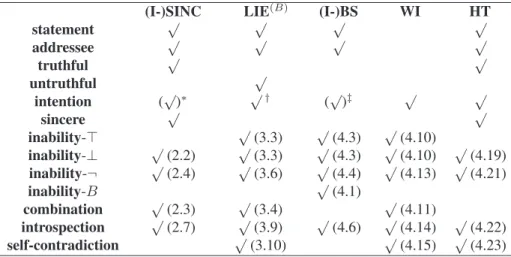
In this paper we consider communication which satisfies the following two conditions: • A statement is made by a speaker (statement condition).
• A statement is received by a hearer (addressee condition).
The statement condition says that communication accompanies a statement of a sen-tence. The addressee condition says that communication requires the existence of a hearer. Communication is sincere if it satisfies the condition:
• A speaker believes the statement to be true (truthfulness condition).
The truthfulness condition represents the sincerity rule of the speech-act theory. More-over, sincere communication is intentional if it satisfies the condition:
• A speaker intends that a hearer believes the statement to be true (intention con-dition).
The condition says that intentional sincere communication is not simply saying some-thing that one believes to be true, but involves an intention to make a hearer believe it. Note that as remarked in Section 2.1 we assume communication such that a hearer recognizes a statement at the same moment when the speaker makes the statement. Thus, intentional sincere communication is such that a speaker believes a sentence and communicates it to a hearer, while intending the hearer’s believing the sentence at the moment when the communication is taken place.5
Under the logic BIC, (intentional) sincere communication is formulated as follows. Definition 2.1 (sincere communication) Let a and b be two agents and σ∈ Φ. Then a sincere communication is defined as follows.
SIN Cab(σ) def
= Cabσ∧ Baσ. (1)
In this case, we say that an agent a sincerely communicates a sentence σ to another agent b. By contrast, an intentional sincere communication is defined as follows.
I-SIN Cab(σ) def
= SIN Cab(σ) ∧ IaBbσ. (2)
By definition, communication from an agent a to another agent b is sincere if a communicates a believed-true sentence σ to b. In (1), both the statement condition and the addressee condition are represented by Cabσ, and the truthfulness condition is
represented by Baσ. In (2), the additional condition IaBbσ is imposed on SIN Cab(σ),
which represents that a has the intention that σ is believed by b. In what follows, (I-)SIN Cab(σ) means either SIN Cab(σ) or I-SIN Cab(σ). (Intentional) sincere
communication has the following properties.
Proposition 2.2 (sincere communication on valid or contradictory sentences)
1. ⊢ (I-)SINCab(⊤).
2. ⊢ (I-)SINCab(⊥) ⊃ ⊥ .
Proof: 1. The result follows by the fact that Cab⊤, Ba⊤, and IaBb⊤ are all theorems
of BIC. 2.(I-)SIN Cab(⊥) implies Cab⊥ that contradicts (DC). ✷
Proposition 2.3 (sincere communication on combined sentences)
1. ⊢ ( SINCab(λ) ∧ SINCab(σ) ) ≡ SINCab(λ ∧ σ).
2. ⊢ ( I-SINCab(λ) ∧ I-SINCab(σ) ) ≡ I-SINCab(λ ∧ σ).
5To characterize belief change of a hearer, temporal or dynamic logic would be more appropriate.
How-ever, we do not formulate the effect of communication nor belief change of a hearer. Whether or not a speaker makes sincere communication depends only on the belief and intention of a speaker, and is independent of the effect of the action. This is in contrast to deception discussed in Section 6.2.
Proof: 1. SIN Cab(λ) ∧ SINCab(σ) ≡ (Cabλ∧ Cabσ) ∧ (Baλ∧ Baσ). By two
theo-rems (RC) and (RB), it holds that⊢ Cabλ∧ Cabσ≡ Cab(λ ∧ σ) and ⊢ Baλ∧ Baσ≡
Ba(λ ∧ σ). Hence, the result holds.
2. I-SIN Cab(λ) ∧ I-SINCab(σ) ≡ SINCab(λ ∧ σ) ∧ IaBbλ∧ IaBbσ. By
Propo-sition 2.1, ⊢ IaBbλ∧ IaBbσ≡ IaBb(λ ∧ σ) holds. Hence, the result holds. ✷
Proposition 2.4 (sincere communication on contrary sentences)
1. ⊢ ( SINCab(σ) ∧ SINCab(¬σ) ) ⊃ ⊥ .
2. ⊢ ( I-SINCab(σ) ∧ I-SINCab(¬σ) ) ⊃ ⊥ .
Proof: The results hold by Propositions 2.2 and 2.3. ✷
A sentence of the form σ∧ ¬Baσ is known as Moore’s paradoxical sentence [47].
The Moore sentence is not communicable in sincere communication. Proposition 2.5 (sincere communication on Moore sentence)
⊢ (I-)SINCab(σ ∧ ¬Baσ) ⊃ ⊥ .
Proof: (I-)SIN Cab(σ ∧¬Baσ) ≡ (I-)SINCab(σ)∧(I-)SINCab(¬Baσ) by
Propo-sition 2.3. (I-)SIN Cab(σ) ∧ (I-)SINCab(¬Baσ) implies Baσ∧ Ba¬Baσ. Baσ
implies BaBaσ (4B), while Ba¬Baσ implies¬BaBaσ (DB). Contradiction. ✷
In speech act theory it is often assumed that communicating a sentence σ counts as an expression of the speaker’s belief that σ.6 This assumption is formally represented as follows.
Definition 2.2 (communicating belief) Leta and b be two agents and σ∈ Φ. Com Belab(σ)
def
= Cabσ⊃ CabBaσ. (3)
With this assumption, the following result holds. Proposition 2.6 (sincere communication on belief)
⊢ (SINCab(σ) ∧ Com Belab(σ)) ⊃ SINCab(Baσ) .
Proof: SIN Cab(σ) implies Cabσ∧ Baσ. Cabσ∧ Com Belab(σ) implies CabBaσ.
Baσ implies BaBaσ by (4B). Hence, the result holds. ✷
An agent has a belief of his/her communication. Proposition 2.7 (introspection)
⊢ (I-)SINCab(σ) ⊃ Ba(I-)SIN Cab(σ) .
Proof:The result holds by Definition 2.1 and the axioms (4CB), (4B), and (4IB). ✷
Communication involves a speaker and a hearer. On the other hand, we can con-sider the special case of communicating to oneself, for instance, taking a note for re-membering or keeping a diary. Normally, if one believes a fact, then he/she does not intend to make oneself disbelieve the fact. We call it a rational balance between be-lief and intention.7 Such a rational balance between belief and intention is formally represented as follows.
Definition 2.3 (rational balance) Let a be an agent and σ∈ Φ. RBa(σ)
def
= Baσ⊃ ¬Ia¬Baσ . (4)
In this case, we say that a is rationally balanced on the sentence σ.
Proposition 2.8 (intentional sincere communication is rationally balanced) ⊢ I-SINCaa(σ) ⊃ RBa(σ) .
Proof:I-SIN Caa(σ) implies IaBaσ, which implies¬Ia¬Baσ by (DI). ✷
3
Lies
In this section, we first provide two different definitions of lies based on Mahon [42] and investigate their formal properties. We then consider incentives behind the act of lying8and introduce the notion of lies with objectives.
3.1
Two definitions of lies
A lie is a representative of dishonest acts by people. According to Wikipedia, there are 30 different types of lies.9 In spite of its familiarity to most of us, the question of
“What is lying?” has been subject to extensive studies by a number of philosophers [5, 7, 14, 30, 42, 64]. Mahon [43] argues that the most common definition of lies requires the statement condition, the addressee condition and the intention condition of Section 2.2. On the other hand, instead of truthfulness of sincere communication, lies require the condition:
• A speaker believes the statement to be false (untruthfulness condition). Note that the untruthfulness condition says that a speaker believes the falsity of the statement but the actual falsity of the statement is not requested. So if a speaker makes a believed-false statement which is in fact true, then the speaker’s act is considered a
7The term is borrowed from [21]. Note that the intention here is the present-directed intention which is
an intention to do some action now, and is different from the future-directed one which is an intention to do some action later [9].
8Some researcher distinguishes “lying” and “telling a lie” in the literature [64], while we do not
distin-guish lying and lies and use those terms interchangeably in this paper.
9Lie. In Wikipedia: The Free Encyclopedia. Retrieved November 2014, from
lie.10 Note also that the untruthfulness condition focuses on the content of the
ment, so if a statement is made not by a speaker but in fact by some impostor, the state-ment is not considered untruthful as far as it contains no information of the speaker. Moreover, lies involve an intention to deceive on the statement made by a speaker. Thus, if one says something manifestly false as a joke or a metaphor, it is not a lie.11
Among a number of different definitions of lies, Mahon [42] states that the four necessary conditions are actually sufficient.
To lie (to another person) is: to make a believed-false statement (to an-other person) with the intention that that statement be believed to be true (by the other person)—[38] and [42, (L6)].
The definition is formulated in BIC as follows.
Definition 3.1 (lie) Let a and b be two agents and σ∈ Φ. LIEab(σ)
def
= Cabσ∧ Ba¬σ ∧ IaBbσ. (5)
In this case, we say that a lies to b on the sentence σ. σ is also called a lie.
By definition, a lies to b if a communicates a believed-false sentence σ to b with the intention that σ is believed by b. (5) satisfies both the statement condition and the addressee condition (Cabσ). (5) also satisfies the untruthfulness condition (Ba¬σ) and
the intention condition (IaBbσ).12
Mahon also argues that although the above definition seems to be suitable for most purposes, it does have the relatively strong requirement that a speaker intends to deceive on the direct contents of his/her statement. However, a speaker may very well have an intention to deceive about his/her belief in the truth of the statement that he/she makes, which we call an intention to deceive about truthfulness.13 By contrast, we also call
the condition IaBbσ of (5) an intention to deceive about truth. Borrowing an example
of [42], suppose that an FBI agent is working undercover in a criminal organization. The crime boss notices this fact, but the FBI agent has no suspicion of this. If the crime boss tells the FBI agent that there are no informants in his organization, then the boss cannot intend that the FBI agent believes this statement to be true because the boss knows that the agent is an informant. In this case, the crime boss can only intend that the FBI agent believes that the boss believes this statement to be true. According to the previous definition, the boss is not lying to the FBI agent. To cope with such cases, Mahon proposes another definition as follows:
To lie (to another person) is: to make a believed-false statement (to an-other person), either with the intention that that statement be believed to be true (by the other person), or with the intention that it be believed (by
10“A person is to be judged as lying or not lying according to the intention of his own mind, not according
to the truth or falsity of the matter itself” [5, p.55].
11Some philosophers argue that an intention to deceive is not a necessary condition of lying, however [14]. 12Note again that a speaker believes ¬σ while communicating σ to a hearer by intending the hearer’s
believing σ at the moment when the communication is taken place.
the other person) that that statement is believed to be true (by the person making the statement), or with both intentions—[42, (L6*)].
Lies about truthfulness are formulated in BIC as follows.
Definition 3.2 (lie about truthfulness) Let a and b be two agents and σ∈ Φ. LIEabB(σ)def= Cabσ∧ Ba¬σ ∧ IaBbBaσ. (6)
In (6), an intention to deceive about truthfulness is represented by IaBbBaσ. In
contrast to Definition 3.2, lies in Definition 3.1 are called lies about truth. Using (6), Mahon’s second definition (L6*) of lies is stated in BIC as follows.
LIEab∗(σ)def= LIEab(σ) ∨ LIEabB(σ) . (7)
Mahon contends that these two definitions, (L6) and (L6*) of [42], are the best definitions of lies. In what follows, LIEab(B)(σ) means either LIEab(σ) or LIEabB(σ).
As the FBI example shows, “intention to deceive about truthfulness” might be the case without “intention to deceive about truth”. The relation between lies about truth and lies about truthfulness is characterized using (3) as follows.
Proposition 3.1 (relation betweenLIE and LIEB)
⊢ (LIEB
ab(σ) ∧ Com Belab(σ)) ⊃ LIEab(Baσ).
Proof: LIEB
ab(σ)∧Com Belab(σ) implies CabBaσ∧Ba¬σ∧IaBbBaσ. Since Ba¬σ
implies Ba¬Baσ by (DB) and (5B), the result holds. ✷
Lies are not sincere communication. Proposition 3.2 (lie is not sincere)
⊢ (LIEab(B)(σ) ∧ (I-)SINCab(σ)) ⊃ ⊥.
Proof: LIEab(B)(σ) ∧ (I-)SINCab(σ) implies Ba¬σ ∧ Baσ, which implies¬Baσ∧
Baσ (DB). Contradiction. ✷
A lie on valid or contradictory sentences is meaningless. Proposition 3.3 (lie on valid or contradictory sentences)
1. ⊢ LIEab(B)(⊤) ⊃ ⊥ . 2. ⊢ LIEab(B)(⊥) ⊃ ⊥ .
Proof: 1. Both LIEab(⊤) and LIEabB(⊤) imply Ba⊥ that contradicts (DB).
2. Both LIEab(⊥) and LIEabB(⊥) imply Cab⊥ that contradicts (DC). ✷
Proposition 3.4 (lie on combined sentences)
1. ⊢ ( LIEab(λ) ∧ LIEab(σ) ) ⊃ LIEab(λ ∧ σ) .
2. ⊢ ( LIEabB(λ) ∧ LIEabB(σ) ) ⊃ LIEabB(λ ∧ σ) .
Proof: 1. LIEab(λ) ∧ LIEab(σ) ≡ Cabλ∧ Cabσ∧ Ba¬λ ∧ Ba¬σ ∧ IaBbλ∧ IaBbσ.
By (RC), (RB) and Proposition 2.1, it is equivalent to Cab(λ ∧ σ) ∧ Ba(¬λ ∧ ¬σ) ∧
IaBb(λ ∧ σ). Since ⊢ Ba(¬λ ∧ ¬σ) ⊃ Ba¬(λ ∧ σ) by (P), (NB) and (KB), the result
holds.
2. By Proposition 2.1, BbBaλ∧ BbBaσ≡ BbBa(λ ∧ σ). By (EI) and (RI), we have
IaBbBaλ∧ IaBbBaσ≡ IaBbBa(λ ∧ σ). Hence, the result holds by the proof of 1. ✷
The converse implication of Proposition 3.4 does not hold in general. For instance, if a job applicant says he/she has skill in both typing and technical writing and he/she in fact has no skill in technical writing, he/she is lying. But this does not imply that he/she is lying on the skill in typing.
A single lie makes the whole communication a lie. Proposition 3.5 (combining lie and sincere communication)
⊢ ( LIEab(λ) ∧ I-SINCab(σ) ) ⊃ LIEab(λ ∧ σ) .
Proof: LIEab(λ) ∧ I-SINCab(σ) implies Cabλ∧ Cabσ, Ba¬λ ∧ Baσ, and IaBbλ∧
IaBbσ. Since ⊢ Ba¬λ∧Baσ≡ Ba(¬λ∧σ) by (RB) and⊢ Ba(¬λ∧σ) ⊃ Ba¬(λ∧σ)
by (P), (NB) and (KB), the result holds. ✷
Lies on contrary sentence are meaningless. Proposition 3.6 (lie on contrary sentences)
1. ⊢ ( LIEab(σ) ∧ LIEab(¬σ) ) ⊃ ⊥ .
2. ⊢ ( LIEabB(σ) ∧ LIEabB(¬σ) ) ⊃ ⊥ .
Proof: The results hold by Proposition 3.3(2) and Proposition 3.4. ✷
When an agent lies about truthfulness, he/she cannot lie on Moore sentences. Proposition 3.7 (lie on Moore sentence)
⊢ LIEB
ab(σ ∧ ¬Baσ) ⊃ ⊥ .
Proof: LIEB
ab(σ∧¬Baσ) implies IaBbBa(σ∧¬Baσ) which is equivalent to IaBb(Baσ∧
Ba¬Baσ) (Proposition 2.1). Since Baσ implies BaBaσ (4B) and Ba¬Baσ implies
¬BaBaσ (DB), ⊢ Baσ∧ Ba¬Baσ ⊃ ⊥. By (NB), (KB), (NI), and (KI), ⊢
IaBb(Baσ∧ Ba¬Baσ) ⊃ IaBb⊥. Hence, IaBb(Baσ∧ Ba¬Baσ) implies IaBb⊥.
On the other hand,¬Bb⊥ (DB) thereby Ia¬Bb⊥ (NI) which implies¬IaBb⊥ (DI).
When an agent lies about truth, the next result holds. Proposition 3.8 (lies on a sentence and its disbelief)
⊢ ( LIEab(σ) ∧ LIEab(¬Baσ) ) ⊃ ⊥ .
Proof: LIEab(σ) implies Ba¬σ, which implies ¬Baσ (DB).¬Baσ implies Ba¬Baσ
(5B), which implies¬BaBaσ (DB). On the other hand, LIEab(¬Baσ) implies BaBaσ.
Contradiction. ✷
If an agent lies, he/she has a belief of his/her dishonest act. Proposition 3.9 (introspection)
⊢ LIEab(B)(σ) ⊃ BaLIE (B) ab (σ) .
Proof:LIEab(σ) and LIEabB(σ) respectively imply BaLIEab(σ) and BaLIEabB(σ)
by Defs 3.1 and 3.2 and the axioms (4CB), (4B), (4IB), and (RB). ✷
When an agent is rationally balanced, lying to oneself leads to contradiction.14
Proposition 3.10 (lie to oneself)
1. ⊢ ( LIEaa(σ) ∧ RBa(¬σ) ) ⊃ ⊥ .
2. ⊢ ( LIEaaB(σ) ∧ RBa(¬Baσ) ) ⊃ ⊥ .
Proof: 1. LIEaa(σ) implies Ba¬σ ∧ IaBaσ. By (DB), (NI) and (KI), it holds that
⊢ IaBaσ⊃ Ia¬Ba¬σ. So IaBaσ implies Ia¬Ba¬σ. On the other hand, RBa(¬σ) ∧
Ba¬σ implies ¬Ia¬Ba¬σ. Contradiction.
2. LIEB
aa(σ) implies Ba¬σ ∧ IaBaBaσ, which implies Ia¬Ba¬Baσ by (DB), (NI),
(KI) and (MP). Also, Ba¬σ implies ¬Baσ (DB) that implies Ba¬Baσ (5B). By
RBa(¬Baσ), Ba¬Baσ implies¬Ia¬Ba¬Baσ, which contradicts Ia¬Ba¬Baσ. ✷
By definition, lies depend only on the belief state of the speaker and his/her act of communication. In many cases, however, one has an incentive to lie. In the next subsection, we will consider conditions under which an agent decides to lie.
3.2
Lies with objectives
One usually has motives for lying and several reasons might be behind the act. Suppose that an agent has a desired outcome that he/she wants to obtain, while he/she believes that the outcome would not be achieved by telling true beliefs. On the other hand, he/she believes that the outcome might be achieved by telling false beliefs. In this case, the agent has an incentive to lie.
14“Self-deception exists, I will say, when a person lies to himself, that is to say, persuades himself to
believe what he knows is not so. ... Thus, self-deception involves an inner conflict, perhaps the existence of contradiction” [25].
We call this lies with objectives. By lies with objectives, a speaker intends to lead a hearer to believe a particular sentence. An objective is an effect expected by a speaker with respect to the result of reasoning by a hearer. Thus, in lies with objectives a speaker reasons about what a hearer believes in the context of discourse. Lies with objectives are formally defined as follows.
Definition 3.3 (lie with objective) Let a and b be two agents and σ, ϕ∈ Φ. O-LIEab(σ, ϕ)
def
= IaBbϕ∧ ¬BaBbϕ∧ BaBb(σ ⊃ ϕ) ∧ Ba¬σ ∧ Cabσ . (8)
In this case, a lies to b on σ with an objective ϕ.
The intuitive meaning of (8) is as follows. An agent a lies on σ with an objective ϕ if (i) a has an intention to make b believe a sentence ϕ (IaBbϕ), and (ii) a disbelieves
that b believes ϕ (¬BaBbϕ), while (iii) a believes that the believed-false sentence σ
leads b to believe ϕ (BaBb(σ ⊃ ϕ) ∧ Ba¬σ), then (iv) a communicates σ to b (Cabσ).
Note that lies with objectives do not necessarily require a speaker a’s intention of a hearer b’s believing σ. The speaker intends to make the hearer believe an objective sentence ϕ, instead. For instance, when a woman gets a telephone call from a sales-person and says that she has something on the stove which is in fact false, she does not necessarily intend to make the salesperson believe that she is cooking but intends to make the salesperson believe that she is not able to talk now. As the case of lies, we can have the second definition for lies with objectives by replacing BaBb(σ ⊃ ϕ) with
BaBb(Baσ⊃ ϕ).
Example 3.1 Suppose that a salesperson a is dealing with a customer b. The salesper-son has the objective of the customer’s buying a product. Then a has an intention to make b believe ϕ= buy, but disbelieves that b believes it:
IaBbbuy∧ ¬BaBbbuy.
The salesperson also believes that the customer will buy the product if it has a high quality:
BaBb(high quality ⊃ buy).
The salesperson believes that the quality of the product is not high, but communicates the contrary to the customer:
Ba¬high quality ∧ Cabhigh quality.
In this case, O-LIEab(high quality, buy) holds.
A lie for the valid or contradictory objective sentence makes no sense. Proposition 3.11 (lie with objective⊤ or ⊥)
1. ⊢ O-LIEab(σ, ⊤) ⊃ ⊥ .
Proof: 1. O-LIEab(σ, ⊤) implies ¬BaBb⊤ by the second conjunct of (8), while ⊢
BaBb⊤ by a repeated application of (NB). Contradiction.
2. O-LIEab(σ, ⊥) implies IaBb⊥ by the first conjunct of (8), while from ⊢ ¬Bb⊥
(DB) it holds that⊢ Ia¬Bb⊥ (NI) thereby⊢ ¬IaBb⊥ (DI). Contradiction. ✷
As a special case, a may lie to b on the objective sentence ϕ to make b believe ϕ. The next result follows by the definition.
Proposition 3.12 (O-lie on the objective sentence)
O-LIEab(ϕ, ϕ) ≡ ¬BaBbϕ∧ LIEab(ϕ) .
In O-LIEab(ϕ, ϕ), the condition ¬BaBbϕ means that a has motives for lying
when a disbelieves that b believes the desired outcome ϕ. Thus, the definition of lies with objectives is stronger than the definition of lies of Definition 3.1. This is due to the fact that lies with objectives have an additional condition to have desired outcomes, so that if a believes that b already believes ϕ, there is no reason to lie anymore.
4
Bullshit, Withholding Information and Half-Truth
In this section, we formulate three different categories of dishonesty—bullshit,with-holding informationand half-truth. We investigate their formal properties and connec-tions to lies.
4.1
Bullshit
Frankfurt [33] studies a category of dishonesty, called bullshit, that is different from lies. Bullshit is a statement that “is grounded neither in a belief that it is true nor, as a lie must be, in a belief that it is not true. It is just this lack of connection to a concern with truth—this indifference to how things really are—that I regarded as of the essence of bullshit” (ibid., pp. 33–34).15 As an example, consider a financial consultant paid by the hour to provide advice to his clients. The consultant gives advice to buy stocks, for instance, but he may or may not believe that buying stocks is the best strategy (due to the lack of expertise). Bullshit is a quite common phenomenon in daily life. Frankfurt states a reason for its occurrence as follows: “Bullshit is unavoidable whenever circumstances require someone to talk without knowing what he is talking about. Thus the production of bullshit is stimulated whenever a person’s obligations or opportunities to speak about some topic exceed his knowledge of the facts that are relevant to that topic” (ibid., p.63). Bullshit can formally be defined in BIC as follows. Definition 4.1 (bullshit) Let a and b be two agents and σ∈ Φ.
BSab(σ) def
= Cabσ∧ ¬Baσ∧ ¬Ba¬σ. (9)
In this case, we say that an agent a bullshits to another agent b on the sentence σ. σ is also called bullshit (for short, BS).
15Cohen [22] argues against this view and bullshit could be produced by a person who may concern about
In lies (Defs 3.1 and 3.2), the speaker a disbelieves σ but believes ¬σ. When bullshitting, on the other hand, a disbelieves¬σ as well. In other words, a has no belief with respect to the truth value of σ.16
Thus, BS satisfies the statement condition and the addressee condition of Sec-tion 2.2, while it does not satisfy the untruthfulness condiSec-tion of SecSec-tion 3.1. Moreover, BS does not satisfy the intention condition. In the example at the beginning of this sec-tion, the financial consultant has no interest in making the client believe that buying stocks is the best strategy or not. The only concern of the consultant is that the client believes that the statement is based on financial expertise. Since a speaker has no be-lief with respect to σ, there is a freedom for the speaker to communicate σ or¬σ. The choice whether to communicate σ or¬σ depends on the speaker’s opinion on how likely it will be for a hearer to believe one of them (given some additional explanation). This is in contrast to lies where speakers have no freedom to make this choice because one of these options (either σ or¬σ) will have consequences they might want to en-joy. A liar usually has an interest in creating a particular belief at a hearer. This is not always the case for BS, however. Another difference is that while one can lie on one’s own beliefs LIEab(Baσ), this is not the case for BS.
Proposition 4.1 (BS on one’s own belief)
1. ⊢ BSab(Baσ) ⊃ ⊥ .
2. ⊢ BSab(¬Baσ) ⊃ ⊥ .
Proof:Both BSab(Baσ) and BSab(¬Baσ) imply ¬BaBaσ∧¬Ba¬Baσ. Here¬BaBaσ
implies¬Baσ by contraposition of (4B), which implies Ba¬Baσ (5B). This
contra-dicts¬Ba¬Baσ. ✷
Proposition 4.1 implies that BS on a sentence and its disbelief is impossible. ⊢ ( BSab(σ) ∧ BSab(¬Baσ) ) ⊃ ⊥ .
Like lies, BS is not sincere communication. Proposition 4.2 (BS is not sincere)
⊢ ( BSab(σ) ∧ SINCab(σ) ) ⊃ ⊥ .
Proof:BSab(σ) ∧ SINCab(σ) implies ¬Baσ∧ Baσ. Contradiction. ✷
BS on valid or contradictory sentences is meaningless. Proposition 4.3 (BS on valid or contradictory sentences)
1. ⊢ BSab(⊤) ⊃ ⊥ .
16Van Ditmarsch [76] provides a similar definition and calls it bluff . Frankfurt distinguishes them,
how-ever. Like lying, “bluffing, too, is typically devoted to conveying something false”, on the other hand, “although it is produced without concern with the truth, it (bullshit) need not be false” [33, pp.46–47].
2. ⊢ BSab(⊥) ⊃ ⊥ .
Proof:Both BSab(⊤) and BSab(⊥) imply ¬Ba⊤, but ⊢ Ba⊤ (NB). ✷
BS on contrary sentences is impossible. Proposition 4.4 (BS on contrary sentences)
⊢ ( BSab(σ) ∧ BSab(¬σ) ) ⊃ ⊥ .
Proof: BSab(σ) ∧ BSab(¬σ) implies Cabσ∧ Cab¬σ, so that Cab(σ ∧ ¬σ) by (RC).
This contradicts (DC). ✷
In contrast to lies, BS on two sentences does not imply BS on their conjunction in general. For instance, suppose that a believes¬λ ∨ ¬σ, and bullshits to b on both λ and σ. In this case, Ba(¬λ ∨ ¬σ) ∧ BSab(λ) ∧ BSab(σ) is consistent, while Ba(¬λ ∨
¬σ) ∧ BSab(λ ∧ σ) is inconsistent.
Combining BS and sincere communication does not produce sincere communica-tion.
Proposition 4.5 (combining BS and sincere communication) ⊢ ( BSab(λ) ∧ SINCab(σ) ) ⊃ ¬SINCab(λ ∧ σ) .
Proof: BSab(λ) ∧ SINCab(σ) implies ¬Baλ∧ Baσ, while SIN Cab(λ ∧ σ) implies
Ba(λ ∧ σ) ≡ Baλ∧ Baσ. Contradiction. ✷
BS satisfies the introspection condition. Proposition 4.6 (introspection)
⊢ BSab(σ) ⊃ BaBSab(σ) .
Proof: The result holds by Definition 4.1 and the axioms (4CB), (5B) and (RB). ✷
BSab(σ) does not contradict the belief of the speaker a. So one cannot lie and BS
on the same sentence.
Proposition 4.7 (lie and BS on the same sentence) ⊢ ( LIEab(σ) ∧ BSab(σ) ) ⊃ ⊥ .
Proof:LIEab(σ) implies Ba¬σ, while BSab(σ) implies ¬Ba¬σ. Contradiction. ✷
Sometimes BS accompanies intention. For instance, suppose a salesperson who is paid on commission basis, but does not really know the products that he is selling. The salesperson would make the claim that a product has a high quality, without having any knowledge on this. This is also an example of BS. However, making a client believe that the product has a high quality is preferred to making the client believe that the product has a low quality. The situation here differs from that of the financial consultant mentioned at the beginning of this subsection (who is paid by the hour by the client, and hence has no intrinsic interest to advise to buy stocks or not). Such
Definition 4.2 (intentional bullshit) Let a and b be two agents and σ∈ Φ. I-BSab(σ)
def
= BSab(σ) ∧ IaBbσ. (10)
In this case, we say that an agent a intentionally bullshits to another agent b on the sentence σ. σ is also called intentional bullshit (for short, intentional BS).
By contrast, BSab(σ) without IaBbσ is called unintentional. In contrast to
uninten-tional BS, intenuninten-tional BS satisfies the intention condition. In this paper, we will ignore the difference between BS and I-BS in cases where it is unimportant. (I-)BSab(σ)
means either BSab(σ) or I-BSab(σ). Like lies, it is also possible to define BS with
an intention to deceive about truthfulness by replacing the condition IaBbσ of (10)
with IaBbBaσ. In contrast to lies, a rationally-balanced agent can (intentionally) BS
to oneself, that is,(I-)BSaa(σ) is consistent with both RBa(σ) and RBa(¬σ).
Intentional BS is also exclusive with intentional sincere communication, and bining intentional BS and intentional sincere communication results in no sincere com-munication. Moreover, when there is intentional communication of a sentence, sincere communication, lies and intentional BS are exhaustive.
Proposition 4.8 (exhaustiveness)
⊢ (Cabσ∧ IaBbσ) ≡ I-SINCab(σ) ∨ LIEab(σ) ∨ I-BSab(σ) .
Proof:(Cabσ∧ IaBbσ) ≡ (Cabσ∧ IaBbσ∧ (Baσ∨ ¬Baσ)) ≡ I-SINCab(σ) ∨
(Cabσ∧ IaBbσ∧ ¬Baσ). Moreover, (Cabσ∧ IaBbσ∧ ¬Baσ) ≡ (Cabσ∧ IaBbσ∧
¬Baσ∧ (Ba¬σ ∨ ¬Ba¬σ)) ≡ (Cabσ∧ IaBbσ∧ ¬Baσ∧ Ba¬σ) ∨ I-BS(σ). By
(DB),(Cabσ∧ IaBbσ∧ ¬Baσ∧ Ba¬σ) ≡ (Cabσ∧ IaBbσ∧ Ba¬σ) ≡ LIEab(σ).
Hence, the result holds. ✷
BS can accompany objectives. Then BS with objectives is defined as follows. Definition 4.3 (BS with objective) Let a and b be two agents and σ, ϕ∈ Φ.
O-BSab(σ, ϕ) def
= IaBbϕ∧ ¬BaBbϕ∧ BaBb(σ ⊃ ϕ) ∧ (I-)BSab(σ). (11)
In this case, a (intentionally) bullshits to b on σ with an objective ϕ.
In (11), a (intentionally) bullshits on σ with an objective ϕ if (i) a has an intention to make b believe a sentence ϕ, and (ii) a disbelieves that b believes ϕ, while (iii) a believes that the unknown sentence σ leads b to believe ϕ, then (iv) a (intentionally) bullshits to b on σ. As in the case of lies with objectives, the intention condition on the sentence σ is not necessarily needed. In particular, O-BS on the objective sentence becomes O-BSab(ϕ, ϕ) ≡ ¬BaBbϕ∧ I-BSab(ϕ).
4.2
Withholding information
Sometimes the act of simply remaining silent with a deceptive intention is called “lie of omission” [42] or “withholding information” [15]. According to [15, p.56], “to with-hold information is to fail to offer information that would help someone acquire true beliefs and/or correct false beliefs.” For instance, a job applicant who has a criminal record but does not inform the employer of this fact is withholding information. With-holding information is similar but different from concealing information. “To conceal information is to do things to hide information from someone—to prevent someone from discovering it” (ibid., p. 56). That is, a person just does not take an action of of-fering information in withholding information, while a person takes an action of hiding information in concealing information. It is worth noting that withholding or conceal-ing information is not necessarily immoral. Suppose that a robber breaks into your home and demands to know where your valuables are. If you do not tell the location of valuables (with an intention that the robber does not believe it), then it would not be im-moral. Withholding information is considered immoral “if there is a clear expectation, promise, and/or professional obligation that such information will be provided” (ibid, p. 56). Our current logic is not expressive enough to represent expectation, promise, or obligation. This section formulates withholding information in BIC for the purpose of contrasting it with lies or bullshit which is considered rather immoral.
We consider that an agent a withholds information σ from b when a makes no com-munication to b on a believed-true sentence σ with the intention that σ is disbelieved by b. Formally, it is defined as follows.
Definition 4.4 (withholding information) Let a and b be two agents and σ∈ Φ. W Iab(σ)
def
= ¬Cabσ∧ Baσ∧ Ia¬Bbσ. (12)
In this case, we say that an agent a withholds information (for short, W I) σ from another agent b. σ is also called withheld information.
Unlike lies and BS, an agent makes no statement when withholding information. So the statement condition, the addressee condition, and the truthfulness condition of Section 2.2 are not satisfied, and the untruthfulness condition of Section 3.1 is also not satisfied. WI is not considered sincere communication in the sense that a speaker does not communicate a believed-true sentence.
Proposition 4.9 (WI is not sincere)
⊢ (W Iab(σ) ∧ (I-)SINCab(σ)) ⊃ ⊥ .
Proof:W Iab(σ) ∧ (I-)SINCab(σ) implies ¬Cabσ∧ Cabσ. Contradiction. ✷
Withholding valid or contradictory sentences is meaningless. Proposition 4.10 (WI on valid or contradictory sentences)
2. ⊢ W Iab(⊥) ⊃ ⊥ .
Proof: 1. W Iab(⊤) implies ¬Cab⊤, however, Cab⊤ is a theorem by (NC).
2. W Iab(⊥) implies Ba⊥, which contradicts (DB). ✷
WI on two sentences implies WI on their conjunction. Proposition 4.11 (WI on combined sentences)
⊢ ( W Iab(λ) ∧ W Iab(σ) ) ⊃ W Iab(λ ∧ σ) .
Proof:First, W Iab(λ) ∧ W Iab(σ) implies ¬Cabλ∧ ¬Cabσ, which implies¬Cabλ∨
¬Cabσ by (P), which is in turn equivalent to ¬Cab(λ ∧ σ) by (RC). Secondly,
W Iab(λ) ∧ W Iab(σ) implies Baλ∧ Baσ, which is equivalent to Ba(λ ∧ σ) by (RB).
Thirdly, W Iab(λ)∧W Iab(σ) implies Ia¬Bbλ∧Ia¬Bbσ which is equivalent to Ia(¬Bbλ∧
¬Bbσ) by (RI), which implies Ia(¬Bbλ∨ ¬Bbσ) which is in turn equivalent to
Ia¬Bb(λ ∧ σ) by (RB), (P) and (EI). Hence, the result holds. ✷
Combining WI and sincere communication does not result in sincere communica-tion.
Proposition 4.12 (combining WI and sincere communication)
⊢ ( W Iab(λ) ∧ (I-)SINCab(σ) ) ⊃ ¬ (I-)SINCab(λ ∧ σ) .
Proof: W Iab(λ)∧(I-)SINCab(σ) implies ¬Cabλ∧Cabσ, while(I-)SIN Cab(λ∧σ)
implies Cab(λ ∧ σ) thereby Cabλ∧ Cabσ by(RC). Contradiction. ✷
Proposition 4.13 (WI on contrary sentences)
⊢ ( W Iab(σ) ∧ W Iab(¬σ) ) ⊃ ⊥ .
Proof:W Iab(σ) ∧ W Iab(¬σ) implies Baσ∧ Ba¬σ, contradiction. ✷
WI satisfies the introspection condition. Proposition 4.14 (introspection)
⊢ W Iab(σ) ⊃ BaW Iab(σ) .
Proof:The result holds by Definition 4.4 and the axioms (5CB), (4B), and (4IB). ✷
When an agent is rationally balanced, withholding information from oneself is im-possible.
Proposition 4.15 (WI from oneself)
Proof:W Iaa(σ) implies Baσ∧ Ia¬Baσ. By RBa(σ), Baσ implies¬Ia¬Baσ.
Con-tradiction. ✷
Lying on a sentence implies WI on its negated sentence. Proposition 4.16 (lie implies WI)
⊢ LIEab(σ) ⊃ W Iab(¬σ) .
Proof:If LIEab(σ) holds, then Cabσ∧ Ba¬σ ∧ IaBbσ. Cabσ implies¬Cab¬σ (DC).
IaBbσ implies Ia¬Bb¬σ by (DB), (KI), and (NI). Hence, the result holds. ✷
It is impossible to lie (or (I-)BS) and WI on the same sentence. Proposition 4.17 (Lie, BS and WI on the same sentence)
⊢ ( (LIEab(σ) ∨ (I-)BSab(σ)) ∧ W Iab(σ) ) ⊃ ⊥ .
Proof:LIEab(σ) or (I-)BSab(σ) implies Cabσ, but W Iab(σ) implies ¬Cabσ.
Con-tradiction. ✷
It is also possible to define WI with an intention to deceive about truthfulness by replacing Ia¬Bbσ with Ia¬BbBaσ in W Iab(σ). WI with objectives is defined as
follows.
Definition 4.5 (WI with objective) Let a and b be two agents and σ, ϕ∈ Φ. O-W Iab(σ, ϕ)
def
= IaBbϕ∧ ¬BaBbϕ∧ Ba(¬Bbσ⊃ Bbϕ) ∧ W Iab(σ). (13)
In this case, a withholds information σ from b with an objective ϕ.
In (13), a withholds information σ from b with an objective ϕ if (i) a has an in-tention to make b believe a sentence ϕ, and (ii) a disbelieves that b believes ϕ, while (iii) a believes that b’s lacking information σ leads b to believe ϕ, then (iv) a with-holds information σ from b. In particular, a can withhold¬ϕ to make b believe ϕ: O-W Iab(¬ϕ, ϕ) ≡ IaBbϕ∧ ¬BaBbϕ∧ Ba(¬Bb¬ϕ ⊃ Bbϕ) ∧ ¬Cab¬ϕ ∧ Ba¬ϕ.
On the other hand, O-W Iab(ϕ, ϕ) implies ¬BaBbϕ∧ Ba(¬Bbϕ ⊃ Bbϕ) which is
inconsistent.
4.3
Half-Truth
Half-truthis a partially true statement intended to deceive or mislead.17 That is, a speaker makes a believed-true statement with the intention that a hearer misuses it to reach a wrong conclusion. It is often understood as indirect lies or lying while saying
the truth[77]. For instance, John, who wants to marry his girlfriend Mary, tells her that he got a permanent position at a company. Mary then considers that John has a stable income now and would agree to marry him. The company is almost bankrupt,
however, and John believes that he would not get a stable income. But John does not tell Mary that his company is going bankrupt. In this speech act, John is telling the truth, while he expects that Mary will reach a conclusion “stable income” which he believes to be false. Thus, different from lies or BS, a speaker asserts what he/she believes true, while, at the same time, he/she conceals something of the truth hoping that a hearer will make an incorrect inference based on his/her belief.18 Half-truths are formulated in BIC as follows.
Definition 4.6 (half-truth) Let a and b be two agents and δ, σ∈ Φ. HTab(σ, δ)
def
= I-SIN Cab(σ) ∧ ¬BaBbδ∧ BaBb(σ ⊃ δ)
∧ Ba¬δ ∧ ¬Cab¬δ ∧ IaBbδ. (14)
In this case, we say that an agent a provides a half-truth (for short, HT) to another agent b on the sentence σ to reach δ. σ is also called an HT.
The meaning of (14) is explained as follows. First, a communicates a believed-true sentence σ with the intention of making b believe it (I-SIN Cab(σ)). Secondly,
a disbelieves that b believes δ (¬BaBbδ), while a believes that σ makes b believe δ.
(BaBb(σ ⊃ δ)). Thirdly, a believes the falsity of δ (Ba¬δ) but does not communicate
¬δ to b with the intention of making b believe δ (¬Cab¬δ ∧ IaBbδ).
Compared with definitions of lies, BS and WI, one can observe that the act of HT is a bit complicated. In fact, “(t)he deceiver takes a more circuitous route to his success, where lying is an easier and more certain way to mislead” [1, p.440]. A reason for the complication is due to the fact that HT relies on the speaker’s belief about the hearer’s inference.19 By definition, HT is an intentional sincere communication, so it satisfies
the statement condition, the addressee condition, the truthfulness condition, and the intention condition of Section 2.2.
Example 4.1 The conversation between John and Mary in the above example is rep-resented as follows. First, John (a) informs Mary (b) that he got a permanent position at a company with the intention that she believes the fact:
Cabpermanent∧ Bapermanent∧ IaBbpermanent.
John disbelieves that Mary believes his stable income, but he believes that the perma-nent position makes Mary believe his stable income:
¬BaBbstable∧ BaBb(permanent ⊃ stable).
On the other hand, John believes that he will not get a stable income but does not inform Mary of this fact with the intention that she believes his stable income:
Ba¬stable ∧ ¬Cab¬ stable ∧ IaBbstable.
In this case, HTab(permanent, stable) holds.
18It is called deception in [1]. In this paper, however, we distinguish half-truths and deception that is
explained later.
19An experimental study in neuroscience shows that increased demands on cognitive control arise when a
One cannot tell a half-truth on σ to reach σ. Proposition 4.18 (impossible HT)
⊢ HTab(σ, σ) ⊃ ⊥ .
Proof:HTab(σ, σ) implies Baσ∧ Ba¬σ, contradiction. ✷
HT on contradictory sentences is meaningless. Proposition 4.19 (HT on contradictory sentences)
⊢ HTab(⊥, δ) ⊃ ⊥ .
Proof:HTab(⊥, δ) implies Cab⊥, which contradicts (DC). ✷
On the other hand, HT on valid sentences is consistent. HT on two sentences implies HT on their disjunction.
Proposition 4.20 (HT on combined sentences)
⊢ ( HTab(λ, δ) ∧ HTab(σ, δ) ) ⊃ HTab(λ ∨ σ, δ) .
Proof:First, HTab(λ, δ) ∧ HTab(σ, δ) implies SIN Cab(λ) ∧ SINCab(σ) which is
equivalent to SIN Cab(λ ∧ σ) (Proposition 2.3). It implies SINCab(λ ∨ σ) by (P),
(KC), (KB), (NC), (NB), and (MP). Secondly, HTab(λ, δ) ∧ HTab(σ, δ) implies
BaBb(λ ⊃ δ) ∧ BaBb(σ ⊃ δ), which implies BaBb((λ ∨ σ) ⊃ δ) by Proposition 2.1
and (EB). Hence, the result holds. ✷
By contrast,(HTab(λ, δ)∧HTab(σ, δ)) ⊃ HTab(λ∧σ, δ) does not hold in general.
This is because a believes that individual sentences λ or σ would lead b to believe δ, but this does not imply that the combined sentence λ∧ σ would also lead b to believe δ. So(HTab(λ, δ) ∧ (I-)SINCab(σ)) ⊃ HTab(λ ∧ σ, δ) does not hold too.
The following properties hold by the definition of HT. Proposition 4.21 (HT on contrary sentences)
⊢ ( HTab(σ, δ) ∧ HTab(¬σ, δ) ) ⊃ ⊥ .
Proof: HTab(σ, δ) ∧ HTab(¬σ, δ) implies Cabσ∧ Cab¬σ, contradiction. ✷
Proposition 4.22 (introspection)
⊢ HTab(σ, δ) ⊃ BaHTab(σ, δ) .
Proof:The result holds by Definition 4.6 and the axioms (4B), (5B), (4CB), (5CB),
and (4IB). ✷
Proposition 4.23 (HT to oneself)
Proof:HTaa(σ, δ)∧RBa(¬δ) implies IaBaδ∧¬Ia¬Ba¬δ. By (DB), (NI), and (KI),
⊢ ¬Ia¬Ba¬δ ⊃ ¬IaBaδ. Hence, IaBaδ∧ ¬Ia¬Ba¬δ implies IaBaδ∧ ¬IaBaδ by
(MP). Contradiction. ✷
By contrast, HTaa(σ, δ) ∧ RBa(σ) is consistent because a performs sincere
com-munication on the sentence σ.
One cannot lie (or (I-)BS) and HT on the same sentence. On the other hand, HTab(σ, δ) implies W Iab(¬δ).
Proposition 4.24 (relationship between lie, BS, WI and HT)
1. ⊢ ( LIEab(σ) ∧ HTab(σ, δ) ) ⊃ ⊥ .
2. ⊢ ( (I-)BSab(σ) ∧ HTab(σ, δ) ) ⊃ ⊥ .
3. ⊢ HTab(σ, δ) ⊃ W Iab(¬δ) .
Proof: 1. LIEab(σ)∧HTab(σ, δ) implies Ba¬σ∧Baσ, contradiction. 2.(I-)BSab(σ)∧
HTab(σ, δ) implies ¬Baσ∧ Baσ, contradiction. 3. HTab(σ, δ) implies Ba¬δ ∧
¬Cab¬δ ∧ IaBbδ. By IaBbδ, Ia¬Bb¬δ is proved by (DB), (NI), (KI), and (MP).
Hence, HTab(σ, δ) implies W Iab(¬δ). ✷
HT with objectives is defined as follows.
Definition 4.7 (HT with objective) Let a and b be two agents and δ, σ, ϕ∈ Φ. O-HTab(σ, δ, ϕ)
def
= IaBbϕ∧ ¬BaBbϕ∧ BaBb(δ ⊃ ϕ) ∧ HTab(σ, δ). (15)
In this case, a provides a half-truth to b on σ to reach δ with an objective ϕ.
In (15), a provides a half-truth sentence σ to b with an objective ϕ if (i) a has an intention to make b believe ϕ, and (ii) a disbelieves that b believes ϕ, while (iii) a believes that the believed-false sentence δ leads b to believe ϕ, then (iv) a provides a half-truth sentence σ to b to make b believe δ. In particular, when δ≡ ϕ, it holds that O-HTab(σ, ϕ, ϕ) ≡ HTab(σ, ϕ).
Note that HT already has an objective by itself. A speaker provides a believed-true sentence σ with the intention that a hearer believes a believed-false sentence δ. On the other hand, the sentence ϕ in Definition 4.7 is not necessarily a believed-false sentence by the speaker. Let us illustrate this by Example 4.1: John informs Mary that he gets a permanent position at a company. John intends Mary to believe that he will get a stable income, which he believes false. John expects that Mary will decide to marry him by this fact. In this case, O-HTab(permanent, stable, marry) holds.
5
Maxims for Dishonest Agents
The philosopher Paul Grice introduces the following maxims for conversation [35]: 1. (The maxim of quality)
• Do not say what you believe to be false.
• Do not say that for which you lack adequate evidence. 2. (The maxim of quantity)
• Make your contribution as informative as is required (for the current pur-poses of the exchange).
• Do not make your contribution more informative than is required. 3. (The maxim of relation) Be relevant.
4. (The maxim of manner) Avoid obscurity of expression; Avoid ambiguity; Be brief (avoid unnecessary prolixity); and Be orderly.
Lies violate the first item of the maxim of quality, and BS violates the second item of it. WI and HT violate the first item of the maxim of quantity. Thus, Grice’s maxims of quality/quantity are violated by dishonest agents.20 In fact, Grice introduces those
maxims in his cooperative principle, while dishonest speech acts are non-cooperative communication in general. Then our question is whether Grice’s maxims can give us any guideline for dishonest agents in their communication. This section provides quantitative and qualitative guidelines for dishonest communication that should ideally be followed by the agents.
5.1
Quantitative maxims
We first consider quantitative guidelines for dishonest communication. Normally one wants to keep his/her dishonesties as small as possible. In lying, for instance, a smaller lie would be considered less sinful than a bigger one from the moral viewpoint. More-over, from self-interested reasons, a smaller lie would cause less personal discomfort and result in lower criticism or punishment if detected. Kupfer says, “The lie, to his immediate advantage, often results in an overall net loss of freedom in what he can do or say. [. . . ] The liar must be circumspect in his speech and action, guarding against the emergence of his real beliefs. The need to maintain the deception binds him” [38, p.119]. A bigger lie makes the liar less free, which he wants to avoid. From the prac-tical viewpoint, lies make the belief state of a hearer deviate from the objective reality (or, at least from the reality as believed by a speaker) and a bigger lie would increase such deviation. This is undesirable for a speaker because it increases the chance of the lie being detected. Thus, an effective lie is a lie that does not have too much “collateral damage” on a hearer. This intuition is formulated by the following postulate which is meant to have a normative value. Let λ, σ, ϕ∈ Φ such that 6⊢ λ ⊃ σ. Then
(PL) Ba(O-LIEab(λ, ϕ) ⊃ Bbϕ) ∧ Ba(O-LIEab(λ ∧ σ, ϕ) ⊃ Bbϕ)
⊃ ¬O-LIEab(λ ∧ σ, ϕ).
(PL) says that if a believes that two lies λ and λ ∧ σ are usable for achieving an
objective ϕ, then a does not lie on the bigger one λ∧ σ. Every (natural or artificial)
20Fallis [30] argues that stating a believed-false sentence is considered a lie only if Grice’s first maxim of
agent should try to satisfy the postulate(PL) as well as those discussed further on
in this section when communicating with another agent. (PL) can be satisfied by
the agent abstaining from communicating the lie λ∧ σ in case he/she believes that a simpler lie λ succeeds in persuading the hearer of believing ϕ. More specifically, in Example 3.1, if a salesperson a believes that O-LIEab(high quality, buy) and
O-LIEab(high quality ∧ valuable, buy) are both effective to persuade a customer
to buy a product, then a can satisfy the postulate(PL) by not lying on the sentence
high quality∧ valuable.
Similar postulates are considered for BS and WI. Let λ, σ, ϕ ∈ Φ such that 6⊢ λ⊃ σ. Then
(PBS) Ba(O-BSab(λ, ϕ) ⊃ Bbϕ) ∧ Ba(O-BSab(λ ∧ σ, ϕ) ⊃ Bbϕ)
⊃ ¬O-BSab(λ ∧ σ, ϕ).
(PWI) Ba(O-W Iab(λ, ϕ) ⊃ Bbϕ) ∧ Ba(O-W Iab(λ ∧ σ, ϕ) ⊃ Bbϕ)
⊃ ¬O-W Iab(λ ∧ σ, ϕ).
The postulates(PL), (PBS) and (PWI) are summarized as the next maxims.
[Quantitative Maxims for Dishonesty]
Maxim I: Lie as little as possible to achieve your objective. Maxim II: BS as little as possible to achieve your objective. Maxim III: WI as little as possible to achieve your objective.
These maxims say that it is reasonable (and courteous to a hearer) not to lie, BS, and WI more than absolutely necessary.21 In HT, on the other hand, this is not nec-essarily the case. The reason is that providing more information in HT increases the knowledge of a hearer. For a speaker, providing more information implies concealing less information, which alleviates immoral feeling of the speaker. Thus, there seems no reason to prefer a smaller HT that provides less information, so we do not have a maxim mandating it.
5.2
Qualitative maxims
Next we consider qualitative guidelines for dishonest communication. Comparing lies and BS, lies are considered more sinful than BS. This is because a liar intentionally implants wrong beliefs at the hearer, while a bullshitter spits out statements without knowing if they are true. As a result, “people do tend to be more tolerant of bullshit than of lies, perhaps because we are less inclined to take the former as a personal affront” [33, p.50]. This intuition is formulated as follows. Let λ, σ, ϕ∈ Φ such that λ6≡ σ. Then
(PLB) Ba(O-LIEab(λ, ϕ) ⊃ Bbϕ) ∧ Ba(O-BSab(σ, ϕ) ⊃ Bbϕ)
⊃ ¬O-LIEab(λ, ϕ).
21The maxims I and II are actually in line with the Grice’s second quantity maxim “Do not make your
(PLB) says that if a believes that a lie σ and BS λ are both usable for achieving an
objective ϕ, then a does not choose lying on σ.
Next, suppose that an agent believes that both a lie and WI (or both BS and WI) are effective to achieve a goal. In this case, our intuition says that WI is preferable to a lie or BS because WI does not introduce any sentence that is disbelieved by a speaker. The intuition is formulated as follows. Let λ, σ, ϕ∈ Φ such that λ 6≡ σ. Then
(PLW) Ba(O-LIEab(λ, ϕ) ⊃ Bbϕ) ∧ Ba(O-W Iab(σ, ϕ) ⊃ Bbϕ)
⊃ ¬O-LIEab(λ, ϕ).
(PBW) Ba(O-BSab(λ, ϕ) ⊃ Bbϕ) ∧ Ba(O-W Iab(σ, ϕ) ⊃ Bbϕ)
⊃ ¬O-BSab(λ, ϕ).
Finally, HT is considered preferable to lies, BS and WI as an agent communicates a believed-true sentence. Let δ, λ, σ, ϕ ∈ Φ such that λ 6≡ σ. Then we have the following postulates. (PLHT) Ba(O-LIEab(λ, ϕ) ⊃ Bbϕ) ∧ Ba(O-HTab(σ, δ, ϕ) ⊃ Bbϕ) ⊃ ¬O-LIEab(λ, ϕ). (PBHT) Ba(O-BSab(λ, ϕ) ⊃ Bbϕ) ∧ Ba(O-HTab(σ, δ, ϕ) ⊃ Bbϕ) ⊃ ¬O-BSab(λ, ϕ). (PWHT) Ba(O-W Iab(λ, ϕ) ⊃ Bbϕ) ∧ Ba(O-HTab(σ, δ, ϕ) ⊃ Bbϕ) ⊃ ¬O-W Iab(λ, ϕ).
These postulates(PLB), (PLW), (PBW), (PLHT), (PBHT) and (PWHT) are
put together as the next maxims. [Qualitative Maxims for Dishonesty]
Maxim IV: Never lie if you can achieve your objective by BS.22 Maxim V: Never lie nor BS if you can achieve your objective by WI. Maxim VI: Never lie, BS, nor WI if you can achieve your objective by HT.
The qualitative and quantitative maxims provide guidelines that agents should try to satisfy for both moral and self-interested reasons (lower punishments if caught). If we assume that agents try to satisfy the dishonesty maxims, then one can characterize an agent’s morality by the worst level of dishonesty he/she is willing to commit in order to achieve a goal. For instance, a lawyer agent might be willing to act on HT (providing only information favorable to his client) or WI (no lawyer would voluntarily provide information against the desirable outcome of his case), but not to BS nor to lie. So if one detects that an agent is performing HT, then one cannot infer that he/she is also willing to WI, BS or lie. However, the other way round, if an agent is willing to lie, then he/she can also be assumed to be willing to BS, WI or to HT. So an agent that is caught on HT (or WI or BS) can perhaps still be trusted not to lie (if trust is the