Titre:
Title:
Detection of Redundant Clone Relations Based on Clone
Subsumption
Auteurs:
Authors: Ettore Merlo et Thierry M. Lavoie
Date: 2009
Type:
Rapport / ReportRéférence:
Citation: Merlo, Ettore et Lavoie, Thierry M. (2009). Detection of Redundant Clone Relations Based on Clone Subsumption. Rapport technique. EPM-RT-2009-05.
Document en libre accès dans PolyPublie
Open Access document in PolyPublie URL de PolyPublie:
PolyPublie URL: http://publications.polymtl.ca/2646/
Version: Version officielle de l'éditeur / Published versionNon révisé par les pairs / Unrefereed Conditions d’utilisation:
Terms of Use: Autre / Other
Document publié chez l’éditeur officiel
Document issued by the official publisher Maison d’édition:
Publisher: École Polytechnique de Montréal URL officiel:
Official URL: http://publications.polymtl.ca/2646/ Mention légale:
Legal notice: Tous droits réservés / All rights reserved
Ce fichier a été téléchargé à partir de PolyPublie, le dépôt institutionnel de Polytechnique Montréal
This file has been downloaded from PolyPublie, the institutional repository of Polytechnique Montréal
EPM–RT–2009-05
DETECTION OF REDUNDANT CLONE RELATIONS
BASED ON CLONE SUBSUMPTION
Ettore Merlo and Thierry M. Lavoie
Département de Génie informatique et génie logiciel
École Polytechnique de Montréal
EPM-RT-2009-5
Detection of Redundant Clone Relations
Based on Clone Subsumption
Ettore Merlo and Thierry M. Lavoie
Department of Computer and software Engineering
École Polytechnique of Montréal
2009
Merlo, Ettore et Lavoie, Thierry M. Tous droits réservés
Dépôt légal :
Bibliothèque nationale du Québec, 2009 Bibliothèque nationale du Canada, 2009 EPM-RT-2009-05
Detection of Redundant clone Relations Based on Clone Subsumption
par : Ettore Merlo et Thierry M. Lavoie
Département de génie informatique et génie logiciel École Polytechnique de Montréal
Toute reproduction de ce document à des fins d'étude personnelle ou de recherche est autorisée à la condition que la citation ci-dessus y soit mentionnée.
Tout autre usage doit faire l'objet d'une autorisation écrite des auteurs. Les demandes peuvent être adressées directement aux auteurs (consulter le bottin sur le site http://www.polymtl.ca/) ou par l'entremise de la Bibliothèque :
École Polytechnique de Montréal
Bibliothèque – Service de fourniture de documents Case postale 6079, Succursale «Centre-Ville» Montréal (Québec)
Canada H3C 3A7
Téléphone : (514) 340-4846
Télécopie : (514) 340-4026
Courrier électronique : [email protected]
Ce rapport technique peut-être repéré par auteur et par titre dans le catalogue de la Bibliothèque :
Detection of Redundant Clone Relations Based on Clone Subsumption
Ettore Merlo, Thierry Lavoie
Department of Computer and Software Engineering, ´Ecole Polytechnique de Montr´eal,
P.O. Box 6079, Downtown Station, Montreal, Quebec, H3C 3A7, Canada
e-mail: [email protected]
Abstract
Clone detection has been presented in the literature at different levels of fragment granularity from functions, to syntactic blocks, to variable length strings of source code or tokens. String matching approaches, pref x and suff x trees, metrics, syntactic approaches and others can be used to compare fragments for similarity.
Inclusion relations between source code lines may cause some clone relations to be redundant, when clones code fragments subsume each other. This may occur between nested blocks of source code, for example.
An original method to analyze this kind of redundancy in clone relations is presented. The proposed method is based on eff ciently combining clone subsumption information to-gether with clone similarity relations on code fragments.
The amount of redundancy in clone relations has been evaluated on two open source Java systems, Tomcat and Eclipse. Experimental results are presented. Execution time performance of redundancy analysis is measured and reported. Results are discussed together with further pro-posed research.
Keywords: clone structural redundancy analysis, clone detection, software metrics, software analysis, open source code analysis.
1 Introduction
The granularity of fragments for clone analysis can be any subset of source code from a few lines to blocks to methods.
When matching of units smaller than methods is per-formed, some pairs in the computed similarity relation may somehow be structurally redundant because the compared blocks may be subsets of similar fragments.
The objective of this paper is to present and evaluate an original linear algorithm for structural redundancy detection from similarity relation between code fragments of arbitrary
granularity.
Structural redundancy detection is computed by con-structing equivalence classes of redundant clone blocks.
Blocks in a system may represent classes, methods, statement blocks, and so on. In this paper we consider only relations between blocks that are either method bodies or statement blocks.
Class bodies or other hierarchical blocks are not investi-gated in this paper, neither are other smaller scale fragments like expressions and their nested sub-expressions, and so on. An inclusion relation may exist between the source code lines of some of these blocks, depending of the syntactic structure of the source code. For example, a block corre-sponding to a method body may contain several possibly nested statement blocks. For example, an if statement may be composed of a “then” block and an “else” block. Ad-ditionally a “then” block may contain other blocks and so on.
Block subsumption occur when the lines of code of a block are contained in the lines of code of another block. In other words, block subsumption in this paper refers to a set inclusion relation between the lines of clones of two blocks. Syntactic nesting in the AST introduces subsumption rela-tions between nested blocks.
In general, the subsumption partial order generated by the set inclusion relation between ranges of source code lines may correspond to the full power set of subsets of lines of code and it can be quite large and complex.
If we restrict ourselves to syntactic blocks that can be ei-ther method bodies or statement blocks, the partial order be-comes a forest of trees where each block may have at most one parent (the including block) or none if it’s a method body. We call this forest the Block Inclusion Forest (BIF ). The set inclusion relation of source code ranges can be easily extracted from an AST representation of code or from the token sequence representation of it. Construction of the BIF is linear on the size of a system (LOC).
This set inclusion perspective of source code ranges may also benef t other clone detection methods, especially those 1
that are not necessarily AST based, like token-based or string matching ones. It has to be noted that several clone detection approaches such as [9, 16, 21] already make use of some structural information derived from the AST , pre-f xes and supre-fpre-f xes.
When the AST structure is available, structural limits of blocks are easily determined. In token based approaches, often some sort of post or pre-processing is performed to achieve similar objectives.
Often, the results of similarity analysis are used for fur-ther purposes such as reporting to the user [11], visualiza-tion of clones [23], bug identif cavisualiza-tion by token mapping mismatch analysis [25]. Structurally redundant similarity relation pairs increase the volume of input to further pro-cessing. In the case of human processing, additional vol-ume may not lead to errors, but could be annoying to de-velopers. When additional volume is fed to further process-ing, it increases the computational processing time. This is more noticeable when quadratic algorithms are used for fur-ther processing by token alignment [23] and token mapping [25].
An experimental evaluation of the execution time per-formance of the presented algorithm has been performed on two large open source systems written in Java, Tomcat and Eclipse, and compared to the execution of a quadratic naive algorithm. At the same time, f gures concerning the volume of structural similarity redundancy in these systems have been evaluated and reported.
The clone relation used in this paper is based on our pre-vious work [7, 24, 27, 28, 29]. Other approaches for clone analysis have been presented in [6, 9, 14, 16, 19, 20, 21, 26]. Empirical studies and evaluation of clone detection ap-proaches can be found in [3, 5, 10, 15, 22, 32, 33]. Scal-ability of clone detection approaches has been addressed in [8, 18], while clones and software evolution have been in-vestigated in [4, 13]. Domain specif c clone detection ap-proaches have been presented in [17] for the business f eld and in [12] for the automotive industry. Very interesting and comprehensive surveys about clone detection literature can be found in [30, 31].
Section 2 introduces an example to explain the presented approach and problem. Section 3 describes the proposed al-gorithm to detect clone relation redundancy in details. tion 4 describes the experiments, set-up, and results; Sec-tion 5 discusses results and issues, and SecSec-tion 6 concludes this paper.
2 Example
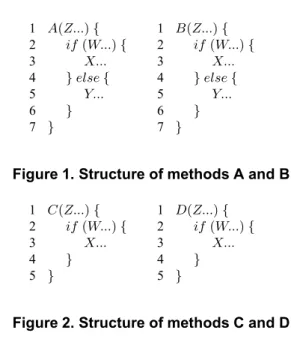
Suppose that a system is composed of methods A, B, C, D, and E whose code structure is depicted in Fig. 1, 2, and 3. Suppose also that method A is similar to B and C is similar to D. 1 A(Z...) { 1 B(Z...) { 2 if(W...) { 2 if(W...) { 3 X... 3 X... 4 } else { 4 } else { 5 Y... 5 Y... 6 } 6 } 7 } 7 }
Figure 1. Structure of methods A and B 1 C(Z...) { 1 D(Z...) {
2 if(W...) { 2 if(W...) {
3 X... 3 X...
4 } 4 }
5 } 5 }
Figure 2. Structure of methods C and D Blocks in this example are identif ed by the method name and the beginning and ending lines of enclosing curly brack-ets in the code. A2,4identif es the block enclosed in curly
brackets from line 2 to 4 in method A.
Fig. 4 shows the Block Inclusion Forest (BIF ) of meth-ods A, B, C, D, and E. Nodes in Fig. 4 are depicted as polygons to emphasize the similarity relation between blocks. Methods are identif ed by the block represent-ing the method body. Thus, method A is identif ed by block A1−7and so on for the other methods. It should be
noted that since A1−7 and B1−7 are similar,
correspond-ing blocks A2−4 and B2−4 are also similar, as are blocks
A5−7 and B5−7. Along this perspective, clone relations
(A2−4, B2−4)and (A5−7, B5−7)are structurally
redun-dant with respect to the relation (A1−7, B1−7).
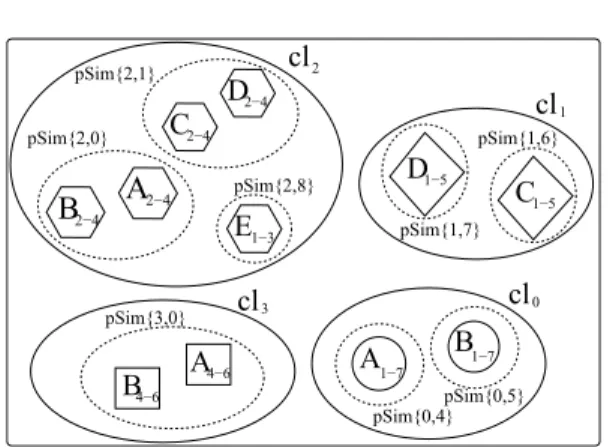
Fig. 5 shows the clusters cl0, cl1, cl2, cl3 of similar
blocks obtained when analyzing the whole system under unitary thresholds for identical block analysis. We can ob-serve in this f gure that blocks A1−7 and B1−7 belong to
cluster cl0; C1
−5 and D1−5 belong to cluster cl1; A2−4,
B2
−4, C2−4, D2−4, and E1−3 belong to cluster cl2; and
A4
−6and B4−6belong to cluster cl3.
Blocks can be further sub-clustered based on the similar-ity relation of their parents int he BIF as def ned in Sec-tion 3. A2
−4, B2−4belonging to cluster cl2also belong to
sub-cluster pSim[2, 0] since their respective parents A1,7
and B1
−7 are both in cluster cl0. C2−4, D2−4 belonging
1 E(Z...) { 2 X... 3 }
Figure 3. Structure of method E 2
A B B C D D A E 2−4 4−6 2−4 4−6 2−4 1−5 2−4 1−7 A B1−7 C1−5 1−3
Figure 4. Block Inclusion Forest (BIF)
D1−5 E1−3 2−4 D 2−4 C 4−6 A B4−6 1−5 C
A
B
2−4 2−4 1−7 B A1−7 cl2 cl1 cl0 cl3 pSim{0,5} pSim{0,4} pSim{2,0} pSim{2,8} pSim{1,7} pSim{1,6} pSim{2,1} pSim{3,0}Figure 5. Similarity partitions
to cluster cl2 also belong to sub-cluster pSim[2, 1] since
their respective parents C1−5and D1−5are both in cluster
cl1. Following the same reasoning, A4−6, B4−6belong to
sub-cluster pSim[3, 0].
A block that represents a method body doesn’t have a parent in the BIF and belongs to a sub-cluster con-taining only the block itself as happens for blocks A1−7
from cluster cl0in sub-cluster pSim[0, 4]; B1−7from cl0
in sub-cluster pSim[0, 5]; C1
−5 from cl1 in sub-cluster
pSim[1, 6]; D1
−5from cl1in sub-cluster pSim[1, 7]; and
E1−3from cl2in pSim[2, 8].
Clone relations between blocks in the same sub-cluster are redundant, while clone relations between blocks in the same cluster but different sub-cluster are not redundant.
Clone relation (A2−4, B2−4) is redundant and in fact
its elements are in the same cluster cl2 and also are in the
same sub-cluster pSim[2, 0]. Clone relation (A2−4, C2−4)
is not redundant because its elements are in the same clus-ter cl2but are also in different sub-clusters pSim[2, 0] and
pSim[2, 1].
Method bodies cannot produce redundant clone relations since they are the only member of their own sub-cluster. Thus, for example, clone relation (A2−4, E1−3)is not
re-dundant and indeed its elements are in the same cluster cl2
but also belong to different sub-clusters pSim[2, 0] and pSim[2, 8]
3 Algorithms
Suppose we have the Block Inclusion Forest (BIF ) of a system and suppose also that the similarity relation be-tween code blocks is an equivalence relation sim(bi, bj)
between code blocks biand bj, which produces a partition
of all blocks into mutually exclusive clusters clk.
Equiv-alence properties of clone detection are often satisf ed by approaches based on AST , metrics, pref x and suff x simi-larity, and so on.
The idea behind structural redundancy analysis of pairs of blocks is that a similarity relation pair (bi, bj)of blocks
belonging to the same cluster clkis redundant if the parents
of biand bjin the BIF are similar under the same
similar-ity relation as children, that is, if they, in turn, belong to the same cluster cp. In other words, similar blocks are
struc-turally redundant if they are also pSim related as follows: redundant(bi, bj) ↔ sim(BIF.parent(bi), BIF.parent(bj), th) ↔ (BIF.parent(bi) 6= U N DEF ) ∧ (BIF.parent(bj) 6= U N DEF )) ∧ sim(bi, bj, th) ∧ pSim(bi, bj, th) (1)
It should be noted that a block bt, that doesn’t have a
par-ent in the BIF , corresponds to a method body and cannot be redundant, if similar to some other block, since it’s a root of a tree in the BIF .
Relation pSim is an equivalence relation on blocks that have parents in the BIF , since its ref exive, symmetric and transitive properties are easily verif ed as follows:
sim(BIF.parent(a), BIF.parent(a)) sim(BIF.parent(a), BIF.parent(b)) → sim(BIF.parent(b), BIF.parent(a)) sim(BIF.parent(a), BIF.parent(b)) ∧ sim(BIF.parent(b), BIF.parent(c)) → sim(BIF.parent(a), BIF.parent(c)) (2)
A block bt that doesn’t have a parent in the BIF
be-longs to an equivalence class [bt] = {bt} containing only
the block itself.
Equivalence redundant classes under the pSim relation can be computed using the algorithm presented in Fig. 6 for Structural Redundancy Analysis (SRA), where clId func-tion associates blocks with the cluster they belong to, in the cluster partition generated by the clone relation.
Relation pSim is computed as a bi-dimensional associa-tive table, rather than as a full bi-dimensional matrix, whose generic element psim[k, m] represents the set of blocks 3
1 pSim ← computeP arentSimilarity( clusters, clId, BIF)
2 seed = | clusters | 3 f orall ck∈ clusters
4 f orall bi∈ ck
5 pi = BIF.parent(bi)
6 if (pi6= U N DEF )
7 pSim[k, clId(pi)].add(bi)
8 else
9 pSim[k, seed].add(bi)
10 seed = seed + 1 11 return pSim
Figure 6. Structural redundancy analysis (SRA)
bithat are all similar to one another and that have parents
which are similar too. Refer to Fig. 5 for a graphical repre-sentation of similarity partitions induced by pSim relation. Index k is associated with cluster ckof similar blocks. The
union of all psim[k, m] that have the same k is equal to cluster ck. Index m identif es the cluster of similar parents
of some member biof psim[k, m], so that either the parent
of bi exists and it belongs to cluster cmor it doesn’t exist
because biis a method and m represents a progressive
iden-tif er that doesn’t correspond to any similarity cluster. In this case, the progressive identif er is generated through a seedas shown in lines 2, 9, 10 in Fig. 6. Line 3 traverses all clusters. Line 4 iterates over the blocks biin cluster ck.
Line 5 computes piparent of biin the BIF . Line 6 tests if
piexists and then adds bito the proper element of pSim at
index [k, clId(pi)], where clId returns the identif er of the
cluster to which pibelongs. At least, pibelongs to a cluster
containing piitself. If line 6 fails, that is if biis a method or
a function and therefore it doesn’t have a parent, the index of pSim is [k, seed]. The initial value of seed is out of the range of cluster identif ers (see line 3) and it is incremented for each additional use (line 10).
Lines 5 to 10 can be executed in constant time if ele-ments of pSim are represented as lists and if the opera-tion add can be implemented so that it has a constant time execution complexity. This condition is easily satisf ed in conventional list implementations. Lines 5 to 10 are exe-cuted as many times as the number of all blocks belonging to all clusters, but since clusters ck represent a partition of
blocks, this number is equal to the total number of blocks in the system under investigation. We can conclude that algo-rithm SRA is linear on the number of blocks composing a system.
The following properties hold for elements in the equiv-alence classes of structural redundancy pSim computed by
SRA:
∀bibj∈ pSim[k, m] → redundant(bi, bj)
bi∈ pSim[k, m] ∧ bj∈ pSim[k, n] ∧
(m 6= n) → ¬ (redundant(bi, bj))
(3) Additionally, we may def ne as def nitely redundant those blocks belonging only to redundant pairs. This oc-curs when a pSim class is equal to the whole cluster to be sub-partitioned. Similarly, we may def ne as def nitely
redundant those blocks that participate only in
non-redundant pairs. This occurs when blocks are alone in a class and there are at least two pSim classes from the sub-partitioning of a cluster. Possibly redundant blocks partici-pate in both redundant and non-redundant pairs, which oc-curs when the sub-partitioning of a cluster produces more than one pSim class with at least two elements.
4 Experiments and results
Experiments have been performed on two open-source Java systems, Tomcat and Eclipse, and have been executed on an Intel Core 2 Duo, 3.0 GHz clock, 3 GB RAM, under Linux Fedora 8. Code has been compiled with g++ 4.1.2. Tomcat [2] is an implementation of the Java Servlet and the Java Server Pages technologies and is widely used to power different kinds of web-based systems. Eclipse [1] is a com-plete IDE to develop Java applications. The size, number of methods, number of blocks and average nesting level of blocks in the BIF for Tomcat and Eclipse are reported in Table 1. In this table and in all reported f gures and exper-iments, data refer to blocks larger than 6 LOC, which is a threshold that has been chosen as a lower bound of signif-icance for block sizes. Choice of 6 LOCs comes from the literature on clones and from previous authors’ experience and is considered a reasonable size threshold for clone de-tection. Other size thresholds can be used if required.
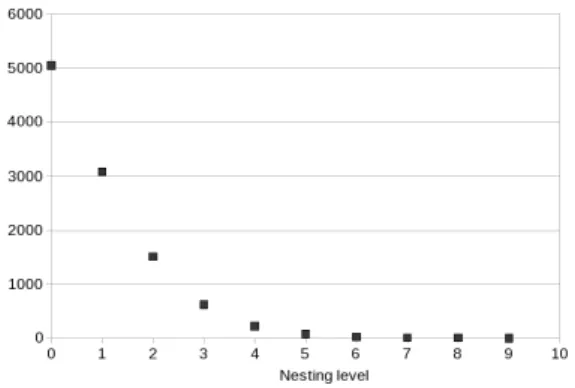
The distribution of nesting levels of blocks in the BIF for the investigated systems is shown in Fig. 7 and Fig. 8. Methods are considered as being at nesting level 0. Nesting levels of statement blocks in the BIF start at 1 and increase as nesting does.
System Tomcat Eclipse
Version 5.5 3.3
LOC 130K 1.3M
Methods 5047 60326
Blocks 5538 32113
BIF Average Nesting 0.89 0.62 Table 1. System features 4
Figure 7. Tomcat BIF nesting level distribution
Figure 8. Eclipse BIF nesting level distribution
The number of blocks at higher BIF nesting levels decreases as block nesting increases. It is interesting to compute the distribution of nesting levels because method clones produce as many redundant relations as the number of their nested blocks. A rather f at structured system has less structurally redundant clones than a deeply nested sys-tem for the same cloning ratio at method level.
Syntactic analysis of investigated systems has been per-formed using Eclipse to extract the Block Inclusion Forest (BIF ) and block metrics from the Abstract Syntax Tree (AST ). Block similarity has been computed using CLAN [10]. The algorithm for similarity clustering used in CLAN is shown in Fig.9. The following metrics have been com-puted for each block in the investigated systems: number of statements, number of branches (IF, CASE, etc.), number of loops (FOR, WHILE, DO, etc.), number of calls, number of parameters (zero for nested blocks, possibly non-zero for methods).
1 clustersT ype ← computeClusters( blocks, metrics) 2 clusters.clear() 3 f orall b∈ blocks 4 i= 1 5 key= () 6 while(i ≤ metrics[b].size()) 8 key.append(int(metrics[b][i])) 9 i= i + 1 10 kSet[b] = key 11 clusters[key] = clusters[key] ∪ {b} 12 return clusters
Figure 9. Similarity Clustering
Overall method and block information have been re-ported in Table 1 together with average nesting levels in the BIF. Table 2 presents the cardinality of the clusters com-puted by algorithm SRA. The minimum cluster cardinality is 2 for all steps and has not been reported.
The distribution of cluster cardinality is reported in Fig. 10 for Tomcat and in Fig. 11 for Eclipse.
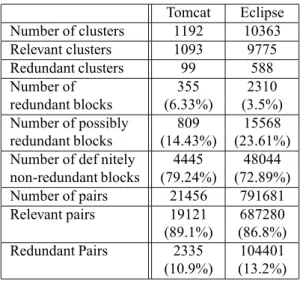
Table. 4 presents the redundant clone block information f gures. Redundant clusters can be safely ignored, because they are totally composed of def nitely redundant blocks. It is interesting to remark that the percentage of def nitely
re-dundant blocks is quite small for both systems, but is higher
for Tomcat than for Eclipse. Possibly redundant blocks are in a larger number for Eclipse than for Tomcat and the num-ber of def nitely non-redundant is about the same for both systems. The percentage of redundant number of clone pairs is between 10 and 13% in the investigated systems and the total number of relevant clone pairs is between 86 and 89% for those systems.
Tomcat Eclipse
avg max avg max
3.71 79 5.36 342
Table 2. Cluster cardinalities
Figure 10. Tomcat cluster cardinality distribu-tion
Figure 11. Eclipse cluster cardinality distribu-tion
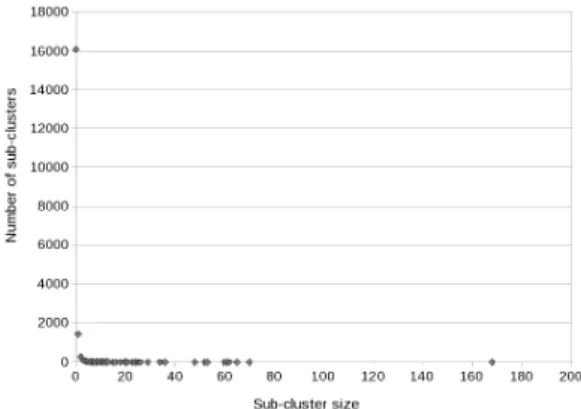
Sub-cluster cardinalities represent the size of structurally redundant sets of blocks. Cardinality distribution of sub-clusters corresponding to pSim partition is depicted in Fig. 12 for Tomcat and in Fig. 13 for Eclipse.
Figure 12. Tomcat sub-cluster cardinality dis-tribution
Figure 13. Eclipse sub-cluster cardinality dis-tribution
It is interesting to remark in these f gures that the overall distribution shape reminds that of a Pareto distribution.
Table 3 show CPU execution time in seconds for SRA. Tomcat execution times are smaller because its total number of blocks is smaller than that of Eclipse.
5 Discussion
Results show that structural redundancy in clone rela-tion can be quickly evaluated using the SRA algorithm on a common desktop computer.
From an application point of view, the results seem 6
System Time (s) Tomcat 0.201 Eclipse 1.91
Table 3. Eclipse and Tomcat execution times Tomcat Eclipse Number of clusters 1192 10363 Relevant clusters 1093 9775 Redundant clusters 99 588 Number of 355 2310 redundant blocks (6.33%) (3.5%) Number of possibly 809 15568 redundant blocks (14.43%) (23.61%) Number of def nitely 4445 48044 non-redundant blocks (79.24%) (72.89%) Number of pairs 21456 791681 Relevant pairs 19121 687280 (89.1%) (86.8%) Redundant Pairs 2335 104401 (10.9%) (13.2%) Table 4. Clusters redundancy analysis interesting for software engineering purposes such as re-factoring, evolution and bug detection analysis.
The presented results also depend on several specif c fac-tors used in the experiments and discussed in the following. The investigated systems are written in Java. Further-more, only two specif c systems with specif c structural block inclusion and cloning features have been investigated. Results using other object oriented languages or procedural languages may be different and should be investigated. In-vestigation should also be carried out on more Java systems for different nesting and cloning characteristics.
The Java inner class programming construct presents an anomaly of classif cation between blocks and functions. Methods bodies from inner classes are actually methods that are nested in other method bodies from other classes. For the presented experiments and results, methods from inner classes have been labeled as compound statement blocks rather than methods at root level in the BIF . This little lack of precision could be easily corrected if required.
Clone relations have been based on software metrics and on the specif c metrics mentioned in Section 4. Other ap-proaches, based for example on string matching, pref x or suff x trees, or graph matching, may produce slightly differ-ent clusters of similar fragmdiffer-ents. In addition, only blocks bigger than 6 LOC have been considered for experiments. Eliminating small blocks from clone analysis is a common strategy to avoid reporting trivial relations between small
blocks. The specif c choice of 6 LOCs is consistent with the literature on clones and with the authors’ previous experi-ence and is considered a reasonable size threshold for clone detection. Other size thresholds can be used if desired or the threshold f ltering could be questioned and removed if necessary.
Metrics based block analysis is eff cient because met-rics for clone analysis are compositional and a single pass through the AST is suff cient to annotate it with the metrics value for each sub-tree. It should be noted that the choice of metrics has been based on the authors’ previous experi-ence, but the metrics presented in [9, 19, 23] could be used almost interchangeably.
Metrics based approaches suffer from the typical distor-tion that similarity of metrics doesn’t necessarily mean sim-ilarity of code. Consider, for example, two blocks, the f rst one composed of an if statement containing a for state-ment and the second composed of a for statestate-ment contain-ing an if statement. Although the metrics count may be the same, the two blocks should not be considered similar, at least not for a unitary threshold indicating a perfect match. Conversely, similarity of code necessarily means similarity of metrics. Think of two code blocks: the f rst being a for statement including an if statement and the second being an if statement including a for. It’s easy to imagine a sit-uation where the metrics are the same for the two blocks, while the two fragments are not similar. In metrics based approaches, false negatives may be absent, while false pos-itives may exist.
We are interested here in discussing whether the pre-sented redundancy detection approach changes or not the intrinsic matching distorsion mentioned above. This dis-tortion may have an impact in structural redundancy clone analysis because false positives may exist in nested blocks as well as in functions at top nesting levels. Since false negatives are absent, when a clone relation is not detected between children or parents in the BIF , no similarity or er-ror is possible. Erer-rors may only occur when some similarity relation exists among children or parents.
When similar children don’t have similar parents in the BIF, children are correctly reported as similar. False pos-itive children are still reported as false pospos-itive. No new errors are introduced by the structural redundancy analysis. When similar parents don’t have similar children, parents may be reported as similar, recursively depending on their parents’ similarity, and so on. False positive parents may still be reported as false positive. There is no new error generated and no change in the global error rate.
Falsely positive children that have falsely similar parents are not reported after structural redundancy analysis, be-cause they are erroneously considered redundant. However, this reduces the number of false positives to parents only and it may indeed reduce the global error rate. Falsely posi-7
tive children that have truly similar parents are not reported since they are considered redundant, which is def nitely not an error since parents are indeed similar. Truly positive children that have falsely similar parents are not reported as clones since they are erroneously considered redundant. This is the only case in which the redundancy analysis in-troduces a new error. Truly positive children that have truly similar parents are not reported as clones, which is perfectly correct.
Overall, structural redundancy analysis reduces the error rate of metrics based clone detection when falsely positive children have falsely similar parents, and it increases the error rate when truly positive children have falsely similar parents.
The global error after structural redundancy analysis is the balance between the two types of errors. Unfortunately, this balance has not been evaluated in this paper. Neverthe-less, we may argue that if the false positives are uniformly distributed over the fragments, the two errors may somehow compensate each other and therefore the overall impact may not be very signif cant. The precise values of uncompen-sated errors should be investigated in future experiments.
Experimental evaluation of def nitely redundant, def
-nitely non-redundant and possibly redundant fragments has
been measured and shows that between 3 and 6% of blocks are def nitely redundant, between 14 and 23% of blocks are
possibly redundant, while between 10 and 13% of clone
pairs are redundant. These f gures are encouraging show-ing that some computational effort can be reduced by takshow-ing into account redundancy information.
Some source code inclusions relations can be originated by sub-sequences of statements in a compound statement. The presented approach doesn’t yet address inclusion rela-tions induced by sub-sequences and this issue is left to fur-ther research. Sub-sequences are nevertheless included in a compound statement, so, if this information is represented in the BIF , the algorithm would compute the redundancy analysis also for sub-sequences.
Some further processing of clone blocks information may be done directly from the clusters and redundancy sub-partitions. For example, visualization of clone blocks can be done by selecting a def nitely non-redundant clone block representative of a cluster and by visualizing the differences with respect to the selected block of all other members of the same cluster. This is the visualization approach used in CLAN.
If bug detection caused by inconsistent image identif er replacement (as described in [25] is sought, identif er map-ping can be performed with respect to a def nitely non-redundant representative of a cluster and by analyzing the consistency of mapping in all other members of the same cluster.
Nevertheless, some further processing of clone
informa-tion may require the output of all pairs of clone blocks. The number of pairs of clone blocks that can be constructed from clusters is quadratic on the cardinality of clusters. Al-though clusters and redundancy information can be com-puted in linear time, computation of all pairs of clone blocks shows nevertheless a quadratic component in com-plexity. Redundancy identif cation may reduce by factors the quadratic component, but still computation of all clone block pairs remains quadratic in general.
6. Conclusions
Clone relations may be affected by structural redundancy when block fragments at different levels of nesting in the Block Inclusion Forest (BIF ) are considered for similarity. A linear algorithm for structural redundancy detection of similarity information has been proposed and experimen-tally evaluated on Tomcat and Eclipse in this paper.
The experimental evaluation of def nitely redundant,
def-initely non-redundant and possibly redundant analyses has
been performed.
The detected redundancy of clone pairs appears to be about 10% for Tomcat and 13% for Eclipse.
The proposed SRA algorithm computes redundant sub-partitions of clusters of similar blocks in linear memory and execution time complexity on the total number of analyzed blocks and is also fast in practice: execution CPU times have been about 0.2 s for Tomcat and about 1.9 s for Eclipse. Further research is required on more numerous and dif-ferent system, possibly written in languages other than Java.
7. Acknowledgements
This research has been funded by the Natural Sciences and Engineering Research Council of Canada under the Discovery Grants Program. The authors wish to thank Melissa Mongeau for her contribution to Eclipse based met-rics extraction.
References
[1] Eclipse. http://www.eclipse.org. [2] Tomcat. http://tomcat.apache.org.
[3] R. Al-Ekram, C. Kapser, R. Holt, and M. Godfrey. Cloning by accident: An empirical study of source code cloning across software systems. In International Symposium on
Empirical Software Engineering, 2005.
[4] G. Antoniol, U. Villano, E. Merlo, and M. D. Penta. Ana-lyzing clone evolution in the linux kernel. Information and
Software Technology, pages 755–765, 2002.
[5] L. Aversano, L. Cerulo, and M. D. Penta. How clones are maintained: An empirical study. In European Conference
on Software Maintenance and Reengineering, 2007.
[6] B. Baker. Finding clones with dup: Analysis of an experi-ment. IEEE Transactions on Software Engineering, 2007. [7] M. Balazinska, E. Merlo, M. Dagenais, B. Lagu, and
K. Kontogiannis. Advanced clone-analysis as a basis for object-oriented system refactoring. In Proc. Working
Con-ference on Reverse Engineering (WCRE), pages 98–107.
IEEE Computer Society Press, 2000.
[8] H. Basit, S. Pugliesi, W. Smyth, A. Turpin, and S. Jarz-abek. Eff cient token based clone detection with f exible to-kenization. In European Software Engineering Conference
and Symposium on the Foundations of Software Engineer-ing, 2007.
[9] I. Baxter, A. Yahin, l. Moura, M. Sant’Anna, and L. Bier. Clone detection using abstract syntax trees. In Proceedings
of the International Conference on Software Maintenance -IEEE Computer Society Press, pages 368–377, 1998.
[10] S. Bellon, R. Koschke, G. Antoniol, J. Krinke, and E. Merlo. Comparison and evaluation of clone detec-tion tools. IEEE Transacdetec-tions on Software Engineering, 33(9):577–591, 2007.
[11] S. Bouktif, G. Antoniol, M. Neteler, and E. Merlo. A novel approach to optimize clone refactoring activity. In
Ge-netic and Evolutionary Computation Conference (GECCO),
pages 1037–1043. ACM Press, 2006.
[12] F. Deissenboeck, B. Hummel, E. Juergens, B. Schaetz, S. Wagner, S. Teuchert, and J. F. Girard. Clone detection in automotive model-based development. In Proceedings
of the International Conference on Software Engineering.
IEEE Computer Society Press, 2008.
[13] E. Duala-Ekoko and M. Robillard. Tracking code clones in evolving software. In Proceedings of the International
Con-ference on Software Engineering. IEEE Computer Society
Press, 2007.
[14] S. Ducasse, O. Nierstrasz, and M. Rieger. On the effective-ness of clone detection by string matching. International
Journal on Software Maintenance and Evolution: Research and Practice, 2006.
[15] R. Falke, P.Frenzel, and R. Koschke. Empirical evaluation of clone detection using syntax suff x trees. Empirical Software
Engineering Journal, 13(6):601–643, 2008.
[16] N. Gode and R. Koschke. Incremental clone detection. In European Conference on Software Maintenance and
Reengineering, 2009.
[17] J. Guo and Y. Zou. Detecting clones in business applica-tions. In Proceedings of the Working Conference on Reverse
Engineering, 2008.
[18] Z. Jiang and A. Hassan. A framework for studying clones in large software systems. In Workshop on Source Code
Anal-ysis and Manipulation, 2007.
[19] J. H. Johnson. Identifying redundancy in source code using f ngerprints. In CASCON, pages 171–183, October 1993. [20] T. Kamiya. Variation analysis of context-sharing identif ers
with code clone. In Proceedings of the International
Con-ference on Software Maintenance - IEEE Computer Society Press. IEEE Computer Society Press, 2008.
[21] T. Kamiya, S. Kusumoto, and K. Inoue. Ccf nder: A multi-linguistic token-based code clone detection system for large scale source code. IEEE Transactions on Software
Engi-neering, 28(7):654–670, 2002.
[22] M. Kim, V. Sazawal, D. Notkin, and G. Murphy. An empir-ical study of code clone genealogies. In European Software
Engineering Conference and Symposium on the Foundations of Software Engineering, 2005.
[23] K. Kontogiannis, R. De Mori, R. Bernstein, M. Galler, and E. Merlo. Pattern matching for clone and concept detec-tion. Journal of Automated Software Engineering, 3:77–108, March 1996.
[24] B. Lag¨ue, D. Proulx, E. Merlo, J. Mayrand, and J. Hude-pohl. Assessing the benef ts of incorporating function clone detection in a development process. In Proceedings of the
International Conference on Software Maintenance - IEEE Computer Society Press, pages 314–321, 1997.
[25] Z. Li, S. Lu, S. Myagmar, and Y. Zhou. Cp-miner: Find-ing copy-paste and related bugs in large-scale software code.
IEEE Transactions on Software Engineering, pages 1–17,
2006.
[26] A. Marcus and J. I. Maletic. Identif cation of high-level con-cept clones in source code. In ASE ’01: Proceedings of the
16th IEEE International Conference on Automated Software Engineering, page 107, Washington, DC, USA, 2001. IEEE
Computer Society.
[27] J. Mayrand, C. Leblanc, and E. Merlo. Experiment on the automatic detection of function clones in a software system using metrics. In Proceedings of the International
Confer-ence on Software Maintenance - IEEE Computer Society Press, pages 244–253, Monterey, CA, Nov 1996.
[28] E. Merlo. Detection of plagiarism in university projects using metrics-based spectral similarity. In R. Koschke, E. Merlo, and A. Walenstein, editors, Duplication,
Re-dundancy, and Similarity in Software, number 06301 in
Dagstuhl Seminar Proceedings, Dagstuhl, Germany, 2007. IBFI.
[29] E. Merlo, G. Antoniol, M. D. Penta, and F. Rollo. Lin-ear complexity object-oriented similarity for clone detection and software evolution analysis. In Proceedings of the
Inter-national Conference on Software Maintenance - IEEE Com-puter Society Press, pages 412–416. IEEE ComCom-puter
Soci-ety Press, 2004.
[30] U. of Alabama at Birmingham. Clone literature. ”http://students.cis.uab.edu/tairasr/clones/literature”. [31] C. Roy and J. Cordy. A survey on software clone
detec-tion research. Technical Report Technical Report 2007-541, School of Computing, Queen’s University, November 2007. [32] C. Roy and J. Cordy. Scenario-based comparison of clone detection techniques. In International Conference on
Pro-gram Comprehension, pages 153–162. IEEE Computer
So-ciety Press, 2008.
[33] C. K. Roy and J. R. Cordy. An empirical study of function clones in open source software. In Proceedings of the
Work-ing Conference on Reverse EngineerWork-ing, 2008.