HAL Id: hal-01411910
https://hal.inria.fr/hal-01411910
Submitted on 7 Dec 2016
HAL is a multi-disciplinary open access
archive for the deposit and dissemination of
sci-entific research documents, whether they are
pub-lished or not. The documents may come from
teaching and research institutions in France or
abroad, or from public or private research centers.
L’archive ouverte pluridisciplinaire HAL, est
destinée au dépôt et à la diffusion de documents
scientifiques de niveau recherche, publiés ou non,
émanant des établissements d’enseignement et de
recherche français ou étrangers, des laboratoires
publics ou privés.
Minoan ER: Progressive Entity Resolution in the Web
of Data
Vasilis Efthymiou, Kostas Stefanidis, Vassilis Christophides
To cite this version:
Vasilis Efthymiou, Kostas Stefanidis, Vassilis Christophides. Minoan ER: Progressive Entity
Resolu-tion in the Web of Data. 19th InternaResolu-tional Conference on Extending Database Technology, EDBT
2016, Mar 2016, Bordeaux, France. 2016, �10.5441/002/edbt.2016.79�. �hal-01411910�
Minoan ER: Progressive Entity Resolution
in the Web of Data
Vasilis Efthymiou
Univ. of Crete & ICS-FORTH
[email protected]
Kostas Stefanidis
ICS-FORTH[email protected]
Vassilis Christophides
Univ. of Crete & INRIA Paris-Rocquencourt
[email protected]
ABSTRACT
Entity resolution aims to identify descriptions of the same entity within or across knowledge bases. In this work, we present the Minoan ER platform for resolving entities de-scribed by linked data in the Web (e.g., in RDF). To re-duce the required number of comparisons, Minoan ER per-forms blocking to place similar descriptions into blocks and executes comparisons to identify matches only between de-scriptions within the same block. Moreover, it explores in a pay-as-you-go fashion any intermediate results of matching to obtain similarity evidence of entity neighbors and discover new candidate description pairs for resolution.
1.
DESCRIPTION
Over the past decade, numerous knowledge bases (KBs) have been built to power large-scale knowledge sharing, but also an entity-centric Web search, mixing both structured data and text querying. These KBs offer comprehensive, machine-readable descriptions of a large variety of real-world entities (e.g., persons, places, products, events) published on the Web as Linked Data (LD). Although KBs (e.g., DBpe-dia, Freebase) may be derived from the same data source (e.g., a Wikipedia entry), they may provide multiple, non-identical descriptions of the same real-world entities. This is mainly due to the different information extraction tools and curation policies employed by KBs, resulting to complemen-tary and sometimes conflicting entity descriptions. Entity resolution (ER) aims to identify descriptions that refer to the same real-world entity appearing either within or across KBs [2, 3]. Compared to data warehouses, the new ER challenges stem from the openness of the Web of data in describing entities by an unbounded number of KBs, the se-mantic and structural diversity of the descriptions provided across domains even for the same real-world entities, as well as the autonomy of KBs in terms of adopted processes for creating and curating entity descriptions. In particular:
• The number of KBs (aka RDF datasets) in the Linking Open Data (LOD) cloud has roughly tripled between
c
2016, Copyright is with the authors. Published in Proc. 19th Inter-national Conference on Extending Database Technology (EDBT), March 15-18, 2016 - Bordeaux, France: ISBN 978-3-89318-070-7, on OpenPro-ceedings.org. Distribution of this paper is permitted under the terms of the Creative Commons license CC-by-nc-nd 4.0
2011 and 2014 (from 295 to 1014), while KBs inter-linking dropped by 30%. The main reason is that with more KBs available, it becomes more difficult for data publishers to identify relations between the data they publish and the data already published. Thus, the ma-jority of KBs are sparsely linked, while their popular-ity in links is heavily skewed. Sparsely interlinked KBs appear in the periphery of the LOD cloud (e.g., Open Food Facts, Bio2RDF), while heavily interlinked ones lie at the center (e.g., DBpedia, GeoNames). Ency-clopaedic KBs, such as DBpedia, or widely used geo-referencing KBs, such as GeoNames, are interlinked with the largest number of KBs [6].
• The descriptions contained in these KBs present a high degree of semantic and structural diversity, even for the same entity types. Despite the Linked Data prin-ciples, multiple names (e.g., URIs) can be used to refer to the same real-world entity. The majority (58.24%) of the 649 vocabularies currently used by KBs are pro-prietary, i.e., they are used by only one KB, while di-verse sets of properties are commonly used to describe the entities both in terms of types and number of oc-currences even in the same KB. Only YAGO contains 350K different types of entities, while Google’s Knowl-edge Graph contains 35K properties, used to describe 600M entities.
The two core ER problems, namely how can we (a) effec-tively compute similarity of entity descriptions and (b) effi-ciently resolve sets of entities within or across sources, are challenged by the large scale (both in terms of the number of sources and entity descriptions), the high diversity (both in terms of number of entity types and properties) and the importance of relationships among entity descriptions (not committing to a particular schema defined in advance). In particular, in addition to highly similar descriptions that fea-ture many common tokens in values of semantically related attributes, typically met in the center of the LOD cloud and heavily interlinked mostly using owl:sameAs predicates, we are encountering somehow similar descriptions with signifi-cantly fewer common tokens in attributes not always seman-tically related, that appear usually in the periphery of the LOD cloud and are sparsely interlinked with various kinds of predicates. Plainly, the coming up of highly and somehow similar semi-structured entity descriptions requires solutions that go beyond those applicable to duplicate detection. A promising area of research in this respect is cross-domain similarity search and mining [8, 7], aiming to exploit simi-larity of objects described by different modalities (i.e., text,
Poster Paper
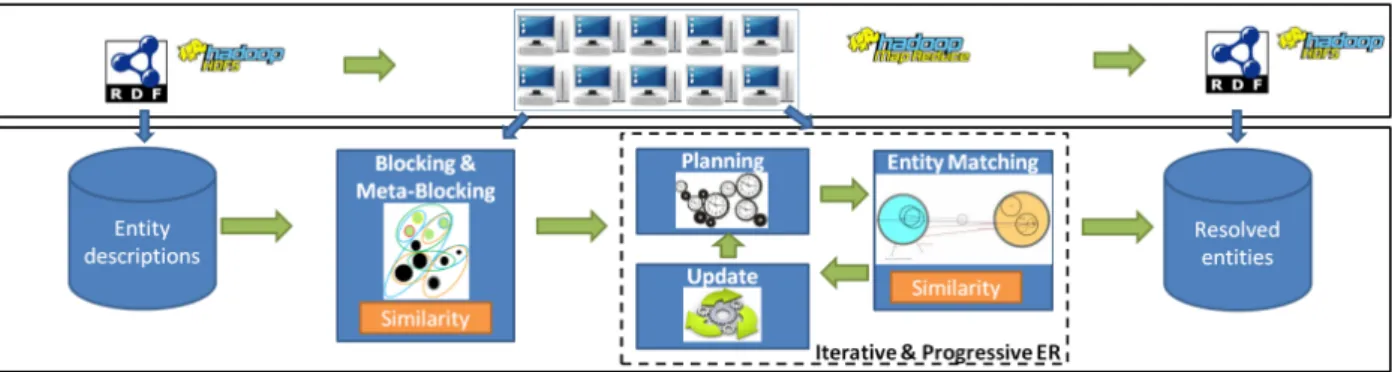
Figure 1: The Minoan ER Framework.
image) and contexts (i.e., facets) and support research by analogy. Such techniques could be also beneficial for match-ing highly heterogeneous entity descriptions and thus sup-port ER at the Web scale.
We present in this poster the Minoan ER platform for resolving entities described by linked data in the Web (e.g., in RDF). Figure 1 illustrates the general steps involved in our process.
Blocking and Meta-blocking in Minoan ER: We use blocking as a pre-processing step for ER to reduce the num-ber of required comparisons. Specifically, blocking places similar entity descriptions into blocks, leaving to the entity matching algorithm the comparisons only between descrip-tions within the same block.
Typically, token-based blocking algorithms place highly similar descriptions (having many common tokens) in many common blocks; intuitively, the more common blocks two de-scriptions share, the more likely it is that they match. This leads to many repeated comparisons between the same pairs of descriptions. To overcome this problem, we accompany blocking with meta-blocking, which prunes such repeated comparisons. Moreover, meta-blocking aims at discarding comparisons between descriptions that share few common blocks and are thus less likely to match. In Minoan ER, to support a Web-scale resolution of heterogeneous and loosely structured entities across domains, we use algorithms for blocking and meta-blocking that disregard strong assump-tions about knowledge of the data schema and rely on a minimal number of assumptions about how entities match (e.g., when they feature a common token in their descrip-tions or URIs) within or across sources. For doing so, we exploit the parallel processing power of a computer cluster via Hadoop MapReduce, as presented in [5, 4].
Progressive Entity Matching in Minoan ER: Block-ing approaches in the Web of data, especially when handlBlock-ing somehow similar descriptions appearing in the periphery of the LOD cloud, may miss highly heterogeneous matching descriptions featuring few common tokens [5]. To overcome that, we focus on exploiting the partial matching results as a similarity evidence for their neighbor (i.e., linked) descrip-tions. Since this inherently iterative process entails an addi-tional overhead, we are interested in maximizing its benefit, given a computational cost budget. So, we need to estimate which part of the graph is the most promising to explore in the next iteration, in a progressive way.
In this respect, Minoan ER focuses on extending the typ-ical ER workflow with a scheduling phase, which is respon-sible for selecting which pairs of descriptions, that have
re-sulted from blocking, will be compared in the entity match-ing phase and in what order. The goal of this new phase is to favor more promising comparisons, i.e., those that are more likely to increase the targeted benefit. This way, those com-parisons are executed before less promising ones and thus, higher benefit is provided early on in the process. The up-date phase propagates the results of matching, such that a new scheduling phase will promote the comparison of pairs that were influenced by the previous matches. This iterative process continues until the cost budget is consumed.
In contrast to existing works in progressive relational ER (e.g., [1]), which consider the quantity of entity pairs re-solved, as the benefit of ER, we explore different aspects of data quality, improved through ER. In particular, we are interested in characterizing the quality of the resolved pairs, with respect to the number of descriptions resolved, corre-sponding to the same real-world entity (targeting attribute completeness), the number of real-world entities resolved (targeting entity coverage), and the number of real-world entity graphs resolved (targeting relationship completeness). Acknowledgements: This work was partially supported by the EU H2020 PARTHENOS (#654119), FP7 DIACHRON (#601043) and FP7 SemData (#612551) projects.
2.
REFERENCES
[1] Y. Altowim, D. V. Kalashnikov, and S. Mehrotra. Progressive approach to relational entity resolution. PVLDB, 7(11):999–1010, 2014.
[2] V. Christophides, V. Efthymiou, and K. Stefanidis. Entity Resolution in the Web of Data. Synthesis Lectures on the Semantic Web: Theory and Technology. Morgan & Claypool Publishers, 2015.
[3] X. L. Dong and D. Srivastava. Big Data Integration. Synthesis Lectures on Data Management. Morgan & Claypool Publishers, 2015.
[4] V. Efthymiou, G. Papadakis, G. Papastefanatos, K. Stefanidis, and T. Palpanas. Parallel meta-blocking: Realizing scalable entity resolution over large, heterogeneous data. In IEEE Big Data, 2015.
[5] V. Efthymiou, K. Stefanidis, and V. Christophides. Big data entity resolution: From highly to somehow similar entity descriptions in the Web. In IEEE Big Data, 2015.
[6] M. Schmachtenberg, C. Bizer, and H. Paulheim. Adoption of the linked data best practices in different topical domains. In ISWC, pages 245–260, 2014.
[7] A. Shrivastava, T. Malisiewicz, A. Gupta, and A. A. Efros. Data-driven visual similarity for cross-domain image matching. ACM Trans. Graph., 30(6):154, 2011. [8] Y. Zhen, P. Rai, H. Zha, and L. Carin. Cross-modal
similarity learning via pairs, preferences, and active supervision. In AAAI, pages 3203–3209, 2015.