HAL Id: hal-01118368
https://hal.archives-ouvertes.fr/hal-01118368
Submitted on 18 Feb 2015
HAL is a multi-disciplinary open access
archive for the deposit and dissemination of
sci-entific research documents, whether they are
pub-lished or not. The documents may come from
teaching and research institutions in France or
abroad, or from public or private research centers.
L’archive ouverte pluridisciplinaire HAL, est
destinée au dépôt et à la diffusion de documents
scientifiques de niveau recherche, publiés ou non,
émanant des établissements d’enseignement et de
recherche français ou étrangers, des laboratoires
publics ou privés.
Fragmentation dynamics of ionized neon trimer inside
helium nanodroplets: A theoretical study
David Bonhommeau, Alexandra Viel, Nadine Halberstadt
To cite this version:
David Bonhommeau, Alexandra Viel, Nadine Halberstadt. Fragmentation dynamics of ionized neon
trimer inside helium nanodroplets: A theoretical study. Journal of Chemical Physics, American
Institute of Physics, 2004, 120 (24), pp.11359-11362. �10.1063/1.1763567�. �hal-01118368�
Fragmentation dynamics of ionized neon trimer inside helium nanodroplets:
A theoretical study
David Bonhommeau, Alexandra Viel, and Nadine Halberstadta)
Laboratoire de Physique Quantique, IRSAMC, UMR 5626, CNRS et Universite´ P. Sabatier, 118 route de Narbonne, F-31062-Toulouse, France
共Received 8 April 2004; accepted 28 April 2004兲
We report a theoretical study of the fragmentation dynamics of Ne3⫹ inside helium nanodroplets, following vertical ionization of the neutral neon trimer. The motion of the neon atoms is treated classically, while transitions between the electronic states of the ionic cluster are treated quantum mechanically. A diatomics-in-molecules description of the potential energy surfaces is used, in a minimal basis set consisting of three effective p orbitals on each neon atom for the missing electron. The helium environment is modeled by a friction force acting on the neon atoms when their speed exceeds the Landau velocity. A reasonable range of values for the corresponding friction coefficient is obtained by comparison with existing experimental measurements. © 2004 American Institute
of Physics. 关DOI: 10.1063/1.1763567兴
I. INTRODUCTION
One of the most challenging problems in the recent field of molecular physics and chemistry inside helium nanodrop-lets is the question of how the helium environment affects molecular processes. In particular, since helium clusters have been shown to be superfluid, it is a fundamental question to know if dopant fragmentation can be hindered in this me-dium. It is an important practical question as well, since mass spectrometry is widely used for analyzing these sys-tems: Electron impact ionization causes extensive fragmen-tation of the helium cluster and of the dopant. We focus here on the dopant fragmentation and how it is affected by the helium environment.
Isolated rare gas clusters are known for fragmenting upon ionization,1–3due to the large difference between equi-librium distances in the neutral and ionized states. Therefore, they constitute ideal model systems to study the influence of the helium environment on a dissociative event. We have chosen to start our study with neon clusters since spin–orbit effects are expected to be small compared to heavier rare gases. There have been many experimental studies on iso-lated ionized neon clusters, in particular on the characteriza-tion of ‘‘magic numbers,’’4and on the 22Ne isotope enrich-ment effect.5–7Theoretical studies so far have been limited to the lowest adiabatic surface. Stampfli8 has studied the frag-mentation of large ionized rare gas clusters by molecular dynamics and Satta et al. have modeled the neon trimer photoionization using time-dependent vibrational self-consistent dynamics.9
Electron impact ionization and fragmentation of neon clusters inside helium clusters have been studied in detail by the group of Janda.10Ne3and Ne4clusters are found never to
survive ionization. For both sizes, the most probable frag-ment is Ne2⫹ 共bare or with some helium atoms attached兲. In the case of the tetramer, some Ne3⫹ fragments are also
de-tected for the larger values of the mean helium droplet sizes. In the present study we simulate the fragmentation of ionized neon clusters using the mixed quantum-classical dy-namics 共MDQT兲 method of Tully.11,12 The nuclei evolve classically on a single potential energy surface, and the ex-istence of various potential energy surfaces is taken into ac-count by allowing for hops between surfaces. The potential energy surfaces are based on the diatomics-in-molecules
共DIM兲 description. The effect of the helium environment is
modeled in an ad hoc fashion by introducing a friction force on the neon atoms when their speed exceeds the critical Lan-dau velocity. The justification is that helium clusters are su-perfluid at their temperature of 0.4 K, but frictionless motion inside superfluid helium is valid only for speeds under the Landau velocity.13 Given the low temperature 共0.4 K兲, the Langevin random force describing how energy is transferred from the helium bath to the neon cluster is neglected. In this paper we present the first results for Ne3⫹inside helium nano-droplets, thereby demonstrating the applicability of the scheme to be used for larger clusters.
II. THEORETICAL METHOD
We use the molecular dynamics with quantum transitions
共MDQT兲 method of Tully11,12,14,15 in which the electronic
degrees of freedom are treated quantum mechanically and the nuclear ones classically. This method allows us to take into account all the potential energy surfaces and their cou-plings and makes it possible to study larger clusters. The classical motion of the nuclei is described in Cartesian coor-dinates on a single potential energy surface Vk:
R␣l t ⫽ p␣l m , 共1a兲 p␣l t ⫽⫺ Vk R␣l⫺␥␣⌰共v␣⫺vL兲v␣l, 共1b兲 a兲Electronic mail: [email protected]
11359
where R␣l and p␣l, ␣⫽1,...,n,l苸兵x,y ,z其 respectively de-note a Cartesian position and momentum component of neon atom ␣ of mass m⫽20.1797 u 共isotopic average兲. The sec-ond member in the r.h.s. of Eq.共1b兲 is a friction force, to be detailed below.
The time-dependent electronic wave function of the sys-tem is expanded on the adiabatic states ⌽j(r;R),
⌿共r,R,t兲⫽
兺
j⫽13n
cj共t兲⌽j共r;R兲, 共2兲
where R and r denote the set of classical variables Riand the
electronic coordinates, respectively. The modulus j(t) and the phase qj(t) of the complex-valued expansion coefficients
cj(t) obey the following equations: ˙j⫽⫺
兺
k⫽ j k R˙•djk共R兲cos共qj⫺qk兲, 共3a兲 q˙j⫽ Vj ប ⫹k兺
⫽ j k j R˙"djk共R兲sin共qj⫺qk兲, 共3b兲where djk(R)⫽
具
⌽j(r;R)兩ⵜR兩⌽k(r;R)典
is the nonadiabaticcoupling vector.
The multisurface aspect of the problem is taken into ac-count by hops between surfaces for the classical coordinates. The probability to hop from state k to state j is given by11
gk→ j⫽⫺2⌬t
j
k
R˙•djk共R兲cos共qj⫺qk兲, 共4兲
where⌬t is the current time step. The electronic wave func-tion coefficients are not modified upon hopping. The atomic momenta are adjusted along the direction of the ⵜ(Vk⫺Vj)
vector16in order to ensure total energy and angular momen-tum conservation.
The electronic Hamiltonian HDIMof the neon cluster ion
is derived from a DIM model17with the addition of induced dipole-induced dipole interactions. It is expressed in the minimal basis set of Ne⫹effective p orbitals共3 per atom兲 for the electronic hole. The potential energy curves required as inputs for the DIM Hamiltonian are taken from the literature: Ref. 18 for Ne2and fit
19
to recent ab initio calculations20for the four Ne2⫹ potentials. The 3n adiabatic state functions
⌽j(r;R) and energies Vj are obtained by diagonalizing
HDIM.
The helium environment is modeled by a friction force
f
ជHe⫽⫺␥␣vជ␣ slowing down the nuclei if their speed v␣ is
superior to the Landau velocity vL⫽58 m/s, which
corre-sponds to a kinetic energy of 2.8 cm⫺1for a neon atom.13In Eq. 共1b兲 ⌰共兲 is the Heaviside function, and the friction coefficient␥␣is taken to be proportional to the instantaneous charge e␣ of the nuclei␣:␥␣⫽e␣␥. Different values for the friction coefficient are tested.
The initial conditions are selected in order to reproduce the experimental ones as closely as possible. Because of the low temperature (T⫽0.4 K) of the helium nanodroplets, the cluster is assumed to be in its ground vibrational state. The classical equivalent condition is obtained as follows: One atom is pulled away from its minimum energy position along a randomly selected direction until the total energy of the
cluster reaches its zero-point energy. The energy is allowed to thermalize during 2 ps by propagation on the potential energy surface of the neutral cluster. Ionization is then simu-lated by a vertical transition to a randomly selected ionic surface with a uniform distribution. This uniform probability of the initial electronic surface for the classical motion is mirrored in the electronic wave function by taking identical
ci(t⫽0) coefficients 关cf. Eq. 共2兲兴.
The time propagation of all the variables is carried out using the variable time step Hamming’s predictor-corrector integrator initialized by a fourth-order Runge–Kutta method. An initial time step of⌬t(t⫽0)⫽32 a.u.⬇0.8 fs is used.
Frag-mentation is assumed to occur when the minimum interfrag-ment atom–atom distance is larger than Rc⫽8 Å.
III. RESULTS
(Ne3⫹)*clusters can a priori dissociate according to one of the three fragmentation channels:
共Ne3⫹兲*→Ne2⫹⫹Ne, 共5a兲
共Ne3⫹兲*→Ne2⫹Ne⫹, 共5b兲
共Ne3⫹兲*→Ne⫹⫹Ne⫹Ne. 共5c兲
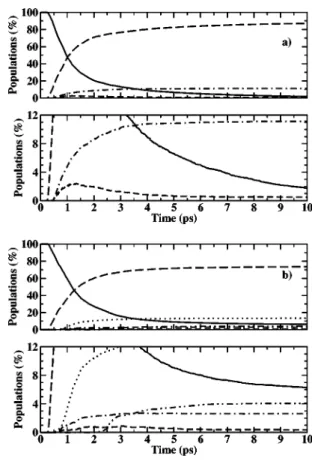
Figure 1共a兲 shows the time evolution of the population of the species involved in the dissociation process of isolated (Ne3⫹)*, i.e., without helium environment (␥⫽0). Channel
FIG. 1. Short time evolution共first 10 ps兲 of the proportion of the species
involved in the dissociation process of Ne3 cluster upon ionization for␥
⫽0 共a兲 and␥⫽2.5 a.u. 共b兲: (Ne3⫹)*共full line兲, Ne2⫹共long-dashed line兲, Ne2
共dashed line兲, Ne⫹ 共dot-dashed line兲, Ne3⫹ (A⬘) 共double-dot-dashed兲 and Ne3⫹(A⬙)共dotted兲. The Ne⫹curve includes population from both共5b兲 and 共5c兲 channels. Percentages have been averaged over 5000 trajectories.
共5a兲 is found to be the main dissociative channel (88.73 ⫾0.41% after a 100 ps propagation兲, which was also the
case in the experimental studies conducted in Janda’s group.10Three-body dissociation共5c兲 is found to be the sec-ond largest channel (10.71⫾0.29%). This process is sequen-tial and mainly results from a previous two-body fragmenta-tion in Ne2or Ne2⫹. The ‘‘hump’’ in the time evolution of the
proportion of Ne2around 1 ps关Fig. 1共a兲兴 is a signature of the
transitory nature of this species. The very limited amount of Ne2 formed after 100 ps reflects the shallow well of Ne2.
Since all the initial energies are above the Ne2⫹⫹Ne disso-ciation limit, no stable Ne3⫹is found. In their adiabatic study of Ne3 photoionization, Satta et al.9 report 21.5% of Ne3⫹
after a 3– 4 ps propagation. They have also found channel
共5a兲 to be the most important one, but with a Ne2⫹/Ne⫹
population ratio of about 1.9 instead of 8.3 in our case. The discrepancy is probably due to the approximations used in their model and to the fact that the dynamics is not over after 3– 4 ps.
Addition of the friction force to model the helium envi-ronment modifies the evolution of the population of the dif-ferent species involved, as shown in Fig. 1共b兲 for the largest ␥value tested共2.5 a.u.兲. The (Ne3⫹)*, Ne2⫹, and Ne2curves
are similar to the isolated cluster case but with modified am-plitudes. The initial decay of (Ne3⫹)* is found to be slightly slower in the case with friction. This is due to the reduction of the particle speeds induced by the friction force, which makes the overall time scale for the dynamics longer. An-other effect of the friction force is to stabilize the trimer by lowering the total energy below the Ne2⫹⫹Ne dissociation limit. The two stable Ne3⫹ species of A
⬘
and A⬙
symmetry共of the Csgroup兲 are detected starting at about 0.5 ps for the
latter and 2.5 ps for the former.
The effect of varying the friction coefficient ␥ on the population of the different species obtained after a propaga-tion of 100 ps is summarized in Table I, together with the percentage of trajectories which have not led to stable frag-ments after 100 ps共last column of the table兲. Error bars have been estimated using ten separate sets of 500 trajectories each. The friction coefficient␥ has not been experimentally determined and is thus an unknown parameter in our model. We have varied its value between 0 and 2.5 a.u.. For com-parison, the experimental value of the ␥ coefficient is 2.5
⫻10⫺3 a.u. for Ne⫹ in gaseous helium at 4.35 K,21 and
0.078 a.u. for Na⫹ in liquid helium at 1.42 K.22
For all the tested␥ values, the dominant fragmentation channel is the formation of Ne2⫹. For␥ below 0.25 a.u. no stable Ne3⫹is detected after 100 ps, in contrast to the larger␥ values. Stable Ne3⫹ of A
⬘
and A⬙
symmetry reach a propor-tion of 4.07⫾0.22% and 14.64⫾0.38%, respectively, for the largest value ␥⫽2.5 a.u. They appear at different ␥ values (␥⫽0.25 a.u. for A⬙
and ␥⫽0.75 a.u. for A⬘
). This stabili-zation of the parent ion cluster can be considered as a cage effect induced by the helium environment. In the Janda group’s experiment,10 stable Ne3⫹ has not been observed, which places an upper bound of 5% on its proportion.23The second main effect of increasing the friction is to decrease three-body fragmentation, and to increase Ne2⫹ formation共see Table I兲. This is a consequence of the reduction of the
available kinetic energy which traps the system into potential wells. The number of ‘‘unfinished’’ trajectories increase with ␥共reaching 1.30% for the largest␥value兲. They mostly cor-respond to a case of electronic metastability where the nuclei evolve on the highest excited A
⬙
surface close to its equilat-eral minimum. Finally, in most of the trajectories 共from 98.8% for ␥⫽0.025 a.u. to 99.9% for ␥⫽2.5 a.u.) the neon atoms remain within the helium droplet for a droplet radius of 20 Å 共⬇1000 atoms兲. As a consequence, no droplet size effect is expected on the fragment populations, which is in agreement with the experimental findings for the trimer.Since the Ne3⫹parent ion has not been detected 共propor-tion smaller than 5%兲,10 we conclude that ␥ should be less than 1.5 a.u. Because the observation of the Ne⫹fragment is difficult,10the experimental population ratio of Ne⫹ to Ne2⫹ was not determined and cannot be used to determine a value for ␥. Experiments on the fragmentation of isolated mass selected Ne3 upon ionization have not been done and
com-parison with the HeN embedded clusters results is thus not
yet possible. However, if an effect of the helium environment is to be present, as was observed for Arn⫹clusters,24,25then a lower limit for␥ of 0.025 a.u. can be inferred.
IV. CONCLUSIONS
We have presented the first theoretical study of fragmen-tation of ionized rare gas clusters embedded in helium drop-let. In this study the helium environment is modeled by a friction force acting on charged Ne atoms. A reasonable range of value for the unique parameter of the model, TABLE I. Influence of the friction coefficient␥共a.u.兲 on the proportion 共%兲 of each (Ne3⫹)*fragmentation
channel. Ne3⫹is determined to be stable when its total energy is below the Ne2⫹⫹Ne dissociation limit. Five
thousand trajectories are propagated during 100 ps for each value of␥.
␥
Stable Ne3⫹
(A⬘state兲
Stable Ne3⫹
(A⬙state兲
Ne2⫹⫹Ne Ne2⫹Ne⫹ Ne⫹⫹Ne⫹Ne Time limit
reached 0. 0 0 88.73⫾0.41 0.38⫾0.12 10.71⫾0.29 0.18⫾0.06 0.025 0 0 89.58⫾0.46 0.44⫾0.10 9.84⫾0.54 0.14⫾0.07 0.078 0 0 90.91⫾0.28 0.50⫾0.10 8.53⫾0.25 0.06⫾0.03 0.25 0 0.72⫾0.10 90.31⫾0.32 0.38⫾0.06 8.38⫾0.26 0.20⫾0.05 0.75 0.18⫾0.04 5.03⫾0.23 88.61⫾0.56 0.50⫾0.08 4.93⫾0.43 0.74⫾0.14 1.5 1.12⫾0.16 10.23⫾0.48 82.95⫾0.57 0.36⫾0.08 4.17⫾0.21 1.16⫾0.15 2.5 4.07⫾0.22 14.64⫾0.38 77.45⫾0.49 0.24⫾0.06 2.30⫾0.24 1.30⫾0.16
namely, the friction coefficient␥, has been set by comparison with available experimental data. In order to improve the determination of this parameter, calculations on larger cluster sizes for which experimental data are available are under-way. The corresponding results are expected to constitute valuable information for the interpretation of experimental observations. The issue of the isotopic effects will also be addressed in future studies.
Extension of the model to include spin–orbit coupling is straightforward. It is necessary since we plan to study heavier rare gas clusters like Arnfor which experimental data on fragmentation patterns for mass-selected isolated and em-bedded clusters are available.24,25
ACKNOWLEDGMENTS
The authors would like to express their thanks to Ken Janda and Marius Lewerenz for numerous and fruitful dis-cussions. The Calmip computer center of Toulouse is grate-fully acknowledged for a grant of computer time. The au-thors thank the University of Paul Sabatier, Toulouse, for financial support through an ATUPS grant 共D.B.兲 and an APC grant共A.V. and N.H.兲.
1
H. Haberland, Surf. Sci. 156, 305共1985兲.
2
U. Buck, J. Phys. Chem. 92, 1023共1988兲.
3U. Buck, in The Chemical Physics of Atomic and Molecular Clusters,
edited by G. Scoles共North Holland, Amsterdam, 1990兲, p. 543.
4T. D. Ma¨rk and P. Scheier, Chem. Phys. Lett. 137, 245共1987兲. 5P. Scheier and T. D. Ma¨rk, J. Chem. Phys. 87, 5238共1987兲.
6M. J. DeLuca, D. M. Cyr, W. A. Chupka, and M. A. Johnson, J. Chem.
Phys. 92, 7349共1990兲.
7M. Fieber, G. Bro¨ker, and A. Ding, Z. Phys. D: At., Mol. Clusters 20, 21
共1991兲.
8P. Stampfli, Z. Phys. D: At., Mol. Clusters 40, 345共1997兲. 9
M. Satta and F. A. Gianturco, Mol. Phys. 100, 3699共2002兲.
10T. Ruchti, K. Fo¨rde, B. E. Callicoatt, H. Ludwigs, and K. C. Janda, J.
Chem. Phys. 109, 10679共1998兲.
11J. C. Tully, J. Chem. Phys. 93, 1061共1990兲. 12
S. Hammes-Schiffer and J. C. Tully, J. Chem. Phys. 101, 4657共1994兲.
13D. R. Allum, P. V. E. McClintock, A. Phillips, and R. M. Bowley, Philos.
Trans. R. Soc. London 284, 23共1977兲.
14W. Mu¨ller and G. Stock, J. Chem. Phys. 107, 6230共1997兲. 15
M. D. Hack and D. G. Truhlar, J. Phys. Chem. A 104, 7917共2000兲.
16N. C. Blais and D. G. Truhlar, J. Chem. Phys. 79, 1334共1983兲. 17
F. Y. Naumkin and D. J. Wales, Mol. Phys. 93, 633共1998兲.
18R. A. Aziz and M. J. Slaman, Chem. Phys. 130, 187共1989兲. 19
The parameters of the fit are available upon request to the authors.
20T. H. Ha, P. Rupper, A. Wu¨est, and F. Merkt, Mol. Phys. 101, 827共2003兲. 21N. Saito, T. M. Kojima, N. Kobayashi, and Y. Kaneko, J. Chem. Phys.
100, 5726共1994兲.
22H. Gu¨nther, M. Foerste, G. zu Putlitz, and T. Schumacher, Low Temp.
Phys. 22, 143共1996兲.
23
K. C. Janda共private communication兲.
24U. Buck and H. Meyer, J. Chem. Phys. 84, 4854共1986兲.
25B. E. Callicoatt, K. Fo¨rde, T. Ruchti, L. Jung, K. C. Janda, and N.
Hal-berstadt, J. Chem. Phys. 108, 9371共1998兲.