Université de Montréal
CEP78, a Novel Centrosomal Protein
by
Yalda Javadi Esfehani
Department of Pathology and Cell Biology
Faculty of Medicine
Memoire presented to Faculty of Medicine for the Degree of Master of Science (M.Sc)
March, 2014
Université de Montréal
Ce mémoire intitulé:
CEP78, a Novel Centrosomal Protein
Présenté par: Yalda Javadi Esfehani
Département de pathologie et biologie cellulaire, Faculté de médecine
Mémoire présenté à la Faculté de médecine en vue de l’o te tio du grade de aîtrise e pathologie et biologie
cellulaire
Mars, 2014
iv
Abstract
Background: The centrosome is a tiny organelle well-known for its
role in establishing the bipolar spindle during cell division. Defects in centrosome function often give rise to human diseases including cancer and kidney cyst formation. We are interested in studying the function of one novel centrosomal protein named CEP78, identified in a proteomic screen for novel centrosomal components. Methods and results: Treatment of cells with nocodazole, a microtubule-depolymerizing agent that specifically depolymerizes cytoplasmic microtubules but not the stabilized centrosome microtubules, showed that CEP78 is a stable centrosomal component. Colocalization of this protein with other centrosomal markers such as CEP164, SAS6, Centrin, Polyglutamylated tubulin and POC5 at different phases of the cell cycle indicated that CEP78 specifically localizes to the distal end of the mother and daughter centrioles. There are 2 CEP78 dots during the interphase and as the cells go through mitosis, procentrioles mature, and the number of CEP78 dots increases to 4 dots per cell and by the end of telophase each daughter cell has 2 CEP78 dots. Characterization of CEP78 functional domains showed that Leucine-rich repeats are necessary for centrosomal localization of the protein. In addition, we found that overexpression of CEP78 did not change the number of centrioles and centrosomes but decreased the number and intensity of CEP170 dots (sub-distal appendage protein) without a decrease in the expression level of this protein. Further studies showed that there is no interaction between these 2 proteins. Finally,
v
overexpression of CEP78 protects microtubules from
depolymerization in the presence of nocodazole, suggesting its ability to bind microtubules. Conclusion: Our findings suggest that CEP78 is targeted to the distal end of mature centrioles via its lecuine-rich repeats, where it could be involved in centriolar maturation or regulation of sub-distal appendage assembly and/or remodeling, a structure known to nucleate and anchor microtubules. Understanding the function of CEP78 will shed light on the role of the centrosome in cell cycle.
vi
Resumé
Contexte: Le centrosome est un petit organite bien connu pour
son rôle dans l'établissement du fuseau bipolaire pendant la division cellulaire. Les déficiences de la fonction du centrosome donnent souvent lieu à des maladies humaines, y compris le cancer et la formation de kystes rénaux. Nous sommes intéressés à étudier la fonction d'une nouvelle protéine centrosomale nommée CEP78, identifiée dans un criblage protéomique pour de nouveaux composants centrosomaux. Méthodes et résultats : Le traitement des cellules avec le nocodazole, un agent qui dépolymérise spécifiquement les microtubules cytoplasmiques mais pas les microtubules stabilisés du centrosome, a montré que CEP78 est un composant centrosomal stable. La colocalisation de cette protéine avec d'autres marqueurs centrosomaux tels que CEP164, SAS6, Centrine, tubuline polyglutamylée et POC5, à différentes phases du cycle cellulaire a indiqué que CEP78 est précisément à l'extrémité distale des centrioles, mères et filles. Il e iste deu poi ts CEP au ours de l’i terphase et les ellules passent par la mitose, procentrioles maturent, et le nombre de points de CEP78 augmente à 4 par cellule et, à la fin de la télophase chaque cellule fille possède 2 points CEP78. La caractérisation des domaines fonctionnels de CEP78 a montré que des répétitions riches en leucine sont nécessaires pour la localisation centrosomale de la protéine. En outre, nous avons constaté que la surexpression de CEP78 ne change pas le nombre de mères/procentrioles mais diminue le nombre et l'intensité des points de CEP170 (protéine d'appendice sous-distal) sans
vii
diminution du niveau d'expression de cette protéine. D'autres études ont montré qu'il n'y a pas d'interaction entre ces deux protéines. Enfin, la surexpression de CEP78 protège des microtubules contre la dépolymérisation en présence de nocodazole, ce qui suggère qu'il possède la capacité de lier les microtubules. Conclusion : Nos résultats suggèrent que CEP78 est destiné à l'extrémité distale des centrioles matures par ses répétitions riche en lecuine, où il pourrait être impliqué dans la maturation ou la régulation de l'assemblage ou de la rénovation de l'appendice sous-distal centriolaire, une structure connue dans la nucléation des microtubules et d'ancrage. Comprendre la fonction de Cep78 contribuera à éclaircir le rôle du centrosome dans le cycle cellulaire.
viii
Table of Contents
Abstract ... IV Table of Contents ... VIII List of Figures and Tables ... XI List of Abbreviations ... XIII Acknowledgments ... XV
Chapter 1 Introduction ... 16
1.1 Centrosome Structure ... 16
1.2 Centrosomal Proteins and their functions ... 20
1.3 Cell Cycle ... 23
1.3.1 The Cycle ... 23
1.3.2 Control of Cell Cycle ... 24
1.3.3 Centrosome and Cell Cycle ... 25
1.4 Centrosome Cycle ... 27
1.5 Cilia ... 31
1.6 Cytoskeleton ... 34
1.7 Diseases ... 37
1.8 CEP78 ... 41
Chapter 2 Material and Methods ... 43
2.1 Material ... 43
2.1.1 Chemicals ... 43
ix
2.2 Methods ... 46
2.2.1 Ba terial ethods ……… 46
2.2.1.1 Purification of GST- tagged CEP78 and GST proteins . 46 2.2.1.2 CEP78 Antibody Purification ... 47
2.2.1.3 Transformation of Competent Cells ... 48
2.2.2 Cellular ethods ………. 49
2.2.2.1 Immunofluorescence Assay ... 49
2.2.2.2 Western Blotting ... 50
2.2.2.3 Knock down with siRNA ... 50
2.2.2.4 Plasmid Transfection with Transit Reagent ...51
2.2.2.5 Plasmid Transfection with CaCl2 ...51
2.2.2.6 Immunoprecipitation ...52
2.2.2.7 Centrosomal Localization Study ...52
2.2.2.8 Microtubule Assay ...53
Chapter 3 Results ... 54
3.1 CEP78 is an intrinsic component of Centrosome ... 54
3.2 CEP78 is a centriolar protein present at the distal end ... 57
3.3 CEP78 localizes to mature centrioles ... 59
3.4 Leucin Rich Repeats are responsible for centrosomal localization of CEP78 ...62
3.5 CEP78 overexpression does not result in centriole duplication or accumulation ...67
x
3.6 CEP78 overexpression does not affect or bind POC5 and
PLK1, proteins involved in centriole maturation ... 69 3.7 CEP78 overexpression does not have a significant effect on other centrosomal proteins ... 72 3.8 CEP78 overexpression reduces the number and intensity of CEP170, a sub-distal appendage protein ... 74 3.9 CEP78 overexpression stabilizes microtubules after
nocodazole treatment ... 79
Chapter 4 Discussion and Conclusion ... 83 Chapter 5 Reference ... 93
xi
Table of Figures and Tables
Figure 1 The centrosome of human cells
Figure 2 The centrosome cycle of animal cells Figure 3 Diagram of ciliary structure
Figure 4 CEP78 is an intrinsic component of centrosomes and
does not require microtubule for its centrosomal localization.
Figure 5 CEP78 localizes to the distal end of centrioles.
Figure 6 CEP78 localization pattern at different stages of cell cycle Figure 7 LRRs are necessary for centrosomal localization.
Figure 8 Some fragments show a) microtubule binding b)
aggregate formation.
Figure 9 CEP78 overexpression does not cause centriole
overduplication or accumulation.
Figure 10 a) CEP78 overexpression does not affect POC5 dots b)
CEP78 does not interact with POC5 or PLK1.
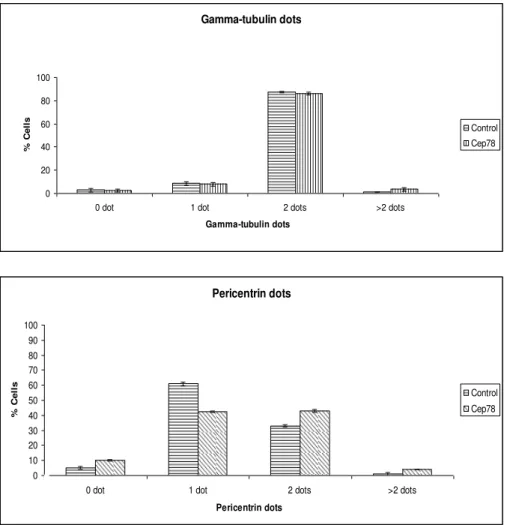
Figure 11 CEP78 overexpression does not affect Gamma-tubulin
xii
Figure 12 CEP78 overexpression a) decreases the number of
CEP170 dots b) does not decrease CEP170 expression level c) CEP170 does not interact with CEP78.
Figure 13 a) CEP78 overexpression does not decrease the number
of ninein dots b) CEP78 does not interact with CEP170, Ninein and α- tubulin.
Figure 14 CEP78 overexpression stabilizes microtubules after
nocodazole treatment in RPE cells.
Figure 15 a) Some CEP78 fragments stabilize microtubules after
nocodazole treatment in RPE cells b) ARPE cells overexpressing CEP78 also keep their microtubules after nocodazole treatment.
Table 1 Percentage of RPE cells transfected with CEP78 fragments
xiii
List of Abbreviations
γ-TuRCs: γ-Tubulin Ring Complexes
ARJP: Autosomal Recessive Juvenile Parkinsonism BBS: Bardet-Biedle Syndrome
CDKs: Cyclin-Dependent Kinases CIN: Chromosomal INstability
CLS: Centrosome Localization Signal
CPAP: Centrosome P4.1 Associated Protein
DMP: DiMethyl Pimelimidate
HAP1: Huntington-Associated Protein 1 IFT: IntraFlagellar Transport
LB: Luria broth
LRRs: Leucine-Rich Repeats M: Mitosis
MAPs: Microtubule-Associated Proteins MCPH: MicroCePHalies
xiv
NuMA: Nuclear Mitotic Apparatus
PBS: Phosphate Buffered Saline
PCD: Primary Cilia Dyskinesia PCM: PeriCentriolar Material PKD: Polycystic Kidney Disease PLK1: Polo-Like Kinase 1
RPM: Revolutions Per Minute
xv
Acknowledgments
The work of my master could not have been accomplished without the help of many others, who also made my experience at Institut de Recherches Cliniques de Montréal and Université de Montréal a memorable one.
First, I want to thank Dr. William Y. Tsang who was always ready to answer my questions in spite of his busy schedule. This research in his lab helped me learn new techniques and improve my analytical thinking. I also want to thank all the members of our lab for their cooperation and help.
I also thank my committee and jury members, Dr. Éric Lecuyer, Dr. Jean-François Côté, Dr. Jean-Philippe Gratton, Dr. David R. Hipfner and Dr. Guy Doucet for all their support and help.
Finally, I want to dedicate my work to my family who have always supported and encouraged me in my life.
16
Chapter 1 Introduction
Cell cycle deregulation is a common feature of several cancers. This cycle is controlled by different pathways and organelles. Due to its microtubule nucleation ability and the role it plays in mitotic spindle assembly, centrosome is a key player in this regulation. Therefore, understanding the biology of centrosomes is key to better understanding of cell cycle.
1.1 Centrosome structure
The centrosome is a non-membranous organelle in the periphery of the nucleus during interphase (Fukasawa 2005, Schatten 2008).
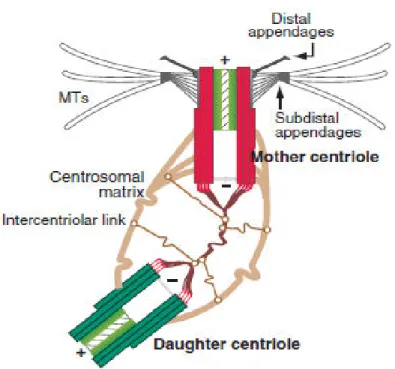
It consists of 2 centrioles (mother and daughter) embedded in an
electron dense pericentriolar material (PCM) (Figure 1). The PCM contains proteins that regulate centrosome functions and is also involved in microtubule nucleation and anchoring (Dammermann, Muller-Reichert et al. 2004, Korzeniewski, Hohenfellner et al. 2013). The centrioles are microtubule-based cylinders that are arranged orthogonally and are characterized by a 9-fold radial symmetry. The distal and proximal ends of centrioles have different functions. While the distal end of mother centriole is involved in ciliogenesis, its proximal end is the site of centriole duplication and that is where procentrioles, the centrioles in early
17
stage of development, start to form. Centrioles have polarity in terms of structure and composition and due to generational difference; the two centrioles are structurally and functionally different (Ou, Zhang et al. 2004, Kitagawa, Vakonakis et al. 2011, Bornens 2012). Structurally, the mother centriole carries two sets of appendages at the distal and sub-distal end. Two main distal appendage proteins include CEP164 and Odf2 and some important sub-distal appendage proteins are CEP170, Cenexin, Ninein, EB1 and ε-tubulin. Studies on sub-distal appendages indicate that these proteins are acquired during G1 and unlike distal appendages, disappear at the onset of mitosis (Guarguaglini, Duncan et al. 2005). Distal appendages are important for docking of the basal body to the cell membrane whereas sub-distal appendages participate in anchoring microtubules, endosome recycling and forming basal body, a structure at the base of cilia which promotes microtubule nucleation (Dammermann, Muller-Reichert et al. 2004, Tsang and Dynlacht 2013). Mother and daughter centrioles are also different functionally. Although both centrioles can nucleate microtubules and accumulate PCM, microtubule anchoring is only done by mother centriole through its sub-distal appendages (Bornens 2012).
18
Figure 1. The centrosome of human cells. Photo adapted from
19
So far 500 proteins have been identified as centrosomal by mass spe tros op . “o e of these protei s su h as γ-tubulin are permanently associated with centrosome and remain in
centrosome even after treatment with microtubule
depolymerizing agents such as cold, nocodazole, colchicine derivatives. These proteins do not need microtubules for their centrosomal localization. However, some other centrosomal proteins such as Nuclear Mitotic Apparatus protein (NuMA) are cell-cycle-specific and temporarily associated with centrosome (Schatten 2008).
Centriole biogenesis happens through two pathways,canonical and de novo. In the first and most common pathway, canonical, procentrioles form in association with the old centrioles whereas the de novo pathway is activated in the absence of centrioles and occurs in multiciliated cells. The second pathway is also thought to take place primarily at deuterosomes (Brito, Gouveia et al. 2012).
During centriole assembly, a disc of fibrous material forms first adjacent to the proximal end of the parental centriole. Next, a set of 9-fold symmetric spokes connected to a central axis form the cart wheel within this material. As the assembly of centriolar microtubules begins at the tips of the spokes, the structure elongates to form the mature centriole. Although in most dividing cells, mother and daughter centrioles template the formation of only one centriole per cell cycle, in ciliated tissues, up to 8 centrioles can form simultaneously around the parent centriole. During differentiation, multiciliated cells assemble multiple basal
20
bodies around structures of unknown composition called deuterosomes (Dammermann, Muller-Reichert et al. 2004, Azimzadeh and Marshall 2010, Korzeniewski, Hohenfellner et al. 2013).
1.2 Centrosomal proteins and their functions
The centrosome is involved in cell shape, cell division, and transport of vesicles, cell polarity and motility through microtubule organization. Centrosomal proteins can be divided into 2 categories:
1. “tru tural protei s su h as γ-tu uli , α-tu li , β-tublin, centrin, pericentrin, Ninein, C-Nap1, centriolin, CP110, cenexin, ODF2, CEP170 and PCM1
2. Regulatory molecules such as Cdc2, Cdk1, PLK1, Nek2 and Dynactin
Due to the importance of the structural proteins, some of them are further discussed here.
Gamma-tubulin: One well-studied structural centrosomal protein is Gamma-tubulin which is localized in PCM. This protein is conserved in eukaryotes and is a component of tubulin ring complex γ-TuRC . γ-TuRC plays a role in microtubule nucleation by covering the minus ends of microtubules. This helps facilitate
21
the growth of protofilaments, the microtubule subunits (Schatten 2008).
Pericentrin: Another well-known centrosomal protein is
pericentrin which forms a o ple ith γ- tubulin and needs the
motor protein dynein for its centrosome localization. This protein acts as a scaffold for anchoring numerous proteins and is essential for centrosome and spindle organization (Schatten 2008, Delaval and Doxsey 2010).
Centrins: These proteins are conserved Ca2+ binding centrosomal proteins that are associated with centrioles and are important for centriole duplication (Schatten 2008).
NuMA (Nuclear Mitotic Apparatus protein): NuMA is a regulatory centrosomal protein involved in the organization of mitotic apparatus during mitosis. It has microtubule binding capacity and converges spindle microtubule ends to poles. It also acts as nuclear matrix protein during interphase (Zeng 2000, Schatten 2008)
CEP170: This is a sub-distal appendage protein which gets phosphorylated by Polo-like kinase 1 (PLK1). It associates with spindle apparatus during mitosis. This protein has several microtubule binding domains and possibly plays a role in microtubule organization (Guarguaglini, Duncan et al. 2005).
Ninein: This is another sub-distal appendage protein which acts as a do ki g site for γ-tubulin complex. It also participates in the anchorage of microtubule minus-ends (Moss, Bellett et al. 2007).
22
C-Nap1: C-Nap1 is important for centriolar cohesion and is regulated through phosphorylation by NEK2. It is involved in establishing link between the pair of basal bodies/centrioles through the protein rootletin which is a physical linker between the centrioles and binds to C-Nap1 (Yang, Adamian et al. 2006).
CP110: This protein is a substrate of Cdk2 and is involved in centriole duplication. It also acts as a cap for the distal end of centrioles and in this way controls their length. Another important function of this protein is the negative modulation of cilia assembly through cooperation with CEP97 (Schmidt, Kleylein-Sohn et al. 2009, Tsang and Dynlacht 2013).
Centriolin: This centriolar protein localizes to the mother centriole and induces the assembly of primary cilia (Hinchcliffe 2003).
CEP164: This component of distal appendage is indispensable for primary cilia formation and localizes to the mother centriole (Graser, Stierhof et al. 2007).
SAS6: SAS6 is one of the several proteins involved in the early stage of procentriole assembly and is essential for the nine-fold symmetry of the centriole (Nakazawa, Hiraki et al. 2007).
POC5: This protein localizes to the distal end of the centrioles and is important for centriole elongation and hence full maturation of procentrioles (Azimzadeh, Hergert et al. 2009).
The various functions of centrosomal proteins underline the importance of the centrosome in cellular function and the role it plays in regulation of several proteins.
23 1.3 Cell Cycle
1.3.1 The cycle
Cell cycle is a crucial cellular event which takes place in order to divide and duplicate cells. It consists of 2 distinct stages: interphase (G1, S and G2) and mitosis (prophase, metaphase, anaphase and telophase). The landmark of interphase is DNA replication which occurs during the S phase. G1 and G2 are the gap phases of interphase that prepare the cell for DNA synthesis and mitosis (Schafer 1998). Also, we must remember that sometimes cells enter a resting phase called G0 which means no proliferation and no DNA replication. Following DNA synthesis in interphase, mitosis (M) begins during which the replicated chromosomes get segregated into two cells. The 4 phases of mitosis are prophase, metaphase, anaphase and telophase (Vermeulen, Van Bockstaele et al. 2003). During prophase, chromatin becomes condensed to form chromosomes and the nucleolus disappears. In early prometaphase, the nuclear membrane dissolves and kinetochores are formed around centromeres where microtubules attach to move the chromosomes. During metaphase, spindle fibers align the chromosomes ensuring that only one copy of each chromosome is received by each new nucleus. During anaphase, the paired chromosomes separate and move to opposite sides of the cell. Finally, during telophase new membrane surrounds the
24
chromatids at the opposite poles and chromosomes go back to their chromatin form. Following mitosis, the spindle fibers disperse and the cytokinesis begins. During this stage, actin contracts around the cell center and divides the cell into two new daughter cells. Cell division is controlled and regulated by different pathways and cell organelles including centrosomes (Morgan 2007). In the next section, these regulations will be further discussed.
1.3.2 Control of cell cycle
The control of cell cycle is vital for cell survival. The main players in the regulation of cell division are cyclin-dependent kinases (CDKs) which act by phosphorylating their target proteins. CDKs have a stable expression level throughout the cell cycle and are activated by cyclins required for different stages of cell cycle. During G1, CDK2 already activated by cyclin E, phosphorylates Histone H1. This helps regulate the progression from G1 to S and is important for chromosome condensation and DNA replication. Next, cyclin A participates in both G2 and G2/M transition through the activation of CDK2 and CDK1. Furthermore, CDK4/CDK6/cyclin D phosphorylates Rb, which in turn release E2F, allowing E2F to activate transcription. Same is true for CDK2/ cyclin E. Finally, mitosis is regulated by CDK2 and cyclin B (Vermeulen, Van Bockstaele et al. 2003). In order for the cell cycle to progress
25
properly, there are several checkpoints which work through regulating the CDK activity. When there is a defect in DNA synthesis or chromosome segregation, the checkpoints become active and arrest the cell cycle for the repair to be done (Malumbres and Barbacid 2009).
It seems that the events in the cell cycle are tightly coordinated with the centrosome cycle.
1.3.3 Centrosome and cell cycle
The centrosome has several functions during cell division. During interphase, it serves by nucleating microtubules, organizing cytoplasmic organelles and forming primary cilia. During mitosis, the centrosome plays an important role in bipolar spindle assembly and this is controlled by a checkpoint monitoring microtubule defects and their attachments to kinetochores (Schwartz and Shah 2005).
For these functions, the centrosome cooperates with CDKs and cyclins. For instance it modulates G1 progression and entry into S phase through cyclins A/E. It has been shown that cyclin E has a centrosome localization signal (CLS) motif which is necessary to target cyclin E to the centrosome and controls the S phase initiation. Also, cyclin A binding to the centrosome might control the entry into S phase. Centrosome might control the interphase
26
through other pathways as well. For instance, studies have shown that removing the core centrosomal components such as centriolin, a mother centriole protein, delay cytokinesis and induces G1 arrest. Another example of such studies indicates that the overexpression of AKAP450, a PCM protein, induces cytokinesis defect and G1 arrest through p53 or p38. Finally, G2/M transition could be arrested by disruption of the interaction et ee γ-Tu uli ri g o ple es γ-TuRCs) and pericentrin which anchors this complex at centrosomes. These findings imply the significance of centrosomes in the regulation of interphase
events during the cell cycle (Matsumoto and Maller 2004, Doxsey,
McCollum et al. 2005, Sluder 2005, Loffler, Lukas et al. 2006).
Centrosome can also regulate mitosis. During prophase of mitosis, the activation of cyclinB/CDK1 occurs in centrosome. Also, the activation of cyclinB/CDK2 by cdc25 is centrosomal dependent. First, cdc25 gets phosphorylated by Aurora-A which localizes to centrosome during mitosis and then the activated cdc25 removes the inhibitory phosphate residues from CDK2 to control mitotic progression. Furthermore, the centrosome participates in DNA damage repair. This is done through negatively regulating cdc25 by Chk1 which accumulates at centrosomes in response to the DNA damage caused by ultraviolet radiation or Hydroxyurea treatment (Doxsey, McCollum et al. 2005, Sluder 2005, Loffler, Lukas et al. 2006).
27 1.4 Centrosome Cycle
Centrosomes need to be duplicated and segregated in synchrony with chromosomes. There are four phases in centrosome cycle: centriole disengagement, centriole duplication, centriole maturation and centriole separation. In summary, at the end of mitosis, the two centrioles of each centrosome disengage but remain in close proximity. During S phase, each centriole nucleates a procentriole along its wall, and in G2 phase, the centriole pairs accumulate more PCM required for microtubule nucleation and anchoring to mature into two centrosomes required for mitosis (Figure 2).
a. Centriole disengagement
This phase starts in prophase and ends at the end of telophase. During centriole disengagement, the tight orthogonal positioning of the two centrioles in each centrosome pair is released and they move to a near parallel position. This stage is mainly controlled by PLK1 and Separase. First, PLK1 promotes the removal of Cohesin from centrosomes. Next, Separase cleaves Cohesin at the centriole to complete this process. Centriole disengagement is important for centriole duplication and for limiting it to once per cell cycle (Azimzadeh, Hergert et al. 2009, Bettencourt-Dias, Hildebrandt et al. 2011, Nigg and Stearns 2011, Korzeniewski, Hohenfellner et al. 2013).
28 b. Centriole duplication
Since each daughter cell inherits one centrosome upon cytokinesis, it is essential that the centrosome duplicates before mitosis so that it can establish bipolarity and correct mitotic spindles. Centriole duplication starts early G1 and continues till G2. During this phase, PLK4 is first recruited to the wall of the mother and daughter centrioles by CEP152. The recruited PLK4 then phosphorylates E3-ubiquitin ligase which in turn stabilizes its substrate SAS-6. Finally, SAS-6 plus SCL-interrupting locus protein (STIL) and CEP135 form a cartwheel that helps define the centriole nine-fold symmetry of procentrioles (Azimzadeh, Hergert et al. 2009, Bettencourt-Dias, Hildebrandt et al. 2011, Nigg and Stearns 2011, Korzeniewski, Hohenfellner et al. 2013).
c. Centriole elongation and maturation
The new formed procentrioles elongate during S and G2 phase. SAS-4 promotes this process and CP110 acts as a cap for the distal end of centrioles to limit microtubule extension. The proteins POC5, OFD1, CEP120 and SPICE1 help this process as well. Following the elongation, the daughter centriole acquires distal and sub-distal appendage components such as Ninein, CEP170 and ODF2 and becomes fully mature. This phase is called maturation and is important for microtubule anchoring and ciliogenesis. Mature centrioles also accumulate more PCM proteins such as CEP152 and CEP192 which are involved in the recruitment of centriole duplication factors. CEP215 is also the
29
PCM protein essential for PCM assembly in the maturation process. Another important event of this stage is the significant increase of microtubule nucleation activity in centrosomes due to the proteins Aurora A and PLK1. For this, PLK1 first recruits Aurora A to the centrosome which co-lo alizes ith γ-tubulin and then this protein in turn recruits the proteins necessary for microtubule stabilization, such as NDEL1 (Azimzadeh, Hergert et al. 2009, Bettencourt-Dias, Hildebrandt et al. 2011, Nigg and Stearns 2011, Korzeniewski, Hohenfellner et al. 2013).
d. Centriole separation
During most of the cell cycle, the mother and daughter centrioles are connected to each other by Rootletin and C-Nap1, the components of the centrosomal linker. This link needs to be broken at the G2/M transition so the two new centrosomes can separate and move to the opposite sides of the cell and form the bipolar mitotic spindles. The proteins participating in this process are NEK2A, MST1/2, PLK1 and Eg5. First, MST1/2 kinases phosphorylates the protein kinase NEK2A which in turn phosphorylates C-Nap1 and rootletin to promote centrosome separation. Eg5 compliments this process by compensating for NEK2A activity if reduced and its recruitment to centrosome is done by PLK1 phosphorylation (Azimzadeh, Hergert et al. 2009, Bettencourt-Dias, Hildebrandt et al. 2011, Nigg and Stearns 2011, Korzeniewski, Hohenfellner et al. 2013).
30
Figure 2. The centrosome cycle. Photo adapted from Mardin et al
31 1.5 Cilia
Although eukaryotic cilia are conserved, they come in different sizes and functional roles (Quarmby and Parker 2005) . These structures are centriole-derived protrusions on the cell surface that contain microtubules and consist of axoneme and basal body. Axoneme is the microtubule structure of cilium and grows from ciliary basal body. Basal body which is at the base of eukaryotic cilia, is the same as mother centriole and participates in axoneme assembly (Bettencourt-Dias and Glover 2007). Similar to centriolar i rotu ules, a o e e i rotu ules are ade of αβ tu uli heterodimers and are surrounded by ciliary membrane which is different from the cell membrane. There are 2 types of Cilia: 1. Primary or non-motile cilia which consist of 9 doublet microtubules and lack molecular motors. These cilia are usually one per cell and are specialized sensory structures. 2. Motile cilia which consist of 9 doublet microtubules surrounding a central pair of singlet microtubules and may be several hundred per cell (figure 3). These cilia need the motor protein dynein for their motility (Satir and Christensen 2007).
Cilia grow at their distal tips and motor proteins transport ciliary precursors for assembly and maintenance (Quarmby and Parker 2005). Signaling molecules, receptors and tubulins are transported to primary cilia by intraflagellar transport (IFT) and motor proteins such as dynein and kinesin-2 (Tsang, Bossard et al. 2008). Since cilia do not have protein synthesis machinery, they
32
depend on IFTs for their assembly. IFTs perform in 2 directions due to the protein complexes, IFT-A and IFT-B. IFT-A is involved in both anterograde and retrograde transport of molecules, whereas IFT-B is only involved in transport from cell body to cilia and directs anterograde transport (Tsang and Dynlacht 2013).
Most ciliated cells are in G0 of the cell cycle. For these cells to enter the mitosis stage, first the cilia need to be resorbed and when mitosis is complete, the cilia will be reassembled (Quarmby and Parker 2005). There are 3 distinct stages in cilia assembly. First, a Golgi-derived vesicle containing membrane proteins destined to the ciliary compartment binds the distal end of the mother centriole and the axoneme starts to form. This vesicle accumulates the essential structures inside the centriole to form the basal body. Next, vesicles create a sheath around the axoneme in which the microtubules are assembled. Finally, the axoneme reaches the cell surface and its membrane fuses to the plasma membrane to form the ciliary necklace (Pedersen, Veland et al. 2008).
33
Figure 3. Diagram of ciliary structure. Photo adapted from
34 1.6 Cytoskeleton
The centrosome is involved in cytoskeleton regulation by its active participation in the assembly of microtubules, a cytoskeleton component that plays important roles in transport of proteins and organelles, cell polarity and mitotic spindles (Luders and Stearns 2007). The cytoskeleton plays an important role in 3 cellular functions. First, it organizes the cell content and components. Second, it helps connect the cells with the external environment physically and biochemically. Finally, it is implicated in cellular movement (Fletcher and Mullins 2010).
Three main polymers of cytoskeleton are actin filaments, microtubules and intermediate filaments. The polymerization and depolymerization of actin filaments and microtubules lead to changes in cell shape and with the help of motor proteins, cellular components are organized. The differences between the 3 cytoskeletal subunits go back to their mechanical stiffness, dynamics of their assembly, their polarity and molecular motors associated with them (Fletcher and Mullins 2010).
Microtubules are the stiffest subunit and have a very complicated assembly dynamic. Their stiffness is beneficial in the interphase stage of cell cycle by assembling the radial array of microtubules that help the intracellular traffic. During mitosis, microtubules form mitotic spindles which enable chromosome alignment through dynamic instability of microtubules (Fletcher and Mullins 2010).
35
Although actin filaments are less rigid than microtubules by themselves, high concentration of the crosslinkers binding them make stiff isotropic, bundled and branched networks. These networks are involved in chemotaxis, cell-cell communication and phagocytosis. Unlike microtubules, actin filaments elongate steadily in the presence of nucleotide-bound monomers and their assembly is in response to the local activity of signaling systems. The intermediate filaments are the least stiff subunit and are not polarized. They interact with both microtubules and actin filaments through plectins and are usually assembled in response of mechanical stress (Fletcher and Mullins 2010).
Mi rotu ules are tu ular pol ers o posed of α a d β tu uli s that asso iate to for protofila e ts ith the β-tubulin subunit o the plus e d of i rotu ules a d α-tubulin subunit on the
i us e d. A third e er of tu uli fa il , γ-tubulin is
important for microtubule nucleation and assembly. Microtubule assembly needs GTP hydrolysis so the GDP-tubulin is stabilized at the plus end by a short cap (Luders and Stearns 2007, Wade
. The α a d β o o ers are kDa a d oth o sist of amino acid residues. Tubulin is subject to several post-translational modifications like acetylation, detyronization and polyglutamylation. These modifications determine the stability of microtubules (Wade 2009).
When tubulin concentrations are low, the microtubule nucleation process is kinetically limiting. Therefore, nucleation takes place in specific structures called microtubule organizing centers (MTOCs) such as centrosome (Wiese and Zheng 2006). During interphase,
36
microtu ules get u leated i MTOCs ri h i γ-TuRC whereas during mitosis they nucleate on centrosomes which are located at spindle poles and the astral microtubules are formed dynamically (Wade 2009).
A large number of proteins interact with microtubules and are referred to as microtubule-associated proteins (MAPs). Two classical types of MAPs isolated from brain are the high-molecular-weight MAPs (200-300 kDa) and the lower molecular weight tau proteins which is 55 kDa. The main role of these proteins is microtubule stabilization against dynamic instability (Wade 2009). The motor proteins, kinesin and dynein, are important microtubule partners during cell division in eukaryotes. Kinesins have 2 conserved regions which are responsible for ATP-binding and microtubule-bindng. Conventional kinesins move to ard plus e d of i rotu ules at μ /s i itro. D ei s also use ATP energy to move but they move towards the minus end of microtubules. Dyneins can move laterally and reverse direction as well. They have 1-3 heavy chains plus several intermediate and light chains. Their important function is in orientation of mitotic spindle and in nuclear migration (Wade 2009).
37 1.7 Diseases
There are 2 types of centrosome abnormalities: 1. structural defect and 2. numerical aberrations. The structural defects are largely due to changes in the expression levels of different centrosomal proteins or altered posttranslational modifications that would lead to an enlarged centrosome or reduction in MT nucleation. Also, a reduction of centrosome size reduces spindle length. Structural defects are common in tumors. As for numerical aberrations, overduplication of centrosome is a good example of these kinds of defects and is widely found in tumors. Both these aberrations could cause diseases (Greenan, Brangwynne et al. 2010, Bettencourt-Dias, Hildebrandt et al. 2011). Some common ones are discussed below.
1. Aneuploidy
Centrosomal deregulation usually leads in chromosomal instability (CIN) and aneuploidy. Aneuploidy is the result of chromosome missegregation and is caused by abnormal mitotic spindle assembly. This is mostly a numerical defect (Kumar, Rajendran et al. 2013).
38
2. Cancer
Important evidence of the role of centrosomal defects in tumorigenesis came from the fact that p53 knock down resulted in centrosome amplification in mouse fibroblasts and skin tumors. Centrosome abnormalities are often observed in breast, prostate, lung, colon and brain cancers. There are several pathways leading to centrosome overduplication. First, the overexpression of PLK4 or mutation in oncogenes or tumor suppressors will cause centriole over-duplication. Another pathway is through cell division failure and cell-cell fusion which causes tetraploidisation (Nigg 2006, Bettencourt-Dias, Hildebrandt et al. 2011).
Centrosomal amplifications and defects usually occur very early in tumorigenesis and are associated with initiation of chromosomal changes. These defects get more severe with tumor progression. In a study on cervical carcinoma, centrosomal amplification increased 20% in epithelia of grade 1 tumors, 5o% in grade 2 tumors and finally in grade 3 tumors, this increase was 70%. In tumor cell lines, centrosome overduplication is mainly caused by the reduced activity of p53 and the overexpression of its inactivating protein, Mdm2, which allows polyploid cells to proliferate rather than undergoing apoptosis (Saunders 2005). Some studies have suggested the link between DNA damage and centrosome numerical abberations. For instance, DNA damage could lead to centrosomal splitting in Drosophila and mammalian cells. Furthermore, the overexpression of ATM/ATR could result in
39
this amplification. The consequences could be cell cycle arrest or errors in mitosis (Saunders, 2005).
3. Brain development
The most common phenotypes in this category are neural migration disorders such as lissencephaly, disorders of brain growth such as microcephalic osteodysplastic primordial dwarfism and primary microcephalies (MCPH) in which the size of brain is significantly reduced. The genes affected by primary microcephalies are either involved in centriole duplication or centrosome maturation. Centrosome P4.1 associated protein (CPAP) and CEP152 are MCPH proteins essential in both of these processes. Also, MCPH mutations could lead in a reduction of the whole body including the size of the brain (Bettencourt-Dias, Hildebrandt et al. 2011).
4. Ciliopathies
Defects in motile cilia cause pathologies referred to as primary cilia dyskinesia (PCD). Patients with PCD show body asymmetry which is an indication of the importance of ciliary motility in directional flow in early embryos and initiation of normal left-right developmental program. Mutations sometimes happen in the primary cilia and cause defects in its structure or function which would lead in diseases such as polycystic kidney disease (PKD),
40
nephronophthisis, retinitis pigmentosa, Bardet-Biedle (BBS) and Joubert and Meckel syndrome. Although cilia structure might not be altered in these disorders, its sensory function might have defects and therefore affects multiple organs such as kidney, retina, brain, bones and liver (Bettencourt-Dias, Hildebrandt et al. 2011).
6. Defects in intracellular transport
Because of its microtubule organizing ability, centrosome plays a crucial role in intracellular transport and spatial organization of cellular organelles. Huntington disease is one of the neurodegenerative disorders that is a consequence of defects in microtubule-dependent vesicular transport. This disease is characterized by loss of cognitive function and motor defects. Huntington-associated protein (HAP1) binds to dynactin and pericentriolar material 1 protein (PCM1) which is involved in centrosome and basal body function. Studies in fibroblast cultures of patients with Huntington disease exhibit aberrant centrosome numbers, a reduction in mitotic index, an increase in aneuploidy and finally persistence of midbody (Badano, Teslovich et al. 2005). Since centrosome deregulation is the cause of several diseases, it is important to study novel centrosomal proteins and their functions as potential therapeutic targets.
41
1.8 CEP78
CEP78 is a novel centrosomal protein first identified in 2003 through proteomic characterization of human centrosome. In this study, a mass-spectrometry analysis of human centrosomes in interphase was performed and 23 new components were discovered. CEP78 was one of them (Andersen, Wilkinson et al. 2003). The CEP78 gene is located on chromosome 9q21. Human CEP78 protein has several isoforms, the biggest one a 78 kDa protein consisting of 722 amino acids. This protein has orthologs in mouse, chicken, lizard, tropical clawed frog, zebrafish and fruit fly. As for the structure of this protein, it consists of 4-6 Leucin-rich Repeats (LRRs) and one coiled-coil domain. Very few papers have discussed possible CEP78 functions. In one such studies, the possible role of CEP78 in centriole anchoring and ciliogenesis was discussed (Azimzadeh, Wong et al. 2012). Also, in a study carried out on the effect of standard treatments on immune responses in prostate cancer patients, CEP78 was one of the proteins recognized for its treatment associated autoantigen reactivity (Nesslinger, Sahota et al. 2007). In a study carried out in 2012, CEP78 expression upregulated 5 fold by noise stress in rat cochleae (Han, Hong et al. 2012). Another study on the genes altered by ethanol treatment during neurodevelopment showed that CEP78 expression decreased on E 14/16 and P 4/7 (Kleiber, Mantha et al. 2013). Finally, a study in 2013 claimed the interaction between CEP78 and PLK4, CP110 and CEP97 (Baffet, Martin et al. 2013). Since all these three proteins are involved in
42
centriole duplication, it is necessary to look at the possible role of CEP78 in this process. The objective of my project was to further study CEP78 localization, function and interactions.
43
Chapter 2 Materials and Methods
2.1 Materials
2.1.1 Chemicals
β-gl erophosphate, β-mercaptoethanol, AEBSF, Ampicillin, Aprotinin, CaCl2, DAPI, DMP, DTT, EDTA, Ethanolamine, Glutathione, Glycerol, Glycine, HCl, Hepes, IPTG, KCl, Leupeptin, Methanol, MgCl2, Tris, Na Borate, NaCl, Nocodazole, NP-40, Paraformaldehyde, PBS, SDS, Triton
2.1.2 Solutions, Buffers and media
2.1.2.1 Coomassie
(50% Methanol; 10% Acetic Acid; 0.2% Coomassie Blue; dH2O)
2.1.2.2 ELB+ Buffer
(1M Hepes pH 7; 5M NaCl; 0.5M EDTA pH 8; 10% NP-40; 1mM
DTT; . M AEB“F; Leupepti μg/ l; Aproti i μg/ l; M
44
2.1.2.3 Glutathione elution buffer
(100mM Tris pH 7.9; 120mM NaCl; 20mM Glutathione; 1mM DTT; 0.2mM AEBSF, dH2O)
2.1.2.4 4X Lower Gel Buffer
(1.5mM Tris-HCl pH 8.8; 0.4% SDS; dH2O)
2.1.2.5 0.1 HEMGN
(100mM KCl; 25mM Hepes pH 7.6; 0.2mM EDTA pH 8; 12.5mM MgCl2; 10% Glycerol; 0.1% NP-40; 1mM DTT; 0.2mM AEBSF;
Leupeptin 2 μg/ml ; Aprotinin 2 μg/ml, dH2O)
2.1.2.6 Maniatis 5x SDS Page Running Buffer (25mM Tris; 250mM glycine; 0.1% SDS; dH2O)
2.1.2.7 Stripping buffer
45
2.1.2.8 4X Upper Gel Buffer
(0.5M Tris-HCl pH 6.8; 0.4% SDS; dH2O)
2.1.2.9 Western Transfer Buffer
46
2.2 Methods
2.2.1 Bacterial methods
2.2.1.1 Purification of GST- tagged CEP78 and GST proteins
The bacteria E.coli DH α strai o tai i g tru ated C a i o acids 590-722) and N (amino acids 1-146) terminal CEP78 plasmids were inoculated from glycerol stock in Luria broth (LB) edia o tai i g μg/ l A pi illi a d gre o er ight. The protein expression was induced by adding 1M IPTG to the cultures and incubating them at 20°C for 16 hours. Next, the bacteria were pelleted at 4000 rpm. After the pellets were washed with 1X PBS (Phosphate Buffered Saline), they were resuspended in 0.1 HEMGN buffer. Then, the bacterial suspensions were sonicated 3 times with 15 second bursts at the microtip limit. The lysates were centrifuged at 10000 rpm(Revolutions Per Minute) and the supernatants were transferred to Eppendorf tubes. Next, the 50% slurry Glutathione agarose beads were prepared. To do this, the beads were first resuspended in 0.1 HEMGN buffer and rocked for 1 hour at room temperature. Next, they were equilibrated in 0.1 HEMGN buffer and finally resuspended in 0.1 HEMGN buffer to make 50% slurry. The beads then were added to the extracts and the samples got incubated at 4°C for 1 hour. After the incubation, the samples were spun at 3000 rpm and the supernatants were
47
aspirated. The beads were washed with 0.1M HEMGN and then eluted with 1ml glutathione elution buffer for 20 minutes and spinned at 3000 rpm. Finally, the eluates were dialyzed against 0.1M HEMGN at 4°C overnight. The dialyzed proteins were stored at -80°C or run on a 10% SDS-PAGE gel and coomassie stained.
2.2.1.2 CEP78 Antibody purification
2.2.1.2.1 Making Columns
At first, the concentration of dialyzed GST and GST-CEP78 proteins was measured by running them on SDS-PAGE, doing a Coomassie staining and comparing the intensity of their bands to the ones of different BSA concentrations. Next, the GST-agarose beads were added to the proteins and incubated at 4°C for 2 hours. After the binding, the samples were spinned down at 1000 rpm and washed with 1X PBS. Next, the beads were washed and resuspended in 0.2M Na Borate pH=9. For crosslinking, solid DMP(Dimethyl pimelimidate) was added to beads and they were incubated at room temperature for 30 minutes. Next, the samples were spun at 1000 rpm and the beads were washed, resuspended in 0.2M Ethanolamine pH=8 and incubated at room temperature. After 2 hours, the samples were spun at 1000 rpm and the beads were washed with 1X PBS and 0.1 Glycine pH=2.5. Following another
48
round of washing with 1X PBS, the beads were transferred to the columns.
2.2.1.2.2 Purifying antibodies
First, rabbits were immunized against CEP78 truncated proteins and their serums were collected by Cocalico Biologicals company. Then the serums were loaded on the GST column and incubated at room temperature. After an hour, the flowthrough was collected from the GST column and added to the GST-CEP78 column and incubated in room temperature. One hour later, the beads were washed with 1X PBS and the antibody elution was carried out with fractions of 0.1M Glycine pH=2.5. The eluates were then collected in the Eppendorf tubes already containing 1M Tris HCl pH=8.
2.2.1.3 Transformation of competent cells
First, the bacteria E.coli DH α strai o pete t ells ere
thawed. Next, 10 ng DNA was added to the competent cells and they were incubated on ice. Then, the samples were heat shocked first at 42°C for 45 seconds and then back on ice for 5 minutes. Later, LB media was added to the cells and the samples
49
were incubated at 37°C. After an hour, the cells were spinned down at 9000 rpm and the supernatant was aspirated. Finally, the pellet was resuspended in LB media and plated on LB plates containing appropriate antibiotic which were incubated at 37°C overnight.
2.2.2 Cellular methods
2.2.2.1 Immunofluorescence Assay
First, the cells were washed with 1X PBS. Next, they were fixed with 100% iced Methanol or 4% Paraformaldehyde and washed with 1X PBS. Following permeabilization with PBS-1% Triton, cells were washed with 1% PBS and blocked with PBS-3% BSA-0.1% Triton. Then they were incubated with the primary antibody. After one hour incubation, the cells were washed with PBS-0.1% Triton. Next, they were incubated in dark with the secondary antibody- fluorochrome-labeled. One hour later, the cells were washed with PBS-0.1% Triton and incubated with DAPI in dark for 7 minutes. Then, they were washed with 1X PBS and H2O. Once dry, the coverslips were mounted on slides using mounting media. Finally, they were sealed with nail polish.
50 2.2.2.2 Western Blotting
First, the cells were harvested by spinning at 1000 rpm for conical tubes or at 3000 rpm for microcentrifuge tubes. The supernatant was aspirated and the pellet was washed with 1X PBS. Next, the sample was lysed with ELB+ buffer and its protein concentration was measured via Biorad protein assay and Spectrophotometry. Then, the sample and loading dye were loaded on 10% gel and run at 150V. Once the running step was complete, the transfer to Nitrocellulose membrane was carried out at 60V for one hour. Next, the membrane was blocked in 3% milk and incubated with the primary antibody. After 1 hour incubation at room temperature, the membrane was washed with H2O and incubated with the secondary antibody at room temperature. One hour later, the membrane was washed with H2O. Finally, ECL was added on the membrane and developing was carried out.
2.2.2.3 Knock Down with siRNA
First, the cells were plated in 6 well plates so that at the time of transfection, they were 40%-50% confluent. For transfection, the siIMPORTER reagent from Millipore company was diluted with
51
serum-free medium in one microcentrifuge tube and in another tube siRNA oligo, siRNA diluent and serum-free medium were mixed so that the final concentration of the oligo was 100 nM. Next, the content of both tubes were mixed and incubated at room temperature for 5 minutes. Finally, the mixture was added to the cells and the cells were incubated at 37°C.
2.2.2.4 Plasmid Transfection with Transit reagent
First, the cells were plated in 6 well plates so that at the time of transfection, they were 60%-70% confluent. For transfection, the Transit reagent was first diluted with serum-free medium and e t μg plas id as added to it. The i ture as the incubated at room temperature for 20 minute. Finally, the mixture was added to the cells and the cells were incubated at 37°C.
2.2.2.5 Plasmid transfection with CaCl2
First, the cells were plated so that at the time of transfection, they
were 60%-70% confluent. For transfection, μg DNA, . M
52
temperature for 20 minutes. Finally, the mixture was added to the cells and the cells were incubated at 37°C.
2.2.2.6 Immunoprecipitation
First, the cells were lysed in ELB+ buffer for 30 minutes. Next, the lysate was spinned down at 14000 rpm and the supernatant was tra sferred i to e Eppe dorf tu es. The , μg a ti od as added to the supernatant and the sample was incubated at 4°C for 1 hour. Following the incubation, 50% slurry protein A/G beads were added to the sample and once again the beads were incubated at 4°C for one hour. Next, the sample was spinned down at 3000 rpm in the cold and washed 3 times with ELB+ buffer. Finally, loading dye was added to the sample for western blotting.
2.2.2.7 Centrosomal localization study
First, the ells ere treated ith μM No odazole a d i u ated at °C. After a hour, the ells ere fi ed a d stai ed ith α-tubulin.
53 2.2.2.8 Microtubule Assay
First, the ells ere treated ith μM No odazole a d i u ated at 4°C. After an hour, Nocodazole was aspirated from plates, the media was replaced and the cells were incubated at 37°C for 2, 5 and 20 minutes. Fi all , the ells ere fi ed a d stai ed ith α-tubulin antibody.
54
Chapter 3 Results
CEP 78 is a novel protein first identified through a mass-spectrometry analysis of human centrosome(Andersen, Wilkinson et al. 2003). It consists of 722 amino acids and structurally has 4-6 Leucine-rich repeats and a coiled coil domain. The objective of this project was to study the localization and function of this protein. For the localization study, experiments were planned to look at the cell cycle pattern of this protein and its centrosomal localization. As for the functions of CEP78, its possible role in different stages of centrosome cycle and its effect on some other centrosomal proteins were studied.
3.1 CEP78 is an intrinsic component of Centrosome.
It had already been shown that CEP78 is a centrosomal protein. In order to study whether CEP78 is a permanent component of centrosome or it requires microtubules for its centrosomal localization, retinal pigment epithelial (hTERT-RPE or RPE) cells were treated with nocodazole which is a microtubule depolymerizing agent. RPE cells were used because they are
55
normal diploid, have normal centrosome number and morphology, and undergo normal cell division. These traits makes them good candidates for studying the effect of a new e troso al protei o other e troso al o po e ts. γ-tubulin a d α-tubulin were used as control proteins. In fact, what we expected was that the net pattern of alpha-tubulin disappeared due to microtubule depolymerization whereas the genuine
centrosomal proteins would remain. Following an
i u ofluores e e assa a d stai i g the ells ith α-tubulin,
γ-tubulin (a permanent centrosomal protein) and CEP78
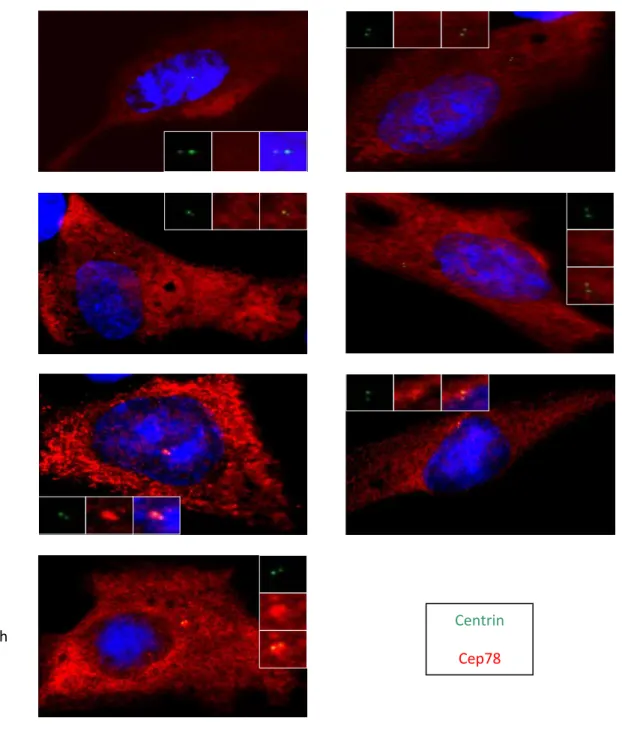
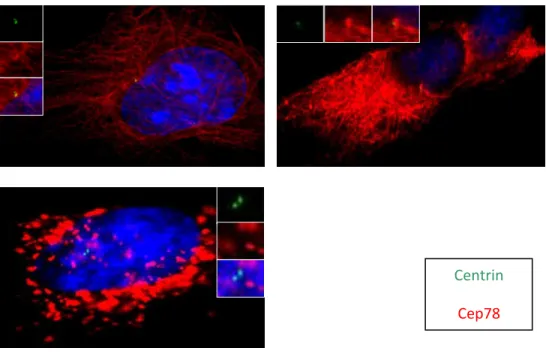
a ti odies, it as o ser ed that the et patter of α-tubulin disappeared hereas γ-tubulin and CEP78 proteins remained at the centrosome. These results indicated that CEP78 is indeed a stable centrosomal component and does not require microtubules for its centrosomal localization [Figure 4].
56
Figure 4: CEP78 is an intrinsic component of centrosomes and does not require microtubule for
its centrosomal localization. RPE cells are treated with nocodazole for 1 hour, fixed and stained ith α-tu uli ,γ-tubulin and CEP78.
α- tubulin
Cep78
γ- tubulin
57
3.2 CEP78 is a centriolar protein present at the distal end.
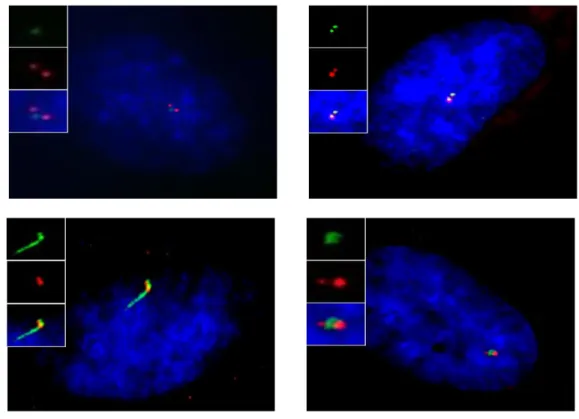
To see whether CEP78 is present at the distal or proximal end of centrioles, co-localization of this protein with other centrosomal proteins was studied in RPE cells by immunofluorescence assay and fluorescence microscopy. Several proximal (C-Nap1, Polyglutamylated Tubulin) and distal (CEP170, POC5) proteins were studied at this step. The results indicated that CEP78 did not
colocalize with the proximal proteins C-Nap1 and
Polyglutamylated Tubulin. However, the distal proteins CEP170, Centrin and POC5 showed a close co-localization with CEP78. In conclusion, CEP78 localizes to distal end of centrioles [Figure 5].
58
Figure 5: CEP78 localizes to the distal end of centrioles. RPE cells are fixed and stained with
CEP170, Polyglutamylated tubulin, C-Nap1, POC5 and CEP78.
Cep170 Cep78 C-Nap1 Cep78 Polyglutamylated tubulin Cep78 POC5 Cep78
59
3.3 CEP78 localizes to mature centrioles.
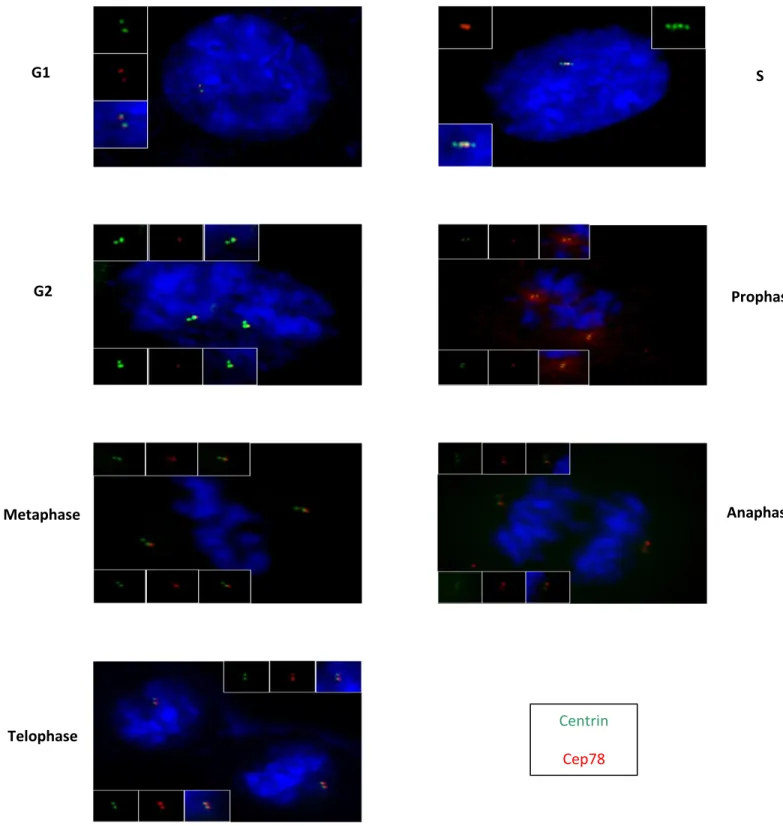
In order to study the cell cycle pattern of CEP78, co-localization with centrin (centriolar marker on mother, daughter and procentrioles), was carried out in RPE cells at different stages of cell cycle by immunofluorescence assay and fluorescence microscopy. Different stages of the cell cycle were identified based on centrin and DAPI staining in asynchonzied cells and Polyglutamylated tubulin for G0 cells. Centrin is a centriolar marker which appears as 2 dots during G1 (mother and daughter centrioles) and 4 dots during S, G2 and mitosis (mother, daughter and procentrioles). During the G0, G1, S and early G2 phases of interphase, there were 2 CEP78 dots in the cells with the intensity of one dot stronger than the other one. My previous colocalization study with CEP170 (a sub-distal appendage protein
on mother centriole) had indicated that the stronger dot belongs
to the mother centriole. Measuring the intensity of these dots using the software Velocity showed that the mother centriole dot was 1.9 times stronger than the daughter centriole dot. In order to calculate the above number, first a number of images were taken by the microscope camera and each image was analyzed separately by the Velocity software to measure the intensity of the CEP78 dots on mother and daughter centrioles. Finally, an average was taken of the intensity differences. During late G2 phase of interphase, the intensity of the mother and daughter
60
centrioles became quite equal implicating that daughter has
matured into a mother. Also, 2 new weak CEP78 dots started to appear on the procentrioles evolving to the daughter centrioles. As the cells went through mitosis, the intensity of the new dots increased gradually. In prophase the CEP78 dots have a quite diffused staining but by the end of telophase, 2 obvious CEP78 dots could be observed in each daughter cell. The co-localization study with Centrin indicated that CEP78 dots only localized to the mother and daughter centrioles but not procentrioles and that
CEP78 is stronger on the mother compared to the daughter
61
Figure 6: CEP78 localization pattern at different stages of cell cycle. RPE cells are fixed
and stained with Centrin and CEP78.
G1 S
G2 Prophase
Metaphase Anaphase
Telophase Centrin
62
3.4 Leucin rich repeats are responsible for centrosomal localization of CEP78.
The CEP78 protein consists of 4-6 Leucin rich repeats (LRRs), amino acids 147-308, and one coiled coil domain, amino acids 450-497. To address the importance of these domains, several CEP78 fragments with deletion in one or some of these domains were expressed in RPE cells and their expression pattern was studied by immunofluorescence assay and fluorescence microscopy. The results showed three distinct phenotypes: centrosomal localization, microtubule binding and aggregate formation [Table 1]. All these three patterns were observed after overexpression of full length CEP78 as well. While the fragments
with deletion in any LRRs could not localize to ce troso e Δ
-, Δ - , Δ - a d Δ -308), the fragments that
o tai ed all the LRRs lo alized to e troso e learl Δ -497,
1-445). About 70% of the cells expressing full length CEP78 (1-722) also showed centrosomal localization [Figure 7]. Furthermore, some of the fragments including the fragment 221-445 as well as 40% of the cells expressing full length CEP78 showed microtubule binding pattern. In fact, 70% of the cells expressing fragment 221-445, showed the net pattern of microtubules. This fragment contains the three middle LRRs. Although the microtubule binding pattern is observed, further studies are required to confirm this binding. Finally, the
63
expression of some of the fragments including 1-220 resulted in aggregate formation. This pattern was only observed in 15% of the cells expressing the full length CEP78 [Figure 8].The protein aggregates could be indicative of a malfunction of the normal process of protein turnover or a problem in the recruitment of the protein to centrosome. These results show that LRRs are crucial for centrosomal localization and probably MT binding of CEP78. They can function by interacting with other proteins that help recruit CEP78 to centrosome or microtubules.
64
TABLE 1: Percentage of RPE cells transfected with CEP78 fragments showing
centrosomal localization or microtubule binding pattern
Construct Centrosomal localization
Microtubule binding
Full Length Cep78 74% 42%
Δ -174) 2% 0% Δ -254) 0% 0% Δ -282) 0% 0% Δ -308) 0% 0% Δ -497) 83% 10% 1-220 0% 0% 221-722 0% 33% 1-445 42% 32% 221-445 7% 70% 446-722 0% 0%
65
Figure 7: LRRs are necessary for centrosomal localization. RPE cells are transfected with
flag tagged CEP78 fragments, fixed and stained with flag and Centrin.
Centrin Cep78 Δ 255-282) Δ 283-308) Δ 450-497) 1-445 Full Length Cep78 Δ -174) Δ -254)
66
Figure 8: Some fragments show a) microtubule binding b) aggregate formation.RPE cells are transfected with flag tagged CEP78 fragments, fixed and stained with flag and Centrin. Centrin Cep78 221-445 1-220 Full Length Cep78
67
3.5 CEP78 overexpression does not result in centriole duplication or accumulation.
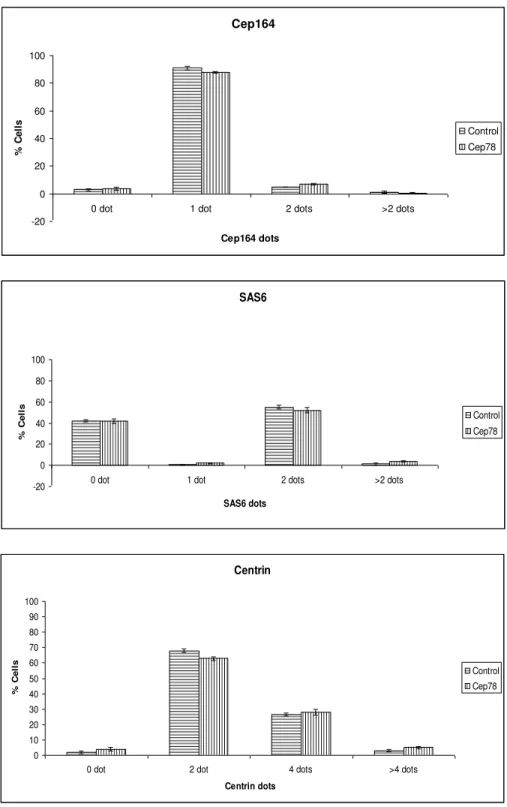
Since CEP78 is a centriolar protein, I speculated that modulation of its protein levels could affect the number of centrioles within a cell. In order to study the possible role of CEP78 in centriole duplication or accumulation, the full length protein was expressed in RPE cells and its effect on CEP164 (mother centriole marker), SAS-6 (procentriole marker) and centrin (marker of mother, daughter and procentrioles) was studied. Since most cells were in G1 phase and only had one mother centriole, most control cells had only one CEP164 dot. Similar to control, most transfected cells had 1 CEP164 dot and there was no increase/decrease in the number of mother centrioles. Studying SAS-6 showed no significant difference between the control and transfected cells either and most cells had zero (no procentriole in G1 phase) or 2 (2 procentrioles from G2) SAS-6 dots based on the stage of cell cycle. This meant that there was no change in the number of procentrioles. Also, looking at centrin confirmed the results of CEP164 and SAS-6 since the number of centrioles did not change. So these experiments indicate that CEP78 overexpression does not result in centriole duplication or accumulation [Figure 9].
68 Cep164 -20 0 20 40 60 80 100
0 dot 1 dot 2 dots >2 dots
Cep164 dots % C e ll s Control Cep78 SAS6 -20 0 20 40 60 80 100
0 dot 1 dot 2 dots >2 dots
SAS6 dots % C e ll s Control Cep78 Centrin 0 10 20 30 40 50 60 70 80 90 100
0 dot 2 dot 4 dots >4 dots
Centrin dots % C e ll s Control Cep78
Figure 9: CEP78 overexpression does not cause centriole overduplication or
accumulation. RPE cells are transfected with flag tagged full length CEP78 and CAIP (control), fixed and stained with flag, CEP164, SAS6 and Centrin.
69
3.6 CEP78 overexpression does not affect or bind POC5 and PLK1, proteins involved in centriole maturation.
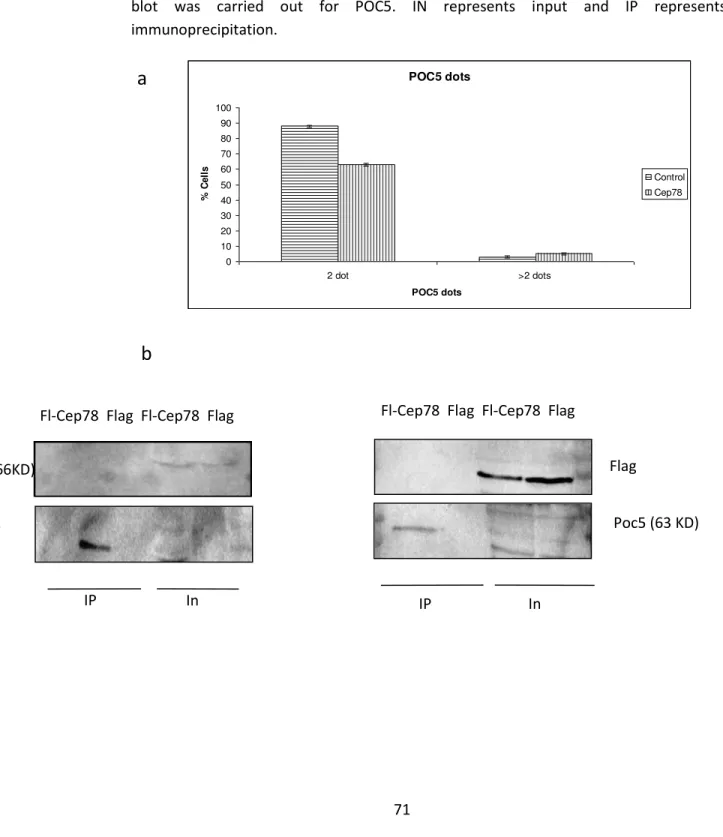
As mentioned before, two new endogenous CEP78 dots start to appear at late G2 and also the intensity of mother and daughter dots becomes equal at this point. Since this phase coincides with centriole maturation in centrosome cycle, there is the possibility that CEP78 is involved in this process. For this purpose, the full length CEP78 was expressed in RPE cells and its effect on POC5 was studied by immunofluorescence assay and fluorescence microscopy. POC5 is a protein involved in centriole elongation and has a cell cycle pattern similar to CEP78, that is there are 2 POC5 dots during G1 and S phase and late G2, 2 new weak POC5 dots start to appear that become strong gradually. The results indicated that similar to the control, the transfected cells had mostly 2 dots and there was no significant difference in the number of POC5 dots [Figure 10a]. Also since POC5 is a distal centriolar protein, its interaction with CEP78 was studied by expressing full length flag-CEP78 and flag (control) in 293 cells and doing a flag immunoprecipitation to pull down CEP78 protein and its interacting proteins.This was followed by Western blotting of POC5. There was no interaction between the 2 proteins [Figure 10b]. The interaction between CEP78 and PLK1, another protein involved in centriole maturation, was studied with the same method discussed for POC5 as well. No interaction was observed