HAL Id: hal-00749175
https://hal-ensta-bretagne.archives-ouvertes.fr/hal-00749175
Submitted on 29 Oct 2013
HAL is a multi-disciplinary open access
archive for the deposit and dissemination of
sci-entific research documents, whether they are
pub-lished or not. The documents may come from
teaching and research institutions in France or
abroad, or from public or private research centers.
L’archive ouverte pluridisciplinaire HAL, est
destinée au dépôt et à la diffusion de documents
scientifiques de niveau recherche, publiés ou non,
émanant des établissements d’enseignement et de
recherche français ou étrangers, des laboratoires
publics ou privés.
AN EXPERIMENTAL TOOLCHAIN BASED ON
HIGH-LEVEL DATAFLOW MODELS OF
COMPUTATION FOR HETEROGENEOUS MPSOC
Julien Heulot, Karol Desnos, Jean François Nezan, Maxime Pelcat, Mickaël
Raulet, Hervé Yviquel, Pierre-Laurent Lagalaye, Jean-Christophe Le Lann
To cite this version:
Julien Heulot, Karol Desnos, Jean François Nezan, Maxime Pelcat, Mickaël Raulet, et al.. AN
EX-PERIMENTAL TOOLCHAIN BASED ON HIGH-LEVEL DATAFLOW MODELS OF
COMPUTA-TION FOR HETEROGENEOUS MPSOC. DASIP, Oct 2012, Karlsruhe, Germany. �hal-00749175�
AN EXPERIMENTAL TOOLCHAIN BASED ON HIGH-LEVEL DATAFLOW MODELS OF
COMPUTATION FOR HETEROGENEOUS MPSOC
I. Heulot, K. Desnos
I.-F. Nezan, M. Pelcat, M. Raulet
INSA, IETR, UMR 6164, UEB
20 avo Buttes de Coesmcs 35708 Rennes
H. Yviquel
IRISA, Univ. Rennes 1
6 rue de Kerampont
22300 Lannion
P.-L. Lagalaye, I.-C. Le Lann*
Modae Technologies
16, Rue Isaac Le Chapelier
35000 Rennes
ABSTRACT
A chain of three state-of-the-art tools is demonstrated to gener-ate efficient code for Multi-Processors System-on-Chips (MPSoCs) from a high-level dataflow language. The experimental platform is based on a 5-core Texas Instruments OMAP4 heterogeneous MPSoC running an image processing application.
Index Terms- Embedded software, Multicore processing, Data flow computing, Signal processing
1. EXTENDED ABSTRACT
High-level languages respecting dynamic dataflow Models of Com-putation (MoCs) are convenient to specify an algorithm in a user-friendly fashion. However, static dataflow MoCs provide more compile-time knowledge of an application parallelism. This knowl-edge is necessary to produce efficient code for a MPSoC. In this paper, we demonstrate a transformation flow that eases the design of retargetable applications for heterogeneous MPSoC by transforming a high-level specification based on a dynamic dataflow MoC into an MPSoC-optimized application based on a static dataflow MoC. This flow consists of three dataflow-based tools: Modae Studio, Open RVC-CAL Compiler (Orcc), and Preesm. The demonstrated hard-ware is based on a 5-core Texas Instruments OMAP4 heterogeneous MPSoC.
2. INTRODUCTION
Modern handheld embedded systems offer an increasing number of functionalities and processing capabilities while respecting a fixed power budget of a few Watts. Recent improvements in em-bedded systems are due to MPSoCs that combine general purpose cores, dedicated cores, and hardware accelerators within a single chip. Generating efficient code for heterogeneous MPSoCs remains a complex and error-prone task. This demonstration illustrates how dataflow MoCs, having precise semantics, favor interoperabil-ity between tools and can be used to program MPSoCs. Three dataflow-based tools (Section 3): Modae Studio, Orcc, and Preesm, are combined to program a heterogeneous MPSoC from a high-level retargetable code with Kahn Process Network (KPN) MoC semantics [1]. The demonstrator is then presented in Section 4.
This work was supported by the ANR COMPA project
*
I.-C. Le Lann is now with Labsticc-ENSTA Bretagne3. MODEL TRANSFORMATION FLOW
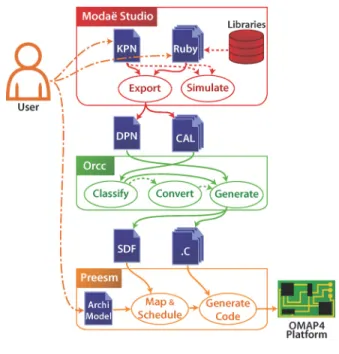
The transformation flow presented in Figure 1 is performed by a tool chain composed of: Modae Studio, Orcc, and Preesm. Each of these tools is successively used on a high-level description of the applica-tion in order to introduce more behavioral knowledge into its MoC. The transformation flow both offers a high-level front-end to the ap-plication designer, and generates an efficient mapping of the appli-cation on the targeted architecture.
Modae Studio! is the first tool of this chain and is used as a schematic entry tool: a system is described as a set of interacting processes, communicating via channels, usually depicted as boxes and arrows. Channels link ports point-to-point. Different MoCs can be tagged on channels. Processes are organized as KPNs: processes communicate via infinite FIFOs, with blocking read semantics.
Fig.1.Transformation Flow
The main novelty of Modae approach relies on the resort to Ruby and Python interpreted languages to describe the algorithmic content of the processes. These languages are dynamically typed and user-friendly. Processes are described using an internal Domain Specific Language (DSL), a technique that popularized Ruby-on-rails web
framework. Such an internal DSL facilitates a seamless integration of domain specific concepts into the host language. The object-oriented nature of Ruby and Python also simplifies the design of high-level libraries. Modae Studio provides libraries for image and signal processing, but also for simple probe displays (xy plots, pixel grids, ...).
Once this closed system is captured, Modae compiler and simu-lators retrieve the bit-accurate type of each variable, hence filling the gap between user representations and machine-oriented representa-tions. In the experimental tool chain described here, the transfor-mation engine generates a Dataflow Process Network (DPN) [1] in RYC-CAL dataflow language syntax [2].
Orcc", the second tool of the transformation flow, is an open source compiler for applications modeled with RYC-CAL and a DPN. When converted into DPNs, processes from KPN are replaced with actors that still communicate via infinite FIFOs. Contrary to KPN processes, actors have a set of firing rules that dictate when an actor is fired and how many data tokens are exchanged [1]. DPNs actors also have the ability to peek in FIFOs, i.e. they can read data-tokens in input FIFOs without consuming them.
The main purpose of Orcc in the flow is to analyze the behavior of the actors generated by Modae Studio and classify their behavior as Synchronous Dataflow (SDF), Cyclo-Static Dataflow (CSDF) [3], or DPN. CSDF is a restriction of DPN where actor firings follow a cyclic fashion and SDF is a restriction of CSDF where the exchanged tokens are constant over firings. The advantage of CSDF and SDF is that they both have a strong predictability, thus opening the way to efficient compile-time optimizations. If the DPN is classified as CSDF, Orcc is asked to convert the graph into a SDF graph before generating the tool's outputs. Applications classified as DPN are currently not supported by this tool chain. Orcc outputs C files, each implementing the internal behavior of an actor, and a SDF graph interconnecting the actors.
Preesrrr', the last element of the tool chain, is an open source rapid prototyping tool that automatically maps and schedules hier-archical SDF graphs on heterogeneous MPSoCs. Beside the SDF graph provided by Orcc, another input of Preesm is a graphically edited System-Level Architecture Model (S-LAM) of the targeted architecture. Using what is called a scenario, the user can also spec-ify a set of parameters and constraints for the mapping and schedul-ing tasks, restrictschedul-ing for instance the mappschedul-ing of an actor on a subset of cores of the architecture.
Before mapping the actors on the heterogeneous MPSoC, Preesm performs a set of conversions on the application model so as to reveal the parallelism embedded in the MoC. Once a static mapping and schedule are obtained, Preesm generates a specific C file for each core of the architecture, handling inter-core communi-cation and synchronization, and containing ordered calls to the C functions of the actors generated by Orcc.
4. DEMONSTRATOR
Developed by Texas Instruments, Open Multimedia Applications Platform (OMAP) is a family of MPSoC designed for embed-ded handheld multimedia applications. OMAP devices include a general-purpose ARM processor core with one or more specialized co-processors. The 4th generation OMAP processors are based on a dual-core ARM Cortex-A9 as main processing unit. The OMAP4460 additionally contains two Cortex-M3 microcontrollers
2http://orcc.sourceforge.net
3http://preesm.sourceforge.net
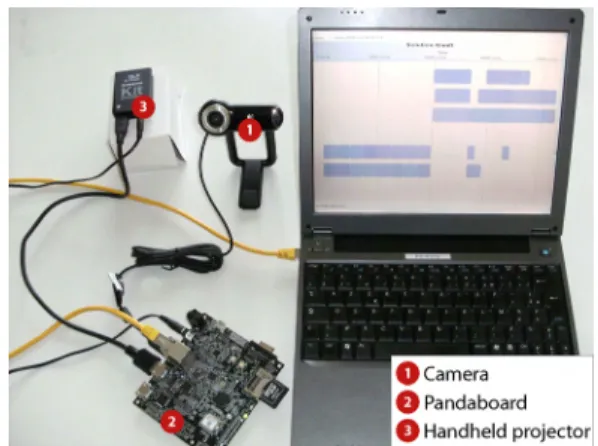
Fig. 2. Demonstrator material including a Pandaboard, a computer, a camera, and a projector
increasing power efficiency as well as a c64xT Digital Signal Pro-cessor (DSP) that can be used to speed-up some DSP-friendly algorithms. Hardware coprocessors are not covered by this demon-stration. In this processor, 5 different cores can thus run simultane-ously, each running a different program. Inter-core communications are possible through a shared Level-3 memory.
The demonstrator (Figure 2) consists of: • a camera that captures a video stream,
• a Pandaboard ES, including an OMAP4460 MPSoC, that re-ceives the video stream and computes an image processing algorithm distributed on up to 5 cores,
• a handheld projector that displays the resulting video, and • a PC that generates and reloads code on each of the 5 cores,
connected to the Pandaboard ES via Ethernet.
During this demonstration, high-level programming of an OMAP4 MPSoC is shown. A Sobel filter application is described, simulated and exported as RYC-CAL code using the Modae Studio tool. Then, the application MoC is converted into the SDF MoC by the Orcc compiler. The algorithm is automatically mapped and scheduled by the Preesm tool, based on knowledge of the applica-tion SDF MoC and of the architecture model. Finally, an executable is built for each MPSoC core, then loaded and run on the OMAP4 processor. The dual-core ARM Cortex-A9 main processing unit of the OMAP4 processor runs a Linux operating system and drives the 3 other cores. The obtained process is highly customizable and, yet, most of the steps are fully automated and performed within seconds. The mapping constraints of actors, as well as the actors themselves, are modified during demonstration, resulting in a different code, mapped and scheduled efficiently on all cores of the OMAP4 pro-cessor. Intermediate generated codes and architecture model are demonstrated.
5. REFERENCES
[1] E. A. Lee and T. M. Parks, "Dataflow process networks,"
Pro-ceedings ofthe IEEE,vol. 83, no. 5, pp. 773-801, 1995. [2] Matthieu Wipliez, Compilation infrastructure for dataflow
pro-grams, Ph.D. thesis, INSA de Rennes, 2010.
[3] G. Bilsen, M. Engels, R. Lauwereins, and J. Peperstraete, "Cycle-static dataflow," Signal Processing, IEEE Transactions