HAL Id: hal-02959152
https://hal.archives-ouvertes.fr/hal-02959152
Submitted on 4 May 2021
HAL is a multi-disciplinary open access
archive for the deposit and dissemination of
sci-entific research documents, whether they are
pub-lished or not. The documents may come from
teaching and research institutions in France or
abroad, or from public or private research centers.
L’archive ouverte pluridisciplinaire HAL, est
destinée au dépôt et à la diffusion de documents
scientifiques de niveau recherche, publiés ou non,
émanant des établissements d’enseignement et de
recherche français ou étrangers, des laboratoires
publics ou privés.
Copyright
Decision Skills in Engineering Programs -a Key for a
VUCA Era
Siegfried Rouvrais, Audunsson Haraldur, Liliane Esnault, Víkingur
Friðgeirsson Thordur
To cite this version:
Siegfried Rouvrais, Audunsson Haraldur, Liliane Esnault, Víkingur Friðgeirsson Thordur. Decision
Skills in Engineering Programs -a Key for a VUCA Era. WEEF/GEDC 2020 : World Engineering
Education Forum and the Global Engineering Deans Council, Nov 2020, Cape Town, South Africa.
�10.1109/WEEF-GEDC49885.2020.9293669�. �hal-02959152�
978-1-7281-9756-2/20/$31.00 ©2020 IEEE
Decision Skills in Engineering Programs - a Key for
a VUCA Era
Rouvrais Siegfried Lab-STICC, UMR CNRS 6285 IMT Atlantique Brest, France https://orcid.org/0000-0003-2801-3498 Esnault Liliane Consultant in project evaluationLyon, France [email protected] Audunsson Haraldur Department of Engineering Reykjavik University Reykjavik, Iceland https://orcid.org/0000-0002-7730-346X
Víkingur Friðgeirsson Thordur Department of Engineering
Reykjavik University Reykjavik, Iceland
Abstract—Judgment and decision skills are now essential graduate attributes for the future engineer, in particular for facing the more frequent than ever volatile, uncertain, complex and ambiguous (VUCA) world in both professional and societal situations. One of the responsibilities of engineering programs is to train students to be agile and capable of taking decisions in challenging VUCA situations. This paper presents conceptual and practical results of an European project which explored, designed and iteratively analysed innovative educational learning and teaching activities to train decision-making skills. Following a design-based research approach, including both quantitative and qualitative analysis, the four VUCA dimensions were categorized, the relevant decision skills were defined, and activities to train decision skills were tested and evaluated. One outcome of this work is a rational selection of learning activities based on experiential learning to train specific decision-making skills, which can be integrated in the engineering curriculum. These learning and teaching activities are freely available for adaption in engineering programs. In addition, six reference models are proposed and delineated, in an effort to support the integration processes for curriculum revisions.
Keywords—engineering education, decision-making skills, learning outcomes, VUCA, learning & teaching activities
I. INTRODUCTION
In 2020, we are facing a new world due to the COVID-19 pandemic and this world is changing at a rapid pace in a way that we are unsure of. More than ever must technological universities prepare their engineering graduates for this volatile, uncertain, complex and ambiguous (VUCA) world [1], and in particular provide them with the skills needed to make good decisions. Engineering programs have no option but to make certain that their strategies and intended learning outcomes properly prepare their graduates for a changing and dynamic future and a new landscape of career opportunities. The question is how can we better prepare engineering students for this new VUCA world?
The current pandemic highlights the need for enhanced decision skills of engineers in a VUCA environment, and in particular on taking proactive and responsible decisions. An engineer need not only be expert in her or his field and have the knowledge of decision models, but also have the skills to make decisions in various situations.
The field of decision analysis was first introduced by Raiffa and Schlaifer [2] and was originally mostly a mathematical discipline. Later scholars like Frank Knight, Francis Galton, Milton Keynes, Oscar Morgenstern, Herb Simon and John von Neumann, just to name some few, paved the way for further understanding of how normative methods are connected to social sciences. The works of Kahneman and Tversky [3, 4] are likewise instrumental in the development of decision analysis as discipline that both include mathematical and social science. VUCA, initially introduced by the US Army War College in the eighties is an interesting addition to the decision analysis context and has made its way to the business lexicon as explanatory platform to understand corporate decision making in our complex world [1]. The VUCA concept has also raised interest within education. Studies indicate that VUCA can be used to understand better the attributes that an engineer should possess meaning the ability to question, label patterns, model conceptually, decompose, experiment, visualize or ideate and communicate effectively [5]. Moreover, VUCA concept can be used to enhance the educational environment by making educational institutions more agile and adaptive to changes and diversity [6].
The aim of this paper is to provide ways on how engineering educational programs may integrate and implement training for decision-making skills in VUCA environments for their graduating engineers and offer tried out examples of training such skills. The following question is used to frame the analysis in light of the main aim: How can we approach and overcome the educational challenges in preparing engineering graduates for their future decision-making skills in a VUCA world?
II. SCOPE
The main objective of the Erasmus+ DAhoy project (www.dahoyproject.eu), lasting three years, was to explore innovative educational ideas on how to integrate decision-making skills in engineering educational programs. The project is grounded on an understanding of the perceptions of students and includes shared examples of innovative learning and teaching (L&T) activities. The project supports the coherent inclusion of active and engaging pedagogical models, to better prepare learners and professionals to face VUCA situations, echoing their future professional environments, may it be a pandemic, natural disaster, refugee crisis, social media disaster, financial crisis or internet
This work was supported by the European Erasmus+ program under Grant 2017-1-FR01-KA203-037301.
overload, to name a few. DAhoy chose to investigate decision-making as a transversal skill, with three complementary dimensions:
● Math-based decision-making, rational approach for large projects, including models and processes as found in multi-criteria and risk analysis;
● Social-based decision-making, includes individuals’ interdependencies and social identities;
● Career-based decision-making, to choose own personal career path and manage her or his competence development.
The three dimensions are not exclusive, each having in the literature its own theories, methods and good practices, but sharing some common grounds. Math- and social-based decision making are conventional [e.g. 3, 4], but in the student-centered learning approach used in the DAhoy project the inclusion of career-based decision making is appropriate and coherent with new professional needs. A major outcome of the analysis in the project was the identification of seven skill statements (i.e. D-skills), i.e. learners should be capable of:
D1 Recognise and qualify the VUCAlity of situations, D2 Analyse VUCA situations,
D3 Make a judgement in VUCA situations, D4 Face complexity of VUCA situations,
D5 Organise and implement actions in VUCA situations,
D6 Take responsibilities in the decision process in VUCA situations,
D7 Learn from his or her experience of VUCA situations.
The above seven skills can be summarized in the DAhoy project motto: "good decisions at right times".
III. METHOD
One efficient way to train students in decision-making under VUCA-like conditions is through experiential learning and teamwork pedagogical styles [7, 8]. Combining these two learning styles emphasize the concurrent math and social aspects of decision making [3, 4]. In 2018 and 2019, project partners analysed quantitatively and qualitatively six one-week innovative L&T activities with STEM and engineering students and faculty (reports and more detailed data analysis are available on the project’s website). These and many of the L&T activities analysed in DAhoy can be adapted to different educational fields.
A. Design-based Research
During the project, decision skills statements and related outcomes were developed in the context of a design-based research (DBR) [9]. DBR focuses on real educational situations [10], which are potentially more complex than simulated environments. The DBR takes into account several variables – knowledge, skills and competencies, motivational factors, the learning situations and VUCA environmental factors in the DAhoy analysis.
The DBR commenced by taking into account high reliability organisational principles [11]. These principles provide guidance to a mind-set in avoiding catastrophes despite a high level of risk and complexity. Specific examples that have been studied are on nuclear power plants, air traffic
control systems, naval aircraft carriers and more recently some healthcare organisations. In the project, specific high reliability variables were scrutinized during VUCA learning events, thus allowing for revisions of the design and L&T offerings [12].
B. Qualitative and Quantitative Analysis
The selected DBR theoretical framework allowed for more methodological robustness in the analysis. In a second DBR iteration, decision-making statements were selected and used for learning activities redesign and student assessments aside a VUCA situation analysis grid. Overall, 59 STEM students participated to the DAhoy L&T activities, and 30 faculty and staff. All participants completed the same questionnaires on decision-making and VUCA rubrics. The questionnaires included Likert scale choices and open questions covering the satisfaction level, what was most appreciated, the VUCA results level, the skills acquired, the impacts level, what would be different for them afterwards when facing decision-making and VUCA situations, so as the level of lessons learnt. In addition, there were questions on the value of the L&T activities regarding decision-making and VUCA situations, both from the students’ and teachers’ perspectives, and on possible reutilization in further learning programs on the teachers’ side. Examples of questions are: "should you happen to encounter similar situations, would you react differently now (state examples of what would be different)"; "the activities enabled me to deal with uncertainty" / to develop specific or open field decision skills. The questionnaires were the same for all the L&Ts and there was consistency in the answers, even though the participants were not with the same profiles, but all engineering students or STEM teachers/faculty.
IV. VUCARUBRIK AND ANALYSIS OF COURSE CAPSULES
One outcome of the project is a toolbox of 15 pedagogical activities that can be utilized by engineering institutions that want to develop learning activities to train decision-making skills in a VUCA context.
A. VUCA Analysis Grid
Depending on the level of VUCA (low-medium-high) for each D-skill, an institution may select activities or course capsules that can match their needs. Fig. 1 is the VUCA situation analysis grid elaborated, inspired by Bennet & Lemoine [1], with the interpersonal component added in the first column, which includes team number and disciplinary / cultural dimensions. This grid aided in developing and analyzing the learning & teaching events.
Fig. 1. VUCA situation analysis grid with interpersonal component (iVUCA) from [9].
In the 6 European mobilities of the project (overall 24 days), participants experienced about 30 different learning situations in the form of activity capsules, covering various dimensions, e.g. math-based, social-based, and career-based. Capsules were iteratively developed, each lasting from 2 hours to 2 days. These capsules are interwoven with the learning of related disciplinary knowledge and other skills, sometimes in professional-like environments. Each capsule relies on pedagogical intentions and style with the learning goal of enhancing decision-making skills in environments that could be VUCA (cf. Fig. 2). These capsules are described and are available on the project’s website under Creative Commons licence.
Fig. 2. VUCA characteristics of an activity capsule.
B. Course Examples and Capsules at the European Level In the spirit of the DAhoy project, Reykjavik University ran a two-day intensive course called “Disaster Days” in September 2019 with 230 Icelandic engineering students and DAhoy engineering students from France and Scotland, using the experiential learning style [13, 14]. The pretend disaster, a VUCA scenario, for Disaster Days in fall 2019 was, ironically, the outbreak of a worldwide plague that forced the authorities to immediately isolate the island, and all supplies to the island were cut off. The task presented to the students was to make prompt decisions and plan the first reaction in Iceland, and estimate if and how the nation could survive in isolation for possibly a few months. The math dimension was preponderant, and social dimensions were also involved. In analyzing this event [15] focused on how this event fostered a positive journey for the student through the engineering program. The engineering programme at Reykjavik University had run similar events for a few years. Analysis of the questionnaires following the event showed that the students appreciated mostly the teamwork in large international teams of students (social dimension) and the Disaster Days activity. There was a large and rich fan of answers regarding the skills acquired, including decision making capabilities. Most of the participants were taken aback by the learning style, even if it took place mostly in classrooms via project-based learning style.
At IMT Atlantique in France, engineering students from Iceland and Scotland were engaged in the "Reliability and Decision-Making via Inshore Cruising – we are all in the same Decision Ship” one-week experiential course for snap-decision training outdoors. In this training event, for a social dimension, part of the training included a capsule in which the students, novice in sailing, had to coordinate immediate reaction for man overboard and rescue [16], under iterative scenarios with various level of VUCAlity. Several unexpected events at sea were repeated with increasing complexity to facilitate confidence and reliability, followed by group discussions and analysis on the good or bad decisions they made, to learn from the experience. In another capsule, under a math-based dimension, students had to prepare navigation plan for a one-day coastal cruise under environmental constraints of weather, currents and tides, and
then justifying its strengths and weakness including the risks, taking into account the crew and potential material failures. The students had to actually go sailing according to the plan they made, confront the associated risks, and manage unexpected events. It was clear from the questionnaires done at the end of the course that the students enjoyed the unusual environment and the outdoors activities at sea. The students stated that they had learnt a lot, even if destabilized by the less formal organization of the learning activities, where they were confronted with unusually difficult and unexpected events calling for immediate decisions and actions. From the teacher's perspective, naturally, the reusability of such learning activities requires some adaptation.
For the career-dimension, the project partnership also led to the development of a professional career course, including several reusable capsules, to prepare students for VUCA careers [17]. Motivation factors for the first job were analysed at the very beginning of the project. According to students’ responses, they consider the mission of the job as a primary criterion, followed by job well-being, style of management, culture and if the job matched their core personal values. Other criteria the students mentioned included teambuilding, responsibilities and autonomy, position or titles (‘prestige job’), location (e.g. local/international), training options and lifelong learning. The DAhoy project has set up the ‘YOU’ continuum that can cover a 3-year curriculum, with three program components called Yourself, Open-mindedness and Up-to-you. Each components includes capsules, aligned with decision skills. A formative evaluation integrated in the capsules are designed to continuously improve the judgement skills of each student. The YOU continuum can be quickly integrated or adapted as a ready-to-go toolkit in career training courses with evaluation and credits at Bachelor or Master levels.
These three course examples are indeed in line with recent papers that have used the VUCA-concept to analyse attributes of engineering students [5] and desired agility of educational institutions [6].
V. FINDINGS AND ADAPTATION
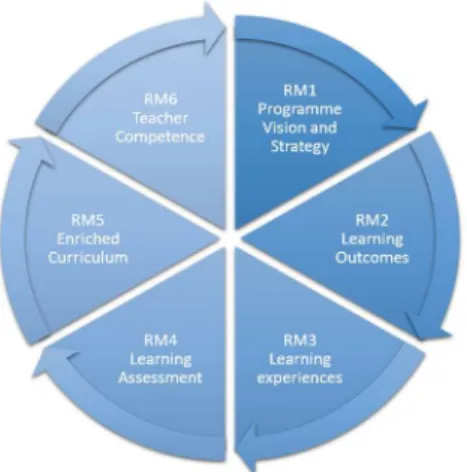
To facilitate the adoption of transversal decision-making skills in existing educational programs, including the various dimensions, the project developed a framework specified by six Reference Models (RMs). These models, or steps along the way of adoption, are intended to guide program directors and university leaders in continuous integration and implementation of L&T capsules for decision-making skills in and for VUCA-like environments. Based on the L&T activities conducted during the project in 2019-2020, partners proposed in 2020 a flexible process of analysis, design, evaluation and revision, as well as theoretical contributions on curriculum integration of decision-making skills.
As with all quality enhancement processes, adapting decision-making skills in engineering programs involves both the effort of the faculty and the leadership of the engineering programs. This involvement is even more relevant when dealing with transversal skills, aside accreditation graduate outcomes.
A. Reference Models
The six RMs provide program leaders with the core guidelines and quality enhancement procedures to implement
training of decision skills. The six RMs are interconnected, each describing a major concern to be considered by stakeholders, which may have distinct responsibilities in educational programme design, development and quality assurance. The RMs are (see also Fig. 3):
Fig. 3. DAhoy reference models for implementing and sustaining VUCA decision skills in an educational programme.
● RM1 VUCA D-Skills Programme Vision and Strategy, to fix the decision-making skills principles, and facilitate support from program leaders to sustain reform initiatives at systemic level;
● RM2 VUCA D-Skills Learning Outcomes, to emphasize decision-making skills in the learning outcomes, as recognition of these skills;
● RM3 VUCA D-Skills Learning Experiences, to underline VUCA capabilities at different levels of intensity the VUCA criteria of capsules and courses; ● RM4 VUCA D-Skills Learning Assessment, to highlight fair and accessible assessments modes and reinforce reflectiveness;
● RM5 VUCA D-Skills Enriched Curriculum, to emphasize methods and processes for decision skills curricular integration;
● RM6 VUCA D-Skills Teacher Competence, to train and commit adequate resources for faculty staff development.
B. Guidelines for Reference Models
The guidelines for RMs are inspired by pattern models as found in software and system engineering. A pattern is a general repeatable solution to a commonly occurring problem in software design. A design pattern isn’t a finished design that can be transformed directly into the code, but is a description or template for how to solve a problem that can be used in many different situations. Patterns can speed the development process by providing tested, proven development paradigms.
Maturity models from quality assurance and quality enhancement processes were followed on their methodological foundations. Capacity and rubrics were formalized accordingly, with hierarchical scales of maturity. The DAhoy RMs and proposed maturity guidelines are also partly structured according to the guidelines from the ISO
organization (33020) and the CDIO standards (see i.e. http://www.cdio.org/content/cdio-standard-21).
C. Curricular Integration Process
For a concrete implementation of decision skills all along curriculum, various forms of activity capsules can be integrated within educational programmes. The L&T of decision skills should not be considered as the addition of a single course to a curriculum, but should be an integral part of it via several capsules in various existing courses to support transversality and for lifelong learning. An integrated curriculum should include decision-making learning experiences that lead to the acquisition of decision-making skills, under various dimensions, interwoven with the learning of disciplinary knowledge, other skills and application in professional environments.
Institutional management and culture differ on quality enhancement processes and curriculum renewal processes. These processes are also embedded at different levels in the European countries, i.e. different national qualification frameworks, different quality assurance agencies [18], and a range of approaches to the academic and to professional qualifications. As such, the RMs are to be adapted to the context of each programme and could be reorganized to the needs and priorities by programme leaders. However, the six RMs, with a shared scale on process maturity, have been developed in such a way that they are 'without barriers'; they can be used by most programme leaders and programme designers.
D. Future Work
The effectiveness of the learning activities developed in this project will continue to be evaluated as a good practice which is inherent in the continuous quality enhancement of engineering education programs in partner institutions. In particular, special consideration will be placed on the effectiveness of experiential pedagogy in developing decision skills. Building on the present work, including models, tools, and rubrik, is an ongoing research on how to implement and adapt the training capsules that take advantage of the natural environment or location of particular institution or university, guided by experiential learning methodology. [19]. Today we are experiencing an overwhelming "infodemic" [20], which is one example of the rapidly increasing flow of often poorly qualified information. This calls for research and development on how engineering programs can best prepare their engineering students for making good decisions in this realm of disinformation and biases. The needed agility by the programs is emphasized by e.g. [6]. Additional learning activities are needed specificly for such situations, including scholar analysis on their efficacy, and a good starting point for this development is the methodology, elements of analysis, and results attained in the DAhoy project.
VI. VUCA WORLD AND THE COVID-19CRISIS
Iceland faced a volcano eruption in 2010 which echoed all over Europe. Indonesia or Japan regularly face tsunamis. Now the entire world faces the COVID-19 pandemic and its effect is predicted to last well beyond 2020. All these VUCA crises have societal and business impacts. In this VUCA world, during and after COVID-19, universities must train students to be more agile and use critical thinking to analyse, judge and appraise. Universities must transform themselves
into learning spaces for students and to prepare them to become VUCA lifelong learners. The DAhoy project ultimately aims to transform the students to be effective leaders for change, especially in the VUCA world, via student-centered and experiential approaches, continuously.
Decisive decisions were made at the onset of the COVID-19 crisis giving the project an unprecedented chance to explore how the seven D-Skills were applied unconsciously under the unexpected VUCA conditions that fundamentally transformed the work within universities. As perspectives, the set of D-skills can be used to describe and analyze this unexpected international VUCA situation and how universities reorganized L&T activities and future semesters to remain resilient in at least the near future.
VII. CONCLUSION
As recalled by Kamp [21], educational change is not driven by science and technology but by university strategy, the changing nature of the student body and the decisions of individual faculty members. One of the responsibilities of engineering programs is to train engineering students to become global citizens, agile and capable of taking decisions in challenging VUCA situations.
The DAhoy analysis and tools presented in this paper is one contribution that engineering program leaders may find useful in tackling these new challenges. The inherent emphasis on experiential learning in the DAhoy tools and modules, including to question, decompose and experiment, is part of the necessary tools engineering students should possess when they graduate, and VUCA situations can help to stimulate [5]. For the post COVID-19 period in engineering education, transversal skills reinforcement is more than ever needed, and now is a great opportunity for engineering education institutions to revise or realign program outcomes. DAhoy transferable courses and activity capsules for VUCA exposure are a good start. The future of society is likely to depend on what governments, professional sectors, and educational institutions decide to do. Educational institutions need to be agile in adopting to changes and diversity in society [6]. Therefore, high expectations are placed on higher education, on how technological universities will prepare their graduates for taking good decisions in VUCA-like situations, under various dimensions, for working in the new emerging world and to take advantage of the new landscape of career opportunities.
ACKNOWLEDGMENT
The authors would like to acknowledge their colleagues in the DAhoy project from 7 partner institutions (see www.dahoyproject.eu). The European Commission’s support for the production of this publication does not constitute an endorsement of the contents which reflects the views only of the authors, and the Commission cannot be held responsible for any use which may be made of the information contained therein, as for the authors’ respective institutions.
REFERENCES
[1] N. Bennett and J. Lemoine, ”What VUCA really means for you,” Harvard Business Review, 92(1/2), 27, 2014.
[2] H. Raiffa and R. Schlaifer, Applied statistical decision theory, MIT Press, Cambridge, MA, 1961.
[3] D. Kahneman and A. Tversky, “Judgment under Uncertainty: Heuristics and biases”, Science, New Series, 185 (4157), 1124-1131, 1974.
[4] D. Kahneman and A. Tversky, “Prospect Theory: An Analysis of Decision under Risk”, Econometrica, 47(2), 263-292, 1979.
[5] S. Latha and P. Christopher, “VUCA in Engineering Education: Enhancement of Faculty Competency For Capacity Building”, Procedia Computer Science, 172, 741-747, 2020.
[6] P. A. Lemoine, P. T. Hackett and M. D. Richardson, Global Higher Education and VUCA – Volatility, Uncertainty, Complexity, Ambiguity, Handbook of Research on Administration, Policy, and Leadership in Higher Education, 2017.
[7] J. Dewey, Experience and Education. Kappa Delta PI Lecture Series, Collier-Macmillan Books, London, 1938.
[8] D. A. Kolb, Experiential learning: experience as the source of learning and development, Englewood Cliffs, NJ, Prentice Hall, 1984. [9] S. Rouvrais, S. Gaultier Le Bris, and M. Stewart, ”Engineering students
ready for a VUCA world? A design-based research on decisionship,” in Proceedings of the 14th International CDIO Conference, KIT, Kanazawa, Japan, pp. 872–881, June-July 2018,
[10] T. Anderson and J. Shattuck, ”Design-based research: A decade of progress in education research?”, Educational Researcher, 41(1), pp. 16-25, 2012.
[11] K. E. Weick, Making sense of the organization. Blackwell Publishing, Malden, MA, 2001.
[12] D. T. Campbell, J. C. Stanley and N. L. Gage, Experimental and quasi-experimental designs for research, Boston, Houghton Mifflin, 1966. [13] I. Saemundsdottir, A. Matthiasdottir, H. Audunsson, and G.
Sævarsdottir, “Facing disaster - learning by doing at Reykjavik University,” in Proceedings of the 8th International CDIO 2012 Conference, Brisbane, Australia, 2012.
[14] H. Audunsson, T. V. Fridgeirsson, and I. Saemundsdottir, “Challenging engineering students with uncertainty in a VUCA situation,” in Proceedings of the 14th International CDIO Conference, Kanazawa Institute of Technology, Kanazawa, Japan, 2018. [15] H. Audunsson, A. Matthiasdottir, and T. V. Fridgeirsson, “Student´s
journey and personal development in an engineering program,” in Proceedings of the 16 th International CDIO Conference, hosted on-line by Chalmers University of Technology, Gothenburg, Sweden, 9-11 June 2020.
[16] S. Rouvrais and S. Gaultier Le Bris, ”Breadth experiential courses to flexibly meet new programme outcomes for engineers,” in Engineering Education for a Smart Society, Springer, International Association of Online Engineering, M.E. Auer & Kwang-Sun Sim (Eds), Advances in Intelligent Systems and Computing Series, 627(1), pp. 326-342, January 2018.
[17] N. Chelin, M. Del Mar Socias Camacho, S. Rouvrais, and G. Matthiasdottir, “Career decision-making learning activities in STEM: An integrated capsule model earmarked for higher and VET educations,” in Proceedings of the 12th annual International Conference on Education and New Learning Technologies, virtual conference, 6-7 July 2020.
[18] ENAEE (2017). The EUR-ACE framework standards and guidelines (EAFSG), The European Network for Accreditation of Engineering Education.
[19] H. H. Haraldsdottir, The future of experiential learning within the department of engineering at Reykjavík University, MS-thesis, Reykjavik University, June 2020.
[20] M. Buchanan, “Managing the infodemic”, Nature Physics, 16, 894, 2020.
[21] A. Kamp, Navigating the landscape of higher engineering education: Coping with decades of accelerating change ahead. Delft University of Technology Edition, 4TU.Centre for Engineering Education, Delft, Netherlands, April 2020.
![Fig. 1. VUCA situation analysis grid with interpersonal component (iVUCA) from [9].](https://thumb-eu.123doks.com/thumbv2/123doknet/11624890.305009/3.892.459.823.926.1081/fig-vuca-situation-analysis-grid-interpersonal-component-ivuca.webp)