To cite this document:
Hugues, Jérôme Tighter Integration of Drivers and Protocols in a
AADL-based Code Generation Process. (2014) In: 5th Analytic Virtual Integration of
Cyber-Physical Systems Workshop (AVICPS), 2 December 2014 - 2 December 2014
(Roma, Italy).
Open Archive Toulouse Archive Ouverte (OATAO)
OATAO is an open access repository that collects the work of Toulouse researchers and
makes it freely available over the web where possible.
This is an author-deposited version published in:
http://oatao.univ-toulouse.fr/
Eprints ID: 13515
Any correspondence concerning this service should be sent to the repository
administrator:
[email protected]
Tighter integration of drivers and protocols
in a AADL-based code generation process
Jérôme Hugues
1 1Université de Toulouse, ISAE10, Avenue E. Belin 31055 Toulouse Cedex 4, France [email protected]
Abstract
Model-based engineering provides an appealing frame-work for the precise modeling and analysis of embed-ded systems. Architecture Description Languages provide a clear and precise semantics to address multiple analy-sis dimensions: scheduling, fault, resource accounting, etc. This is completed by code generation tools that generate all required glue code to enable intercommunication between components and associated configuration mechanisms. The diversity of embedded targets requires extended con-figuration to support multiple devices, operating systems but also compilation toolchains. Yet, those are usually hard-wired in the code generation process.
In this paper, we propose several patterns to support model-level configuration of the target, but also increased analysis capabilities in the context of the AADLv2.
Keywords AADL, REAL, device driver and RTOS inte-gration
1.
Introduction
Model-based engineering provides an appealing frame-work for the precise modeling and analysis of embed-ded systems. Architecture Description Languages provide a clear and precise semantics to address multiple analy-sis dimensions: scheduling, fault, resource accounting, etc. This is completed by code generation tools that generate all required glue code to enable intercommunication between components and associated configuration mechanisms.
Even-though there are modeling patterns for decoupling platform specific concerns from the logic of the system (PIM/PSM decoupling), there is still a strong need for patterns to integrate configuration parameters of the tar-get environment, but also implicit execution resources – tasks, buffers, etc. – used by the execution runtime. Higher
precision in modeling patterns and associated information would bring more confidence in analysis results.
Besides, the diversity of embedded targets requires ex-tended configuration to support multiple devices, OS but also compilation toolchains. Still, we note those are usu-ally hard-wired in the code generation process.
In this paper, we consider the AADLv2 language [9]. This architecture description language promoted by SAE aims at the precise description of embedded systems for analysis and generation purposes. In [6], we underlined the fact that the AADL ecosystem is rich of many diverse analysis tools, covering most steps in a typical engineering cycle. We also underlined the fact that precise modeling is a key asset to be further addressed.
In the following, we consider precise modeling from the perspective of code generation. We present contributions to model precisely runtime elements such as interrupts, device drivers. Those are central for embedded systems, but are seldom contemplated in an inclusive and extensive code generation strategies. We introduce both modeling patterns and code generation artifacts to support them.
In section 2, we briefly introduce AADLv2; in section 3 we introduce AADLib, a library of reusable building blocks for AADLv2; section 4 introduces modeling patterns for platform elements: interrupt handlers and drivers. Then, we tackle the issue of code integration in section 5 and conclude.
2.
An overview of AADLv2
The “Architecture Analysis and Design Language” AADL is a textual and graphical language for model-based engi-neering of embedded real-time systems. It has been pub-lished as an SAE Standard AS-5506B [9]. AADL is used to design and analyze software and hardware architectures of embedded real-time systems.
The AADL allows for the description of both software and hardware parts of a system. It focuses on the defini-tion of clear block interfaces, and separates the implemen-tations from these interfaces. It can be expressed using both a graphical and a textual syntax. From the description of these blocks, one can build an assembly of blocks that rep-resent the full system. To take into account the multiple way to connect components, the AADL defines different
connection patterns: between subcomponents, across com-ponents and binding of software blocks to hardware.
An AADL model can incorporate non-architectural ele-ments: embedded or real-time characteristics of the compo-nents (execution time, memory footprint, . . . ), behavioral descriptions. Hence it is possible to use AADL as a back-bone to describe all the aspects of a system. Let us review all these elements:
An AADL description is a set of components. The AADL standard defines software components (data, thread, thread group, subprogram, process) and execution platform components (memory, bus, processor, device, virtual processor, virtual bus) and hybrid compo-nents (system).
Each Component category describes well identified ele-ments of the actual architecture, using the same vocabulary of system or software engineering:
•Subprogramsmodel procedures like in C or Ada. Threads
model the active part of an application (such as POSIX threads). AADL threads may have multiple operational modes. Each mode may describe a different behaviour and property values for the thread. Processes are mem-ory spaces that contain the threads. Thread groups are used to create a hierarchy among threads.
•Processorsmodel micro-processors and a minimal
op-erating system (mainly a scheduler). Memories model hard disks, RAMs, buses model all kinds of networks, wires, devices model sensors, . . .
•Virtual busand Virtual processor models “virtual”
hard-ware components. A virtual bus is a communication channel on top of a physical bus (e.g. TCP/IP over Eth-ernet); a virtual processor denotes a dedicated schedul-ing domain inside a processor (e.g. an ARINC653 par-tition running on a processor).
•Unlike other components, Systems do not represent
any-thing concrete; they combine building blocks to help structure the description as a set of nested components. Packagesadd the notion of namespaces to help structur-ing the models. Abstracts model partially defined com-ponents, to be refined during the modeling process. Component declarations have to be instantiated into subcomponents of other components in order to model architecture. At the top-level, a system contains all the component instances. Most components can have subcom-ponents, so that an AADL description is hierarchical. A complete AADL description must provide a top-most level system that contains certain kind of components (proces-sor, process, bus, device, abstract and memory), thus pro-viding the root of the architecture tree. The architecture in itself is the instantiation of this system, which is called the root system.
The interface of a component is called component type. It provides features (e.g. communication ports). Compo-nents communicate one with another by connecting their features. Each component type can receive zero or sev-eral implementations. Each of them describes the internals
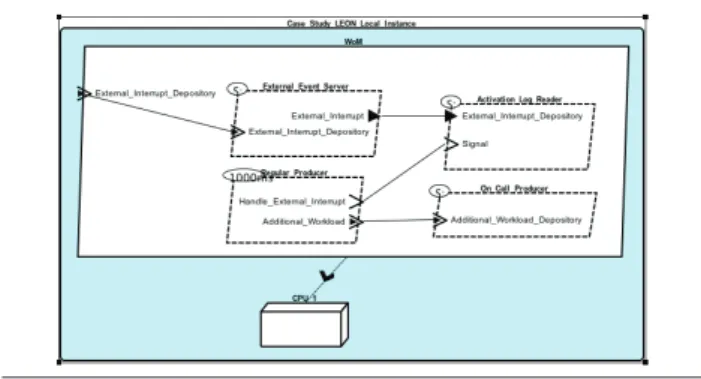
Figure 1. Ravenscar case study
of the components: subcomponents, connections between those subcomponents, . . .
An implementation of a thread or a subprogram can specify call sequences to other subprograms, thus describ-ing the execution flows in the architecture. Since there can be different implementations of a given component type, it is possible to select the actual components to put into the architecture, without having to change the other com-ponents, thus providing a convenient approach to configure applications.
The AADL defines the notion of properties that can be attached to most elements (components, connections, features, . . . ). Properties are typed attributes that specify constraints or characteristics that apply to the elements of the architecture: clock frequency of a processor, execution time of a thread, bandwidth of a bus, . . . Some standard properties are defined, e.g. for timing aspects; but it is possible to define new properties for different analysis (e.g. to define particular security policies).
AADL is a language, with different representations. A textualrepresentation provides a comprehensive view of all details of a system, and graphical provide a higher level of abstraction, and allow for a quick navigation in multiple dimensions. In the following, we illustrate both notations. Let us note that AADL can also be expressed as a UML model following the MARTE profile [4].
The concepts behind AADL are those typical to the con-struction of embedded systems, following a component-based approach: blocks with clear interfaces and proper-ties are defined, and compose to form the complete system. Besides, the language is defined by a companion standard document that documents legality rules for component as-semblies, with its static and execution semantics.
The figure 1 is derived from [3] is a case study for illustrating the concepts of the Ravenscar computational model, applied in AADL. It illustrates on an instance model how a set of tasks can be connected, packaged in a process and finally bound to a processor that abstracts away the system’s execution resources.
AADL is rich of many projects that address analysis di-mensions: scheduling, fault, resource accounting, etc. This is completed by code generation tools that generate all re-quired glue code to enable intercommunication between components and associated configuration mechanisms.
•Ocarina [8] is a model processing framework,
support-ing code generation towards C and Ada. It acts as a compiler, generating code in one pass. Configuration parameters are limited to one parameter defining the tar-get RTOS, and configuration of transport endpoints for communication layers.
•RAMSES [1] is a code generation framework based on
ATL, and an extension of OSATE2. It operates through successive refinement of the initial AADL models, mak-ing explicit all system calls (buffer and queue manage-ment, task creation, etc). It targets two operating sys-tems: OSEK and ARINC653/POK.
These two projects share common patterns for model-ing and then generatmodel-ing code. Yet, the support of the target platform is imprecise, and reduced to the configuration of the scheduling parameters (scheduler, priority only). Com-munication mechanisms are hard-coded in the model trans-formation, relying on a restricted set of libraries.
As we mentioned earlier, AADL, or others like MARTE and EAST-ADL provide similar constructs, and are con-ceptually really closed as underlined in [7]. A natural ques-tion is thus to review missing blocks for precise system modeling. In particular, how to define a library of reusable blocks? How one would model interrupts, bus and asso-ciated protocol stacks? how to support seamless integra-tion of associated code blocks in the generated code? All those particular concerns are important to propose a com-plete view of the system, and to provide accurate analysis.
In the following, we review each concern separately, and discuss solutions implemented in the Ocarina project1.
3.
AADLib: Extended property sets and
reusable models
Like most MDE notations, AADL has a rich ecosystem of tools supporting a wide range of concerns (safety, schedul-ing, budget analysis, etc.). This may be overwhelming for newcomers.
The general objective of this library is to provide a central repository of AADL models geared towards the community. To be effective, this library should be easily integrated with existing AADL modeling environment, but also provide a large variety of examples.
To support these objectives, we initiated a project on the GitHub forge codenamed “AADLib” for AADL Library. This project provides AADL models freely reusable, under a Free/Libre Software license.
3.1 Extended property sets
AADLv2 supports a wide set of non-functional properties. Yet, to our surprise, some key properties are not present in the current standard, and could be of great help to provide a clear description of blocks. AADLib provides additional properties. We list here the additional concerns modeled:
•processor_properties.aadl: this property set
com-pletes the properties applicable to processors with endi-1All models presented in this paper are available on-line.
See http://www.openaadl.org for more details.
anness, frequency, MIPS, FPU or multi-core concerns, see listing 1 for an example,
•bus_properties.aadl: adds bandwidth and channel
type (duplex, half-duplex) considerations,
•data_sheet.aadl: connects AADL model entities to
data sheets or bill of materials for physical implementa-tion,
•electricity_properties.aadl: covers energy
con-verters and electric units. This is useful for characteriz-ing devices or processor consumptions.
•physical_properties.aadl: adds other units for
power, mass, etc.
•memory_segments.aadl: extends the description of
memory components with fine-grained definition of segment or page descriptors.
These properties help providing a full description of a system, and it is used intensively to model the blocks forming the library of reusable AADL elements provided by AADLib.
property set P r o c e s s o r _ P r o p e r t i e s i s
Processor_Family : enumeration
(ARM, AVR, SPARC, PowerPC , x86 , x86_64 ) applies to ( processor ) ; Frequency : type a a d l i n t e g e r 0 Hz . . 2#1#e32 Hz u n i t s
( Hz , KHz => Hz ∗ 1000 , MHz => KHz∗ 1000 , GHz => MHz∗ 1 0 0 0 ) ;
−− Frequency o f a p r o c e s s o r
Processor_Frequency : P r o c e s s o r _ P r o p e r t i e s : : Frequency
app lies to ( processor ) ;
Endianess : enumeration ( L i t t l e _ E n d i a n , Big_Endian , Bi_Endian )
app lies to ( processor )
Word_Length : Size applies to ( processor ) ;
−− Length o f a word f o r t h i s p r o c e s s o r a r c h i t e c t u r e FPU_Present : aadlboolean applies to ( processor ) ;
MIPS : a a d l i n t e g e r 0 . . Max_Aadlinteger applies to ( processor ) ; Core_Id : a a d l i n t e g e r 0 . . Max_Aadlinteger
app lie s to ( v i r t u a l processor ) ;
end P r o c e s s o r _ P r o p e r t i e s ;
Listing 1. Property set for processor
3.2 Reusable building blocks
In addition to extended property sets, AADLib proposes a set of building blocks. These blocks provide a valuable asset to start new models. The library is built following AADL model hierarchy of elements:
•Processors: various ARM, AVR, PowerPC, SPARC,
x86 processors are available, with endianess, frequency, ports modeled;
•Buses: typical network interfaces are modeled,
cover-ing AFDX, ARINC429, CAN, Ethernet, I2C, MIL-STD 1553, PCI, SpaceWire, UART, USB, with known limits in bandwidth, packet size, etc.,
•Miscellaneous devices: battery, GPS, accelerometers,
with Buses : : UART, Buses : : E t h e r n e t ,−− . .
−− Set o f i m p o r t e d elements
system GR_XC3S_1500 f e a t u r e s
UART_Bus_0 : requires bus access UART. i m p l ; UART_Bus_1 : requires bus access UART. i m p l ; Eth_Bus_0 : requires bus access E t h e r n e t . i m p l ;
end GR_XC3S_1500 ;
system implementation GR_XC3S_1500 . i m p l subcomponents
LEON_Core : processor Processors : : SPARC : : LEON2 ; SRAM : memory SRAM
{ Memory_size => 64 MByte ; } ; Eth_0 : device G e n e r i c _ E t h e r n e t ; UART_1 : device Generic_UART ; UART_2 : device Generic_UART ;
end GR_XC3S_1500 . i m p l ;
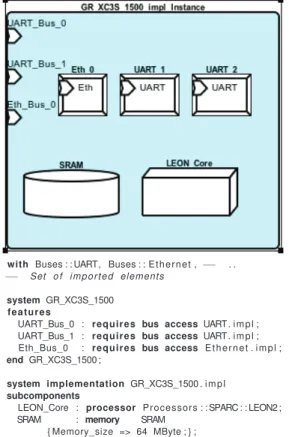
Figure 2. Graphical and textual representation of GR-XC3S board (subset)
components we use for teaching real-time or embedded systems in our classes at ISAE,
•Full systems, modeled after known reference design:
Arduino, Aeroflex Gaisler boards, Wind River SBCs. In the following example, a full system based on Aeroflex-Gaisler reference design for a LEON2 single-board-computer GR-XC3S-1500 is presented. It aggregates other blocks like UART and Ethernet devices, processors and memo-ries. Each subcomponent comes with a full set of prop-erties, specifying endianness, supported bandwidth range, size of memory, etc.
4.
Modeling device drivers
An important aspect of embedded systems is their capa-bility to associate physical events to software reactions. Such functions have a significant impact on software per-formance: bus usage, associated CPU overhead for copy-ing data, specific memory mappcopy-ings, etc. Thus, one needs to model the software blocks in charge of processing in-put/outputs.
AADL provides some concepts for attaching subpro-grams to devices, thus modeling associated device drivers. Yet, they are not precise enough to lead to code generation. In this section, we review additions supported by Ocarina to attach code representing an Interrupt Service Routine (or ISR) and drivers to AADL models.
thread ISR p r o p e r t i e s D i s p a t c h _ P r o t o c o l => I n t e r r u p t ; −− T h i s i s an ISR bound Deployment : : C o n f i g u r a t i o n => " SIGUSR1 " ; −− t o " i n t e r r u p t " SIGUSR1 Compute_Entrypoint => c l a s s i f i e r ( SIGUSR1_ISR . i m p l ) ; −− a c t u a l ISR code P r i o r i t y => 253; −−and a s s o c i a t e d p r i o r i t y−l e v e l end ISR ;
Figure 3. Modeling an Interrupt Service Routine in AADL
4.1 Modeling Interrupts
An interrupt service routine can be seen as a particular kind of thread, attached to one interrupt line in a system. Its modeling is thus reduced to an extension of existing dispatch protocols supported by AADLv2.
We took advantage of some liberty provided by the lan-guage to extend the list of supported dispatch protocol, specified in the AADL_Project property set. This set de-fines the list of available enumerators for some properties, like the concurrency control protocol, queuing discipline, etc. Let us note similar allowance exists for Ada, it is thus typical.
The list of supported dispatch protocol has been ex-tended with the “Interrupt” enumerator for specifying a new dispatch protocol. It is associated with an extended property definition Deployment::Configuration that represents the name of the associated interrupt. Depending on the target operating system or language, a tool genera-tor like Ocarina will map this string to the corresponding type definition. In the context of Ada, it has to conform to one of the names defined in the Ada.Interrupts.Names package.
Several restrictions are put on this category of threads:
•To respect constraints on ISR (short time, no blocking,
etc), ISR threads cannot have ports for communicating. This would require complex support from the underly-ing AADL runtime;
•inports are also forbidden, which have no sense: ISR
is triggered by an interrupt, external to the thread inter-face;
•outports would require protected object for
communi-cating, and thus could incur blocking.
Let us note that, should an ISR need to communicate and store information, it has to use global variables with associated concurrency protocol. This is supported through “required data access” mechanism in AADL.
Supporting this modeling pattern for code generation is straightforward in Ada: we take advantage of existing lan-guage features to bind the ISR subprograms to an interrupt handler represented as an Ada protected object. This is be-ing defined as a particular task archetype in our Ada AADL runtime “PolyORB-HI/Ada”: PolyORB_HI.ISR_Task. This archetype follows typical pattern documented in [3].
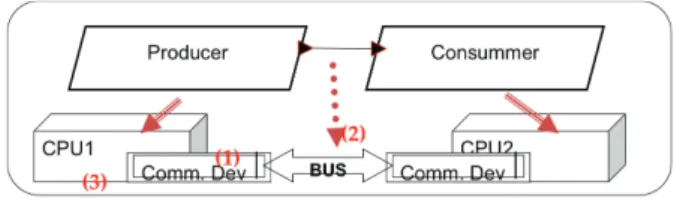
Figure 4. Modeling communication stack
4.2 Modeling drivers
In addition to modeling drivers for interrupt-driven devices, we need to express the relationship between a logical con-nection between two processes, and the associated runtime support through an actual communication stack.
From a modeling perspective (see figure 4), only AADL processes can interact with remote processes through logi-cal connections. Thread would ultimately send an event on their outgoing ports to one of the outbound port of a pro-cess.
Supporting hardware devices (marked as (1) in the fig-ure) are attached to AADL processor components, model-ing the fact that the device is known by the support oper-ating system (3). The device has also access to a bus (2), representing the physical connection. AADL “virtual bus” elements, subcomponents of the bus can be added to model actual communication protocols.
Finally, the logical connection is bound to the physical one to indicate which resources can be used to supporting the interaction between the two processes.
This modeling pattern is actually a faithful interpreta-tion of AADL concepts; it provides all informainterpreta-tion quired to map logical interactions to actual support re-sources (bus and devices). In order to complete this models, one needs additional patterns for modeling resources used by the devices, namely internal buffers, threads for process-ing incomprocess-ing requests, links to actual protocol routines, etc. To achieve separation of concerns, we take advantage of the Device_Driver property to model all associated re-sources, see figure 5 for all details.
In this model, we indicate the device is accessing an Eth-ernet bus, the abstract entity Driver_TCP_IP_Protocol provides two resources to send and receive packets. We use a dedicated subprogram for the emission of mes-sages, and a thread for processing incoming requests. We need a separate thread to wait, due to the semantics of TCP/IP protocol,while we can use the user thread to per-form the actual sending as part of its execution. The ini-tialization is performed by the subprogram attach to the Initialize_Entrypointproperty.
Actual configuration of the device is done when instan-tiating one component of this type, through the use of the Deployment::Locationproperty.
Similarly to the interrupt-modeling pattern, several re-strictions must be enforced:
•The receiving thread must use a background or
time-dependent dispatch protocol, and cannot be time-dependent on a model-level event: its dispatch is triggered form
device TCP_IP_Device f e a t u r e s
E t h e r n e t _ W i r e : requires bus access E t h e r n e t . i m p l ;
p r o p e r t i e s
D e v i c e _ D r i v e r =>
c l a s s i f i e r ( TCP_IP_Protocol : : D r i v e r _ T C P _ I P _ P r o t o c o l . i m p l ) ;
I n i t i a l i z e _ E n t r y p o i n t => c l a s s i f i e r ( TCP_IP_Protocol : : I n i t i a l i z e ) ;
end TCP_IP_Device ;
−− I n AADLv2 , we can model t h e a c t u a l i m p l e m e n t a t i o n o f a d r i v e r −− u s i n g an a b s t r a c t component .
a b s t r a c t D r i v e r _ T C P _ I P _ P r o t o c o l end D r i v e r _ T C P _ I P _ P r o t o c o l ;
a b s t r a c t implementation D r i v e r _ T C P _ I P _ P r o t o c o l . i m p l subcomponents
r e c e i v e r : thread D r i v e r _ T C P _ I P _ P r o t o c o l _ t h r e a d _ r e c e i v e r . i m p l ; sender : subprogram Send ;
end D r i v e r _ T C P _ I P _ P r o t o c o l . i m p l ;
−− A c t u a l usage and c o n f i g u r a t i o n
system implementation A_System . i m p l subcomponents
TCP_IP_Cnx_1 : device TCP_IP_Protocol : : TCP_IP_Device . i m p l { Deployment : : L o c a t i o n => " i p 1 2 7 . 0 . 0 . 1 1 2 3 3 " ; } ;
end A_system . i m p l ;
Figure 5. Modeling a driver in AADL
the arrival of a message (e.g. TCP/IP) and/or specific time;
•Priority of receiving thread must be compatible with the
overall schedulability objective of the system, e.g. to avoid risk of priority inversion in case a sender thread blocks a receiver ones.
This list is to be completed by the user with all platform-specific considerations, like level of priorities, restrictions for concurrent accesses to the bus, etc.
Ocarina code generation strategies, detailed in [8] have been enriched to support this new modeling pattern. Code generation takes advantage of the enriched model to
•add to the task set defined by the user the additional
threads required by the device drivers;
•connect send/receive functions provided by the driver to
the minimalist middleware generated from the architec-tural model;
•configuration parameters are passed to the initialization
function of the device, and enforced during the partition elaboration.
The user has to respect a minimal set of conventions for the driver code: the signature of the Send function is derived from the AADL model, and holds the message and destination. It has all relevant information for sending the message.
On the receiving side, the user code has to unmarshall the request, and then make usage of one internal API to route the message to the receiving thread.
This modeling pattern has been implemented in Oca-rina, and declined for various protocols, namely: UART based on GNAT.Serial, TCP/IP based on GNAT.Sockets, SpaceWire and UART based on ORK+ runtime [2].
5.
From model patterns to correct
integration of code
In the previous sections, we introduced modeling patterns for supporting interrupts and communication protocols through AADL devices. We also listed several restrictions to be respected.
In this section, we detail how these restrictions are checked at architecture level using the REAL language. 5.1 Validation of architectural constraints
An AADL architectural model is a combination of blocks. Its correctness is asserted in multiple dimensions: through the type systems, external tools for specific analysis. Yet, there is a gap in-between, e.g. assessing a device driver is compatible with a given processor/OS couple, or that a models fulfills a given set of patterns (e.g. synchronous, Ravenscar, . . . ).
These considerations lead us to define an AADL lan-guage annex: REAL. REAL (Requirement Enforcement Analysis Language) aims at checking constraints enforce-ment on architectural descriptions at the specification step, saving significant time over verification at execution time. In this section, we describe the main features of this lan-guage. REAL pursues multiple design goals:
•Enabling easy navigation through AADL meta-model
elements, yet being at a high-level abstraction. To do so, we discarded the use of the UML Object Constraint Language (OCL) and decided to define a specific DSL based on AADL meta-model concepts to ease writing of constraints.
•Allowing to define generic rules. We note that
mathe-matics universal quantifiers (∀, ∃) notation is interest-ing to define metrics that can apply to a wide range of models, not just specific instances.
•Allowing for modularity through definition of separate
constraints that can be later combined.
•Being integrated to the AADL as an annex language, so
that constraints are coupled to models.
From these goals, we defined REAL with the following design decisions: REAL is based on set theory and associ-ated mathematical notations. The basic unit of REAL is a theorem. A theorem verifies an expression over all the ele-ments of a set that is called the range set. It allows one to build sets whose elements are AADL entities (connections, components or subprogram calls). Verification or computa-tions can then be performed on either a set or its elements by stating Boolean expressions.
In order to write complex expressions, one can use pre-defined sets, which contain the instances of the AADL model of a given type, or build intermediary sets, using re-lations between elements of sets (e.g. returns the elements of the set A which are subcomponents of any elements of the set B). Listing 2 shows how to assess all threads are cyclic.
theorem a l l _ t a s k s _ c y c l i c
foreach t i n Thread_Set do
−− T h i s system drags advanced AADL l e g a l i t y r u l e s f o r d r i v e r s , p r o t o c o l s , e t c . system AADL_System annex r e a l _ s p e c i f i c a t i o n {∗∗ theorem c h e c k _ a l l f o r e a c h s i n l o c a l _ s e t do r e q u i re s ( check_aadl ) ;
−− meta−theorem , checking a l l r u l e s
end c h e c k _ a l l ;
∗ ∗} ;
end AADL_System ;
Figure 6. Applying REAL constraints at model level
check ( ( Get_Property_Value ( t , " D i s p a t c h _ P r o t o c o l " ) = " p e r i o d i c " ) o r
( Get_Property_Value ( t , " D i s p a t c h _ P r o t o c o l " ) = " s p o r a d i c " ) ) ;
end a l l _ t a s k s _ c y c l i c ;
Listing 2. REAL example
REAL [5] has been integrated as an annex language in Ocarina, our AADL toolsuite. We present full examples of REAL in the next sections and show how it can help com-puting metrics of AADL models to drive an optimization process. It has been successfully applied to assess a model conforms to the Ravenscar, MILS or ARINC653 architec-tural profiles.
As part of the modeling of drivers and interrupts han-dlers, we defined in the previous sections a set of additional constraints to be met. These were encoded as a set of REAL predicates that are then bound to a model using AADL an-nex clauses and checked on the model during model analy-sis, and code generation.
We then apply one theorem at the top node of the hier-archy of components. This theorem has two objectives:
1. calls all subtheorem provided as external library; 2. apply recursively to all its subcomponents (process, bus,
device, . . . )
As defined, this theorem serves as an architectural con-tract the subsequent implementation has to fulfill. Subse-quently, we can check all constraints to be met by a set of blocks.
5.2 Integrating last bits: inclusion of user code The last step towards full inclusion of model patterns and code is to instruct code generator, but also model builders how to link code to models, and ensure the code is valid for the model assembly.
We defined two additional sets of enrichments for the AADL library of models:
1. Constraints a model entity (e.g. a device) must met towards integration. For instance, a given driver can work only for a given operating system/runtime 2. Additional properties for configuring the build system
These two elements rely on a specific property set geared towards the Ada compilation system we use (GNAT in our case), and additional REAL constraints.
In the following example, we use a GNAT-specific project file for setting name of the compiler (following
processor LEON p r o p e r t i e s
Deployment : : E x e c u t i o n _ P l a t f o r m => (LEON_ORK ) ;
−− Usink ORK+ K e r n e l
GNAT : : Compiler_Name => ‘ ‘ sparc−e l f−’ ’ ;
−−Name o f t h e c o m p i l e r
GNAT : : R e s t r i c t i o n s => ( ‘ ‘ r a v e n s c a r . adc ’ ’ , ‘ ‘ h i . adc ’ ’ ) ;
−− R e s t r i c t i o n s t o be a p p l i e d
end LEON ;
device ORK_UART extends Generic_UART p r o p e r t i e s Deployment : : S u p p o r t e d _ E x e c u t i o n _ P l a t f o r m => (LEON_ORK ) ; −− Requires ORK+ GNAT : : P r o j e c t _ F i l e => ( ‘ ‘ o r k . gpr ’ ’ ) ; −−GNAT p r o j e c t f i l e f o r l i b r a r y i n c l u s i o n end ORK_UART;
Figure 7. Deployment-specific constraints (AADL side)
theorem check_deployment foreach d i n Device_Set do
CPU = { p i n Processor_Set | Is_Bound_To ( p , d ) } ;
−− Processors d i s bound−t o
check ( I s _ I n ( p r o p e r t y ( d , " S u p p o r t e d _ E x e c u t i o n _ P l a t f o r m " ) ,
p r o p e r t y (CPU, " E x e c u t i o n _ P l a t f o r m " ) ) ) ;
end check_deployment ;
Figure 8. Deployment-specific constraints (REAL-side)
GNU conventions), but also specific restrictions to be en-forced during compilation phases.
Then, we specify that the device ORK_UART can only operates when bound to a processor with the same exe-cution platform. This additional check is performed using specific REAL constraints that ensure supported execution platforms match the execution platform of the processor (see below).
From these properties, Ocarina now has all elements to generate from the architectural model, but also the ac-companying set of makefile and GNAT project files that will compile user-code for both the functional part and the platform-specific part.
6.
Conclusion
In this paper, we considered precise modeling from the perspective of code generation. We presented contributions to model precisely runtime elements such as interrupts, device drivers. Those are central for embedded systems, but are seldom contemplated in an inclusive and extensive code generation strategies. We introduced both modeling patterns, and code generation artifacts integrated in Ocarina that support them. Our contribution is two-fold:
First, we introduced a systematic way to model library of components using AADL, focusing on extended prop-erty sets so as to extend the coverage of concerns a system has to embrace.
Then, we introduced model patterns for supporting in-terrupts and device drivers for supporting communication across partitions. We emphasized the need to extend the set of legality rules to platform-specific constraints. We take advantage of the REAL constraint language to express them, and check them at model-level. This ensures the path towards code generation is clean.
Finally, we introduced patterns to capture compilation-specific concerns: compilation chain, configuration, link to user code.
By combining all those elements, we provide all build-ing blocks to prepare for library of reusable model assets that match platform needs and associated code. We also, as part of the AADLib project, provide a ready-made set of such blocks.
Future direction will consider 1) the extension of this work to support more operating systems, but also languages targetting C, 2) moving from code generation towards more precise resource analysis (e.g. memory or scheduling).
References
[1] Fabien Cadoret, Etienne Borde, Sébasient Gardoll, and Lau-rent Pautet. Design patterns for rule-based refinement of safety critical embedded systems models. In Engineering of Complex Computer Systems (ICECCS), 2012 17th Interna-tional Conference on, pages 67–76, 2012.
[2] Juan Antonio de la Puente, José F. Ruiz, and Juan Zamorano. An open ravenscar real-time kernel for gnat. In Hubert B. Keller and Erhard Plödereder, editors, Ada-Europe, volume 1845 of Lecture Notes in Computer Science, pages 5–15. Springer, 2000.
[3] Brian Dobbing, Alan Burns, and Tullio Vardanega. Guide for the use of the of the Ravenscar Profile in High Integrity Systems. Technical report, 2003.
[4] Madeleine Faugere, Thimothee Bourbeau, Robert de Simone, and Sebastien Gerard. MARTE: Also an UML Profile for Modeling AADL Applications. Engineering of Complex Computer Systems, IEEE International Conference on, 0:359–364, 2007.
[5] Olivier Gilles and Jerome Hugues. Expressing and enforcing user-defined constraints of AADL models. In Proceedings of the 5th UML& AADL Workshop (UML&AADL 2010), pages 337–342, University of Oxford, UK, March 2010.
[6] Jérôme Hugues. Analytic virtual integration of cyber-physical systems & AADL: challenges, threats and oppor-tunities. In Proceedings of the second Analytic Virtual Integration of Cyber-Physical Systems Workshop, Vienna, Austria, November 2011.
[7] Andreas Johnsen and Kristina Lundqvist. Developing Dependable Software-Intensive Systems: AADL vs. EAST-ADL. In A. Romanovsky and T. Vardanega, editors, Ada-Europe 2011, pages 103–117. Springer-Verlag, June 2011. [8] Gilles Lasnier, Bechir Zalila, Laurent Pautet, and Jérôme
Hugues. OCARINA: An Environment for AADL Models Analysis and Automatic Code Generation for High Integrity Applications. In Reliable Software Technologies’09 - Ada Europe, volume LNCS, pages 237–250, Brest, France, June 2009.
[9] SAE. Architecture Analysis and Design Language (AADL) AS-5506B. Technical report, The Engineering Society For Advancing Mobility Land Sea Air and Space, Aerospace Information Report, Version 2.1, January 2011.