How to build stable relationships between
people who lie and cheat.
Ivar Ekeland
CEREMADE, Université Paris-Dauphine
March 2013
Abstract
This is a talk delivered at the conference "Mathematics in a Complex World", on the occasion of the 150th anniversary of the Politecnico di Milano. Asymmetry of information, i.e. the possibility for human beings to hide their information, or not to keep their promises, is a fundamental fact of social life, and must be taken into account. I will show how this creates complexity, even in the very simple situation of a contract between two parties, one of whom commits to work for the other, but cannot be monitored.
1
Building society from the bottom up
There are two approaches to the social sciences. One can go bottom-up, starting from free individuals and trying to understand how they form societies, or one can go top-down, starting from a given society and trying to understand how they assimilate individuals. The …rst one goes back to the bourgeois Enlighten-ment, marked by Rousseau and Montesquieu in France, Locke in England, Hume and Smith in Scotland, while the second one originates with Comte, Hegel and Marx, and has given birth to sociology and anthropology. One can also seek analogies in the sciences, and relate the …rst approach to physics, and the sec-ond to biology. A physicist will consider atoms and molecules as the primary entities, and will seek to explain the properties of macroscopic objects, solids, liquids or gases, from the properties of these microscopic building blocks. A bi-ologist, on the contrary, will consider the macroscopic organism as the primary entity, and will try to understand how its microscopic components …t into the bigger entity and help it ful…l its purpose.
Modern economic theory is decidedly bottom-up: it considers that societies are constructed from individuals, much like are built from atoms. It then has to explain (a) how isolated individuals behave, and (b) how they interact with others.
Individuals are characterized by a set of preferences, which determines their behaviour: in each circumstance, they are supposed to rank all possible
al-ternatives, and to choose the one they prefer. This is usually expressed by a utility function u over possible actions. If individual 1 has a utility function u1, and u (a) > u (a0), then she prefers a to a0; note that another individual
will have another utility function u2, and we may well have u2(a) < u2(a0),
so that the two individuals have opposite tastes. Of course, the consequences of any decision are a usually not known with total certainty: there are several possible outcomes x, each of which has a probability Pa, which depends on a,
and the agent then ranks the outcomes, not the decision itself. She is supposed to choose the action which maximises the expected utility of the outcomes, that is, to choose a so as to maximise Ea[u (x)]. The function u is concave, which
captures various degrees of risk aversion. If we are dealing with money, so that x is one-dimensional, one usually takes u (x) = 1x , with 1 (negative values of are admissible, and for = 0 one takes u (x) = ln x), with x 0. If = 1, the corresponding individual is risk-neutral: she will pay 50; 000 to buy a lot-tery ticket which gives her a 50% chance of winning 100; 000. Most individuals would pay much less for such a ticket; how much they would pay depends on their particular , and the amount is easily seen to decrease with :
These individuals, each one with his or her utility function, are now supposed to enter contracts with each other. There is a large variety of possible contracts. At one end of the scale, there is the simple act of buying bread: you give a loaf or a baguette, and I give you cash. At the other end, you have the constitutions and laws regulating states, which in fact are contract between its citizens. There is even a long-standing tradition in political science, going back to Rousseau, which imagines the free individuals, in the so-called " state of nature" (meaning that society does not exist yet), gathering together before history begins and negociating their freedom away in the "social contract", behind a suitable "veil of ignorance" (Rawls). In short, one understands society as a network of contracts between individuals and groups. This is obviously a highly complicated view of society, much more complicated then, say, the physicist’s view of solids: atoms come in …nitely many species, and within each species they are identical. They do not have memories, they are not born, they do not age and they do not die. Human beings, on the other hand, are all di¤erent, and they change during their lifetime. We are very far from being able to understand how society emerges from this variety, so we will be content with studying the simplest possible contract, which is a contract between two parties.
The most important fact that the economist has to contend with, is assym-metry of information. If human beings were transparent to each other, social life would be easy. One would detect liars because their nose grows, like Pinocchio’s, and one would detect evil people because they have black tails and hooved feet. Unfortunately it does not work that way. People can lie, or at least hide rel-evant information, and people can renege on promises, as every voter will tell you. This is called asymmetry of information, and economists classify it in two categories: adverse selection and moral hazard.
things about myself that I am not going to tell you. If I am interested in buying your house, I will not rave about how wonderful it is and how much I would be willing to spend to get it. It is wiser to let the seller think that I am interested, but that I am looking at other houses, and anyway I do not have deep pockets. Adverse selection takes its name from the insurance industry. In health insurance, for instance, the insurer would like to know the genetic imprint and past history of all applicants, but this would result in insuring only those who do not need it, namely the healthy !
In the short span of this lecture, I will not deal with adverse selection, and illustrate instead the contractual consequences of moral hazard. As I mentioned, people will renege on promises, or simply cheat, if they can get aay with it. When drawing up a contract, this possibility has to be taken into account, and this results in great complications. In fact, these complications where insuperable until very recently, when Sannikov found a way to reduce the moral hazard problem to an optimal control problem in a seminal paper of 2008 [5]. Since then, his method has been shown to be extremely fruitful (see [6]; we will give more references later on). In this conference, we will describe Sannikov’s method. As usual, there are two approaches to the resulting optimal control problem, one through PDEs and the HJB (Hamilton-Jacobi-Bellman) equation, and the other through the stochastic maximum principle and BSDEs (backward stochastic di¤erential equations). We will choose the …rst one, like Sannikov, and we refer to the recent book of Cvitanic [3] for the other.
2
Working for someone else
We will descrive a simple contract between two parties, where the …rst one (the principal) hires the second one (the agent) to work for him. The agent is in charge of a project which generates a stream of revenue dXtfor the principal
dXt= Atdt + dZt
Here Zt is a standard Brownian motion, which generates a …ltration FtZ;
and > 0 is a given constant. The process Atis FtZ-adapted, with 0 At a.
It is chosen, not by the principal, but by the agent. If the agent chooses At
at time t, she incurs an instateneous cost of h (At), where h : [0; a] ! R is
an increasing and convex function, with h (0) = 0. We shall refer to At as the
e¤ort of the agent, and to h (At) as the cost of e¤ort. Since the revenue dXt
accrues to the prinicipal, the agent has no interest in making any e¤ort, and would choose At= 0. So the principal has to compensate her for e¤ort, and to
this end chooses a process Ct 0. Let us now write the intertemporal utilities
of both parties: (principal) rE Z 1 0 e rt(dXt Ctdt) (1) (agent) rE Z 1 0 e rt(u (Ct) h (At)) dt (2)
As mentioned earlier, Atis the agent’s e¤ort (chosen by the agent) and Ctis
the agent’s compensation (chosen by the principal). Both parties have the same discount rate r (the presence of r in front of the integrals has no role except to somewhat simplify the formulas). The remaining function u and h characterize the agent: u is her utility function, and h the cost of e¤ort. Note that the agent is risk-adverse but not the principal.
If we made no further assumptions, the principal would want the agent to work as hard as possible, so that At = a, and would propose her a contract
whereby she sets At = a and gets in exchange a compensation slightly above
the level c wheret u (c) = h (a); the agent would then accept the contract, because her intertemporal utility then is slightly above 0. In other words, the agent would be kept at subsistence level while the principal would capture all the surplus. We now incorporate in the model two major features, which will put the agent in a much better (in fact, as we shall see, a fantastically better) position: moral hazard and limited liability.
Condition 1 (1:Moral Hazard) Denote by FtX the …ltration generated by
Xt. Then the process Ctis FtX-adapted
In other words, the agent’s compensation is conditional on past revenues: Ctcan depend only on the values of Xsfor s t. This expresses moral hazard:
the principal observes neither Atnor Zt, he observes only dXt. The randomness
protects the agent: if the principal’s revenue decreases, the agent can always claim that it is due to bad luck (dZt < 0), rather than lack of e¤ort (At <
0). The agent would dearly like to make compensation conditional on present e¤ort, that is, set Ct = ' (At) for some increasing function ', but he cannot,
because the agent can always shirk, i.e. claim to have done maximum e¤ort (At= a), while in fact doing nothing (At= 0). The principal can only make
the contract conditional on what he can observe, namely Xt. Of course, the
past history of Xt, that is, the values of Xsfor s t, contain information about
the agent’s actual performance, and the right contract should be able to extract that information. So it is certainly not going to be Markovian, i.e. Ct should
not depend on t only, but on all the history of Xs for s t.
Condition 2 (2: Limited Liability) Ct 0 for all t.
This means that the principal cannot …ne the agent, or even recover money given earlier: any compensation given to the agent is for ever lost to the prin-cipal. The principal would dearly like the contract to specify some dreadful penalty if the agent is caught napping on the job; if the penalty is severe enough, the agent is more or less sure to perform, even if the likelyhood of being caught is small. Fortunately (for the agent) he cannot do that, barring exceptional cir-cumstances (sentries in time of war are supposed to be shot if they fall asleep): the worst that can happen to her is to be …red. Since the principal does not have a stick, he will have to use the carrot: instead of punishing severely poor performance, he will have to reward extravagantly good performance.
Before we proceed with the mathematical analysis, let us give some examples. Suppose I am an absentee landlord: I own a farm, in some remote countryside far away from the big city where I live, and I want someone else to take care of it for me. What kind of contract should I give the tenant ? Three possibilities come to mind:
1. Ct = c (…xed salary). The agent gets c no matter what the revenue is.
There is no incentive for her to work, she gets c whether At= 0 or At= a,
and since e¤ort is costly she chooses At= 0.
2. Ct= aXt (…xed share of revenue). The agent gets to share the revenue.
She now has an incentive to work - the harder she works, the higher is her expected gain. The problem for the principal is to choose the correct value of a, that is, not to be too generous: the higher a, the higher the agent’s incentive, but the higher the cost to the principal, all the way up to a = 1 where all the revenue goes to the agent
3. Ct= Xt c (the principal rents out the project to the tenant). This seems
an excellent compromise: the agent’s incentive is maximal, and yet the principal gets something as well. The problem, of course, is to determine the correct value of c. There is another drawback to this solution: it is not an e¢ cient way to share the risk. The principal is risk-neutral, whereas the agent is risk-adverse, so the principal should bear the risk. And yet, with Ct = Xt c, it is the agent who bears all the risk, in fact insuring
the principal
The situation I have described occurs in all kinds of societies, where absentee landlords, living in cities, have tenants cultivate their dominions. Solution 1 (…xed salary) is never observed. Note, however, that is used in other situations, such as domestic help or farmhands, where the agent works under the close supervision of the principal, so that there is little or no moral hazard. Solution 2 is known as sharecropping, and Solution 2 as farming. Both are historically and geographically widespread, and there are very interesting economic studies characterizing conditions favouring one or the other.
The same situation occurs in the modern …nance industry. Suppose you have 100; 000 Euros to invest - say, savings towards your retirement. You are not going to invest them yourself: you have neither the time nor the expertise. You bring them to an investment manager, who will invest them for you. And then you are back into the moral hazard problem: if the returns are bad, is it due to her or to the market ? It is easy to blame everything on the economic environment, and you are very unlikely to hear any other explanation, but how do you know ? Even when bad results persist, and you become convinced that your manager is at fault, that she is regularly taking too much risk and picking the bad investment options, your only resort is to …re her, that is, to cash in whatever remains of your portfolio and put it away. All the losses are yours, and there is no recovering the management fees: this is the limited liability problem.
Moral hazard and limited liability are the core of the …nance industry. The money manager invests other people’s money and charges a fee for doing so. Financial investments are so arcane that the client cannot monitor what the manager is actually doing (moral hazard), and since the client, not the manager (limited liability) is carrying the losses, the manager is prone to taking risks which he would not take with his own money.
We summarize the preceding discussion:
De…nition 3 A contract is a pair (Ct; At), with Ct 0 and FtX-adapted while
Atis FtZ-adapted
The point to bear in mind is that the contract is written down at time t = 0. The compensation part Ctis veri…able (both parties observe Xt) and enforceable
(the principal has to pay Ct; if he does not, the agent goes to court and forces
him to do so). Note that this precludes any kind of arbitrary behaviour. The principal can specify in the contract under which circumstances he would …re the agent, and he will …re him if these circumstances are met; but he cannot …re the agent under other circumstances. The e¤ort part Atis speci…ed in the
contract, but cannot be veri…ed, since only the agent observes it.
On paper, the contract binds both parties for ever. In e¤ect, it can be ter-minated by either party:
by setting Ct= 0 for t T the principal …res the agent at time T
by setting At= 0 for t T the agent walks o¤ the job at time T
De…nition 4 A contract (Ct; At) is incentive-compatible (IC) if the agent …nds
it in her own interest to exert the contractual e¤ ort At at every t. It is
indi-vidually rational (IR) if both the principal and the agent …nd it in their own interest to enter the contract at t = 0.
(principal) rE Z 1 0 e rt(dXt Ctdt) 0 (3) (agent) rE Z 1 0 e rt(u (Ct) h (At)) dt 0 (4)
The principal devises a contract and o¤ers it to the agent. The agent can take it or leave it: there is no negociation. If a contract does not satisfy (3), the principal will not o¤er it, for he is better o¤ doing nothing. If a contract does not satisfy (4), the agent will not accept it, for she is better o¤ doing nothing. If a contract is not IC, the principal will not o¤er it, for he knows the agent while she will not deliver her side of the bargain. The principal’s problem consists of maximizing his expected pro…t (1) among all contracts which are IR and IC.
3
Solving the principal’s problem.
3.1
Characterizing IC contracts
Suppose a contract (Ct; At) is given. Let us look at the continuation value the
agent derives from it at time t: Wt = rE Z 1 t e r(s t)(u (Cs) h (As)) ds j FtZ = rertE Z 1 0 e rs(u (Cs) h (As)) ds j FtZ rert Z t 0 e rs(u (Cs) h (As)) ds
The …rst term on the RHS is a martingale. Using the martingale represen-tation theorem we …nd that there is a Zt-adapted process Yt(depending on Ct
and At) such that:
1
rdWt = (Wt u (Ct) + h (At)) dt + Yt dZt (5) = (Wt u (Ct) + h (At) YtAt) dt + YtdXt (6)
Now suppose the agent has conformed to the contract (Cs; As) for s t,
and tries to cheat, by performing e¤ort a in the following interval [t; t + dt], and reverting to As for s t + dt:
her immediate compensation Ctis una¤ected
her cost on [t; t + dt] is rh (a) dt
her expected bene…t on [0; 1] is E [YtdXt] = rYtadt
the balance is r (aYt h (a))
So, for the contract to be IC, we must have: YtAt h (At) = max
0 afaYt h (a)g a.e (7)
The preceding argument is heuristic. Moreover, it gives only a necessary condition. It turns out that it can be made rigorous, and that in addition the condition is also su¢ cient:
Theorem 5 The contract (At; Ct) is IC if and only if condition (7) holds
Proof. Suppose (A; C) does not satisfy condition (7). Then there is an alter-native contract (A ; C ) with:
YtAt h (At) YtAt h (At) a.e
The agent picks t > 0 and plans to apply A for s t and A for t. Her expected utility at t, conditional on Z:t, is:
1 rVt = E Z 1 0 e rt(u (Ct) ht) ds j FtZ = Z t 0 e rs(u (Cs) h (As)) ds + e rtWt(A; C) = W0(A; C) + Z t 0 e rs(h (A s) h (As) YsAs+ YsAs) ds + Z t 0 e rsY s(dXs Asds)(8)
Since dXs= Asdt + dWsfor s t, the last term is a martingale. Hence:
E [Vt] = W0(A; C) + E
Z t 0
e rs(h (As) h (As) YsAs+ YsAs) ds
The integrand is non-negative, and positive on a set of positive measure in (t ; !). It follows that there is some t such that E [Vt] > W0(A; C). But this
means that switching from A to A at time t is better than sticking with A from the beginning. So (A; C) cannot be (IC). This proves that condition (7) is necessary.
Conversely, if (A; C) satis…es condition (7), then, by formula (8), Vt is a supermartingale, with:
W0(A; C) = V0 E [V1] = W0(A ; C)
so At is at least as good as any alternative strategy At. This proves that
condition (7) is su¢ cient.
3.2
Reduction to an optimal control problem
Substituting condition (7) in (5) or (6), and assuming, for the sake of commodity, that the maximum is not attained at a boundary, so that Yt= h0(At), we get:
1
rdWt = (Wt u (Ct) + h (At)) dt + h
0(A
t) dZt (9)
= (Wt u (Ct) + h (At) h0(At) At) dt + h0(At) dXt (10)
Conversely, if (9) holds, we have Yt= h0(At), so that the contract (Ct; At)
is IC. Sannikov’s idea is to read this in another way, namely as a stochastic di¤erential equation for a state variable Wt, controlled by Ct and At. The
principal will then solve the optimal control problem: max Ct;AtrE Z 1 0 e rt(dXt Ctdt) 1 rdWt = (Wt u (Ct) + h (At)) dt + h 0(A t) dZt; W0= w0
(w is exogeneous), the solution of which will be found in feedback form Ct =
c (Wt) and At = a (Wt), for suitable functions c (w) and a (w). The contract
1. The principal will pay the agent Ct:= c (Wt), where Wtis de…ned by (10)
and At is de…ned below
2. The agent will perfom At:= a (Wt), where Wtis de…ned by (9)
This optimal contract is IC, by construction, so the agent will actually per-form At, as stipulated in the contract, and formulas (10) and (9) coincide. So
both parties will agree on the current value of Wt, which serves as a
perfor-mance index for the agent. It depends on past perforperfor-mance, through formulas (10) and (9), and payments will be conditional on the current value of Wt. In
other words, the contract will not be Markovian w.r.t. the revenue Xt, but it
will be Markovian w.r.t. the performance index Wt.
Before we go any further, let us introduce a special class of contracts. Sup-pose Ct= c for time t T : the principal pays a constant compensation after
time T . As we noticed earlier, the agent then stops exerting e¤ort, so that At= 0
for t T . In fact, the principal pensions o¤ the agent. It is not immediately obvious why he should wish to pay her for doing nothing, as he has always the possibility to …re her, i.e. to set Ct= 0. We will see, however, that the optimal
contract involves retiring the agent instead of …ring her.
The time T when the agent is pensioned o¤ must be speci…ed in the contract, so it is a stopping time w.r.t. FX
t . The continuation value at time T is easily
computed: WT = r Z 1 T e rtu (c) ds = u (c) so c = u 1(W
T). The value of the contract for the principal is given by:
rE "Z T 0 e rt(dXt Ctdt) + e rT Z 1 T e rtcds # = rE "Z T 0 e rt(At Ct) dt + dZt + e rT r u 1(W T) #
We now summarize. The principal has to solve the stochastic optimal control problem: sup ( rE "Z T 0 e rt(At Ct) dt + dZt + e rT r u 1(W T) #) 1 rdWt= (Wt u (Ct) + h (At)) dt + h 0(A t) dZt
The optimisation is carried over the controls At2 [0; a] and Ct 0, and the
stopping time T 0. The state variable is Wt. The initial value, W0 = w0, is
exogenous: it is part of the contract, and the principal will choose it in the way which is best for himself.
3.3
The HJB equation.
As usual, to solve the optimal control problem, we introduce the value function
F (w) = r sup E "Z T 0 e rt(dXt Ctdt) e rT r u 1(W T) j W0= w0 #
F (w) is the highest expected utility the principal can obtain while guaran-teeing the agent an expected utility of w.
F : [0; 1) ! R is continuous, and F (w) u 1(w) everywhere. T is
the …rst time when F (Wt) u 1(w) The function F satis…es the
Hamilton-Jacobi-Bellman equation, which in this case is a quasi-variational inequality:
F (w) = max a a 0; c 0 u 1(w) ; a c + F0(w) (w u (c) + h (a)) +r 2F00(w) h0(a) 2 2 (11) Denote by A (w) and C (w) the points a and c where the maximum is attained on the RHS.
Theorem 6 Suppose F solves (HJB) with F (0) = 0. Pick some w0and de…ne
Wtas follows:
1
rdWt= Wt u (C (Wt) + h (A (Wt))) dt + h
0(A (W
t)) dZt (12)
with W0= w0Then the contract Ct= C (Wt), At= A (Wt) is IC, IR, and has
value w0 for the agent and F (w0) for the principal. The principal pensions o¤
the agent at time T := inf t j F (Wt) u 1(Wt) . Any IC and IR contract
starting from W0= w yields to the principal a pro…t less than or equal to F (w)
Note that the stopping time T occurs either when Wt= 0 or when Wt= w;
where w is the smallest positive solution of F (w) = u 1(w). It turns out that
it is …nite: T < 1 a.s.
Proof. Let us prove that the contract yields value F (w0) for the principal.
By construction, Wt is the continuation value for the agent, so W0= w0is the
expected utility the agent derives from the contract when she enters it. The expected utility to the principal is:
rE "Z T 0 e rs(As Csds) e rT r u 1(W T) #
The random variable Gt::=
Rt
0e rs(As Csds) + r 1e rtF (Wt) is a di¤usion.
Applying Ito’s Lemma to 12 and using (HJB), we check that it is a martingale. By the optional stopping theorem,
E [GT] = G0= F (W0)
One then checks that this contract is optimal, provided the solution F is convex. We refer to [5] for a full proof.
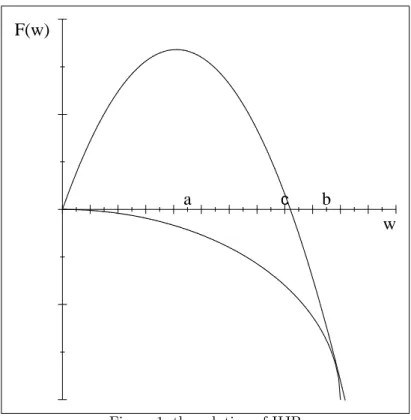
w
F(w)
a
c
b
Figure 1: the solution of HJB
The solution is depicted in Figure 1. The upper curve is F (w), the lower curve is F0(w) := u 1(w). The two curves meet at w = 0 and w = b, and
by the smooth pasting principle (which can be derived rigorously from (HJB) itself), the two curves much have a common tangent at b. The principal will choose w0= a; where F (a) = maxwF (w), and o¤er the corresponding contract
to the agent. The horizontal coordinate w = Wt then evolves according to
equation (12), starting from Wt = a;until it meets either the left boundary 0
or the right b, which will occur a.s. at some …nite time T . If WT = 0, the
principal …res the agent (Ct= 0 and At= 0 for t T ), if WT = b, the principal
pensions the agent o¤ (Ct = u 1(b) and At= 0 for t T ). Further analysis
shows that A (w) decreases and C (w) increases when w ! b from the left: as the agent nears the retirement point, she works less and less and gets paid more and more.
Let us denote by c the point where F (w) = 0. In the region where c < w b, we have F (w) < 0, meaning that the principal is expecting to lose money. To test the reader’s understanding of the situation, here are three questions:
1. Why does the principal continue the contract in the region c < w b, and not quit as soon as c is reached ?
2. Why does the principal pension o¤ the agent when b is reached, instead of simply …ring her ?
3. Why does the principal …re the agent when 0 is reached, instead of o¤ering her to start again at a, which would make both of them better o¤ ? The answers is all about incentives. The principal is bound by the contract, so if he wants to do any one of 1, 2, or 3, he must write it in the contract, so the agent will know it as soon as she signs in. Then:
1. If the agent knows that the principal is going to quit at c, she will try not to reach c, because she is making positive pro…t in the meantime, so she will slack o¤ in the region [0; c], thereby hurting the pro…ts of the principal
2. If the agent knows she will be …red when b is reached, she will try not to reach b, because she is making positive pro…ts in the meantime, so she will slack o¤ in the region [c ; b] , where the principal is losing money, and keep him there for ever.
3. If the agent knows she will not be …red when 0 is reached, but simply o¤ered a new contract, she will not be afraid of reaching 0, and slack in the region [0; a], thereby hurting the pro…t of the principal.
The last situation is particulary interesting: it is called renegociation. It is like promising your child he will be punished if he breaks grandmother’s vase, which has been defacing the living-room for twenty years. When the vase is broken, you are rather happy that it is gone, you do not want to punish the child, and he is no glutton for punishment either. So, even though both of you would be better o¤ not doing it, still you punish the child, because if he knows ahead of time that he will get away with it, your word will carry no authority.
4
Conclusion
Moral hazard and limited liability are ubiquitous in our society. We have in-vestigated their consequences in a very simple situation. The contract we get at the end is quite complicated, and one even counter-intuitive: the principal has to pay the agent more and more to do less and less, and when he can no longer a¤ord her (diminishing) services, he has to pension her o¤ comfortably ! However, no one can deny that it bears a close resemblance to what happens in the …nance industry nowadays: traders routinely get huge bonuses, bankers who have led their institution to bankruptcy and lost incredible amounts of in-vestors’ money are pensioned o¤ with golden parachutes. Never before in the history of the world has incompetence been so highly rewarded.
Moral hazard and limited liability occur in many other situations as well. Here are just some of them:
How can the owners of a …rm induce the managers to spend enough e¤ort in preventing accidents, in an industry where accidents are rate but very costly (to the owners) ? See [1]
What kind of contracts should …nanciers pass with entrepreneurs, when the latter have the possibility not to exert due diligence, or even to divert investment money to other purposes ? See [2]
All these (second-best) contracts turn out not to be renegociation-proof. Can one devise incentive-compatible contracts which are renogociation-proof (third-best) ? See [4]
In all these models, the message is the same: if you cannot punish the agent (limited liability), and cannot monitor what she is doing (moral hazard), all you can do is pay her so much that she will feel she owns the project. This is what banks and …rms do nowadays, by giving their executives stock options and bonuses, not to mention ever-increasing paychecks.
I would like to conclude with one word of caution to the reader: this is not a law of nature, or even a law of economics. This is the logical consequence of the rules we have set, namely moral hazard and limited liability. If you do not like the consequences, if you do not like traders getting all this money for risking other peoples’ savings, or bankers getting huge bonuses or golden parachutes when their institution has been rescued by taxpayers, then you have to change the rules of the game. Moral hazard can be reduced by monitoring, and limited liability does not hold when negligence can be proven. Unfortunately, this would require society to invest much more in monitoring and regulation agencies than it does at present; from present trends, I do not think we are going that way. Regulatory bodies continue to be the "parent pauvre" of the …nancial industry, while the best and the brightest ‡ock to business schools, where they are taught precisely what I have described in this paper, and apply their knowledge to the bene…t of their own career.
References
[1] Biais, Mariotti, Rochet, Villeneuve, "Large risks, limited liability and dy-namic moral hazard ", EMA (2010), 73-118
[2] See Biais, Mariotti, Plantin, Rochet, "Dynamic Security Design: Conver-gence to Continuous Time and Asset Pricing Implications", The Review of Economic Studies (2007) p. 345-390.
[3] Cvitanic and Zhang, "Contract theory in continuous-time models", Springer, 2012
[4] Ekeland and Rochet, work in progress
[5] Sannikov, "A continuous-time version of the principal-agent problem", RES (2008) 75, 957-984
[6] Sannikov, "Contracts: the theory of dynamic principal-agent relationships and the continuous-time approach", Working paper, 2012