This project is funded by the European Union under the 7th Research Framework Programme (theme SSH) Grant agreement nr 290752. The views expressed in this press release do not
Working Paper n° 51
Finance for Development: Are Sovereign Bond Issues
in Sub-Saharan Africa Supporting Sustainable
Development?
James Gichuki and Anke Hoeffler
Centre for the Study of African Economies, Department of
Economics, University of Oxford,
Enhancing Knowledge for Renewed Policies against PovertyFinance for Development: Are Sovereign Bond Issues in
Sub-Saharan
Africa
Supporting
Sustainable
Development?
James Gichuki* and Anke Hoeffler**
January 2017
* University of the Witwatersrand, Department of economics, [email protected] ** Centre for the Study of African Economies, Department of Economics, University of Oxford, [email protected]
Paper prepared for the NOPOOR Project funded by the European Community’s Seventh Framework Programme (FP7/2007-2013) under grant agreement no. 290752.
Abstract
In this paper we provide a survey and a discussion of the recent sovereign bond issues in Sub-Saharan Africa. The Seychelles were the first country to issue Eurobonds in 2006, followed by the Republic of Congo, Ghana and Gabon in 2007. Others followed suit and to date a total of fifteen countries have used this source of finance. Raising funds through the international markets provides opportunities and risks. On the one hand bonds allow governments to pursue their sovereign choices and development trajectory. On the other hand countries face multiple risks, such as changes in exchange rates and commodity prices. Furthermore, some countries have only got weak capacity to implement and oversee the projects and manage their debt in a sustainable way. While some countries, for example
This project is funded by the European Union under the 7th
1 Introduction
Historically governments in sub-Saharan Africa (henceforth SSA)1 have had to rely on grants and loans from bilateral and multilateral donors to finance development. This has changed considerably over the past decade. The Seychelles were the first country to issue sovereign bonds in 2006 and another fourteen countries have followed suit. Borrowing from the international markets amounted to about $26 billion by the end of 2015. This compares to about $19.6 million of development aid that these countries receive per annum.
After the global financial crisis the frontier economies in SSA were perceived as attractive investment opportunities. New natural resource discoveries, e.g. oil in Ghana, and high growth rates resulted in strong outlook for these economies resulting in many of their bond issues being oversubscribed. For African governments borrowing in the international markets was an attractive alternative to borrowing from the traditional bi- and multilateral lenders because they can use the funds to pursue their sovereign choices in economic development without having to adhere to the conditions that these lenders stipulate. Sovereign bonds thus provide a new development opportunity for African countries. The main aim of this paper is to investigate whether these new opportunities are being used effectively. The paper is structured in the following way. In Section 2 we provide a definition of sovereign bonds and some related financial terms. We then turn to a description of the sovereign bond issues in SSA before discussing the risks associated with these bonds in Section 4. Given these risks we provide an assessment of the problems that lie ahead for the bond issuing governments.
2
Sovereign Bonds as a Source of Government FinanceFundamentally a sovereign bond, is defined as a debt issued by a national government and (Fabozzi and Mann, 2012). It is a form of loan where the government borrows
on how credit worthy the market considers it to be and the maturity period of the bond. The government is obliged to pay the lender interest (referred to as the coupon) and has to repay the principal at a later date (referred to as the maturity date). Maturity rates for bonds are typically over twelve years and they can be traded in a secondary market. The current yield of the bond is simply the annual interest payment divided by the current market price of the bond. The yield to maturity takes into account the current market price, and the amount and timing of all remaining coupon payments and of the repayment due on maturity. It is equivalent to the internal rate of return of a bond. Bonds provide the government with funds to finance government expenditure, which includes long-term investments or current expenditure.
Government bonds are usually issued in an auction where members of the public and banks may bid for bonds. Sovereign bonds can be denominated in domestic currency, but in the case of low income countries, they are mostly issued in a foreign currency because it is more stable compared to domestic currency which is prone to market volatilities. All of the sovereign bonds issued in SSA are so called Eurobonds, however, they are denominated in dollars, rather than in Euros as the name would suggest. If the bond is denominated in the national currency some of the real burden of the debt can be eased through inflation. However, this is not an option if the debt is denoted in foreign currency. A sovereign government controls its own affairs and cannot be forced to pay back its debt. When governments run into financial difficulties, they default on (part of) their debt which is referred to as a sovereign default. However, it is rare that governments completely default on their debts. As in the recent case of Greece in 2010, it is often in the lenders’ interest to restructure the debt in order to negotiate an orderly or controlled default. Bondholders either agree to a delay in repayment (debt restructuring) or to a partial reduction of their debt (“haircut” or “write-off’) of international debt obligations.
There are number of reasons why many SSA governments have been turning to the market away from the multilateral development banks (MDB’s). Loans from MDBs typically come with conditions attached, such as the reduction of public spending, fighting corruption and raising of tax revenue. Since the global financial crisis, interest
rates in high income countries have been low and investors have been increasingly looking for opportunities outside high income countries for risk-adjusted yields and diversification opportunities for their investments. Hereto SSA is perceived as a region with high natural resource wealth and potential further income.
3 Sovereign Bond Issues in Sub-Saharan Africa
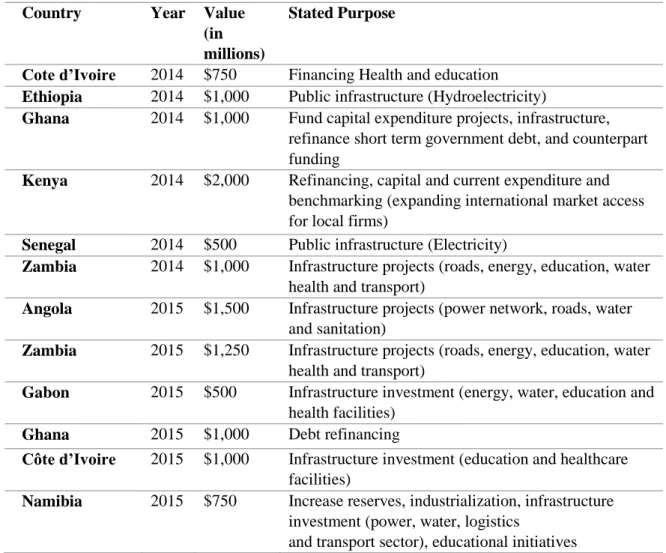
So far fifteen countries in SSA have issued sovereign bonds and details of the most recent issuances are listed in Table 1, while he appendix provides a list of all the issuances. The majority of the countries have used the bonds to finance infrastructure projects. Four countries have so far used the money raised by the bonds to restructure their debts namely: Cote d’Ivoire, Republic of Congo, Gabon and Seychelles. Others have used the Eurobonds to benchmark prices on the international markets for their corporates to borrow such as Nigeria and Kenya. Two countries borrowed to finance state corporations (Rwanda and Mozambique). Others do not disclose the intended use of the funds, e.g. Tanzania, where the bonds were only issued to selected buyers.
One of the attractions for issuers are the comparatively low international interest rates, making bond issues a cheaper source of finance compared to the sale of domestic securities. Another advantage is that bond issues prevent the crowding out effects on private investment that can result from the increase in interest rates from domestic borrowing. The highest yield on offer ever issued in the region was by Cote d’Ivoire (17.35%) offered in 2010 for debt restructuring under the Heavily Indebted Poor Countries (HIPC) initiative. The second highest yield at issue that has been offered for a bond in the region was 10.75% by Ghana in 2015.
Table 1: Recent Bond Issuances in Sub-Saharan Africa and Their Intended Use
Country Year Value (in millions)
Stated Purpose
Cote d’Ivoire 2014 $750 Financing Health and education
Ethiopia 2014 $1,000 Public infrastructure (Hydroelectricity)
Ghana 2014 $1,000 Fund capital expenditure projects, infrastructure, refinance short term government debt, and counterpart funding
Kenya 2014 $2,000 Refinancing, capital and current expenditure and benchmarking (expanding international market access for local firms)
Senegal 2014 $500 Public infrastructure (Electricity)
Zambia 2014 $1,000 Infrastructure projects (roads, energy, education, water health and transport)
Angola 2015 $1,500 Infrastructure projects (power network, roads, water and sanitation)
Zambia 2015 $1,250 Infrastructure projects (roads, energy, education, water health and transport)
Gabon 2015 $500 Infrastructure investment (energy, water, education and health facilities)
Ghana 2015 $1,000 Debt refinancing
Côte d’Ivoire 2015 $1,000 Infrastructure investment (education and healthcare facilities)
Namibia 2015 $750 Increase reserves, industrialization, infrastructure investment (power, water, logistics
and transport sector), educational initiatives Compiled by the authors.
Figure 1 shows the amount of funds raised through bonds issuances between 2007 and 2015. Côte d’Ivoire issued the highest total value of bonds ($4,050 million), followed by Ethiopia ($4,000 million) and Ghana ($3,500 million). Ghana had four issuances: $750million (2007), $750 million (2013), $1,000 million (2014) and $1,000 (2015). Zambia issued bonds three times and Gabon twice. The biggest issues per year took place in Côte d’Ivoire ($2,300 million in 2010) and Kenya ($2,000 million in 2014). Ten out of the fifteen countries which have been active in the bond markets are among those whose debts were forgiven. The top three issuers Côte d’Ivoire, Ethiopia and Ghana are countries which participated in the HIPC and Multilateral Debt Relief Initiative (MDRI) programs and between them share 40.8 per cent of the bonds so far.
Another way of looking at the importance of bond issuances is to investigate the structure of public debt. Figure 2 shows the share of bonds, loans from commercial banks, other private creditors as well as from bilateral and multilateral agencies for a selected number of SSA countries in 2015. Ghana, Zambia and Cote d’Ivoire now hold over 20 per cent of the public debt in bonds. In Gabon this share is just under 50 per cent. Despite large issuances, Ghana’s bonds only make up 17 per cent of total public debt. Given that the bond issuances are all relatively recent, the structure of debt has changed very quickly.
Figure 1: Sovereign Bond issuances in SSA Excluding South Africa (2007-2015)
Source: International Debt Statistics, World Bank http://datatopics.worldbank.org/debt/, authors’ calculations 30 454 1000 750 168 2300 500 500 500 1500 1000 750 1000 400 600 850 1000 1500 750 500 2000 1000 1000 1500 750 750 1500 1250 500 1000 1000 S E Y C H E L L E S R W A N D A C O N G O T A N Z A N I A M O Z A M B I Q U E S E N E G A L N A M I B I A N I G E R I A K E N Y A A N G O L A Z A M B I A G A B O N G H A N A E T H I O P I A C O T E D ' I V O I R E 2007 2010 2011 2012 2013 2014 2015
Figure 2:
Selected SSA countries: Shares of public and publicly guaranteed debt by creditor, 2014
Source: International Debt Statistics, World Bank http://datatopics.worldbank.org/debt/, authors’ calculations
4 Bond Issues as a Source of Risk in Sub-Saharan Africa
While bond issuances provide development opportunities that reflect the sovereign choices of African countries, there are a number of risks that countries face.3 These new opportunities may not result in accelerated development and in the following discussion we want to highlight some of the potential problems. Our discussion focuses on four potential problems: (1) exchange rate risks, (2) macroeconomic risks, (3) project overruns and delays and (4) the diversion of funds.
4.1 Exchange Rate Risk
Since the debt is issued in dollars, African countries face an exchange rate risk. The inflow of capital should lead to an appreciation of their exchange rate which would help the countries to repay their debt, but in many SSA countries this has not been the case.
3 For a discussion of the risks of sovereign bond issues in SSA see Tyson (2015b) and more generally
0 0,2 0,4 0,6 0,8 1 Gabon Zambia Côte d’Ivoire Ghana Rwanda Kenya Senegal Mozambique Nigeria Angola Ethiopia
Partly this was caused by the reaction of high income countries to the global financial crisis of 2008/09. As their countries fell into a recession, the governments responded through expansionary monetary policy. In order to stimulate private sector spending and return inflation to target, central banks created new money by buying financial assets. This process of quantitative easing lead to a devaluation of the dollar. However, due to the more recent tighter monetary policy in the US African currencies have depreciated.
Exchange rate regimes vary across SSA countries and it is the exchange rate regime that determines the kind of problems countries face. Some pursue a fixed exchange rate regime or a crawling peg but most countries have a floating exchange rate regime. In these cases the governments intervene in the exchange market to avoid large and sudden changes in their exchange rates. Where an exchange rate is pegged as the case for Ethiopia, it tends to be overvalued. This makes exports uncompetitive and thus limits foreign exchange earnings. Foreign exchange reserves get run down in an attempt to sterilize the economy as happened in Ethiopia 2011. On the other hand, it safeguards against inflationary pressures and the sudden changes in exchange rate swings that characterizes policy actions of the world currency actors. This stability makes bond markets attractive to investors. For the managed floaters like Ghana, Nigeria and Zambia changes in the exchange rate can create considerable uncertainties. When the currency depreciates the costs of the loan repayments rise. Consider the recent exchange rate developments in Zambia. The Zambian kwacha has been on a steady devaluation which has escalated in between 2014 and 2016. In 2015 alone the kwacha devalued by 45% against the dollar falling 12.56 units to the dollar in day according to Bloomberg4.
Other examples include Ghana and Nigeria (for further discussion see Te Velde, 2014). Ghana issued a bond in 2013 and the coupon rate was 7.8755, interest rates on domestic debt was around 20%, making bonds an attractive finance option. However, the Ghanaian Cedi devalued by 14.3% per annum, and this made the rate of debt servicing comparable to domestic debt (7.9%+14.3%=22.2%). The Nigerian Naira has also depreciated by 20%
price falls generates difficulties for the repayment for oil exporters like Nigeria and Ghana.
This is reflected in the judgement credit rating agencies make. After Ghana received assistance under the HIPC and the MDRI the credit rating was B1 but was downgraded by Moody’s to B2 in 27 Jun 2014 citing “Ghana’s deteriorating fiscal strength, as reflected in the rising debt level and worsening debt affordability amid persistently high fiscal deficits and the increase in Ghana’s vulnerability to shocks given its large debt-refinancing needs and wide external imbalances.” 5
Given the recent commodity price decreases and exchange rate depreciation there are now concerns that the amount of debt is not sustainable for some countries. According to ADB (2016) Ghana’s total debt has risen from 71% of GDP to 78% in 2015. Where the ratio of external debt was 56% of GDP, internal debt 77.9%, nominal interest rates were 23.5% and the real GDP growth at 3.0%. Subsequently, the yield for its 2023 Eurobond has risen to 15%, which reflects the market judgment of a possible future debt restructuring or default.
4.2 Macroeconomic Risk
There are also other macroeconomic risks, large scale capital inflows can lead to volatility, credit booms and inflation. This requires careful macroeconomic management and sterilization. The existing literature shows that capital flows including those related to bonds may result in financial instability in developing countries both in sub-Saharan Africa, Asia and Latin America (Boyce and Ndikumana, 2011; Kindleberger and Aliber, 2005; Reinhart and Rogoff, 2009). The markets favour countries with sound macroeconomic fundamentals while depreciating currencies, growing fiscal deficits, and spikes in interest rates are indicators that either dissuade investors from taking up bond offers or make them decide to invest in them only when the yields are high. An example is Ghana, having to offer higher yield of 10.75% (in 2015) in the context of a
5
depreciating exchange rate and a rising debt ratio, while countries with better macroeconomic fundamentals like South Africa offered at 4.875% in 2016.
As already mentioned above, the fluctuations and trends in the international commodity markets also pose a considerable risk to the ability of repaying the debt. Commodity prices for the primary exports in this region continue falling and are projected to continue in the short term. If this happens, oil and metal exporters like Nigeria, Angola, Gabon, Côte d’Ivoire, Ghana and Zambia will be affected. The effects of the commodity price falls are bound to be serious because they affect the foreign exchange earnings and thereby the amortizations of the interest and loans. A continued fall may affect the response of the lenders who may foresee repayment problems and this may also reflect on the yield on offer increasing the cost of borrowing. This appears to the be case with the recent bond issuance by Ghana paying a high yield 10.75% for their 2015 offer on the $1billion bond compared to the 8.5% yield offer for the 2007 and the 2013 bonds. Zambia too has recorded a similar rise in borrowing costs whose debut $750 million bond offer in 2012 was at 5.625 yield on offer while the $1,250 million 2015 one had 8.75% yield on offer. This problem is likely to increase because the World Bank (World Bank, 2016) projects a continued fall in prices of metals and oil.
4.3 Project Overruns and Delays
Project overruns and delays can seriously impede economic development. Higher project costs and late delivery decrease the returns from the projects and make repayment more difficult. According to Price Waterhouse Coopers PWC (2014) project delays and cost overruns were significant problems in SSA. In their firm survey done by interviewing stakeholders in development projects, nearly half of respondents reported delays of more than six months and more than a third said that projects went 10–50% over budget. The survey covered water transport, energy, mining, social infrastructure, telecoms and real estate. Their report cited problems pertaining to corruption, government, regulatory and legal related stoppages among others as major problems as
opposes the plans for the railway to pass through a national park. Furthermore, the cost of moving the workforce along the railway line during construction has been underestimated. This list of factors make this project unlikely to be completed by the planned time of 2017 with huge cost implications for the government and the contractors.
4.4 Diversion of Funds
In addition to macro- and microeconomic risks there is also the more general risk that funds will be diverted from their intended use. One example is the bond issue in Mozambique in 2012 which raised $850million with the aim to invest in a tuna fishing fleet. However, reports emerged that the funds had been used to build speedboats for the navy, raising serious concerns about the sustainability of the debt6. In April 2016 the Mozambican government took advice on restructuring its debt, mainly to regain the IMF’s support. Consequently, the “tuna bond” maturing in 2023 collapsed from 81.2 cents on the dollar to a low of 66.6 cents, which is equal to an annual yield of over 20 per cent. It is feared that Mozambique will become the first African country to renege on its debts since the Seychelles in 20087. Other defaults include the brief 2011 default by Côte d’Ivoire in the wake of post-election turmoil, and a mysterious default by the Republic of Congo in early 2016 which was swiftly reversed upon the full payment of interest on a $478 million bond which had fallen overdue leading to Standard & Poor briefly downgrading it to default8.
5 Outlook
In this paper we have described the bond issues by fifteen SSA countries and discussed the associated risks. There is a small cross-country literature that has examined the effects of capital flows to low income countries. However, the focus in this literature is not on bonds issued by African countries because these bond issuances are too recent.
6 The Wall Street Journal
http://www.wsj.com/articles/tuna-and-gunships-how-850-million-in-bondswent-bad-in-mozambique-1459675803, accessed 13 December 2016
7
See https://www.ft.com/content/d738052c-9ad2-11e6-b8c6-568a43813464.
8
Typically this literature considers a number of different private capital flows to countries in Asia, Latin America and Africa. The findings of this literature tend to be mixed and the results can be summarized as follows: Foreign direct investment (FDI) are long term capital flows and their impact on growth tends to be positive. On the other hand the effect of short-term capital on growth tends to be either negative or insignificant. The type of short term flows that are investigated are portfolio investment (bond and equity flows).9 Thus, based on our reading of this literature it is unlikely that African countries will experience higher growth as a result of their bond issuances.
Our discussion focused on a number of risks associated with sovereign bonds. They include risks that have international or domestic causes. International risks include changes in the currency and commodity price markets that small SSA countries cannot influence. However, the ability to absorb exogenous shocks and make their economies more resilient is shaped by domestic policy choices. Other risks are entirely due to domestic causes. Corruption, poor project planning and oversight and the misuse of funds for purposes other than the intended use jeopardize the debt repayment.
To our mind a general judgement of the region’s debt sustainability is not helpful10
, because the experience differs greatly across countries and over time. Take the example of the Seychelles, the first country to issue Eurobonds and to run into difficulties, the country has apparently turned around economic policies and the credit ratings have recently improved.11 Another example is Ethiopia. In December 2016 the Gibe III hydroelectric power generation project added 1,870mw to the national grid only two years after the bond issue. Given the previous shortage of power in the country this will generate considerable returns and thus provides a positive outlook on Ethiopia’s ability to pay back the loan when it matures. Contrast this to Mozambique where the funds
9 Choong, Lam, and Yusop (2010) find a positive relationship between private capital flows and
were not invested in a tuna fishing fleet but in unproductive speed boats for the navy. This raises serious concerns regarding the repayment of the loans when they mature.
In order to gain from these additional funds governments need to develop a clear plan on how the funds are going to be used and tackle legal, institutional and capacity bottlenecks before the funds arrive. It may be instructive to learn from other countries’ experiences. Take Botswana as an example where every government project is assessed using cost benefit analysis before it can go ahead. More generally, managing debt could be overseen by a specially set up independent debt management office, possibly using the debt management office in Nigeria as a template. Even though Nigerian public debt is comparatively low (12% of GDP) this office is tasked with the management of both local and international debt. Such an institution can advise the government on how much to borrow, how to invest and how the debt can be repaid sustainably. Donors could support such efforts by providing technical assistance.
To be able to take advantage of foreign capital our discussion above suggests that there is need to further develop the financial markets and support them with macro-prudential policies, otherwise the funds coming in will not translate into growth. Commodity exporters face additional risks from changes in commodity prices and have to take a number of measures to make their economies more resilient. To this end, they have to diversify their economies, raise more (tax) revenue, coordinate and prioritize their expenditures with a view to directing it to high return projects. All countries have to implement systems to manage and supervise the projects in order to avoid project overruns and corrupt diversion of funds. If countries are not able to improve their macro policies and the management of their projects, this will ultimately lead to unsustainable levels of debt. This will then result in debt restructuring with support from the IMF, other MDBs and bilateral donors. This has already happened in the cases of Angola, Ghana and Mozambique who turned to the IMF for help in 2015. This assistance was granted under the condition of a number of reforms and policy improvements. This is where the story comes full circle. Even though Eurobonds provide opportunities to pursue sovereign development choices, the markets’ demands on government behaviour are very similar to those demanded by the IMF and MDBs. Without sound
macroeconomic policies, strong institutions and anti-corruption measures none of the loans, whether concessional or non-concessional, will result in economic growth and development.
References
ADB (2016). “Debt Sustainability Implications of Hardened MDB Terms to African Countries”. In: ADF Policy Innovation Lab Working Paper Series, No 1.
Boyce, James and Leonce Ndikumana (2011).´ Africa’s odious debts: how foreign loans
and capital flight bled a continent. Zed Books.
Brambila-Macias, Jose and Isabella Massa (2010). “The Global Financial Crisis and Sub-´ Saharan Africa: The Effects of Slowing Private Capital Inflows on Growth”.
African Development Review 22(3), pp. 366–377.
Choong, Chee-Keong, Siew-Yong Lam, and Zulkornain Yusop (2010). “Private capital flows to low-income countries: The role of domestic financial sector”. In: Journal of
Business Economics and Management 11.4, pp. 598–612.
Fabozzi, Frank J and Steven V Mann (2012). The handbook of fixed income securities. McGraw Hill Professional.
Guscina, A., Pedras, M.G. and Presciuttini, G., 2014. First-Time International Bond
Issuance—New Opportunities and Emerging Risks (IMF WP 14/127). International
Monetary Fund, Washington D.C.
Hou, Z., Keane, J., Kennan, J., Massa, I. and Te Velde, D.W. (2014) ‘Shockwatch bulletin: Global monetary shocks: impacts and policy responses in sub-Saharan Africa’, ODI Working Paper, March. London: Overseas Development Institute http://bit.ly/1pFOL9Q
Kindleberger, Charles P and Robert Z Aliber (2005). “Speculative Manias” chapter 3 in: History of Financial Crises: Manias, panics and crashes. 5th ed. Palgrave McMillan: Basingstoke.
Mecagni, Mauro, Kriljenko, Jorge Ivan Canales, Gueye, Cheikh Anta,Mu, Yibin, Yabara, Masafumi and Sebastian Weber (2014). Issuing international sovereign bonds: Opportunities and challenges for Sub-Saharan Africa, IMF Africa Department.
Nalishebo, Shebo and Albert Halwampa (2015). “A Cautionary Tale of Zambia’s International Sovereign Bond Issuances”. Zambian Institute for Policy Analysis WP 22.
PWC, PricewaterhouseCoopers (2014). “Capital projects and infrastructure in East Africa, Southern Africa and West Africa”. https://www.pwc.co.za/en/assets/pdf/capital-projects-and-infrastructure.pdf
Reinhart, Carmen M and Kenneth Rogoff (2009). “This time is different”. In: Eight
Centuries of Financial Folly, Princeton University, Princeton and Oxford.
Tyson, Judith E. 2015b. Sub-Saharan Africa International Sovereign Bonds Part II: Risks for Issuers, Overseas Development Institute, January 2015.
Te Velde, Dirk Willem (2014). “Sovereign Bonds in Sub-Saharan Africa–Good for Growth or Ahead of Time?” In: Briefing Paper 87.
Data source
International Debt Statistics, World Bank http://datatopics.worldbank.org/debt/
Indicators and codes used:
• PPG, bilateral (DOD, US$) (DT.DOD.BLAT.CD) • PPG, bonds (DOD, US$) (DT.DOD.PBND.CD)
• PPG, commercial banks (DOD, US$) (DT.DOD.PCBK.CD) • PPG, multilateral (DOD, US$) (DT.DOD.MLAT.CD)
• PPG, other private creditors (DOD, US$) (DT.DOD.PROP.CD) • Gross National Income (current US$) (NY.GNP.MKTP.CD)
List of countries:
Angola, Republic of Congo, Côte d’Ivoire, Ethiopia, Gabon, Ghana, Kenya, Mozambique, Namibia, Nigeria, Rwanda, Senegal, Seychelles, Tanzania, Zambia
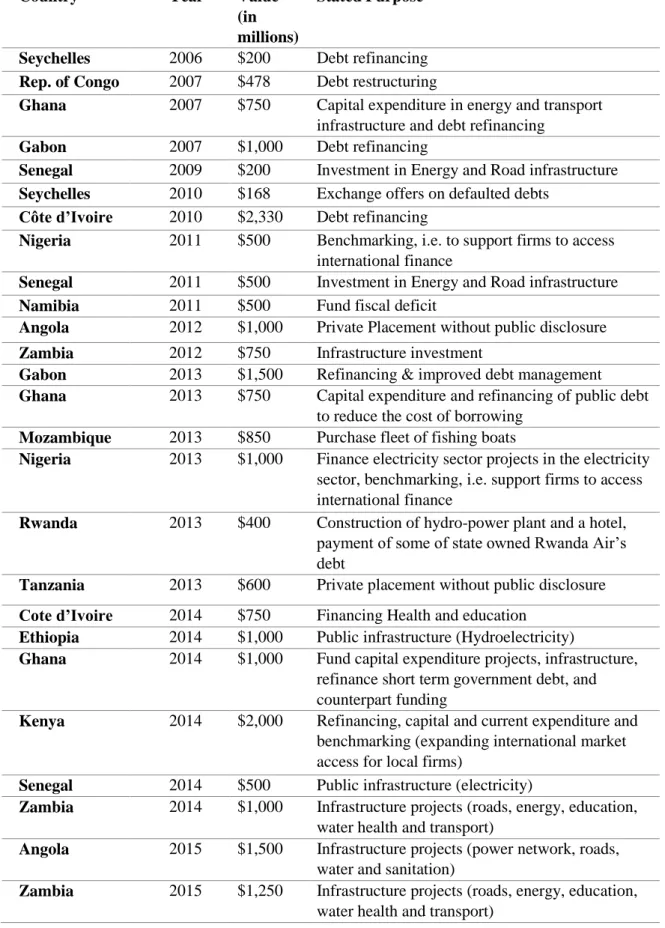
Table A1: Bond Issuances in Sub-Saharan Africa and Their Intended Use
Country Year Value (in millions)
Stated Purpose
Seychelles 2006 $200 Debt refinancing
Rep. of Congo 2007 $478 Debt restructuring
Ghana 2007 $750 Capital expenditure in energy and transport infrastructure and debt refinancing
Gabon 2007 $1,000 Debt refinancing
Senegal 2009 $200 Investment in Energy and Road infrastructure
Seychelles 2010 $168 Exchange offers on defaulted debts
Côte d’Ivoire 2010 $2,330 Debt refinancing
Nigeria 2011 $500 Benchmarking, i.e. to support firms to access international finance
Senegal 2011 $500 Investment in Energy and Road infrastructure
Namibia 2011 $500 Fund fiscal deficit
Angola 2012 $1,000 Private Placement without public disclosure
Zambia 2012 $750 Infrastructure investment
Gabon 2013 $1,500 Refinancing & improved debt management
Ghana 2013 $750 Capital expenditure and refinancing of public debt to reduce the cost of borrowing
Mozambique 2013 $850 Purchase fleet of fishing boats
Nigeria 2013 $1,000 Finance electricity sector projects in the electricity sector, benchmarking, i.e. support firms to access international finance
Rwanda 2013 $400 Construction of hydro-power plant and a hotel, payment of some of state owned Rwanda Air’s debt
Tanzania 2013 $600 Private placement without public disclosure
Cote d’Ivoire 2014 $750 Financing Health and education
Ethiopia 2014 $1,000 Public infrastructure (Hydroelectricity)
Ghana 2014 $1,000 Fund capital expenditure projects, infrastructure, refinance short term government debt, and counterpart funding
Kenya 2014 $2,000 Refinancing, capital and current expenditure and benchmarking (expanding international market access for local firms)
Senegal 2014 $500 Public infrastructure (electricity)
Zambia 2014 $1,000 Infrastructure projects (roads, energy, education, water health and transport)
Angola 2015 $1,500 Infrastructure projects (power network, roads, water and sanitation)
Zambia 2015 $1,250 Infrastructure projects (roads, energy, education, water health and transport)
Gabon 2015 $500 Infrastructure investment (energy, water, education and health facilities)
Ghana 2015 $1,000 Debt refinancing
Côte d’Ivoire 2015 $1,000 Infrastructure investment (education and healthcare facilities)
Namibia 2015 $750 Increase reserves, industrialization, infrastructure investment (power, water, logistics
Scientific Coordinator : Xavier Oudin ([email protected]) Project Manager : Delia Visan ([email protected])
Find more on www.nopoor.eu Visit us on Facebook, Twitter and LinkedIn