Advances in Environmental Biology
ISSN-1995-0756 EISSN-1998-1066 Journal home page: http://www.aensiweb.com/AEB/Copyright © 2016 by authors and Copyright, American-Eurasian Network for Scientific Information (AENSI Publication).
A survey of weed seed production in vegetable crops
of Setifian high plateau
Rafika Lebazda, Mohamed Fenni, Meriem Hani and Habiba Boukhebti
1Laboratory of Natural Resource Valorisation, Faculty of Nature Life Sciences, Ferhat Abbas University Setif-1, 19000 Setif, Algeria
Address For Correspondence:
Rafika Lebazda, Laboratory of Natural Resource Valorisation, Faculty of Nature Life Sciences, Ferhat Abbas University Setif-1, 19000 Setif, Algeria
This work is licensed under the Creative Commons Attribution International License (CC BY). http://creativecommons.org/licenses/by/4.0/
Received 23 August 2016; Accepted 1 November 2016; Published 20 November 2016
ABSTRACT
Weeds are one of the most significant limiting factors in agricultural production. Weeds compete strongly with crops for light, water and nutrients. This brings about severe interference with normal crop growth, causing high crop losses and reducing the quality of produce. Most annual weeds produce a prolific number of seeds each year. Production of abundant small seeds is a common adaptation that ensures a high probability of dispersal and re-infestation. With this background, the experiment was to counting the number of seeds produced by plant weed presented in legumes and garlic crops of Setifian high plateau. Seed production of 68 weed species (56 broadleaves, 12 annual grasses and one LiIiaceae) collected from 38 vegetable crops was investigated in the north east of Algeria (the Setifian high Plateau). Weed plants were harvested in may 2014 at maturity of legumes and garlic crops, and the number of seeds per plant was determined. four weeds produced more than 1500 seeds/plant and four produced between 1000 and 1500 seeds/plant, 17 weeds had between 500 and 1000 seeds/plant, 30 weeds had between 100 and 500 seeds/plant and 13 had less than 100 seeds/plant in at least one of the two vegetable crops. The eight high seed producing weeds (more than 1000 in at least one vegetable crop) were Sinapis arvensis, Sonchus asper, Papaver
hybridum, Bromus lanceolatus, Capsella-bursa-pastoris, Glaucium corniculatum, Papaver rhoeas, Bromus madritensis. Of the 30 species
that produced between 100 and 500 seeds / plant, seven species are Asteraceae, five Fabacea, five Apiaceae and three are poaceae. Nine species have produced almost the same number of seeds in both legumes than garlic crops are: Lathyrus ochrus, Vicia monantha,Vicia
sativa, Convolvulus arvensis, Melilotus indicus, Vicia hirsuta Sonchus oleraceous, Hordeum murinum, Chrysantemum segetum. Any
longterm strategy for weed management should focus on mininizing weed seed production.
KEYWORDS
:
Vegetable crops, legumes, pulses, seed production, weeds, Setifian high Plateau.INTRODUCTION
In Algeria, food legumes (pulses), are part of the agricultural landscape for millennia. These cultures are used in rotations with cereals because enrich the soil with nitrogen. Pulses are also cultivated because they are an important source of protein that can replace animal protein inaccessible to a large segment of the population [20]. In most areas, mainly for reasons of order economic and material, chemical weed control has become almost absent from the itinerary technique of the majority of farms [14]. The presence of a weed is both linked to an ecological environment (soil, climate) and agronomic practices [10], Le Bourgeois, 1993 in[9], and edaphic conditions (pH, texture) [11], [5] and number of seeds produced [6]. This number is highly variable between species and within a same species [11]. This production of seeds varies depending on the culture in which the weed grows [13]. Weed seeds are difficult to manage because they are (1) small, (2) abundant, and (3) produce a lot of seed [24].
Annual weeds depend on seed production as the sole means of propagation and survival. Production of abundant small seeds is a common adaptation that ensures a high probability of dispersal and re-infestation [26]. Due to high seed production potential combined with dormancy, seed longevity possesses higher advantage as
there is a chance of at least for some of them to germinate and grow into new plant. A single plant of an annual weed can produce enough seeds in one season to cover an area of one acre. One plant of Tripleurospermum
inodorum produces over a million seeds (1,000,000) [18]. Most weed species are prolific seed producers [7], in
some cases produce more than 1 million seeds/plant. Weed seeds can have numerous fates after they are dispersed into a field. While a few of these weed seeds will germinate, emerge, grow and produce more seeds [21], a large proportion of them were returned to the soil and increase in the seed bank[16], Indeed, with a seed potential of around 4,000 viable seeds per m2 and if we admit that the levees field typically represent between 5% and 10% of the number of buried seed, estimated infestations of a culture represent 200 to 400 weeds per m2 [1]Amaranthus powellii, Echinochloa crus-galli and Setaria faberi produce 30,000, 100,000 and 28,700 seeds per plant respectively, while Matricaria perforata produces 300,000 seeds per plant[2]. In this study, we will shed light on the weed seed production, the experiment was to counting the number of seeds produced by plant weed presented in legumes and garlic crops of Setifian high plateau. Knowledge of this number is essential firstly in understanding the dynamics of weed populations and also in selecting long weed control strategies term.
MATERIALS AND METHODS
A total of 38 vegetable crops have been prospected between 10 and 30 May 2014 at the same of maturity cultures. The numbers of legumes and garlic crops were respectively of 21 and 17. Five mature plants per weed species were randomly collected in a area of about 50 x 50 m in each surveyed crops. Each plant was placed in a paper bag .In the Laboratory of Natural Resource Valorisation, Faculty of Nature Life Sciences, Ferhat Abbas University Setif-1, the plants were subsequently sanded and the mature seed are cleaned manually and counted.
RESULTS AND DISCUSSION
Weeds cause considerable losses over the world as well as in the region of study where [8] evaluated these losses by rates vary between not controlled, where as weeds impact negatively on this latter. This competition becomes more intensive during the first stages of growth, in which weeds absorb nutritive elements faster than the cultivated plant [9]. The study of weeds in every respect is very important, moreover, the study of seeds plays big role in propagating weeds because each seed gives birth to a new plant [12].The presence of weed in culture has a direct impact on operating expenses of farmers, weeding can attain 30% of this latter, but also on the quality and quantity of harvested and sorted seed lots [4]. Seed production was determined for 68 weed species: one Liliaceae (Allium nigrum), 12 annual Poaceae (Aegilops geniculata Roth., Avena sterilis L., Bromus
lanceolatus Roth. B. madretensis L., B. sterilis L., B. rigidus Roth., B. rubens L., Hordeum murinum L., Lolium multiflrum Lamk., Lolium rigidum Gaud., Phalaris brachystachys Link. and Phalaris paradoxa L. ),and 56
broadleaves. Four weeds produced more than 1500 seeds/plant and four produced between 1000 and 1500 seeds/ptant, 17 weeds had between 500 and 1000 seeds/plant, 30 weeds had between 100 and 500 seeds/plant and 13 had less than 100 seeds/plant in at least one of the two vegetable crops. The eight high seed producing weeds (more than 1000 in at least one vegetable crop) were Sinapis arvensis, Sonchus asper, Papaver
hybridum, Bromus lanceolatus, Capsella-bursa-pastoris, Glaucium corniculatum, Papaver rhoeas, Bromus madritensis.
Species had less than 100 seeds / plant are considered by [27]as less prolific. Of the 30 species that produced between 100 and 500 seeds / plant, seven species are Asteraceae, five Fabacea, five Apiaceae and three are poaceae. Nine species have produced almost the same number of seeds in both legumes than garlic crops are: Lathyrus ochrus, Vicia monantha,Vicia sativa, Convolvulus arvensis, Melilotus indicus, Vicia hirsuta
Sonchus oleraceous, Hordeum murinum, Chrysantemum segetum (table 1).
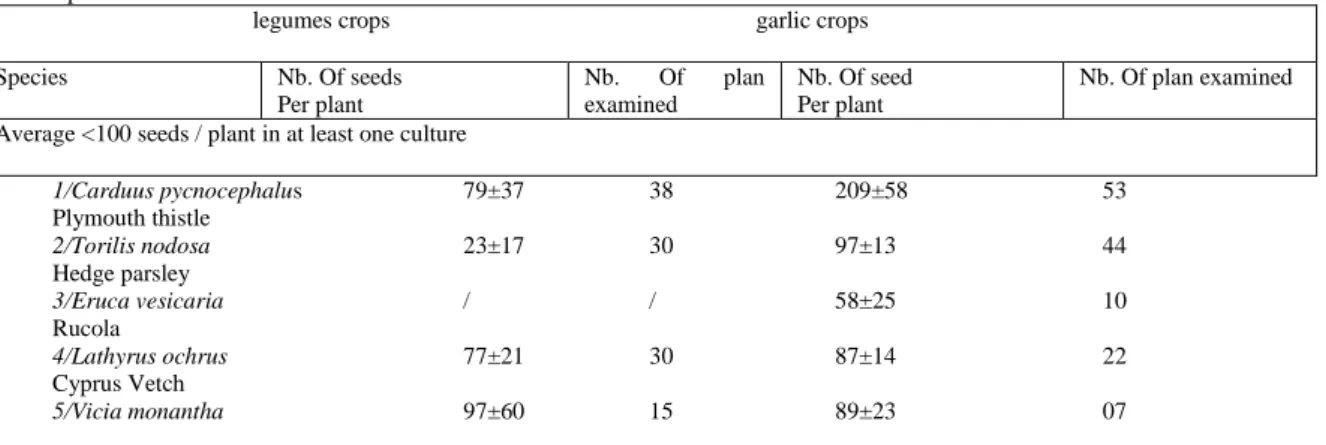
Table 1: Average number of seeds produced per plant (+SD) collected weeds in the mature legumes and garlic crops in Setifian high plateau.
legumes crops garlic crops
Species Nb. Of seeds Per plant Nb. Of plan examined Nb. Of seed Per plant Nb. Of plan examined Average <100 seeds / plant in at least one culture
53 209±58 38 79±37 1/Carduus pycnocephalus Plymouth thistle 44 97±13 30 23±17 2/Torilis nodosa Hedge parsley 10 58±25 / / 3/Eruca vesicaria Rucola 22 87±14 30 77±21 4/Lathyrus ochrus Cyprus Vetch 07 89±23 15 97±60 5/Vicia monantha
monantha vetch 14 90±11 18 82±09 6/Vicia sativa The vetch 18 78±27 / / 7/Plantago lagopus Round-headed plantain 38 68±20 40 110±11 8/Avena sterilis Sterile oat 07 103±39 05 66±12 9/Aegilops geniculata Ovate goatgrass 14 227±66 13 59±97 10/Medicago orbicularis Round-fruited medick 31 100±12 / /
11/Lolium rigidum Gaud.
Stiff ryegrass 27 52±32 30 60±1 12/Convolvulus arvensis Field bindweed 07 100±52 10 106±28
13/Centaurea diluta Ait. Algeriensis Cross. & Dur.
diluted knapweed
100 < Average < 500 seeds / plant in at least one culture 05 460±49 09 335±13 14/Anacyclus clavatus Anacyclus clavata 15 401±43 07 223±94 15/Calendula arvensis Field marigold / / 10 344±73 16/Cichorium intybus Chicory 14 225±73 14 106±68 17/Picris echioides Bristly oxtongue 10 127±12 07 298±35 18/Rhagadiolus stellatus Star Hawkbit 25 335±63 40 147±22 19/Coronilla scorpioides Annual Scorpion-vetch 33 70±36 48 136±62 20/Scorzonera laciniata Cutleaf vipergrass 29 367±40 25 210±39 21/Urospermum picroides
Prickly golden fleece
31 208±17 20 165±67 22/Bunium incrassatum great pignut 14 63±21 ??? 09 103±17 23/Bupleurum lancifolium Hornem Lanceleaf thorow-wax / / 08 147±20 24/Borago officinalis Starflower 23 52±11 41 148±85 25/Scandix-pecten-veneris Shepherd's needle 11 100±17 18 163±23 26/Torilis arvensis
Spreading hedge parsley
27 74±254
45 378±182
27/Turgenia latifolia
Turgénie broad leaves
7 237±73 / / 28/Anchusa azurea Garden anchusa 18 95±12 12 198±47 29/Vaccaria pyramidata Cow soapwort / / 10 150±45 30/Scorpiurus muricatus Prickly Caterpillar / / 10 337±140 31/Roemeria hybrida Hybrid Roemérie 31 100±12 / /
32/Lolium rigidum Gaud.
Stiff ryegrass 17 211±72 14 156±35 33/Phalaris paradoxal Hood canarygrass 14 215±57 14 374±211 34/Adonis annua Pheasant's-eye 09 105±17 21 25±38 35/Ranunculus arvensis Buttercup corn 30 85±11 26 187±22 36/Galium tricorne
Rough corn bedstraw
11 217±35 06 430±111 37/Astragalus hamosus European milkvetch 16 28±37 50 163±21 38/Raphanus raphanistrum L. Wild radish 09 210±59 11 147±38
39/Melilotus indicus (L.) All.
sweet clover 20 186±4 17 277±15 40/Malva parviflora L. Little mallow
11 160±58 08 110±37 41/Vicia hirsuta Hairy tare 17 110±36 23 225±18 42/Anagallis arvensis Poorman's barometer 40 2±18 47 127±61 43/Bromus rigidus Ripgut brome
500 < Average < 1000 seeds / plant in at least one culture 13 107±42 13 525±100 44/Carduus tenuiflorus Slender-flower thistle 17 522±108 // 45/Crepis vesicaria Hawk's-beard 12 958±118 08 680±64 46/Senecio vulgaris Common groundsel 30 745±111 42 886±210 47/Sonchus oleraceous
Smooth sow thistle
07 700±206 10 335±120 48/Ammi majus Bishop's flower 15 560±212 20 340±70 49/Conringia orientalis
Hare's ear mustard
/ / 10 562±57 50/Diplotaxis erucoides White wall-rocket 16 455±78 17 543±57 51/Medicago polymorpha Toothed medick 18 677±87 10 865±178 52/Sinapis alba White mustard 14 715±72 09 211±75 53/Allium nigrum Black garlic 10 639±229 13 885±111 54/Medicago hispida Black medick 40 610±98 30 527±110 55/Hordeum murinum Wall barley 22 465±153 27 618±250 56/Lolium multiflorum Ryegrass 11 560±173 09 237±90 57/Phalaris brachystachys Short-spike canarygrass 24 117±38 19 503±54
58/Melilotus sulcatus Desf.
Sweet-clover 07 876±158 13 610±200 59/Diplotaxis virgata Wall-rocket 10 478±30 10 530±60 60/Chrysantemum segetum L. Corn marigold
1000 < Average < 1500 seeds / plant in at least one culture 10
987±190 12
1275±347
61/Sonchus asper
Spiny sow thistle
09 737±170 07 1175±340 62/Sinapis arvensis Charlock mustard 10 978±128 16 1130±445 63/Papaver hybridum
The opium poppy
22 975±298 28 1120±230 64/Bromus lanceolatus Lanceolate bromegrass
Average> 1500 seeds / plant in at least one culture
/ / 07 1500±200 65/Capsella-bursa-pastoris Shepherd's-purse 08 2370±350 6 3750±420 66/Glaucium corniculatum Blackspot hornpoppy 11 2280±450 08 4100±530 67/Papaver rhoeas Corn poppy 30 1040±270 18 2170±340 68/Bromus madritensis Compact brome
The production of seeds varies depending on the culture in which the weed grows; 14 weeds produce more seeds in legumes than it produces in garlic crops are: Avena sterilis ,Scorzonera laciniata,
Scandix-pecten-veneris , Turgenia latifolia, Vaccaria pyramidata, Adonis annua , Galium tricorne, Astragalus hamosus, Raphanus raphanistrum L., Carduus tenuiflorus, Sonchus oleraceous, Sinapis alba, Melilotus sulcatus Desf. , Sinapis arvensis, Papaver rhoeas, Bromus madritensis. 9 weeds produce more seeds in garlic than it produces
in legumes crops: Carduus pycnocephalus, Aegilops geniculata, Medicago orbicularis, Calendula arvensis,
Coronilla scorpioides, Senecio vulgaris, Ammi majus, Conringia orientalis, Allium nigrum.
Weeds are adapted to the same soil and climatic conditions similar crops. Practices that promote cultures also favor weeds [13] Independently of the prospected culture, the average annual production of seven Poaceae
seeds was according to the order of: Aegilops geniculata Roth., Avena sterilis L., Bromus lanceolatus Roth.
Bromus madretensis L., Bromus sterilis L., Bromus rigidus Roth., Bromus rubens L., Hordeum murinum L., Lolium multiflrum Lamk., Lolium rigidum Gaud., Phalaris brachystachys Link. and Phalaris paradoxa L. ). In
the culture of légumeneuses, weeds of the family Fabaceae Produced: Lathyrus ochrus 77±21,Vicia monantha 97±60, Vicia sativa 82±09, Medicago orbicularis 59±97, Coronilla scorpioides 147±22, Scorpiurus
muricatus150±45 Astragalus hamosus 430±111, Melilotus indicus147±38, Vicia hirsuta110±37 Medicago polymorpha 543±57, Medicago hispida 885±111 and Melilotus sulcatus Desf 503±54.
Seed production was absent or low in certain weeds like Carduus pycnocephalus (Asteraceae) , Anacyclus
clavatus (Asteraceae) Diplotaxis virgata (Brassicaceae) Anchuza azurea (Boraginaceae). The seeds have been
totally or partially destroyed by insects. These insects have not been identified, but damage has shown that insects contribute in some instances to reduce the number of seeds produced per plant. The adverse effect of insects on seed production of weeds was noted by [25, 21, 15, and 4].
Weed seeds can have numerous fates after they are dispersed into a field; a proportion of seed is shed at harvest of a crop or falls from agricultural vehicles [19]. Some of them mixed with the crop and cause a change of taste [9]. Some seeds germinate, emerge, grow, and produce more seeds; a large proportion of them will germinate and die, others decay in the soil, or fall to predation by insects, birds or mammals [22]. Weed seed production can be reduced by management factors, but according to Hartzler 1996 in[23] even a few weed escapes can produce enough seed to partly replenish weed seedbanks. A several of seeds remains in a dormant state in the soil and germinates during conditions that would otherwise be ideal for germination [7].
Conclusion:
In the present research, we performed a survey of weed seed production in vegetable crops of Setifian high plateau. Seed production was determined for 68 weed species: one Liliaceae (Allium nigrum), 12 annual Poaceae (Aegilops geniculata Roth., Avena sterilis L., Bromus lanceolatus Roth. B. madretensis L., B. sterilis L., B. rigidus Roth., B. rubens L., Hordeum murinum L., Lolium multiflrum Lamk., Lolium rigidum Gaud.,
Phalaris brachystachys Link. and Phalaris paradoxa L. ),and 56 broadleaves. Among the 68 weeds: four weeds
produced more than 1500 seeds/plant and four produced between 1000 and 1500 seeds/ptantare:
Capsella-bursa-pastoris , Glaucium corniculatum, Papaver rhoeas and Bromus madritensis . 17 weeds had between 500
and 1000 seeds/plant, 30 weeds had between 100 and 500 seeds/plant and 13 had less than 100 seeds/plant in at least one of the two vegetable crops. The eight high seed producing weeds (more than 1000 in at least one vegetable crop) were Sinapis arvensis, Sonchus asper, Papaver hybridum, Bromus lanceolatus,
Capsella-bursa-pastoris, Glaucium corniculatum, Papaver rhoeas, Bromus madritensis. Nine species have produced
almost the same number of seeds in both legumes than garlic crops are: Lathyrus ochrus, Vicia monantha,Vicia
sativa, Convolvulus arvensis, Melilotus indicus, Vicia hirsuta Sonchus oleraceous, Hordeum murinum, Chrysantemum segetum. The production of seeds varies depending on the culture in which the weed grows; 14
weeds produce more seeds in legumes than it produces in garlic crops and 9 weeds produce more seeds in garlic than it produces in legumes crops.
Seed production by weeds was consistent even with competition from weeds or other crops. Producing a largest amount of seeds gives a greater chance of weeds for the dispersal and re-infection. For seed companies, soiling of a lot by weed seeds results in additional sorting steps, which are responsible for additional costs and loss of good seed. In addition, the sorting of seed lots may be ineffective for certain weeds and therefore does not always get the purity levels required.
In seed production, a good weed management is needed to limit their harmfulness on several levels: competition field versus culture, decreased quality and economic value of yield, increased seed bank in the soil, sorting difficulties.... According to these results, management of weeds in crops should be firstly preventive: technical routes that would avoid the contamination of the plots should be adopted. On grassy plots already weeding strategy should give priority to the species that has a largest production capacity and focus on the technical procedures that prevent the production of new seeds.
REFERENCES
[1] Barralis, G., R. Chadoeuf,1987. Potentiel semencier des terres arables. Weed Research, 27(6): 417-424. [2] Blackshaw, K.N., R.E. Harker,1997. Scentless chamomile (Matricaria perforata) growth, development and
seed production. Weed Scecesi., 45(5): 701-705.
[3] Bounechada, M., M. Fenni, 2012. Les alticinae (Coleoptera,Chrysomelidae) de la region de Setif: Un moyen de lutte biologique contre les mauvaises herbes des cultures, Agriculture, 3: 37-41.
[4] Casals, M.-L., J. Hacquet, F. Deneufbourg, B. Chauvel, G. Citron, 2014. Integrated weed management in Integrated weed management in alfalfa seed production in West of Franceseed production in West of France, Innovations Agronomiques, 35: 19-26.
[5] Colbach, N., A. Gardarin, S. Granger, J.P. Guillemin, N. Munier, 2008. La modélisation au service de l'évaluation et de la conception des systèmes de culture intégrés, Innovations Agronomiques, 31(2): 61-73.
[6] Debaeke, Ph., 1988. Dynamique de quelques dicotylédones adventices en culture de céréales, I. Relations flore levée, stock semencier, Weed Research, 28: 251-257.
[7] DiTomaso, J.M., G.B. Kyser, 2013. Weed Control in Natural Areas in the Western United States. Weed Research and Information Center(WRIC), University of California. pp: 544.
[8] Fenni, M., 2005. Election to the tillage tool and the date of plowing, Dep. Agronomy, in: International Congress on Agricultural Mechanization. pp: 123-127.
[9] Fenni, M., 2003. Study of weeds of winter cereals Constantine high plains, ecology, dynamics, phenology and biology of brome, Doc. Thesis, Biol. Inst., Setif, pp: 165.
[10] Fried, G., B. Chauvel and X. Reboud, 2008. Évolution de la flore adventice des champs cultivés au cours des dernières décennies : vers la sélection de groupes d'espèces répondant aux systèmes de culture. Innovations Agronomiques, 3: 15-26.
[11] Gardarin, A., C. Dürr, N. Colbach 2011. Prediction of germination rates of weed species: Relationships between germination speed parameters and species traits. Ecological Modelling. 222: 626-636.
[12] Hani, M., M. Fenni and S. Bouharati, 2011. Fuzzy Inference System for Identification of Cereals Weeds Seeds. Journal of Environmental Science and Engineering, 5: 1337-1342.
[13] Hannachi, A., 2010. Etude des mauvaises herbes des cultures de la région de Batna : Systématique, Biologie et Ecologie. Mémoire de magister. Université Ferhat Abbas-Sétif, p: 85.
[14] Houara, F., 1997. Mise en évidence de la nuisibilité de quelques adventices (dicotylédones) dans une culture de céréale (orge: Hordeum vulgareL) dans la région de Mostaghanem, pp: 13-27.
[15] Ipou Ipou, J., L.M.D. Adou, A. Touré, P. Marnotte, 2011. Aspects de la dynamique d’enherbement des parcelles par Euphorbia heterophyllaL.(Euphorbiaceae): production de graine et évolution du stock de semences, Journal of Applied Biosciences, 46: 3144-3152.
[16] Leguizamón, E.S. and A. roberts h, 1982. Seed production by an arable weed community. Weed Research, 22: 35-39.
[17] Loudyi, M.C., M. Godron, D. El Khyari, 1995. Influence of environmental variables on the distribution of weeds in crops of Sais (central Morocco), Weed Research, 35: 225-240.
[18] Lutman, P.J.W., 2002. Estimation of seed production by Stellaria media, Sinapis arvensin,
Tripleurospermum inodorum in arable crops Weed Research, 42: 359-369.
[19] Lutman, P.J.W., G.W. Cussans, K.J. Wright, B.J. Wilson, G.M. Wright and H.M. Lawson, 2002. The persistence of seeds of 16 weed species over six years in two arable fields. Weed Research, 42: 231-241. [20] Melakhessou, Z., 2007. Etude de la nuisibilité directe des adventices sur la cultures du pois chiche d’hiver
(Cicer aritinum L.) variété ILC 3279 .cas de Sinapis arvensis L .Mémoire de magister .Université El hadj Lakhdar de Batna, pp: 72.
[21] Menalled, F.D., 2008. Weed Seedbank Dynamics & Integrated Management of Agricultural Weeds. Agriculture and Natural Resources (Weeds), 200-708SA
[22] Menalled, F.D., 2013. Manage the Weed Seed Bank—Minimize "Deposits"and Maximize "Withdrawals". Available at: extension.org http://www.extension.org/pages/18527/manage-the-weed-seedbankminimize-deposits-andmaximize-withdrawals#. VkG6 Xl53C1t.
[23] Rahman, A., T.K. James, J.M. Mellsop and N. Grbavac, 2001. Weed seedbank dynamics in maize under different herbicide regimes, New Zealand Plant Protection, 54: 168-173.
[24] Robert, L., Zimdahl, 2007. Fundamentals of Weed Science, Academic Press is an imprint of Elsevier, p: 80-83.
[25] Sheppard, A.W., J.M. Cullen, J.P. Aeschlimann, 1994. Predispersal seed predation on Carduus nutans (Asteraceae) in southern Europe, Acta Oecologica , 5: 529-541.
[26] Shivakumar, K.V., R. Devendra, M.V. Muniswamappa, G.K. Halesh and M. Mahadevamurthy, 2014. Weed seed production potentials in Bidens pilosa L. in plantation crops in hill zone of Karnataka, International Journal of Research in Applied, Natural and Social Sciences (IJRANSS), 2: 11-18.
[27] Tanji, A., 1999. Production de semences par les adventices dans les champs de blé et d'orge en milieu semi-aride marocain. Al Awamia, 99: 09-18.