O
pen
A
rchive
T
OULOUSE
A
rchive
O
uverte (
OATAO
)
OATAO is an open access repository that collects the work of Toulouse researchers and
makes it freely available over the web where possible.
This is an author-deposited version published in :
http://oatao.univ-toulouse.fr/
Eprints ID : 15097
To cite this version :
Bourneuf, Séda and Jacob, Matthieu and
Albasi, Claire and Sochard, Sabine and Richard, Romain and
Manero, Marie-Hélène Load variations buffering by
adsorption/desorption experiments and modelling: innovative
application to aqueous effluents. (2015) In: 10th European Congress
of Chemical Engineering (ECCE10), 27 September 2015 - 1
October 2015 (Nice, France).
Any correspondence concerning this service should be sent to the repository
administrator:
[email protected]
Load variations buffering by adsorption/desorption experiments
and modelling: innovative application to aqueous effluents
S. BOURNEUFa,b,c, M. JACOBc, C. ALBASIb, S. SOCHARDd, R. RICHARDa,b, M.H. MANEROa,b
aUniversité de Toulouse; INPT, UPS ; Laboratoire de Génie Chimique ; 4, Allée Emile Monso; 31030 Toulouse, France, bCNRS ; Laboratoire de Génie Chimique ; 31030 Toulouse, France
cTOTAL, PERL - Pôle d'Etudes et de Recherche de Lacq, BP 47 - RN 117; 64170 Lacq, France
dUniversité Pau et Pays de l'Adour; Laboratoire de Thermique Energétique & Procédés; ENSGTI; Rue Jules Ferry; BP 7511 -
64075 Pau Cedex, France.
Industrial activities generate a large variety of contaminated effluents which require an appropriate treatment before being released into the environment. Due to the unsteady-state nature of industrial processes, variations of effluents charge with time (flow and/or concentrations) are very often encountered. Generally, they negatively impact running forthcoming treatments, with risks of leading to non-respect of discharge norms [1]. In order to avoid this, buffering of wastewater treatment is generally achieved by equalization basins. Although they assure the regulation of effluent fluctuations, their setting-up exhibits major disadvantages (occupation, odor, cost…) [2]. In this context, an alternative solution could be to set up a column of adsorbent, prior to treatment as a buffer/equalizer unit. This buffering strategy, first proposed by Ottengraf (1986) [3], is based on the reversible feature of adsorption.
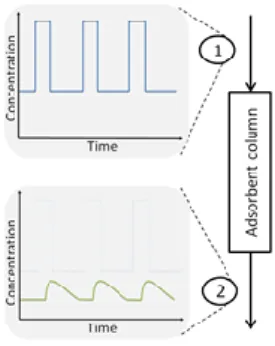
During periods of high loading, contaminants would accumulate into the adsorbent. When the inlet charge would return to a usual load, contaminants would progressively be released out of the adsorbent column. Thanks to this process, a buffering of dynamic load variations could be achieved and contamination loading would be distributed more consistently over time (Fig. 1). This strategy has been tested in previous studies focusing on gaseous effluent treatment [4] but data on wastewater lines are scarce and very few researches have been reported on desorption of a fixed-bed column in water phase.
Fig. 1 Theoretical buffering strategy using an adsorbent column to prevent from load variations
The objective of this study was to conduct experiments and perform numerical modelling to assess the feasibility of granular activated carbon (GAC) column to buffer load variations of contaminants in an industrial context of petroleum wastewater treatment.
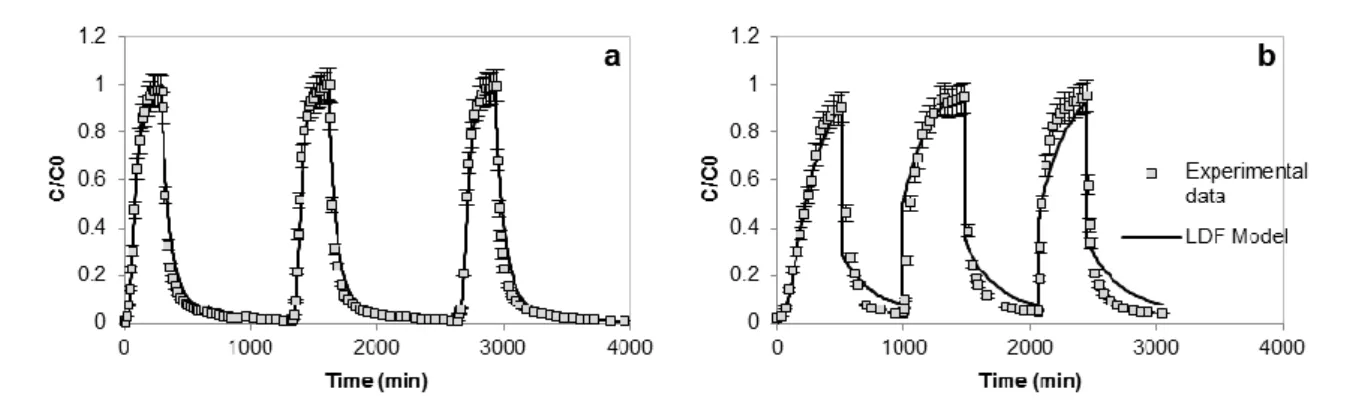
Cycles of adsorption, and more especially desorption, of methyldiethanolamine (MDEA) and 2,4-dimethylphenol (2,4-DMP) have been carried out on GAC. Dynamically variations of contaminants concentrations were run at several conditions of duration (peaks)... GAC fixed-bed exhibited a stable adsorption/desorption capacity after undergoing two conditioning cycles. The study of pollution peaks revealed that attenuation is largely dependent on the targeted pollutant: 2.4 ± 0.5 % and 6.0± 1.2 % attenuation/cm of bed for MDEA and 2,4-DMP respectively. Mass balances calculated from both injected and recovered pollutant during peaks were respected.
Fig. 2 Experimental values and modelled cycles of adsorption and desorption for (a) MDEA (21 ± 1°C) and (b) 2,4-DMP (22
± 1°C) on a fixed-bed of activated carbon
Finally, the Linear Driving Force (LDF) model and isotherms models were coupled to fit experimental data for both adsorption breakthrough and desorption curves (Fig. 2). The model was used to predict adsorption and desorption behaviors of following cycles. Good agreement with experimental values was obtained.
References
[1] A.H. Wani, R.M.R. Branion, A.K. Lau, Effects of periods of starvation and fluctuating hydrogen sulfide concentration on biofilter dynamics and performance, J. Hazard. Mater. 60 (1998) 287–303.
[2] G. Tchobanoglous, F.L. Burton, H.D. Stensel, Wastewater Engineering: Treatment and Reuse, 4th edition, McGraw-Hill Science/Engineering/Math, Boston, 2002.
[3] S.P.P. Ottengraf, Exhaust gas purification, Rehm, H.J. and Reed, G., VCH Verlagsgesellschaf, Weinheim, Germany, 1986.
[4] W.M. Moe, C. Li, A design methodology for activated carbon load equalization systems applied to biofilters treating intermittent toluene loading, Chem. Eng. J. 113 (2005) 175–185.