HAL Id: hal-02547668
https://hal.archives-ouvertes.fr/hal-02547668
Submitted on 20 Apr 2020HAL is a multi-disciplinary open access archive for the deposit and dissemination of sci-entific research documents, whether they are pub-lished or not. The documents may come from teaching and research institutions in France or abroad, or from public or private research centers.
L’archive ouverte pluridisciplinaire HAL, est destinée au dépôt et à la diffusion de documents scientifiques de niveau recherche, publiés ou non, émanant des établissements d’enseignement et de recherche français ou étrangers, des laboratoires publics ou privés.
From Formal Specification to Optimized Implementation
of Distributed Systems.: A Multi-Formalism Approach
Alioune Diagne, Fabrice Kordon
To cite this version:
Alioune Diagne, Fabrice Kordon. From Formal Specification to Optimized Implementation of Dis-tributed Systems.: A Multi-Formalism Approach. [Research Report] lip6.1997.039, LIP6. 1997. �hal-02547668�
From Formal Specification to Optimized
Implementation of Distributed Systems :
A Multi-Formalisms Approach
Alioune Diagne & Fabrice Kordon, Laboratoire d’Informatique de Paris 6
Université P.&M. Curie
4 place Jussieu, 75252 Paris Cedex 05, France
E-mail: [email protected], [email protected]
Abstract
This paper proposes a methodology to build safe distributed systems that considers both conceptual and operational description aspects. At the conceptual level, we focus on the safety and liveness properties expected from the system. Such properties are stated and then verified. At the operational level, we focus on properties addressing the optimization of the generated code. Traceability between the two levels is managed in a satisfactory semi-automatic way. It preserves the properties proved at the first level and dis-cards information that are not relevant for code generation. The paper presents the general methodology and proposes an application to a simple example.
Keywords
Formal Specification, Petri Nets, Validation, Verification, Design Traceability, Prototyping, Distributed Systems.
1.
Introduction
The complexity of distributed systems is a problem when designers want to evaluate their safety and liveness. Systematic tests of the application cannot be considered as verification because of the potentially huge number of states due to the parallelism. Such systems are made of cooparating components that should interact while managing local resources. Interaction must not corrupt the integrity of involved components and has to be safe (i.e. free of faults like deadlocks or starvation). So expected properties must be known and verified during the specification of the solution. Then, they have to be preserved all over the system life-cycle.
A solution should be the promotion of verification of a system at the early design phases (modeling). For the reason that disables systematic testing, simulation of a model cannot be considered safe in off.
Thus, formal description techniques represent a solution. While a designer describes his system, he/she states the expected properties and then verifies them. Formalisms such as Petri nets have been systematically improved and Colored Petri nets [Jensen 92] are now widely used in research for modeling distributed systems. Their use in a potentially industrial context has also began (like in the PARSE Software engineering environment for the production of Distributed systems [Jelly 96]).
However, the main drawback of Petri nets is their poor structuring facilities. They are thus difficult to use for large scale systems. Recent studies have led to two main research areas:
• extension of Petri nets in order to add some hierarchical or structuring capabilities [Buchholz 94],
• association of Petri nets with another formalism that brings its structuration capa-bilities [Lakos 95a].
Object Oriented (OO) techniques facilitate the decomposition of complex systems into interworking components. For that reason, such a paradigm could be a solution for the structuration of a Petri net specification.
Design Automation for Embeded Systems : Special Issue «Rapid Prototyping»
aspects. It merges OO techniques and formal description of a system by means of Petri nets. This enables the construction and analysis of large distributed systems without ha-ving to deal with too much complexity at the design level. Real-time systems are not spe-cifically addressed by our method because the Petri nets class we use do not handle time. The paper is organized as follows. We describe our methodology in Section 2. Then, Section 3 presents the involved formalisms that are compared to depict out the similari-ties and differences. The Section 4 deals with the different transformations that enable to link the formalisms and manage traceability all over the methodology. Analysis per-formed in the formal description is also presented. An example is detailed in Section 5 to illustrate the shift from the conceptual level to the operational level before a conclu-sion.
2.
The Methodology
Building distributed systems enforces a couple of needs :
1) formal specification techniques allowing verification against quality criteria. The quality expected from the system should be stated and verified. In this work, we are mainly interested in safety and liveness properties [Valmari 94]. Safety proper-ties state what should always or never happen in the system. Liveness properties state what is a correct behavior for the system. Violation of safety properties leads to
hazar-dous components while violation of liveness properties leads to deadlocking; 2) optimized implementation allowing traceability of the confidence level attained
in a specification. Code generation is a valuable way to deduce implementation from specification without any drift. Optimization techniques make the code effi-cient and can be used as long as we maintain the traceability of the quality.
To complete these needs, the use of Formal Description Techniques (such as Petri nets,
algebraic specification, etc.) is of interest. They enable the computation of properties (structural, behavioral), without having to consider the entire state space of the system and also support model checking. However, due to the underlying mathematical theory, the description of the system is more complex. On an other hand, it is easier to handle system specification using high-level description techniques (for example Object
orien-ted based modeling). Our approach tries to mix both type of description and to maintain traceability between them. Its goal is clearly to take benefits from Petri nets without ha-ving to manipulate them.
Moreover, the two discrete phases of the design procedure have been identified : Con-ception and implementation. When a designer builds a system, he/she first deals with its architecture. He/she then has to take care of conceptual aspects like the functions the
system has to provide or the interoperability of its software/hardware components. Once the conceptual description has reached a satisfactory maturity, the designer may then think about operational or implementationrelated details.
Code generation is more efficient if it states from the operational description. It can lead to an executable prototype; this is then quite different from an animation/simulation ap-proach. On the contrary, the conceptual description can only be animated for debug purposes.
These two separate aspects of the design deal with different types of information and it should be valuable to express them by means of separate representation. However, the second one is deduced from the first one and a simple procedure should be provided. Both steps should also consider the properties of the system. Properties may be derived:
• from the requirements, like «the system has only one terminal state»;
• from conception assumptions, like «this service must be run first to operate a sub-system»;
• from operational hypothesis, like «this variable can be duplicated in order to increase efficiency».
Verification or computation of such properties cannot be done without having a formal description of the system. Petri nets are suitable for such a role but they are not suitable
From Formal Specification to Optimized Implementation of Distributed Systems : A Multi-Formalisms Approach. to handle large specifications. Moreover their capabilities allow one to describe both con-ceptual and operational specifications. It is then easy to mix up both features in the same model.
Figure 1 : Formalisms and Operations in our Methodology.
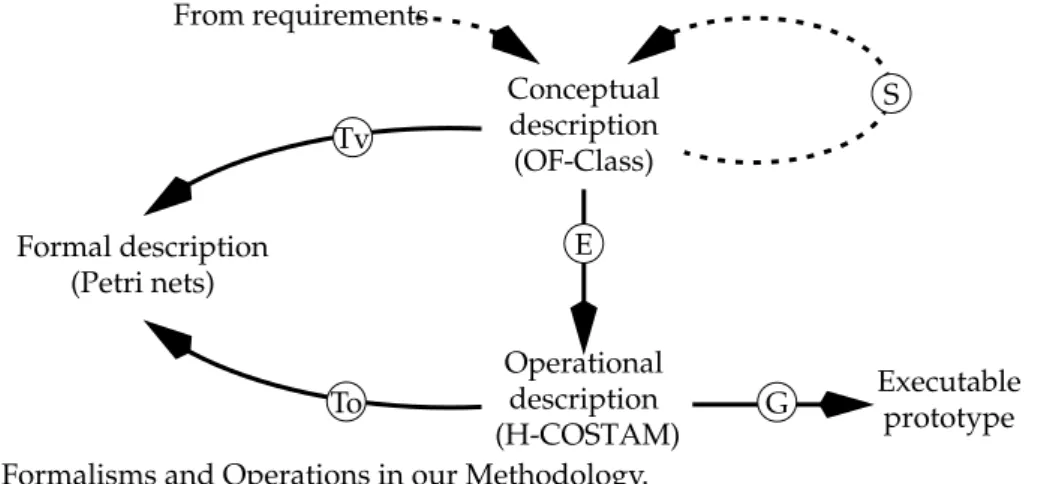
This is why the methodology we propose relies on three formalisms (Figure 1):
• Well Formed Petri nets [Chiola 91] fit all the formal needs. It is a potential target
used to verify or compute properties of the system model;
• OF-Class (Object Formalism Class) [Diagne 96] provides a conceptual description
of the system. It provides information about the association of components, the way they behave and how they should be used. It may be animated and transfor-med into a formal description;
• H-COSTAM (Hierarchical COmmunicating STAte Machine Model) [Kordon 95] allows the designer to deal with operational aspects of his system. Such a
descrip-tion may be derived from the conceptual descripdescrip-tion by addidescrip-tion of informadescrip-tion. It can also be transformed into the formal description and enables code genera-tion.
Three operations between these representations are characterized:
• Two transformations from respectively OF-Class into Petri nets (Tv in Figure 1)
and H-COSTAM into Petri nets (To in Figure 1) enable the link with the formal representation. These transformations are different while they do preserve dis-crete properties. The result is a Petri net that express either functional relations (to get conceptual properties of the system) or an operational description (to extract implementation characteristics that should lead to the optimization of the proto-type). Transformation Tv aims to provide information about the safety and live-ness of the system while transformation To focuses on the computation of characteristics for optimization purpose;
• Elicitation of the system is the transformation of a conceptual description into an
operational one (E in Figure 1). This step should not be automatic like the two other ones. It should be performed once when the system attains a satisfactory level of confidenceregard of properties. It can be considered as a list of questions that gradually clarify all the points of the implementation.
• Code generation is performed from the operational description (G in Figure 1). It
may compute and use operational properties to optimize code generation. In the context of distributed systems, this operation must produce both a compilable program and a location proposal. This location proposal is computed for a given hardware architecture description [El Kaïm 94].
3.
The Formalisms
Our purpose is to provide a method that is dedicated to design distributed systems. The systems we want to model and implement communicate by means of messages exchan-ged between the application components (potentially located on discrete hosts).
Conceptual description (OF-Class) Operational description (H-COSTAM) E Executable prototype Formal description (Petri nets) Tv To From requirements S G
Design Automation for Embeded Systems : Special Issue «Rapid Prototyping»
As we mentioned before, our methodology involves three formalisms. This enables the use of the most appropriate formalism at each stage of the software life-cycle. This is of interest because a scrupulous correspondence between these formalisms is maintained. First, we present ongoing works that go in similar direction than ours. Then, we present the main characteristics of our formalisms and we detail OF-Class and H-COSTAM.
3.1. A view on some similar approaches
The idea to associate a formal method with higher level formalisms is being investiga-ted since the late 80’s. Some first studies, like [Di Giovanni 90] or [Paludetto 91] have proposed an association of Petri Nets with HOOD. HOOD brings the structuring capa-bility and Petri Nets its verification strength. Such methodologies mainly focus on the structuration of Petri nets to ensure the readability of large size specification. Some pro-totyping characteristics are enabled in [Paludetto 91] while it is possible to deduce some implementation directives from the specification.
Some later works, like [Bruno 94] and [Lakos 95b] propose a closer association between high level concepts like instanciation, encapsulation and even inheritance. These stu-dies basically focus on the executability of the specification. The model can be animated and executed. This point is important but the high-level concepts introduced may disa-ble major verification capabilities.
Among the couple of approaches depicted so far, the first one requires a system desi-gner to have a valuable knowledge on both the high level formalism and the formal description technique while the second one generally lacks in verification capabilities. So, a third approach has to be considered : Petri net encapsulation. The idea is to com-pletely hide the complexity of Petri nets and the underlying theory to system designers. This kind of solution is investigated in the PEP environment [Grahlmann 96] designed at Hildesheim University. A language : B(PN)2 (Basic Petri Net programming) [Fleinschhack 97], is used to model systems. It is an imperative language including pro-cedures in its last version. Petri nets are synthesized from this high level formalism in order to enable formal verification of the system. The environment also has enhanced simulation capabilities to execute the specification. Thus, it is a prototyping approach, more likely oriented to simulation and verification than to code generation.
In the same line, but more likely adapted to Software/Hardware systems, the SEA envi-ronment (System Engineering and Animation), designed at Paderborn University, also takes aim at providing a similar encapsulation [Heitbreder 97]. The input specification level is therefore a hierarchical graphical representation whose semantics is an exten-sion of the one of Petri Nets [Kleinjohann 96]. This high level language appears to be a good media for the elaboration of heterogeneous systems (Codesign). The kernel of the SEA environment is a Predicate/Transition net simulator that is in charge of the execu-tion and animaexecu-tion of the upper specificaexecu-tion.
Our approach also encapsulates the Petri net model (and its theory). However, by provi-ding two discrete description levels, our goal is to reasonably cover both the validation/ verification aspect and the production of an independent application : i.e. which may run out of the environment that produced it. Our formalisms have been designed espe-cially for distributed cooperative software systems.
3.2. Main Characteristics of the high level Formalisms
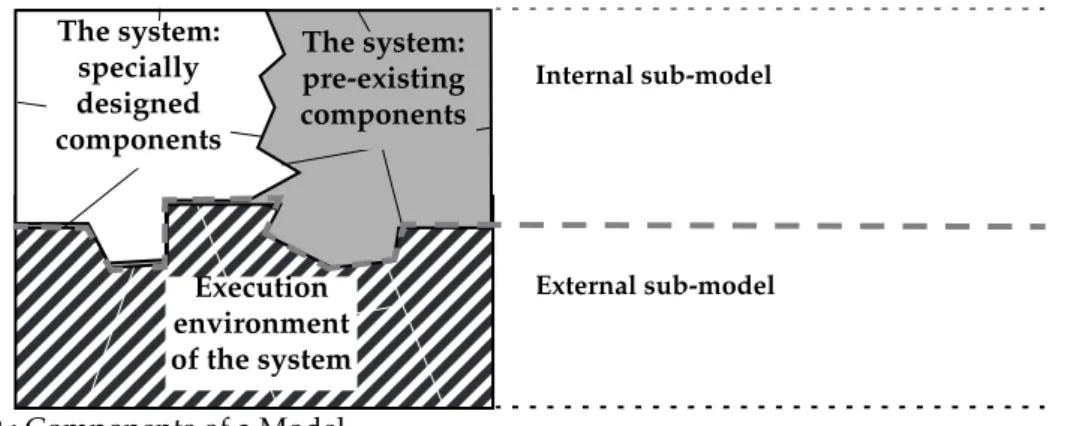
We consider that a model should be divided in two parts (Figure 2):• The sub-model of the execution environment: it corresponds to already existing
pieces of software for which no modification or evolution is possible. The opera-ting system of a computer is a good example of execution environment. This sub-model is tagged external;
• The sub-model of the system itself that is divided in two discrete parts: parts that
are reused from others applications (they already exist but can be modified if necessary) and specifically designed components. These submodels are tagged
From Formal Specification to Optimized Implementation of Distributed Systems : A Multi-Formalisms Approach.
Figure 2 : Components of a Model.
Both conceptual and operational descriptions are hierarchically divided. The macro-level describes the relation between components. The micro-level contains the
descrip-tion of an elementary component.
3.3. Scheduling the Formalisms
We first use OF-Class that fits the needs for validation and verification of a system obtai-ned by composition of components. OF-Class is appropriate to all the needs pointed out at the conceptual level but is quite poor for the operational aspects necessary to enable prototyping.
This is why the Elicitation step (Figure 1) was introduced. A progressive addition of operational information (how communication is performed, where strictly sequential parts of the system are, etc.) leads to the production of an equivalent H-COSTAM speci-fication that is more likely oriented towards code generation of distributed systems that communicate by means of messages.
At both levels (conceptual with OF-Class and operational with H-COSTAM), an auto-matic transformation to Well Formed Petri nets enables a semantics analysis of the sys-tem.
3.4. The Conceptual Formalism: OF-Class
OF-Class is a template dedicated to the conceptual description of distributed systems. In one hand, it takes into account the main features of such systems pointed out in the Reference Model of Open Distributed Processing (RM-ODP) [ODP 95]. It provides a constrained interfacing mechanism in order to achieve most formal interactions. In ano-ther hand, it is formally associated with a modular Colored Petri net (CPN) model [Dia-gne 96]. This modular CPN models the internal automaton describing the behavior of an OF-Class. It allows to undertake verification of both the structure and the dynamic of specifications.
OF-Class does not claim to support object-oriented activities such as analysis and con-ception. However, it is as generic as possible to enable transformation from any object-oriented model to undertake its verification.
3.4.1. Modeling a Distributed System with OF-Class
Specification and design of a distributed system consist of describing the components and their interactions. To evaluate the designed system, the expected properties of its components and their interaction must be expressed.
The execution environment of the system is considered to be a set of valid components accessed across bounded interfaces. The environment of a given component is made of both the execution environment (as defined in Section 3.2.) and the set of other compo-nents it is interacting with.
Properties that are expected from a distributed system are of two kinds:
• local properties on components concerning the managed resources or the offered services. These properties can be expressed as invariants - like in RM-ODP - on those resources or availability constraints on services. These properties are expressed on the micro-level description,
The system: specially designed components The system: pre-existing components Execution environment of the system External sub-model Internal sub-model
Design Automation for Embeded Systems : Special Issue «Rapid Prototyping»
• global properties on the whole system such as safety of the interactions between its components (like deadlock and starvation free system), meaningful reachable states (like home state and reversibility). They can be expressed as Linear tempo-ral Logic assertions on the system evolution.
The model of the system may include observation facilities. They are information sup-plied to run the system and evaluate its behavior. They model the information neces-sary to simulate execution of the system.
A component has private resources to manage (it is the only one to manipulate it) and an abstraction on its environment. It offers to the environment services that handle those resources. To achieve these goals, there are two description levels.
3.4.2. The Micro-Level in OF-Class
The micro-level describes the local resources of a component and their possible transfor-mations. A resource is an entity local to a component that can be accessed only through invocations of services offered by that component (see next section). Transformations of resources are done by means of elementary actions. These actions are grouped to build operations.
An operation is a set of actions performing a given semantical transformation on local
resources. An operation can issue requests to the environment. It has input and output parameters, local variables and a return code. Two special operations handle the dyna-mic creation (constructor) and deletion (destructor) of instances. The interactions by means of operations are subject to fault propagation. We alleviate this by a notion of
exceptions. Each component can state expectations on the results coming from its
envi-ronment and execute exceptional behavior when they are not met (think about testing the results of Unix system calls).
A component may also trigger some sets of actions when reaching some meaningful states or when some events occur while interworking with the environment. These mechanisms are slightly different from operations because they cannot be invoked from the environment. Such actions are called triggers which have no equivalence in
RM-ODP concepts. Triggers bear eventually preconditions, i.e. predicates on the resources values or input parameters specifying the state in which they are executed. Triggers are executed automatically and can undertake interactions with the environment.
3.4.3. The Macro-Level in OF-Class
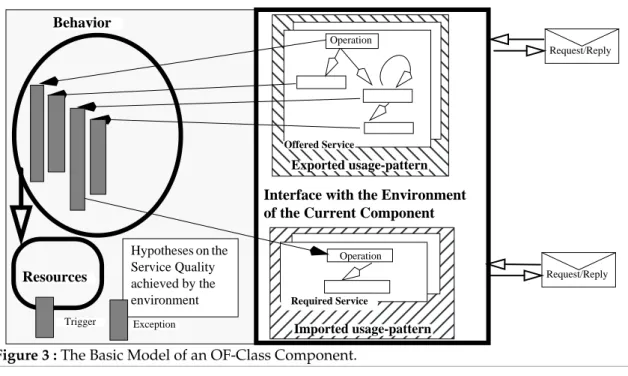
The macro-level describes the structural and dynamic links necessary for interaction of components in an OF-Class specification (Figure 3). Structural links allow to compose discrete components in order to build a more complex one. Dynamic links are:
• the offered services exported by a component. An offered service is a set of opera-tions with contractual constraints like precedence or access semantics (asynchro-nous, rendez-vous, etc.). It is a coherent partial view on the behavior provided to the environment for access to the local resources. The set of offered services is the exported usage pattern of the component;
• the required services from the environment show a given component the way it must use the services. They are provided by other components of the system. Components are functionally assembled by using exported and imported usage pattern. The semantics of interactions is therefore attached to these usage patterns. An exported service specifies a communication mechanism (synchronous, asynchronous or client driven). The available operation behaviors are the following :
• rendez-vous operations which model hard synchronization between components,
• synchronous RPC operations which model blocking requests,
• asynchronous RPC operations which model non-blocking requests.
A component may have expectations on the service quality provided by other compo-nents. These expectations must be used to check results provided when an interaction occurs. This is important because, associated with the notion of external components, this notion allows us to integrate already existing pieces of software in a formally vali-dation design approach.
From Formal Specification to Optimized Implementation of Distributed Systems : A Multi-Formalisms Approach.
Figure 3 : The Basic Model of an OF-Class Component.
3.5. The Operational Formalism: H-COSTAM
This section does not aim to give a full definition of H-COSTAM that can be found in [Kordon 95]. We just remind here the main principles of H-COSTAM and introduce new capabilities.
H-COSTAM is a formalism dedicated to the operational description of distributed sys-tems that communicate by means of messages. Its features are the following:
• Hierarchy: this is to support hierarchical descriptions and obtain a readable and
structured specification;
• A macro and a micro description: entities of the system and their relations are
defined at the macro-level. Elementary components that are sequential state machines are described at the micro-level.
• Strongly typed communication mechanisms: it is a communication model in the
sense of CSP. However, communicating entities are sequential state machines or subsystems instead of instructions;
• Integration of the system into its execution environment: this is very valuable to
enable implementation of applications that have interaction with an «outside world»;
• genericity management: genericity (in the sense of the Ada language) is
suppor-ted by H-COSTAM in order to facilitate the parameterization and the reuse of main components.
3.5.1. Structure of a H-COSTAM Specification
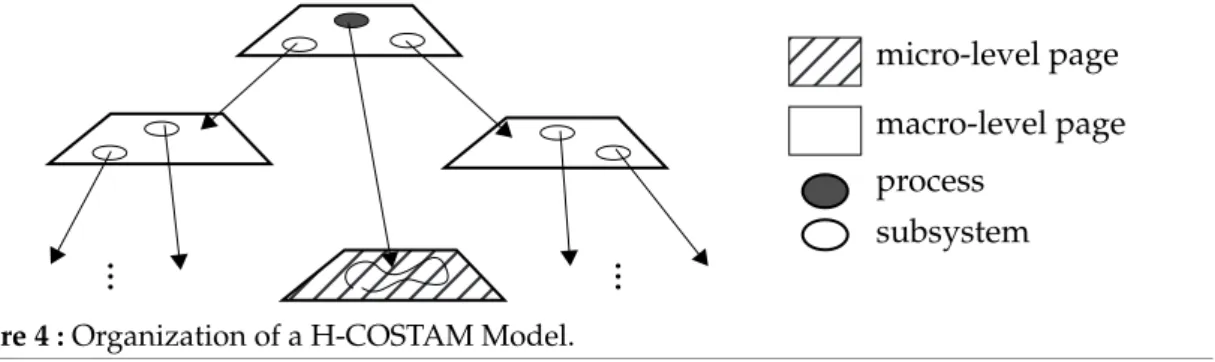
An H-COSTAM specification is composed of pages that belong either to the macro-level or the micro-level (Figure 4). A macro-level page describes the relation between entities that are either subsystems (and then a link to another macro-level page) or a process
(and then a link to a micro-level page presented in Section 3.5.2.).
According to the rules identified in Section 3.1, pages are tagged external if they
des-cribe the functional behavior of the execution environment or internal if they
corres-pond to the description of the system itself. If a macro page is tagged external, all its components should be tagged external as well.
External and internal components cannot be interpreted in the same way:
• external components represent pieces of software the system will be linked with. The only necessary information is an H-COSTAM version of the usage-manual introduced in OF-Class (Section 3.4.3.),
• internal components are parts of the system and must be described in detail. The
Behavior
Offered Service
Required Service
Interface with the Environment of the Current Component
Hypotheses on the Service Quality achieved by the environment Resources Operation Request/Reply Trigger Operation Exported usage-pattern Imported usage-pattern Request/Reply Exception
Design Automation for Embeded Systems : Special Issue «Rapid Prototyping»
code generator will use this information to produce programs that will be linked with the already existing code associated to the external components.
Figure 4 : Organization of a H-COSTAM Model.
3.5.2. The Micro-Level in H-COSTAM
The micro-level describes one elementary component called process. A process is
inter-faced with the outside world by means of media that define an interaction. Each
medium is strongly typed by both the type of data that go through and its behavior. There are four classes of media:
• multi rendez-vous corresponds to a synchronization between a set of N entities.
The synchronization may be guarded by a condition and allows the exchange of information between the participants;
• links correspond to asynchronous transmissions that have some specific behavior.
Three behaviors are defined: FIFO (the order of messages is preserved), LIFO (last message in is first out) or random (no order preserved). Links may be connected to an arbitrary number of entities. Each input entity may send a message that will be received by all the output entities;
• remote procedure call relates client entities to one server entity. On the client side,
it appears like an atomic operation (equivalent to a synchronization). On the ser-ver side, it behaves like two FIFO links, the first is an input that corresponds to the service invocation, the second is an output that corresponds to the service termi-nation;
• factories are entry points for special messages that enable dynamicity in the
crea-tion of sequential processes.
Media interfacing a process are connected to an internal automaton expressed using a State/Transition model whose semantic is close to the one of Well Formed Petri net. The internal automaton has to be a sequential state machine in the sense of [Hack 74]. The automaton describes the static behavior of the elementary process. Each of them may be instanciated statically (a set of instances are predefined at the initialization of the system) or dynamically (when a special event comes from a factory).
Each instance may have its own distinct context represented by a set of private varia-bles. A restricted set of operations is available on these variables: Identity, successor, predecessor, product and restriction. Such a limited set is necessary because we want to maintain an equivalence with Petri nets. However, if more complex and specialized capabilities are needed, they can be introduced by means of external components. Communication media may also be local to the entity. They are then potentially shared by all instances and cannot be accessed from outside.
3.5.3. The Macro-Level in H-COSTAM
The macro-level describes the relations between entities. So, involved objects in a macro-level page are either communication media (including factory) or entities.
A communication mediumis either the real one associated with entities interfaces or an interface with an upper level. Like in the micro-level, only interfaces media may be accessed out of the page. In the macro-level, factories (local or interface with the upper level) cannot be defined if they are not connected to the interface of at least one contai-ned unit.
...
...
micro-level page macro-level page process subsystemFrom Formal Specification to Optimized Implementation of Distributed Systems : A Multi-Formalisms Approach. An entity is either a process, defined in a micro-level page, or a subsystem, described in another macro-level page. In both case, media that define interfaces of contained entities are then associated with the real ones that perform the communications.
3.5.4. Typing and Genericity
Types are used to define the format of data that go through media (both macro and micro-levels) or to declare variables in a process context (micro-level). Types may be defined :
• in the page where they are used;
• imported from an entity that contains the page.
It is also possible to define a generic entity : some types are then provided by the «upper level» (the unit that contains the generic entity). Such types are only known after some reduced characteristics :
• their name (for referencing purpose);
• some possible values. This is useful to define guards. Such values are then consi-dered as constants that have to be defined when the entity is instanciated.
The instanciation in H-COSTAM works in a more restricted way than the one defined for languages like Ada. Values have to be associated with the generic parameters and each instanciated unit will be a distinct customized copy.
3.6. Summary of Conceptual versus Operational Formalisms
Both OF-Class and H-COSTAM models deal with the main concepts underlining the specification and design of distributed systems. Thus, they do have common basic fea-tures that are necessary to build interacting components.
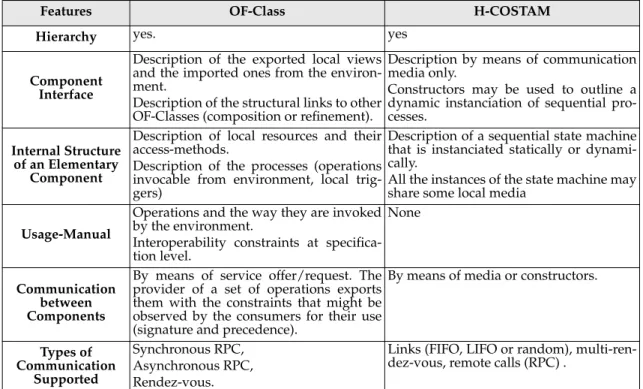
Table 1 summarizes these features. It may be considered as a basis for the definition of the shift from the conceptual description to the operational one.
As previously outlined, both OF-Class and H-COSTAM do have very similar capabili-ties. The main difference is found in the way interactions between entities are defined : H-COSTAM has no «usage-manual» capabilities that enable to verify if a component is properly used. On the contrary, communication media in H-COSTAM are closer to the implementation.
Features OF-Class H-COSTAM
Hierarchy yes. yes
Component Interface
Description of the exported local views and the imported ones from the environ-ment.
Description of the structural links to other OF-Classes (composition or refinement).
Description by means of communication media only.
Constructors may be used to outline a dynamic instanciation of sequential pro-cesses.
Internal Structure of an Elementary
Component
Description of local resources and their access-methods.
Description of the processes (operations invocable from environment, local trig-gers)
Description of a sequential state machine that is instanciated statically or dynami-cally.
All the instances of the state machine may share some local media
Usage-Manual
Operations and the way they are invoked by the environment.
Interoperability constraints at specifica-tion level.
None
Communication between Components
By means of service offer/request. The provider of a set of operations exports them with the constraints that might be observed by the consumers for their use (signature and precedence).
By means of media or constructors.
Types of Communication Supported Synchronous RPC, Asynchronous RPC, Rendez-vous.
Links (FIFO, LIFO or random), multi-ren-dez-vous, remote calls (RPC) .
Design Automation for Embeded Systems : Special Issue «Rapid Prototyping»
4.
Operations in the Methodology
This section is dedicated to the description of all operations in our methodology. The operations we consider are the following :
• transformations into Petri nets (for both conceptual and operational levels), • analysis and what information we get from it,
• elicitation of an OF-Class model into an H-COSTAM model, • code generation from an H-COSTAM model.
4.1. Principle of Transformations
Modular aspects of Petri nets had been largely discussed in the literature as a response to the lack of compositionality which is the major weakness raised on that formalism [Bachatène 93].
The formal model associated with both the conceptual and operational descriptions is a modular Colored Petri net that supports composition by means of channels [Souissi 90]. A channel is a set of two places per operation shared by its provider and the consumers. It allows to model synchronous and asynchronous communications. The rendez-vous semantic is achieved by a «serie transitions» fusion on duplicated channels [Berthelot 86].
The actions in the micro-level description are transformed into Petri net items using the method developed by Heiner [Heiner 92]. Dynamic links are transformed into chan-nels.
A Petri net pattern replaces specific configurations like dynamical links in OF-Class or communication media in H-COSTAM. This pattern corresponds to a piece of «runtime» that handles specific semantical aspects of the formalism. These patterns may be para-meterized.
For example, parameters of a FIFO link are its maximum capacity and the type of data that go through. During the transformation process, these information are used to build the appropriate instance of a pattern that models the behavior of a FIFO link.
4.2. Analysis and Exploitation of Results
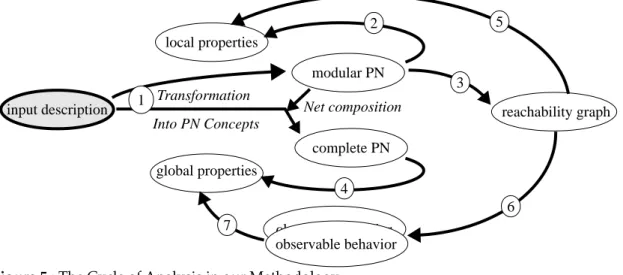
Figure 5 shows the analysis cycle in our methodology. Analysis may be performed either locally (on one component only) or globally. So, the obtained properties are used to provide information either about the behavior of one component or about the interac-tions between a set of components.
Analysis has discrete goals according to the input of the transformation :
• when it is performed from the conceptual level, it aims at the verification of some properties of the system;
• when it is performed from the operational level, it aims at the computation of some properties that could lead to an optimization of the generated prototype. At the conceptual level, a modular colored Petri net is obtained from each component. These modular nets can be analyzed using structural invariants techniques (arrow 2 in Figure 5) to check for flows for instance. Such flows can give information about the way the resources in the module evolve. The nets can be composed by place fusion to have a net modeling the whole system.
Modular nets can have their interface places overloaded with some abstraction of the environment and then a reachability graph is computed (arrow 3 in Figure 5). Such a
Partial and Global Reuse
Global reuse is supported through com-position.
Partial reuse is supported through refine-ment with enrichrefine-ment or simplification.
Global reuse achieved through composi-tion,
Generic entities (both sequential state machines or subsystems).
Features OF-Class H-COSTAM
From Formal Specification to Optimized Implementation of Distributed Systems : A Multi-Formalisms Approach. graph supports verification of properties related to safety and/or liveness (arrow 5 in Figure 5)
Figure 5 : The Cycle of Analysis in our Methodology.
At the operational level, we focus more on the production of complete Petri nets that are the composition of submodels that represent the behavior of H-COSTAM processes (communication by means of channel places). We are mainly interested in the communi-cation aspects of the system to be prototyped. So, the behavior of processes may be some times reduced to a single transition or a more complex submodel if the process has some characteristics (for example loops) that may interfere with communication aspects. On such models, the properties we exploit so far are boundness and structural P-invariants. We also study how the net can be partially unfolded according to discrete color domains in order to detect symmetries from which replicability of software com-ponents can be deduced.
For both levels, several transformations into Petri nets may be considered. It is useful, to ease the verification process, to discard information that brings «noise» (i.e. is not relevant). For example, the behavior of communication media is not required when checking their potential replicability.
4.2.1. Conceptual Level
At the conceptual level, analysis is performed for verification purpose. We focus on safety and reliability properties. The analysis is based on the following principles:
• for each OF-CPN, we compute a version of Chaos-Free Failures Divergence model (CFFD-model) [Valmari 94]. This model is a reduction of the reachability graph of a given component to observable actions (i.e. performing interactions with the environment), divergent actions (i.e. that make the components enter endless loop), deadlocking states and interactions faults (arrow 6 in Figure 5). For the purpose of the CFFD-model computation, we overload some interface places with the information that can be expected from the environment. Such a model gives a good point of view on the quality of an isolated component,
• Once all the CFFD-models computed, we can deduce from them smaller Petri nets which are equivalents to the components for the observable actions. Such nets can be composed with the whole net of a given component as an abstraction of its environment. We can then undertake further evaluation on such an extended component. The validation step is done either for components we found faulty on the previous step or for components on which we want state-oriented informa-tion. The CFDD models can be synchronized to check for deadlocks in the whole system coming from interactions between components (arrow 7 in Figure 5). The CFFD-model computation allows one to distinguish actions modifying the interfa-ces from actions that do not. We abstract those last actions considered as unobservable actions. Divergences need to be analyzed precisely because they can lead a component to commit interaction faults.
input description complete PN modular PN local properties global properties Transformation Into PN Concepts
Net composition reachability graph
obsevable behavior observable behavior 4 3 1 7 6 5 2
Design Automation for Embeded Systems : Special Issue «Rapid Prototyping»
The major benefit we get from this formal description is the two-level verification. The CFFD-models give a first level of verification which can be refined at the following step. Observation equivalence based on the CFFD-model allows to reduce the abstraction of the environment in order to consider further state-oriented information for a given component.
4.2.2. Operational Level
At the operational level, analysis is performed for code optimization. Local analysis mainly aims to compute bounds of local media or to agglomerate sequences of actions. Global analysis may provide information about the potential partitioning (parallelism, pipe-line, etc.) of the application, bounds of shared media, replicability of processes and communication media. An example of the involved techniques will be illustrated in Section 5.4.
Moreover, H-COSTAM can also takes benefits from operational research studies about distributed location of tasks [Norman 93]. Most of these studies consider a simple appli-cation structure composed of tasks that consume inputs to produce outputs (sort of batch-like jobs). Tasks are then related using precedence constraints. Communication are also considered in some algorithms.
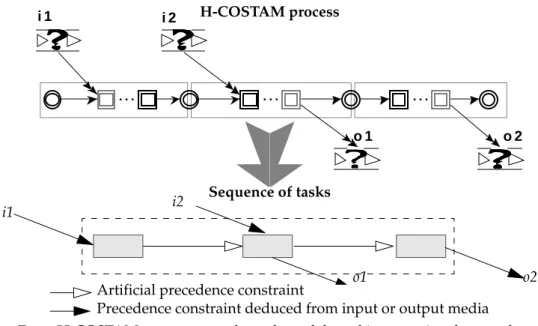
Figure 6 : From H-COSTAM sequences to the task model used in operational research.
The granularity of H-COSTAM is higher than the one of such application structures but it can be transformed into it. Figure 6 illustrates such a transformation. The upper H-COSTAM process automata is related to input and output communication media (here, random links). When a sequential process is split into a sequence of elementary tasks, precedence constraints are inserted where links existed with a media and between tasks issued from the same H-COSTAM process (artificial precedence constraints in the Figure).
To avoid the computation of absurd placement (e.g. an H-COSTAM process spread on discrete processors), a infinite valuation (or communication cost) is affected to artificial precedence if both involved tasks are not located in the same processor. Multi-rendez-vous (not represented in Figure 6) can be associated with a bilateral constraint.
The main problem still being investigated are loops. So far, we unfold them when the imported heuristic does not handle them if an estimation of the number of loops is pro-vided. Such an information can be deduced from previous executions of the generated prototype.
4.3. The Elicitation Operation
The shift from OF-Class to H-COSTAM is the Elicitation operation presented in Figure 1. It is a semi-formal transformation based on the correspondence established in Section 3.6.
Artificial precedence constraint
Precedence constraint deduced from input or output media
H-COSTAM process Sequence of tasks i1 i2 o1 o2 o 1 o 2 i 1 i 2
…
…
…
From Formal Specification to Optimized Implementation of Distributed Systems : A Multi-Formalisms Approach. Such an operation is too complex to be operated automatically : the system designer must provide some information that cannot be deduced from the conceptual descrip-tion. Different problems are raised in this operation :
• the equivalence between OF-Class and H-COSTAM must be established. This is not complex for the macro-level description because the communication mecha-nisms are very similar. However, at the micro-level description, the equivalence is quite difficult : triggers and some specific configuration have to be interpreted; • some information has to be discarded. This is the case for the «usage-manual» that
has no sense in H-COSTAM (while no verification is performed at this level).
In Table 4, we summarize some main rules for the elicitation. Some rules are fully auto-matic. Some others need some basic information from the designer. There are also some transformations that may only be guided : the designer is the only one who can handle the semantics of his system and then solve the problem.
However, even if this operation cannot be completely automated, a tool should be rele-vant to perform the elicitation. Such a tool could run like a sort of «question game». Each question is raised at the right time considering the configuration of the studied part of the model.
4.4. Code Generation from H-COSTAM
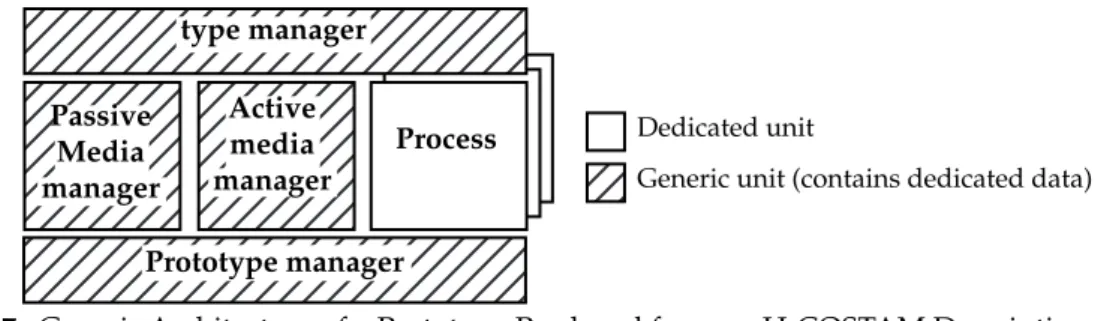
H-COSTAM is dedicated to code generation. So, its entities can be translated into code patterns. Thus, a generic architecture (Figure 7) can be formulated and used as a frame for code generation. This architecture contains dedicated modules that are especially generated from the H-COSTAM processes [Kordon 95].
Generic modules perform the main operations in H-COSTAM :
• The type manager handles all types manipulation and operations (it is a library); • Both passive and active media managers take care of communications. They
should be implemented as sets of concurrent processes;
• The prototype manager is in charge of initialization and termination of the proto-type execution. It also takes care of dynamic process creation (by means of facto-ries). If we consider a distributed implementation, there should be one prototype manager per target CPU.
a. A systematic question may be asked to the system designer about the type of expected communication («does mes-sages have to remain sorted or not»).
b. It is sometimes possible to help the system designer and to propose him a set of possible decompositions. c. There is a problem when the trigger is not strictly sequential (use of Unix-like forks). However, is it sometimes
pos-sible to propose a decomposition.
OF-Class Equivalent in H-COSTAM Auto.
macro-level
Rendez-vous operations Multi-rendez-vous (binary) yes
Synchronous RPC operations RPC yes
Asynchronous RPC operations Two links, one for the call, one for the return value and output parameters. If the queries order is preserved, links will be FIFO. Otherwise, links will be random. The type of information that go through these media is deduced from the parameters of the service.
yesa
Usage manual of a component Discarded (no verification is performed at the operatio-nal level while the specification is supposed to be con-ceptually safe)
yes
micro-level
Internal automaton If it is a sequential automaton, the unit is one process. Otherwise, it must be divided into a H-COSTAM sub-system (a subsub-system that contains several processes)
semib Triggers One process to handle internal events plus one process
per trigger. The process that manages internal events dynamically creates instances of triggers.
semic Services One H-COSTAM process. It is connected by means of a
factory to a process that manages creation and destruc-tion of OF-Class instances. More informadestruc-tion are provi-ded in the example.
yes
Variables, variable
manipula-tions and local resources Direct translation (semantics are very close) yes
Design Automation for Embeded Systems : Special Issue «Rapid Prototyping»
Figure 7 : Generic Architecture of a Prototype Produced from an H-COSTAM Description. H_COSTAM genericity can be supported using the corresponding feature in the target language (templates in C++, genericity in Ada, etc.). Otherwise, a rewriting mechanism similar to macros has to be implemented in the code generator.
Communication between components of the generated prototype can be done via a standard message passing interface like PVM [Geist 94] or MPI [MPI 94], according to the target execution architecture.
The code generator only considers specification components that correspond to the sys-tem (i.e. tagged internal in Section 3.2.). Specification components that represent the execution environment are «glued» with the prototype during code generation. It is not really a linking procedure while the implementation of such components must respect convention regarding interfaces (connection between H-COSTAM processes are done using communication media only). Procedures having no side effect (otherwise, the validation of the system has no more signification) may be connected to H-COSTAM actions.
Then, it is of interest to use the software architecture of the prototype (issued from the H-COSTAM structure) to compute an appropriate location of components over a set of networked processors. Information we can extract from either Petri net synthesized models or operational research heuristics (see Section 4.2.2.) is valuable to help the sys-tem designer to get a location of its software components. Such an application partitio-ning should provide «good» performances and reasonably exploit the target execution architecture.
5.
Application to an Example
We give here a small example to briefly illustrate capabilities of our representations (expression, analysis), the elicitation operation and code generation. The example models the collaboration between basic producers and consumers. It contains three components:
• one «init_master» which creates a set of couples <producer, consumer> that exchange messages,
• the «prod_class» which models production of messages, • the «cons_class» which models consumption of messages.
Each couple of producer and consumer first synchronizes after the end of initialization. Then, they communicate via a pipe (ordered communication medium). Each producer only communicates with one consumer. The two entities of a couple share the same identifier.
5.1. The OF-Class Model
The listing below contains the macro-level description of the example. The root defini-tion of the system is the one of the init_master unit. This unit corresponds to the entry
point of the system. It is responsible of the dynamic instanciation of two enclosed subsystems : prod_class and cons_class. It also defines some global types and
cons-tants that will be visible in the enclosed units.
The usage-manual of the offered service comm in prod_class specifies that operation init_ok should be performed once first. Then, it is possible to run operation get_msg
as many as necessary. The required service of cons_class is defined according to the
Process
Generic unit (contains dedicated data) Dedicated unit Passive Media manager Active media manager type manager Prototype manager
From Formal Specification to Optimized Implementation of Distributed Systems : A Multi-Formalisms Approach. one offered by prod_class. It is this way that the dynamical links between enclosed
components are specified. init_master isa ofclass macro-level
composition { prod_class , cons_class } /* definition of enclosed units */ types { /* exported types toward the enclosed units */
ident is range 1 .. 20; msg is range 1 .. 100;
/* propagation to enclosed units */ msg in cons_class is msg;
id in cons_class is ident; msg in prod_class is msg; id in prod_class is ident; }
constants { /* exported constants toward the enclosed units */ START in msg is 1 ,
STOP in msg is 100 }
/* required specifications of enclosed units */ prod_class isa ofclass
macro-level interface
exports { /* offered services to the environment */ comm { init_ok , get_msg* }
invocation-mode { synch,asynch,rendez-vous } }
cons_class isa ofclass macro-level
interface imports {
from prod_class comm {
init_ok invocation-mode rendez-vous get_msg invocation-mode synch
default-return continue }
}
The listing below contains the micro-level description of the prod_class unit. It defines
the actions performed in each operation referenced in the offered service of the macro-level. The local resource cur-msg of the unit is also specified. It is duplicated, i.e. each
created instance manages one copy of the resource (keyword duplicated).
Function oself represents the current identifier of an instanciation. This is an attribute
automatically associated with an OF-Class component. The type of this function is deduced from the constructor of prod_class.
prod_class isa ofclass
micro-level /* private part of the unit */ /* local resources */
resources { type msg m duplicated}
instances { 1,2,3,4,5,6,7,8,9,10,11,12,13,14,15,16,17,18,19} process
constructor {parameters id : prod in} begin
prod.m = start; return;
end destructor
precondition (oself.m = stop) begin
delete; return; end
init_ok {parameters id : cons in} precondition (cons = oself) begin return; end get_msg returns int begin m++= cur_msg;; return m; end
Design Automation for Embeded Systems : Special Issue «Rapid Prototyping»
5.2. Properties of the OF-Class model
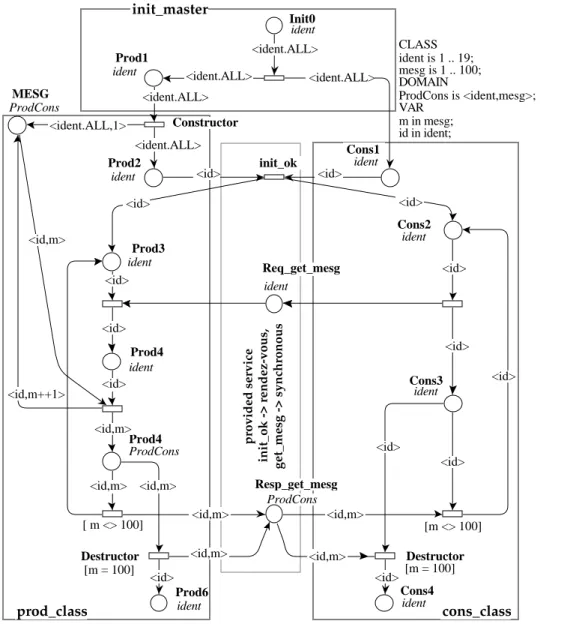
According to Table 4, we transform the OF-Class specification into a Petri net for each component and compose them to a global net (Figure 8). In this model <ident.ALL> represents the diffusion function (the action is performed for all the elements of the ident color class).
In this example, the components are simple, thus we do not need to compute CFFD-models. We directly use the reachability graph of the net modeling the global system.
Figure 8 : The Petri net derived from the OF-Class model.
OF-Class Petri net equivalent
macro-level
Offered service One medium per operation. If the access is a rendez-vous, the medium is a shared transition. Otherwise, it is a set of shared places (one for an asynchronous operation, two for a synchro-nous one).
required service Arcs connected to the corresponding offered service. enclosed components A sub-Petri net obtained after computation.
micro-level
resources, variables and
parame-ters A place whose color domain is deduced from the type of theitem. Actions One transition connected to the places modeling involved
resources variables and service parameters. Operations and triggers Set of places to sequence the actions.
Table 3: Some Translation Rules from OF-Class to Petri nets.
Destructor [m = 100] Destructor [m = 100] ident Cons4 Prod6 ident ProdCons Prod4 ident Prod4 ident Prod3 ident Cons2 init_ok [ m <> 100] [m <> 100] ident Cons3 ProdCons Resp_get_mesg ident Req_get_mesg ident Cons1 ident Prod2 Constructor ProdCons MESG ident Prod1 ident Init0 CLASS ident is 1 .. 19; mesg is 1 .. 100; DOMAIN ProdCons is <ident,mesg>; VAR m in mesg; id in ident; <ident.ALL> <ident.ALL> <ident.ALL> <ident.ALL,1> <ident.ALL> <id> <id,m> <id> <id> <id> <id> <id> <id> <id,m> <id> <id> <id,m++1> <id,m> <id,m> <id,m> <id> <id> <id,m> <id> <id> <id> <ident.ALL> <id,m> <id,m> init_master prod_class cons_class provided service init_ok -> rendez-vous, get_mesg -> synchronous
From Formal Specification to Optimized Implementation of Distributed Systems : A Multi-Formalisms Approach. We can show that the model presents a deadlocked state, the one in which the places DeadCons and DeadProd are marked by all processes. On the reachability graph, this state appears as a deadlock but we know it is a correct final state.
We have the following place invariant :
(<ident.x1>)Req_get_mesg+(<ident.x1>)Resp_get_mesg+(<ident.x1>)Cons2+
(<ident.x1>)Cons3+(<ident.x1>)Prod4+(<ident.x1>)Prod5+ (<ident.x1>)Cons4 = (<ident.x1>)Cons3+(<ident.x1>)Cons2+(<ident.x1>)Cons4.
where ident.x1 corresponds to a variable that takes any value in the color class ident. Its projection on the communication channel shows that the channel is safe (no message is neither lost nor generated). The other information we deduce from that place inva-riant is that the components (producer and consumer) are honest and reliable. Each request corresponds to one and only one reply and vice versa.
5.3. The Elicitation to Get the H-COSTAM Model
The elicitation should start at the macro-level. Each unit is investigated but we only pre-sent the procedure for prod_class.
We characterize interfaces and units at the macro-level. Each OF-Class corresponds to one H-COSTAM unit (later, we will determine if it is a process or a subsystem).
init_master is the root definition of the system. It is obviously a subsystem because it
contains two units : prod_class and cons_class. All units are tagged «internal»
because they do not describe the execution environment.
init_master does not export any services or entry point. It only requires the
construc-tors of the enclosed units.
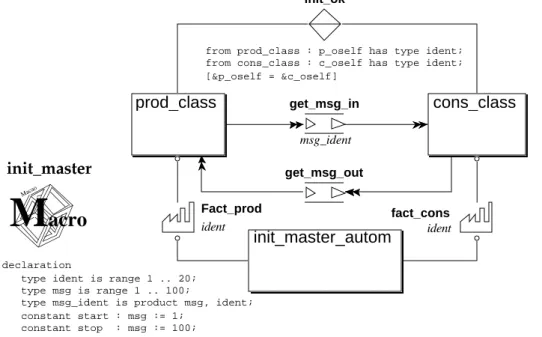
We first have to characterize the interfaces. Operations are used to deduce the corres-ponding set of media. Figure 9 describes the unit init_master. It contains three
H-COSTAM entities : two deduced from the OF-Class description plus one corresponding to the behavior of init_master (init_master_autom).
Figure 9 : The H-COSTAM Macro-Level Description of init_master. According to Table 2, page 13 :
• operation init_ok is transformed into a multi-rendez-vous. The precondition is
built from the one of the init_ok operation;
• operation get_msg is transformed into a couple of pipes. The designer considers
here that messages remain sorted and that there is a maximum capacity of 20 pen-ding queries. The first pipe is typed accorpen-ding to the parameters of the operation. The second only signals that the service is completed;
• two factories are related to init_master_autom because its micro-description
prod_class cons_class
init_master_autom declaration
type ident is range 1 .. 20; type msg is range 1 .. 100;
type msg_ident is product msg, ident; constant start : msg := 1;
constant stop : msg := 100;
init_master
init_ok
from prod_class : p_oself has type ident; from cons_class : c_oself has type ident; [&p_oself = &c_oself] Fact_prod ident fact_cons ident get_msg_in msg_ident get_msg_out Macao
M
acro
Design Automation for Embeded Systems : Special Issue «Rapid Prototyping»
(not presented here) is connected to OF-Class constructors of prod_class and cons_class.
Types are directly deduced from the original definition in OF-Class. Instanciations are declared according to propagation in the OF-Class macro-page.
We now focus on the micro-level transformation of the prod_class micro-level
descrip-tion. Resource m in the OF-Class description is duplicated so, it becomes a part of the
process context. The oself function corresponds to a part of the context that contains
the identifier of each instance. Its value is provided by the factory associated with the constructor.
Figure 10 : The H-COSTAM Micro-level Description of prod_class.
There is only one service and no trigger. So, the prod_class unit is a sequential process.
Otherwise, it would be a subsystem that contains :
• one process (service_handler) that accepts services, creates a process dedicated to this service and waits for the result that is returned,
• one process per service that is dynamically created by the service_handler; • one process (trigger_handler) to manage trigger preconditions;
• one process per trigger that is dynamically instanciated when necessary by the trigger_handler.
The internal state machine associated with process dedicated to a service is deduced from its usage-manual. Here init_ok is performed and then, get_msg may be
perfor-med as many as necessary. Once the stop message is send, the destructor is triggered. Here, it corresponds to the last state of the process. The operation get_msg is
transfor-med into two sequences guarded by preconditions : this corresponds to the test on the
stop message.
Generic parameters are deduced from the types propagation defined in the correspon-ding OF-Class macro-page.
5.4. Some deduced characteristics of the H-COSTAM model
We propose in [Kordon 95] some translation rules from H-COSTAM to Petri nets. Simi-lar rules, presented in Table 4, are used here to get a Petri net that is equivalent to the H-COSTAM specification.
The objective of such a transformation is to get a «view» that is suitable to extract some interesting characteristics. In the present example, we are interested by some distribu-tion capabilities that are discussed in the next secdistribu-tion.
Macao
m
icro
init_ok out ident; fact_prod ident [&m = $stop] [&m < $stop] get_msg_out get_msg_in msg_ident prod_class declaration none; context m : msg := $start; oself : ident; initial_state none; &oself := %fact_prod; %init_ok := &oself; &m := &m++1;From Formal Specification to Optimized Implementation of Distributed Systems : A Multi-Formalisms Approach.
Figure 11 corresponds to the Petri net obtained when the transformation is completed. The macro-level description defines the structure of the model (the three processes are outlined).
From this Petri net model, we can first deduce that the number of message stored in either GET_MSG_IN or GET_MSG_OUT cannot exceed 19 (the number of couple prod_class/cons_class created by init_master_autom). This information is derived
from the bound of places associated with these FIFO media. Thus, a fixed array imple-mentation is sufficient and induces no extra task blocking.
Figure 11 : The Petri net derived from the H-COSTAM specification.
H-COSTAM Petri net equivalent
macro-level
Multi-rendez-vous If it is the «representative»(it is the corresponding object found in the page closest to the root page), it is a transition, otherwise, it is fusioned with the «representant».
RPC Two places (one for the query, one for the answer).
Factory If it is the «representative», an arc from all the input actions (transition) to all the output states (place). otherwise, nothing. Communication media One place only. This is to reduce the size of the model and to
focus on the media itself, not on its behavior (transformation is not for validation purpose)..
Enclosed components (subsystems
and processes) a sub-Petri net obtained after computation.
micro-level
Process context A color domain that contains all the involved variables. This color domain is the one of all transitions issued from places.
States One place.
Actions One transition if it is not connected to a multi-rendez-vous. Otherwise, it is fusionned with the «representative» of this multi rendez-vous.
Interfaces (media, RPC, factories
and multi-rendez-vous ) Fusionned with the «representative».
Table 4: Some Translation Rules from H-COSTAM to Petri nets.
class ident is 1 .. 20; msg is 1 .. 100; domain msg_ident is <msg, ident>; var c, o, o1, o2 in ident; m, m1, m2 in msg; A_2_13 [m1 = 100] A_2_12 S_2_11 msg_ident S_2_9 msg_ident S_2_8 msg_ident S_2_6 A_2_20 [m1 < 100] S_3_9 S_3_7 msg_ident S_3_6 msg_ident S_3_5 msg_ident A_3_4 [o = o2] A_3_3 [m2 = 100] A_3_2 [m2 < 100] A_4_9 [c = 20] S_4_6 ident A_4_5 [c < 20] BEGIN ident <1> GET_MSG_OUT GET_MSG_IN msg_ident INIT_OK <c> <c> <o2, m2> <o2, m2> <o2, m2> <o1, m1> <o1, m1> <o1, m1> <c> <c, 1> <c, 1> <c ++1> <o2, m2> <o2, m2> <o2, m> <o2, m2> <o2, m2> <o1, m1> <o1, m1> <o1, m1++1> <o1, m1> <o1, m1> <o1, m1> <o, m> prod_class cons_class init_master_autom
arc derived from factory fact_cons
Design Automation for Embeded Systems : Special Issue «Rapid Prototyping»
We may find out that the couple prod_class/cons_class can be replicated without
risks if the following rule is respected : ∀ oself ∈ [1.. 19] prod_class(oself) on host x ⇒ prod_class(oself) on host x. Such an information can be deduced from one of the following observations :
i. the partial unfolding of the Petri net model after color class ident produces a
model in which there are many distinct prod_class + cons_class + GET_MSG_IN + GET_MSG_OUT + INIT_OK non connected components;
ii. the predicate of transition A_3_2 forces a prod_class instance identified by a
value of oself to communicate with the instance of cond_class having the same
value. The predicate of shared transition init_ok also respects this rule.
So, groups <prod_class, cons_class, GET_MSG_IN, GET_MSG_OUT, init_ok> can be
duplicated on several hosts.
Figure 12 : Task Allocation Strategy over a Set of Processors.
Figure 12 proposes an example of task allocation over three processors. Process
init_master_autom may be located on any CPU (in this case, it is the second one).
Each host runs its own copy of prod_class, cons_class, GET_MSG_IN, GET_MSG_OUT
and init_ok. This execution remains correct (and faster) if the condition computed
from the Petri net is respected.
6.
Conclusion
In this paper, we have proposed a methodology to build distributed systems from the
conceptual level (specification) to the operational one (implementation). The
multi-for-malisms approach allows one to have a suitable model for each level. Thus, a system designer may focus on the properties that are appropriate for a given level.
The conceptual level is dedicated to the explicit definition and verification of safety and liveness properties. The operational level is more likely dedicated to implicit properties addressing the optimization and location of the generated prototype. Code generation is achieved from the operational level.
We do take care of the traceability between the levels. The elicitation operation enables a coherent transformation by preserving :
• the semantics of the system,
• the properties proved at the conceptual level (no need for a verification at the ope-rational level).
Strongs links with the Petri nets theory allows us to derive formal specification from both the conceptual and the operational levels (potentially checked properties are sum-marized in Table 5). H-COSTAM can also take benefits from operational research stu-dies about distributed location of tasks [Norman 93]. Properties evaluated at the conceptual level are related to safety and liveness of the system. Properties evaluated at the operational level are exploited to optimize key points like task allocation in the generated prototype.
Host 3
proc_class (1..7) cons_class (1..7) PMM GET_MSG_IN GET_MSG_OUT AMM init_okOther runtime functions (type management...)
proc_class (18..14) cons_class (8..14) init_master_autom PMM GET_MSG_IN GET_MSG_OUT AMM init_ok proc_class (14..19) cons_class (14..19) PMM GET_MSG_IN GET_MSG_OUT AMM init_ok
Host 2
Host 1
From Formal Specification to Optimized Implementation of Distributed Systems : A Multi-Formalisms Approach.
Some aspects of our approach have been considered in other works. [Di Giovanni 90] focuses on the specification aspects. [Paludetto 91], [Bruno 94] and [Lakos 95b] also support prototyping either by execution or implementation directives. However, they are less concerned with tracing properties from conceptual to operational level. Our methodology also enables optimization on distribution of the generated code.
In order to manage large size specification and to evaluate the pertinence of our metho-dology, we are currently working on the implementation of an experimental CASE tool. Previous experimentation where also performed within the university project MARS [MARS 94] and the industrial EURÊKA IRENA project [IRENA 95]. The example presen-ted in this paper was partially compupresen-ted using the current implementation.
7.
References
[Bachatène 93] H. Bachatène & J.M. Couvreur, "A Reference Model for Modular Colored Petri Net", IEEE/System, Man and Cybernetics International Conference, Le Touquet, France, October 1993.
[Berthelot 86] G. Berthelot, "Transformations and Decompositions of Nets", Proceedings of Advances in Petri Nets 1986, Part I, West Germany, Bad Honnef, September 1986, Edited by W. Brauer, W. Reisig and G. Rozenberg, LNCS vol. 254, PP. 359-376.
[Bruno 94] G. Bruno, A. Castella, R. Agarwal & M.P. Pescarmona, "CAB: An Environment for Developping Concurrent Applications", Proceedings of the 15th Internatio-nal Conference on Application and Theory of Petri Nets, Zaragoza, Spain, June 1994, LNCS vol. 815 PP. 141-160.
[Buchholz 94] P. Buchholz, "Hierarchical High Level Petri Nets for Complex System Analysis", Proceedings of the 15th International Conference on Application and Theory of Petri Nets (LNCS, spinger Verlag), Zaragoza, Spain, June 1994, LNCS vol. 815 PP. 119-138.
[Chiola 91] G. Chiola, C. Dutheillet, G. Franceschini & S. Haddad, "On Well-Formed Colored Nets and their Symbolic Reachability Graph", High Level Petri Nets. Theory and Application. Edited by K. Jensen G.Rozenberg, Springer Verlag 1991. [Diagne 96] A. Diagne & P. Estraillier, "Formal Specification and Design of Distributed
Sys-tems", International Workshop FMOODS’96, Paris, Mars 1996.
[Di Giovanni 90] R. Di Giovanni, "Petri Nets and Software Engineering : HOOD Nets", Procee-dings of the 11th International Conference on Application and Theory of Petri Nets, Paris, June 1990.
[El Kaim 94] W. El Kaim & F. Kordon, "An Integrated Framework for Rapid System Prototy-ping And Automatic Code Distribution", Proceedings of the 5th International Workshop on Rapid System Prototypin", N. Kanopoulos Ed, IEEE comp. Soc. Press, Grenoble, June 1994.
[Fleinschhack 97] H.Fleinschhack & B.Grahlmann, "A Petri Net Semantics for B(PN)2 with proce-dures", in proceedings of PDSE’97, 1997.
[Geist 94] A.Geist, A.Beguelin, J.Dongarra, W.Jiang, R.Manchek & V.Sunderam, "PVM: Par-ralel Virtual Machine, A Users’ Guide and Tutorial for Networked Parrallel Computing", MIT Press, 1994
Property
Conceptual
Level
Modular verification of safety and liveness properties. For each module extended with an abstrac-tion of its environment, we look for terminal states. Such a state tells that the module is blocked for ever. We also look for safe termination of the operations.
The reachability graphs for the modular verification are abstracted while hiding the internal actions. Theses abstractions are synchronized to look for deadlocks caused by the interactions.
Operational
Level
Pipe-line detection: pipe-lines are outlined by some structural invariants (P-semi-flows). Then, pipe steps may be located on discrete machines.
Duplication detection: resources or communication mechanisms that can be duplicated on a target architecture can be detected analyzing partial unfolding of the colored Petri net. The system desi-gner may then get both the replicable element and how to duplicate it.