HAL Id: pastel-00589633
https://pastel.archives-ouvertes.fr/pastel-00589633
Submitted on 29 Apr 2011HAL is a multi-disciplinary open access archive for the deposit and dissemination of sci-entific research documents, whether they are pub-lished or not. The documents may come from
L’archive ouverte pluridisciplinaire HAL, est destinée au dépôt et à la diffusion de documents scientifiques de niveau recherche, publiés ou non, émanant des établissements d’enseignement et de
A Resilience Engineering approach for the evaluation of
performance variability: development and application of
the Functional Resonance Analysis Method for air traffic
management safety assessment
Luigi Macchi
To cite this version:
Luigi Macchi. A Resilience Engineering approach for the evaluation of performance variability: de-velopment and application of the Functional Resonance Analysis Method for air traffic management safety assessment. Business administration. École Nationale Supérieure des Mines de Paris, 2010. English. �NNT : 2010ENMP0037�. �pastel-00589633�
présentée et soutenue publiquement par
Luigi MACCHI
le 22 juin 2010
A Resilience Engineering approach to the evaluation of performance variability:
development and application of the Functional Resonance Analysis Method for
Air Traffic Management safety assessment
Doctorat ParisTech
T H È S E
pour obtenir le grade de docteur délivré par
l’École nationale supérieure des mines de Paris
Spécialité “Sciences et Génie des Activités à Risques ”
Directeur de thèse : Erik HOLLNAGEL
Jury
M. Philippe CABON, Maîtrede Conférences HDR, Unité d'Ergonomie, Université Paris Descartes Rapporteur
M. Frederic VANDERHAEGEN, Professeur, LAMIH, Université de Valenciennes Rapporteur
M. Nicholas MC DONALD, Professeur, School of Psychology, Trinity College Dublin Examinateur
M. Pietro Carlo CACCIABUE, Professeur, Politecnico of Milan Examinateur
M. Sébastien TRAVADEL, Adjoint au chef du département Investigation, BEA Examinateur
M. Erik HOLLNAGEL, Professeur, Mines Paristech Directeur de thèse
Ecole doctorale n° 432: Sciences et métiers de l’ingénieur
T H E S E
A
A
CKNOWLEDGEMENTS
CKNOWLEDGEMENTS
After having written the whole manuscript, it is now due time to give credit to the persons without whom this thesis would have never seen the light. Those I mention (as well as those I forgot to mention) have full credit for what went right. I take full responsibility for what went wrong.
An heart-felt thank goes to Prof. Erik Hollnagel for the knowledge and experience he always put at disposal. I am grateful to him for the subtle, inspiring and accurate scientific supervision of my thesis.
My gratitude goes to Dr. Denis Besnard and to Dr. Eric Rigaud as well. Merci beaucoup pour votre contribution à ce travail. Discuter avec vous, soit sur des sujets scientifique ou bien sur questionnes personnelles, a été toujours d'aide. Merci.
I (as much as the readers) feel in debt with Elaine Seery for proof-reading the thesis. It was painful, I know. But, thanks a lot!
Un remerciement particulier va à les autres doctorants de la Chaire de Sécurité Industrielle. Eduardo et François qui ont démarré leur thèse au même moment que moi et qui ont été mes compagnons dans cette expérience; Damien et Daniel qui ont rejoint le groupe en cours de route et avec qui a été un plaisir travailler.
Je suis reconnaissant aussi à tout l'équipe du Centre de Recherche sur les Risques et les Crises (CRC), en particulier au secrétariat et au support informatique que bien souvent m'ont donne un coup de main, au delà de leur du.
This thesis offered me the possibility to have a glance into the surprising Air Traffic Management world. For that, I want to acknowledge EUROCONTROL and Deutsche FlugSicherung (DFS) for the generous support offered during the FARANDOLE project. Special credit goes to all DFS Air Traffic Controllers and human factors and safety experts I met and bothered during my study. In particular, Jörg Leonhardt deserves a mention. It has been a pleasure to meet you as much as to work with you.
Je dis merci à tous les thésards (et pas thésards) que j'ai eu la fortune de rencontre pendant mon séjour sur la Cote. Merci à vous tous pour avoir partage avec moi les pauses café sur la passerelle, les pétanques, les moments de détentes etc.
T
T
ABLE
ABLE
OF
OF
C
C
ONTENT
ONTENT
List of Figures...5
List of Tables...6
List of Tables - Annex...7
Summary...9
Chapter 1: Safety Challenges for Air Traffic Management...13
Résumé du Chapitre 1...15
Introduction ...15
1 Research context: Air Traffic Management ...16
1.1 Air Traffic Management: a complex socio-technical system ...17
2 Research objectives...19
3 Safety assessment: identifying and eliminating unacceptable risks ...19
3.1 Theories and models of the negative: three ages of industrial Safety assessment...21
3.1.1 The age of Technology...21
3.1.2 The age of Human Factors...22
3.1.3 The age of Safety Management...23
3.2 Safety assessment for Air Traffic Management: the EUROCONTROL approach ...25
4 From focusing on the negative to also looking at the positive...27
4.1 Normal Accident Theory ...27
4.2 Resilience Engineering...29
4.2.1 Resilience: multiple definitions on a common base ...29
4.2.2 Safety cannot be separated from business...30
4.2.3 Safety as a control issue (proactivity and reactivity)...31
4.2.4 Safety requires local adjustments...31
4.3 Implications of choosing a theory...33
Conclusion ...34
Chapter 2: Managing Performance Variability to Improve System Safety...37
Résumé du Chapitre 2...39
1 Reasons for performance variability ...40
1.1 Efficiency-Thoroughness Trade Off (ETTO)...43
1.2 Resilience Engineering and ETTO...46
2 Functional Resonance Analysis Method (FRAM)...47
2.1 Define the Purpose of the Analysis...50
2.2 Identification and Description of System Functions...50
2.2.1 System functionality and system's boundaries definition ...51
2.2.2 Function identification ...52
2.2.3 Function description ...54
2.2.4 FRAM model...56
2.2.5 Consistency and completeness of FRAM model...57
2.2.6 FRAM instantiation...57
Conclusion ...58
Chapter 3: Methodology for Performance Variability Evaluation ...60
Résumé du Chapitre 3 ...62
Introduction ...62
1 CPCs-based Performance Variability assessment ...63
1.1 Limitations of the CPCs-based methodology ...66
2 Improved methodology for performance variability evaluation...68
2.1 Performance variability of heterogeneous functions...68
2.1.1 Human, Technological and Organisational functions ...69
2.1.2 Foreground and Background functions...70
2.2 Performance variability due to local adjustments...73
2.3 Aggregated representation for performance variability...76
Conclusion ...79
Chapter 4: Evaluation of the Developed Methodology: Case Study in the Air Traffic Management Domain...82
Résumé du Chapitre 4...84
Introduction ...84
1 Case study: the Minimum Safe Altitude Warning system ...85
1.2 Minimum Radar Vectoring Altitude monitoring...87
1.3 Approach Path Monitoring...87
2 The MSAW safety assessment process by DFS...89
2.1 Deutsch FlugSicherung safety assessment...89
2.1.1 Environment assumptions...89
2.1.2 Accidents considered ...90
2.1.3 Hazard Analysis ...91
3 Evaluation of the developed methodology...93
3.1 Scenario Definition: A Landing Approach in Stuttgart ...94
3.2 Foreground functions identification...95
3.2.1 MSAW functions identification ...100
3.3 Background functions identification...103
3.4 FRAM model ...107
3.5 Scenario instantiation ...108
3.5.1 Nominal scenario ...108
3.5.2 Normal scenario ...109
3.6 Safety assessment for the normal scenario...110
3.6.1 Normal scenario - First instantiation ...112
3.6.2 Normal scenario- Second instantiation ...113
3.6.3 Normal scenario – Third instantiation ...113
3.7 Discussion about results...116
Conclusion ...117
Chapter 5: Conclusions and Perspectives...120
Résumé du Chapitre 5...122
Introduction ...122
1 Conclusions ...123
1.1 Conclusions: Theoretical achievement ...124
1.2 Conclusions: Practical achievements ...126
2 Emerging questions ...128
2.1 Management of performance variability...128
2.3 Field data collection ...132
2.4 Efficiency of the analysis ...132
3 Perspectives ...133
3.1 Perspectives for integration...133
3.1.1 Can the Resilience Engineering perspective contribute to the definition of the Logical Model? ...135
3.1.2 Can the Resilience Engineering perspective overcome the consequence of the underspecification of the Logical Model? ...135
3.1.3 Can the Resilience Engineering perspective contribute to the management of performance variability? ...136
Final thoughts ...137
References...140
Annexes...149
1 Annex I: Over-flight functions...151
L
L
IST
IST
OF
OF
F
F
IGURES
IGURES
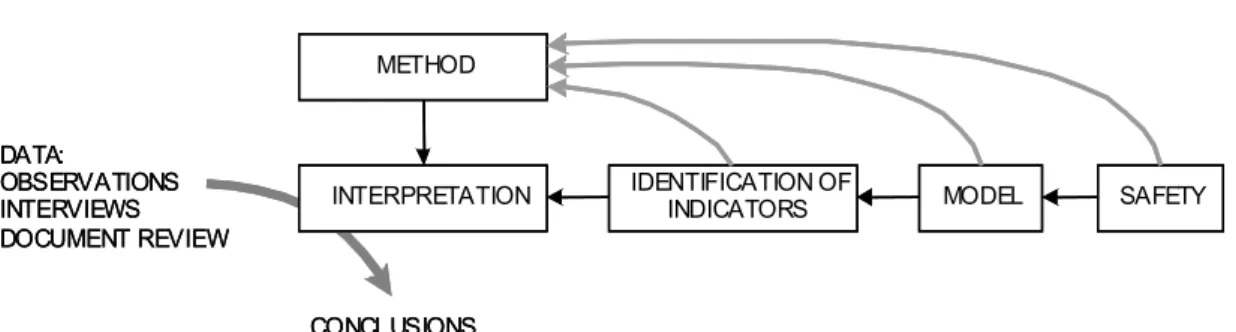
Figure 1: Relation between safety definition, model and indicators (Adapted from
Hollnagel, 1998)...21
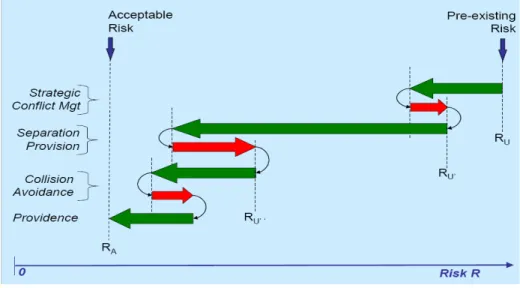
Figure 2: ATM risk graph (from Fowler et al., 2009)...27
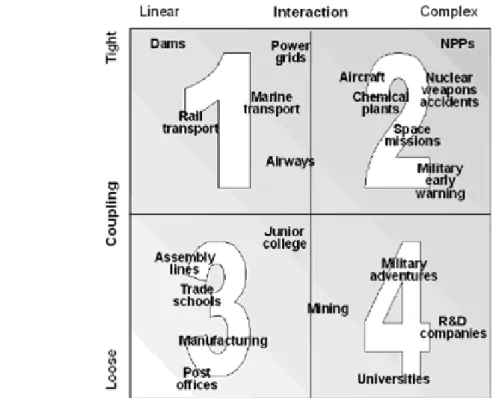
Figure 3: Distribution of socio-technical systems (Adapted from Perrow, 1984)...30
Figure 4: System functionality...54
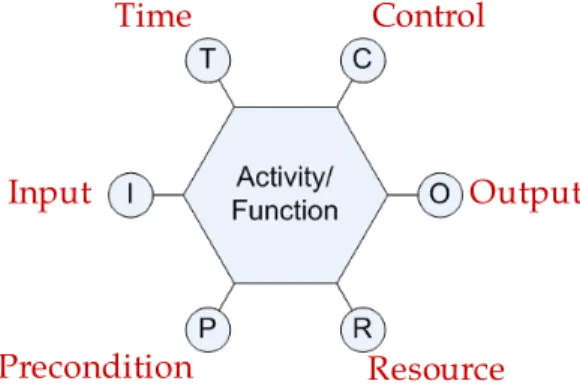
Figure 5: FRAM function...55
Figure 6: Function description...57
Figure 7: FRAM nominal instantiation for Over-flight scenario...60
Figure 8: Matching MTO categories and Common Performance Conditions (adapted from Hollnagel, 2004) ...67
Figure 9: Likely performance variability as a function of Common Performance Conditions...68
Figure 10: The Sharp end - Blunt end relationship (Adapted from Hollnagel, 2004) 73 Figure 11: Dampening performance variability effect of good quality aspects...78
Figure 12: Increasing performance variability effect of degraded quality aspects....79
Figure 13: Example of aggregated representation for performance variability ...80
Figure 14: Terrain Data Model (from MSAW documentation)...88
Figure 15: Glide Slope protection areas...89
Figure 16: Centreline protection areas...90
Figure 17: Stuttgart airport arrival chart...97
Figure 18: Display data on CWP and Monitoring instantiation...102
Figure 19: Generate MSAW alert and Display data on CWP instantiation...105
Figure 20: Monitoring and Manage procedures instantiation...107
Figure 21: Pilot-ATCO communication, Issue clearance to pilot and Manage teamwork instantiation ...108
Figure 22: The FRAM model of the socio-technical system...110
Figure 23: Aircraft approaching path for Nominal instantiation...111
Figure 24: Aircraft approaching path for Normal instantiation...112
Figure 25: Normal scenario – First instantiation...114
Figure 27: Normal scenario - Third instantiation...116
Figure 28: Relation between safety definition, model and indicators – FRAM specific version...132
L
L
IST
IST
OF
OF
T
T
ABLES
ABLES
Table_ 1: Functions in the Over flight control activity...56Table_ 2:Provide ATC clearance to pilot function description ...58
Table_ 3: Heterogeneity of performance variability...73
Table_ 4: Functions: output characterisation...77
Table_ 5: Example of aggregated representation for performance variability ...81
Table_ 6: Environment assumptions...91
Table_ 7: Accidents considered...92
Table_ 8: Hazards analysis...93
Table_ 9: Functions for the Over-flight control activity...98
Table_ 10: Foreground functions...99
Table_ 11: Monitoring function description...100
Table_ 12: Display data on CWP function description...100
Table_ 13: MSAW functions...102
Table_ 14: Generate MSAW alert function description...103
Table_ 15: Monitoring function description...106
Table_ 16: Manage procedures function description...106
Table_ 17: Background functions...109
L
L
IST
IST
OF
OF
T
T
ABLES
ABLES
- A
- A
NNEX
NNEX
Annex_I_Table 1: Provide ATC clearance to pilot function description...153
Annex_I_Table 2: Monitoring function description...154
Annex_I_Table 3: Planing function description...155
Annex_I_Table 4: Strip marking...155
Annex_I_Table 5: Coordination function description...155
Annex_I_Table 6: Update flight data processing system function description...156
Annex_I_Table 7: Provide meteorological data to controller function description..156
Annex_I_Table 8: Sector- Sector communication function description...157
Annex_I_Table 9: Provide flight and radar data to controller function description 157 Annex_I_Table 10: Pilot-controller communication function description...158
Annex_II_Table 1: Enable MSAW alert function description...159
Annex_II_Table 2: Define alert inhibit air space volumes function description...159
Annex_II_Table 3: Generate MSAW alert function description...159
Annex_II_Table 4: Define alert inhibit SSR codes function description...160
Annex_II_Table 5: Update met. data function description...161
Annex_II_Table 6: Provide met. data function description...161
Annex_II_Table 7: Provide flight & radar data function description...162
Annex_II_Table 8: Strip marking function description...162
Annex_II_Table 9: Display data on CWP function description...163
Annex_II_Table 10: Monitoring function description...164
Annex_II_Table 11: Planning function description...165
Annex_II_Table 12: Coordination function description...166
Annex_II_Table 13: Update FDPS function description...167
Annex_II_Table 14: Pilot-ATCO communication function description...167
Annex_II_Table 15: Sector-Sector communication function description...168
Annex_II_Table 16: Issue clearance to pilot function description...168
Annex_II_Table 17: Manage resources function description...169
Annex_II_Table 18: Manage competence function description...170
Annex_II_Table 19: Manage procedures function description...170
S
S
UMMARY
UMMARY
This thesis demonstrates the need to develop and apply systemic safety assessment methods to account for the effect of performance variability on Air Traffic Management safety.
Traditionally, safety assessments have been focused on the identification and estimation of failures, breakdowns and human errors. Thus, they required the identification and description of system's components, their functioning modes and their interdependencies. As the underlying assumption of safety assessment was that the system's components - including humans - have a bimodal functioning, i.e. they function or they fail, it was possible to warrant safety by making sure that the prescribed components' performance was reliable and no deviations occurred.
For Air Traffic Management, this assumption is inadequate. Like most modern socio-technical systems, it is so complex and it changes so rapidly that, in practice, it is impossible for it to be completely described and specified. As direct consequence, performance cannot be completely specified because it must vary to meet actual conditions and demands. Resilience Engineering acknowledges that performance variability is, in the context of complex socio-technical systems, an inevitable asset to ensure the functioning of an organisation and at the same time can be harmful for system safety when it combines in an unexpected and undesired manner.
This argument clearly indicates the need for safety assessment methods that can deal with performance variability. Several applications (e.g. Woltjer & Hollnagel, 2007; Lundblad et al., 2008, Rome, 2009) illustrate that the Functional Resonance Analysis Method (FRAM) (Hollnagel, 2004) has the ability to model socio-technical systems and to account for performance variability, both in accident analysis and safety assessment. However parts of the FRAM can be improved to expand its capabilities to evaluate and manage performance variability.
This thesis addresses this weakness and develops and illustrates a methodology for the evaluation of performance variability that accounts for:
1. The heterogeneity of functions performed in a socio-technical system;
2. The performance variability due to local adjustments made to meet performance demands;
3. An aggregate representation for performance variability during safety assessment.
The evaluation of the the methodology has been based on a safety assessment case study for a ground based safety net in the German Air Traffic Management domain. The results have been compared with the official results obtained during a traditional safety assessment process. The comparison shows the added valued of the proposed methodology. In particular it illustrates the possibility to identify emergent risks and human contribution to system safety.
The concluding section of this thesis explores the integration of the proposed methodology into current safety assessment and potential guidelines for future improvements to the Resilience Engineering approach to system safety are outlined.
References
Hollnagel, E. (2004). Barriers and accident prevention. Aldershot: Ashgate.
Lundblad, K., Speziali, J., Woltjer, R., & Lundberg, J. (2008). FRAM as a risk assessment method for nuclear fuel transportation. In Proceedings of the 4th International Conference Working on Safety. Crete, Greece.
Rome, F. (2009). De l'analyse de l'accident à l'analyse du travail: Application à deux cas d'étude dans la sécurité aérienne. PhD Thesis: Ecole Doctorale “Cognition, Comportament, Conduites Humaines”. Universitè Paris Descartes.
Woltjer, R. & Hollnagel, E. (2007). The Alaska Airlines Flight 261 accident: A systemic analysis of functional resonance. Proceedings of the 2007 (14th) International Symposium on Aviation Psychology (ISAP), 763-768, Dayton, OH.
Because things are the way they are, things will not stay the way they are
Bertolt Brecht
Ah, this is obviously some strange usage of the word 'safe' that I wasn't previously aware of.
C
C
HAPTER
HAPTER
1: S
1: S
AFETY
AFETY
C
C
HALLENGES
HALLENGES
FOR
FOR
A
A
IR
IR
T
T
RAFFIC
RAFFIC
M
Résumé du Chapitre 1
Dans un proche avenir, le système européen de gestion du trafic aérien sera révolutionné par de grands changements structurels, fonctionnels et organisationnels, afin d'accroître son efficacité. Tous ces changements doivent se soumettre à un processus d'évaluation des risques, de manière à identifier et éliminer tous les risques considérés inacceptables.
La gestion du trafic aérien a besoin de modèles et de méthodes pour assurer et améliorer la sécurité; l'objectif de cette thèse est de démontrer la nécessité d'appliquer des méthodes systémiques pour évaluer la variabilité de la performance et ses effets sur la sécurité du système.
La pertinence de cet objectif est examinée à partir d'une analyse de l'évolution historique des stratégies de sécurité. La complexité du système de gestion du trafic aérien requiert l'application de méthodes capables de saisir la dynamique de système réels ainsi que leur performance. Traditionnellement, les modèles et méthodes étaient axés sur les accidents, les incidents évités de justesse, tandis que le fonctionnement normal du système était généralement exclu de l'analyse. Ce chapitre, sur la base de Normal Accident Theory, Théorie des accidents normaux (Perrow, 1984) et de Resilience Engineering, Ingénierie de la Résilience (Hollnagel, Woods, Leveson, 2006; Hollnagel, Nemeth, Dekker, 2008), présente les raisons pour lesquelles le fonctionnement normal doit être au centre de l'étude de l'estimation de la sécurité et la raison pour laquelle la variabilité de la performance doit être correctement gérée.
Introduction
In the near future European Air Traffic Management system will be revolutionised by major structural, functional and organisational changes to increase its efficiency. All these changes have to undergo a safety assessment process to identify and eliminate all unacceptable risks.
Air Traffic Management needs models and methods to ensure and improve safety; the objective of this thesis is to demonstrate the need for applying systemic methods to evaluate performance variability and its effect on system safety.
The relevance of this objective is discussed, starting from a review of the historical evolution of safety approaches. The complexity of Air Traffic Management systems requires the application of methods able to capture real system's dynamics and performance. Traditionally, models and methods have been focused on accidents, incidents, near-misses while the normal system functioning was normally excluded from the analysis. This chapter, on the basis of Normal Accident Theory (Perrow, 1984) and of Resilience Engineering (Hollnagel, Woods, Leveson, 2006; Hollnagel, Nemeth, Dekker, 2008), presents the reasons why normal functioning has to be the focus of safety assessment and why performance variability has to be correctly managed.
1
Research context: Air Traffic Management
Safety is aviation's top priority. Air Traffic Management (ATM) plays a major role in ensuring safe aircraft departures, flights, landings and ground manoeuvres. Air Navigation Service Providers (ANSPs) produce safety by providing safe separation margins to aircraft both in the air and on the ground. At the same time, economic and operational conditions have to be maintained efficiently.
European citizens increased mobility, for business and leisure, has led to a growing demand for safe, high-quality air transport. By the year 2020, air traffic is predicted to grow by about 5% a year which means that the traffic flow in Europe will double with respect to what it was ten years ago. Hence, in the near future, European ATM will have to meet the increased traffic flow while simultaneously improving safety levels and reducing environmental impact in a cost-effective way.
These requirements are going to be satisfied by the development of a new ATM concept implying a structural revision of the ATM system. The Single European Sky (SESAR) Joint Undertaking, launched by the European Community and by the European Organisation for the Safety of Air Navigation (EUROCONTROL), aims at
the implementation of the first necessary step in the direction of a reorganisation of European ATM system: the achievement of one airspace continuum for ATM purposes in Europe which encompasses the airspace at and around airports as well as en-route
(EUROCONTROL, 2003. p.16).
1.1 Air Traffic Management: a complex socio-technical system
Air Traffic Management is a socio-technical system where technology is embedded in a social context that designs, tests, runs and maintains it. The term socio-technical system refers to the coupling between social and technical aspects in an organisation (Trist, 1978). From the interaction between the two set of aspects stems the successful (or unsuccessful) performance of the organisation.
Modern and future Air Traffic Management, as socio-technical system, holds prominent features which increase the challenges to ensure its safe functioning. Safety assessment has to be performed for a system where Air Traffic Controllers (ATCOs) have to continually interact and control a dynamic environment to produce an efficient and safe traffic flow in the sky. Air Traffic Controllers learn rules and procedures, as well as how to best use the available technology to accomplish their tasks. To be successful, besides reliable technology and appropriate procedures, ATM requires another important element: the controllers' activity that continuously combines their procedural knowledge with the requests and constraints from their working environment and from the on-going situations. The ATM domain can be characterised by four features which challenge safety and thus have to be considered when performing safety assessment:
Complexity
ATM is indeed complex. The central aspect of complexity is related to the number of elements and the nature of the interactions taking place within the system. Complex socio-technical systems are as well characterised by large problem space, distributed dynamic, potentially high hazards, many coupled subsystems, automated uncertain data and mediated interaction via computers (Vincente, 1999). The enormous amount of technology, required to meet ATM performance demands, leads to a high
level of system complexity. The envisaged revision of ATM structure, to increase performance capacity, is likely to result in a general ATM system increase in complexity even if, locally, there will be improvements. The increased complexity is also likely to result in an increased level of unpredictability of system behaviour where actions have unexpected and potentially adverse consequences (Hollnagel & Woods., 2005).
Uncertainty
The uncertainty characteristic of ATM relates to the knowledge about the environment and its future states. To deal with regular environment, Air Traffic Controllers develop patterns of behaviour appropriate to solve recurrent situations. But for out-of-the ordinary situations, they are obliged to build a hypothesis with the available information and knowledge and to make judgements on how to best cope with the demands.
Dynamic
The ATM environment is intrinsically dynamic. The control of a dynamic process is affected by four aspects: 1) the rate of change in the process to be controlled; 2) the relation between the process to be controlled and the control process; 3) possible delays in the system; 4) the quality of the feedback information. Controllers have three possibilities to control a dynamic process: 1) develop a mental model of the task; 2) develop heuristic rules; 3) rely on feedback and modification of behaviour (Brehmer & Allard., 1991).
Underspecification
The three above mentioned features of ATM domain leads straight to a fourth one: underspecification. No matter the amount of effort, it is utopian to claim to achieve a complete description of an ATM system, a description accounting for every possible scenario, every possible situation's development, every possible interaction between system components etc. The underspecification of ATM requires ATCOs fundamental contribution to system functioning and safety. This situation is extremely clear to controllers, who pride themselves on their skills, and their
understanding of rules and procedures, that enable them to deliver the best service to their clients (EUROCONTROL, 2009).
2
Research objectives
Safety for modern Air Traffic Management is a big challenge since it has to be assessed and ensured for any change in the ATM system and accidents are unacceptable. Safety assessment tradition is long and honoured. But modern socio-technical systems question the power of available safety assessment methods. The underspecification of ATM creates the needs for controllers to perform local adjustments of their activities. These adjustments are, not only constant, but necessary for the the organisation to effectively pursue its objective (Bourrier, 1996). Local adjustments make performance variable and this has to be considered during safety assessment.
The objective of this thesis is to demonstrate the need for developing and applying systemic safety assessment methods to account for the effect of performance variability on Air Traffic Management safety. In contributing to the development of the Functional Resonance Analysis Method this thesis aims at demonstrating the necessity to acknowledge that performance is – and has to be – variable, to maintain the functioning of modern socio-technical system. The acknowledgement of sources and reasons for performance variability is the precondition for its management and for safety improvements.
3
Safety assessment: identifying and eliminating
unacceptable risks
To ensure an acceptable safety level for such a complex and distinctive socio-technical system it is necessary for any change in ATM to undergo a thorough safety assessment process. EUROCONTROL (2001) defines safety assessment as the systematic and comprehensive process to establish safety requirements and to demonstrate that these requirements are met.
While accident analysis is a reactive process, safety assessment is a proactive one. The proactivity of safety assessment consists in foreseeing potential events and in taking appropriate actions to prevent undesired events to strike the organisation. The efficacy of safety assessment therefore relies in the ability of the organisation to predict as many risks as possible, since their non-identification will leave the organisation unprepared to cope with them.
To be effective, risks identification requires a systematic and rigorous application of an accident model, and its associated method, in order to make sense of the indicators used to predict the occurrence of future events (Figure 1). A safety definition, an accident model and the identification of indicators are used to develop a safety assessment method which is applied to interpret (i.e. to make sense of) field data. Risks identification and safety requirements are the concluding achievement of this process (Hollnagel, 1998).
In the next section it is argued that there are three main stages in the development of safety assessment methods. The distinction refers to different assumptions, methods and attribution of accident causes characterising the history of industrial safety (Hale & Hovden, 1998). The evolution has been driven by the technological development of the industrial system, and it could be represented by the efforts of safety practitioners and scientific community to keep the pace with the changes of the industrial world.
Figure 1: Relation between safety definition, model and indicators (Adapted from Hollnagel, 1998)
METHOD DATA: OBSERVATIONS INTERVIEWS DOCUMENT REVIEW CONCLUSIONS IDENTIFICATION OF
INDICATORS MODEL SAFETY
INTERPRETATION METHOD DATA: OBSERVATIONS INTERVIEWS DOCUMENT REVIEW CONCLUSIONS IDENTIFICATION OF
INDICATORS MODEL SAFETY
3.1 Theories and models of the negative: three ages of industrial
Safety assessment
New, more complex technologies and organisational structures required safety assessment models and methods more and more powerful to identify and to manage risks.
1. From the nineteenth century to the the end of the Second World War (the age of Technology), the concern was exclusively related to technological failures triggering accidents. Safety assessment methods searched for root causes by applying simple linear thinking about cause-effect relationships; 2. Starting from 1979 (the age of Human Factors), the human role in accident
causation was considered. Together with probabilities of technical failures, the evaluation of probabilities of human errors became relevant. Safety assessment methods evolved towards the adoption of multi-cause linear thinking, also expressed by the epidemiological models;
3. From the late 1980s (the age of Safety Management), the role of organisations and organisational culture came into the picture. Safety assessments methods moved towards a more systemic approach and accidents started to be considered as the outcome of normal system functioning rather than out-of-the-ordinary events.
3.1.1 The age of Technology
Hale and Hovden (1998) identified the first age of safety in scientific studies that started in the nineteenth century and lasted until after the Second World War. In that period, safety concerns were related to technical reliability. The safety objective was the prevention of structures' collapse, explosions and failures. The need to have safe and reliable technologies drove the development of safety assessment methods to assure that nothing goes wrong as a consequence of technological failures.
That it is possible to warrant the safety of a technological system, through an appropriate safety assessment study, is related to the nature of the system itself. Technological systems are built from clear and explicit design principles. Their
architecture, components and functioning are known to designers. Models and analysis methods are formal, standardised and validated. In addition, a technological system has a well-defined mode of operation and high structural and functional stability.
The methods developed to perform safety assessment in the age of Technology (e.g. HAZOP, Fault Tree, FMEA) are based on the assumption that it is possible to identify the root causes of accidents through the application of a linear search of cause-effect relationships. Despite the efficiency of this approach in managing the safety of technological systems, linear reasoning shows its limitations when applied to more complex systems.
3.1.2 The age of Human Factors
The Three Mile Island (TMI) nuclear power plant accident that occurred in 1979 showed how a technical safety assessment could not solve every safety problem, and called for the inclusion of humans in the analysis focus. The most substantial development of the second age of industrial safety is nevertheless to be found in the merging of technological safety assessment and ergonomics/human factors studies. In the age of Technology, as previously explained, it was possible to assure safety because the functioning of the technology was clear and understood. However the situation is not the same when humans are taken into account. When the same characteristics are considered, it is clear that for humans the design principles are unknown and their architecture is only partly known. If for technology, models are formal and explicit, in the case of humans, models are based on analogies and methods are unproven. Despite the evidence that humans are reliable, their mode of functioning is only vaguely defined and understood.
The urge to develop, in response to the TMI event, safety assessment methods and the practicality offered by available knowledge and experience, led to the development of methods with a similar approach for humans and technology. The first methods (e.g. THERP, OAT SLIM/MAUD), also called first generation Human Reliability Assessment methods, were based on event tree representations,
and they aimed to estimate human error probabilities and their effect on system failures. The simple, linear casual thinking, that characterised the technological methods, evolved towards a complex, casual thinking. The safety community realised that it was needed to account for multiple causes of accidents, and the effect of the context, on error probabilities was also introduced into the analysis.
This evolution moved the accident models and methods towards the development of the so-called epidemiological models. Epidemiological accident models (the Swiss Cheese model (Reason, 1997) is the champion of this category) consider accident development as a linear phenomenon but their scope is longer in time, and levels of analysis (e.g. latent failures that originate from design) can be included. In terms of the causality approach to accident analysis, epidemiological models adopt an improved and more complete version of the linear cause-effect relation.
The age of Human Factors came to an end, according to Hale and Hovden (1998), when in the '80s dissatisfaction with the ability of the methods and models to match the safety needs of industrial systems became evident.
3.1.3 The age of Safety Management
The third safety age identified described by Hale and Hovden (1998) concerns the development of models and methods that expanded the focus of analysis from the workplace and the interaction between humans and technology, to the study of the organisation and its dynamics. If a birth date has to be set for the age of Safety Management, it could be 1986, when the Chernobyl nuclear power plant disaster and the Challenger explosion rose awareness that established approaches were no longer sufficient to assure system safety.
Before entering into the discussion of organisational theories and models it is worth addressing, as it has already been done for the Technology and Human Factors age, the question of the organisation's characteristics upon which safety is ensured. The step-by-step design of an organisation and the actual final result are only partially known. The models used to assure safety are based on a semi-formal description of the organisation, and the methods could not be proved true. Despite
the fact that the modes of operation are complex and only partially definable, organisations tend to show a good functional stability.
However, the theoretical development of safety management approaches started earlier. Hale and Hovden trace the first attempts to account for the managerial dimension of safety back to the beginning of the twentieth century. The two authors recognise that those attempts were basically a collection of common sense and general management principles applied to safety.
In the age of Safety Management a wide number of theories and models have been proposed by the scientific community e.g. Man-made disasters (Turner, 1978); High Reliability Organisations (LaPorte & Consolini, 1991; Rosness et al, 2004); Normal deviation theory (Vaughan, 1996); Drift into failures (Rasmussen, 1997), but despite the enlarged focus of analysis they shared a common approach with earlier models: they were focused on accidents and aimed at the identification of their causes.
This is true for all three ages of industrial safety. Accidents were considered to be caused either by a fallible technology, or by careless, inexperienced, untrained humans or by the characteristics (complex, brittle etc.) of the organisations. Over the time, accidents causes were attributed to technology, to human errors or to organisational failures and the safety efforts were aiming at the implementation and improvement of safety barriers. This approach has two major consequences. The first consequence is that safety is, normally, perceived in competition with the core business of the organisation. Since safety is disjunct from business, every resource allocated to improve safety is perceived as detracting from business. The second consequence is related to the possibilities for organisational learning. Since learning is related to the number and typology of events, if safety efforts are successful, few (or ideally no) negative events will occur. In this scenario, safety management will lack information about the organisation's safety status and the planning of safety improvements might become a matter of expert-guess.
Acknowledging the drawbacks and limitations of the use of safety assessment methods based on a “negative” approach to safety, EUROCONTROL is currently developing an advanced and innovative safety assessment approach to cope with
the massive changes to European ATM, due to SESAR development. The main guidelines of this approach are presented in the following section.
3.2 Safety assessment for Air Traffic Management: the
EUROCONTROL approach
In the need to ensure safety for European Air Traffic Management, EUROCONTROL acknowledges that a traditional, failure based approach to safety assessment will be unable to provide the full scope of assurances needed, and to ensure that the new operational concepts will be acceptability safe. Central to development of the innovative approach is understanding the relationship between pre-existing risk, the positive and negative contribution of the three ATM barriers (i.e. Strategic Conflict Management, Separation Provision, and Collision Avoidance), as well as the positive contribution of Providence (Fowler, Perrin & Pierce, 2009). The following figure expresses the relationship between pre-existing risk and the contribution (positive and negative) of the ATM barriers.
The safety assessment is based on the construction of safety cases, that, once demonstrated, warrant that the risks identification and elimination process is at an acceptable level.
A safety case consists of two main elements: a set of arguments or statements which claim that something is true (or false), and supporting evidence to show that the
argument is valid. Arguments are normally defined in a hierarchical way, meaning that any particular argument is valid only if all the next-level arguments are themselves valid.
At some point in the decomposition of the arguments, the hierarchical structure requires that it can be determined that the ATM system has been designed in a satisfactory manner, and that all the system requirements and specifications are satisfied by the implementation. But in the case of the development and design of a brand new operational concept (as SESAR is at the current stage), it is not possible to assess the detailed physical design, since it will only become clear in a later implementation phase. In order to overcome this problem, EUROCONTROL (2009) proposes to base the safety assessment on a more generic representation of the future system, called the logical design. The logical design is composed of a Logical Model (LM), which is defined as:
A high-level, architectural representation of the system design that it is entirely independent of the eventual physical implementation of that design. The LM describes the main human
tasks, machine functions, and airspace design parameters and what each of those “actors” provides in terms of safety functionality and performance – these are known as Functional
Safety Requirements (FSRs). The LM normally does not show elements of the physical design, such as hardware, software, procedures, training etc.
The correctness of the Logical design under normal and abnormal conditions of functioning is checked by means of a Thread analysis of the Functional Safety Requirements of the designed system.
Despite the formal acknowledgement of the limitations of a failure based safety assessment, EUROCONTROL approach is still focused on the search for hazards and risks. Accident prevention is based on the enforcement of barriers, for which both the positive and negative contribution to risk reduction is assessed.
To overcome the limitations of a failure based safety assessment, and to improve the management of safety in ATM it is necessary to use a language that does not emphasize structure, components, parts and interaction, cause and effect (Dekker, 2005). It is as well necessary to expand the focus of safety analysis by the
consideration of the normal functioning of the socio-technical system, the functioning which produces daily successful operations.
4
From focusing on the negative to also looking at the
positive
In the age of Safety Management the normal characteristic of industrial accidents started to be highlighted in the safety literature. The Drift into failure metaphor, the identification of normal deviations and, obviously, the Normal Accident theory showed the non-extraordinary nature of the mechanisms leading to accidents. Despite this, approaches were still focused on the “negative”, causes and barriers were the relevant focus of analysis. Rasmussen (1997), with the drift into failure metaphor, recognises the importance of trades-off in governing normal organisation activities and in influencing the possibility of failure or success. Vaughan's notion (1996) that deviations might become acceptable and that they therefore constitute the normal context for successful functioning of the organisation (until something goes wrong) pinpoints the fact that accidents should not be understood as something intrinsically different from success. Acknowledging that the organisational activities leading to an accident are the same as the organisational activities leading to success should draw the attention to the lack of theories and models able to explain operational success or normal work (Dekker, 2006).
4.1 Normal Accident Theory
The champion of the theories about the normal nature of accidents in industrial systems dates back to 1984 when the sociologist Charles Perrow introduced the idea that, for some types of industries, accidents have to be considered normal events rather than exceptional ones. Perrow describes industrial domains in terms of two qualities: complexity and coupling. The result of his classification is that systems could be either “linear or complex” and “loosely or tightly” coupled.
The complexity dimension, for Perrow means the degree of "baffling, hidden interactions" that have not been anticipated in the design and hold the potential to "jump" from one subsystem to another (Perrow, 1984).
The coupling dimension accounts for the amount of slack or buffer that is embedded in the organisation. Tightly coupled systems have no buffer available to absorb and reduce the propagation of disturbances and failures within the system. In other words, what happens to a component of the system affects directly other parts of the system. On the other hand, a loosely coupled system, hit by a perturbation, has the possibility to manage, recover and control the situation.
In 1984, Perrow classified some of socio-technical systems according to their degree of coupling and complexity. The result of his classification is presented in the following figure (Figure 3).
The approach followed by the author leads to the acknowledgement that, for certain industries and organisations accidents should not be considered as exceptional, but rather as normal in the sense that they are inevitable. For industrial systems like nuclear power plants, air traffic management, oil drilling platforms etc. it is very unlikely that a major accident is produced by an isolated technical or human failure. It is more likely that the combination of several failures (or even in the case of absence of failures) within the systems could generate accidents.
4.2 Resilience Engineering
The need to further develop theories and models to improve industrial safety is not related to the occurrence of a major industrial accident (as it was for the other safety ages), but rather to the recognition of the inadequacy of the available tools to predict accidents and, in more general terms, to manage organisational safety (Dekker, 2006). In October 2004 a group of safety scientists and safety practitioners held a symposium to discuss and develop the ideas of Resilience Engineering, i.e. ideas about an alternative approach to improve system safety. The motivation behind the development of Resilience Engineering is the need to find innovative ways to deal with risks in socio-technical systems that are more and more complex and tightly coupled (according to Perrow's definition of complexity and coupling previously mentioned), in a world where safety and productivity can no longer be disjunct. There is a consensus about the newly born concept of Resilience Engineering as well as a common (but perhaps imprecise) understanding of what it is.
4.2.1 Resilience: multiple definitions on a common base
The term Resilience has a long tradition in many domains (physics, ecology, economy, psychology etc.) where it has generally been used to describe the characteristic or the ability of something to absorb blows, to deal with disruptions and stress, and to regain its original functional features. In the safety domain, the term has been used since 1993 when Foster defined it as “an ability to accommodate change without a catastrophic failure”. It is not until 2004 that the term Resilience, in the safety literature, has been associated to the term Engineering with the idea that something could and should be done in an organisation to improve its resilience. Since then, a proliferation of definitions for Resilience have appeared. The importance of having a detailed definition of what is meant by Resilience is the same as that which has been presented concerning safety: models, methods and indicators are developed in accordance to the definition. The definition sets the boundaries for what will be considered and what will be neglected and sets a coherent line to transfer theoretical concepts into practice.
The following three definitions represent how Resilience is differently understood by the research community:
1. The characteristic of managing the organisation’s activities to anticipate and circumvent threats to its existence and primary goals (Hale & Heijer, 2006); 2. The system capability to prevent or adapt to changing conditions in order to
preserve its control over a system property (Leveson et al. 2006);
3. The intrinsic ability of a system to adjust its functioning prior to, during, or following changes and disturbances, so that it can sustain required operations under both expected and unexpected conditions. (Hollnagel, 2010).
The Hale & Heijer definition refers to the ability the organisation must have to manage the conflict between safety efforts and production efforts and it is focused on the possible drift in the safe margins of operations. Leveson, in the development of the STAMP method, hints at the problem of loss of control that could happen in the attempt to adapt to fluctuating conditions. Hollnagel highlights the organisation's need for adjustments if normal functioning has to be guaranteed. Reviews of the Resilience Engineering literature (Hollnagel, Woods & Leveson, 2006; Hollnagel, Nemeth & Dekker, 2008; Rigaud, 2008; SINTEF, 2009) supports the identification of three premises for Resilience Engineering:
1. Safety can not be separated from business;
2. Safety is a question of being in control and therefore requires a proactive as well as a reactive attitude;
3. Safety requires local adjustments.
4.2.2 Safety cannot be separated from business
The consequences of separating safety from business have already been mentioned. To summarise the adoption of an approach that considers these two aspects as two sides of the same coin resolves:
2. The problem of having at our disposal only a limited number of events for organisational learning;
3. The problem of being stuck in a model of the negative.
4.2.3 Safety as a control issue (proactivity and reactivity)
To be effective and efficient, safety management cannot be based solely on hindsight, error tabulation, and failure probabilities. This point highlights the control problems that arise from the attempt to steer safety, by exclusively looking at what has happened in the past, or waiting for problems to emerge, before finding solutions. A proactive safety management approach will instead be able to anticipate risks, to eliminate some of them (not all risks can be predicted and therefore eliminated) and to create the conditions to cope with disturbances in an effective manner.
4.2.4 Safety requires local adjustments
The third premise of Resilience Engineering, concerns the need that socio-technical systems have for local adjustments to support their core business and therefore safety. This premise requires a thorough discussion, since it implies a further set of points to be acknowledged, and it has major implications for the development of this work.
Intractability of socio-technical systems. Since 1984, with Perrow's work on normal accidents, the complexity of some types of socio-technical systems has been acknowledged. This notion has been revised by Hollnagel (2008) and the notion of complexity substituted by the notion of intractability. An intractable socio-technical system is characterised by high complicacy (elaborate and detailed description), by low comprehensibility (principles of functioning not completely known) and by low stability (rapidly changes). Fabre & Macchi (2009) identified a more detailed list of characteristics (e.g. proximate production steps, low feedback quality, indirect information sources etc.) for intractable systems. These features imply that it is impossible to identify all potential working scenarios or working conditions that, consequently, are underspecified.
Underspecification of performance conditions. The above mentioned characteristics of intractable socio-technical systems result in the impossibility of specifying work operations exhaustively in advance, as organisations (as well as the people in them) are in a state of constant flux. The need for humans to perform efficiently in underspecified conditions requires their performance to be locally adjusted to current circumstances. Adjustments take place continually even in the highly standardised and proceduralised socio-technical systems like the nuclear industry, the army, the aviation maintenance etc. (Bourrier, 1999, Snook, 2000, McDonald 2001). Since adjustments take place with limited resources and time they are inevitably approximate.
Duality of performance variability. Approximate adjustments result in performance variability, i.e. human performance will vary to match current conditions. Due to the intractable nature of socio-technical systems, performance variability is not only an inevitable phenomenon, but it also constitutes an asset for the organisation. The impossibility of conceiving rules and procedures for every potential situation, shows how human performance variability represents normally, a source of success. For example, McDonald (2006) argues that operators, in the aviation maintenance domain, do not follow procedures routinely, but they adjust their performance in a better, quicker, safer way with respect to following the manual to the letter. The same deviations from norms and procedures can sometimes (hopefully rarely) result in incidents or accidents.
Accidents as emergent phenomena. Modern socio-technical systems are designed so that a single failure does not result in an accident (barriers implementation, redundancy of systems etc. serve this purpose). But their intractability and the required performance variability make possible the occurrence of accidents emerging from unexpected combinations of performance variability. This emergent nature of accidents is not addressed by traditional safety assessment methods, and it requires the adoption of methods able to account for performance variability, and the way it may combine in unexpected manners.
4.3 Implications of choosing a theory
This research recognises the potential advantages of Resilience Engineering in improving safety, and particularly safety assessment practices, in complex industrial systems. As highlighted in Section 3, to perform safety assessment it is necessary to apply a method which is coherent with a safety definition and with its theoretical assumptions. Thus, a Resilience Engineering safety assessment method has to satisfy the following requirements:
1. Resilience Engineering requires the adoption of a systemic safety assessment method. The scope of safety analysis can not be constrained to a specific part of the socio-technical system, but it has to consider a larger picture where the organisation is considered as a whole rather than as an assembly of components.
2. Resilience Engineering requires a method able to model the normal functioning of the socio-technical system. As presented above, most of the methods are focused on the possibility of failures and accidents. But in a Resilience Engineering perspective, normal system functioning is considered as the source for both success and failure.
3. Resilience Engineering also requires a method that looks at safety and accidents as emergent phenomena that are the result of the normal functioning of the socio-technical system. This fact that was somewhat recognised during the age of Safety Management (e.g. Normal Accident Theory, Normal Deviations, Drift into Failures) has never been exploited in the development of a safety assessment method.
4. Resilience Engineering requires a method able to take into consideration human performance, not in a nominal and standardised manner, but rather in a way that can describe performance variability as the expression of the local adjustments humans make in their daily work. In this respect, it is necessary to acknowledge the positive contribution to safety that humans bring to the organisation.
Conclusion
The need for a safe Air Traffic Management system is evident. ATM, considered as a socio-technical system, is becoming and, because of the anticipated reorganisation at European level, will become more and more complex. The complexity is due to the necessity of meeting environmental demands, and therefore to have advanced technologies to support human activities in an uncertain dynamic environment. Traditionally, the systematic identification of hazards and risks has been based on a decomposition of systems and an estimation of their failures probabilities. This approach, perfectly appropriate to systems which can be specified, is inadequate for socio-technical systems like ATM. This inadequacy is the result of the underspecification that characterises intractable dynamic socio-technical systems. EUROCONTROL (2009) acknowledges that a second inadequacy of traditional safety assessment methods is the failure based approach that characterises them. Despite the different foci adopted during the evolution of theories and models, the main common concern was to find the unreliable, weak and problem-generating component of socio-technical systems, and to fix it. The approaches were, in other terms, looking only at the dark side of organisational functioning, i.e. they were exclusively interested in negative outcomes.
In agreement with Perrow's notion of Normal Accidents, the Resilience Engineering approach uses the understanding of normal performance as a premise to explain that accidents emerge from normal system performance, rather than resulting from technical, human or organisational failures.
The perspective shift introduced by Resilience Engineering requires a set of theoretical assumptions. When adopted, they guide the development of innovative safety assessment methods that overcome the limitations of those available. These assumptions could be summarised as follows:
1. Safety and core business are two sides of the same coin;
3. Socio-technical systems are intractable and therefore performance conditions underspecified;
4. Local adjustments are necessary to ensure system functioning; 5. Local adjustments imply human performance is variable.
To ensure Air Traffic Management safety,we must renounce the optimistic attempt to base safety assessment on high-level, abstract representation of the socio-technical system (as suggested by EUROCONTROL Logical Model) and instead to represent, in the most realistic possible way, its actual normal functioning. Dealing with complex underspecified systems represents a difficult safety challenge. To improve system safety it is necessary to understand and to manage performance variability. Understanding the reasons for performance variability is the precondition for its management. The reasons for performance are addressed in the next chapter and the Functional Resonance Analysis Method is presented as a safety assessment method aiming at its modelling.
C
C
HAPTER
HAPTER
2: M
2: M
ANAGING
ANAGING
P
P
ERFORMANCE
ERFORMANCE
V
V
ARIABILITY
ARIABILITY
TO
TO
I
Résumé du Chapitre 2
Les caractéristiques majeures (présentées au Chapitre 1) du système de gestion du trafic aérien produisent leurs propres sous-spécifications. L'estimation de la sécurité de cette typologie de systèmes socio-techniques nécessite la reconnaissance de la présence de la variabilité de performance et son rôle dans le fonctionnement du système. L'objectif d'améliorer la sécurité en limitant les performances, et donc de réduire la probabilité d'écarts par rapport aux règles et procédures, ne pourrait être atteint, car il suppose une classification bimodale de la performance: correcte ou incorrecte. Mais la réalité est différente. La performance de systèmes socio-techniques complexes doit être variable afin de maintenir le fonctionnement du système. De toute évidence la variabilité de performance n'est pas seulement un atout pour le fonctionnement du système, elle pourrait en même temps représenter une atteinte à la sécurité lorsqu'elle se déroule de manière indésirable ou inattendue. La perspective de Resilience Engineering – Ingénierie de la Résilience, souligne le rôle de la variabilité de la performance pour assurer le fonctionnement normal des systèmes socio-techniques. Le fait de décrire la performance en termes de défaillances, dysfonctionnements et erreurs humaines est manifestement insuffisant pour représenter une performance qui varie en fonction des possibilités et des contraintes pour être aussi efficace que possible. Ce chapitre présente une approche différente pour expliquer une performance qui satisfasse à la fois la nécessité d'exploiter des possibilités (par exemple, augmenter l'efficacité, le temps sûr, réduire la charge de travail, etc.) et de faire face aux contraintes (par exemple, résoudre des problèmes inattendus, la pression de production, la pression du temps, etc.). Le compromis Efficacité-Rigueur est présenté comme un cadre de discussion de la variabilité de la performance, et la Functional Resonance Analysis Method – FRAM, en français Méthode d'Analyse de Résonance Fonctionnelle- est introduite comme la méthode adéquate pour l'estimation de la sécurité.
Introduction
The prominent features (presented in Chapter 1) of an Air Traffic Management system create its underspecification. Safety assessment for this typology of socio-technical systems requires us to acknowledge the presence of performance variability and its role in system functioning. The attempt to improve safety by constraining performance, and therefore reducing the probability of deviation from rules and procedures, cannot be achieved, since it assumes a bimodal classification of performance; correct or incorrect. But reality is different. Complex socio-technical systems performance has to be variable to maintain system functioning. Obviously performance variability is not only an asset for system functioning, it could at the same time represent an obstacle to safety when it combines in unwanted or unexpected ways.
The Resilience Engineering perspective stresses the role of performance variability to ensure the normal functioning of socio-technical systems. Describing performance in terms of failures, malfunctions and human errors is clearly an inadequate way to represent performance that varies according to opportunities and constraints in order to be as efficient as possible. This chapter introduces a different approach to explain performance that satisfies both the need to exploit opportunities (e.g. increase efficiency, save time, reduce workload etc.) and to deal with constraints (e.g. solve unexpected problems, production pressure, time pressure etc.). The Efficiency-Thoroughness Trade-Off is presented as a framework to discuss performance variability and the Functional Resonance Analysis Method is introduced as an adequate safety assessment method.
1
Reasons for performance variability
To prevent accidents emerging from unwanted combinations of performance variability it is necessary first to understand what the reasons are. Humans are the main source of performance variability in socio-technical systems. Technology is designed, built and maintained to be as reliable as possible. Current technological progress produces extremely reliable systems in which variability might almost be forgotten. That does not mean that technology cannot fail, indeed it does and often
accident analysis also identifies technological failures. It only means that technology performs in a bimodal way which means “it works” or “it does not work”. Normally it does work, it rarely fails and once this happens, humans have to cope with a degraded situation and adjust to it. Thus, describing performance variability, inevitably, is mainly a matter of human performance description.
Scientific studies of human performance at work have a tradition as long as the history of industry. Back to the first industrial revolution, physiological factors influencing performance variability have been identified. Since then the influence of several other factors has been identified.
It is possible to distinguish five classes of reasons for performance variability related to human, social or contextual conditions:
Physiological and/or fundamental Psychological factors This class of factors have an influence on perception and vigilance. They have been considered since the very beginning of Human Reliability Assessment methods (HRA 1st generation). Their
effect on human reliability has been studied in Ergonomics and Human Factors in the analysis of human behaviour and by the development of cognitive models to estimate response times and human error probabilities.
Higher level Psychological factors. Ingenuity, creativity, adaptability etc. and their effect on human performance have been investigated by Human Resources management and selection studies. This kind of high level psychological factor, as noted by Hale & Hovden (1987) has been categorised for safety purposes as individual accident proneness. Incidents and accidents are more likely to occur to some people. To improve safety it is necessary to choose the right people.
Contextual factors. The second generation HRA methods overcame the limitations of the first generation by including the effect of contextual factors in human reliability analysis. Extensive lists of contextual factors have been compiled (e.g. Common Performance Conditions in CREAM, Error Forcing Conditions in ATHEANA, Configuration Importante de la Conduite Accidentelle in MERMOS) to account for the detrimental effect context may have on human reliability.