
HAL Id: tel-01885501
https://pastel.archives-ouvertes.fr/tel-01885501
Submitted on 2 Oct 2018HAL is a multi-disciplinary open access archive for the deposit and dissemination of sci-entific research documents, whether they are pub-lished or not. The documents may come from teaching and research institutions in France or
L’archive ouverte pluridisciplinaire HAL, est destinée au dépôt et à la diffusion de documents scientifiques de niveau recherche, publiés ou non, émanant des établissements d’enseignement et de recherche français ou étrangers, des laboratoires
Oxidation of phosphasalen complexes
Irene Mustieles Marín
To cite this version:
Irene Mustieles Marín. Oxidation of phosphasalen complexes. Coordination chemistry. Université Paris-Saclay, 2017. English. �NNT : 2017SACLX078�. �tel-01885501�
NNT : 2017SACLX078
T
HESE DE DOCTORAT
DE
L’U
NIVERSITE
P
ARIS
-S
ACLAY
PREPAREE A
“E
COLE
P
OLYTECHNIQUE
”
E
COLED
OCTORALE N° 571
2MIB | Sciences chimiques :
molécules, matériaux, instrumentation et biosystèmes
Spécialité de doctorat : Chimie
Par
Irene Mustieles Marín
Oxidation of phosphasalen complexes
Thèse présentée et soutenue à Palaiseau, le 26 octobre 2017 :
Composition du Jury :
Président : Dr. Yves Le Mest
Mme Anxolabéhère-Mallart, Elodie Directrice de Recherche à l’Université Paris Diderot Examinatrice M. Thomas, Fabrice Professeur à l’Université Grenoble-Alpes Examinateur M. Le Mest, Yves Directeur de Recherche à l’Université Bretagne Occidental Rapporteur Mme Sénéchal-David, Katell Maitre de Conférences à l’Université de Paris-Sud Rapporteur Mme Auffrant, Audrey Chargée de Recherche à l’Ecole Polytechnique Directrice de thèse
Oxidation of
Phosphasalen Complexes
Irene Mustieles Marín
Chemistry
Ecole Polytechnique, Université Paris-Saclay
PhD thesis defended on:
October 2017
List of abbreviations
COE Cyclooctene
CT Charge Transfer
DABCO 1,4-diazabicyclo[2.2.2]octane
DCM Dichloromethane
DFT Density Functional Theory
EPR Electronic Paramagnetic Resonance
Fc Ferrocene
GC Gas Chromatography
HOMO Highest Occupied Molecular Orbital
HSAB Hard Soft Acid Base
iPr Isopropyl
KHMDS Potassium bis(trimethylsilyl)amide
LMCT Ligand Metal Charge Transfer
LUMO Lowest Unoccupied Molecular Orbital
m-CP meta-chlorobenzoate
m-CPBA meta-chloroperoxybenzoic acid
Me Methyl
NBO Natural Bond Orbital
NBS N-Bromosuccinimide
NMO N-Methylmorpholine-N-Oxide
NMR Nuclear Magnetic Resonance
OMe Methoxy
ORTEP Oak Ridge Thermal Ellipsoid Plot
Ph Phenyl
ppm Parts per million
PSalen Phosphasalen
PSalophen Phosphasalophen
Salen N,N’-ethylenebis(salicylimine)
SCE Saturated Calomel Electrode
SQUID Superconducting Quantum Interference Device
SOMO Singly Occupied Molecular Orbital
tBu tert-butyl
THF Tetrahydrofuran
TMS Tetramethylsilane
TMSN3 Trimethylsilyl azide
TS Transition State
Table of contents
Chapter 1: Introduction to phosphasalen ligands ... 15
1. Redox non-innocent ligands ... 15
1.1 Definition ... 15
1.2 Role of redox non-innocent ligands in catalysis ... 16
1.3 Redox non-innocent ligands in bio-inorganic chemistry ... 20
2. Salen ligands ... 23
2.1 Relevance of salen ligands in catalysis ... 23
2.2 Salen complexes as biomimetic models of galactose oxidase ... 26
2.2.1 Electronic structure of Cu and Ni complexes displaying redox non-innocent ligands ... 26
2.2.2 Galactose oxidase enzyme... 30
2.2.3 Examples ... 31
3. Phosphasalen ligands ... 34
3.1 The iminophosphorane function ... 35
3.1.1 Synthesis ... 35
3.1.2 Electronics and geometrical parameters ... 37
3.1.3 Basicity and hydrolysis ... 40
3.2 Electronic properties of phosphasalen ligands ... 40
3.3 Synthesis of phosphasalen ligands ... 41
3.4 Previous work ... 43
3.4.1 First complexes ... 43
3.4.2 Catalytic applications ... 44
3.4.3 NiIII phosphasalen complex... 44
4. Objectives ... 45
5. References ... 47
Chapter 2: Influence of the phenolate substituents in Ni and Cu phosphasalen
complexes ... 51
1. Introduction ... 51
2. Synthesis of the ligand and neutral complexes ... 53
3. Characterization of neutral complexes [Ni(PsalenOMe)], [Cu(PsalentBu)] and [Cu(PsalenOMe)] ... 54 3.1 NMR spectroscopy... 54 3.2 EPR spectroscopy ... 56 3.3 UV-visible spectroscopy ... 58 3.4 X-Ray diffraction ... 59 3.5 Magnetic measurements ... 61
3.6.1 Cyclic voltammetry of the ligands ... 62
3.6.2 Cyclic voltammetry of the complexes ... 63
4. Oxidation of neutral complexes ... 65
5. Characterization of the oxidized complexes ... 65
5.1 NMR spectroscopy... 65
5.1.1 Fit of the VT-NMR data of [Cu(PsalenOMe)]+. ... 70
5.2 EPR spectroscopy ... 72 5.3 UV-vis spectroscopy ... 76 5.4 X-ray diffraction ... 79 5.5 Magnetic measurements ... 83 6. Calculations ... 85 7. Conclusion ... 90 8. References ... 92
Chapter 3: Influence of the phosphorus substituents in Ni and Cu
phosphasalen complexes ... 93
1. Introduction ... 93
2. Synthesis of the ligand and neutral complexes ... 95
3. Characterization of neutral complexes [Ni(iPrPsalen)] and [Cu(iPrPsalen)] ... 96
3.1 NMR spectroscopy... 96
3.2 EPR spectroscopy ... 98
3.3 UV-visible spectroscopy ... 99
3.4 X-ray diffraction ... 100
3.5 Electrochemical studies ... 101
4. Oxidation of neutral complexes ... 103
5. Characterization of the oxidized complexes ... 103
5.1 NMR spectroscopy... 103 5.2 EPR spectroscopy ... 109 5.3 UV-visible spectroscopy ... 111 5.4 X-ray diffraction ... 112 5.5 Magnetic measurements ... 114 6. Conclusion ... 114 7. References ... 116
Chapter 4: Influence of the N,N-linker in Ni and Cu phosphasalophen
complexes ... 117
I. Introduction ... 117
II. Psalophen complexes ... 121
1. Synthesis of the ligand and neutral complexes ... 121 2. Characterization of neutral complexes [Ni(Psalophen)] and [Cu(Psalophen)]123
2.2 EPR spectroscopy ... 124
2.3 UV-vis spectroscopy ... 125
2.4 X-ray diffraction ... 126
2.5 Electrochemical studies ... 128
3. Oxidation of neutral complexes ... 131
4. Characterization of the oxidized complexes ... 131
4.1 NMR spectroscopy... 131
4.2 EPR spectroscopy ... 133
4.3 UV-visible spectroscopy ... 135
4.4 X-ray diffraction ... 136
5. Study of the dimers ([Ni(Psalophen)]+SbF6-)2 and ([Cu(Psalophen)]+SbF6-)2 ... 139
5.1 Dimerization process ... 139
5.2 NMR spectroscopy... 142
5.3 EPR spectroscopy ... 147
III. PsalophenMe complexes ... 150
1. Synthesis of the ligand and neutral complexes ... 150
1.1 NMR spectroscopy... 151
1.2 EPR spectroscopy ... 153
1.3 UV-visible spectroscopy ... 153
1.4 X-ray diffraction ... 154
1.5 Electrochemical studies ... 156
2. Oxidation of neutral complexes ... 158
3. Characterization of the oxidized complexes [Ni(PsalophenMe)] and [Cu(PsalophenMe)] ... 158
3.1 NMR spectroscopy... 158
3.2 EPR spectroscopy ... 161
3.3 UV-vis spectroscopy ... 164
3.4 Magnetic measurements ... 165
IV. PsalophenCF3 complexes ... 167
1. Synthesis of the ligand and neutral complexes ... 167
2. Characterization of neutral complexes [Ni(PsalophenCF3)] and [Cu(PsalophenCF3)] ... 168 2.1 NMR spectroscopy... 168 2.2 EPR spectroscopy ... 170 2.3 UV-visible spectroscopy ... 171 2.4 X-Ray structures ... 171 2.5 Electrochemical studies ... 174
3. Oxidation of neutral complexes ... 175
4. Characterization of the oxidized species ... 176
4.1 NMR spectroscopy... 176
4.2 EPR spectroscopy ... 179
4.4 X-ray structures ... 181
4.5 Magnetic measurements ... 183
V. PsalophenOMe2 complexes ... 184
1. Synthesis of the ligand and neutral complexes ... 184
2. Characterization of neutral complexes [Ni(PsalophenOMe2)] and [Cu(PsalophenOMe2)] ... 185 2.1 NMR spectroscopy... 185 2.2 EPR spectroscopy ... 187 2.3 UV-vis spectroscopy ... 188 2.4 X-Ray diffraction ... 188 2.5 Electrochemical studies ... 191
3. Oxidation of neutral complexes ... 193
4. Characterization of the oxidized complexes ... 193
4.1 NMR spectroscopy... 193 4.2 EPR spectroscopy ... 201 4.3 UV-vis spectroscopy ... 204 4.4 X-ray diffraction ... 205 VI. Conclusion ... 210 VII. References ... 211
Chapter 5: Mn phosphasalen complexes: coordination and reactivity ... 213
1. Introduction ... 213 2. Synthesis of complexes ... 214 2.1 MnII complexes ... 214 2.2 MnIII complexes ... 215 3. Characterization of MnII complexes ... 216 3.1 NMR spectroscopy... 216 3.2 X-ray diffraction ... 217 3.3 UV-vis spectroscopy ... 220
4. Characterization of MnIII complexes ... 222
4.1 NMR spectroscopy... 222
4.2 X-ray diffraction ... 223
4.3 Electrochemical studies ... 227
5. Catalysis results ... 228
5.1 Catalysis with m-CPBA and iodosylarenes ... 229
5.2 Oxidation with Lewis acids ... 231
6. Stabilization of high-valent complexes ... 232
6.1 Nitrido-complexes ... 232
6.2 Manganese-peroxo complex ... 234
Conclusions and perspectives ... 241
Experimental part ... 241
I. General considerations ... 243
II. Experimental Part ... 245
Chapter 2 ... 245
Chapter 3 ... 248
Chapter 4 ... 251
Chapter 1: Introduction to phosphasalen
ligands
1. Redox non-innocent ligands
1.1 Definition
Redox non-innocent ligands have been described as “ligands with more energetically accessible levels that allow redox reactions to change their charge state”.[1] This concept of
non-innocence was first introduced by Jorgensen in 1966[2] in order to account for the
difficulties in assigning oxidation states to metals bearing certain ligands. Gray and co-workers determined that the oxidation state in square planar nickel and cobalt complexes featuring two dithiolene ligands (L2-) were better described as NiII and CoII complexes,
despite the regular electron counting points to an oxidation state +IV for the metal centers.[3] Since these ligands do not necessarily possess a closed-shell configuration, it is
important to make a difference between the formal and the spectroscopic oxidation state of a metal. The former arises from the ligand field theory and can be defined as “the charge left on the metal after all ligands have been removed in their normal, closed-shell configuration, that is with their electron pair”.[4] However, this formal oxidation state can
either match or not with the spectroscopic (or physical) oxidation state, which is the one obtained after measurements by various spectroscopic techniques.[5] This spectroscopic
oxidation state better define the electronic configuration of the metal when featuring a redox-active ligand. The presence of redox non-innocent ligands may render the assignment of the oxidation state of the metal very difficult, and therefore a combination of spectroscopic, magnetic and computational studies must be used to give a response as accurate as possible.
Depending on the nature of the redox-active orbitals of the complex, ligand or metal-based, the redox process occurs on the ligand (redox non-innocent ligand) or on the metal (innocent ligand). In the latter case, formal and spectroscopic oxidation states match.
Aminophenol and phenylenediamine ligands are good examples of such redox non-innocence (Scheme 1).[6] Complexes displaying these ligands can undergo successive
oxidations in which only the ligand is involved, and the metal center preserves its oxidation state.
Scheme 1. Oxidation levels of the deprotonated aminophenol and phenylenediamine ligands and related nomenclature. [6]
Scheme 1 illustrates the oxidation levels of the deprotonated aminophenol and phenylenediamine ligands and the concomitant geometrical modifications experienced upon oxidation. These ligands can display three different oxidation levels: the initial dianionic forms LPA and LPDA (PA = phenolamine; PDA = phenyldiamine), a first oxidized
form in which the ligands adopt a semiquinonate (LSQ) and iminosemiquinonate pattern
(LISQ), and a doubly oxidized form which exhibits a benzoquinone (LBQ) and
diiminobenzoquinone (LIBQ) patterns.
1.2 Role of redox non-innocent ligands in catalysis
Catalysts are present in most industrial chemical reactions and allow the production of molecules and materials essentials for the society. Thus, the development of more efficient and selective catalysts remains an intense field of research.
Bas de Bruin and Volodymyr Lyaskovskyy highlighted in 2012 the importance of redox non-innocent ligands in catalysis,[7] which can either act as spectators or be involved in the
catalytic cycle. They listed four different strategies that can be followed when utilizing these ligands.[7] The approaches proposed, as well as related illustrative examples, will be
commented in this section.
They established four different strategies depending on the role played by these ligands during the catalytic reaction: I) The first one concerns the oxidation/reduction of the ligand in order to modify the electronic properties of the metal center (e.g. Lewis acidity). II) The second one implies the use of the ligand as an electron reservoir, since they can be
center while this maintains its oxidation state, as illustrated Scheme 1. III) The third one corresponds to the participation of the ligand in bond breaking/forming reactions during the catalytic process; the ligand helps the metal in the substrate activation or formation of the product. IV) The last one arises in cases where the substrate itself can act as a redox non-innocent ligand, thus activation and modification of its properties can be performed. These four strategies can be classified in two different groups depending on the role played by the ligand: A) when the ligand is accepting or releasing electrons (strategies I and II), and B) when the ligand interferes in the cleavage or formation of chemical bonds (strategies III and IV).[7]
Strategy I concerns the modification of the electronic properties of the metal, usually achieved by modification of the substituents (electron-withdrawing or electron-donating groups) of the ligands, via redox changes of the non-innocent ligands. An illustrating example is the case of the cobaltocenium-rhodium complex depicted in Scheme 2.[8] This
complex is used as a catalyst in hydrogenation reactions of olefines. The rate determining step in this reaction is the oxidative addition of a molecule of H2, normally facilitated by
electron-rich metals. The catalytic activity of complex 1, bearing a redox-active metallocene motiv, can be enhanced by reducing the ligand (cobaltocene moiety) resulting in species 2, which reacts sixteen times faster than 1.[8]
Scheme 2. Rhodium complexes studied by Wrighton and co-workers.[8]
Strategy II represents one of the most important applications of redox non-innocent ligands: their use as electron reservoirs.[7] Reductive activation or oxidative elimination
are elemental two-electron transfer steps in homogenous catalysis, normally performed by complexes based on noble metals (Pd, Pt, Rh, etc). Thanks to the ability to store (or release) electrons of redox-active ligands, these can assist the metal during a catalytic reaction allowing non-noble transition metals (Fe, Co, Cu, etc.) to perform these transformations. Therefore, it is said that redox non-innocent ligands confer nobility to first-row transition metals. A good example for this strategy was illustrated by Chirik and co-workers in the study of the [2,2]cycloaddition reaction of dienes catalyzed by the iron(II) complex 3 (Scheme 3).[9]
Scheme 3. Iron complex bearing a redox-active ligand acting as an electron reservoir.[9] Complex 3 was established as a two-electron reduced bis(imino)pyridine FeII complex by
computational spectroscopic and structural studies.[10] In presence of a diene this complex
reacts to form the π-species 4 (Scheme 3, A). Complex 4 was found to be in equilibrium with complex 5 (Scheme 3, B), which has undergone the oxidative addition of the diene. This addition requires the transfer of two electrons from the complex to the substrate which have been delivered by the ligand. Hence, the ligand is present in its oxidized form in complex 5, while the metal keeps its oxidation state +II. To complete the cycle, the substrate is released via a reductive elimination reaction and the ligand is doubly reduced, leading to the starting species 3 (Scheme 3, C). Over the whole catalytic reaction the ligand has acted as an electron reservoir allowing the metal to keep its oxidation state (+II).[8]
The cooperative substrate activation proposed as strategy III entails the participation of the ligand in the catalytic reaction, becoming an “actor” instead of being a “spectator”, as in strategies I and II.[7] This is the case of redox-active ligands present in the metalloenzymes
which mediate in the catalytic processes. An illustrating example is the Galactose Oxidase (GO), a copper-based enzyme which catalyzes the oxidation of D-galactose (primary alcohol) in D-galactohexodialdose (aldehyde) in presence of oxygen and has been largely investigated in recent years (Scheme 4).[11]
The inactive species of the active site of GO consists in a CuII complex bound to two
histidine and two tyrosine residues and a molecule of water. This species is activated by the oxidation of one tyrosine residue from the basal plane and consequent formation of a Cu(II)-tyrosyl complex. After coordination of the substrate to the metal center, the oxidation occurs via a proton-coupled electron-transfer (PCET) reaction and release of the
Scheme 4. Catalytic cycle of galactose oxidase enzyme.[7]
After reaction with dioxygen and a second proton-coupled electron-transfer reaction, the active site is recovered after the release of hydrogen peroxide. For this system, the redox-active role of the ligand is essential for the functioning of the catalytic system. The electronic structure of GO and the use of salen complexes as biomimetic models will be further discussed in section 2.2.2 of this chapter.
Another interesting example, where a redox-active ligand is exploited with another purpose than catalysis, was published by Wang and Stiefel in 2001.[12]
Scheme 5. Ethene purification by a dithiolene nickel complex. MCS = multicomponent stream.[12] In this example mediation of a redox-active ligand allows the purification of light gases such as ethene. Neutral complex 6 reacts with ethene to form complex 7 (Scheme 5). The addition of ethene to the complex occurs through the sulfur ligand instead of the metal. The impurities commonly present in olefin streams such as hydrogen gas, carbon monoxide or acetylene, do not react with the complex, thus separating from the ethene.
The gas can be released from the complex by electrochemical reduction forming the anionic species 8, which can be electrochemically oxidize to generate 6.[12]
The last strategy (IV) arises from the use of the redox-active properties of the substrate itself.[7] Activation of the substrate by abstraction or donation of electron density,
generates substrate-based radical species which possess a different reactivity and selectivity compared to their initial forms. Scheme 6 shows the example of the catalytic cycle of nitrene insertion into the C-H bond of the toluene.[13] The catalytic species is a
non-heme complex of FeII (Scheme 6, 9). The loss of one molecule of solvent yields 10, and
allows the coordination of an organic azide to form complex 11. The loss of a molecule of N2 generates a radical on the nitrene moiety. This reactive species abstracts a hydrogen
from a toluene molecule leading to the formation of 13 and a benzyl radical which binds to the nitrogen and leaves the metal, recovering the catalyst 10 and releasing the insertion product.[13]
Scheme 6. Catalytic cycle of nitrene insertion in the C-H bond of toluene.[13]
The strategies presented in this section show how the use of redox non-innocent ligands can enhance the catalytic activity in various manners; their applications in catalysis have therefore opened new opportunities for chemists. However, they play also an important role in the chemistry of life.
1.3 Redox non-innocent ligands in bio-inorganic chemistry
Redox non-innocent ligands are found to participate as co-ligands in the active site of certain metallo-enzymes,[14] as well as substrates (O2, NO, quinones).[15] The number of
introduction. However, some illustrating examples will be briefly explained here in order to highlight the importance of these ligands in biological systems.
The non-innocent behavior of the O2 molecule has been recognize due to its ability to bind
under different oxidation states: dioxygen (O2), which possesses a triplet ground state (S =
1), superoxide (O2·-) as a doublet (S = 1/2), and peroxide (O22-) which is diamagnetic (S =
0). Due to this redox variety, the coordination mode of the oxygen molecule in certain enzymes is still a topic of debate. This is case of the oxymyoglobin, the oxygenated form of myoglobin, a protein in charge of oxygen storage in muscle tissues. Since the determination of the X-ray structure of the oxymyoglobin in 1958,[16] different models
concerning the coordination and oxidation state of the oxygen molecule have been proposed,[17] the most relevants by Pauling[17a] and Weiss[17e] (Scheme 7). The first one
described the oxymyoglobin as a valence bond structure where the oxygen molecule is coordinated to the metal in an end-on way and both units are diamagnetic, as well as the whole molecule, in agreement with the spectroscopic data. However, Weiss proposed an electron transfer from the metal center to the oxygen molecule with consequent formation of a FeIII center and a superoxide radical, which couple antiferromagnetically to lead to a
diamagnetic molecule.[17e]
Scheme 7. Models for oxy-heme bindings. [17a,17e]
Both possibilities have been considered as valid, but recent theoretical investigations show a preference for the Weiss formulation, evidencing the non-innocent behavior of the oxygen molecule.[18]
Other redox active ligands widely present in nature are the quinones. These ligands participates in numerous biological systems[15,19] notably in respiration[20] and
photosynthesis,[21] conferring them a high relevance. The design of redox-active ligands
mimicking o-quinones or catechol systems has been comprehensively studied.[22]
Phenyldithio, diamine and dioxolene ligands come up as the best candidates to mimic the electronic properties of these systems (Scheme 1).
Catechol dioxygenases are non-heme iron(III) enzymes which catalyzes intra-diol C-C bond cleavage reactions (Scheme 8).[23] The binding of catechol to the iron center (Scheme
8, 18) and consequent electron transfer from the metal to the substrate generates the intermediate 19 where the substrate is activated and the iron center has been reduced to oxidation state +II. This intermediate is able to activate a dioxygen molecule (20) which inserts into the aromatic ring of the substrate (21) and promotes the bond cleavage.
Scheme 8. Catalytic cycle of the protocatechuate 3,4-dioxygenase.[23]
Tetrapyrrolic macrocycles, such as porphyrins or corroles, are among the most important examples of redox-active ligands present in biological systems, able both to accept or donate electrons.[24] Porphyrins are dianionic ligands possessing four coordinating
nitrogen atoms and a conjugated flat backbone (Por2-). One-electron oxidation leads to the
formation of the anionic radical Por·-, while one-electron reduction generates the
trianionic form Por·3-. One of the most well-known and studied examples of biological
systems bearing porphyrin ligands is the cytochrome P-450. P-450 monoxygenases are heme-iron(II) enzymes which catalyze the oxidation of substrates via oxygen activation in a two-electron two-proton coupled reduction process (Equation 1).[25] One of the
electronic structures proposed for the catalytic species involves an iron(IV)-oxo complex featuring one-electron oxidized phorphirinyl ligand (Por·-).[25c]
[FeIII(Por2-)]+ + O2 + 2e- + 2H+ H2O + [FeIVO(Por·-)]·+ (Equation 1)[25c]
These examples give a general idea about the importance of redox non-innocent ligands in the field of catalysis for biological and industrial applications. The study and modification of the different mechanisms by which they work can allow us to control their reactivity, and thus to develop more selective and effective catalysts.
2. Salen ligands
The well-known salen ligands are very good example of redox non-innocent ligands and their properties have been largely investigated since their first synthesis.[26] Pfeiffer
reported the synthesis of salen ligands (N,N′-Ethylenebis(salicylimine)) in 1933 by condensation of two salicylaldehydes with a diamine in mild conditions (Scheme 9).[27]
Salen ligands contain two Schiff bases and two phenols that can act as coordinating groups, allowing the coordination of exogenous ligands in the axial positions.
Scheme 9. Synthetic procedure for salen ligands.
Their convenient synthesis and the simplicity of the starting materials allow a large variety of structures for this ligand, i.e. a fine tuning of its electronic properties. The oxidation products of salen complexes lead in some cases to the formation of phenoxyl radical species, which has attracted the interest of numerous research groups.
2.1 Relevance of salen ligands in catalysis
Salen are NNOO moderate electron donor ligands. Their easy preparation allows the synthesis of a large number of ligands with wide structural and electronic diversity. The introduction of stereogenic centers is possible by introducing a chiral N,N linker. The conformation adopted by the complex and the different phenol substitutions can modulate the trajectory of the substrate approach and thus influence the diastereoselectivity. The presence of axial ligands also modifies the conformation of the complex. Theoretical calculations have shown that coordination of an axial donor ligand approaches the metal to the substrate in rate determining stereoselective processes.[26b]
Schiff-based complexes of early transition metals such as zirconium or titanium have been shown to be active in polymerization catalysis.[28] Recently the group of Wang has
reported the use of a titanium(III) chloride salen complex as catalyst in the copolymerization of CO2 and cyclohexene oxide.
Scheme 10. [Ti(salen)Cl] complex (left) and copolymerization reaction (right).
Titanium salen complexes can also catalyze pinacol coupling of aromatic aldehydes following the protocol developed by Fürstner with the TiIV complex [Ti(salen)Cl2].[29] Using
a chiral linker, this coupling reaction can be made in an enantioselective manner with excellent enantiomeric yields (Scheme 11).[30]
Scheme 11. [Ti(salen)Cl2] complex (left) and enantioselective pinacol coupling reaction (right). [30] Iron salen complexes have been also investigated due to the similarity of salen ligands to porphyrins, which are widely present in biological systems. Fe(II)-salen complexes are unstable and get oxidized in presence of air and moisture, hindering their use in catalysis. However, Fe(III)-salen complexes prepared in situ promote the oxidation of sulfides in sulfoxides.[31] Dimeric chiral Fe(salen) μ-oxo species prepared by Nguyen are useful
precursors for the formation of iron carbenes further used for the cyclopropanation of olefins (Scheme 12, left).[32] Complexes of ruthenium displaying chloride and nitrosyl
groups in axial positions described by Katsuki, catalyze cis and trans epoxidation of olefins mediated by visible light (Scheme 12, right). Visible light irradiation promotes the dissociation of the nitrosyl ligand and thus the activation of the complex.[33]
A stabilized ruthenium salen complex was synthesized by Nguyen using pyridine as axial ligands. This complex is a very efficient catalyst for the cyclopropanation of olefins (Scheme 13).[34]
Scheme 13. [Ru(salen)(py)2] complex (left) and diasteroselective cyclopropanation reaction.[34] Cobalt salen complexes have been found to be active in various catalytic reactions. CoII
complexes displaying a square pyramidal geometry are able to bind O2. Thus, [Co(salen)]
has been used for the oxidation of phenols, indoles, flavonols and amines via coordination of the substrate to the metal center.[35] [Co(salen)] can be reduced to form CoI species
which are highly reactive and can activate small and inert molecules such as CO2 via
oxidative addition.[36]
Aluminum salen complexes are involved in the polymerization of propylene oxide, ethylene[37] and lactide.[38] Aluminum salen derivatives have been also useful in other
reactions such as Meerwein-Ponndorf-Verley reductions,[39] Diels-Alder reactions or
dipolar cycloadditions.[37]
Maybe one of the most known examples of salen-based catalysts is the Jacobsen’s catalyst. In 1985 Kochi and co-workers reported the catalytic activity of manganese and chromium salen complexes in the epoxidation of alkenes by using PhIO as oxidant.[40] Some years
later, Jacobsen and Katsuki independently reported the asymmetric epoxidation of alkenes using iodosylarenes as stoichiometric oxidants.
First results obtained using complexes 25 and 26 (Scheme 14, left) included 1-8 mol % catalyst loadings and good-to-excellent enantiomeric yields (57-93 %) for the epoxidation of monosubstituted terminal, trisubstituted and cis-alkenes.[41] Some years later, Jacobsen
introduced the used of bleach instead of iodosylarene as source of oxygen, making the reaction more operable.[42] The Jacobsen’s catalyst displays tert-butyl substituents in the
phenolate ring and a chiral diamine linker (Scheme 14, right), and was shown to catalyze the asymmetric epoxidation of a wide range of substrates such as cis-alkenes,[43]
heterocyclic enamines,[44] or cinnamate esters.[45] The poor conversion of some substrates,
such as terminal alkenes (styrene) was enhanced by using m-CPBA as oxidant. The Jacobsen’s catalyst is utilized in industry and is commercially available.
2.2 Salen complexes as biomimetic models of galactose oxidase
Due to the electronic properties and the coordination environment of salen ligands, salen complexes have been used to build biomimetic models of Galactose Oxidase (GO) enzyme. Copper and, in another approach, nickel salen complexes have been proposed as mimics for the catalytic activity of GO. Before discussing the different complexes synthesized for this purpose, it is important to remind some aspects about the electronic configuration of copper and nickel centers, as well as that of the GO.
2.2.1 Electronic structure of Cu and Ni complexes displaying redox non-innocent ligands
CuII centers possess a 3d9 electronic configuration, thus leading to mononuclear
paramagnetic complexes when featuring closed-shell ligands. They usually prefer octahedral geometries, but because of the important Jahn-Teller distortion present in these complexes,[46] square planar geometries are also very common. When bound to
redox non-innocent ligands, the assignment of the oxidation state of the copper center becomes convoluted upon oxidation. Depending on the relative energy of both the metal and ligand orbitals (redox-active orbitals), the oxidation can take place either on the ligand or on the metal center. If the oxidation takes place on the metal center, a high-valent metal complex is generated (Scheme 15, left). CuIII complexes possesses a 3d8 electronic
configuration, and in square-planar environments this are diamagnetic (S = 0). It is the so-called “closed-shell singlet” configuration. On the other hand, if the frontier orbitals of the ligand possess higher energy than those of the metal, a ligand-centered oxidation occur leading to the formation of Cu(II)-radical species. In this case, where two unpaired
Scheme 15. Representation of the different electronic configurations for oxidized copper complexes in a square-planar environment.
If the unpaired spins couple antiferromagnetically, the total spin of the molecule is zero (S = 0), and the complex behaves as diamagnetic. This configuration is also called “open-shell singlet” configuration (Scheme 15, center). Contrarily, if these electrons couple ferromagnetically leading to a triplet state (S = 1), the molecule is paramagnetic (Scheme 15, right).
The similarity on the magnetic properties between the closed-shell and open-shell singlet configurations can lead to wrong or ambiguous oxidation state assignments. An illustrating example is found in the family of corrole complexes. Corroles are trianionic ligands and coordinated to CuII centers can give neutral complexes, so that in some cases
these complexes have been described as CuIII species.[47] This assumption led to the
unfortunate formulation of CuIV species upon one-electron oxidation of the neutral
corroles. However, structural[48] and computational studies[49] suggest an
antiferromagnetically coupled radical complex as the best description for the ground state of neutral copper corroles. Nocera and co-workers illustrated this with the study of the electronic configuration of the one-electron oxidation and reduction products of a copper corrole (Scheme 16).[50]
The neutral species 21 displays a silent EPR spectrum and an “apparent” diamagnetic 1H
spectrum. When recording the NMR spectrum at different temperatures an important shift of certain signals was observed. This peculiar shift suggests a spin equilibrium between singlet and triplet species. Thanks to data obtained from VT-NMR and susceptibility measurements ,an open-shell ground state with a triplet state laying at 1236 ± 40 cm-1 was
established.
The oxidized and reduced products both display EPR signals typical of CuII centers,
configurations of the corrole macrocycle, this being tri-anionic in 21- (Scheme 16, left) and mono-anionic in 21+ (Scheme 16, right).
Scheme 16. Structures of the oxidized, neutral and reduced copper corrole investigated by Nocera and co-workers.[50]
The ferromagnetic or antiferromagnetic coupling between the metal center and the radical ligand seems to be governed by the geometry of the complex, which determines the overlap between the metal orbitals and the p orbitals of the π-system. For example, the semiquinone copper complexes presented in Scheme 17 present the same coordination environment but different electronic configurations.[51] The X-ray structure of
[Cu(DBDE)]+ (Scheme 17, left) shows a twist angle between the N-Cu-N and the O-Cu-O
planes of 51°, while this angle was only of 14 ° for [Cu(TMCD)]+ (Scheme 17, right). The
ferromagnetic configuration is favored in planar complexes due to the orthogonality of the copper and semiquinone orbitals.[52] When the distortion from the planar geometry
increases, the overlap between the basal copper orbitals and the semiquinone π system increases, favoring an antiferromagnetic coupling.[51]
Scheme 17. Structures of semiquinone [Cu(DBDE)]+ and [Cu(TMCD)]+ complexes.[51]
Examples of CuIII complexes displaying redox-non innocent ligands are rare in the
literature.[52b] These complexes are usually stabilized in square planar geometries by the
Concerning the electronic structure of one-electron oxidized Ni complexes displaying redox non-innocent ligands, the assignment of the oxidation state of the metal becomes easier. NiII complexes possess a 3d8 configuration and are diamagnetic in a square planar
environment. Upon oxidation, both high-valent metal (NiIII 3d7, Scheme 18, left) and
radical complexes (NiIIL+·, Scheme 18, right) are paramagnetic (S = 1/2). Contrary to
copper complexes, EPR techniques allow the assignment of the oxidation state of the metal relatively easy.
Scheme 18. Representation of the different electronic configurations for Ni oxidized complexes in a square-planar environment.
Few examples of NiIII complexes exist in the literature. Octahedral environments favor the
stabilization of these high-valent metal centers.[56] In a square planar geometry, these
centers are stabilized by strong donating ligands such as amidates,[57] oxamidates,[58] and
recently Mirica and co-workers reported the characterization of an organometallic NiIII
complex.[59]
Oxidized products of nickel salen complexes are usually characterized as Ni(II)-radical complexes. A valence tautomerism, where ligand radical species are favored at high temperatures and NiIII species are stabilized at low temperatures, has been reported in
some cases.[60] This was explained by the presence of exogenous ligands, whose
coordination to the metal center was reinforced at low temperatures, favoring the stabilization of the NiIII complex.[56,61] Another explanation related to the difference
between the relaxation times of metal and organic radicals was proposed as well by J-L. Pierre and co-workers. Since the change on the EPR signal was observed at temperatures close to the melting point of the solvent, only the organic radical contribution, which relaxes slower than the metal, was observed in solution (high temperature), while the metal contribution, which relaxes faster, was observed for the frozen solutions (low temperature).[62]
2.2.2 Galactose oxidase enzyme
GO is an extracellular enzyme found in several fungal species[63] that belongs to the family
of oxidoreductases. This copper enzyme catalyzes the two electron oxidation of primary alcohols to form the corresponding aldehydes with release of hydrogen peroxide. This two electron oxidation is effective thanks to the synergy between the copper center and a tyrosyl radical residue. The X-ray structure of GO, resolved in 1991,[64] shows that the
copper center displays a square-based pyramidal coordination environment in the active site with two histidines, one tyrosine and an exogenous ligand (water or acetate molecule) in the equatorial positions, and another tyrosine residue occupying the apical position. The second coordination sphere is highly important in enzymes, therefore other structural factors have been shown to have an influence on the catalytic activity of the GO. A cysteine residue was found to be linked through a thioether bond to the carbon in ortho position to the oxygen in Tyr272. This binding reduces the flexibility of the tyrosine residue and is believed to lower the redox potential of the tyrosine, making its oxidation easier.[65] The
catalytic cycle, already explained in section 1.2, is not discussed in this section.
Scheme 19. Oxidation forms of the GO.[65a]
As mentioned above, the enzyme can be present in three different oxidation forms. In the inactive form (Scheme 19, A) all the amino acid residues bound to the CuII center are
present in their closed-shell configuration. In the active form (Scheme 19, B), the Tyr272 has been oxidized and is bound to the CuII center as a tyrosyl radical. Finally, the reduced
form (Scheme 19, C) consists in a CuI center bound to the protonated Tyr272 resulting
from the release of the oxidized substrate.[65a]
These three species have been characterized by spectroscopic techniques and the active form (Scheme 19, B) turned out to possess a diamagnetic ground state due to a strong antiferromagnetic coupling between the unpaired electron of the copper center and the free radical of the tyrosyl moiety. From TD-DFT calculations the coupling constant has been calculated at 752 cm-1.[66]
2.2.3 Examples
Several small molecules have been synthesized in an attempt to mimic the electronic and/or the geometrical properties of GO.[67] These ligands incorporate phenol groups
bearing bulky substituents at the ortho and para positions which stabilize the formed radical and prevent dimerization through the phenoxyl ring.
In 1998, Stack and co-workers reported the electronic structure of four salen-type complexes, establishing the bases of the use of salen complexes as biomimetic models of the GO enzyme.[68] These complexes presented a salen-type ligand with disubstituted
phenol rings (SPh, tBu, SiPr or Br) and a binaphtyl as bridging moiety. The X-ray structures of the neutral complexes displayed a non-square planar coordination geometry around the metal center.
Scheme 20. Copper salen-type complexes reported by Stack and co-workers.[68]
The one-electron oxidation of these complexes occurs on the phenol moieties leading to the formation of EPR-silent species, in agreement with the electronic structure of the active form of GO (Scheme 19, B). These complexes demonstrated catalytic activity towards benzyl and allylic alcohols in presence of a small amount of base at 1 atm of O2
and room temperature.
From these first examples, a wide variety of salen complexes have been studied in an attempt to establish new GO models, as well as tuning the oxidation locus; few of these examples will be discussed here.
One of the most relevant examples is the case of the salen complex [CuSal] (Scheme 21).[69]
This complex presents tert-butyl substituents in the ortho and para positions of the phenol and a cyclohexyl linker. The importance of this complex does not reside on its catalytic activity, which was found to be rather low, but on its electronic structure. [CuSal]+ was
described as a CuIII complex in the solid state thanks to X-ray diffraction, magnetic
susceptibility, K-edge XAS, L-edge XAS and XPS measurements.[69] [CuSal]+SbF6- is the first
stabilized in square planar environments by polyanionic or strong polarizable ligands.[55,70]
Interestingly, this closed-shell configuration was reported to be involved in a temperature-dependent equilibrium with nearly isoenergetic triplet state radical species (S = 1, Scheme 21).[69]
Scheme 21. [CuSal] complex (left) and spin equilibrium of [CuSal]+ in solution.[69]
This equilibrium was established by variable temperature absorption spectroscopy, NMR and magnetic susceptibility measurements; the high-valent metal form being favored at low temperature. The presence of both species in solution was explained by a greater flexibility of the ligand in solution. The generated radical is coupling ferromagnetically with the electron of the copper, and displays an EPR-silent spectrum due to a large zero-field splitting. [CuSal]+ displays weak catalytic activity in the oxidation of benzyl alcohol in
which the rate determining step is the abstraction of the hydrogen atom from the α-position of the benzyl alcohol.[69]
Reduced salen derivatives, displaying amines instead of imines (labelled salan), have been studied as well (Scheme 22). Their copper complexes possess lower oxidation potentials due to the better σ-donation of the amine functions: E11/2 = 0.08 and 0.11 V vs. Fc+/Fc for
[CuSalred] and [CuSalenred] respectively, while E11/2 = 0.45 V for [CuSal].[71]
Scheme 22. [CuSalred] (left), [CuSalenred] (middle) and [Cu(Salophen)] (right) complexes. The oxidized products of [CuSalred] and [CuSalenred] give temperature-invariant phenoxyl
radical complexes which display silent EPR spectra[72] due to either an antiferromagnetic
coupling between the spins, or a ferromagnetic coupling with a large zero-field splitting parameter. At low substrate concentrations [CuSal ] was found to catalyze the oxidation
of benzyl alcohol 12 times faster than [CuSal]+ explained by disfavored axial substrate
coordination to the CuIII complex.[72] [CuSalenred]+ was shown to oxidize primary alcohols
such as methanol, ethanol or n-butanol in their respective aldehydes in presence of catalytic amounts of base.
In order to increase the rigidity of the ligand, a phenyl ring was introduced in the ligand backbone as N,N linker. This does not modify only the geometry of the complex, but also the electronic properties because of conjugation of the phenolates and the aromatic linker
via the imine functions. Despite the redox-active properties of the phenylene linker,
oxidation of [Cu(Salophen)] leads also to the formation of Cu(II)-phenoxyl species. However, an equilibrium was established between the partially localized phenoxyl species in one side of the molecule and the fully delocalized structure present in solution and at room temperature.[73]
Due to their close electronic structure, nickel salen complexes have been also studied as biomimetic models of the Galactose Oxidase. The easier characterization of the one-electron oxidized products compared to the copper analogues, notably by EPR, helps for the better understanding of the electronic configuration of the oxidized products. Ni centers possess also a biological relevance as they are present in several enzymes.[74]
In most of the cases, similar electronic structures have been described for nickel and copper salen complexes when displaying the same ligand. For example, [NiSalOMe]+ and
[CuSalOMe]+ complexes, which display methoxy substituents in the phenolate rings, were
both characterized as phenoxyl radical complexes (Scheme 23). The X-ray structure of both oxidized species show a quinoid pattern of the phenoxyl ring.[75]
Scheme 23. [NiSalOMe]+ and [CuSalOMe]+ complexes.[75]
However, some differences have been found in the description of the nickel and copper oxidized species. While [CuSal]+ was characterized as a CuIII complex in the solid state, the
radical form is favored in its nickel analogue, which remains a Ni(II)-radical complex from 5 to 295 K.[76] The EPR signal obtained at giso = 2.045, intermediate between those of
phenoxyl coordinated species and NiIII complex (gav = 2.13-2.17),[77] indicates a
non-negligible contribution of the metal orbitals to the SOMO.
Another example of different electronic behavior was recently reported by Storr and co-workers.[78] A salen ligand displaying electron-withdrawing groups in the phenolate rings
(CF3) was shown to stabilize the high-valent metal form at low temperature for the copper
derivative, while the nickel species are present in the radical form in the temperature range studied (Scheme 24).
Scheme 24. Oxidized forms of [NiSalCF3]+ and [CuSalCF3]+.[78]
3. Phosphasalen ligands
Scheme 25. Structures of phosphasalen and salen ligands.
Phosphasalen ligands have been developed in our laboratory and can be described as the phosphorus counterparts of the salen ligands.[79] Despite the different modifications
introduced in the salen backbone, few examples including heteroatoms are present in the literature. Iminophosphorane functions possess completely different electronic and geometrical properties than imines. Therefore, this small variation in the salen structure entails a change of the electronic and geometric properties of the ligand, making them more electron-donating and more flexible. Their synthesis was first reported in 2011 together with the first coordination complexes.[80] Since then, phosphasalen ligands and
their coordination chemistry have been developed, including their application in catalysis.[81]
3.1 The iminophosphorane function
Iminophosphorane functions often depicted with a double bond between a phosphorus and a nitrogen atom. They were first synthesized in 1919 by Jules Meyer and Herman Staudinger.[82] Iminophosphoranes are the conjugated bases of the aminophosphonium
groups, where the nitrogen atom is protonated.
Scheme 26. Iminophosphorane and aminophosphonium functions. 3.1.1 Synthesis
The main methods concerning the synthesis of iminophosphorane functions are those developed by Staudinger (1919)[82] and Kirsanov (1950),[83] including the modification
introduced by Horner and Oedinger (1959).[84]
The Staudinger reaction consists in the nucleophilic addition of an organic azide (R’-N3) to
a phosphine (PR3) leading to the formation of the iminophosphorane function and
releasing of nitrogen (Scheme 27).[82] Staudinger proposed the formation of a
“nitrogen-rich compound”, a phosphazide (R3PN3R’), during the reaction. Isotopic studies
determined that the nitrogen atom incorporated to the phosphine corresponds to the Nγ.[86]
Scheme 27. Staudinger reaction and possible intermediates.[86]
Kinetic studies done by J.E. Leffler and R. D. Temple hypothesized that the formation of the iminophosphorane function occurs via a cis intermediate. Other possibilities, such a trans or gamma intermediates, or a concerted process were considered as well. Theoretical calculations done by the group of Wang using the reaction between PH and NH as model,
pointed to the cis intermediate as the most stable and possessing the lowest activation barrier.[86] One of the advantages of this reaction is the formation of N2 as side product,
which is easily removed of the reaction medium. Furthermore, the reaction can be applied to a wide range of phosphines. The only drawback of this reaction is the use of organic azides that can be explosive, the use of this method being unwise for large scale synthesis.
The second method derives from a reaction of PCl5 with phenylsulfonamide described by
Kirsanov in 1950.[83] During this reaction an aminophosphonium is formed which in
presence of a Grignard reagent generates the corresponding iminophosphorane (Scheme 28).
Scheme 28. Kirsanov reaction described in 1950.[83]
A modification of this reaction was done by Horner and Oedinger in 1959. They used an in
situ generated bromophosphonium salt (Scheme 29, A), obtained by the bromination of a
tertiary phosphine, instead of PCl5. The nucleophilic substitution of the aromatic amine
leads to the formation of the aminophosphonium salt (Scheme 29, B), which in presence of a tertiary sacrificial amine forms the iminophosphorane compound (Scheme 29, C).[84]
Scheme 29. Horner-Oedinger variation of Kirsanov reaction.[84]
In 1963, H. Zimmer applied this method using alkyl amines but the isolated product turned out to be the aminophosphonium salt.[88] The triethylamine was not strong enough
to deprotonate the aminophosphonium and stronger bases, such as KHMDS, were necessary to form the iminophosphorane. This can be seen as an advantage since the ionic form is more stable towards humidity and air than iminophosphoranes. Thus, they can be stored under their stable aminophosphonium form and be generated in situ by using a strong base.
A great variety of amines can be used with this method, contrary to the Staudinger reaction which is limited by the hazards of the azides. The use of chiral amines is
especially interesting for applications in catalysis.[88] This reaction has been largely used in
our laboratory, and is applied for the synthesis of phosphasalen ligands.[79]
3.1.2 Electronics and geometrical parameters
Iminophosphorane functions are usually described with a double bond between the nitrogen and phosphorus atoms (Scheme 30, B). However, due to the difference in the electronegativity of both atoms, the zwitterionic form, where the charges are separated, is valid as well (Scheme 30, A).
Scheme 30. Limiting resonant forms of the iminophosphorane function.
Based on literature data in the solid state, the average bond length for an iminophosphorane is 1.58 Å. This distance is intermediate between the average bond length of aminophosphines (1.71 Å) and that of iminophosphanes (1.55 Å),[89c] thus the
double bond treatment of the iminophosphorane bond is acceptable.
Scheme 31. Aminophosphine, iminophosphorane and iminophosphane structures and corresponding bond lengths averages.[89c]
Moreover, according to the Valence Shell Electron Pair Repulsion theory (VSEPR), the P-N-R angle in case of a double bond must be around 120 °, while this must be around 109 ° in case of a simple bond. In the solid state, an average of 123 ° has been found for iminophosphorane functions suggesting a strong double bond character in the solid state.[89c]
However, these experimental observations seem to be in contracdiction with ab-initio calculations concerning the rotation barrier of the P-N bond on the molecule HN=PH3,
which was found rather low, 2.1 kcal/mol, pointing to a simple character of the bond.
To get further information of this system, calculations of the molecule HNPH3, as well as
functional and 6-31+G* basis set. The following results have been published in the thesis of A. Buchard and T.P.A. Cao.[89]
NBO (Natural Bond Orbitals) analysis tends to localize the electrons for a given wave function, leading to a picture which is close to the Lewis structure. NBO analysis of HNPH3
shows a localization of the lone pairs in the nitrogen atom, with a very small contribution of the phosphorus orbitals (Figure 1). The first pair (L1) is localized in a hybrid spx orbital
(47 % s, 53 % p, occupancy 1.88), and the second one (L2) is localized in a pure p orbital (occupancy 1.75). These localized forms suggest that the zwitterionic form would better describe this bond. However, the occupancy in both orbitals is lower than 2 entailing a certain delocalization of the lone pairs in the phosphorus orbitals.
Figure 1. Lone pairs of the nitrogen for the molecule HNPH3.[89]
Indeed, some electronic density is delocalized in the unoccupied σ*(P-H) antibonding orbitals, reinforcing the P-N bond. This interaction (delocalization) is named negative-hypercongugation, and is stabilizes the lone pair L1 by 17 kcal/mol and L2 by 33 kcal/mol (Figure 2 and Figure 3).[89]
Figure 3. Stabilizing interactions between L2 and two σ*(P-H) antibonding orbitals.[89] As said before, this analysis tends to localize the electrons and minimize delocalization, then these cannot be taken as the real molecular orbitals. It is necessary to check the orbitals obtained by DFT calculations.
Figure 4. DFT calculated orbitals for HNPH3. [89]
HOMO and HOMO-1 of the molecule HNPH3 are depicted in Figure 4. The shape of these
orbitals is not very different than that obtained for the localized pairs L1 and L2, discarding the possibility of a π-system for the P-N bond.
This is also supported by the Wiberg index obtained by NBO analysis, which estimates the bond order. Thus, the Wiberg index is 2.03 for the imine (H2C=NH), while this is 1.34 for
the iminophosphorane (HN=PH3) and 1.37 for the ylure (H3P-CH2).[89]
From these analyses we can conclude that the P-N bond does not possess a double bond character and could be seen as a simple bond where a charge separation exists. However, the negative hyperconjugation between the lone pairs of the nitrogen and the phosphorus orbitals reinforces the P-N interaction. This will be determining on the reactivity of the iminophosphorane compounds.
Even though the P=N representation of bond is not strictly correct, it will be used in this manuscript as this is done in the literature.
3.1.3 Basicity and hydrolysis
Due to the presence of the localized lone pairs on the nitrogen, iminophosphoranes are strong bases. The first iminophosphorane base was synthesized by Schwesinger and co-workers in 1987 (Scheme 32) and is one of the strongest existing bases.[90] Since then, the
design of iminophosphorane bases has been persecuted and a great variety of these superbases have been developed by Schwesinger and co-workers.[91] The basicity is
increased by the introduction of electron-donating substituents. Some examples are present in Scheme 32.
Scheme 32. Example of iminophosphorane bases.[90-91]
Because of the electrophilic character of the phosphorus, iminophosphorane functions usually decompose in water. It can be either by protonation of the nitrogen atoms in acid medium, or attack of hydroxides groups to the phosphorus in basic medium.
Scheme 33. Hydrolysis of the iminophosphorane function.
3.2 Electronic properties of phosphasalen ligands
Phosphasalen are dianionic ligands displaying two nitrogen and two charged oxygen coordinating atoms.
Due to the presence of two lone pairs in the nitrogen atoms iminophosphorane functions act as strong bases and their coordination properties differ markedly from those of imines. Iminophosphorane are strong σ and π donors. Because of the absence of a π-system in the P=N bond, there is not backbonding from the metal, contrary to imines which act as
σ-However, the phosphorus substituents create a steric hindrance in the second coordination sphere.
Iminophosphoranes are hard bases according to the HSAB theory,[92] thus they prefer to
coordinate electron-poor metals, such as early transition metals or metals in high oxidation states.
Upon coordination, an elongation of the P=N bond occurs due to the shift of the electron density towards the metal leading to a weaker negative hyperconjugation. Consequently, a contraction of the P-R bonds must theoretically occur, because of the partial depopulation of the antibonding σ*(P-R) orbitals. This suggests that the zwitterionic form is reinforced upon coordination.
As in salen ligands, phenolate moieties are redox-active conferring them redox non-innocent properties. The electronics of the phenolate rings are easily modified by the substituents. Better electron-donating groups increase the electron density on the ring favoring its oxidation and stabilizing the generated radical.[93] On the other hand,
electron-withdrawing groups decrease the energy of the phenolate orbitals, favoring a metal-centered oxidation.[78]
The phosphorus and nitrogen substituents determine the extent of the negative hyperconjugation, which influences the electronic properties and consequently, the coordination to the metal.
Because all of this, phosphasalen ligands are more electron-donating and more flexible than the salen analogues, and should favor the stabilization of high-valent metal complexes (discussed below).[79]
The tuning of the donating ability of iminophosphorane functions, as well as that of the phenolate rings, will be discussed in this manuscript.
3.3 Synthesis of phosphasalen ligands
The synthesis of phosphasalen ligands was first published in 2011[79,80] by the groups of
P.Diaconescu and our group. The former followed the Staudinger reaction to synthesize the phosphorus analogues of salphen ligands, which include a ferrocene unit in the ligand backbone. In our case, we the Kirsanov reaction modified by Horner and Oedinger (see section 3.1.1).[84] Phosphasalen ligands are usually obtained as their aminophosphonium
optimized procedure is here explained, a more detailed discussion concerning the synthesis of the different ligands used in this work will be found in each chapter.
Scheme 34. Retrosynthesis of phosphasalen ligands.
Firstly, the phosphine is readily achieved from the corresponding phenol. The presence of a tert-butyl group in the ortho position provides a better solubility to the complex and avoids possible dimerization.
Scheme 35. General synthetic procedure for the phosphine starting materials.
The corresponding phenol is treated with N-bromosuccinimide to obtain the ortho brominated product B which reacts with two equivalents of n-BuLi to give the ortho lithiated product C which is then reduced with a chlorophosphine, leading to D. After aqueous work-up, the phosphines are obtained as powders in good yields.
Following the Horner-Oedinger modification of the Kirsanov reaction, the phosphine is brominated to obtain the phosphonium bromide intermediate E (Scheme 36). This intermediate reacts with the diamine bridge in presence of a non-nucleophilic base to form the desired product F, which is purified by precipitation.
The nature of the diamine linker and the solubility of the ammonium and aminophosphonium salts formed determine the choice of the sacrificial base. For example, tributylamine is used when the linker is ethylenediamine, while DABCO (1,4-Diazabicyclo[2.2.2]octane) is used when the ligand displays an aromatic linker.[89b]
Scheme 36. General synthetic procedure for phosphasalen ligands.
Different variations can be introduced on these ligands by changing the phenolate substituents, the phosphorus substituents or the linker between the two nitrogens, allowing the creation of a great library of ligands.
Some already published phosphasalen ligands are shown in Scheme 37. These ligands were obtained as white powders in yields ranging from 69 to 78 %.[89b]
Scheme 37. Examples of phosphasalen ligands.[89b]
3.4 Previous work
3.4.1 First complexes
Scheme 38. [Ni(Psalen)] and [Pd(Psalen)] complexes.[79]
First coordination studies were made with nickel and palladium using unsubstituted ligands. These complexes were studied from a geometrical and theoretical point of view.[79] The X-ray structures of these complexes display nearly square planar geometries
and the M-N and M-O bond lengths were longer in average compared to their salen counterparts. A significant difference with respect to the salen analogues was observed in the redox potentials of these complexes, which are more easily oxidable. This is due to the
presence of the better electron-donating iminophosphoranes instead of imines. These complexes were found to be essentially diamagnetic, but a small paramagnetic contribution was detected for the nickel derivative in solution (μeff = 1.40 μB). This was
studied by DFT calculations which confirmed a small singlet-triplet energy gap, resulting in the presence of triplet species in solution.[79]
3.4.2 Catalytic applications
Scheme 39. Some of the phosphasalen complexes studied for rac-lactide polymerization.[81a] A series of phosphasalen ligands differing by the amino-linker and the phenolate substituents were studied towards Ring Opening Polymerization (ROP) of lactide (LA).[81]
ROP initiators are highly desirable because of the numerous of polylactid.[94] Yttrium,
lutetium and indium phosphasalen complexes were found to be good initiators and exhibit high rates of ROP for rac-lactide, good selectivity and high stereo-control, even at low loadings. Depending on the ligand backbone and the metal, heteroselective or isoselective polymerization takes place. They present, in some cases, higher activity and rates than their salen analogues despite the reduced Lewis acidity of the metal which was explained by a more labil M-alkoxide bond allowing an easier migration and thus, a rapid propagation.[81b]
3.4.3 NiIII phosphasalen complex
Scheme 40. [Ni(PsalentBu)] complex. [95]
In 2014 the synthesis and characterization of the [Ni(PsalentBu)] complex and its
one-electron oxidized species was reported (Scheme 40).[95] This complex displays tert-butyl
substituents in the ortho and para positions of the phenolate rings, an ethylenediamine bridge and phenyl substituents on the phosphorus atoms.
![Figure 7. 1 H NMR spectrum of [Cu(Psalen OMe )] in CDCl 3 at room temperature. Signals at 5.30, 1.50, 1.26, 0.88 ppm correspond to dichloromethane, water and pentane](https://thumb-eu.123doks.com/thumbv2/123doknet/2892284.73906/57.892.223.670.518.842/figure-spectrum-psalen-temperature-signals-correspond-dichloromethane-pentane.webp)
![Figure 17. Cyclic voltammetry curves of [Cu(Psalen tBu )] (blue), [Cu(Psalen OMe )] (green) and [Ni(Psalen OMe )] (red)](https://thumb-eu.123doks.com/thumbv2/123doknet/2892284.73906/64.892.245.655.349.584/figure-cyclic-voltammetry-curves-psalen-psalen-green-psalen.webp)
![Figure 22. Variable temperature 1 H NMR spectra of [Cu(Psalen tBu )] + in CD 2 Cl 2](https://thumb-eu.123doks.com/thumbv2/123doknet/2892284.73906/69.892.238.657.756.1051/figure-variable-temperature-nmr-spectra-cu-psalen-tbu.webp)
![Figure 23. 1 H NMR spectrum of [Cu(Psalen OMe )] + at room temperature in CD 2 Cl 2](https://thumb-eu.123doks.com/thumbv2/123doknet/2892284.73906/70.892.234.655.538.829/figure-nmr-spectrum-cu-psalen-ome-room-temperature.webp)
![Table 10. Experimental and calculated bond distances for [Ni(Psalen OMe )] and [Ni(Psalen OMe )] + complexes and bond distance differences between the neutral and the oxidized species expressed](https://thumb-eu.123doks.com/thumbv2/123doknet/2892284.73906/86.892.270.626.104.362/experimental-calculated-distances-complexes-distance-differences-oxidized-expressed.webp)
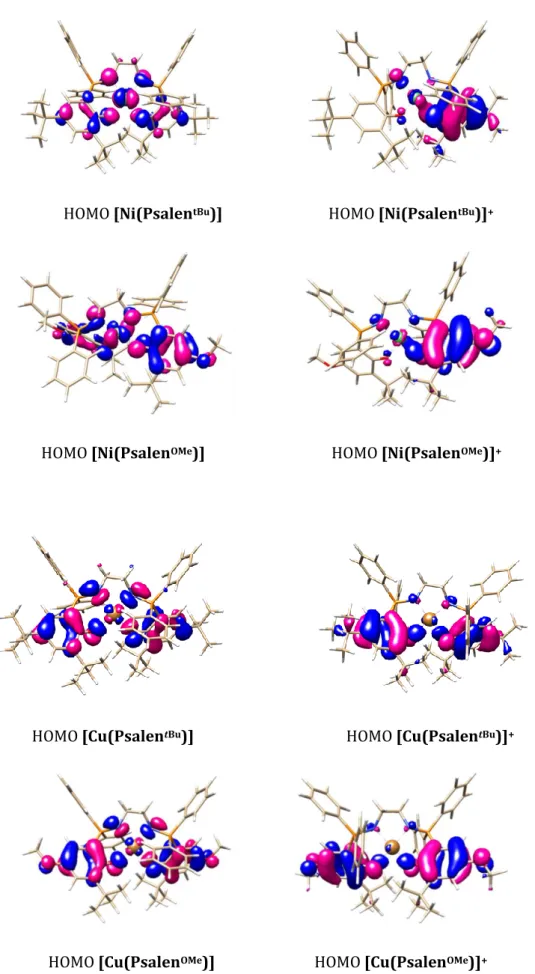
![Figure 42. Active space molecular orbitals occupied by unpaired electrons associated to their “metal” or “ligand” character for [Ni(Psalen OMe )] +](https://thumb-eu.123doks.com/thumbv2/123doknet/2892284.73906/89.892.161.736.626.825/figure-molecular-orbitals-occupied-unpaired-electrons-associated-character.webp)
![Figure 43. Active space molecular orbitals occupied by unpaired electrons associated to their “metal” or “ligand” character for [Ni(Psalen tBu )] +](https://thumb-eu.123doks.com/thumbv2/123doknet/2892284.73906/90.892.160.735.110.309/figure-molecular-orbitals-occupied-unpaired-electrons-associated-character.webp)
![Figure 45. Active space molecular orbitals occupied by unpaired electrons with a “metal-ligand” character for [Cu(Psalen OMe )] +](https://thumb-eu.123doks.com/thumbv2/123doknet/2892284.73906/91.892.149.748.553.713/figure-active-molecular-orbitals-occupied-unpaired-electrons-character.webp)
![Figure 47. 1 H NMR of [Cu( iPr Psalen)] in CD 2 Cl 2 at 20 °C. The signal around 0 ppm corresponds to silicon grease](https://thumb-eu.123doks.com/thumbv2/123doknet/2892284.73906/99.892.231.663.104.403/figure-nmr-cu-psalen-signal-corresponds-silicon-grease.webp)