Scientific Name: Tithonia diversifolia Family: Asteraceae Common Names: Mexican sunflower, Tithonia, Marigold tree
Plant Description
Tithonia is a tropical shrub rich in protein, valuable for feeding ruminants and rabbits. (Heuzé et al. 2016). It is a woody herb or succulent shrub, stoloniferous, annual or perennial, that can reach a height of 2 to 3 m. Mexican sunflower is a fast-growing plant that tolerates heat and drought and can rapidly form large herbaceous shrubs (CABI, 2014). It is adaptable to most soils and could be found growing at roadsides in Trinidad.
Roots: It has a taproot with many fine secondary roots (Mwango et al. 2014).
Leaves: Alternate or opposite, sub-ovate, densely pubescent, 5-17 cm long x 3.5-12 cm broad.
Flowers: Each mature stem may bear several large yellow flowers, up to 12 cm in diameter.
Propagation and Cultivation Mexican sunflower can be easily propagated by direct seeding or by planting cuttings.
Sowing: Seeds can be sown directly or in containers. Cuttings: Should be 20-30 cm long cuttings from green stems and cut at a 45 degree angle at both ends.
Transplanting: Seeds and cuttings can be planted at a spacing of 0.5-0.75 m x 0.75 m (Orwa et al. 2009).
Fertilisation: Organic fertilisers (Manure) can be applied pre-planting and biannually.
Forage Management:
Tithonia can be harvested approximately 3 months after transplanting. It tolerates regular heavy pruning (Sosef et al., 1997). Post-flowering cuttings result in higher yields than pre-flowering cuttings. In Côte d’Ivoire, annual biomass yields of 60 t/ha have been obtained at cutting intervals of 4 months (Sosef et al. 1997).
Forage Fact Sheet
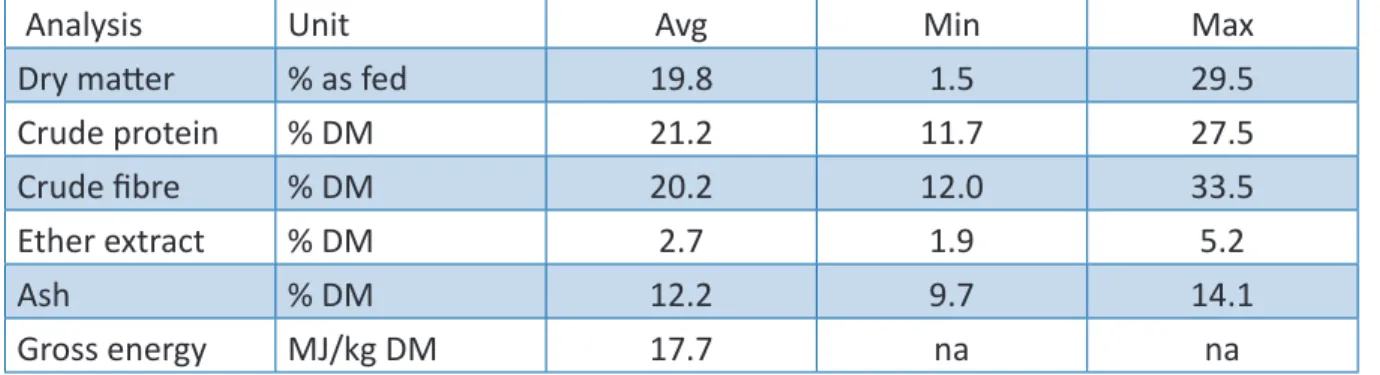
Nutrient content of Tithonia leaves, fresh
Analysis Unit Avg Min Max Dry matter % as fed 19.8 1.5 29.5 Crude protein % DM 21.2 11.7 27.5 Crude fibre % DM 20.2 12.0 33.5 Ether extract % DM 2.7 1.9 5.2
Ash % DM 12.2 9.7 14.1
Gross energy MJ/kg DM 17.7 na na
Table taken from http://www.feedipedia.org/node/15645 Feeding Tithonia to Small Ruminants
Mexican sunflower foliage is a valuable fodder for ruminants, due to its high protein content and relatively high digestibility and degradability.
A normal standard for feeding recently weaned small ruminants is to feed a 4% of the body weight of the animal on a dry matter basis example:
According to the table above the average dry matter of Tithonia is 19.8% which means that 100 lb of fresh Tithonia contains approximately 19.8 lb of dry matter and 80.2 lb of water.
A 100 lb animal would require 4 lb DM and Tithonia should comprise up to 30% of the daily intake therefore 30% of 4 lb is 1.2 lb DM.
To provide 1.2 lb DM of Tithonia you would require 100/19.8*1.2= 6.06 lb of wet Tithonia leaves to be fed.
Mature animals should be fed 2.5% body weight on a dry matter basis. References
1. CABI, 2014. Invasive Species Compendium. Wallingford, UK: CAB International.
2. Heuzé V., G. Tran, A. Boudon, and D. Bastianelli. 2016. Nacedero (Trichanthera gigantea). Feedipedia, a programme by INRA, CIRAD, AFZ and FAO. http://www.feedipedia.org/node/7270 Last updated on February 25, 2016, 14:05
3. Makkar, H. P. S., and K. Becker. 1997. Nutrients and antiquality factors in different morphological parts of the Moringa oleifera tree. J. Agric. Sci., 128 (3): 311-322
4. Mwango, S. B., B. M. Msanya, P. W. Mtakwa, D. N. Kimaro, J. Deckers, J. Poesen, V. Masawe, and I. Bethuel. 2014. Root properties of plants used for soil erosion control in the Usambara mountains, Tanzania. Int. J. Plant Soil Sci., 3 (12): 1567-1580
5. Orwa, C., A. Mutua, R. Kindt, R. Jamnadass, and S. Anthony. 2009. Agroforestree Database: a tree reference and selection guide version 4.0. World Agroforestry Centre, Kenya.
6. Sosef, M. S. M., and L. J. G. van der Maesen. 1997. Tithonia diversifolia (Hemsley) A. Gray. Record from Proseabase. I. Faridah Hanum & L.J.G van der Maesen (Editors). PROSEA (Plant Resources of South-East Asia) Foundation, Bogor, Indonesia.
Please contact the TTGSS at email: [email protected] or 789-8765 and IICA at email: [email protected] / 645-5020 / 645-8886 for further details.