HAL Id: hal-00328593
https://hal.archives-ouvertes.fr/hal-00328593
Submitted on 30 Jun 2003
HAL is a multi-disciplinary open access
archive for the deposit and dissemination of
sci-entific research documents, whether they are
pub-lished or not. The documents may come from
teaching and research institutions in France or
abroad, or from public or private research centers.
L’archive ouverte pluridisciplinaire HAL, est
destinée au dépôt et à la diffusion de documents
scientifiques de niveau recherche, publiés ou non,
émanant des établissements d’enseignement et de
recherche français ou étrangers, des laboratoires
publics ou privés.
A first analysis of the mean motion of CHAMP
F. Deleflie, P. Exertier, P. Berio, G. Metris, O. Laurain, J.-M. Lemoine, S.
Loyer
To cite this version:
F. Deleflie, P. Exertier, P. Berio, G. Metris, O. Laurain, et al.. A first analysis of the mean motion of
CHAMP. Advances in Geosciences, European Geosciences Union, 2003, 1, pp.101. �hal-00328593�
c
European Geosciences Union 2003
Advances in
Geosciences
A first analysis of the mean motion of CHAMP
F. Deleflie1, P. Exertier1, P. Berio1, G. Metris1, O. Laurain1, J.-M. Lemoine2, and S. Loyer2 1Observatoire de la Cˆote d’Azur – CERGA/GRGS, Av. N. Copernic F-06130 Grasse, France 2Observatoire Midi-Pyr´en´ees OMP/GRGS, Av. E. Belin, F-31400 Toulouse, France
Abstract. The present study consists in studying the mean
orbital motion of the CHAMP satellite, through a single long arc on a period of time of 200 days in 2001. We actually investigate the sensibility of its mean motion to its accelero-metric data, as measures of the surface forces, over that pe-riod.
In order to accurately determine the mean motion of CHAMP, we use “observed” mean orbital elements com-puted, by filtering, from 1-day GPS orbits. On the other hand, we use a semi-analytical model to compute the arc. It consists in numerically integrating the effects of the mean potentials (due to the Earth and the Moon and Sun), and the effects of mean surfaces forces acting on the satellite. These later are, in case of CHAMP, provided by an averaging of the Gauss system of equations.
Results of the fit of the long arc give a relative sensibility of about 10−3, although our gravitational mean model is not
well suited to describe very low altitude orbits. This tech-nique, which is purely dynamical, enables us to control the decreasing of the trajectory altitude, as a possibility to vali-date accelerometric data on a long term basis.
Key words. Mean orbital motion, accelerometric data
1 Introduction
Why studying the solely long period effects on orbits, and in particular for the CHAMP satellite? Among the advantages, we can quote the continuous description of the evolution of orbital parameters: over a given period of time, the computed orbital elements are adjusted on observations only at the ini-tial epoch of the arc. That long period approach has been developed by the GRGS, “Groupe de Recherche en G´eod´esie Spatiale”, for about more than 10 years, in the CODIOR soft-ware (Exertier et al., 1994).
Correspondence to: F. Deleflie
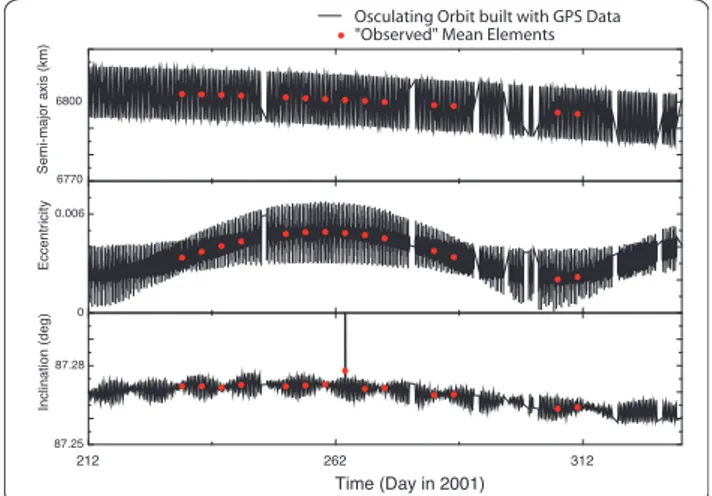
([email protected]) 212 262 312 Time (Day in 2001) 87.25 87.28 Inclination (deg) 0 0.006 Eccentricity 6770 6800 Semi-major axis (km)
Osculating Orbit built with GPS Data "Observed" Mean Elements
Fig. 1. The Observed Mean Elements (circles) deduced from the
osculating orbits
We call “mean motion” the motion described by 6 orbital parameters for which all short periodic variations, linked to the period of revolution of the satellite, have been removed: the osculating differential equations of dynamics are trans-formed in an analytical way to get the averaged equations of dynamics (see M´etris and Exertier, 1995). This transfor-mation has been expressed by M´etris (1991), for all the per-turbations acting on the satellites, with respect to classical keplerian elements: the semi-major axis a, the eccentricity e, the inclination i, the ascending node , the argument of perigee ω, and the mean anomaly M. To take into account the coupling effects between geodynamical parameters, an algorithm deduced from (Deprit, 1969) has been used, and computed with the algebric manipulator MS (Claes et al., 1988). Then the obtained averaged differential system ver-ified by dadt0, dedt0, didt0, ddt0, dωdt0, and dMdt0, is then integrated numerically. The integration step size varies from 12 hours for satellite with a high altitude such as LAGEOS, to 01:30 for CHAMP.
96 F. Deleflie et al.: First analysis of the mean motion of CHAMP
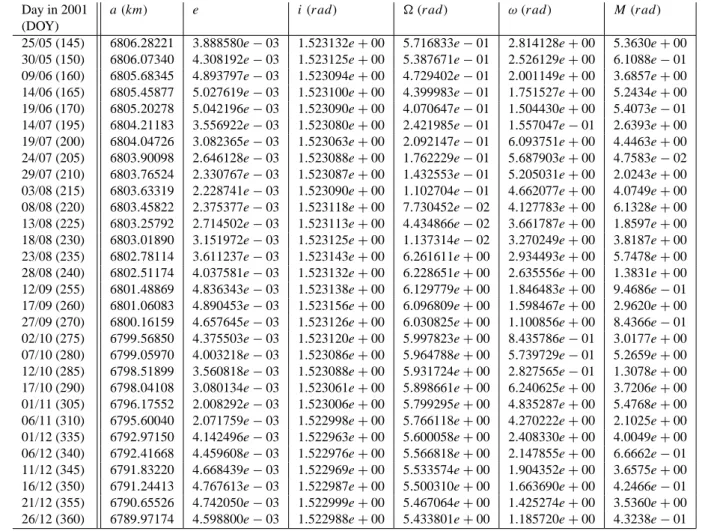
Table 1. “Observed” Mean Elements of CHAMP. (at 0h0min19sfor each date)
Day in 2001 a (km) e i (rad) (rad) ω (rad) M (rad)
(DOY)
25/05 (145) 6806.28221 3.888580e − 03 1.523132e + 00 5.716833e − 01 2.814128e + 00 5.3630e + 00 30/05 (150) 6806.07340 4.308192e − 03 1.523125e + 00 5.387671e − 01 2.526129e + 00 6.1088e − 01 09/06 (160) 6805.68345 4.893797e − 03 1.523094e + 00 4.729402e − 01 2.001149e + 00 3.6857e + 00 14/06 (165) 6805.45877 5.027619e − 03 1.523100e + 00 4.399983e − 01 1.751527e + 00 5.2434e + 00 19/06 (170) 6805.20278 5.042196e − 03 1.523090e + 00 4.070647e − 01 1.504430e + 00 5.4073e − 01 14/07 (195) 6804.21183 3.556922e − 03 1.523080e + 00 2.421985e − 01 1.557047e − 01 2.6393e + 00 19/07 (200) 6804.04726 3.082365e − 03 1.523063e + 00 2.092147e − 01 6.093751e + 00 4.4463e + 00 24/07 (205) 6803.90098 2.646128e − 03 1.523088e + 00 1.762229e − 01 5.687903e + 00 4.7583e − 02 29/07 (210) 6803.76524 2.330767e − 03 1.523087e + 00 1.432553e − 01 5.205031e + 00 2.0243e + 00 03/08 (215) 6803.63319 2.228741e − 03 1.523090e + 00 1.102704e − 01 4.662077e + 00 4.0749e + 00 08/08 (220) 6803.45822 2.375377e − 03 1.523118e + 00 7.730452e − 02 4.127783e + 00 6.1328e + 00 13/08 (225) 6803.25792 2.714502e − 03 1.523113e + 00 4.434866e − 02 3.661787e + 00 1.8597e + 00 18/08 (230) 6803.01890 3.151972e − 03 1.523125e + 00 1.137314e − 02 3.270249e + 00 3.8187e + 00 23/08 (235) 6802.78114 3.611237e − 03 1.523143e + 00 6.261611e + 00 2.934493e + 00 5.7478e + 00 28/08 (240) 6802.51174 4.037581e − 03 1.523132e + 00 6.228651e + 00 2.635556e + 00 1.3831e + 00 12/09 (255) 6801.48869 4.836343e − 03 1.523138e + 00 6.129779e + 00 1.846483e + 00 9.4686e − 01 17/09 (260) 6801.06083 4.890453e − 03 1.523156e + 00 6.096809e + 00 1.598467e + 00 2.9620e + 00 27/09 (270) 6800.16159 4.657645e − 03 1.523126e + 00 6.030825e + 00 1.100856e + 00 8.4366e − 01 02/10 (275) 6799.56850 4.375503e − 03 1.523120e + 00 5.997823e + 00 8.435786e − 01 3.0177e + 00 07/10 (280) 6799.05970 4.003218e − 03 1.523086e + 00 5.964788e + 00 5.739729e − 01 5.2659e + 00 12/10 (285) 6798.51899 3.560818e − 03 1.523088e + 00 5.931724e + 00 2.827565e − 01 1.3078e + 00 17/10 (290) 6798.04108 3.080134e − 03 1.523061e + 00 5.898661e + 00 6.240625e + 00 3.7206e + 00 01/11 (305) 6796.17552 2.008292e − 03 1.523006e + 00 5.799295e + 00 4.835287e + 00 5.4768e + 00 06/11 (310) 6795.60040 2.071759e − 03 1.522998e + 00 5.766118e + 00 4.270222e + 00 2.1025e + 00 01/12 (335) 6792.97150 4.142496e − 03 1.522963e + 00 5.600058e + 00 2.408330e + 00 4.0049e + 00 06/12 (340) 6792.41668 4.459608e − 03 1.522976e + 00 5.566818e + 00 2.147855e + 00 6.6662e − 01 11/12 (345) 6791.83220 4.668439e − 03 1.522969e + 00 5.533574e + 00 1.904352e + 00 3.6575e + 00 16/12 (350) 6791.24413 4.767613e − 03 1.522987e + 00 5.500310e + 00 1.663690e + 00 4.2466e − 01 21/12 (355) 6790.65526 4.742050e − 03 1.522999e + 00 5.467064e + 00 1.425274e + 00 3.5360e + 00 26/12 (360) 6789.97174 4.598800e − 03 1.522988e + 00 5.433801e + 00 1.185720e + 00 4.3238e − 01
Due to divisions by the eccentricity in dedt0, dωdt0, and dMdt0, (Deleflie, 2002) has formulated the averaged differential sys-tem with respect to the non-singular elements for eccentric-ity C = e cos ω, S = e sin ω, and λ = ω + M. For satellites with a small eccentricity such as CHAMP, this is in fact the equations verified by dCdt0,dSdt0,dλdt0 which are integrated in a numerical way, for gravitational effects as well as for non-gravitational effects.
We propose here to apply to the CHAMP orbit the method we have developed for geodetic satellites such as STAR-LETTE (Exertier et al., 1999) or AJISAI (Deleflie, 2002).
We transform in Sect. 2 the osculating orbits computed from May to December 2001 with GPS data to get the “ob-served” mean elements. These quantities are comparable to those computed with the CODIOR software.
Let note that a specific approach has been developed for CHAMP to build the second member of the averaged equa-tions of dynamics verified by non-gravitational forces with the data obtained from the STAR accelerometer (Perret et al., 2001). This specific approach makes it possible to give mean characteristics of the STAR accelerometer, this is the subject of Sect. 3.
The long arc of CHAMP is shown in Sect. 4. Such a long period approach for CHAMP permits to give the characteris-tics of the orbital mean motion on the basis of observations obtained over a long period of time. And for example the initial conditions of the motion. These conditions are all the more determined with a great precision as there are few pa-rameters which are used to compute the mean orbit.
The conclusion (Sect. 5) sums up the reached accuracy on the long arc of CHAMP, and presents what can now be de-veloped to improve it.
2 The removal of short period effects from the observa-tions
To adjust a mean orbit on measurements, it is necessary to get quantities comparable to those computed in the CODIOR software. We call these quantities “observed” mean
ele-ments, even if they are not the quantities effectively observed
(this explaining the inverted comma).
There are two steps to build these “observed mean ele-ments”.
Table 2. Mean characteristics of the STAR accelerometer derived from CODIOR Limits of areas CT CN BT BN (DOY in 2001) (m.s−2) (m.s−2) Aera 1 from 143 to 173 0, 42 0, 47 −1, 64 10−6 −0, 47 10−6 Area 2 from 173 to 226 0, 71 0, 25 −2, 6 10−6 0, 33 10−6 Area 3 from 226 to 281 0, 77 0, 25 −2, 8 10−6 0, 8 10−7 Area 4 from 281 to 293 0, 85 0, 25 −3, 2 10−6 0, 8 10−7 Area 5 from 293 to 341 0, 62 0, 25 −2, 3 10−6 0, 19 10−6
CT: Tangential scale factor. CN: Normal scale factor. BT: Tangential bias. BN: Normal bias.
First, short arcs are computed with a classical numerical integration: we use the GINS software to compute 1-day arcs, from the end of May 2001 to the end of December 2001, derived from on board GPS tracking data with the short per-turbations being present. These orbits are formulated with orbital elements and not with positions and velocities, in or-der to isolate the short from the long period perturbations. The metric elements of all these orbits are shown in Fig. 1.
Secondly, all the short period terms are removed. This filtering approach, applied in the CANEL software, is de-scribed in (Exertier, 1990), and made up of two steps: first an analytical step based on an explicit formulation of the short period terms, expressed in a set of non singular elements for eccentricity. This formulation is deduced from an analytical solution of the Lagrange planetary equations (Deleflie et al., 2003). The osculating elements Eosc contain long as well
as short period terms: Eosc = ELP +ESP. This solution
formulates the short period terms ESPon the basis of the
os-culating elements, terms which are removed from Eosc. This
step enables to remove terms whose amplitude range from decimeters to 10 km. Secondly, there is a numerical step based on a convolution product (Goad, 1977), to filter short terms not yet removed, in particular the resonances with a characteristic period of about a few days: 2,3 days in the
case of CHAMP. That’s why we have chosen a window width equal to 5 days. This width is not far from the Nyquist pe-riod, but allows to get enough “observed mean elements”, about one every 5 days (see Table 1).
As a result, we give the filtered orbital parameters ELP in
Fig. 1.
3 Mean characteristics of the STAR accelerometer
In the CODIOR software, the equations of dynamics are for-mulated in a set of non singular elements for eccentricity: a, C = e cos ω, i, , S = e sin ω, λ = ω + M. We use therefore the averaged Gauss equations to take into account the influence of a perturbative force−→F, with respect to the corresponding mean variables (with a prime). This force is decomposed in the classical frame linked to the satellite, and oriented by the radial position:−→F
R T N
Defining η = √
1 − C02−S02, and ¯n the mean motion
of the satellite (linked to the third law of Kepler ¯n2a3 =µ where µ is the gravitational constant of the Earth), we can write (Deleflie, 2002): da0 dt = 2η ¯ nT dC0 dt = − S0η ¯ na0R + 1 ¯ na0 −C 0 η −C 0 2 + C0(C02+S02) 2(1 + η) ! T − 3 2S 02 cos i0 ¯ na0ηsin i0N di0 dt = − 3 2 C0 ¯ na0ηN d0 dt = − 3 2 S0 ¯ naηsin i0N dS0 dt = C0η ¯ n R + 1 ¯ na0 −S 0 η −S 0 2 + S0(C02+S02) 2(1 + η) ! T +3 2C 0 S0 cos i 0 ¯ na0ηsin i0N dλ0 dt − ¯n = 1 ¯ na0(−3 + η)R + 3 2S 0 cos i0 ¯ na0ηsin i0T (1)
The STAR accelerometer on board CHAMP measures, ev-ery second, the resultant acceleration due to non gravita-tional forces (air drag, Earth albedo, solar radiation, manoeu-vers,...) in these three axes (radial, along-track and
across-track), that is to say the quantities RSTAR, TSTAR, NSTAR. To take into account the instrumental characteristics, these quantities are corrected, in each axe, with a scale factor and
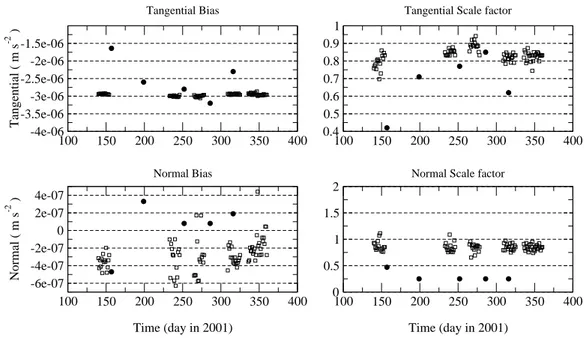
98 F. Deleflie et al.: First analysis of the mean motion of CHAMP 100 150 200 250 300 350 400 Time (day in 2001) -6e-07 -4e-07 -2e-07 0 2e-07 4e-07 Normal ( m s -2 ) Normal Bias 100 150 200 250 300 350 400 -4e-06 -3.5e-06 -3e-06 -2.5e-06 -2e-06 -1.5e-06 Tangential ( m s -2 ) Tangential Bias 100 150 200 250 300 350 400 Time (day in 2001) 0 0.5 1 1.5 2
Normal Scale factor
100 150 200 250 300 350 400 0.4 0.5 0.6 0.7 0.8 0.9 1
Tangential Scale factor
Estimated corrections for 5 periods between may and december 2001
STAR ACCELEROMETER - CALIBRATION RESULTS
with the GRGS tools CODIOR (circle) and GINS (square).
Fig. 2. Characteristics of the STAR accelerometer: comparison between GINS and CODIOR
a bias, before their use in the Gauss equations:
Rreal = CRRSTAR + BR
Treal = CTTSTAR + BT
Nreal = CNNSTAR + BN
(2)
Before the use of these measurements in the CODIOR or-bit computation, the raw data (level 1 data from GFZ Post-dam) have been filtered to reduce the noise, to eliminate out-liers and to fill the data gaps. This numerical preprocessing is realized in three steps:
1. Filtering of the short periods smaller than the orbital pe-riod of about 5400 s in the raw data, thanks to a Vondr´ak filter (Vondr´ak, 1969; 1977),
2. Detection and removal of outliers by comparing raw and filtered data (3σ criterion),
3. Filling of the data gaps using spline interpolations. Only the gaps smaller than the orbital period can correctly be filled.
Due to problems on STAR, the data of the radial axe can not be used (Koenig et al., 2001). We suppose therefore R = 0. Moreover, the biases and scale factors in the two other axes can be affected by very strong variations (in par-ticular the biases), meaning the changes of the spatial envi-ronment of the satellite (magnetic storms for example). Nev-ertheless, they can be considered constant over the duration of a short arc (1 or 2 days).
What is at stake in a long arc computation is the definition of the mean characteristics of the accelerometer, i.e. only one value for each bias and each scale factor over a long period of time. A possible application of such an approach is the study of possible slow drift in these characteristics. With no uncontrolled jumps in the accelerometric data, this would be easy. But these jumps have a great influence on the mean motion. To manage them to a certain extent, we have empiri-cally divided the considered period in five areas (see Table 2). For each area, we have adjusted the bias and the scale factor for the along track and accross track axes (i.e. 20 parameters over the whole period).
The results of these adjustments are shown in Table 2. They have been adjusted at the same time as the initial con-ditions of the arc. Figure 2 shows the comparison between the results derived by CODIOR and those derived by GINS, the GRGS classical software.
The results are quite similar, even if CODIOR adjusts so few empirical parameters. In particular, let note that the tan-gential bias has a better stability in GINS than in CODIOR. The difference of stability of the normal scale factor between the two softwares is still unexplained. A part of these dif-ferences could come from the difference of nature of the ad-justed parameters in CODIOR and GINS. In this figure, for GINS, the plotted coefficients are CT, CN, CTβT, CNβN,
since the parameters adjusted by GINS, CT, CN, βT, βN,
verify:
Rreal = CR(RSTAR + βR)
Treal = CT(TSTAR + βT)
Nreal = CN(NSTAR + βN)
Semi-major Axis Time (DOY) 145 173 226 281 293 335 Eccentricity 145 173 226 281 293 335 Inclination 145 173 226 281 293 335
Fig. 3. Evolution of the metric elements of the long arc of CHAMP.
Nevertheless, we think that we can conclude that there is no slow drift in the accelerometer, drift which can not be seen with short arcs. A longer period of analysis would be useful to confirm that.
4 The Long Arc of CHAMP
On the basis of the available accelerometric data and of the “observed” mean elements, we have computed a mean arc of CHAMP over a period of 190 days in 2001, from May 25th to December 1st: since only the gaps in accelerometric data smaller than the orbital period can correctly be filled, the length of the mean arc computed with CODIOR is shorter than the period when “observed” mean elements are avail-able, but reaches nevertheless more than the period of two revolutions of the argument of the perigee (about 92 days).
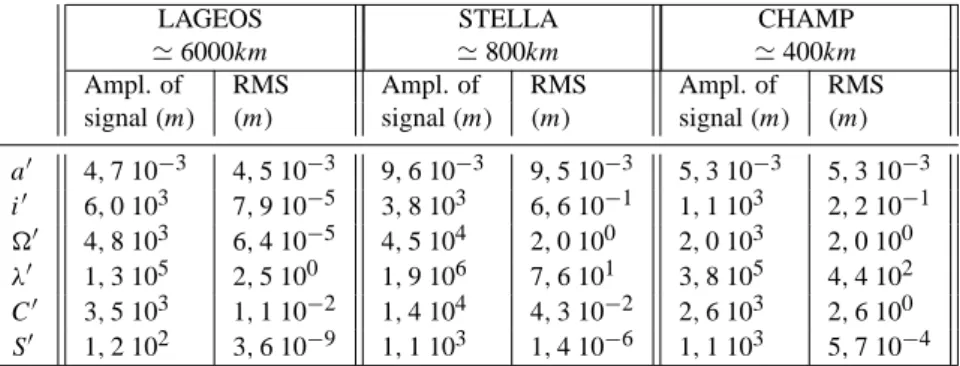
First, we have checked that CODIOR enables to compute a mean orbit as low as this of CHAMP: in Table 3, we show that the semi-analytical model built to compute mean orbits with an altitude of 800 km or more still leads to a great preci-sion, and that the neglected coupling effects have not a strong influence at 400 kilometers.
Over that period of 190 days, we have computed a single long arc with the following standards:
– GRIM5-S1 for the gravity field model (Biancale et al.,
2000),
– (Schwiderski, 1980) for the ocean tides,
– the Love numbers k2=0, 299 and k3=0, 094 to
com-pute the terrestrial tides,
– the VSOP82 theory for the luni-solar effects and the
planets (Bretagnon and Francou, 1988).
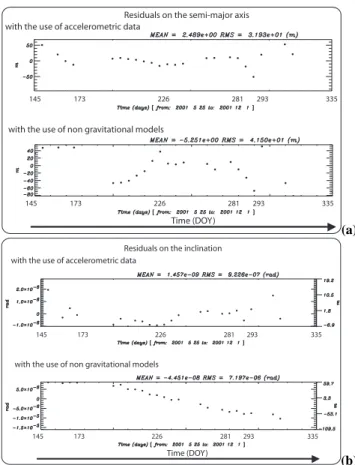
The shapes of the computed metric elements are shown Fig. 3, and the residuals in Fig. 4. In order to validate the averaging method of the accelerometric data, another arc
Residuals on the semi-major axis with the use of accelerometric data
with the use of non gravitational models
145 173 226 281 293 335
145 173 226 281 293 335
Time (DOY)
(a)
Residuals on the inclination with the use of accelerometric data
with the use of non gravitational models
Time (DOY)
145 173 226 281 293 335
145 173 226 281 293 335 (b)
Fig. 4. Comparison of the results obtained with accelerometric data
and with non gravitational models. The residuals we get on the semi-major axis are about 30-40 meters, and have to be compared to the total decrease due to the atmospheric drag which reaches 12 km. For the inclination, we get lower residuals when using accelerome-tric data, since the non-gravitational model we have used does not include the management of shadow effects. On the eccentricity, we get a level of residuals of 2, 3 10−5(which corresponds to 150 m, to be compared to a total variation of about 21 km). The residuals obtained on the angular elements are about 6, 2 10−5on the ascend-ing node, 3, 2 10−3on the argument of the perigee, 1, 2 10−2on the rapid variable.
has been computed with a non-gravitational model includ-ing only the atmospheric drag (modelled in DTM-94; Berger et al., 1998). At the same time, the comparison with the first arc confirms that, at low altitudes, accelerometric data permit to reach a better accuracy of the orbit than non-gravitational models, even if the values of air drag scale factors are close to 1 (see Table 4).
5 Conclusion
Since few years, the concept of mean orbital motion is devel-oped into the CANEL/CODIOR package, allowing to anal-yse the long periodic and secular variations affecting a long arc orbit (typically over several thousands of revolutions).
The mean gravitational model of the semi-analytical the-ory is actually suited for altitude greater than 800 km.
Nev-100 F. Deleflie et al.: First analysis of the mean motion of CHAMP
Table 3. Long period effects on the orbital parameters: Theoretical amplitudes due to gravitational effects, and corresponding residuals in
the CODIOR software. Amplitudes of the long period effects depend on the altitude of the satellite. For each satellite, and for each mean variable a0, i0, 0, C0, S0, λ0, are shown these theoretical amplitudes due to gravitational effects (static part of the gravity field developed up to degree and order 40, terrestrial and oceanic tides, luni-solar effects) in the first column (not including the influence of J2), and the level of
residuals obtained in CODIOR in the second one. In each case, the residuals are not equal to zero because some negligible coupling effects are not included in the model [Deleflie,2002]. All quantities are expressed in meters (m), with arcs computed over a period of 200 days. It appears that the level of the residuals is still very satisfactory, even with a low altitude such as this of CHAMP.
LAGEOS STELLA CHAMP
'6000km '800km '400km Ampl. of RMS Ampl. of RMS Ampl. of RMS signal (m) (m) signal (m) (m) signal (m) (m) a0 4, 7 10−3 4, 5 10−3 9, 6 10−3 9, 5 10−3 5, 3 10−3 5, 3 10−3 i0 6, 0 103 7, 9 10−5 3, 8 103 6, 6 10−1 1, 1 103 2, 2 10−1 0 4, 8 103 6, 4 10−5 4, 5 104 2, 0 100 2, 0 103 2, 0 100 λ0 1, 3 105 2, 5 100 1, 9 106 7, 6 101 3, 8 105 4, 4 102 C0 3, 5 103 1, 1 10−2 1, 4 104 4, 3 10−2 2, 6 103 2, 6 100 S0 1, 2 102 3, 6 10−9 1, 1 103 1, 4 10−6 1, 1 103 5, 7 10−4
Table 4. Values of air drag scale factors. Atmospheric drag model:
DTM-94 Limits of areas (DOY in 2001) Aera 1 from 143 to 173 1, 03 Area 2 from 173 to 226 1, 10 Area 3 from 226 to 281 0, 94 Area 4 from 281 to 293 1, 18 Area 5 from 293 to 335 0, 82
ertheless, an application to the CHAMP orbit has been re-alized here. Instead of mean non-gravitational models, we use accelerometric data provided by the STAR accelerome-ter. These are measured accelerations (of the total surface forces acting on the satellite), which are to be averaged dur-ing the long arc computation. Many difficulties have come from the use of these data, because of the data noise level, the numerous gaps in a long time-serie, and also because of the few parameters used in CODIOR to calibrate the mea-surements.
In this context, we have investigated the sensibility of the mean orbital motion of CHAMP to a long term varia-tion (through the biases and scale factors) of the STAR ac-celerometer. The method is purely dynamical. We use the fact that analysing a single long arc of 200 days is much more efficient than using 1-day arcs, even if the later approach is much more precise, in terms of orbit determination, than the former.
Results of the long arc fitting thus allow to determine em-pirical coefficients with a level of relative precision of around 10−3. This precision directly depends on the variations of the mean orbital elements. Obviously, in case of the CHAMP or-bit, the semi-major axis variations, of about 12 km over a
pe-riod of 200 days, are the greatest, allowing to compute along track coefficients with precision. In addition, the control of the decreasing of the satellite altitude is at the same relative level: the residual in the mean semi-major axis are around 30 m rms.
References
Berger, C., Biancale R., Ill M., and Barlier F.: Improvement of the empirical thermospheric model DTM: DTM94 – a compara-tive review of various temporal variations and propects in space geodesy applications, J. Geodesy, 72, 161–178, 1998.
Biancale, R., Balmino, G., Lemoine, J.-M., Marty, J.-C., Moynot, B., Barlier, F., Exertier, P., Laurain, O., and Gegout, P.: A new global Earth’s gravity field model from satellite orbit pertur-bations: GRIM5-S1, Geophys. Res. Lett., 27, 22, 3611–3614, 2000.
Bretagnon, P. and Francou, G.: Planetary theories in rectangular and spherical variables. VSOP87 solutions, Astron. Astroph., 202, 309–315, 1988.
Claes, H., Henrard, J., Zune, J. M., et al.: Guide d’Utilisation du Manipulateur de S´eries [MS], Int. Publication, Univ. Namur, Bel-gique, 1988.
Cook, G. E.: Perturbations of Near-Circular Orbits by the Earth’s Gravitational Potential, Planet. Space Sci., 14, 433–444, 1966. Deleflie, F.: Th´eorie Semi-Analytique des Mouvements
Quasi-Circulaires Moyens en M´ecanique Spatiale - Applications aux Satellites G´eod´esiques, Th`ese de doctorat de l’Observatoire de Paris, 2002.
Deleflie, F., M´etris, G., and Exertier, P.: An Analytical Solution of the Lagrange Planetary Equations Valid Also for Very Low Eccentricities, Celest. Mech., submitted, 2003.
Deprit, A.: Canonical Transformations Depending on a Small Pa-rameter, Celest. Mech. 1, 12–30, 1969.
Exertier, P.: Precise Determination of Mean Orbital Elements from Osculating Elements, by Semi-Analytical Filtering, Manuscripta Geodaetica, 15, 115–123, 1990.
Exertier, P., M´etris, G., Boudon, Y., and Barlier, F.: Long Term Evolution of Mean Orbital Elements of Artificial Satellites, AGU Geophysical Monograph, 82, IUGG Vol. 17, 103–108, 1994. Exertier, P., Bruinsma, S., M´etris, G., Boudon, Y., and Barlier,
F.: Geodynamics from Mean Orbital Motion of Geodetic Satel-lites, UGGI General Assembly, Birmingham (UK), 121, 262– 270, 1999.
Goad, C. C.: Application of a digital filtering to satellite geodesy, Tech. Report, NOS71-NGS6, NOAA, 1977.
Koenig, R., Neumayer, K. H., Reigber, C., and Zhu, S.-H.: Aspects of Accelerometry in CHAMP Precise Orbit Determination, Eos. Trans. AGU, 82(47), Fall Meet. Suppl., Abstract G41C-07, 2001. M´etris, G.: Th´eorie du Mouvement du Satellite Artificiel – D´eveloppement des Equations du Mouvement Moyen –
Ap-plication `a l’Etude des Longues P´eriodes, Th`ese de Doctorat de l’Observatoire de Paris, 1991.
M´etris, G. and Exertier, P.: Semi-Analytical Theory of the Mean Orbital Motion, Astron. Astrophys., 294, 278–286, 1995. Perret, A., Biancale, R., Camus, A. L., Lemoine, J.-M., Fayard,
T., Loyer, S., Perosanz, F., and Sarrailh, M.: CHAMP mission: STAR Commissioning Phase Calibration/Validation Activities in CNES, Technical Report CNES, 2001.
Schwiderski, E. W.: Ocean tides, Part 1: Global ocean tidal equa-tions, Marine Geodesy, 3, 161–207, 1980.
Vondr´ak, J.: A contribution to the problem of smoothing observa-tional data, Bull. Astron. Inst. Czech, 20, 6, 349–355, 1969. Vondr´ak, J.: Problem of smoothing observational data II, Bull.