O
pen
A
rchive
T
OULOUSE
A
rchive
O
uverte (
OATAO
)
OATAO is an open access repository that collects the work of Toulouse researchers and makes it freely available over the web where possible.This is an author-deposited version published in : http://oatao.univ-toulouse.fr/
Eprints ID : 16347
To link to this article :
URL http://https://prodinra.inra.fr/?locale=fr#!ConsultNotice:188835
To cite this version : Havet, Alain and Coquil, Xavier and Fiorelli,
Jean-Louis and Gibon, Annick, and Martel, Gilles and Roche, Bénédicte and Ryschawy Jukie and Schaller, Noémie and Dedieu, Benoît :
Crop-livestock interfaces established through adaptations of farmers' practices over the short and long term (2012), II International Symposium on
Integrated Crop-Livestock Systems, Porto Alegre, Brésil, pp.1-11
Any correspondance concerning this service should be sent to the repository administrator: [email protected]
Crop-livestock interfaces established through adaptations of farmers’ practices over the short and long term
A. HAVET1, X. COQUIL2, JL. FIORELLI2, A. GIBON3, G. MARTEL4, B. ROCHE4, J. RYSCHAWY3, N. SCHALLER1, B. DEDIEU5
1
INRA, Umr SAD APT, Grignon, France [email protected] 2
INRA UR Aster, Mirecourt, France [email protected], [email protected] 3
INRA, Umr Dynafor, Toulouse, France [email protected], [email protected]
4
INRA Ur SAD Paysages, Rennes, France [email protected], [email protected] 5
INRA Umr Metafort, Theix, France [email protected]
Introduction
Since the 1960s, there has been a global trend toward specializing and intensifying farming systems in order to produce more. However, several authors (Hendrickson et al., 2008; Griffon, 2009; Russelle et al., 2007; Wilkins, 2008) have denounced agricultural development based on these systems, citing such negative impacts as the excessive build-up of nutrients in soil and water, economic dependency on product prices and a decrease in biodiversity. Conversely, integrated crop-livestock farming systems (CLFS), which combine crop production with animal husbandry (Russelle et al., 2007, Hendrickson et al., 2008), are now being reconsidered as a means of improving farm and land sustainability (Herrero et al., 2010). CLFS systems improve nutrient cycles (via exchanges of manure and straw) and are a source of economies of scope (Vermersch, 2007). They have the potential to bring about diversification in cropping plans, crop rotations and crop and grassland locations (Bonny, 2011). This double nature of diversity (of agricultural activities, of resources for production) can be seen from the adaptive capacity point of view (Milestad et al., 2012), i.e. as a source of the farming systems’ flexibility.
Most CLFS studies that have been conducted thus far refer to experimental or modeling approaches (Ryschawy et al. 2012b). There is a lack of knowledge on the interfaces between livestock and crop management in farming systems themselves, through on farm studies. The aim of our investigation was to analyze the crop-livestock interfaces in CLFS systems at different spatial and temporal scales, based on the assumption that the ways in which farmers adapt their CLFS farms over time reveal the original crop-livestock interfaces. Adaptive capacities refer to different time scale of dynamic approaches (Dedieu and Ingrand, 2010). Long term trajectories of farm-family systems (several decades, at the territory level), reveal the place of the combining of activities within farm’s path of development (Evans, 2009) through stabilities, on crisis-induced bifurcations (severe drought, erosion) or opportunities. Medium term (several years) and short term (the chaining of periods within the year) analysis, within one farm development sequence, can show how the CLFS adapt to hazards, prices volatility and climate variability. Calibration of the agricultural system and the functions of different constitutive elements, so as to benefit from buffer capacities on one side and adjustments – regulations on the other, so as to react quickly to irregularities are the two sides of farmers decisions in regard with adaptive capacities (Dedieu and Ingrand, 2010). Medium term can also position research on transition sequences: what is at stake is how to engage change, notably here on the way to reduce the use of inputs, to move towards self-sufficiency. All that dynamic approaches applied with farm surveys or with clinical approaches (David, 2004) of individual farm case will contribute to this paper to analyze crop livestock interfaces:
farmers’ choices pertaining to cropping plans (dimensioning of crop areas and grasslands) and the spatial location of crops and grasslands, soil fertility management through the inclusion of grassland in crop rotation, multifunctionality of crops, contribution of specific animal batches to the regulation of cropping systems and interactions between crop species combinations and livestock feeding equilibrium.
Materials and Methods
Our paper associates different studies (n = 6) realized in France, that are summarized below. We gather the knowledge produced on each study by identifying several transversal traits of what the on-farm and dynamic approaches lead to, declining crop livestock interfaces. 1. Materials
Data were collected for 6 case studies covering oceanic, continental and semi-oceanic regions of France, and involving mostly beef and dairy cattle.
Crop livestock as farms paths of development in Coteaux de Gascogne (one case study, CS1): Coteaux de Gascogne (Pyrenean Piedmont in south western France) is an upland area where there has been limited specialization in agriculture. In this hilly region, half of the farms currently use a mixed crop-livestock system including cattle and cash crops, while the others specialize in either crops or cattle. We carried out spatially explicit surveys of all the farms located in four municipalities (56 farms) to assess the local diversity in the farm characteristics and the changes undergone since 1950.
Crop-livestock in intensive farming systems in western France (four case studies, CS2 to CS5):
For diverse environmental reasons, grassland conservation or development has become an important issue in livestock farming systems in Western France, especially dairy cattle farms. We studied many dairy farms with different levels of self-sufficiency in terms of their inputs, particularly straw and animal feed. The forage systems of these farms, which are located in intensive arable crop or intensive crop-livestock production regions, are undergoing changes.
- Agricultural specialization in crop production in the Pays de Caux (north western France, CS2) has resulted in erosive runoff. Grasslands are increasingly being recognized as a tool for mitigating this phenomenon. In order to assess the possibility of developing such a tool in dairy systems, we surveyed eight dairy farms and conducted an economic assessment of different farm management options.
- In the Plaine de Niort (western France, CS3), the conversion of grasslands into intensive annual crops led to a huge decline in the populations of Little Bustards (Tetrax
tetrax, a heritage bird species). This trend was reversed in 2004 thanks to agri-environment
schemes. In order to assess the role of grasslands in production systems, we analyzed: (i) farmers’ management choices (24 farms) and (ii) farmers’ decisions and adaptation regarding crop choices, crop successions and crop allocation across fields (5 farms).
- In Brittany (western France), the intensification of farming systems has led to farm enlargement and specialization toward animal production (dairy or beef cattle, pigs and poultry). Land use simplification at the regional level has resulted in three main categories of land use: grassland (38% of farm area), maize (26%) and winter cereals (26%) (ASP, 2010). Dairy farmers have developed a variety of livestock farming systems, ranging from maize-based systems to grassland-maize-based systems, which are sometimes combined with cash crops.
We studied the various managements of livestock and grasslands in 21 farms by means of surveys (CS4). We also surveyed 28 pig farms (CS5), some of which incorporate dairy or cash crop production. We explored the links between cropping plans and the origin of feed (bought or produced on-farm).
Transition of crop-livestock toward high levels of self-sufficiency (CS6) (East and West): In all regions of France, farmers may choose to steer their farming activities toward self-sufficient or organic farming systems. This case study deals with the design of self-self-sufficient and organic mixed crop-dairy systems in the Mirecourt experimental farm (Plaine des Vosges, north eastern France) and two commercial farms that are part of the Sustainable Agriculture Network in western France. The transitions designed by the experimenters and farmers for these mixed crop-dairy systems were analyzed so as to learn how free from inputs self-sufficient systems can be managed.
Self-sufficiency, environmental considerations (erosion, biodiversity), and long term paths of development: the reasons for studying crop livestock farming can be diverse in the gathering exercise we present here.
Note two important gradients within the cases:
- various functions of crops production, from crops for cash to crops for cattle or pig feeding (as extremes polarities) ;
- self-sufficiency as a primary or a secondary goal for the farming system. In the first case, animal and crop performances are due to the way farmers achieve this primary objective. In the other case, the objective is to minimize inputs.
2. Methods
In all the case studies, farmers’ practices and farm trajectories were analyzed in relation to the framework of the European Livestock Farming System approaches (Gibon et al., 1999; Dedieu et al., 2008). Farm management was considered via a global approach, whereby farms are viewed as finalized systems. In such systems, the farmer and his family aim to achieve their own objectives, within the limits of their advantages and constraints, by combining human and biotechnical subsystems and exchanging information (Capillon, 1993; Osty & Landais, 1993).
In two of the case studies (CS3 and CS6), we analyzed the planning and adjustment dynamics relating to (i) crop rotation decisions, via repeated surveys (Schaller et al., 2011), and (ii) farmers’ practices concerning crop and livestock management during transitions toward more self-sufficient systems (Coquil et al., 2011).
In situation 1 (CS1), we carried out an exhaustive and retrospective assessment of all the farms based on a series of long-term surveys dating back to 1950. We analyzed farm trajectories to identify the ‘paths to last’ of CLFS systems (Ryschawy et al., 2012a).
Results
Ryschawy et al. (2012a) have defined five types of past trajectories of change in CS1. Of these, four have been found to lead to mixed crop-livestock systems. The first ‘path to last’ leading to mixed crop-livestock farming has to do with maximizing self-sufficiency by combining crops and livestock. The second path involves the constant diversification of production to benefit from economies of scope and safeguard the farm against market fluctuations. The other two paths consist in the enlargement and progressive adaptation of the farm to a family-based workforce. The survival of mixed crop-livestock systems associated with these two paths is highly conditioned by workforce availability. Only the fifth ‘path to last’, which involves enlargement and economies of scale, does not lead to any mixed crop-livestock system.
Ryschawy et al. (2012a) have highlighted the major drivers of change that have influenced the survival of CLFS systems (Table 1). Since 1950, CLFS systems have been marginalized in European agricultural development. The globalization of the market and the orientations of CAP (European Common Agricultural Policy) subsidies have encouraged the enlargement and specialization of farms to achieve economies of scale (Ryschawy et al., 2012b). The importance of the local territorial context with regard to the potential economic advantages of mixed crop-livestock systems has been underlined. In CS1, CLFS systems are considered to be traditional, which has contributed to their survival in the region. Mixed crop-livestock systems are mostly found in unfavorable areas, where economic results are limited by soil and climatic conditions (Ryschawy et al., 2012a). Nevertheless, the choices made by the farmers and the values to which they adhere have worked against these driving forces, thereby ensuring the survival of some mixed crop-livestock farming systems.
In view of the current changes in these driving forces, maximizing self-sufficiency and diversifying production appear to be appropriate adaptive capacities for facing the current challenges and maintaining mixed crop-livestock systems in Europe.
Table 1: Major drivers of change that have influenced the survival of CLFS systems (Ryschawy et al., 2012a) Group of
factors
General economic and political environment Farm structure Regional
location Driver of
change
Market globalization European CAP orientations Decrease in
available workforce Tradition associated with CLFS Low agricultural prices Fluctuations of input and product prices Production-based subsidies Second-pillar environmental subsidies Impact on CLFS survival - + - + - +
2. Achieving self-sufficiency in mixed crop-livestock systems by enhancing crop-livestock interfaces
The paths to self-sufficiency in the dairy CLFS systems that were studied reveal the presence of new crop-livestock interfaces. Such paths increase exchanges between crop and livestock systems to limit recourse to externally bought inputs. The interfaces concern such aspects as the dimensioning and location of crop areas and grasslands, soil fertility, crop multifunctionality, animal batches and crop species combinations in relation to livestock feeding. These interactions were mainly analyzed at the farm level. Both short and medium time scales were considered.
In CS3, annual cropping plan decisions were found to depend on a certain crop function hierarchy, which is a classification of crops based on farmers’ representation of them (Scahller, 2011): (i) priority crops fulfill essential functions for farmers (e.g. incomes, forage providing) and cannot be replaced by other crops; (ii) complementary crops fulfill an essential function but may be replaced by another crop (e.g. maize can be replaced by sorghum); (iii) optional crops fulfill non essential functions in farmers point of view but this function is punctually interesting (e.g. a supplement forage attempted one year, extension of the cropping sequence with winter barley). Examples of functions include ‘providing protein-rich forage’ or ‘providing high-energy roughage’, and so on. Annual cropping plan decisions also depend on agronomic constraints (e.g. crop return time) and plot characteristics (e.g. soil quality, distance to cowshed). It appears that the emphasis placed on priority crops is quite inflexible: farmers tend to adjust the area dedicated to priority crops as much as possible, even sometimes by changing the way in which they divide up their farmland into plots.
In CLFS systems, cropping plans are often more complex due to multiyear forages in crop rotations and the fact that plot sizes are smaller than those in arable farms (CS3: Schaller, 2011). In CLFS systems, farmers manage the relationship between crop and livestock production. Any changes in cropping plans are aimed at providing an annual food supply for the herd while taking into account (i) the natural properties of the land, (ii) field pattern functionalities, and (iii) the desire to attain feed and straw self-sufficiency in the system. In herbivorous livestock farming, improved self-sufficiency in feed can sometimes be achieved by increasing the size of plots devoted to forage crops and possibly feed crops. During conversions to organic farming, there is a tendency for CLFS farms to increase grassland areas and decrease other forage and cash crop areas as well as stocking rates (CS6). This leads to cropping plan changes and subtle distinctions between the agronomic potential of the various fields. Conversely, in an attempt to increase their self-sufficiency, many intensive dairy farms (CS2, CS3 and CS4) have replaced grass with maize and, occasionally, winter cereals. Nowadays “protein sufficiency” has become a real issue, but is not something that is always easily attained on-farm (CS6: Coquil et al., 2011). In a few cases, rape crops have been developed for this purpose (CS4). In pig farming (CS5), self-sufficiency is often achieved by incorporating more maize in cropping plans.
During the agricultural year, farmers may change their cropping plans. For instance, they may decide to increase their forage stocks for the following year, in anticipation of possible shortages. For example (CS3), at the end of the second hay-cutting period (around June-July), if the amount of stored forage is less than the desired minimum, farmers can change their plans and sow grass in the autumn or the following spring (after a wheat or winter barley crop) instead of sunflower or pea as originally planned. Such a decision may also be made after the third and last hay harvest, once the final quantity of forage available for the next winter is known (Havet et al., 2010a).
In addition to these overall trends, CLFS systems evolve constantly to adapt to certain constraints. Over medium time scales, changes made to arable crops in CLFS farms are affected by the CAP. At the landscape level in CS3, we observed a decrease in the total area devoted to sunflower between the late 1990s and 2006. Before 2003, farmers would grow ryegrass until May, around which time they would harvest it for hay, before ploughing to sow sunflower and obtaining an annual CAP subsidy (direct payments for rape and oil crops). Following 2003 and the CAP reform, farmers started to receive subsidies for grasslands as well; consequently, they now maintain ryegrass for more than one cut per year, motivated by grassland subsidies and the production of forage stocks (Schaller et al., 2012).
b. Spatial location of crops and grasslands
There are two rationales behind the spatial location of crops and grasslands: on the one hand, in some areas, environmental protection (biodiversity, runoff) presupposes the enlargement of grasslands, and on the other hand, the desire to achieve forage self-sufficiency encourages some farmers to limit the cultivation of drought-sensitive crops like maize in certain kinds of fields (CS3). In making these choices, farmers consent to a potential reduction in the maximum technical performance of their crops and livestock.
In CS3, adaptation to drought is one of the reasons for a decrease in maize silage area and an increase in grassland area. Furthermore, local protected birds require grass for their development. Initially based on a common intensive model in the late 1990s, farms progressively underwent changes and by 2006, four distinct types, which are presented in Table 2, could be identified. This table also shows that the milk production performance per cow decreases when farmers choose to let milk cows graze. Farmers are observed to take into account soil depth when deciding whether or not to grow maize; similarly, the proximity of fields to cowsheds is considered when it comes to sowing grass (Havet et al., 2010b).
Table 2. Identification of farms with dairy cattle in CS3 (Havet et al., 2010b)
Type Maize irrigation Grass / MFA (%) Milk / cow (kg) Milk cow grazing Maize / MFA (%)
1 no 35-45 6000-8000 possible 30-40
2 no 10 8000-9000 not possible 60-80
3 yes 10-35 7000-9000 not possible 50-80
4 yes 35-50 7000-8000 possible 20-40
In the same way, we detected, at the landscape level, a certain regularity in the spatial distribution of crops: maize is frequently grown as a monoculture in the vicinity of grasslands, which are traditionally located in deep and humid soils (Schaller et al., 2012).
The priority in intensive dairy farming is to fulfill the forage requirements of dairy cows all year round. Farmers often use maize silage and grassland grazing at a high stocking rate for periods of varying lengths in spring (CS2 and CS4). Some farmers currently limit the amount of purchased inputs and aim to ensure farm self-sufficiency by including more grassland in their crop successions (80% grassland in the fodder area instead of 60% in conventional systems, for instance in CS2). Their decisions regarding the spatial allocation of grasslands are not only influenced by the possibility of having milk cows graze near cowsheds, but also reflect, in CS2, their stated objective of reducing erosive runoff via the establishment of grasslands in fields located in the pathways followed by surface runoff during heavy rains (Faure et al., 2010).
The use of fields on a farm scale is less specialized when converting to organic agriculture (CS6): temporary grasslands are integrated into arable land and crops are integrated into areas that were exclusively devoted to grazing prior to conversion.
c. Soil fertility management by incorporating grassland into rotations
Crop rotations integrating multiyear temporary grasslands or annual arable crops can be positive for plant production. We observed that farmers try to enhance these positive effects at the farm level.
We identified two types of projects involving self-sufficient organic farms (CS6): the first aims to produce milk from grasslands, while the second aims to produce milk and wheat for feed, as well as to attain self-sufficiency in the production of straw for litter. In the first case, the objective of having annual crops is to renew grasslands in order to maintain the system’s productivity. In the second case, the cultivation of grasslands meets the agronomic goals of entire cropping systems by breaking annual and multiyear weed cycles and providing the soil with nitrogen and organic matter. Farmers take into account the pertinence of using multiyear grasslands as starter crops: indeed, in tillage management, at the end of a crop rotation cycle, farmers are less concerned about weeding because of the anti-weed effect of the subsequent grassland (Coquil et al., 2011).
d. Multifunctional nature of specific crops
Most of the time, a single crop cultivated in CLFS farms can be used in different ways, for example as forage or a cash crop. Thus, farmers can easily decide to change the function of their crops in the course of the year. Farmers may conduct experiments to test the forage quality of crops that they wish to introduce in their forage systems. While maize is a common forage feed, other crops are less often subjected to functional changes for use as buffers. In CS6, farmers test the pertinence of cultivating annual crops for animal feed. For instance, fodder beet is used to supplement grazed grasslands in spring; spelt is incorporated in crop rotations on account of its mineral content, which is beneficial to calves. Another possibility is to use arable crops as forage when they are overrun by weeds: this leads to a certain on-farm valorization that cannot be achieved in specialized cropping systems (Coquil et al., 2011).
In CS3, during the spring period, farmers aim to produce sufficient forage stocks for the next winter. As we have seen, forages can be introduced to offset stocks that are found to be insufficient. However, farmers can only make arable crop substitutions, that is, using forage crops that fall under one of four forage categories that seem to be defined according to their reasoning as: (i) extremely high-energy roughage, (ii) roughage that is equally high in energy and nitrogen, (iii) high-energy concentrates that are produced on-farm, and (iv) externally bought high-energy and high-nitrogen concentrates. Therefore, farmers can ensile wheat (category ii) if they find forage stocks of this category to be insufficient, while cultivating wheat primarily for sale, or even for animal feed (category iii) (Schaller, 2011).
Dairy farmers, for whom maize is the priority forage for milking cows, tend to provide more surface to maize crop than needed. They choose in autumn whether each field is dedicated to silage production or to sale (CS4). This choice is made according to forage needs, maize yields and less according to incomes needs: incomes are opportunities in this case.
e. Contribution of specific animal batches (in slow-growth programs) to cropping system regulations
The quality of forage that is intended for stocking purposes is dependent on the agronomic properties of the fields and on management.
CLFS systems in CS6 are managed in a very adaptive way, with low planning. In one of the farms, the farmer aims to manage the quality of the grass that is grazed by milk cows. Research on regrowth quality has led to a reduction in grazing refusals by milk cows: a batch of animals with low dietary requirements (heifers, dry cows) is made to graze on these refusals. In CS6 Mirecourt experimental farm, in order to avoid the invasion of temporary grasslands by rumex, animals with low growth requirements, such as heifers approaching the end of pregnancy, graze on infested fields in late summer to limit rumex development all over the crop rotation. Another management aim, that of increasing forage proportion in hay, has been achieved by means of early turnouts of heifers to temporary grasslands i.e. topping. Cutting can thus be postponed for about two weeks, which raises the likelihood of making hay as opposed to grass silage.
f. Interaction between crop species combinations and livestock feeding equilibrium
In CLFS farms that strive to achieve self-sufficiency, crop species combinations depend on the diversity of the selected diet. Farmers make decisions at different times during the agricultural year, or between years. We studied two different types of self-sufficiency: organic farming in Mirecourt with a focus on interannual diversity (CS6) and pig farming with a focus on the impact of an on-farm feed production unit (CS5).
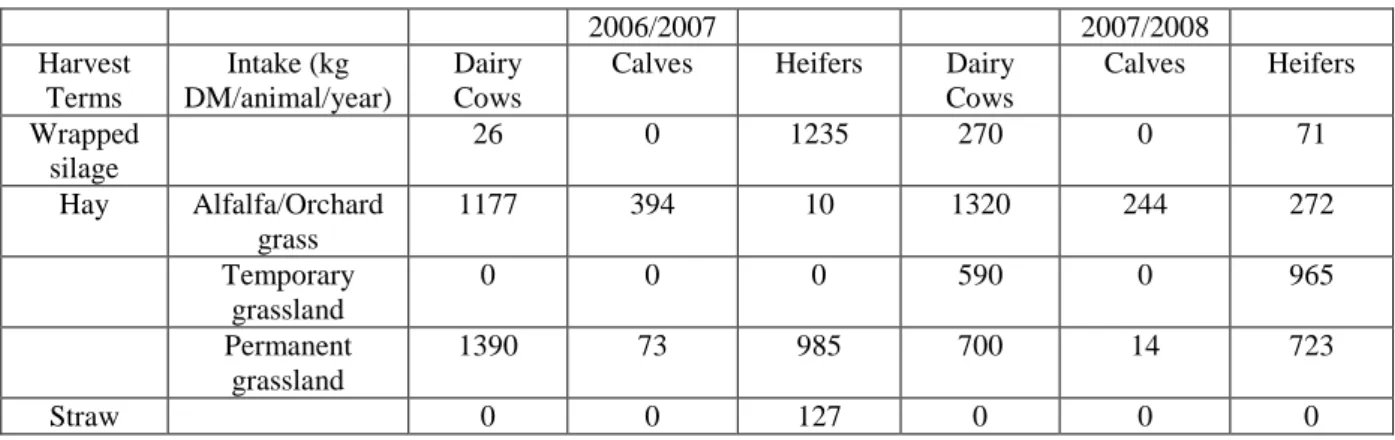
In Mirecourt, self-sufficiency consists in feeding the herd with resources produced on the farm itself (forages, concentrates), and more specifically by: (i) managing arable and forage areas to obtain adequate forages, and (ii) compensating for variations in the availability of crop and forage areas, or interannual yield variations. In intensive systems, crop rotation and forage management strategies (cultivation, harvest or purchase) ensure adequate feed ration levels in terms of consistent energy and nitrogen contents. However, in organic farming, farmers must cope with variations in availability during grazing periods or indoor feeding in winter. Grazing by milk cows is carried out on both permanent and temporary grasslands comprising alfalfa/orchard grass. Given the difficulty in getting milk cows to graze on alfalfa, the experimentators only carry out alfalfa/orchard grass grazing when there is a lack of forage, for instance during drought periods, since alfalfa is resistant to water deficits. They make mid-term adjustments for indoor feeding in winter: calves and milk cows have relatively regular diets from one year to another, whereas heifers are fed the remaining stocks and therefore experience more dietary changes from year to year (Table 3). Over the long term, herd size is adjusted through early culling and the sale of animals, which also helps to cope with insufficient stocks of forage and hay (Coquil et al., 2009).
Table 3: Interannual variations in diets (excluding grazing) for three batches, in Mirecourt (Coquil et al., 2009)
2006/2007 2007/2008 Harvest Terms Intake (kg DM/animal/year) Dairy Cows
Calves Heifers Dairy
Cows Calves Heifers Wrapped silage 26 0 1235 270 0 71 Hay Alfalfa/Orchard grass 1177 394 10 1320 244 272 Temporary grassland 0 0 0 590 0 965 Permanent grassland 1390 73 985 700 14 723 Straw 0 0 127 0 0 0
Refusals 0 0 0 0 0 346 TOTAL 2601 469 2358 2880 258 2377 Cereal/Protein-rich plant1 509 112 2 198 67 2 Cereal2 72 66 42 421 77 11 TOTAL Concentrates 586 179 44 652 144 13
1 oats/horse bean; triticale/peas; barley/lupine, etc.; 2 barley, triticale, oats, spelt, rye, etc.; DM: dry matter
In CS5, formula feed self-sufficiency is an objective of some pig farms possessing an on-farm feed production unit (FPU). Given that the agricultural area per farm in Brittany is often too small to feed herds, farmers tend to saturate their fields with wheat and maize. Conversely, specialized pig farms without an FPU have more varied cash crop rotations: diversification is justified by the objective of best prices and yields (Tersiguel et al., 2012).
Discussion and Conclusion Is CLFS a way to sustainability?
Our results show that CLFS farms can last over the long term. Increasing the interaction between livestock and crops results in new adjustment practices (e.g. cropping plans changing during the agricultural year), the emergence of multiple uses for crops (for sale or for use as animal feed, straw for litter, to increase the agronomic potential of soil, etc.) and the development of individualized functions for animal batches (e.g. early grazing by heifers for topping grasslands). Such diversification safeguards CLFS farms against hazards and enhances their adaptability, which is a means of increasing sustainability (Darnhofer et al., 2010). However, this only applies to areas where farm production is supported by a nearby production chain. For instance, in CS1, the dairy production chain is being threatened by the decline in the number of dairy farms and if milk collection were to cease, all the CLFS farms in the area would have to stop production for the lack of another outlet.
The quest for complete self-sufficiency is another efficient and sustainable method of enhancing the interfaces between crops and livestock. However, Holling (2001) has established that this strong connectedness, which is linked to decreased resilience, might lead to a certain weakness that would force these systems to be redesigned if an external impact were to prevent interactions from taking place. According to Holling (2001), it is indeed highly possible that such situations may need to be redesigned.
The diversity of the values of the indicators that were studied calls for a better understanding of farmers’ overall decisions and practices.
In their study of CLFS farms that took into account economic and environmental aspects, Ryschawy et al. (2012b) showed that CLFS farms are rarely the most ideal systems when compared to specialized ones, but are certainly not the least ideal either, which concurs with previous findings in the literature. They have underlined the importance of the local territorial context in the potential economic advantages of mixed crop-livestock systems. For instance, as crop productivity is limited by soil and climatic conditions, European CLFS farms are mostly found in unfavorable areas. CLFS systems have been marginalized in European agricultural development, and current agri-environmental policies are aimed at providing assistance to mixed crop-livestock farms in favorable areas (CS2 and CS3) rather than unfavorable ones.
The research of self-sufficiency in farms goes also through cooperation between farms and has various consequences concerning biodiversity at landscape level. Studying this level seems a new challenge to better understand CLFS developing.
So, Schaller et al. (2011) have shown that manure and straw exchanges between farms partially determine farmers’ choices pertaining to crops and crop successions. Manure provided by livestock farmers allows farmers specializing in crop production to grow spring crops on a large area, over which they may spread this organic fertilizer at the end of winter. The possibility of obtaining straw without having to grow cereal crops allows CLFS farmers to devote a larger area to forage crops and seed oil crops, as well as increase the range of crops cultivated. Otherwise, the effects of a goal of farm self-sufficiency can be opposite at landscape level: diversification and the increasing importance being given to grasslands have positive effects on biodiversity for milk production (CS2 and CS3), whereas feed production units on pig farms does not lead to crop diversity (CS5). At least, Bamière et al. (2011) have shown that public policies measures that are implemented must be reflected at the level of the landscape field pattern in order to ensure the greatest impact on biodiversity; for instance, Little Bustards (Tetrax tetrax) depends on the location of crops and grasslands at this level. Our results indicate a large variability in crop-livestock interfaces among farms, even within a given situation. This variability constitutes a valid argument for increasing interdisciplinary research efforts in order to better understand farmers’ decisions, taking into account factors such as the organization of labor, social interactions, economic constraints, etc. (Gibon et al. 2010). Moreover, in order to support the development of agriculture in a way that enables production and landscape management functions to be combined within a given territory, this research must be carried out by working in conjunction with farmers, agricultural advisors, policy decision-makers and other rural stakeholders (Gibon et al. 2012).
References
ASP – Agence de Services et de Paiement (2010). Registre Parcellaire Graphique Anonyme de 2009. http://www.asp-public.fr/?q=node/856.
Bamière L., Havlik P., Jacquet F., Lherm M., Millet G. and Bretagnolle V. (2011). Farming system modelling for agri-environmental policy design: the case of a spatially non-aggregated allocation of conservation measures.
Ecological Economics, 70, 891-899.
Bonny S. (2011). L’agriculture écologiquement intensive: nature et défi. Cahiers Agricultures, 20, 451-462. Capillon A. (1993). Typologie des exploitations agricoles, contribution à l’étude régionale des problèmes
techniques, thèse INAP-G, tome 1, 48 pp.
Coquil X., Blouet A., Fiorelli J.L., Bazard C. and Trommenschlager J.M. (2009). Conception de systèmes laitiers en agriculture biologique : une entrée agronomique. Inra Prod. Anim., 22 (3), 221-234.
Coquil X., Béguin P. and Dedieu B. (2011). Systèmes de polyculture élevage laitiers évoluant vers l’AB et l’autonomie : un renforcement des interfaces cultures/élevage. In: colloque de la SFER, les transversalités de
l’Agriculture Biologique, 18 pp.
Darnhofer I., Bellon S., Dedieu B. and Milestad R. (2010). Adaptiveness to enhance the sustainability of farming systems. A review. Agronomy for Sustainable Development, 30, 545-555.
David A. 2004. Etudes de cas et généralisation scientifique en sciences de gestion. XIIIème Conférence de l’Association Internationale de Management Stratégique – AIMS, 20 pp.
Dedieu B., Faverdin P., Dourmad JY. and Gibon A. (2008). Système d’élevage, un concept pour raisonner les transformations de l’élevage. Inra Prod. Anim., 21 (1), 45-58.
Dedieu B. and Ingrand S. (2010). Incertitude et adaptation : cadres théoriques et application à l'analyse de la dynamique des systèmes d'élevage. Productions Animales, 23 (1), 81-90.
Evans N. (2009). Adjustment strategies revisited: agricultural changes in the Welsh marches. J. Rural. Stud., 25, 217 – 230.
Griffon M. (2009). Pour des agricultures écologiquement intensives, des territoires à haute valeur
environnementale et de nouvelles politiques agricoles. Éditions de l'Aube et Conseil général des Côtes d'Armor,
109 pp.
Gibon Sibbald A.R., Flamant J.C., Lhoste P., Revilla R., Rubino R., Sørensen J.T., 1999 Livestock farming systems research in Europe and its potential contribution for managing towards sustainability in livestock
farming.Livestock Production Science, 61, 121–137
Gibon A., Sheeren D., Monteil C., Ladet S. and Balent G. (2010). Modelling and simulating change in reforesting mountain landscapes using a social-ecological framework. Landscape Ecol. 25, 267-285.
Gibon A., Ryschawy J., Schaller N., Fiorelli J.L., Havet A. and Martel G. (2012). Why and how to analyse the potential of mixed crop-livestock farming systems for sustainable agriculture and rural development at landscape
level. In 10th European IFSA Symposium, Producing and reproducing farming systems, new modes of
organisation for sustainable food systems of tomorrow, Aarhus, Denmark, 1-4 July, 9pp.
Havet A., Faure J., Martin P., Mathieu A., Remy B. and Schaller N. (2010a). Adaptation des exploitations laitières aux aléas climatiques et économiques à différents pas de temps. Cas de la plaine de Niort et du pays de Caux. In Eds V. Ancey, B. Dedieu, M. Antona, I. Avelange, G. Azoulay, I. Darnhofer, B. Hubert, B. Lémery, Colloque Agir en situation d’incertitude, Montpellier, France, pp. 159-164.
Havet A., Martin P., Laurent M. and Lelaure B. (2010b). Adaptation des exploitations laitières aux incertitudes climatiques et aux nouvelles réglementations. Le cas des productions bovines et caprines en Plaine de Niort.
Fourrages, 202, 145-151.
Hendrickson J.R., Hanson J.D., Tanaka D.L. and Sassenrath G.F. (2008). Principles of integrated agricultural systems: Introduction to processes and definition. Renewable Agriculture and Food Systems, 23, 265-271. Herrero M., P. K. Thornton A. M., Notenbaert, S. Wood, S. Msangi, H. A. Freeman, D. Bossio, J. Dixon, M. Peters, J. van de Steeg, J. Lynam, P. Parthasarathy Rao, S. Macmillan, B. Gerard, J. McDermott, C. Seré, M. Rosegrant. 2010. Smart Investments in Sustainable Food Production: Revisiting Mixed Crop-Livestock Systems.
Science, 327, 822-825.
Holling C.S. (2001). Understanding the Complexity of Economic, Ecological, and Social Systems. Ecosystems 4, 390-405.
Osty P.L. and Landais E. (1993). Fonctionnement des systèmes d’exploitation pastorale. Proceedings of the IV International Rangeland Congress, Montpellier, 1137-1146.
Milestadt R., Dedieu B., Darnhofer I. and Bellon S. (2012). Farms and famers facing change: the adaptive approach. In Darnhofer I., Gibbon D. and Dedieu B. (Eds) Farming Systems Research into the 21st century: The new dynamic. Eds Springer, 365 – 385.
Roche B., Lanoë E., Le Cœur D., Thenail C. and Martel G. (2010). Diversité des systèmes de polyculture élevage et des modes d’exploitation des prairies : quelles conséquences sur la diversité végétale ? Renc. Rech.
Ruminants, 17, 41-44.
Russelle M.P., Entz M.H. and Franzluebbers A.J. (2007). Reconsidering Integrated Crop–Livestock Systems in North America. Agronomy Journal, 99, 325-334.
Ryschawy J., Choisis N., Choisis J.P., Joannon A. and Gibon A. (2012a). Paths to last in mixed crop-livestock farming: lessons from an assessment of the variety in farm trajectories of change. Minor revision. Animal. Ryschawy J., Choisis N., Choisis J.P., Joannon A. and Gibon A. (2012b). Mixed crop-livestock systems: an economic and environmental-friendly way of farming? Animal, 6, 1722-1730.
Schaller N. (2011). Modélisation des décisions d’assolement des agriculteurs et de l’organisation spatiale des
cultures dans les territoires de polyculture-élevage. Thèse AgroParisTech ABIES, 384 pp.
Schaller N., Aubry C., Boussard H., Joannon A. and Martin, P. (2011). DYSPALLOC, a model to simulate farmers’ cropping plan decisions in their spatial and temporal dimensions. 3rd Farming Systems Design congress.
Schaller N., Lazrak E.G., Marti, P., Mari J.F., Aubry C. and Benoît M. (2012). Combining farmers’ decision rules and landscape stochastic regularities for landscape modelling. Landscape Ecol, 27, 433-446.
Tersiguel E., Ramonet Y., Giteau J.L. and Martel G. (2012). Déterminants du choix de l’assolement par les éleveurs de porcs en Bretagne. Journées de la recherche porcine, 6pp.
Vermersch D. (2007). L’éthique en friche. Ed. Quae. 113 pp.
Wilkins R.J. (2008). Eco-efficient approaches to land management: a case for increased integration of crop and animal production systems. Philosophical Transactions of the Royal Society B-Biol. Sci., 363, 517-525.