
Pépite | Organisation de la structure locale de mélanges liquide ionique/solvant moléculaire : une étude théorique basée sur la dynamique moléculaire
189
0
0
Texte intégral
(2) Thèse de Volodymyr Koverga, Lille 1, 2017. © 2017 Tous droits réservés.. lilliad.univ-lille.fr.
(3) Thèse de Volodymyr Koverga, Lille 1, 2017. No of order: 42563. Lille 1 University – Science and Technology Doctoral School 104 – Science of the Matter, of the Radiation, and of the Environment. Doctoral Thesis by. Volodymyr KOVERGA to obtain the degree of. Doctor of Lille 1 University Discipline: Physical Chemistry. Local Structure Organization in Ionic Liquids and Molecular Solvents Mixtures: A Molecular Dynamics Simulation. Defended on 19 december 2017 in front of the jury: Pál JEDLOVSZKY Referee Professor, Eszterhazy Karoly University (Hungary) Michael KISELEV Referee Professor, Institute of Solution Chemistry (Russia) Abdenacer IDRISSI Professor, Lille 1 University. Supervisor. Oleg KALUGIN Co-supervisor Professor, V.N. Karazin Kharkiv National University (UKRAINE) Sylvain CRISTOL Professor, Lille 1 University Ari SEITSONEN Professor, University of Zurich (Switzerland) Frederic AFFOUARD Professor, Lille 1 University. © 2017 Tous droits réservés.. President Examiner Examiner. lilliad.univ-lille.fr.
(4) Thèse de Volodymyr Koverga, Lille 1, 2017. © 2017 Tous droits réservés.. lilliad.univ-lille.fr.
(5) Thèse de Volodymyr Koverga, Lille 1, 2017. ACKNOWLEDGEMENTS This work was done in the framework of co-tutorial agreement between Lille 1 University – Science and Technologies and V. N. Karazin Kharkiv National University under co-supervision of Prof. Abdenacer IDRISSI and Prof. Oleg KALUGIN and I hereby express my sincere gratitude to both of them for the wise and consistent guidance as well as for all the experience and knowledge they shared during my PhD. Their motivation and strong support have been vital for my successful defense. Also, I would like to thank to Ukrainian government for the basic scholarships as well as “Erasmus Mundus IANUS II” and “Eiffel excellence scholarship” research mobility grants for the given opportunity to perform my research work here in Lille. The referees of this thesis, Profs. Pal JEDLOVSZKY and Michael KISELEV, are gratefully acknowledged for their time and efforts to examine my thesis. A special gratitude to my colleagues in Kharkiv University, namely Dr. Yaroslav KOLESNIK, Oleksandr KORSUN, Igor VOVCHYNSKYI, Anastasiia RYABCHUNOVA, and in LASIR – Dr. Bogdan MAREKHA, Dr. Konstantin SMIRNOV, Dr. François-Alexandre MIANNAY, Yulia Ashina and others, for the extremely interesting discussions and for the friendly, almost family-like atmosphere throughout last two years. Finally, my deepest gratitude is given to my family for all their love and strength.. 5 © 2017 Tous droits réservés.. lilliad.univ-lille.fr.
(6) Thèse de Volodymyr Koverga, Lille 1, 2017. RESUME Ce travail est motivé par l’utilisation dans de nombreux dispositifs électrochimiques des mélanges de liquides ioniques (LIs) à base du cation 1-butyl-3-méthylimidazolium (C4mim+) couplés à des anions perfluorés (BF4−, PF6−, TFO−, TFSI−), avec d’autre part des solvants aprotiques polaires tels que l'acétonitrile (AN), la γ-butyrolactone (GBL), le carbonate de propylène (PC). Nous avons réalisé des simulations de dynamique moléculaire afin de caractériser la structure locale de ces mélanges. Les variations de la structure microscopique en fonction de la composition du mélange ont été calculées via l’utilisation d’un arsenal de fonctions statistiques avancées, basé sur la structure locale. Celle-ci est largement déterminée par la distribution radiale et orientationelle des plus proches voisins à un ion ou une molécule de référence. Dans un premier temps, la structure locale dans les LIs purs et dans les solvants moléculaires a été analysée. Pour l'ensemble des LIs, il a été établi que les interactions de liaison H de type C−H···X impliquant les atomes d’hydrogène H2,4−5 du cycle imidazolium et les atomes électronégatifs de l’anion sont faibles et peuvent être classés dans l’ordre suivant BF4−, PF6−, TFO−, TFSI−. Pour le solvant pur, nos résultats montrent que les interactions dipôle-dipôle jouent un rôle important dans la structure locale des solvants étudiés, alors que les interactions liaison H dans le PC et le GBL sont faibles. Les résultats montrent que dans tous les mélanges LI/solvant moléculaire étudiés, la distribution de l'anion autour du cation n'est pas fortement affectée lorsque la fraction molaire du LI, xIL, varie entre 0.30 et 1.00. Mais pour les valeurs de xIL inférieures à 0.30 les interactions entre cation et anion sont fortement diminuées. Ces résultats corroborent les données publiées sur le comportement du déplacement chimique du proton 2H en fonction de xIL. Nos résultats soulignent aussi l’importance des interactions anion-solvant dans la description de la structure locale des mélanges LI/solvant moléculaire.. Mots clés: liquides ioniques, solvants dipolaires aprotiques, interactions de liaison hydrogène, facteur de Kirkwood, les plus proches voisins approche, orientation mutuelle.. 6 © 2017 Tous droits réservés.. lilliad.univ-lille.fr.
(7) Thèse de Volodymyr Koverga, Lille 1, 2017. 7 © 2017 Tous droits réservés.. lilliad.univ-lille.fr.
(8) Thèse de Volodymyr Koverga, Lille 1, 2017. RESUME Mixtures of imidazolium ionic liquids (ILs) with perfluorinated anions and dipolar aprotic solvent are promising candidates for electrolytic components used in different electrochemical applications. Current state of technologies requires detailed information on the influence of the mixture composition on the physical and chemical properties of the mixture. This thesis presents a molecular dynamics simulation analysis of the local structure organization of the mixtures of 1-butyl-3-methylimidazolium (C4mim+) ILs with perfluorinated anions (BF4‒, PF6‒, TFO‒, TFSI‒) and dipolar aprotic solvents such as acetonitrile (AN), γbutyrolactone (GBL) and propylene carbonate (PC). As a first step, the local structure in the neat ILs and molecular solvents has been analyzed. For the set of ILs it was established that H-bonding interactions at the H2 site is strongly enhanced compared to the H4–5 sites in the case of asymmetric and/or strongly basic anions like TFO− or TFSI−. The cation-cation contacts via the aggregation of the butyl chains is much stronger and less anion-dependent than the π+–π+ stacking of the imidazolium rings. For the pure solvent our results show that although the dominant dipole-dipole orientation between a reference molecule and first neighbor is the antiparallel one, while for the subsequent neighbors the antiparallel orientation is gradually weakened in favor of the parallel one. More distant neighbors tend to be parallel to the reference molecule. A deep analysis of the local structure made it possible to identify the presence of weak hydrogen bonds in the selected dipolar solvents. For the mixtures of imidazolium-based ILs the results show that in all the studied IL/molecular solvent mixtures, the distribution of the anion around the cation is not drastically affected in the range of xIL between 1.00 and 0.30 and for further decrease of xIL noticeable changes in the distance characteristics describing the cation and anion hydrogen bonding interactions, occur. These changes are associated with the expected weakening of the cation and anion interactions. These results are in good agreement with the behavior of the 2H chemical shift as a function of xIL. Furthermore, our results point out to the importance of the anion-solvent interactions in describing the locale structure in these mixture.. Keywords: ionic liquids, dipolar aprotic solvents, H-bonding interactions, Kirkwood factor, nearest neighbors approach, mutual orientation.. 8 © 2017 Tous droits réservés.. lilliad.univ-lille.fr.
(9) Thèse de Volodymyr Koverga, Lille 1, 2017. 9 © 2017 Tous droits réservés.. lilliad.univ-lille.fr.
(10) Thèse de Volodymyr Koverga, Lille 1, 2017. TABLE OF CONTENTS. LIST OF ABBREVIATIONS .......................................................................................... 13 Chapter 1.. GENERAL INTRODUCTION ................................................................... 15. Chapter 2.. METHODOLOGY AND COMPUTATIONAL DETAILS ............................ 28. Intramolecular force field ...................................................................... 35 Intermolecular force field ...................................................................... 38 2.3.2.1. Atomic charges derivation........................................................ 38. 2.3.2.2. Lennard-Jones parameters ...................................................... 41. Individual compounds........................................................................... 48 Binary mixtures of ILs-molecular solvent .............................................. 53 Spatial distribution function .................................................................. 56 Radial distribution function ................................................................... 57 Angular distribution function ................................................................. 59 Combined distribution function ............................................................. 59 Nearest neighbors approach ................................................................ 60. Chapter 3. LOCAL STRUCTURE IN TERMS OF NEAREST NEIGHBOR APPROACH IN IMIDAZOLIUM-BASED ILS ............................................................... 68. Cation···anion arrangement ................................................................. 71 Cation···anion H-bonding ..................................................................... 78 Cation···cation arrangement ................................................................ 87. 10 © 2017 Tous droits réservés.. lilliad.univ-lille.fr.
(11) Thèse de Volodymyr Koverga, Lille 1, 2017. Chapter 4. LOCAL STRUCTURE ORGANIZATION AND ORIENTATIONAL ASPECTS IN MOLECULAR SOLVENTS ..................................................................... 98. Radial distribution function ................................................................. 102 Spatial distribution function ................................................................ 104 Spatial arrangement of the solvent molecules .................................... 105 Manifestation of the molecular orientation in the dielectric properties 111 H-bond interactions ............................................................................ 114. Chapter 5. LOCAL STRUCTURE IN THE MIXTURES IMIDAZOLIUM-BASED ILS WITH MOLECULAR SOLVENTS ............................................................................... 123. Hydrogen bonding interactions ........................................................... 130 5.2.2.1. Spatial Distribution functions.................................................. 130. 5.2.2.2. Radial Distribution functions .................................................. 133. 5.2.2.2.1. Cation···anion interactions ............................................. 133. 5.2.2.2.2. Cation···solvent interactions ........................................... 135. 5.2.2.2.3. Anion···solvent interactions ............................................ 138. 5.2.2.3. Nearest neighbor radial distribution functions ........................ 140. Orientation between the cation···anion and cation···solvent .............. 145 Cation···cation stacking interactions .................................................. 148 Solvent···solvent interactions ............................................................. 152. Chapter 6.. 5.2.4.1. Radial distribution function ..................................................... 152. 5.2.4.2. Nearest neighbor radial distribution ....................................... 153. 5.2.4.3. Orientation between the solvent molecules ........................... 155. THE CHARGE DISTRIBUTION EFFECT .............................................. 166. Hydrogen bonding interactions ........................................................... 169 6.2.1.1. Spatial distribution function .................................................... 169 11. © 2017 Tous droits réservés.. lilliad.univ-lille.fr.
(12) Thèse de Volodymyr Koverga, Lille 1, 2017. 6.2.1.2. Radial distributions functions ................................................. 170. 6.2.1.3. Nearest neighbor radial distributions ..................................... 172. Stacking interactions .......................................................................... 175 6.2.2.1. Radial distribution function ..................................................... 175. 6.2.2.2. Nearest neighbor radial distributions ..................................... 176. 6.2.2.3. Orientation between the cations ............................................ 177. CONCLUSIONS AND PERSPECTIVES .................................................184. 12 © 2017 Tous droits réservés.. lilliad.univ-lille.fr.
(13) Thèse de Volodymyr Koverga, Lille 1, 2017. LIST OF ABBREVIATIONS. AN. acetonitrile. GBL. γ-butyrolactone. PC. propylene carbonate. IL. ionic liquid. C4mim+. 1-n-butyl-3-methylimidazolium. TFO‒. trfluoromethylsulfonate, triflate, CF3SO3‒. TFSI‒. bis(trifluoromethanesulfonyl)imide, triflimide,. (CF3SO2)2N‒ IR. infrared. AIMD. ab initio molecular dynamics. PBC. periodic boundary conditions. PME. Particle-Mesh-Evald. LJ. Lennard-Jonnes. GAFF. generalized AMBER force field. DFT. density functional theory. PES. potential energy surface. MD. molecular dynamics. ADF. angular distribution function. CDF. combined distribution function. SDF. spatial distribution function. 13 © 2017 Tous droits réservés.. lilliad.univ-lille.fr.
(14) Thèse de Volodymyr Koverga, Lille 1, 2017. 14 © 2017 Tous droits réservés.. lilliad.univ-lille.fr.
(15) Thèse de Volodymyr Koverga, Lille 1, 2017. Chapter 1.. General Introduction. Ionic liquids (ILs) constitute a large class of substances, which present a considerable scientific interest due to their number of advantageous properties. In many applications ILs are used in mixtures with molecular solvents of different nature. It still remains to be an unresolved task of creating a comprehensive microscopic picture on the structure in such systems as a function of mixture composition and nature of the constituents. This chapter gives a brief introduction to ILs, as well as an overview of the problem and possible strategies to study mixtures of ILs with molecular solvents.. 15 © 2017 Tous droits réservés.. lilliad.univ-lille.fr.
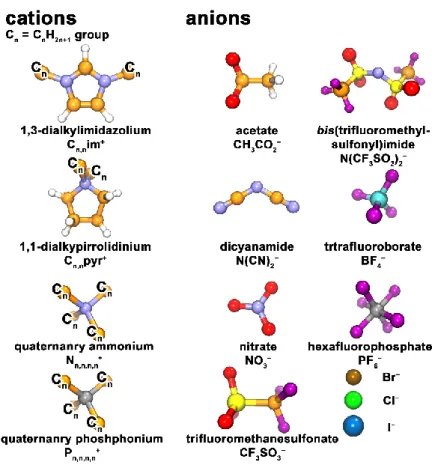
(16) Thèse de Volodymyr Koverga, Lille 1, 2017. During the last decade ionic liquids (ILs), the class of low-temperature molten salts, have turned from promising functional materials into objects that are used across many areas of scientific and engineering research.1-5 ILs successfully used as alternative solvents for carrying out organic reactions, and their still increasing popularity goes beyond simply solvating molecules, i.e., they have a growing potential on the application in almost every single branch of physical sciences, ranging from catalysis;6,7 separation science, such as liquid-liquid extraction8,9 and extraction of metals10 and hazardous waste;11 liquid mirror telescopes,12 molecular gas capture, such as H2, CO and CO2;13,14 active pharmaceutical ingredients;15,16 and alternative energy devices, such as metal-ion batteries,17 fuel,18 thermoelectrochemical19 and solar cells.20 Such progress in the scale and in the range of applications of ILs is determined by the unique set of properties of these materials (negligibly low vapor pressure, wide range of liquid state, thermal and electrochemical stability, high dissolving capability towards both organic and inorganic matter etc.) and also by enormous number of possible counterion combinations7,21 which allow one to select an IL fitting almost any requested set of properties. ILs are usually composed of large (organic or inorganic) ions, where the ionic head groups (ammonium, imidazolium, sulfate, sulfonate etc.) are attached to non-polar (mostly alkyl) side chains. The charge is usually not centered at one particular atom, with the exception of halide anions, but rather delocalized over several atoms of a molecular ion. Asymmetry is also essential for ILs, and either the cations or the anions size and their shape are very different or the attached side chains vary in length. Molecular structures of commonly employed cations and anions of ILs are shown in Figure 1.1. Among the cations, it is the family of dialkylimidazolium-based ILs, which is the most investigated, particularly the ILs containing 1-alkyl-3-methylimidazolium cations. The selection of anion depends more on the field of application, e.g., OAc− are popular for cellulose dissolution, while perfluorinated anions like BF4−, PF6− and (CF3SO2)2N− are common for electrochemical applications and catalytic reactions. 16 © 2017 Tous droits réservés.. lilliad.univ-lille.fr.
(17) Thèse de Volodymyr Koverga, Lille 1, 2017. Figure 1.1. Chemical structures of typical cations and anions composing ILs.. However, the effective usage of ILs is partly hindered by several disadvantages, where the very high viscosity is the primary one, while difficulties in purification and rather high cost should also be mentioned. In particular, in the field of electrochemical applications the family of 1-alkyl-3-methylimdazolium (Cnmim+) ILs with perfluorinated anions (PF6−, BF4−, CF3SO3−, (CF3SO2)2N−) has proven to be good candidates for conducting components of various electrochemical devices such as supercapacitors or electrochemical actuators. 22-28 Among the key factors which determine successful performance of these ILs in electrochemical devices, it is the mobility of ions which is limited by the inherent high viscosity of ILs stemming from strong long range Coulomb interactions between the ions.29 Temperature variations (ca. by less than 50 K) would only lead to reduction in viscosity by less than one order of magnitude.30 However, this point can be overcome by combining the ILs with low-weight molecular solvents, which leads 17 © 2017 Tous droits réservés.. lilliad.univ-lille.fr.
(18) Thèse de Volodymyr Koverga, Lille 1, 2017. to an exponential decay of the viscosity as a function of molar fraction, 31-33 whereby the increasing the electrical conductivity of the resulting ion-molecular mixture. In this regard, dipolar aprotic solvents, such as acetonitrile (AN) and cyclic organic esters and carbonates, e.g., γ-butyrolactone (GBL) and propylene carbonate (PC), seem to be a good choice for admixing to ILs. In particular, in the field of electrochemical applications,34-36 unlike the aqueous solutions, they have a number of attractive properties like wide electrochemical window, relatively high dielectric constant and low viscosity making them easily dissolve electrolyte salts and fully miscible with ILs. Moreover, for the family of cyclic organic esters and carbonates, like GBL and PC, peculiar the wide temperature range of the liquid state, nontoxicity along with environmental friendliness that particularly appreciated in electrolytes media for the various electrochemical devices. For a broad selection of mixtures of imidazolium-based ILs with polar dipolar aprotic solvents it was found that electrical conductivity has a maximum at IL mole fraction, xIL, between 0.1 and 0.2.37-39 This phenomenon is traditionally explained by the interplay between concentration and ionic association effects from one side and viscosity variation from the other.40 The former determine the effective number of charge carriers while the latter influences their mobility.40 Indeed, admixing molecular solvent to IL should, in general, influence not only the viscosity but modulate the overall microscopic structure as a result of concentration modulation of the interactions between the components. Depending on the propensity of each neat component to give up its inherent interaction pattern (i.e., ion-ion interactions giving rise to network structure in ILs and dipole-dipole interactions in dipolar aprotic solvents leading to their self-association) in favor of solvation one could anticipate different concentration regimes over the entire range of compositions.41 Thus, the prediction of the practically important macroscopic properties of the ion-molecular systems based on the detailed description of the influence of the nature of individual constituents as well as of the concentration on 18 © 2017 Tous droits réservés.. lilliad.univ-lille.fr.
(19) Thèse de Volodymyr Koverga, Lille 1, 2017. the local organization of the mixtures of ILs with molecular solvents at the microscopic level is an actual task In context of the binary mixtures the ILs with molecular solvents can be considered as electrolyte solutions for which their structure and properties from one side are determined by the balance of such types of interactions as interionic (mainly by hydrogen bonds) and intermolecular (dipole-dipole) interactions but also by more complex interactions as ion-molecular (cation···solvent and anion···solvent) from the other side. Thus, one of the most prominent feature of binary systems based on ILs is that the composing ions are multiatomic and, in general, asymmetric, as a result, the mentioned above interactions should be regarded as anisotropic ones, having preferential localization around some molecular fragment (interaction center or site). Another feature of these systems, in comparison with conventional electrolyte solutions, is the full miscibility of ILs with many molecular solvents that allows obtaining mixtures corresponding to either a solution of IL in molecular solvent or a solution of molecular solvent in IL. Interactions in mixtures of two liquids of different nature at different compositions of these mixtures can be represented as a gradual transition from one pure liquid through solution of the second liquid in the first one, then through solution of the first liquid in the second one, and to pure second liquid. In this type of representation the problem converges to the following question: which composition ranges correspond to the mentioned above regions and which type interactions are the dominant ones. In pure dipolar aprotic liquids the main structure motif is the dipole-dipole interactions which are considered to be the key ones. However, the issue of the dipolar orientation of molecules, parallel (“head-to-tail”) or antiparallel, is still controversial. Additionally, for some solvents the presence of hydrogen bonds between the solvent molecules is also the subject of hottest discussions. Along with the complex structures and diverse properties, the ILs remains rather complex systems. The interactions between anions and cations range from weak van der Waals, solvophobic, dispersion forces to strong Coulomb and 19 © 2017 Tous droits réservés.. lilliad.univ-lille.fr.
(20) Thèse de Volodymyr Koverga, Lille 1, 2017. anisotropic hydrogen bonding, halogen bonding, dipole-dipole, magnetic dipole, electron pair donor/acceptor interactions, which leads to their obviously different properties. Particularly, for the imidazolium-based ILs. Particularly, for the imidazolium-based ILs it is widely considered that the local structure in neat ILs defined by the strong Coulombic attraction formally determining the association of the counterions that existed prior to the interaction and remain unchanged in the interaction.42,43 A significant contribution is also supposed to arise from other strong secondary interactions between the ions, in particular directional hydrogen bonds between the cations and anions. Furthermore, Dupont44-46 postulated that ILs form a clustered supramolecular structure to maintain a 3D H-bond network. The strength and structure of these clusters are determined by the nature (polarizability, polarizing action, size etc.) of anion. Triolo and his colleagues have established a substantial degree of microheterogeneity in various ILs by means of a set of scattering techniques complemented with simulations.47-50 The effect is more pronounced for ILs with longer alkyl chains and it is attributed to the microscopic segregation of the polar (ionic) and nonpolar (alkyl chain) domains. The mentioned above considerations on the structure of pure components suggest for the corresponding mixtures two main phenomena, in which redistribution of the balance between possible interionic, intermolecular and ionmolecular interactions upon the composition change can be manifested. They are ionic association/aggregation and ionic solvation. Going from pure IL to pure solvent, these phenomena can be understood as a gradual destruction of large ionic aggregates into smaller ones up to ion pairs.51 Experimental information about the local structure in the binary mixtures of ILs with molecular solvent, particularly the change of character of interionic interactions (loose and contact ion pairs, and higher aggregates), upon the change in mixture composition can be extracted directly by conductivity measurements. Furthermore, the information about the relative speed of motion of different molecules and ions along with idea of which supramolecular entities are composed 20 © 2017 Tous droits réservés.. lilliad.univ-lille.fr.
(21) Thèse de Volodymyr Koverga, Lille 1, 2017. of which particles can be a sufficient basis to build a model of determinative interactions and the corresponding microstructure. Vibrational and NMR spectroscopies are fundamental tools to characterize the phenomena of ionic association and solvation in the mixtures of ILs with molecular solvents at the microscopic level. The vibrational spectroscopy techniques of infrared (IR) and Raman can provide deep insights on the nature of ionic interactions, the role played by interionic hydrogen bonds, molecular conformations, and their modifications as pressure and temperature is varied in the normal liquid phase, during phase transition to crystalline or amorphous (glassy) solid phases, after vaporization, etc. From another side, NMR measurements are valuable supplement to the IR/Raman, since such measurements allow bring out information on the change of the electronic microenvironment of every chemically non-equivalent nucleus and on the relative arrangement for some nuclei. In a broad perspective,. NMR spectroscopy is more advantageous since it suffers from. spectral overlaps and signal assignment much less than vibrational spectroscopy The two phenomena being considered (association and solvation) are also reflected in “statistical” microstructure of such binary mixtures, especially in the microstructure of ionic subsystem. Thus, a certain ordering of mutual distribution of counterions at low distances can be expected in case of pronounced ionic association as well as a certain ordering of distribution of the solvent molecules relative to ions in case of specific solvation. Nowadays experimental evidence on “statistical” microstructure at different temporal and dimensional scales can only be provided by diffraction techniques (various methods of diffraction of X-rays and neutrons). These methods are rather expensive and not easily accessible, as well as complicated in terms of raw data treatment. At the same time they are the only ‘direct’ methods of investigation of microstructure of condensed matter. Most of the studies in this field deal with a single representative system IL-molecular solvent,52-54 so the generalized and systematic picture is still to be established. Despite the broad set of experimental approaches targeted at the discovery of peculiarities of intermolecular interactions in binary systems of ILs with molecular 21 © 2017 Tous droits réservés.. lilliad.univ-lille.fr.
(22) Thèse de Volodymyr Koverga, Lille 1, 2017. solvents, as mentioned above, most of them are indirect methods which are typically challenging in interpretation. Modern methods of molecular modeling can help to solve these problems and they also can be a valuable complement and sometimes even an alternative to otherwise unfeasible experiments with ILs and ILbased system. In view of the phenomena, effects and objects of interest, methods that would be definitely complementary to the proposed experimental techniques are quantum chemical calculations as well as the methods of molecular dynamics simulation.55,56 Quantum chemical electronic structure calculations have been routinely used to study various properties of the IL-based systems, to help with the analysis of experimental results and to design new potentially better performing ILs. One should always be cautious when trying to connect the results obtained from calculations on model systems of the size of tens of atoms, often performed in the gas phase, to subtle properties of the macroscopic samples. At present, quantum chemical calculations of small model systems are affordable for the routine use in order to reveal the electronic properties of ILs in detail. The limitations of static quantum chemical calculations are external conditions (usually zero point temperature and without consideration of any effects of medium) as well as the size of a system that can be investigated. The modeling of a liquid phase, the analysis of the links between its macroscopic properties and their nature at a molecular level is a problem that can be effectively explored within the framework of statistical mechanics. In this context, molecular dynamics (MD) simulations have been used as either predictive or interpretative tools to establish relations between the complex structure and interactions of ionic liquids and their fascinating properties. Over the last few years, the use of MD simulations as a powerful tool to discuss experimental results at a molecular level has successfully been applied to different sources of IL data as diverse as gas solubility/absorption and fluid-phase equilibria, X-ray and neutron diffraction, FTIR/Raman/NMR spectroscopy, TE/AF microscopy, transport properties and rheology, or physical and chemical adsorption. 22 © 2017 Tous droits réservés.. lilliad.univ-lille.fr.
(23) Thèse de Volodymyr Koverga, Lille 1, 2017. Despite the fact, that the classical MD simulations can provide reliable information on the structure and dynamics unfortunately, the problem of the forcefield development for classical MD simulation of ILs remains an open issue and a subject to discussion. In this regard the methods of ab initio molecular dynamics (AIMD) can be additionally applied. Since AIMD is based on the explicit treatment of the electronic structure on-the-fly during the MD simulations of a larger assembly of molecules with periodic boundary conditions, it provides reliable structural information in a statistical ensemble. Therefore, it can be used to validate, for example, structures from classical MD simulations. Organization of the thesis In this thesis a classical MD simulation have been used to investigate the local structure organization of the binary mixtures of imidazolium-based ILs with dipolar aprotic solvents, relevant for the various electrochemical applications. The discussion of the obtained results organized as follows. Chapter 2 presents the computational details used in the study and brief review on the available potential models for ILs and molecular solvents. A special emphasis made to the description of the methodology on the developing new potential models for the set of molecular solvents. The analysis of the local structure organization of the neat individual constituents, neat ILs and dipolar solvents, discussed in details in Chapter 3 and 4. The hydrogen bonding, stacking and dipole-dipole interactions as well as the mutual. orientation. aspects. of. the. cation···anion,. cation···cation. and. solvent···solvent are established within the nearest neighbors approach. Chapter 5 is devoted to study role of the solvent and the behavior of ILs with the same cation and the different counterions in the binary mixtures by following the evolution of hydrogen bonding, stacking and dipole-dipole interactions depending from the mixture compositions. Particular attention is paid to the cation···solvent and anion···solvent complexes.. 23 © 2017 Tous droits réservés.. lilliad.univ-lille.fr.
(24) Thèse de Volodymyr Koverga, Lille 1, 2017. The influence of the charge distribution model depending from the mixture compositions on the structure organization in binary mixtures of ILs with molecular solvents are set forth in Chapter 6. Finally, conclusions, summarizing the key findings of the work, and future perspectives are outlined.. 24 © 2017 Tous droits réservés.. lilliad.univ-lille.fr.
(25) Thèse de Volodymyr Koverga, Lille 1, 2017. References for Chapter 1 (1) Hallett, J. P.; Welton, T. Room-Temperature Ionic Liquids: Solvents for Synthesis and Catalysis. 2. Chem. Rev. 2011, 111, 3508-3576. (2) Torimoto, T.; Tsuda, T.; Okazaki, K. I.; Kuwabata, S. New Frontiers in Materials Science Opened by Ionic Liquids. Adv. Mater. 2010, 22, 1196-1221. (3) Olivier-Bourbigou, H.; Magna, L.; Morvan, D. Ionic liquids and catalysis: recent progress from knowledge to applications. Appl. Catal., A 2010, 373, 1-56. (4) Giernoth, R. Task-Specific Ionic Liquids. Angew. Chem., Int. Ed. 2010, 49, 2834-2839. (5) Patel, D. D.; Lee, J.-M. Applications of Ionic Liquids. Chem. Rec. 2012, 12, 329-355. (6) Sheldon, R. Catalytic reactions in ionic liquids. Chem. Commun. 2001, 2399-2407. (7) Plechkova, N. V.; Seddon, K. R. Applications of ionic liquids in the chemical industry. Chem. Soc. Rev. 2008, 37, 123-150. (8) Zhao, H.; Xia, S.; Ma, P. Use of ionic liquids as ‘green’ solvents for extractions. Journal of Chemical Technology & Biotechnology 2005, 80, 1089-1096. (9) Poole, C. F.; Poole, S. K. Extraction of organic compounds with room temperature ionic liquids. J. Chromatogr. A 2010, 1217, 2268-2286. (10) Abbott, A. P.; Frisch, G.; Hartley, J.; Ryder, K. S. Processing of metals and metal oxides using ionic liquids. Green Chemistry 2011, 13, 471-481. (11) Visser, A. E.; Swatloski, R. P.; Reichert, W. M.; Mayton, R.; Sheff, S.; Wierzbicki, A.; Davis, J. H.; Rogers, R. D. Task-Specific Ionic Liquids Incorporating Novel Cations for the Coordination and Extraction of Hg2+ and Cd2+: Synthesis, Characterization, and Extraction Studies. Environmental Science & Technology 2002, 36, 2523-2529. (12) Borra, E. F.; Seddiki, O.; Angel, R.; Eisenstein, D.; Hickson, P.; Seddon, K. R.; Worden, S. P. Deposition of metal films on an ionic liquid as a basis for a lunar telescope. Nature 2007, 447, 979. (13) Vijayraghavan, R.; Pas, S. J.; Izgorodina, E. I.; MacFarlane, D. R. Diamino protic ionic liquids for CO2 capture. PCCP 2013, 15, 19994-19999. (14) MacDowell, N.; Florin, N.; Buchard, A.; Hallett, J.; Galindo, A.; Jackson, G.; Adjiman, C. S.; Williams, C. K.; Shah, N.; Fennell, P. An overview of CO2 capture technologies. Energy & Environmental Science 2010, 3, 1645-1669. (15) Hough, W. L.; Smiglak, M.; Rodriguez, H.; Swatloski, R. P.; Spear, S. K.; Daly, D. T.; Pernak, J.; Grisel, J. E.; Carliss, R. D.; Soutullo, M. D.; Davis, J. J. H.; Rogers, R. D. The third evolution of ionic liquids: active pharmaceutical ingredients. New J. Chem. 2007, 31, 1429-1436. (16) Petkovic, M.; Seddon, K. R.; Rebelo, L. P. N.; Silva Pereira, C. Ionic liquids: a pathway to environmental acceptability. Chem. Soc. Rev. 2011, 40, 1383-1403. (17) Scrosati, B.; Garche, J. Lithium batteries: Status, prospects and future. J. Power Sources 2010, 195, 2419-2430. (18) Noda, A.; Susan, M. A. B. H.; Kudo, K.; Mitsushima, S.; Hayamizu, K.; Watanabe, M. Brønsted Acid−Base Ionic Liquids as Proton-Conducting Nonaqueous Electrolytes. J. Phys. Chem. B 2003, 107, 4024-4033. (19) Abraham, T. J.; MacFarlane, D. R.; Pringle, J. M. Seebeck coefficients in ionic liquids prospects for thermo-electrochemical cells. Chem. Commun. 2011, 47, 6260-6262. (20) Grätzel, M. Conversion of sunlight to electric power by nanocrystalline dye-sensitized solar cells. Journal of Photochemistry and Photobiology A: Chemistry 2004, 164, 3-14. (21) Rogers, R. D.; Seddon, K. R. Ionic Liquids--Solvents of the Future? Science 2003, 302, 792-793. (22) MacFarlane, D. R.; Forsyth, M.; Howlett, P. C.; Pringle, J. M.; Sun, J.; Annat, G.; Neil, W.; Izgorodina, E. I. Ioinc Liquids in Electrochemical Devices and Processes: Managing Interfacial Electrochemistry. Acc. Chem. Res. 2007, 40, 1165-1173. 25 © 2017 Tous droits réservés.. lilliad.univ-lille.fr.
(26) Thèse de Volodymyr Koverga, Lille 1, 2017. (23) MacFarlane, D. R.; Tachikawa, N.; Forsyth, M.; Pringle, J. M.; Howlett, P. C.; Elliott, G. D.; Davis, J. H.; Watanabe, M.; Simon, P.; Angell, C. A. Energy applications of ionic liquids. Energy & Environmental Science 2014, 7, 232-250. (24) Lu, W.; Qu, L.; Henry, K.; Dai, L. High performance electrochemical capacitors from aligned carbon nanotube electrodes and ionic liquid electrolytes. J. Power Sources 2009, 189, 1270-1277. (25) Fedorov, M. V.; Kornyshev, A. A. Ionic Liquids at Electrified Interfaces. Chem. Rev. 2014, 114, 2978-3036. (26) Merlet, C.; Rotenberg, B.; Madden, P. A.; Taberna, P.-L.; Simon, P.; Gogotsi, Y.; Salanne, M. On the molecular origin of supercapacitance in nanoporous carbon electrodes. Nat. Mater. 2012, 11, 306-310. (27) Lewandowski, A.; Galiński, M. Carbon–ionic liquid double-layer capacitors. Journal of Physics and Chemistry of Solids 2004, 65, 281-286. (28) Liu, S.; Liu, W.; Liu, Y.; Lin, J.-H.; Zhou, X.; Janik, M. J.; Colby, R. H.; Zhang, Q. Influence of imidazolium-based ionic liquids on the performance of ionic polymer conductor network composite actuators. Polymer International 2010, 59, 321-328. (29) Fumino, K.; Wulf, A.; Ludwig, R. Strong, Localized, and Directional Hydrogen Bonds Fluidize Ionic Liquids. Angew. Chem., Int. Ed. 2008, 47, 8731-8734. (30) Tokuda, H.; Hayamizu, K.; Ishii, K.; Susan, M. A. B. H.; Watanabe, M. Physicochemical Properties and Structures of Room Temperature Ionic Liquids. 1. Variation of Anionic Species. J. Phys. Chem. B 2004, 108, 16593-16600. (31) Canongia Lopes, J. N.; Costa Gomes, M. F.; Husson, P.; Pádua, A. l. A. H.; Rebelo, L. P. N.; Sarraute, S.; Tariq, M. Polarity, Viscosity, and Ionic Conductivity of Liquid Mixtures Containing [C4C1im][Ntf2] and a Molecular Component. J. Phys. Chem. B 2011, 115, 6088-6099. (32) Li, W.; Zhang, Z.; Han, B.; Hu, S.; Xie, Y.; Yang, G. Effect of water and organic solvents on the ionic dissociation of ionic liquids. J. Phys. Chem. B 2007, 111, 6452-6456. (33) Wang, J.; Tian, Y.; Zhao, Y.; Zhuo, K. A volumetric and viscosity study for the mixtures of 1-n-butyl-3-methylimidazolium tetrafluoroborate ionic liquid with acetonitrile, dichloromethane, 2-butanone and N, N - dimethylformamide. Green Chem. 2003, 5, 618-622. (34) Rizzuto, A. M.; Pennington, R. L.; Sienerth, K. D. Study of the BMIM-PF6: Acetonitrile binary mixture as a solvent for electrochemical studies involving CO2. Electrochim. Acta 2011, 56, 5003-5009. (35) Trivedi, S.; Sarkar, A.; Pandey, S. Solvatochromic absorbance probe behavior within 1butyl-3-methylimidazolium hexafluorophosphate + propylene carbonate: preferential solvation or solvent–solvent interaction? Chem. Eng. J. 2009, 147, 36-42. (36) Chagnes, A.; Diaw, M.; Carré, B.; Willmann, P.; Lemordant, D. Imidazolium-Organic Solvent Mixtures as Electrolytes for Lithium Batteries. J. Power Sources 2005, 145, 82-88. (37) Stoppa, A.; Hunger, J.; Buchner, R. Conductivities of Binary Mixtures of Ionic Liquids with Polar Solvents. J. Chem. Eng. Data 2009, 54, 472-479. (38) Nishida, T.; Tashiro, Y.; Yamamoto, M. Physical and electrochemical properties of 1alkyl-3-methylimidazolium tetrafluoroborate for electrolyte. J. Fluorine Chem. 2003, 120, 135141. (39) Kalugin, O. N.; Voroshylova, I. V.; Riabchunova, A. V.; Lukinova, E. V.; Chaban, V. V. Conductometric study of binary systems based on ionic liquids and acetonitrile in a wide concentration range. Electrochim. Acta 2013, 105, 188-199. (40) Marcus, Y.; Hefter, G. Ion Pairing. Chem. Rev. 2006, 106, 4585-4621. (41) Dupont, J. On the solid, liquid and solution structural organization of imidazolium ionic liquids. J. Braz. Chem. Soc. 2004, 15, 341-350. (42) Angenendt, K.; Johansson, P. Ionic liquid structures from large density functional theory calculations using mindless configurations. J. Phys. Chem. C 2010, 114, 20577-20582.. 26 © 2017 Tous droits réservés.. lilliad.univ-lille.fr.
(27) Thèse de Volodymyr Koverga, Lille 1, 2017. (43) Tokuda, H.; Tsuzuki, S.; Susan, M. A. B. H.; Hayamizu, K.; Watanabe, M. How Ionic Are Room-Temperature Ionic Liquids? An Indicator of the Physicochemical Properties. J. Phys. Chem. B 2006, 110, 19593-19600. (44) Avent, A. G.; Chaloner, P. A.; Day, M. P.; Seddon, K. R.; Welton, T. Evidence for hydrogen bonding in solutions of 1-ethyl-3-methylimidazolium halides, and its implications for room-temperature halogenoaluminate(III) ionic liquids. J. Chem. Soc., Dalton Trans. 1994, 34053413. (45) Bonhôte, P.; Dias, A.-P.; Papageorgiou, N.; Kalyanasundaram, K.; Grätzel, M. Hydrophobic, Highly Conductive Ambient-Temperature Molten Salts. Inorg. Chem. 1996, 35, 1168-1178. (46) Consorti, C. S.; Suarez, P. A. Z.; de Souza, R. F.; Burrow, R. A.; Farrar, D. H.; Lough, A. J.; Loh, W.; da Silva, L. H. M.; Dupont, J. Identification of 1,3-dialkylimidazolium salt supramolecular aggregates in solution. J. Phys. Chem. B 2005, 109, 4341-4349. (47) Russina, O.; Lo Celso, F.; Di Michiel, M.; Passerini, S.; Appetecchi, G. B.; Castiglione, F.; Mele, A.; Caminiti, R.; Triolo, A. Mesoscopic structural organization in triphilic room temperature ionic liquids. Faraday Discuss. 2013, 167, 499-513. (48) Fazio, B.; Triolo, A.; Di Marco, G. Local organization of water and its effect on the structural heterogeneities in room-temperature ionic liquid/H2O mixtures. J. Raman. Spectrosc. 2008, 39, 233-237. (49) Macchiagodena, M.; Gontrani, L.; Ramondo, F.; Triolo, A.; Caminiti, R. Liquid structure of 1-alkyl-3-methylimidazolium-hexafluorophosphates by wide angle x-ray and neutron scattering and molecular dynamics. J. Chem. Phys. 2011, 134, 114521. (50) Zheng, W.; Mohammed, A.; Hines, L. G.; Xiao, D.; Martinez, O. J.; Bartsch, R. A.; Simon, S. L.; Russina, O.; Triolo, A.; Quitevis, E. L. Effect of Cation Symmetry on the Morphology and Physicochemical Properties of Imidazolium Ionic Liquids. J. Phys. Chem. B 2011, 115, 6572-6584. (51) Stassen, H. K.; Ludwig, R.; Wulf, A.; Dupont, J. Imidazolium Salt Ion Pairs in Solution. Chemistry – A European Journal 2015, 21, 8324-8335. (52) Russina, O.; Sferrazza, A.; Caminiti, R.; Triolo, A. Amphiphile Meets Amphiphile: Beyond the Polar–Apolar Dualism in Ionic Liquid/Alcohol Mixtures. J. Phys. Chem. Lett. 2014, 5, 1738-1742. (53) Takamuku, T.; Honda, Y.; Fujii, K.; Kittaka, S. Aggregation of imidazolium ionic liquids in molecular liquids studied by small-angle neutron scattering and NMR. Anal. Sci. 2008, 24, 1285-1290. (54) Shimomura, T.; Takamuku, T.; Yamaguchi, T. Clusters of Imidazolium-Based Ionic Liquid in Benzene Solutions. J. Phys. Chem. B 2011, 115, 8518-8527. (55) Kirchner, B.: Ionic liquids from theoretical investigations. In Ionic Liquids; Kirchner, B., Ed.; Topics in Current Chemistry; Springer-Verlag: Berlin/Heidelberg, 2010; Vol. 290; pp 213262. (56) Zahn, S.; Brehm, M.; Brüssel, M.; Hollóczki, O.; Kohagen, M.; Lehmann, S.; Malberg, F.; Pensado, A. S.; Schöppke, M.; Weber, H.; Kirchner, B. Understanding ionic liquids from theoretical methods. J. Mol. Liq. 2014, 192, 71-76.. 27 © 2017 Tous droits réservés.. lilliad.univ-lille.fr.
(28) Thèse de Volodymyr Koverga, Lille 1, 2017. Chapter 2.. Methodology. and. computational. details. 28 © 2017 Tous droits réservés.. lilliad.univ-lille.fr.
(29) Thèse de Volodymyr Koverga, Lille 1, 2017. Introduction In the framework of MD simulation, investigation of the microstructure of the binary mixtures of ILs with molecular solvent allows to obtain the wide range of different properties, which not only well corroborate with experimental observations but also significantly complements them. For accurate prediction of properties of neat ILs and their mixtures by means of MD simulation, a reliable and transferrable potential model is required. Certain potential models are quite system specific, whereas other have been developed and successfully applied to broad set of cation and anion. The most widely applicable potential of IL has been developed by Lopes and Padua.1 This all-atom fully flexible potential model was parametrized by means of ab initio calculations on the dihedral energy profiles and further compared with experimental densities. The resulting model reproduces experimental density within 3% for the most of investigated ILs, as well as the cell parameters in the crystalline phase. On the other hand, the computed transport properties, particularly selfdiffusion coefficient, shear viscosity and ionic conductivity, are fail to reproduce the experimental measurements. Another universal potential model developed by Maginn et al.2-5 has been validated against experimental heat capacities, self-diffusion coefficients, viscosities and melting points. While for a number of ILs it was yielded satisfactory agreement with the experimental data, there remains a group of the alkylpyridinium-based ILs for which the simulated dynamic properties are about an order of magnitude lower compared with experimental ones. Borodin6 have introduced new polarizable potential model for a wide set of ILs. The validation procedure included comparison of the resulting dynamic and thermodynamics properties to the corresponding experimental values. In most cases the agreement between simulated and experimental results is obtained. Nevertheless, for some ILs the deviations up to 50% were noted, often in the case of the pyridinium- and piperidinium-based ILs. Borodin suggests that this may be 29 © 2017 Tous droits réservés.. lilliad.univ-lille.fr.
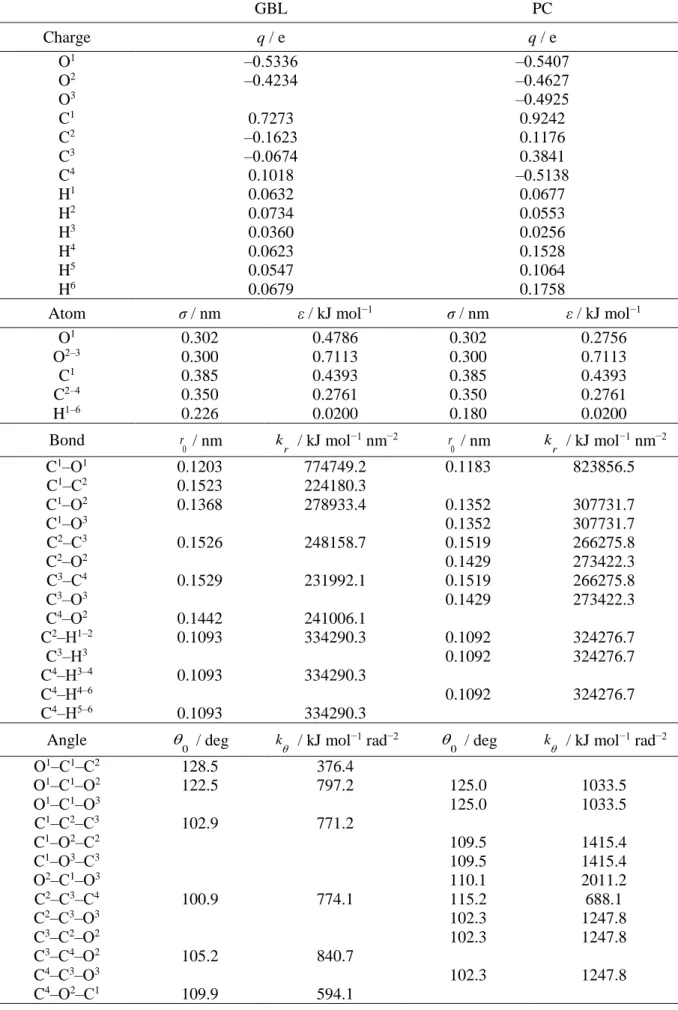
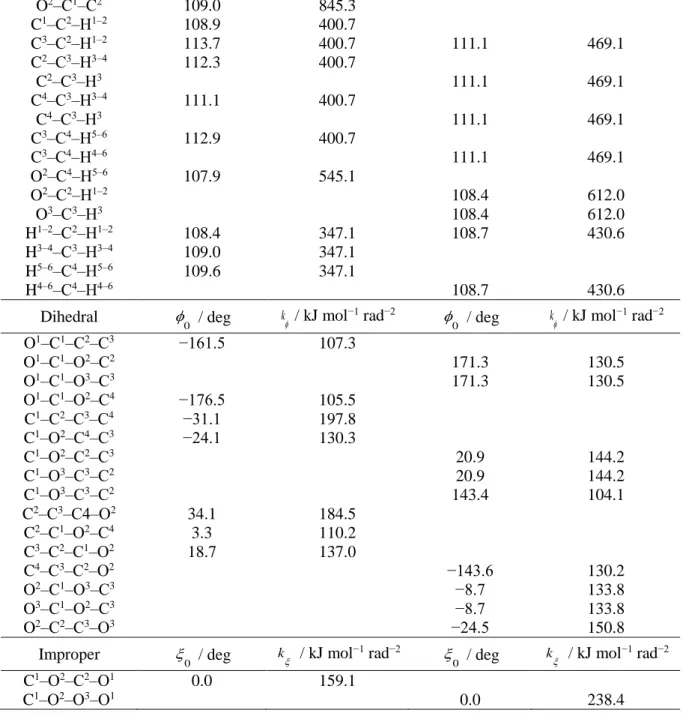
(30) Thèse de Volodymyr Koverga, Lille 1, 2017. caused by unreliability of the experimental data, which are still scarce for certain types of ILs. Further, using ab initio parametrization Yethiraj at al.7 developed a polarizable potential model for Cnmim-based ILs that predict the experimental density, enthalpy of vaporization, self-diffusion coefficient and conductivity. Thus, in order to achieve an accurate dynamic, one needs to incorporate electronic polarizability effect in the potential models. The inclusion of the polarizability does not come without a significant computational effort. Additionally, ILs require very long simulation times in order to ensure an adequate sampling of phase trajectory. The inclusion of polarizability amplifies computation cost by 4‒10 times. This is especially true if ionic conductivities and shear viscosities, that are of primary interest. Voth et al.8 showed that ionic clusters of ILs tend to form stable cells which remain neutral for long time and slow down the overall dynamics of the simulated system. When electrostatic charge fluctuations are considered, an additional mechanism operates charge screening, which increases the dynamics of the simulated system, turning it more realistic. A few attempts have been made to obtain a realistic dynamics in ILs without including polarizability. Thus, Bhargava and Balasubramanian 9 proposed a refined potential model for C4mimPF6 in which partial charges on the cation and anion were allowed. The physical justification for this approach were ab initio calculations showing a significant charge transfer between the ions of ILs. According to these calculations, C4mim+ has a total charge of +0.904 e, and PF6‒, consequently, ‒0.904 e, instead of ± 1 e. Reducing the partial charges on the ions improves self-diffusion by an order of magnitude, making them closer to the experimental values. Later, the similar methodology was used to develop the set of Lennard-Jones parameters and charge distribution for other potential models of imidazolium ILs.10,11 The derived set of parameters well reproduce basic experimental thermodynamic and transport properties, namely density, enthalpy of vaporization, self-diffusion coefficient, shear viscosity etc. 30 © 2017 Tous droits réservés.. lilliad.univ-lille.fr.
(31) Thèse de Volodymyr Koverga, Lille 1, 2017. Another way to improve the correctness of the simulated dynamic properties is the adjusting of Lennard-Jones parameters. Koedderman et al.12 changed the Lennard-Jones parameters on some selected centers of CnmimTFSI to get correct dynamic and thermodynamic properties of this particular ILs. Micaelo et al. optimized F‒F and O‒O Lennard-Jones parameters for PF6‒ and NO3‒ to achieve proper matches for Cnmim-based ILs. Values of ε for P in PF6‒ and O in NO3‒ were set 0.001-0.01 kJ mol‒1. Although reproducing density and transport properties very well, this potential model underestimates the enthalpy of vaporization. Considering the available potential models for the dipolar aprotic solvents one can see the significant similarities in approaches for the developing or calibrating of the potential models for ILs and solvents. The most prominent example is the case of potential model for acetonitrile. At present, numerous potential models for acetonitrile have been designed to reproduce various experimental properties. Their degree of detail commonly ranges from models with six interaction sites (all atom models),13-22 to the more simplified three-site models (united atoms models)23-29 where hydrogen atoms of the CH3 group are not considered explicitly to reduce the computational cost and to allow for simulations of larger systems over longer time scales. Most of the recent computational studies devoted to neat acetonitrile are directly connected to calibration of parameters for all-atom models. Rather successful potential models of acetonitrile were implemented in terms of OPLS/AA21 and AMBER17 force fields. The thermodynamic and structural properties derived with these models show reasonable agreement with experimental measurements. However, their further usage undergone considerable revisions. Thus, Wu et al.30 by calibration of the Lennard-Jones parameters has introduced a potential model able to reproduce an experimental value of diffusion coefficient, while the density was noticeably underestimated. Similar effort on the calculations of thermodynamic properties was reported in the study of Nikitin and Lyubartsev. 18 Despite the several advantages, a common drawback of these potential models is that some intramolecular parameters significantly different depending from the 31 © 2017 Tous droits réservés.. lilliad.univ-lille.fr.
(32) Thèse de Volodymyr Koverga, Lille 1, 2017. force field. Typically, such parameters are defined from the quantum-chemical calculations. Nevertheless, based on DREIDING31 force field Orhan has presented another approach that combines empirical tuning of both intra- and intramolecular parameters and leads to the good agreement of the studied dynamic and dielectric properties.20 General aspects All the molecular dynamics simulation were carried out using GROMACS 4.5.5 simulation package.32 Initial systems containing 864 particles (molecules, ion pairs and/or their combinations), generated by Packmol 33 and placed randomly in a cubic simulation box with periodic boundary conditions (PBC) applied. A Velocity-rescaling thermostat maintained the temperature and Parrinello-Rahman barostat set the pressure at 1 bar throughout the simulation with relaxation times of 0.1 and 0.5 ps, respectively. Equations of motion were integrated using Verlet leapfrog algorithm with a time-step of 0.5 fs. The electrostatic long-range interactions were accounted by the computationally efficient Particle-Mesh-Ewald (PME) algorithm. The 12-6 Lennard-Jones (LJ) interactions are treated by the conventional shifted force technique. Cross interactions between different atom types were derived using standard Lorentz-Berthelot combination rule. The structure properties presented here was analyzed using TRAVIS-1.14.0 code.34 For the simulation of pure molecular solvents, firstly, the derived set of the potential model parameters were tested with respect to their ability to reproduce the basic experimental thermodynamics and dynamics properties, namely density, enthalpy of vaporization, self-diffusion coefficient and shear viscosity, at the room temperature. For each temperature, the system was equilibrated in isothermalisobaric (NPT) ensemble during 500 ps. This step was followed by 1000 ps performed in canonical (NVT) that was used to obtain reliable values for the selfdiffusion coefficient and shear viscosity. The structure properties were derived from 500 ps trajectory in NVT ensemble. The electrostatic long-range interactions. 32 © 2017 Tous droits réservés.. lilliad.univ-lille.fr.
(33) Thèse de Volodymyr Koverga, Lille 1, 2017. equal to 1.2 nm and similar to cut-off distance for real-space component. The 12-6 LJ interactions are treated with a switch region between 1.0 and 1.1 nm. Due to the slow internal dynamics of ILs the initial relaxation is carried out at 400 K for 5000 ps in NVT ensemble to achieve ergodicity. Next, the generated systems are cooled down to the room temperature at NPT ensemble during 15000 ps. The transport properties are derived from 50000 ps trajectories for each system in NVT ensemble. The structure properties were than derived from the last 1000 ps trajectory. The electrostatic long-range interactions equal to 1.5 nm and similar to cut-off distance for real-space component. The 12-6 LJ interactions are treated with a switch region between 1.3 and 1.4 nm. For the mixtures of ILs with molecular solvents with mole fraction of ILs, xIL, 0.05; 0.10; 0.15; 0.20; 0.30; 0.40; 0.50; 0.60; 0.70; 0.80 the same set of parameters was used during the simulation. Force field development As was mentioned above the selection of proper potential parameters may affect not only on the physicochemical properties of individual compounds but also on properties of the resulting mixtures. Considering the uncertainty in the empirical approaches of parameterization of acetonitrile as well as other solvents under study one can deduce about the demand for such potential model that is able i) to reproduce correctly the intramolecular vibrations along with considering the effects polarization in condensed phase; ii) to reproduce the greatest possible set of properties at the room temperature. For the studied set ILs (see Figure 2.1) these requirements are well satisfied by the recently developed potential model of Mondal and Balasubramanian.10 For the dipolar aprotic solvents the new set of potential parameters was derived and adopted in order to reproduce the basic physicochemical properties such as density, enthalpy of vaporization, self-diffusion coefficient and shear viscosity. In the case of mixture of IL with molecular solvent, the concern of making the results of simulations as close as possible to the experimental ones, especially on diffusion, conductivity and viscosity, the above discussed scaled charge scheme 33 © 2017 Tous droits réservés.. lilliad.univ-lille.fr.
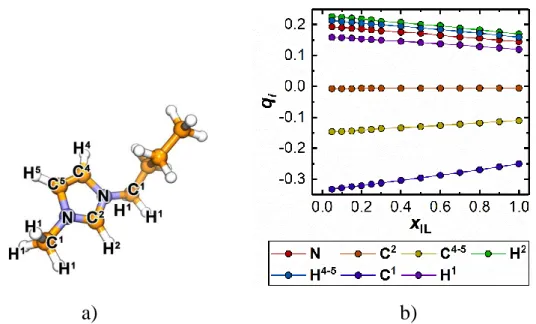
(34) Thèse de Volodymyr Koverga, Lille 1, 2017. was used by changing the scaling factor, fmix, as function of the composition of a binary mixture of IL with molecular solvent. Indeed, one can expect that the value of the scaling factor of the mixture, fmix, will increase starting from fIL in the neat IL, and going to 1 for the infinitely diluted solution of IL in a molecular solvent. 11 This composition dependent scaling factor is defined as follow: f mix (1 f IL2 )(1 xIL ) f IL2. (2.1). where fIL is a scaling factor for the pure IL, and xIL the IL mole fraction in the mixture. The authors justified this functional form by the fact that the interionic and ion-molecular interactions are linearly depend on xIL. The effect of the scaling was addressed by studying the structure (i.e., radial distribution function) properties of C4mimPF6/AN mixture.. Figure 2.1. Molecular structure of the ions composing four employed ILs C4mimBF4, C4mimPF6, C4mimTFO, C4mimTFSI and the three molecular solvents used in this study AN, GBL and PC.. Another questionable issue is which atoms of cation and anion should be involved in the variation of the effective charges. The most sensitive atoms of the imidazolium cation to the anion presence in it vicinity are the ring hydrogens of the C4mim+ and of the CH2 and CH3 groups connected directly to the nitrogen atoms of the ring. Thus, it would be logical to consider the partial charges of all the atoms of 34 © 2017 Tous droits réservés.. lilliad.univ-lille.fr.
(35) Thèse de Volodymyr Koverga, Lille 1, 2017. the imidazolium ring and C and H atoms of the CH2 and CH3 groups directly connected to the N of the ring (C2, C4, C5, N, H2, H4, H5, C1 and H1 atoms, see Figure 2.2a) as variable values, i.e., as a function of the mixture composition. For the anion the respective partial charges of all the atoms should be also rescaled at each composition. Figure 2.2b demonstrates the variation of the partial charges on the C4mim+ atoms mentioned above as a function of the mixture composition. In this regard, here we consider both schemes of charge distribution of the studied ILs, namely “constant” and “variable” ones. The former one then will be discussed in Chapter 5, while the comparison of the charge distribution effect on the local structure of the binary mixtures of ILs with molecular solvents will be discussed in detail in Chapter 6.. a). b). Figure 2.2. The numbering scheme of the atoms of the C4mim+ cation (a) and variation of partial charges, qi, on the C4mim+ atoms as a function of the mixture composition (b).. Intramolecular force field A reliable representation of molecular geometry is important in terms of adequate parameterization of the intramolecular potentials, which in turn is essential for reproducing the vibrational spectra of the considered solvents. Toward this purpose, the quantum-chemical calculations of one AN, GBL and PC. 35 © 2017 Tous droits réservés.. lilliad.univ-lille.fr.
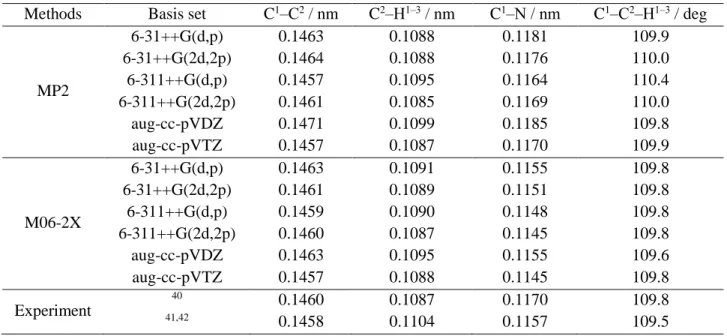
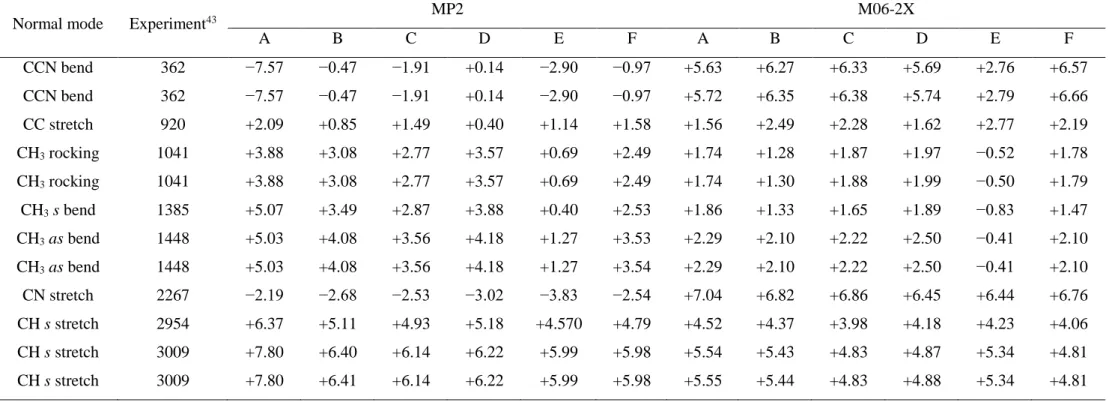
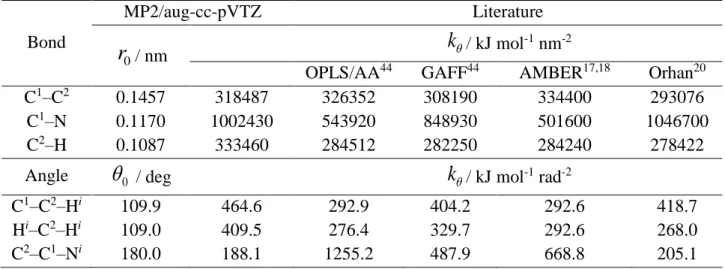
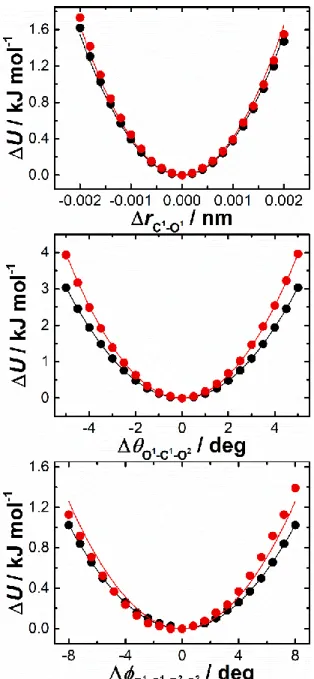
(36) Thèse de Volodymyr Koverga, Lille 1, 2017. molecules were carried out followed by harmonic vibrational analysis. The latter were carried out using GAUSSIAN 09W program suite.35. Figure 2.3. Molecular structure of acetonitrile (AN), γ-butyrolactone (GBL) and propylene carbonate (PC) with atomic labeling used for parametrization procedure.. In order to evaluate the reliability of the level of theory for our calculations we performed a benchmark study on small linear AN molecule in gas phase. For this purpose a series of calculations were carried out by using the second-order Møller-Plesset perturbation theory (MP2)36 together hybrid meta-GGA exchangecorrelated functional from Truhlar’s group (M06-2X)37 with six different basis sets (6-31++G(d,p), 6-31++G(2d,2p), 6-311++G(d,p), 6-311++G(2d,2p), aug-cc-pVDZ and aug-cc-pVTZ). The optimal geometry was obtained under very tight optimization convergence criteria as implemented in the software and tested to be true minima by the absence of imaginary frequencies in the corresponding vibration spectra. Calculated geometry parameters and vibrational frequencies together with literature data38 are listed in the Table 2.1 and Table 2.2. The geometry parameters obtained by both methods are comparable to each other and are in good agreement with experimental data. Nevertheless, comparing C≡N bond length calculated M062X and MP239 slightly overestimates this value, making it closer to the value in liquid phase.40 On another hand, M06-2X significantly blue-shifts the C≡Nstretching band (146-159 cm-1), which is reflected in the energy profiles (See Figure 2.3).. 36 © 2017 Tous droits réservés.. lilliad.univ-lille.fr.
(37) Thèse de Volodymyr Koverga, Lille 1, 2017. Table 2.1. Optimized geometry of acetonitrile at MP2 and M06-2X with different basis sets along with experimental values. Methods. MP2. M06-2X. Basis set 6-31++G(d,p) 6-31++G(2d,2p) 6-311++G(d,p) 6-311++G(2d,2p) aug-cc-pVDZ aug-cc-pVTZ 6-31++G(d,p) 6-31++G(2d,2p) 6-311++G(d,p) 6-311++G(2d,2p) aug-cc-pVDZ aug-cc-pVTZ 40. Experiment. 41,42. C1‒C2 / nm 0.1463 0.1464 0.1457 0.1461 0.1471 0.1457 0.1463 0.1461 0.1459 0.1460 0.1463 0.1457 0.1460 0.1458. C2‒H1‒3 / nm 0.1088 0.1088 0.1095 0.1085 0.1099 0.1087 0.1091 0.1089 0.1090 0.1087 0.1095 0.1088 0.1087 0.1104. C1‒N / nm 0.1181 0.1176 0.1164 0.1169 0.1185 0.1170 0.1155 0.1151 0.1148 0.1145 0.1155 0.1145 0.1170 0.1157. C1‒C2‒H1‒3 / deg 109.9 110.0 110.4 110.0 109.8 109.9 109.8 109.8 109.8 109.8 109.6 109.8 109.8 109.5. 37 © 2017 Tous droits réservés.. lilliad.univ-lille.fr.
(38) Thèse de Volodymyr Koverga, Lille 1, 2017. Table 2.2. Comparison the vibrational frequencies represented as standard deviations (%) obtained at MP2 and M06-2X with different basis sets (where A is 6-31++G(d,p), B - 6-31++G(2d,2p), C - 6-311++G(d,p), D - 6-311++G(2d,2p), E - aug-cc-pVDZ, F - aug-cc-pVTZ) along with experimental values. Normal mode. Experiment43. CCN bend. MP2. M06-2X. A. B. C. D. E. F. A. B. C. D. E. F. 362. −7.57. −0.47. −1.91. +0.14. −2.90. −0.97. +5.63. +6.27. +6.33. +5.69. +2.76. +6.57. CCN bend. 362. −7.57. −0.47. −1.91. +0.14. −2.90. −0.97. +5.72. +6.35. +6.38. +5.74. +2.79. +6.66. CC stretch. 920. +2.09. +0.85. +1.49. +0.40. +1.14. +1.58. +1.56. +2.49. +2.28. +1.62. +2.77. +2.19. CH3 rocking. 1041. +3.88. +3.08. +2.77. +3.57. +0.69. +2.49. +1.74. +1.28. +1.87. +1.97. −0.52. +1.78. CH3 rocking. 1041. +3.88. +3.08. +2.77. +3.57. +0.69. +2.49. +1.74. +1.30. +1.88. +1.99. −0.50. +1.79. CH3 s bend. 1385. +5.07. +3.49. +2.87. +3.88. +0.40. +2.53. +1.86. +1.33. +1.65. +1.89. −0.83. +1.47. CH3 as bend. 1448. +5.03. +4.08. +3.56. +4.18. +1.27. +3.53. +2.29. +2.10. +2.22. +2.50. −0.41. +2.10. CH3 as bend. 1448. +5.03. +4.08. +3.56. +4.18. +1.27. +3.54. +2.29. +2.10. +2.22. +2.50. −0.41. +2.10. CN stretch. 2267. −2.19. −2.68. −2.53. −3.02. −3.83. −2.54. +7.04. +6.82. +6.86. +6.45. +6.44. +6.76. CH s stretch. 2954. +6.37. +5.11. +4.93. +5.18. +4.570. +4.79. +4.52. +4.37. +3.98. +4.18. +4.23. +4.06. CH s stretch. 3009. +7.80. +6.40. +6.14. +6.22. +5.99. +5.98. +5.54. +5.43. +4.83. +4.87. +5.34. +4.81. CH s stretch. 3009. +7.80. +6.41. +6.14. +6.22. +5.99. +5.98. +5.55. +5.44. +4.83. +4.88. +5.34. +4.81. 36.
(39) Thèse de Volodymyr Koverga, Lille 1, 2017. Starting from the optimized structure the determination of the force constants, associated with the bond lengths and bond angles, in a framework of relaxed potential energy surface (rPES) scanning concept. The rPES scans were performed for all internal coordinates simultaneously optimizing all the unconstrained degrees of freedom, so that the minimum total energy is obtained along the chosen internal coordinate. For each coordinates 18 scans configurations have been computed with a step of 0.0002 nm and 0.3 deg for bonds and angles, respectively. Fitting these curves to suitable polynomials reveals good description by second-order polynomial, i.e. in terms of a simple harmonic approximation. The following functional form has been used for the intramolecular potential, which is the typical expansion in terms of valence coordinates. k kr (r r0 )2 ( 0 )2 bond 2 angle 2. U (r, ) U bond U angle . (2.2). where U(r, θ) is a sum over the internal terms as a function of atomic coordinates represented by bond distances (r) and angles (θ). The parameters k r and k are the respective force constants and the variables with the subscript “0” are the corresponding equilibrium values.. Figure 2.4. Examples of rPES profiles for C≡N stretching from the gas phase ab initio calculations and plotted from the literature data: M06-2X/aug-cc-pVTZ, MP2/aug-cc-pVTZ, AMBER based models,17,18 Orhan,20 OPLS/AA and GAFF adopted by Caleman et al.44 Lines represents the harmonic approximation function.. 37 © 2017 Tous droits réservés.. lilliad.univ-lille.fr.
(40) Thèse de Volodymyr Koverga, Lille 1, 2017. The computed stretching force constants (Table 2.3) are in a relatively good agreement with implemented in earlier force fields. Exceptions are the values for C≡N bond used in OPLS/AA and AMBER based models,17,18 which are found two times lower than those obtained with rPES scans. An opposite pattern is observed for the C‒C≡N bending constants that are significantly overestimated.. Table 2.3. Intramolecular force field parameters for AN obtained with MP2/aug-cc-pVTZ level of theory and from the literature MP2/aug-cc-pVTZ Bond. k / kJ mol-1 nm-2. r0 / nm. C1‒C2 C1‒N C2‒H. 0.1457 0.1170 0.1087. Angle. 0 / deg. C1‒C2‒Hi Hi‒C2‒Hi C2‒C1‒Ni. 109.9 109.0 180.0. Literature. 318487 1002430 333460. OPLS/AA44 326352 543920 284512. GAFF44 308190 848930 282250. AMBER17,18 334400 501600 284240. Orhan20 293076 1046700 278422. k / kJ mol-1 rad-2 464.6 409.5 188.1. 292.9 276.4 1255.2. 404.2 329.7 487.9. 292.6 292.6 668.8. 418.7 268.0 205.1. Intermolecular force field 2.3.2.1 Atomic charges derivation In order to estimate the effective partial charges on the atoms of AN molecule in the liquid state an ab initio molecular dynamics (MD) simulations were performed on the systems consisted of 32 deuterated acetonitrile (AN-d3) molecules placed in the cubic super-cell. Substitution of the H-atoms by D-atoms allowed one to increase essentially the MD time step and to eliminate quantum effects for the proton dynamics. The lattice constant equals to 1.41027 nm was chosen taking into account AN-d3 experimental density at the 298.15 K and high-precision atomic masses values.45-47 The periodic boundary conditions (PBC) have been applied. Initial configuration of the simulated system was generated through the classical MD simulation using AN model developed by Nikitin and Lyubartsev.18 Ab initio MD simulation in Car-Parrinello (CP) version and subsequent static quantum-chemical calculations were carried out using CPMD program package.48 38 © 2017 Tous droits réservés.. lilliad.univ-lille.fr.
(41) Thèse de Volodymyr Koverga, Lille 1, 2017. The CPMD code is based on the pseudo-potential Density Functional Theory and converged plane-wave basis set.49 For modelling the gradient-corrected B-LYP exchange-correlational functional and the norm-conserving Troullier-Martins (TM) pseudo-potentials were applied.50-52 The plane-wave kinetic energy cutoff was fixed at 90 Ry. Recently the efficiency of the B-LYP&TM/90 Ry level of theory for the periodic ab initio simulations of molecular systems has been shown.53-55 To calculate atomic charges of the AN molecule the following procedure was chosen. At the first stage the single point density optimization of the initial atomic configuration has been done. Then a time step of 0.175 fs for the CP simulation has been used, and by variation of the fictitious electron mass it was identified that the stable CP dynamics in microcanonical ensemble is possible if the variable value equals to 1200 a.u. or higher. The value of the fictitious electron mass was increase by 50 a.u. and was used in the equilibration and production CP runs. Within a second stage in the canonical ensemble at 298.15 K the two equilibration runs of 1.05 ps time length have been carried out: without, B-LYP&TM/90 Ry, and with the vdW-corrections by Grimme (D2) for all simulated atoms, B-LYP&TM+vdW/90 Ry.56 In both cases the Nosé-Hoover chain thermostat for the nuclei with 2263.1 cm−1 frequency has been applied.57,58 Used frequency corresponds to the maximal vibrational mode in the liquid AN-d3.59 During the third stage, after a preliminary single point density optimization, two production trajectories of 3.15 ps duration time each were generated. For the given runs Nosé-Hoover chain thermostat for the so-called fictitious electron dynamics was also included to the invariable parameters of canonical ensemble. The target kinetic energy on the basis of equilibration runs and frequency of the new thermostat equals to 0.05 a.u. and 7500 cm−1 correspondingly were used. At the final stage the atomic charges were evaluated by analysing 100 uniformly distributed nuclear configurations for the both production trajectories. For each configuration the single point density optimization with subsequent computation of the atomic charges derived from electrostatic potential have been done.60 Calculated charges for all atomic species were statistically handled along 39 © 2017 Tous droits réservés.. lilliad.univ-lille.fr.
(42) Thèse de Volodymyr Koverga, Lille 1, 2017. the both trajectories. The obtained values of atomic charges with their standard errors are listed in the Table 2.4 along with the literature data.. Figure 2.5. Time evolution of the fictitious orbital kinetic energy, Torb, nuclear temperature, T, total potential, V, and suare of total dipole moment per volume unit, M2Ω-2, during production Car-Parrinello MD simulations of the system consisted of 32 AN-d3 molecules at 298.15 K. The black and red lines correspond to the MD simulation without (B-LYP&TM/90 Ry) and with vdW-corrections by Grimme (B-LYP&TM+vdW/90 Ry), respectively.. Comparison of the Table 2.4 data computed with and without vdWcorrections indicates that partial charges are exactly the same for the nitrile group atoms and slightly differ for the methyl group atoms. The main point to stress is that both levels of theory results in small charges negative values on hydrogen atoms. We also point out that the polarity of the C‒H bonds is essentially inversed compared to all the others force fields and the CH3 group then is sufficiently more polar. In the present paper, the atomic charges from B-LYP&TM+vdW/90 Ry level of theory have been implemented in our new model. 40 © 2017 Tous droits réservés.. lilliad.univ-lille.fr.
(43) Thèse de Volodymyr Koverga, Lille 1, 2017. Table 2.4. Atomic charges (q) in the liquid AN evaluated from the Car-Parrinello MD trajectories with subsequent static quantum-chemical calculations and from the literature. MD trajectories were generated without B-LYP&TM/90 Ry, and with vdW-corrections by Grimme, B-LYP&TM+vdW/90 Ry, the difference expressed as a standard deviation Δq.. Atom N C1 C2 H1‒3. New model B-LYP&TM/ B-LYP&TM 90 Ry +vdW/90 Ry q/e q/e −0.475 −0.475 +0.305 +0.305 +0.185 +0.182 −0.005 −0.004. Literature Δq / e. OPLS/AA44. GAFF44. Nikitin18. Orhan16,20. q/e −0.56 +0.46 −0.08 +0.06. q/e −0.5168 +0.4484 −0.4008 +0.1564. q/e −0.5126 +0.4917 −0.5503 +0.1904. q/e −0.493 +0.475 −0.552 +0.190. 0.001 0.002 0.002 0.000. 2.3.2.2 Lennard-Jones parameters Careful tuning of Lennard-Jones (LJ) parameters (σ, ε) is extremely important for an accurate reproduction of the thermodynamic and the dynamic properties and several attempts were undertaken on this direction. For example, Nikitin and Lyubartsev18 modified mainly the values of the LJ parameters of nitrogen and nitrile carbon (C1) of the different force fields to reproduce density and enthalpy of vaporization. A better agreement of thermodynamic properties with the experimental data was found while the self-diffusion coefficient is 20% less the corresponding experimental one. In another study reported by Orhan20 only the value of the nitrogen LJ values were modified in order to obtain reasonable agreement with the experimental dynamic and dielectric properties. To get an adequate value of the self-diffusion coefficient of pure AN Wu et al.30 inserted a reduced separation distance (σ) of hydrogen to the model developed by Grabuleda et al.17 Thus, the empirical approach to obtain the LJ parameters is fully justifiable. As the density, ρ, as well as the enthalpy of vaporization, vap HT , are sensitive to the used force field model, the refined set of potential parameters was used along with LJ parameters for nitrogen and hydrogen taken from literature (see Table 2.5 for details). The vap HT values can be computed from the equation vap HT HT ,gas HT ,liq UT ,gas UT ,liq RT. (2.3). 41 © 2017 Tous droits réservés.. lilliad.univ-lille.fr.
(44) Thèse de Volodymyr Koverga, Lille 1, 2017. where UT is the ensemble-averaged potential energy in either the gas or liquid (liq) phase at the temperature T. Quantitative estimation of translational dynamics can be implemented by means of the self-diffusion coefficient of the center of mass of a molecule i which is obtained from the well-known Einstein relation 2 1 d Di lim r i t ri 0 6 t dt. where ri t ri 0 . 2. (2.4). is the ensemble-averaged mean-square displacement (MSD). of molecule i. Additionally the β coefficient was calculated using equation:. t . d log MSD t d log t. (2.5). where the MSD(t) is the mean square displacement of the molecule and is given by:. MSD t . 2 1 N ri t ri 0 N i 1. (2.6). The range time where β coefficient is equal 1,10 evidences that the system has reached the diffusive regime during the simulation and β follows from the Einstein relation. The shear viscosity of the system was estimated through the fitting of the transverse current autocorrelation functions (TCAFs) for plane waves based on momentum fluctuations61,62 realized within the “g_tcaf” tool of GROMACS package. The dependence of the viscosity on the plane wave vector, k, is extrapolated to k = 0 to obtain the share viscosity. This achieved using the expansion. (k ) (0)(1 ak 2 ) O(k 4 ). (2.7). 42 © 2017 Tous droits réservés.. lilliad.univ-lille.fr.
Figure
+7

Documents relatifs