This is an author-deposited version published in :
http://oatao.univ-toulouse.fr/
Eprints ID : 3645
O
pen
A
rchive
T
OULOUSE
A
rchive
O
uverte (
OATAO
)
OATAO is an open access repository that collects the work of Toulouse researchers and
makes it freely available over the web where possible.
To link to this article
: DOI:
10.1016/j.scitotenv.2009.02.008
URL :
http://dx.doi.org/10.1016/j.scitotenv.2009.02.008
To cite this version
:
Angéli, N. and Dambrine, Etienne and Boudot, J.P. and
Nedeltcheva, T. and Guérold, F. and Tixier, G. and Probst, Anne
and Party, J.P. and Pollier, B. and Bourrié, G. ( 2009)
Evaluation
of streamwater composition changes in the Vosges Mountains
(NE France): 1955–2005
.
Science of the Total Environment, vol.
407 (n° 14). pp. 4378-4386. ISSN 0048-9697
Evaluation of streamwater composition changes in the Vosges Mountains
(NE France): 1955
–2005
☆
N. Angéli
a,b, E. Dambrine
a,⁎
, J.P. Boudot
b, T. Nedeltcheva
a, F. Guérold
c, G. Tixier
c, A. Probst
d,
J.P. Party
e, B. Pollier
a, G. Bourrié
fa
INRA, Unité Biogéochimie des Ecosystèmes Forestiers, Champenoux, 54280 Nancy, France
b
CNRS, Laboratoire des Interactions Microorganismes-Minéraux-Matières Organiques dans les Sols UMR 7137, Université Henry Poincaré, Faculté des Sciences, 54506 Vandoeuvre-lès-Nancy Cedex, France
c
Laboratoire Biodiversité et Fonctionnement des Ecosystèmes, UFR Sci-FA, Université de Metz, 57070 Metz, France
dCNRS, Laboratoire des Mécanismes et Transferts en Géologie, UMR 5563, Université Paul Sabatier, 31400 Toulouse, France e
Sol-Conseil, 2 rue de Roppenheim, 67000 Strasbourg, France
f
INRA, Unité Géochimie des Sols et des Eaux, Cerege, BP80, 13545 Aix-en- Provence cedex 04, France
a b s t r a c t
Keywords: Stream chemistry Acidity Long-term trends Vosges mountainsIn 1995, in the southwestern Vosges Mountains (NE France), 158 of 395 streams (40%) had a pH lower than 5.5 at baseflow. As elsewhere in Europe, acid deposition has decreased since the seventies, as has base cation deposition. In order to assess the response of streamwater to decreasing deposition, we compared their present chemical composition to their former composition. All comparisons showed a decrease in sulphate concentration, which was greater on granite than on sandstone. In addition calcium, magnesium and aluminium concentrations generally decreased. Acidity in streams draining granite decreased in spring, especially during the eighties, decreases were not observed on sandstone. Continuous monitoring of 5 streams since 1998 confirmed that Al concentrations decreased while changes in pH were small. Chemical trends in streams from the Vosges massif fell between those measured in Northern Europe and Central Europe. This study provides thefirst broad-scale overview of surface water acidification and recovery in France and emphasizes the need for continuous monitoring to assess long-term changes in aquatic ecosystems.
1. Introduction
Since both the United Nations Conference on the Human Environ-ment in 1972 and the Convention on Long-range Transboundary Air Pollution in 1979, several protocols havefixed the objectives of pollutant reduction and ecosystem monitoring facing acidification and eutrophi-cation. The results of this united effort are encouraging: SO2emissions
have decreased by 70% from the beginning of the eighties, and NOx
emissions have decreased by 25%, but important disparities within European countries remain. Finally, NH3emissions have fallen by 20% in
20 years as well (Barrett et al., 2000; Tarrason et al., 2004; W.G.E., 2004). In North America, SO2emissions have decreased by 50% in Canada, and
40% in the United States during the same period (McMurray et al., 2004). As a consequence, sulphate deposition have decreased in both North America (Boucher and Pham, 2002; Likens et al., 2001) and Europe (Cooper, 2005; Harriman et al., 2001; Mylona, 1996; Vuorenmaa, 2004),
while nitrate and ammonia depositions either have remained stable (Cooper, 2005) or have decreased (Barrett et al., 2000; Vuorenmaa, 2004) depending on the countries. At many sites, emission control has resulted in a reduction in proton deposition but also a decrease in base cation deposition (Hedin and Likens, 1996; Skjelkvale et al., 2001).
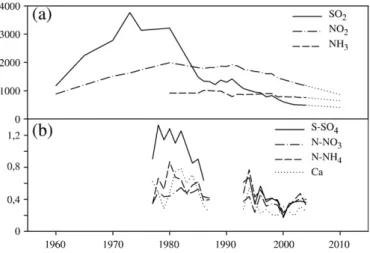
In France, SO2 emission has decreased by 88% since the 1973
maximum, NO2emission has decreased by 41% since the maximum in
1980 and NH3emission has decreased by 25% since 1986 (Barrett et al.,
2000; CITEPA, 2005) (Fig. 1a). Associated decreases of pollutant concentrations in precipitation were reported byCroise et al. (2002);
Dambrine et al. (1995a,b)andUlrich et al. (1993). These trends are illustrated for the north of the Vosges mountains inFig. 1b.
Responses of small forest streams and lakes to the decrease in deposition were synthesized byDriscoll et al. (2003);Ferrier et al. (2001); Kahl et al. (2004); Prechtel et al. (2001); Stoddard et al. (1999);Skjelkvale et al. (2001, 2003, 2005);Wright et al. (2001):
- non-marine sulphate concentration decreased significantly in the eighties and more steeply in the nineties;
- nitrate concentration did not generally decrease in spite of regional downward trends (North America, Central Europe);
☆ This paper was presented at the 5th International Symposium on Ecosystem Behaviour, held at the University of Califonia, Santa Cruz, on June 25-30, 2006.
⁎ Corresponding author. Tel.: +33 3 83 39 40 71; fax: +33 3 83 39 40 69. E-mail address:[email protected](E. Dambrine).
- alkaline-earth cations (Ca, Mg) decreased markedly. The decrease was equivalent (in charge unit) to the decrease in sulphate in North America but less pronounced in Europe;
- Alkalinity/pH generally increased during the nineties in the Scandinavian countries, East Central Europe and north-east of the American continent, but not in the United Kingdom, the Ireland and the Alps;
- dissolved organic carbon increased generally.
These syntheses did not include data from southern Europe, probably because of the lack of national monitoring programs.
In the Vosges mountains (NE France),Nisbet (1958)reported the acidity of one stream, attributed to the low calcium content of the sandstone bedrock and to the occurrence of acid peat land.Bourrié (1978)studied the composition of springs draining the granitic part of the massif and defined the composition of water as a complex function of ecological factors (pathflow, soil types, bedrock, rainfall acidity). From the eighties, the influence of acid deposition on soil acidification (Dambrine et al., 1995a,b; Poszwa et al., 2003), surface water acidification (Fritz, 1982; Kreiser et al., 1995; Massabuau et al., 1987; Probst et al., 1987, 1990, 1995a) and aquatic organisms (Guérold, 1992; Guérold et al., 1997; Massabuau et al., 1987; Probst et al., 1990; Tixier and Guérold, 2005) was studied. Large scale studies on spring and stream acidity (Party et al., 1995; Probst et al., 1995b, 1999; Thomas et al.,1999) confirmed that 12% of streams were acid at baseflow (Party, 1999) whereas this proportion was close to 40% in the southern part of the Vosges (Guérold et al., 1997). Using analysis of springs supplying
drinking water in the north-western region on sandstone,Probst et al. (1999) demonstrated a continuous acidification of springwater between 1965 and 1995. During the same time, several authors observed a decrease in soil exchangeable base cations (Bonneau, 2005; Dambrine et al., 1998; Lefèvre, 1997; Thimonier et al., 2000).
The aim of the present paper was to provide a synthesis of the historical evolution of surface water chemistry in the Vosges Mountains. For this purpose, we have considered 4 old datasets (Nisbet, 1958; Bourrié, 1978; Probst et al., 1990; Guérold et al., 1997) describing the composition of 135 streams, that were resampled in 2003–2004. Our hypothesis was that the period of high deposition (seventies and early eighties) had determined an increase in base cations and sulphate concentrations and a decrease in pH in streams. But that the decrease of emissions during the nineties would not lead necessarily to stream recovery.
2. Material and methods 2.1. Studied area
The maximum elevation of the Vosges Mountains is 1424 m. The climate is oceanic with a continental influence. Rainfall is between 900 and 2300 mm yr− 1and the mean annual temperature ranges from 8 °C at 600 m to 5 °C at 1200 m. The dominant bedrocks are greywacke, granite and quartz-rich sandstone. The vegetation is composed of deciduous and conifer forests (mainly Abies alba Mill. and Fagus sylvatica L.), widely substituted with Norway spruce (Picea abies L.). The summits are often deforested, covered by heath and surrounded by a belt of European Beech (Fagus sylvatica L.). The forest has experienced large-scale needle loss and Mg deficiencies during the eighties and suffered from an important storm event in December 1999 (Colin, 2003). Fifteen to 30% of the stands were blown down especially the conifer stands on sandstone. These phenomena may influence stream hydrochemistry over several years (Didon-Lescot et al., 1998).
2.2. Samplings
Thefirst dataset concerns one stream (Basse des Escaliers, mean catchment altitude: 696 m), studied byNisbet (1958)between May 1955 and March 1957 and sampled again between November 1995 and 1996 (Guérold et al., 1997), and between March 2002 and October 2003. Bourrié (1978) studied in June 1974 the composition of 40 springs draining the southern granitic part of the massif at high elevation (mean catchment altitude 1042 m). In autumn 1988 and spring 1989,Probst et al. (1990)sampled 32 mostly acid streams over the whole of the massif (mean catchment altitude 780 m).Guérold et al. (1997)sampled and analysed 62 streams on granite draining the south-west of the massif (mean altitude 996 m) at lowflow in 1995. All streams have been resampled during the autumn 2003, the spring
Fig. 1. Long-term trends of: (a) annual emissions of SO2, NO2and NH3(103t yr− 1) in
France (Barrett et al., 2000; CITEPA, 2005) and (b) annual bulk precipitation concentrations of S–SO4, N–NO3, N–NH4and Ca (mg l− 1) in the North of the Vosges
mountains (BAPMON/Cenac and Zephoris, 1990 inUlrich et al., 1993; Croise et al., 2002; Dambrine et al., 1995a,b).
2004 and the autumn 2004. The sampling dates have been chosen to be close to historical periods and associated hydrological conditions. Finally, 5 streams on granite (mean altitude 929 m) were also monitored from the end of the nineties (Tixier 2005; Tixier and Guérold, 2005). The total prospected area extends over about 5000 km2. The exact location of the original samplings was identified
using the original maps of the investigators at the scale of 1/25,000. All study sites were chosen upstream of direct human influences such as housing, farming and industrial activities (except selective logging). Some streams were excluded because of incomplete original analy-tical data or recent local pollution by road salting.
2.3. Hydrological conditions
The discharge of the different streams and springs was not measured. The hydrologic conditions between the different sampling periods have been compared using the Moselle river discharge data (Fig. 2). This major river drains all the western side of the massif. The flow was low during the springs 1974 and 2004 and the autumn of 1988, 1995 and 2003, whereas it was high in spring 1989 and autumn 2004.
The comparison of silica concentrations, which behaviour is related to discharge, was also used as an indicator of similar hydrologic conditions (Idir et al., 1999; Ladouche et al., 2001).
2.4. Data analysis
In all studies, water was analysed afterfiltration (0.45 µ), and pH was measured in the lab with a glass electrode after gentle spinning. Aluminum was measured by atomic absorption spectrometry (AAS) with a graphite furnace, or by ICP (this study). Calcium and Mg was measured by complexometry (Nisbet, 1958), by ICP (this study) or by AAS. Sulphate and nitrate were measured by colorimetry (Bourrié, 1978),
Ionic Chromatography (Probst et al.,1990; Guérold et al.,1997) and in this study by colorimetry (NO3) and ICP (SO4). Silica was measured by
colorimetry or by ICP (this study). Comparison of data measured at different time intervals wasfirst done graphically by plotting old against recent values of each parameter. An uncertaintyfield was empirically defined using the accuracy of methods routinely used in laboratories: SO4, NO3and Ca +Mg (±10 µeq l−1), Al (±2.5 µmol L−1), Si (±20 µmol
l−1) and pH (±0.2 pH unit). Thesefields were evaluated byAngéli (2006)from analytical comparisons between (a) different methods used at INRA (SO4 by ICP and IC; NO3 by colorimetry and IC), different methods (Ca, Mg, Al, SO4, NO3) used at 3 different labs (Metz University,
CNRS Nancy, INRA Nancy), and the same method (pH) used at different labs (Metz University, CNRS Nancy, INRA Nancy).
For each parameter, we compared the number of values above and below this uncertainty field. A mean annual change for each parameter was also calculated. The parametric simple or pared t-Student test (a) was applied when conditions of normality and variance was respected. Otherwise, we used the non-parametric test of Mann-Whitney Rank Sum or Wilcoxon Signed Rank (b). Changes are significant according to the selected p-value (⁎ = b0.05, ⁎⁎=b0.01, ⁎⁎⁎=b0.001, ns=no significant).
Time trends were tested using the multivariate seasonal Mann– Kendall test (SKT) (Helsel and Hirsch, 1992; Hirsch et al., 1982; Hirsch and Slack, 1984; Libiseller and Grimvall, 2002). The estimation of the mean slope was obtained with the Sen Slope Estimator (c) (Sen, 1968) and the simple linear regression (SLR).
3. Results
3.1. Comparison: May 1955/October 2003
Between 1955–56 and 1995, pH decreased from 5.2 to 4.2 pH unit (a,⁎⁎⁎), Ca+Mg decreased from 162 to 73 µeq l− 1(b,⁎⁎) and Si
decreased from 75 to 65 µmol l− 1. Most of this decrease occurred before 1996.
3.2. Comparison: June 1974/May 2004
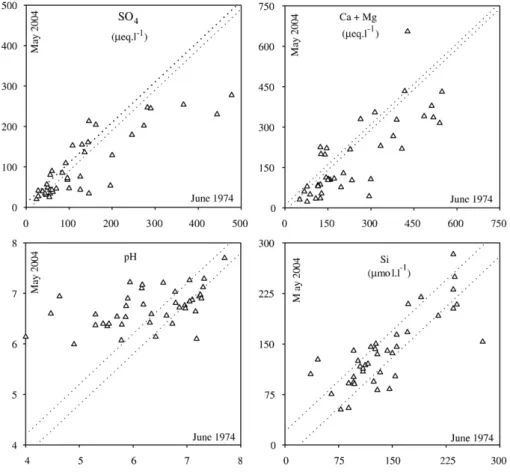
Between 1974 and 2004, sulphate concentrations decreased by more than 10 µeq l−1in 23 out of 40 springs (b,⁎⁎) and increased by more than 10 µeq L−1in 9 springs (Fig. 3). The decrease was larger in the springs with high sulphate concentration in 1974. No significant change was observed in springs draining greywacke (a, ns). Bourrié (1978)had measured nitrate concentrations in 15 out of 40 springs only. The comparison with the recent years showed a large data scattering, without clear trend (b, ns). Calcium and magnesium concentrations decreased by more than 10 µeq l−1in 27 out of 40 springs (a,⁎⁎⁎) and increased by more than 10 µeq l−1in 7 springs (Fig. 3). The springs showing both the highest Ca+ Mg concentrations (N200 µeq l−1) and steepest decrease in base cations
between 1974 and 2004 drained granites rich in amphibole and biotite,
and greywacke. pH increased by more than 0.2 (b,⁎⁎⁎) units in 23 out of 40 springs (reaching up to +2 pH units for the most acid springs) and decreased by more than 0.2 pH units in 10 springs (Fig. 3). pH stayed stable in springs draining greywacke (b, ns). The silica concentrations remained stable (variations between +20 and−20 µmol l−1) in 20 out of
40 springs between 1974 and 2004, and increased or decreased by more than 20 µmol l−1in the 20 remaining springs (Fig. 3).
3.3. Comparison: September 1988–March 1989/October 2003–May 2004 Concentrations in streams on granite were lower than in streams draining sandstone (Nedeltcheva et al., 2006a,b). Sulphate: granite b135 µeq l− 1bsandstone; nitrate: granite b50–65 µeq l− 1depending
on the seasonbsandstone; Ca+Mg: granite b170 µeq l− 1bsandstone.
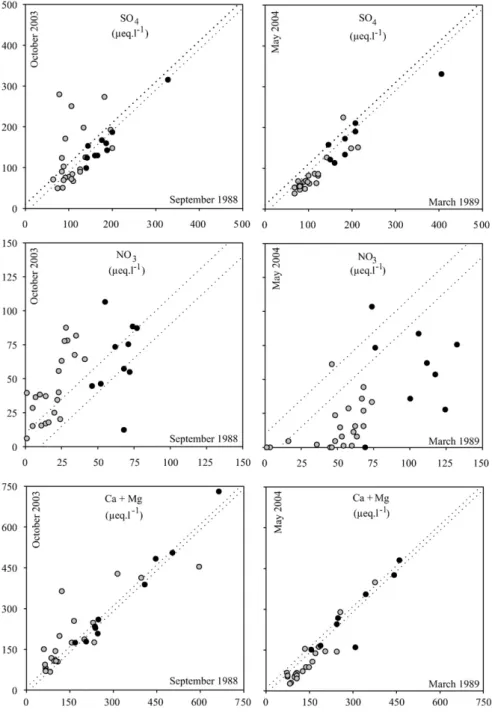
Between September 1988 and October 2003, sulphate concentra-tions decreased in 19 streams out of 32 streams (b, ns) and increased in 6 streams (Fig. 4). Between March 1989 and May 2004, sulphate
Fig. 4. Water chemistry in: 32 streams between September 1988 and October 2003 (left) and 30 streams between March 1989 and May 2004 (right): SO4, NO3, Ca + Mg. Black
concentrations decreased in 26 out of 30 streams (a, ⁎⁎⁎) and increased in 2 streams (Fig. 4).
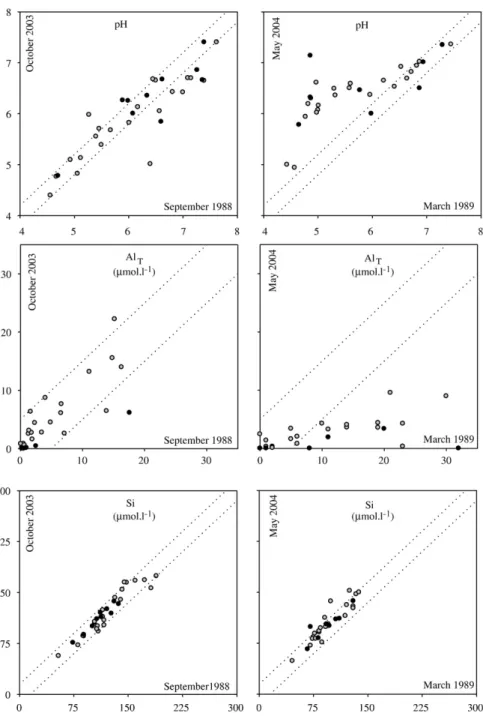
The variations in nitrate, alkaline earth cations and pH (Figs. 4 and 5) showed reverse trends in autumn and spring. Between September 1988 and October 2003, nitrate concentrations increased in 20 out of 32 streams (a,⁎⁎⁎) and decreased in 2 streams (Fig. 4). Conversely, between March 1989 and May 2004, nitrate concentrations decreased in 25 out of 30 streams (a,⁎⁎⁎) and increased in 2 streams (Fig. 4). The shift in alkaline earth cations was equally contrasted: between September 1988 and October 2003, Ca+Mg concentrations increased in 16 streams (b,⁎) and decreased in 8 streams (Fig. 4). As for the nitrates, between March 1989 and May 2004, Ca+Mg concentrations decreased in 22 streams (a,⁎⁎⁎) and increased in 6 streams (Fig. 4). Between September 1988 and October 2003, pH decreased in 13 streams (b, ns) and increased in 8 streams (Fig. 5). On the opposite, between March 1989 and May 2004, pH increased (up to +1 pH unit for the most acid streams) in 20 streams (b, ⁎⁎⁎) and stayed stable in 9 streams (Fig. 5). The aluminium
concentrations decreased by more than 2.5 µmol l−1 in 17 streams (b,⁎⁎⁎) and increased in 1 streams (Fig. 5). The silica concentrations were stable in 30 streams between September 1988 and October 2003, and in 28 streams between March 1989 and May 2004 (Fig. 5).
3.4. Comparison: October 1995/December 2004
Between 1995 and 2004, sulphate concentrations decreased in 51 out of 62 streams (b,⁎⁎⁎) (Fig. 6). Nitrate concentrations decreased in 21 streams (b,⁎⁎⁎), between 1995 and 2004 and increased in only 3 streams (Fig. 6). At the same time, the Ca + Mg concentrations decreased in 40 streams (b,⁎⁎⁎) and increased in 7 streams (Fig. 6). pH remained stable in 31 streams and decreased in 19 streams (b, ns) which were originally close to neutrality (Fig. 6). Aluminium concentrations did not change in 36 streams, but decreased in 19 streams (b,⁎⁎) (Fig. 7). Silica concentrations were stable in 48 streams and decreased in 9 streams (Fig. 6).
Fig. 5. Changes in pH, and AlTand Si concentrations in 32 streams between September 1988 and October 2003 (left) and 30 streams between March 1989 and May 2004 (right): Black
3.5. Monitoring of 5 streams between January 1998 and November 2005
Fig. 7shows the changes in water chemistry in 5 streams between 1998 and 2005. Sulphate concentrations decreased significantly and continuously (except a peak in 2003) in thefive studied streams with a mean slope ranging from 2.47 to 2.77 µeq l− 1yr− 1according to the different statistical tests (b, ⁎⁎⁎ and c, ⁎⁎). Nitrate concentrations followed seasonal variations with higher concentrations during winter and lower concentrations during summer. Despite this seasonal variation, nitrate concentration decreased by 0.93–0.60 µeq l− 1yr− 1
according to the different statistical tests (a,⁎⁎ and c, ⁎). The trend was less clear for Ca + Mg concentrations. For aluminium and pH, the study period could be divided into two periods: 1998–2002 and 2002–2006. On average, pH was higher and aluminium concentrations were lower in the second period. Over the study period, the aluminium concentration decreased by 1.10–0.93 µeq l− 1yr− 1(b,⁎⁎ and c, ⁎)
and the proton concentration by 1.13–0.78 µeq l− 1yr− 1(b,⁎⁎ and c, ⁎).
3.6. Comparison of trends across the different studies
Sulphate decreased significantly in all studies except in streams draining greywacke in the 1974–2004 comparison and in streams draining granite in the 1988–2003 comparison. The decrease was steeper in recent years:−1.2 between 1974 and 2004, −1.5 to −1.9 between 1988–89 and 2003–04, −2.66 between 1995 and 2004 and −2.47 to 2.77 µeq l− 1yr− 1between 1998 and 2005. Moreover, the
annual rate of sulphate decrease from 1995–2004 was in agreement with that observed during the monitoring study 1998–2005. Because of important seasonal variation in nitrate concentrations, general trends across all studies could not be detected. Nevertheless, as with sulphate, the decrease from 1995–2004 (−0.8 µeq l− 1yr− 1) was coherent with that observed during the monitoring study 1998–2005 (−0.93 to 0.60 µeq l− 1 yr− 1). Significant changes in base cation
concentrations were found only in streams draining granite (except the 1955–2005 comparison), and a contradiction was found between
Fig. 6. Changes in SO4, NO3, Ca + Mg, Si, AlT, and pH in 62 streams between November 1995 and December 2004. The chemical variations between the two dotted lines are no
the rates in 1995–2004 (−3.1 µeq l− 1 yr− 1) and during the
monitoring period 1998–2005 (−0.90 µeq l− 1 yr− 1). Since 1988, aluminium concentration significantly decreased in most studies, but less in autumnal comparisons (−0.23 and 0.36 µeq l− 1yr− 1). The
proton concentration decreased significantly in spring comparisons. 4. Discussion and conclusion
This work is thefirst synthesis on long-term changes of stream-water composition in French forested areas. Nevertheless, it suffers from weaknesses in the sampling scheme and the analytical procedures.
4.1. Sampling
The various samplings involved in this synthesis cover afifty-year time span, but in each study, streams were selected with different criteria: spatial location, geology or initial acidity. So the different comparisons did not involve every time the same streams. As a result, variations in the proportion of acid streams throughout the studied period cannot be directly interpreted in terms of regional acidity changes. In order to compare the mean change in concentrations
between two dates, we decided to compare them with recent concentrations. Re-sampling dates were selected to be close to the original sampling periods and associated hydrological conditions. Except for the 1989–2004 comparison, where flow conditions differed from the old to the recent sampling, the hydrological periods and the silica concentrations were similar enough to minimize the bias related to dilution/concentration effect on water chemistry. The seasonal biological activity influences deeply water chemistry, especially, nitrate concentrations, which are higher from October to March and lower from May to August (Probst et al., 1995b). During the autumn 1988–2003 comparison, streams have been sampled one month later in 2003 (October) than in 1988 (September). In spring, the streams have been sampled later in 2004 (May) than in 1989 (March). The increase in nitrate in autumn and the decrease in nitrate in spring are probably partly due to this shift between the sampling dates rather than to a long-term variation of nitrate concentrations.
4.2. Analytical techniques
The analytical data compared have been obtained with different techniques for which data quality may not be comparable. The chosen approach is based on the empirical definition of uncertainty fields. In order to strengthen our conclusions, trends obtained by comparison at different time intervals were checked with recent continuous monitoring.
The overall sulphate concentrations decreased with time whatever the time interval investigated and the bedrock. The more recent rate of decrease is close to−3 µeq l−1yr−1, a value already observed between
1986 and 1996 in the Strengbach stream draining granite (Dambrine et al., 2000). These results are in agreement with those reported between 1990 and 2001 in the following regions:−2.20 µeq l−1yr− 1
(Vermont/Quebec),−2.06 µeq l−1yr−1(Adirondacks),−2.27 µeq l− 1
yr−1(Appalachian Plateau) and−2.47 µeq l− 1yr− 1(Upper Midwest)
(Driscoll et al., 2003; Kahl et al., 2004; Skjelkvale et al., 2003). These rates are lower than those observed in Central Europe in the eighties and nineties (Skjelkvale et al., 2003; Stoddard et al., 1999).
Nitrate and earth alkaline cation concentrations vary with the season. The recent monitoring study (1998–2005) suggests a decrease in nitrate concentration, which may be related to the slow decrease in nitrogen emissions as well as to the improvement of forest health during this period. This decrease is comparable with data from sites of Eastern (−0.87 µeq l−1 yr−1) and Western (−1.00 µeq l−1 yr−1) Central
Europe (Skjelkvale et al., 2003). Higher winter peaks in 2002–2004 might be related to the consequences of storm event of December 1999. Alkaline-earth cation concentrations tend to decrease in recent years in agreement with the results obtained in the Strengbach catchment (Probst et al., 1995a,b).
The pH changes were different according to the bedrock and the time span involved. On sandstone, since 50 years, stream and spring (Probst et al., 1999) pH has dramatically dropped with no sign of recent recovery. This is related to the extremely low base cation content of the bedrock, high porosity and sulphate storage capacity (Angéli, 2006). On granite, streamwater pH has increased in spring since 30 years, especially for the most acid streams. The increase in pH measured between 1974 and 2004 was larger than between 1988(89) and 2004, or 1995 and 2004. This suggests that the steep decrease of deposition acidity during the late seventies and early eighties has had direct effects on stream acidity. Continuous monitoring shows that stream pH and alkalinity tent to increase only slowly in recent years (Probst et al., 1995a,b), and that this increase may be masked by seasonal variations and catastrophic events such as storms etc. No trend has been evidenced on greywacke, where soils have a higher acid neutralising capacity.
Overall, the concentration of ions in streamwater has decreased since thirty years. This decrease results from the decrease in sulphate and alkaline-earth cations deposition, as well as from the leaching of
Fig. 7. Time variation of SO4, NO3, Ca + Mg, AlTconcentrations and pH in 5 streams on
soil base cations during former decades. With time, mineral weath-ering should compensate for the leached base cations and allow soil base saturation and stream pH to rise again. Factors that may delay stream recovery are the thickness of the soil and saprolite, the soil sulphate storage capacity (Angéli, 2006), and, for the most sensitive streams, the increase in biomass productivity.
Acknowledgements
We thank Louisette Gelhaye and Séverine Bienaimé for their helps in chemical analysis, Jean-Marc Baudoin, Guillaume Tixier, the DIREN, RENECOFOR and Erwin Ulrich for the provision of chemistry data, the ONF, the département des Vosges and the Région Lorraine for their technical andfinancial supports.
References
Angéli, N. 2006. Evolution de la composition chimique des ruisseaux vosgiens. Analyse rétrospective et effet d'un amendement. Thesis, Université Henri Poincaré, Nancy, 458pp.
Barrett K, Aas W, Hjellbrekke AG, Tarrason L, Schaug J. An evaluation of trends for concentrations in air and precipitation. In: Tarrason L, Schaug J, editors. Transboundary Acidification and Eutrophication in Europe, EMEP Summary Report 2000. Oslo, Norway: Norwegian Meteorological Institute; 2000. p. 41–8.
Bonneau M. Evolution of the mineral fertility of an acidic soil during a period of ten years in the Vosges mountains (France). Impact of humus mineralisation. Ann Sci For 2005;62:253–60.
Boucher O, Pham M. History of sulfate aerosol radiative forcings. Geophys Res Lett 2002;29(9):22(1)–4).
Bourrié G. Acquisition de la composition chimique des eaux en climat tempéré. Application aux granites des Vosges et de la Margeride. Strasbourg: Louis Pasteur; 1978. 174 pp.
CITEPA/Coralie/format Secten. Inventaire des émissions de polluants atmosphériques en France. Séries sectorielles et analyses étendues. Mise à jour de février 2005, Centre interprofessionnel technique d'études de la pollution atmosphérique, Paris, France; 2005. p. 248.
Colin G. Les forêts françaises après les tempêtes de décembre 1999. Inventaire Forestier National; 2003. p. 27.
Cooper DM. Evidence of sulphur and nitrogen deposition signals at he United Kingdom acid waters monitoring network sites. Environ Pollut 2005;137:41–54.
Croise, L., Ulrich, E., Duplat, P. and Jaquet, O., 2002. RENECOFOR - Deux approches indépendantes pour l'estimation et la cartographie des dépôts atmosphériques totaux hors couvert forestier sur le territoire français. In: D. R. e. D. Office National des Forêts (Editor), pp. 102.
Dambrine E, Ulrich E, Cénac N, Durand P, Gauquelin T, Mirabel P, et al. Atmospheric deposition in France and possible relation with forest decline. In: Landmann G, Bonneau M, editors. Forest decline and atmospheric deposition effects in the French mountains. New York: Springer; 1995a. p. 286–99.
Dambrine E, Bonneau M, Ranger J, Mohamed AD, Nys C, Gras F. Cycling and budgets of acidity and nutrients in Northeastern France and the Erzgebirge. In: Landmann G, Bonneau M, editors. Forest decline and atmospheric deposition effects in the French mountains. New York: Springer; 1995b. p. 233–58.
Dambrine E, Pollier B, Poszwa A, Ranger J, Probst A, Viville D, et al. Evidence of current soil acidification in spruce stands in the Vosges mountains, North-eastern France. Water Air Soil Pollut 1998;105:43–52.
Dambrine E, Probst A, Viville D, Biron P, Belgrand MC, Paces T, et al. Spatial variability and long-term trend in mass balance of N and S in Central European Forested catchments. In: Schulze ED, editor. Carbon and nitrogen cycling in European forest ecosystems. Ecological Studies. Berlin Heidelberg: Springer-Verlag; 2000. Didon-Lescot JF, Guillet B, Lelong F. Le nitrate des ruisseaux, indicateur de l'état sanitaire
et des perturbations de l'écosystème forestier. Exemple du Mont Lozère. Comptes-Rendus de l'Académie des Sciences de Paris, Sciences de la terre et des planètes, vol. 327. ; 1998. p. 107–13.
Driscoll CT, Driscoll KM, Roy KM, Mitchell MJ. Chemical response of lakes in the Adirondack region of New York to declines in acidic deposition. Environ Sci Technol 2003;37:2036–42.
Ferrier RC, Jenkins A, Wright RF, Schopp W, Barth H. Assessment of recovery of European surface waters from acidification 1970–2000: an introduction to the special issue. Hydrol Earth Syst Sci 2001;5(3):274–82.
Fritz B. Caractéristiques chimiques des eaux de surface d'un bassin versant des Vosges du sud. Rech Géogr Strasbg 1982;19–21:179–84.
Guérold, F., 1992. L'acidification des cours d'eau. Impact sur les peuplements de macroinvertébrés benthiques: application au massif vosgien, Metz, 251 pp. Thèse de doctorat de l'Université de Metz, mention:Sciences de la Vie, spécialité: Hydrobiologie, 251 pp.
Guérold F, Boudot JP, Merlet D, Rouiller J, Vein D, Jacquemin G. Evaluation de l'état d'acidification des cours d'eau du département des Vosges, Rapport d'étude; 1997. p. 64. Harriman R, Watt AW, Christie AEG, Collen P, Moore DW, McCartney AG, et al. Interpretation of trends in acidic deposition and surface water chemistry in Scotland during the past three decades. Hydrol Earth Syst Sci 2001;5(3):407–20.
Hedin LO, Likens GE. Atmospheric Dust and acid rain. Sci Am 1996:88–92.
Helsel DR, R.M. H. Statistical Methods in Water Resources, 49. Amsterdam, Netherlands: Elsevier Science; 1992. 522 pp.
Hirsch RM, Slack JR. A nonparametric trend test for seasonal data with serial dependence. Water Resour Res 1984;20:727–32.
Hirsch RM, Slack JR, Smith RA. Techniques of trend analysis for monthly water quality data. Water Resour Res 1982;18(1):107–21.
Idir S, Probst A, Viville D, Probst JL. Contribution des surfaces saturées et des versants auxflux d'eau et d'éléments exportés en période de crue: traçage à l'aide du carbone organique dissous et de la silice. Cas du petit bassin versant du Strengbach (Vosges, France). Comptes-Rendus de l'Académie des Sciences de Paris, Sciences de la terre et des planètes, vol. 328. ; 1999. p. 89–96.
Kahl JS, Stoddard JL, Haeuber R, Paulsen SG, Birnbaum R, Deviney FA, et al. Have U.S. surface waters responded to the 1990 Clean Air Act Amendments? Environ Sci Technol 2004;38:484A–90A.
Kreiser AM, Rose NL, Probst A, Massabuau JC. Relationship between lake-water acidification in the Vosges mountains and SO2— NOX emissions in western Europe.
In: Landmann G, Bonneau M, editors. Forest decline and atmospheric deposition effects in the French mountains. New York: Springer; 1995. p. 363–70.
Ladouche B, Probst A, Viville D, Idir S, Baque D, Loubet M, et al. Hydrograph separation using isotopic, chemical and hydrological approaches (Strengbach catchment, France). J Hydrol 2001;242:255–74.
Lefèvre Y. Essai de mise en évidence d'une évolution récente du pH et de la teneur en cations basiques de quelques sols forestiers des Vosges (nord-est de la France). Ann Sci For 1997;54:483–92.
Libiseller C, Grimvall A. Performance of partial Mann Kendall tests for trend detection in the presence of covariates. EnvironMetrics 2002;13:71–84.
Likens GE, Buttler TJ, Buso DC. Long- and short-term changes in sulfate deposition: effects on the 1990 Clean Air Act Amendments. Biogeochemistry 2001;52:1–11. Massabuau JC, Fritz B, Burtin B. Mise en évidence de ruisseaux acides (pH≤ 5) dans les Vosges.
Comptes-Rendus de l'Académie des Sciences de Paris, Série III, vol. 305. ; 1987. p. 121–4. McMurray C, Hicks B, McLean B, Page S, Polkowsky B, Rothblatt S, et al. Progress report 2004. United States-Canada. Air Quality Agreement. United States Environment Protection Agency; 2004.
Mylona S. Sulphur dioxide emissions in Europe 1880–1991 and their effect on sulphur concentrations and depositions. Tellus 1996;48B:662–89.
Nedeltcheva T, Piedallu C, Gégout J-C, Stussi J-M, Boudot J-P, Angéli N, et al. Influence of granite mineralogy, rainfall, vegetation and relief on streamwater chemistry (Vosges mountains, North Eastern France). Chem Geol 2006a;231:1–15. Nedeltcheva T, Piedallu C, Gégout J-C, Boudot J-P, Angéli N, Dambrine E. Environmental
factors influencing streamwater composition on sandstone (Vosges Mountains). Ann For Sci 2006b;63:369–73.
Nisbet M. Aperçu chimique sur quelques ruisseaux des Vosges: le Rabodeau et ses affluents. Ann Stn Hydrobiol 1958;7:270–84.
Party J-P. Acidification des sols et des eaux de surface des écosystèmes forestiers français: facteurs, mécanismes et tendances. Strasbourg: Louis Pasteur; 1999. 248 pp. Party J-P, Probst A, Dambrine E, Thomas AL. Critical Loads of acidity to surface waters in
the Vosges massif (North-East of France). WaterAir Soil Pollut 1995;85:2407–12. Poszwa A, Wickman T, Dambrine E, Ferry B, Dupouey JL, Helle G, et al. A Retrospective
isotopic study of spruce decline in the Vosges mountains (France). WaterAir Soil Pollut Focus 2003;3(1):201–22.
Prechtel A, Alewell C, Armbruster M, Bittersohl J, Cullen JM, Evans CD, et al. Response of sulphur dynamics in European catchments to decreasing sulphate deposition. Hydrol Earth Syst Sci 2001;5(3):311–25.
Probst A, Fritz B, Ambroise D, Viville D. Forest influence on the surface water chemistry of granitics basins receiving acid precipitation in the Vosges massif, France. Forest Hydrol Watershed Manag 1987;167:109–20.
Probst A, Massabuau JC, Probst JL, Fritz B. Acidification des eaux de surface sous l'influence des précipitations acides: rôle de la végétation et du substratum, conséquences pour les populations de truites. Le cas des ruisseaux des Vosges. Comptes-Rendus de l'Académie des Sciences de Paris, Série III, vol. 311. ; 1990. p. 405–11.
Probst A, Probst JL, Massabuau JC, Fritz B. Surface water acidification in the Vosges mountains: relation to bedrock and vegetation cover. In: Landmann G, Bonneau M, editors. Forest decline and atmospheric deposition effects in the French mountains. New York: Springer; 1995a. p. 371–86.
Probst A, Fritz B, Viville D. Mid-term trends in acid precipitation, streamwater chemistry and element budgets in the Strengbach catchment (Vosges mountains, France). WaterAir Soil Pollut 1995b;79:39–59.
Probst A, Party J-P, Février C, Dambrine E, Thomas AL, Stussi JM. Evidence of springwater acidification in the Vosges Moutains (North-East France): influence of bedrock buffering capacity. WaterAir Soil Pollut 1999;114(3–4):391–411.
Sen PK. Estimates of the regression coefficient based on Kendall's tau. J Am Stat Assoc 1968;63:1379–89.
Skjelkvale BL, Stoddard JL, Andersen T. Trends in surface water acidification in Europe and North America (1989–1998). WaterAir Soil Pollut 2001;130:787–92. Skjelkvale BL, Stoddard J, Jeffries DS, Torseth K, Hogasen T, Bowman J, et al. Trends in
surface water chemistry: 1990–2001. In: Skjelkvale BL, editor. The 15-year report: Assessment and monitoring of surface waters in Europe and North America; acidification and recovery, dynamic modelling and heavy metals. Norwegian Institute for Water Research; 2003.
Skjelkvale BL, Stoddard JL, Jeffries DS, Torseth K, Hogasen T, Bowman J, et al. Regional scale evidence for improvements in surface water chemistry 1990–2001. Environ Pollut 2005;137:165–76.
Stoddard JL, Jeffries DS, Lukewille A, Clair TA, Dillon PJ, Driscoll CT, et al. Regional trends in aquatic recovery from acidification in North America and Europe. Nature 1999;401:575–8.
Tarrason L, Fagerli H, Jonson JE, Klein H, Van Loon M, Simpson D, et al. EMEP Report 2004. Transboundary acidification, eutrophication and ground level ozone in Europe. Norwegian Meteorological Institute; 2004.
Thimonier A, Dupouey JL, Le Tacon F. Recent losses of base cations from soils of Fagus sylvatica stands in Northeastern France. Ambio 2000;29(6):314–21.
Thomas AL, Dambrine E, King D, Party JP, Probst A. A spatial study of the relationships between streamwater acidity and geology, soils and relief (Vosges, Northeastern France). J Hydrol 1999;217:35–45.
Tixier, G., 2005. L'acidification anthropique des eaux de surface. Effets sur les communautés de macro invertébrés benthiques. Autoécologie et réponses d'espèces caractéristiques des ruisseaux de tête de bassin des Vosges, Thèse, Université de Metz, Metz, 270 pp.
Tixier G, Guérold F. Plecoptera response to acidification in several headwater streams in the Vosges Mountains. Biodivers Conserv 2005;14:1525–39.
Ulrich E, Williot B, Landmann G. les dépôts atmosphériques en France de 1850 à 1990. Nancy: INRA; 1993.
Vuorenmaa J. Long-term changes of acidifying deposition in Finland (1973–2000). Environ Pollut 2004;128:351–62.
W.G.E.. Review and assessment of air pollution effects and their recorded trends. United Kingdom: National Environment Research Council; 2004. p. 70.
Wright RF, Alewell C, Cullen JM, Evans CD, Marchetto A, Moldan F, et al. Trends in nitrogen deposition and leaching in acid-sensitive streams in Europe. Hydrol Earth Syst Sci 2001;5(3):299–310.