O
pen
A
rchive
T
oulouse
A
rchive
O
uverte (
OATAO
)
OATAO is an open access repository that collects the work of Toulouse researchers and
makes it freely available over the web where possible.
This is an author-deposited version published in:
http://oatao.univ-toulouse.fr/
Eprints ID: 2215
To cite this version: BESSON O. LARUE DE TOURNEMINE C.
MONTESINOS J. On convergence of the auxiliary-vector beamformer
with rank-deficient covariance matrices. IEEE Signal Processing
Letters, April 2009, vol. 16, n° 4, pp. 249-252. ISSN 1070-9908.
Any correspondence concerning this service should be sent to the repository administrator:
On Convergence of the Auxiliary-Vector Beamformer
With Rank-Deficient Covariance Matrices
Olivier Besson, Senior Member, IEEE, Julien Montesinos, Student Member, IEEE, and Cécile Larue de Tournemine
Abstract—The auxiliary-vector beamformer is an algorithm that generates iteratively a sequence of beamformers which, under the assumption of a positive definite covariance matrix , converges to the minimum variance distortionless response beamformer, without resorting to any matrix inversion. In the case where is rank-deficient, e.g., when is substituted for the sample covariance matrix and the number of snapshots is less than the number of array elements, the behavior of the AV beamformer is not known theoretically. In this letter, we derive a new convergence result and show that the AV beamformer weights converge when is rank-deficient, and that the limit belongs to the class of reduced-rank beamformers.
Index Terms—Adaptive beamforming, rank-deficient covari-ance matrix, reduced-rank beamformer.
I. INTRODUCTION
T
HE minimum variance distortionless response (MVDR) beamformer amounts to solving the following minimiza-tion problem [1](1) where is the signature of the signal of interest (SOI), with the number of array elements, and stands for the in-terference plus noise covariance matrix. The solution to (1) is known to be given by
(2) and the MVDR beamformer enables one to achieve the optimal signal to interference plus noise ratio (SINR), which is equal to where denotes the SOI power [1]. In practice, only snapshots are available and is usually substituted for the sample covariance matrix (SCM) in (2) to yield
(3) where the superscript “smi” stands for sample matrix inversion. The measure of effectiveness (MOE) of (3), viz., the number of
Manuscript received October 20, 2008; revised December 17, 2008. Current version published February 11, 2009. This work was supported by the Déléga-tion Générale pour l’Armement (DGA) and by Thales Alenia Space. The as-sociate editor coordinating the review of this manuscript and approving it for publication was Prof. Yimin Zhang.
O. Besson and J. Montesinos are with the University of Toulouse, ISAE/TéSA, 14-16 Port Saint Etienne, 31000 Toulouse (e-mail: olivier. [email protected]; [email protected]).
C. Larue de Tournemine is with Thales Alenia Space, 31037 Toulouse, France (e-mail: [email protected]).
Digital Object Identifier 10.1109/LSP.2009.2014105
snapshots required to maintain an average SINR loss, with re-spect to , of less than 3 dB, is known to be
snapshots [2]. In applications that employ space-time adaptive processing [3], non-stationarities and the bandwidth over which frequency averaging can be done often make it impossible to obtain this number of snapshots. Moreover, with
is rank-deficient and therefore (3) cannot even be implemented. Observe that, for is invertible with probability 1 but, in this case, one needs to invert an matrix, which can be prohibitive in terms of computational cost. The need for beamformers with an enhanced MOE and algorithms that could avoid the inversion of a large matrix has raised a large amount of studies in the recent years [1]. Several strategies have been proposed to combat these two drawbacks. A first solution is di-agonal loading [4], [5] which consists in adding a scaled identity matrix to before inversion. The resulting beamformer has an MOE that is commensurate with twice the number of interfer-ence , and is thus very effective [4]. However, it does not alle-viate the need to invert an covariance matrix. A second and important class of fast-converging beamformers consists of the so-called reduced-rank (RR) beamformers which exploit the fact that the interference generally occupy a low-rank subspace, and the latter can be estimated from eigenvalue decomposition (EVD) of the sample covariance matrix. The principal compo-nent method [6], [7], the cross-spectral metric method [8], [9] and the dominant mode rejection method [10] belong to this class and were shown to converge within a very small number of snapshots. However they require the EVD of . The multistage Wiener filter (MWF) [11], which operates in a Krylov subspace [12] and can thus be implemented through a conjugate gradient (CG) algorithm [13], constitutes one of the seldom approaches that combines the advantages of having a small MOE and of avoiding matrix inversion, at least when implemented with a CG algorithm.
Another alternative is the auxiliary vector (AV) beamformer which was introduced in [14]. Starting with the conventional beamformer, the AV beamformer adds non-orthogonal auxiliary vectors and generates an infinite sequence of beamformers. For the sake of readability, and because it will be used in the next section, we reproduce in Algorithm 1 the successive steps of this algorithm. Therein, denotes the projection matrix on the subspace orthogonal to . The input covariance matrix of Al-gorithm 1 should be viewed as a “generic” input matrix even if, in practice, Algorithm 1 will generally be fed with . However, for the sake of generality, we keep the notation to denote the input matrix of Algorithm 1. In [14], it was proved that, with a positive definite covariance matrix, the AV weight vector converges to in (2) as goes to infinity. Moreover, in finite samples, its performance was shown to be commensurate
250 IEEE SIGNAL PROCESSING LETTERS, VOL. 16, NO. 4, APRIL 2009
with that of the MWF [15], [16]. Therefore, it is a very inter-esting solution to consider. However, in “sample-starved” sce-narios where —which, in practice, will replace as an input to Algorithm 1—becomes rank-deficient and there-fore it is of utmost importance to study the behavior of the AV beamformer in such a case. Note also that in some applications, the true covariance matrix may also be rank-deficient. Interest-ingly enough, there is no result of convergence for the AV filter when the input matrix is rank-deficient while this may occur fre-quently in practice. In this letter, we fill this gap. We provide a new convergence result and derive, for any rank-deficient input covariance matrix , the limit of the AV beamformer of Al-gorithm 1.
Algorithm 1 Auxiliary-vector beamformer Input: 1: 2: for do 3: 4: if then 5: exit 6: else 7: 8: 9: end if 10: end for
Output: sequence of beamformers
II. MAINRESULT
The main result of this letter is summarized in the next propo-sition. In the sequel, stands for the range space of the ma-trix between braces.
Proposition 1: Let be a rank-deficient covariance matrix whose EVD is with
a semi-unitary matrix. Then, assuming that , the limit of the weight vector of Algorithm 1 is
(4)
where is an orthonormal basis for .
Proof: The proof begins along the same lines as in [14] but additional results are rapidly needed to handle the case of a rank-deficient . Similarly to [14], we observe that
(5) where we used the fact that —see line 3 of Algo-rithm 1—and the definition of . Next, we show that, despite the fact that is rank-deficient, remains bounded. Towards this end, one can write
(6)
Therefore if and only if which implies that . However this is impos-sible—unless —since, from line 3 of Algorithm 1,
. It follows that
(7)
where and are, respectively, the maximal and minimal non-zero eigenvalues of . Consequently is bounded. From the previous observations, one has
(8) where, to obtain the last line, we used the fact that
. The sequence is a monoton-ically decreasing sequence of non-negative numbers. Since is bounded, we conclude as in [14] that converges to as tends to infinity. In particular it implies that
(9)
In contrast to [14] we now show that also converges to . From the previous equation, one can write
(10)
Premultiplying by and observing that, by assumption, and that , we conclude that converges to zero as tends to infinity. This implies that also converges to and finally
(11)
Therefore, the component of in converges to , or equivalently
(12)
Let us now consider the component of in . From line 8 of Algorithm 1, one can write
(13) Hence, since , it follows from (13) that is aligned with for every . Oth-erwise stated
Furthermore, since by construction,
(15) Since converges to , it follows that
(16) from which we conclude that
(17)
Finally, (12) and (17) imply that
(18)
which terminates our proof.
Some remarks concerning Proposition 1 are provided as fol-lows.
Remark 1: A less rigorous but intuitively appealing conver-gence study can be obtained as follows. For notational conve-nience, let us temporarily note the weight vector se-quence of Algorithm 1 corresponding to the input matrix . In order to obtain the limit of , we consider the limit of and then let tend to zero. For any , the matrix is positive definite, and the convergence the-orem of [14] applies, i.e.,
(19) Therefore, all “trajectories” of converge to . In order to infer the limit of , let us now examine the trajectory of when goes to zero. For any , one has
(20) Consequently
(21)
Although the previous derivations do not constitute a proof, they provide an intuitive explanation to the fact that con-verges to .
Remark 2: When Algorithm 1 is used with and , the AV beamformer weights converge to a vector that operates in a low-rank subspace. Hence, the AV beamformer asymptoti-cally (in ) belongs to the class of RR beamformers. Therefore, it should inherit their enjoyable properties in terms of MOE.
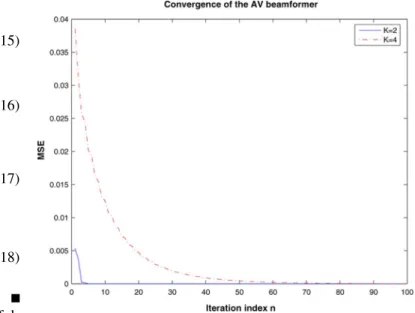
Fig. 1. Mean-square error versus iteration index.
Moreover, it enables one to achieve effective interference can-celation, as illustrated now. In the absence of noise, the array output is given by where the columns of
are the interference steering vectors and the columns of correspond to the interference waveforms. In this case, for and the principal subspace of in-cludes , along with vectors orthogonal to . In any case, all vectors in are orthogonal to and hence the interferences will be nulled. However, the asymptotic vector will not use all degrees of freedom in the space orthog-onal to the interferences, but only out of . When noise is present, is of rank with proba-bility 1 and will be not be contained entirely in , but will also have components in . However, for inter-ference dominating scenarios, i.e., for high interinter-ference to noise ratio (INR), this leakage will be small, and the columns of will be quasi-orthogonal to . In other words, for high inter-ference to noise ratio, Algorithm 1 converges to a weight vector that mostly lies in the null space of the interferences. A last but important observation is the following. In the special case when the sample support is exactly equal to the signal subspace dimension will contain the eigenvectors of cor-responding to the smallest eigenvalues. Hence, in that case, the AV sequence converges to the minimum norm eigen-canceler (MNE) of [6].
III. NUMERICALILLUSTRATIONS
In this section, we illustrate, through a simple scenario, the main theoretical result of this letter—namely the convergence of the AV beamformer to —as well as the transient be-havior of Algorithm 1. We consider a uniform linear array with elements spaced a half-wavelength apart. The array is steered at broadside (0 ) and the interferences consist of 2 signals with directions of arrival and interference to noise ratio [10 dB 5 dB], respectively. In Fig. 1, we plot the mean-square error (MSE)
252 IEEE SIGNAL PROCESSING LETTERS, VOL. 16, NO. 4, APRIL 2009
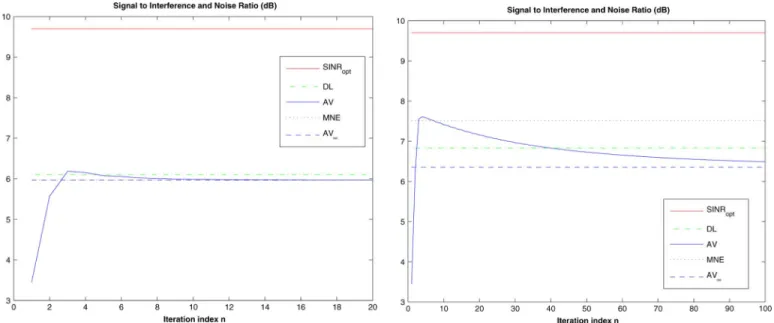
Fig. 2. Output SINR versus iteration index.K = 2.
versus the iteration index , for two different levels of snasphot support, namely and . The results are given for a particular realization of . This figure confirms the validity of the theoretical analysis. It also shows that the convergence is slower with than with . However, as illustrated next, the SINR obtained after convergence will be higher in the former case.
We consider now the transient behavior of the AV beam-former and compare its performance with diagonal loading (with a loading level 15 dB above the thermal noise power) and the minimum norm eigencanceler. The results are shown in Figs. 2 and 3, which correspond to and , respectively. We also display the optimal SINR, for compar-ison purposes. As can be observed, when , the asymptotic vector is exactly the MNE vector while they are different when . It can be observed that the SINR obtained for small can be larger than that obtained with , and that the AV beamformer can outperform the MNE for some values of . Of course, a delicate issue is to select the value at which the iterations are stopped, although a solution to this issue has been proposed in [17].
IV. CONCLUSION
In this letter, we presented a new convergence result for the auxiliary-vector beamformer in case of a rank-deficient input covariance matrix. This case is of utmost practical importance in low sample support where the number of snapshots is less than the number of array elements, and a sample covariance matrix is used. We proved that the limit of the AV algorithm belongs to a low-rank subspace, actually the null space of the covariance ma-trix, and is thus quasi-orthogonal to the interferences subspace. This result shades a new light on the behavior of the AV beam-former.
REFERENCES
[1] H. L. Van Trees, Optimum Array Processing. New York: Wiley, 2002.
Fig. 3. Output SINR versus iteration index.K = 4.
[2] I. S. Reed, J. D. Mallett, and L. E. Brennan, “Rapid convergence rate in adaptive arrays,” IEEE Trans. Aerosp. Electron. Syst., vol. 10, no. 6, pp. 853–863, Nov. 1974.
[3] J. Ward, Space-Time Adaptive Processing for Airborne Radar Lin-coln Lab., Mass. Inst. Technol., Lexington, MA, Tech. Rep. 1015, Dec. 1994.
[4] O. P. Cheremisin, “Efficiency of adaptive algorithms with regularised sample covariance matrix,” Radio Eng. Electron. Phys., vol. 27, no. 10, pp. 69–77, 1982.
[5] B. D. Carlson, “Covariance matrix estimation errors and diagonal loading in adaptive arrays,” IEEE Trans. Aerosp. Electron. Syst., vol. 24, no. 4, pp. 397–401, Jul. 1988.
[6] A. M. Haimovich, “The eigencanceler: Adaptive radar by eigenanal-ysis methods,” IEEE Trans. Aerosp. Electron. Syst., vol. 32, no. 2, pp. 532–542, Apr. 1996.
[7] I. P. Kirsteins and D. W. Tufts, “Adaptive detection using low rank approximation to a data matrix,” IEEE Trans. Aerosp. Electron. Syst., vol. 30, no. 1, pp. 55–67, Jan. 1994.
[8] K. A. Byerly and R. A. Roberts, “Output power based partial adaptive array design,” in Proc. 23rd Asilomar Conf., Pacific Grove, CA, Nov. 1989, pp. 576–580.
[9] J. S. Goldstein and I. S. Reed, “Subspace selection for partially adaptive sensor array processing,” IEEE Trans. Aerosp. Electron. Syst., vol. 33, no. 2, pp. 539–544, Apr. 1997.
[10] D. Abraham and N. Owsley, “Beamforming with dominant mode re-jection,” in Proc. IEEE OCEANS’90, Sept. 24–26, 1990, pp. 470–475. [11] J. S. Goldstein, I. S. Reed, and L. L. Scharf, “A multistage representa-tion of the Wiener filter based on orthogonal projecrepresenta-tions,” IEEE Trans.
Inform. Theory, vol. 44, no. 7, pp. 2943–2959, Nov. 1998.
[12] M. L. Honig and W. Xao, “Performance of reduced-rank linear inter-ference suppression,” IEEE Trans. Inform. Theory, vol. 47, no. 5, pp. 1928–1946, Jul. 2001.
[13] G. Golub and C. V. Loan, Matrix Computations, 3rd ed. Baltimore, MD: John Hopkins Univ. Press, 1996.
[14] D. A. Pados and G. N. Karystinos, “An iterative algorithm for the com-putation of the MVDR filter,” IEEE Trans. Signal Process., vol. 49, no. 2, pp. 290–300, Feb. 2001.
[15] D. A. Pados, G. N. Karystinos, S. N. Batalama, and J. D. Matyjas, “Short-data-record adaptive detection,” in Proc. 2007 IEEE Radar
Conf., Boston, MA, Apr. 17–20, 2007, pp. 357–361.
[16] G. N. Karystinos, D. A. Pados, S. N. Batalama, and J. D. Matyjas, “Auxiliary-vector detection on measured radar data,” in Proc. 2008
IEEE Radar Conf., Rome, May 26–30, 2008, pp. 1134–1138.
[17] H. Qian and S. N. Batalama, “Data record-based criteria for the selec-tion of an auxiliary vector estimator of the MMSE/MVDR filter,” IEEE