
Pépite | Stratégies thermo-mécaniques et multi-échelles pour la modélisation du contact rugueux : application aux systèmes de freinage
197
0
0
Texte intégral
(2) Thèse de Yassine Waddad, Lille 1, 2017. i. Remerciements Mon engouement pour la recherche a fait que j’ai décidé de faire une thèse à la suite de mon cursus d’ingénieur. La réalisation de ma thèse n’aurait pas été possible sans l’aide de plusieurs personnes, auxquelles je tiens à témoigner ma profonde gratitude et mon entière reconnaissance. Mes pensées vont tout d’abord à mon directeur de thèse Philippe Dufrénoy que je remercie pour la confiance qu’il m’a accordée ainsi que sa disponibilité tout au long de ma thèse. Ses qualités humaines et sa rigueur professionnelle ont rendues bonnes mes conditions de travail et m’ont marqué sur le plan professionnel et personnel. Je voudrais ensuite remercier chaleureusement Vincent Magnier pour avoir encadré ma thèse, en me guidant avec enthousiasme vers les différentes pistes de travail tout en me laissant une grande autonomie qui m’a permis de m’épanouir durant ma thèse. Je le remercie pour le temps qu’il m’as accordé, sa présence permanente a permis l’avancement de mon travail sans interruption. J’adresse mes remerciements également à Géry de Saxcé qui a co-dirigé cette thèse; ses conseils précieux et ses idées ont participé indéniablemet à l’aboutissement de ce travail. Je le remercie pour ses encouragements et sa disponibilité malgré ses responsabilités multiples. J’aimerais remercier Daniel Nélias et Michele Ciavarella d’avoir accepté de rapporter mon mémoire et pour l’intérêt qu’ils ont pu porter à mes travaux. Je tiens aussi à remercier vivement Emmanuelle Rouhaud, Maxence Bigerelle et Bernard Desmet qui ont examiné avec attention ce travail. Je tiens à remercier tous les membres de l’équipe µFrein et du Laboratoire de Mécanique de Lille en général. Je souhaiterais remercier en particulier Quentin, Loic, Itziar, Sofiane, Florent, Ruddy et Jean-François pour la bonne ambiance et les moments de détente et de partage passés au sein de la "D252". J’adresse mes remerciements également à tous mes ami(e)s pour leur aide et leur soutien moral. La liste est tellement longue que je ne peux pas citer vos noms, mais je voudrais remercier particulièrement Hassan, Zouhair, Yassine et Ayoub pour l’aide qu’ils m’ont apporté avant d’entamer ma thèse. C’est enfin à ma famille que j’adresse mes derniers remerciements : mes parents Fatima et Mohamed et mon frère Anas pour leur affection infaillible et le soutien moral et financier qu’ils m’ont toujours offert, et, en dernier lieu, mon épouse Maryam pour sa tendre présence, son soutien indéféctible et son amour inconditionnel.. Yassine. © 2017 Tous droits réservés.. lilliad.univ-lille.fr.
(3) Thèse de Yassine Waddad, Lille 1, 2017. © 2017 Tous droits réservés.. lilliad.univ-lille.fr.
(4) Thèse de Yassine Waddad, Lille 1, 2017. ii. Abstract Keywords : Contact analysis, Surface Roughness, Finite element method, Multi-scale analysis, Thermo-mechanical modeling Abstract Friction brakes are subjected to important developments aiming to increase their energetic efficiency and durability on the one hand and, on the other hand, decrease their maintenance costs and their impacts on the environment (noise, particle emissions,etc.). In these applications, the contact interface between the rotating part of the brake and the static one, is central to its functioning as it presents the location of heat dissipation, thermal exchanges and mechanical interactions. Indeed, these phenomena are a source of wear, leading thus to the constant modification of the contact surface and material properties which may affect the braking performances. To address these issues, the current approach used by manufacturers, which is based on feedback tests, is expensive and inefficient against the new technical and environmental requirements. Besides, experiments can not give precise measures of contact surface data. Hence, theoretical modeling and numerical simulations can help to fill this gap. The main objective of this work is to propose a numerical strategy consisting of modeling contact applications like brakes with realistic assumptions made at the contact interface by considering micro-contact phenomena, unlike the classical approaches which assume perfect contact conditions. This challenge has been overcome by building a methodology which associates a large scale Finite Element model of the system and several refined micro-contact models considering only the interface and covering the thermal, mechanical and wear features. At micro-scale modeling, contact analysis has been performed with semi-analytic approaches considering the real contact area for a given topography. The thermal and the mechanical features are both considered and the contact problem is solved by means of quadratic programming. The case of a normal gradient of properties has also been investigated, which is often encountered in case of severe thermal loadings. Moreover, the evolution of surface roughness has been considered by modeling wear with Archard’s law. From the micro-scale analysis, several contact parameters have been calculated such as contact stiffness, thermal conductance, wear volume, heat distribution, etc. The dependency of all these parameters on many physical properties has been investigated. Thereafter, these parameters have been integrated into a Finite Element large scale model using an embedding strategy which conserves the surface flatness at the system scale and considers the effects of roughness and its evolution. With this technique, the contact phenomena complexity is transformed into homogenized contact laws and parameters that are integrated into the macro-scale model. The advantage is the considerable reduction of computation time while maintaining the precision of calculations in comparison to classical Finite Element ones. This multi-scale methodology has been used for dynamic and thermo-mechanical analysis of braking systems with the aim of evaluating their performances considering micro-scale issues. With this strategy, the interaction between non uniform surface and system behavior is clearly shown. The results of numerical simulations highlight the impact of the contact interface and its evolution on the braking performances, and vice versa.. © 2017 Tous droits réservés.. lilliad.univ-lille.fr.
(5) Thèse de Yassine Waddad, Lille 1, 2017. iii. Résumé Mots-clés : contact, rugosité, éléments finis, Multi-échelle, modélisation thermo-mécanique Résumé Les freins à friction font l’objet d’importants développements visant à améliorer d’une part leur efficacité énergétique et leur durabilité, et d’autre part, réduire leurs coûts de maintenance ainsi que leurs impacts environnementaux. Dans ces applications, l’interface de contact entre la partie statique du frein et sa partie mobile, est importante dans leur fonctionnement, puisqu’elle présente l’endroit où est dissipée l’énergie et où se produisent des échanges thermiques et des interactions mécaniques. De plus, ces phénomènes sont à l’origine de l’usure, conduisant ainsi à une évolution continue de la surface de contact et des propriétés des matériaux, ce qui peut influencer les performances du système. Afin de traiter ces problèmes, les industriels se basent actuellement sur des retours d’expériences de type essai/erreur qui sont coûteuses et peu efficaces face aux nouvelles exigences et réglementations. De plus, les mesures expérimentales sont difficilement accessibles dans les aires de contact. Ainsi, la modélisation numérique présente une des solutions alternatives permettant de diminuer le nombre d’essais et de mieux cerner les phénomènes de contact. L’objectif principal de cette thèse est de proposer une stratégie numérique consistant à modéliser des systèmes, présentant un contact mécanique tel qu’un frein à friction, avec des hypothèses réalistes au niveau du contact consistant à considérer les phénomènes se produisant à l’échelle microscopique. Ce challenge a été surmonté en développant une méthodologie qui associe un modèle Éléments Finis macroscopique du système et plusieurs modèles micro qui considèrent l’interface de contact réelle et ses aspects thermique et mécanique ainsi que son usure. A l’échelle microscopique, la modélisation du contact a été faite en se basant sur des approches semianalytiques qui considèrent l’aire de contact réelle pour une topographie donnée. Les aspects thermique et mécanique sont tous les deux considérés et le problème est résolu avec des techniques d’optimisation sous contraintes. Le cas d’un matériau à gradient de propriétés normal à la surface a été aussi considéré, qui est souvent rencontré dans le cas de sollicitations thermiques sévères L’usure est modélisée par la loi d’Archard. Á partir de ces calculs, l’évolution de plusieurs paramètres physiques a été étudiée, tels que la raideur de contact, l’aire de contact réelle, la conductance thermique, la distribution de chaleur, la température de surface, etc. Ensuite, ces paramètres ont été intégrés dans un modèle macroscopique en utilisant une stratégie d’enrichissement qui conserve la planéité des surfaces de contact tout en considérant l’effet de la rugosité et de son évolution. Avec cette technique, la complexité des phénomènes de contact est traduite par des paramètres/lois de contact homogénéisés qui sont intégrés dans le modèle macroscopique. L’avantage de cette méthode est la réduction considérable du temps de calcul en comparaison à des calculs Éléments Finis complets, tout en accédant à des informations locales précieuses. Cette stratégie de modélisation multi-échelle a été adoptée pour l’analyse dynamique et thermo-mécanique des systèmes de freinage afin d’évaluer leurs performances prenant en compte l’effet de l’interface de contact. Avec cette stratégie, les interactions entre l’interface et le système sont bien éclaircies. Les résultats des simulations numériques montrent l’impact de l’interface et de son évolution sur les performances du frein et vice-versa.. © 2017 Tous droits réservés.. lilliad.univ-lille.fr.
(6) Thèse de Yassine Waddad, Lille 1, 2017. Contents Acknowledgments . . . . . . . . . . . . . . . . . . . . . . . . . . . . . . . . . . . . . . . . . . . . Abstract . . . . . . . . . . . . . . . . . . . . . . . . . . . . . . . . . . . . . . . . . . . . . . . . . Résumé . . . . . . . . . . . . . . . . . . . . . . . . . . . . . . . . . . . . . . . . . . . . . . . . . General introduction 0.1 Context of the thesis . . . . . . . . . . . . . . . . . . . . . . . . . . . 0.2 The contact problem : physical point of view . . . . . . . . . . . . . 0.3 The contact problem : modeling solutions . . . . . . . . . . . . . . . 0.3.1 Contact modeling of rough surfaces : mechanical and thermal 0.3.2 Third body modeling . . . . . . . . . . . . . . . . . . . . . . 0.3.3 Braking system modeling . . . . . . . . . . . . . . . . . . . . 0.4 Aim of the thesis . . . . . . . . . . . . . . . . . . . . . . . . . . . . . 0.4.1 Micro-contact modeling . . . . . . . . . . . . . . . . . . . . . 0.4.2 Multi-scale embedding strategy . . . . . . . . . . . . . . . . . 0.5 Outline of the thesis . . . . . . . . . . . . . . . . . . . . . . . . . . .. I. . . . . . . . . . . . . . . . aspects . . . . . . . . . . . . . . . . . . . . . . . . . . . . . .. . . . . . . . . . .. . . . . . . . . . .. . . . . . . . . . .. . . . . . . . . . .. . . . . . . . . . .. . . . . . . . . . .. . . . . . . . . . .. Contact mechanics of rough surfaces. i ii iii 1 1 2 7 7 9 9 10 11 12 12. 19. Transition. 20. 1 A multiscale method for frictionless contact mechanics of rough surfaces 1.1 Introduction . . . . . . . . . . . . . . . . . . . . . . . . . . . . . . . . . . . . . . . . 1.2 Contact models . . . . . . . . . . . . . . . . . . . . . . . . . . . . . . . . . . . . . . 1.2.1 Hertz theory . . . . . . . . . . . . . . . . . . . . . . . . . . . . . . . . . . . 1.2.2 Contact models for rough surfaces . . . . . . . . . . . . . . . . . . . . . . . 1.2.2.1 Discrete model without interaction . . . . . . . . . . . . . . . . . . 1.2.2.2 Discrete circular contact with interaction . . . . . . . . . . . . . . 1.2.2.3 Discrete elliptic contact with interaction . . . . . . . . . . . . . . . 1.3 Example . . . . . . . . . . . . . . . . . . . . . . . . . . . . . . . . . . . . . . . . . . 1.3.1 Surfaces . . . . . . . . . . . . . . . . . . . . . . . . . . . . . . . . . . . . . . 1.3.2 Results . . . . . . . . . . . . . . . . . . . . . . . . . . . . . . . . . . . . . . 1.4 A numerical interface embedding strategy . . . . . . . . . . . . . . . . . . . . . . . 1.4.1 A brief overview on the numerical treatment of frictionless contact problem 1.4.2 Embedding strategy principle . . . . . . . . . . . . . . . . . . . . . . . . . . 1.5 Numerical examples . . . . . . . . . . . . . . . . . . . . . . . . . . . . . . . . . . . 1.5.1 Numerical models . . . . . . . . . . . . . . . . . . . . . . . . . . . . . . . . 1.5.2 Results . . . . . . . . . . . . . . . . . . . . . . . . . . . . . . . . . . . . . .. 21 22 25 25 26 27 28 30 32 32 33 36 36 37 40 40 41. © 2017 Tous droits réservés.. . . . . . . . . . . . . . . . .. . . . . . . . . . . . . . . . .. . . . . . . . . . . . . . . . .. . . . . . . . . . . . . . . . .. lilliad.univ-lille.fr.
(7) Thèse de Yassine Waddad, Lille 1, 2017. CONTENTS. v. Transition 2 A new contact model for multi-layered solids with rough surfaces 2.1 Introduction . . . . . . . . . . . . . . . . . . . . . . . . . . . . . . . . . . . . 2.2 Surface loading of multi-layered elastic solid : the transfer matrix technique 2.2.1 General framework . . . . . . . . . . . . . . . . . . . . . . . . . . . . 2.2.2 The transfer matrix technique . . . . . . . . . . . . . . . . . . . . . . 2.3 Elastic contact of an axially symmetric asperity . . . . . . . . . . . . . . . . 2.3.1 General contact problem . . . . . . . . . . . . . . . . . . . . . . . . . 2.3.2 Contact solution for a parabolic asperity . . . . . . . . . . . . . . . . 2.4 Contact of rough surfaces . . . . . . . . . . . . . . . . . . . . . . . . . . . . 2.4.1 An approximate asperity contact model . . . . . . . . . . . . . . . . 2.4.2 A multi-asperity contact model . . . . . . . . . . . . . . . . . . . . . 2.5 Results . . . . . . . . . . . . . . . . . . . . . . . . . . . . . . . . . . . . . . .. 47 . . . . . . . . . . .. . . . . . . . . . . .. . . . . . . . . . . .. . . . . . . . . . . .. . . . . . . . . . . .. . . . . . . . . . . .. . . . . . . . . . . .. . . . . . . . . . . .. Transition 3 Numerical analysis of wear in a rough contact for multi-layered solids 3.1 Introduction . . . . . . . . . . . . . . . . . . . . . . . . . . . . . . . . . . . . 3.2 Global framework and general assumptions . . . . . . . . . . . . . . . . . . 3.3 Modeling of the contact mechanics problem . . . . . . . . . . . . . . . . . . 3.3.1 Discretization of the contact problem . . . . . . . . . . . . . . . . . . 3.3.2 Interaction terms for homogeneous solids . . . . . . . . . . . . . . . 3.3.3 Interaction terms for multi-layered solids . . . . . . . . . . . . . . . 3.3.4 Numerical solving of the contact problem . . . . . . . . . . . . . . . 3.4 Wear modeling . . . . . . . . . . . . . . . . . . . . . . . . . . . . . . . . . . 3.5 Numerical analysis of the evolution of a rough surface under wear process . 3.5.1 Wear step effect on the model predictions . . . . . . . . . . . . . . . 3.5.2 Case of a two-layered solid . . . . . . . . . . . . . . . . . . . . . . .. 72 . . . . . . . . . . .. . . . . . . . . . . .. . . . . . . . . . . .. . . . . . . . . . . .. . . . . . . . . . . .. . . . . . . . . . . .. . . . . . . . . . . .. Transition 4 Influence of roughness on mode Lock-in in a brake system 4.1 Introduction . . . . . . . . . . . . . . . . . . . . . . . . . . . . . . . . . . . . . 4.2 Multi-scale modeling of contact interface . . . . . . . . . . . . . . . . . . . . . 4.2.1 Global strategy . . . . . . . . . . . . . . . . . . . . . . . . . . . . . . . 4.2.2 Micro-contact model . . . . . . . . . . . . . . . . . . . . . . . . . . . . 4.3 Multi-scale modeling of a braking system including contact interface behavior 4.3.1 Numerical model presentation . . . . . . . . . . . . . . . . . . . . . . . 4.3.2 Pad/disc interfaces modeling . . . . . . . . . . . . . . . . . . . . . . . 4.4 Results and discussion . . . . . . . . . . . . . . . . . . . . . . . . . . . . . . . 4.5 Conclusion . . . . . . . . . . . . . . . . . . . . . . . . . . . . . . . . . . . . .. II. Thermal contact of rough surfaces. Transition. © 2017 Tous droits réservés.. 48 49 51 51 51 53 53 56 58 58 60 63. . . . . . . . . . . .. 73 74 76 77 77 78 78 80 80 80 81 83 87. . . . . . . . . .. . . . . . . . . .. . . . . . . . . .. . . . . . . . . .. . . . . . . . . .. . . . . . . . . .. 88 . 89 . 90 . 90 . 91 . 93 . 93 . 94 . 97 . 101. 105 106. lilliad.univ-lille.fr.
(8) Thèse de Yassine Waddad, Lille 1, 2017. CONTENTS. 5 Heat conduction in multi-layered solids with 5.1 Introduction . . . . . . . . . . . . . . . . . . . 5.2 Global framework . . . . . . . . . . . . . . . . 5.3 Surface heating of multi-layered solids . . . . 5.4 Thermal contact of multi-layered solids . . . . 5.4.1 Contact area definition . . . . . . . . . 5.4.2 Thermal contact problem . . . . . . . 5.4.3 Solving method . . . . . . . . . . . . . 5.5 Numerical example . . . . . . . . . . . . . . . 5.5.1 Model presentation . . . . . . . . . . . 5.5.2 An illustrative case study . . . . . . . 5.5.3 Parametric study . . . . . . . . . . . .. vi. rough surfaces . . . . . . . . . . . . . . . . . . . . . . . . . . . . . . . . . . . . . . . . . . . . . . . . . . . . . . . . . . . . . . . . . . . . . . . . . . . . . . . . . . . . . . . . . . . . . . . . . . . . . . . . . . . . . .. . . . . . . . . . . .. . . . . . . . . . . .. . . . . . . . . . . .. . . . . . . . . . . .. . . . . . . . . . . .. . . . . . . . . . . .. . . . . . . . . . . .. . . . . . . . . . . .. . . . . . . . . . . .. . . . . . . . . . . .. . . . . . . . . . . .. . . . . . . . . . . .. . . . . . . . . . . .. . . . . . . . . . . .. . . . . . . . . . . .. 107 108 110 110 114 114 115 116 116 116 117 119. Transition. 129. 6 Heat partition and surface temperature in sliding contact problems 6.1 Introduction . . . . . . . . . . . . . . . . . . . . . . . . . . . . . . . . . . . . . . . . . . . . 6.2 Analytic solutions for thermal loading of moving and static homogeneous solids . . . . . . 6.2.1 Surface heating of a fixed semi-infinite region . . . . . . . . . . . . . . . . . . . . . 6.2.2 Surface heating of a rotating semi-infinite region . . . . . . . . . . . . . . . . . . . 6.2.3 Illustration of the analytic solutions . . . . . . . . . . . . . . . . . . . . . . . . . . 6.3 The transient temperature and heat distribution in sliding contact problems . . . . . . . . 6.3.1 General equations . . . . . . . . . . . . . . . . . . . . . . . . . . . . . . . . . . . . 6.3.2 Discretization of the contact problem . . . . . . . . . . . . . . . . . . . . . . . . . . 6.3.3 Expression of the gap of temperature: the thermal resistance and capacitance, and profiles of heat generation . . . . . . . . . . . . . . . . . . . . . . . . . . . . . . . . 6.3.4 Solving of thermal contact problem . . . . . . . . . . . . . . . . . . . . . . . . . . . 6.3.5 Solving scheme . . . . . . . . . . . . . . . . . . . . . . . . . . . . . . . . . . . . . . 6.3.6 The special case of a perfect contact : equal surface temperatures in contact zones 6.4 Results and case studies . . . . . . . . . . . . . . . . . . . . . . . . . . . . . . . . . . . . . 6.4.1 Model presentation . . . . . . . . . . . . . . . . . . . . . . . . . . . . . . . . . . . . 6.4.2 Parametric study : case of a perfect contact . . . . . . . . . . . . . . . . . . . . . . 6.4.2.1 Influence of the velocity . . . . . . . . . . . . . . . . . . . . . . . . . . . . 6.4.2.2 Influence of the velocity profile . . . . . . . . . . . . . . . . . . . . . . . . 6.4.2.3 Influence of the ratio between conductivities . . . . . . . . . . . . . . . . 6.4.2.4 Influence of roughness . . . . . . . . . . . . . . . . . . . . . . . . . . . . . 6.4.3 Influence of the gap of temperature . . . . . . . . . . . . . . . . . . . . . . . . . . . 6.4.3.1 Influence of the heat generation profile . . . . . . . . . . . . . . . . . . . 6.4.3.2 Influence of the thermal resistance . . . . . . . . . . . . . . . . . . . . . . 6.4.3.3 Influence of the thermal capacitance . . . . . . . . . . . . . . . . . . . . . 6.5 The steady heat conduction in a sliding contact : consideration of non-zero infinity temperatures . . . . . . . . . . . . . . . . . . . . . . . . . . . . . . . . . . . . . . . . . . . . . 6.5.1 Results . . . . . . . . . . . . . . . . . . . . . . . . . . . . . . . . . . . . . . . . . .. 130 131 133 133 134 135 138 138 141. Transition. 164. © 2017 Tous droits réservés.. 143 144 145 146 147 147 148 149 149 152 154 155 155 155 156 158 159. lilliad.univ-lille.fr.
(9) Thèse de Yassine Waddad, Lille 1, 2017. CONTENTS. 7 Multi-scale thermo-mechanical modeling of a pin-on-disc 7.1 Introduction . . . . . . . . . . . . . . . . . . . . . . . . . . . 7.2 Presentation of the multi-scale modeling strategy . . . . . . 7.2.1 Global strategy . . . . . . . . . . . . . . . . . . . . . 7.2.2 Micro-contact modeling . . . . . . . . . . . . . . . . 7.3 Description of the numerical model . . . . . . . . . . . . . . 7.3.1 Numerical model of a pin-on disc system . . . . . . . 7.3.2 Results . . . . . . . . . . . . . . . . . . . . . . . . . 7.4 Conclusions . . . . . . . . . . . . . . . . . . . . . . . . . . . Conclusions and prospects. © 2017 Tous droits réservés.. vii. system . . . . . . . . . . . . . . . . . . . . . . . . . . . . . . . . . . . . . . . .. . . . . . . . .. . . . . . . . .. . . . . . . . .. . . . . . . . .. . . . . . . . .. . . . . . . . .. . . . . . . . .. . . . . . . . .. . . . . . . . .. . . . . . . . .. . . . . . . . .. . . . . . . . .. 165 166 168 168 170 172 172 173 179 183. lilliad.univ-lille.fr.
(10) Thèse de Yassine Waddad, Lille 1, 2017. © 2017 Tous droits réservés.. lilliad.univ-lille.fr.
(11) Thèse de Yassine Waddad, Lille 1, 2017. General introduction 0.1. Context of the thesis. The transport domain has been subjected to important developments in the recent years. For instance, the progress achieved in railway and automotive sectors helped to increase the maximal speed. However, the operating speed is limited to much lower values. For example, a vehicle could reach easily a speed of 200km/h while the speed limit on highways is 130km/h. These limitations are related to transport operating costs and maintenance which increase with the operating speed. To overcome this obstacle, for instance, the manufacturers seek to improve braking systems by reducing their weights and numbers, and increasing their efficiency and life cycle. Nevertheless, the improvement of braking systems is subjected to environmental requirements related to noise pollution and particle emissions. A compromise has therefore to be found between the different needs and requirements. Most brakes commonly use friction to absorb the mechanical energy and inhibit the motion of the system. In friction brakes, the braking action is generally performed by pressing together the surface of a static friction material into a rotating solid (e.g. an axle or a wheel). This contact surface is central to the braking action, as it represents the location where several complex and prominent phenomena occur. On one hand, friction transforms mainly the kinetic energy into heat. The consequence is a rise of temperature reaching high levels that cause wear at the interface and possible degradation of the contacting materials (damage, fracture, etc.). Furthermore, air quality is also affected by particle emissions originating from wear. Thus, the knowledge of surface temperature is of high interest, as it allows to choose efficiently the friction brake materials, and thus reduce the maintenance costs and increase their performance (durability, etc.). On the other hand, during braking, a small part of energy may be converted into acoustic energy, contributing to noise pollution. Indeed, it has been shown that the contact interface between the disc and the friction material generates numerous kinds of high-pitched noises, of whom squeal is the most encountered. For instance, in the automotive industry, even if squeal does not significantly affect performances, such noise causes a high customer complaints warranty cost each year. Thus, the understanding of the system dynamics is prominent to study the noise generation propensity. The contact interface is therefore involved in many issues affecting braking performances. Actually, to face up these issues, manufacturers implemented solutions which are mainly based on the use of feedback based tests and the empirical trial/error methods. Such method leads to complex friction material development. This kind of methods reflects a lack of a real understanding of the mechanisms governing friction brakes needing a high number of trial tests which is very costly and inefficient in front of the new technical and environmental requirements. Furthermore, the phenomena occurring in the interface are of high complexity since they cover many areas of physics like thermic, mechanics and tribology. To deal with such a problem, small-scale experiments are of great interest, allowing a real understanding of contact interface phenomena. However, despite the recent advances in measuring techniques, it is difficult to set up an experiment within the contact. © 2017 Tous droits réservés.. lilliad.univ-lille.fr.
(12) Thèse de Yassine Waddad, Lille 1, 2017. 0.2 The contact problem : physical point of view. 2. area to measure surface data (temperature, pressure, contact area, etc). Thus, theoretical modeling and numerical simulations can help to fill this gap. In the recent years, with the development of computational tools, several numerical strategies covering various aspects such as dynamics and thermo-mechanics, have been proposed for braking systems modeling. However, even if these aspects have been well handled from a structural point of view, there are still some points related to contact phenomena, which are often simplified or not considered at all. In fact, on one side, the classical modeling approaches consider only the scale of brake components and assume that the contact interface is smooth and perfect, neglecting thus the effects of roughness, thermal and stress localizations, wear and many other features happening in several scales smaller than the brake system’s scale. On the other side, contact phenomena have been widely studied using various analytical and numerical models, by targeting a particular physic (mechanical, electrical, thermal, etc.) and choosing the appropriate scale (meso, micro or nano-scale). Nevertheless, such models do not consider the system’s induced interactions. Thus, this work objective is to propose a numerical strategy going beyond the existing ones by considering the contact complex phenomena at the system’s scale and the different couplings presents in the system (mechanics, thermal, tribology, etc.). This is a real challenge as it allows to take an important step toward developing realistic numerical strategies that can be integrated into the industrial design processes. Indeed, the developed approach should not only consider the real contact phenomena but also provide results within a reasonable computational time. With the purpose of bringing the reader into the contact phenomena issues, the following section presents these points from a physical point of view. Afterwards, existing modeling solutions are briefly presented, as they will be discussed, in detail, in the following chapters of this thesis. Finally, the modeling strategy proposed in this work will be presented.. Figure 1: (a) TGV braking system (b) Microscopic image of a friction material surface [Roussette et al.(2001)]. 0.2. The contact problem : physical point of view. The contact problem is one of the most relevant issues in engineering applications. A proper understanding of the contact mechanisms is crucial in the design process. Contact between two solids allows transferring mechanical loads, heat and electrical power in some applications. These exchanges are performed from one solid to another through the contact surface. The knowledge of the contact area is of great interest,. © 2017 Tous droits réservés.. lilliad.univ-lille.fr.
(13) Thèse de Yassine Waddad, Lille 1, 2017. 0.2 The contact problem : physical point of view. 3. as it influences these exchanges. Real surfaces are generally non-smooth, thus the real contact area is much smaller than the nominal one. Indeed, real solids have rough surfaces, and make contact only at separated zones where the asperities of the two mating surfaces are in contact. Thus, the interactions between the contacting solids are mainly performed through these micro zones. Therefore, contact forces are concentrated in these areas and, in case of the presence of a thermal gradient, heat flows mainly throw these zones and marginally through the air contained in these gaps and radiation. As the contact load increases, the gap between the two surface decreases and the contact area increases. This evolution affects both the stiffness and the thermal conductance of the contact, and certainly depends on the surface topography, and both thermal and mechanical loads, with respect to material properties. In sliding contact problems, which is the case of braking systems, frictional forces appear in the real contact zones as a resistance to the sliding motion. As it is commonly known, the largest percentage of the frictional energy is transformed into a thermal energy through several mechanisms (plastic deformations, atomic scale interactions, etc.). As a consequence, high elevations of temperature occur near to the contact area. Since the micro-contact zones are very small, the temperatures and stresses near to them would be severe, and could damage the material, accelerate the wear process and change the material properties by overheating[Archard(1959), Furey(1964), Kennedy(1984), Bos and Moes(1995)]. Moreover, the thermal expansion around contact zones can give birth to the phenomenon known as thermoelastic instability which disturbs the pressure and temperature distribution [Barber(1969)]. Therefore, the knowledge of the mechanisms that originate heat generation, their location and the ability to measure or predicate surface temperature, is important to avoid material failure. Furthermore, high temperatures may lead to melting which cause wear with sliding. In addition, the wear process can be accentuated by micro-cracks due to high stresses and chemical transformations if the environment is corrosive [Meng(1995), Masen(2005)]. Moreover, there is several types of wear : adhesive, abrasive, corrosive and fatigue (see Fig.2). Generally, in real contact systems, wear does not take place through a single mechanism [Kato(2000)]. However, with regard to many factors (material properties, dynamic behavior, environment, etc), it may be possible that one or more of these types are the dominant ones. Thus, to estimate correctly the material loss, it is necessary to know the dominant mode with respect to the system, the contact situation and material properties. The main consequence of wear is the change of the contact surface topography due to material removal. The removed material debris integrate what is commonly known as the "tribologic circuit" (see Fig.3). Indeed, a part of surface debris circulates within the contact interface while another one is ejected from the contact system. The part remaining inside the contact system can either continue its circulation or be compacted to form a thin layer called "third body". As sliding continues, this third body is in turn fragmented progressively and its debris recirculate within the interface. Thus, this circuit traduces the cycle life of a particle from its creation to its ejection from the system or the end of the sliding motion if the particle is still within it [Eriksson et al.(1999)]. Fig.4 illustrates a 3D image of a worn surface. In this image, we can remark the presence of what is namely called "contact plateaus". These zones correspond either to the compacted third body zones or the worn zones of the surface. The presence of the third body modifies the exchanges between the contacting solids, as it represents an additional obstacle at the interface. Moreover, the complexity of the third body lies in the various states in which it exists. Indeed, the third body presents the wear particles, the agglomerated debris that can be at different stages and the compacted ones. Thus, its physical properties depend surely on its state. Surface roughness is implicated in several issues. Its evolution during contact affects the dynamic behavior of the system [Bergman(1998), Eriksson et al.(2002)]. As is shown in [Eriksson et al.(1999)], the change of surface roughness leads to a change of the pressure and temperature distributions, these two factors having the major impact on the generation of brake squeal. Indeed, squeal appears mainly when the system is. © 2017 Tous droits réservés.. lilliad.univ-lille.fr.
(14) Thèse de Yassine Waddad, Lille 1, 2017. 0.2 The contact problem : physical point of view. 4. Figure 2: Classification of wear modes and their interrelations [Kato(2000)]. Figure 3: Schematic of the tribologic circuit in a sliding frictional contact [François et al.(2006)]. unstable. This is the case when the deformation energy of the system is higher than the dissipated one and the contact interface is involved in the dissipation process [Fieldhouse and Newcomb(1996)]. For instance, Fig. 5 shows a hologram of an unstable mode of a braking system reconstructed using interferometry. Furthermore, the increase of the real contact area with friction, by wear and third body compaction, leads to an increase of the friction coefficient [Bergman et al.(1999)]. As a consequence, the squeal generation. © 2017 Tous droits réservés.. lilliad.univ-lille.fr.
(15) Thèse de Yassine Waddad, Lille 1, 2017. 0.2 The contact problem : physical point of view. 5. Figure 4: 3D image of a worn rough surface obtained with white light interferometry [Eriksson et al.(1999)]. increases dramatically with friction (see Fig.6). Thus, the contact surface evolution plays a key role in squeal generation.. Figure 5: Fieldhouse and Newcomb’s reconstructed hologram of a squealing disc brake system [Fieldhouse and Newcomb(1996)] Furthermore, thermal contact phenomena originate a thermal gradient which may cause thermal damage and early failures. Indeed, surface topography and thermal expansions lead to localized contact areas and hot spots [Dufrénoy and Weichert(1995), Majcherczak et al.(2006)]. For detailed informations about the classification of these gradients and their characteristics, the reader may refer to [Dufrénoy and Weichert(1995)]. The shape and the size of these hot spots depend on many factors and control the shape of cracks, surface degradations and transformations and the flow of wear debris. Besides, the rheology of the resultant third body plays a key role in speed accommodation [Majcherczak et al.(2006)]. For instance, in Fig.7 are shown surface cracks induced in a rotating system developed by [Majcherczak et al.(2007)]. Thus, to prevent the initiation of these cracks and to understand the way as they spread, it is interesting to estimate correctly these gradients and their resulting stresses. Physics in the contact interface is of high complexity. This brief and non-exhaustive review does not present all the contact phenomena features. Indeed, here, our concern is only focused on some meso and. © 2017 Tous droits réservés.. lilliad.univ-lille.fr.
(16) Thèse de Yassine Waddad, Lille 1, 2017. 0.2 The contact problem : physical point of view. 6. Figure 6: Gradual change of the disc surface and corresponding friction and squeal generation curves [Bergman et al.(1999)]. Figure 7: Orientation of surface cracks in the mobile side of a sliding contact for two kind of materials (a: C35 steel and b: sapphire) [Majcherczak et al.(2006)]. micro-scale issues. But in fact, the contact complexity goes beyond these scales to cover the atomic scale. For instance, friction and adhesion are related to inter-atomic potentials [Landman et al.(1993)]. In the contact surface take place several phenomena which are linked to each other. As we can see, their effects on the functioning of the system are considerable. In the next paragraph, are presented some modeling solutions for these phenomena.. © 2017 Tous droits réservés.. lilliad.univ-lille.fr.
(17) Thèse de Yassine Waddad, Lille 1, 2017. 0.3 The contact problem : modeling solutions. 0.3 0.3.1. 7. The contact problem : modeling solutions Contact modeling of rough surfaces : mechanical and thermal aspects. Many different models have been proposed to solve the contact mechanics problem. The first contact model goes back to the pioneering work of Hertz (1882). As is well known, his theory considers the frictionless smooth contact between two elastic solids with curved surfaces. Only since the middle of the twentieth century, researchers made many advancements in contact phenomena like friction, adhesion and roughness. For instance, surface roughness effects have been highlighted by the experiments of [Bowden and Tabor(1939)], by measuring the electrical conductance for a wide range of loads. Their results allow to estimate the contact area and confirm that the real contact area is very small comparing to the apparent one. Surface roughness analysis is the first step when dealing with the contact problem. Its characterization can be performed either with statistical approaches or fractal techniques [Abbot and Firestone(1933), LonguetHiggins(1957), Nayak(1971)]. Besides, numerical surfaces can be generated with surface parameters obtained from measurements. For instance, the spectral density or the auto-correlation function can both be used to generate random rough samples [Persson et al.(2005)].. Figure 8: Two rough fractal surfaces generated numerically using the power spectrum density [Yang and Persson(2008)]. The two samples correspond to two different surface scales With the statistical surface parameters, several contact theories have been proposed [Archard(1953), Greenwood and Williamson(1966), Bush et al.(1975)]. These works consider a rough surfaces as a random set of spherical or parabolic asperities. However, these models suffer from many weaknesses such as their dependencies on the surface statistical parameters and several simplifying assumptions, for instance. © 2017 Tous droits réservés.. lilliad.univ-lille.fr.
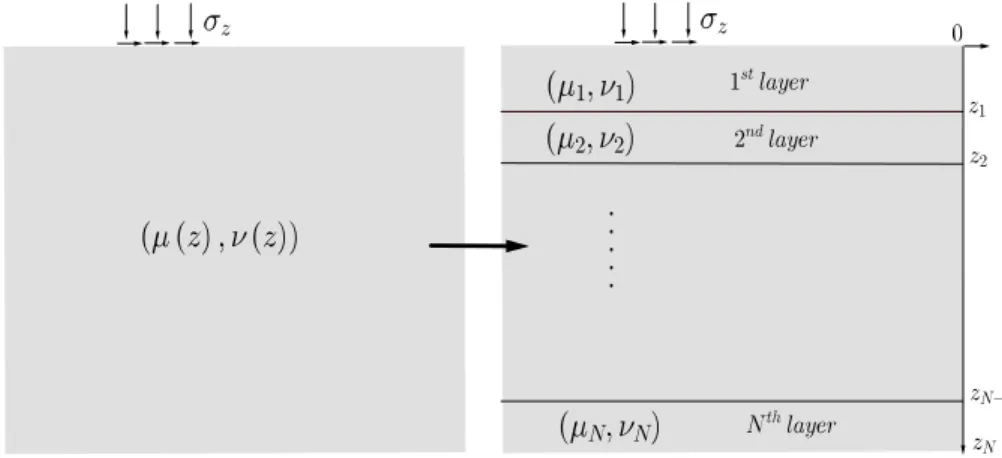
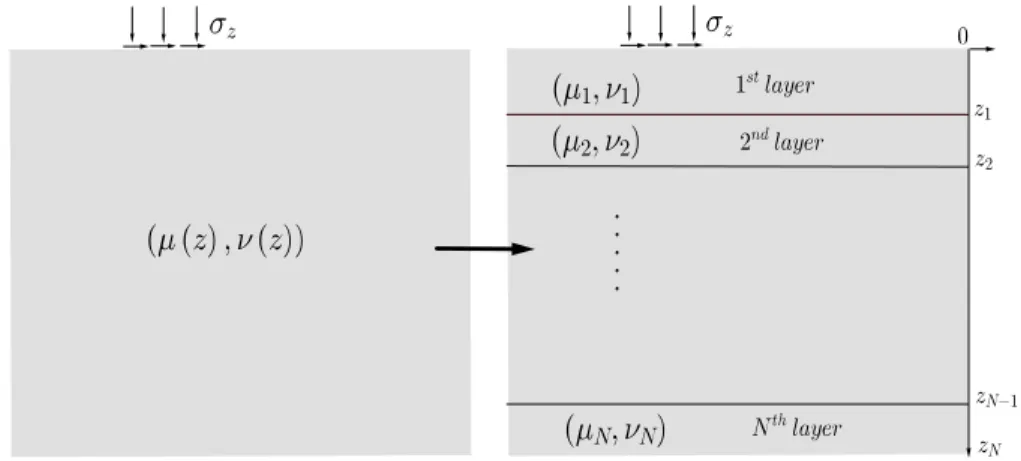
(18) Thèse de Yassine Waddad, Lille 1, 2017. 0.3 The contact problem : modeling solutions. 8. the non-consideration of interactions between asperities. Nevertheless, these theories have been improved through the last years [Ciavarella et al.(2006)] and have been very successful until the end of the twentieth century.. Figure 9: Contact between smooth sphere and rough plane. (a) Schematic of the problem, (b) Actual contact spots for steel ball pushed against glass block [Greenwood and Tripp(1967)] With the increasingly advancement in computing industry, the use of numerical methods has become very important in the last years. Contact modeling has been one of the most treated topics. Using constrained optimization techniques, this problem has been solved with the Finite Element Method (FEM) [Wriggers(2006)]. Smooth contact has been extensively studied in many applications while the rough contact problem is poorly explored since the needed computational time to address it increases with roughness[Pei(2005)]. Indeed, a highly refined mesh is necessary to perform a precise estimation of a rough contact evolution, which can be extremely costly in terms of time, especially for industrial research. Another numerical technique has been also used to solve the rough contact problem, which consists of meshing only the surface and define the so-called influence coefficients[Johnson(1987), Willner(2008)]. The problem is solved with optimization methods. The most important point of this method is its rapidity comparing to FEM. This method can also be accelerated with the Fast Fourier Transform [Gallego et al.(2010)]. Moreover the frictional contact problem can also be treated with this method in a coupled way such as in [Willner(2008)] or by decoupling the normal problem and the tangential one such as in [Gallego et al.(2010)]. Nevertheless, from these works, it seems that the tangential behavior have a relatively negligible effect on contact properties like the real area and wear. Indeed, the elastic tangential deformations are much lower comparing to the normal ones, the latter define mainly the contact area and the normal pressure. The tangential deformations can change the shape of the pressure distribution but. © 2017 Tous droits réservés.. lilliad.univ-lille.fr.
(19) Thèse de Yassine Waddad, Lille 1, 2017. 0.3 The contact problem : modeling solutions. 9. the total normal load remains almost the same [Willner(2008)]. Furthermore, other methods have been used to solve the rough contact problem like the continuum approach of [Persson et al.(2002)] which is based on the surface spectral density. Indeed, he derives a diffusion-like equation for the stress distribution. This approach is interesting as it exhibits the multi-scale nature of the rough contact problem. Besides, the dynamic molecular approach have been also used for rough contact modeling [Almqvist et al.(2011)], which is a particle based approach. However, this method is limited to the contact problem at the atomistic scale since it needs a huge amount of computation time. Contact mechanics modeling allows defining the real contact area distribution. The knowledge of the contact area is beneficial for several contact features such as heat conduction [Cooper et al.(1969), Mikic(1974), Yovanovich(2005)] and generation [Tian and Kennedy(1994), Vick(2001)]. For these thermal issues, the most used theoretical framework is the method of heat sources that allows getting thermal solutions for simple geometries like circles and squares [Blok(1937), Carslaw and Jaeger(1959), Zeng et al.(1997)]. From these elementary solutions, rough contact modeling can be solved by superposing all heat sources [Chao and Trigger(1956), Coulibaly et al.(2014)]. Other numerical methods have been also used to solve the thermal contact problem [Laraqi(1996), Laraqi et al.(2009), Sadowski et al.(2010)], but often considering a simplified geometry of the surface.. 0.3.2. Third body modeling. While the above cited approaches are dedicated to rough contact modeling from a static point of view, other approaches are used for the third body, which is a dynamic problem. Most of these methods are based on particle interactions. For instance, the Discrete Element Method (DEM)[Renouf et al.(2004), Renouf et al.(2011)] considers the third body as a flowing granular medium made from rigid or deformable particles. While this approach does not account for the large scale interactions between the contacting bodies, an improved approach called “Non Smooth Contact Dynamics" [Moreau(1986)] has been used in [Nhu(2017)] combining the FEM for contact bodies deformation and the DEM for the third body particles. Other approaches are also used for the third body flowing issue such as the Cellular Automaton[Muller and Ostermeyer(2007)]. In this method, the medium is seen as a discrete set of cells having different states and linked to each other by many rules controlling the evolution of the third body. The state of each cell is defined by the state of its neighboring cells. An enhancement of this method is the Movable Cellular Automaton approach[Psakhie et al.(2001), Dimitriev et al.(2010)] which consists of pairing two cells by a state corresponding to their chemical bonds. Thereafter, a general equation is obtained to describe the motion of the automaton considering the links between the cells and the force of inter-cell interaction. To solve the problem, a response function is introduced to consider the material behavior (elastic, plastic, etc.) by linking the cell deformation to stress.. 0.3.3. Braking system modeling. Concerning braking simulations, contact modeling is often simplified by considering only flat surfaces. The FEM has been widely used to solve this problem. For instance, braking systems modeling has been performed in [Newcomb(1960), Day and Newcomb(1988), Kao et al.(2000), Dufrénoy and Weichert(2003), Naidoo(2014), Mann(2017)] by considering a perfect contact. Furthermore, by reducing the degrees of freedom, other minimal approaches have been also proposed for the purpose of studying the dynamic behavior of the system. For instance, with mode Lock-in theory, the stability of frictional systems has been analyzed using simplified mass-spring systems [Hoffmann et al.(2002), Magnier et al.(2014)]. Since the scale of roughness is lower than the system’s scale, there are several approaches allowing to. © 2017 Tous droits réservés.. lilliad.univ-lille.fr.
(20) Thèse de Yassine Waddad, Lille 1, 2017. 0.4 Aim of the thesis. 10. consider roughness effects [Zavarise et al.(1992), Bandeira et al.(2004), De Lorenzis and Wriggers(2013)]. The interesting point is that there is no need to mesh finely the contact surface. Indeed, the surface is flat and contact interface laws or parameters, traducing the micro-contact evolution, are integrated into a large scale model of the studied system. Besides, it considers both of the interface and the system behaviors and allows to reduce the computation time. For instance, [Wriggers and Reinelt(2009)] proposed a multi-scale strategy to compute a homogenized coefficient of friction that reflects the influence of roughness on a frictional contact. This kind of methods are of great interest and will be addressed in this thesis.. Figure 10: A finite element model of a complete braking system [G. Vermot des Roches(2011)]. Figure 11: A finite element modeling strategy to compute a homogenized friction coefficient [Wriggers and Reinelt(2009)] In addition to this brief review of the existing methods for contact modeling, complementary detailed reviews will be presented in the thesis chapters. With regard to the contribution of this work, the built modeling strategy is based on the different approaches described before. The choice of a method instead of another one depends on two main factors : the accuracy and the computation time. In what follows, we present the objectives and the main lines of the realized work in this thesis.. 0.4. Aim of the thesis. The aim of this thesis is to build a strategy which allows modeling large scale contact problems considering interface phenomena occurring at lower scales. The establishment of the strategy needs :. © 2017 Tous droits réservés.. lilliad.univ-lille.fr.
(21) Thèse de Yassine Waddad, Lille 1, 2017. 0.4 Aim of the thesis. 11. • The definition of the surface scale and the related contact phenomena; • The development of contact models which consider these phenomena; • The development of a strategy which integrates the interface behavior into a large scale numerical model. In this thesis, the surface scale is the one of roughness (meso and micro scale). At this scale, contact modeling allows analyzing the evolution of contact properties under the effect of contact phenomena (thermal and mechanical loadings). Then, the calculated parameters are incorporated in a large scale numerical model of the system. In what follows, the latter two points are presented.. 0.4.1. Micro-contact modeling. At the roughness scale, the first step in contact modeling is the definition of the real contact area. This will be done using several contact mechanics models. These models relate the load to area and displacements. With respect to the existing modeling solutions, the different models presented in this thesis are inspired from the semi-analytic asperity based models which consider interactions between asperities and the numerical models which discretize only the surface using the so-called influence coefficients. The Finite Element Method will be used as a verification tool of the developed models. Furthermore, these models consider that the material is homogeneous. But, as noted earlier, there are material transformations occurring near to the interface (damage, phase change,etc.). In order to consider these transformations, we examine the case when a gradient of material properties emerges with heating and mechanical loadings. In this work, this gradient is considered to be normal to the interface. Moreover, due to the lack of informations about the way the material properties are varying, an in-depth material gradient has been introduced to describe various situations. Furthermore, the solid having a gradient of material properties will be assimilated as a multi-layered solid. Thus, the solid will be discretized in the normal direction to the interface into many layers, as explained later. Another feature which has to be included is the surface roughness evolution due to wear in sliding contacts. For this, we consider that wear process occurs according to Archard’s law. Here, many simplified assumptions have been considered to realize this objective. First, the contact is assumed to be perfectly sliding and the frictional forces are supposed not to cause elastic deformations within the solid, which means that friction is assumed not to change the contact area. Besides, the tribological circuit is not studied, thus wear debris flow, circulation and compaction will not be included in this thesis. Once the contact area is defined, the thermal phenomena are studied by considering heat conduction and heat generation phenomena. These problems are also solved with the same philosophy adopted for the contact mechanics problem. The heat conduction problem is solved under stationary conditions by considering either homogeneous materials or a material properties gradient. With regard to the problem of heat generation, the problem is solved, under transient conditions, using the heat source method. Both works consider only a discretized surface. From these two works, the thermal conductance, surface temperatures and the distribution of heat are found for a given load, velocity, roughness and material properties. Note that, at this scale, thermal expansion, which can modify the contact area, is not considered. Thus, with regard to the contact phenomena, this thesis will focus on the surface evolution under mechanical loads and wear. The thermal contact study provides the thermal conductance and heat partition, and allows to compute surface temperatures that can be used in wear modeling (e.g. a wear rate depending on temperature). With respect to the existing modeling solutions, many improvements and new solutions are presented in this thesis. The developed approaches are based on half-space solutions, potential theory, heat source method, integral transforms and optimization techniques. The studied surface samples are. © 2017 Tous droits réservés.. lilliad.univ-lille.fr.
(22) Thèse de Yassine Waddad, Lille 1, 2017. 0.5 Outline of the thesis. 12. generated with fractal methods using a spectral density. Several examples are presented with the aim to show the efficiency of the proposed models.. 0.4.2. Multi-scale embedding strategy. In order to integrate the micro-scale calculations into a large scale model of a system, an embedding strategy is developed in this thesis which consists of defining, for each zone of the studied surface, a homogenized interface parameter/law obtained from the micro-contact analysis. These parameters are : stiffness, thermal conductance and the heat coefficient partition. They depend on both mechanical and thermal loadings and wear. As regards the friction coefficient, it will be fixed at both scales. Two applications of this work strategy will be presented : • The first one aims to investigate the interface effect on the dynamic behavior of a complete braking system using the Finite Element Method. The calculations are based on a quasi-static analysis which is followed by a complex modal analysis. The idea is to analyze the stability of the system modes using mode Lock-in theory for a given contact situation. Here, only the mechanical features are analyzed by considering only the contact stiffness. Note that, in this application, surface roughness does not evolve (wear is not considered). • In the second study, we present a FEM thermo-mechanical analysis of a pin-on-disc system. Here, all the micro-scale studied features are integrated. The aim of this work is to evaluate the temperature field in the system considering surface evolution. Besides, the analysis is transient and the macroscale thermal expansion is considered, which could affect the contact area. Compared to the first application, here, there is a time evolution of the contact surface with wear and temperature. Through these two applications, the aim is to show the different features of the multi-scale strategy proposed in this work. The results highlight the role of the interface in defining the system’s response. Finally, this work presents an important step toward numerical modeling of contact applications considering a realistic contact interface behavior.. 0.5. Outline of the thesis. The outline of this thesis follows the path of the strategy presented above. The different elements of this work are shown in Fig.12. The thesis can be divided into two parts. The first part deals with the contact mechanics problem while the second aims to investigate the thermal contact issues. In Part 1, Chapter 1 describes the development of the multi-scale model for the contact mechanics problem considering roughness. This chapter is divided into two parts. The first part deals with the micro contact problem and the second one describes how the interface behavior is embedded into a Finite Element model using the strategy proposed in this work. At this point, the contact analysis is done for homogeneous solids. In Chapter 2, the analysis is extended by considering a gradient of material properties by modeling the rough contact of multi-layered solids. The asperity based model proposed in Chapter 1 is extended to cover the case of the gradient using integral transforms and the transfer matrix technique. In Chapter 3, a contact mechanics analysis is performed considering wear process. In this chapter, a different approach is used to solve the contact problem and wear is modeled using Archard’s law. Here, the surface is fully discretized contrary to the asperity based approaches developed in the previous chapters. The case of a gradient of properties is also investigated. Finally, Chapter 4 comes at the end of Part 1 to present the first application of the proposed strategy.. © 2017 Tous droits réservés.. lilliad.univ-lille.fr.
(23) Thèse de Yassine Waddad, Lille 1, 2017. 0.5 Outline of the thesis. 13. Indeed, a Finite Element analysis of a complete brake system is performed, considering the interface behavior. In this chapter, the study is done with the aim to show the influence of roughness on mode Lock-in of a braking system. Part 2 begins by Chapter 5 which deals with the problem of the stationary heat conduction in presence of roughness. The case of the in depth gradient is also considered. While this chapter considers only the steady problem and a static contact, Chapter 6 extends the study to cover the transient thermal problem of sliding contact with frictional heat generation. For both chapters, the real contact area is considered from contact mechanics calculations presented in Part1. In these two chapters, a parametric study is presented with the aim to define the influence of each of the contact parameters. Finally, at the end of Part 2, in Chapter 7, a thermo-mechanical analysis of a pin-on-disc system is described. Here, the multi-scale strategy is used and both thermal and mechanical features of the contact are considered. Moreover, surface evolution due to wear is also considered. An example is presented for a given load and velocity, with the aim to highlight the effects of the time evolution of the interface. Of course, there are still many features that are not addressed in this thesis. Also, there are many weaknesses arising from many simplified assumptions that should be improved in future works. This is why the main results and assumptions are recalled at the end of this thesis, and the prospects and possible improvements are proposed.. Figure 12: Outline of the thesis. © 2017 Tous droits réservés.. lilliad.univ-lille.fr.
(24) Thèse de Yassine Waddad, Lille 1, 2017. Bibliography [Abbot and Firestone(1933)] Abbott, E & Firestone, F. Specifying surface quality: a method based on accurate measurement and comparison. Journal of Mechanical Engineering, No. 55, 1933, 569-572. [Almqvist et al.(2011)] Almqvist, A., Campana, C., Prodanov, N., & Persson, B. N. J. Interfacial separation between elastic solids with randomly rough surfaces: comparison between theory and numerical techniques. Journal of the Mechanics and Physics of Solids, 2011, 59(11), 2355-2369. [Archard(1953)] Archard, J. F. Contact and rubbing of flat surfaces. Journal of Applied Physics, 1953, 24(8), 981-988. [Archard(1959)] Archard, J. F. The temperature of rubbing surfaces. Wear, 1959, 2(6), 438-455. [Bandeira et al.(2004)] Bandeira, A., Wriggers, P. & de Mattos Pimenta, P. Numerical derivation of contact mechanics interface laws using a finite element approach for large 3D deformation. International Journal for numerical methods in Engineering, Wiley Online Library, 2004, 59, 173-195 [Barber(1969)] Barber, J. R. Thermoelastic instabilities in the sliding of comforming solids. In Proceedings of the Royal Society of London A: Mathematical, Physical and Engineering Sciences, 1969, 312(1510), 381–394. [Bergman(1998)] F. Bergman Tribological nature of squealing disc brakes. Uppsala University, 1998. [Bergman et al.(1999)] Bergman, F., Eriksson, M., & Jacobson, S. Influence of disc topography on generation of brake squeal. Wear, 1999, 225, 621–628. [Blok(1937)] Blok, H. Theoretical Study of Temperature Rise at Surfaces of Actual Contact under Oiliness Conditions. Proc. Inst, of Mechanical Engineers General Discussion of Lubrication, 1937, 2, 222-235. [Blok(1963)] Blok, H. The flash temperature concept. Wear, 1963, 6(6), 483-494. [Bos and Moes(1995)] Bos, J., & Moes, H. Frictional heating of tribological contacts. Journal of tribology, 1995, 117(1), 171-177. [Bowden and Tabor(1939)] Bowden, FP & Tabor, D. The area of contact between stationary and between moving surfaces. Proceedings of the Royal Society of London. Series A, Mathematical and Physical Sciences, 1939, 169(938), 391–413. [Bush et al.(1975)] Bush, A., Gibson, R. & Thomas, T. The elastic contact of a rough surface. Wear, 1975, 35, 87-111 [Carslaw and Jaeger(1959)] Carslaw, H. S., & Jaeger, J. C.Conduction of heat in solids. Oxford: Clarendon Press, 1959. © 2017 Tous droits réservés.. lilliad.univ-lille.fr.
(25) Thèse de Yassine Waddad, Lille 1, 2017. BIBLIOGRAPHY. 15. [Chao and Trigger(1956)] Chao, B. T., & Trigger, K. J. C.Temperature distribution at tool-chip and toolwork interface in metal cutting. ASME, 1956. [Ciavarella et al.(2006)] Ciavarella, M., Delfine, V. & Demelio, G. A re-vitalized Greenwood and Williamson model of elastic contact between fractal surfaces. Journal of the Mechanics and Physics of Solids, 2006, 54, 2569-2591 [Cooper et al.(1969)] Cooper, M. G., Mikic, B. B., & Yovanovich, M. M. Thermal contact conductance. International Journal of heat and mass transfer, 1969, 12(3), 279-300. [Coulibaly et al.(2014)] Coulibaly, M., Chassaing, G., & Philippon, S. Thermomechanical coupling of rough contact asperities sliding at very high velocity. Tribology International, 2014, 77, 86-96. [Day and Newcomb(1988)] Day, A..J & Newcomb, T.P. The dissipation of frictional energy from interface of an annular disc brake. Proc. Inst. Mech. Eng. Part F: J Rail Rapid Transit, 1988, 202, 91-99. [De Lorenzis et al.(2013)] De Lorenzis, L. & Wriggers, P., Computational homogenization of rubber friction on rough rigid surfaces. Computational Materials Science, 2013, 77, 264-280. [Denape and Laraqi(2000)] Denape, J., & Laraqi, N. Aspect thermique du frottement: mise en évidence expérimentale et éléments de modélisation. Mécanique & industries, 2000, 1(6), 563-579. [Dimitriev et al.(2010)] Dmitriev, A. I., Schargott, M., & Popov, V. L. Direct modelling of surface topography development in a micro-contact with the movable cellular automata method. Wear, 2010, 268(7), 877-885. [Dufrénoy and Weichert(1995)] Dufrénoy, P., & Weichert, D. Prediction of railway disc brake temperatures taking the bearing surface variations into account. Proc IMechE Part F: J Rail Rapid Transit, 1995, 209, 67-76. [Dufrénoy and Weichert(2003)] Dufrénoy, P., & Weichert, D. A thermomechanical model for the analysis of disc brake fracture mechanisms. Journal of Thermal Stresses, 2003, 26(8), 815-828. [Eriksson et al.(1999)] Eriksson, M., Bergman, F., & Jacobson, S. Surface characterization of brake pads after running under silent and squealing conditions. Wear, 1999, 232(2), 163-167. [Eriksson et al.(2002)] Eriksson, M., Bergman, F. & Jacobson, S. On the nature of tribological contact in automotive brakes. Wear, Elsevier, 2002, 252, 26-36 [Fieldhouse and Newcomb(1996)] J.D. Fieldhouse & T.P. Newcomb Double pulsed holography used to investigate noisy brakes. Optics and lasers in Engineering, 1996, 25, 455–494. [François et al.(2006)] François, M., Desplanques, Y., and Degallaix, G. Méthodologie d’observation in situ des surfaces frottantes en freinage ferroviaire. Tribologie dans les transports Actes des JIFT 2005, 2006, 27-36. [Furey(1964)] Furey, M. J. Surface temperatures in sliding contact. ASLE TRANSACTIONS, 1964, 7(2), 133-146. [Gallego et al.(2010)] Gallego, L., Nelias, D. & Deyber, S. A fast and efficient contact algorithm for fretting problems applied to fretting modes I, II and III. Wear, 2010, 268, 208–222.. © 2017 Tous droits réservés.. lilliad.univ-lille.fr.
(26) Thèse de Yassine Waddad, Lille 1, 2017. BIBLIOGRAPHY. 16. [Greenwood and Williamson(1966)] Greenwood, J. & Williamson, J. Contact of nominally flat surfaces. Proceedings of the Royal Society of London. Series A. Mathematical and Physical Sciences, The Royal Society, 1966, 295, 300-319 [Greenwood and Tripp(1967)] Greenwood, J. & Tripp, H. The elastic contact of rough spheres. Journal of Applied Mechanics. 1967, 295, 153-159 [Hetzler and Willner(2012)] Hetzler, H. & Willner, K. On the influence of contact tribology on brake squeal. Wear, Elsevier, 2012, 46, 237-246 [Hoffmann et al.(2002)] Hoffmann, N., Fischer, M., Allgaier, R., & Gaul, L. A minimal model for studying properties of the mode-coupling type instability in friction induced oscillations. Mechanics Reasearch Communications, 2002, 29, 197–205. [Johnson(1987)] Johnson, K. L. Contact mechanics. Cambridge university press, 1987 [Kao et al.(2000)] Kao, T., Richmond, J.W., Douarre, A. Brake disc hot spotting and thermal judder: an experimental and finite element study. Int. J. Vehicle Des., 2000, 23, 276-296. [Kato(2000)] Kato, K. Wear in relation to friction—a review. Wear, 2000, 241(2), 151-157. [Kennedy(1984)] Kennedy, F. E.,Thermal and thermomechanical effects in dry sliding. Wear, 1984, 100(1), 453-476. [Landman et al.(1993)] Landman, U., Luedtke, W.D., & Ringer, E.M. Molecular dynamics simulations of adhesive contact formation and friction, in Fundamentals of Friction: Macroscopic and Microscopic Processes, Singer, I.L. and Pollock, H.M. (Eds.), Kluwer Academic Publishers, Dordrecht, 463.. Kluwer Academic Publishers, 1993, Dordrecht, 463. [Laraqi(1996)] Laraqi, N. Phénomène de constriction thermique dans les contacts glissants. International journal of heat and mass transfer, 1996, 39(17), 3717-3724. [Laraqi et al.(2009)] Laraqi, N., Alilat, N., de Maria, J. G., & Baïri, A. Temperature and division of heat in a pin-on-disc frictional device—exact analytical solution. Wear, 2009, 266(7), 765-770. [Longuet-Higgins(1957)] Longuet-Higgins, M. S. The statistical analysis of a random, moving surface. Philosophical Transactions of the Royal Society of London. Series A, Mathematical and Physical Sciences, 1957, 321-387 [Magnier et al.(2014)] Magnier, V., Brunel, J.F. & Dufrénoy, P. Impact of contact stiffness heterogeneities on friction-induced vibration. International Journal of Solids and Structures, Elsevier, 2014, 51, 1662– 1669 [Majcherczak et al.(2006)] Majcherczak, D., Dufrenoy, P., Berthier, Y., & Nait-Abdelaziz, M. Experimental thermal study of contact with third body. Wear, 2006, 261(5), 467-476. [Majcherczak et al.(2007)] Majcherczak, D., Dufrenoy, P., & Berthier, Y. Tribological, thermal and mechanical coupling aspects of the dry sliding contact. Tribology International, 2007, 40(5), 834-843. [Mann(2017)] Mann, R., Experiments and thermomechanical modelling of braking application and friction material characterization with loading history effect. Université de Lille , 2017. © 2017 Tous droits réservés.. lilliad.univ-lille.fr.
(27) Thèse de Yassine Waddad, Lille 1, 2017. BIBLIOGRAPHY. 17. [Masen(2005)] Masen, M. A., De Rooij, M. B., & Schipper, D. J. Micro-contact based modelling of abrasive wear. Wear, 2005, 258(1), 339-348. [Meng(1995)] Meng, H. C., & Ludema, K. C. Wear models and predictive equations: their form and content. Wear, 1995, 181, 443-457. [Mikic(1974)] Mikić, B. B. Thermal contact conductance; theoretical considerations. International Journal of heat and mass transfer, 1974, 17(2), 205-214. [Moreau(1986)] Moreau, J.-J. Une formulation du contact à frottement sec ; application au calcul numérique. Comptes Rendus Acad. Sci. Paris, Series II, vol. 302, 1986, p. 779-801. [Muller and Ostermeyer(2007)] Muller, M., & Ostermeyer, G.P. A cellular automaton model to describe the three dimensional friction and wear mechanism of brake systems. Wear, 2007, 263, 1175–1188. [Naidoo(2014)] Naidoo R., D. Influence of friction material & test sequence on disc brake squeal. Université Lille-1 , 2014 [Nayak(1971)] Nayak, P. R. Random process model of rough surfaces. Journal of Tribology, American Society of Mechanical Engineers, 1971, 93, 398-407 [Newcomb(1960)] Newcomb, T.P. Temperatures reached in disc brakes. J. Mech. Eng. Sci., 1960, 2(3), 167–177. [Pei(2005)] Pei, L., Hyun, S., Molinari, J. F. & Robbins, M. O.Finite element modeling of elasto-plastic contact between rough surfaces. Journal of the Mechanics and Physics of Solids, 2005, 53, 2385-2409 [Persson et al.(2002)] Persson, B., Bucher, F. & Chiaia, B. Elastic contact between randomly rough surfaces: comparison of theory with numerical results. Physical Review-Series B-, American Physical Society, 2002, 65, 184106 [Persson et al.(2005)] Persson, B., Albohr, O., Tartaglino, U., Volokitin, A. & Tosatti, E. On the nature of surface roughness with application to contact mechanics, sealing, rubber friction and adhesion. Journal of Physics: Condensed Matter, IOP Publishing, 2005, 17, R1-R62 [Psakhie et al.(2001)] Psakhie, S. G., Horie, Y., Ostermeyer, G. P., Korostelev, S. Y., Smolin, A. Y., Shilko, E. V., ... & Zavšek, S. Movable cellular automata method for simulating materials with mesostructure. Theoretical and applied fracture mechanics, 2001, 37(1), 311-334. [Renouf et al.(2004)] Renouf, M., Dubois, F., & Alart, P. A parallel version of the non smooth contact dynamics algorithm applied to the simulation of granular media. Journal of Computational and Applied Mathematics, 2004, 168(1), 375-382. [Renouf et al.(2011)] Renouf, M., Cao, H. P., & Nhu, V. H. Multiphysical modeling of third-body rheology. Tribology International, 2011, 44(4), 417-425. [Roussette et al.(2001)] Roussette O, Desplanques Y, Degallaix G & Gallo Y, Comportement tribologique en freinage á haute énergie de garnitures en matériaux organiques. JFT 2001 Tribologie des Matériaux Organiques, Obernai, France, 2001. [Sadowski and Stupkiewicz(2010)] Sadowski, P., & Stupkiewicz, S. A model of thermal contact conductance at high real contact area fractions. Wear , 2010, 268(1), 77-85.. © 2017 Tous droits réservés.. lilliad.univ-lille.fr.
(28) Thèse de Yassine Waddad, Lille 1, 2017. BIBLIOGRAPHY. 18. [Tian and Kennedy(1994)] Tian, X., & Kennedy, F. E.,Maximum and average flash temperatures in sliding contacts. Journal of Tribology, 1994, 116(1), 167-174. [G. Vermot des Roches(2011)] Vermot des Roches, G., Frequency and time simulation of squeal instabilities. Application to the design of industrial automotive brakes. PhD thesis, Centrale Paris, 2011. [Vick(2001)] Vick, B., & Furey, M. J. A basic theoretical study of the temperature rise in sliding contact with multiple contacts. Tribology International, 2001, 34(12), 823-829. [Nhu(2017)] Nhu, V. H. Dialogues numériques entre échelles tribologiques. INSA de Lyon, 2013 [Willner(2008)] Willner, K. Fully coupled frictional contact using elastic halfspace theory. Journal of Tribology, American Society of Mechanical Engineers, 2008, 031405, 1–8. [Wriggers (2006)] Wriggers, P. Computational contact mechanics. 2nd ed., Springer, 2006. [Wriggers and Reinelt(2009)] Wriggers, P. & Reinelt, J., Multi-scale approach for frictional contact of elastomers on rough rigid surfaces. Computer Methods in Applied Mechanics and Engineering, Elsevier, 2009, 198, 1996-2008 [Yang and Persson(2008)] Yang, C., & Persson, B. N. J. Contact mechanics: contact area and interfacial separation from small contact to full contact. Journal of Physics: Condensed Matter, 2008, 20(21), 215214. [Yastrebov et al. (2015)] Yastrebov, V. A., Anciaux, G. & Molinari, J.-F. From infinitesimal to full contact between rough surfaces: evolution of the contact area. International Journal of Solids and Structures, 2015, 52, 83-102. [Yovanovich(2005)] Yovanovich, M. M. Four decades of research on thermal contact, gap, and joint resistance in microelectronics. IEEE transactions on components and packaging technologies, 2005, 28(2), 182-206. [Zeng et al.(1997)] Zeng, Z., Brown, J. M. B., & Vardy, A. E. On moving heat sources. Heat and mass transfer, 1997, 33(1-2), 41-49. [Zavarise et al.(1992)] Zavarise, G., Wriggers, P., Stein, E. & Schrefler, BA. Real contact mechanisms and finite element formulation - a coupled thermomechanical approach. International Journal for Numerical Methods in Engineering, Wiley Online Library, 1992, 35, 767-785. © 2017 Tous droits réservés.. lilliad.univ-lille.fr.
(29) Thèse de Yassine Waddad, Lille 1, 2017. Part I. Contact mechanics of rough surfaces. © 2017 Tous droits réservés.. lilliad.univ-lille.fr.
(30) Thèse de Yassine Waddad, Lille 1, 2017. 20. Transition The first part of this thesis is related to the contact mechanics issues. Its first chapter is dedicated to the modeling of the normal contact of rough surfaces and homogeneous solids. In this chapter, the contact mechanics problem is solved considering surface asperities and their interactions. The asperities are considered either spherical or elliptical and the problem solving is done by minimizing an objective function. Thereafter, the micro-contact behavior is integrated into a large scale numerical model using an embedding strategy based on the penalty method. Finally, several examples are presented and compared with the Finite Element Method results, with the objective of showing the efficiency of the proposed strategy. This chapter presents the first step towards the implement of the complete multi-scale strategy proposed in this thesis.. This figure presents the complete plan of this thesis. The first chapter position is highlighted by a blue box in the background.. © 2017 Tous droits réservés.. lilliad.univ-lille.fr.
(31) Thèse de Yassine Waddad, Lille 1, 2017. Chapter 1. A multiscale method for frictionless contact mechanics of rough surfaces Contents 1.1. Introduction. 1.2. Contact models . . . . . . . . . . . . . . . . . . . . . . . . . . . . . . . . . . . . . . 25. 1.3. 1.4. 1.2.1. Hertz theory . . . . . . . . . . . . . . . . . . . . . . . . . . . . . . . . . . . . . . . 25. 1.2.2. Contact models for rough surfaces . . . . . . . . . . . . . . . . . . . . . . . . . . . 26. Example . . . . . . . . . . . . . . . . . . . . . . . . . . . . . . . . . . . . . . . . . . 32 1.3.1. Surfaces . . . . . . . . . . . . . . . . . . . . . . . . . . . . . . . . . . . . . . . . . . 32. 1.3.2. Results . . . . . . . . . . . . . . . . . . . . . . . . . . . . . . . . . . . . . . . . . . 33. A numerical interface embedding strategy . . . . . . . . . . . . . . . . . . . . . 36 1.4.1 1.4.2. 1.5. © 2017 Tous droits réservés.. . . . . . . . . . . . . . . . . . . . . . . . . . . . . . . . . . . . . . . . 22. A brief overview on the numerical treatment of frictionless contact problem . . . . 36 Embedding strategy principle . . . . . . . . . . . . . . . . . . . . . . . . . . . . . . 37. Numerical examples . . . . . . . . . . . . . . . . . . . . . . . . . . . . . . . . . . . 40 1.5.1. Numerical models . . . . . . . . . . . . . . . . . . . . . . . . . . . . . . . . . . . . 40. 1.5.2. Results . . . . . . . . . . . . . . . . . . . . . . . . . . . . . . . . . . . . . . . . . . 41. lilliad.univ-lille.fr.
Figure
![Figure 3: Schematic of the tribologic circuit in a sliding frictional contact [François et al.(2006)]](https://thumb-eu.123doks.com/thumbv2/123doknet/3690001.109479/14.918.234.730.590.873/figure-schematic-tribologic-circuit-sliding-frictional-contact-françois.webp)
![Figure 6: Gradual change of the disc surface and corresponding friction and squeal generation curves [Bergman et al.(1999)]](https://thumb-eu.123doks.com/thumbv2/123doknet/3690001.109479/16.918.269.694.118.501/figure-gradual-change-surface-corresponding-friction-generation-bergman.webp)

+7

Documents relatifs