ReDrop Simulation and Results
Especially for such complex processes, where during process design only limited amounts of the product are available, extraction-column design based on drop-based simulation with the ReDrop (REpresentative DROPs) program are promising. The parameters of suitable models used in the drop-based column simulation are fitted to data obtained in dedicated lab-scale experiments. In ReDrop, a sufficient number of individual drops is followed in their behavior, taking sedimentation, mass transfer, breakage and splitting into account, also considering the swarm effect as well as the interactions with the internals. Even for technical systems, prediction accuracy of column performance is better than 10% up to and including flooding limit. The tool has been extended to account for chemical reactions in either phase as well as at the interface.
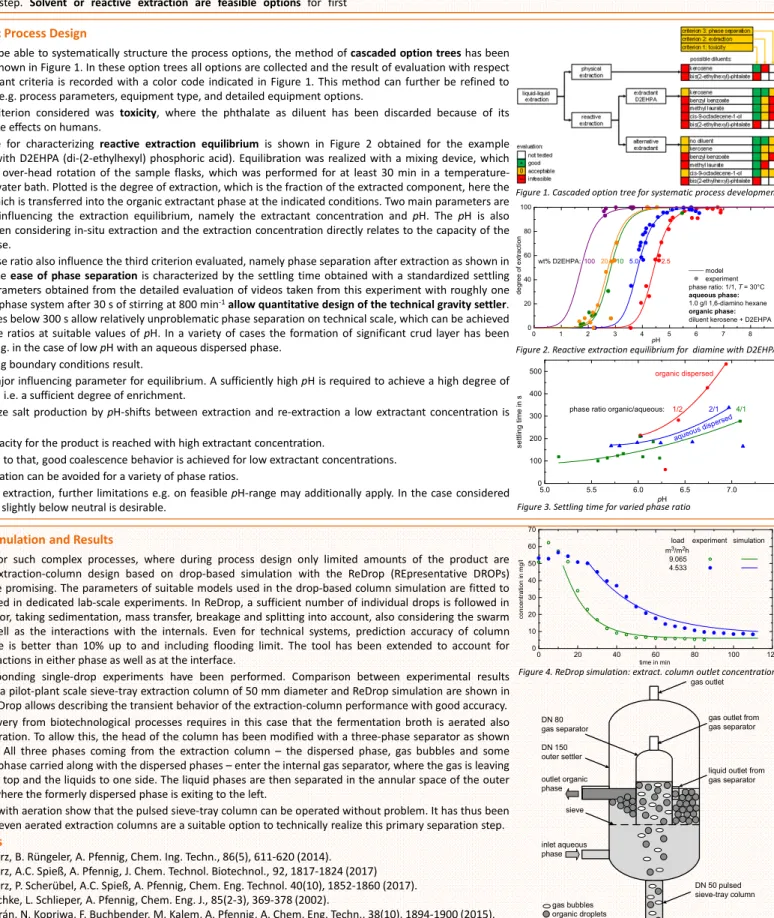
The corresponding single-drop experiments have been performed. Comparison between experimental results obtained in a pilot-plant scale sieve-tray extraction column of 50 mm diameter and ReDrop simulation are shown in Figure 4. ReDrop allows describing the transient behavior of the extraction-column performance with good accuracy. In-situ recovery from biotechnological processes requires in this case that the fermentation broth is aerated also during separation. To allow this, the head of the column has been modified with a three-phase separator as shown in Figure 5. All three phases coming from the extraction column – the dispersed phase, gas bubbles and some continuous phase carried along with the dispersed phases – enter the internal gas separator, where the gas is leaving towards the top and the liquids to one side. The liquid phases are then separated in the annular space of the outer separator, where the formerly dispersed phase is exiting to the left.
The results with aeration show that the pulsed sieve-tray column can be operated without problem. It has thus been shown that even aerated extraction columns are a suitable option to technically realize this primary separation step.
References
1. A. Bednarz, B. Rüngeler, A. Pfennig, Chem. Ing. Techn., 86(5), 611-620 (2014). 2. A. Bednarz, A.C. Spieß, A. Pfennig, J. Chem. Technol. Biotechnol., 92, 1817-1824 (2017) 3. A. Bednarz, P. Scherübel, A.C. Spieß, A. Pfennig, Chem. Eng. Technol. 40(10), 1852-1860 (2017). 4. M. Henschke, L. Schlieper, A. Pfennig, Chem. Eng. J., 85(2-3), 369-378 (2002).
5. J. Ayesterán, N. Kopriwa, F. Buchbender, M. Kalem, A. Pfennig, A. Chem. Eng. Techn., 38(10), 1894-1900 (2015). 6. N. Kopriwa, F. Buchbender, J. Ayesterán, M. Kalem, A. Pfennig, Solvent Extr. Ion Exc., 30(7), 683-723 (2012).
Systematic Process Design
In order to be able to systematically structure the process options, the method of cascaded option trees has been applied as shown in Figure 1. In these option trees all options are collected and the result of evaluation with respect to the relevant criteria is recorded with a color code indicated in Figure 1. This method can further be refined to account for e.g. process parameters, equipment type, and detailed equipment options.
The first criterion considered was toxicity, where the phthalate as diluent has been discarded because of its hormone-like effects on humans.
An example for characterizing reactive extraction equilibrium is shown in Figure 2 obtained for the example extraction with D2EHPA (di-(2-ethylhexyl) phosphoric acid). Equilibration was realized with a mixing device, which allows slow over-head rotation of the sample flasks, which was performed for at least 30 min in a temperature-controlled water bath. Plotted is the degree of extraction, which is the fraction of the extracted component, here the diamine, which is transferred into the organic extractant phase at the indicated conditions. Two main parameters are apparently influencing the extraction equilibrium, namely the extractant concentration and pH. The pH is also relevant when considering in-situ extraction and the extraction concentration directly relates to the capacity of the organic phase.
pH and phase ratio also influence the third criterion evaluated, namely phase separation after extraction as shown in Figure 3. The ease of phase separation is characterized by the settling time obtained with a standardized settling cell. The parameters obtained from the detailed evaluation of videos taken from this experiment with roughly one liter of two-phase system after 30 s of stirring at 800 min-1allow quantitative design of the technical gravity settler.
Settling times below 300 s allow relatively unproblematic phase separation on technical scale, which can be achieved for all phase ratios at suitable values of pH. In a variety of cases the formation of significant crud layer has been observed, e.g. in the case of low pH with an aqueous dispersed phase.
The following boundary conditions result.
• pH is a major influencing parameter for equilibrium. A sufficiently high pH is required to achieve a high degree of extraction, i.e. a sufficient degree of enrichment.
• To minimize salt production by pH-shifts between extraction and re-extraction a low extractant concentration is desired.
• A high capacity for the product is reached with high extractant concentration.
• In contrast to that, good coalescence behavior is achieved for low extractant concentrations. • Crud-formation can be avoided for a variety of phase ratios.
• For in-situ extraction, further limitations e.g. on feasible pH-range may additionally apply. In the case considered here, a pH slightly below neutral is desirable.
.
ISEC 2017, The 21st International Solvent Extraction Conference 2017, Miyazaki, Japan
Introduction
The foreseeable feedstock change in chemical industry towards renewable resources will lead to an increased application of bio-reactions for obtaining desired products. The challenge in an overall process with a biotechnological step is the primary product recovery, because typically the product is obtained at low concentration in an aqueous environment. This means that very selective process steps have to be used to achieve directly a significant enrichment of the desired product component(s) and to minimize correspondingly the flowrates in the first separation step. Solvent or reactive extraction are feasible options for first
downstream steps. The extractant can be chosen to maximize selectivity and capacity. Another challenge results, if the first separation shall be realized as in-situ extraction. Because some microorganisms require continuous supply of oxygen, the extraction process has to be aerated in that case. This leads to the demand to realize a three-phase separation, which creates additional challenges. As an example case the production of diamine by fermentation has been chosen, because it is a component of potential industrial relevance as monomer for polyamide production. Such a high-added-value component has the chance to be economically competitive as bio-based product already today.
Aerated Extraction Column
for Reactive Extraction from Fermentation Broth
Andreas BEDNARZ1, Peter SCHERÜBEL2, Antje SPIEß3, Andreas PFENNIG4
1. RWTH Aachen, AVT – Fluid Process Engineering, Wüllnerstr. 5, 52062 Aachen, Germany
2. TU Graz, Institute of Chemical Engineering and Environmental Technology, Inffeldgasse 25/C/II, 8010 Graz, Austria 3. TU Braunschweig. Institute for Biochemical Engineering, Rebenring 56, 38106 Braunschweig, Germany
4. University of Liège, Department of Chemical Engineering – PEPs, Belgium http://chemeng.uliege.be, [email protected]
Figure 2. Reactive extraction equilibrium for diamine with D2EHPA Figure 1. Cascaded option tree for systematic process development
organic droplets gas bubbles gas outlet DN 80 gas separator DN 150 outer settler outlet organic phase inlet aqueous phase
liquid outlet from gas separator
DN 50 pulsed sieve-tray column sieve
gas outlet from gas separator 0 1 2 3 4 5 6 7 8 9 0 20 40 60 80 100 100 20 10 5.0 d e g re e o f e x tr a c ti o n pH model experiment phase ratio: 1/1, T = 30°C aqueous phase: 1.0 g/l 1,6-diamino hexane organic phase: diluent kerosene + D2EHPA
wt% D2EHPA: 2.5 5.0 5.5 6.0 6.5 7.0 7.5 0 100 200 300 400 500 organic dispersed aqueou s dispe rsed 2/1 4/1 s e tt lin g t ime i n s pH 1/2
phase ratio organic/aqueous:
Figure 3. Settling time for varied phase ratio
0 20 40 60 80 100 120 0 10 20 30 40 50 60 70
load experiment simulation m3/m2h 9.065 4.533 c o n c e n tr a ti o n i n m g /l time in min
Figure 4. ReDrop simulation: extract. column outlet concentration