M-POWER Research Fellowship
Water governance in multipurpose
hydropower and irrigation schemes:
Case study of the Nam Mang 3 Project in Lao PDR
Phimthong Kouangpalath
Researcher and Lecturer of the Department of Rural Economics and Food
Technology, Faculty of Agriculture, Nabong Campus,
National University of Lao PDR
Philip Hirsch
Professor of Human Geography; Director, Mekong Research Group (AMRC)
School of Geosciences, the University of Sydney, Australia
Mekong Program on Water, Environment and Resilience (M-POWER)
Research Fellowship Program (2011-2013) 15 June 2013
M-POWER stands for the Mekong Program on Water, Environment and Resilience. We are a network of collaborators undertaking action based research, facilitated dialogues and knowledge
brokering to improve water governance in the Mekong Region in ways that support sustainable livelihoods and healthy communities and ecosystems.
Working Papers are available in electronic format at http://www.mpowernetwork.org/
Please address comments and/or queries for information to: Phimthong Kouangpalath
Email: [email protected] Chao Praya Call (2011-2013)
Table contents
ABSTRACT ... 4 LIST OF FIGURES ... 5 ACKNOWLEDGEMENTS... 6 1. INTRODUCTION ... 7 2. THEORETICAL REVIEW ... 8 3. METHODOLOGY... 10 3.1. Study sites ... 103.2. Research approach and methods ... 10
3.3. Data collection... 11
4. RESULTS AND DISCUSSION ... 11
4.1. Background of Nam Mang 3 Hydropower Project ... 11
4.2. Ownership Nam Mang 3 Hydropower project ... 12
4.3. How the irrigation component functions along with hydropower operations... 13
4.4. The irrigated area in the NM3-irrigation scheme... 15
4.5. Who is in charge of Nam Mang 3 irrigation scheme? ... 15
4.6. Key stakeholders in the NM3-irrigation and water governance ... 16
4.7. NM3-irrigation issues and challenges ... 17
4.8. Irrigation scheme and good governance perceptions ... 19
5. CONCLUSIONS AND RECOMMENDATIONS ... 20
5.1. Conclusion ... 20
5.2. Recommendations ... 21
Abstract
The multipurpose Nam Mang 3 Hydropower Project is one of the trans-basin diversion schemes and one of the 18 hydropower dams in operation in Lao PDR. The multipurpose hydropower and irrigation project has caused a number of negative impacts for farmers especially in downstream areas and in the Nam Nyam and Houay Hong Pheng areas.
This study aims to understand the water management regime between the project’s hydropower and irrigation purposes in order to find alternatives and to mitigate as much as possible the negative impacts downstream of the dam, especially for villages along the Nam Nyam valley or Napheng plain directly concerned water releases and benefit from irrigation. We used the key informant and focus group survey with various stakeholders of Nam Mang irrigation scheme and field work observation.
The findings show that farmers can grow a second season of rice crop but the electricity generation in the rainy season leads to the flooding of rice fields along the Nam Nyam valley. Sometimes during dry season, farmers in the irrigated areas do not have enough water for irrigation of the rice crop downstream of the NM3 and Nam Nyam irrigation schemes, as the water is stored for generating electricity. This is exacerbated by the absence of coordination between the dam operator and TSC-NM3 office. Overall, the project has contributed to, rather than diminished, poverty of people and increase inequality in the area.
The study recommends a review of the governance arrangements in the dam operations which at present are not transparent making it difficult to take into account the multiple benefits and costs to different stakeholders in the water diversion project. The operators of the dam and irrigation scheme have to establish a dialogue with the assistance of the development partners or government to find alternatives to mitigate the negative impacts in the downstream areas. Also there must be mechanisms in place for farmers whose livelihoods are affected.
Keywords
List of Figures
Figure 1: Trans-basin scheme of Nam Mang 3 Hydropower Project ... 8
Figure 2: Water governance chart ... 9
Figure 3: Study area, within the layout of the Nam Mang 3 Project ... 10
Figure 4: Directly and indirectly received water from NM3-Irrigation scheme ... 15
Figure 5: Good governance, organisation and management ... 19
Acronyms and abbreviations
DAFEO District Agriculture and Forestry Extension Office
EDL Electricité du Laos
EDL-Gen Electricité du Laos- Generation Project Affected Persons
EIA Environmental Impact Assessment
GOL Government of Lao PDR
Lao PDR or Laos Lao People’s Democratic Republic
LDCs Least Developed Countries
MAF Ministry of Agriculture and Forestry
MDG Millennium Development Goals
MEM Ministry of Energy and Mining
MRC Mekong River Commission
NBCAs National Biodiversity Conservation Areas
NGPES National Growth Poverty Eradication Strategy
NM3 Nam Mang 3
NM3HP Nam Mang3 Hydropower Project
NM3-IPO Nam Mang3 Irrigation Project Office
NT2 Nam Theun 2 Hydropower Project
NT-HB Nam Theun-Hinboun Hydropower Project
NSEDP National Socio-Economic Development Plan
NTFP Non-timber Forest Products
PAFO Provincial Agriculture and Forestry Office
PKK Phou Khao Khouay
PKK-Mai Phou Khao Khouay Mai village
TSC-NM3 Technical Service Centre Nam Mang 3 Office
WUG Water User Group
Lao Language English
Khong Mai/Khong Nyai Primary canals irrigation
Khong Xoy Secondary canals irrigation
Khong sai kai Tertiary canals irrigation
Kum Nyai/Kum xao na Big Group of Water User Group/Farmer Group
Kum Nyoi/kum phu xom xai nam Sub-Group of Water User Group at irrigated village
Exchange Rate
Acknowledgements
I wish to extend my sincere thanks to many individuals and organizations that assisted and encouraged me at different stages of this research. I would not have succeeded in completing this study without their assistance.
Water governance in multipurpose hydropower and irrigation
schemes: Case study of the Nam Mang 3 Project in Lao PDR
1.
Introduction
Hydropower sector is considered a national priority in order to meet the socio-economic development goals set by the Government of Lao PDR (GOL). These goals include reaching the Millennium Development Goals (MDGs) in 2015, and achieving the goals set in 1996 by the 6th Party Congress, namely to exit from the ranks of Least Developing Countries (LDCs) by 2020 (GOL 2004). At present, the country has 18 hydropower plants in operation (small to big in size), under 2,800 MW, and 17 under construction for 3,000 MW. Another 25 plants are at planning stage (6,500 MW), while 35 more are undergoing feasibility studies stage for 10,600 MW (MEM 2013 March).
The existing and proposed dams in Laos are the centre of controversy for their impacts on the environment and on people’s livelihoods, especially due to changes in the river ecosystems (Duganp, Barlow et al. 2010), or their carbon footprint (Chanudet, Desclox et al. 2011). Socio-economic impacts include: resettlement, flooded agricultural land, declining fishing activities, etc. (Scudder 2005, WCD 2008, Hirsch 2011, Bhatia, Cestti et al. eds, 2008, Molle, Foran et al. eds, 2009).
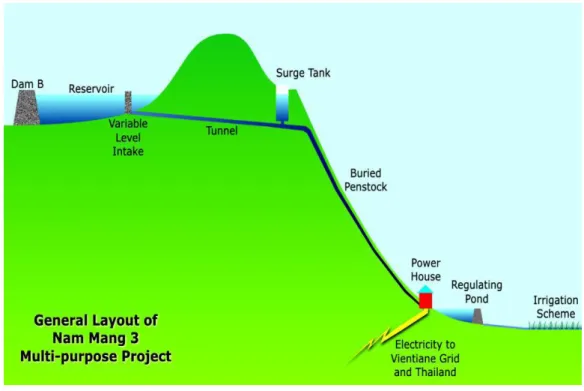
The Nam Mang 3 Hydropower Project (NM3HP) is a multipurpose project for hydropower and irrigation that started operations since January 2005. It is a transbasin scheme (simialr to Nam Theun 2 dam), which diverts water from the Nam1 Nyong (main river) on the Phou Khao Khouay (PKK) or PKK-National Biodiversity Conservation Area (NBCA), into the Nam Nyam and Houay Hong Pheng (subsidiary rivers) (see Figure 1). The dam’s water discharges released downstream of the powerhouse are retained in a regulating pond to be used for irrigation purposes in the Nam Nyam valley, Thourakhom district, Vientiane province, and planned to irrigate more than 2,900 ha. This research studied the effects of the dam on the downstream areas along the Nam Nyam valley settled in by more than 10 villages (about 3,000 households). The project has an irrigation component for downstream communities. Most of the downstream area farmers rely on subsistence
1 Throughout this paper, the words “Nam”, "Houay” are used to “River or stream” and “Ban” to mean “Village”. To
farming of rice with livestock, gathering of non-timber forest products, and fishing. However, due to the impacts of the NM3HP, large paddy fields and other agricultural lands have been flooded during the rainy season. Although an Environment Impact Assessment (EIA) was done before constructing the project, it stated that there would be very little social impacts; but once dam operations began, many problems have emerged in the downstream areas. The purpose of this study is critically analyzed the water governance issues in the case of the NM3HP and provides some policy recommendations towards improving water governance for hydropower and irrigation. Figure 1: Trans-basin scheme of Nam Mang 3 Hydropower Project
Source: Electricité du Laos (EDL), 2005.
2.
Theoretical review
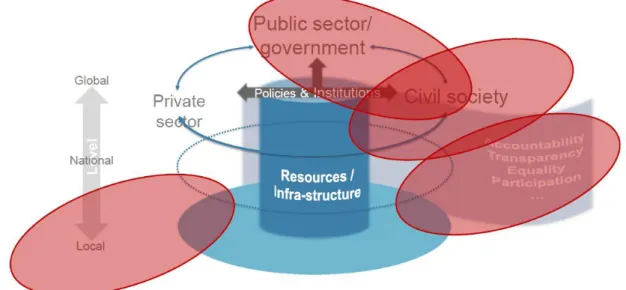
The research project fits within the broader topic area of water governance, defined as “(…) the range of political, social, economic and administrative systems that are in place to regulate development and management of water resources and provisions of water services at different levels of society" (UNDP 2003). Analyzing water governance involves focusing on the actors that are involved in the management of water resources, i.e. traditional state actors but also non-state actors such as businesses and civil society (see Figure 2). What is at stake is to study changes in the identity of the actors (public and private) that are involved in the control and management of water as well as the institutions or organizations that may have emerged to take up this task.
Figure 2: Water governance chart
Source: WeSenselt Citizen Water Observatories http://www.unesco-ihe.org
According to the Global Water Partnership (GWP) water governance is defined as “the range of political, social, economic and administrative systems that are in place to develop and manage water resources, and the delivery of water services, at different levels of society”(OECD 2011 p.9)
Moreover, water governance is therefore the set of systems that control decision-making with regard to water resources development and management. It is therefore more about the way in which decisions are made (i.e. how, by whom and under what conditions) than about the decisions themselves (Moench, Dixit et al. 2003).
As highlighted by Neef (2009), many countries have experienced or are currently experiencing a transition towards natural resources management policies that are more collaborative, and rely more on the participation of local stakeholders. This global trend towards enhanced citizen participation in environmental governance is backed by the Principle 10 of the Rio Declaration. In Laos, although some attempts to involve local stakeholders (farmers, WUG...) into irrigation schemes have recently been made through “participatory irrigation management”, nevertheless participation remains quite limited (Williams and Weale 2006).
3.
Methodology
3.1. Study sites
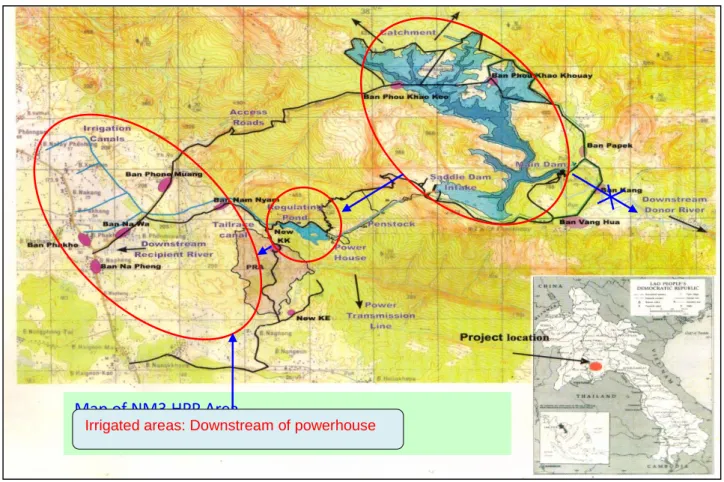
The study area comprises irrigation scheme areas along Nam Nyam valley downstream of trans-basin scheme of NM3HP Project. It is located in Thourakhom district, Vientiane province, about 60 km North of Vientiane Capital, Laos.
Figure 3: Study area, within the layout of the Nam Mang 3 Hydropower Project
Source: Electricité du Laos, 2005.
3.2. Research approach and methods
The first part of the research was aimed at understanding the governance of the irrigation scheme related to the NM3HP and its evolution. The purpose of this task is to show how the project has evolved over time: what topics of concern have emerged, by whom they were brought out as a relevant issue, how have they been tackled, what were the actors involved, etc.
The second part aims to bring together the perceptions of the irrigation and water governance process by the various stakeholders through focus groups. This enables us to better define and to
Map of NM3 HPP Area
identify different issues of the relevant groups of actors to be included in water governance: upstream/downstream; district/village; women/men; fishermen/farmers; water users/dam operators; landowners/landless farmers; etc.
The data analysis is mainly used Microsoft excel to count the frequency, calculate in percentage for the qualitative and quantitative date.
3.3. Data collection
Both a qualitative and quantitative survey combined with a review of existing documents was used. The qualitative survey focuses on key stakeholders involved in the NM3-irrigation scheme by using key informant surveys with 15 key informants.
Also focus group surveys were conducted mainly at the village level: village authorities, village Water Users Group committee, women’s and elder’s groups...etc. by using specific guidelines. The survey was done in 5 villages located in irrigated areas in both upstream and downstream areas and indirectly linked irrigation schemes (concrete diversionary weirs) related to NM3-irrigation scheme.
4.
Results and discussion
4.1. Background of Nam Mang 3 Hydropower Project
More than 30 years ago, the Interim Committee for Coordination of Investigations of the Lower Mekong Basin (LMB), now the MRC Secretariat, developed an indicative plan for developing hydropower in the Mekong basin, including small to big size projects (Mekong Secretariat 1990). Then, the GOL requested the Mekong Secretariat to carry out a reconnaissance study on NM3 project on the Nam Nyong in 1987 in PKK, which concluded that NM3 project can be developed as a multi-purpose project with power generation and an irrigation scheme (Mekong secretariat 1987). In 1992, another pre-feasibility study was carried out; and in 1994, another feasibility study, this time with more information regarding the geographic locations and proposed sitting options. Another feasibility study in 2001 considered more thoroughly the dam’s environmental impacts (EDL 2005, EDL-Gen website 2013). However, the irrigation schemes downstream were not taken into account (IRN 2003). Actually, PAFO of Vientiane province had already conducted a feasibility survey for free gravity irrigation system2 in 2000. This survey found that this system could irrigate
around 2,220 ha surrounding Nam Nyam valley and along the road N° 10 and made a proposal to Ministry of Agriculture and Forestry (MAF).
But the construction of NM3HP went ahead in early January 2002. At the same time, MAF required EDL to include the irrigation scheme in downstream areas that have been surveyed by PAFO. During 2003/04, EDL got a loan from the Chinese Government of US$2.8 million for constructing irrigation scheme and for initial operation costs. The construction of the NM3HP and irrigation schemes was concluded on 15 December 2004 and the project officially started electricity generation in January 2005. The 550 m of height difference provides a hydropower generating capacity of up to 40 MW, with an average energy production of 138 to 140 GWh/year; 1/3 of this electricity is exported to Thailand.
In fact, the NM3HP was financed by the GOL by loans3. About US$63 million for the hydropower and irrigation scheme and US$27.7 millions for the substations and transmission line scheme. (Jakob, Julia et al. 2009).
4.2. Ownership Nam Mang 3 Hydropower project
Actually, NM3HP was under responsibility of EDL at the beginning and then since end of 2010 this project is under EDL-Generation Public Company as dam operator.
Electricité du Laos (EDL): established initially in 1959 to supply the French military bases in Vientiane (World Bank 2012 b pp.4-5) and was established officially on December 18, 1961. Today, EDL is a state-owned corporation under the MEM that owns and operates the country's main generation, transmission and distribution assets in Laos, and manages electricity imports into its grids and exports from its stations. EDL also has a project development role and has been the implementing agency for government hydropower power projects and in the case of Independent Power Producer (IPP) projects is the Government's shareholder. It has been past practice for EDL to take over from MEM the responsibility for a project once a shareholders' agreement is executed and the project loans are closed (EDL website 2013).
In December 2010, the GOL has approved the privatization of EDL’s power generation business and the establishment of EDL-Generation Public Company (EDL-Gen)4 as owner/operator. It is the first public company in Laos. On the 15th December 2010, Ministry of Industry and Trade
380% of the fund came from a loan from the Export-Import Bank of China (interest of 2% per annum during 12 years) and the other 20% from EDL. In addition, the contractor has used the fund (approx. US$2.5 million) to finance the EIA and the mitigation measures.
(Business Registration Office) issued the business license No.4637/BRO.MOIC, EDL-Gen became public company and listed in the Lao Stock Exchange5. EDL-GEN is owned 75% by EDL and 25% owned by public Investors (domestic and foreign investors) (EDL-Gen 2010).
Based on the Concession Agreement (CA) signed with the GOL on 15th December 2010, 7
projects6 are under the management of the Company including NM3HP. The validation period is 30 years and can be negotiated to be extended to 10 years. After these periods the Company should transfer all assets used in generating electricity to the GOL. Moreover, this CA included mostly the electricity tariff and Land Lease Agreement.
4.3. How the irrigation component functions along with hydropower
opera-tions
The NM3 irrigation scheme is a gravity or reservoir irrigation scheme. It is a large size7 irrigation related to power generation with water discharged from a Regulating Pond used for irrigation schemes. NM3 irrigation schemes comprises about 27 Km8 of primary and secondary canals fed from a gated sluice on the Regulating Pond via a concrete lined canal of 2.3 Km.
Actually, the NM3 irrigation also indirectly feeds other existing concrete diversionary weir schemes along the Nam Nyam9, Nam Teng10 and Houay Hong Pheng benefiting from water releases to Nam Nyam and Nam Teng and overflows of drained downstream rice fields. Before 2005, farmers along the Nam Nyam valley grew rice particularly in the rainy season (Na pi). After the NM3 irrigation scheme started, farmers in this area can now grow a second rice crop (Na Xeng) along with other cash crops in the dry season (November to April). The rice production is the most represented in terms of cultivated areas; about 90 % and 6% are various vegetable gardens along the canal banks in the dry season. Another 4 % are for livestock activities, aquaculture and other purposes.
5 According to Decree No.526/PM on the registration of EDL-Gen in Lao Securities Exchange
6 The EDL-Generation Public Company has 7 hydropower Plant in 2010: Nam Ngum 1 (155 MW), Xe Set 2 (76MW),
Nam Leuk (60MW), Xe Set1 (45MW), Nam Mang3 (40MW) and Xe Labam.
7 The size of irrigation schemes (article 18) of the Law on Agriculture N°105/PO (1998) is “Small-scale irrigation
[refers to] irrigation that serves a production area of less than 100 hectares; medium-scale irrigation [refers to] irrigation that serves a production area of 100 to 500 hectares; large-scale irrigation [refers to] irrigation that serves a production area exceeding 500 hectares”.
8 While, 17.3 Km is new canals network extension and it concluded at the beginning of 2012. This extension is about
US$ 7.8 million, funded by government.
9 at Ban Namnyam, Nakeo and Nongphong 10 At Ban Namnyam
About 95% of farmers (irrigation users) need irrigation water during dry season and 5% during rainy season (May to October) but only at the beginning of the season in May (to prepare seedlings) and during the flowering period in September.
In contrast, the powerhouse of NM3HP works mostly during the rainy season (12-24 hours per day), and 6 hours per day during the dry season to guarantee 6-GWh of energy production for every month of the year. The production serves also to meet the peak energy demand in the rainy season as well as allowing additional energy production to be sold for cash to Thailand. It is expected to generate annual revenues of US$6 million11. Moreover, the water discharged from the regulating pond after power generation is sufficient to irrigate more than 1,650 ha in the dry season 2011/2012 (Matthouvong 2011) and not 2,900 ha as initially planned.
Naturally, NM3HP has a small regulating pond. The full supply level of this pond is 201.50 masl , with 0.2 Km² by a concrete dam across the Nam Teng. There is a spillway to discharge 22 m³/s and 4.7 m³/s maximum to the irrigation scheme. The concrete lined canal of 2.3 Km has two areas for releasing water to Nam Teng and Nam Nyam in the rainy season. In fact, when the powerhouse works full capacity during rainy season, the dam has to release a large quantity of water downstream that floods the rice fields along Nam Nyam valley and No.10 road. This happens because the Nam Nyam valley forms a "U valley" and has poorly drained areas (180-200 m altitude). Moreover, the drainage ways are blocked by newly constructed roads and canal networks. For example, during the rainy season of 2011, floods destroyed more than 200 ha of rice fields (Matthouvong 2011) including already transplanted rice areas, seedlings, fish ponds, irrigation canals and roads as well as inundated homes in the village. Today, many hectares of rice fields are abandoned. The more well-off farmers can invest in other economic activities, but poor farmers face livelihood problems. In the dry season, the water quantity for irrigation is not enough to supply the whole network downstream of the NM3-irrigation scheme such as Ban Phonkeo, Haiyorn, and Phonhong. Also the concrete diversionary weir schemes that are indirectly connected downstream of Nam Nyam and Houay Hong Pheng at Ban Napheng, Nakeo and Nongphong face scarcity of water.
-4.4. The irrigated area in the NM3-irrigation scheme
The actual irrigated areas in the dry season 2011/2012 of 2,254 ha increased to 92%, compared to the dry season 2005/06 (1,170 ha). All irrigated areas of direct or indirect schemes are counted (see Figure 4):
4.5. Who is in charge of Nam Mang 3 irrigation scheme?
The NM3 irrigation scheme is excluded from EDL-Gen in terms of organization. EDL funded only US$2.8 million for constructing the canal irrigation network, offices, purchase of some vehicles, and initial costs for operation. NM3HP ownership (EDL-Gen) is responsible for only 2.3 Km stretch of primary concrete canal for maintenance costs. PAFO of Vientiane province has to be responsible for the management of this irrigation scheme including operation costs and staff allocation. Of US$2.8 million, 2% was for operation costs during the two years (2005-2007) and the NM3-irrigation scheme paid operation costs by collecting water fees only during the dry season; big maintaining works were subsided by PAFO (government) as well.
The management started at NM3 Irrigation Project office (NM3-IPO) from 2005 to 2009, the staff came directly from PAFO of Vientiane province. The role of this office is to manage the irrigation system network such as collecting water fees for maintaining the irrigation system and managing operation costs of the office, and to promote rice production in the irrigated area. At that time the WUG at the village was not set up yet. There was only a Farmer Group "Kum xao na", with 3 or 4 persons, who worked and coordinated closely with NM3-IPO and farmers. This group works as farmer's representative in charge of the registered farmers, resolving conflict problems, organizing
NM3-irrigation scheme (73% or 1650
ha) Nam Nyam & Nam Teng
concrete weirs concrete weir at Ban Namnyam (2% or 54 ha);
Ban Dong & Khoutsambath: connected
directly by concrete canal (7% or 150 ha)
Concrete weir and
Embankment Lake at Ban
Nakeo (7% or 150 ha)
Concrete weir and pumping scheme at
Ban Nongphong (9%
or 200 ha) Concrete weir Concrete weir
at Ban Napheng (2%, or 50 ha)
Directly Indirectly
meetings with farmers for irrigation scheduling, etc. Other concrete diversionary weir schemes are not involved with NM3-IPO in terms of operation and management. Those schemes are under the village authorities under the supervision of DAFEO.
In 2010, PAFO decided to merge the Agriculture Technical Centre12 and NM3-IPO as there were too many interrupting activities in the same area. This became the Technical Service Centre NM3 Office (TSC-NM3). The staffs in this office are from DAFEO and PAFO. The objectives are still the same, but the whole irrigation scheme that is connecting indirectly with NM3-irrigation is administratively under the TSC-NM3 office. Therefore, TSC-NM3 office formulated a specific regulation for managing the irrigation scheme, only in 2010 (17th February) by decree No. 071 of the District Governor on setting up "Water User Group Committee". On 19th March 2010 other regulations on "Role and Right of Water User Group committee" and "Usage and Management of NM3-irrigation scheme" were registered finally on the paper (District Gouvernor 2010, Salyphoth and Mattouvong 2010, Saynirath 2010).
So after these institutional changes, a new Head of TSC-NM3 and 2 members of WUG in each village were established. The farmer group still exists and 80% of the water user fees are managed by the farmer’s group as big WUG (Kum Nyai) and 20% are managed by WUG at the village as a sub-group (Kum Nyoi) for their remuneration13 and basic operation cost.
4.6. Key stakeholders in the NM3-irrigation and water governance
Dam operator (EDL-Generation Public Company): Actually, the water discharged to the canal
regularly feeds the primary concrete canal with less than 1 m³/s to avoid canals being broken. However, the dam operation runs opposite to the needs of the rice production season. Dam operator concentrates on its own electricity production in rainy season for example. Since this project started up, they don't stop any time their production to prevent the downstream flooding. The CA presents only the duration of handing over to government (30 years), electricity tariff, and Land Lease Agreement; there was not any mitigation measure for downstream impacts. The operating system for the dam does not seem to be transparent, making it difficult to take into account the multiple benefits and costs to different stakeholders in this diversion project.
12In 2008, the Nam Ngum River Basin Development Sector Project (NNRB) managed by NAFES supported DAFEO of Thourakhom district to create an Agriculture Technical Centre (ATC). This centre was next to NM3-IPO.
Technical Service Centre Nam Mang 3 Office: This office is responsible for the whole NM3
irrigation scheme and other connected irrigation schemes by promoting agricultural production and to ensure the benefits of irrigation for farmers and maintaining the irrigation scheme. The NM3 office staff from DAFEO and PAFO work together and make monthly and annual reports of their activities.
Kum Nyai: Works closely with TSC-NM3 office (3 days/week in dry season)14and during the rainy season. Actually, Kum Nyai plays an important role in the NM3-irrigation scheme as a representative of the farmers and other groups. They coordinate with NM3HP to inform them about the water requirements based on the traditional irrigation schedules of farmers and with other stakeholders such as village authorities, DAFEO, PAFO etc. They are responsible for primary canal (khong mai /khong nyai) network water allocation and also help solve problems at the village level. They are responsible for water fees management and collecting fees from each sub-group. For the maintenance, cleaning and rehabilitation of the primary canals, they have a budget of 15 million kip each year.
Kum Nyoi: There are two persons per irrigated village according to the government regulation, but
some villages still have 5 to 7 persons (Ban Nakeo, Nongphong, Namnyam). They are responsible for the measurement of the irrigated area after rice transplantation (January) and collection of the water fee (20,000 kip/rai)15 from farmers for the dry season rice crop. They are in charge for the second (khong xoy) and tertiary (khong sai kai) water allocation upstream and downstream of the canal network, and they also solve problems in the village and coordinate vertically with village authorities, kum nyai and TSC-NM3. They are responsible for informing the farmers to participate in canal cleaning and irrigation scheduling. If members of the WUG in the village plant rice, they have to pay the water fees.
4.7. NM3-irrigation issues and challenges
Water fees management: Since 2010/2011, 80% of the water fees for the dry season rice crop
were sent to Kum Nyai at TSC-NM3 office. But some WUGs at the village didn't transfer their water fees to Kum Nyai in 2011/12 like Ban Nongphong, because they are not sure if those amounts will contribute efficiently for irrigation reparation in their village. Some villages are not satisfied with this principle, they wish to manage all the fees by themselves, and they use some of it for their
14 Their salary per year evolved 1,000,000 kip (200//5/06) to 3,000,000 kip/year in 2011/2012
village development activities such as road repairs, school construction (Ban Namnyam) and others. The collection and transparent use of water user fees for maintenance are very much needed and important for village authorities, WUGs and farmers. Actually, the annual budget of 15 million kip for irrigation maintenance is not sufficient. The irrigation canals usually break after each rainy season due to flooding.
Upstream and downstream farmers: In the dry season, the farmers downstream have less water
to irrigate their field due to water removals by upstream farmers. There were fewer problems with the upstream and downstream primary canals. The problems are mainly along the khong sai khai dug by farmers themselves and the secondary canals, where there are many rice fields. These canals sometimes are either not big enough or too long. They cross several plots of land and, due to limited budget or poor design, don't have standardized levels or are situated too low between the rice fields. The rice fields situated downstream face the risks of low yields. The rice fields located along the
khong mai/khong nyai gain easier access to irrigation than the rice fields next to khong xoy and khong sai kai canals. In the rainy season, the farmers downstream of the irrigation network and
Nam Nyam find there is too much water. In fact, farmers upstream have enough water and release water freely to the downstream plots to avoid flooding of their own fields.
Water releases: The operations related to hydropower water releases are counter to the needs of
irrigated rice production. The water releases for hydropower production at NM3HP do not consider the downstream benefits and costs to the users of the water for irrigation, and impacts of flooding. The best solution to mitigate negative impacts downstream is to shut down or reduce the electricity generation especially when there is a heavy rain, because the regulating pond is small and the areas are poorly drained.
The compensation: It has taken place only for impacts upstream (on PKK) during the construction
phase in cash for rice field, fruit garden and others assets. Because there were three villages16 have impacted during construction phase and two villages17 have to resettle in foothill of PKK. The compensation was in charge by EDL for assets lost in reservoir area and resettlement process and development program. During operation phase, farmers how face flooding in downstream areas especially in the Nam Nyam valley do not receive any compensation from EDL.
16 Ban Vangheua, Ban Phou Khao Khouay-Kao and Ban Phou Kho Keo
4.8. Irrigation scheme and good governance perceptions
The stakeholders were asked about their perception of a good irrigation scheme through interviews with key informants and focus group surveys. The results show that 63% both upstream and downstream want to have enough water during the dry season while they feel there’s too much water in the rainy season (due to the flooding caused by the water releases). Another 32% want access to irrigation water as they face difficulty to get water due to poor irrigation scheme design, bad canal networks, poor drainage system, and not enough secondary canal channels. Another 5% said they want irrigation for the whole year especially for upland rice fields, gardens, and fish and pig farms. Some other negligible perceptions are related to the agricultural promotion activities in irrigated areas: technical and crop extension needs such as for high yield seeds, marketing, and credit schemes. etc. Some farmers also requested a bridge across the primary canal line (to facilitate transport and avoid damages to the canal), and to have enough budget for regular maintenance and monitoring. Further some farmers asked for a big concrete tank by the road and irrigation canal networks to facilitate water drainage during the rainy season.
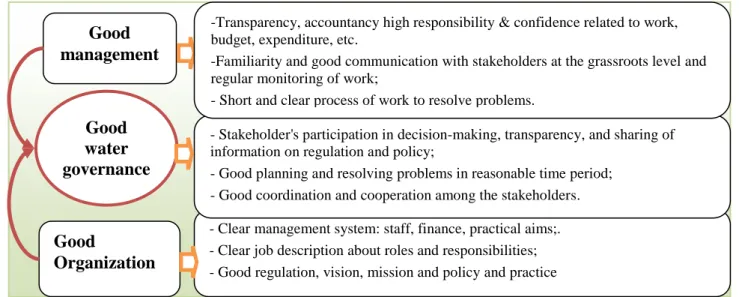
Moreover, the study asked the question of “what signifies good water governance” to various stakeholders (EDL, PAFO, DAFEO, village authorities) (see Figure 5). It is quiet difficult for our informants to define good water governance or governance. The answers are usually related to "what is good work" as TSC-NM3 office, Kum Nyai, Kum nyoi, etc. However, we found that the perception of good governance is related to good management and good organisation.
Figure 5: Good governance, organisation and management
Source: author data from field survey
Good water governance Good Organization Good management
- Clear management system: staff, finance, practical aims;. - Clear job description about roles and responsibilities; - Good regulation, vision, mission and policy and practice
- Stakeholder's participation in decision-making, transparency, and sharing of information on regulation and policy;
- Good planning and resolving problems in reasonable time period; - Good coordination and cooperation among the stakeholders.
-Transparency, accountancy high responsibility & confidence related to work, budget, expenditure, etc.
-Familiarity and good communication with stakeholders at the grassroots level and regular monitoring of work;
5.
Conclusions and recommendations
5.1. Conclusion
NM3HP is a small dam, but it is an associated with the electricity production (both for export and domestic consumption) and for irrigation. Before the project, downstream farmers mainly cultivated wet season rice. With the project introducing the new irrigation system, farmers can grow a second (dry season) rice crop. But coupled with this benefit, they often face serious problems of flooding of their rice fields in the rainy season due to releases of water from the dam. Some farmers have abandoned their rice fields and turned to other activities, but the most vulnerable families encounter livelihood difficulties. In contrast, the irrigation scheme doesn't have enough water in the dry season for the whole canal network especially downstream of the canals and Nam Nyam (concrete weir schemes). This causes conflict among water users during the dry season. Moreover, the second rice crop in the dry season leads to high production costs due to buying improved seeds, chemical fertilizers, paying irrigation fees, while the price for rice is lower than for the wet season rice crop. Moreover, in the dry season, the harvest period is risky because it is also the beginning of the rainy season and often can lead to crop losses from heavy rains.
The compensation for farmers has taken place only for impacts upstream during the construction phase, but farmers how face flooding in downstream areas do not receive any compensation from the dam operators. The governance of NM3-irrigation is concerned especially with the water allocation upstream and downstream along the irrigation channels, and the collection and transparent use of water user fees for maintenance. The dam operations for both hydropower and irrigation are not really done with full consideration of the downstream benefits and costs to the users of the water for irrigation, and the impacts from flooding. The budget of TSC-NM3 from water fees does not cover maintenance costs.
The perceptions of various stakeholders about the irrigation scheme are related particularly with mitigation of flooding in the rainy season and the low standard of irrigation. The water uses perceive good water governance as being linked with good management and good organization. The study showed the need to apply good water governance to specific projects in dealing with problems of managing different needs of different uses (hydropower and irrigation) and users (the multiple stakeholders within communities such as upstream/downstream irrigators, between agricultural communities and others, and between private dam operators and public authorities.
5.2. Recommendations
A policy dialogue about the NM3-irrigation scheme governance is very much needed. It should include farmers, local authorities, rural development partners, DAFEO, PAFEO, concerned ministries and the dam operator to discuss mitigation measures taking into account the negative impacts caused by the dam for downstream communities. To share information, identify stakeholders and their interests means including them as early as possible in the project to avoid top-down decision-making and lack of transparency. This would help ensure benefit sharing from projects by considering the social welfare of local communities and reinforce capacity building in the water governance chain.
To mitigate some of the negative impacts from the project downstream along the Nam Nyam valley, the operator of NM3HP should pay or compensate for the flooding of rice fields caused by the water releases from the dam operations. The dam operator should stop or reduce hydropower production when there is a heavy rain to prevent the big floods downstream. It should also allocate some annual budget for TSC-NM3 office for operation costs, training programmes, fieldwork cost and irrigation maintenance caused by flooding. In fact, 15 million kip per year from water fees are not enough for the whole irrigation scheme maintenance. So today, the government has to subsidise with a large budget for repairs of road and irrigation canals damaged after each rainy season while villagers also are asked to contribute to these costs.
Governor authority and local authority should work closely on the negative impacts and find solutions and alternatives. For example they should develop a policy for “irrigated land allocation” for farmers who don’t have any irrigated paddy field in the dry season or who have uncultivated paddy fields due to flooding in rainy season. Mostly, well-off households have irrigated paddy fields and benefit from the project. The poor households will be still poor, which increases inequality in the village.
The TSC-NM3 should have a contract or irrigation schedule with the dam operator (EDL-Gen) on their operations during the dry season and rainy season. At present, the dam operator can release water at any time for electricity production. A rule for water releases is required. TSC-NM3 office, DAFEO and PAFO should help to improve irrigation services in the irrigation scheme. Cooperation and coordination is necessary among DAFEO and PAFO to allocate qualified staff to TSC-NM3 office and field work. Capacity building is also very important to improve the irrigation service performance by training programmes and exchange of experiences among WUGs, farmer models in the province or other provinces. The experimental and extension activities for agriculture are useful for farmers to improve their technical skills, and
gain knowledge about high yield seeds and marketing. Greater transparency and accountability on water fees management and usage is needed for farmers and WUGs.
Kum Nyai or farmer group is an active group and the most well-known in the irrigated area. Re-election each 4 years is necessary to integrate younger people to help with the water fees management. This group should allocate its tasks to other units in TSC-NM3 office, because they are responsible for several tasks at the same time.
Village authorities should inform more about the meetings and changes in water governance and other activities relevant to the villagers. They should help farmers to propose the negative impact by dam operation as flooding rice fields during rainy season, increased water fees and other...
Kum Nyoi or Water User Group (WUGs) is representative of farmers, but they don’t know their role. So they are like marionettes for Kum Nyai in particular and for village authorities, since the village authorities still play an important role in the village. The WUGs should have the same size in all villages in NM3-irrigation scheme (2 persons per village) and have the same type of management in each village. The WUGs should include women especially to help with the accounting and budget expenditure. WUGs should participate in training or sharing of experiences with other irrigation schemes.
Farmers should show solidarity in reporting the negative impacts that they suffer from. The farmers who receive irrigation benefits should help other villagers to allocate irrigated rice fields. The irrigating famers upstream should respect regulations to fairly access water to avoid conflicts.
References
Books and report
Jakob, M., et al. (2009). Watershed Management in Lao PDR, A case study of opportunities for hydropower and forestry Vientiane National University of Laos (NUOL), Vientiane, Laos, In cooperation with VITRI/University of Helsinki, and Kasetsart University, Bangkok, Under the framework of the FORMEB project of the Finnish Ministry for Foreign Affairs, Institutional Cooperation Instrument (ICI): 32.
Scudder, T. (2005). The Future Of Large Dams: Dealing with Social, Environmental, Institutional and Political Costs. . London: Earthscan: 289 p.
UNDP (2003). Governing Water Wisely for Sustainable Development. Water for People, Water For Life: . The UN World Water Development Report. Paris, United Nations Department of Economic and Social Affairs (UNDESA); UNDP; United Nations Economic Commission for Europe (UNECE).
WCD (2008). Dams and Development: A New Framework for Decision-Making. London: Earthscan, World Commission on Dam: 404 p.
Moench, M., et al. (2003) The Fluid Mosaic, Water Governance in the Context of Variability, Uncertainty and Change. 71 p
Molle, F., et al. (eds, 2009). Contested Waterscapes in the Mekong Region: Hydropower, Livelihoods and Governance. London: Earthscan: 416 p.
OECD (2011). Water Governance in OECD Countries: A Multi-level Approach, . OECD Studies on Water. Paris, OECD Publishing. http://dx.doi.org/10.1787/9789264119284-en: 245 p.
Papers and journals
Chanudet, V., et al. (2011). "Gross CO2 and CH4 Emissions from the Nam Ngum and Nam Leuk Sub-tropical Reservoirs in Lao PDR." 408(24): pp. 5382-5391.
Duganp, J., et al. (2010) Fish Migration, Dams, and Loss of Ecosystem Services in the Mekong Basin. pp. 344-348
Hirsch, P. (2011). "China and the Cascading Geopolitics of Lower Mekong Dams." The Asia-Pacific Journal 9(20): 2 p.
Neef, A. (2009). "Transforming Rural Water Governance: Towards Deliberative and Polycentric Models?" Water Alternatives [Vol. 2](1): pp 53-60.
Williams, S. E. and J. C. Weale (2006) Water Policy Briefing Series: Water governance in the Mekong region- the need for more informed policy-making. [Vol. 22], 8 p
WREA (2009). National adaptation programme of action to climate change. Vientiane, Water Resources and Environmental Administration-UNDP-GEF.
Government and project Documents
District Gouvernor (2010). Decree on the settlement of "Water User Committee" of Technical Service Center Nam Mang 3 (17 February). 071/District Governor of Thourakhom, Thourakhom District, Vientiane Province 3 p.
EDL (2005). The Nam Mang 3 Hydropower Development Project Electricité du Laos and China International Water & Electric Corp. (CWE) 5 p.
EDL-Gen (2010). Annual Report 2010. Vientiane, EDL-Generation Public Company [http://www.edlgen.com.la/wp-content/uploads/2011/05/Annual_Report_2010_en.pdf]: 41 p. GOL (2004). National growth and poverty eradication strategy (NGPES). Vientiane, Ministère des
Affaires Etrangères: 245 p.
Matthouvong, T. (2011). Report the damage of inundation on the 25 June to 5 July 2011. Thourakhom District, Vientiane province, Technical Service Center Nam Mang 3 (TSC NM3): 6 p.
Mekong secretariat (1987). Nam Mang N° 3 Multi-Purpose Project, Lao PDR. Reconnaissance Report, Interim Committee for Co-orination of Investigations of the Lower Mekong Basin Mekong Secretariat (1990). Feasibility study on the Nam Mang N° 3 Multi-Purpose Project (Lao
PDR), Interim Committee for Co-ordination of Investigation of Lower Mekong Basin: 10 p. MEM (2013 March). Electric Power Plans in Lao PDR. Vientiane, Department of Energy Business,
Ministry of Energy and Mines [http://www.laofab.org/document/view/2076].
Salyphoth, S. and T. Mattouvong (2010). Meeting record on the role and right of WUG and regulation of irrigation scheme management-use of Technical Service Center Nam Mang 3 (19 March 2010). Management-Use regulation of irrigation users. Thourakhom District, Vientiane provice, TSC NM3: 6 p.
Saynirath, O. (2010). Management-Use NM3-irrigation scheme regulation for TSC-NM3 Thourakhom district: 8 p.
Internet websites
EDL-Gen website (2013). "Nam Mang 3 Hydro Power Plants." Retrieved 10 May 2013, from http://www.edlgen.com.la
EDL website (2013). "About EDL - Vision and mission." Electricite du Laos (EDL). Retrieved 30 May, 2013, from http://www.edl.com.la