HAL Id: lirmm-00616667
https://hal-lirmm.ccsd.cnrs.fr/lirmm-00616667v2
Submitted on 4 May 2012HAL is a multi-disciplinary open access
archive for the deposit and dissemination of sci-entific research documents, whether they are pub-lished or not. The documents may come from teaching and research institutions in France or abroad, or from public or private research centers.
L’archive ouverte pluridisciplinaire HAL, est destinée au dépôt et à la diffusion de documents scientifiques de niveau recherche, publiés ou non, émanant des établissements d’enseignement et de recherche français ou étrangers, des laboratoires publics ou privés.
A New Exact Algorithm to Solve the Multi-Trip Vehicle
Routing Problem with Time Windows and Limited
Duration
Rodolphe Giroudeau, Oliver Naud, Florent Hernandez, Dominique Feillet
To cite this version:
Rodolphe Giroudeau, Oliver Naud, Florent Hernandez, Dominique Feillet. A New Exact Algorithm to Solve the Multi-Trip Vehicle Routing Problem with Time Windows and Limited Duration. RR-11023, 2011. �lirmm-00616667v2�
A new exact algorithm to solve the Multi-trip
vehicle routing problem with time windows and
limited duration
Florent Hernandez
Cemagref UMR ITAP, 361 rue JF Breton, Montpellier, France , LIRMM UMR 5506, 161 rue Ada 34392, Montpellier France,
[email protected], Dominique Feillet
Ecole des Mines de Saint-Etienne, CMP Georges Charpak, F-13541 Gardanne, France, [email protected],
Rodolphe Giroudeau
LIRMM UMR 5506, 161 rue Ada 34392, Montpellier France, [email protected],
Olivier Naud
Cemagref UMR ITAP, 361 rue JF Breton, Montpellier, France, [email protected],
Abstract
This article tackles the multi-trip vehicule routing problem with time windows and limited du-ration. A trip is a timed route such that a succession of trips can be assigned to one vehicle. We provide a two-phase exact algorithm to solve it. The first phase enumerates possible ordered lists of client matching trip maximum duration criterion. The second phase uses a Branch and Price scheme to generate and choose best set of trips to visit all customers. We propose a set covering formulation as the column generation master problem, where columns (variables) rep-resent trips. The sub-problem selects appropriate timing for trips and has a pseudo-polynomial complexity. Computional results on Solomon’s benchmarks are presented. The computional times obtained with our new algorithm are much lower than the ones obtained in the sole exact algorithm previously published on this problem.
Keywords : Vehicle routing, Time windows, Multi-trip, Column Generation, Dynamic pro-gramming, Branch and Price
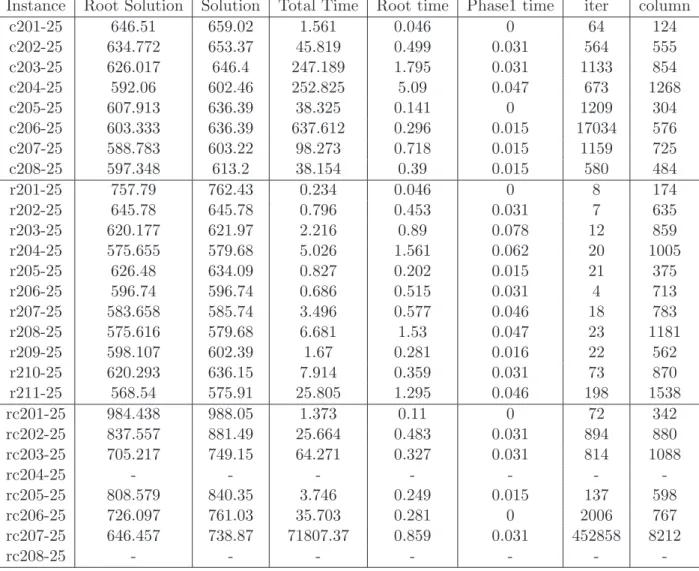
Instance Root Solution Solution Total Time Root time Phase1 time iter column c201-25 646.51 659.02 1.561 0.046 0 64 124 c202-25 634.772 653.37 45.819 0.499 0.031 564 555 c203-25 626.017 646.4 247.189 1.795 0.031 1133 854 c204-25 592.06 602.46 252.825 5.09 0.047 673 1268 c205-25 607.913 636.39 38.325 0.141 0 1209 304 c206-25 603.333 636.39 637.612 0.296 0.015 17034 576 c207-25 588.783 603.22 98.273 0.718 0.015 1159 725 c208-25 597.348 613.2 38.154 0.39 0.015 580 484 r201-25 757.79 762.43 0.234 0.046 0 8 174 r202-25 645.78 645.78 0.796 0.453 0.031 7 635 r203-25 620.177 621.97 2.216 0.89 0.078 12 859 r204-25 575.655 579.68 5.026 1.561 0.062 20 1005 r205-25 626.48 634.09 0.827 0.202 0.015 21 375 r206-25 596.74 596.74 0.686 0.515 0.031 4 713 r207-25 583.658 585.74 3.496 0.577 0.046 18 783 r208-25 575.616 579.68 6.681 1.53 0.047 23 1181 r209-25 598.107 602.39 1.67 0.281 0.016 22 562 r210-25 620.293 636.15 7.914 0.359 0.031 73 870 r211-25 568.54 575.91 25.805 1.295 0.046 198 1538 rc201-25 984.438 988.05 1.373 0.11 0 72 342 rc202-25 837.557 881.49 25.664 0.483 0.031 894 880 rc203-25 705.217 749.15 64.271 0.327 0.031 814 1088 rc204-25 - - - -rc205-25 808.579 840.35 3.746 0.249 0.015 137 598 rc206-25 726.097 761.03 35.703 0.281 0 2006 767 rc207-25 646.457 738.87 71807.37 0.859 0.031 452858 8212 rc208-25 - - -
-Table 1: Results on the Solomon’s benchmark (25 customers) with tmax value set (75; 220)
instances have not been solved within a limit on computing time set to 30 hours.
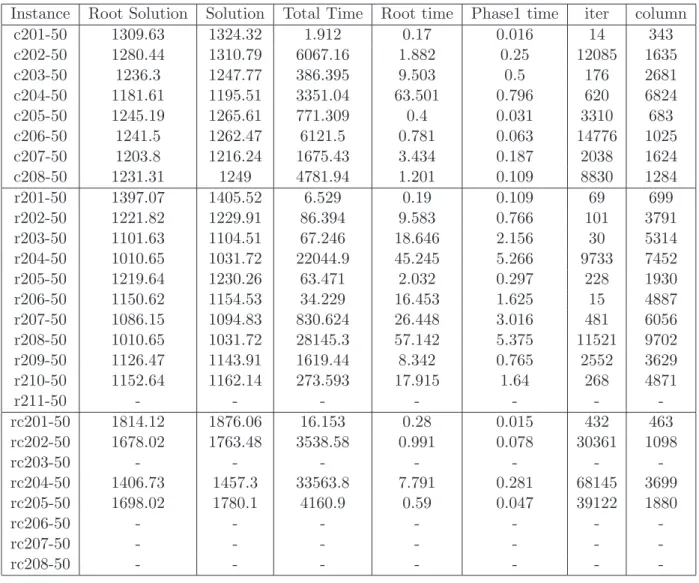
Tables 1 and 2 present these results. For each instance, we have the root solution cost and the solution cost of the Branch and Price scheme used in Phase 2, the computation time for both phases (Total time), the computation time of Branch and Price root in Phase 2 (Root time), the computation time of Phase 1 (Phase1 time), the number of iteration (iter) and the number of generated columns (column).
We can note, as for the VRPTW, there is great variation for time resolution between in-stances of the same class. We can also note a significant increase of total computation time between the instances with 25 and 50 customers.
5.4 Impact of the dominance rule in phase 1
In this section, we evaluate the impact of the dominance rule when feasible trips are generated with the elementary shortest path algorithum with ressource constraints in Phase 1. The number of available vehicles (U ) was set to 2 for these tests.
In Table 3, for each instance, we compare the following criteria : the number of generated structures in Phase 1 (# trips), the computation time for both phases (Total time) and the computation time of Phase 1 (Phase1 time), with (Dom) and without (No Dom) dominance
Instance Root Solution Solution Total Time Root time Phase1 time iter column c201-50 1309.63 1324.32 1.912 0.17 0.016 14 343 c202-50 1280.44 1310.79 6067.16 1.882 0.25 12085 1635 c203-50 1236.3 1247.77 386.395 9.503 0.5 176 2681 c204-50 1181.61 1195.51 3351.04 63.501 0.796 620 6824 c205-50 1245.19 1265.61 771.309 0.4 0.031 3310 683 c206-50 1241.5 1262.47 6121.5 0.781 0.063 14776 1025 c207-50 1203.8 1216.24 1675.43 3.434 0.187 2038 1624 c208-50 1231.31 1249 4781.94 1.201 0.109 8830 1284 r201-50 1397.07 1405.52 6.529 0.19 0.109 69 699 r202-50 1221.82 1229.91 86.394 9.583 0.766 101 3791 r203-50 1101.63 1104.51 67.246 18.646 2.156 30 5314 r204-50 1010.65 1031.72 22044.9 45.245 5.266 9733 7452 r205-50 1219.64 1230.26 63.471 2.032 0.297 228 1930 r206-50 1150.62 1154.53 34.229 16.453 1.625 15 4887 r207-50 1086.15 1094.83 830.624 26.448 3.016 481 6056 r208-50 1010.65 1031.72 28145.3 57.142 5.375 11521 9702 r209-50 1126.47 1143.91 1619.44 8.342 0.765 2552 3629 r210-50 1152.64 1162.14 273.593 17.915 1.64 268 4871 r211-50 - - - -rc201-50 1814.12 1876.06 16.153 0.28 0.015 432 463 rc202-50 1678.02 1763.48 3538.58 0.991 0.078 30361 1098 rc203-50 - - - -rc204-50 1406.73 1457.3 33563.8 7.791 0.281 68145 3699 rc205-50 1698.02 1780.1 4160.9 0.59 0.047 39122 1880 rc206-50 - - - -rc207-50 - - - -rc208-50 - - -
-Table 2: Results on the Solomon’s benchmark (50 customers) with tmax value set (75;220)