THÈSE DE DOCTORAT
de
l’Université de recherche Paris Sciences et Lettres
PSL Research University
Préparée à
l’Université Paris-Dauphine
COMPOSITION DU JURY :
Soutenue le
par
École Doctorale de Dauphine — ED 543 Spécialité
Dirigée par
L’impact de l’évolution des réglementations comptables, de
la gouvernance d'entreprise et des stratégies RSE sur la
performance M&A des sociétés françaises
12.12.2016
Gérard DESPINOY
Maurice NUSSENBAUM
Université Paris-Dauphine Maurice NUSSENBAUM Université Paris-Dauphine Edith GINGLINGER Laurence CAPRON INSEAD José-Miguel GASPAR ESSEC Sciences de gestion Directeur de thèse Président du jury Rapporteure RapporteurParis Dauphine
1
UNIVERSITÉ PARIS-DAUPHINE
ÉCOLE DOCTORALE EDOGEST
Numéro attribué par la bibliothèque
L’impact de l’évolution des réglementations comptables, de la
gouvernance d'entreprise et des stratégies RSE sur la
performance M&A des sociétés françaises
Document de soutenance de thèse
Pour l’obtention du titre de
DOCTEUR EN SCIENCES DE GESTION
(Arrêté du 7 août 2006)
Soutenue publiquement le 12 décembre 2016 par
Gérard DESPINOY
COMPOSITION DU JURY
Directeur de Thèse : Monsieur Maurice NUSSENBAUM
Professeur, Université Paris-Dauphine
Président du Jury : Madame Edith GINGLINGER
Professeur, Université Paris-Dauphine
Rapporteurs : Madame Laurence CAPRON
Professeur, INSEAD
Monsieur José-Miguel GASPAR
2
L’université n’entend donner aucune approbation ni improbation
aux opinions émises dans les thèses : ces opinions doivent être
3
Remerciements
Je souhaite remercier toutes les personnes qui ont contribué d’une façon ou d’une autre à la très belle aventure que j’ai vécue en préparant cette thèse.
Mes remerciements s’adressent en premier lieu à Maurice Nussenbaum pour m’avoir conseillé et encadré. J’ai beaucoup apprécié sa patience à m’écouter et me guider dans l’exploration de ce domaine de recherche très complexe qui nous passionne : les fusions & acquisitions.
Je souhaite aussi remercier tous les enseignants des cours de première et de deuxième année, qui m’ont fourni des outils indispensables à l’élaboration de cette thèse : François Degeorge et Ken Womack, pour leurs apports en matière de finance comportementale, Serge Darolles, pour la mise à jour qu’il m’a permis de faire en matière d’économétrie, et Szusannah Fluck, pour son intervention sur le sujet des relations contractuelles.
Mes remerciements vont aussi à ceux qui ont accepté de constituer le jury de cette thèse, Laurence Capron, José-Miguel Gaspar et Edith Ginglinger. J’ai une pensée plus particulière pour Edith Ginglinger qui m’a fourni quelques éléments de réflexion pour identifier la voie à suivre à un moment critique de mon travail de recherche.
Je souhaite aussi recommander la qualité de l’environnement de recherche offert par l’Université Paris-Dauphine, au sein duquel j’avais déjà fait mes premières armes, avec une mention toute particulière pour le laboratoire DRM Finance.
DRM Finance m’a permis de côtoyer de nombreux intervenants de très grande qualité tels que Morten Bennedsen, Denis Gromb, Christopher Hennessy, Roni Michaely, Manji Puri, Luc Renneboog et Théo Vermaelen, parmi tant d’autres.
Je remercie aussi tout particulièrement certaines personnes sans lesquelles DRM Finance ne serait vraiment pas le laboratoire qu’il est aujourd’hui. J’ai une pensée plus particulière pour Françoise Carbon, qui s’est avérée être un soutien et un support sans faille, de tous les jours, ainsi que pour Carole Gresse, qui a notamment montré une incroyable réactivité pour permettre la signature d’une convention de partenariat avec Vigeo ainsi qu’un contrat d’accès à la base IODS DataCG. Je remercie la société Vigeo pour le support qu’ils m’ont apporté ainsi que pour la qualité des échanges que nous avons eus. Je ne peux oublier Marc Julien pour son travail de relecture.
Je pense aussi à mon épouse, Marielle, et mes trois filles, Eva, Emily et Elise, qui seront très certainement soulagées de savoir que j’ai achevé ce travail de recherche si intéressant mais si prenant. Leur compréhension et leur soutien ont été déterminants pour me permettre de mener à bien mes travaux.
4 « I gnorant i quem port um pet at nullus suus vent us est »
5
TABLE DES MATIÈRES
Remerciements ...
3
Introduction générale ...
8
Bibliographie ... 18
Chapter 1: Impact of IAS 36 and IFRS 3 on M&A performance in France ... 21
1. Introduction ... 22
2. The Change in Regulations: An External Shock over M&A Practices ... 26
3. Literature Review and Development of Hypothesis ... 28
3.1. Literature Review ... 28
3.2. Development of Hypothesis ... 33
4. Sample, Data & Methodology ... 35
4.1 Sample ... 35
4.2. Data ... 35
4.3. Methodology ... 37
5. Results ... 41
5.1 Acquisition performance in France between 1995 and 2013 ... 41
5.2. Impact of changes in accounting rules on acquisition success in France ... 42
6. Conclusions ... 45
Appendix A – Acquisition process steps, bias and debiaising prescriptions ... 47
Appendix B – Views from practitioners ... 48
6
Chapter 2: Impact of Board Committees on M&A performance in France ... 64
1. Introduction ... 65
2. Corporate Governance and its evolution post-Enron ... 69
3. Literature Review and Development of Hypotheses ... 75
3.1. Literature Review ... 75
3.2. The increased interest for corporate governance ... 75
3.3. Impact of corporate governance on financial performance ... 76
3.4. Impact of corporate governance on acquisition performance ... 81
3.5. Hypotheses related to the impact of Board Committees on acquisition performance ... 82
4. Sample, Data & Methodology ... 83
4.1. Sample ... 83
4.2. Data ... 83
4.3. Methodology ... 85
5. Results ... 92
5.1. Impact of the presence of a Board Committee on M&A performance ... 92
5.2. Impact of the number of Board Committees on M&A performance 92 5.3. Impact of the presence of Board Committees with advisory roles on M&A performance ... 92
5.4. Impact of the presence of a Board Committee with relevant roles to M&A on M&A performance ... 93
5.5. Impact of the presence of a Board Committee with a strategy role on M&A performance ... 93
6. Conclusions ... 94
7
Chapter 3: Impact of CSR on M&A Performance in France ... 114
1. Introduction ... 115
2. The Development of CSR activity in France ... 118
3. Literature Review and Development of Hypotheses ... 119
3.1. Literature Review ... 119
3.2. Development of Hypotheses ... 123
4. Sample, Data & Methodology ... 124
4.1. Sample ... 124
4.2. Data ... 124
4.3. Methodology ... 126
5. Results ... 130
5.1. Impact of the “NRE” Law on M&A performance in France ... 130
5.2. Impact of the existence of a CSR score on M&A performance in France ... 130
5.3 Impact of the total CSR score on M&A performance in France ... 130
5.4 Impact of the different CSR scores to M&A on M&A performance in France ... 130
6. Conclusions ... 131
References ... 133
Appendix A – Vigeo scoring criteria ... 138
Appendix B – Egan, Mauléon, Wolff & Bendick (2009) ... 139
8
Introduction générale
Alors que le marché mondial des Mergers & Acquisitions (« M&A ») était entré dans une nouvelle phase de déclin entre 2007 et 2013, avec des volumes de transactions en baisse de 4,8T$ à 2,4T$ (Dealogic, Thomson-Reuters - MERGERS & ACQUISITIONS REVIEW FINANCIAL ADVISORS, Full Year 2014), l’heure est au bilan pour la recherche en matière de performance M&A.
La pertinence des opérations de M&A pour assurer le développement d’une entreprise et créer de la valeur a été tôt démontrée par de nombreuses études. Alors que Lutbakin (1983) décrit la volonté de générer des synergies comme principal moteur du M&A, Bradley, Kim and Desaï (1988) affirment que les synergies générées par les opérations de M&A sont créatrices de valeur.
Parmi les nombreuses motivations des entreprises actives en M&A détaillées par Trautwein (1990) se trouvent de nombreuses motivations rationnelles, positives dans la perspective d’une création de valeur pour les actionnaires : synergies, augmentation du pouvoir de marché, capture de valeur au détriment des vendeurs ou valorisation d’informations privées.
Bower (2001) estime que le M&A est l’un des moyens de mise en œuvre de la stratégie et détaille différents objectifs stratégiques tout à fait légitimes que peut couvrir le M&A : consolidation de marché avec élimination de surcapacités, expansion géographique, extension de la gamme de produits ou extension des marchés couverts, acquisition de ressources R&D, ou encore positionnement sur de nouveaux métiers.
Gopinath (2003) affirme que le M&A est un moyen de rapidement en place la stratégie d’une entreprise.
D’après Meier & Schier (2009), c’est la volonté de meilleure performance qui justifie la réalisation d’une transaction M&A.
Comme le synthétisent plusieurs papiers réalisés sur le sujet de la performance du M&A, le constat d’une absence de valeur créée pour les acquéreurs est en revanche
9
invariable. Agrawal & Jaffe (2000) passent en revue 22 études qui montrent que les retours à long terme des opérations d’acquisition sont négatifs.
Sirower (2000) déclare que “Despite a decade of research, empirically-based academic literature can offer no clear understanding of how to maximize the probability of success in acquisition programs”.
Dans une synthèse portant sur une centaine d’études scientifiques réalisées entre 1971 et 2001 sur les opérations de M&A réalisées aux Etats-Unis, Bruner (2002) explique que les acquéreurs ne créent pas de valeur au sens d’une rentabilité en excès de leur coût du capital et déclare que synergies, efficacité accrue et croissance créatrice de valeur sont des objectifs difficiles à atteindre.
Moeller, Schlingermann, & Stulz (2005) démontrent que les actionnaires de sociétés acheteuses avaient aux Etats-Unis entre 1998 et 2001 perdu 12 cents par dollar investi dans une acquisition, ce qui correspond à une perte de 240 Mds de $.
Covin, Dalton, Daily, & King (2004) avancent même que la corrélation entre succès d’une acquisition d’une part et des variables telles que l’expérience antérieure en acquisition, mode de paiement ou proximité des activités de la cible de celles de l’acquéreur n’est pas très élevée.
Cartwright & Schoenberg (2006) constatent que le taux d’échec des opérations M&A est demeuré remarquablement élevé et stable au cours des 30 dernières années.
Pour ce qui concerne l’Europe, Martynova & Renneboog (2011) concluent à la suite d’une revue de 2419 transactions réalisées dans 28 pays entre 1993 et 2001 que la création de valeur significative mesurée par la variation du cours de bourse des acquéreurs à l’annonce de l’acquisition n’était que de 0,53%
Brock, Calipha, & Tarba & (2010) observent un gap très important entre la popularité des opérations de M&A dans le monde et la production de la recherche académique dans ce domaine.
10
Plus récemment, certains chercheurs sont même allés jusqu’à remettre en cause les méthodologies utilisées. Dans un article intitulé « Measuring the Economic Gains of Mergers and Acquisitions: Is it Time for a Change? », Antoniou, Arbour & Zhao (2011) expliquent que les méthodes habituellement utilisées, n’ont pas permis de tirer des leçons significatives concernant le sujet de la création de valeur par les fusions & acquisitions.
Pour Meglio & Risberg (2010), les chercheurs se cantonnent trop à des approches qui ont fait leur preuve au sein du seul monde académique dans le passé et qui sont plus facilement acceptées pour des publications qui forment des facteurs limitants. Par ailleurs, la notion de performance M&A ne serait pas suffisamment bien définie.
Zollo & Meier (2008) constatent une absence de consensus sur les critères de mesure de la performance d’une acquisition.
Dans ce contexte, la recherche a tout de même fermement tout d’abord établi au travers du courant de la finance comportementale que les dirigeants d’entreprises sont affectés par d’importants biais décisionnels lorsque confrontés à des investissements de croissance externe.
Pour ce qui concerne les biais décisionnels, dans le meilleur des cas, d’après Roll (1986) ou Sudarsanam & Gao (2004), les dirigeants d’entreprises souffrent d’hubris, une confiance aveugle qui les amènent à surestimer la valeur créée lors d’une acquisition d’entreprise. Dans le pire des cas, d’après Jensen (1986) or Shleifer & Vishny (1989), les dirigeants d’entreprise engagés dans des investissements en croissance externe poursuivent leurs propres intérêts au détriment de ceux des actionnaires des entreprises qu’ils dirigent.
Très récemment, la recherche, en partie au travers du courant de finance comportementale, s’est attachée à illustrer la réalité de ces biais décisionnels. En conclusion de l’analyse du caractère cyclique des investissements M&A, Martynova & Renneboog (2011) constatent que les acquisitions réalisées en fin de cycle sont tirées par des motivations non-rationnelles, essentiellement dans l’intérêt personnel des dirigeants d’entreprises.
11
Lovallo, Viguerie, Uhlaner, & Horn (2007) détaillent de façon structurée l’ensemble des biais qui affectent l’acquéreur dans une transaction M&A : « confirmation bias », « overconfidence », « underestimating cultural differences », « underestimating time, money, and other resources needed for integration », « bidding above the target’s true value when multiple players enter the game », « anchoring » et « sunk cost fallacy ».
Malmendier & Tate (2008) ainsi que Baker, Pan & Wurgler (2012) montrent que des points d’ancrage affectent les décisions d’entamer des opérations M&A, le prix auquel ces transactions sont réalisées, la probabilité que ces transactions soient effectivement réalisées, la réaction des marchés à ces transactions ainsi que la matérialisation de cycles.
Harford, Humphery-Jenner, and Powell (2012) démontrent que la destruction de valeur attachée aux opérations provient de ce que les dirigeants d’entreprises ont tendance à éviter d’acheter des sociétés non cotées et que, lorsqu’ils le font, ils ont tendance à ne pas les financer en fonds propres seulement alors qu’il a été démontré que ce mode de financement conduit à une sous-performance. Par ailleurs, les dirigeants d’entreprises non seulement paient trop cher les sociétés qu’ils achètent mais tendent aussi à acheter des sociétés qui ont un potentiel réduit de génération de synergies.
De façon assez remarquable, peu de chercheurs se sont attachés à identifier, pour le bénéfice des dirigeants d’entreprise, les meilleures pratiques qui permettent d’augmenter la probabilité de succès d’une opération de fusions & acquisitions. Parmi ceux-ci, Haspelagh & Jemmison (1987,1991), inspirateurs de l’école des process, ont démontré que la différence entre le succès et l’échec reposait sur une parfaite compréhension et gestion des processus décisionnels par lesquels les décisions d’investissement et d’intégration sont prises.
Dans la veine de ce courant, Lovallo, Viguerie, Uhlaner, and Horn (2007) fournissent un ensemble de solutions pour gérer les différents biais décisionnels susceptibles d’affecter les décisions d’investissement de croissance externe.
Ayant piloté la mise en place réussie d’un process M&A, inspiré des idées d’Haspeslagh & Jemmison (1987,1991) au sein du groupe Schneider-Electric, sous la direction de son Président-Directeur Général, Monsieur Henri Lachmann, j’ai pu constater de façon empirique sur un volume de plus de 300 projets, dont une cinquantaine effectivement réalisés, l’impact positif, mesuré sur les indicateurs comptables de l’entreprise, de l’adoption de bonnes pratiques en matière de mise en place et de gestion d’un process d’acquisition.
12
Dans le cas de Schneider-Electric, c’est la mise en œuvre des nouvelles normes comptables IFRS relatives au traitement comptable des acquisitions qui avait poussé la direction du groupe à mettre en place les outils pour réussir une politique d’acquisition, très suivie par les marchés depuis l’échec de l’opération Legrand qui avait laissé Schneider-Electric avec 3.6 Mds d’€ de trésorerie disponible et une réputation détériorée en matière de fusions & acquisitions.
Au cours des années pendant lesquelles j’ai piloté les processus d’acquisition du groupe Schneider-Electric, la performance des fusions & acquisitions mesurée en interne a fortement progressée et des articles laudatifs de la performance du groupe ont été publiés.
Dans le cas de Schneider-Electric, la détermination des dirigeants à améliorer la performance de l’entreprise en matière fusions & acquisitions a été clairement exacerbée par la publication de nouvelles normes comptables. Ces dernières intégrant l’impératif de pouvoir permettre aux auditeurs de mesurer la qualité des résultats effectifs par rapport aux résultats attendus ont conduit les dirigeants à porter une attention accrue aux business plan d’acquisition – qui devaient être mis à la disposition des auditeurs – et aux processus qui conduisaient aux décisions d’acquisition.
Cette expérience m’a permis de comprendre que la bonne performance en matière de fusions & acquisitions est possible et qu’elle est effectivement très dépendante de la volonté des dirigeants de l’entreprise. De ce fait, la question de ce qui pouvait inciter les dirigeants d’entreprise – qu’ils souffrent d’hubris ou qu’ils cherchent à tirer le meilleur parti pour eux-mêmes des opérations de M&A qu’ils pilotent – à adopter de meilleures pratiques avérées m’est ainsi apparue comme centrale et originale pour améliorer la compréhension de la performance en matière de M&A.
L’idée générale de cette thèse est de chercher à identifier les impacts possibles de différents chocs externes, observés au cours des dernières années, tels que modification des réglementations, changement des modes de gouvernance ou évolution des pratiques managériales, sur la performance M&A. Etant donné que la mise en place et l’amélioration des processus permettent une amélioration de la performance M&A, est-ce que des chocs externes susceptibles d’avoir un impact sur les pratiques managériales de leurs dirigeants en matière de M&A, ont un impact sur leur performance M&A ?
13
Le premier article de cette thèse (« Impact of IAS 36 and IFRS 3 on M&A performance in France ») explore la performance des fusions & acquisitions en France entre 1995 et 2013 et analyse l’impact qu’a pu avoir la mise en place en 2004 de normes comptables dont l’objectif était l’amélioration de la qualité de l’information fournie par les entreprises en matière de fusions & acquisitions.
L’introduction de la pratique du « goodwill impairment » qui requiert une analyse ex post périodique de la valeur créée par une opération de croissance, par des auditeurs considérés comme indépendants, peut en effet être légitimement considérée comme une source de pression sur les dirigeants d’entreprise pour améliorer leur performance M&A.
L’article confirme tout d’abord que les que la valeur créée par les opérations de M&A, mesurée à l’aide d’une étude d’événement les rendements anormaux consécutifs à l’annonce de ces opérations, conformément aux modèles concurrents de Brown & Warner (1985) et de Barber & Lyon (1997), est significativement positive pour les acheteurs français, et significativement supérieure à celle qui est créée aux Etats-Unis.
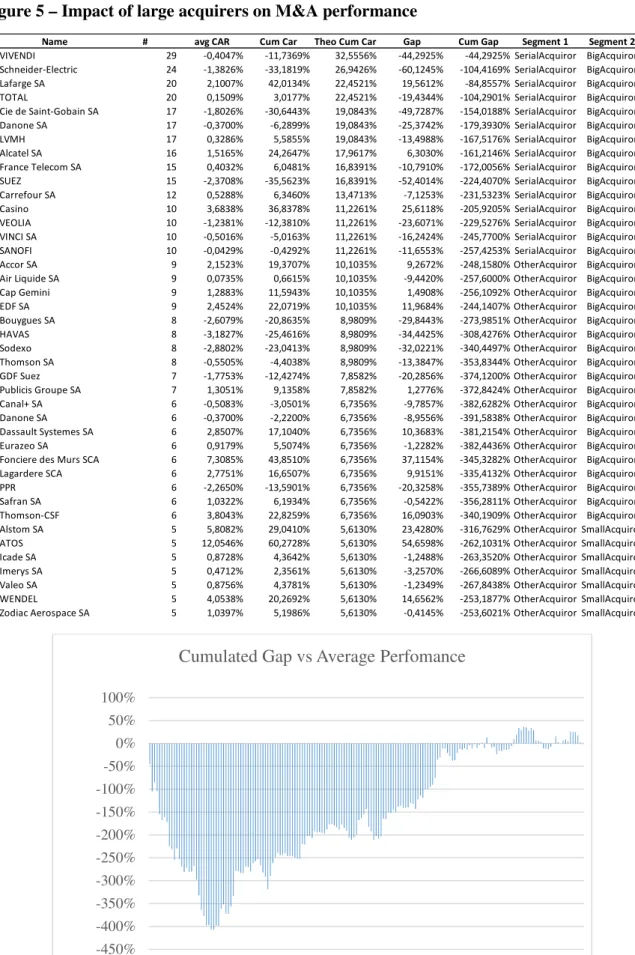
L’article présente un résultat intéressant qui est que les acquéreurs les plus importants, ayant réalisé au moins 5 acquisitions d’une valeur supérieure à 100M$ sur 1995-2010 ont une performance significativement inférieure. Ce résultat conforte les conclusions d’Ismail (2006),
de Billett & Qian (2008), et de Kim, Haleblian & Finkelstein (2011), qui tendent à montrer que l’expérience ne conduit pas à une meilleure performance M&A.
L’article montre enfin que la mise en place des normes comptables n’a pas conduit à une augmentation des rendements anormaux générés par les opérations M&A réalisées par des entreprises françaises. Ce résultat est conforté par un constat d’absence de différence significative entre la performance relative du M&A aux Etats-Unis et en France avant et après l’entrée en vigueur des nouvelles normes comptables, selon une méthodologie « diff-in-diff », telle que développée par Ashenfelter and Card (1985).
Cet article permet de mieux jauger le pouvoir dont disposent les dirigeants d’entreprise (« managerial discretion ») dans leurs échanges avec des auditeurs jugés indépendants mais qu’ils contractualisent et rémunèrent.
14
Le second article de cette thèse (« Impact of Board Committees on M&A performance in France ») analyse l’impact l’émergence de nouvelles réglementations relatives à la gouvernance d’entreprise qui ont fait suite aux affaires Enron ou Worldcom. L’une des plus importantes est la Loi Sarbanes-Oxley (« SOX »), qui a notamment rendu obligatoire un comité d’audit au sein du conseil d’administration des sociétés cotées.
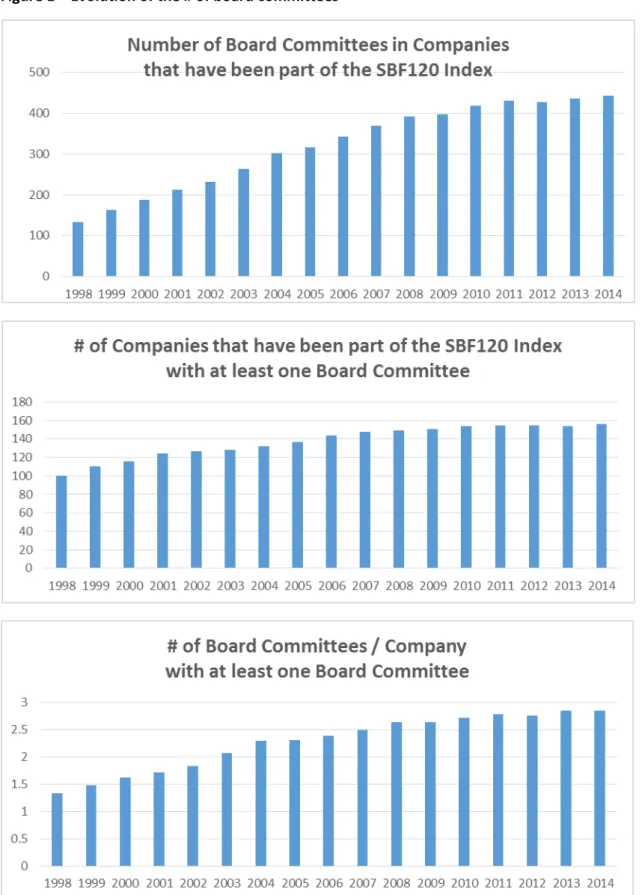
Depuis le début des années 2000, les entreprises ont alors multiplié le nombre de comités spécialisés, d’audit ou autre, dans leurs conseils d’administration, en vue d’améliorer les fonctions de contrôle et de conseil que ces conseils jouent.
Comme le rappelle Van Ness, Miesing & Kang (2010), la recherche est peu conclusive sur le sujet des liens entre composition des conseils et performance financière. Chen & Wu (2016) observent cependant que peu d’études portent sur les liens entre présence d’un comité et performance financière. Fartschian (2012), qui a focalisé ses recherches sur l’impact de l’activité des conseils, relève que la recherche a peu creusé le sujet des liens entre l’activité des conseils et la performance M&A.
Dans ce contexte, Faleye, Hoitash & Hoitash (2010), qui mesure une différence de performance en fusions & acquisitions entre les comités qui ont plus une fonction de contrôle et les comités qui ont plus une fonction de conseil, nous ont paru être une source d’inspiration.
L’article capitalise sur les informations d’une base de données peu utilisée en recherche, DataCG, qui recense des informations de gouvernance depuis 1999, pour explorer l’impact des comités mis en place au sein des conseils de surveillance ou d’administration des entreprises du SBF 120 sur leur performance M&A.
L’originalité de ce travail réside dans l’étude au travers d’une analyse de texte du rôle rempli par le comité en fonction au moment où une acquisition est réalisée. Nous concluons au fait que l’existence de comités, le nombre de comités existants et le type de comités existants n’ont pas d’impact sur la performance M&A.
Ce constat n’est pas dissonant de celui fait par les consultants tels que McKinsey (Bhagat & Huyett, 2013) qui observent que les entreprises, très respectueuses de la distance entre management et gouvernance, ont tendance à ne pas suffisamment engager leurs conseils de surveillance ou d’administration dans leurs opérations de fusions & acquisitions.
15
Le troisième article de cette thèse (« Impact of CSR on M&A Performance in France ») étudie les conséquences d’une autre tendance de marché qui a impacté la direction des entreprises au cours de ces dernières années : le développement de stratégies et de pratiques en matière de Responsabilité Sociétale d’Entreprise.
La recherche s’est penchée sur le sujet des liens entre performance de l’entreprise et mise en place de stratégies RSE. En revanche, la recherche sur l’impact de la mise en place d’une stratégie RSE sur la performance M&A des entreprises est plus limitée.
Les normes RSE sont susceptibles d’affecter les entreprises dans leurs activités M&A de deux façons opposées : 1) des contraintes supplémentaires, susceptibles d’impacter négativement les résultats à court terme et peut-être positivement à long terme la création de valeur consécutive à une opération ou 2) comme dans tous les cas de mise en place de normes une amélioration des process de l’entreprise, parmi lesquels les process M&A. Pour supporter ce second point, on peut aussi supposer que les acquéreurs doivent être amenés à faire preuve d’une vigilance accrue concernant la qualité de leurs cibles.
Deux articles récents présentent des résultats contradictoires sur ce sujet : Deng, Kang,
and Low (2013) montrent que les entreprises qui disposent de scores RSE plus élevés réalisent de meilleures acquisitions alors que Meckel & Theuerkorn (2015) montrent que ces entreprises génèrent des rendements anormaux inférieurs lorsqu’elles réalisent des acquisitions.
Partant du constat que le périmètre étudié par ces deux articles couvre les opérations de fusions & acquisitions essentiellement réalisées aux Etats-Unis pour l’un et aux Etats-Unis et en Allemagne pour l’autre, avec une qualification qui repose sur une valeur de transaction très basse, notre travail se focalise sur les fusions & acquisitions réalisées par des acquéreurs français, avec une valeur de transaction minimale supérieure à 100M€ pour éliminer d’éventuels bruits.
Nous fondons en effet notre travail sur l’originalité que présente la France qui, contrairement aux Etats-Unis pourtant caractérisés par une même tendance de marché, a été marquée par la publication de lois concernant la publication d’informations RSE en vue de rendre plus transparentes les pratiques des entreprises françaises dans ce domaine.
16
Notre travail mesure tout d’abord l’impact qu’a eu la publication de la Loi sur les Nouvelles Régulations Economiques du 15 mai 2001 (« NRE ») sur la performance M&A des entreprises. L’article cherche aussi à identifier les relations qui existent pour mes sociétés françaises entre un score de Responsabilité Sociétale d’Entreprise élevé et leurs performance M&A, ainsi qu’entre la mise en place d’une stratégie RSE, marquée par la publication d’un score RSE, et leur performance M&A. Par ailleurs, l’article évoque l’impact des différents scores RSE sur la performance M&A des entreprises françaises.
Grâce à la signature d’une convention de partenariat avec Vigeo, acteur européen majeur de l’évaluation extra-financière de grandes entreprises, nous avons pu accéder à une base de données qui recense l’évolution de la notation RSE des grandes entreprises françaises depuis 1999. Nos analyses ont porté sur l’identification de liens entre existence d’un scoring et niveau de scoring RSE d’une part et rendement anormal généré par une acquisition d’autre part. Nous montrons qu’il n’existe aucun lien entre ces deux facteurs.
Nous analysons ensuite le lien entre le niveau de scoring des entreprises qui en disposaient au moment de leurs acquisitions, et leur performance M&A. Le niveau de scoring est analysé pour chacun des critères RSE définis et regroupés par Vigéo en 6 domaines : « Corporate Governance », « Business Behaviour », « Environement », « Human Resources », « Human Rights » et « Community Involvement ».
Nos recherches montrent que la performance M&A est négativement impactée par des scores RSE plus élevés sur les dimensions « Environment » et positivement impactée par des scores « Human Rights » plus élevés.
Au final, les chocs externes étudiés semblent avoir un impact sur la performance M&A des entreprises lorsqu‘ils sont caractérisés par une obligation de transparence accrue de l’information avec une capacité limitée du management à travailler cette information et qu’ils ne conduisent pas à un alignement sur de nouveaux standards de marché auxquels l’ensemble des acteurs adhèrent.
17
Ainsi, la Loi NRE, qui oblige les entreprises à plus de transparence dans leur communication d’informations extra-financières, a eu un impact positif sur la performance M&A alors que les réglementations IFRS, qui obligent les entreprises à justifier de leurs résultats post-acquisition avec une contrainte limitée puisque le management dispose d’une importante liberté pour expliquer les résultats à des auditeurs qui disposent par définition d’une moins bonne connaissance des activités, n’ont pas eu d’impact. De la même façon, la présence d’un comité au sein du conseil d’administration ou de surveillance impacte positivement la performance M&A, cependant sans que cet impact ne soit provoqué par l’obligation d’avoir au moins un comité d’audit.
Notre travail apporte tout d’abord une contribution à la recherche en matière de performance M&A en adoptant une approche spécifique, l’étude de l’impact de chocs externes mais fournit aussi des éléments d’appréciation de l’ampleur de la discrétion managériale, telle que définie par Williamson (1984).
Les managers disposent au final d’une telle liberté en matière de décision d’investissement que peu de facteurs, comprenant modification des réglementations – à l’exception de celles qui visent à améliorer la transparence de l’information sur les marchés, modes de gouvernance ou évolution des pratiques managériales de marché semblent l’affecter.
Dans le cadre de recherches ultérieures, il serait intéressant de comprendre au travers d’études cliniques, conformément à ce qui est avancé par Antoniou, Arbour & Zhao (2011) et sur le modèle de ce qui a été réalisé par Fartschtschian (2012) pour Nestlé et Swissair, les spécificités organisationnelles qui conduisent certaines entreprises à enregistrer une performance supérieure.
18
Bibliographie
Agrawal A, & Jaffe J.F. (2000). “The post-merger performance puzzle Advances in Mergers and Acquisitions”, Volume 1 ed.: 7-41. JAI Series
Antoniou, A., P. Arbour & H. Zhao (2011). “Measuring the Economic Gains of Mergers and Acquisitions: Is It Time for a Change?”, Journal of Financial Transformation, 32 159-168.
Ashenfelter, O., & Card, D. (1985). “Using the Longitudinal Structure of Earnings to Estimate the Effect of Training Programs”. Review of Economics and Statistics, 67(4), 648-660
Baker, M., Pan, X. & Wurgler, J. (2012). “A Reference Point Theory of Mergers and Acquisitions”, Journal of Financial Economics 106 (2012) 49–71
Barber, B., & Lyon, J. (1997). “Detecting Long-Run Abnormal Returns: The Empirical Power and Specification of Test Statistics”, Journal of Financial Economics 43, pages 341-372
Bhagat, C., & Huyett, B. (2013). “Modernizing the Board's Role in M&A”, McKinsey Quarterly 45 (Winter), 9–13
Billett, M. T. and Qian, Y. (2008). “Are Overconfident CEO’s Born or Made? Evidence of Self-Attribution bias from Frequent Acquirers”. Management Science, 54 (6):1037 – 1051.
Bower, J.L. (2001). "Not All M&As Are Alike-and That Matters", Harvard Business Review, March 2001
Bradley, M., Desai, A., & Kim, E. H. (1988). “Synergistic Gains from Corporate Acquisitions and their Division between the Stockholders of Target and Acquiring Firms”, Journal of Financial Economics 21(1): 3-40.
Brock, D., Calipha, R., & Tarba, S. (2010). “Mergers and Acquisitions: A Review of Phases, Motives, and Success Factors”, in Cary L. Cooper, Sydney Finkelstein (ed.) Advances in Mergers and Acquisitions (Advances in Mergers and Acquisitions, Volume 9), Emerald Group Publishing Limited, pp.1 – 24
Brown, S., & Warner, J. (1985). “Using Daily Stock Returns: The Case of Event Studies,” Journal of Financial Economics 14, pp. 3-31
Bruner, R., (2002). “Does M&A Pay? A Review of the Evidence for the Decision-Maker”, Journal of Applied Finance (Spring/Summer 2002) 12:48-68
Cartwright, S. & Schoenberg, R. (2006). “Thirty Years of Mergers and Acquisitions Research: Recent Advances and Future Opportunities”, British Journal of Management, 17, S1-S5
Deng, X., Kang, J., & Sin Low, B. (2013). “Corporate Social Responsibility and Stakeholder Value Maximization: Evidence from Mergers”, Journal of Financial Economics, 110, 87-109 Faleye, O., Hoitash, R., & Hoitash, U. (2011). “The Costs of Intense Board Monitoring”, Journal of Financial Economics 101, 160-181
Farschtschian, F. (2012). “The Reality of M&A Governance: Transforming Board Practice for Success”. Springer, 2012
19
Gopinath, C. (2003). "When acquisitions Go Awry: Pitfalls in Executing Corporate Strategy", Journal of Business Strategy, Vol. 24(5), 22–26
Harford, J., Humphery-Jenner, M. & Powell, R. (2012). “The Sources of Value Destruction in Acquisitions by Entrenched Managers”, Journal of Financial Economics 106, 247-261
Haspeslagh, P. & Jeminson, D. (1987). “Acquisitions: Myths and Reality”, Sloan Management Review”, 28 (2), p. 53-58
Haspeslagh, P. & Jemison, D. (1991). “Managing Acquisitions: Creating Value Through Corporate Renewal”, New York: The Free Press
Ismail, A. (2006). “Will Multiple Acquirers Ever Learn? The US Evidence from Single versus Multiple Acquirers”. Unpublished working paper, http://dx.doi.org/10.2139/ssrn.765245
Jensen, M.C. (1986). “The Takeover Controversy: Analysis and Evidence”, Midland Corporate Finance Journal 4(2): 6-27
Covin, J.G., Daily, C.M., Dalton, D.R., & King, D.R. (2004). “Meta-Analysis of Post-Acquisition Performance: Indications of Unidentified Moderators”, Strategic Management Journal 25(2): 187-200
Kang, J., Miesing, P., & Van Ness, R. (2010). “Board of Director Composition and Firm Financial Performance in a Sarbanes-Oxley World”, Academy of Business and Economics Journal, 10(5): 56-74
Kim, J., Haleblian, J., & Finkelstein, S. (2011). “When Firms Are Desperate to Grow via Acquisition: The Effect of Growth Patterns and Acquisition Experience on Acquisition Premiums”, Administrative Science Quarterly, 56: 26-60
Lovallo, D., Viguerie, P. & Uhlaner, R., & Horn, J. (2007). “Deals Without Delusions”, Harvard Business Review, 85: 92-99
Lubatkin M. (1983). “Mergers and the Performance of the Acquiring Firm”, Academy of Management Review 8(2): 218
Malmendier, V., & Tate, G. (2005). “CEO Overconfidence and Corporate Investment”, Journal of Finance, 60: 2661–2700
Malmendier, V., & Tate, G. (2008). “Who Makes Acquisitions? CEO Overconfidence and the Market‘s Reaction”. Journal of Financial Economics. 89(1): 20–43, ISSN 0304-405X
Martynova, M. & Renneboog, L.D.R. (2006). “Mergers and Acquisitions in Europe”. ECGI - Finance Working Paper No. 114/2006; CentER Discussion Paper Series No. 2006-06
Martynova, M. & Renneboog, L.D.R. (2011). “The Performance of the European Market for Corporate Control: Evidence from the 5th Takeover Wave”. European Financial Management, 17(2): 208-260
Meckel, R. & Theuerkorn, K. (2015). “Corporate Social Responsibility as a success factor for M&A transactions”, European Journal of Business and Social Sciences, Vol. 4, No. 01, April 2015, 213–226
20
Meglio, O. & Risberg, A. (2010). “Mergers and Acquisitions - Time for a Methodological Rejuvenation of the Field?”, Scandinavian Journal of Management, 26: 87-95
Meier, O. & Schier, G. (2009). “Fusions & Acquisitions – Stratégie, Finance, Management”, 3ème édition, Dunod
Meier, D. & Zollo, M. (2008). “What is M&A Performance?”, Academy of Management Perspective, vol. 22, n°3: 55-77
Moeller, S., Schlingermann, F. and Stulz, R. (2005). “Wealth Destruction on a Massive Scale? A Study of Acquiring-Firm Returns in the Recent Merger Wave”, Journal of Finance, 60: 757 782 Roll, R. (1986). “The Hubris Hypothesis of Corporate Takeovers”, Journal of Business 59: 197-216
Shleifer, A, & Vishny, R. (1989). “Management Entrenchment, The Case of Manager-Specific Investments”, Journal of Financial Economics 25 (1989): 123-139, North-Holland
Sirower M.L. (2000). “The Synergy Trap: How Companies Lose the Acquisition Game”, The Free Press: New York
Sudarsanam, S. & Gao, L. (2004). “Value Creation in UK High Technology Acquisitions”, Financial Management Association (USA) Annual Meeting, New Orleans
Trautwein, F. (1990). “Merger Motives and Merger Prescriptions”, Strategic Management Journal 11: 283-295
21
Chapter 1: Impact of IAS 36 and IFRS 3 on M&A performance in France
Abstract
IFRS 3, a reform of accounting practices in M&A, was implemented in France in March 2004. One of its main objectives is to improve investors’ knowledge about the value of acquired assets, substituting historical cost with “fair value” for the measurement of goodwill resulting from an acquisition. It therefore introduced the goodwill impairment practice. Goodwill resulting from M&A has to be yearly tested by external auditors. In case the acquired assets are deemed not to have the value they had at the time of the acquisition, goodwill has to be impaired. As a result, acquired assets are accounted for at their “fair value” rather than at a pure “accounting value”, that is to say cost of the acquisition reduced by cumulated accounting depreciations. Considering the implementation of IFRS as an exogenous shock to information asymmetry, we test whether M&A performance, traditionally found poor in France, improved post-IFRS implementation, in analyzing abnormal returns from a set of 9865 acquisitions made by French and US companies over 1995-2013. We use an event study to test whether French acquirers’ performance has improved and a diff-in-diff approach to test whether the differential performance between US and French acquirers have evolved post-IFRS implementation. We also find that the implementation of IFRS 3 has had no impact on M&A performance in France.
22 1. Introduction
Much research demonstrates that mergers & acquisitions (M&A) create no value for acquirers. At the same time, M&A activity is picking up again with a worldwide investment valued at US$3.5 trillion in 2014, up 47% from 2013, which had been the worst year since 2009 (Thomson-Reuters - MERGERS & ACQUISITIONS REVIEW FINANCIAL ADVISORS, Full Year 2014). Possible explanations for this paradox include management biased decision-making. According to Kummer & Steger (2008), companies evolve in a context where growth is required by analysts and investors. Nevertheless, when internal growth initiatives do not materialize, or there are no other organic growth options, M&A transactions prove to be the only way to generate growth. While they are pressured to grow, management may be overconfident about transaction outcomes, according to Roll (1986), or pursue their own interests in making transactions at the detriment of shareholders, according to Jensen (1986) or Shleifer and Vishny (1989).
Tenants of the acquisition process theory, following Haspeslagh & Jemison (1987, 1991), such as Lovallo, Viguerie and Uhlaner & Horn (2007, 2010), deem that management have the possibility to improve their acquisition performance thanks to a better acquisition process.
It is therefore interesting to understand whether or not an increased pressure on management, such as a decrease in information asymmetry, leads to an increase in M&A performance, knowing that such an improvement is theoretically possible through the improvement of acquisition processes. We use a major change in M&A accounting rules in Europe in 2004, as an opportunity to assess the impact on acquisition performance of an assumed external shock over information asymmetry leading to an increased pressure on management to improve their M&A performance.
Adoption in the European Union of International Accounting Standards (IAS), published in 2001 by the International Accounting Standards Committee (IASC) of International Financial Reporting Standards (IFRS), issued in 2004 by the International Accounting Standards Board (IASB), represented a major milestone towards international convergence in financial reporting.
Main piece of change brought by the new accounting rules was a switch from a systematic amortization approach to an annual impairment testing of goodwill, defined as the difference between the price paid by an acquirer and the book value of the assets acquired.
As stated by Nussenbaum (2003), since the acquired assets are booked in acquirer’s accounts at their market value, goodwill is a clear measure of the synergies left to the seller in order to close the deal in a competitive environment. If synergies are not material, goodwill
23
becomes a measure of overpricing, i.e. of value destruction by the acquirer. Therefore, a comparison in time between market and book value of goodwill provides information on M&A success.
Former practice of annual goodwill amortization led to goodwill having a pure accounting value, with no connection to market value. Therefore, information provided by accounting regarding success of the acquisition was the same whatever the acquisition was creating value for the acquirer, meaning a goodwill with a market value higher than its book value at the time of the acquisition, or destroying value, meaning a goodwill with a market value lower than its book value at the time of the acquisition.
New practice, goodwill impairment, requires management to regularly assess, under auditors’ scrutiny, the performance of past acquisitions through a comparison between acquisition business plan forecasts and actual results. In case actual results are below business plan forecasts, a depreciation of the goodwill‘s book value has to be made. Therefore, market value of the goodwill has to be regularly estimated by experts but also to be communicated. As result, a goodwill impairment is a clear and visible sign that the considered M&A transaction performs below expectations. In accordance with objectives, implementation of this new practice should obviously lead to a better quality of information provided to analysts and investors and therefore to a reduction in the asymmetry of information between shareholders and management. The greater transparency implied by this highly visible process arguably make management more accountable for their M&A performance.
The new accounting rules, IFRS 3 and IAS 36, were actually assumed by practitioners to have an effect on the M&A performed by listed companies, which had to comply with those rules (see Appendix B). Auditors expected a decrease in information asymmetry between shareholders and management. Deloitte (2004) declared: “Purchase price allocations prepared after the
closing date of transactions assist shareholders in appraising the intrinsic value of the acquisition and evaluate the merit of any strategic premium paid for the target.” As a consequence, auditors
also expected an improvement in acquisition process. PwC (2005) declared: “IFRS will have an
impact on every aspect of the deal. From planning to execution, the acquisition process will need to become more rigorous.”
Several consulting companies argue that M&A performance has improved in recent years. In a document dated 2012, Accenture reports that more than 60% of the acquisitions performed over 2002-2009 created value, vs 10 to 30% before. However, they do not relate the claimed improvement to the change in accounting rules.
24
Thanks to Boulerne & Sahut (2010), we know that IAS/IFRS led to an increased relevance of total intangible assets and goodwill and to an improvement in the capabilities of financial markets to integrate such information in stock market prices and returns.
Recent research has however questioned the true impact of the new accounting rules, suggesting that management enjoys considerable discretion in implementing the goodwill impairment test, a concern commonly expressed in the practitioner literature, e.g. Hlousek (2002). Indeed, the review of the acquisition business plan required to assess goodwill is conducted under the responsibility of management, which can be assumed to be more business-knowledgeable than investors, analysts or auditors. For instance, management can easily sustain for some time that less-good-than-expected short-term M&A performance is only due to a different phasing of marketing conditions or synergy implementation, and not a sign of bad M&A overall. Therefore, management being in a good position to leverage a remaining information asymmetry, information provided would still not be fully reliable.
Our paper studies the impact of new accounting rules on M&A performance. We first use short-term event studies to assess M&A performance and then compare M&A performance in France before and after the adoption of IAS 36 and IFRS 3 in 2004. We then use short-term event studies to assess M&A performance in the US and we perform in a natural experiment setting, a “diff-in-diff” analysis to identify a possible evolution of the difference between M&A performance measured in France and M&A performance measured in the US
We analyze 636 acquisitions made by French listed companies over 1995-2013. We compute cumulated abnormal returns (CARs) on an observation period of 11 days around announcement of the acquisitions ([-5;+5]). We perform a regression using CARs calculated on the two different observation periods as a dependent variable, a dummy as an independent variable defined as 0 for acquisitions made before the date of regulation implementation and 1 for those made after, and usual control variables in M&A performance studies: size of the acquisition, market conditions, method of payment, listing status of the target, relatedness of business between acquirer and target, target industry, and the serial nature of acquirers.
We find no significant impact on abnormal returns before and after the implementation of the new regulations. Our other findings are in line with results commonly found in research related to M&A performance: Abnormal returns from M&A in Europe are slightly but significantly positive, payment by shares, acquisition of a listed target and acquirer being a repetitive acquirer have a negative impact on M&A success.
25
Performing consistency checks, we find no different results in using an observation period of 5 days ([-2;+2]). In excluding acquisitions 21 outlying acquisitions that generated a CAR below -20% or above +20% and in replacing cumulated abnormal returns (CARs) by buy-and-hold abnormal returns (BHARs).
In a second step, we calculate CARs on an observation period of 11 days around announcement of the acquisitions ([-5;+5]) on 9229 acquisitions made in the USA over 1995-2013. Following Ashenfelter and Card (1985), we develop a “diff-in-diff” approach (DiD). We calculate the average CAR in France and in the US before and after the different dates of implementation of the new regulations. We then calculate the difference in performance before and after the implementation of the new regulations in France while there were no such a change in the US, and we test the significance of this difference, using a similar regression setting as earlier explained.
We find that the difference in the M&A performance in France and in the USA, before and after the implementation of the new regulations, is not significant. Our other results are in line with Bruner (2002): M&A performance in the USA is not significantly different from 0.
As a result, we conclude that our analysis show that the implementation of IFRS 3 in France has had no impact on M&A performance, to the contrary of practitioners’ expectations. Our results are in line with Muller, Neamtiu & Riedl (2010), Li & Sloan (2012), and Ramanna and Watts (2012). New standards indeed generated considerable controversy, owing to their reliance on subjective fair value estimates for mandatory annual goodwill impairment testing.
The paper is organized as follows: Section 2 describes the changes in accounting standards for business combinations and goodwill which took place in 2004 and in 2008, Section 3 details the research issues related to prior literature, Section 4 explains the research method and the sample selection, Section 5 provides the empirical results, Section 6 concludes the study.
26 2. The Change in Regulations: An External Shock over M&A Practices
There have been long debates over the value of intangible assets. For the more conservative, intangible assets were not easy to value objectively through the use of any another method, and therefore had to be valued at historical cost. Others argued with a more economical stance over the growing importance of this type of assets in modern economies and the significant difference in value between historical cost and revenue expectations. Over years, accounting principles have more and more admitted, starting with acquired assets, that intangible assets be valued at fair value.
Goodwill, a specific intangible asset, defined as the difference between purchase price and value of assets acquired, had long remained an exception before the publication in France, as a result of a move towards common international standards, on the 31st of March 2004 of IFRS 3 “Business Combinations”, of IAS 36 “Impairment of Assets” and of IAS 38 “Intangible Assets”.
IFRS 3 defines a business combination as separate entities or businesses into one reporting entity to form “an integrated set of activities and assets conducted and managed for the purpose of providing a return to investors; or lower costs or other economic benefits directly and proportionally to policyholders or participants”.
As stated by PwC (Capital Finance, n°666, 19th), IFRS 3 introduced a few new principles,
whereas all business combinations are acquisitions (pooling-of-interest method not allowed anymore). Also, an acquirer must be identified for every combination. More intangible assets have to be identified and recognized on acquisition – some will be intangible assets with indefinite lives, with goodwill not amortized but subject to an annual impairment test and negative goodwill is recognized immediately in income. Restructuring costs are charged to income and contingent liabilities are recognized at fair value. Detailed disclosures about transactions and impairment testing are required. First-time adopters must apply new rules from day one of their IFRS track record and can choose to restate past deals.
IAS 36 describes the goodwill impairment practice as a two-step procedure to assess fair value, whereas assessment of whether or not the reporting unit’s fair value is less than its book value. If yes, derive the implied fair value of goodwill by subtracting the fair value of all other net assets of the reporting unit from the fair value of the reporting unit. Then, if the implied fair value of goodwill is less than its book value, difference is the goodwill impairment is to be reported.
A revised IFRS was published on the 10th of January 2008. As explained by Duff & Phelps (2010), non-controlling interests are measured either at their proportionate interest in the net identifiable assets or at fair value. Also, the requirement to measure at fair value every asset and
27
liability at each step for the purposes of calculating a portion of goodwill has been removed. Instead, goodwill is measured as the difference at acquisition date between the fair value of any investment in the business held before the acquisition, the consideration transferred and the net assets acquired. Acquisition-related costs are generally recognized as expenses. Contingent Considerations must be recognized and measured at fair value at the acquisition date. Subsequent changes in fair value are recognized in accordance with other IFRSs, usually in profit or loss. Changes in a parent’s ownership interest in a subsidiary that do not result in the loss of control are accounted for as equity transactions.
A key feature introduced by the change in accounting regulations in 2004 is the substitution of historical cost with fair value for the goodwill, introducing the goodwill impairment practice, thus eliminating the goodwill amortization practice.
Nevertheless, as explained by Nussenbaum (2003), goodwill can be related to the value of synergies which are expected to be generated by a transaction but left to the seller so that the deal can be made. In case synergies are not materialized, goodwill is a measure of overpricing, making goodwill a topic of interest to understand acquisition success.
As stated by Hayn & Huygues (2005), this change in regulations put a new and continuous responsibility on management to periodically determine the fair value of the goodwill in their books. This should also be performed under a more active supervision of auditors, who will have their responsibility engaged in reviewing periodically management impairment decisions. Investors should therefore enjoy a better information regarding value created through M&A, which can be translated as a reduction in asymmetric information, expected to result in an increased pressure over managers to pay more attention to their M&A performance. As a consequence, M&A should lead to higher level of value creation for acquirers.
28 3. Literature Review and Development of Hypothesis
3.1. Literature Review
M&A success has been widely documented over time and a significant amount of research shows that M&A does not create a significant value for acquirers: Jensen & Ruback (1983) on M&A prior to 1980; Jarrell, Brickley & Netter (1988) on the 1980s takeover wave; Bruner (2002) for the US and Martynova & Renneboog (2011) for Europe on the 1990s wave. Sudarsanam (2003) covers studies over several decades.
Bruner (2002) provides with a useful table summary of 44 studies performed between 1977 and 2001 and concludes that the aggregate abnormal returns to buyer shareholders from M&A activity are essentially zero: buyers essentially break even.
In one of the most significant pieces of analysis, Moeller, Schlingemann, and Stulz (2005) find that between 1998 and 2001, acquiring firms’ three-day announcement period average CAR is +0.69% but the aggregate dollar return a total loss of $240 billion.
As far as Europe is concerned, Martynova and Renneboog (2011) find an average CAR of +0.53% for the bidding firms.
In short, research solidly considers that while they trigger those operations, buyers make no money in M&A: There is no value creation above cost of capital. This observation has also been largely made by the major consulting firms: McKinsey (2004), BCG (2007) and Bain (2004).
Explanations regarding poor acquirer performance are first centered on the imperfect information that may characterize mergers & acquisitions, that is to say the difficulty to estimate the right level of value created for the acquirer in a M&A transaction and therefore to pay the seller accordingly.
Indeed, if we follow Bradley, Desai, Kim (1983, 1988), pricing should lead to an objective and specific price for the target’s shares, based on estimates of the increase in value resulting from synergies thanks to new shareholding and on a division of these synergies between buyers and sellers, according to their bargaining power.
However, there are in reality strong caveats to that view. As explained by Shojai (2009), there is information asymmetry between bidding firms and target firms, which makes it difficult to organize a fair division of gains between buyers and sellers.
29
Furthermore, in the context of a bid for a listed company, bidders have a limited access to target firms. Aktas, de Bodt & Roll (2010) explained that acquirers can be pressured by the fact they had the sentiment of negotiating under the threat of an auction.
Baker, Pan, and Wurgler (2009) deem that target price cannot be set with precision but only within a broad range: valuation is complicated and subjective, which opens way for mispricing and relative bargaining power is a concept with no solid grounds.
This imperfection of information is also thought to have a powerful secondary effect: It is difficult for investors to control the relevance of managers’ buying and pricing decisions. A solid string of research has then elaborated on the devious role played by management in M&A: either they take personal advantages of environments in which they see more than investors, as shown by Jensen (1986) or Schleifer & Vishny (1989, 2003), or they are overconfident in their decision-making, being victims of environments which are less clear than what they believe, as shown by Roll (1986) or Sudarsanam & Gao (2004).
Over the past recent years, behavioral finance theorists have taken over the topic and further explored the lack of rationality of managers and shareholders when making acquisitions. Management bias in decision-making have widely been documented, detailed and confirmed.
According to Martynova & Renneboog (2005), takeovers towards the end of each acquisition wave are usually driven by non-rational, frequently self-interested managerial decision-making.
Lovallo, Viguerie, Uhlaner, and Horn (2007) have established a list of the various biases which affect management decision when making acquisitions. They list confirmation bias, overconfidence, underestimation of cultural differences, planning fallacy and conflict of interest in the preliminary due diligence phase. They also deem that acquirers are struck by winner’s curse in the bidding phase. Also, according to their study, decision-making was affected by anchoring and sunk cost fallacy in the final phase (see Appendix A).
Malmendier and Tate (2008) demonstrate a relation between CEOs’ personal over-investment in their company and their press portrayal, as proxy for their overconfidence, and acquisition success.
Harford, Humphery-Jenner, and Powell (2012) show that entrenched managers destroy value in avoiding private targets, which have been shown to be generally associated with value creation. Also, when they do buy private targets or public targets with blockholders, they tend
30
not to use all-equity offers, which has the effect of avoiding the transfer of a valuable blockholder to the bidder. Entrenched managers overpay and also select low-synergy targets in the first place.
At the same time, researchers who have investigated M&A as a process have explained that managers can improve their M&A performance in improving their M&A process, that is to say to invest more time and money as well as to improve efficiency to solve problems linked to imperfect information.
Haspeslagh & Jemmison (1987) asserted that a variety of recurring patterns offers clues to the disappointing results. They noted that managers were trying to capture rather than create value.
Lovallo, Viguerie, Uhlaner, and Horn (2007) have more recently published a structured list of prescriptions to address main biases which affect management-decision making at every step of an acquisition.
Whether driven by overconfidence or selfishness, management behavior can be assumed not to be forever set in stone. Research has indeed shown that management behavior can change upon pressure or incentives.
As explained by Jensen (1986), corporate managers are subject to many pressures to act in the interest of shareholders. This includes monitoring by the board of directors (Fama & Jensen, 1983), managerial labor market (Fama 1980), product market competition (Hart, 1983), and threat of a takeover (Jensen & Ruback, 1983 or Scharfstein, 1988). Schleifer & Vishny (1988) recommend to implement incentives to improve the acquisition process.
Healey, Palepu & Ruback (1992) have demonstrated that when managers have more at stake, more value is created in mergers & acquisitions.
Kaplan (1989), Muscarella & Vetsuypens (1990), Smith (1990), Opler (1992), and Andrade & Kaplan (1998) have shown that LBOs, operations in which management is usually involved in shareholding, create value for buyers.
From our analysis of the literature related to mergers & acquisitions, it sounds reasonable to assume that M&A performance is impacted by management behavior, negatively because of overconfidence or selfishness, or positively thanks to external pressure that would push them to adopt a better acquisition process. Testing the impact of a better acquisition process is not easy since it requires an access to a lot of non-public information. However, it is possible to
31
test the assumed positive impact of an increased external pressure on managers making acquisitions on an improved M&A performance.
In parallel, accounting regulations have been proven to have impacts on the way managers perform their acquisitions. It is for instance interesting to note that in the US, prior to the issue of FASB 141 ‘Business Combinations’, acquiring firms could avoid recognizing and amortizing purchased goodwill by structuring the acquisition to qualify as a pooling transaction, which led to no impact on future earnings. Acquisitions which did not qualify for pooling needed to be accounted for using purchase method with goodwill amortized over a maximum life of 40 years, deducted over future earnings.
Several studies showed that management were prone to prefer pooling over purchase as it allows them to avoid the systematic amortization of goodwill required under the purchase method. Bugeja & Loyueng (2011) remind the findings of Robinson & Shane (1990), Aboody, Kasznik & Williams (2000) and Ayers, Lefanowicz & Robinson (2002): while pooling-of-interest allowed managers to avoid goodwill amortization and therefore to publish higher post-acquisition earnings, post-acquisitions are more likely to be accounted for using the pooling-of-interest method when the target firm has a higher amount of underlying goodwill which would result in material goodwill amortization charges if accounted for as a purchase. Aboody, Kasznik and Williams (2000) had even found that firms were more frequently using the pooling-of-interest method if the CEO of the acquirer has an earnings-based compensation scheme in place. It has also been documented that takeover premiums are higher in acquisitions accounted for using the pooling method (Robinson and Shane, 1990; Ayers, Lefanowicz and Robinson, 2002).
In a context where information can be seen as imperfect, it is interesting to note that the new regulations implemented between 2004 and 2008 have been proven to lead to an improvement of the quality of the information received by shareholders, including on the visibility of management performance. Indeed, a study of goodwill write-off announcements by French companies over the period 2000-2004 made by Feuilloley & Sentis (2007) showed that goodwill depreciation had a negative impact on firm values, confirming the economic impact of this accounting practice. Based on a study targeting 120 companies listed in France, Boulerne & Sahut (2010) conclude to a higher relevance of financial information conveyed by accounting when following IFRS 3: Empirical tests on goodwill lead to a substantial contribution of these intangibles to shareholder value and value of this contribution is better embedded in stock prices. Li, Shroff, Venkataraman & Zhang (2011) suggest that investors and financial investors reacted to goodwill impairment: downwards expectations on
32
announcement, with a revision related to the magnitude of the loss. Olante (2010) found that requirements for annual impairment test improved the timeliness of recognizing goodwill impairment losses and that the cause of impairment was overpayment rather than subsequent occurrence of events leading to a performance deterioration of the reporting unit.
It is also interesting to note that practitioners also anticipated a positive impact of new accounting rules over M&A practices and outcomes (see Appendix B).
As a first conclusion to our review of research and practitioners’ views, it is reasonable to consider that the change in the accounting regulations between 2004 and 2008, assumed to put more pressure on managers and to improve the quality of the information provided to investors, could lead to an increased M&A performance since managers would tend to implement good practices in terms of acquisition process.
However, without any specific focus on mergers & acquisitions, a few recent studies have expressed doubts about the impacts of the changes on managerial practices. The general idea is that the new accounting rules leave managers with significant discretion as far as goodwill impairment is concerned. As a result, we may assume that the discretion left may lighten or even cancel the pressure which was assumed to push management to adopt better practices leading to increased M&A performance.
Li & Sloan (2015) estimated for instance that new standards resulted in relatively inflated goodwill balances and untimely impairments, not necessarily fully anticipated by investors and that managers exploited the discretion afforded by SFAS 142, equivalent in the US of IFRS 36, to delay goodwill impairments, causing earnings and stock prices to be temporarily inflated.
Muller, Neamtiu & Riedl (2010) deem that long-term information asymmetries between managers and market participants can exist regarding declines in the value of recognized goodwill. They remind findings showing that managers bias the timing of asset impairments in general (e.g., Alciatore et al. 2000; Riedl 2004), and of goodwill impairments in particular (e.g., Francis et al. 1996; Gu and Lev 2011; Li et al. 2011). They explain that because impairments of goodwill are only recognized when the entire reporting unit is impaired, a considerable cushion to recording a goodwill impairment loss can exist if the fair value of the other assets in the unit exceeds their carrying value. In addition, the test requires estimates of fair values for both the reporting units and for specific assets and liabilities, often in the absence of verifiable market prices.
33
Ramanna and Watts (2012) note that the new standards generated considerable controversy, owing to its reliance on subjective fair value estimates for mandatory annual goodwill impairment testing.
In order to apprehend the true impact of the changes in M&A regulations on M&A performance, we have to take into consideration the different findings in the area. A significant number of other factors that may have an impact over M&A performance have indeed been identified. They include: Method of payment (Loughran & Vijh, 1997 ; Rau & Vermaelen, 1998), diversification (Berger & Ofek, 1995 ; DeLong, 2001 ; Martynova & Renneboog, 2006), market conditions (Lubatkin & O’Neill, 1987 ; Lubatkin & Chatterjee, 1991), size of the transaction (Moeller et al, 2004) and target listing status, that is to say privately-held or publicly-held (Shojai, 2009). From Bruner (2002) and Martynova & Renneboog (2011), we also know that acquisition returns can differ by country.
More recently, Harford, Humphery-Jenner, and Powell (2012), while simulating M&A performance according to CEO’s level of entrenchment, list a set of variables, including industry sector, cross-border, size of the target and relative size of acquirer vs. target, as having a possible impact.
Acquisition experience is another factor that has been more recently explored, with controversial results. While Aktas, De Bodt & Roll (2009, 2011) remind that empirical research has shown that, from deal to deal, serial acquirers’ cumulative abnormal returns (CAR) are declining, not a lot of research has focused on the performance of more acquisitive firms vs. less acquisitive firms. Billett & Qian (2008) show that first deals performed by CEO’s exhibit zero announcement effects while their subsequent deals exhibit negative announcement effects, a result which is consistent with a self-attribution bias leading to overconfidence. Kim, Haleblian & Finkelstein (2011) show that firms may be more prone to acquisition making and overpaying their acquisitions when their organic growth is low and when a firm becomes dependent on acquisitions for continuing growth, it is vulnerable to overpaying, with limited benefit coming from their acquisition experience to prevent them overpaying for their targets. In a paper entitled “Will multiple acquirers ever learn? The US Evidence from Single versus Multiple Acquirers”, Ismail (2006) explains that his study of a large sample of 16,221 US takeovers between 1985 and 2004 shows that single acquirers outperform multiple acquirers by 1.66%