SETTING NEW RULES FOR GOODWILL
ACCOUNTING: THE BRITISH
EXPERIENCE
Abstract:
The purpose of this paper is to analyse the process of development of the standard relating to goodwill by the British Accounting Standards Board (ASB) (FRS 10, 1997) and more precisely to understand how and why the ASB came to favour a solution (capitalisation of goodwill with impairment tests) at odds with the existing regulations (capitalisation and systematic amortization). The first part of the paper provides an overview of the evolution of the national and international regulations on the subject. Although this “innovation” is generally attributed to the FASB, we point out the active role of the ASB. In the second part, a detailed description of the development of the standard-setting project on goodwill within the ASB is provided for the period 1991-1995, through interviews conducted with the project director. The results suggest that although this solution appeared early in the process, its acceptance was dependent on its practical feasibility. Moreover, its final adoption as a mere option within FRS 10 highlights the fact that it is not comfortable for a standard-setter to go against the mainstream.
Key words: goodwill, impairment tests, innovation, standard-setting process.
Résumé :
Cette étude a pour objet d’analyser le processus de développement de la norme relative au goodwill par l’Accounting Standards Board (ASB) britannique (FRS 10, 1997), plus précisément le processus d’émergence et d’acceptation d’une solution (activation avec tests de dépréciation) en rupture avec les diverses réglementations alors en vigueur (activation avec amortissement systématique). Dans une première partie, est proposée une évolution des réglementations nationales et internationales en la matière. Si l’« innovation » est généralement mise sur le compte du FASB américain, nous mettons en évidence le rôle moteur de l’ASB. Dans la deuxième partie, le processus de développement de FRS 10 est reconstitué sur la période 1991-1995, à travers notamment des entretiens réalisés avec le directeur de projet. Les résultats suggèrent que bien qu’envisagée assez tôt par l’ASB, cette solution ne s’est pas tout de suite imposée en raison de problèmes d’opérationnalisation. Par ailleurs, le fait qu’elle ne constitue que l’une des options proposées par FRS 10 montre la difficulté pour un normalisateur de se mettre en porte-à-faux avec la pratique dominante.
INTRODUCTION
Accounting for goodwill has been one of the most contentious issues in the history of modern accounting. Initial recognition as well as measurement subsequent to initial recognition has been largely debated by national and international standard-setters. Acceptable accounting approaches have run from charging goodwill to equity, to capitalizing it permanently, and to capitalizing and amortizing it. In June 2001, the issuance of SFAS 142 “Goodwill and Other Intangible Assets” by the Financial Accounting Standards Board (FASB), the American standard-setter, has provoked a big bang within the accountants’ community. In fact, the provisions of this standard prohibit the capitalization and amortization approach which has been the most dominant one in practice for more than twenty years. Other standard-setters have adopted the same line, in particular the IASB, through IFRS 3 “Business Combinations” and in a way the British Accounting Standards Board (ASB) through FRS 10 “Goodwill and Intangible Assets”. A consensus has emerged on the subject, which leads us to question the reasons why regulations have changed.
Although the FASB is often considered as the initiator of this solution, there is evidence that the British ASB played a significant role in legitimating the non systematic depreciation approach and applying the concept of impairment tests for goodwill. This justifies our interest in the ASB and in its process of developing the goodwill standard. The purpose of this paper is to understand how and why the ASB came to favour this solution and to adopt it as an option in its final standard.
The first part of the paper provides an overview of the evolution of the different national regulations relating to goodwill accounting. This analysis leads us to point out the active role of the ASB, the British standard-setter, in initiating the solution of recognising goodwill as an asset and following up its value through impairment tests (which will be referred to in the remainder of the paper as the “impairment solution”). In the second part, a detailed description of the development of the standard-setting project on goodwill within the ASB is provided and analysis is conducted in order to understand the emergence of this solution as an acceptable accounting treatment. Our main source of information is a series of regular interviews carried out with the person in charge of the project during year 1995 so as to shed the light on the standard-setting process from an internal viewpoint. This paper differentiates from earlier studies in two main aspects. First, the use of in-depth interviews is quite rare since most studies base their conclusions on the analysis of comment letters considered as the most observable form of lobbying (Grinyer and Russel, 1992; Hatwig, 2006; Tollington, 2006). Second, the paper emphasizes the standard-setting process within the ASB (namely how the impairment solution arose and finally became a legitimate one) and doesn’t aim at identifying the supportive arguments set forth by the different actors.
SECTION I: A HISTORICAL OVERVIEW OF REGULATIONS
RELATING TO ACCOUNTING FOR GOODWILL
Several earlier researches have already proposed a comparative analysis of the accounting regulations associated with intangible assets (Can••ibano and al., 2000; Stolowy and Jeny-Cazavan, 2001; Powell, 2003). Their results highlight the heterogeneity of regulations and practices as far as accounting for intangible assets is concerned. The diversity of approaches followed by national and international standard-setters seems to be due to the lack of a commonly accepted conceptual framework that proposes a clear definition of these assets. Consequently, accounting for intangible assets has been considered as one of the causes of international accounting disharmony (Stolowy and Jeny-Cazavan, 2001). Can••ibano and al. (2000) point out that the existence of alternative accounting treatments for intangible assets impairs the comparability and the relevance of the information on the intangible determinants of companies’ value.
Since this article focuses on the way the impairment solution emerged within the British accounting standard-setter, our analysis will be limited to requirements related to accounting for goodwill1 subsequent to initial recognition. However, it will be difficult to isolate the standards addressing accounting for goodwill from those dealing with accounting for other intangible assets. Most regulators aim at achieving a consistent treatment of both in order to eliminate potential accounting arbitrage between the two. Moreover, greater emphasis will be given to regulations that are likely to be of particular interest for the remainder of the study. Namely, the recent history of the American, international, and British regulations will be examined in turn in order to identify the standard-setter that first came up with the impairment test idea for goodwill. As mentioned earlier, both the American and International standards that address accounting for goodwill prohibit the capitalization and systematic amortization approach and require instead the application of impairment tests (at least annually) respectively since 2001 and 2004. The giant step taken by the FASB through the issuance of SFAS 142 is commonly associated with the idea that this standard-setter was the initiator of the impairment solution for goodwill. The following analysis shows that this idea can be challenged.
1.1 From 1970 to late 1990’s: a consensus around the capitalization and amortization approach
Our analysis starts from 1970, a key date in the United States where the accounting standard-setter of the time, the Accounting Principles Board (APB), issued APB Opinion n° 16 “Business Combinations” and APB Opinion n° 17 “Intangible Assets”. These standards required the capitalization and amortization of goodwill over a period which can not exceed forty years. Once these standards came into force, the application of the capitalization and amortization approach spread gradually to become a dominant practice in the US by around
1
It is worth noting that we are going to deal only with acquired goodwill since almost all jurisdictions prohibit the capitalization of internally generated goodwill. However, it is important to point out that the consistency of accounting treatments of both goodwills has always been of a particular importance when deliberating on accounting for purchased goodwill.
1975 (Richard and al., 2005). The issuance of these standards provoked strong opposition from industry. In order to gain support from companies, the predecessor of the FASB had to allow them to use a very long amortization period for goodwill. Thus, the maximum limit of forty years “was generally understood to be a “compromise”, granted to companies as an incentive to replace the old write-off method2.” (Richard and al., 2005, p. 23-24). During the 1970’s, the FASB3 had an active project on its agenda to reconsider the accounting for business combinations and purchased intangible assets. However, the FASB decided first to defer consideration of these issues until after it completed to develop its conceptual framework and later to remove them from its agenda to focus on higher priority projects. No substantial change occurred from the mid 1970’s until August 1996 when the FASB decided to add the project on business combinations and intangible assets to its agenda.
Several national standard-setters followed the same line concerning accounting for goodwill subsequent to its initial recognition. The amortization approach has been the most commonly adopted one throughout the world. However, countries which require the amortization of goodwill do not always behave in the same way regarding the duration of amortization. Some regulations simply indicate that amortization must be recorded over the useful life of the asset whereas others prescribe an upper limit to that duration. For example, France sets no maximum limit for the useful life of goodwill and only requires that the choice of the period be in line with documented goals and hypotheses defined at the date of acquisition4. Yet, France was quite isolated in this position, the dominant practice being the amortization over the goodwill’s useful life, often subject to an upper limit of 5 or 20 years, with only the USA5 allowing a maximum of 40 years. The establishment of a maximum amortization period for goodwill stems from the difficulty to estimate the useful economic life of this asset with sufficient accuracy. The upper limit of 20 years6 chosen by Australia, Germany and New-Zealand was justified by the fact that the planning horizon adopted by an enterprise for its operations is unlikely to exceed 20 years. Consequently, projections of the life of goodwill beyond that planning period are not sufficiently reliable to permit a longer amortization period.
It is noteworthy however that most jurisdictions that prescribed the systematic amortization approach also required that the carrying value of goodwill be subjected to a “review”. The circumstances in which this “review” had to be carried out varied from one regulation to another. For instance, Australia, Germany and New-Zealand required an annual “review” whereas the international standard IAS 22 (revised in 1998) obliged entities to assess the carrying amount of goodwill annually only when the amortization period exceeded 20 years. The “review” had also to be conducted when there was an indication that goodwill had lost
2
This method consisted in writing-off goodwill against reserves on the acquisition date. It was favoured by companies in the absence of restrictive requirements since it allowed them to keep their profitability unchanged (ceteris paribus). It has been the dominant practice in US till the publication of APB opinions n° 16 and 17 (1970) and in UK till the issuance of Financial Reporting Standard FRS 10 “Goodwill and intangible assets” (1997).
3
The FASB has been designed to establish standards of financial accounting and reporting in the US since 1973.
4
In 2005, the French National Accounting Council proposed to limit the amortization period to 20 years but this proposal was not endorsed by the Accounting Regulation Committee.
5
Canada also allowed a maximum amortization period of 40 years for goodwill.
6
This upper limit was also adopted by the International standard-setter in both revisions of IAS 22 (1993, 1998). The prescriptions of international standards will be examined later in detail.
value. Some jurisdictions chose to use the term “impairment test” whereas others kept more usual terms that may not be specific to intangibles (e.g. additional write-off). Stolowy and Jeny-Cazavan (2001) point out that the “impairment concept” for intangible assets was put forward by the International Accounting Standards Committee (IASC) through the publication of IAS 38 and IAS 36, and the revision of IAS 22 in 1998. The former revision of IAS 22 (1993) required that the amortization period of goodwill should never exceed 20 years whereas the 1998 version sets a rebuttable presumption that the useful life of goodwill will not exceed 20 years, which means that an enterprise can amortize over a longer period provided that it discloses the reasons for its choice and estimates annually the recoverable amount of goodwill in order to identify and record any impairment loss. The prescriptions of the third version of IAS 227 were highly influenced by the outcome of the project on accounting for intangible assets. This project was put on the IASC’s agenda since 1993 and gave rise to the exceptional issuance of two exposure drafts (E50, 1995 and E60, 1997). The resulting standards, IAS 38 and IAS 36, prescribe the capitalization and systematic amortization of purchased identifiable intangibles assets, over a period normally not exceeding 20 years. This maximum limit can be rebutted by a company in particular circumstances provided it performs annual impairment tests to assess the recoverability of the intangible asset balance. The same rules have been adopted later for goodwill in order to prevent companies from making arbitrary choices.
From the above analysis, it is reasonable to conclude that goodwill amortization has been dominant in most jurisdictions from 1970 till the late 1990’s. It is also noteworthy that amortization and impairment were not mutually exclusive since impairment was often added to amortization.
1.2 Impairment for goodwill: a complement versus an alternative to amortization
The IASC (through IAS 36 “Impairment of Assets” which was issued in 1998 and is still effective) as well as the FASB (through SFAS 121 “Accounting for the Impairment of Long-Lived Assets and for Long-Long-Lived Assets to Be Disposed Of” which was issued in 1995 and has now been superseded) provided a detailed methodology aimed at identifying and measuring potential impairment losses associated with goodwill.
The first public document relating to the impairment issue (a Discussion Memorandum) was published by the FASB in December 1990. This Discussion Memorandum did not address accounting for goodwill but invited comments on the tentative decision to exclude goodwill from the scope of the project. Based on comments received, the FASB decided to include goodwill in the scope of the exposure draft and the final standard8. The exposure draft was issued in November 19939 and required that goodwill be reviewed for impairment whenever events or changes in circumstances indicate that its carrying amount may not be recoverable. So, the IASC can not be considered as the first accounting standard-setter to have developed
7
IAS 22 was first issued in 1989.
8
The justification given by the FASB is that long-lived assets and identifiable intangibles can not be tested for impairment without also considering the goodwill arising from the acquisition of those assets.
9
This date preceded the issuance by the IASC of the second exposure draft E60 (1997) relating to accounting for intangible assets and the third revision of IAS 22 “Business Combinations”.
the “impairment concept” for intangible assets in general and goodwill in particular, as have been pointed out by Stolowy and Jeny-Cazavan (2001). However, it can be said that the IASC requirement to perform annual impairment tests when the useful life of goodwill exceeds 20 years (brought about by the third version of IAS 22) was a more important step towards the impairment approach since recoverability tests had to be carried out regularly in certain circumstances (and not merely when impairment indicators emerge like proposed by SFAS 121). Impairment tests, when the useful life of goodwill was expected to exceed 20 years, made part of the amortization approach and were not considered merely as a complement to it.
At this stage of the analysis, we can conclude that the “impairment concept” for goodwill was first brought about by the American standard-setter through the exposure draft issued in 1993. The circumstances under which impairment tests have to be performed have evolved since that date to include an annual frequency in some jurisdictions (and under some conditions). However, our conclusions have to be tempered since the analysis does not consider the evolution of the British regulation related to accounting for goodwill.
1.3 The British accounting standard-setter: an outsider?
The first British accounting standard that have addressed accounting for goodwill was issued by the Accounting Standards Committee (ASC)10in 1984. This standard was not in line with the dominant practice of the time since it recommended to charge goodwill against reserves at the date of acquisition (although it also allowed the capitalization and amortization approach). A first attempt was made by the ASC (before its demise in 1990) in order to reconsider accounting for goodwill (and other identifiable intangible assets). The responses to the exposure drafts issued by the ASC were later analysed by the newly formed standard-setter, the ASB, which did not deliberate on the issue until 1993. The consultation process spanned over four years, including the publication of a discussion paper (1993), a working paper (1995), an exposure draft (1996) and a final standard in 1997. Since the beginning of the process, the ASB felt it must find a way out since systematic amortization was highly rejected by industry. An alternative solution based on the annual review of goodwills believed to have indefinitely long lives has been proposed in the working paper. In this case, goodwill should not be submitted to systematic amortization. Goodwill having a finite life should be amortized over that life and submitted to an impairment test at each year-end (this test was qualified as a “minimal review”). These prescriptions, which were later included in the final standard, brought the British rules into conflict with the dominant approach adopted by national and international standard-setters, since goodwill amortization could be avoided in some circumstances. The ASB was thus the first standard-setter to propose the impairment solution as an alternative to the amortization approach. Few accounting standard-setters dared to go so far at that time. The IASC required testing goodwill for impairment annually only if its useful life was expected to be superior to 20 years but it did not forbade the systematic amortization in those circumstances. Kwok and Sharp (2005) point out the fact that “the UK’s experience with intangible assets served as an important input into the IASC’s intangible assets project” (p. 93). They add that “the UK had wanted to follow the
10
international practice of 20 years of amortization, but the industry was not in favour. Therefore, it came up with the impairment test idea which slowly gained acceptance” (p. 93). The ASB could not completely move away from the amortization approach since the revision of the standard addressing accounting for goodwill firstly aimed at bringing the British practice in line with the international one. Thus, the solution of impairment as an alternative to systematic amortization was only proposed as an option in the final standard. This is the reason why, we think, the adoption of the impairment solution for goodwill is usually, if not always, associated with the American standard-setter although much work has been done on the subject within the ASB since the early 1990’s. The solution adopted in FRS 10, that is capitalization and amortization over a finite life with the possibility to use impairment tests in special circumstances, was a compromise intended to avoid a rejection of the standard by industry. The abolishment of goodwill amortization did not occur before the issuance in 2001 of the American standards which initiated a real move of accounting jurisdictions towards the impairment solution.
SECTION II: THE DEVELOPMENT OF THE “IMPAIRMENT
SOLUTION” WITHIN THE BRITISH ASB
In this part, a detailed description of the development of the project on goodwill within the ASB is provided and an analysis is conducted in order to understand the emergence of the impairment solution as an acceptable accounting treatment. Our study is based on the following sources:
- Analysis of publicly available documents (discussion papers, exposure drafts, standards, letters of comment to public documents). Our understanding has been limited by not being able to get access to private documents such as internal documents or minutes of Board meetings.
- Interviews with the project director in charge of the project within the ASB. The interviews were carried out on a regular basis during year 1995 (January, March, June, and October) in order to understand the progress of the project.
- Attendance to the public hearings held on the subject (September 1995).
Using as the main material interviews with the project director gives a specific tone to the report. It constitutes an in-depth study of the process from an internal point of view and a study of the process in progress, without the a posteriori rationalization inherent in the study of finished projects.
Because of the controversy attached to accounting for goodwill, this project has been one of the longest of the ASB. The ASB started working on the subject at the end of 1991 and the standard was adopted in 1997. Four formal stages may be identified corresponding to the issuance of public documents: 1) the development of a first series of proposals, contained in the discussion paper published in December 1993; 2) the refinement of the proposals, developed in the working paper (June 1995), providing the basis for the public hearings 3) the publication of the exposure draft in June 1996 (FRED 12 “Goodwill and intangible assets”), followed by another exposure draft (FRED 15 “Impairment of fixed assets and goodwill”), in July 1997 ; 4) The adoption of the standard, FRS 10 “Goodwill and intangible assets”, in December 1997. Guidelines on impairment tests have been defined in a later standard,
FRS 11 “Impairment of fixed assets and goodwill”, issued in July 1998. Our empirical study focuses on the period when this approach emerged and started to be consolidated and accepted as a possible solution. It runs from the end of 1991 when the ASB began working on the subject till the public hearings in 1995. Although the standard was adopted afterwards, the core of the proposals was already present in the working paper.
Before getting into the report stage by stage of the process, one needs to understand how standards are set within the ASB. The most visible part of the standard-setting process is due-process i.e. the publishing of several documents reflecting the thinking of the standard-setting body (a discussion paper, an exposure draft, a public hearing) ahead of a standard, in order to get comments from outsiders and possibly incorporate some of them into the final standard. Each published document is the result of a succession of choices and of a process of gathering information, thinking and decision-making among others. The preparatory process within the ASB is conducted by a project director (or a team of project directors) under the control of the Board. The nine or ten Board members are the final decision-makers. The project director is in charge of gathering information, consulting, making proposals and drafting public documents, all this work being drawn while regularly reporting to the Board and taking into account its orientations. The Board meets every fortnight, and for projects on the agenda, project directors concerned prepare a paper along the lines decided with the Board at previous meetings. These papers serve as a basis of the discussion during the meeting. For most projects, a group of “consultants”, i.e. people coming from different backgrounds and/or having some interest in the project, was formed. The purpose of consultancy groups is to help the project director in developing his thinking, formulating proposals, and being aware of practical problems.
A detailed report of the development stage by stage of the project on goodwill is provided. It consists in the chronology of events, supported by comments from “the field” by the project director in charge of the subject (quotations are in inverted commas).
2.1 From the ASC’s exposure drafts to the ASB’s discussion paper (October 1991-December 1993): The emergence of an initial version of the impairment solution
When the ASB took over the ASC, accounting for goodwill was already a problem and a source of abuse in the United Kingdom. The existing standard, SSAP 22 “Accounting for goodwill” (1984), allowed two different treatments for purchased goodwill: 1) elimination of goodwill against reserves immediately on acquisition (preferred method) or 2) capitalization of goodwill and depreciation over its useful economic life (alternative method). The dominant practice was the elimination against reserves. This accounting treatment was highly criticized mainly for two reasons. First, a company could pay more than needed to acquire another company without suffering anything through the profit and loss account (Tweedie, 1993). Second, this rule was totally out of line with international practice, generally based on capitalization and systematic depreciation.
Concerns about abuses relating to accounting for goodwill and intangible assets led the Accounting Standards Committee (ASC), the predecessor of the ASB, to put the problem on the agenda. The project resulted in the issuance of two exposure drafts in 1990: ED 47
“Accounting for goodwill” and ED 52 “Accounting for intangible fixed assets” These exposure drafts recommended capitalization of goodwill and depreciation over its estimated useful economic life (which would generally not exceed 20 years and could never exceed 40 years). Moreover, in order to avoid potential arbitrage between goodwill and other intangible assets, the ASC proposed that few intangible assets could be recognized separately from goodwill.
The reform of the standard-setting institutions hasn’t allowed the ASC to complete the process. And the newly constituted Accounting Standards Board came to birth with an initial program dedicated to the elimination of abuses and the cleaning up of British accounting (Tweedie, 1993), in particular accounting for intangible assets and goodwill.
Table 1: The background of the project
- Existing standard (since 1984): SSAP 22 “Accounting for, goodwill” (two allowed treatments : 1) elimination of goodwill against reserves ; 2) capitalization of goodwill and depreciation over its useful economic life
- Exposure drafts published by the ASC in 1990: ED 47 “Accounting for goodwill” and ED 52 “Accounting for intangible fixed assets” (Main proposals : restrictive recognition criteria of intangibles separately from goodwill ; capitalization of goodwill and intangibles and systematic amortization over their useful lives)
The ASB used as a starting point the work already done by the ASC. The first task of the project director, in October 1991, was the analysis of responses to the two exposure drafts issued by the ASC on the subject. The project director prepared a substantial paper on the responses because Board members thought “that it was very important to get a really good
flavor of what was coming through”. And “what was coming through” was a strong
opposition to the proposals contained in the exposure drafts. Companies in particular were overwhelmingly against a systematic amortization of goodwill (more than 90% according to the ASB). The main reason to their opposition was the fact that in the context of an acquisition, companies generally paid for something very valuable, particularly when brands were concerned, and those intangibles required advertising and promotion expenses which maintained and often enhanced their values. Therefore, systematic depreciation amounted to penalizing companies twice. “There was a special outcry from industry against it and it was
apparent from that piece of analysis that we could not really go ahead with that approach unless we wanted to have a total outcry from industry and we were willing to fight a battle like that”.
The Board decided to explore another approach. “Instead we thought we would look more
carefully at the approach consisting in monitoring the value of goodwill and only writing down the carrying value of goodwill when we really believed it was worth less than what was shown on the balance sheet.”
In parallel to the analysis of responses, the project director conducted some conceptual thinking. Several papers were presented to the Board between the end of 1991 and the beginning of 1992, in particular a paper on the concept of asset in relation with the project of Statement of Principles (i.e. the ASB’s conceptual framework) and a paper providing a comparison between the three possible treatments for goodwill (capitalization and depreciation; capitalization and regular monitoring of its value; elimination against reserves).
In order to assess the appropriateness of the approach based on capitalizing and monitoring the value of goodwill, the ASB asked a group of academics to give an opinion on the subject. Between February and April 1992, the project director worked with a team of academics, conducting interviews. About 15 finance directors, 4 of the Big 6 auditors and a couple of analysts were asked whether they thought an approach based on monitoring the value of goodwill was possible. The results of this campaign were presented to the Board in May 1992.
The proposals were therefore oriented towards the capitalization of goodwill and the regular monitoring of its value. At this stage, a large definition of goodwill was favoured, including intangibles “We felt, and there is a strong argument, that they are really part of goodwill. If
you sell them you are selling the goodwill and that part of the business”.
From summer 1992, the project director started assessing the operationalization of this solution by trying to design tests intended to monitor the current value of goodwill. The project director worked with a small group of companies that became the consultant group on this project11.
That is how the project director recalls the work conducted during this period
“I [discussed] with companies of how one might monitor the value of goodwill, putting
forward various ideas like looking at ratios return on capital employed, looking at pay-back periods and looking at discounted cash-flows. And I discussed with some economists (...) and quite a lot of reading ... It was clear that the only rigorous approach or the approach that is currently believed to be rigorous is to look at discounted cash-flows (...) Because it was considered to be the state of art best model assessment of value at the moment, that is why we ended up with discounted cash-flows.”
These discussions enabled the project director to start building the tests aimed at controlling the current value of goodwill, then called “ceiling tests”. The project director considers himself as the designer of the tests, with the help of David Tweedie, chairman of the Board, “The person here who has looked at them most is David Tweedie (…) They are sort of my
baby with a bit of David Tweedie as well.”
During autumn 1992, the ceiling tests were submitted to the Board. “I think a lot of [Board
members] were skeptical. You could see that some of them were saying ‘very good idea’. [One member] was saying he never thought we could get this far with goodwill ‘it may not come off soon but pursue it’. Another member was saying it was too complicated, it won’t work.”
A first version of the Discussion Paper was presented to the Board at the beginning of 1993. One Board member got uncomfortable that the tests were not severe enough and that they could be breached too easily. During the first semester 1993, the project director spent considerable time trying to refine the tests and make them tougher. “Quite a lot of time was
spent on dummy data and I did a lot of computer modeling looking at what might happen with various types of tests and what the pattern of results would be.” These tests have been
designed with the contribution of companies constituting the consultancy group. These
11
As mentioned earlier, a group of consultants is generally constituted for each project with the purpose to help the project director in developing proposals, both by providing information about current practices and highlighting practical difficulties that might emerge from proposed solutions.
companies have accepted to apply the tests to their past acquisitions and to follow the value of goodwill over five or six years.
“So I must have spent from the summer 1992 to the summer 1993 really working on initial
stages of the ceiling tests, which does seem a long time. I think we kept revising the tests. We did one test then removed it and we did another one and at one stage we had a combination of three different tests and then we thought that was too many so we reduced it to two. And we went desperately trying to link past and actual results with future projections and trying to think of a good way of doing that. And out of that year of work came the ceiling tests that went into the discussion paper and that are still the foundations of how we are trying to test for impairment now.”
A first full draft of the discussion paper was presented to the Board in September 1993. It was followed during the autumn by a heavy drafting stage, punctuated by several Board meetings. The discussion paper was published in December 1993.
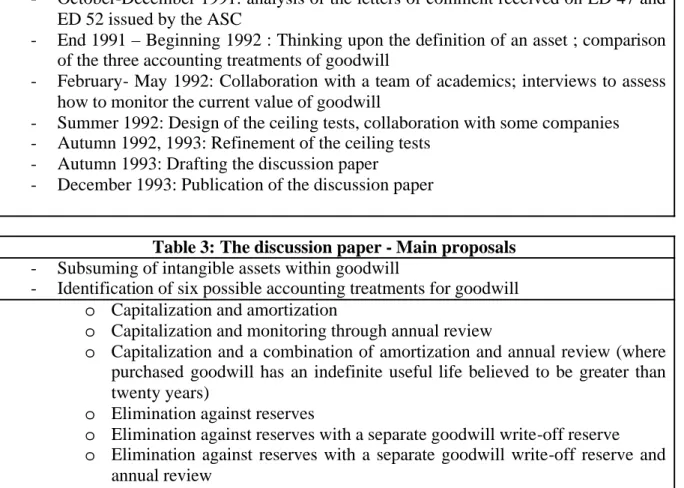
Table 2: The emergence of the impairment solution : from the ASC’s exposure drafts to the ASB’s discussion paper
- October-December 1991: analysis of the letters of comment received on ED 47 and ED 52 issued by the ASC
- End 1991 – Beginning 1992 : Thinking upon the definition of an asset ; comparison of the three accounting treatments of goodwill
- February- May 1992: Collaboration with a team of academics; interviews to assess how to monitor the current value of goodwill
- Summer 1992: Design of the ceiling tests, collaboration with some companies - Autumn 1992, 1993: Refinement of the ceiling tests
- Autumn 1993: Drafting the discussion paper
- December 1993: Publication of the discussion paper
Table 3: The discussion paper - Main proposals - Subsuming of intangible assets within goodwill
- Identification of six possible accounting treatments for goodwill o Capitalization and amortization
o Capitalization and monitoring through annual review
o Capitalization and a combination of amortization and annual review (where purchased goodwill has an indefinite useful life believed to be greater than twenty years)
o Elimination against reserves
o Elimination against reserves with a separate goodwill write-off reserve
o Elimination against reserves with a separate goodwill write-off reserve and annual review
Concluding comments on stage 1
It appears from the first two years dedicated to the development of the goodwill project within the ASB that the approach of capitalizing goodwill and following its value through an annual review have been considered very early in the process as a possible alternative. And the reason seems to be the opposition of industry to an approach based on a systematic depreciation of goodwill.
“Accounting for goodwill, particularly what came out of the responses to ED 47, can evoke a
very emotional response. People can get extremely upset. We could have a complete revoke from industry just refusing to comply, which could result in the blowing up of the ASB. We can’t allow that to happen so we are consulting to see whether industry thinks this approach is feasible (…) and comes up with a sensible answer. And we are focusing mainly on industry consultants rather than analysts and auditors because they are the ones that make the most noise on the goodwill issue and seem to feel most strongly about it.”
This might explain the unusual membership of the consultancy group, with industry representatives exclusively.
During this first phase, the project director and the Board began “exploring” this solution. A lot of time and energy has been spent on its operationalization, looking for a procedure allowing a regular control of the current value of goodwill. And that is how the “ceiling tests” emerged. Interestingly, even within the Board, support was not totally granted.
This appears through the content of discussion paper with two favoured treatments: a) elimination against reserves with a separate goodwill write-off reserves and b) capitalization with a hybrid follow-up of the value of goodwill: amortization when the useful life is definite and annual review when it is indefinite. It is worth noting that considerable time was spent on what is only an option of one of the preferred solutions.
2.2 From the discussion paper to the public hearings (1994-1995): The consolidation of the impairment solution
The first task was obviously the analysis of the responses to the discussion paper. Three main trends may be identified:
- A strong opposition, especially from industry, to incorporating intangible assets into goodwill.
- None of the treatments relating to the initial accounting for goodwill gave rise to massive support. According to the project director, one third of respondents favoured elimination against reserves on a distinct line; one quarter favoured capitalization and systematic depreciation; one quarter supported capitalization and annual review. - Many comments relating to the ceiling tests: “The comments on the ceiling tests came
from all the place. Some people were saying they are too complicated, some were saying they are too subjective, some were saying they were too mechanical. And I think there was a lot of fear underlying all that”.
From the responses to the discussion paper, “It was clear that we had to do something about
the intangible assets or we would have another big fight.” “And the ceiling tests were not going to fly as they were whether because either we had explained them into a complicated
fashion or they were generally too complicated.” From here on, the project director spent a
lot of time trying to adjust the proposals along these two directions. The project director worked very closely with the group of consultants. Three collective meetings were held. In addition to that, the project director went around visiting each consultant individually. The purpose was to submit the proposals to them in order to assess their acceptability and their feasibility. The project director worked on the identification of intangible assets as well as on simplifying the ceiling tests, both the procedure and the explanations.
This brainstorming and consulting work enabled the project director to formulate new proposals:
- Separate identification of intangible assets under specific conditions
- Design of another procedure for monitoring the value of goodwill called “impairment tests”. These tests are not dissimilar in substance to the former ceiling tests and are also based on discounted cash flows “We have relaxed them slightly and I hope we
will explain them more succinctly in the hope that they will be accepted...” It is worth
mentioning that the phrase “impairment test” replaced “ceiling test”. It is also worth noticing that the project director used the FASB’s proposals on impairment of long-lived assets12.
The project director kept on working on the refinement of the proposals at the beginning of year 1995. During the first semester 1995, the project was submitted several times to the Board. This resulted in several modifications.
“I felt I have improved the paper quite a lot. We had changed the paper. The idea was the
same but how it was explained was different really”.
“I got so far with the consultants and then when I presented the paper to the Board. It has
actually changed a lot in terms of lessening the amount of work that would be involved”.
An arrangement was introduced for those who want to keep a simple accounting. A simpler impairment test is to be conducted if intangible assets and goodwill are depreciated over a period not exceeding 20 years.
The project director spent some time redrafting the proposals in order to make the text shorter and clearer “The consultants have said ‘can you make the explanations clearer and make it
shorter so that it’s easy to understand’. They said actually it isn’t difficult but it can sound difficult”.
Because the non amortization of capitalized goodwill may contravene the Companies Act and the European Fourth Directive, the ASB asked for a legal opinion which confirmed the necessity of requiring the true and fair override13. The ASB also organized the field-testing of the proposals. The seven companies constituting the group of consultants accepted to apply the proposals. The results of the field-testing were considered as critical. If companies “come
back saying ‘yes, we did it, it was not difficult and it gave sensible results’, then I think the Board will be persuaded. If they come back saying ‘it was crazy, we spent out hours and
12
The due-process that surrounded the publication of SFAS 121 “Accounting for the Impairment of Long-Lived Assets and for Long-Lived Assets to Be Disposed Of” was examined in the first part of the paper. At the time, the FASB was proposing impairment tests for long-lived assets, including goodwill, as a complementary procedure to amortization whereas the ASB was working on the idea of non systematic amortization.
13
In the United Kingdom, the true and fair view prevails over other legal rules. Its application may lead, in the case of incompatibility, to depart from the law.
couldn’t get anywhere’, obviously the Board won’t go ahead with it”. Six companies out of
seven were supportive. “Most of them have sent a written-up package of what they have done.
I ran through that package with them, almost as though I was an auditor auditing what they’ve done.”
The ASB was considering holding public hearings on this project. Before going that far, the ASB wanted to have a flavor of the reactions of constituents, apart from that of the seven companies constituting the group of consultants. A meeting was organized with about thirty invited people, representing industry, large accountancy firms and analysts.
“By and large, as we took each vote, there was general agreement for each stage”
“On a topic like this, it’s always going to be trying to strike the best middle road (...) that’s probably as close as we can get.”
“I felt and the other Board members felt that there was a slight disappointment that it hasn’t been more of an emotional screaming and that people seemed fairly reasonably happy with it and didn’t seem to feel all that strongly anyway.”
“It really gave us confidence that it will all go ahead and it wouldn’t be a total flop”.
This meeting confirmed the general support for the proposals. The ASB felt it could pursue working in this direction. The next step was the organisation of public hearings on the subject. A working paper “Goodwill and intangible assets” was issued in June 1995. This document was to serve as a basis to the public hearings, the first in the history of the ASB. The public hearings were held in September 1995.
Table 4: The consolidation of the impairment solution: from the discussion paper to the public hearings (1994-1995) :
- May 1994 : Analysis of the letters of comment received on the discussion paper
- Summer and autumn 1994 : Adjustment of the proposals with the contribution of the consultants: some new proposals
- First semester 1995: Refinement of the proposals: legal advice, field-testing, discussion at several Board meetings, drafting the document
- May 1995: A meeting with a larger group of constituents
- June 1995: Publication of the working paper “Goodwill and intangible assets” - September 1995: Public hearings
Table 5: The working paper – Main proposals
- Separate recognition of intangible assets provided their fair value can be measured reliably
- Capitalization of goodwill and other intangible assets - Goodwill and intangible assets
o having a finite life: should be depreciated over that life
o believed to have indefinitely long lives: should not be depreciated
o should be reviewed for impairment at each year-end (a simpler impairment test is to be applied if the useful life of the asset is estimated to be inferior to 20 years)
- A rebuttable presumption that goodwill has a finite life that does not exceed twenty years
Concluding comments on stage 2
The proposals have been refined. As during the first phase, considerable time was spent on the operationalization of the approach, i.e. the design of reliable tests meant to monitor the current value of goodwill. As can be noted from the proposals contained in the working paper, this is only one option (when a company rebuts the presumption of goodwill having a finite life inferior to twenty years).
Throughout this stage, the concern of the Board was to come to an acceptable solution for industry. For instance, the reversal of the Board’s attitude towards the separate identification of intangible assets, “I looked very hard at how we could pull out intangible assets, almost
bending over backwards to trying to please the companies, because that is where the problem is with goodwill accounting but at the same time, not wanting them to get away with being able to show intangible assets on the balance sheet that have no value and that were not likely to maintain their value.” The same applies to the impairment tests. The Board was
trying to find a balanced position between reliability and feasibility.
It is interesting to note the position of Board members, far from being a fixed one. “I think
the Board was a little bit worried about putting our project out (...) But surprisingly, they did all agree to it going out and they think that it is the right idea and that we have got the project as far as we can get it and they think that if we are going to adopt an impairment approach, this is the best we can do”.
Many previous quotations mirror the fact that no definitive decision has been made. The choice is a tentative one. And the Board seemed to have been very keen on checking, stage by stage, from small consultants groups to wider ones, that the proposals were supported. During this phase, a meeting at the international level with representatives of several national standard-setting bodies was held (in March 1995). The project director presented the proposals on goodwill. The reactions of other standard-setters are worth pointing out. “I felt it
wasn’t very well received. Other countries were slightly suspicious that the impairment tests are not going to be very reliable. (...) Australia and America were very anti it. They think that David Tweedie has got the wrong approach entirely and basically think: if you buy something, then you allocate the cost of what you’ve bought to the profit and loss account over future accounting periods, and to do an impairment test is just totally wrong and conceptually wrong”. At this time, the ASB was still the only one to propose a non
systematic depreciation approach for goodwill accounting. But at the same time, the ASB followed the work conducted by the FASB on impairment of long-lived assets.
Responses to the working paper were, as a whole, positive and allowed, from the Board point of view, to confirm the general orientations defined in the working paper. The Board agreed on developing the exposure draft along the same lines.
2.3 Analysis
Three main features may be emphasized from this study:
• The impairment solution seemed to have appeared quite early in the process as a relevant treatment.
• Significant time was spent on its operationalisation and the building of what became known after as the impairment tests.
• The “innovation” relying on the non-amortization of goodwill is limited since it is only an option within a hybrid solution
2.3.1 An “innovation” that emerged early in the process
The impairment solution seemed to have appeared quite early in the process as a relevant treatment. Despite the scepticism of some Board members and although the ASB was quite isolated in this position on the international level, the Board agreed to explore this solution in depth.
How did the impairment solution come to be proposed as a possible solution? One main reason emerges from our analysis. The will to accommodate industry seems to have led the ASB to be innovative, departing from the current solutions provided in the existing regulations (see also Kwok and Sharp, 2005). Neither the elimination of goodwill against reserves could be retained because it has been a source of abuse, nor capitalization of goodwill with systematic depreciation because of industry’s strong opposition. Goodwill being a “political hot potato”, one of the worries of the standard-setter was to avoid opposition from industry. Significant time was spent interacting with companies, trying to take into account their needs and expectations as well as trying to have them accept the recommended treatment. This might explain some specific stages of the process. For instance, a heavy field-testing of the proposals by a small group of companies was conducted and for the first time in its history the ASB carried out public hearings.
One may also suspect the influence of some personalities, for instance the chairman, in initiating this solution.
2.3.2 Conceptual “innovation” versus practical implementation
Another notable feature of the process is the significant time spent on the operationalisation and the building of what became known after as the impairment tests. In a way, the success of the capitalization and impairment approach as a valid solution seemed to have been dependent on the construction of robust tests. In other words, the problem was not dependant on the conceptual issue but on the practical side of it. The success of this conceptual “innovation” rested on the possibility of its successful implementation into practice. The same conclusions have been reached by Tollington (2006).
Success has never been taken for granted. Among other conclusions, it appears that the process of setting the standard on goodwill appears to be far from a linear and rational process in which it is possible to isolate the moment of decision-making. Phases do not succeed each other in a well-ordered fashion but may overlap and involve taking a step back (Alter, 2001). It is an iterative process relying on feedback and on interaction between several
actors, between the project director and the Board as well as between the ASB and the outside through formal but also informal consultation. In fact, the idea has been initiated by some actors within the ASB but the development of the standard required a persuasion process towards board members as well as towards the outside (Akrich and al., 1988). Therefore, the proposals were constantly tentative. At any moment, the project director seemed sure of what the outcome would be.
”I think we are coming to a very interesting period because in the next six months, there are
various possibilities. One is the whole thing will never come to the light of day anyway because the Board might throw it (...). I don't think they will actually but a subsequent meeting of a bigger group of consultants could say it is still too complicated. Alternatively, it could go ahead to public hearings and it could be adopted and it will make quite a big change to accounting for goodwill in this country. If it is accepted at the public hearings, then we are going to move on to an exposure draft very quickly and we would be looking at the standard not that long off, maybe the next year probably. It could go to the public hearings and still reach an impasse. We can still come back to capitalising and writing down for some fixed period maybe 20 years. But I feel that we are getting to the conclusion of the project in terms of which way we are going to go, there is not much more research. I feel I have researched, researched ...”
2.3.3 An “innovation” limited in its application
As mentioned earlier, the ASB did not adopt a pure solution – which the FASB did a few years later - but a hybrid one, combining amortization where the useful life of goodwill is finite and impairment where it is indefinite. Besides, this required rebutting the presumption of a finite life for goodwill not exceeding twenty years and invoking the true and fair override. Going against the “mainstream” is not always obvious and several studies have pointed out discrepancies with the international position to explain the ASB’s relatively timorous choice (Richard et al, 2005). As for the development of public policies, “incrementalism”, i.e. the introduction of marginal rather than radical changes, is a safe way for policy-makers to move on (Gerboth, 1972). As Rogers (1995) points out, “getting a new idea adopted, even when it has obvious advantages, is often very difficult. Many innovations require a lengthy period, often of many years, from the time they become available to the time they are widely adopted.” (p. 1)
CONCLUSION
Considering the significant role played by the British ASB in the development of regulations enabling the capitalization and impairment of goodwil without systematic amortization (i.e. the “impairment solution”), the purpose of this paper is to understand how and why the ASB came to favour this solution. One of the contributions of this paper relies in the insight it provides on the development of a standard, differentiating from earlier studies that base their conclusions on the analysis of comment letters without giving an internal view of the process.
The development of the impairment solution by the ASB has been described as an “innovation” since it introduces a new way of accounting for goodwill. The concept of not amortizing goodwill systematically is not new in itself as showed by Richard et al (2005) who refer to this solution as the “actuarial approach”. It is its introduction in a national regulation leading to wreck a quasi general consensus that we consider as new and term “innovation”. The analogy between the development of a standard and the development of an innovation has been established (Hussein, 1977; Jönsson, 1988) since adopting a new regulation is in a way introducing an “innovation”. The literature related to the development of an innovation may contribute to understand the development of the impairment solution within the ASB.
The parallel between an innovation and a standard leads to pointing out new avenues for future research. Many theories have been developed to explain the diffusion of an innovation (Meyer and Rowan, 1977; Rogers, 1995). These theories may be transposed to the standard-setting field in order to understand how the “impairment solution” gained the American and the international regulations.
BIBLIOGRAPHY
Accounting Principles Board (1970), APB Opinion n°16 “Business Combinations”. Accounting Principles Board (1970), APB Opinion n°17 “Intangible assets”.
Accounting Standards Board (1993), Discussion paper “Goodwill and Intangible assets”.
Accounting Standards Board (1995), Working paper for discussion at public hearing “Goodwill and Intangible assets”.
Accounting Standards Board (1996), Financial Reporting Exposure Draft 12 “Goodwill and Intangible assets”. Accounting Standards Board (1997), Financial Reporting Standard n°10 “Goodwill and Intangible assets”, December.
Accounting Standards Board (1998), Financial Reporting Standard n°11 “Impairment of fixed assets and goodwill”, July.
Akrich M., Callon M. and Latour B. (1988), « A quoi tient le succès des innovations ? Premier épisode : L’art de l’intéressement », Gérer et Comprendre, june, p. 5-17.
Akrich M., Callon M. and Latour B. (1988), « A quoi tient le succès des innovations ? Deuxième épisode : L’art de choisir les bons porte-parole », Gérer et Comprendre, september, p. 15-29.
Alter N. (2001), L’innovation ordinaire, 2ndEdition, Edition Presses Universitaires de France.
Can••ibano L., Garcia-Ayuso M. and Sanchez P. (2000), “Accounting for Intangibles: A Literature Review”,
Journal of Accounting Literature, vol. 19, p. 102-130.
Chee Chiu Kwok W. and Sharp D. (2005), “Power and international accounting standard setting: Evidence from segment reporting and intangible assets projects”, Accounting, Auditing & Accountability Journal, vol. 18, n° 1, p. 74-99.
Churyk N. T. (2005), “Reporting goodwill: are the new accounting standards consistent with market valuations? », Journal of Business Research, vol. 58, p. 1353-1361.
Davis M. (2005), “Goodwill Impairment: Improvement or Boondoggle?”, The Journal of American Academy of
DiMaggio P. J. and Powell W. W (1991), “The Iron Cage Revisited: Institutional Isomorphism and Collective Rationality in Organizational Fields” in The New Institutionalism in Organizational Analysis Edited by Powell W. W and DiMaggio P. J, The University of Chicago Press.
Dumont J. L. and Paret E. (1996), « Comment traiter les immobilisations incorporelles et les écarts d'acquisition? », Revue de droit comptable, September, n° 96-3, p. 139-162.
Eckstein C. (2004), “The measurement and recognition of intangible assets: then and now”, Accounting Forum, vol. 28, p. 139-158.
Financial Accounting Standards Board (1995), Statement of Financial Accounting Standards n° 121 “Accounting for the Impairment of Long-Lived Assets and for Long-Lived Assets to Be Disposed Of”, March. Financial Accounting Standards Board (2001), Statement of Financial Accounting Standards n° 141 “Business Combinations”, June.
Financial Accounting Standards Board (2001), Statement of Financial Accounting Standards n° 142 “Goodwill and Other Intangible Assets”, June.
Gerboth D.L. (1972), « ‘Muddling through’ with the APB », Journal of Accountancy, may, pp. 42-49.
Grinyer J. R. and Russel A. (1992), “National Impediments to International Harmonization: Evidence of Lobbying in the U.K.”, Journal of International Accounting, Auditing & Taxation, vol. 1, No. 1, p. 13-31. Grinyer J. R., Russel A. and Walker M. (1990), “The Rationale for Accounting for Goodwill”, British
Accounting Review, vol. 22, p. 223-235.
Hartwig F. (2006), “Positions and supportive arguments regarding the proposed prohibition of goodwill amortization in ED 3 "Business Combinations"”, 29thEAA annual Congress, Dublin.
Hennings S., Lewis B. L. and Shaw W. H. (2000), “Valuation of the components of purchased goodwill”,
Journal of Accounting Research, autumn, vol. 38, n°2, p. 375-386.
Hirschey M. and Richardson V. J. (2003), “Investor underreaction to goodwill write-offs”, Financial Analysts
Journal, November-December, vol. 59, n° 6, p. 75-84.
Hirschey M. and Richardson V. M. (2002), “Information content of accounting goodwill numbers”, Journal of
Accounting and Public Policy, vol. 21, p. 173-191.
Hussein M. E. (1977), A socio-political framework of the process of adopting generally accepted financial
accounting standards, Phd, University of Pittsburgh.
International Accounting Standards Board (2002), Exposure Draft ED 3 ““Business Combinations”, London International Accounting Standards Board (2004), International Financial Reporting Standard IFRS 3 ““Business Combinations”, London.
International Accounting Standards Committee (1993), International Accounting Standard n° 22 “Business Combinations”, London.
International Accounting Standards Committee (1998), International Accounting Standard n° 22 “Business Combinations”, London.
International Accounting Standards Committee (1998), International Accounting Standard n° 38 “Intangible Assets”, London.
Jennings R., LeClere M. and Thompson II R. B. (2001), “Goodwill amortization and the usefulness of earnings”, Financial Analysts Journal, vol. 57, No. 5, p 20-28.
Jennings R., Robinson J., Thompson II R. B. and Duvall L. (1996), “The relation between accounting goodwill numbers and equity values”, Journal of business, finance and accounting, vol. 23, No. 4, June, p. 513-533. Johnson T. L. and Petrone K. R. (2000), «Why did the board change its mind on goodwill amortization? », Status Report (FASB), vol. 331, December, p. 8-10.
Jönsson S. (1988), Accounting regulation and elite structures (driving forces in the development of accounting
policy), John Wiley & Sons.
Kwok W.C.C., Sharp D. (2005), “Power and international accounting standard-setting – Evidence from segment reporting and intangible assets projects”, Accounting, Auditing and Accountability Journal, 18, 1, 74-99.
Meyer J. W. and Rowan B. (1977), “Institutionalized organizations: formal structure as myth and ceremony”,
American Journal of Sociology, vol. 83, p. 340-363.
Moehrle S. R., Reynolds-Moehrle J. A. and Wallace J. S. (2001), “How informative are earnings numbers that exclude goodwill amortization?”, Accounting horizons, September, vol. 15, No. 3, p. 243-255.
Peasnell K. V (1996), “A UK perspective on accounting for goodwill and other intangibles”, Issues in
Accounting Education, vol. 11, No. 2, autumn, p. 487-489.
Powell S. (2003), “Accounting for intangible assets: current requirements, key players and future directions”,
European Accounting Review, vol. 12, n° 4, p. 797-811.
Richard J., Stolowy H. and Ding Y. (2005), “Accounting regulation and social actors: an international study on goodwill”, 28thEAA annual Congress, Göteborg, Sweden.
Rogers E. M. (1995), Diffusion of Innovations, 4thEdition, The Free Press.
Singleton-Green B. (1990), “The rise and fall of the ASC”, Accountancy, August, p. 84-85.
Stolowy H. and Jeny-Cazavan A. (2001), “International accounting disharmony: the case of intangibles”,
Accounting, auditing and accountability journal, vol. 14, No. 4, p. 477-496.
Tollington T. (2006), “UK goodwill and intangible asset structuration: The FRS 10 rule creation cycle »,
Critical Perspectives on Accounting, vol. 17, n°6, September, p. 799-826.
Tweedie D. (1993), “The accounting profession and financial reporting: why should anyone believe us?” in
Research in Accounting Regulation, under the direction of Previts G.J., JAI Press, vol. 7, p. 161-182.
Zeff S. A (2002), “"Political" lobbying on proposed standards: A challenge to the IASB”, Accounting Horizons, March, vol. 16, No. 1, p. 43-54.